Connect with us

NewsBeat

Manchester United co-owner Sir Jim Ratcliffe says he has ‘no confidence in the UK’ and country is ‘on the slide’

Published

on

Manchester Evening News

‘The risk you’ve got this winter is that we run out of gas’

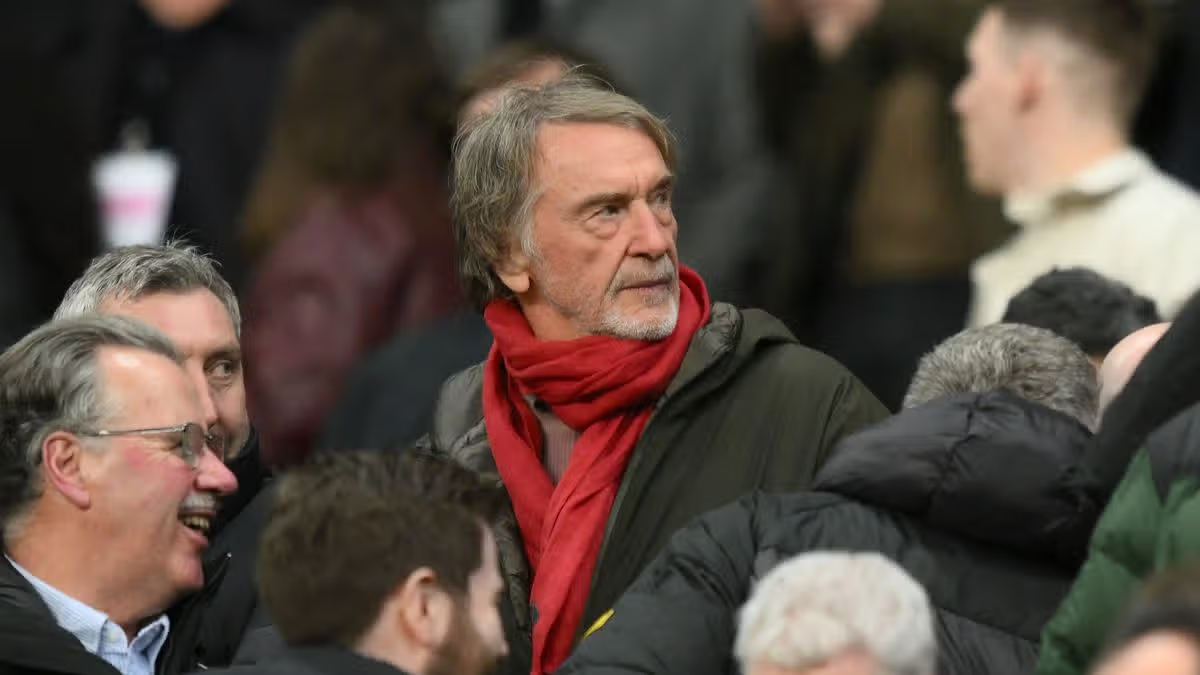
The co-owner of Manchester United FC, Sir Jim Ratcliffe, has said he has ‘no confidence in the UK’ and that the country is ‘on the slide’

Advertisement

One of Britain’s wealthiest businessmen, Sir Jim said Britain was in decline because of high taxes and immigration.

The founder of chemicals giant Ineos, who moved to Monaco from the UK in 2020, told the BBC’s Big Boss Interview: “I think the UK, unfortunately, it was a fantastic place. We had the greatest empire in the world. We were a great people. We won two world wars. We’re good, honest folk.

Click here to get the biggest stories straight to your inbox in our Daily Newsletter

“But unfortunately, at the moment, I think the UK is on the slide. It’s quite difficult to see how we arrest it. Two things: we need politicians who are tough enough to deal with some very difficult problems, and we know what the problems are.

Advertisement

“And we need politicians who will make decisions which are good for the country, not good for themselves and their party. And we haven’t had one of those for a long time.” Asked what issues politicians should focus on, Sir Jim said immigration was ‘clearly one’, as well as high taxes.

Earlier this year, Sir Jim told Sky News the UK had been ‘colonised by immigrants’ before he said he was sorry if those remarks had ‘offended some people’.

The billionaire also said failing to invest further in North Sea resources by handing licences for the Jackdaw and Rosebank oil and gas fields amounted to “insanity”, and warned the UK’s reliance on energy imports meant the country could “run out of gas” if there was a cold spell this winter.

He said: “The risk you’ve got this winter is that we run out of gas. If we have a really sharp cold spell, then there is conceivably the possibility that we’ll run out of gas and have to switch the industry off.”

It comes after Andy Burnham insisted he was “determined” to reach net zero by 2050. The Prime Minister faces pressure from both sides over looming decisions on whether to approve the controversial Jackdaw and Rosebank fields.

Climate campaigners have urged him to block the proposed new developments in the North Sea while the oil and gas industry and opposition politicians have argued they would create thousands of jobs and cut bills. Permission for one or both would throw his commitment to net zero into question.

Sir Jim also said the UK had “a bit of a green eye towards wealth at the moment”, “encouraging” the wealthiest to relocate.

Advertisement

He told the podcast: “In America they applaud people who create wealth. And the good thing about those people who create wealth is that they then spend that wealth in the economy in which they’re resident. Unfortunately, the UK has got a bit of a green eye towards wealth at the moment.

“And, unfortunately, with the things that they’ve been doing, they’ve been encouraging the people who have created wealth to leave the UK because it’s just become uncomfortable for them for tax reasons or whatever. Also, crime on the streets has gone up as well, which doesn’t help.”

Asked if he was planning on returning to the UK, the businessman said: “Not at the moment, no. I don’t see growth being tackled. “I would like to see the benefits bill cut in half and all the savings spent on robotics and AI.”

Asked whether AI would have an impact on the job market and leave many jobless, Sir Jim said: “No, no. I mean, you think about the two biggest industries that are going to change our lives, at the moment, is AI and robotics. “I mean, it’s going to have fundamental changes to the way in which we live, the way in which we work, and the UK is nowhere at the moment in those two technologies.”

Advertisement

Source link

Continue Reading
Click to comment

You must be logged in to post a comment Login

Leave a Reply

NewsBeat

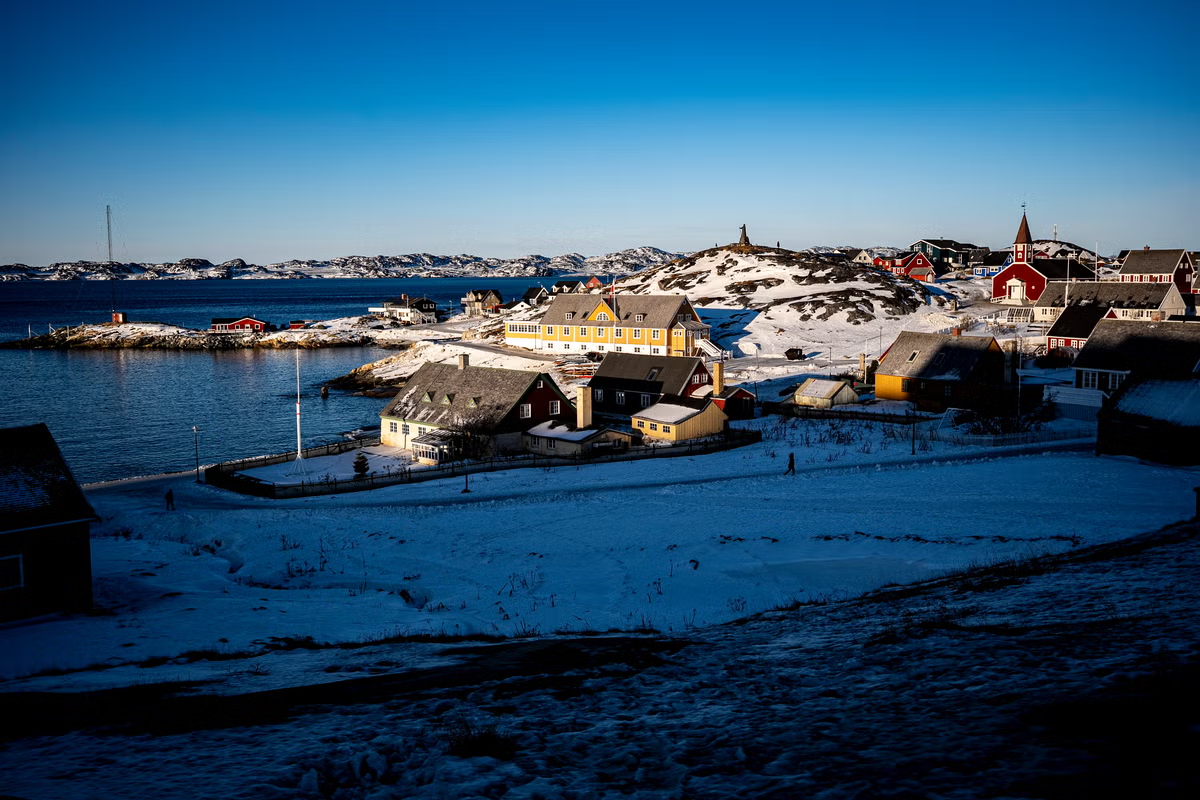
Danish leaders cautiously optimistic about Trump’s Greenland deal after months of talks

Published

on

Danish leaders cautiously optimistic about Trump’s Greenland deal after months of talks

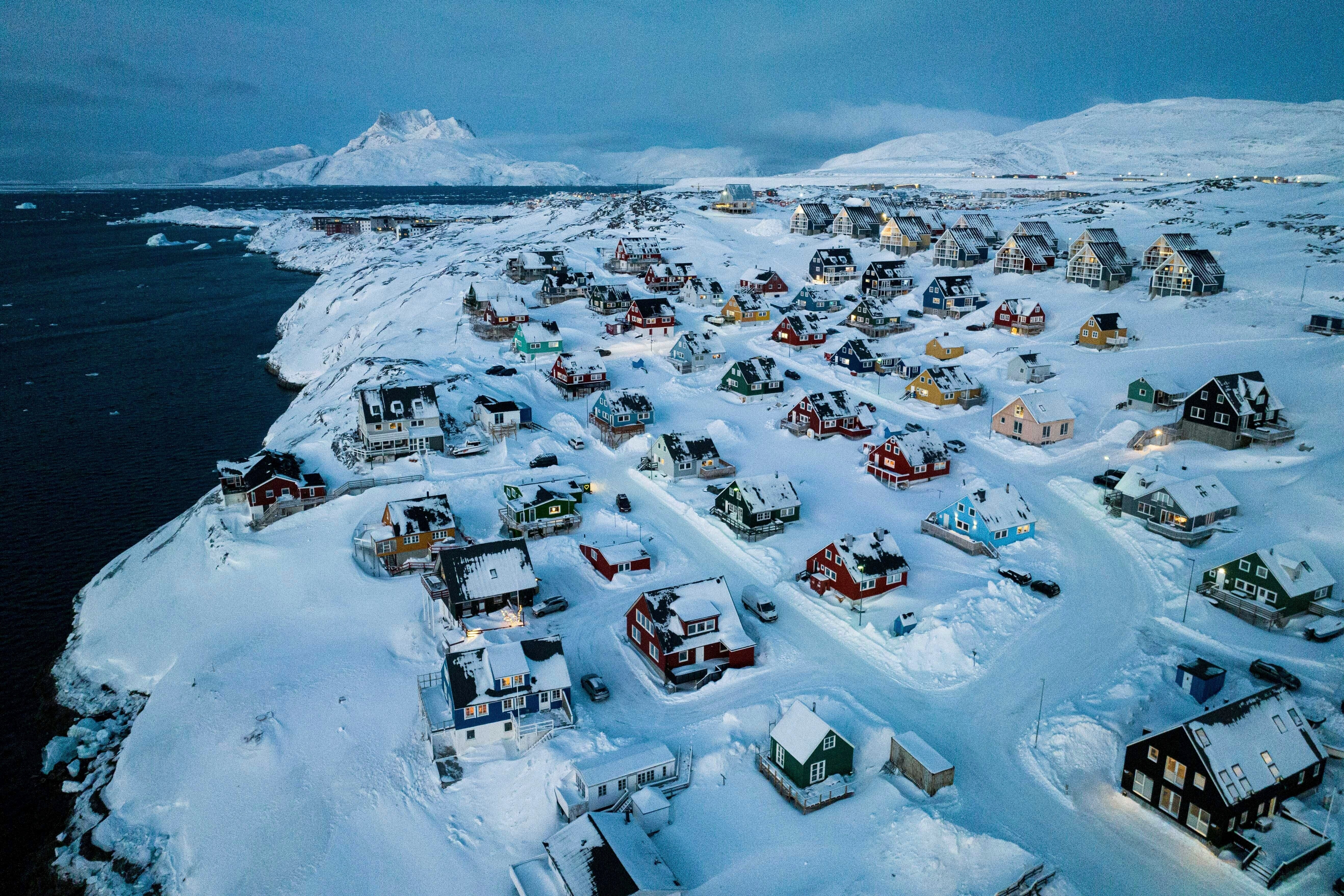
The Danish government expressed guarded optimism on Saturday following Donald Trump’s announcement of a deal regarding Greenland, which aims to boost the US military footprint while maintaining Danish authority over the island.

The agreement comes after months of threats from the U.S. president to take over the semiautonomous territory of a fellow NATO member.

A similar stance was taken by Greenland’s top diplomat, who noted that the arrangement had been a long time coming.

On Friday, Trump declared that the accord would provide the United States with “permanent control over security, and all other needs, in Greenland, completely addressing ALL of our many U.S. concerns.”

Advertisement

The office of Denmark’s prime minister, Mette Frederiksen, confirmed that representatives from all three governments will sign the agreement next week at the United Nations General Assembly.

Ratification by the Danish and Greenland parliaments remains necessary before the deal can take effect.

Danish Foreign Minister Lars Løkke Rasmussen wrote on Instagram on Saturday morning: “Next week could be a good week … for Greenland, Denmark, and the United States alike.”

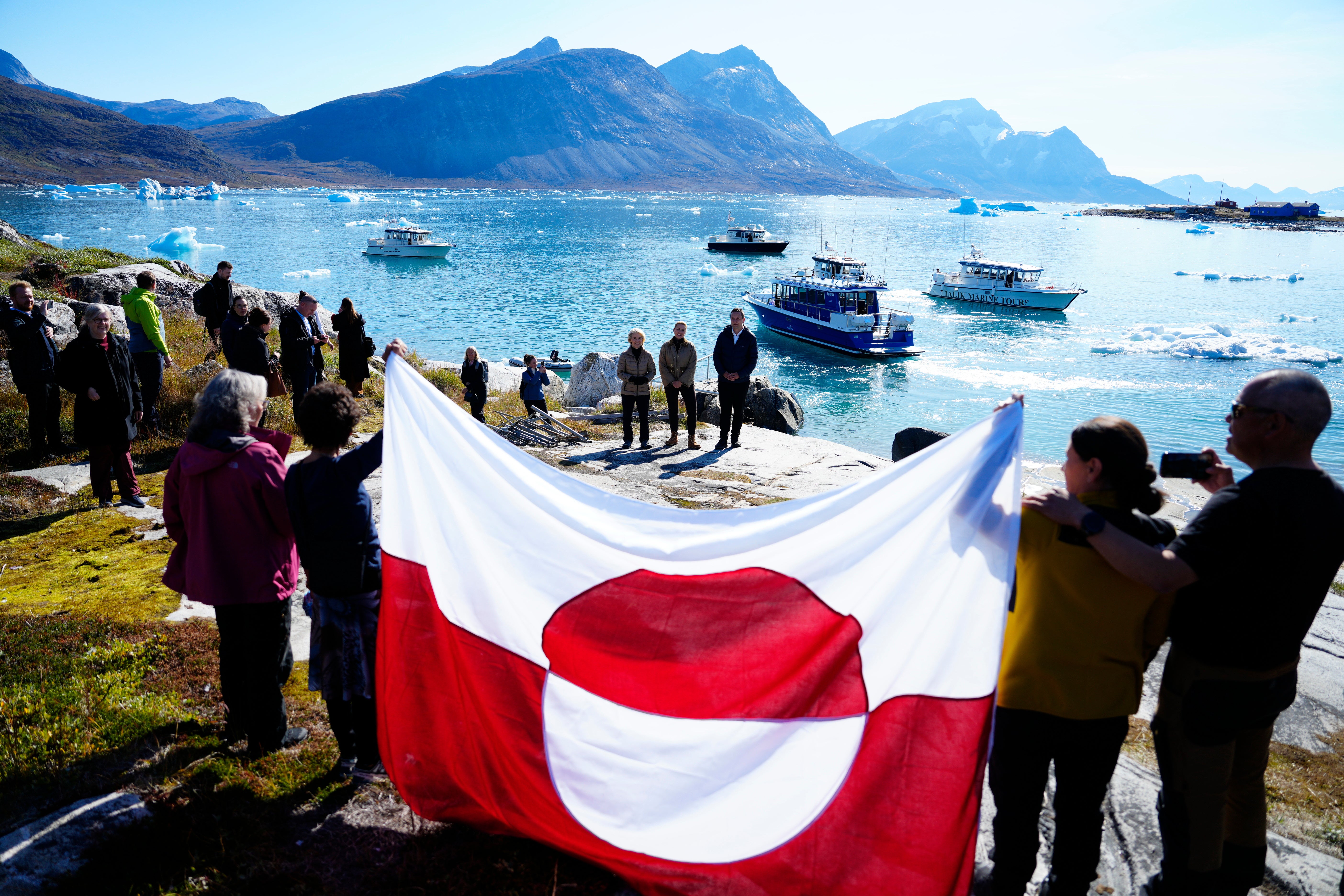
In Greenland, the Arctic island's top diplomat echoed that stance and said the deal had been long in coming
In Greenland, the Arctic island’s top diplomat echoed that stance and said the deal had been long in coming (Associated Press)

He added: “A period of uncertainty will hopefully be replaced by a binding agreement that strengthens security in the Arctic and the North Atlantic — and thus also our shared security within NATO and Europe — while respecting the Kingdom’s red lines,”

The foreign minister of Greenland, Múte B. Egede, said he was pleased that “we now have an agreement within reach.”

Advertisement

“It has taken some time,” he told Denmark’s TV2 broadcaster. “I’m pleased that we finally have an end product within reach. And it’s about time.”

Trump said that with the agreement, the U.S. would “immediately” begin the process of developing a larger military presence on the mineral-rich Danish territory.

The U.S. had long held several bases and installations on the Arctic territory through the Cold War, before dialing back its presence.

It still operates the remote Pituffik Space Base in northwestern Greenland, built after the U.S. and Denmark signed the Defense of Greenland Treaty in 1951. It supports missile warning, missile defense and space surveillance operations for the U.S. and NATO.

Advertisement

Few details about the deal are known so far

A U.S. State Department official said the agreement bans any non-NATO base in Greenland, limits adversaries from being able to make investments in Greenland, and guarantees that China and Russia cannot have a base on the island. The official was not authorized to comment publicly and spoke on condition of anonymity.

U.S., Greenlandic and Danish officials had quietly negotiated for months behind the scenes, searching for solutions to address some of Trump’s security concerns about a territory of roughly 56,000 residents

U.S., Greenlandic and Danish officials had quietly negotiated for months behind the scenes, searching for solutions to address some of Trump’s security concerns about a territory of roughly 56,000 residents.

With the announcement of the pact, Trump is able to tout a foreign policy achievement ahead of the midterm elections in the U.S.

After his return to the White House last year, Trump had called on Denmark to sell the island to the U.S., while insisting Greenland is crucial for U.S. security. He pointedly wouldn’t rule out taking the island by military force, even though Denmark is a NATO ally of the U.S.

Advertisement

Denmark and Greenland repeatedly said the island is not for sale and condemned reports of the U.S. gathering intelligence there. The U.S. push for Greenland was also fiercely opposed by Russia and much of Europe.

Greenland grassroots pro-sovereignty activist Orla Joelsen wrote on X that “our fight against Trump’s ambition to take over Greenland has been won.”

“The new agreement explicitly recognizes the sovereignty and territorial integrity of the Kingdom of Denmark and the Greenlandic people’s right to self-determination,” the activist added.

Source link

Advertisement
Continue Reading

NewsBeat

Illegal migrant Deliveroo rider raped woman he had dragged off the street ‘like a ragdoll’ – then went to hospital ‘to get to her again’

Published

on

Deliveroo rider Salem Rekoub, 28, who had no right to work in the UK, has been jailed for 21 years for raping a woman

Advertisement

An illegal migrant Deliveroo rider who dragged a woman off the street ‘like a ragdoll’ before raping her has been jailed for 21 years.

Following the vicious assault, which left his victim feeling ‘destroyed’, Salem Rekoub, 28, was caught on CCTV wearing his turquoise uniform and smirking as he followed her ambulance to hospital, because he wanted to ‘get to the woman again’.

Rekoub, who was dubbed a public danger by the judge, arrived in Britain on a tourist visa in 2023. He did not have the right to work in the UK. 

Isleworth Crown Court heard that he took advantage of the woman, who is in her 40s, after seeing her ‘semi-conscious’ at a bus stop.

Advertisement

Rekoub then dragged her down a side road in Chelsea, West London, before finding a gap between cars where he attacked her in July 2024. 

During the 17-minute assault, the woman drifted in and out of consciousness while he repeatedly told her: ‘You need to be quiet’.

His victim was left with 33 bruises across her body.

Rekoub then called 999 and told operators a ‘pack of lies’, said prosecutors, as he tried to deceive them over what had happened.

Advertisement

Deliveroo rider Salem Rekoub, 28, who had no right to work in the UK, has been jailed for 21 years for raping a woman

Rekoub was caught on CCTV walking along the corridors of Chelsea and Westminster Hospital in a bid to 'get to the woman again' after being taken there by ambulance following her ordeal

Rekoub was caught on CCTV walking along the corridors of Chelsea and Westminster Hospital in a bid to ‘get to the woman again’ after being taken there by ambulance following her ordeal

He told a paramedic the woman had ‘too much to drink’, before telling police, under an assumed name, that he was simply a concerned passerby.

Advertisement

Rekoub then followed his victim’s ambulance to Chelsea and Westminster Hospital, where cameras recorded him walking through corridors and looking into triage rooms in an attempt to find her. 

When one hospital worker asked him what he was doing, he said: ‘I’m here to find someone.’

As his victim recovered, she was able to tell paramedics what happened and Rekoub was arrested nine days later. 

The court heard the woman, who must remain anonymous for legal reasons, had been left in ‘an almost catatonic state’ since the attack, and has suffered seizures. She has also spent time in a mental health treatment centre.

Advertisement

In a victim impact statement read to the court, she said: ‘This has destroyed my life and I am not the same person.

‘It has killed me and made me feel worthless. I tried to take my own life because I felt like I could not cope.

‘I have been left in a constant state of fear. I couldn’t escape because he told me to be quiet and had his hands around my throat.

‘I have been left completely numb and disassociated. I have begun to have seizures and my speech has become slurred.’

Advertisement

The court heard how the woman had been out with friends and had taken a bus home but got off early because she was feeling unwell. She passed out at the bus stop, where she was then found by Rekoub.

Following a trial by jury, Rekoub was found guilty of three counts of rape, and two counts of assaulting a female by penetration.

His defence told the court he had been a promising footballer who was almost selected for the Algerian team, but a knee injury had cut short his career.

A Deliveroo spokesman said: ‘We are appalled by these truly horrific crimes and our thoughts are with the victims and their families.

Advertisement

‘This individual was not a verified rider on our platform, but a criminal who abused our systems to gain access illegally.

‘We have since significantly strengthened the measures to control who can access our platform – and continue to invest to combat any abuse.’

Advertisement

Source link

Continue Reading

NewsBeat

Oasis 2027: Everything we know about who will support the band on 2027 tour

Published

on

Oasis 2027: Everything we know about who will support the band on 2027 tour

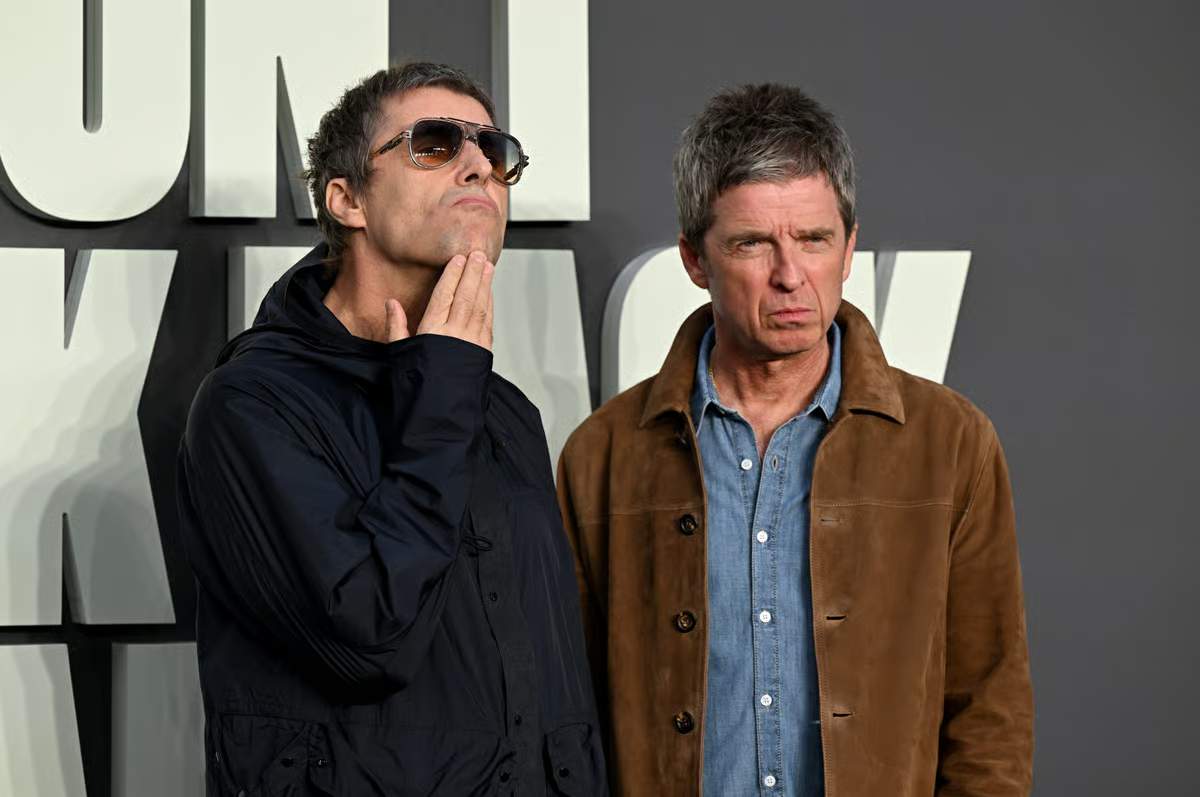
Oasis are hitting the road again in 2027, just two years after their momentous comeback tour.

The UK shows are made up of five dates in Glasgow, 11 dates in Manchester and four at Knebworth, 30 years after they played a historic two nights to 250,000 fans at the Hertfordshire venue in 1996.

Oasis are to return with a 38-date live tour next year

PA

Advertisement

Whilst the dates and venues have been confirmed, after months of speculation, one thing is still (mostly) up in the air – who will be supporting the band?

Here’s what we know so far about which artists will be joining the Gallagher brothers on tour.

The Verve’s Richard Ashcroft is the only officially confirmed support act that will be hitting the road with Noel and Liam next year for all 38 dates.

Source link

Continue Reading

NewsBeat

New restaurant given go-ahead to open on busy city centre street

Published

on

Cambridgeshire Live

The restaurant has won awards for its burgers

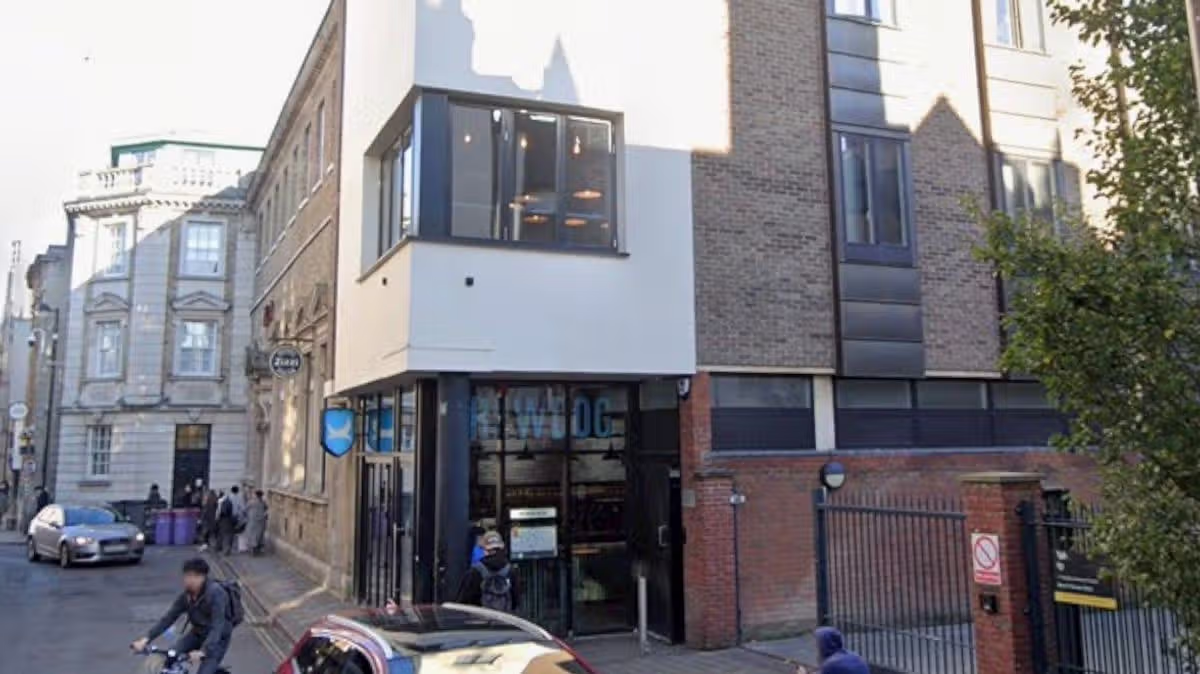
A new restaurant has been given the go-ahead to open on a city centre street. The Beefy Boys Holdings has been told they can change the use of a former bar on Bene’t Street in Cambridge into a new restaurant.

Advertisement

The restaurant chain sought permission from Cambridge City Council in June and it has now been approved. The site, on 15 Bene’t Street, forms part of the Grade II listed Barclay’s Bank. It was last used by Brewdog, but has been vacant since March 2026.

The Beefy Boys opened its first restaurant in Hereford in 2015, before opening a second site in Shrewsbury in 2021 and a third site in Cheltenham in 2023. It also has sites in other locations including Oxford and Nottingham.

Now, Cambridge locals could get a taste of its award-winning burgers. The burger chain has won both Signature Burger and Burger Chef of the Year at The National Burger Awards.

The applicants said the new restaurant will “serve as a meeting place for local people and visitors” and will provide a “suitable alternative facility to the existing use”.

Advertisement

Planning documents state it would provide a “high quality restaurant”, enhance the “vitality and viability of this part of Cambridge City Centre ” and help to “secure the future up keep of the Grade II Listed building”.

The new restaurant would be situated close to a range of existing pubs and restaurants including The Eagle, The Bath House and Pint Shop.

The building’s existing use permits opening hours between 11am and midnight between Sunday and Thursday and between 11am and 12.30am on Fridays and Saturdays. The Beefy Boys Holdings Ltd said these hours are “considered suitable for the proposed use”, but there is considered to be no concerns if earlier hours from 8am were permitted to allow “flexibility for a future use”, they said.

Alongside a change of use request, the applicant sought permission for Listed Building Consent for works to the building including internal changes and new signage.

Advertisement

Source link

Continue Reading

NewsBeat

The Original Meaning Of The Word Quick

Published

on

The Original Meaning Of The Word Quick

“Quick” is a word people say all the time as a synonym for fast. But most probably don’t realise that the word used to mean something very different.

Like “nice” and “awful” (which used to mean “ignorant” and “worthy of awe”, respectively), the word quick has travelled some distance from its original meaning. But it does manage to hold onto a little bit of the old and new at the same time.

“Quick originally meant alive, not fast,” Sophie Vignoles, a linguist and head of learning content at the language learning app Babbel, told HuffPost.

“It comes from the Old English ‘cwic.’ That older meaning survives in the phrase ‘the quick and the dead,’ which means ‘the living and the dead.’”

Advertisement

Indeed, earlier translations of the Bible and the Nicene Creed include “the quick,” and even some versions of the creed used to this day include the line “he shall come again with glory to judge both the quick and the dead.” There are also multiple Westerns with the title “The Quick and the Dead,” drawing from those Christian origins.

Farm animals also used to be called “quickstock” before “livestock” took over.

So how did “quick” evolve from “alive” to “fast”?

“The shift toward speed follows a simple logic,” Vignoles said. “Living things move, and dead things do not, so a word meaning alive naturally came to describe liveliness and motion. By the medieval period, quick was already being used for fast movement, and that became its dominant sense in everyday English.”

Advertisement

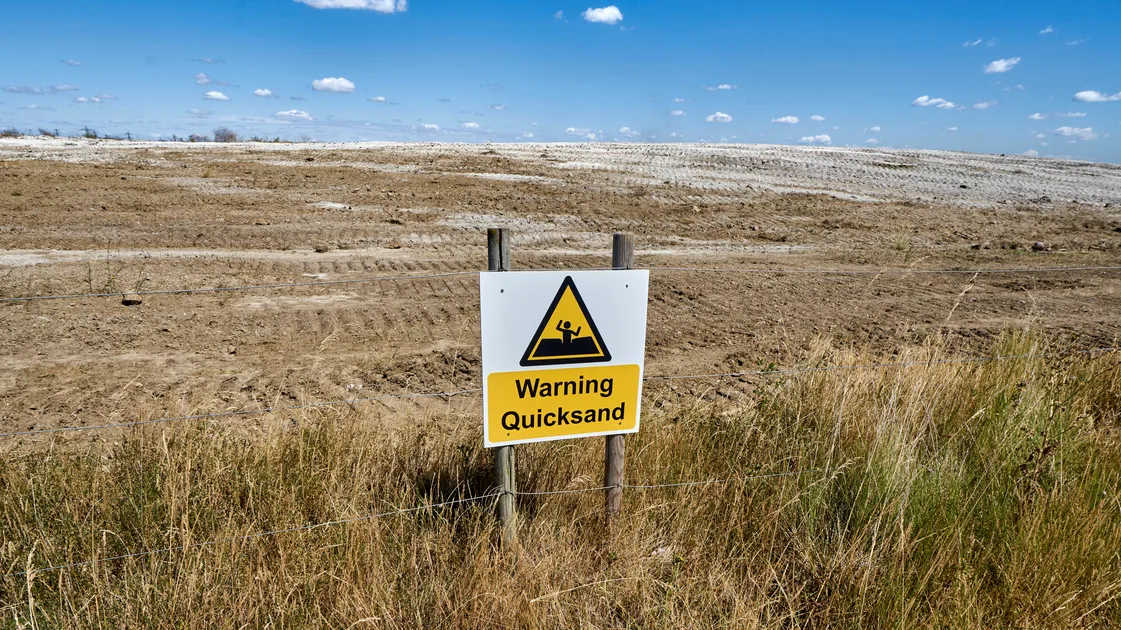
In many ways, it feels like a clean semantic chain from alive to animated to moving to fast. But what makes quick particularly interesting is how many traces of its original meaning are still hiding in plain sight. Take, for example, the words “quicksand” and “quicksilver” and the term “quickening” in pregnancy.

“Quicksand is sand that behaves as if it has a life of its own, shifting and pulling things under,” Vignoles said. “Quicksilver was the old name for mercury, called that because its constant, restless movement made it appear alive. Quickening in pregnancy refers to the first moment a woman feels the baby move, historically understood as the point at which the baby became alive. Each one is a small fossil of the word’s original meaning, preserved inside modern English.”

Matt Mawson via Getty Images

The original meaning of “quick” makes much more sense in the context of the word “quicksand,” since quicksand isn’t actually fast at all.

Those terms preserve the older sense of alive, rather than fast. Quicksand is basically “living sand” – which makes more sense than “fast sand,” given it’s actually a rather slow-moving phenomenon (unlike depictions in movies). And quicksilver is “living silver.” In fact, Pliny the Elder described the substance of mercury as “argentum vivum,” which literally means “living silver” or “quicksilver” in the earlier English translation.

Advertisement

“Cut to the quick” is another surviving phrase linked to that earlier meaning of quick. The phrase refers to the idea of piercing straight to the heart of something or causing someone hurt on a very deep level. In other words, to cut to the quick can mean to cut to the very core of what makes you a living being.

In the context of this phrase, quick can also refer to the sensitive, living flesh beneath your fingernails, which can hurt intensely if you cut your nails deep. In this sense, it might be that you’re cutting into tender skin that’s alive versus a fingernail, which is made up of dead cells.

For Vignoles, the story of “quick” illustrates something broader about how languages carry their histories.

“It shows that old meanings rarely disappear. They survive in fixed phrases long after the main sense of a word has moved on,” she said, pointing to Babbel’s research on the way American English has evolved in honor of the United States’ 250th anniversary this year.

Advertisement

The evolution also points to how deep some of these connections can run, she added.

“The root behind quick is the same one that produced Latin words like vivid and revive, and it is also related to the root behind the Hindi word jeevan, meaning ‘life,’” Vignoles said. “Babbel’s research found Hindi has only entered the American dictionary in the past two decades, through words like yoga and karma, but the deeper connection between English and Hindi at the root level goes back much further than that.”

She believes the word quick is a clear case of a word maintaining its original and modern meaning side by side in everyday language.

“The same root shows up even further afield,” Vignoles said. “Russian zhivoy, meaning alive or lively, comes from the same ancient source, and so does the Greek bios, the root behind words like biology and biography. It is a reminder that a single ancient idea, the idea of being alive, has quietly seeded vocabulary across English, Hindi, Russian and Greek alike, even though most speakers of those languages would never guess the words are related.”

Advertisement

Now perhaps next time you ask someone to be quick with something, you’ll remember that you are invoking a word whose original meaning was a reminder to all that we are alive.

Source link

Advertisement
Continue Reading

NewsBeat

Decades of male-focused medical research could bias healthcare AI

Published

on

Decades of male-focused medical research could bias healthcare AI

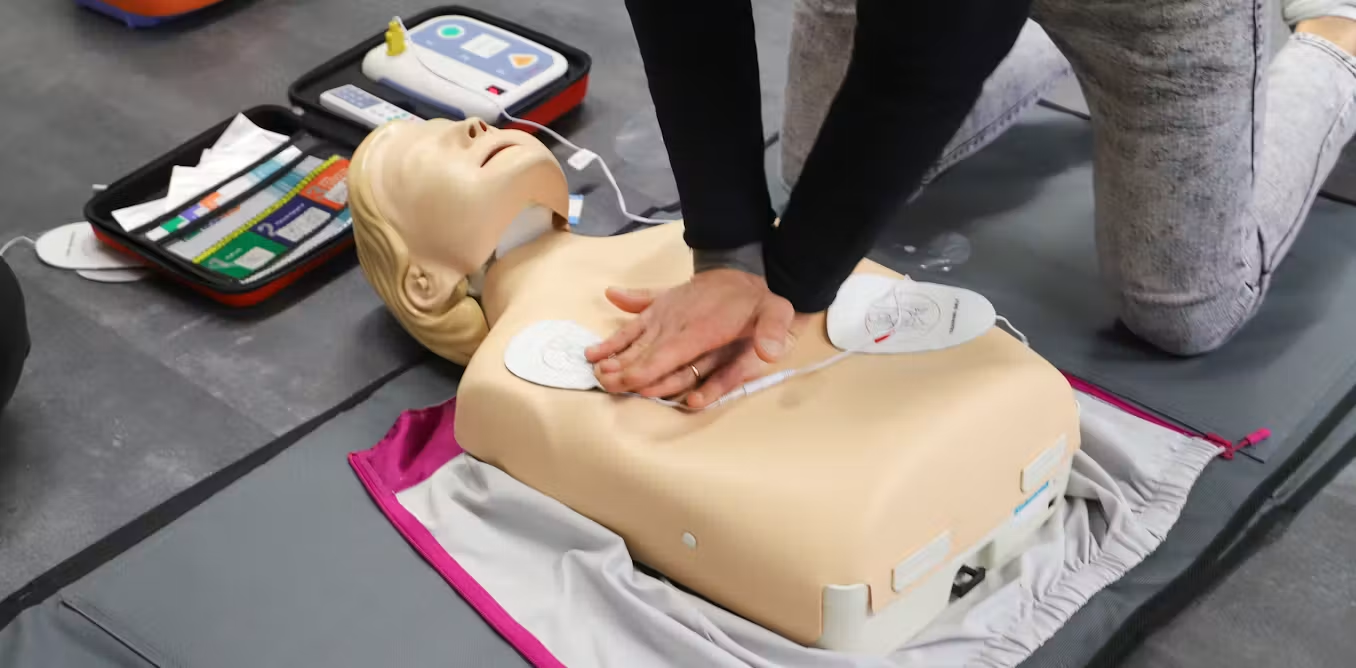
Many people will learn CPR using a flat-chested manikin. A 2024 study of 20 models of CPR manikins sold worldwide found that three quarters were described as male or had no sex specified. Of the 20, only one offered a breast overlay.

The manikins reflect a wider tendency in medical teaching and research to treat the male body as standard. The terms “male and female” and “men and women” in this article reflect the sources, which often fail to distinguish sex from gender or say whether gender-diverse people were included.

The lack of female representation can have consequences. In a US study of 19,331 out-of-hospital cardiac arrests, 39% of women who collapsed in public received bystander CPR, compared with 45% of men.

For CPR, even a short delay can affect survival. Another US study found that people who received bystander CPR four to five minutes after a witnessed cardiac arrest had 27% lower odds of surviving to hospital discharge than those who received it within one minute. In England, fewer than one in 12 patients for whom ambulance services attempted resuscitation survived 30 days, according to figures reported in 2024.

Advertisement

If bystanders hesitate to perform CPR on women because of the presence of breasts, training on more representative manikins could help. Historical gaps in representation now have another consequence. Healthcare increasingly uses artificial intelligence trained on medical records and research data produced when male bodies were often treated as the norm.

When old data trains new systems

Healthcare AI learns associations from health data. But medical records reflect clinical decisions as well as biology. If women and men with similar symptoms have historically been assessed differently, an algorithm may learn that pattern without knowing why it exists.

For example, an experimental study of medical students and residents found that when coronary heart disease symptoms were presented alongside psychological stress, women received fewer coronary heart disease diagnoses and cardiology referrals than men, and their symptoms were more likely to be interpreted as psychogenic. An AI system trained on records shaped by such decisions could treat that pattern as though it reflected disease itself.

Reviews of AI in medicine warn that unbalanced datasets can produce uneven performance. It can also be difficult to assess performance: a 2024 review of 692 AI-enabled medical devices approved by the US Food and Drug Administration found that demographic information and details of performance studies were often missing from public documents.

Advertisement

Understanding that risk requires looking at how the medical evidence AI may draw on was created.

How men became the medical default

Females are consistently underrepresented in medical studies. Hormonal changes across the menstrual cycle have historically been viewed as a source of unwanted variation. After the thalidomide tragedy of the late 1950s and early 1960s, the US Food and Drug Administration in 1977 recommended excluding women who could become pregnant from early drug trials. The policy was reversed in 1993 amid concern that it was limiting knowledge about how medicines affected women.

Women of childbearing potential were routinely excluded from industry-sponsored trials. Male animals have also been favoured in laboratory research, despite evidence that females are no more biologically variable, and many studies fail to report the sex of cells used in experiments.

These gaps can affect treatment. Women clear the sleeping drug zolpidem more slowly than men, and in 2013 regulators recommended halving the starting dose for women. A 2020 analysis found that women experienced adverse drug reactions nearly twice as often as men, with differences in how drugs move through the body explaining many of them.

Advertisement

Representation has improved. The 2016 Sex and Gender Equity in Research (SAGER) guidelines encourage researchers to consider and report sex and gender. But equal participation does not guarantee equal understanding. A 2026 review of 574 papers found that 61% included both sexes, yet only 44% of those analysed results by sex.

Biological sex and gender can both affect health, and separating their effects is difficult. Sex-related biology may influence drug metabolism, while gendered experiences may affect access to healthcare and how symptoms are interpreted. Yet many health databases collapse both into one binary category, limiting what researchers can conclude.

Biology or bias?

Heart-attack symptoms show why precision is needed. An analysis of more than one million people with acute coronary syndromes found that 74% of women and 79% of men experienced chest pain, but women had higher odds of reporting other symptoms including neck or jaw pain, fatigue and shortness of breath.


À lire aussi :
Women are at a higher risk of dying from heart disease − in part because doctors don’t take major sex and gender differences into account

Advertisement

Stroke care presents a similar problem. An Australian study of more than 202,000 people admitted with stroke found that among those under 70 arriving by ambulance, women were less likely than men to be assessed as having a stroke by paramedics and less likely to be managed under the pre-hospital stroke protocol.

Finding a difference is only the starting point. A study of 6.9 million people in Denmark found that women were older at their first hospital diagnosis for most conditions examined. That does not necessarily mean doctors took longer to diagnose them: disease onset and use of healthcare may also vary.

Medical research is becoming more representative, but much of today’s evidence was collected when male bodies were more often treated as standard. Careful design could help AI identify patterns that older research missed. As tomorrow’s healthcare is built from yesterday’s records, researchers must ask whether an apparent difference reflects biology or the way patients encountered healthcare. Otherwise old assumptions could become embedded in new technology.

Advertisement

Source link

Continue Reading

NewsBeat

My Mom Pressured Me To Have Kids, But I Had A Secret

Published

on

My Mom Pressured Me To Have Kids, But I Had A Secret

As a little girl, my favourite doll was Betsy Wetsy, a 1950’s “drink and wet” toy that resembled an infant. I fed her water through a baby bottle, and moments later, she wet her diaper, the water dripping down her plastic, chubby legs.

“Oops! She has to be changed,” I shouted to my mother.

Taking care of Betsy made me feel like a mom, and like so many girls on my Brooklyn block, I dreamed of becoming one in the future. But that was not meant to be.

I was married to Steve, the love of my life, for 45 years, but we did not have children.

Advertisement

My mother pressured me to have a baby throughout my life. “You’re selfish,” she said. “You care more about your lifestyle and work than you do about having children.”

My cousin Susan, a Southern Baptist and mother of two, came at me from a different angle. “It’s against the Lord’s will. You must have a child,“ she said.

My mother’s second husband asked, “Why did you ever get married if you had no intention of having children?”

When I was nearing the end of my childbearing years, my mother told me, “When you’re older, you’ll be sorry, just like my Aunt Laura. She’s alone. I don’t want that to happen to you.”

Advertisement

Steve and I had discussed having a child. In fact, we almost had one. Three months after our wedding, I found out I was pregnant. It was unplanned, and we decided it was not the right time to be parents.

Our Greenwich Village apartment was in a tenement, up four flights with no elevator. I had just started a master’s degree program, and my husband hated his new teaching job. “It’s just too soon for us now,” he said.

The author and Steve getting married in West Nyack, New York, in 1976.

Abortions had recently become legal in New York. The decision seemed easy. I made a phone call to Planned Parenthood, secured an office visit and paid $175 in cash.

“It’s the right thing to do,” we told each other. “We’ll have other opportunities.”

Advertisement

There were no other opportunities.

A year after the abortion, my gynaecologist discovered huge fibroids were pressing against my uterus. “Your uterus is heart-shaped,” he said. “You’ll have problems carrying a fetus to full term and will probably have a miscarriage.”

Some couples might be devastated by the news, but Steve and I were ambivalent. He always said, “I don’t have a burning desire.”

Did I have a burning desire? Not then.

Advertisement

When I turned 37 in 1985, and Steve was 36, my childbearing clock began ticking loudly. I suddenly, desperately wanted a child. Our jobs were secure, and we were happy together. If not now, then when? I wondered. However, the universe had other ideas.

The author and Steve in St. Martin in 2004.

That year, AIDS was beginning to pop up in national headlines more and more frequently. No one in our circle knew much about it or how it was contracted, but as the months went by, we became more concerned.

“Do you get it from having sex?” I asked my doctor. It seemed like there were no definitive answers. Still, no matter how someone became sick with the disease, the telltale signs were visible at some point.

Soon, the West Village was filled with skeletons slowly making their way down the cozy streets. People with AIDS were grappling not only with the deadly disease, but also a huge stigma. There was very little information available at that time and no medications; a blood test to detect HIV had just become available.

An internist we knew was one of the first doctors to get access to the screening. Since Steve and I had both had other partners before and occasionally during our marriage, we decided to be tested before trying to have a child.

Advertisement

We took the test in 1986. I tested negative. Steve didn’t. From that moment on, he was labeled HIV+, a status he lived with for the rest of his life. It’s impossible to know when he contracted it. The test only indicated he was positive and nothing else.

Steve’s diagnosis affected our marriage in ways we could have never anticipated.

“We can’t tell anyone,” my husband pleaded. “I’ll tell my brothers I have a blood disorder, so if I start having symptoms, I can blame it on that.”

I nodded my head yes. My life felt like a nightmare.

Advertisement

We decided to tell our personal doctors. “Promise me you won’t tell anyone else,” Steve said.

“Yes. Yes. I promise.”

“And we can’t have sex.”

The author with Steve and Cassie in Woodstock, New York, in 2006.

There would be no babies for us, even though my mother continued to try to coax us into having one.

“Why don’t you have children?” she asked repeatedly.

Advertisement

“It’s just not right for us,” I’d answer.

When I shared Steve’s diagnosis with my gynaecologist, his face fell, and his usual cheery disposition faded. He told me of a young doctor friend who, when he found out he was HIV+, jumped off his roof.

“You know, Ann, the life expectancy rate is five years after a diagnosis,” he told me.

I had heard that figure and other rumours about HIV and AIDS, but I didn’t know if they were true.

Advertisement

My therapist told me to have affairs, reasoning, “You’re too young not to have sex.”

“You could look into artificial insemination,” my gynaecologist suggested. Then he paused, shook his head, and said, “Actually, it’s probably not a good idea – you have to consider that you might wind up a single mother.”

I could play the odds of whether or not I would miscarry, but I could not fathom my life without Steve. As I got older and understood that my chances of getting pregnant were decreasing, I fantasised even more about being a mother, but the path forward felt unbearably difficult.

We thought about adopting, but after speaking with several agencies, we learned we’d have a hard – if not impossible – time being accepted. Nobody wanted to risk placing a baby in what could become a single-parent household.

Advertisement

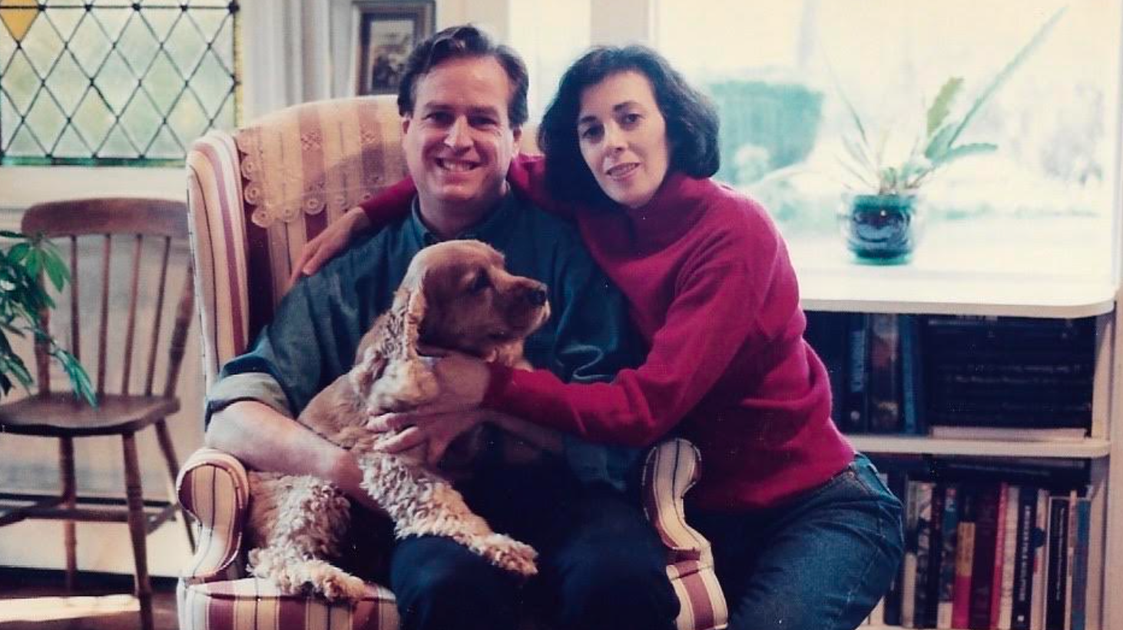
So, we focused on our careers and bought a house in the country. From the outside, it appeared we had the perfect life. We even rescued a dog from a local animal shelter: a cute brown and white cocker spaniel named Cassie. Though she wasn’t a child, we adored her, and in so many ways, she was our baby.

Thanks to experimental medications, a diligent diet, a healthy lifestyle and good luck, Steve’s HIV+ status never progressed to AIDS.

The author and Steve at the New York City Marathon.

Our dog Cassie passed away right before Covid-19 hit. In 2022, when I was 71, Steve was admitted to the ICU with a highly contagious strain of pneumonia that developed after he had surgery for cancer. While he was in the hospital, he used his iPad to search the internet for a puppy.

“Annie, you need a dog,” he typed. “I found one – Romeo.”

Several weeks later, the night before Steve passed, I held his hand as the nurses were getting ready to disconnect him from life support.

Advertisement

“I love you,” I told him. “I would not have chosen any other life than the one we’ve had together.”

A smile came to his lips.

I meant every word. Did I wish I had married someone else? Never. I had a wonderful life with Steve despite his health challenges and the resulting hardships we endured because of them. And through it all, we always had each other.

The author with Romeo in Riverside Park in New York City in 2023.

Would I have liked to have had a child? Of course. But just because I don’t have any children doesn’t mean that I’m alone. My brother and stepsister have children and now grandchildren. They have been a huge part of my life. I’ve watched them grow, and we care deeply about each other. And I have a wonderful group of friends and a vibrant community.

I also have Romeo. I met him a few weeks after Steve passed. He’s an adorable mini goldendoodle, and he’s always by my side – literally, following me from room to room.

Advertisement

He has brought me such joy in the midst of so much grief. He was Steve’s parting gift to me, and one more example of how even in the worst of times, he was always looking out for my happiness in whatever ways he could.

Yes, my mother was right – sort of. I would have loved to have had a child, but it wasn’t meant to be. I realise now she was just doing what she thought would be best for me. When she was near death, I told her the truth about Steve’s diagnosis. She looked at me with tears in her eyes, and whispered, “I understand.”

Even though my life turned out differently than what she expected – or I once desired – I’ve had a beautiful life. I got to spend 45 years with a man who truly loved me, and though I’m not a traditional mother, I’ve found ways to feel motherly love and be connected.

Ann Gorewitz is a writer. Her debut memoir, You, Me, & The Dog: An Unconditional Love Story (Heliotrope Books), is now available at Amazon, Barnes & Noble, Bookshop, iBooks, Kobo, Booktopia, and other eBook platforms. Ann can be contacted on Instagram @gorewitzann, Facebook @ann.gorewitz, and her website.

Advertisement

Do you have a compelling personal story you’d like to see published on HuffPost? Find out what we’re looking for here and send us a pitch at pitch@huffpost.com.

Source link

Advertisement
Continue Reading

NewsBeat

Perth shark attack: Beaches shut as deadly attack prompts rare kill order

Published

on

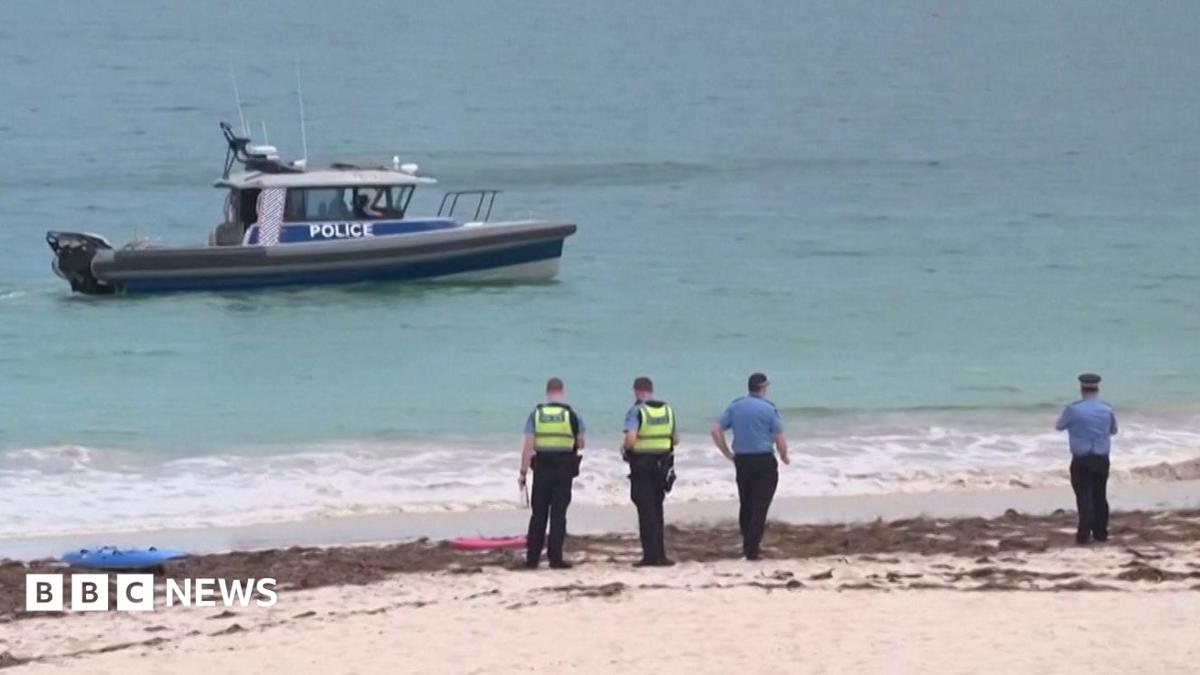
Police officers stand on Sorrento Beach while a police boat patrols offshore during search and recovery operations after a fatal shark attack

A rare catch-and-kill order has been issued for a great white shark off the coast of Western Australia, after a man was killed while on a morning swim at a popular beach on Friday. His body has still not been found.

Authorities have said that beaches along the state’s coast, including in the capital Perth, will remain closed until at least Sunday as the search for the shark continues.

It is the second shark attack in Western Australia (WA) this week, and the third fatal attack in the state this year.

The incident, at Sorrento Beach in Perth’s north, has reignited debate about how to keep beachgoers safe in Australia.

Advertisement

The swimmer has been identified as 63-year-old Greg O’Neill, the Australian Broadcasting Corporation (ABC) has reported.

“Greg loved the ocean and was known as a passionate swimmer, sports lover, dedicated worker and an all-round generous, witty guy,” his family said in a statement to the broadcaster.

Witness Jacqui Rapaic told the ABC that two men were swimming, but only one made it back to shore, and that she could see “a pool of blood” in the water.

Another witness told WAtoday that she saw the man being “mauled” as the shark “tossed him around like a fish”.

Advertisement

Members of the public reported seeing a 2.5m-long (8ft 2in) shark at around the same time.

Authorities in Perth’s Joondalup area, where Sorrento is located, said all beaches were closed “as a precautionary measure” and would remain so until at least midday on Sunday.

Pictures on Saturday showed the coastline being patrolled by a police boat and helicopter.

Source link

Advertisement
Continue Reading

NewsBeat

Joanne Sheen’s close friend says ‘nothing can prepare you’ as missing mum found seven years after disappearance

Published

on

Manchester Evening News

The mum-of-three was last seen in Southampton in December 2019

A close friend of a mother-of-three whose remains were found nearly seven years after she disappeared said “nothing could prepare” her for the tragic news.

Advertisement

Rachel Roussel, from Southampton, said the discovery of the remains of Joanne Sheen – affectionately known as “Little Jo” – was “absolutely devastating”.

The Metropolitan Police were called on the evening of August 12 after bones, thought to belong to a woman aged between 25 and 45, were found at shrubland known as The Pits near Padstow Walk in Feltham after the area was affected by a blaze. Detectives had launched a murder probe, but Hampshire and Isle of Wight Constabulary have taken over the investigation after the remains were identified as those of Ms Sheen.

Click here to get the biggest stories straight to your inbox in our Daily Newsletter

A 56-year-old man from Southampton was arrested on suspicion of conspiracy to commit murder on Thursday (17 September).

Advertisement

Of the police update, Ms Roussel told the Press Association (PA): “It’s something that everybody’s heavily anticipated, and you kind of get yourself ready and prepare yourself for it. But nothing could prepare you for that, nothing at all.”

The 47-year-old said the years of uncertainty had been particularly difficult for Ms Sheen’s three daughters, two of whom she said have since become mothers themselves.

“Her daughters are mums themselves now, so they’ve had their babies, and their mum wasn’t there for that,” she said. “To have to go through something like this and to have to be going through it for so long, seven years, is just unfathomable.”

Ms Roussel, who met Ms Sheen in 2003, has launched a fundraiser on GoFundMe to help give her friend “a send-off that she so rightly deserves”.

Advertisement

“Now we can focus on helping the girls, bringing her home, and set about laying her to rest finally, which is what they’ve wanted to do,” she said. The two became close while raising their children in Townhill Park in the Hampshire city, with Ms Roussel describing her friend as a “devoted mum” with a “wicked sense of humour”.

“She was just lovely, she’d do anything for you, if you needed to nip to the shop, she’d stay and watch the children,” she told PA. “If you needed to borrow some money, and all she had was £5 in her pocket until the next income support payment dropped, she’d lend it to you.

“She was just lovely, and a devoted mum, a completely devoted mum, every ounce of her energy went into those girls, it was amazing.”

Advertisement

Ms Roussel continued: “Jo was just so much fun to be around, she had a personality that was a bit crazy, but you loved her for it. She had a wicked sense of humour, a fantastic laugh that I’ll never forget, she could make you belly laugh until your belly hurt.”

Ms Roussel recalled them celebrating birthdays, Halloween and New Year’s Eve together. Explaining why she set up the fundraiser, Ms Roussel said she had found herself asking: “What can I do?”

“She was my friend and I loved her very much and I wanted to do something to help the girls,” she said. Ms Roussel said she wanted Ms Sheen to be remembered above all as a mother and friend.

Advertisement

Ms Roussel added: “She was just an amazing human being who’d light up a room, I know that’s a very cliche thing to say about people but she really was. She was a big, big personality, an amazing friend, and she will be very sadly missed, very greatly missed by lots of people.”

The 44-year-old had not been seen since travelling from Fareham towards her home city of Southampton on December 5, 2019.

A Hampshire and Isle of Wight Constabulary spokesperson said more than 4,000 lines of inquiry have been raised, more than 300 statements taken, and detailed searches carried out at more than 10 addresses and on numerous vessels.

Advertisement

Detective Chief Inspector Toby Elcock said the identification of Ms Sheen’s remains is a “significant development” in a “long and complex investigation”. Crimestoppers has reinstated a £20,000 reward for information.

A Metropolitan Police spokesman confirmed that the remains were found by a member of the public after the nearby land was affected by a recent wildfire. The site is close to Bedfont Lakes Country Park.

Shrubbery appeared to have been burned at a woodland area close to where the police crime scene was in place last month and a large patch of the ground was charred.

An incident log on The London Fire Brigade’s website showed that four fire engines and about 25 firefighters had tackled a grass fire in the area on August 5. About two hectares of shrubland were damaged in the blaze.

Advertisement

Source link

Continue Reading

NewsBeat

Earl Spencer’s Diana book opens old wounds royals would rather forget

Published

on

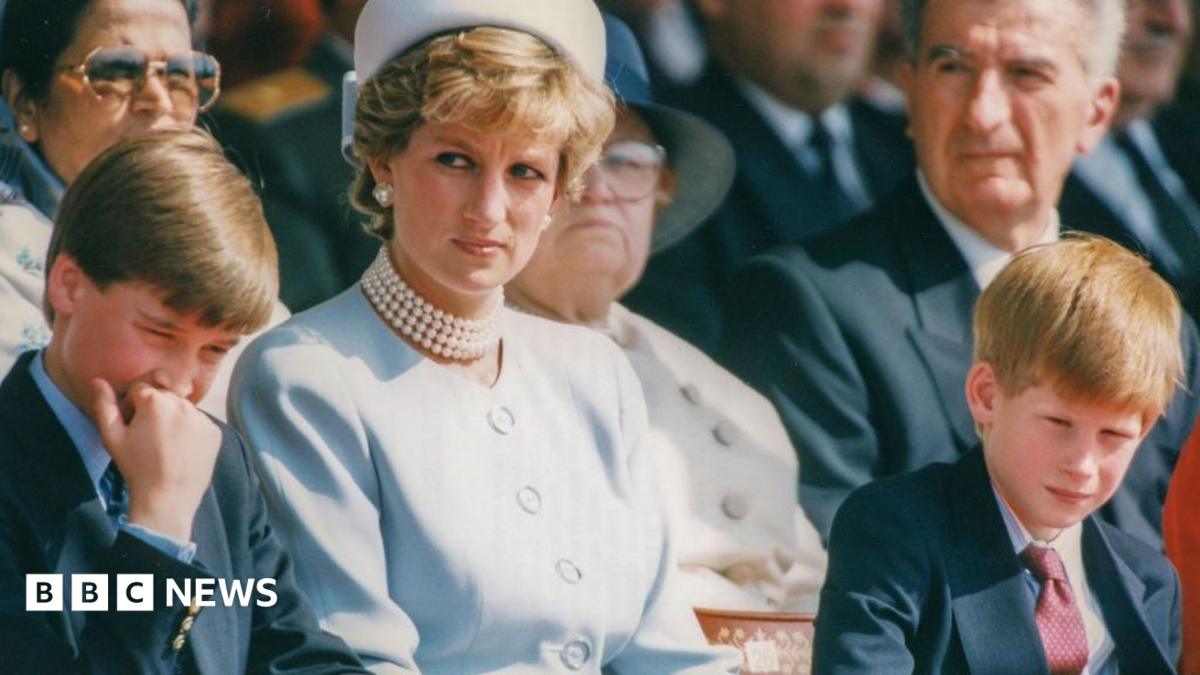
Princess Diana, wearing a light blue dress and hat, sits in between a young Prince William on the left (holding his hand to his mouth) and Harry to the right. Diana is looking into the distance to the left.

At issue is Earl Spencer’s account of a conversation with the then Prince Charles after the death of Diana, with the prince accused of telling Earl Spencer: “We’ll forget her soon enough.”

He is accused of sounding “giddily elated” and like a “lottery winner” after the news of her death.

Buckingham Palace hit back with a response, which although dressed in courtier-like politeness, was essentially saying the conversation had never happened like that.

The King was said to be “mindful that the pain of fraternal grief can cloud reason, affect judgment and colour memory in ways that others do not recognise”.

Advertisement

Anyone who has lost someone knows how feelings can run high, people can hear different things about the same conversations – and families can fall out, or come together, in the wake of a death.

Psychotherapist Nick Hatter says he doesn’t have a view on which version of events is correct, but he says that during traumatic events memories can be “distorted”. A phone call doesn’t have any of the visual clues or body language to give a fuller picture, he adds.

Hatter says there can be very different and unpredictable responses to grief, including a condition known as “bereavement mania” where someone can seem inappropriately hyper or even euphoric after the loss of a loved one.

The first opinion poll on who to believe has been published by YouGov – and it suggests a very split view, with 31% believing Earl Spencer’s allegations, 36% suspecting it’s not true and 33% saying they don’t know.

Advertisement

Low thinks the book is unlikely to change many opinions, as “people have settled into their camps about how they regard Charles, how they look back on the Diana years”.

There could also be a feeling that it’s “tawdry” to rake up these claims so many years later, he says.

That’s echoed by historian and author Sir Anthony Seldon who says Earl Spencer showed great courage at the time of Diana’s funeral, but says his memoir is a “sad and unnecessary publication”.

Royal commentator Richard Palmer says the book threatens to take the royals back to the difficult days of 1997.

Advertisement

“This book and the run-up to next year’s 30th anniversary of Diana’s death threaten to undermine the Royal Household’s three decades of work to rehabilitate Charles and Camilla’s image,” he says.

Veteran broadcaster David Dimbleby, who led the BBC’s coverage of Diana’s funeral, said it seemed “odd” Earl Spencer would release the book now.

“Why 30 years later for god sake you should do it, well again you have to ask him,” he said, adding he wished the appetite for the “cycle of gossip” would decline and instead focus would shift to what kind of monarchy the country needs.

Source link

Advertisement
Continue Reading

Trending

Copyright © 2025