
Connect with us

NewsBeat

The Original Meaning Of The Word Quick

Published

on

The Original Meaning Of The Word Quick

“Quick” is a word people say all the time as a synonym for fast. But most probably don’t realise that the word used to mean something very different.

Like “nice” and “awful” (which used to mean “ignorant” and “worthy of awe”, respectively), the word quick has travelled some distance from its original meaning. But it does manage to hold onto a little bit of the old and new at the same time.

“Quick originally meant alive, not fast,” Sophie Vignoles, a linguist and head of learning content at the language learning app Babbel, told HuffPost.

“It comes from the Old English ‘cwic.’ That older meaning survives in the phrase ‘the quick and the dead,’ which means ‘the living and the dead.’”

Advertisement

Indeed, earlier translations of the Bible and the Nicene Creed include “the quick,” and even some versions of the creed used to this day include the line “he shall come again with glory to judge both the quick and the dead.” There are also multiple Westerns with the title “The Quick and the Dead,” drawing from those Christian origins.

Farm animals also used to be called “quickstock” before “livestock” took over.

So how did “quick” evolve from “alive” to “fast”?

“The shift toward speed follows a simple logic,” Vignoles said. “Living things move, and dead things do not, so a word meaning alive naturally came to describe liveliness and motion. By the medieval period, quick was already being used for fast movement, and that became its dominant sense in everyday English.”

Advertisement

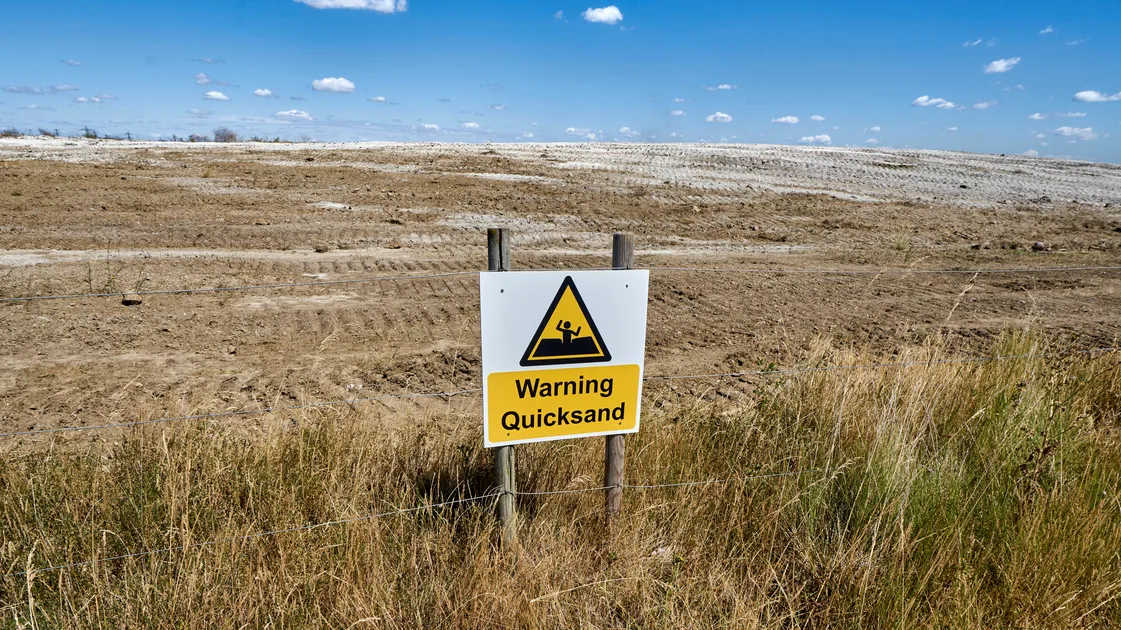
In many ways, it feels like a clean semantic chain from alive to animated to moving to fast. But what makes quick particularly interesting is how many traces of its original meaning are still hiding in plain sight. Take, for example, the words “quicksand” and “quicksilver” and the term “quickening” in pregnancy.

“Quicksand is sand that behaves as if it has a life of its own, shifting and pulling things under,” Vignoles said. “Quicksilver was the old name for mercury, called that because its constant, restless movement made it appear alive. Quickening in pregnancy refers to the first moment a woman feels the baby move, historically understood as the point at which the baby became alive. Each one is a small fossil of the word’s original meaning, preserved inside modern English.”

Matt Mawson via Getty Images

The original meaning of “quick” makes much more sense in the context of the word “quicksand,” since quicksand isn’t actually fast at all.

Those terms preserve the older sense of alive, rather than fast. Quicksand is basically “living sand” – which makes more sense than “fast sand,” given it’s actually a rather slow-moving phenomenon (unlike depictions in movies). And quicksilver is “living silver.” In fact, Pliny the Elder described the substance of mercury as “argentum vivum,” which literally means “living silver” or “quicksilver” in the earlier English translation.

Advertisement

“Cut to the quick” is another surviving phrase linked to that earlier meaning of quick. The phrase refers to the idea of piercing straight to the heart of something or causing someone hurt on a very deep level. In other words, to cut to the quick can mean to cut to the very core of what makes you a living being.

In the context of this phrase, quick can also refer to the sensitive, living flesh beneath your fingernails, which can hurt intensely if you cut your nails deep. In this sense, it might be that you’re cutting into tender skin that’s alive versus a fingernail, which is made up of dead cells.

For Vignoles, the story of “quick” illustrates something broader about how languages carry their histories.

“It shows that old meanings rarely disappear. They survive in fixed phrases long after the main sense of a word has moved on,” she said, pointing to Babbel’s research on the way American English has evolved in honor of the United States’ 250th anniversary this year.

Advertisement

The evolution also points to how deep some of these connections can run, she added.

“The root behind quick is the same one that produced Latin words like vivid and revive, and it is also related to the root behind the Hindi word jeevan, meaning ‘life,’” Vignoles said. “Babbel’s research found Hindi has only entered the American dictionary in the past two decades, through words like yoga and karma, but the deeper connection between English and Hindi at the root level goes back much further than that.”

She believes the word quick is a clear case of a word maintaining its original and modern meaning side by side in everyday language.

“The same root shows up even further afield,” Vignoles said. “Russian zhivoy, meaning alive or lively, comes from the same ancient source, and so does the Greek bios, the root behind words like biology and biography. It is a reminder that a single ancient idea, the idea of being alive, has quietly seeded vocabulary across English, Hindi, Russian and Greek alike, even though most speakers of those languages would never guess the words are related.”

Advertisement

Now perhaps next time you ask someone to be quick with something, you’ll remember that you are invoking a word whose original meaning was a reminder to all that we are alive.

Source link

Advertisement
Continue Reading
Click to comment

You must be logged in to post a comment Login

Leave a Reply

NewsBeat

Funeral details for Co Tyrone priest after sudden death less than two weeks into new role

Published

on

Belfast Live

The 55-year-old’s sudden death has prompted an outpouring of tributes

Funeral details have been announced for the a Co Tyrone-born priest who died suddenly, less than two weeks after taking up a new role in Co Louth.

Advertisement

Fr Mark O’Hagan, originally from Coalisland, had spent more than two decades serving the Dundalk community before becoming parish priest of Ardee, Collon and Ballapousta in Co Louth earlier this month.

The 55-year-old’s sudden death was announced by both parishes on Friday, prompting an outpouring of tributes from parishioners and organisations in the area. He had only taken up his new position on September 6, having celebrated his first Mass at the Church of Mary Immaculate in Collon just last Sunday.

St Patrick’s Parish in Dundalk said it was “saddened to share the news of the sudden death of our previous parish priest”.

Fr Mark had served in Dundalk since shortly after his ordination, working as curate, administrator and parish priest during his 22 years in the town.

Advertisement

His death notice described him as the beloved son of Irene and the late Joe, cherished brother of Dwyer (Majella), Sinead (Steven) and John (Sonia), much loved uncle to Caoilean, Connor, Caoimhín, Coleen, Dara, Kate, Emily-Rose, Joseph, Rory and Eathan and granduncle to Ada and Donnchadh.

It added that his death is deeply regretted by his loving family circle, Archbishop Eamon Martin DD, Cardinal Seán Brady JCD, Bishop Michael Router DD, the clergy and religious of the Archdiocese of Armagh, his parishioners, former parishioners and many friends.

On Saturday, September 19 there will be a public visitation from 5pm and lying in repose for Mass at 6.30pm in the Church of the Nativity of Our Lady, Ardee. Arrival at 9.30pm for Night Prayer in St. Patrick’s Church, Dundalk.

On Sunday, September 20, his remains will be lying in repose for the 9am and 11am Masses in St. Patrick’s Church, Dundalk, with removal following the 11am Mass to repose at Fr. Mark’s family home, Lisnastrane Park, Coalisland BT71 4PW.

Advertisement

On Monday, September 21, Requiem Mass will be held in Holy Family Church, Coalisland at 2pm. Burial afterwards in the cemetery adjacent to St. Mary and St. Joseph’s Church, Coalisland.

Speaking to the Dundalk Argus before leaving St Patrick’s at the end of August, Fr Mark reflected on the difficulty of departing a community where he had spent his entire priestly ministry.

“It’s with a very heavy heart that I am leaving, but that is part of the priesthood. My whole ministry has been in Dundalk, so it will be strange going somewhere else.”

He had previously described his departure as emotional, while acknowledging that moving between parishes was part of his vocation.

Advertisement

“I am leaving with a heavy heart…my whole ministry has been in Dundalk,” he told the local newspaper.

His new parishes also confirmed his death in a statement, saying they were “with deep sadness” sharing the news of the “unexpected death this morning of our parish priest”.

“We mourn such a profound loss and especially remember Fr. Mark’s family in our prayers in these days.”

Advertisement

One parishioner recalled his first Mass in Collon last Sunday, saying he had spoken enthusiastically about his plans for the coming decade before eventually retiring.

Tributes have also been paid by the Order of Malta Ireland’s Dundalk Ambulance Corps, which said Fr Mark had made a lasting impact during his years serving the community.

“During his many years of service, he touched the lives of countless people through his kindness, dedication and commitment to his parish community.”

Dundalk South councillor Sionainn McCann also paid tribute to the priest, remembering his connection to Dundalk and his personality.

Advertisement

“Terrible news. Fr. Mark originally from Coalisland always had a smile and joke ready. He cared deeply about the town and will be sorely missed.”

Before entering the priesthood, Fr Mark studied business and worked at Belfast’s Europa Hotel before deciding to pursue his vocation.

Reflecting on his years in Dundalk in his interview with the Argus, he said his approach to priesthood had always centred on the community he served.

“My ministry has always been one of serving the people.”

Advertisement

For all the latest news, visit the Belfast Live homepage here and sign up to our daily newsletter here.


Source link

Continue Reading

NewsBeat

Cliona Hagan recalls magical wedding day and touching gesture from father-in-law

Published

on

Belfast Live

The popular country music artist married longtime love Simon Sheerin in Kilronan Castle back in 2022

Cliona Hagan says the years have flown by, four years on from her magical wedding to husband Simon Sheerin.

The country music star tied the knot in 2022, and said the day was filled with love and laughter.

Co Tyrone woman Cliona and Simon “loved every bit” of their wedding day.

Advertisement

“My husband Simon and I got married at Kilronan Castle in Roscommon and it was absolutely magical,” Cliona told RSVP Magazine.

“We can’t believe it has been four years, where has the time gone? We loved every bit of it.

“It was quite a big wedding, there were almost 200 people at it. It took a year to plan.

“Thank goodness I had a fantastic wedding planner to help me out with it, otherwise I would have gotten nothing done!”

Advertisement

On the morning of the wedding, Cliona felt very calm.

She said: “I thought I was going to be jumping around the place but I was actually really calm and relaxed. To be honest, I just couldn’t wait to see Simon.

“We spend so much time with each other and we work with each other too, so it was so weird being away from him the night before and morning of.”

Cliona’s father-in-law sang for the couple’s first dance, which is the standout memory of the day for the singer.

She said: “We went for What God Has Joined Together. It’s quite an old song and I had never heard it before, but Simon’s dad was up there, singing it with a guitar and I just thought it was so special.

“It is something we always remember about the day and it is a really lovely memory to have.”

For any future brides currently planning their wedding, Cliona has simple advice: “This is going to sound crazy, but I would actually say, have a sandwich before the ceremony!

Advertisement

“Hunger ramps up with excitement and emotions of the day. I personally couldn’t eat a lot before I went to the chapel, but afterwards I was like, ‘Oh my God, I’m going to faint if I don’t have food!’.

“So I would recommend having a sandwich or snack beforehand, because it’s going to be another few hours before you have your dinner.

“Another tip is to take some time out together when you get to your venue.

“As soon as we got to Kilronan Castle, we took some time to go to our room and decompress and have a moment for ourselves before getting back into the swing of things.

Advertisement

“We didn’t get photographs for half an hour after we arrived.”

For all the latest news, visit the Belfast Live homepage here and sign up to our daily newsletter here.

Source link

Advertisement
Continue Reading

NewsBeat

West Ham stars receive hostile welcome from Millwall as police brace for London derby CHAOS – with English football’s nastiest rivalry reignited today

Published

on

West Ham stars receive hostile welcome from Millwall as police brace for London derby CHAOS - with English football's nastiest rivalry reignited today

Advertisement

West Ham received a hostile welcome from Millwall supporters ahead of their London derby. 

The London foes are set to reignite one of English football’s fiercest rivalries for the first time in 14 years as Nuno Espirito Santo‘s Championship leaders travel to The Den to face Alex Neil’s underdogs.

The Met Police confirmed this week that additional measures have been put in place to help ensure the match passes off safely, with approximately 400 officers on duty for the game.

And in the build up to kick off, Millwall fans set the tone by booing and shouting at the Hammers as they arrived at The Den. 

Advertisement

One fan could be heard yelling: ‘You f***ing n**heads’ as the team bus pulled in. 

Others shouted ‘f*** off’ and directed x-rated hand gestures at the coach.  

It was a relatively quiet build up to kick off following a Friday night crackdown, with 26 people arrested after a fight was arranged at The Carpenters pub in Stratford – a popular local pub for West Ham fans. 

Hammers boss Santo urged fans to refrain from violence ahead of kick off.

Advertisement

He said: ‘What we want most is that everything goes well, both fans supporting their teams and no conflict. We have people inside the club who are taking care of that. We have to focus on our tasks.’ 

More to follow. 

West Ham players received a hostile welcome from Millwall supporters on Saturday morning

Advertisement
A Millwall fan aims an x-rated hand gesture at West Ham's bus as it arrived at The Den

A Millwall fan aims an x-rated hand gesture at West Ham’s bus as it arrived at The Den

There was a large police presence as the Met kept opposing supporters apart

There was a large police presence as the Met kept opposing supporters apart

Advertisement

Source link

Continue Reading

NewsBeat

Teenage boy seriously injured in crash with lorry on A1

Published

on

Cambridgeshire Live

Police have issued a public appeal

A 16-year-old boy has been taken to hospital with serious injuries following a crash with a lorry on the A1. Officers and paramedics were called at about 6.30pm on Thursday (September 17) to the southbound carriageway of the A1, at Thornhaugh, near Peterborough.

A white DAF lorry was involved in the collision with a stationary black Toyota Yaris. A 16-year-old boy, from Peterborough, who had got out of the Yaris suffered serious injuries and was taken to Peterborough City Hospital.

The HGV driver, a 54-year-old man from Wigan, was arrested on suspicion of causing serious injury by careless driving. The road remained closed while recovery took place but has since reopened.

Advertisement

The force has issued a public appeal for information. Anyone with who saw what happened or has footage should use reference 35/72248/26 and report it through the force website. Anyone without internet access should call 101.

Source link

Continue Reading

NewsBeat

The ‘rare’ Roman mound where a woman was found buried

Published

on

Cambridgeshire Live

Roman artefacts including an urn and pottery were found buried with the woman

The Romans played an important part in history, and Cambridgeshire too. Some Roman remnants discovered in Cambridgeshire weren’t always visible – with several excavations uncovering important artefacts in our county.

Advertisement

Following an excavation at Hey Hill in Barton in 1908, a large discovery was made. Archaeologists found a Roman barrow, an ancient burial site which is considered rare by Historic England.

Inside the barrow was a stone coffin without a cover, which contained a disjointed skeleton of a young woman, according to Capturing Cambridge. Alongside the woman’s body, there were a number of other items including two bone hairpins, goose and cockerel bones, and also a pig and sheep tooth. She was also buried with fragments of Roman pottery and a Roman urn. On the outside of her coffin, 27 hobnails were found.

During the excavation of Hey Hill and buried above the woman, there was evidence of a second burial that took place. A decapitated skeleton was found, and it was thought to date to Anglo-Saxon times.

Because of the important discoveries, Hey Hill is now recognised as a scheduled monument. This means it is recognised as a nationally important archaeological site and is given legal protection against unauthorised change.

Advertisement

Source link

Continue Reading

NewsBeat

Danish leaders cautiously optimistic about Trump’s Greenland deal after months of talks

Published

on

Danish leaders cautiously optimistic about Trump’s Greenland deal after months of talks

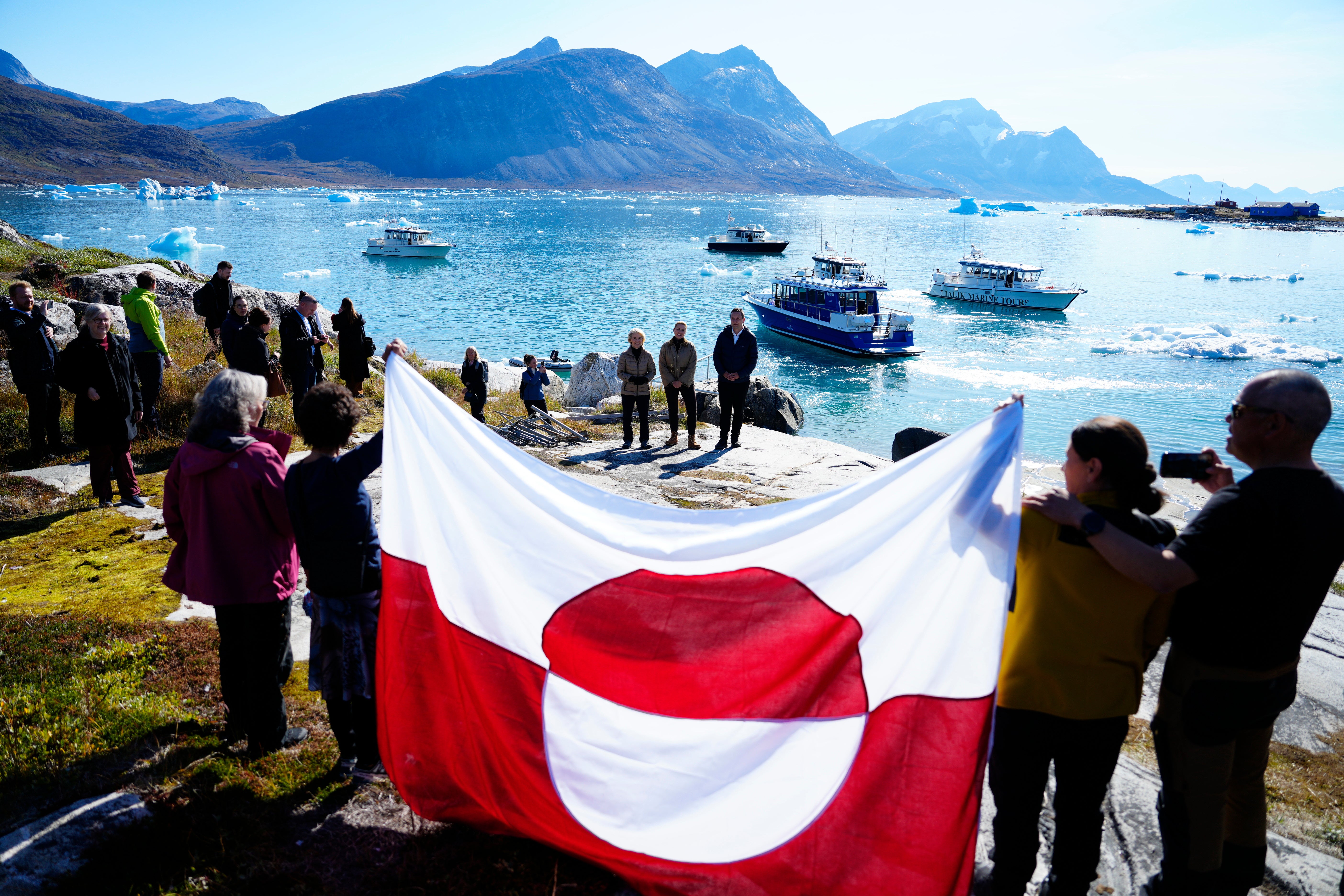
The Danish government expressed guarded optimism on Saturday following Donald Trump’s announcement of a deal regarding Greenland, which aims to boost the US military footprint while maintaining Danish authority over the island.

The agreement comes after months of threats from the U.S. president to take over the semiautonomous territory of a fellow NATO member.

A similar stance was taken by Greenland’s top diplomat, who noted that the arrangement had been a long time coming.

On Friday, Trump declared that the accord would provide the United States with “permanent control over security, and all other needs, in Greenland, completely addressing ALL of our many U.S. concerns.”

Advertisement

The office of Denmark’s prime minister, Mette Frederiksen, confirmed that representatives from all three governments will sign the agreement next week at the United Nations General Assembly.

Ratification by the Danish and Greenland parliaments remains necessary before the deal can take effect.

Danish Foreign Minister Lars Løkke Rasmussen wrote on Instagram on Saturday morning: “Next week could be a good week … for Greenland, Denmark, and the United States alike.”

In Greenland, the Arctic island's top diplomat echoed that stance and said the deal had been long in coming
In Greenland, the Arctic island’s top diplomat echoed that stance and said the deal had been long in coming (Associated Press)

He added: “A period of uncertainty will hopefully be replaced by a binding agreement that strengthens security in the Arctic and the North Atlantic — and thus also our shared security within NATO and Europe — while respecting the Kingdom’s red lines,”

The foreign minister of Greenland, Múte B. Egede, said he was pleased that “we now have an agreement within reach.”

Advertisement

“It has taken some time,” he told Denmark’s TV2 broadcaster. “I’m pleased that we finally have an end product within reach. And it’s about time.”

Trump said that with the agreement, the U.S. would “immediately” begin the process of developing a larger military presence on the mineral-rich Danish territory.

The U.S. had long held several bases and installations on the Arctic territory through the Cold War, before dialing back its presence.

It still operates the remote Pituffik Space Base in northwestern Greenland, built after the U.S. and Denmark signed the Defense of Greenland Treaty in 1951. It supports missile warning, missile defense and space surveillance operations for the U.S. and NATO.

Advertisement

Few details about the deal are known so far

A U.S. State Department official said the agreement bans any non-NATO base in Greenland, limits adversaries from being able to make investments in Greenland, and guarantees that China and Russia cannot have a base on the island. The official was not authorized to comment publicly and spoke on condition of anonymity.

U.S., Greenlandic and Danish officials had quietly negotiated for months behind the scenes, searching for solutions to address some of Trump’s security concerns about a territory of roughly 56,000 residents

U.S., Greenlandic and Danish officials had quietly negotiated for months behind the scenes, searching for solutions to address some of Trump’s security concerns about a territory of roughly 56,000 residents.

With the announcement of the pact, Trump is able to tout a foreign policy achievement ahead of the midterm elections in the U.S.

After his return to the White House last year, Trump had called on Denmark to sell the island to the U.S., while insisting Greenland is crucial for U.S. security. He pointedly wouldn’t rule out taking the island by military force, even though Denmark is a NATO ally of the U.S.

Advertisement

Denmark and Greenland repeatedly said the island is not for sale and condemned reports of the U.S. gathering intelligence there. The U.S. push for Greenland was also fiercely opposed by Russia and much of Europe.

Greenland grassroots pro-sovereignty activist Orla Joelsen wrote on X that “our fight against Trump’s ambition to take over Greenland has been won.”

“The new agreement explicitly recognizes the sovereignty and territorial integrity of the Kingdom of Denmark and the Greenlandic people’s right to self-determination,” the activist added.

Source link

Advertisement
Continue Reading

NewsBeat

Illegal migrant Deliveroo rider raped woman he had dragged off the street ‘like a ragdoll’ – then went to hospital ‘to get to her again’

Published

on

Deliveroo rider Salem Rekoub, 28, who had no right to work in the UK, has been jailed for 21 years for raping a woman

Advertisement

An illegal migrant Deliveroo rider who dragged a woman off the street ‘like a ragdoll’ before raping her has been jailed for 21 years.

Following the vicious assault, which left his victim feeling ‘destroyed’, Salem Rekoub, 28, was caught on CCTV wearing his turquoise uniform and smirking as he followed her ambulance to hospital, because he wanted to ‘get to the woman again’.

Rekoub, who was dubbed a public danger by the judge, arrived in Britain on a tourist visa in 2023. He did not have the right to work in the UK. 

Isleworth Crown Court heard that he took advantage of the woman, who is in her 40s, after seeing her ‘semi-conscious’ at a bus stop.

Advertisement

Rekoub then dragged her down a side road in Chelsea, West London, before finding a gap between cars where he attacked her in July 2024. 

During the 17-minute assault, the woman drifted in and out of consciousness while he repeatedly told her: ‘You need to be quiet’.

His victim was left with 33 bruises across her body.

Rekoub then called 999 and told operators a ‘pack of lies’, said prosecutors, as he tried to deceive them over what had happened.

Advertisement

Deliveroo rider Salem Rekoub, 28, who had no right to work in the UK, has been jailed for 21 years for raping a woman

Rekoub was caught on CCTV walking along the corridors of Chelsea and Westminster Hospital in a bid to 'get to the woman again' after being taken there by ambulance following her ordeal

Rekoub was caught on CCTV walking along the corridors of Chelsea and Westminster Hospital in a bid to ‘get to the woman again’ after being taken there by ambulance following her ordeal

He told a paramedic the woman had ‘too much to drink’, before telling police, under an assumed name, that he was simply a concerned passerby.

Advertisement

Rekoub then followed his victim’s ambulance to Chelsea and Westminster Hospital, where cameras recorded him walking through corridors and looking into triage rooms in an attempt to find her. 

When one hospital worker asked him what he was doing, he said: ‘I’m here to find someone.’

As his victim recovered, she was able to tell paramedics what happened and Rekoub was arrested nine days later. 

The court heard the woman, who must remain anonymous for legal reasons, had been left in ‘an almost catatonic state’ since the attack, and has suffered seizures. She has also spent time in a mental health treatment centre.

Advertisement

In a victim impact statement read to the court, she said: ‘This has destroyed my life and I am not the same person.

‘It has killed me and made me feel worthless. I tried to take my own life because I felt like I could not cope.

‘I have been left in a constant state of fear. I couldn’t escape because he told me to be quiet and had his hands around my throat.

‘I have been left completely numb and disassociated. I have begun to have seizures and my speech has become slurred.’

Advertisement

The court heard how the woman had been out with friends and had taken a bus home but got off early because she was feeling unwell. She passed out at the bus stop, where she was then found by Rekoub.

Following a trial by jury, Rekoub was found guilty of three counts of rape, and two counts of assaulting a female by penetration.

His defence told the court he had been a promising footballer who was almost selected for the Algerian team, but a knee injury had cut short his career.

A Deliveroo spokesman said: ‘We are appalled by these truly horrific crimes and our thoughts are with the victims and their families.

Advertisement

‘This individual was not a verified rider on our platform, but a criminal who abused our systems to gain access illegally.

‘We have since significantly strengthened the measures to control who can access our platform – and continue to invest to combat any abuse.’

Advertisement

Source link

Continue Reading

NewsBeat

Oasis 2027: Everything we know about who will support the band on 2027 tour

Published

on

Oasis 2027: Everything we know about who will support the band on 2027 tour

Oasis are hitting the road again in 2027, just two years after their momentous comeback tour.

The UK shows are made up of five dates in Glasgow, 11 dates in Manchester and four at Knebworth, 30 years after they played a historic two nights to 250,000 fans at the Hertfordshire venue in 1996.

Oasis are to return with a 38-date live tour next year

PA

Advertisement

Whilst the dates and venues have been confirmed, after months of speculation, one thing is still (mostly) up in the air – who will be supporting the band?

Here’s what we know so far about which artists will be joining the Gallagher brothers on tour.

The Verve’s Richard Ashcroft is the only officially confirmed support act that will be hitting the road with Noel and Liam next year for all 38 dates.

Source link

Continue Reading

NewsBeat

New restaurant given go-ahead to open on busy city centre street

Published

on

Cambridgeshire Live

The restaurant has won awards for its burgers

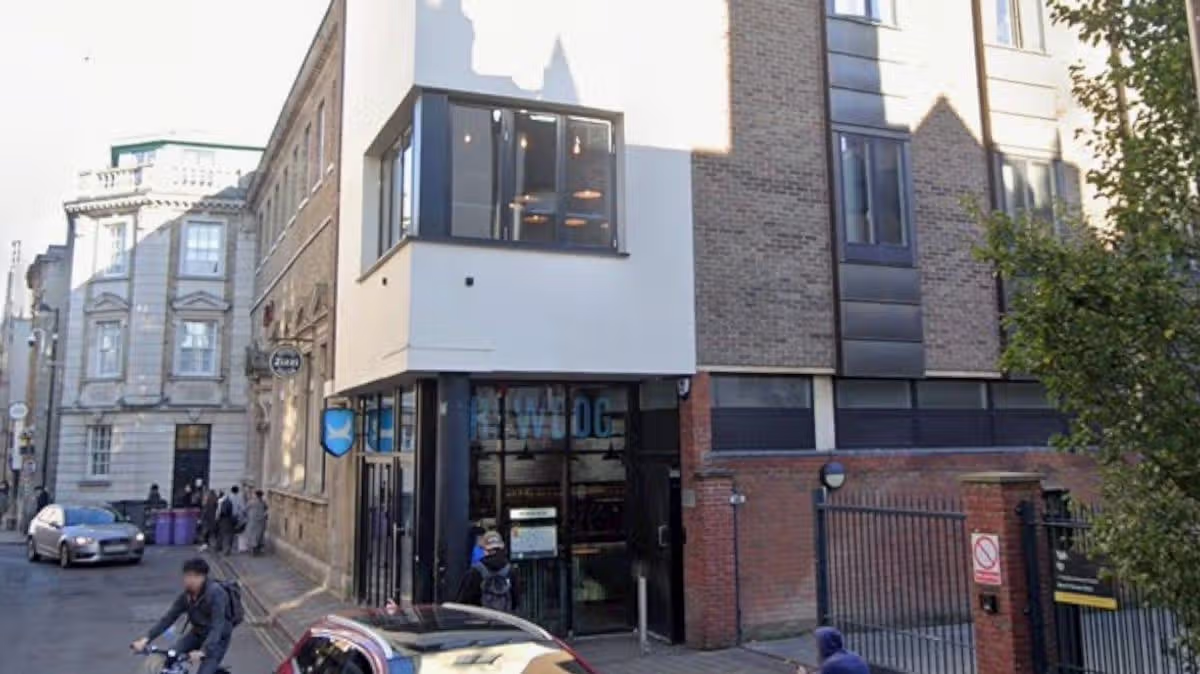
A new restaurant has been given the go-ahead to open on a city centre street. The Beefy Boys Holdings has been told they can change the use of a former bar on Bene’t Street in Cambridge into a new restaurant.

Advertisement

The restaurant chain sought permission from Cambridge City Council in June and it has now been approved. The site, on 15 Bene’t Street, forms part of the Grade II listed Barclay’s Bank. It was last used by Brewdog, but has been vacant since March 2026.

The Beefy Boys opened its first restaurant in Hereford in 2015, before opening a second site in Shrewsbury in 2021 and a third site in Cheltenham in 2023. It also has sites in other locations including Oxford and Nottingham.

Now, Cambridge locals could get a taste of its award-winning burgers. The burger chain has won both Signature Burger and Burger Chef of the Year at The National Burger Awards.

The applicants said the new restaurant will “serve as a meeting place for local people and visitors” and will provide a “suitable alternative facility to the existing use”.

Advertisement

Planning documents state it would provide a “high quality restaurant”, enhance the “vitality and viability of this part of Cambridge City Centre ” and help to “secure the future up keep of the Grade II Listed building”.

The new restaurant would be situated close to a range of existing pubs and restaurants including The Eagle, The Bath House and Pint Shop.

The building’s existing use permits opening hours between 11am and midnight between Sunday and Thursday and between 11am and 12.30am on Fridays and Saturdays. The Beefy Boys Holdings Ltd said these hours are “considered suitable for the proposed use”, but there is considered to be no concerns if earlier hours from 8am were permitted to allow “flexibility for a future use”, they said.

Alongside a change of use request, the applicant sought permission for Listed Building Consent for works to the building including internal changes and new signage.

Advertisement

Source link

Continue Reading

NewsBeat

Decades of male-focused medical research could bias healthcare AI

Published

on

Decades of male-focused medical research could bias healthcare AI

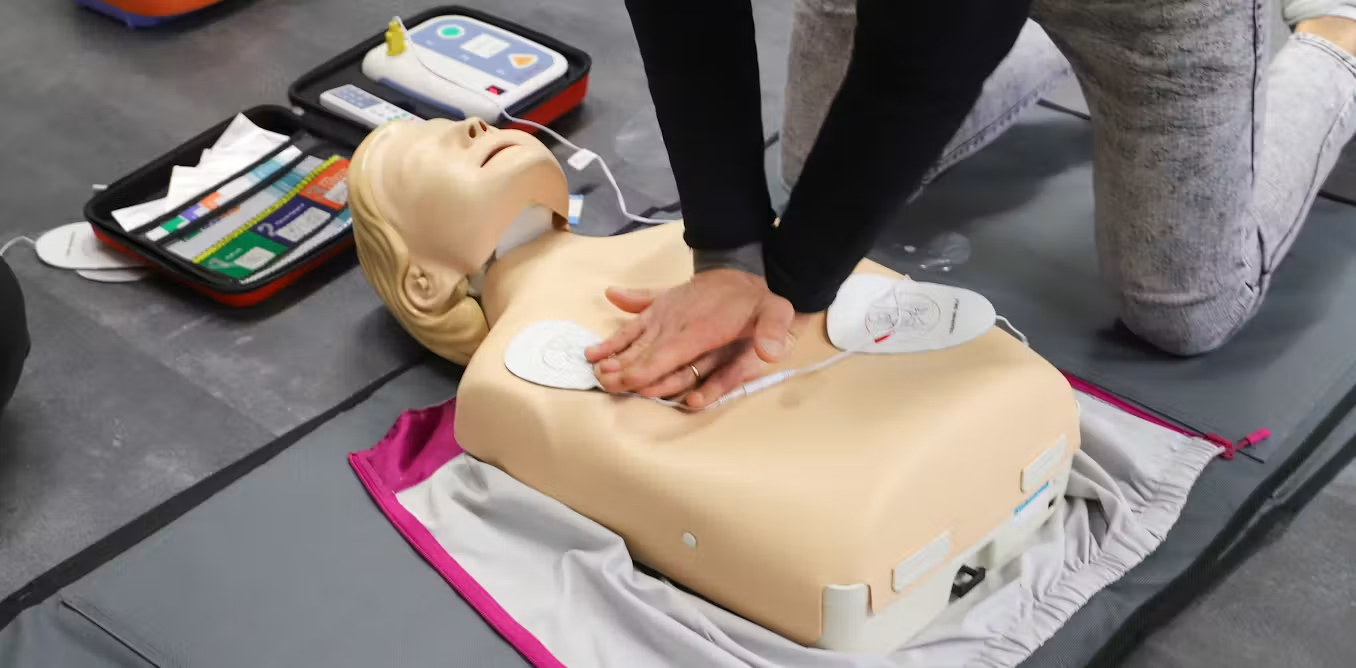
Many people will learn CPR using a flat-chested manikin. A 2024 study of 20 models of CPR manikins sold worldwide found that three quarters were described as male or had no sex specified. Of the 20, only one offered a breast overlay.

The manikins reflect a wider tendency in medical teaching and research to treat the male body as standard. The terms “male and female” and “men and women” in this article reflect the sources, which often fail to distinguish sex from gender or say whether gender-diverse people were included.

The lack of female representation can have consequences. In a US study of 19,331 out-of-hospital cardiac arrests, 39% of women who collapsed in public received bystander CPR, compared with 45% of men.

For CPR, even a short delay can affect survival. Another US study found that people who received bystander CPR four to five minutes after a witnessed cardiac arrest had 27% lower odds of surviving to hospital discharge than those who received it within one minute. In England, fewer than one in 12 patients for whom ambulance services attempted resuscitation survived 30 days, according to figures reported in 2024.

Advertisement

If bystanders hesitate to perform CPR on women because of the presence of breasts, training on more representative manikins could help. Historical gaps in representation now have another consequence. Healthcare increasingly uses artificial intelligence trained on medical records and research data produced when male bodies were often treated as the norm.

When old data trains new systems

Healthcare AI learns associations from health data. But medical records reflect clinical decisions as well as biology. If women and men with similar symptoms have historically been assessed differently, an algorithm may learn that pattern without knowing why it exists.

For example, an experimental study of medical students and residents found that when coronary heart disease symptoms were presented alongside psychological stress, women received fewer coronary heart disease diagnoses and cardiology referrals than men, and their symptoms were more likely to be interpreted as psychogenic. An AI system trained on records shaped by such decisions could treat that pattern as though it reflected disease itself.

Reviews of AI in medicine warn that unbalanced datasets can produce uneven performance. It can also be difficult to assess performance: a 2024 review of 692 AI-enabled medical devices approved by the US Food and Drug Administration found that demographic information and details of performance studies were often missing from public documents.

Advertisement

Understanding that risk requires looking at how the medical evidence AI may draw on was created.

How men became the medical default

Females are consistently underrepresented in medical studies. Hormonal changes across the menstrual cycle have historically been viewed as a source of unwanted variation. After the thalidomide tragedy of the late 1950s and early 1960s, the US Food and Drug Administration in 1977 recommended excluding women who could become pregnant from early drug trials. The policy was reversed in 1993 amid concern that it was limiting knowledge about how medicines affected women.

Women of childbearing potential were routinely excluded from industry-sponsored trials. Male animals have also been favoured in laboratory research, despite evidence that females are no more biologically variable, and many studies fail to report the sex of cells used in experiments.

These gaps can affect treatment. Women clear the sleeping drug zolpidem more slowly than men, and in 2013 regulators recommended halving the starting dose for women. A 2020 analysis found that women experienced adverse drug reactions nearly twice as often as men, with differences in how drugs move through the body explaining many of them.

Advertisement

Representation has improved. The 2016 Sex and Gender Equity in Research (SAGER) guidelines encourage researchers to consider and report sex and gender. But equal participation does not guarantee equal understanding. A 2026 review of 574 papers found that 61% included both sexes, yet only 44% of those analysed results by sex.

Biological sex and gender can both affect health, and separating their effects is difficult. Sex-related biology may influence drug metabolism, while gendered experiences may affect access to healthcare and how symptoms are interpreted. Yet many health databases collapse both into one binary category, limiting what researchers can conclude.

Biology or bias?

Heart-attack symptoms show why precision is needed. An analysis of more than one million people with acute coronary syndromes found that 74% of women and 79% of men experienced chest pain, but women had higher odds of reporting other symptoms including neck or jaw pain, fatigue and shortness of breath.


À lire aussi :
Women are at a higher risk of dying from heart disease − in part because doctors don’t take major sex and gender differences into account

Advertisement

Stroke care presents a similar problem. An Australian study of more than 202,000 people admitted with stroke found that among those under 70 arriving by ambulance, women were less likely than men to be assessed as having a stroke by paramedics and less likely to be managed under the pre-hospital stroke protocol.

Finding a difference is only the starting point. A study of 6.9 million people in Denmark found that women were older at their first hospital diagnosis for most conditions examined. That does not necessarily mean doctors took longer to diagnose them: disease onset and use of healthcare may also vary.

Medical research is becoming more representative, but much of today’s evidence was collected when male bodies were more often treated as standard. Careful design could help AI identify patterns that older research missed. As tomorrow’s healthcare is built from yesterday’s records, researchers must ask whether an apparent difference reflects biology or the way patients encountered healthcare. Otherwise old assumptions could become embedded in new technology.

Advertisement

Source link

Continue Reading

Trending

Copyright © 2025