
Crypto World
Fossil fuel emissions set to fall in after oil shock

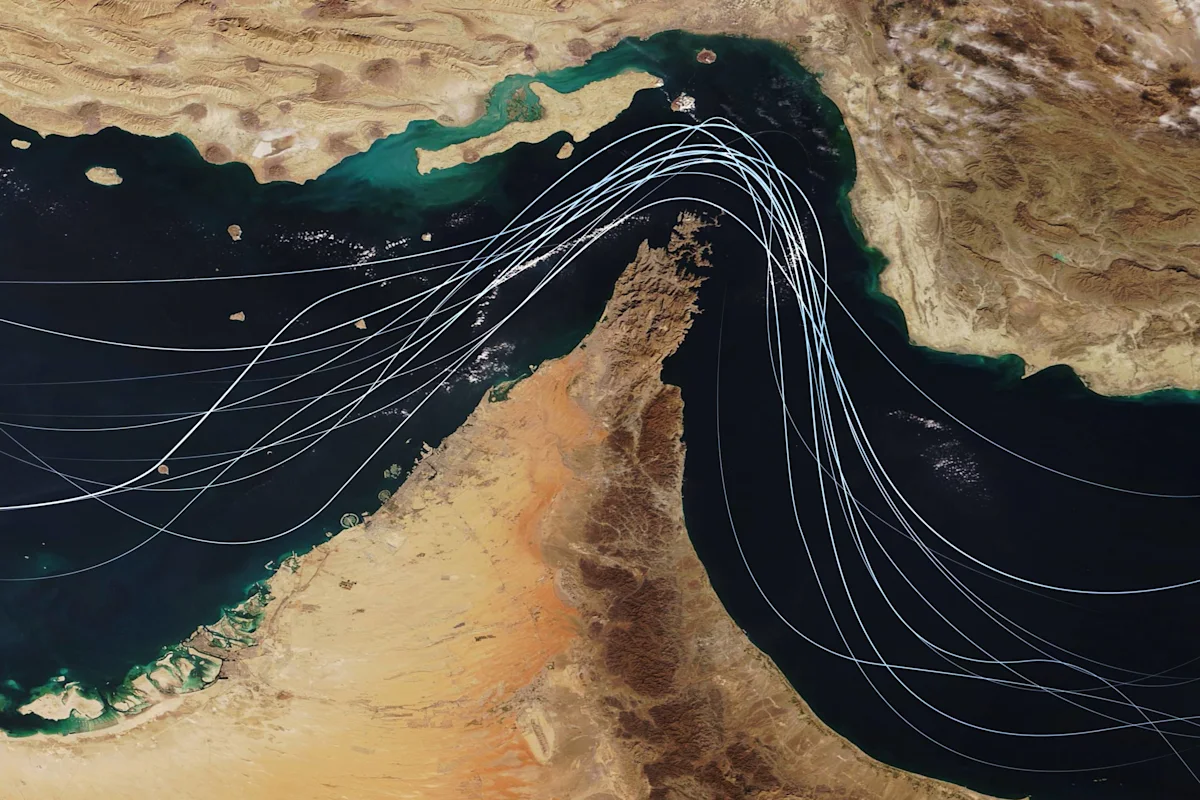
Every energy shock teaches the same lesson, and nobody enjoys learning it. When fuel stays expensive long enough, people stop buying it. Not because a rule told them to, but because the math at the pump stopped working.
That math broke in late February, when strikes on Iran began and tanker traffic through the Strait of Hormuz seized up. Brent crude settled at $104.82 a barrel on Sept. 17, according to CNBC.
The national average for a gallon of regular reached $4.4386 that same day, and diesel in California averaged $8.3496, according to AAA.
Seven months of those prices do predictable things. Airlines thinned schedules, Asian petrochemical plants idled, and car buyers from Jakarta to Berlin went looking for anything with a plug.
The International Energy Agency (IEA) now expects global oil consumption to shrink by 2.5 million barrels per day in 2026, a 2.4% drop from 2025 levels.
Which brings us to a figure published Sept. 16 that the market barely registered. Global emissions from fossil fuels are set to fall by roughly 0.5% this year, according to Carbon Brief.
That would be the first annual decline since the pandemic year of 2020. No treaty produced it.
How the Hormuz shutdown rewired global fuel demand
About a fifth of the world’s oil trade moves through a 21-mile-wide channel between Iran and Oman, along with a similar share of seaborne liquefied natural gas (LNG). Close it, and everything downstream reprices within weeks.
The forecasting record tells this story better than any headline does. In January, the IEA expected global oil demand to grow by 930,000 barrels per day in 2026. By September, it was modeling a 2.5 million barrel per day contraction, according to the IEA.
More Oil & Gas:
I ran those two numbers against each other, and the swing comes to roughly 3.4 million barrels a day in nine months. That is not a forecast being trimmed at the edges. That is a demand curve snapping.
Demand destruction is the polite term for it. Jet fuel got too expensive to fly certain routes. Naphtha got too expensive to crack. Gasoline got too expensive to commute on five days a week.
The scale is without precedent. The agency has called the loss of Gulf barrels the largest supply disruption in the history of the global oil market, a point TheStreet covered when Exxon’s CEO warned the shock was not fully priced.



The sticker price on a phone stopped being the price anyone actually pays a long time ago.
What you pay is a blend of a trade-in credit, a monthly installment, a plan tier you may not have chosen on your own, and a commitment that outlasts most car leases.
That structure is why two people can buy the identical phone in the same week and pay very different amounts for it. One trades in a three-year-old handset on a premium unlimited plan and pays almost nothing each month. The other buys outright and pays full retail on the spot.
Apple (AAPL) raised the price of its Pro iPhones by $100 this year. The Pro starts at $1,199 and the Pro Max at $1,299, and for a lot of households that jump is the difference between upgrading now and waiting another year.
Then the three major U.S. carriers made their counteroffer, and Bank of America (BAC) spent this week working out what it is really worth to you.

How carrier trade-in credits actually reach your bill
Carrier promotions work as credits rather than discounts, and that distinction decides how much cash leaves your account on day one.
When a carrier advertises $1,200 off, the full retail price of the phone goes onto a 36-month installment plan, and the credit comes back to your bill in monthly slices across those same 36 months.
Related: Bank of America flags surprising iPhone 18 pre-order trend
Leave early and the remaining credits stop. That structure is the point, because it keeps you on the account and on a plan tier that bills more each month than an entry-level one.
Apple sells the same phones outright with no strings. The trade-off is that you pay for all of it at once.
What the $1,200 iPhone 18 trade-in credit actually covers
Maximum trade-in credits for the iPhone 18 Pro Max have climbed to $1,200 at Verizon (VZ), AT&T (T) and T-Mobile (TMUS), Bank of America analyst Wamsi Mohan wrote in a Sept. 17 research note.
More Apple News:
That is $100 more than the top credit on the iPhone 17 Pro Max last year and $200 more than the iPhone 16 Pro Max the year before. The richer promotions largely cancel out Apple’s price increase, according to Mohan.
Here is the part that matters at the register. Even at the maximum credit, you are not walking out for nothing.
Carriers charge an activation or upgrade fee of $35 to $40, and sales tax is calculated on the full retail price of the phone rather than the discounted amount. On BofA’s figures, using New York City sales tax, that lands at $142 to $147 for the Pro and $250 to $255 for the Pro Max.

Nobody knows when the next stock market crash will happen. It could be next week. It could be years from now. But I know what I’d want to buy if it happened.
The Vanguard Dividend Appreciation ETF (NYSEMKT: VIG) is a portfolio of high-quality companies that generate big cash flow and demonstrate a history of paying and growing dividends over time.
Missed AI’s “Act 1”? Act 2 Could Be 15x Bigger. Most investors think they missed the AI boat because they didn’t buy Nvidia in 2005. But according to our analysts, we’re only at the end of “Act 1″—the R&D phase. “Act 2” is the global rollout. Continue »
But that’s not the biggest selling point in a down market. It provides the combination of growth and income that helps cushion against downside risk when weaker companies are getting hit hard, yet maintains a more growth-oriented profile that should capitalize on an eventual recovery.
In a sense, it potentially allows you to take advantage of both the crash and the rebound.

In this case, VIG isn’t really a dividend story
The Vanguard Dividend Appreciation ETF tracks an index that requires companies to have grown their annual dividend for at least 10 consecutive years. It eliminates the highest-yielding stocks right off the bat, helping to avoid companies that could be signaling financial trouble.
That last piece effectively serves as a quality screen for the fund, which is incredibly important during crashes. In volatile markets, investors often turn to safer, more durable stocks that can withstand tough environments. The dividend growth requirement and high yield elimination essentially help create a portfolio of those very stocks.
The fund’s portfolio is a bit unique for a dividend ETF. Technology accounts for around 25% of the portfolio, which is one of the highest allocations in this category. While that could increase volatility, I’d point out that half of that allocation goes to Broadcom, Microsoft, and Apple. Those are three heavyweight tech companies with huge revenue streams that should be able to hold up. These aren’t speculative growth names.
The additional sector weightings to financials (22%) and healthcare (18%) provide an attractive combination for an eventual recovery, quality companies with meaningful exposure to economically sensitive areas of the market.
The Vanguard Dividend Appreciation ETF will almost certainly fall in the next market crash. Investing in this fund isn’t meant to be a way to avoid it altogether. But it’s got durability, balance sheet strength, cash flows, and an improving income stream. These are the kinds of companies that are built for down markets.
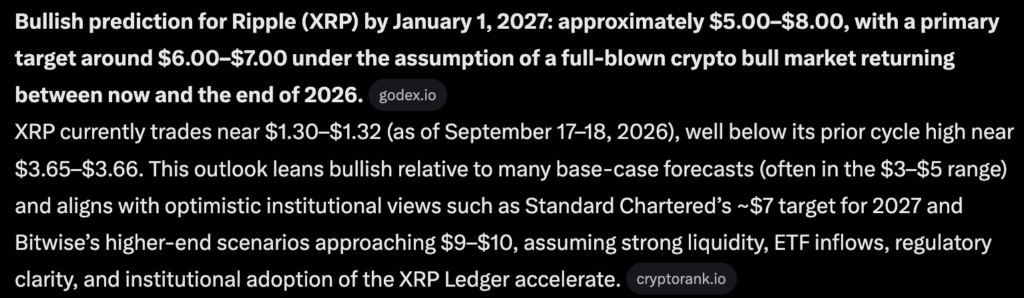
When prompted, Google Gemini AI predicts that under a full bull market structure between now and 2027, XRP could surge as high as $7, a 5x move from current prices, which will be sure to excite the Ripple army.
XRP currently trades near $1.30–$1.32, as of September 18, well below its prior cycle high near $3.65–$3.66. This outlook leans bullish relative to many base-case forecasts ($3–$5 range) and aligns with optimistic institutional views such as Standard Chartered’s ~$7 target for 2027 and Bitwise’s higher-end scenarios approaching $9–$10.

However, all of these forecasts assume strong liquidity, ETF inflows, regulatory clarity, and accelerated institutional adoption of the XRP Ledger. The core premise is a late-2026 return to sustained risk-on conditions, driven by improving macro liquidity, expanded XRP ETF inflows, growing use of XRPL for cross-border payments and tokenization, and broader altcoin rotation once Bitcoin leads higher.
In prior cycles, XRP has delivered sharp, high-beta moves once momentum returns; a move from the current ~$1.30 area through the prior highs near $3.65 and into the mid-to-high single digits would be consistent with a full bull-market environment and XRP’s positioning as a major large-cap asset with expanding institutional infrastructure.
Google Gemini AI Predicts the XRP Price: Does Technical Analysis Support the $7 Target?
Good Morning $XRP Family!
After touchdown on the 20 WEMA, price has bounced back into the 0.5 midline of the parallel channel and prior $1.33/6 support floor. This area has a strong flipped S/R potential if all fails to reclaim it.
Break it? Descending resistance awaits. https://t.co/MnpuYMQBEs pic.twitter.com/AIds6sUsYq—
ChartNerd
(@ChartNerdTA) September 18, 2026

On the higher timeframes, XRP has been consolidating after a significant pullback from recent highs, currently holding above key demand zones near $1.25–$1.30 while facing stacked short-term resistance around $1.33–$1.40 and higher supply near $1.50–$1.65.
A sustained break and weekly close above $1.40–$1.50 (with volume confirmation) would strengthen the intermediate bullish structure and open the path toward the prior cycle high near $3.65.
In a full bull-market regime, reclaiming that prior high often acts as a powerful psychological and technical catalyst for further extension; Fibonacci projections and measured moves from the multi-year base and recent recovery low project into the $5–$8 zone on continued momentum.
Price is holding above longer-term moving averages (such as the 50- and 100-day), with RSI in neutral-to-oversold territory on shorter timeframes, favoring mean-reversion upside once resistance is cleared.
Key supports to defend on any retests include the $1.20–$1.28 zone and the broader $1.00–$1.10 area; a decisive break below those would weaken the near-term recovery thesis.
Overall, the chart setup favors a multi-leg advance with strong upside potential if risk appetite returns, consistent with XRP’s historical pattern of sharp rallies once key resistances are cleared in bull-market conditions.
Earn $50 and Enter $300K Prize Draw on EdgeX
LiquidChain Targets Early Mover Upside as XRP Tests Key Levels
For traders watching the ongoing XRP price action, rotating capital toward earlier-stage projects with room to grow makes sense, especially when the alternative is waiting for a multi-billion-dollar market cap coin to reclaim ground it’s already lost twice.
Enter LiquidChain ($LIQUID), a Layer 3 infrastructure project fusing Bitcoin, Ethereum, and Solana liquidity into a single execution environment. The presale is priced at $0.014956 with $967,410.09 raised so far.
Its core pitch, Deploy-Once Architecture, lets developers build a single application and reach all three ecosystems without rewriting code for each chain, backed by a Unified Liquidity Layer and Single-Step Execution for cross-chain trades.
Those curious can dig into the background on its cross-chain approach, which is also covered in this earlier breakdown.
Gain Special Access to Layer 3 Trading Here
Discover: The Best Token Presales
The post Google Gemini AI Predicts an Explosive End to 2026 for XRP appeared first on Cryptonews.

When most investors think about what companies are cashing in on the AI data center boom, they typically picture chipmakers or utilities. Many investors don’t initially consider pipeline companies that supply gas to data centers or utilities. That’s a missed opportunity for generating income. For example, you could generate $600 a month in dividend income by investing around $141,000 into some of the pipeline companies cashing in on AI power demand.
Here’s a look at some of the top pipeline stocks to buy to generate income from the AI data center boom.
Missed Nvidia in 2009? This Rare Signal Is Flashing Again. In 2009, a “Double Down” signal flashed for a little-known chipmaker called Nvidia. For the first time in years, that same “Total Conviction” signal is flashing for a company 1/100th the size of Nvidia. Continue »

Pipeline AI profits into your portfolio
Pipeline giants Energy Transfer (NYSE: ET) and Kinder Morgan (NYSE: KMI) are leaders in capitalizing on surging gas demand to support AI data centers. Here’s the math for generating $600 a month from these energy stocks:
Data source: Google Finance and the author’s calculation.
I chose these pipeline stocks for their strong financial profiles and meaningful exposure to the AI power trend.
Energy Transfer has signed several deals to support AI data center power demand, including those to directly supply gas to data centers and to power producers. The master limited partnership (which sends a Schedule K-1 Federal tax form) is also investing in several large-scale gas pipeline projects to support rising gas demand. These investments should give it the fuel to grow its distribution by 3%-5% each year.
Meanwhile, Kinder Morgan currently has $8.2 billion of natural gas pipeline projects under construction to support rising gas demand. Additionally, it’s pursuing over $10 billion in other opportunities beyond its backlog to support growth in gas demand. These projects should give Kinder Morgan the fuel to continue increasing its dividend, which it has done for nine straight years.
You can collect real income today by investing in the pipeline stocks cashing in on the AI data center boom. While $141,250 is a lot to begin with, you can also start small and steadily build your income, as a $12,000 investment would produce over $600 in dividends each year.
Kalshi has filed with U.S. regulators to launch perpetual futures contracts linked to individual U.S. stocks, a move that would extend a crypto-style derivatives structure into traditional equity markets. The company’s proposal was submitted to the Securities and Exchange Commission as a rule change and simultaneously sent to the Commodity Futures Trading Commission for review, according to the filing.
The development arrives as Coinbase has also put forward a separate plan to offer single-stock perpetual futures. Both efforts point to growing competition among regulated crypto derivatives venues to adapt perpetual contract mechanics—particularly the use of ongoing funding payments—to equity instruments.
Key takeaways
- Kalshi filed a proposed rule change with the SEC and submitted the related materials to the CFTC to enable perpetual futures tied to specific U.S. equities.
- The contracts would have no fixed expiration date and would use periodic funding payments between long and short positions to keep pricing aligned with the underlying stocks.
- Kalshi said the products would be treated as security futures and cleared through its CFTC-registered clearinghouse, Kalshi Klear.
- Coinbase filed a parallel proposal the same day, and Kraken’s parent company Payward also moved forward with filings through Bitnomial.
- These proposals come amid renewed uncertainty in U.S. crypto-related regulatory pathways following the Senate’s failure to advance the CLARITY Act earlier this month.
Kalshi’s SEC and CFTC filing targets stock-linked perpetuals
According to Kalshi’s rule change submission to the SEC, the company is seeking approval to list perpetual futures tied to individual U.S. stocks. The filing was made on Friday and the CFTC has not yet approved the proposal.
The key feature of Kalshi’s design is that the futures would be structured without a preset expiration date. Instead of settling at a particular maturity, the price relationship to the underlying stock would be maintained through “periodic funding payments” exchanged between long and short positions, a mechanism widely used in crypto perpetual futures.
Kalshi also indicated that the proposed contracts would be treated as security futures products and cleared using Kalshi’s CFTC-registered clearinghouse, Kalshi Klear—an element that matters for market participants because it points to an operating model built around regulated clearing rather than bespoke settlement arrangements.
The filing is available through the SEC’s website as part of Kalshi’s proposed rule change: https://www.sec.gov/files/rules/sro/kalshiex/2026/34-106422.pdf.
Coinbase moves in parallel as the “equity perp” race expands
Kalshi’s submission followed the same day as a separate announcement from Coinbase. Cointelegraph previously reported that Coinbase has also filed a proposal to bring perpetual futures tied to individual U.S. stocks to the market, using the same broad idea: perpetual exposure without a traditional expiration, balanced through periodic funding payments. The earlier Coinbase coverage is linked here: https://cointelegraph.com/news/coinbase-files-to-bring-single-stock-perpetual-futures-to-us-market.
These filings are significant not only because they replicate a familiar crypto derivatives template, but because they attempt to translate it into the equity derivatives framework—where product categorization, clearing arrangements, and regulator oversight can differ materially from crypto-native contracts.
Payward and Bitnomial also seek approval for stock perpetuals
Kalshi and Coinbase were not the only players advancing this concept. Payward—the parent company of crypto exchange Kraken—also filed to offer single-stock perpetual futures. The proposal was submitted through Payward’s Bitnomial Exchange, and Payward said it expects the products to be available to U.S. traders on Kraken.
Payward stated it plans to start with perpetual futures tied to 10 U.S. equities, including Tesla, Nvidia, Apple, Microsoft, and Amazon, and that it is working toward 24/5 trading.
The underlying SEC filing for Payward is available here: https://www.sec.gov/files/rules/sro/btnl/2026/34-106421.pdf. Payward’s public statement is referenced in a post on X: https://x.com/Payward/status/2101013602790490360.
Crypto-style funding meets a policy moment after the CLARITY Act setback
The push for single-stock perpetual futures comes after the U.S. Senate did not advance the CLARITY Act on Sept. 15, according to reporting referenced in the source. The bill failed to reach the 60-vote threshold needed to proceed.
In the immediate aftermath, SEC Chair Paul Atkins said the agency would act “decisively” within its existing statutory authority “with or without legislation,” signaling that regulators may pursue frameworks through other channels even if broader legislation stalls. The source ties this statement to an Atkins post on X: https://x.com/SECPaulSAtkins/status/2100256253645668860.
For investors and traders, these details matter because regulatory clarity is often what determines whether and how new derivative structures can be launched at scale. Perpetual futures can be attractive to market participants seeking continuous exposure, but they also shift how risk is managed over time—especially given the role of funding payments in maintaining price relationships.
Kalshi has already been operating in the perpetual futures space for crypto assets in the U.S. The source notes that Kalshi received CFTC approval for its Bitcoin perpetual contract in May and offers perpetual contracts tied to assets including Ether, Solana, and XRP.
What to watch next
With multiple exchanges now seeking permission to list stock-linked perpetual futures, the immediate focus should be on regulatory review timelines at the SEC and CFTC and whether the proposed contract structures—no fixed expiration plus funding-based pricing alignment—survive scrutiny in practice. Market participants will also want to monitor how funding mechanics and clearing arrangements are handled as these proposals move from filing to approval.
Crypto World
Cathie Wood Sold Palantir and AMD, Then Poured $3.35 Million Into Archer Aviation. Is ARK Betting Big on Flying Taxis?

All companies that have more than $100 million in investments are required to submit quarterly 13F filings that disclose their holdings. Additionally, individuals and funds have to submit filings when their ownership stakes cross 5% and 10%. When holdings reach the 10% threshold, each subsequent trade must be disclosed. Meanwhile, Cathie Wood’s Ark Invest firm takes things to another level when it comes to transparency.
Ark Invest publishes regular updates disclosing all trades for the exchange traded funds (ETFs) that it manages, giving investors a clear look at all the moves made by Wood and her team of analysts and managers. Ark recently disclosed that it made some notable moves, selling shares of Palantir and Advanced Micro Devices and buying roughly $3.35 million worth of Archer Aviation (NYSE: ACHR) for its flagship Ark Innovation ETF.
Missed AI’s “Act 1”? Act 2 Could Be 15x Bigger. Most investors think they missed the AI boat because they didn’t buy Nvidia in 2005. But according to our analysts, we’re only at the end of “Act 1″—the R&D phase. “Act 2” is the global rollout. Continue »

What do Ark’s moves mean for investors?
Ark Invest tends to take a very active approach to portfolio management, and Wood and her team will regularly trim holdings when they feel that stocks have posted big gains and present worthwhile profit-taking opportunities — or simply no longer offer sufficient upside potential to justify the associated risks. Palantir and AMD have generated significant wins for Ark, and recent sales of these stocks look like profit taking rather than a fundamental loss of confidence in the companies.
Coming in as the Ark Innovation ETF’s 11th- and 12th-largest holdings, respectively, Palantir and AMD are larger positions in the fund than Archer Aviation, which ranks as the fund’s 30th-largest holding and accounts for roughly 1.2% of the portfolio by weight. On the other hand, Ark’s move to increase its holdings in Archer Aviation, the maker of the electric vertical take-off and landing (eVTOL) aircraft, clearly reflects growing confidence in the company.
Archer has been making some interesting moves lately, most notably entering into a deal with Boeing to acquire its Insitu, SkyGrid, and Wisk Aero subsidiaries. Integrating these companies could significantly improve Archer’s positioning in eVTOLs, drones, and autonomous aerial navigation. While the deal will result in Boeing receiving a 16.5% stake in Archer, it will also bring the aerospace and defense giant on board as a partner — a development that could prove a substantial boon to the eVTOL company in ways beyond the subsidiary purchase.

On August 19, Ferrovial (NASDAQ:FER) announced it had been selected to deliver the I-24 Southeast Choice Lanes, a 26-mile project running between Nashville and Murfreesboro. It is the largest single capital investment in Tennessee’s history and the state’s first public-private partnership. The price tag is $9.2 billion, though Ferrovial isn’t carrying it alone, since its DriveTN consortium also counts Transurban and Tikehau Star Infra as partners.

The Model Travels Well
Choice lanes are familiar ground for Ferrovial, which has replicated the model in Washington, D.C., Charlotte and Dallas-Fort Worth. On Virginia’s 66 Express corridor, similar lanes shaved up to 50% off peak-hour travel times. That is the pitch for I-24, a stretch of highway that already ranks among the region’s most jammed: drivers who opt in get steadier speeds, and those in the free lanes should see less traffic too.
The business behind the bid looks healthy, too. Ferrovial’s July 28 results showed adjusted EBITDA up 21.6% on a like-for-like basis to €746 million over the first six months of the year, with U.S. highways doing most of the lifting. Those roads are sending cash home as well, since Ferrovial received €357 million in dividends from North America. And the construction order book reached an all-time high of €18 billion, so plenty of work is already in hand. The pipeline keeps filling: Ferrovial bid on I-285 East in Georgia in July, and its D35 Highway bid in the Czech Republic was the most cost-effective submitted, with technical evaluation still underway.
Beyond the roads, the balance sheet looks sturdy. Ferrovial ended the first half with €1.3 billion in net cash, excluding infrastructure projects, meaning cash outweighs debt outside those projects. The airport arm is progressing too: Ferrovial has finished funding the $1.1 billion in equity it pledged for New Terminal One at JFK, and construction there is 92% complete.
Fine Print Worth Reading
Start with the line that looks worst on the page. Net profit for the first half of 2026 came in at €258 million, versus €540 million for the same period of 2025. That earlier figure included capital gains from asset rotation, which makes the comparison harsh, but the mismatch is still there: EBITDA climbed while reported profit fell.
Then there is the work itself. Construction turned 3.5% of revenue into adjusted EBIT, right on target, so there isn’t much room for a costly overrun on a big job. North America also accounts for 47.9% of the order book, so plenty rides on one region. The $24.8 billion in concession value cited for the project is a figure for Tennessee, not a profit forecast for Ferrovial. And a winning bid is not a finished road: I-24 still has to be financed, built and operated, and the CEO talks in terms of decades.
Crypto World
Massive Crypto Acquisition: Why S&P Global Is Buying Blockchain Security Giant OpenZeppelin

S&P Global (SPGI) has agreed to acquire OpenZeppelin, the smart contract security firm whose open-source code library sits behind more than $37 trillion in transferred value, and will run the auditor as a standalone business unit under its own name.
Founded in 2015, OpenZeppelin pairs security assessments and secure development services for decentralized finance (DeFi) protocols and traditional financial institutions with OpenZeppelin Contracts, a free library of standard token and contract implementations that the vast majority of the largest stablecoins and tokenized funds are built on.
The $37 trillion counts cumulative value moved through contracts built with that library, according to the announcement. OpenZeppelin has run more than 900 security engagements, including a late-2021 review that flagged a bug putting $15 billion in Convex Finance deposits at risk before it was patched.
“Our digital assets strategy centers on bringing trusted data, benchmarks and transparent risk assessment to markets as they move onchain,” said Yann Le Pallec, President of S&P Global Ratings.
Le Pallec stated that OpenZeppelin will complement the company’s smart contract and onchain technology risk assessment capabilities, giving traditional institutions and DeFi-native firms “the confidence to build and transact in this new environment.”
OpenZeppelin Keeps Its Name and CEO
OpenZeppelin will continue operating as its own unit inside S&P Global, with CEO Demian Brener staying in charge and reporting to Le Pallec. Financial terms were not disclosed, and S&P Global said the purchase is not expected to have a material impact on its financial results.
“OpenZeppelin’s standards, technology, and expertise already power the infrastructure behind the world’s leading stablecoins, tokenized funds, DeFi protocols, and onchain markets,” said Demian Brener, CEO of OpenZeppelin. “With S&P Global, that foundation reaches a broader set of organizations entering this market, as well as the blockchain networks and DeFi protocols gaining institutional adoption.”
Jefferies is serving as financial advisor to S&P Global, with Clifford Chance as legal counsel. FT Partners advises OpenZeppelin on the financial and strategic side, and Cooley on legal.
Deal Lands Amid Tokenization Push
S&P Global’s index arm has published crypto benchmarks since 2021, when S&P Dow Jones Indices launched a broad market index tracking more than 240 coins alongside its dedicated Bitcoin and Ethereum gauges, with pricing data supplied by Lukka.
On the same day as the acquisition, the US Securities and Exchange Commission (SEC) opened the door to secondary trading of tokenized US stocks through a temporary innovation exemption that requires the smart contracts involved to be publicly auditable and to run on public, permissionless blockchains.
The post Massive Crypto Acquisition: Why S&P Global Is Buying Blockchain Security Giant OpenZeppelin appeared first on CryptoPotato.
Crypto World
B. Riley and Roth Capital Both Cut Targets as AI Growth Struggles to Offset Legacy Declines

On September 3, 2026, eGain Corporation (NASDAQ:EGAN) reported fiscal 2026 fourth-quarter and full-year results. Full-year revenue rose 3% to $91.1 million, AI customer revenue grew 20%, and adjusted EBITDA climbed to $13.6 million, a 15% margin, up from 10% a year earlier. Operating cash flow reached a record $21.2 million.
Fiscal 2027 guidance calls for total revenue of $84.5 million to $86 million, below fiscal 2026’s total, with adjusted EBITDA margin guided to just 1% to 2%.

Iakov Filimonov/Shutterstock.com
A Gartner Nod and a Widening Pipeline Back the Long-Term AI Bet
Despite the weaker fiscal 2027 outlook, eGain still has several indicators that support management’s longer-term AI thesis. In July, Gartner released its inaugural Magic Quadrant covering customer service knowledge management systems, placing eGain Corporation (NASDAQ:EGAN) in the Leaders category and positioning it highest for ability to execute and furthest for completeness of vision. CEO Ashu Roy described the recognition as evidence that AI-focused knowledge management is emerging as a distinct layer of enterprise infrastructure. New customer wins rose 27% year-over-year, while the number of pipeline opportunities carrying at least $500,000 in annual recurring revenue doubled. Customers are also showing greater willingness to pay for pilot programs before moving to broader deployments, replacing the free-trial approach eGain had previously used. In one early testing and certification engagement, self-service resolution reached 95%. Cash increased to $73.3 million from $62.9 million, despite the company repurchasing 1.6 million shares for $11.5 million. Management is targeting $100 million to $120 million in AI customer ARR by fiscal 2030, compared with $54 million in fiscal 2026.
Analysts on Record Say the Legacy Runoff is Outrunning the AI Ramp
B. Riley’s Erik Suppiger cut his target to $6 from $10.50 on September 8, 2026, keeping a Neutral rating, saying eGain Corporation (NASDAQ:EGAN) beat fiscal Q4 estimates but issued fiscal 2027 guidance well below consensus, driven by accelerating churn in the legacy non-AI business that is significantly reducing next year’s revenue and profitability.
Roth Capital’s Richard Baldry went further the same day, downgrading eGain Corporation (NASDAQ:EGAN) to Neutral from Buy and cutting his target to $7 from $21, citing a meaningful revenue pullback and roughly breakeven adjusted EBITDA for much of the year as legacy attrition more than offsets what he called “modest” AI revenue growth.
Kalshi has filed with U.S. regulators to launch perpetual futures linked to individual US stocks, extending the “crypto-style” derivatives model into traditional equity trading. The prediction market operator submitted its proposed rule change to the Securities and Exchange Commission (SEC) and separately to the Commodity Futures Trading Commission (CFTC) for approval on Friday, with the CFTC still pending a decision.
The proposal would create contracts without a preset expiration date and would rely on periodic funding payments between long and short positions to keep the futures price aligned with the underlying equities. Kalshi said the products would be treated as security futures and cleared through its CFTC-registered clearinghouse, Kalshi Klear.
Key takeaways
- Kalshi filed for single-stock perpetual futures with the SEC and CFTC; CFTC approval is still outstanding.
- No expiration date: contracts would remain open-ended, with periodic funding used to maintain price alignment.
- Security futures framework: Kalshi says the contracts would be cleared through its CFTC-registered clearinghouse, Kalshi Klear.
- Racing competitors: Coinbase submitted a related proposal the same day, and Payward (Kraken) also filed to expand the concept.
What Kalshi’s proposal would change in US equities
Perpetual futures are a derivatives format that has been widely used in crypto markets, where contracts do not settle on a predetermined maturity date. Instead, traders typically rely on a funding mechanism—payments exchanged between long and short positions—to encourage the perpetual contract to track the spot price of the underlying asset.
In Kalshi’s filing, the exchange described contracts tied to individual US stocks that would similarly avoid a fixed expiration date and use periodic funding payments to keep contract prices in step with the referenced equities. Kalshi also framed the offering as “security futures products,” which would place the proposal in a specific regulatory lane and allow for clearance via Kalshi Klear.
Coinbase and Payward join the single-stock perpetual push
Kalshi’s filing lands in the middle of a broader push by crypto firms and crypto-linked trading venues to bring perpetual-style derivatives to the US stock market.
According to a separate report, Coinbase submitted its own proposal to offer perpetual futures tied to individual US stocks on the same day. The timing suggests a coordinated wave rather than isolated experimentation.
Payward—the parent company of crypto exchange Kraken—also moved forward. Earlier coverage of the filings noted that Payward, through its Bitnomial Exchange, submitted a proposal to offer single-stock perpetual futures and said it intends to make them available to US traders on Kraken. Payward stated it plans to start with perpetual futures linked to 10 equities, naming Tesla, Nvidia, Apple, Microsoft, and Amazon among them, and said it is working toward 24/5 trading.
Kalshi already has a precedent: crypto perps
This is not Kalshi’s first attempt at perpetual derivatives. The company already offers perpetual futures tied to cryptocurrencies in the US, including Bitcoin, Ether, Solana, and XRP. Kalshi received CFTC approval for its Bitcoin perpetual contract in May, demonstrating it has experience operating within the CFTC’s regulatory framework for these products.
That prior track record may be part of why Kalshi is now attempting to replicate the structure—perpetual contracts paired with funding payments—within a different underlying asset class. Still, investors should note that the regulatory posture for equities and security futures differs from crypto spot and crypto derivatives, even if the trading mechanics are familiar to perp users.
Regulatory momentum after the CLARITY Act setback
The filings come shortly after the CLARITY Act failed to advance in the US Senate on Sept. 15, falling short of the 60 votes required to proceed. The outcome has raised questions about whether comprehensive crypto legislation would move forward quickly.
In a statement reported following the vote, SEC Chair Paul Atkins said the agency would “act decisively” within its existing statutory authority “with or without legislation.” That message aligns with what traders and market operators are now seeing: rather than waiting for new legislation, firms are moving ahead with product proposals that fit within existing regulatory pathways.
Kalshi’s SEC and CFTC submissions, along with parallel filings from Coinbase and Payward, effectively test how the current rulemaking and approval processes handle perpetual derivatives when the underlying assets are equities instead of crypto tokens.
What to watch next
For traders and market participants, the key next step is regulatory: the CFTC must decide on Kalshi’s proposal, and other filings—such as Coinbase’s and Payward’s—will also need to clear their respective review processes. The most important question is how quickly regulators will reconcile perpetual contract mechanics with security futures requirements, and whether the early product schedules described by applicants translate into approved, widely accessible trading.

Apple Watch Series 12 and Ultra 4 weekend deals on Amazon

Is a Global Financial Reset Happening? If So, How?
Reform would dodge any Labour ban on foreign donors by ‘setting up a crypto industry union’, senior aide claims




-

 Fashion1 day ago
Weekend Open Thread: Talbots – Corporette.com
-

 Tech6 days ago
The Latest Weird Thing to Play Doom Is the Mapped-Out Brain of a Fruit Fly
-

 Crypto World5 days ago
Kraken Lets xStocks Holders Earn Yield Through DeFi
-

 Crypto World5 days ago
Revolut Attackers Warn of Ongoing Daily Customer Data Leaks
-
 NewsBeat1 day ago
Trump says US has reached an agreement to take permanent control of Greenland’s security
-

 Crypto World4 days ago
What Is the Status of the U.S.-Iran Peace Talks? Here's What Both Sides Are Saying
-

 Crypto World3 days ago
US Charges Robinhood Engineers Over Crypto Listing Trades
-

 Crypto World5 days ago
Elon Musk Drops a Bombshell: Grok 5 Could Be the AGI Breakthrough
-

 Crypto World4 days ago
Robinhood engineers charged over $50K crypto scheme
-
 Crypto World6 days ago
New Tesla Roadster Uses SpaceX Tech. Will It Impact the Stock Price?
-

 Business7 days ago
Rivals Sam Altman and Elon Musk Rally Behind Dario Amodei’s Call for a Slowdown in AI Development
-
 NewsBeat5 days ago
‘Sick conspiracy’: Trump says only guardrails AI needs is ‘a strong and smart (High IQ!) president’ in all-caps rant
-

 Crypto World5 days ago
NVIDIA Analysis: Attempted Rising Wedge Breakout Amid Pressure on the AI Sector
-

 Crypto World23 hours ago
Bitcoin price breaks channel as RSI climbs to 63
-
Business5 days ago
SK Hynix ADRs Fall More Than 6% as Memory Rally Breaks on Fears of Slower AI Spending
-

 Crypto World5 days ago
DOJ Seeks to Seize $61M in Iran Oil Funds From Binance Accounts It Vouched For
-
Crypto World5 days ago
Can Circle’s Arc Repeat Robinhood Chain’s Meme Coin Boom?
-
 NewsBeat7 days ago
Last Night of the Proms pays moving tribute to Dolly Parton as Sheridan Smith wears a gold sequin jumpsuit in memory of the Queen of Country
-

 Crypto World6 days ago
3 Token Unlocks to Watch in the Third Week of September 2026
-

 Crypto World6 days ago
Goldman Sachs backs 25bp Fed hike after CPI
You must be logged in to post a comment Login