The FBI warned that Americans lost more than $20 million last year amid a massive surge in ATM “jackpotting” attacks, in which criminals use malware to force cash machines to dispense money.
According to a Thursday FBI flash alert, more than 700 ATM jackpotting incidents were reported last year alone in a significant spike compared to the roughly 1,900 total incidents reported across the United States since 2020.
These attacks can be carried out in minutes and target the software layer controlling an ATM’s physical hardware, using malicious tools such as the Ploutus malware. Most often, they go undetected by financial institutions and ATM operators until the cash is already gone.
As the FBI explained, cash machines are designed to verify transactions through their bank before dispensing cash. However, Ploutus bypasses this process entirely, allowing the criminals to issue commands directly to the ATM and trigger withdrawals on demand without a bank card, a customer account, or the bank’s approval.
“Ploutus malware exploits the eXtensions for Financial Services (XFS), the layer of software that instructs an ATM what to physically do. When a legitimate transaction occurs, the ATM application sends instructions through XFS for bank authorization,” the FBI said. “If a threat actor can issue their own commands to XFS, they can bypass bank authorization entirely and instruct the ATM to dispense cash on demand.”
Advertisement
To install the malware, the attackers usually gain physical access to the targeted ATM using widely available generic keys. Once inside, they remove the machine’s hard drive, copy malware onto it and reinstall it, or even swap the original drive out entirely for another one preloaded with the malicious software.
To defend against these attacks, the FBI encouraged financial institutions to audit their ATM systems for signs of unauthorized removable storage use and unauthorized processes.
“When combined with gold image integrity validation, this approach enables early identification of physical intrusion and malware staging events that would otherwise evade network-based monitoring,” the law enforcement agency added.
FBI’s warning comes after a wave of arrests targeting members of the Tren de Aragua (TdA) gang, all linked to a massive ATM jackpotting scheme that used Ploutus malware to steal millions in cash from bank ATMs across the United States.
Advertisement
In total, the U.S. Department of Justice has charged 87 Tren de Aragua members over the past six months, who are now facing maximum prison terms ranging from 20 to 335 years each.
Modern IT infrastructure moves faster than manual workflows can handle.
In this new Tines guide, learn how your team can reduce hidden manual delays, improve reliability through automated response, and build and scale intelligent workflows on top of tools you already use.
WhatsApp has introduced Group Message History, a new feature that allows recent chat messages to be shared with newly added members so they can catch up without interrupting ongoing conversations.
The update enables group admins and participants to send between 25 and 100 recent messages to a new member, reducing the need for screenshots, copied summaries or repeated explanations when someone joins an active discussion.
Group Message History keeps all shared messages end-to-end encrypted, maintaining the same privacy protections as standard personal and group messages across the platform.
When a user adds a new participant to a group, WhatsApp now displays an option to send recent chat history, giving existing members deliberate control over whether relevant context is shared.
Advertisement
Advertisement
The feature limits shared content to a defined batch of recent messages rather than granting full access to earlier conversations, helping balance context with privacy inside long-running groups.
WhatsApp notifies everyone in the group when message history is sent, and the shared messages appear visually distinct from regular chat entries with clear timestamps and sender information.
Admins retain the ability to disable the feature for their groups, though they can always choose to share message history themselves regardless of broader group settings.
Advertisement
The addition addresses one of the most frequently requested improvements for group messaging, particularly in large chats where fast-moving conversations can make onboarding new members disruptive.
By formalising how recent context is shared, WhatsApp reduces reliance on informal workarounds while reinforcing transparency through visible notifications and consistent encryption standards.
The staged rollout means some users may not see the option immediately, as WhatsApp enables the feature in phases across supported devices and regions while monitoring stability and performance.
Advertisement
Advertisement
WhatsApp has begun rolling out Group Message History gradually, and availability may vary by region and device while deployment continues over the coming weeks.
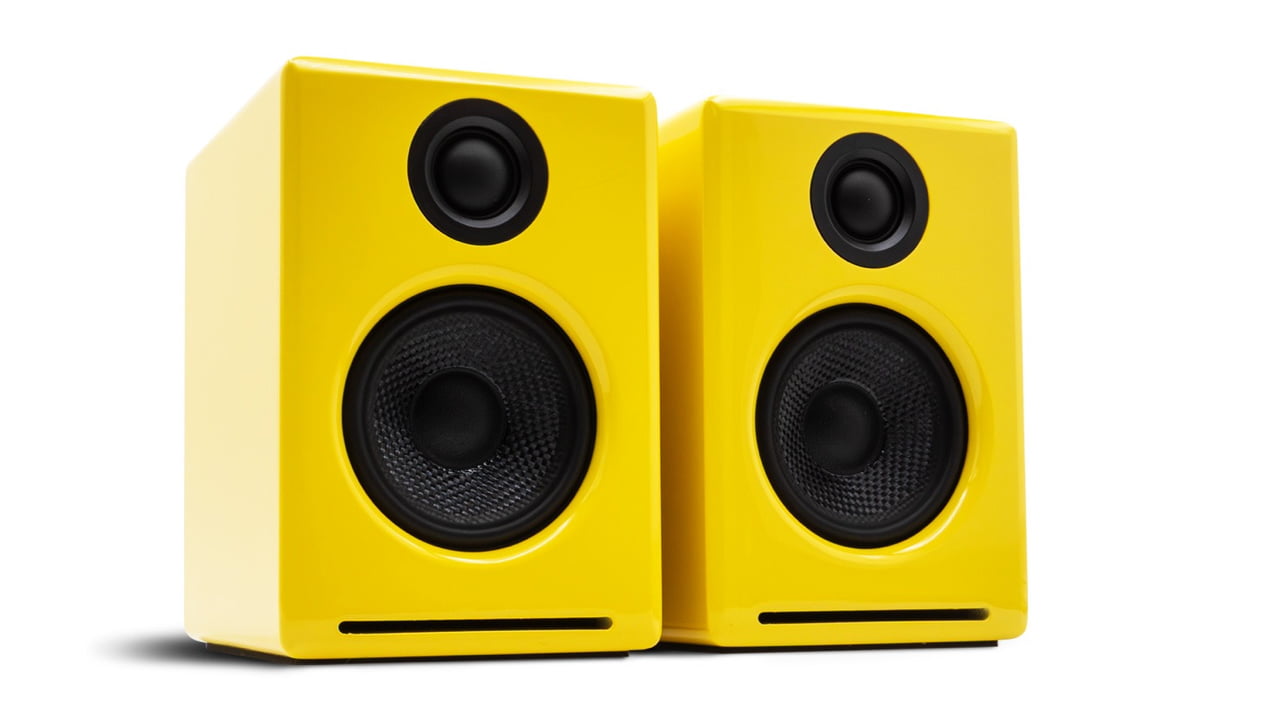
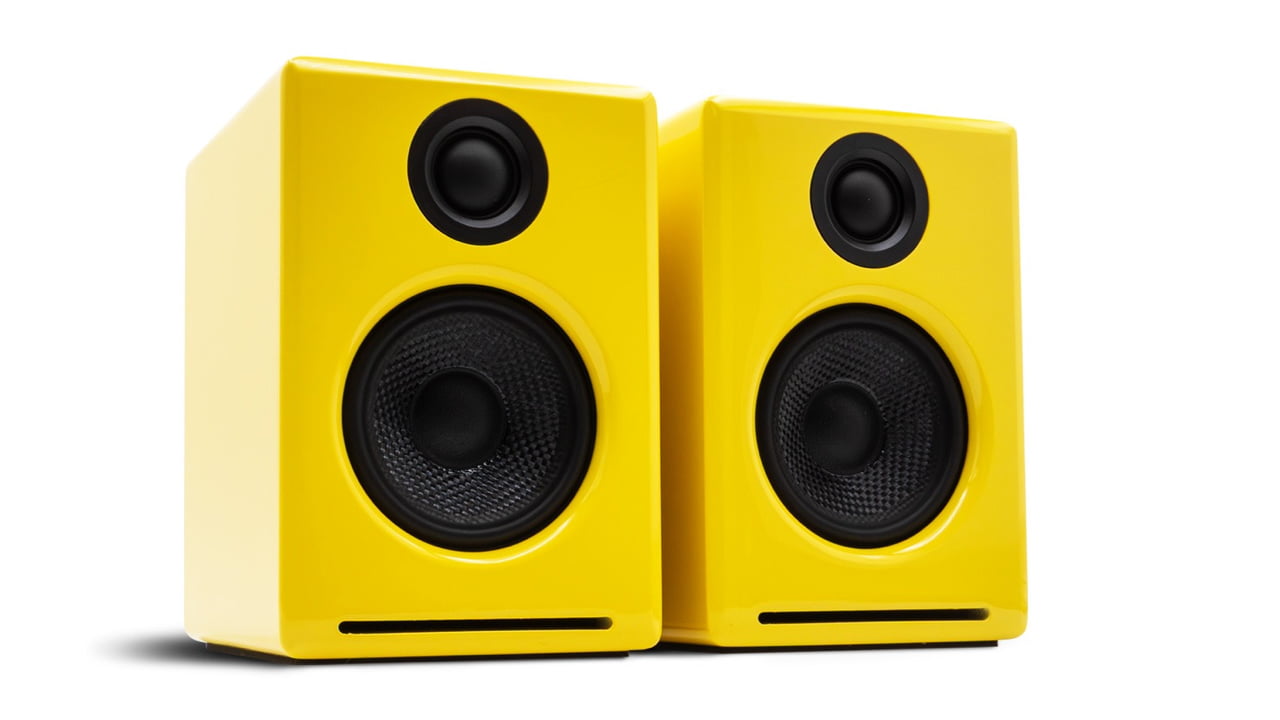
After a winter that still refuses to end with record-breaking cold, snow stacked on top of more snow, and the uncomfortable realization that even escaping to the Florida Keys in late-January didn’t feel like enough distance, Audioengine has decided to change the mood. The company just announced its 2026 Color of the Year: Limoncello Yellow, a limited-edition high-gloss finish rolled out across a complete, coordinated listening system created with Crosley.
Call it seasonal defiance. After an industry-wide 2025 where color quietly became the most obvious form of innovation, Audioengine is leaning hard into the idea that design matters when your gear lives in the open and not buried in a rack.
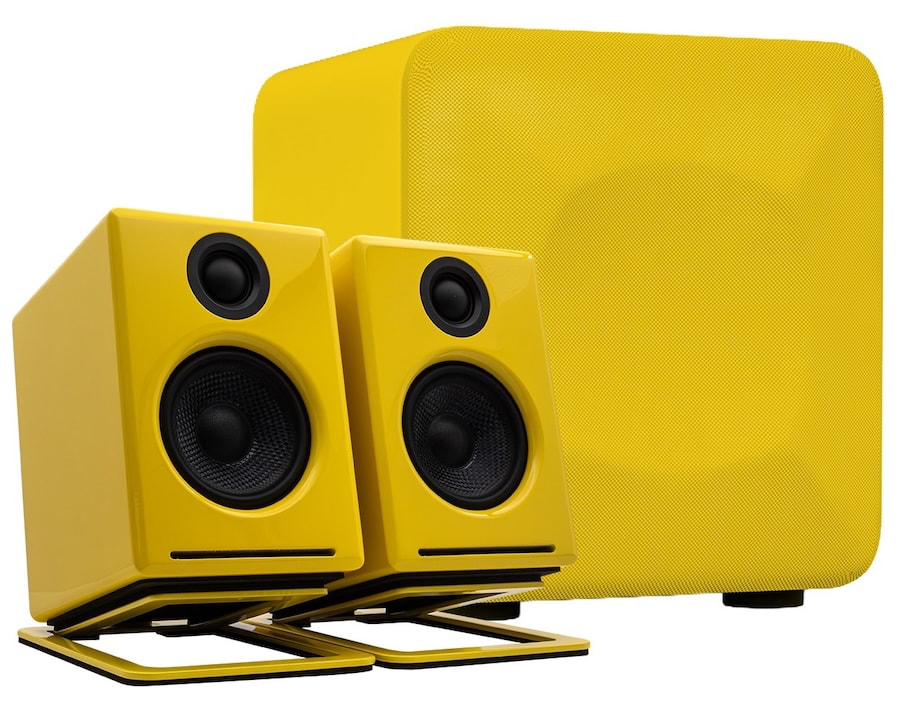
Instead of slapping a fresh coat of paint on one product and calling it a launch, Audioengine went all in. Limoncello Yellow spans the A2+ Home Music System, S6 Subwoofer, DS1M speaker stands, and the Crosley C6 turntable, all finished to match. The result looks intentional rather than improvised; bright without being gimmicky, and perfectly timed for anyone who has seen enough gray skies to last a lifetime. Spring can’t get here fast enough.
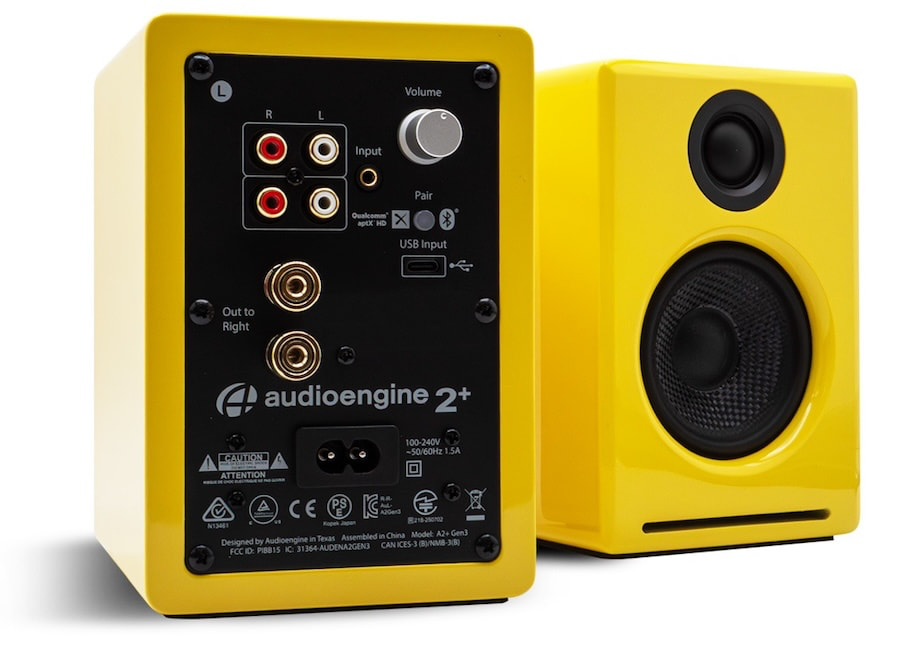
Audioengine A2+ in Limoncello Yellow
And while we’re at it, would it be too much to ask for someone to pass the Limoncello? Not the sad, sugary stuff they sell at the Venice airport, but the real kind that actually takes the edge off while you’re staring across a stone courtyard at Nicole Grimaudo and briefly forgetting that winter still has you in a headlock.
If Audioengine can’t fix the weather, at least they can fix the mood. And honestly, that’s progress.
Advertisement
Each Audioengine product in the collection uses real wood cabinets finished through a 13-step, piano-grade painting process. That means sealing, layered color application, curing, hand polishing, and final inspection done the slow way, because shortcuts show. The same high-gloss finish is applied across the A2+ Home Music System, S6 Subwoofer, and DS1M speaker stands, so the color actually matches instead of playing “close enough” under different lighting.
The Back Story
Audioengine A2+ Desktop Speakers on DS1 Stands in Black
When Audioengine first introduced the A2 Powered Speaker System, it was conceived as a true desktop audio solution; compact enough to sit comfortably beside a computer monitor, measuring only slightly taller than a modern iPhone, yet capable of delivering sound that felt far larger than its footprint suggested.
Back in 2007, that idea wasn’t obvious or common. Dedicated desktop speaker systems barely existed, and most compact speakers were designed to be accessories for larger hi-fi rigs, not standalone solutions. If you wanted better sound at a desk, you usually gave up space, added boxes, or both. The A2 flipped that logic, proving that a small, self-contained system could be practical, intentional, and good enough to live on a desktop without apology.
The goal of Audioengine was to design a desktop audio speaker solution that would provide more than what was expected. As a result of their efforts, the A2 and A2+ have enjoyed the success that inspired Audioengine to provide additional high-performance compact speaker systems such as the A5+, HD3, HD4, HD5, HD6, A1-MR, and more.
Audioengine A2+ Home Music System
The Audioengine A2+ Home Music System ($279 at Amazon) is a compact, powered speaker system designed for desks, shelves, and smaller rooms where space is tight but expectations aren’t. Each speaker delivers 20 watts RMS per channel into 4 ohms, with 30 watts peak, for a total of 60 watts peak output. That’s more than enough for nearfield listening, apartments, or office setups without pretending it’s trying to replace a full-size system.
Connectivity is straightforward and flexible. Bluetooth 5.3 is on board with support for aptX Adaptive, aptX HD, standard aptX, AAC, and SBC, so wireless playback works well whether you’re on Android, iOS, or a laptop. Wireless range stretches to about 100 feet (30 meters) under good conditions, which is genuinely useful unless you’re trying to stream through walls. For wired sources, you get USB-C digital audio supporting up to 24-bit/96kHz, plus RCA and 3.5mm analog inputs, making it easy to connect computers, streamers, turntables with built-in phono stages, or just about anything else with an output.
Advertisement
Advertisement. Scroll to continue reading.
Digital conversion is handled by a PCM5100A DAC, chosen for reliability and clean performance. Noise and distortion stay well under control, with a signal-to-noise ratio greater than 95 dB and THD+N below 0.05 percent at all power levels. Frequency response runs from 65 Hz to 22 kHz, which is realistic for a speaker this size and pairs naturally with a subwoofer like Audioengine’s S6 if you want more low-end weight.
Driver duties are handled by 2.75-inch aramid fiber woofers and 0.75-inch silk dome tweeters with neodymium magnets, tuned for clarity and balance rather than artificial hype. Protection circuits cover output current, thermal limits, and power on or off transients, so the system behaves itself even when pushed.
Physically, each speaker measures 6 x 4 x 5.25 inches (H x W x D), which explains why the A2+ works so well on desks without turning into visual clutter. In the Limoncello Yellow edition, those real wood cabinets go through Audioengine’s 13-step, piano-grade finishing process, resulting in a deep, high-gloss surface that actually holds up over time.
Advertisement
Audioengine S6 Compact Subwoofer
The Audioengine S6 Compact Subwoofer ($299 at Amazon) is designed for small spaces and compact systems, and yes—it actually works on a desk. Measuring 10 x 8.7 x 10 inches and weighing just over 15 pounds, it fits under or beside a desk without getting in the way, something we’ve done ourselves without regret.
A front-firing 6-inch driver in a sealed cabinet is powered by a Class D amplifier rated at 140 watts RMS (210 watts peak), delivering controlled bass down to 33 Hz. Adjustable volume, crossover (40-130 Hz), and phase (0-180 degrees) controls make it easy to integrate with small powered speakers or compact systems from Audioengine and other brands.
Connectivity is straightforward with RCA/LFE and 3.5 mm inputs, and while the S6 isn’t wireless by default, it can be made wireless using Audioengine’s W3 transmitter/receiver kit ($149). Power consumption drops below 1 watt at idle thanks to auto-sensing standby, and the 15 mm MDF cabinet keeps things solid without adding bulk. It’s a practical subwoofer for desks, apartments, and small rooms where space matters as much as sound.
Crosley C6 Turntable
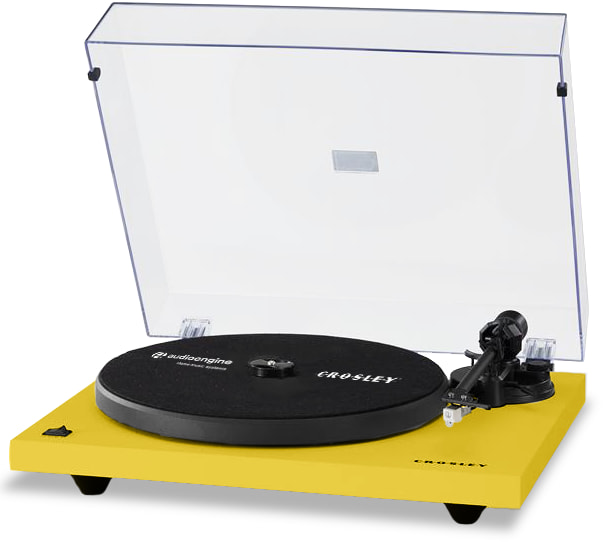
The Crosley C6 Turntable is a manual, two-speed record player built around a straightforward analog design. It uses an audio-grade MDF plinth paired with a heavy steel platter to provide a stable platform for vinyl playback. A belt-driven, low-vibration motor sits beneath the platter and supports 33-1/3 and 45 RPM records, keeping operation simple and consistent without automation getting in the way.
Setup is hands-on but not complicated. The tonearm features an adjustable counterweight and anti-skate, and the table comes with a pre-mounted Audio-Technica cartridge, so you’re not starting from scratch. Connectivity is flexible, with a built-in, switchable phono preamp for direct connection to powered speakers or integrated amplifiers, along with RCA outputs for systems that already have a phono stage. Bluetooth is also built in for wireless playback when convenience matters more than cabling.
The C6 isn’t trying to be clever or overdesigned. It’s a clean, manual turntable that fits neatly into compact systems, especially paired with powered speakers, and does its job without demanding constant attention. In the Limoncello Yellow finish, it adds visual cohesion to the setup while keeping the focus where it belongs—on playing records.
Advertisement
Audioengine A2+ speakers on DS1M stands with S6 subwoofer
The Bottom Line
What you’re buying here is a cohesive compact system that handles both analog and digital sources without setup issues. The Audioengine A2+ speakers are a time-tested design that many audiophiles and more than a few hi-fi editors still rely on for desktops and secondary systems because they’re consistent, balanced, and easy to live with. They’re only “underrated” by people who haven’t lived with them.
This setup is for listeners who want vinyl, streaming, and computer audio in one small footprint for desks, offices, apartments, or second systems where space matters but sound still counts. Add the S6 for low-end support and the Crosley C6 for analog playback, and you get a system that covers real-world listening needs without excess, complexity, or pretending to be a full-scale hi-fi rig.
Bili House is a hacker house located on the water in Bellevue, Wash. (Photo courtesy of Bili House)
A large house overlooking Meydenbauer Bay in Bellevue, Wash., could be the home of the Seattle-region’s next big AI startup. At the very least, it’s a place where ideas are being hatched by tech founders who are inspired by living and working with one another.
Bili House is a hacker house started by a group of young people interested in improving connections and opportunities in the Seattle-area startup community.
The 7,000-square-foot waterfront house, complete with swimming pool and boat dock, features five bedrooms and co-working space. It’s already serving as a gathering space for events and workshops for such things as learning to vibe code. And applications are open for a first cohort of four to six teams.
The house was launched by four founders: Sylviane Zhao, who recently graduated from Cornell University, and Shawn Yang and Tehani Cabour, who both worked at French software giant Dassault Systèmes. They’re working together on projects including CodeChimp, a project management platform that aims to turn vibe coding into a “multiplayer experience” by using multi-agent orchestration and other AI-powered tools. Last fall they were part of a Plug and Play cohort in Seattle. Jatin Kumar is the fourth founding member and a Z Fellow.
“We’re just trying to get the early stage startup scene kick started here in Bellevue,” Yang told GeekWire.
Advertisement
“Every morning you wake up, you just go upstairs from your room and start working with each other,” Zhao added. “Everything is 24/7, and it’s very accessible.”
Startup founders working out of Bili House include, from left, Julian Toro (community volunteer), Shawn Yang (founding member and community manager), Armand Noureldin (director of events), Sylviane Zhao (founding member), Tehani Cabour (founding member), Jatin Kumar (founding member), Kalin Isbell (creative director), and Sasi Thomala (community volunteer). (Photo courtesy of Bili House)
Yang said that before starting the hacker house, they were considering a move to San Francisco. He joked that the money they’re paying for the house in Bellevue would get them a two-bedroom apartment in the Bay Area.
“I was living in San Francisco back in 2022-23 and I established rooms in different hacker houses. That really changed my perspective,” Yang said, adding that he feels like there are more startup “doers” than just “talkers” choosing to live and work this way.
The group found the rental house on Zillow last year after realizing they could pay less together than they were for separate apartments. They pooled their resources and are bootstrapping the hacker house expenses.
The hacker house idea is not a new concept, especially in Silicon Valley where communal living for the tech-inclined has long been a way to incubate the next big thing. And it’s been tried in the Seattle area. Tech veteran Andy Rebele (Pure Watercraft) ran a few different spaces more than a decade ago, including on Capitol Hill and in the University District.
Advertisement
Seattle startup Tune also ran a house in 2015 near the University of Washington for women studying computer science. The desire for houses geared specifically toward female entrepreneurs continues today with FoundHer House, a San Francisco-based space spotlighted by The New York Times last year. Seattle is on the radar for potential expansion.
The Bili House website says rent ranges from $500 to $2,000 per month depending on room size. Amenities include utilities, high-speed internet, access to all common spaces, and community events. A minimum stay is three months.
In addition to events such as demo nights, founder dinners, and hackathons, the group is looking into partnerships, perhaps with a venture capital firm that could help defer some costs for startup founders. Bili House is also running a marketplace to connect renters to hacker spaces in other cities.
Other AI startups currently working out of Bili House include legal simulation platform LexSims and construction cost analysis company Bevr.
Advertisement
“I really just enjoy the culture,” Yang said. “I think it’s nice to have people building alongside you, and to be able to share experiences, as well as skill sets, especially in today’s age. It really helps to stay connected in the community, to encourage each other.”
After mentioning parking can be a bit of a constraint at the location, Yang offered up a hack for commuting to or from Bili House.
“University of Washington is 10 minutes by boat. Driving is like 30 or 40,” he laughed.
Proofpoint uncovered fake RMM tool “TrustConnect” built as cover for RAT malware
Criminals created website, paid for certificate, tricking firms into $300/month subscriptions
Tool gave attackers full remote control; linked to Redline infostealer customer
A group of cybercriminals went to great lengths to infect businesses with a remote access trojan (RAT), setting up an entire company, vibe-coding a website, and paying thousands for a legitimate certificate.
In its report, Proofpoint said it was fairly common for cybercriminals to use legitimate remote monitoring and management (RMM) tools in their tech stack. They would trick their victims into installing their tool of choice and sharing login credentials which would enable them to deploy all sorts of stage-two malware, including infostealers, remote access trojans, or ransomware.
However, what researchers haven’t seen before is criminals building an entirely new product, website and all, that looks legitimate on the surface, but is actually completely malicious. Yet that is exactly what TrustConnect is.
Subscribing for a RAT
“Initially, TrustConnect appeared to be another legitimate RMM tool being abused,” Proofpoint explained.
“Given the sheer number of existing remote administration tools available for threat actors to choose from, and their prevalence in the threat landscape, it could have made sense.”
The crooks built a .com website, and applied for a certificate, paying “thousands of dollars” and going through “additional levels of validation on behalf of the domain holder”. The certificate was revoked on February 6, but any files signed before that date remain valid, it was said.
Advertisement
Companies that don’t spot the trick will actually end up paying $300 a month to use the RMM. What they’re getting instead is a RAT backdoor that grants the attackers full mouse and keyboard controls, as well as the ability to record and stream whatever is on the victim’s screen. Furthermore, the tool provides all the usual RMM features such as file transfer, command execution, or user account control bypass.
Sign up to the TechRadar Pro newsletter to get all the top news, opinion, features and guidance your business needs to succeed!
While it is impossible to know for certain, Proofpoint said it was “moderately confident” that TrustConnect was developed by a VIP customer of Redline, a popular infostealer.
Douglas Trumbull’s 1972 sci-fi film appeared just as space tales were becoming increasingly cold and remote. Silent Running changed that by firmly rooting its futuristic vision in the kind of realistic, beat-up features found in everyday life. On board the Valley Forge, a gigantic converted cargo based on a real, retired aircraft carrier, the sets appeared to be in constant use. The pipes, consoles, and congested halls appeared practical rather than sleek. This method lured the viewer into a world that seemed plausible, one in which technology serviced human needs rather than the other way around.
Trumbull, who had recently completed the psychadelic effects work on 2001: A Space Odyssey, simply wanted to warm things up. He directed his debut picture with a strong emphasis on connecting with the characters on an emotional level. Bruce Dern plays Freeman Lowell, a botanist tasked with caring for the last of Earth’s trees, which happen to be floating in geodesic domes in space. When orders are issued to burn them down, Lowell takes great measures to do the right thing and save the flora. He has some unexpected assistance in the form of three small maintenance drones, Huey, Dewey, and Louie, who become his crew. Actors with amputations wore custom suits, so the machines all looked awkward and endearingly jerky in their movements, giving them a feeling of personality without the use of words.
Those little drones created an effect, and George Lucas even drew influence from them while designing R2-D2. The idea of a little, expressive robot that communicates through beeps and body language rather than words originated with the Silent Running helpers. Lucas even secured Trumbull’s permission to create a comparable figure. R2-D2 exudes the same quiet commitment, transforming a tool into a friend.
Not only did the robots have an impact, but the film’s visual language was also highly significant. Trumbull’s team created these extremely accurate miniatures with genuine texture and hundreds of model kit parts mixed together for surface detail, then shot them using a variety of unique approaches. John Dykstra, a young effects artist on Silent Running, went on to manage the special effects team for Star Wars. He introduced motion control photography and a dynamic camera approach, making spaceships feel alive during dogfights. Many of the personnel from Trumbull’s workshop ended up joining ILM, bringing some of the practical model work and devotion to realism with them.
Star Wars captured that lived-in feel on board, with spaceships displaying signs of wear, filth, and maintenance. The interiors felt industrial and utilitarian, similar to the Valley Forge’s carrier-inspired designs. The Death Star’s huge, metallic halls provide the same feeling of scale and function. This trend away from clean, polished futures and toward ones that were torn and worn became the genre’s new standard.
Many other films followed suit, such as Alien, which adopted the gritty, no-nonsense appearance of a working-class spaceship with crew members whining about wages and conditions. Blade Runner expanded the detailed, evocative surroundings. WALL-E paid respect by depicting a lonely robot maintaining a fragile plant in a destroyed planet. Even Interstellar and Avatar continue the environmental concern that Silent Running raised, highlighting our duty to nature in the face of technological advancement. [Source]
TerraClear’s autonomous field robot the TerraScout. (TerraClear Photo)
TerraClear’s mission to help farmers map and tackle tough field problems such as rocks and weeds has evolved with the launch of a new machine: an autonomous robot called TerraScout.
The startup, based in Issaquah, Wash., and Grangeville, Idaho, says the device can collect ultra-high-resolution imagery across an entire field and convert the data into plans which can be executed by existing farm equipment, such as its rock picker or existing sprayers.
Founded in 2017 with the goal of simplifying the laborious task of removing large rocks from farmers’ fields, TerraClear has expanded into AI-powered identification and management of weeds using the same tech stack.
“TerraScout will scout entire fields in almost any condition and turn that intelligence into precise action for existing crews and equipment,” TerraClear CEO Devin Lammers said in a new release Thursday. “Today we focus that output on rock and weed management, but the future applications for this platform are vast. It is my firm belief that this technology will drive the next era of farm productivity gains.”
TerraClear says the robot can collect more than 4 billion image samples per acre and map over 1,000 acres per day at speeds of up to 15 mph. TerraScout can operate autonomously for up to six hours without refueling. Onboard technology turns massive image datasets into actionable maps in real-time.
Advertisement
TerraClear was founded by Brent Frei, the former CEO of Onyx Software and co-founder of Smartsheet. The initial focus was on its rock picker hardware, which can mount to a variety of machines and pick hundreds of rocks per hour, and its AI-powered mapping of fields where those rocks can cause expensive damage to machinery.
Lammers, a longtime leader in the agriculture technology industry, took over as CEO in August 2024.
The company, which employs about 50 people and has raised about $53 million to date, is not sharing revenue numbers, but is closing in on 1,000 customers.
Field trials for TerraScout began earlier this year and TerraClear said it will expand trials to existing retail partners and select farm customers this spring.
The U.S. Cybersecurity and Infrastructure Security Agency (CISA) ordered government agencies to patch their systems within three days against a maximum-severity Dell vulnerability that has been under active exploitation since mid-2024.
According to security researchers from Mandiant and the Google Threat Intelligence Group (GTIG), this hardcoded-credential vulnerability (CVE-2026-22769) in Dell’s RecoverPoint (a solution used for VMware virtual machine backup and recovery) is being exploited by a suspected Chinese hacking group tracked as UNC6201.
After gaining access to a victim’s network in CVE-2026-22769 attacks, UNC6201 deploys several malware payloads, including a newly identified backdoor called Grimbolt. This malware is built using a relatively new compilation technique that makes it harder to analyze than its predecessor, the Brickstorm backdoor.
While the group swapped Brickstorm for Grimbolt in September 2025, it’s not yet clear whether this switch was part of a planned upgrade or “a reaction to incident response efforts led by Mandiant and other industry partners.”
“Analysis of incident response engagements revealed that UNC6201, a suspected PRC-nexus threat cluster, has exploited this flaw since at least mid-2024 to move laterally, maintain persistent access, and deploy malware including SLAYSTYLE, BRICKSTORM, and a novel backdoor tracked as GRIMBOLT,” they said.
Advertisement
The security researchers have also found overlaps between UNC6201 and the Silk Typhoon Chinese state-backed cyberespionage group (although the two are not considered identical by GTIG), also tracked as UNC5221 and known for exploiting Ivanti zero-days to target government agencies with custom Spawnant and Zipline malware.
CISA has now added the security flaw to its Known Exploited Vulnerabilities (KEV) catalog on Wednesday and ordered Federal Civilian Executive Branch (FCEB) agencies to secure their networks by the end of Saturday, February 21, as mandated by Binding Operational Directive (BOD) 22-01.
“These types of vulnerabilities are frequent attack vectors for malicious cyber actors and pose significant risks to the federal enterprise,” CISA warned on Wednesday.
Advertisement
“Apply mitigations per vendor instructions, follow applicable BOD 22-01 guidance for cloud services, or discontinue use of the product if mitigations are unavailable.”
Hacktron, which reported the vulnerability on January 31, warned in early February that around 11,000 BeyondTrust Remote Support instances were exposed online, and that around 8,500 were on-premises deployments that required manual patching.
Modern IT infrastructure moves faster than manual workflows can handle.
In this new Tines guide, learn how your team can reduce hidden manual delays, improve reliability through automated response, and build and scale intelligent workflows on top of tools you already use.
The good folks over at Adafruit are raising the alarm about a new New York State 3D printing law that could greatly imperil the public’s freedom to tinker and could generally make life way more annoying for the schools, libraries, hospitals, small businesses, hobbyists, and garages that utilize 3D printers.
New York’s 2026–2027 executive budget bill (S.9005 / A.10005) includes language requiring that all 3D printers operating in the state need to include software or firmware that scans every print file through a “firearms blueprint detection algorithm” and then locks the hardware up so it refuses to print anything it flags as a potential firearm or firearm component.
“A firearms blueprint detection algorithm would need to identify every possible firearm component from raw STL/GCODE files, while not flagging pipes, tubes, blocks, brackets, gears, or any of the millions of legitimate shapes that happen to share geometric properties with gun parts. This is a classification problem with enormous false positive and false negative rates.”
NY’s new law would apply to open source firmware like Marlin, Klipper, and RepRap, which are generally maintained by volunteers without the resources for compliance. As well as office printers that never touch the internet, or CNC milling machines that can basically generate any shape you can imagine.
Advertisement
Torrone goes on to explain how the bill could be dramatically improved by exempting open source firmware, and focusing more concretely on the intent to create fire-arms, instead of waging an impossible enforcement war on ambiguous shapes. They’re also recommending limited liability for retailers, schools, and libraries, and the elimination of mandatory file scanning:
“But the answer to misuse isn’t surveillance built into the tool itself. We don’t require table saws to scan wood for weapon shapes. We don’t require lathes to phone home before turning metal. We prosecute people who make illegal things, not people who own tools.
The Open Source 3D printing community probably does not know about this. OSHWA and other open source advocacy orgs have ignored many of the things we really need their help with. That needs to change. This bill is in early stages — the working group hasn’t even convened yet. There’s time to work together, in the open, for amendments that make sense.”
Random aside: it’s worth reminding folks that this proposal comes on the heels of a recently passed New York State “right to repair” law (supposed to make it easier and cheaper to repair technology you own) that Governor Kathy Hochul basically lobotomized at lobbyist behest after it was passed, ensuring it doesn’t actually protect anybody’s freedom to tinker.
For three days in February, porn star Alix Lynx flew to Miami for her first exclusive creator gathering where she was in full grind mode: shooting Reels and talking strategy with other creators. “It was kind of like SoHo House for OnlyFans girls,” she says of the experience, which is called The Circle and drew more than a dozen sex workers, including Remy LaCroix and Forrest Smith.
Lynx, who is a former webcam model turned OnlyFans starlet, has a combined 2 million followers across Instagram, TikTok, and X. She joined OnlyFans in 2017 with “the luxury of having my own following,” she says, but those numbers haven’t always translated to subscriptions. It’s why she was in Miami.
“I don’t think people understand. I do a shitload of marketing,” Lynx says.“That’s the big misconception with OnlyFans—when creators join they think it’s going to be easy. But unless you’re a genius at marketing on social media, which is few and far between, it’s genuinely hard to get found and gain a following.”
Many of OnlyFans’ 4 million creators have said the same thing: native discovery on the platform sucks. “There’s just a frustration,” Lynx says. “In a perfect world, there would be that searchability feature because it makes it an even playing field for creators.” (According to OnlyFans, the platform limits its search feature as a safety precaution so users don’t accidentally stumble across content they didn’t intend to see.)
Advertisement
It’s a problem that Presearch—a free, private, decentralized search engine—wants to fix with the launch of its image-based discovery tool Doppelgänger.
Doppelgänger is the newest addition to Presearch’s Spicy Mode, a NSFW feature for searching adult content. Users can upload an image of a celebrity—or any person they think is hot—to find OnlyFans creators that resemble them. The technology matches the user with similar creators who want an audience rather than to deepfake platforms that are nonconsensual and illegal. Ever wondered who Sabrina Carpenter’s or Pedro Pascal’s porn doppelgängers were? Wonder no more.
According to the company, Doppelgänger is built with specific guardrails—no tracking what users search, explicit age-gating—and runs on Presearch’s decentralized index, “which surfaces content traditional search engines and commercial AI suppress,” says Brenden Tacon, head of product and business development at Presearch.
“We’re trying to offer a place where you might serendipitously become discovered,” Tacon tells WIRED. “You won’t on OnlyFans. If you’re hustling yourself on Instagram, Reddit, and all these places, it’s so hard to break through the noise.”
Advertisement
With 300,000 daily active searches on Presearch—according to the company—Doppelgänger is one of the first tools on the market pushing for ethical discovery of adult creators at scale. Unlike traditional reverse image tools that scan across the open web to locate where a photo appears or attempt to trace someone’s identity, Doppelgänger does not search the broader internet, does not surface personal information, and does not attempt to identify a person. “It simply returns visually similar public profiles based on image features, making it structurally more limited and, in many ways, more privacy-protective than a standard reverse image search,” Tacon says.
Still, the accuracy of Doppelgänger could use some improvement. In multiple tests run by WIRED, the AI seems better tailored to find matches for women than men. I had no problem finding look-alikes for Cardi B and Sydney Sweeney. But when searching for Michael B. Jordan look-alikes, it suggested female creators Chanell Heart (the number 3 match) and Chamile Symone, in addition to Uncut Jock NYC, a white-presenting Brazilian sex worker. In fact, five women were suggested among Jordan’s top 40. Curious if this was a glitch, I dragged a photo of actor Jeff Goldblum—a perennial “hottie,” according to the subreddit r/VintageLadyBoners—into the image finder, and the top search result was for Jean B, a self-described “twink content creator,” followed by 38 suggestions of large-breasted women. (A second search for Goldblum—who, for what it’s worth, is more zaddy than twink—with a different photo, did not fare any better; the lone male “look-alike” was for YCC, who is Chinese.)
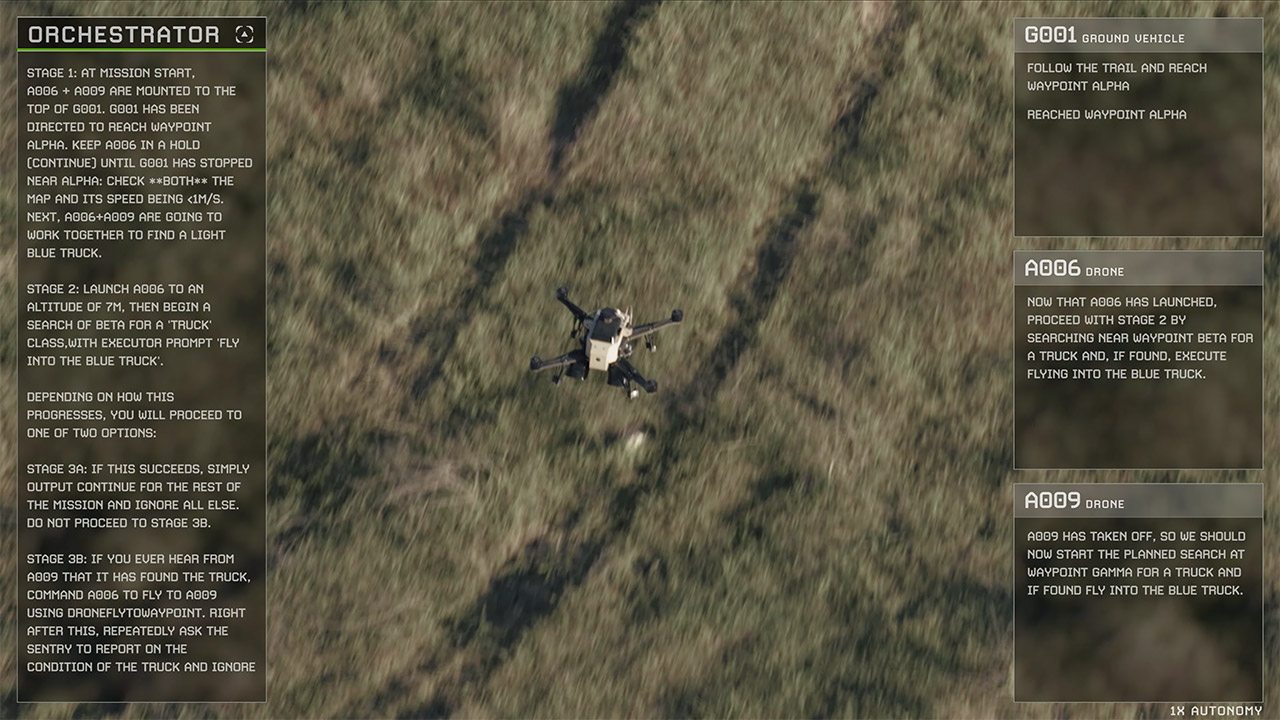
A low-key demonstration high in the hills of central California recently showcased some new military technology. Scout AI, a new defense startup, integrated its Fury software into a self-driving ground vehicle and two armed drones. The entire system collaborated to hunt down a truck and blow it up, all activated by a single simple instruction written in plain English.
Fury serves as the central coordinator. A commander types or speaks a goal, such as sending a vehicle to a spot and launching drones to strike a specific target, and Fury takes care of breaking it all down into individual steps, assigning tasks to the machines, monitoring what’s going on through video feeds and data, and stepping in to adjust things as needed. One drone detects the truck, Fury reroutes the others, and the strike is launched. A human is present to keep an eye on things, but the majority of the specifics are handled by machines on their own.
Due to platform compatibility issue, the DJI Fly app has been removed from Google Play. DJI Neo must be activated in the DJI Fly App, to ensure a…
Lightweight and Regulation Friendly – At just 135g, this drone with camera for adults 4K may be even lighter than your phone and does not require FAA…
Palm Takeoff & Landing, Go Controller-Free [1] – Neo takes off from your hand with just a push of a button. The safe and easy operation of this drone…
Fury’s approach is based on large AI models that have been taught to figure out what’s going on in a scene, devise a plan, and provide directions. The largest model, with over 100 billion parameters, functions similarly to the mission commander in that it accepts the command and begins working. It then assigns jobs to smaller models, each with approximately 10 billion parameters, which run directly on the various machines. The smaller models then handle movement, navigation, and the final explosive release. The system employs conventional cameras rather than expensive sensors, and it can connect to a variety of devices without interfering with their built-in functions. Fury just examines the technical specifications for each platform and determines the appropriate commands to deliver to their systems.
Advertisement
Everything in the test was real, done on actual equipment in tough terrain, with no pre-scripted situations, fake special effects, or constant human steering. The ground vehicle followed a dirt road, unleashed the drones, and set off to search. Once the truck arrived, one of the drones zeroed in and detonated its payload on impact, capping off the mission with a rapid damage assessment. The entire process went well, demonstrating how well the program can handle a variety of air and ground units from various manufacturers.
Scout AI created Fury to address a long-standing issue with unmanned systems. Older setups rely on tight, unchanging code that adheres to rigorous rules, so when things change or unanticipated challenges arise, they struggle. Fury allows the machines to think through difficulties, devise new solutions, and adjust to changing situations while remaining focused on the reward. It also simplifies communication, even when things get hectic, and scales up to larger groups working in different venues.
Colby Adcock, who co-founded the company with Collin Otis, describes the transition as follows. AI bots are already quite good at managing jobs in simulated environments, and Fury brings that same adaptable brainpower to real-world operations for American forces. The software serves as a buffer between command systems and machines, allowing units from all around to collaborate as a single team under human supervision. [Source]