


Sales of Hannah Arendt’s The Origins of Totalitarianism (1951) rocketed when Donald Trump won the 2016 US presidential election. Nearly a year into the second Trump administration – and 50 years since Arendt’s death in December 1975 – it seems like an apposite time to revisit the book and see what light it sheds on 2025.
The book is brilliant but difficult, combining history, political science and philosophy in a way that can be very disorientating. So what might we, as democratic citizens, gain from reading it?
Born to a secular German Jewish family in 1906, Arendt studied philosophy under Martin Heidegger and Karl Jaspers before turning to Zionist activism in Berlin in the early 1930s. After a brush with the gestapo, she fled to France, and in 1941 left Europe for the US. So when she began researching Origins in the early 1940s, she was no stranger to totalitarianism.
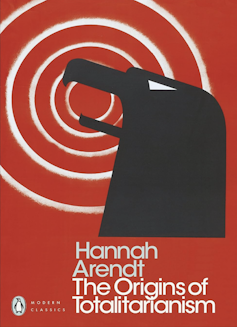
Penguin
Totalitarianism, she argued, was a radically new form of government distinguished by its ideological conception of history. For the Nazis, history was a clash of races; for Stalinism, it was class war. Either way, totalitarian leaders sought to execute historical “laws” by forcibly reshaping the humans they ruled.
Humanity, Arendt said, is distinguished by its infinite variability – no person can ever entirely substitute for another. Totalitarianism aimed to destroy this. It isolated individuals, dissolving the bonds through which they unite and empower each other, and sought to extinguish human personhood.
The concentration camps’ total domination did so by reducing each inmate to “a bundle of reactions that can be liquidated and replaced” before killing them. With everyone ultimately subject to this threat, totalitarianism rendered the human person as such, superfluous.
Rather than pursuing stability, totalitarianism was always a movement, constantly instigating change. When its propaganda collided with facts, it brutalised reality until the facts conformed. Its ideal subjects not only believed its lies: they no longer found the distinction between truth and falsehood meaningful. This was “post-truth politics” at its most extreme.
Common sense won’t save us
Comparing today’s politics to fully fledged totalitarianism can be illuminating. But if it’s all we do, we risk overlooking Arendt’s subtler lessons about warning signs that can help us gauge threats to democracy.
The first is that political catastrophe isn’t always signposted by great causes, but arises when sometimes seemingly trivial developments converge. The greatest example for Arendt was political antisemitism. During the 19th century, only a “crackpot” fringe embraced it. By the 1930s, it was driving world politics.
This resonates with hard-right and far-right ideology today. Ideas widely seen as eccentric 20 years ago have increasingly come to shape democratic politics. Anti-immigrant sentiment and xenophobia penetrate the political mainstream. Alongside growing Islamophobia, antisemitism is on the rise again too.

Granger Historical Pictorial Archive / Alamy
The mainstreaming of previously marginal views helps explain a second warning sign that politics is increasingly driven by what Arendt described as “forces that cannot be trusted to follow the rules of common sense and self-interest”.
A simplistic politics of ideological fantasy and paranoia takes over instead. It appeals most to the isolated and lonely, people lost in society who have given up hope that anyone will ever address their real interests and concerns. Perpetually frustrated by reality, they seek escape in conspiracy theories instead.
Arendt’s story resonates with There Is Nothing For You Here, Fiona Hill’s account of the “left-behind” in communities of de-industrialised regions in the US, UK, Russia, and Germany – regions where the far right has grown.
In early 20th-century Europe, similar experiences of powerlessness spread alongside the imperialist embrace of what Arendt called “the limitless pursuit of power after power”. When colonial violence boomeranged back to its European source, the powerless were drawn to leaders who exemplified the violent pursuit of power for power’s sake.
New wine in old bottles
The neo-imperialist flex of a US government executing civilian boat crews in international waters while deploying regular armed forces domestically to fight crime looks like an appeal to the same instincts Arendt was writing about.
But perhaps Origins’ most important lesson is about trying to understand something radically new using outdated concepts – “interpreting history by commonplaces” as Arendt called it. Faced with a jarringly new style of politics, there is a temptation to explain it away as mere nationalistic excess, for instance. Or as an understandable expression of economic disappointment and one readily addressed with economic remedies.

Joshua Sukoff / Shutterstock
Origins tells instead the story of something much greater than the sum of its parts taking on a terrible life of its own. By trying to reduce it to familiar terms, Arendt said, “the impact of reality and the shock of experience were no longer felt” and people failed to resist when they most needed to.
But this lesson also applies to the idea of totalitarianism itself. It helped Arendt understand the 1940s, but we shouldn’t assume that it will apply directly to 2025. The term totalitarianism could itself distract, rather than mobilising people.
For example, if claiming that Trumpian populism is already totalitarian seems excessively alarmist, then deciding that it isn’t might be excessively reassuring. Either could diminish people’s ability to respond to the demands of the moment.
What we urgently need instead is what Arendt described as “the unpremeditated, attentive facing up to, and resisting of, reality – whatever it may be”. Origins’ greatest lesson is in showing us what that looks like.
The main lesson for 2025 is as much about what Arendt was doing in the 1940s as about what she was saying: actively thinking in the now, and trying to grasp an emergent “something” on its own terms – a threat that is taking shape, but which hasn’t yet fully revealed itself.
This article features references to books that have been included for editorial reasons, and may contain links to bookshop.org; ff you click on one of the links and go on to buy something, The Conversation UK may earn a commission.

Looking for something good? Cut through the noise with a carefully curated selection of the latest releases, live events and exhibitions, straight to your inbox every fortnight, on Fridays. Sign up here.



