





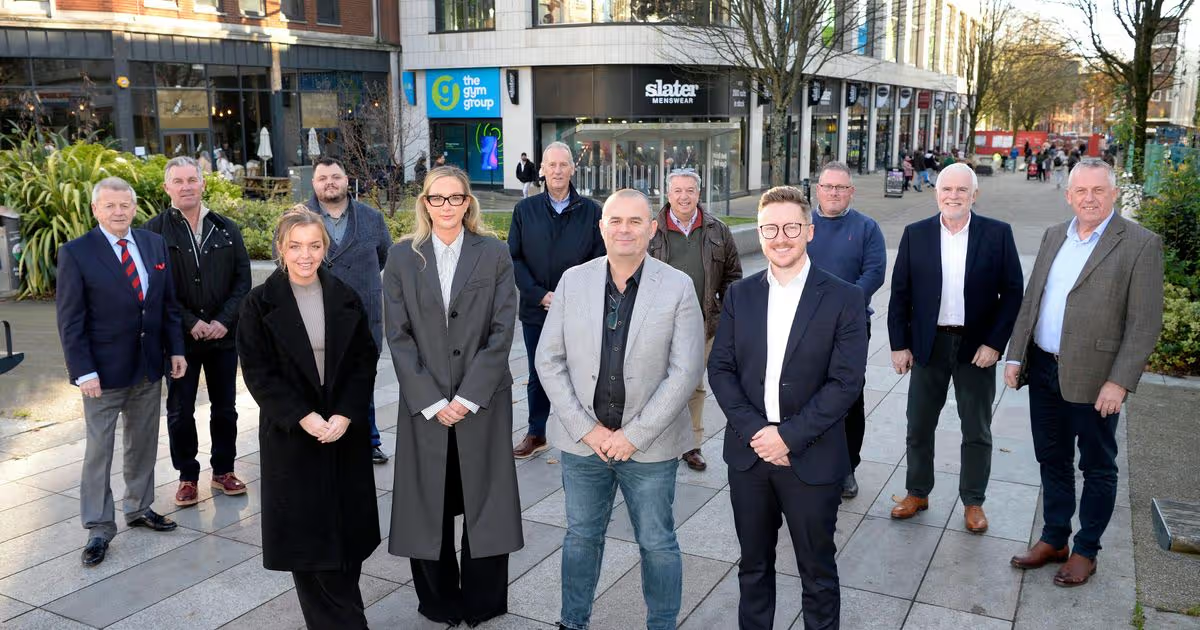
Celtico brings together 12 firms across South Wales that employ more than 1,400 people

A new collaboration giving voice to leading engineering and manufacturing firms in Wales has been established aimed at providing a platform for securing new workloads related to major renewable projects across the UK.
Celtico brings together 12 firms based South Wales. The founding partners employ more than 1,400 skilled people and generate over £250m in annual turnover, spanning capabilities including fabrication, machining, marine engineering, coating, assembly and advanced manufacturing.
Rather than operating as a single company, Celtico has been created as a collaboration, offering developers, contractors and major procuring bodies a single point of engagement backed by the combined scale, capability and experience of its members.
As major renewable and infrastructure projects move from planning into delivery, Celtico aims to ensure Wales is not only ready to participate but positioned as a centre of excellence for high-value engineering, manufacturing and marine capability.
Poltico’s founding partners include 3Ks Engineering Company, Afon Engineering, J.E.S. Group, King Site Services (South West), Ledwood Mechanical Engineering, Mainstay Marine Solutions, Mii Engineering, Pro-Steel Engineering, Rhyal Engineering, Site Heat Treatment Services, Techno Engineering (Jenkins & Davies) and Weldlec. Discussions are already under way with additional companies interested in joining the collaboration.
READ MORE: Largest ever number of renewable projects in Wales backed in UK Goverment auction roundREAD MORE: How a £30m Cardiff Capital Region company contract to demolish Aberthaw Power Station was botched
Celtico is supported by the Swansea Bay City Deal skills and talent Programme, funded by the UK and Welsh Government, and works in partnership with the Regional Learning and Skills Partnership to align industry demand with skills development and workforce growth. With offshore wind capacity set to expand significantly in the Celtic Sea – where developers have options to deliver three floating offshore wind farms with the capacity to power millions of homes – alongside growing opportunities in tidal range, grid infrastructure, hydrogen and carbon capture, developers are increasingly seeking supply chains that can deliver at scale while maximising local content and regional economic benefit.
Celtico said it will offer developers a simplification procurement process, reduce risk and increase certainty of delivery, while also supporting local hiring, skills development and UK-based manufacturing.
Andrew Beer, chairman of Celtico (who is also chair of the regional learning and skills partnership manufacturing cluster), said:“Celtico was created to address a long-standing challenge. Wales has world-class engineering companies, but too often they’ve been too small individually to access major contract packages. By coming together, we can offer the scale, capability and credibility required to compete for and deliver the UK’s most ambitious energy projects.
“This collaboration is about more than winning work. It’s about building a strong, resilient regional supply chain, keeping economic value in Wales, and ensuring local companies and people play a central role in the energy transition.”
Nick Revell, managing director, Ledwood Mechanical Engineering and member of Celtico, added:“Developers are looking for certainty, speed and capability, and that’s exactly what Celtico provides. Our collaborative model gives clients a single, trusted route into a highly skilled regional supply chain, without the complexity of managing multiple contractors.
“At the same time, we’re creating real opportunities for Welsh businesses and workers by aligning delivery with skills, training and long-term capacity building. This is about setting Wales up to succeed not just in offshore wind and tidal range, but across the wider low-carbon economy.”
Ioan Jenkins, executive adviser at Celtico, added:“This is such an exciting project to be a part of, with such potential to make a difference to this region. The world is changing fast, and this venture offers local companies the chance to play their part on delivering the UK’s next generation of renewable energy and low-carbon infrastructure projects.”