Recently published figures for Q3 of the 2025-26 financial year revealed gross gambling yield (GGY) for UK online casinos of £1.5 billion. Will they be able to continue posting such results amid rising costs in the coming months?
The cost of a UK Gambling Commission (UKGC) licence is likely to be increased later this year. It’s the latest piece of bad financial news for UK online casinos. Although the online gambling industry continues to post impressive results, there are also concerns about the dangers of addiction.
Last year saw a new mandatory levy come into force. UK gambling sites reviewed by Dailystoke.com had been making voluntary payments with funds going towards researching gambling harm and treatment of those who have been affected. However, the government felt not all companies were making an equal contribution and introduced a mandatory levy. This is aimed at raising £100 million a year with some of the funds going to the NHS.
Then came the Autumn Budget which included details of a rise in Remote Gaming Duty. A rise had been considered long overdue but companies were shocked when the rate went up from 21% to 40%. This will come into force in April of this year. A further rise in sports betting tax rates will take place next year.
There has been stricter regulation introduced in the past year and more is likely to come into force in the future. One major rule change last year saw maximum stakes for online slots introduced and this year, action has been taken against the bonuses UK online casinos offer.
Advertisement
Financial results published since the maximum stakes for online slots were introduced haven’t been bad news for online casinos. Slots provide a large proportion of GGY for sites and for Q3 the figure was £788 million 10% higher than recorded in the same period 12 months ago.
The average length of sessions for players has fallen from 18 minutes to 16 minutes but sites will be relieved to see the high GGY figure. The overall GGY of £1.5 billion was up from the £1.42 recorded in Q2. However, compared to Q3 of the previous financial year, there was a 2% fall.
Last month saw a consultation period begin regarding a rise in the cost of a UKGC licence. These are required for a company to legally operate in the UK. As you will read, there are many companies who are unlicensed and causing serious problems for the Treasury, legal operators and gamblers.
The UKGC has a tough task regulating the gambling industry and regularly investigates companies who may have committed regulatory breaches. This has seen several companies issued with fines when breaches have been confirmed. With the UKGC also looking to deal with the problems being caused by illegal sites, their costs have been steadily increasing and not been matched by their level of funding, hence the existence of a shortfall that needs to be closed.
Advertisement
That is why they are calling for a rise of an average 30% but there are other options currently being discussed in the consultation period. Other options are a 20% increase and the one that the government prefers. That would see a 30% rise in licence fees but only 20% would be used for commission-related costs with the remaining 10% ring-fenced and only used for specific regulatory priorities. These would include strengthening their enforcement capabilities and taking action against illegal operators.
The UKGC say that if the increase was to be only 20%, this would lead to savings of £15.8 million needing to be made and possibly a 10% cut in staffing levels by 2030-31. They would find it difficult to be able to carry on their current level of investigating suspected regulatory breaches.
How would UK online casinos be affected by a further rise in costs on top of the mandatory levy and tax increases? Stricter regulation is driving players to the black market and that is a worrying problem for the legal sites. It’s not good news for players either as the levels of customer protection are not as high as they do not need to adhere to the new rules. The Treasury does not receive any mandatory levy or tax contributions so a strong UKGC is needed to lead the fight against the illegal operators.
Top companies such as bet365, Flutter Entertainment and Entain are global businesses. If the levels of regulation continue to increase as well as the higher costs, they may be forced to make cuts in the UK and concentrate more on overseas interests in South America, the USA and Asia.
The dollar was trading near a two-week high as the minutes of the Federal Reserve’s meeting last month showed several policymakers were open to potentially raising interest rates if inflation remains elevated.
“The mere suggestion that the key interest rate could rise again is obviously making some market participants sit up and take notice,” Commerzbank’s Antje Praefcke said in a note.
A rate cut in March appears unlikely and the market isn’t even fully pricing in two rate cuts this year, she said. Friday’s U.S. PCE inflation and fourth-quarter U.S. economic growth data could boost the dollar further if they exceed expectations, she said.
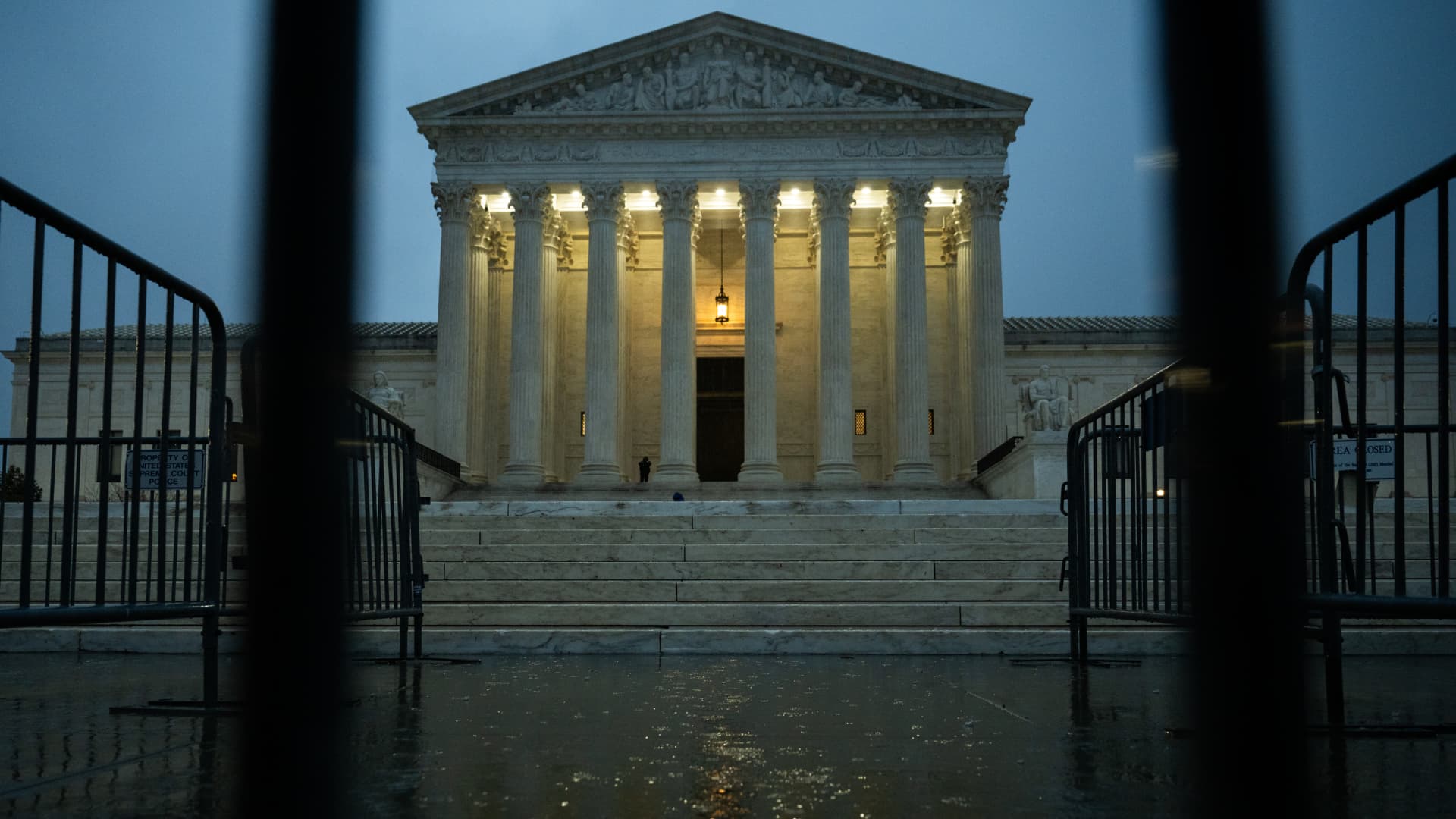
The Supreme Court during a rain storm in Washington, Feb. 20, 2026.
Annabelle Gordon | Bloomberg | Getty Images
The Supreme Court on Friday ruled that President Donald Trump’s country-specific “reciprocal” tariffs are unconstitutional, delivering a win for many consumer companies facing higher import costs.
Advertisement
But the ruling doesn’t cover all sectors.
The Supreme Court reviewed tariffs enacted under the International Emergency Economic Powers Act of 1977, or IEEPA, which the Trump administration used to justify the sweeping tariff agenda. The act had never before been used by a president to impose tariffs.
In a 6-3 decision, the Supreme Court ruled that IEEPA “does not authorize the President to impose tariffs.”
Still, the Supreme Court’s ruling does not cover tariffs enacted under Section 232 of the Trade Expansion Act of 1962. Those duties are intended to target specific products that threaten national security, and they remain in effect after Friday’s ruling.
Advertisement
Separate from his country-specific rates, Trump has raised tariffs on imports of steel, semiconductors, aluminum and other products deemed to impair national security.
Here are the sectors still facing higher levies even after the Supreme Court decision.
Autos
It’s not immediately clear how much the decision will impact the U.S. and global automotive industry. The industry continues to face billions of dollars in tariff costs, depending on where an imported auto part or vehicle originates.
The Trump administration last year broadly implemented 25% tariffs on vehicles and certain auto parts imported into the U.S., citing national security risks. It has since struck independent deals to lower the levies to 10% to 15% with countries such as the United Kingdom and Japan. Others, such as South Korea, have also struck deals for lower rates, but it’s unclear if those changes have actually taken effect.
Advertisement
“This is not a moment to ease up. The auto industry must stay nimble and ready to adapt, as further developments could quickly shift the operating environment,” said Lenny LaRocca, U.S. automotive lead for consulting firm KPMG. “Automakers should continue planning for multiple scenarios and keep supply chain considerations top of mind as the trade and tariff landscape continues to evolve.”
America’s largest automaker, General Motors, last month said it expects between $3 billion and $4 billion in tariff costs this year, and Ford Motor earlier this month said its net tariff impact is expected to be roughly flat year over year at $2 billion in 2026.
Neither Ford nor GM immediately responded to a request for comment on the Supreme Court decision and whether it changes those forecasts.
Pharmaceuticals
The pharmaceutical industry is facing a lot of uncertainty over tariffs. Trump has repeatedly threatened tariffs on pharmaceutical imports, though they haven’t yet taken effect, in part because of negotiated multiyear deals between the administration and drugmakers.
Advertisement
If that were to change, however, pharmaceutical tariffs would still be covered under Section 232.
The administration has floated imposing tariffs on the industry that could eventually reach up to 250%. Last July, Trump threatened 200% tariffs on pharmaceuticals, and the administration has already opened a Section 232 investigation into pharmaceuticals to investigate the impact of imports on national security.
The tariff threats are a move to push drug companies to manufacture in the U.S. instead of abroad.
In December, multiple companies inked a deal with Trump to voluntarily lower their prices in exchange for a three-year exemption from any pharma tariffs — as long as they invest further in U.S. manufacturing. That deal included major players like Merck, Bristol Myers Squibb, Novartis and more.
Advertisement
Furniture
The furniture industry found little relief from Friday’s Supreme Court ruling.
Last fall, items like couches, kitchen cabinets, vanities and more were hit with higher tariffs under Section 232. The roughly 25% duties will remain in place even now that the IEEPA tariffs have been deemed unconstitutional.
The furniture industry is already facing greater uncertainty, with the 25% tariff expected to rise to 50% in 2027, and more broad pressures from higher interest rates and inflation.
Smaller companies are getting hit the hardest, with fewer resources to work with, while larger companies are facing bankruptcy, like Value City Furniture’s parent company, American Signature Furniture, which went out of business late last year.
Advertisement
Food and consumer packaged goods
Under Section 232, steel and aluminum imports into the U.S. are still carry tariffs.
With higher aluminum tariffs, companies like Coca-Cola, PepsiCo, Keurig Dr Pepper and Reynolds will continue to face higher costs associated with manufacturing their products.
Still, some of the key tariffs for the sector have been rolled back, even before Friday’s ruling.
Advertisement
In November, Trump issued an executive order exempting several hundred agricultural products, including bananas, coffee and spices, from tariffs. And in September, he similarly rescinded a 10% tariff on Brazilian pulp, a key component of paper towels, diapers and toilet paper.
— CNBC’s Mike Wayland, Annika Kim Constantino, Gabrielle Fonrouge and Amelia Lucas contributed to this report.
| Revenue of $67.97M (-3.76% Y/Y) beats by $304.75K
Barings BDC Inc (BBDC) Q4 2025 Earnings Call February 20, 2026 9:00 AM EST
Company Participants
Joseph Mazzoli – Head of Investor Relations & Client Development Thomas McDonnell – Chief Executive Officer Matthew Freund – President & Head of North America Private Credit Portfolio Management Elizabeth Murray – CFO, COO & Principal Accounting Officer
Advertisement
Conference Call Participants
Finian O’Shea – Wells Fargo Securities, LLC, Research Division Casey Alexander – Compass Point Research & Trading, LLC, Research Division Robert Dodd – Raymond James & Associates, Inc., Research Division
Advertisement
Presentation
Operator
At this time, I’d like to welcome everyone to the Barings BDC, Inc. Conference Call for the quarter and year ended December 31, 2025. [Operator Instructions] Today’s call is being recorded, and a replay will be available approximately 2 hours after the conclusion of the call on the company’s website at www.baringsbdc.com on the Investor Relations section. At this time, I’ll turn the call over to Joe Mazzoli, Head of Investor Relations for Barings BDC.
Advertisement
Joseph Mazzoli Head of Investor Relations & Client Development
Please note that this call may contain forward-looking statements that include statements regarding the company’s goals, beliefs, strategies, future operating results and cash flows. Although the company believes these statements are reasonable, actual results could differ materially from those projected in forward-looking statements. These statements are based on various underlying assumptions that are subject to numerous uncertainties and risks, including those disclosed under the sections titled risk factors and forward-looking statements in the company’s annual report on Form 10-K for the fiscal year ended December 31, 2025, as filed with the Securities and Exchange Commission.
Barings BDC undertakes no obligation to update or revise any forward-looking statements unless required by law. I will now turn the call over to Tom McDonnell, Chief Executive Officer of Barings BDC.
| Revenue of $208.89M (27.12% Y/Y) beats by $6.28M
iRhythm Holdings, Inc. (IRTC) Q4 2025 Earnings Call February 19, 2026 4:30 PM EST
Company Participants
Stephanie Zhadkevich – Director of Investor Relations Quentin Blackford – President, CEO & Director Daniel Wilson – CFO & Principal Financial Officer
Advertisement
Conference Call Participants
Joanne Wuensch – Citigroup Inc., Research Division Vijay Kumar – Evercore ISI Institutional Equities, Research Division K. Gong – JPMorgan Chase & Co, Research Division Richard Newitter – Truist Securities, Inc., Research Division Brandon Vazquez – William Blair & Company L.L.C., Research Division Marie Thibault – BTIG, LLC, Research Division Nathan Treybeck – Wells Fargo Securities, LLC, Research Division David Rescott – Robert W. Baird & Co. Incorporated, Research Division Michael Polark – Wolfe Research, LLC David Saxon – Needham & Company, LLC, Research Division Suraj Kalia – Oppenheimer & Co. Inc., Research Division David Roman – Goldman Sachs Group, Inc., Research Division Stephanie Piazzola – BofA Securities, Research Division John Young – Canaccord Genuity Corp., Research Division
Advertisement
Presentation
Operator
Hello, everyone. Thank you for attending today’s iRhythm Holdings, Inc. Q4 2025 Earnings Conference Call. My name is William, and I will be your moderator today. [Operator Instructions]
At this time, I would now like to pass the conference over to our host, Stephanie Zhadkevich, Senior Director of Investor Relations with iRhythm. Stephanie?
Advertisement
Stephanie Zhadkevich Director of Investor Relations
Thank you all for participating in today’s call. Earlier today, iRhythm released financial results for the fourth quarter and full year ended December 31, 2025.
Before we begin, I’d like to remind you that management will make statements during this call that include forward-looking statements within the meaning of federal securities laws pursuant to the safe harbor provisions of the Private Securities Litigation Reform Act of 1995. Any statements contained in this call that are not statements of historical fact should be deemed to be forward-looking statements.
The retail industry on Friday said the Supreme Court’s ruling that struck down some of President Donald Trump’s global tariffs would usher in more predictability and flexibility for innovation, freeing up businesses from the burden of higher import costs.
“The Supreme Court’s announcement today regarding tariffs provides much-needed certainty for U.S. businesses and manufacturers, enabling global supply chains to operate without ambiguity,” the National Retail Federation said in a statement following the ruling. “Clear and consistent trade policy is essential for economic growth, creating jobs and opportunities for American families.”
The nation’s highest court determined that Trump’s broad tariff rates on U.S. trade partners enacted under the International Emergency Economic Powers Act, or IEEPA, overstepped the president’s authority. The Supreme Court is sending the case back to the lower court with instructions to dismiss it for lack of jurisdiction.
The reversal raises questions about if, when and how the government may refund tariffs that have already been paid, and whether Trump will pursue other kinds of duties that hit retailers and their imports.
Advertisement
“We urge the lower court to ensure a seamless process to refund the tariffs to U.S. importers,” the NRF said in its statement. “The refunds will serve as an economic boost and allow companies to reinvest in their operations, their employees and their customers.”
As it awaited the Supreme Court decision, warehouse club giant Costco sued the Trump administration in December to get a full refund of the tariffs it had paid and to block import duties from continuing.
In the lawsuit, filed in the U.S. Court of International Trade, Costco said it risked losing money it has already paid even if the Supreme Court ruled against the tariffs.
Costco did not immediately respond to request for comment about the Supreme Court decision and what it means for the retailer’s lawsuit.
Advertisement
The NRF represents a number of U.S. retailers, from big-box retailers such as Walmart to smaller brands and manufacturers. Clothing, footwear and discretionary items were among the imports most vulnerable to Trump’s tariffs, which imposed steep rates on countries such as China and Vietnam, where the retail industry maintains large portions of its supply chain.
Footwear has been one the most heavily impacted industries, since nearly 100% of all footwear sold in the U.S. is imported, according to Footwear Distributors and Retailers of America, the industry’s trade group.
Even before Trump’s first term, footwear manufacturers were moving some sourcing out of China as its labor force shrank, Matt Priest, CEO of the FDRA, said. Yet he said it would be unrealistic to return production to the U.S., and moving it to another part of Asia can be difficult.
In a statement on Friday, Priest said the decision marked an “important step toward creating a more predictable and competitive environment for American businesses and consumers.”
Advertisement
“By removing these widespread tariffs, the footwear industry can redirect billions of dollars toward innovation, job creation, and affordability for families across the country,” Priest said. “This ruling provides relief at a time when cost pressures have been significant, and it opens the door for continued collaboration between industry leaders and policymakers to ensure trade policy reflects today’s global marketplace.”
The trade group said it would continue to work with the Trump administration and Congress to create a trade framework that would benefit consumers, retailers and manufacturers.
Other business industry groups also cheered the Supreme Court’s ruling on Friday. Neil Bradley, executive vice president and chief policy officer at the U.S. Chamber of Commerce, said the ruling was “welcome news” for businesses and consumers.
“Over the past year, the Chamber has been working with small and midsize businesses around the country that have seen significant cost increases and supply chain disruptions as a result of these tariffs,” Bradley said in a statement. “Swift refunds of the impermissible tariffs will be meaningful for the more than 200,000 small business importers in this country and will help support stronger economic growth this year.”