


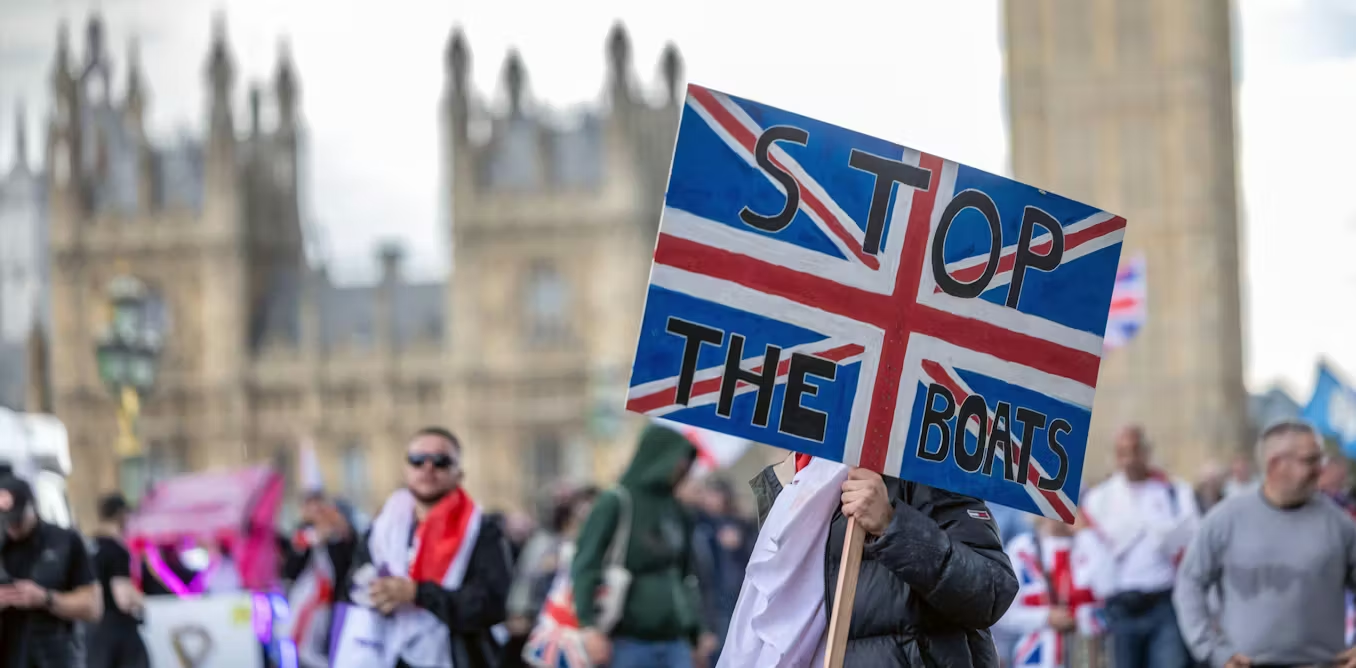
Discussions of migration in Britain often portray immigrants as “invaders”. This is evident in from the narrative around migrants arriving on small boats, to recent comments by Jim Ratcliffe, the billionaire co-owner of Manchester United.
Ratcliffe, who relocated to the tax haven of Monaco in 2020, blamed immigrants for the country’s economic challenges and claimed the UK had been “colonised”. After a public backlash, he apologised “that his choice of language has offended some people”.
A look at the history of immigration policy and rhetoric shows how this narrative came to play such a big role – and why it is so harmful.
Britain’s history is intertwined with empire and colonialism. The UK was forged as a nation-state alongside, and partly to facilitate, the growth of a global empire sustained through violence, brutality and war. It also led to immigration from Britain’s current and former colonies.
Although empire-related immigration began hundreds of years earlier, it accelerated after the second world war. Thousands of workers were recruited from the Caribbean and south Asia, as well as from Ireland and continental Europe, to relieve labour shortages and help staff the newly-formed National Health Service.
The 1948 British Nationality Act essentially allowed the entry of all subjects of the British empire. However, this did not reflect widespread acceptance of mass immigration. Rather, it was an attempt to maintain control over Britain’s colonial territories by formalising a specifically imperial identity for them.
Groups such as those onboard the ship Empire Windrush arrived under these conditions. However, increased immigration fuelled local anxieties, and controls were gradually tightened. Britain’s colonial and Commonwealth citizens were now recast as “immigrants”. This did not stop people from wanting to move to the UK, drawn by family or cultural ties – forged by a history of empire.
Themes of invasion
Immigration in the following decades was greater in scale and different than previous migration movements. Alongside this, a rhetoric of invasion began to solidify, one that is still politically influential today.
This narrative developed off the back of national myths that emerged during the second world war. The war was seen as a “people’s war” for Britain – a small, isolated island overcoming foreign enemies. Historians like Paul Ward argue that such national myths shaped ideas of a socially and ethnically homogenous British national identity, one that apparently needed “defending against foreign invasion”.
Alamy
We can see this theme in key historical moments, such as Enoch Powell’s 1968 “Rivers of Blood”, one of modern Britain’s most notorious speeches. Powell recounted supposed conversations with white Britons fearful of being ruled by immigrants and their descendants.
A similar message was created in response to the so-called Kenyan Asian crisis (1968) and Uganda Asian crisis (1972).
These newly-independent countries were attempting to remove Britain’s imperial influences, including by expelling people of Asian descent whose families had been brought there by colonial governments.
The panic in Britain of a possible “invasion” of African Asian immigrants led to the 1968 Commonwealth Immigrants Act passing in just three days. This act restricted the rights of Commonwealth citizens to migrate to the UK.
The mood around immigration was hardening. Shortly before becoming prime minister, Margaret Thatcher appeared on television in 1978 sympathising with voters afraid of being “rather swamped by people with a different culture”. Immediately afterwards, Thatcher’s Conservatives gained a 11-point poll lead over Labour.
Thatcher’s governments overhauled the UK immigration system. The 1981 British Nationality Act removed citizenship for Commonwealth citizens, formally ending the link between British nationality and a shared history of empire.
Views today
In the last two decades, immigration from within and outside of the European Union has been a key response to the economic and demographic challenges of Britain’s ageing population. Workers from overseas have been recruited to fill gaps in areas such as hospitality, health and social care.
Similarly, Britain’s involvement in conflict zones, such as Afghanistan, Iraq and Libya led to increased applications from people seeking asylum in the UK. In response, anti-immigration sentiment has only grown. Ukip’s infamous “breaking point” poster portrayed refugees fleeing the Syrian conflict as a mass of people headed towards British shores, setting the tone for a debate that ultimately led to Brexit.
Such attitudes have continued as immigration from non-EU countries has grown since Brexit. Many contemporary anxieties around immigration stem from beliefs that a traditional British way of life is under threat. But these views are often based on information that is inaccurate or distorts general demographic change.
The suggestion that immigration is acting like a form of colonisation risks legitimising the “great replacement” far-right conspiracy theory. A recent study found that nearly a third of people in the UK believe this view, which contends that white populations are being deliberately replaced by people of colour.
Immigrants, meanwhile, have experienced not the privileges of colonisers, but discrimination. Immigration benefits Britain in various ways. Most migrants to the UK make a net positive contribution to the economy over their lifetime, paying more in taxes than they consume in public services. Yet they have faced increasing levels of hostility, policies designed to make their life in the UK harder, violence and other systemic disadvantages.
Recent years have seen the consequences of these views, in the form of more overt racism, and violent protests. The “invasion” or “coloniser” narrative is not just rhetoric – it can have harmful, physical consequences.