Connect with us

NewsBeat

How immigrants hoping for a better life in Britain came to be viewed as ‘colonisers’ or ‘invaders’

Published

on

How immigrants hoping for a better life in Britain came to be viewed as ‘colonisers’ or ‘invaders’

Discussions of migration in Britain often portray immigrants as “invaders”. This is evident in from the narrative around migrants arriving on small boats, to recent comments by Jim Ratcliffe, the billionaire co-owner of Manchester United.

Ratcliffe, who relocated to the tax haven of Monaco in 2020, blamed immigrants for the country’s economic challenges and claimed the UK had been “colonised”. After a public backlash, he apologised “that his choice of language has offended some people”.

A look at the history of immigration policy and rhetoric shows how this narrative came to play such a big role – and why it is so harmful.

Britain’s history is intertwined with empire and colonialism. The UK was forged as a nation-state alongside, and partly to facilitate, the growth of a global empire sustained through violence, brutality and war. It also led to immigration from Britain’s current and former colonies.

Advertisement

Although empire-related immigration began hundreds of years earlier, it accelerated after the second world war. Thousands of workers were recruited from the Caribbean and south Asia, as well as from Ireland and continental Europe, to relieve labour shortages and help staff the newly-formed National Health Service.

The 1948 British Nationality Act essentially allowed the entry of all subjects of the British empire. However, this did not reflect widespread acceptance of mass immigration. Rather, it was an attempt to maintain control over Britain’s colonial territories by formalising a specifically imperial identity for them.

Groups such as those onboard the ship Empire Windrush arrived under these conditions. However, increased immigration fuelled local anxieties, and controls were gradually tightened. Britain’s colonial and Commonwealth citizens were now recast as “immigrants”. This did not stop people from wanting to move to the UK, drawn by family or cultural ties – forged by a history of empire.

Themes of invasion

Immigration in the following decades was greater in scale and different than previous migration movements. Alongside this, a rhetoric of invasion began to solidify, one that is still politically influential today.

Advertisement

This narrative developed off the back of national myths that emerged during the second world war. The war was seen as a “people’s war” for Britain – a small, isolated island overcoming foreign enemies. Historians like Paul Ward argue that such national myths shaped ideas of a socially and ethnically homogenous British national identity, one that apparently needed “defending against foreign invasion”.

The Windrush generation of Caribbean migrants helped rebuild postwar Britain.
Alamy

We can see this theme in key historical moments, such as Enoch Powell’s 1968 “Rivers of Blood”, one of modern Britain’s most notorious speeches. Powell recounted supposed conversations with white Britons fearful of being ruled by immigrants and their descendants.

A similar message was created in response to the so-called Kenyan Asian crisis (1968) and Uganda Asian crisis (1972).
These newly-independent countries were attempting to remove Britain’s imperial influences, including by expelling people of Asian descent whose families had been brought there by colonial governments.

The panic in Britain of a possible “invasion” of African Asian immigrants led to the 1968 Commonwealth Immigrants Act passing in just three days. This act restricted the rights of Commonwealth citizens to migrate to the UK.

Advertisement

The mood around immigration was hardening. Shortly before becoming prime minister, Margaret Thatcher appeared on television in 1978 sympathising with voters afraid of being “rather swamped by people with a different culture”. Immediately afterwards, Thatcher’s Conservatives gained a 11-point poll lead over Labour.

Thatcher’s governments overhauled the UK immigration system. The 1981 British Nationality Act removed citizenship for Commonwealth citizens, formally ending the link between British nationality and a shared history of empire.

Views today

In the last two decades, immigration from within and outside of the European Union has been a key response to the economic and demographic challenges of Britain’s ageing population. Workers from overseas have been recruited to fill gaps in areas such as hospitality, health and social care.

Similarly, Britain’s involvement in conflict zones, such as Afghanistan, Iraq and Libya led to increased applications from people seeking asylum in the UK. In response, anti-immigration sentiment has only grown. Ukip’s infamous “breaking point” poster portrayed refugees fleeing the Syrian conflict as a mass of people headed towards British shores, setting the tone for a debate that ultimately led to Brexit.

Advertisement

Such attitudes have continued as immigration from non-EU countries has grown since Brexit. Many contemporary anxieties around immigration stem from beliefs that a traditional British way of life is under threat. But these views are often based on information that is inaccurate or distorts general demographic change.

The suggestion that immigration is acting like a form of colonisation risks legitimising the “great replacement” far-right conspiracy theory. A recent study found that nearly a third of people in the UK believe this view, which contends that white populations are being deliberately replaced by people of colour.

Immigrants, meanwhile, have experienced not the privileges of colonisers, but discrimination. Immigration benefits Britain in various ways. Most migrants to the UK make a net positive contribution to the economy over their lifetime, paying more in taxes than they consume in public services. Yet they have faced increasing levels of hostility, policies designed to make their life in the UK harder, violence and other systemic disadvantages.

Recent years have seen the consequences of these views, in the form of more overt racism, and violent protests. The “invasion” or “coloniser” narrative is not just rhetoric – it can have harmful, physical consequences.


Advertisement

Source link

Continue Reading
Click to comment

Leave a Reply

Your email address will not be published. Required fields are marked *

NewsBeat

Daily horoscope February 21, 2026: Predictions for your star sign

Published

on

Daily horoscope February 21, 2026: Predictions for your star sign
What’s in store for you today? (Picture: Metro.co.uk)

The Moon in Aries is tied to Mars in Aquarius, creating a sizzling cosmic energy. Thoughts become action today, and productivity is on the cards.

Pisces, Aquarius and Capricorn, changes are simmering beneath the surface. Tune into this transformation and embrace it with an open mind.

Ambition and innovation will stir today. Don’t apologise for what you want; go after it now, and who knows what the future holds.

Ahead, you’ll find all the star signs’ horoscopes for today: Saturday February 21, 2026.

Advertisement

Like checking your horoscope every morning? You can now sign up to our free daily newsletter to get a personalised reading for your star sign delivered straight to your inbox.

To download your free Unique Personal Horoscope based on your time, date and place of birth, visit patrickarundell.com/free-birth-chart/.

Aries

March 21 to April 20

Today you get a double shot of courage as a cosmic blend of strong emotions and electric ideas sets things in motion. You’re bold, fired up and ready to act, but your moves are fuelled by innovation, not just instinct. The Moon in your sign and its tie to Mars in Aquarius turns energy into purpose and may push you in unexpected ways. Just watch the impulse to charge ahead without a plan.

Advertisement

Head here for everything you need to know about being an Aries

Today’s celestial guidance for Aries

Taurus

April 21 to May 21

Your inner world is buzzing beneath that calm exterior. You’re fired up behind the scenes with planning and maybe even scheming of the productive kind. Flashes of insight around career, purpose or long-term goals could arrive like lightning, especially when you give yourself space to think unconventionally. This isn’t the day for basking in your comfort zone, as it’s more about breakthroughs.

Head here for everything you need to know about being a Taurus

Today’s planetary forecast for Taurus

Gemini

May 22 to June 21

A lively line-up means your energy is electric, your ideas spark like lightning and your social charm is off the charts. Today’s cosmic blend fuels your thirst for action, adventure and a few clever debates along the way. You’re not just thinking outside the box, you’ve launched it into orbit. Group projects or visionary goals could get the green light. Just be mindful not to scatter your brilliance in too many directions.

Advertisement

Head here for everything you need to know about being a Gemini

How the stars aligned for Gemini today

Cancer

June 22 to July 23

Your usual cosy instincts get a jolt of ambition and innovation. You may be dreaming about change, but also ready to do something daring, especially in your career or shared ventures. Emotional courage meets strategic firepower, making this the perfect time to take a calculated risk or lead with confidence. Break free from outdated rules and trust your ability to navigate unfamiliar territory.

Head here for everything you need to know about being a Cancer

Celestial energies for Cancer today

Leo

July 24 to August 23

You may feel bold, bright and a bit rebellious as the Aries Moon aspects Mars in eccentric Aquarius. This alignment fires up your desire for adventure, big ideas and thrilling connections. You’re ready to shake things up, whether it’s booking a spontaneous trip, diving into a new philosophy or sharing something that really needs saying. Even so, being right isn’t as powerful as using wisdom when it’s needed.

Advertisement

Head here for everything you need to know about being a Leo

Your daily zodiac insight for Leo

Virgo

August 24 to September 23

You could get a celestial nudge to shake up your usual systems in a strategic way. You may crave depth, efficiency and a dash of rebellion, especially around work, wellness or behind-the-scenes matters. It’s the perfect day to tackle a problem with fresh eyes or finally kick an unhelpful habit for good. Enthusiasm meets precision now and your instincts are sharp. Just don’t let perfectionism slow you down.

Head here for everything you need to know about being a Virgo

Cosmic messages for Cosmic messages for Virgo today

Libra

September 24 to October 23

Sparks may be flying in love, collaboration or creative pairings. This is no time for tiptoeing, as you’re drawn to bold connections and brilliant minds, craving excitement with purpose. Someone may challenge you, but that’s not a bad thing, as it could ignite something fresh. A little playful tension might push things in a stimulating new direction.

Advertisement

Head here for everything you need to know about being a Libra

Your daily stellar guidance for Libra

Scorpio

October 24 to November 22

Your focus zeroes in on routines, responsibilities and that to-do list you’ve been eyeing up. But this isn’t about dull activity, it’s about action with attitude. You’re ready to revolutionise your daily flow, ditch outdated habits and spark change where life has felt stale. Health, work or home projects could get a boost. Be determined, be efficient and above all trust your instincts.

Head here for everything you need to know about being a Scorpio

Star alignments for Scorpio today

Sagittarius

November 23 to December 21

Your energy is practically electric thanks to today’s Moon-Mars tie-up. You’re fired up creatively, romantically and intellectually, and you’re not in the mood to play small. This cosmic blend fuels daring self-expression, unplanned adventures and inspired ideas that deserve sharing. Flirt with life, share that wild concept or dive into a project fearlessly. Let your inner visionary take the wheel and enjoy the ride.

Advertisement

Head here for everything you need to know about being a Sagittarius

Today’s astral messages for Sagittarius

Capricorn

December 22 to January 20

Your foundations are on fire, but in a constructive way. Emotions may bubble up around home, family or your sense of stability, pushing you to make bold moves where you usually prefer careful planning. Have a sudden urge to rearrange your space, initiate a tough conversation or set new boundaries? Follow it. This is action with intention. Lead with calm confidence, but don’t fear the shake-up.

Head here for everything you need to know about being a Capricorn

Your zodiac forecast for Capricorn today

Aquarius

January 21 to February 19

Your mind is blazing and your conversations may be too. You’re bursting with ideas and the urge to act now. Discussions are lively, curiosity fills the air and your words can motivate or mildly startle those around you. Use the energy of the Aries Moon and Mars in your sign to champion a cause, launch a project or say what’s been simmering. Your originality is your power today.

Advertisement

Head here for everything you need to know about being an Aquarius

Daily cosmic update for Aquarius

Pisces

February 20 to March 20

Your inner world buzzes with daring intentions, even if you’re keeping them private. You’re quietly preparing a revolution, driven by intuition and a surge of enthusiasm. This is the perfect time to liberate yourself from an old habit, limiting belief or sleepy routine. Don’t underestimate the power of a private breakthrough. Big changes often start small but can be truly revolutionary.

Head here for everything you need to know about being a Pisces

Your cosmic energy update for Pisces

Your daily Metro.co.uk horoscope is here every morning, seven days a week (yes, including weekends!). To check your forecast, head to our dedicated horoscopes page.

Head here for this week’s tarot horoscope reading, and see what the cards have in store for you!

Advertisement

Check out the tarot horoscope reading for the month of February here.

Prefer us to the others? Then tell Google!

As a loyal Metro reader, we want to make sure you never miss our stories when searching for your news. Whether it is the latest politics news explained, live football coverage or a showbiz scoop.

Click here and tick Metro.co.uk to ensure you see stories from us first in Google Search.

Our journalists work hard to deliver the most important stories from around the world
Advertisement

Source link

Advertisement
Continue Reading

NewsBeat

the older adults redefining what ageing looks like

Published

on

the older adults redefining what ageing looks like

Liverpool is not one of the “blue zones” – a term used for regions of the world where people tend to live unusually long lives, such as parts of Sardinia, Okinawa and Ikaria.

Healthy life expectancy in Liverpool is only about 56 years. However, overall life expectancy is much higher there, with many people living into their late 70s and beyond. This means many residents spend their final working years and a large part of retirement managing chronic illness or disability.

Ageing is inevitable but losing independence is not. As a PhD researcher studying muscle ageing, I work with adults in their 70s whose strength, mobility and resilience challenge common assumptions about later life – despite many of them living with long-term health conditions.

Jackie has three prolapsed discs in her spine and osteopenia, a condition where bone density is lower than normal and fracture risk is higher. Norma lives with a stoma following bowel cancer surgery. Mike jokes that his medical notes make him sound like “a wreck”.

Advertisement

But then you see the three of them train together five times a week.

During lockdown, when gyms closed and isolation threatened their health, they converted Mike’s garage into a makeshift training space so they could keep moving and stay independent. “We thought, we’ve got to do something,” Mike told me.

They embrace effort. They run parkrun, climb stairs deliberately, and value the feeling of being challenged – slightly breathless but capable. I think of them as Liverpool’s “blue people”. Their experience suggests that ageing well depends less on where you live, and more on how you live.


À lire aussi :
Small improvements in sleep, physical activity and diet are linked with a longer life

Advertisement

I met them through Research Roasters, a science cafe connecting scientists and the public around health and ageing. They volunteered for studies on muscle health and physical function in later life, and helped shape how they were designed and delivered. They helped refine participant information and consent materials, introduced me to community groups and offered feedback on study design.

Their experiences reflect a core biological reality. Skeletal muscle is not just what helps us move. It is the body’s largest metabolic organ, essential for regulating blood sugar, maintaining body temperature and preserving independence.

Muscle maintenance

Muscle ageing starts earlier than many people realise. From our 30s, strength begins to decline – often faster than muscle size. People can look healthy while their muscle function is deteriorating.

Advertisement

One simple way to glimpse this is through movement. Try standing up from a chair and sitting back down five times as quickly as possible without using your hands. If it feels slow, difficult or unstable, it may signal reduced muscle quality.


À lire aussi :
How low can you go (and still build muscle)? Why strength training matters at any age


This matters because muscle function predicts future health. Poor muscle quality increases fall risk, slows recovery and raises the likelihood of conditions such as type 2 diabetes.

At the microscopic level, muscle quality is shaped by proteins. These generate force, produce energy and repair damage. Unlike genes which remain relatively stable, proteins are constantly renewed. During physical activity, muscles rebuild and reorganise their protein machinery to meet demand. When muscles are not challenged, this renewal slows. The system becomes less responsive and function declines.

Advertisement

In my research, we use “dynamic proteome profiling” to track how thousands of muscle proteins are produced and renewed in older adults. This approach measures how quickly proteins are built, repaired and replaced inside muscle tissue.

Participants complete strength and mobility tests, wear activity monitors and provide small muscle samples, supported by a multidisciplinary team of researchers and clinicians. We analysed thousands of proteins and also grew their muscle stem cells in the lab, to understand how muscle adapts to activity.

The results do not show simple deterioration. Older muscle is different, but remains adaptable. Protein turnover may be slower and some repair processes less efficient, but muscles still respond to activity by building the proteins needed for strength, energy production and resilience.

Even later in life, muscles can adapt when they are used. This helps explain why our participants became stronger and more capable despite existing health conditions. Their experience highlights a crucial point. Ageing is strongly influenced by how muscles are used across the lifespan.

Advertisement

Blue people

Ray’s gym is a community fitness space in Liverpool where many of our participants train regularly. Not a formal research site, it is where the group work out, supporting each other and maintaining the strength and mobility that underpin their independence. The environment encourages effort, personal progress and accountability.

Members are not defined by their age. They are people working towards goals that matter to them – often, simply staying independent and in control of their lives.

This challenges common narratives about blue zones, which emphasise location, diet or lifestyle traditions as the main drivers of longevity. Those factors matter, but they can create the impression that healthy ageing is largely determined by where you live, rather than what you do. Liverpool’s “blue people” suggest something different.

Advertisement


À lire aussi :
People in the world’s ‘blue zones’ live longer – their diet could hold the key to why


Their strength comes not from perfect health but ongoing adaptation. They challenge their muscles and stay engaged with their bodies. Muscle quality is not fixed – it reflects the demands placed on it.

The implications are significant. Healthy ageing does not require relocation to longevity hotspots or adherence to exotic diets. It begins with recognising muscle as the organ that underpins independence, and maintaining it through regular activity.

Research is helping us understand the biology behind this process. New studies and recruitment cycles reflect growing efforts to understand how muscle health can shape independence across the lifespan.

Advertisement

The people taking part are already showing what this looks like in practice. They are not reversing ageing, but they are maintaining capability. In doing so, they offer a realistic and accessible vision of growing older well.

Most of us can become a “blue person” by investing in the organ that most strongly shapes whether we age with independence as well as longevity: muscle.

Advertisement

Source link

Continue Reading

NewsBeat

Speed limit will be cut on Cambridgeshire road after motorcyclist died in crash

Published

on

Cambridgeshire Live

Cambridgeshire County Council has said it will cut the speed limit along Bates Drive after a fatal collision to try and improve safety

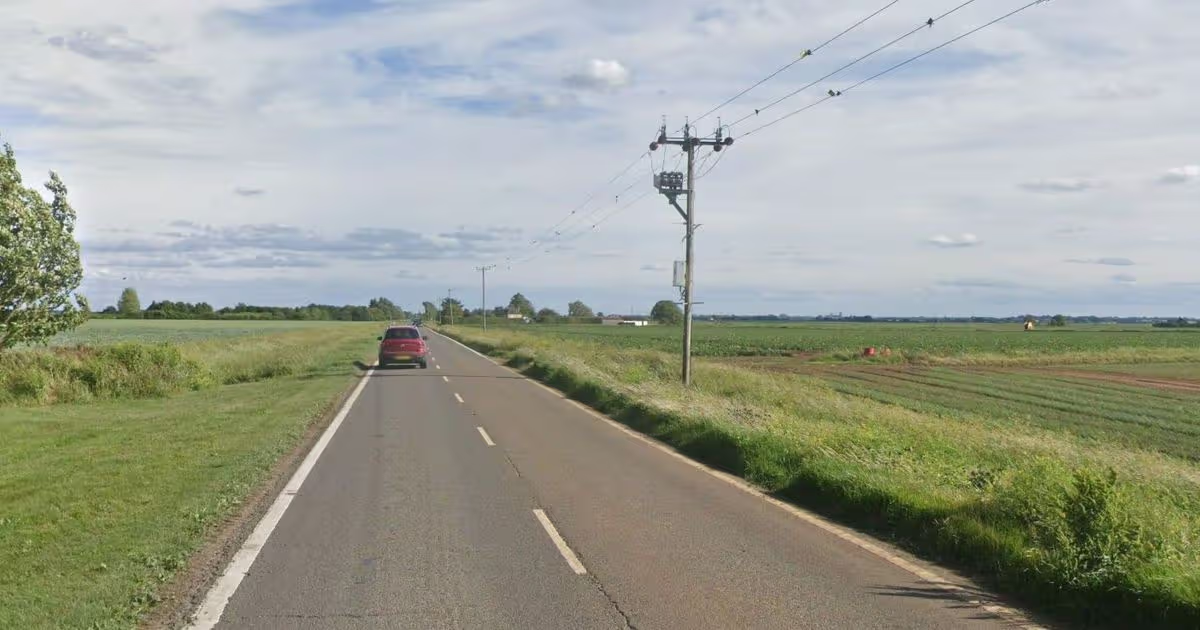
The speed limit along Bates Drove near Littleport will be cut to try and improve safety after a fatal crash. Cambridgeshire County Council has said it will be cutting the speed limit from 60mph to 50mph.

Advertisement

The decision was made following a number of incidents on the road, including a “tragic” fatal motorcycle collision that happened in June last year.

A report published by the county council said another “serious” motorcycle collision took place just eight days later, and that a further two incidents where people had been injured had been recorded along the road in recent years.

A multi-agency investigation was launched to assess the safety of the road following the incidents. The report said: “The investigation team undertook several site visits and conducted a thorough review of the traffic conditions. Their assessment concluded that the existing speed limit is inappropriate for the road’s structure and environment.

“Bates Drove is characteristic of Fenland infrastructure, it is undulating due to subsidence, narrow in places, and visually deceptive in terms of safety, particularly for powered two-wheeled vehicles.

Advertisement

“Additionally, sections of the nearby A1101 are straight and encourage higher speeds, further increasing the risk of serious collisions. Many surrounding Fen roads are already subject to a 50mph limit, reflecting the unique challenges posed by the terrain and road layout.

“Reducing the speed limit on Bates Drove would bring it in line with these roads and enhance safety for all road users, especially vulnerable groups.”

Concerns were raised by some about the plans to cut the speed limit along Bates Drove. Five objections were lodged during a statutory consultation on the proposals, with many making the argument that it would be better to repair the roads than to cut the speed limit.

One objector said: “The road surface is more of an issue than the speed limit. The new speed limit won’t be enforced and so won’t make a difference. The council is proposing speed limit changes purely as it’s cheaper than sorting the road.”

Advertisement

The county council report said road maintenance is “undertaken according to the authority’s asset management plan”. It added that cutting the speed limit would not be a substitute for ongoing maintenance, but would be a “proportionate and evidence-based measure to address specific risks identified by a multi-agency investigation”.

The plans were considered at a meeting this week (February 18) by Councillor Lorna Dupré, Councillor John Wells, and Richard Ling, the interim head of parking and traffic management.

They agreed that the Traffic Regulation Order (TRO) should be made to cut the speed limit along Bates Drove from 60mph to 50mph. The decision notice said the members believed it would be “unlikely” that the national speed limit would be maintained if the route was resurfaced and maintained to a higher standard.

It also said that the “risk of harm” at 60mph was “still much higher” than at 50mph and that on these grounds alone a lower speed limit could be “justified”.

Advertisement

To get more breaking news and top stories delivered directly to your phone, join our new WhatsApp community. Click this link to receive your daily dose of CambridgeshireLive content.

We also treat our community members to special offers, promotions, and adverts from us and our partners. If you don’t like our community, you can check out any time you like. If you’re curious, you can read our Privacy Notice .

Source link

Advertisement
Continue Reading

NewsBeat

Rose Byrne is raw, magnetic and unfiltered as a woman in crisis

Published

on

Rose Byrne is raw, magnetic and unfiltered as a woman in crisis

Director Mary Bronstein’s discomfiting new film, If I Had Legs I’d Kick You, is a compelling watch. Centred by a career-defining performance from Rose Byrne that has gained her an Oscar nomination, the film is a dark treatise on motherhood, swirling in blame, shame and an increasing sense of dread.

Byrne’s Linda is an exhausted and perpetually worried mother, wife and therapist harbouring both guilt and resentment. She is looking after her seriously sick child, who is almost never shown on screen. Linda is not a woman unravelling, she is unravelled – the remnant pieces disintegrating in front of our eyes through a series of escalating awful events.

Her life is literally falling apart: her daughter’s health is not improving, her work as a therapist is difficult and unfulfilling, her husband (Christian Slater) is away for work and barely interested. Then the ceiling of her apartment falls in.

Byrne is magnetic, searingly raw and unfiltered as a woman pushed to the edge. She is ferociously committed to her performance and has never been better onscreen. She moves with emotional precision, careful and considered, never slipping into cliched melodrama or histrionics.

Advertisement

Throughout the film, Byrne is shown in close-up – in all interactions, the camera is focused on her. In this way, the director brings the audience fully into Linda’s mind and point of view. Every unsympathetic dismissal (even from her own therapist, a grim-faced Conan O’Brien), every moment of blame, is keenly felt and depicted without apology.

Linda’s daughter’s doctor (played by Bronstein) has an impatient callousness which compounds the anxiety. Linda’s daughter is around ten years of age, and portrayed primarily through sound off-screen: grating, insistent and impossible to ignore. Her cries, her arguing, her screams and the beeping of her medical equipment create an uncomfortable and urgent soundtrack, which draws viewers even further into Linda’s intense and stressful reality.

Even welcome moments of levity are tinged with a darkness which restricts their impact. Linda’s therapy clients provide some light relief, but a pervading heaviness hangs in the air, particularly in disturbing scenes with Caroline (an excellent Danielle Macdonald). An anxious, needy and demanding patient, Caroline is also a struggling mother, like Linda.

Advertisement

An unfortunate incident with a hamster builds in dark hilarity, only for the laughter to curdle. Linda becomes locked in a battle of wills with a motel receptionist (Ivy Wolk), whose jobsworth insistence around the sale of wine is exaggeratedly maddening – and leads to Linda’s unlikely connection with a charming motel employee, James (A$AP Rocky in fine form).

This is an urgent, important and admirable cinematic portrayal of motherhood, but I can’t say I enjoyed watching it. Its treatment of maternal anger and ambivalence without softening the edges is confronting and somewhat triggering. But this may have been Bronstein’s directorial intention.

Modern cinema has become less interested in saccharine, idealised depictions of mothers and more concerned with their inner lives, however messy. Recent films such as Nightbitch and Die My Love forego maternal sentimentality and tidy redemption, instead showing mothers as complex and imperfect human characters raising children.

Based on some of Bronstein’s real-life experiences of caring for a sick child, If I Had Legs I’d Kick you shines a glaring and uncomfortable light on aspects of motherhood which are usually kept in the shadows: the thankless drudgery, the loss of selfhood, and all the resentment and resultant guilt these carry with them.

Advertisement

Linda is drowning in despair and shame, unable to find help, empathy or even a break. Her experience of motherhood is harrowing and messy, and the film dares its audience to confront the strain both of looking after a sick child and of fierce maternal attachment.

Like its depiction of Linda’s life, If I Had Legs I’d Kick You is imperfect and at times overwhelmingly chaotic. At its core, this is a dark and unsettling film which will start conversations about the complexities of motherhood. Byrne’s unrelenting and towering central performance makes it a compelling and unforgettable watch, albeit a challenging one.


Looking for something good? Cut through the noise with a carefully curated selection of the latest releases, live events and exhibitions, straight to your inbox every fortnight, on Fridays. Sign up here.

Advertisement

Source link

Continue Reading

NewsBeat

Mum found guilty of murdering two-month-old daughter

Published

on

Wales Online

A mum has been found guilty of murdering her daughter who suffered multiple fractures after coming into contact with a hard surface

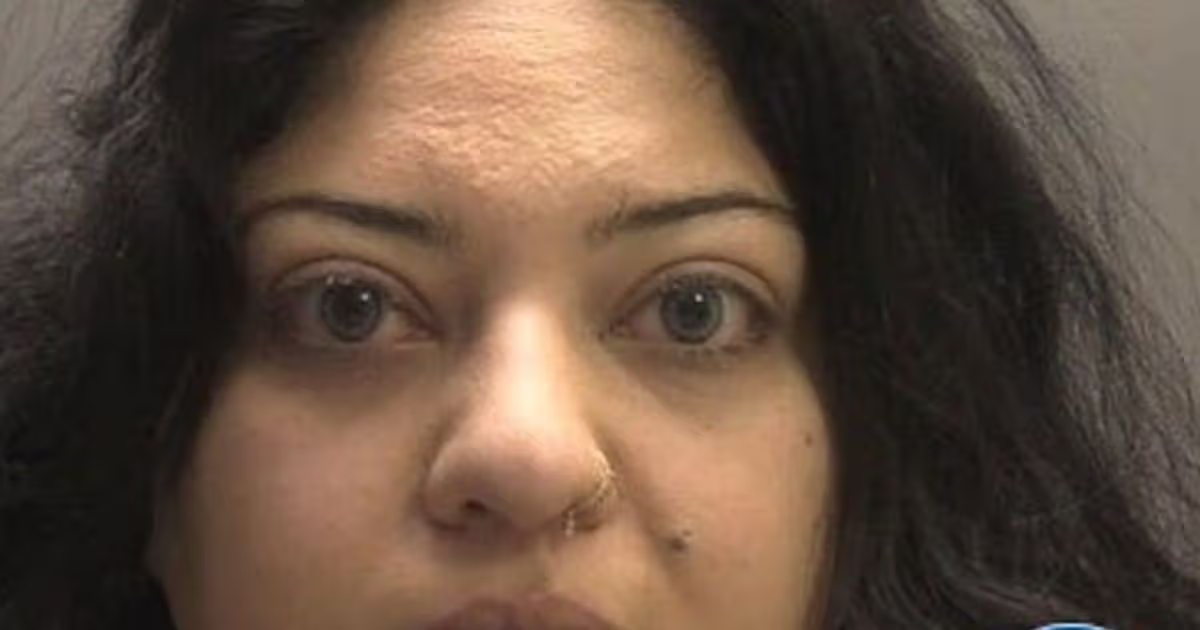
A mum from West Bromwich has been found guilty of murdering her two-month-old daughter.

Emergency services rushed to the home of Zara Arsalan after receiving a call to say a baby girl was unresponsive after she fell from her mother’s lap on July 23, 2020. However, paramedics found Harleen had suffered a serious head injury and her breathing was not stable.

Advertisement

The child was taken to hospital but died from her injuries the next day. A post-mortem determined that Harleen had suffered multiple skull fractures, bleeding on the brain, fractured ribs and a fractured collar bone.

The injuries were believed to have come from contact with a hard surface and were not consistent with a fall, reported Birmingham Live.

It was believed Harleen was also likely shaken. Arsalan was arrested and later charged with Harleen’s murder.

She had pleaded not guilty to killing her baby. However, a jury found the 31-year-old guilty of murdering her daughter at Coventry Crown Court on Friday (Friday, February 20).

Advertisement

Detective Chief Inspector Phil Poole, from West Midlands Police’s Homicide Unit, said: “This is an incredibly tragic case. Harleen was only two months old when she died at the hands of the person who should have been doing everything to keep her safe.

“Arsalan has never taken responsibility for her actions. Instead, she has repeatedly lied about what happened to Harleen despite being shown evidence that rejects her claims.

“I want to thank all of the officers involved as I know they were deeply affected by this investigation. They have worked incredibly hard to get justice for Harleen and her family.”

Arsalan will be sentenced on Thursday, March 12.

Advertisement

Source link

Continue Reading

NewsBeat

Karen Byrne leaves Late Late Show viewers in stitches with ‘Dessie Swim’ admission

Published

on

Ipso logo

Karen Byrne and Brian Redmond appeared on The Late Late Show ahead of Dancing With The Stars’ 100th episode as the judge recalled the iconic Dessie Swim moment with Des Cahill

Karen Byrne had Late Late Show audiences in fits of laughter as she looked back on an unforgettable moment from her debut series on Dancing With The Stars.

Prior to the programme’s 100th episode airing on Sunday evening, Karen and fellow judge Brian Redmond, both present since the beginning, appeared alongside host Patrick Kielty on the popular RTÉ chat show.

Advertisement

Whilst the pair reflected on memorable moments from previous years on the dance floor, Patrick highlighted one particular recollection – leading Karen to confess, “What was I thinking?”.

READ MORE: Police seek public’s help in locating missing teenage girlREAD MORE: Peter ‘Minter’ Murray: Tributes paid to ‘West Belfast institution of football and education’

The Late Late host was referencing the ‘Dessie Swim’, a signature move Karen created whilst paired with sports journalist Des Cahill during the show’s first series.

The duo replicated a swimming motion during an Austin Powers themed performance, which remains one of the programme’s most celebrated moments, reports RSVP Live.

Advertisement

Patrick remarked: “Karen, there are many moments from over the years that are highlights when we think of you.

“I know exactly what you’re going to say. I bet I do. The Dessie Swim,” Karen responded.

“Does everyone remember that in the audience? What was I thinking?”.

“When I was doing the choreography I don’t know what was going through my mind. But listen, people loved it. Give the people what they want. Oh no, don’t play it!”.

Advertisement

Patrick subsequently showed the footage, prompting the audience to erupt in laughter.

Karen chuckled: “Live telly. Why not?”.

“It’s a move that hasn’t caught on in dance floors around Ireland,” Patrick observed. “I don’t ever remember studying that in a ballroom dancing technique when I was a young lad,” Brian remarked.

“The first time I saw it was live on the show. It’s not often you’re stuck for words as judges, but I was like, ‘Des, Karen, what are you thinking? My God, this is just iconic’.

Advertisement

“You could see it in the moment, from the reaction in the audience.

“It was Austin Powers for Movie Week. And come here, we’re still talking about it nine years on so I must have been doing something right,” Karen responded.

Meanwhile, Nicky Byrne has confirmed he’ll be making a return to Dancing With The Stars this week as a special guest judge to mark the programme’s 100th episode.

The Westlife singer presented the show from 2017 through to 2022.

Advertisement

Speaking about rejoining the programme for this milestone occasion, Nicky said: “I couldn’t be more excited to be heading back to the Dancing with the Stars ballroom. The show has been a massive part of my life for nearly 15 years – I’ve been a contestant on Strictly in the UK, I hosted five incredible seasons in Ireland and now I get to be a judge for one night only. It really is a full-circle moment for me.

“I’m really looking forward to the performances on the night because at the end of the day it’s all about the celebrities, professionals and the journey they’re on. I’ve been in those dance shoes before… I know the nerves, the pressure and the adrenaline, so I’ll definitely be encouraging and supportive… and if Brian gets out of line, I’ll be the first one sticking up for them!”.

“I can’t wait to see all my friends from the cast and crew again. It’s going to be such a special night – you only turn 100 once so as a great man once said, ‘It’s going to be ‘Box Office!’”.

Want to see more of the stories you love from Belfast Live? Making us your preferred source on Google means you’ll get more of our exclusives, top stories and must-read content straight away. To add Belfast Live as a preferred source, simply click here

Advertisement

Source link

Continue Reading

NewsBeat

Moment fake animal rehoming centre owner is arrested by police | News

Published

on

Video Player Placeholder

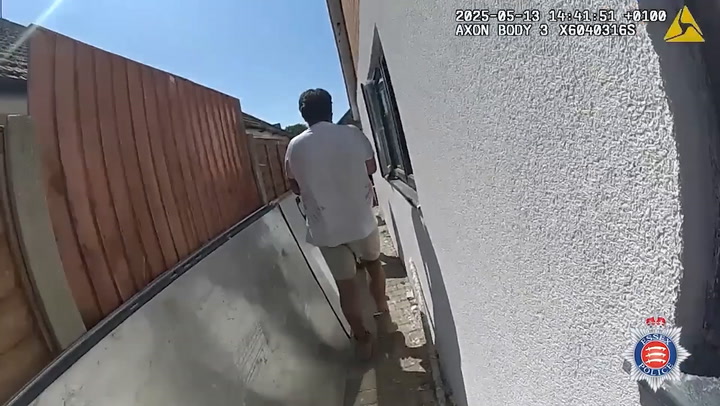
This is the moment an fake animal rescue centre owner who abused pets in his care was arrested.

Oaveed Rahman, 26, purported to be looking after the animals at a rehoming centre called Save A Paw in Crays Hill, Billericay, Essex. Instead, he left them to suffer in filthy conditions amongst the caracasses of other dogs.

He took about £4,800 from his 11 victims, telling them it would be used to rehome dogs, provide a new kennel block or train dogs to behave around children and other animals.

Advertisement

Essex Police found 37 dead dogs when they first searched the rehoming centre in May, 2025. Four more dead dogs were found after the property was demolished.

“Many animals taken in by you… were subjected to prolonged barbaric mistreatment, cruelty and neglect,” Judge Conley said.

On Friday (20 February), Rahman, of Hope Road, Crays Hills, was jailed for a total of five years and given a lifetime order banning him from owning any animals.

Source link

Advertisement
Continue Reading

NewsBeat

At least 12 killed in Israeli strikes on Lebanon – including senior Hezbollah official | World News

Published

on

Hussein Yaghi. Pic: Hezbollah media

Israeli airstrikes have killed at least 10 people in Lebanon’s Bekaa Valley and another two people in a Palestinian refugee camp, the Lebanese Health Ministry has said.

Hezbollah has confirmed senior leader Hussein Yaghi was killed in the Bekaa attacks.

He is the son of former Hezbollah MP Mohamed Yaghi, and his funeral is set to take place on Saturday, according to Hezbollah media.

Advertisement

Twenty-four people – including three children – were also injured in the attack.

Earlier on Friday, another Israeli strike hit Ain al-Hilweh – a densely populated Palestinian refugee camp near Sidon, killing the two people.

The strikes are among the deadliest reported in eastern Lebanon in recent weeks and risk rupturing a US-brokered ceasefire between Israel and Hezbollah, strained by frequent accusations of violations.

In a post on X on Friday evening, the Israel Defence Forces (IDF) said: “STRUCK: Hezbollah command centers used to advance terror attacks against IDF troops and Israel, in the Baalbek area in Lebanon.

Advertisement

“Within the command centers, weapons and funds utilized by Hezbollah were being stored, constituting a violation of the understandings between Israel.”

Referring to the separate strike, the IDF posted hours earlier: “In response to repeated ceasefire violations, the IDF struck a Hamas command center, from which terrorists operated, in the Ain al-Hilweh area in southern Lebanon.”

Read more from Sky News:
How Iran might be preparing itself for a potential US strike

NASA says moon mission could blast off next month

Israeli airstrikes in several areas of southern Lebanon early on Thursday morning targeted Hezbollah weapon depots, missile launchers, and other military sites, the IDF said, as reported by The Times of Israel.

Advertisement

The strikes were the latest in the Israeli military’s campaign against Hezbollah.

There have been frequent airstrikes as the military says the terror group continues to try to rebuild its capabilities, contravening the US-brokered ceasefire in November 2024.

The truce came after more than a year of war along the border.

This included two months of open conflict in which a ground operation in Lebanon’s south was carried out by the IDF as it sought to enable the safe return of some 60,000 displaced residents of northern Israel.

Advertisement

Hezbollah started attacking Israel on 8 October 2023 – a day after Hamas’s invasion of southern Israel, which triggered the war in Gaza.

The ground invasion of southern Lebanon, launched in September 2024, significantly damaged the terror group’s leadership and stripped back its military capabilities.

Israel and Hezbollah were required to withdraw from southern Lebanon, to be replaced by the Lebanese armed forces.

Israel has left all but five strategic posts along the border, The Times of Israel reports.

Advertisement

The IDF said more than 400 Hezbollah operatives and members of allied terror groups have been killed in strikes since the ceasefire.

The Israeli military says it has struck hundreds of Hezbollah sites and has carried out over 1,200 raids and other small operations in southern Lebanon.

Source link

Advertisement
Continue Reading

NewsBeat

Liam Rosenior: Chelsea FC prepared to abandon a match if faced with racist abuse

Published

on

Liam Rosenior: Chelsea FC prepared to abandon a match if faced with racist abuse

Benfica head coach Jose Mourinho received criticism for controversial comments he gave after the match, when he said: “I told [Vinicius], when you score a goal like that you just celebrate and walk back. When he was arguing about racism, I told him the biggest person in the history of this club [Eusebio] was black. This club, the last thing that it is, is racist.”

Source link

Continue Reading

NewsBeat

Tottenham: Igor Tudor issues response to ‘Spursy’ claims amid ’emergency situation’

Published

on

Tottenham: Igor Tudor issues response to 'Spursy' claims amid 'emergency situation'

But Tudor revealed he had not heard of the term ‘Spursy’ as he spoke in his first press conference since joining, and insists an “emergency situation”, with the club just five points above the relegation zone and with a raft of injuries, means talk of a style of play is premature and far from the priority for the club right now.

Source link

Continue Reading

Trending

Copyright © 2025