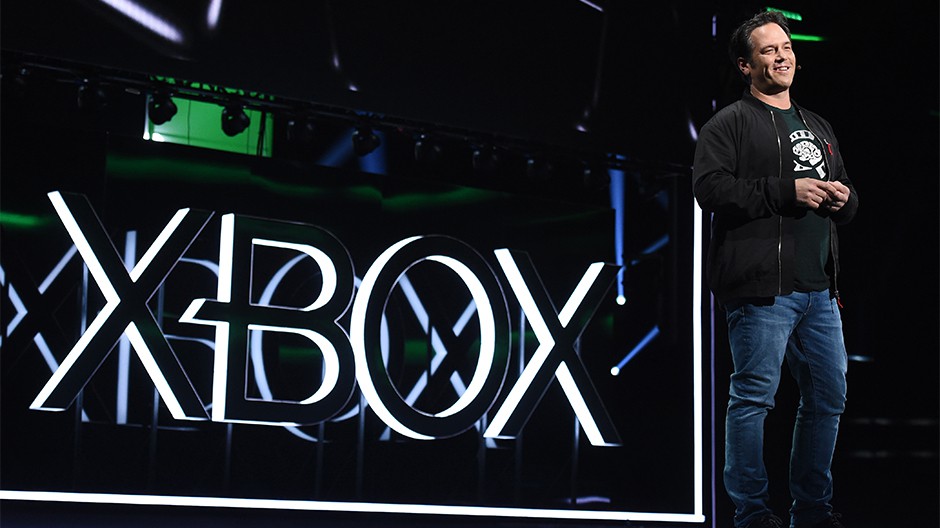
Phil Spencer, head of Xbox at Microsoft, at the Xbox E3 Briefing at the Microsoft Theater in Los Angeles in 2019. (Microsoft Photo)
Phil Spencer, the Xbox leader who spent 38 years at Microsoft and helped reshape the gaming industry through big acquisitions and a bet on cloud gaming, is retiring from the company.
He will be succeeded as CEO of Microsoft Gaming by Asha Sharma, a former Instacart chief operating officer and Meta vice president who joined Microsoft two years ago, the company said Friday.
The transition also includes the departure of Sarah Bond, the Xbox president who was widely seen as a potential Spencer successor, and the promotion of Matt Booty to executive vice president and chief content officer overseeing Microsoft’s nearly 40 game studios.
In an email to employees, Spencer said he told Microsoft CEO Satya Nadella last fall that he was ready to step back, and that they had been planning the transition since then. He called his nearly four decades at Microsoft “an epic ride and truly the privilege of a lifetime.”
Spencer “expanded our reach across PC, mobile, and cloud; nearly tripled the size of the business; helped shape our strategy through the acquisitions of Activision Blizzard, ZeniMax, and Minecraft; and strengthened our culture across our studios and platforms,” Nadella wrote in a separate memo.
Advertisement
The longtime Xbox leader will remain in an advisory role through the summer to support the handoff. Bond is also expected to remain at the company through a transition period.
Asha Sharma and Matt Booty, the new leadership team for Microsoft Gaming. (Microsoft Photo)
Sharma, who is currently president of Microsoft’s CoreAI product organization, has roots in the Seattle startup community, with deep experience in consumer platforms and operations, and no prior experience in the video-game industry.
That’s where Booty’s new role will presumably come in — as chief content officer, the industry veteran will oversee Microsoft’s sprawling studio portfolio, pairing his decades of gaming experience with Sharma’s operational background.
In her first message to the gaming team, Sharma pledged to recommit to Xbox’s core console fans and vowed that the company would not “flood our ecosystem with soulless AI slop,” calling games “art, crafted by humans.”
Microsoft had been planning to make the announcement next week, but accelerated its timeline after IGN learned about the plans from inside sources. The gaming publication broke the news a short time ago.
Advertisement
Xbox is facing headwinds heading into the transition.
Gaming revenue fell 9%, or $623 million, during Microsoft’s most recent quarter, with Xbox content and services revenue declining 5% and hardware revenue falling 32%. Microsoft’s CFO Amy Hood attributed the decline in part to a prior-year quarter that benefited from stronger first-party game releases.
The business accounts for just over 7% of Microsoft’s total revenue — about $5.96 billion of the company’s $81.3 billion in the most recent quarter — but remains core to the tech giant’s consumer ambitions.
Here is the full text of the Microsoft memos announcing the news:
Advertisement
From Satya Nadella:
Gaming has been part of Microsoft from the start. Flight Simulator shipped before Windows, and you can practically ray‑trace a line from DirectX in the ’90s to the accelerated‑compute era we’re in today.
As we celebrate Xbox’s 25th year, the opportunity and innovation agenda in front of us is expansive. Today we reach over 500 million monthly active users, are a top publisher across all platforms, and continue to innovate across gaming hardware, content and community, in service of creators and players everywhere.
I am long on gaming and its role at the center of our consumer ambition, and as we look ahead, I’m excited to share that Asha Sharma will become Executive Vice President and CEO, Microsoft Gaming, reporting to me. Over the last two years at Microsoft, and previously as Chief Operating Officer at Instacart and a Vice President at Meta, Asha has helped build and scale services that reach billions of people and support thriving consumer and developer ecosystems. She brings deep experience building and growing platforms, aligning business models to long-term value, and operating at global scale, which will be critical in leading our gaming business into its next era of growth.
Matt Booty will become Executive Vice President and Chief Content Officer, reporting to Asha. Matt’s career reflects a lifelong commitment to games and to the people who make them. Under his leadership, Microsoft Gaming has grown to span nearly 40 studios across Xbox, Bethesda, Activision Blizzard, and King, which are home to beloved franchises including Halo, The Elder Scrolls, Call of Duty, World of Warcraft, Diablo, Candy Crush, and Fallout.
Advertisement
Together, Asha and Matt have the right combination of consumer product leadership and gaming depth to push our platform innovation and content pipeline forward. Last year, Phil Spencer made the decision to retire from the company, and since then we’ve been talking about succession planning. I want to thank Phil for his extraordinary leadership and partnership. Over 38 years at Microsoft, including 12 years leading Gaming, Phil helped transform what we do and how we do it. He expanded our reach across PC, mobile, and cloud; nearly tripled the size of the business; helped shape our strategy through the acquisitions of Activision Blizzard, ZeniMax, and Minecraft; and strengthened our culture across our studios and platforms. I’ve long admired Phil’s unwavering commitment to players, creators, and his team, and I am personally grateful for his leadership and counsel. He will continue working closely with Asha to ensure a smooth transition.
We have extraordinary creative talent across our studios and a global platform that is second to none. I’m excited for how we will capture the opportunity ahead and define what comes next, while staying grounded in what players and creators value.
Please join me in congratulating Asha and Matt on their new roles, and in thanking Phil for everything he has done for Microsoft and for our industry.
From Phil Spencer:
Advertisement
When I walked through Microsoft’s doors as an intern in June of 1988, I could never have imagined the products I’d help build, the players and customers we’d serve, or the extraordinary teams I’d be lucky enough to join. It’s been an epic ride and truly the privilege of a lifetime.
Last fall, I shared with Satya that I was thinking about stepping back and starting the next chapter of my life. From that moment, we aligned on approaching this transition with intention, ensuring stability, and strengthening the foundation we’ve built. Xbox has always been more than a business. It’s a vibrant community of players, creators, and teams who care deeply about what we build and how we build it. And it deserves a thoughtful, deliberate plan for the road ahead.
Today marks an exciting new chapter for Microsoft Gaming as Asha Sharma steps into the role of CEO, and I want to be the first to welcome her to this incredible team.Working with her over the past several months has given me tremendous confidence. She brings genuine curiosity, clarity and a deep commitment to understanding players, creators, and the decisions that shape our future. We know this is an important moment for our fans, partners, and team, and we’re committed to getting it right. I’ll remain in an advisory role through the summer to support a smooth handoff.
I’m also grateful for the strength of our studios organization. Matt Booty and our studios teams continue to build an incredible portfolio, and I have full confidence in the leadership and creative momentum across our global studios. I want to congratulate Matt on his promotion to EVP and Chief Content Officer.
As part of this transition, Sarah Bond has decided to leave Microsoft to begin a new chapter. Sarah has been instrumental during a defining period for Xbox, shaping our platform strategy, expanding Game Pass and cloud gaming, supporting new hardware launches, and guiding some of the most significant moments in our history. I’m grateful for her partnership and the impact she’s had, and I wish her the very best in what comes next.
Advertisement
Most of all, to everyone in Microsoft Gaming, I want to say “thank you”. I’ve learned so much from this team and community, grown alongside you, and been continually inspired by the creativity, courage, and care you bring to players, creators, and to one another every day.
I’m incredibly proud of what we’ve built together over the last 25 years, and I have complete confidence in all of you and in the opportunities ahead. I’ll be cheering you on in this next chapter as Xbox’s proudest fan and player.
Phil
XBL: P3
Advertisement
From Asha Sharma:
Dear team,
Today I begin my role as CEO of Microsoft Gaming.
I feel two things at once: humility and urgency.
Humility because this team has built something extraordinary over decades. Urgency because gaming is in a period of rapid change, and we need to move with clarity and conviction.
Advertisement
I am stepping into work shaped by generations of artists, engineers, designers, writers, musicians, operators and more who create worlds that have brought joy and deep personal meaning to hundreds of millions of players. The level of craft here is exceptional, and it is amplified by Xbox, which was founded in the belief that the power of games connect people and push the industry forward.
Thank you to Phil for his leadership, and to every studio, platform, and operations team that built this foundation. We are stewards of some of the most loved stories and characters in entertainment and bring players and creators together around the fun and community of gaming in entirely new ways.
My first job is simple: understand what makes this work and protect it.
That starts with three commitments.
Advertisement
First, great games.
Everything begins here. We must have great games beloved by players before we do anything. Unforgettable characters, stories that make us feel, innovative game play, and creative excellence. We will empower our studios, invest in iconic franchises, and back bold new ideas. We will take risks. We will enter new categories and markets where we can add real value, grounded in what players care about most.
I promoted Matt Booty in honor of this commitment. He understands the craft and the challenges of building great games, has led teams that deliver award-winning work, and has earned the trust of game developers across the industry.
Second, the return of Xbox.
Advertisement
We will recommit to our core Xbox fans and players, those who have invested with us for the past 25 years, and to the developers who build the expansive universes and experiences that are embraced by players across the world.
We will celebrate our roots with a renewed commitment to Xbox starting with console which has shaped who we are. It connects us to the players and fans who invest in Xbox, and to the developers who build ambitious experiences for it.
Gaming now lives across devices, not within the limits of any single piece of hardware. As we expand across PC, mobile, and cloud, Xbox should feel seamless, instant, and worthy of the communities we serve. We will break down barriers so developers can build once and reach players everywhere without compromise.
Third, future of play.
Advertisement
We are witnessing the reinvention of play.
To meet the moment, we will invent new business models and new ways to play by leaning into what we already have: iconic teams, characters, and worlds that people love. But we will not treat those worlds as static IP to milk and monetize. We will build a shared platform and tools that empower developers and players to create and share their own stories.
As monetization and AI evolve and influence this future, we will not chase short-term efficiency or flood our ecosystem with soulless AI slop. Games are and always will be art, crafted by humans, and created with the most innovative technology provided by us.
The next 25 years belong to the teams who dare to build something surprising, something no one else is willing to try, and have the patience to see it through. We have done this before, and I am here to help us do it again. I want to return to the renegade spirit that built Xbox in the first place. It will require us to relentlessly question everything, revisit processes, protect what works, and be brave enough to change what does not.
Advertisement
Thank you for welcoming me into this journey.
Asha
From Matt Booty:
I read Phil’s note with much gratitude. He has been a steady champion for game creators and our studio teams, and I’ve learned so much from his leadership over the years. All our games have benefited from his foundational support. I’m also grateful to Satya for his ongoing commitment to gaming and holding a vision of how it can connect back to the larger company.
Looking forward, I’m excited to partner with Asha as our next CEO. Our first conversations centered on her commitment to making great games and the role that plays in our overall success. She asks questions, pushes for clarity, and wants our choices grounded in player and developer needs. That mindset matters as the industry around us is changing quickly: how players engage, how games are made, and how business models and platforms evolve.
Advertisement
We have good reasons to believe in what’s ahead. This organization and its franchises have navigated change for decades, and our strength comes from teams who know how to adapt and keep delivering. That confidence is grounded in a strong pipeline of established franchises, new bets we believe in, and clear player demand for what we are building.
My focus is on supporting the teams and leaders we have in place and creating the conditions for them to do their best work. To be clear, there are no organizational changes underway for our studios.
Thanks for everything you do for players and for each other.
Microsoft is preparing to bring another change to the humble Notepad app. According to Windows Latest, internal testing on Windows 11 shows that the classic text editor is gaining full image support.
Notepad was once just a simple tool for typing plain text, but that simplicity has steadily evolved over multiple updates. Microsoft has modernized Notepad with autosave, undo history, and Markdown formatting. You can now apply basic styling, such as bold text, italics, and links.
WordPad, the older rich text editor that could handle images, has been removed from Windows, leaving Notepad to fill the gap. With WordPad gone, Microsoft appears to be expanding Notepad’s capabilities to cover more use cases.
The new image support will be part of Notepad’s extended formatting features. Microsoft sources told Windows Latest that image support is being tested in internal versions of Notepad. You’d be able to turn the feature off in Settings if you prefer the classic text-only experience.
Advertisement
How Notepad has been quietly changing
Microsoft
Image support in Notepad can be seen as a natural step toward a more capable note-taking tool, similar to Apple’s Notes or other built-in apps that support text formatting and images.
However, adding too many features could dilute what made Notepad appealing to users in the first place. Adding visual elements risks blurring the line between Notepad and more complex apps like OneNote.
Notepad’s evolution reflects broader changes in how people use built-in apps. If image support rolls out widely, the simple editor could become a more flexible space for jotting down ideas, links, and pictures all in one place.
Think you can quickly identify fake faces generated by AI models? Think again. According to a recently published study by Australian researchers, AI-generated faces are now essentially too difficult to spot – except for a small minority of people who are exceptionally skilled at analyzing facial features. As a result,… Read Entire Article Source link
TCS’s Gavin McPaul discusses how he got his start in cyber and the benefits of working out of picturesque Donegal.
“From an early age, I’ve always been fascinated by technology: phones, laptops, any new gadgets really,” says Gavin McPaul, the head of enterprise vulnerability management at Tata Consultancy Services (TCS).
His family soon noticed his skill in the area of IT and at home he became the go-to person for all things tech related. “And I still am, unfortunately,” he jokes. “Towards the end of secondary school, I knew I wanted to pursue a career in IT.”
But like many young people at that stage of their lives, he was unsure of the educational direction he wanted to take, especially as his research showed him just how vast the IT sector was, indicated by the sheer volume of courses available at his chosen college, ATU Letterkenny.
Advertisement
He explains: “One course immediately jumped out at me because of its title, Computing with Computer Security and Digital Forensics. It sounded incredibly interesting, and I’m certainly glad I made that choice. It was towards the end of my degree that I realised I wanted to specialise in penetration testing.”
How have you progressed in your career as quickly as you have?
I believe my quick progression comes down to curiosity. I’ve always been driven to learn new things, take on more responsibility, question the status quo to find better ways of working, and I’m always interested in helping other people.
When I first started at TCS, we had a large team, but much of the work was individual projects. I made an effort to speak to everyone, understanding how they approached their tasks. I quickly realised everyone had their own methods. This led me to create a central collaboration space where ideas could be shared, benefiting the entire team and new joiners alike.
My curiosity and fresh perspective straight out of college meant that within my first five months, I identified an opportunity for improvement with one of our applications. This was a significant career boost, demonstrating my ability and knowledge. It got me noticed by senior leadership and opened doors to new projects.
Advertisement
What aspects of the TCS culture do you believe make it an attractive place to begin a career?
What I truly appreciate about TCS is the incredible team environment. An office space with genuine collaboration and where you can learn from team members is invaluable, especially early in your career. Nobody at TCS wants to see you fail. There’s a robust support system ready to guide you in the right direction.
As a large consultancy, our core goal at TCS is to support clients through their technology transformation journeys. Working with numerous clients across diverse sectors means there are always opportunities to explore and specialise in areas of interest. Our clients are often undergoing significant transformations, actively seeking fresh ideas and innovative solutions, and they truly value the insights and solutions we bring.
What does a typical day look like for you?
The most exciting aspect of cybersecurity and penetration testing is that no two days are the same; you truly never know what challenges might arise. I’m fortunate to work with one of our financial services clients in the US, collaborating with an excellent team spread across the US, Ireland and India. As a lead within their offensive security team, I’m currently helping them transform their entire penetration testing programme.
As the technical lead for our teams in Ireland and India, I provide advice, guidance and support on all aspects of penetration testing. Our core goal for the client is to secure their applications and data from external threats.
Advertisement
Beyond that, my work is diverse and includes meeting potential new clients, building out new capabilities, developing internal training programmes, interviewing and onboarding new resources, and helping manage our team of 10 people, which we’re looking to expand by another six.
What do you enjoy most about living and working in the north-west?
I love the beauty and quiet of living in Donegal. We’re fortunate to have several large organisations here, which is fantastic for our county. These provide great opportunities for people living in the area, especially with a local university like ATU Letterkenny feeding directly into places like TCS.
I feel incredibly fortunate to have found a cybersecurity career in Donegal, working here since college and still being given opportunities to further my career with TCS, even after six years.
What advice would you give someone looking to start a career in cybersecurity or penetration testing?
We all leave college with the same degree after four years, but what truly sets you apart from everyone else? Most students haven’t considered this question, so they often don’t have an immediate answer. When I interview graduates, I’m really looking for passion and genuine interest in cybersecurity. Often, this shines through in what they’ve done outside of their degree. Here are a few things I always recommend to students.
Advertisement
Sign up for any IT or cybersecurity societies at your college. If there isn’t one, take the initiative to start it. Attend conferences like BSides, IRISSCON, or OWASP local chapters. Get involved in ‘capture the flag’ competitions, like Zero Days CTF or the many free online options. These are fantastic for hands-on experience and for networking with other students and industry professionals. You can even prepare for them through your college society.
Create a LinkedIn account. It’s an excellent way to connect with like-minded people, and recruiters are always on the lookout there. During summer, reach out to companies about internship programmes. They offer invaluable insight and hands-on industry experience.
If you can, pursue certifications. In Ireland, anyone can access industry-recognised certs like CompTIA Security+ or Pentest+ for free, funded by the Irish government. Research areas you’re interested in, read blogs, follow specialists, or even start a personal project.
If application penetration testing interests you, get to know OWASP – it will become your best friend in this field.
Advertisement
TCS are currently recruiting for application penetration testing roles. Click here to apply.
Don’t miss out on the knowledge you need to succeed. Sign up for the Daily Brief, Silicon Republic’s digest of need-to-know sci-tech news.
High refresh rate gaming monitors have slowly become more affordable, but Dell’s latest launch takes that trend to a new extreme. The company has introduced two new 27-inch gaming monitors with 240Hz refresh rates starting at roughly $130, a price that would have seemed impossible for this spec just a few years ago.
Dell
The two models, the SE2726HG and SE2726HGS, focus on delivering fast, responsive gameplay at a budget-friendly price. Both displays are built around a 27-inch Full HD panel, a combination that prioritizes high frame rates and smooth motion over ultra-high resolution. For competitive gaming, that trade-off makes sense. Lower resolution reduces GPU strain and helps players reach the high frame rates needed to fully take advantage of a 240Hz refresh rate.
Speaking of which, the high refresh rate is also paired with 0.5ms response time, which is designed to minimize motion blur and input delay. For fast shooters and esports titles, this can translate into smoother tracking, clearer movement, and a more responsive feel overall. Add to that, there’s support for AMD FreeSync to help eliminate screen tearing and keep gameplay fluid when frame rates fluctuate.
Dell
Dell has also paid attention to everyday usability. The panels cover 99% of the sRGB color space, which means they are capable of delivering reasonably accurate colors for media consumption, casual content creation, and general desktop work. The only difference between the two monitors is mainly in ergonomics and design. The SE2726HGS includes an adjustable stand that allows height and tilt changes. The SE2726HG, meanwhile, sticks with a simpler stand to keep the design straightforward and accessible.
The bigger takeaway from these monitors is how much high-refresh displays have evolved. Not long ago, 240Hz screens were niche products aimed almost exclusively at professional esports players. Now, they are becoming part of the mainstream gaming conversation. Dell’s new models highlight how competitive gaming features are gradually moving into everyday setups. Smooth motion, low latency, and adaptive sync are no longer luxury upgrades but features that more players can realistically consider. For gamers building or upgrading a setup, this release signals a shift in expectations.
from the to-be-fair,-a-coup-is-ALSO-a-way-to-secure-power dept
Trump couldn’t accept the fact that he lost the 2020 election. So he stood idly by (if you believe his narrative) or urged on (if you believe your own eyes and ears) his supporters to raid the Capitol building to seize the election from the electorate. If that meant killing his own vice president, so be it.
Eventually, Trump left office, replaced by Joe Biden for a whole four years of relative sanity. Then Trump returned to office and immediately pardoned nearly every one of his supporters who had been criminally charged with federal crimes for participating in the January 20th insurrection attempt.
The GOP has a very slim majority at the moment. GOP legislators opting to retire are now derailing pro-MAGA legislation. Democratic opposition is finally showing some signs of life. And California has responded with pro-Dem gerrymandering of its own, limiting the effectiveness of GOP members running for congressional seats.
Advertisement
Now that it’s starting to look like a fair fight out there in the electorate with the mid-term elections approaching, the administration is making a push to seize election power from the states in order to give Trump the congressional majority he needs to keep being as awful as he’s been since his return to office.
President Trump doubled down on his extraordinary call for the Republican Party to “nationalize” voting in the United States, even as the White House tried to walk it back and members of his own party criticized the idea.
Mr. Trump said on Tuesday that he believed the federal government should “get involved” in elections that are riddled with “corruption,” reiterating his position that the federal government should usurp state laws by exerting control over local elections.
If states “can’t count the votes legally and honestly, then somebody else should take over,” he said in the Oval Office, accusing several Democratic-run cities of corruption. “Look at some of the places — that horrible corruption on elections — and the federal government should not allow that,” he added. “The federal government should get involved.”
A nationalized election process is just a welcome wagon for autocracy. That’s why it’s never happened before, thanks to the foresight of the founding fathers who definitely weren’t interested in going back to being the subjects of a king, even if the king pretended a captive process was actually a democratic election.
Advertisement
And that’s why it’s being bandied about by this administration — one that clearly doesn’t care what happens to America as long it continues to remain in power. That’s also why Trump isn’t necessarily angling for a full takeover of midterm elections. He just wants to interfere in places where his lackeys have a real chance of losing elections.
During a podcast interview with Dan Bongino, his former deputy F.B.I. director, on Monday, Mr. Trump called for Republican officials to “take over” voting procedures in 15 states, though he did not name them. “The Republicans should say, ‘We want to take over,’” he said. “We should take over the voting, the voting in at least many — 15 places. The Republicans ought to nationalize the voting.”
No sentence should ever begin with “during a podcast interview with Dan Bongino” and end with an actual sitting president stating he should be allowed to “take over” the midterm elections in a select number of areas where his supporters aren’t likely to win.
None of this matters to Trump, however. Blessed with a lack of foresight or hindsight, Trump ventured out into the relative safety of his favorite conflict of interest — Truth Social — to ensure Americans that he hasn’t ruled anything out when it comes to actually stealing an election. (h/t Derek Guy and his preservation efforts)
If you can’t see/read the embed, consider yourself blessed. Consider yourself cursed (and feel free to do as much cursing as you feel is necessary) if you choose to read on. Here’s the entirety of Trump’s “it’s coup time baby!” Truth Social post:
The Democrats refuse to vote for Voter I.D., or Citizenship. The reason is very simple — They want to continue to cheat in Elections. This was not what our Founders desired. I have searched the depths of Legal Arguments not yet articulated or vetted on this subject, and will be presenting an irrefutable one in the very near future.There will be Voter I.D. for the Midterm Elections, whether approved by Congress or not! Also, the People of our Country are insisting on Citizenship, and No Mail-In Ballots, with exceptions for Military, Disability, Illness, or Travel. Thank you for your attention to this matter! PRESIDENT DONALD J. TRUMP
These are not the words of a well person. These are certainly not the words of anyone you’d want to have the driver’s keys to a nation, much less the access code to an apartment pool.
Advertisement
Someone who thinks the answer to his hostile takeover of the American election process can be justified by “Legal Arguments not yet articulated or vetted” is the same sort of person who thinks they’re only days away from perfecting a perpetual motion machine or discovering the secret to eternal life.
But while that part of the post may be comically delusional, it’s the next sentence that’s far more worrying. This is the president claiming he will mandate his version of “Voter I.D.” at the polls, whether it’s legal or not.
And it definitely won’t be legal. Almost every effort the administration has made to disenfranchise voters, alter long-standing election rules, and eliminate voters not likely to side with Trump and the GOP has resulted in lawsuits. Very little of this litigation is settled. And what little of it has been settled has resulted in a loss for Trump.
The GOP’s efforts to codify Trump’s baseless voter fraud conspiracy theories haven’t had much more success. What has managed to move forward is largely redundant, but with the added bonus of allowing Trump’s DOJ to prosecute election officials if the administration believes (hallucinates) local officials didn’t do enough (whatever that means) to dissuade non-citizens from voting.
Advertisement
But this is exactly the sort of thing Trump loves, even if he possibly knows there’s no factual basis for the accusations and insinuations he’s making. If his GOP counterparts lose elections during the midterm, he’ll be the first to start mouthing off about immigrants and “illegal” votes. If his boys win, he’ll take credit for the “fair” election. And the conspiracy theories will return to the slow boil until they’re needed in 2028.
The creator economy is evolving fast, and ad revenue alone isn’t cutting it anymore. YouTubers are launching product lines, acquiring startups, and building actual business empires. In fact, MrBeast’s company bought fintech startup Step, and his chocolate business is outearning his media arm. This isn’t just one creator’s strategy. For many, it’s the new playbook.
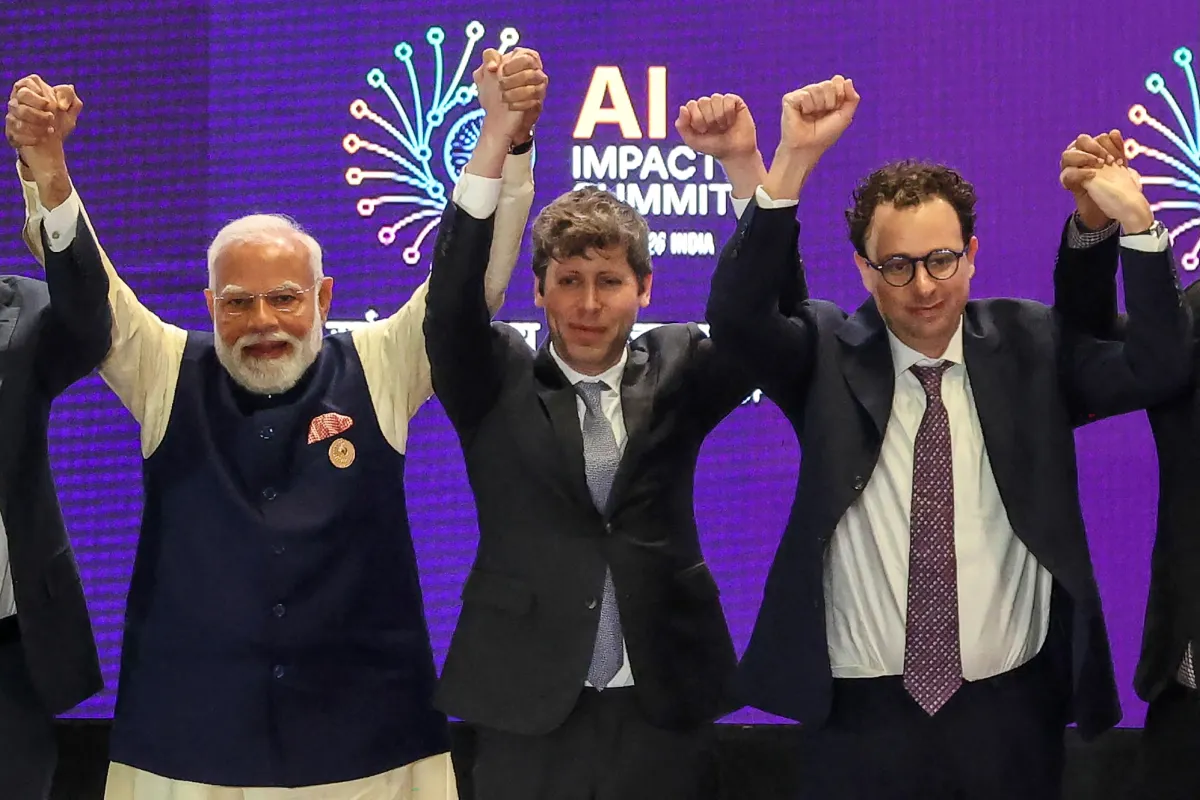
On this episode of TechCrunch’s Equity podcast, hosts Kirsten Korosec, Anthony Ha, and Rebecca Bellan unpack how creators are diversifying beyond ads, whether their model can scale beyond the top 1%, everything happing at India’s AI Impact Summit, and more of the week’s headlines.
This week, things were a little quieter as we await the reveals of Samsung Unpacked next week, but that’s not to say it was boring.
YouTube went down, Apple teased its next product event, and Discord rivals crashed under the weight of new users fleeing to their platforms.
To catch up on this and more, scroll down for our recap of the week’s seven biggest tech news stories.
Advertisement
7. The Discord exodus started
(Image credit: Getty Images)
Discord has inadvertently spoiled its reputation over the last week, with an announcement that it will be introducing its strict age verification plans to its users globally, after the UK’s updated Online Safety Act. It unsurprisingly sparked outrage among Discord users, who fled to multiple alternative social platforms, so much so that it gave one in particular, Stoat, server capacity issues.
It comes after a plethora of users took to unsubscribing from the platform’s Nitro service, with many looking to force Discord to rethink its strategy. Unfortunately, Discord is yet to make any adjustments to its verification plans set for March, and has only issued an update to its initial press release, providing extra ‘clarification’ for those plans.
Advertisement
6. We tested the weirdest e-bike so far
(Image credit: Future / Paul hatton)
AI really is finding its way into everything, as this week we tried Acer’s ebii 20 — an e-bike with AI features aimed to enhance the rider’s experience.
There is something to be said for the security protection and AI pedal assistance, but the hub motor lacks the power most would expect from an e-bike in this price bracket.
Sign up for breaking news, reviews, opinion, top tech deals, and more.
Advertisement
It also has poor weight distribution, and made some annoying ticking and white noise sounds while we were testing it — likely because we didn’t outfit the bike with a SIM card — which led to frustrations that meant we could only award it three-and-a-half stars in our review.
5. Movie studios fought back against AI clones
(Image credit: Getty Images/JOEL SAGET )
Netflix and Paramount might be battling over which of them will buy Warner Bros., but for now, the trio, and some other Hollywood studios like Disney, are allies in pushing back on Seedance 2.0 — a new AI video generator from ByteDance (the TikTok owner).
That is because they all claim the platform is using their characters and IP without permission.
Advertisement
Several Seedance videos have gone viral recently, including one starring Brad Pitt and Tom Cruise in a fight scene, with dialogue that sees Pitt accuse Cruise of killing Jeffrey Epstein — with the Screen Actors Guild of America (SAG-AFTRA) calling the video “unacceptable”.
The Chinese company has since said it will take steps “to prevent the unauthorized use of intellectual property and likeness by users.”
Advertisement
4. We dissected the new Game of Thrones trailer
(Image credit: HBO Max)
Thankfully, this week we didn’t need AI to get excited about one major entertainment property, as the trailer for House of the Dragon season 3 dropped.
With last season’s finale suggesting that the Targaryen Civil War will finally take center stage this season, its first teaser, which you can watch above, is a thoroughly explosive one.
Unfortunately, the one thing we’re still missing is an official release date. It’s coming sometime in June, but precisely when is still a mystery for now.
Advertisement
3. Ring defended its leaked plan to “zero out crime”
(Image credit: Amazon)
Privacy has been a huge theme this week – and Discord (see above) wasn’t the only company that shot itself in the foot. Ring also had to defend itself from accusations that it’s planning to create an opt-out system that borders on mass surveillance.
A leaked email from Ring founder Jamie Siminoff poured gasoline on a controversy that was sparked by the company’s Super Bowl ad for its ‘Search Party’ feature. That feature is designed to help lost dogs, but the email said it could lead to a “future where we are able to zero out crime in neighborhoods”.
That understandably didn’t go down too well with privacy advocates – but Ring told us that it’s standing firm, despite the backlash.
Advertisement
2. YouTube went down in a very rare outage
(Image credit: Getty Images / NurPhoto)
We’re getting pretty used to outages on X, which went down twice this week – but seeing YouTube go offline is a more panic-inducing rarity. Well, that unfortunate incident happened on Tuesday night when YouTube gave millions of people a taste of what life was like before 2006.
The 90-minute outage hit every part of YouTube – from the website and app to YouTube Music and TV – and was caused by an innocent “issue with our recommendations system”, according to Google. The experience made many realize how dependent they’ve become on the video-sharing site, which is so culturally significant it’s now an exhibit at London’s V&A museum.
1. Apple announced a big March event
(Image credit: Apple / Future)
We might currently be gearing up for Samsung’s upcoming Unpacked next week, but not wanting to be left out of the conversation, Apple has teased a showcase for March 4 — and it could be a doozy.
Advertisement
As ever, the company is keeping tight-lipped about what product launches we might see at the event, with nothing specific mentioned in the press invite itself; however, there are suggestions from leaks and speculation that it’ll have a wide range of products to announce.
This could include new MacBook Pros, the iPhone 17e, a new iPad Air, and possibly a new Mac Studio. We’ll have to wait and see what gets announced, but if you’re an Apple fan looking to upgrade your tech, you might want to wait a week or so to see what Apple has up its sleeves.
Google is trying out something different: conversational AI on YouTube’s TV apps.
This big move brings the “Ask” feature to your smart TVs, gaming consoles, and streaming devices. It’s a game-changer because for the first time, you can actually use your TV remote’s microphone to ask questions about the video you’re watching, with Gemini doing the heavy lifting to give you the answers.
This chatty AI tool has been on the YouTube website and mobile apps for a bit, but now TVs are finally getting some love.
In this small test, users who are in the club will spot an “Ask” button beneath videos. Hitting that button opens the AI tool, where you can either pick from suggested prompts or go wild and ask your own questions using voice.
Advertisement
Advertisement
For instance, let’s say you’re watching a cooking tutorial; you could ask, “What ingredients are they using for this recipe?” or during a music video, “What’s the story behind these lyrics?”
Google states the feature is currently available in English, Hindi, Spanish, Portuguese, and Korean, and only in a few spots.
The rollout is still experimental, with only a small bunch of users included. Apps will need to be updated to fully support the feature, so don’t hold your breath for widespread availability right away. Nevertheless, this action signals Google’s intent to make YouTube more interactive, transforming passive viewing into a conversational experience.
Advertisement
YouTube is stepping up its game, becoming more than just a video platform by bringing conversational AI right into its TV apps.
This shift is designed to revamp how you watch stuff, letting you actually chat with the content, ask questions while the video is playing, and get these cool, AI-driven summaries, like the best parts or what a word means, all without pausing the action.
It’s all well and good that we have a system of laws and rules in place. For the most part, the bumpers on the bowling lane help keep a lot of stuff on the field of play (to mix metaphors), even if powerful politicians would rather have the rules apply to everyone else but them.
This simply isn’t working during Trump’s second term in office. The rules and laws (and the oft-referenced “rule of law”) are still in place. But they don’t mean much when there are no meaningful methods of enforcement.
Trump continues to staff the DOJ with prosecutors who have never been subjected to the legally required confirmation process. To be fair, it’s always been a struggle to staff Trump’s DOJ. Those who haven’t quit because they refuse to engage in vindictive prosecutions are being fired because they either won’t engage in vindictive prosecutions or they’re simply not doing it as hard and as fast as Trump would like.
Plenty of people who used to serve Trump personally as his attorneys have been elevated into top-level prosecution roles, despite their complete lack of relevant experience. None of these people have been appointed legally.
Advertisement
Judges have been pushing back, which has led to Trump’s former insurance lawyer, Lindsey Halligan being unceremoniously ousted from her role as a US attorney. Alina Habba spent most of a year generating massive conflicts of interest after being quasi-appointed to the position of US Attorney. She did this while still employed by Trump as his personal lawyer. Last December, she resigned from the position she never held legally and is now just another Trump lawyer who gets to hang around in the West Wing.
John Sarcone — Trump’s former campaign lawyer — was disqualified by a judge in January because he, too, had not been legally appointed to his position because Trump (and AG Pam Bondi) decided anyone who Trump wanted to be a US attorney could be one, even if that meant skipping the confirmation process entirely.
That didn’t bode well for Trump’s revenge fantasies. Sarcone being benched by the bench meant that all of his subpoenas targeting NY state attorney general Letitia James were no longer valid.
If the president decides he doesn’t want to subject his prosecutorial appointees to the confirmation process, that’s fine. But they only get to serve for so long (120 days) before they have to be replaced with a confirmed nominee. If that doesn’t happen, the court system gets to appoint a prosecutor to the now-open position.
The White House on Wednesday evening fired a new interim U.S. attorney in New York’s Northern District less than five hours after a panel of federal judges had appointed Donald T. Kinsella to the position.
The swift termination of Kinsella, a former longtime federal prosecutor, underscored the ongoing tensions in federal districts where the administration of President Donald J. Trump has clashed with judges who have declined to appoint his interim appointments of U.S. attorneys who have not been confirmed by the Senate.
That’s insane. It probably took more time to discuss the appointment than it did for Trump to fire Kinsella. Kinsella was the court-appointed placeholder — one that could only be replaced by a nominee confirmed by the Senate.
But that’s not happening here. Not only did the administration fire Kinsella, but it immediately declared John Sarcone was still the acting US Attorney, no matter what the court had declared. And rather than caution the administration against ritually abusing the process to keep former Trump lawyers in positions of government power, Trump’s high-level officials got up on the socials to make sure everyone knew this president is actually a king.
Advertisement
On Wednesday evening, after the Times Union first reported Kinsella’s appointment as well as his subsequent firing by the White House, the U.S. deputy attorney general, Todd Blanche, posted on X: “Judges don’t pick U.S. Attorneys, @POTUS does. See Article II of our Constitution. You are fired, Donald Kinsella.”
Hopefully, the court will just appoint someone else and force the administration to keep showing its autocratic ass until one of the White House bumblefucks says or does something that can’t be walked back. Attrition is the name of the game here. And I think there are more than enough qualified prosecutors available to outlast Trump’s revolving door of personal lawyers willing to accept government positions in lieu of a personal check from Trump.
Sarcone ran for Westchester County district attorney as a Republican in 2024 but lost to eventual winner Susan Cacace, a Democrat. He was later nominated by the Trump Administration to be U.S. attorney for the Northern District of New York, which covers the Capital region, North Country, Central New York and parts of the Southern Tier and Hudson Valley. But neither the U.S. Senate nor federal judges confirmed him, so the Trump Administration made him a special attorney for the region, devoid of term limits and traditional oversight.
Questions were eventually raised about his residence, since he had lived and campaigned in Westchester just a year before being named U.S. attorney for the Northern District of New York. The Times Union reported that Sarcone’s listed address was a boarded-up building. Following that report, Sarcone ordered his staff to remove Times Union journalists from the office’s press distribution list.
That’s who Sarcone is. And that’s who he is going to be. If the courts are serious about standing up to abuses of executive power, it might be time to engage in a war of attrition.
Written by Ivan Milenkovic, Vice President Risk Technology EMEA, Qualys
For the better part of the last decade,we have engaged in a comfortable fiction around security and development. If we could only “shift left” and get developers to take a modicum more responsibility for security alongside their coding, testing and infrastructure deployment, the digital world would become a safer, faster and cheaper place. Instead, the fundamental conflict between speed and security has got worse.
Why did this fail? Developers are under crushing pressure. The classic triangle of project management – Fast, Good, Cheap; pick two – has been smashed to pieces.
Businesses demand fast, good, cheap and secure. When push comes to shove, “fast” always wins. At the same time, we pushed too much cognitive load onto developers who were already drowning.
Advertisement
When they choose to use public container images to speed up development, they are trying to meet their goals, but they are also open to potential risk. So how can we understand what the real problem is, and then work to solve that?
Business demands beat security recommendations
There is a pervasive narrative in the security industry that developers are lazy or careless. This is absolutely not true. Developers are not lazy; they are overloaded, pragmatic professionals reacting to the incentives placed before them. If their bonus depends on shipping features by Friday and the security scan takes four hours to run and blocks the build, they will find a way around the scan.
Businesses demand results faster and faster, which has created an environment where security protocols are seen as a barrier to productivity rather than an integral part of engineering. When security tools are noisy, slow, and disconnected from the workflow, they are a barrier.
However, the result of this is that organisations have lost control of what is actually running in their environments. We have pipelines that deploy code automatically, infrastructure that scales up and down without human intervention, and AI agents that can now write and execute their own scripts.
Advertisement
Into this high-speed, automated chaos, we treat public registries like curated libraries, assuming that because an image is on Docker Hub, it must be safe. But pulling a container from a public registry like Docker Hub is a trust decision.
The likes of Docker, Amazon, Google and Microsoft all operate public container registries, so there is a natural assumption that they are safe.
This trust is misplaced. By the time that container image makes it to the deployment pipeline, it is already a trusted artifact, baked into the application.
The 2026 Forrester Wave™ for Cloud-Native Application Protection Platforms (CNAPP) provides objective analysis around cloud security.
Advertisement
Find out why Qualys is one of the leaders in the market today.
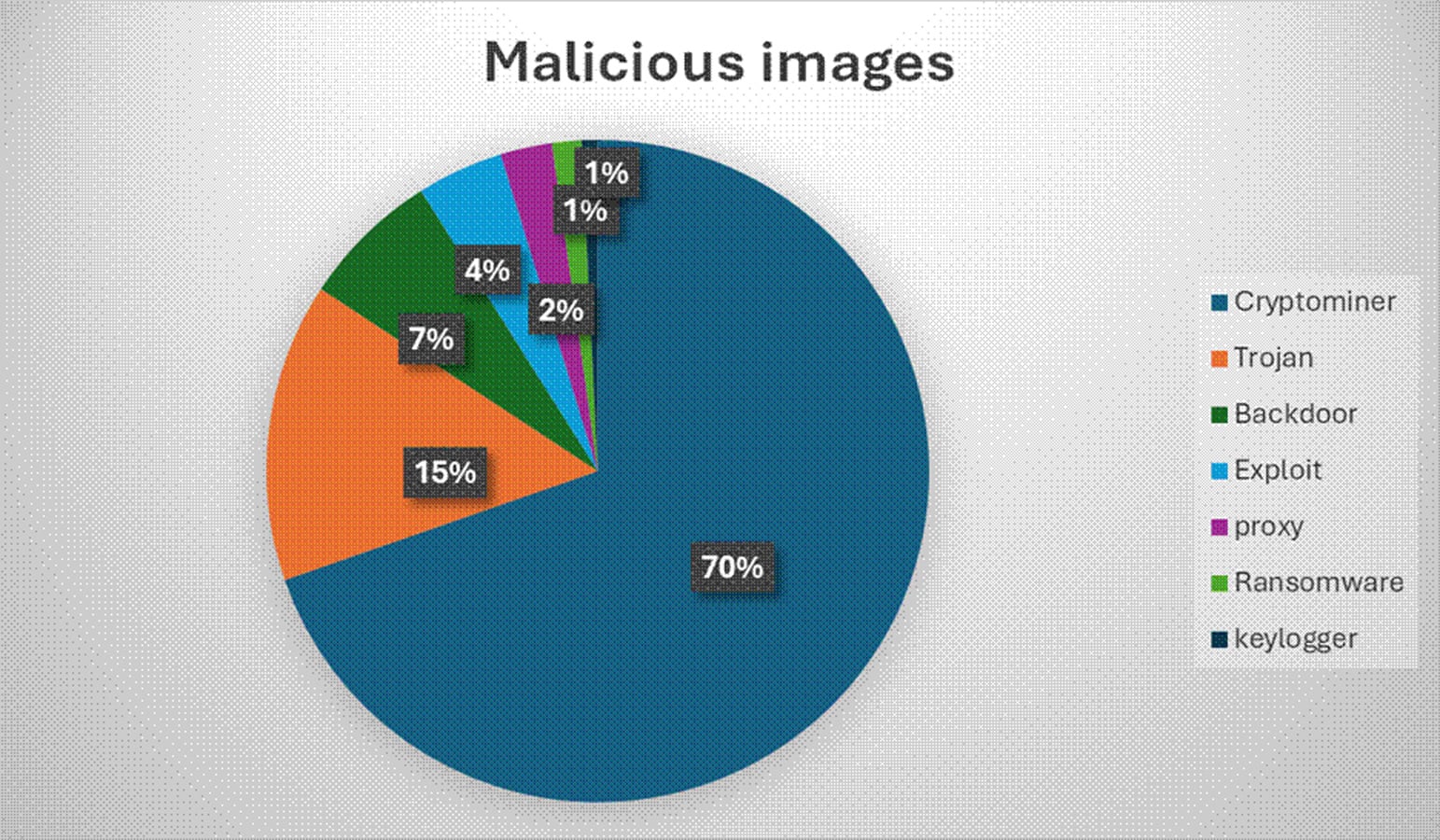
Of that total, around 2,500 images – approximately 7.3 percent of the sample – were malicious. Of the malicious images, 70 percent contained cryptomining software.
On top of this, 42 percent of images contained more than five secrets that could be used to get access to other resources or accounts. This includes valuable items like AWS access keys, GitHub API tokens, and database credentials baked directly into the image layers.
Advertisement
Qualys Research – make up of malicious images based on analysis of more than 2,500 confirmed malicious containers detected on DockerHub
In our analysis, the biggest issues around malicious containers are still very simple. Typosquatting is one of the most common methods that attackers use to get their malicious containers downloaded. The standard advice to “check the spelling” is essential, yes, but it is also a low-energy response to a high-stakes problem.
Telling a developer to “be more careful” is not a security strategy. While public registries are handy for speed, we should not be letting developers pull from public registries at all.
In a mature environment, every external image should be proxied through an internal artifact repository that acts as a quarantine zone. Yet that need for speed is not going to go away. Instead, we have to work on how to help developers move faster while keeping security in place.
This does mean more work for the infrastructure team, but that work should enable developers to move ahead faster and with less risk.
Shift down
The logic is that it is cheaper to fix a bug during design or coding than in production. Therefore, moving security earlier in the Software Development Life Cycle (SDLC) should reduce risks later. While this makes sense in theory, it asks developers to scan their own code, check their own dependencies, and manage their own infrastructure.
Advertisement
In reality, we just shifted the pain onward. It asks developers to manage vulnerabilities, configuration hardening, secret detection, compliance auditing, and so on. At the same time, those developers are measured primarily on feature velocity.
“Shift left” was supposed to make security collaborative. Instead, it simply moved the problem into every developer’s IDE. To fix this problem, we have to make security within infrastructure the default, rather than by design.
This involves real collaboration between developers and security – developers have to understand what they want to achieve and what will be required of what they build, while security will have to work around those requirements so they can be delivered securely. Both teams are responsible, but they both have to work at the speed that the business needs.
In practice, we can create a “golden path” for developers. If they use the standard templates, the pre-approved base images, and the official CI pipelines, security is free. If they want to go “off-road” and build something custom, then they have to do the additional work of security reviews and manual configurations.
Advertisement
This is also something that should be flagged back to the business from the start, so security and development present a united front around what the cost is.
Taking this approach incentivises secure deployment by making it the path of least resistance. It moves the responsibility down the stack to the infrastructure layer, managed by a specialised Platform Engineering team. And if something different is needed, that work can be done collaboratively to ensure it is right first time, rather than leading to more issues that need to be remediated.
For example, instead of asking a developer to please enable versioning on a specific S3 bucket, the platform team writes a policy using Terraform modules, Crossplane compositions, or Open Policy Agent that simply doesn’t allow a bucket to exist without versioning. The developer literally cannot make the mistake.
The platform corrects it automatically or rejects the request. Similarly, developers shouldn’t have to remember container scanning in their workflows, the CI pipeline should do it automatically. The admission controller should reject non-compliant images before they ever hit a cluster. The developer doesn’t need to know how the scan works, only that if they try to deploy a critical vulnerability, the door will be locked.
Advertisement
“Shift down” also means automating the fix. For instance if a vulnerability is found in a base image, the platform should automatically generate a Pull Request to upgrade it. If a runtime security tool detects a container behaving badly (e.g., spawning a shell for persistence), it shouldn’t just send an alert. It should kill the pod and isolate the node autonomously.
Rather than sticking with existing ways of running across security and development, we have to react to what is happening. This can mean we fundamentally change how we operate across teams.
If we continue with the “shift left” mentality of piling cognitive load onto developers, we will fail. We will burn them out, and they will bypass our controls simply so they can get what needs to be done for the business.
Instead, security has to be proactive around how to implement and support the right platforms for the business, so they can be made secure automatically.