

Crypto World
Searching for the next 100x gen, between BNB and Patos on Solana


Disclosure: This article does not represent investment advice. The content and materials featured on this page are for educational purposes only.
The Patos Meme Coin token presale launched on December 18th of 2025, and current on-chain data confirms it is rapidly selling out its initial allocation at the foundational floor price of $0.000139999993.
For forward-looking investors seeking to bypass the congestion of legacy secondary markets, researching the mechanics of this high-velocity Solana token at PatosMemeCoin.com has become the defining prerequisite for Q1 2026 portfolio allocation.
The subculture wars: Binancians vs. The Flock
In the modern cryptocurrency ecosystem of 2026, value is dictated as much by communal fervor as it is by underlying cryptography. At the forefront of this tribal financial landscape are two of the most loyal cryptocurrency subculture followings: the “Binancians” and “The Flock.”
Binance Coin holders, proudly referring to themselves as Binancians, represent the old guard of the centralized exchange era. They are the investors who weathered the regulatory storms, the executives who utilize the BNB Chain for decentralized applications, and the traders who rely on BNB for fee discounts across the world’s largest exchange ecosystem. While Binance is much more established with a significantly larger global fanbase, market saturation has tempered their expectations.
In stark contrast, the Patos token holders — known colloquially as “The Flock” — are an insurgency of high-risk, high-reward capital allocators. They are much more fervent for success in February 2026, driven by the viral mechanics of Solana-based wealth generation.
The Flock is not interested in single-digit annual percentage yields; they are hunting for generational wealth. This comparative analysis posits a central thesis: between the entrenched Binancians and the hyper-aggressive Flock, which group is actually likely to see a 100X ROI first?
The anatomy of a Solana gem
Patos is the new Solana memecoin that currently commands a ‘ton of hype’ across decentralized finance (DeFi) message boards, alpha groups, and trading terminal chatrooms. Since ripping onto the scene on December 18th of 2025, it has systematically gained clout with heavy-hitting Solana Whales and most recently, crypto sharks. In less than two months, it has undeniably become Solana’s #1 crypto moon prospect.
The project is garnering more support from centralized crypto exchanges than any other token presale currently active on any blockchain — including the dominant forces of Ethereum, Binance, Solana, and Sui.
As investor FOMO (Fear Of Missing Out) spreads through the crypto degen trenches, the official token presale is moving over 14.5 million tokens daily. These sales averages are compounding weekly with strong upward momentum, creating a feedback loop of scarcity and demand. At this current rate of geometric growth, one prominent on-chain analyst report suggests its floor price offering could sell out completely well before its scheduled June 2026 end.
Smashing the legacy ceiling: The 111-exchange strategy
What elevates Patos Meme Coin from a standard speculative asset to a verified “Solana Gem” is its unprecedented infrastructural roadmap. Patos is aiming to smash crypto records with 111 crypto exchange listings in its first week of public trading. This is an institutional undertaking that is nearly 10x more ambitious than the launch of any noteworthy legacy meme coin in history.
To put this in perspective, one must look at the historical data on the market’s current multi-billion-dollar titans. Tokens like Bonk Inu, Pudgy Penguin, Shiba Inu, and Dogecoin all had fewer than 12 listings during their respective debut weeks, with most launching on under 9 platforms. They relied on slow, organic growth over the years to eventually secure Tier 1 exchange support.
Patos is bypassing this multi-year grind entirely. On its 56th day of presale, less than 2 months in, Patos already has enough confirmed Exchange agreements to show it will top the combined debuts of these billion-dollar brands. Top 30 ranked exchange, Biconomy, became the 8th CEX to confirm it will list PATOS after its initial coin offering concluded just last week. The news triggered a rush of token presale buys, increasing FOMO and hype.
This staggering level of pre-launch market penetration is exactly what has crypto investors repeating their buying, dollar-cost averaging, and watching smart contract activity closely.
The mathematics of a Mars shot
Patos Meme Coin is currently priced at $0.000139999993 per token today. Because this asset is in its incubation phase, a violent price surge is imminent once it officially launches on crypto exchanges in June, during the third quarter of 2026.
For early presale buyers, suggesting a 10x return is more than likely at this point with absolute ease; however, a 70x-80x multiple is considered far more likely according to various decentralized analysts mapping the project’s liquidity constraints. Patos is expected to list with a multi-million dollar liquidity pool and a baseline market cap of just over $11 million.
Centralized exchanges act as floodgates; they expose newly listed tokens to millions of active retail users and billions of dollars of dormant investor funds. An injection of $333 million into the Patos ecosystem upon its coordinated launch is easily plausible in the current macroeconomic climate. Because the starting market cap is tightly compressed, a $333 million liquidity injection represents a 33X multiple on both the market cap and the individual token value.
Table 1: Patos Meme Coin price forecast (post-launch 2026)
The following forecast models Patos Meme Coin’s price growth from its June 26th CEX listing date until the end of 2026. This model bases its figures on only 20 active crypto exchange listings, specifically including the wildcard event in which one Tier 1 exchange is predicted to occur.
| Month (2026) | ‘Bad Market’ Scenario | ‘Good Market’ Scenario | Month’s ATH (All-Time High) |
| June (Debut) | $0.000450 | $0.001800 | $0.003500 |
| July | $0.000380 | $0.002200 | $0.004200 |
| August | $0.000500 | $0.003500 | $0.006800 |
| September | $0.000850 | $0.005100 | $0.009500 |
| October | $0.000700 | $0.004800 | $0.008900 |
| November | $0.001100 | $0.007500 | $0.012500 |
| December | $0.001500 | $0.009800 | $0.015500 (~110X ROI) |
How tokens get their value
To understand why a 100x return is achievable for the Patos Flock and statistically impossible for Binancians in 2026, investors must grasp the fundamental equations of cryptocurrency valuation.
The formula is absolute: Market Capitalization divided by Total Token Supply is the token’s value. Market capitalization is simply the total amount of money currently supporting the asset in the open market. Therefore, whatever percentage of increase a market cap has, that exact percentage is directly responsible for the increase of the token price — provided the token supply remains strictly unaltered. If an asset has a $11 million market cap and receives $11 million in new buying pressure, its market cap doubles (100% increase), and its token price doubles (100% increase).
The fixed supply advantage
This economic reality is where the Patos Flock possesses an insurmountable investment advantage over Binance investors.
The Patos token operates with a strictly fixed, immutable supply of 232,323,232,323 tokens. Because this supply can never increase, every single dollar of new buying pressure is forcefully routed into pushing the token price upward. There is no inflation to dilute the holdings of the early presale adopters.
Binance Coin (BNB) operates with a Total Token Supply of 136.4 million coins. While Binance regularly executes “burns” to manage supply, the core issue is not the supply itself, but the sheer weight of the capital already holding it up.
For those who had the foresight to purchase BNB early, during its floor price days in the ICO of July 2017 (when it traded for cents), investing in BNB would be a no-brainer over 99% of the market.
They would have already achieved 100x, 1000x, or even 10,000x return. However, today is a different reality. The market cap of BNB is the fifth largest of all cryptocurrencies at $85.1 billion. This means it will take an extremely large new audience of retail traders and institutional financial entities to come in and invest just for this token value to marginally increase.

The burden of billions: Imagine this population analogy
To truly conceptualize the immensity of an $85.1 billion market cap, we must use a global analogy. Imagine trying to gather a population of 85.1 billion people. To reach this number, someone would need every single man, woman, and child currently alive on Planet Earth.
If every single citizen of Earth (all ~8 billion of them) collectively logged onto an exchange and bought $10 in BNB Coin, they would inject roughly $80 billion into the ecosystem. This monumental, globally synchronized financial event would only be enough to double the price of BNB (a 2x return).
For a 10x in price to occur, the market cap would need to receive $833 billion from new token buyers. For a 100x return? BNB would require a market cap of over $8.3 trillion — an amount rivaling the gold standard and the GDP of superpowers. Frankly, the market cap is just so bloated that this won’t happen again anytime soon. The mathematical ceiling for hyper-growth has been reached.
Table 2: Binance Coin price forecast (2026)
The following forecast models Binance Coin’s price growth from current valuations until the end of 2026, illustrating the slow, restricted movements of a mega-cap asset.
Month (2026)
‘Bad Market’ Scenario
‘Good Market’ Scenario
Month’s ATH (All-Time High)
March
$580.00
$640.00
$675.00
April
$550.00
$660.00
$710.00
May
$520.00
$645.00
$690.00
June
$560.00
$680.00
$730.00
July
$540.00
$670.00
$715.00
August
$590.00
$710.00
$760.00
September
$570.00
$740.00
$795.00
October
$530.00
$720.00
$780.00
November
$610.00
$780.00
$830.00
December
$630.00
$820.00
$890.00 (< 1.5X ROI)
(Highlight Disclaimer: All data presented in these tables is generated with an AI-assistant, which means massive historical market data was compared to create such algorithmic forecasts. These numbers are only meant to assist research on both Patos Meme Coin and BNB Coin. Each investor should do their own comprehensive due diligence before investing in any cryptocurrency.)
The presale profit multiplier
When comparing these two economic realities, it explains exactly how Patos Flock’s investments will generate much bigger profits for investors who get in during its floor price rounds, before the public market capitalization is generated on centralized exchanges. Buyers of this Solana and Ethereum bridged memecoin are effectively acquiring assets at wholesale valuations.
It is critical to note that securing 111 crypto exchange listings would blow past any predictions seen online to date. The sheer volume of order routing, retail access, and automated arbitrage across 111 platforms will create a perpetual-volume machine.
In the event a Tier 1 crypto exchange like Binance, Coinbase, OKX, BitGet, MexC, KuCoin, or other Top 15 global exchanges list Patos Meme Coin, the crypto mars shot is possible, not just a moon ride. A Tier 1 listing triggers massive institutional liquidity bots and retail FOMO that can easily push a micro-cap coin into the multi-hundred-million-dollar valuation bracket overnight.
A purpose-built wealth generation vehicle
Ultimately, Patos Meme Coin is an unapologetic ‘for-profit’ project looking to create a massive liquidity inflow and market cap explosion in its first week on exchanges by listing on 111 crypto exchanges in a very small window (1 week). This is the development team’s overall, unwavering focus.
The new Solana token was explicitly designed to be a money-making opportunity for crypto newbies, seasoned degens, and institutional crypto savants the same. It is highly reminiscent of the cultural and financial phenomena of Doge and Shiba Inu, but upgraded with the high-speed infrastructure required in 2026. Patos Meme Coin is a calculated crypto degen opportunity aimed at a crypto mars shot that has not yet been seen on the Solana network, and it appears to be exceptionally well-organized from an operational and marketing standpoint.
New Z: The reality of the Trenches
Binance HODLers will undoubtedly see steady, small gains over the coming years. BNB is a vital piece of global exchange infrastructure and should not be ignored within a heavily diversified portfolio designed for wealth preservation. However, for ambitious investors actively looking for a major price pump to become a crypto millionaire fast, they should not be looking at BNB. The math simply prevents it.
The crypto degen lifestyle is defined by high risk and high reward. This is precisely why all the degen trenches are discussing Patos Meme Coin as of February 2026. The Flock understands that finding the next 100x gem requires abandoning the safety of the bloated mega-caps and aping into the ground floor of the next viral ecosystem.
Disclosure: This content is provided by a third party. Neither crypto.news nor the author of this article endorses any product mentioned on this page. Users should conduct their own research before taking any action related to the company.



There’s only one step left until the v20 version.
Pi Network’s Core Team took it to X at the end of the business week to announce the latest blockchain update that was successfully migrated. The protocol v19.6 has been implemented, leaving version 19.9, which is next in line, the only one left before the highly-anticipated v20.
The announcement also urged nodes to ensure they had upgraded to comply with the new version.
Network Update: Protocol v19.6 migration successfully completed ✅ Next up is v19.9 — the final step before v20. Node operators should make sure they’re upgraded and stay tuned for further instructions: https://t.co/mnbwVzhaD9
— Pi Network (@PiCoreTeam) February 20, 2026
Nodes, The Update Is Here
Recall that the team first outlined the upcoming series of upgrades last week, stating that the Pi nodes have until February 15 to complete their migration to remain connected to the network once it’s implemented.
In the explanatory post dedicated to nodes, the team described them as the “fourth role within the Pi ecosystem,” which needs to operate on laptops and desktop computers rather than mobile devices. Similar to nodes in other blockchains, they have to validate transactions and maintain the distributed ledger by reaching consensus on the order of transactions.
However, there’s a difference between Pi Network’s nodes and those operating on proof-of-work systems, such as Bitcoin. Since Pi employs a consensus mechanism derived from the Stellar Consensus Protocol (SCP), nodes from trusted groups, known as quorum slices, validate transactions only when trusted peers agree.
It’s worth noting that security circles created by mobile miners form a global trust graph that helps determine which nodes can participate in validation.
You may also like:
Build for Accessibility
The Core Team also emphasized another difference between nodes on different blockchains and those operating within the Pi ecosystem. They explained that Pi Network’s entire concept is to work under a user-centric design where even less technically savvy Pioneers can install the Pi Node desktop application and enable or disable node participation with a simple interface.
The team noted that this method aligns with Pi’s strategy of “progressive decentralization,” which allows the network to evolve toward full decentralization while remaining accessible to everyday users.
SECRET PARTNERSHIP BONUS for CryptoPotato readers: Use this link to register and unlock $1,500 in exclusive BingX Exchange rewards (limited time offer).
Disclaimer: Information found on CryptoPotato is those of writers quoted. It does not represent the opinions of CryptoPotato on whether to buy, sell, or hold any investments. You are advised to conduct your own research before making any investment decisions. Use provided information at your own risk. See Disclaimer for more information.

Bitcoin (CRYPTO: BTC) could see a renewed leg higher if AI equities overheat, according to macroeconomist Lyn Alden. In a discussion with Natalie Brunell on the Coin Stories podcast published to YouTube on Thursday, Alden noted that AI stocks may peak, prompting a rotation into assets with more upside potential. The core idea is simple but influential: when a price narrative becomes hard to justify, capital tends to migrate toward opportunities with stronger risk-reward profiles. The suggestion is not that crypto is guaranteed to rally, but that it could benefit from a shifting allocation mindset as investors reassess growth drivers.
Bitcoin’s price context matters here. From an October high near $126,100, the benchmark has retraced substantially, with data suggesting a drop of about 46% from that peak. The current trading environment—framed by recent softness in the AI rally and ongoing macro uncertainty—raises the prospect that capital may rotate away from frothy AI names and into assets considered more offense-ready over the medium term. Alden argued that BTC could be a beneficiary of this rotation even if the upshot requires patience, highlighting that long-term holders help set a price floor while shorter-term traders search for new catalysts.
Nvidia may be the “most important stock” in US, says exec
On the equity side, Nvidia (EXCHANGE: NVDA), the GPU giant central to AI workloads, remains a barometer for the market’s appetite for AI-driven growth. Albion Financial Group chief investment officer Jason Ware recently told Fox Business that while Nvidia could deliver “another great quarter,” the sustainability of those gains is not a foregone conclusion. “We all know they are the most concentrated, obvious winner in the AI build out. Can that growth continue in a way that supports the stock moving higher?” Ware asked, underscoring the delicate balance between AI optimism and actual earnings momentum. Over the past year, NVDA has climbed more than 35%, underscoring its status as a focal point for risk sentiment and equity leadership.
The linkage between AI enthusiasm and crypto markets is a recurring theme in contemporary market discourse. As investor interest in AI equities intensifies, Bitcoin is increasingly framed as a potential beneficiary of capital reallocation, particularly if the AI trade loses some steam or becomes viewed as overextended. The observation that Bitcoin is now competing for capital in a manner unseen before underscores the broader shift in how investors evaluate “growth” assets against “risk-off” assets in a precarious macro landscape. For some analysts, BTC’s appeal lies not in rapid gains but in its relative resilience as a hedge and store of value as traditional equities encounter volatility tied to interest-rate expectations and policy dynamics.
Bitcoin only needs a “marginal amount” of new demand
Yet Alden cautions that a rapid ascent is not a prerequisite for BTC to move higher. In her view, a marginal uptick in fresh demand could suffice to lift prices when long-term holders have already established a support floor and when speculative participants rotate elsewhere for a time. The rotation thesis rests on the idea that BTC’s supply-demand balance can tilt with a relatively small influx of new buyers entering the market as other narratives pause or cool off. The practical implication is a patient, risk-managed approach: BTC does not require a sudden flood of new capital to shift higher, but it does depend on a shift in who is holding the asset and why they are staying invested.
As part of the broader market mosaic, the industry continues to grapple with the reality that macro conditions—ranging from liquidity cycles to regulatory signals—shape how quickly a rotation into BTC can take hold. The discussion around whether AI leadership can sustain its current pace adds a layer of market psychology to the analysis: if AI stock names face a valuation reset, that reset could accelerate a reallocation toward perceived hedges or diversifiers, including cryptocurrency. In the same breath, observers acknowledge that BTC’s path is unlikely to mirror a textbook V-shaped rebound. The narrative often unfolds as a grind higher or sideways movement, punctuated by occasional pullbacks and interim pauses as market participants reassess risk premia.
At the time of writing, Bitcoin was trading near the mid-to-low $60,000s, a level that sits above the volatility troughs of past retracements but below the earlier peak reached during the height of the previous cycle. The price action aligns with Alden’s framework: slow, methodical accumulation by long-term holders, paired with selective participation by traders seeking a favorable entry point after a drawdown. Additional data points, including price action and on-chain signals, will be essential to gauge whether the rotation thesis translates into a sustained uptrend or whether BTC remains tethered to a choppy, range-bound regime.
It’s also worth noting the broader narrative around AI equities and crypto’s role within it. The AI narrative has intensified investor focus on the most influential players in the space, including Nvidia, whose momentum is often viewed as a proxy for AI-sector health. While Nvidia’s immediate near-term path remains subject to quarterly results and market expectations, the story underscores a wider appetite for AI exposure that could indirectly benefit crypto assets if risk appetites normalize and capital flows diversify. In parallel, market observers have drawn attention to the ongoing debates about crypto policy, macro liquidity, and the pace at which institutional participants allocate to digital assets. The dialogue continues to evolve as regulators, miners, and developers respond to shifting market dynamics and evolving use cases for blockchain technology.
Beyond price action, industry watchers recall that Bitcoin’s network metrics provide context for how price might respond to evolving demand. For example, mining-difficulty dynamics and network security considerations serve as a backdrop to price speculation, with several pieces of coverage illustrating how miners adapt to the macro environment and electricity markets. The broader informational ecosystem also includes a spectrum of research and data sources that track BTC’s performance relative to macro risk signals, as well as on-chain indicators that illuminate the behavior of long-term holders versus short-term traders. In this sense, the rotation narrative intersects with fundamentals, psychology, and policy considerations that collectively shape Bitcoin’s path forward.
For readers tracking the genesis of the current debate, it’s helpful to recall earlier commentary that highlighted Bitcoin’s evolving role as a capital allocator during periods of AI-driven market exuberance. The assertion that Bitcoin could garnert capital when AI valuations pause is not a guarantee but a lens on potential cross-asset dynamics where a shift in capital allocation could favor non-traditional growth assets. As Alden and others emphasized, the market’s focus on AI can create dislocations that crypto markets might exploit, particularly if the rotation proves sustainable and broad-based rather than episodic. The evolving narrative invites a closer look at how BTC’s price structure interacts with risk sentiment, liquidity, and the tempo of capital inflows or outflows across major asset classes. For those who monitor the crosswinds of technology, finance, and macroeconomics, the current moment offers a case study in how narrative-driven flows can realign as the market digests successive waves of innovation and regulation.
In the near term, observers will be watching for signals that indicate the depth and durability of any potential rotation. The intersection of AI momentum and crypto markets is likely to remain a focal point for traders seeking asymmetrical risk-reward opportunities. While no one can predict a definitive turn, the conversation about whether AI valuations will normalize and how BTC might respond remains central to the current market discourse. The ongoing dialogue also reflects a broader truth about crypto markets: they are increasingly entangled with the same macro drivers that shape traditional assets, even as they maintain their own distinct risk-and-reward profile. As the story unfolds, investors will be evaluating BTC’s price action alongside AI-ecosystem developments, regulatory signals, and the evolving architecture of the digital asset space.
What to watch next
- Watch Bitcoin price action for signs of a sustained breakout or renewed grinding below current levels, with attention to potential support zones around $60,000–$65,000.
- Monitor AI sector momentum, particularly Nvidia’s earnings cadence, to gauge whether current AI enthusiasm remains intact or begins to cool.
- Track capital flows into crypto from traditional risk assets as investor sentiment shifts, noting any shifts in cross-asset liquidity conditions.
- Observe long-term holders’ behavior as the market tests new price levels and potential floor formation, indicating conviction in BTC’s longer-term value proposition.
- Keep an eye on on-chain indicators and mining-related developments that could influence BTC’s supply dynamics and price resilience during periods of rotation.
Sources & verification
- Lyn Alden’s discussion on the Coin Stories podcast with Natalie Brunell; YouTube link: https://www.youtube.com/watch?v=x0kNGaxLg18
- Bitcoin price context and performance data (October high near $126,100; BTC price page in Cointelegraph) – https://cointelegraph.com/bitcoin-price
- Nvidia (EXCHANGE: NVDA) coverage and analysis from Fox Business interview with Jason Ware – https://www.foxbusiness.com/video/6389652121112
- Bitcoin is now competing for capital link to Ethereum price narrative – https://cointelegraph.com/news/bitcoin-price-quantum-computing-fears-ethereum-developer
- Bitcoin mining difficulty rebound coverage – https://cointelegraph.com/news/bitcoin-difficulty-rebounds-15-as-us-miners-recover-from-winter-outages
Rotation dynamics shaping Bitcoin’s next leg
Bitcoin (CRYPTO: BTC) sits at a crossroads as investors weigh whether the AI-driven surge can sustain its momentum and whether capital will reallocate toward crypto as a complementary growth narrative. In a recent dialogue with Natalie Brunell on the Coin Stories podcast, macroeconomist Lyn Alden outlined a rotation thesis: when AI stock valuations become difficult to justify, money tends to move toward assets that offer a more compelling risk-reward profile. The discussion, anchored in the idea that a fresh wave of demand is all that’s needed to alter price trajectories, emphasizes that BTC could benefit as market participants reassess where to allocate risk in a complex macro environment. The YouTube-embeds and podcast link in that discussion provide a direct thread to the source material for readers seeking further context.
The case for BTC as a beneficiary of rotation hinges on several interlocking dynamics. First, Bitcoin’s price action is framed by a sharp drawdown from its October all-time high of around $126,100. As Alden noted, the asset is down substantially from that peak, a development that invites a re-evaluation of BTC not as merely a risk-on asset but as a potential store of value and a non-sovereign alternative to traditional risk assets during periods of monetary tightening and liquidity shifts. The idea is not that Bitcoin will rally in a vacuum, but that its upside could be unlocked by a reallocation toward assets with different risk profiles when AI valuations come back to earth. The discussion also touches on how AI leadership may shape market expectations across asset classes, with the NFT and crypto ecosystems occasionally serving as counterweights to momentum-driven sectors.
Nvidia (EXCHANGE: NVDA), described by Ware as a cornerstone of AI infrastructure, remains a focal point for market participants assessing the sustainability of AI-driven growth. The tension between “the most concentrated, obvious winner in the AI build out” and a stock’s ability to justify further appreciation is a central question for investors watching both equities and crypto. The tension is not merely about the pace of AI-capital deployment; it is about how the broader risk appetite evolves. If AI stocks begin to trade at multiples that investors deem unsustainable, some capital could rotate into crypto assets that, for some participants, offer a different risk-reward proposition in a market that has grown more volatile and liquidity-driven. In this context, Bitcoin’s narrative as a potential beneficiary of a rotation in risk sentiment becomes increasingly plausible, even if a decisive up move remains elusive in the near term.
From a price-availability standpoint, Alden highlights that BTC does not require a flood of fresh capital to move higher; instead, a marginal amount of new demand could establish a floor, particularly if long-term holders maintain conviction while short-term players shift focus. The price landscape, characterized by a grinding pattern rather than a rapid V-shaped rebound, supports the view that BTC’s path is likely to be gradual and path-dependent. At the same time, the broader market’s liquidity regime and macro policy expectations will influence the speed and breadth of any rotation into crypto. The Bitcoin narrative is increasingly interwoven with the AI story, and as investors balance these competing drivers, the market will continue to search for price discovery in an environment shaped by policy, technology, and evolving risk sentiment.
As the market digests these ideas, observers will be attentive to on-chain signals and macro signals that could confirm or refute the rotation thesis. The discussion around AI momentum, regulatory developments, and the health of the broader crypto market will continue to shape BTC’s trajectory. In a landscape where AI leadership can still drive significant wealth creation, Bitcoin’s role as a potential beneficiary of shifting capital becomes a compelling line of analysis for traders, investors, and builders seeking to understand how sentiment translates into price movement across asset classes. The evolving narrative invites ongoing observation of how BTC responds to rotating flows, the pace of AI adoption, and the resilience of the crypto market in a world of rising macro uncertainty and policy evolution.

South Korean lawmakers are stepping up pressure on financial regulators after crypto exchange Bithumb mistakenly credited customers with Bitcoin it did not hold, an error that briefly sparked a rush to sell and renewed questions about oversight of the country’s fast-growing digital-asset market.
Lawmakers said the Financial Services Commission (FSC) failed to detect critical flaws in Bithumb’s internal systems despite at least three inspections since 2022, The Korea Times reported Thursday.
Representative Kang Min-guk of the main opposition People Power Party said the incident was more than a technical mishap, claiming structural weaknesses in the crypto market, including gaps in regulation and oversight.
Bithumb mistakenly credited 2,000 Bitcoin (BTC) per user instead of 2,000 Korean won ($1.40) during a promotional event on Feb. 6, distributing a total of 620,000 BTC that the exchange did not actually hold.
FSC delays probe into Bithumb, intensifying accusations
Lawmakers’ criticism of the FSC intensified as the regulator delayed its inspection of Bithumb. The authority opened the investigation on Feb. 10, with FSC officials emphasizing they would take “stern legal actions against acts that harm the market order.”
The probe, initially expected to conclude Feb. 13, has been extended, with officials aiming to complete it by the end of February, citing a need for additional review, multiple local publications reported.
Bithumb CEO cites two prior payout incidents
The FSC’s inspection of Bithumb reportedly covers not only the recent 620,000 BTC error, but also two similar incidents in the past.
“There were two previous cases in which coins were mistakenly paid out and later recovered, but the amounts were minimal,” Bithumb CEO Lee Jae-won said during an emergency National Assembly session on Feb. 11.

In the latest incident, Bithumb said it managed to recover the majority of miscredited assets, with only 125 BTC ($8.6 million) out of the non-existent 620,000 BTC unrecovered.
Concerns over South Korea’s handling of crypto: The case of the disappearing Bitcoin
The Bithumb incident also lands as authorities face renewed embarrassment over custody and security of seized digital assets.
In 2021, 22 BTC worth about $1.5 million at current prices, disappeared from a cold wallet at Seoul’s Gangnam Police Station during a nationwide audit.
Related: Mirae Asset agrees to buy 92% stake in Korean exchange Korbit for $93M
A separate August 2025 case saw 320 BTC vanish from the Gwangju District Prosecutors’ Office, reportedly due to a leaked password. Authorities only reported yesterday that the full amount had been recovered after the hacker returned the funds, raising eyebrows as the disclosure comes amid the ongoing FSS investigation into Bithumb.
Lawmakers and industry observers say these incidents underscore persistent weaknesses in authorities’ oversight and custody of digital assets.
Magazine: How crypto laws changed in 2025 — and how they’ll change in 2026
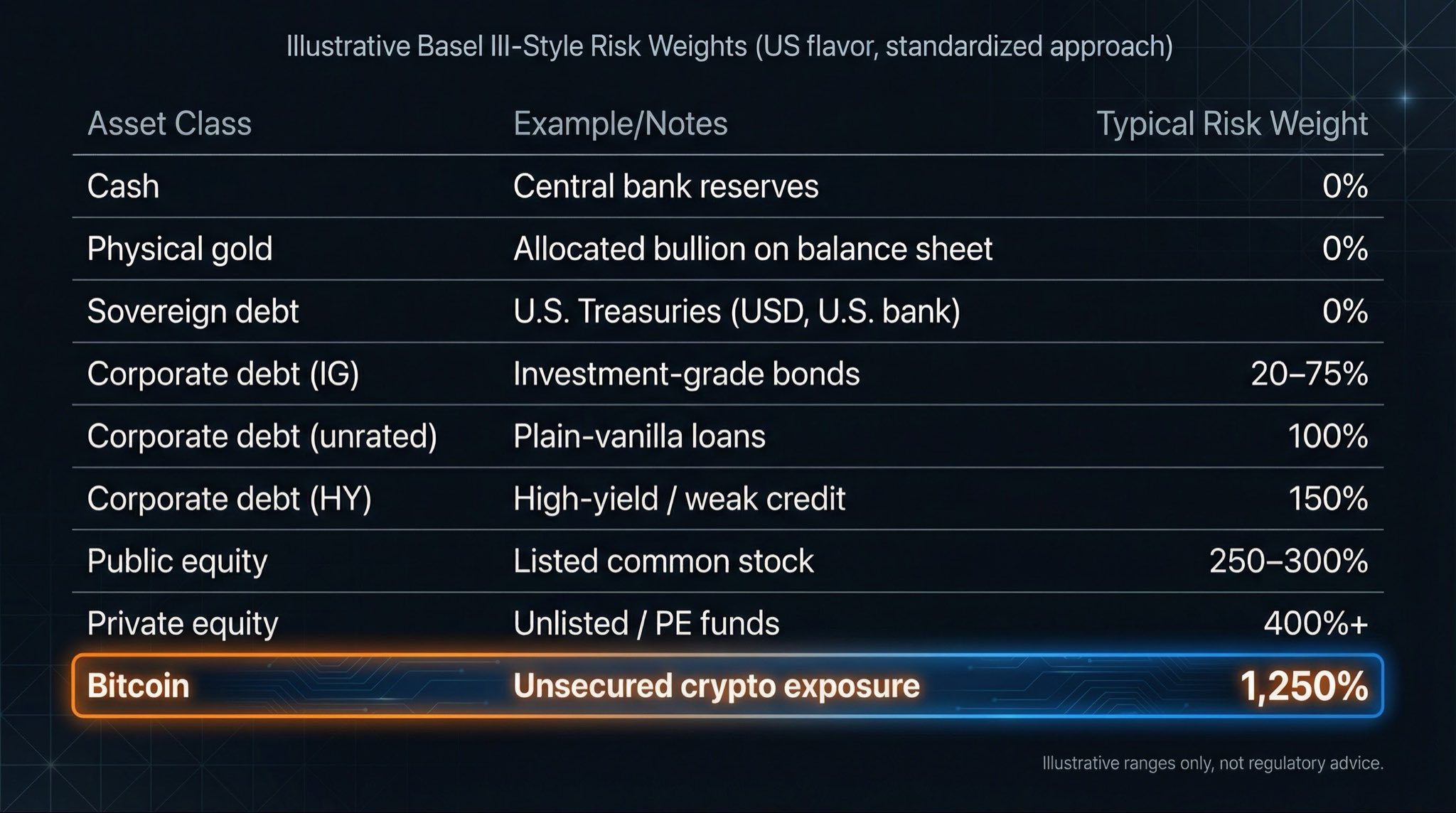
Crypto treasury executives are calling on the Basel Committee on Banking Supervision (BCBS), an international banking regulatory body, to revise the 1,250% risk weight for Bitcoin and other cryptocurrencies under the Basel III framework.
The 1,250% capital requirement means that banks must back any Bitcoin (BTC) on their balance sheets at a 1:1 ratio with approved collateral, making BTC holding more costly than other asset classes.
For comparison, cash, physical gold and government debt carry a 0% risk weight under the Basel III framework.

“If the US wants to be the ‘crypto capital’ of the world, the banking regulations need to change. Risk is mispriced,” Jeff Walton, chief risk officer at Bitcoin treasury company Strive, wrote on X.
The capital rules under Basel III discourage banks from holding BTC and crypto because of the relatively high cost of holding digital assets vis-a-vis reserve requirements, which lowers a bank’s return on equity, a critical metric for bank profitability, according to Chris Perkins, president of investment company CoinFund.
Related: Banks can’t seem to service crypto, even as it goes mainstream
Basel responds to growing backlash and pressure from the crypto industry
The Basel Committee proposed the current risk weightings in 2021, placing BTC and other cryptocurrencies in the highest risk category and imposing a 1,250% risk weight on digital assets.
In 2024, the committee finalized the capital requirements outlined in the 2021 proposal, which drew heavy backlash from the crypto industry.

The current rules represent a “different type of chokepoint” than the overt debanking of crypto companies in what some industry insiders dubbed Operation Chokepoint 2.0, Perkins told Cointelegraph in August 2025.
“It’s a very nuanced way of suppressing activity by making it so expensive for the bank to do those activities,” Perkins said.
In October 2025, reports emerged that the committee was considering easing the capital requirements for digital assets in response to the surge in the stablecoin market cap, which is nearing $300 billion, according to data from RWA.xyz.
The following month, Erik Thedéen, chair of the BCBS, said the international banking regulator may need a “different approach” to the 1,250% risk weight for cryptocurrencies, signaling a potential change in reserve requirements.
Magazine: Crypto wanted to overthrow banks, now it’s becoming them in the stablecoin fight
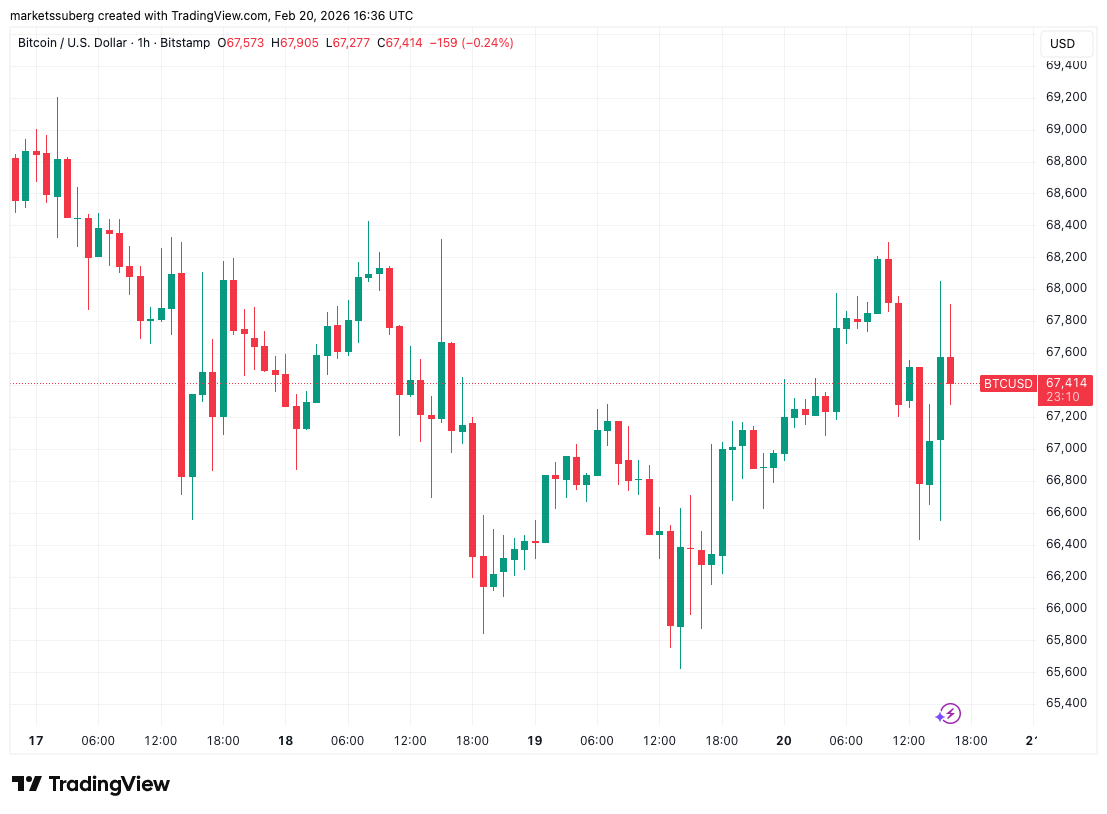
Bitcoin (BTC) saw choppy price action after Friday’s Wall Street open as markets reacted to the US Supreme Court decision on President Donald Trump’s trade tariffs.
Key points:
-
The US Supreme Court rules that certain US tariffs are illegal, sparking a modest risk-asset response.
-
US inflation data further cuts market hopes of a March interest-rate cut.
-
Bitcoin price action stays rooted in a firm range, with consensus seeing bears “in control.”
Supreme Court ruling attacks Trump tariffs
Data from TradingView showed $67,000 forming a focus for BTC price action, while US stocks gained.

The overall risk-asset response was muted however, as the Supreme Court ruled that some tariffs remained legal. In the firing line were those implemented under the International Emergency Economic Powers Act (IEEPA).
“IEEPA does not authorize the President to impose tariffs,” the Court wrote in its 170-page ruling.
Despite this, talk quickly surfaced over tariff refunds, with trading resource The Kobeissi Letter putting the potential total at $150 billion.
“Today’s Supreme Court ruling will be referenced for decades to come,” it added in a thread on X.
The event overshadowed earlier US macro data, which missed expectations. The Personal Consumption Expenditures (PCE) Index, known as the Federal Reserve’s “preferred” inflation gauge, hit its highest levels since late 2023 at 3%.

GDP data for Q4 2025, meanwhile, came in much lower than anticipated at 1.4% growth instead of 3%.
The numbers further reduced the odds of the Fed cutting interest rates at its March meeting, with data from CME Group’s FedWatch Tool now seeing a mere 4% chance of a 0.25% reduction.

On Thursday, trading resource Mosaic Asset Company expressed hope that stocks could still perform well despite the gloomy rates outlook.
“Even if the Fed goes an extended period on hold with interest rates, it’s worth remembering that financial conditions are still running much looser than average,” it summarized in an update.
“That should remain a tailwind for the bull market for now, even if the S&P 500 doesn’t reflect it. The combination of loose conditions and strong market breadth means a positive backdrop for position trading (for now).”
Bitcoin failing to escape “downwards trajectory”
Bitcoin traders continued to have few illusions about the precarious state of the market.
Related: Bitcoin ‘roadmap to bottom’ says $58.7K Binance cost basis now crucial
In his latest analysis, trader Jelle said that bears were still “in control.”
Bears remain in control – driving price lower and lower.
Don’t fight the trend, embrace it as the opportunity it presents: another chance to load up on cheaper coins.$BTC pic.twitter.com/wnhrKanAUb
— Jelle (@CryptoJelleNL) February 20, 2026
Trader and analyst Rekt Capital emphasized the importance of the 200-week exponential moving average (EMA), along with Bitcoin risking flipping it to resistance.
“History suggests Weekly Closes below the 200-week EMA followed by bearish retests of the EMA into new resistance can spur on the next phase of Bearish Acceleration to the downside,” he wrote on Thursday.

Earlier in the week, trader and commentator Skew suggested that the local BTC price range was indicative of “developing ‘value.’”
“Clear respected market supply around $70K & Clear tested market demand around $65K. This essentially points out the obvious which is a sustained move above $70K or below $65K will lead to trending price action,” he told X followers.
“Since the trend is in a downwards trajectory currently, this makes $72K quite significant as many shorts will place stops above & also it acts as a near term invalidation if cracked.”
This article does not contain investment advice or recommendations. Every investment and trading move involves risk, and readers should conduct their own research when making a decision. While we strive to provide accurate and timely information, Cointelegraph does not guarantee the accuracy, completeness, or reliability of any information in this article. This article may contain forward-looking statements that are subject to risks and uncertainties. Cointelegraph will not be liable for any loss or damage arising from your reliance on this information.
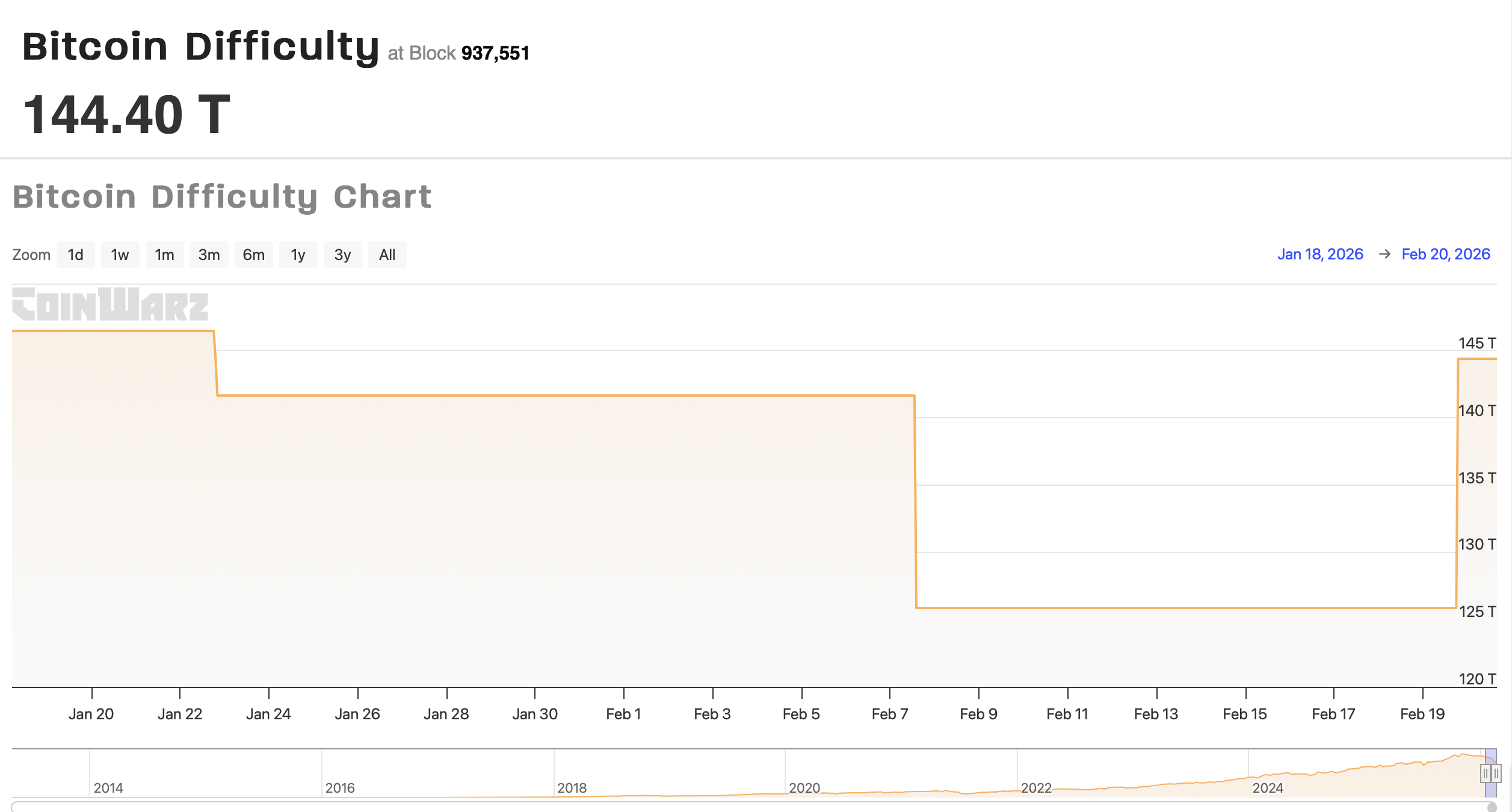
Bitcoin’s mining difficulty jumped about 15% to 144.4 trillion on Feb. 20, according to CoinWarz data, reversing an 11% drop earlier this month that marked the sharpest decline since China’s 2021 mining ban.
The earlier decline followed a sharp drop in hash rate after severe winter storms swept across much of the United States, disrupting power grids and forcing miners offline. In late January, Foundry USA, the largest mining pool by hash rate, briefly saw its computing power fall to about 198 exahashes per second from nearly 400 EH/s, before recovering.

Hash rate measures the total computing power securing the network, while mining difficulty adjusts every 2,016 blocks, about every two weeks, to keep block production near its 10-minute target.
As US miners restored operations after the storm, hash rate rebounded, prompting the latest upward difficulty adjustment.
While higher difficulty strengthens Bitcoin’s (BTC) network security, it also raises the computational effort required to earn block rewards, tightening margins for miners already facing cost pressures.
Related: Thirteen years after the first halving, Bitcoin mining looks very different in 2025
US miners monetize grid curtailments during winter storm
Although January’s winter storm forced some US Bitcoin miners offline, it didn’t necessarily erase revenue. Many participate in demand response programs or hold flexible power contracts, allowing them to pause mining and sell electricity back to the grid when prices spike.
“In January, our power infrastructure highlighted the flexibility of our operating model,” said Bruce Rodgers, chairman and CEO of Bitcoin miner LM Funding America.
According to a February report, the company curtailed operations during Winter Storm Fern and redirected contracted power to the grid, generating more than a quarter of its typical quarterly energy and curtailment revenue over a single weekend.

Canaan Inc., a Singapore-based mining hardware manufacturer with US operations, also said in its January production update that its US mining activities participated in power curtailments in storm-affected regions through coordination with site partners to help balance grid demand.
Since China’s 2021 mining crackdown, the United States has become the world’s largest Bitcoin-mining hub, hosting major operations in crypto-friendly states such as Texas and Georgia.
According to data from Cambridge Centre for Alternative Finance, the US accounts for over one-third of global Bitcoin hash rate.
Magazine: Is China hoarding gold so yuan becomes global reserve instead of USD?
More than $2.4 billion in crypto options are set to expire at 08:00 UTC today on Deribit, a positioning event that could inject fresh volatility into the market.
Summary
- Around $2.0B in Bitcoin and $404M in Ethereum contracts are set to roll off on Deribit, raising the potential for short-term volatility.
- Bitcoin’s put/call ratio of 0.59 and Ethereum’s 0.75 reflect constructive sentiment, with max pain at $70,000 for BTC and $2,050 for ETH.
- BTC faces resistance near $69,500–$70,000 and support at $65,000, while ETH must clear $2,000–$2,050 to confirm upside momentum.
According to Deribit data, $2 billion in Bitcoin (BTC) options and $404 million in Ethereum (ETH) options will roll off.
🚨 Options Expiry Alert 🚨
At 08:00 UTC tomorrow, over $2.4B in crypto options are set to expire on Deribit.$BTC: ~$2.0B notional | Put/Call: 0.59 | Max Pain: $70K$ETH: ~$404M notional | Put/Call: 0.75 | Max Pain: $2,050 Positioning skews call heavy across both assets, with… pic.twitter.com/pgl2z4ZGJ6
— Deribit (@DeribitOfficial) February 19, 2026
For Bitcoin, the put/call ratio stands at 0.59, signaling call-heavy positioning and a stronger upside skew. The max pain level is $70,000, slightly above current spot levels, suggesting price could gravitate toward that area into expiry.
Ethereum’s put/call ratio sits at 0.75, reflecting more balanced but still constructive positioning, with max pain at $2,050.
Large options expiries can trigger short-term volatility, especially with positioning skewed toward calls. With $2 billion in Bitcoin and over $400 million in Ethereum contracts expiring, dealer hedging around key strikes, notably $70,000 for BTC and $2,050 for ETH, could pin prices near those levels.
However, a decisive move beyond them may amplify momentum through gamma-driven flows, increasing the odds of a sharp breakout.
Crypto market prediction: Bitcoin (BTC)
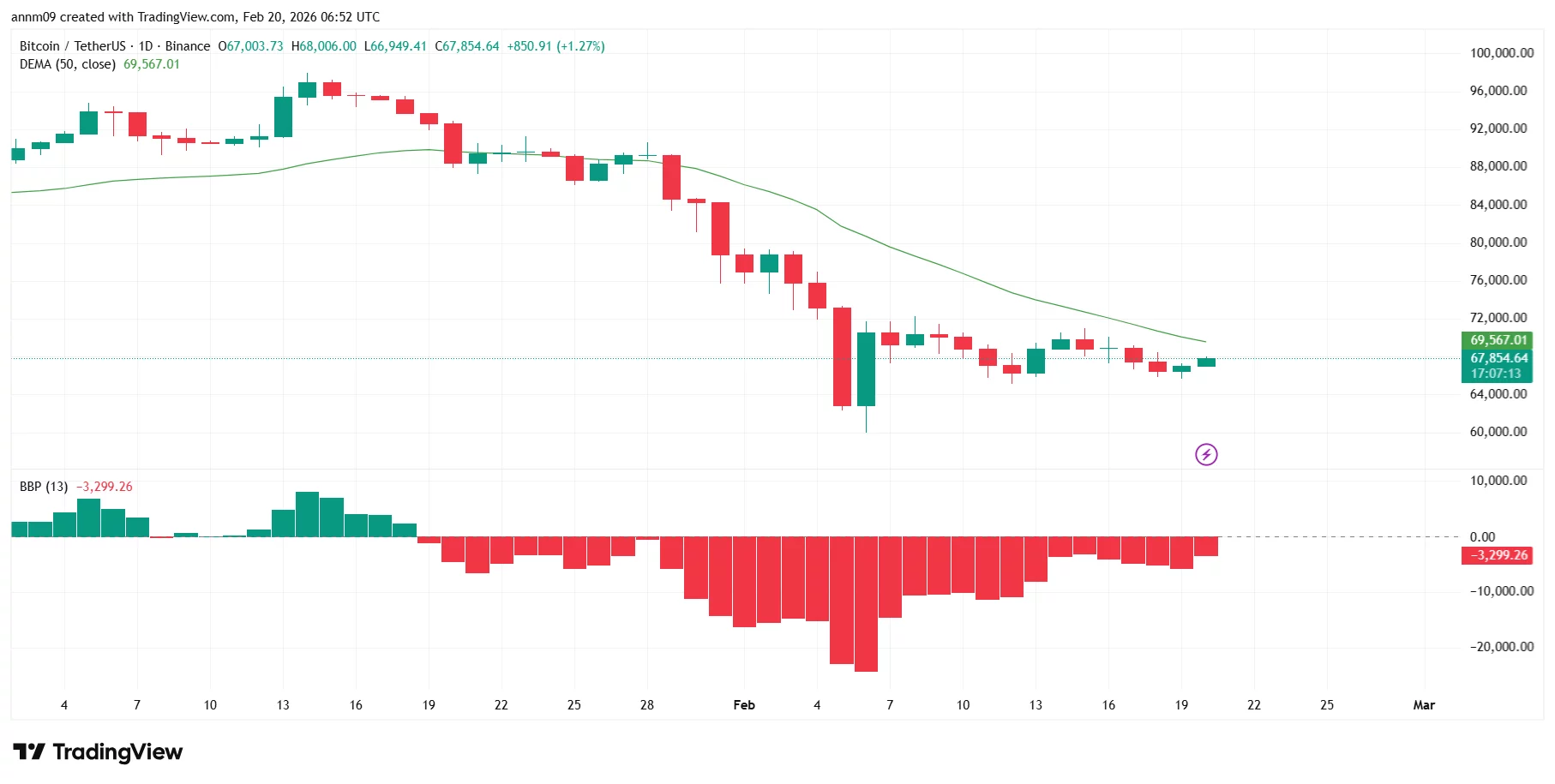
Bitcoin trades around $67,850 on the daily chart, attempting to stabilize after a sharp early-February sell-off that dragged price from the mid-$90,000s to a local low near $60,000. Since that flush, BTC has been consolidating between roughly $65,000 and $70,000.
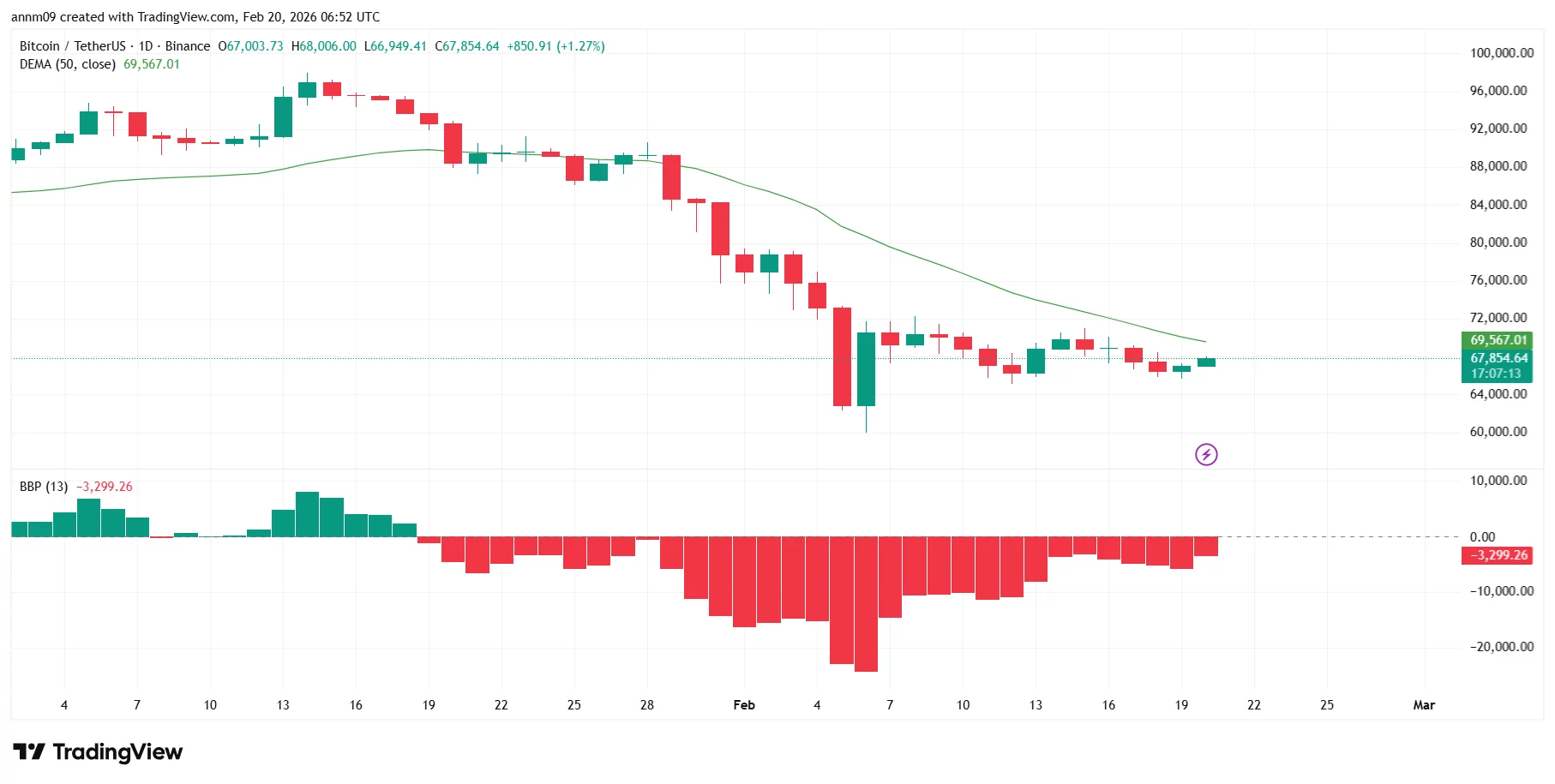
Technically, price remains below the 50-day DEMA near $69,500, which now acts as immediate resistance. A sustained break above $69,500–$70,000 would open the door toward $72,000 and potentially the mid-$70,000 region.
On the downside, support sits around $65,000, followed by the psychological $60,000 level — the zone that previously attracted strong dip buying.
Momentum indicators show bearish pressure easing but not fully reversed. The Balance of Power histogram remains negative, though red bars are shrinking, signaling waning selling intensity. A decisive push toward the $70,000 max pain level could accelerate short-term flows tied to options hedging.
Ethereum (ETH) price prediction
Ethereum, meanwhile, trades near $1,958 after sliding from above $3,000 in January to a recent low around $1,900. The daily chart shows ETH attempting to form a base just below the $2,000 psychological level.
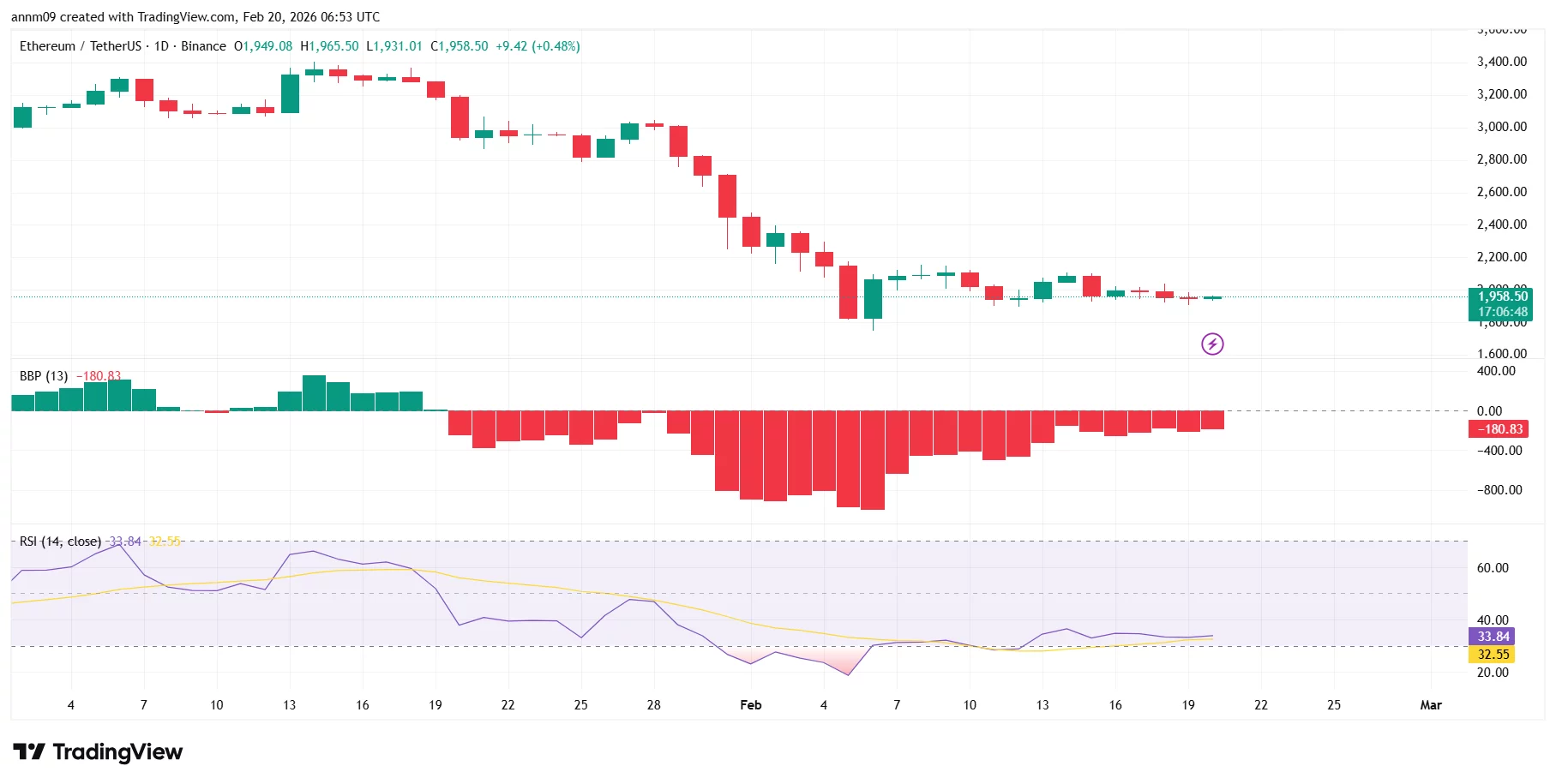
The RSI sits near 34, recovering from oversold territory but still below the neutral 50 mark, indicating momentum remains fragile.
Immediate resistance is clustered between $2,000 and $2,050, notably close to the max pain level. A break above that zone could trigger a squeeze toward $2,200. Support lies near $1,900, with a deeper floor around $1,800.
With positioning skewed toward calls, particularly in Bitcoin, traders will be watching whether price gravitates toward max pain levels or breaks decisively as contracts expire, potentially setting the tone for the next directional move.

Securities and Exchange Commission (SEC) leadership unveiled a concrete plan for an “innovation exemption” at ETHDenver Wednesday, signaling a pragmatic but cautious pathway for trading tokenized securities in U.S. markets.
SEC Chair Paul Atkins and SEC Commissioner Hester Peirce in Conversation by: — ETHDenver
– @HesterPeirce, SEC Commissioner
– @SECPaulSAtkins, 34th Chairman of the @SECgov
– @PallerJohn from @EthereumDenver, @opolis, @BufficornV & @SporkDao
"We are not looking to hurt or break anything, the… pic.twitter.com/KDE7NcXu7s


 (@EthereumDenver) February 18, 2026
SEC Chair Paul Atkins and Commissioner Hester Peirce detailed an incremental framework that allows crypto companies to facilitate limited trading of blockchain-based traditional assets, effectively creating a regulatory sandbox for Real World Assets (RWAs).
Quick Takeaways
The Exemption Deal: The proposal allows issuers to collaborate with specialist transfer agents to whitelist token holders for onchain trading.
Volume Limits: The “innovation exemption” will likely include strict volume caps and temporary duration periods to test stability.
Market Demand: Tokenized stock interest is exploding.
Why The SEC Is Acting Now
The agency is playing catch-up with market reality. Over the last year, TradFi giants have aggressively moved toward blockchain settlement.
Nasdaq Nasdaq wants to update its rules so some stocks and exchange-traded products can exist in either a normal digital form or as blockchain-based tokens.
Trading would work the same way it does today.
The only difference is that blockchain technology would help handle record-keeping and settlement behind the scenes. is already seeking approval to trade tokenized equities alongside traditional stocks.
This follows the SEC’s January 2026 clarification, which established that the economic reality of an asset determines its status, not the technology used.
This regulatory clarity is crucial for product issuers, paving the way for even more major ETF launches and staking products from firms like Grayscale and Canary Capital.
Details on the ‘Incremental’ Approach
Don’t expect an overnight revolution. Commissioner Peirce described the exemption as a “modest” step, comparing the current state of tokenized securities to buying an “abandoned storage unit.”
“Tokenized securities are still securities,” Peirce reiterated. The new framework focuses on integrating technology without dismantling investor protections.
Under the plan, issuers can test novel platforms, likely DeFi Automated Market Makers (AMMs) on permissionless chains, provided they maintain strict compliance with disclosure and custody rules.
This measured approach contrasts sharply with other global jurisdictions.
While the U.S. attempts to integrate crypto rails, authorities elsewhere are clamping down, with Russia moving to block foreign crypto exchanges entirely.
What This Means For Traders
This is the green light for institutional-grade RWAs. If approved, this exemption bridges the gap between “crypto native” assets and traditional finance.
For traders, this signals that liquidity for tokenized treasuries and equities will likely move on-chain in a regulated manner.
This is particularly bullish for ledgers optimized for RWA operations, a sector where XRP is currently aggressive in establishing infrastructure.
However, risks remain. Regulatory experts warn that “synthetic” tokenized securities, those not directly sponsored by the issuer, could be classified as security-based swaps, carrying higher counterparty risks.
It is a stark reminder of the risks noted by Christine Lagarde regarding digital assets operating without clear frameworks.
Expect formal rulemaking for these crypto capital-raising pathways by mid-2026.
Discover: The best pre-launch crypto sales
The post SEC Commissioners Outline ‘Incremental’ Path for Tokenized Securities Frameworks appeared first on Cryptonews.
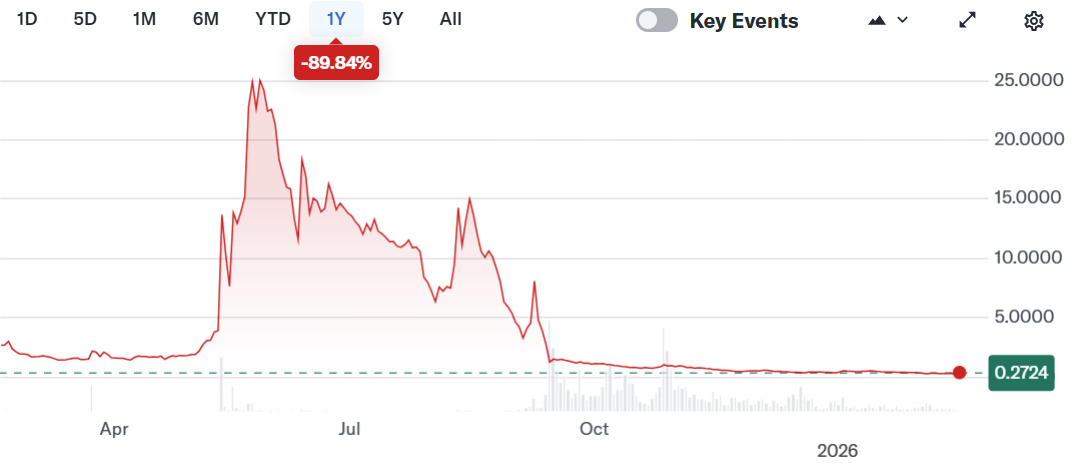
Crypto markets have erased nearly $1 trillion in value over the past month, yet parts of the industry tied to infrastructure and tokenized real-world assets (RWAs) are telling a different story. Tokenized Treasurys are expanding, venture firms are still raising capital and Bitcoin-focused companies are consolidating their footprints.
This week’s Crypto Biz looks at the widening gap between spot markets and capital formation — from Nakamoto’s $107 million acquisition spree to Dragonfly’s new $650 million fund, the continued rise of tokenized RWAs and why Paradigm says Bitcoin miners may have a growing role in stabilizing the power grid.
Nakamato to acquire two Bitcoin companies for $107 million
Bitcoin holding company Nakamoto has agreed to acquire BTC Inc and UTXO Management in a combined $107 million deal, expanding its footprint across Bitcoin media, events and financial services.
Under the terms of the agreement, investors in BTC Inc and UTXO will receive 363,589,819 shares of Nakamoto common stock. The shares are priced at $1.12 under a call option structure, which is well above Nakamoto’s current trading price of about $0.30.
The transaction brings Bitcoin Magazine and the annual Bitcoin Conference under Nakamoto’s umbrella, while adding UTXO’s asset management and advisory business to the company’s portfolio.

Dragonfly closes $650 million fund
Despite a broader shake-up in crypto venture capital, Dragonfly Capital has closed its fourth fund at $650 million, signaling continued institutional appetite for blockchain infrastructure plays.
The firm indicated it is increasingly focused on financial products built on blockchain rails, including payment systems, stablecoin networks, lending markets and tokenized real-world assets. The strategy reflects a wider pivot among investors toward revenue-generating infrastructure rather than speculative token launches.
“This is the biggest meta shift I can feel in my entire time in the industry,” said Dragonfly general partner Tom Schmidt, describing the transition toward onchain finance and tokenized capital markets.

Tokenized RWA market expands despite crypto downturn
While broader crypto markets remain under pressure, tokenized real-world assets continue to gain traction, highlighting steady demand for onchain yield products.
The total value of tokenized RWAs has climbed about 13.5% over the past 30 days, according to RWA.xyz data. Over the same period, the broader crypto market has lost about $1 trillion in value. Much of the RWA growth has been driven by tokenized US Treasurys and private credit, though tokenized stocks are also gaining traction.
The divergence underscores how tokenized fixed-income products continue to attract capital even during periods of market stress, positioning RWAs as one of the more resilient segments of the digital asset economy.

Paradigm reiterates Bitcoin mining’s role in energy stabilization
Venture firm Paradigm is making the case that Bitcoin mining can serve as a flexible power load on the grid, potentially helping balance electricity demand at a time when local energy sources are being constrained by rapid AI data center development.
In a recent report, Paradigm argued that Bitcoin miners are well-positioned to absorb excess generation during low-demand periods and scale back when the grid is strained. That flexibility, Paradigm suggests, could make mining a useful partner for utilities facing peak-load challenges.
The idea isn’t entirely new, but it’s getting renewed attention as pressure grows on power systems from both decarbonization goals and rising overall electricity use tied to AI. Whether miners can actually deliver that flexibility at scale will depend on contracts with grid operators and the economics of energy markets, two areas with many moving parts.
Crypto Biz is your weekly pulse on the business behind blockchain and crypto, delivered directly to your inbox every Thursday.
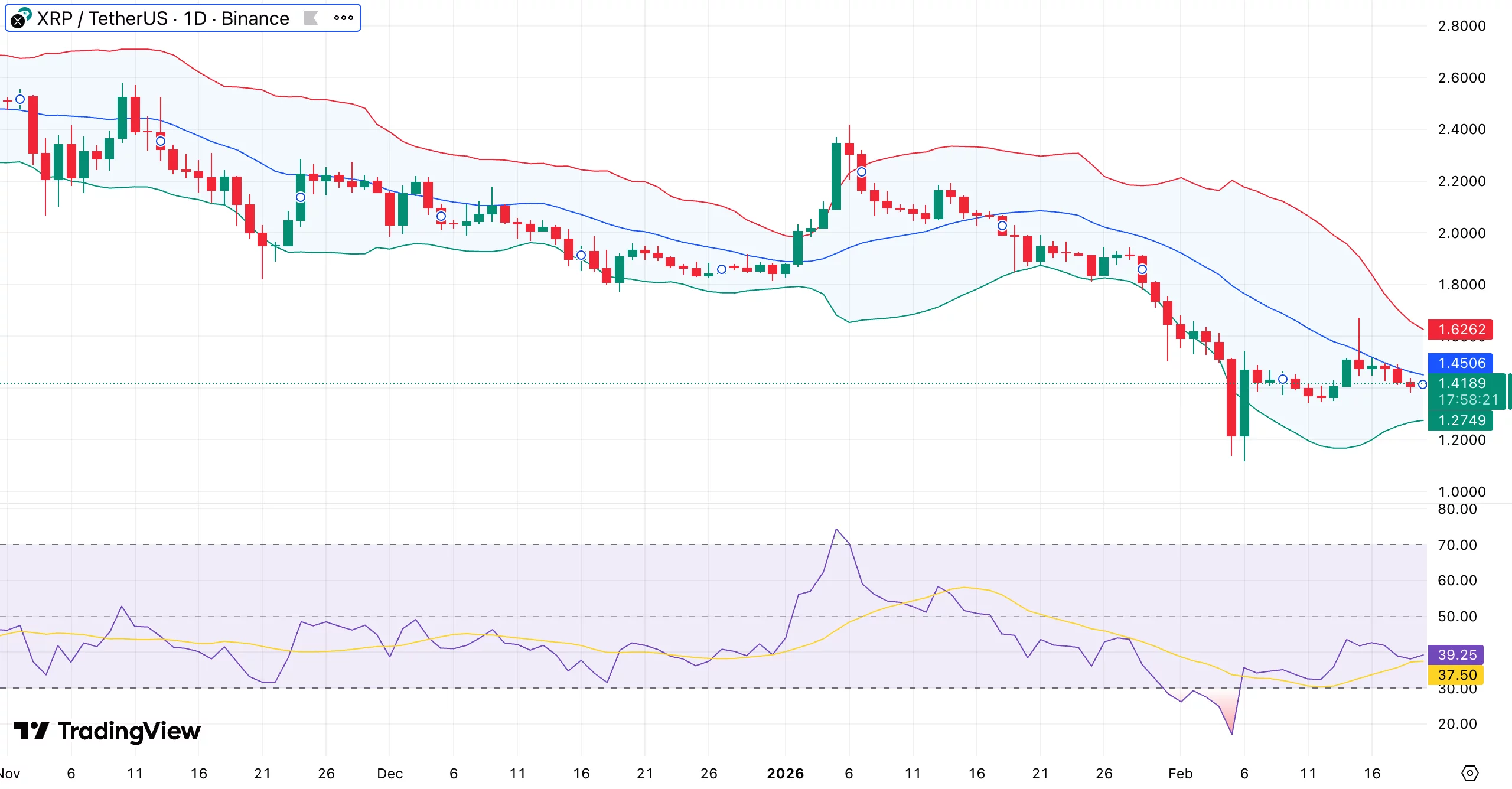
XRP price is hovering near $1.42 as thinning liquidity and repeated tests of the $1.30 support level raise the risk of a breakdown.
Summary
- XRP is down 25% in 30 days and remains below major resistance.
- On-chain data shows declining USD and XRP liquidity, increasing fragility.
- $1.30 is the critical support level to watch.
XRP traded at $1.42 at press time, down 0.7% in the last 24 hours. Over the past week, price has ranged between $1.35 and $1.64, with sellers capping rebounds near the upper end of that band.
The recent correction has been sharp. After a 25% decline over the last 30 days, XRP (XRP) is now 61% below its July 2025 peak of $3.65. As lower highs continue to form on the daily chart, the overall structure remains weak.
In derivatives markets, positioning is relatively stable. CoinGlass data shows futures volume up 0.96% to $3.75 billion, while open interest slipped 0.43% to $2.36 billion. That mix suggests traders are active but not aggressively increasing leverage.
Liquidity compression adds fragility
A Feb. 20 analysis by CryptoQuant contributor The Alchemist 9 reviewed three indicators: Binance exchange inflows, USD liquidity (MAG-XRP), and XRP liquidity (MAG-XRP).
During a previous rally phase, exchange inflows spiked sharply. Large inflows usually mean tokens are moving onto exchanges, which can signal potential sell pressure. In that instance, the spike occurred before a period of strong volatility and a major price expansion.
USD liquidity measures the capital depth supporting XRP markets. When XRP rallied, USD liquidity expanded and helped sustain the move. Recently, liquidity has been declining. With less capital depth in the order book, the price becomes more sensitive to sudden selling.
XRP liquidity tracks token-side availability. Before the earlier breakout, XRP liquidity compressed significantly. That reduction in active supply aligned with the start of the upward move. Now, XRP liquidity is trending lower again, resembling those earlier pre-expansion conditions.
At present, exchange inflows are moderate, but both USD and XRP liquidity are contracting. This creates a thinner market structure. In thin conditions, breaks of support or resistance often trigger sharper moves.
These metrics do not predict direction on their own, but they highlight rising volatility risk.
XRP price technical analysis
The $1.30 level is the key short-term support. It marks the lower boundary of recent consolidation. Price has repeatedly tested this range.
While rebounds followed, repeated touches often weaken demand. A daily close below $1.30 may lead to accelerated selling in a thin market.
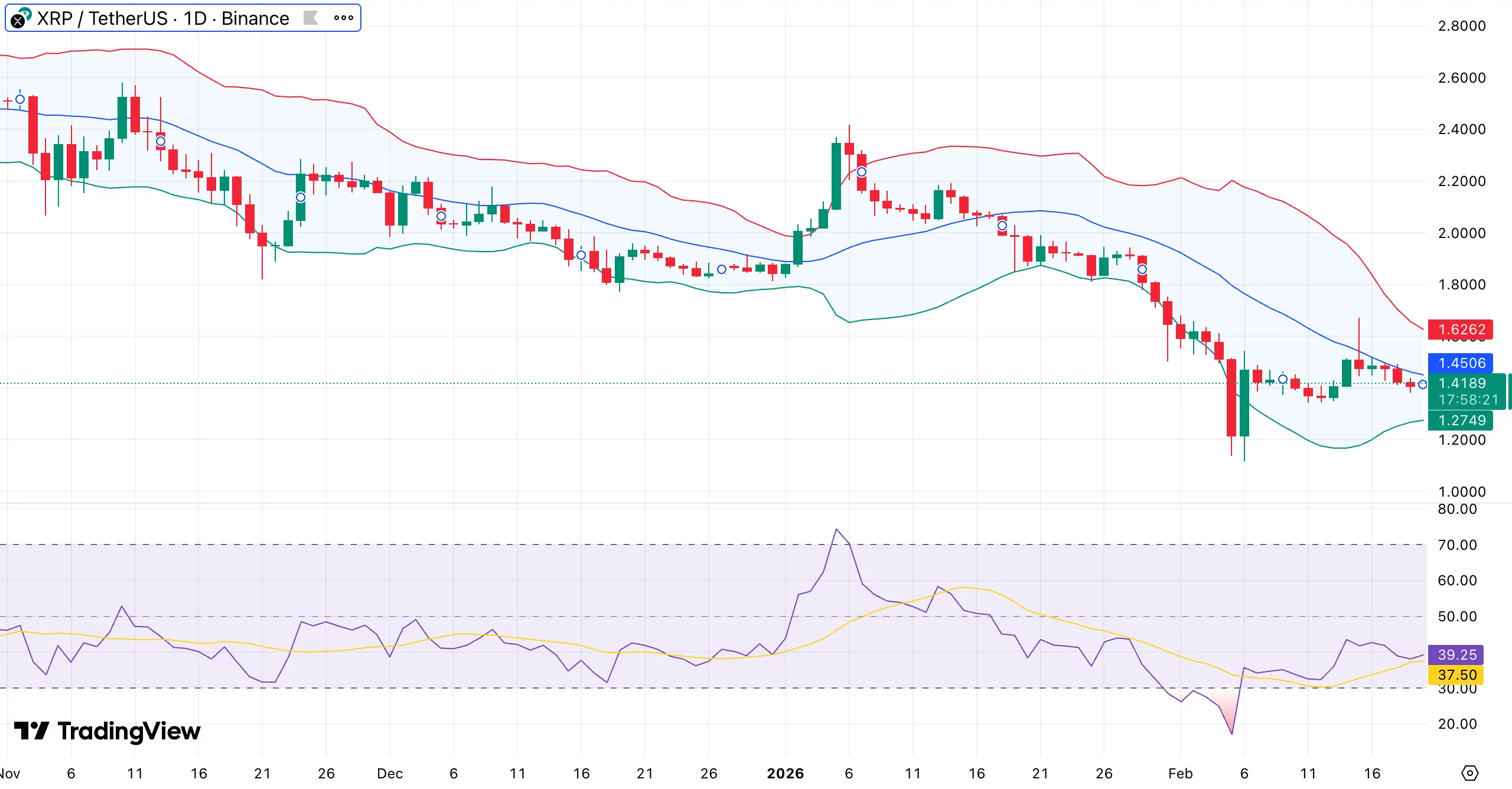
Lower highs are still visible in the daily structure. The 50-day moving average serves as trend resistance, and XRP is trading below it. Bollinger Bands are tightening, showing price compression. This often precedes a strong move once support or resistance breaks.
The relative strength index is hovering between 35 and 45, reflecting limited bullish momentum. With attempts to push above 50 having failed, there is no clear bullish divergence at this stage.
If $1.30 holds and price reclaims $1.40 to $1.45, momentum could improve, opening room toward $1.50 to $1.60. If $1.30 breaks on a daily close, the next downside targets sit near $1.20 to $1.25, followed by $1.10 to $1.15 if selling pressure intensifies.

Floyd Mayweather announces boxing comeback after retiring 9 years ago

NASA Eyes March 6 To Launch 4 Astronauts To the Moon On Artemis II Mission

“Are you gay” Sick kids doctor sent messages and indecent images to child he met through work


-

 Video5 days ago
Bitcoin: We’re Entering The Most Dangerous Phase
-

 Tech6 days ago
Luxman Enters Its Second Century with the D-100 SACD Player and L-100 Integrated Amplifier
-

 Crypto World4 days ago
Can XRP Price Successfully Register a 33% Breakout Past $2?
-

 Sports4 days ago
GB's semi-final hopes hang by thread after loss to Switzerland
-

 Fashion10 hours ago
Weekend Open Thread: Boden – Corporette.com
-

 Video1 day ago
XRP News: XRP Just Entered a New Phase (Almost Nobody Noticed)
-
 Tech4 days ago
The Music Industry Enters Its Less-Is-More Era
-

 Business3 days ago
Infosys Limited (INFY) Discusses Tech Transitions and the Unique Aspects of the AI Era Transcript
-

 Entertainment3 days ago
Kunal Nayyar’s Secret Acts Of Kindness Sparks Online Discussion
-

 Video4 days ago
Financial Statement Analysis | Complete Chapter Revision in 10 Minutes | Class 12 Board exam 2026
-

 Tech3 days ago
Retro Rover: LT6502 Laptop Packs 8-Bit Power On The Go
-
 Sports2 days ago
Clearing the boundary, crossing into history: J&K end 67-year wait, enter maiden Ranji Trophy final | Cricket News
-

 Entertainment2 days ago
Dolores Catania Blasts Rob Rausch For Turning On ‘Housewives’ On ‘Traitors’
-

 Business3 days ago
Tesla avoids California suspension after ending ‘autopilot’ marketing
-
 NewsBeat5 days ago
The strange Cambridgeshire cemetery that forbade church rectors from entering
-

 Crypto World2 days ago
WLFI Crypto Surges Toward $0.12 as Whale Buys $2.75M Before Trump-Linked Forum
-

 Politics4 days ago
Eurovision Announces UK Act For 2026 Song Contest
-
 NewsBeat6 days ago
Man dies after entering floodwater during police pursuit
-

 Crypto World1 day ago
83% of Altcoins Enter Bear Trend as Liquidity Crunch Tightens Grip on Crypto Market
-

 NewsBeat7 days ago
UK construction company enters administration, records show