UK businesses remained under intense financial pressure throughout 2025, with more than 28,000 insolvency-related activities recorded over the year, underlining the fragile state of the operating environment despite easing inflation.
New figures from R3, the trade association for restructuring and insolvency professionals, show there were 28,616 corporate insolvency activities in 2025. While this was slightly lower than the 29,366 cases recorded in 2024, the total remains well above pre-pandemic levels.
R3 said the data points to a prolonged period of stress for UK companies, particularly smaller and mid-sized firms with limited financial buffers.
Tom Russell, president of R3, said: “2025 was a year in which UK businesses struggled to regain their footing after several years of economic challenges. While inflation has eased, the cumulative impact of higher costs, tighter credit conditions and weak demand continues to place significant pressure on cashflow.”
The findings form part of R3’s Annual Business Health report, which analyses insolvency trends, start-up activity and sector performance across the UK using data from Creditsafe.
Advertisement
Construction once again accounted for the highest number of insolvency activities, with 4,584 cases recorded in 2025. Although this represented a 6 per cent fall on the previous year, R3 said the sector remains highly exposed to rising material costs, payment delays, skills shortages and subdued investor confidence.
Wholesale and retail followed closely with 4,124 insolvencies, while accommodation and food services recorded 3,831 cases. R3 said these sectors continue to face intense margin pressure as households rein in discretionary spending and businesses struggle to ab sorb or pass on higher operating costs.
Manufacturing insolvencies also remained historically high, with 2,188 cases during the year. Energy prices, supply chain disruption and weaker export demand have all weighed heavily on manufacturers.
One of the sharpest increases was seen in water supply, waste management and remediation, where insolvency activity rose by 14 per cent to 172 cases in 2025, reflecting the growing impact of regulatory pressure and rising operating costs.
Advertisement
Greater London recorded the highest number of insolvencies, with 5,684 cases, reflecting the concentration of businesses in the capital. Encouragingly, this represented an 11 per cent decrease on the previous year.
High insolvency levels were also reported in the North West (4,880 cases), East Anglia (3,812 cases) and the West Midlands (3,152 cases), regions with significant exposure to manufacturing, construction and retail.
The report also highlights a slowdown in new business formation, suggesting a more cautious entrepreneurial climate. Start-ups in Greater London fell by 3 per cent year on year to 259,092, while Yorkshire and Humberside, Northern Ireland and the East Midlands recorded the steepest declines.
However, Wales and Scotland bucked the trend with modest growth in start-up activity, alongside resilience in parts of England including the North West and North East.
Advertisement
Russell, who is also a licensed insolvency practitioner and director at James Cowper Kreston, said the outlook for 2026 remains challenging.
“As we move into 2026, it’s evident that many businesses are operating with limited financial resilience amid tough market conditions,” he said. “Seeking professional advice at an early stage can make a critical difference, giving viable businesses the best chance of survival and recovery.”
R3 warned that without an improvement in demand and access to finance, insolvency levels are likely to remain elevated, even if headline economic indicators continue to stabilise.
Amy Ingham
Amy is a newly qualified journalist specialising in business journalism at Business Matters with responsibility for news content for what is now the UK’s largest print and online source of current business news.
Craig Revel Horwood campaign and Dubai-inspired biscuits drove revenue to £695m
Felix Armstrong www.cityam.com
16:17, 24 Feb 2026
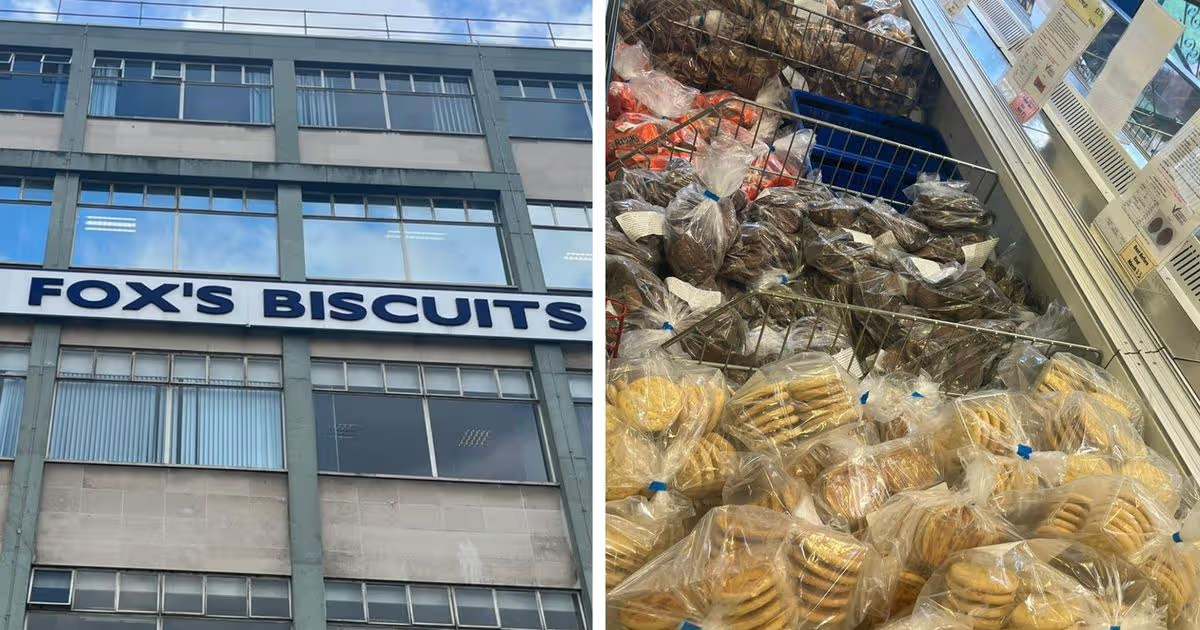
Batley has become famous as the home of Fox’s Biscuits(Image: Lucy Marshall)
The confectionery behemoth behind Jammie Dodgers and Wagon Wheels experienced a surge in profits, thanks to a Strictly Come Dancing judge and a “Dubai-inspired” biscuit driving up sales.
Advertisement
The conglomerate, encompassing Burton’s Biscuit Company and Fox’s Biscuits, reported a nine per cent increase in revenue, reaching £695m for the year ending August 2025.
Fox’s Burton’s Companies (FBC) recruited Strictly Come Dancing panellist Craig Revel Horwood to spearhead the relaunch of its Fox’s Chocolatey range.
The group posted a pre-tax profit of £14.3m, marking a turnaround from a pre-tax loss of £6.4m in the year to August 2024, as reported by City AM.
The firm maintained its position as the second-largest sweet biscuit producer in the UK and expanded its market share to 13 per cent.
FBC, also the maker of Party Rings and Maryland Cookies, credited its encouraging performance to “innovation”.
The group was established following a merger between Fox’s and Burton’s, both of which were acquired by Italian chocolate firm Ferrero.
Its “Fox’s Fabulous” campaign featured dance show judge Horwood sporting a chocolate face mask and urging Brits to indulge themselves, using his signature “fabulous” catchphrase.
Advertisement
FBC also launched a “Dubai-style” version of its Fox’s Chocolatey brand, capitalising on the craze for chocolate made with pistachio cream and filo pastry that took the UK by storm last year.
Simon Browne, the group’s chief executive officer, said: “This financial year has been a positive year of growth across all key financial metrics, delivered through maximising the opportunities of consolidating the legacy businesses and a strong new product development pipeline.
“Despite a challenging operating environment, we have successfully outperformed the market and increased our branded sweet biscuit market share.”
Samsung Electronics Co. shares have rallied sharply in early 2026, hitting all-time highs near 200,000 won as explosive demand for AI-related memory chips propels the South Korean tech giant’s recovery and positions it as a key player in the global semiconductor supply chain.
Samsung Electronics AFP
As of February 24, 2026, Samsung (005930.KS) closed at 200,000 won, up 3.63% on the day and marking a fresh peak after climbing from around 193,000 won in recent sessions. The stock has surged more than 60% year-to-date, reflecting a dramatic turnaround fueled by record quarterly profits and aggressive advances in high-bandwidth memory (HBM) technology critical for AI accelerators.
The momentum accelerated following Samsung’s announcement in February that it had begun mass production and commercial shipments of its industry-first HBM4 chips. The sixth-generation HBM delivers consistent transfer speeds of 11.7 Gbps—up 22% from its HBM3E predecessor—with potential peaks at 13 Gbps, addressing data bottlenecks in AI computing. Samsung highlighted improved power efficiency and secure process technology, with plans to deliver HBM4E samples in the second half of 2026.
Analysts view the HBM4 rollout as a pivotal step for Samsung to regain ground in the high-margin AI memory market, where it had lagged rivals like SK Hynix. The company anticipates HBM sales to more than triple in 2026 compared to 2025, with capacity expansions underway to meet surging orders from major clients, including those building Nvidia-powered AI infrastructure.
This optimism stems from Samsung’s blockbuster fourth-quarter and full-year 2025 results, released January 29, 2026. The company posted record quarterly revenue of 93.8 trillion won (about $65.45 billion), up 9% quarter-on-quarter and 24% year-over-year. Operating profit soared to an all-time high of 20.1 trillion won, more than tripling from the prior year and surpassing analyst expectations. For the full fiscal year, revenue reached 333.6 trillion won, up 11%, while operating profit stood at 43.6 trillion won.
Advertisement
The Device Solutions (DS) division, encompassing semiconductors, drove the performance with quarterly revenue of 44.0 trillion won and operating profit of 16.4 trillion won. Memory profitability improved dramatically amid a global shortage of high-value AI chips, particularly HBM used in Nvidia GPUs and other accelerators. Management attributed the surge to strong demand from hyperscalers investing heavily in AI data centers.
Despite challenges in other segments, such as seasonal softness in home appliances and mobile devices due to trade conditions, the DS strength more than offset declines elsewhere. Currency tailwinds from a stronger U.S. dollar added roughly 1.6 trillion won to operating profit.
Samsung’s push into advanced memory extends beyond HBM4. The company showcased LPDDR6 developments at the International Solid-State Circuits Conference (ISSCC) 2026, achieving transfer speeds up to 14.4 Gbps—a 35% improvement over LPDDR5X—targeting power-efficient solutions for AI-enabled mobile and edge devices. Mass production for LPDDR6 is expected in the second half of 2026.
Investors have rewarded the progress. Samsung shares jumped as much as 7.6% following the HBM4 shipment news, renewing all-time highs. The stock’s valuation reflects renewed confidence in Samsung’s ability to capitalize on AI infrastructure spending, projected to reach hundreds of billions across Big Tech in 2026.
Advertisement
Wall Street and Seoul analysts remain largely bullish. Consensus targets suggest further upside, with some firms highlighting Samsung’s diversified portfolio—spanning smartphones, displays, foundries, and consumer electronics—as a buffer against sector-specific risks. The company’s foundry utilization rebounded above 80% in early 2026, driven by HBM4 base die production on 4nm processes and orders for Exynos mobile processors.
Competition remains fierce. SK Hynix has led in HBM market share, supplying Nvidia extensively, while Micron pushes aggressively. Reports indicate HBM4 capacity is sold out for 2026 across major suppliers, with long-term agreements locking in demand. Samsung’s pricing strategy—potentially 20-30% higher for next-gen products—could boost margins if sustained.
Broader industry dynamics support the rally. AI demand has diverted manufacturing capacity toward HBM, squeezing supply for standard DRAM and creating shortages that benefit incumbents. TrendForce estimates HBM will consume 23% of total DRAM wafer output in 2026, up from 19% in 2025, with global HBM demand growing 70% year-over-year.
Samsung’s upcoming Galaxy Unpacked event on February 25, 2026, in San Francisco adds another layer of anticipation. The company is expected to unveil the Galaxy S26 series, potentially integrating advanced AI features powered by its memory expertise.
Advertisement
Looking ahead, Samsung guided for continued semiconductor strength in 2026, with conservative capex in 2025 shifting to increased memory investments. Executives emphasized building comprehensive AI leadership through ethical, high-performance solutions.
While risks persist—geopolitical tensions, supply chain disruptions, and potential AI spending slowdowns—the current trajectory points to sustained momentum. Samsung’s disciplined execution in fixing earlier HBM qualification issues and scaling production has transformed it from laggard to contender in the AI chip race.
For investors, the stock’s climb underscores a broader theme: companies mastering AI-enabling technologies stand to benefit most in the ongoing digital transformation. Samsung Electronics, once challenged by memory market cycles, now appears well-positioned to ride the AI wave into 2026 and beyond.
Rachel Reeves will deliver her Spring Statement on March 3, just over three months after her November Budget, in what is expected to be a lower-key fiscal event focused more on forecasts than fresh policy announcements.
Unlike the autumn Budget, the Spring Statement is not expected to contain tax rises or major spending cuts. Reeves has pledged to limit significant fiscal changes to a single annual event, giving herself £21.7bn of headroom in November to avoid returning with further measures before the autumn.
Nevertheless, the update will be closely watched as the Office for Budget Responsibility publishes revised forecasts for growth, borrowing and the public finances.
Although the OBR will no longer formally assess performance against fiscal rules twice a year, economists will scrutinise its projections to determine whether the government remains on track.
Some analysts expect a modest increase in Reeves’s fiscal headroom to around £24bn. A fall in that buffer could reignite speculation about future tax rises, particularly if weaker growth or higher borrowing narrows the margin. Conversely, a significant rise in headroom could intensify pressure from within Labour to loosen spending plans.
Advertisement
Ruth Gregory of Capital Economics has warned the statement could become “another flashpoint” if fiscal space tightens. James Smith of the Resolution Foundation said the government should not allow economic policy to stall until the autumn, arguing that more should be done to address sluggish growth and rising unemployment.
No tax rises – for now
Fresh tax measures are not expected in March, but debate over fiscal strategy is likely to intensify. The Institute for Fiscal Studies has argued that frequent adjustments driven by narrow headroom targets create instability and undermine long-term policymaking.
The IFS has proposed a shift towards a broader “fiscal traffic lights” framework to reduce the need for rushed policy changes when forecasts fluctuate.
The statement also comes after controversy at the OBR, which accidentally published market-sensitive material ahead of the November Budget. Former chair Richard Hughes stepped down following the incident, and the watchdog will release its new forecasts without a permanent successor in place.
Advertisement
With the government prioritising economic expansion, Reeves is expected to reiterate commitments to boost investment, support employment and stabilise public finances.
While the Spring Statement may lack the drama of a Budget, it will provide an important snapshot of the UK’s economic trajectory, and a signal of whether the chancellor’s fiscal strategy remains intact ahead of what could be a more consequential autumn showdown.
Jamie Young
Jamie is Senior Reporter at Business Matters, bringing over a decade of experience in UK SME business reporting.
Jamie holds a degree in Business Administration and regularly participates in industry conferences and workshops.
When not reporting on the latest business developments, Jamie is passionate about mentoring up-and-coming journalists and entrepreneurs to inspire the next generation of business leaders.
Shares of Western Digital Corp. (NASDAQ: WDC), the parent company that owns the SanDisk brand, closed at $68.42 on Monday, February 23, 2026, up 1.8% from the previous session’s $67.21 finish. The gain reflected renewed investor optimism about the NAND flash memory market’s recovery and Western Digital’s positioning to benefit from surging demand for high-capacity storage in AI data centers, enterprise servers, and consumer devices.
SanDisk
Western Digital’s market capitalization stood at approximately $23.8 billion at Monday’s close. The stock has climbed more than 65% over the past 12 months and is up roughly 22% year-to-date in 2026, recovering strongly from lows near $35 in mid-2025. Trading volume reached about 4.8 million shares, near average for the name.
The rally has been driven by a combination of improving NAND pricing, signs of inventory normalization across the supply chain, and growing recognition of Western Digital’s role in the AI infrastructure buildout. After a prolonged downturn in 2023-2024 marked by oversupply and price collapses, NAND flash spot prices have risen steadily since mid-2025, with 128Gb TLC NAND up more than 40% year-over-year according to TrendForce and other industry trackers.
Western Digital’s most recent earnings, reported January 30, 2026, for its fiscal second quarter (ended December 27, 2025), showed revenue of $4.3 billion (up 28% year-over-year) and non-GAAP EPS of $0.42 (beating consensus of $0.31). Flash revenue grew 39% sequentially and 45% year-over-year, fueled by higher average selling prices and strong demand for enterprise SSDs and client SSDs. HDD revenue rose modestly, supported by nearline drives used in cloud and AI storage.
CEO David Goeckeler highlighted the company’s “strong execution” in diversifying its portfolio and capitalizing on AI-driven storage needs. Western Digital has ramped production of high-capacity BiCS8 3D NAND (218-layer and beyond) and advanced QLC technologies, positioning it to meet demand for cost-effective, high-density storage in hyperscale data centers. The company also emphasized progress on its separation of flash and HDD businesses, with the flash unit (SanDisk-branded products) expected to operate as a standalone entity by late 2026 or early 2027, potentially unlocking value for shareholders.
Advertisement
Analysts have grown increasingly bullish. Consensus rating is Moderate Buy, with an average 12-month price target around $78-$82 (implying 14-20% upside from current levels). Recent updates include Morgan Stanley raising its target to $90 from $80 (Overweight), citing NAND price momentum and Western Digital’s strong position in enterprise and client SSDs. Deutsche Bank maintained Buy at $85, while a few firms hold Hold ratings with targets near $70, expressing caution over cyclical risks and competition from Samsung, SK hynix, Micron, and Kioxia.
The AI boom has become a key tailwind. Hyperscalers and cloud providers are deploying massive GPU clusters that require enormous amounts of high-performance, high-capacity storage for training datasets, inference caches, and checkpointing. Western Digital’s Ultrastar DC SN655 and SN850 enterprise SSDs, along with its high-density QLC drives, are gaining traction in these workloads. Analysts estimate that AI-related storage demand could drive NAND bit growth of 25-30% annually through 2028.
Challenges remain. The NAND market remains cyclical, and any slowdown in AI capex or renewed oversupply could pressure prices. Western Digital’s gross margins (around 32-34% non-GAAP in recent quarters) are improving but still lag peers due to higher manufacturing costs and ongoing foundry investments. The planned flash-HDD separation carries execution risk and potential short-term costs.
The company maintains a solid balance sheet with more than $2.5 billion in cash and manageable debt. Free cash flow turned positive in fiscal 2025, and management targets sustained positive FCF generation in 2026.
Advertisement
Looking ahead, Western Digital’s next earnings report is expected in late April or early May 2026 for the fiscal third quarter. Investors will watch for updates on NAND pricing trends, enterprise SSD demand, progress on the business separation, and any new AI-focused product announcements.
SanDisk-branded products — including portable SSDs, microSD cards, USB drives, and consumer storage solutions — continue to hold strong brand recognition and market share in retail channels. The brand benefits from Western Digital’s scale and technology leadership in flash memory.
As AI infrastructure spending accelerates and NAND supply-demand dynamics improve, Western Digital (and by extension SanDisk) appears well-positioned for further recovery. The stock’s recent strength reflects growing confidence in the company’s ability to capitalize on secular storage demand, though cyclical risks and execution hurdles remain.
Intel Corporation (NASDAQ: INTC) shares closed at $43.63 on Monday, February 23, 2026, down 1.09% from the previous session’s $44.11 finish, but the stock showed resilience in pre-market trading Tuesday, February 24, climbing about 1.4% to around $44.24 after news of a multi-year technical partnership with AI chip startup SambaNova Systems.
Intel AFP
The modest decline capped a volatile period for the semiconductor giant, which has traded in a 52-week range of $17.67 to $54.60. Year-to-date in 2026, INTC is up roughly 18-20% from late-2025 levels, reflecting cautious optimism about new CEO Lip-Bu Tan’s turnaround efforts, though the stock remains well below its 2021 peak and faces persistent valuation and execution questions.
Intel’s market capitalization stands at approximately $217-220 billion, supported by a cash position and CHIPS Act funding but weighed down by ongoing foundry losses and competitive pressures in AI and data center chips. Trading volume on February 23 reached about 57 million shares, near average for the name.
The latest catalyst came Tuesday when Intel announced it is participating in SambaNova’s $350 million Series E funding round and entering a multi-year technical collaboration. SambaNova, a maker of generative AI chips, will adopt Intel server processors and graphics cards for its systems, while Intel gains exposure to advanced AI workloads. The deal follows reports of failed acquisition talks between the companies and underscores Intel’s push to strengthen its AI ecosystem amid dominance by Nvidia and competition from AMD.
CEO Lip-Bu Tan, who took the helm in late 2025, has emphasized partnerships and ecosystem building as part of Intel’s recovery strategy. The SambaNova tie-up provides a positive signal, but analysts note it is incremental rather than transformative given Intel’s broader challenges in foundry profitability and AI market share.
Advertisement
Recent performance has been choppy. After rallying to the mid-$50s in January 2026 on optimism around Tan’s leadership and foundry progress, shares pulled back sharply following weaker-than-expected Q1 2026 guidance in early February. The company projected Q1 revenue of $11.7 billion to $12.7 billion, below some estimates, reflecting supply constraints and soft PC demand.
Full-year 2025 results (reported earlier) showed revenue growth but persistent foundry losses exceeding $2.5 billion annually. Management targets foundry breakeven by 2027-2028, with customer commitments for the 14A process expected in the second half of 2026. An Analyst Day planned for Santa Clara in H2 2026 will detail how AI infrastructure spending translates to shareholder returns.
Analyst views remain divided. Consensus rating is Hold to Moderate Buy, with an average 12-month price target around $45-48 (implying limited upside from current levels). Recent notes include caution over Nova Lake CPU delays (now pushed beyond CES 2027) and Meta’s shift toward Nvidia for some CPU workloads, potentially pressuring Intel’s data center position. However, bulls highlight undervaluation, government support, and potential upside from foundry ramps and AI partnerships.
Institutional activity shows mixed flows: some funds increased stakes, while others trimmed amid uncertainty. Insider buying by executives has been modest but positive.
Advertisement
Looking ahead, the next major update is Q1 2026 earnings (expected late April), where investors will seek clarity on foundry progress, AI GPU traction (including Gaudi and upcoming Falcon Shores), and any new customer wins. The stock’s trajectory depends on execution against ambitious goals in a highly competitive landscape.
For now, Intel remains a high-risk, high-reward turnaround story. Its cash position and strategic shifts provide a foundation, but near-term volatility persists as the market weighs AI spending sustainability, foundry profitability, and competition from Nvidia, AMD, and custom silicon players.
Hims & Hers Health Inc. (NYSE: HIMS) shares tumbled sharply in trading on Tuesday, February 24, 2026, falling as much as 9% intraday to around $14.07-$14.40 after the telehealth company issued first-quarter 2026 revenue guidance that missed Wall Street estimates, citing regulatory headwinds to its compounded semaglutide offerings.
Hims & Hers Health
The stock closed the prior session (February 23) at $15.51, down 0.77%, with after-hours and pre-market action pushing it lower to reflect investor disappointment with the outlook. Volume spiked to over 18-43 million shares in recent sessions, well above average, as the reaction erased much of the recent recovery gains. Year-to-date in 2026, HIMS is down more than 50%, with the stock trading near its 52-week low of $13.74-$15.15 after peaking above $70 in mid-2025.
Hims & Hers reported fourth-quarter and full-year 2025 results on February 23, posting revenue of $617.8 million for Q4 (up 28% year-over-year) and full-year revenue of $2.35 billion (up 59%). Adjusted EBITDA reached $318 million for the year, with net income of $128 million and subscribers surpassing 2.5 million (up 13%). Q4 EPS of $0.08 beat consensus estimates of $0.02-$0.05, reflecting solid execution in personalized care, weight-loss products, and non-GLP-1 categories.
However, the company’s Q1 2026 guidance of $600 million to $625 million fell short of analyst expectations around $653 million. Management attributed a $65 million headwind to regulatory changes impacting compounded semaglutide shipping and availability. Full-year 2026 revenue guidance of $2.7 billion to $2.9 billion aligned with or slightly topped consensus of $2.74 billion, while adjusted EBITDA is projected at $300 million to $375 million (margin of 11-13%).
The miss on Q1 guidance overshadowed the beat, with analysts and investors focusing on the near-term impact of compounding restrictions. Hims & Hers vowed to maintain its 2030 revenue target of more than $6.5 billion, emphasizing growth in personalized non-weight-loss offerings, overseas expansion, and subscriber retention through AI-driven care.
Advertisement
BTIG Research downgraded the stock from Buy to Neutral on February 24, citing the regulatory pressure and softer short-term outlook. Other firms maintained cautious stances, though some bulls argue the pullback creates an attractive entry given long-term tailwinds in telehealth and personalized medicine. Consensus price targets range widely from the high $20s to $60+, with an average around $27-33 (implying significant upside from current levels for believers).
Hims & Hers has built a strong position in direct-to-consumer health, offering treatments for sexual health, hair loss, mental health, dermatology, and weight management via telehealth consultations and compounded medications. The GLP-1 weight-loss category drove rapid growth in 2025, but regulatory scrutiny on compounded versions of drugs like semaglutide (used in Ozempic/Wegovy) has introduced uncertainty.
The company continues to scale its platform, with 65% of users now receiving personalized care and revenue per subscriber rising 11% to $83. Balance sheet strength remains a positive: operating cash flow reached $300 million in 2025, with liquidity over $900 million and no significant debt.
The stock’s sharp decline reflects a classic growth-to-value rotation, where high-multiple names face pressure when near-term visibility softens. Despite the pullback, Hims & Hers maintains a forward-looking narrative centered on digital health innovation, subscriber loyalty, and expansion into new categories and markets.
Advertisement
Investors await further clarity on regulatory outcomes for compounded GLP-1s and progress on international growth. The next earnings report is expected in early May 2026, with focus on Q1 performance and updated 2026 commentary.
Hims & Hers remains a polarizing name: bulls see a scalable, high-margin platform with massive addressable market, while bears highlight regulatory risks, competition, and valuation compression in a tougher macro environment for growth stocks.
Byrna Technologies CEO Bryan Ganz discusses the company’s efforts to ramp up its U.S. manufacturing operations.
A company that makes self-defense products has spent the last few years moving much of its manufacturing to the U.S. and is finding the benefits extend beyond having the ability to put a “Made in America” label on their products.
Byrna Technologies, which makes non-lethal personal security devices that can launch plastic or chemical irritant rounds, moved its main manufacturing facility from South Africa to Indiana in 2021 and began finding qualified U.S. component suppliers to prevent supply chain disruptions like what transpired during the pandemic.
Advertisement
“There are over 100 components that go into our launchers, we wanted redundancy on all of them,” Byrna Technologies CEO Bryan Ganz told FOX Business. “Generally, the offshore manufacturers were a little bit less expensive, so they got the majority of the production.”
Byrna Technologies moved its main manufacturing facility from South Africa to Indiana in 2021. (Sam Wolfe/Bloomberg via Getty Images)
“But when it was evident that Donald Trump was going to be elected president, we said, ‘You know what, he’s been very, very vocal about tariffs, this is probably a good time for us to start the process of moving the supply chain back on-shore,’” Ganz said.
“We started this even before the tariffs were announced. When the tariffs were announced, we were feeling pretty smart about ourselves that we had correctly surmised that we would be able to on-shore things,” he added.
Advertisement
Ganz said that while the process of onshoring more of Byrna’s supply chain before the Trump administration’s tariffs were implemented last year, the tariffs made domestic production more cost-effective and the onshoring process revealed other benefits.
“It was very interesting because not only was it much cheaper with the imposition of the tariffs to be producing in the U.S., but we also discovered all sorts of soft cost benefits,” he said.
Byrna Technologies moved its manufacturing back to the U.S. before President Donald Trump implemented tariffs. (Brendan Smialowski/AFP via Getty Images)
“When you’re supplying componentry from offshore, you either have air freight costs, you have lengthy ocean voyages – when you’re supplying it from a hundred miles away by truck, you can be much more responsive to changes in consumer demand. If I need to visit the factory because there’s a quality problem, I can do it.”
He added that while Byrna continues to buy some of its accessories from offshore suppliers, the company has focused its onshoring effort on the most critical aspects of its product, such as the launcher itself and its ammunition.
“We’re making self-defense products and I think the quality of the product, the dependability of the product, is really important to our consumers, so the Made in America moniker is very, very meaningful for our type of product,” he explained.
Ganz noted that Byrna closed its ammunition manufacturing facility in South Africa and moved it to a newly built facility in Fort Wayne that’s five miles away from the company’s facility where its launchers are produced.
The company’s latest launcher, the Byrna CL, was made of 34% U.S. components prior to the reshoring effort, but the launcher is now made with 92% U.S. components.
“It’s not without some cost. We’ve seen a couple percentage points increase in our cost as a result of bringing it back to the U.S., because of course, we would have been making it in the U.S. to begin with if it was the same price,” Ganz said. “But our margins have remained within two percentage points – last year we were 62% and this year we were 60.5-61% – so it was a de minimis impact on the cost.”
Ganz added that the tariffs were a determining factor in some of its reshoring decisions due to the higher cost of the import levies.
“When we ship something up, even though it may have been 10% less expensive than building it here, not so when you put a 30% tariff on. I’m a very patriotic guy, I like making stuff here in America. On the other hand, we’re a public company, we have shareholders – we have to look at what’s in the best interest of our shareholders,” he said. “With the tariffs, it was clear that it became less expensive to build in the U.S. than to build offshore.”
Ganz added that Byrna maintains some component manufacturing abroad to keep redundancy in the supply chain to guard against vulnerabilities that would arise if a domestic facility were to go offline unexpectedly, but the onshoring push has brought the company’s overall supply chain into the 80%-90% range for domestically-sourced components.