In the western reaches of Wales lies a small village with a population of approximately 2,000 people. Aside from being enveloped by stunning natural beauty on every side, it seems at first glance to be fairly unremarkable and similar to countless other villages across the country.
But what sets this village apart from nearly all others is that this isn’t its original location. In fact, it was relocated here in its entirety from a site slightly to the east around a century ago.
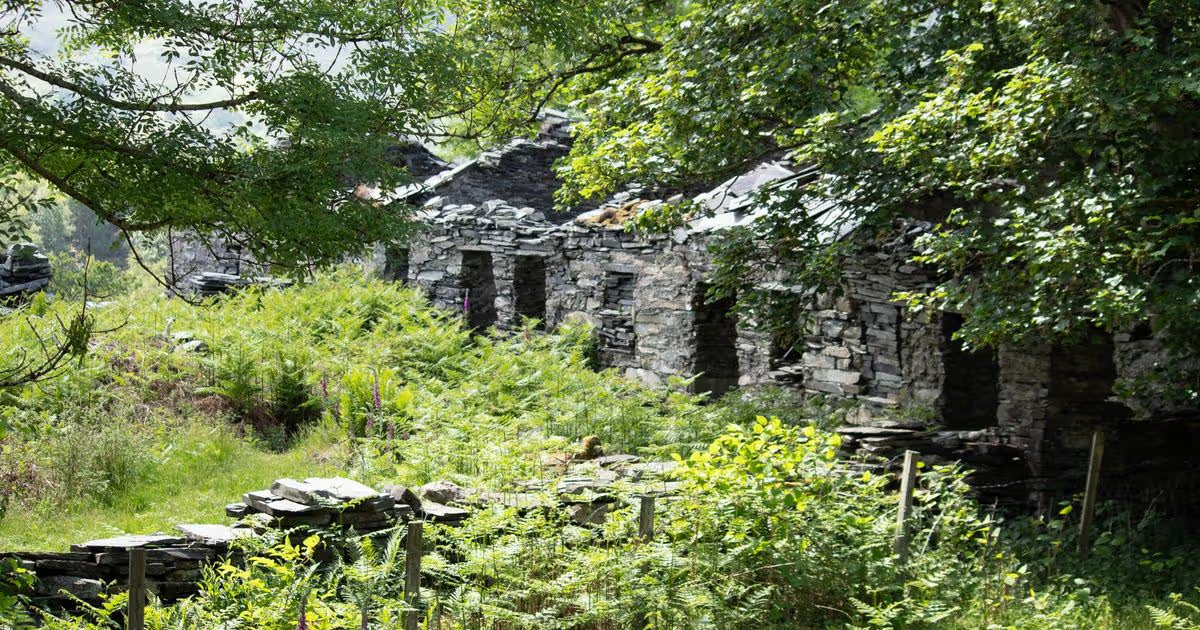
The remnants of its original location, including cottages and even a villa, remain visible, and one explorer has gone so far as to describe the site as a “Welsh Angkor Wat”.
The displacement of entire communities in Wales to create reservoirs for supplying England’s urban centres with water continues to provoke an emotional, even visceral, response to this day. Perhaps the most well-known of these is the village of Capel Celyn, which was cleared of its inhabitants then submerged to create a reservoir to supply water to Liverpool.
However, water wasn’t the sole cause for village relocations or their complete erasing. The swift expansion of the slate industry during the 19th century also impacted entire communities, each possessing their own unique identity and culture.
One such community was Talysarn, which found itself inconveniently located as slate mining spread throughout Eryri. Gradually, a collection of small quarries in the Dyffryn Nantlle valley were absorbed into larger operations like the formidable Dorothea quarry, so significant that it’s now recognised as a World Heritage Site.
Whether the more recent recognition of its global importance would offer any solace to the villagers who were compelled to leave their homes and relocate a kilometre west is debatable. However, they established new roots and the village continues to be a stronghold of the Welsh language, just as it was in the early 20th century. In 1927, the village road was also moved southward, though remnants of what is locally known as Yr Hen Lon (Welsh for “the old road”) can still be seen.
Some of the original village buildings continued to be utilised by the quarry and their ruins are still visible today. These included Plas Talysarn, an 18th-century country house that was later extended into a Victorian villa.
The remarkable site draws visitors from across the country and beyond. Among them is photographer Tony Harnett, who operates the Gems of Snowdonia website showcasing the “hidden treasures” of the national park. Tony provided his photographs to North Wales Live and revealed he was astonished by his discoveries at Dorothea.
“I’d seen photos of Plas Talysarn and knew it was an interesting place,” he said. “But I thought that’s all there was. When I went there, I did not expect to find so many other old buildings in the area. Some I just stumbled across, others I could see in the distance but didn’t have time to visit. I arrived late in the day, for the golden hour for photography, so I only had two hours there. But I could easily have stayed for the whole day, there’s so much to explore.”
Photographer and author of Wild Guide Wales, Daniel Start, has likened what survives today of the ruins to a “Welsh Angkor Wat”.
“Only the baboons are missing,” he writes. “It’s a vast, wild site with many fascinating, overgrown ruins, including a Cornish beam engine and the overgrown remains of the chapel at Plas Talysarn.”
In its prime, the grand residence of Plas Talysarn was truly remarkable. It boasted a fountain, constructed as a 21st birthday gift for the daughter of the Robinson family who owned the property and travelled by stagecoach. An old track behind the house, formerly the Nantlle horse tramway (which continued to utilise horses until the early 1960s), now leads to a bridge that seemingly goes nowhere, ending at more walled enclosures.
Close by stood a sizeable lodge house along with an assortment of other buildings. The remnants of one structure are believed to have once been a gothic chapel or folly.
Today, all these structures lie in the damp woodland, covered in moss and entwined with vines, their graffiti-covered walls adding to the feeling of desolation.
Plas Talysarn remained in the possession of the Robinson family until 1905 when it was sold to a quarry company. Local residents remember that it was last inhabited in 1946, ultimately being deserted when a landslip brought Dorothea uncomfortably close.
Nearby lies the entrance to what used to be a stable block and kennels, later converted into a shower block for the quarry workers. A former boiler house, now largely roofless, still houses two dilapidated Lancashire boilers.
Other neighbouring buildings are cloaked in moss and tree roots. Like many other quarry pits, production declined significantly after the outbreak of the Second World War.
The quarry eventually closed in 1970. Dorothea Quarry has long since flooded, with the lake exceeding 100m deep in places.
The site now forms part of the Slate Landscape of Northwest Wales World Heritage Site, which was announced by Unesco in July 2021.
How Talysarn came to be abandoned
This story dates back 500 million years to the formation of an extensive belt of Cambrian slate between two valleys in north Wales. Some of the largest and most productive slate quarries in the world were located along this belt and the region was said to have “roofed the 19th century world”.
There were numerous small and separate quarries in the area owned by various landowners. Amalgamations and takeovers over time created larger quarries like Dorothea, which opened in 1820 and remained operational until 1970.
By the 1840s, the major production levels at Dorothea looked promising for the future but it was facing serious flooding problems and in 1884 several men were drowned when the pit was engulfed.
As the quarries of the Nantlle Valley continued to expand it was decided that the village of Talysarn would be relocated to the west where it remains today and is home to just under 2,000 people.
The village phone box at the centre of a spy plot
In January 1982, a couple residing near Talysarn observed unusual activity in the red telephone box opposite their home.
At that time, detectives and other agencies were on the hunt for those behind the arson attacks on holiday homes in Wales.
Eifionwen and Moses Edwards became intrigued when they spotted two unfamiliar individuals in a white car appearing three times near their home, which overlooked the phone box, on 6th January 1982. They noticed the two men placing something inside the phone box.
After the strangers had left, the couple decided to investigate. Speaking to reporters at the time, Moses Edwards revealed that he discovered an object resembling a walkie talkie in the box: “Something like a policeman would use,” he described.
However, as he was returning to his house, the car sped back down the country lane.
“One of the men got out and said ‘I’ll take it back. I’m working for the GPO’,” he recounted. During that period, the GPO (General Post Office) was in charge of telephone services in Britain.
But Mr Edwards wasn’t convinced, and when local police officers attempted to trace the car’s registration number, they were obstructed by the Home Office. Lord Dafydd Wigley, who was the local MP at the time, has previously reminisced about the incident, stating that the men “claimed to be telephone engineers” but were actually “secret agents W.H.O. were not associated with the local constabulary [and were] acting without authority”.