

Crypto World
Bitcoin, Ether Hold Strong as Trump Announces Additional Universal 10% Tariff


Cryptocurrency markets showed resilience Friday after US President Donald Trump unveiled a new universal 10% tariff on imports, even as the policy followed a Supreme Court decision blocking his earlier use of emergency economic powers.
Key Takeaways:
- Crypto prices held steady despite Trump announcing a new 10% universal tariff.
- The Supreme Court blocked the use of emergency powers, but the administration shifted to other trade laws.
- Unlike past trade tensions, markets reacted cautiously with no major selloff in Bitcoin or Ether.
Bitcoin traded near $67,800 during the session, while Ether held around $1,960, according to data from CoinMarketCap.
Broader crypto conditions remained steady, with the total digital asset market capitalization hovering around $2.33 trillion and sentiment indicators continued to reflect caution rather than panic.
Trump Orders 10% Global Tariff Using New Legal Authority After Court Ruling
Trump sharply criticized the court’s ruling during a press conference, calling the decision “ridiculous,” and said his administration would proceed using alternative legal authorities.
“Effective immediately… I will sign an order to impose a 10% Global tariff under Section 122 over and above our normal tariffs already being charged,” he said, adding that national security tariffs under Sections 232 and 301 would remain in force.
The Supreme Court earlier ruled that the White House lacked authority to impose tariffs under the International Emergency Economic Powers Act (IEEPA) during peacetime.
In its opinion, the court emphasized that the Constitution grants Congress, not the executive branch, the power to levy duties and taxes, noting no previous administration had used the statute to enact tariffs of comparable scale.
Tariffs have historically unsettled risk assets, including equities and digital currencies, as trade disputes tend to tighten liquidity expectations and cloud economic forecasts.
Previous tariff announcements from Washington have often triggered rapid selloffs across global markets.
— Brian Allen (@allenanalysis) February 20, 2026
 Gavin Newsom isn’t mincing words:
“Trump owes families their money back. $1,751 per household.”
Trump illegally taxed working Americans through tariffs.
Took hundreds of billions. Got caught.
Got ruled against.
Now he needs to return every dollar.
No excuses. No delays. pic.twitter.com/sKvIiX4RJ0
This time, however, crypto traders appeared to take a measured stance. Bitcoin showed only marginal intraday changes and Ethereum posted small gains over 24 hours, while major tokens such as XRP and BNB also moved modestly.
Trump had previously imposed tariffs of 25% on certain imports from Canada and Mexico and 10% on Chinese goods, citing national security and trade deficit concerns.
The court rejected those justifications under the emergency statute, but the administration’s new order relies on longstanding trade laws, including the Trade Expansion Act of 1962 and the Trade Act of 1974.
Bitcoin Loses 25,000 Millionaire Addresses Under Trump
As reported, Bitcoin has shed roughly 25,000 millionaire addresses in the year since Donald Trump returned to the White House, even as US policy shifted toward a more crypto-friendly stance.
Blockchain data shows the number of addresses holding at least $1 million in BTC fell about 16% year over year, suggesting regulatory optimism has not translated into sustained on-chain wealth growth.
The pullback was less severe among the largest holders. Addresses with more than $10 million in Bitcoin declined by about 12.5%, indicating that top-tier investors were better able to withstand price volatility, while wallets near the millionaire threshold were more exposed to market swings.
Much of the increase in Bitcoin millionaire addresses occurred before Trump took office, driven by a late-2024 rally fueled by election-related optimism and expectations of deregulation.
The post Bitcoin, Ether Hold Strong as Trump Announces Additional Universal 10% Tariff appeared first on Cryptonews.

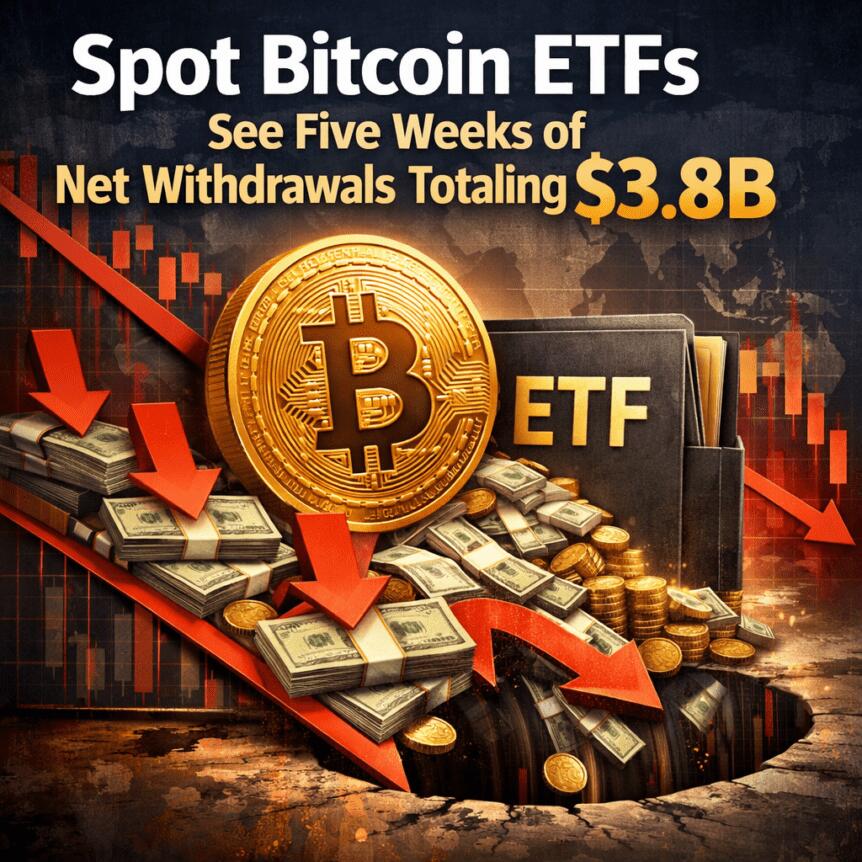
US spot Bitcoin ETFs have extended a five-week stretch of net outflows, with investors pulling roughly $3.8 billion from the products across the period. The latest weekly snapshot shows continued pressure even as inflows emerged on select days, underscoring a broader de-risking phase among institutional holders. In aggregate, spot Bitcoin ETFs have drawn about $54.01 billion in net inflows since inception, while total assets sit around $85.31 billion, a share of roughly 6.3% of Bitcoin’s overall market capitalization. Ether ETFs have mirrored the mood on the downside, posting a fifth consecutive week of net selling, even as pockets of buying appeared on specific dates.
Key takeaways
- Five consecutive weeks of net outflows from US spot Bitcoin ETFs, totaling about $3.8 billion, with the trend anchored in broader risk-off sentiment.
- The week ended Jan. 30 marked the largest single pull, about $1.49 billion, illustrating how quickly allocations can swing when macro headlines intensify.
- Last week saw mixed activity, including roughly $315.9 million in net outflows but with some days posting inflows, indicating evolving but uneven demand.
- Ether (ETH) ETFs followed a similar pattern, recording net outflows of around $123.4 million for the week, even as selective daily inflows appeared.
- Since launch, spot Bitcoin ETFs have accumulated approximately $54.01 billion in net inflows, with total assets near $85.31 billion, representing about 6.3% of Bitcoin’s market capitalization.
Sentiment: Bearish
Price impact: Negative. The persistent outflows suggest selling pressure from institutional reallocations and risk-off positioning, even as occasional inflows temper the pace.
Market context: The data arrive as traders weigh macro developments, including geopolitical dynamics and tariff news, which have sharpened risk-off tendencies across asset classes. Amid a fragile liquidity backdrop, crypto markets remain sensitive to headline risk and shifting expectations for central bank policy.
The latest numbers align with a broader pattern observed in recent weeks: institutional de-risking rather than a wholesale loss of interest in crypto assets. Vincent Liu, chief investment officer at Kronos Research, framed the outflows as evidence that portfolio managers are trimming risk exposures rather than exiting the asset class altogether. “The withdrawals reflect de-risking in response to geopolitical tensions and macro uncertainty,” Liu told this publication. “Market inflows will be dependent on macro events like incoming Thursday’s initial jobless claims, as weaker data could revive expectations for future rate cuts and help support sentiment currently at 14 extreme fear on the crypto fear and greed index.”
Why it matters
The sustained outflows from spot Bitcoin ETFs highlight a meaningful dynamic in how institutions approach crypto exposure during periods of heightened macro risk. While the asset class still sits within a broader allocation framework for many long-term investors, near-term positioning appears to be guided by a careful risk assessment rather than aggressive capitalization. The fact that outflows are occurring across multiple weeks, rather than isolated incidents, signals a rebalancing mindset rather than a wholesale retreat from crypto.
From a market structure perspective, the outflows matter because ETFs are a primary on-ramp for many traditional investors. They offer familiar mechanics and regulated exposure, which means the behavior of ETF flows can influence price discovery, liquidity, and volatility around spot markets. The correlation with macro headlines — such as jobless claims data or trade developments — underscores how crypto markets remain part of a global risk-off narrative, even as they retain the potential for high beta moves when risk appetite returns.
Meanwhile, the persistence of inflows on certain days shows there is ongoing, if uneven, demand for crypto exposure at the institutional level. The net inflows since inception remain sizable, underscoring that crypto remains a fixture in diversified portfolios for many buyers who still view the space as part of a longer-term thematic thesis. The market is watching whether a shift in macro cues — perhaps softer data or signs of policy accommodation — could unlock a renewed wave of ETF buying, particularly as the crypto fear and greed index signals a more cautious sentiment among traders.
What to watch next
- Upcoming macro data releases, including initial jobless claims, which could influence near-term risk appetite and ETF flows.
- Next-week updates on spot ETF allocations and whether any positive sessions in Bitcoin or Ether ETFs reverse the five-week downtrend.
- Regulatory and policy developments that alter the risk-reward calculus for regulated crypto exposure.
- Any notable shifts in long/short positioning among institutions that could hint at a broader reallocation cycle.
Sources & verification
- SoSoValue data on weekly net flows for US spot Bitcoin and Ether ETFs (spot ETF fund flow page).
- Vincent Liu, Kronos Research CIO, remarks on de-risking and macro drivers in an interview addressing ETF outflows.
- Bloomberg reporting on net inflows for Bitcoin ETFs despite recent outflows (as referenced in related analyses).
- Historical context of cumulative ETF inflows and total assets for spot Bitcoin ETFs since launch.
Market reaction and near-term outlook for spot ETF flows
Bitcoin (CRYPTO: BTC) and Ether (CRYPTO: ETH) exchange-traded products have been navigating a delicate balance between risk-off dynamics and a persistent demand for regulated crypto exposure. The five-week streak of net outflows from US spot Bitcoin ETFs, totaling around $3.8 billion, reflects a market where institutions are recalibrating risk rather than retreating from the asset class, according to market observers. The weekly data show a notable swing within the period: a peak weekly outflow of approximately $1.49 billion in the week ending Jan. 30, underscoring how quickly sentiment can shift in response to macro headlines. While there were days of inflows — including a Friday that added roughly $88 million — the week closed with a negative tilt, reinforcing the overarching trend toward de-risking during periods of heightened uncertainty.
The Ether ETF picture mirrors Bitcoin’s, with five consecutive weeks of net selling and a weekly tally that reached about $123.4 million in outflows last week. There were pockets of buying on particular days, such as inflows near $48.6 million on Feb. 17 and $10.3 million on Feb. 13, but these gains were not enough to reverse the cumulative downward trajectory of flows for Ether, reflecting a broader risk-off environment that has weighed on top-tier crypto exposures across the board. The divergence between intraday inflows and the week’s net negative outcome highlights how price reaction and liquidity conditions can differ from calendarized flow data, particularly in markets that operate under tighter liquidity conditions and heightened counterparty risk awareness.
Beyond the short-term movement, the longer-term context remains constructive in a cumulative sense. Spot Bitcoin ETFs have drawn about $54.01 billion in net inflows since launch, while total assets stand near $85.31 billion, representing roughly 6.3% of Bitcoin’s market capitalization. That scale indicates that regulated products continue to play a meaningful role in channeling institutions’ crypto exposure into traditional portfolios, even as daily flows swing with macro headlines. Some observers point to the possibility that macro catalysts could reignite inflows; others warn that the current risk-off backdrop could persist until clearer signals emerge from the policy front or labor market data. In any case, the overall trajectory is one of gradual, regulated access to exposure, rather than rapid, speculative allocation. As markets await further clarifications on policy and macro data, the path of ETF flows will likely remain a barometer of institutional appetite for regulated crypto assets.
What it means for users and investors
The ongoing flow dynamics have practical implications for users ranging from long-term holders to active traders. For investors seeking regulated exposure, the persistence of outflows may imply tighter liquidity on the ETF side in the short term, potentially widening bid-ask spreads on pullback days. For builders and ecosystem participants, the data highlight the importance of robust on-chain analytics and transparent product disclosures, helping users navigate a landscape where inflows and outflows can diverge from underlying price action for extended periods.
On the regulatory front, the resilience of spot ETF products suggests that, for a broad segment of the market, the regulated vehicle remains an attractive conduit for exposure. However, the macro overlay remains the primary determinant of flows in the near term. The crypto markets are in a phase where risk tolerance is sensitive to data surprises and geopolitical developments, reinforcing the idea that ETF flows are not a separate universe from macro risk; they are a lens through which investors adjust positions as incentives and risks shift.
What to watch next
- Upcoming macro headlines, especially labor market data, that could tilt sentiment toward or away from risk assets.
- Any shifts in ETF flow data in the following weeks that indicate a renewed appetite for regulated crypto exposure.
- Regulatory developments that could affect the structure, liquidity, or accessibility of spot ETFs in the United States.
Sources & verification
- SoSoValue ETF flow pages documenting weekly and cumulative spot Bitcoin and Ether ETF flows.
- Vincent Liu’s examination of de-risking and macro drivers for ETF outflows (Kronos Research).
- Bloomberg references to net inflows in Bitcoin ETFs against the backdrop of recent outflows.

The Netherlands Gambling Authority has moved against prediction markets platform Polymarket, ordering its Dutch affiliate, Adventure One, to stop offering wagering services to residents without a permit.
Key Takeaways:
- Dutch regulators ordered Polymarket’s affiliate to halt operations for offering unlicensed betting to residents.
- Authorities said prediction market wagers are illegal in the Netherlands, even for licensed gambling operators.
- The case reflects wider global regulatory pressure on event-based contracts and prediction platforms.
In a notice released Tuesday, the regulator said the company must “cease its activities immediately” or risk penalties of up to $990,000.
Officials said the platform allowed users in the Netherlands to place bets prohibited under national law, including contracts tied to local elections, and had failed to respond to earlier requests from authorities to address the issue.
Prediction Markets Not Permitted Under Dutch National Gambling Rules
“Prediction markets are on the rise, including in the Netherlands,” said Ella Seijsener, the authority’s director of licensing and supervision.
She added that such operators provide wagers that are not allowed in the Dutch market under any circumstances, even for licensed gambling companies.
Earlier this year, the company’s chief legal officer Neal Kumar said the firm was open to discussions with regulators while US federal courts consider questions over oversight of prediction markets.
The dispute mirrors broader regulatory tension around event-based contracts. In the United States, platforms offering similar products have drawn scrutiny from state authorities, many of which argue the services resemble sports betting.
At the same time, leadership at the Commodity Futures Trading Commission has pushed back against state intervention, asserting federal jurisdiction over prediction market activity.
BREAKING: Dutch financial daily FD reports that @Polymarket has been officially banned in the Netherlands — PredictFolio (@PredictFolio) February 17, 2026

The regulator warns that failure to cease services for Dutch users could result in fines of €420,000–€840,000 per week.https://t.co/gZ7rT04401
The enforcement action also comes as Dutch lawmakers debate tighter rules affecting digital assets.
The country’s House of Representatives recently advanced a proposal introducing a 36% capital gains tax on certain investments, a measure expected to cover cryptocurrencies if enacted.
Should the Senate approve the plan, the tax could take effect as early as 2028.
For now, the regulator’s order places Polymarket’s operations in the Netherlands on hold, highlighting how rapidly growing prediction markets are colliding with national gambling frameworks across multiple jurisdictions.
Dutch Indirect Crypto Investments Hit €1.2B
As reported, Dutch exposure to cryptocurrency through financial securities has grown rapidly over the past five years, reaching about €1.2 billion by October 2025, according to De Nederlandsche Bank (DNB).
The increase largely reflects rising prices of major digital assets rather than a surge of new investor money.
Holdings stood at roughly €81 million at the end of 2020, showing how valuation gains have expanded crypto-linked investments across households, institutions and companies.
Despite the jump, direct ownership of cryptocurrencies remains relatively limited for many investors.
Even with the growth, crypto securities represent only about 0.03% of the Netherlands’ overall investment market, indicating traditional assets still dominate portfolios.
Last year, Dutch crypto firm Amdax raised €30 million ($35 million) to launch Amsterdam Bitcoin Treasury Strategy (AMBTS), a dedicated Bitcoin treasury company that plans to accumulate up to 1% of the total BTC supply, or roughly 210,000 Bitcoin.
The post Dutch Regulator Orders Polymarket to Halt Unlicensed Betting Operations appeared first on Cryptonews.
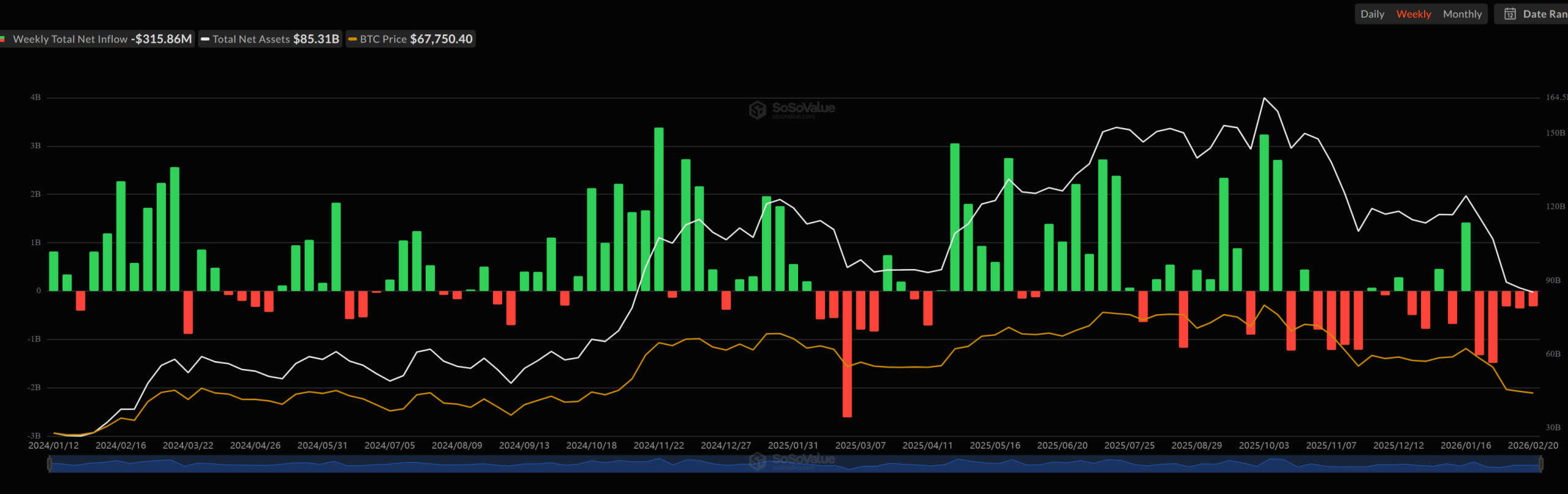
US spot Bitcoin exchange-traded funds (ETFs) have posted five consecutive weeks of net outflows, with investors pulling roughly $3.8 billion from the products over the period.
During last week, the funds recorded about $315.9 million in net outflows, according to data from SoSoValue. The biggest weekly withdrawal during this 5-week streak occurred in the week ending Jan. 30, when spot Bitcoin (BTC) ETFs recorded about $1.49 billion in net outflows.
The net weekly outflows come as some sessions posted inflows. On Friday, Bitcoin ETFs saw about $88 million in inflows, but they were outweighed by larger redemption days earlier in the week. Notable withdrawals included more than $410 million on Feb. 12, along with additional negative sessions from Feb. 17 through Feb. 19, leaving the weekly total firmly negative.

As of Friday, spot Bitcoin ETFs have accumulated roughly $54.01 billion in net inflows since launch. Total net assets stood near $85.31 billion, representing approximately 6.3% of Bitcoin’s overall market capitalization.
Related: Bitcoin ETFs shed $166M as BTC heads for worst start in years
Institutional de-risking drives Bitcoin ETF outflows
Recent withdrawals from spot Bitcoin ETFs appear tied to institutional positioning rather than a loss of long-term interest in the asset, according to Vincent Liu, chief investment officer at Kronos Research. He said the outflows reflect portfolio de-risking as geopolitical tensions and broader macro uncertainty rise.
Liu added that flows may remain unstable in the near term. Escalating trade disputes and tariff developments have reinforced a risk-off environment across markets, leaving digital assets sensitive to macro headlines.
“Market inflows will be dependent on macro events like incoming Thursday’s initial jobless claims, as weaker data could revive expectations for future rate cuts and help support sentiment currently at 14 extreme fear on the crypto fear and greed index,” he told Cointelegraph.
Related: Bitcoin ETFs still sit on $53B in net inflows despite recent outflows: Bloomberg
Spot Ether ETFs see outflows
Spot Ether (ETH) ETFs have also faced sustained selling pressure, with flows turning negative across the past five weeks as investors trimmed exposure to the second-largest cryptocurrency.

During last week, the funds recorded about $123.4 million in net outflows, according to SoSoValue data. The weekly losses came despite occasional positive sessions. Ether ETFs posted inflows on several days, including about $48.6 million on Feb. 17 and $10.3 million on Feb. 13, but they were outweighed by heavier selling earlier in the week.
Magazine: Bitcoin may take 7 years to upgrade to post-quantum — BIP-360 co-author

TLDR:
- MARA France completed a 64% majority acquisition of Exaion after securing all required regulatory approvals.
- NJJ Capital acquired a 10% stake in MARA France, strengthening the deal’s local French investment structure.
- Fred Thiel and Xavier Niel will both serve on Exaion’s board, representing key stakeholders across the partnership.
- The three-way deal aims to position Exaion as a leading European player in secure cloud and HPC services.
MARA Holdings has completed its acquisition of a 64% majority stake in Exaion, a French high-performance computing firm.
EDF Pulse Ventures, the investment arm of EDF Group, partnered with MARA and NJJ Capital to support this deal.
The transaction, initially agreed upon on August 11, 2025, received all required regulatory approvals before closing. EDF Group continues as both a minority shareholder and a customer of the company.
MARA and EDF Pulse Ventures Formalize a Strategic Alliance
Through this agreement, MARA France completed the acquisition after fulfilling all conditions precedent. The deal marks a notable step for MARA beyond its core Bitcoin mining operations.
Exaion develops and operates high-performance computing data centers based in France. The company also provides secure cloud services and artificial intelligence infrastructure to its clients.
Fred Thiel, Chairman and CEO of MARA, addressed the partnership’s broader purpose at the time of the initial announcement. “Our partnership with Exaion would bring together two global leaders in data center development and digital energy,” Thiel said.
“As data protection and energy efficiency become top priorities for both governments and enterprises, MARA and Exaion’s combined expertise would enable us to deliver secure and scalable cloud solutions built for the future of AI.” His statement laid out the strategic vision that drove the months-long approval process.
As part of the transaction, NJJ Capital acquired a 10% stake in MARA France. NJJ Capital is a holding company closely associated with French billionaire Xavier Niel.
This stake positions NJJ as a key strategic partner alongside MARA in the French market. The arrangement also brought additional regulatory confidence, as France required a local investor to participate before granting its approval.
Exaion’s Board of Directors will reflect the new ownership structure going forward. MARA Inc will appoint three representatives, EDF Pulse Ventures will appoint three, and NJJ will appoint one, with Exaion’s CEO and co-founder also holding a seat.
Xavier Niel and Fred Thiel will both serve on the board. This governance model ensures every major stakeholder has a direct voice in Exaion’s direction.
Exaion Eyes European Leadership in Digital Infrastructure
The core aim of this three-way partnership is to accelerate Exaion’s expansion across Europe. MARA, EDF, and NJJ together plan to strengthen Exaion’s capabilities in HPC and secure cloud services.
The partnership is specifically designed to position Exaion as a European leader in digital infrastructure. This goal has been central to all three partners since the deal was first structured.
Julien Villeret, Head of Innovation at EDF Group, commented on EDF’s role in enabling this transition. “Since its creation in 2020, EDF Pulse Ventures has supported Exaion’s growth and the development of its cutting-edge digital technologies,” Villeret said.
“This transaction would mark a new chapter, as Exaion would join forces with a seasoned global tech partner, while maintaining a collaborative relationship with the EDF Group.” He further described it as a major opportunity for Exaion to accelerate its international development.
The deal also carried strong backing from the French government. France’s Finance Minister Roland Lescure described the deal as a confirmation of the country’s ability to attract international capital without relinquishing control over its strategic assets, noting that the agreement guarantees the protection of national interests and technological sovereignty.
His remarks reflected France’s careful approach to approving the foreign acquisition.
MARA’s move into AI data centers reflects a broader trend among crypto mining companies. Bitcoin miners have been redirecting computational resources toward AI and HPC workloads.
This transition allows companies to diversify revenue beyond cryptocurrency market cycles. The MARA-Exaion deal fits directly within that wider industry pattern, combining energy expertise, digital infrastructure, and computing capacity under one strategic alliance.
TLDR:
- Wintermute CEO Evgeny Gaevoy says crypto is now driven by a “number go up” mindset over cypherpunk values.
- Gaevoy argues stablecoins reinforce U.S. dollar dominance rather than building a truly decentralized financial system.
- Despite Ethereum’s $120B+ in TVL, Gaevoy says most of it is “stuck money” with little real-world application use.
- Gaevoy warns that deeper TradFi integration could permanently erase the original cypherpunk dream of decentralized finance.
Cypherpunk ideals once drove the creation of Bitcoin and decentralized finance. However, Wintermute founder and CEO Evgeny Gaevoy believes the industry has moved far from those origins.
Speaking on Fortune’s Crypto Playbook podcast, Gaevoy argued that crypto has been consumed by a “number go up” mindset.
He also raised concerns about stablecoins reinforcing dollar dominance and the limited real-world adoption of decentralized applications, even as blockchain valuations remain high.
The Shift Away From Decentralization
Gaevoy expressed concern about how the crypto industry has repositioned itself over recent years. Rather than building systems that operate outside traditional finance, many projects now align closely with Wall Street structures.
This shift, he said, runs counter to Bitcoin’s founding philosophy as a libertarian, government-independent currency.
Earlier in February, Gaevoy shared his views in a viral thread on X. He argued that despite pro-blockchain government sentiment and institutional adoption, the core mission of crypto has been overshadowed.
The industry, in his view, is now driven more by price speculation than by meaningful technological purpose.
Stablecoins have become one of the most widely used products in crypto. However, Gaevoy pointed out that their growth comes with a contradiction.
“We were supposed to build something parallel to the dollar,” he said on the podcast, “but now we are actually imposing the dollar on the rest of the world.” That framing challenges the widely held view that stablecoin expansion equals genuine crypto progress.
For Gaevoy, this represents a fundamental conflict in values. The industry set out to create an alternative financial system, but has instead become a channel for extending existing monetary dominance. Rather than replacing the dollar-based order, crypto has largely reinforced it.
Limited Adoption Despite High Valuations
The debate between Ethereum and Solana often dominates crypto conversations. Gaevoy, however, believes this misses a larger issue: neither blockchain has achieved genuine decentralized application adoption.
Despite Ethereum holding over $120 billion in total value locked, according to CoinMarketCap, Gaevoy described much of it plainly. “It’s stuck money,” he said, pushing back against the idea that high TVL figures reflect real economic activity.
Corporate pilots placing bonds or cash markets on blockchains have attracted significant media attention. Yet Gaevoy cautioned against reading too much into them.
“People quite overestimate those pilots by corporations to put some bonds on blockchains or some cash markets on blockchains,” he said. These efforts, he added, remain a tiny fraction of what happens in traditional finance daily.
Wintermute itself works across centralized and decentralized exchanges rather than committing to one direction. This positions the firm to operate at multiple levels of integration with traditional finance.
Still, Gaevoy maintains that the ideal future involves returning to cypherpunk principles rather than a deeper merger with Wall Street.
“Everyone is cheering for this merger with TradFi,” Gaevoy said. “But nobody understands that it will basically just cancel out the cypherpunk dream altogether.”
He remains confident the tide will turn. “My bet is this pendulum will swing back again when people realize there is a benefit to this crazy blockchain stuff, and it’s not just memecoins,” he added.
So far, bitcoin has remained relatively stable after the new tariffs were announced, but history shows pain might be on its way.
On Friday, the US Supreme Court ruled against President Trump’s tariffs, indicating that he could not use a 1977 law – the International Emergency Economic Powers Act (IEEPA) – to levy taxes on imports from almost all countries.
Trump’s reaction was immediate, calling the ruling a disgrace and threatening to take even more actions. He did so hours later, announcing a new 10% temporary tariff on goods from all countries under a law that was never used before, known as Section 122.
It allows him to impose tariffs of up to 15% for 150 days before Congress steps in. However, experts have warned that Trump could once again work around the law, as Section 122 does not expressly prohibit him from allowing the tariffs to lapse after 150 days and then declaring a new emergency to bring them back.
It’s worth noting that the Friday court ruling applies only to tariffs that Trump had enacted under the IEEPA. This allows the President to regulate trade in response to an emergency. Additionally, tariffs imposed under Section 232 of the Trade Expansion Act of 1962 will remain, including those on steel, aluminium, lumber, and automotives.
In its 6-3 ruling on Friday, the Supreme Court failed to address or provide guidance on returning the money to the affected parties that paid the taxes, worth around $130 billion. Treasury Secretary Bessent said after the decision was announced that the refund issue could drag on for years.
For now, perhaps the most important question for crypto investors is whether these latest developments will lead to another crash in the market.
Recall that BTC and the alts plunged in February and April last year when Trump hit essentially every country with tariffs. More corrections took place a few months ago when he only threatened the EU with additional taxation during the Greenland saga.
You may also like:
So far, bitcoin has remained relatively stable, trading around $68,000. However, it appeared stable after the threats against the EU but plummeted once all financial markets opened on that Monday morning.
SECRET PARTNERSHIP BONUS for CryptoPotato readers: Use this link to register and unlock $1,500 in exclusive BingX Exchange rewards (limited time offer).

In a strategic move that blends crypto mining with enterprise AI ambitions, MARA Holdings completed a majority stake acquisition in Exaion, the French computing infrastructure operator. The deal, initially agreed in August 2025 with EDF Pulse Ventures, hands MARA France a 64% stake in Exaion after the necessary regulatory clearances. EDF remains a minority shareholder and customer, while NJJ Capital—the investment vehicle of telecom entrepreneur Xavier Niel—will take a 10% stake in MARA France as part of the broader alliance. Governance is being reshaped to reflect the new ownership structure: MARA, EDF Pulse Ventures, and NJJ will each hold board seats alongside Exaion’s CEO and co-founder, with Niel and MARA’s chief executive Fred Thiel also expected to participate on the board. The arrangement crystallizes a multi-party partnership that could accelerate Exaion’s AI and cloud ambitions while reinforcing MARA’s diversification beyond traditional mining operations.
Key takeaways
- MARA Holdings secures a 64% stake in Exaion, a French computing infrastructure operator, after regulatory approvals).
- EDF Pulse Ventures remains a minority shareholder and customer, preserving existing commercial ties with Exaion.
- NJJ Capital will acquire a 10% stake in MARA France, creating a broader alliance with MARA.
- Board composition will reflect the new tri-party ownership, with 3 seats for MARA, 3 for EDF Pulse Ventures, and 1 for NJJ, plus Exaion’s leadership.
- The move aligns with a wider industry trend of Bitcoin miners repurposing facilities for AI data centers to diversify revenue amid hashprice pressure and rising mining costs.
Tickers mentioned: $BTC, MARA
Market context: The deal sits at the intersection of crypto mining, AI infrastructure demand, and large-scale energy deployment. The sector has faced tighter economics since the 2024 halving reduced block rewards and rising network difficulty squeezed margins. In response, several miners have pursued hybrid models—maintaining mining as a cash-flow anchor while building AI computing capacity to stabilize revenue streams. This broader trend is evident in public players adapting their asset bases, with companies like HIVE Digital Technologies reporting strength driven by AI expansion, and others such as CoreWeave moving from crypto mining toward substantial AI infrastructure operations. The industry context underpins MARA’s strategic push into Exaion, emphasizing resilience through diversified endpoints rather than a sole reliance on hash-rate economics.
Bitcoin mining economics have continued to evolve as the hash-rate environment shifts. In the latest cycle, Bitcoin mining difficulty rose about 15% to 144.4 trillion, reversing a prior decline and underscoring the ongoing challenge of maintaining profitability in a volatile cost environment. The rebound in difficulty highlights the need for miners to find steadier revenue streams that can weather fluctuations in price and energy costs. As miners explore data-center-scale AI and high-performance computing services, the balance between pure block rewards and ancillary computing offerings remains a focal point for investors and operators alike.
In the context of this transaction, the governance structure is designed to ensure broad-based representation from MARA, EDF Pulse Ventures, and NJJ while preserving Exaion’s leadership, a balance that could shape how the company evolves as an AI-focused infrastructure provider.
Why it matters
The MARA-Exaion deal signals a concrete step toward a more integrated model of value creation in the crypto ecosystem—one that marries mining with enterprise-scale AI infrastructure. By consolidating Exaion under a majority stake, MARA positions itself to leverage Exaion’s data-center capabilities to offer AI-ready compute at scale, potentially tapping into markets that demand GPU-accelerated processing, machine learning workloads, and cloud-style services tailored for research, development, and production environments. This aligns with a broader industry leitmotif: as hash price becomes an increasingly uncertain driver of earnings, diversified revenue streams anchored in computing infrastructure can provide a stabilizing layer for balance sheets, particularly in a sector prone to volatility in crypto cycles.
The governance implications are non-trivial. The board composition—a representation split among MARA, EDF Pulse Ventures, and NJJ, plus Exaion’s leadership—suggests a framework designed to maintain continuity while enabling cross-pollination of strategic priorities. Xavier Niel’s NJJ Capital involvement and MARA’s continued leadership signal a durable collaboration that could accelerate product development, client acquisition, and international deployment of Exaion’s AI-oriented infrastructure. For investors, the arrangement offers a clearer line of sight into how a crypto-focused mining group can pivot toward high-value computing services while maintaining exposure to digital-asset cycles. For builders in the space, the alliance may foreshadow more multi-party partnerships that blend energy, telecom, and cloud-oriented compute into cohesive platforms for AI workloads and data processing at scale.
From a market perspective, the development occurs amid ongoing demand for AI capacity and cloud infrastructure. Publicly traded miners have increasingly pursued hybrid business models; several have reported that AI-focused data-center initiatives are contributing to revenue growth or serving as a counterweight to mining volatility. The MAVA-Exaion collaboration exemplifies how crypto operators can leverage established energy and data-center assets to participate in AI infrastructure without fully stepping away from mining fundamentals. This approach may influence how other players structure alliances and funding rounds, especially as regulatory and policy considerations around AI compute, data sovereignty, and energy efficiency continue to evolve.
In the long run, the Exaion partnership could shape a more resilient blueprint for how crypto-native firms participate in data-center ecosystems. While the shift toward AI infrastructure is driven by macro-level demand for compute power, it also reflects a broader appetite among investors for differentiated, asset-light growth vectors that are less dependent on volatile crypto price cycles. If executed effectively, the MARA-Exaion alliance could deliver an AI-forward product suite that appeals to enterprises seeking scalable, secure, and energy-conscious computing solutions—an outcome that would diversify both top-line growth and risk exposure for a company historically driven by mining revenues.
What to watch next
- Board governance implementation and any subsequent changes to Exaion’s leadership structure.
- The timing and terms of NJJ Capital’s 10% stake in MARA France and how it influences cross-border collaboration.
- Product roadmaps and enterprise customer wins for Exaion’s AI data-center services, including capacity expansions and new partnerships.
- Regulatory developments affecting AI infrastructure and energy usage across France and Europe that could impact deployment scales.
Sources & verification
- Official MARA Holdings press release detailing the Exaion stake acquisition and ownership structure.
- EDF Pulse Ventures partnership announcements outlining minority participation and customer relationships.
- Public disclosures from NJJ Capital regarding its 10% MARA France stake and strategic intent.
- Exaion governance documents and leadership statements released in connection with the transaction.
Strategic convergence: AI, cloud computing and Bitcoin mining intersect
Bitcoin (CRYPTO: BTC) has emerged as a reference point for miners as they recalibrate portfolios toward AI-forward infrastructure. The combination of a 64% Exaion stake for MARA (NASDAQ: MARA) and a 10% stake for NJJ Capital in MARA France signals a deliberate move to anchor AI data-center capabilities within a crypto ecosystem historically defined by hash power. The arrangement envisages Exaion as a platform for AI and high-performance computing, powered by MARA’s energy assets and regulatory experience, while EDF Pulse Ventures preserves its role as a strategic partner and customer. This alignment not only diversifies revenue streams but also positions the group to bid for larger enterprise workloads that require GPU-accelerated compute at scale, a space where the demand is growing even as crypto prices swing.
Industry dynamics underpinning the transaction extend beyond this deal. A number of mining operators are repurposing facilities to host AI and data-center workloads, a trend underscored by notable moves across the sector. HIVE Digital Technologies has reported strong results strengthened by AI initiatives, while CoreWeave has shifted from crypto mining toward AI infrastructure provision as GPU demand cooled for mining. Other players—TeraWulf, Hut 8, IREN, and MARA among them—are similarly realigning assets to unlock steadier, non-volatile income streams. The logic is straightforward: AI compute centers can offer recurring revenue tied to enterprise demand, while mining remains a cash-flow anchor rather than a sole driver of profitability.
In parallel, the industry continues to monitor mining difficulty and hash-rate dynamics. A rebound in difficulty—rising roughly 15% to 144.4 trillion—reiterates the energy and efficiency challenges miners face, including weather-related outages that periodically disrupt grid reliability. Against that backdrop, the ability to monetize excess energy capacity and repurpose facilities into AI data-center hubs could prove essential for long-term resilience. The MARA-Exaion venture thus sits at a confluence of capital, energy strategy, and enterprise-grade compute services, highlighting how crypto businesses are evolving to weather market cycles while expanding their tech footprint into AI-enabled markets.
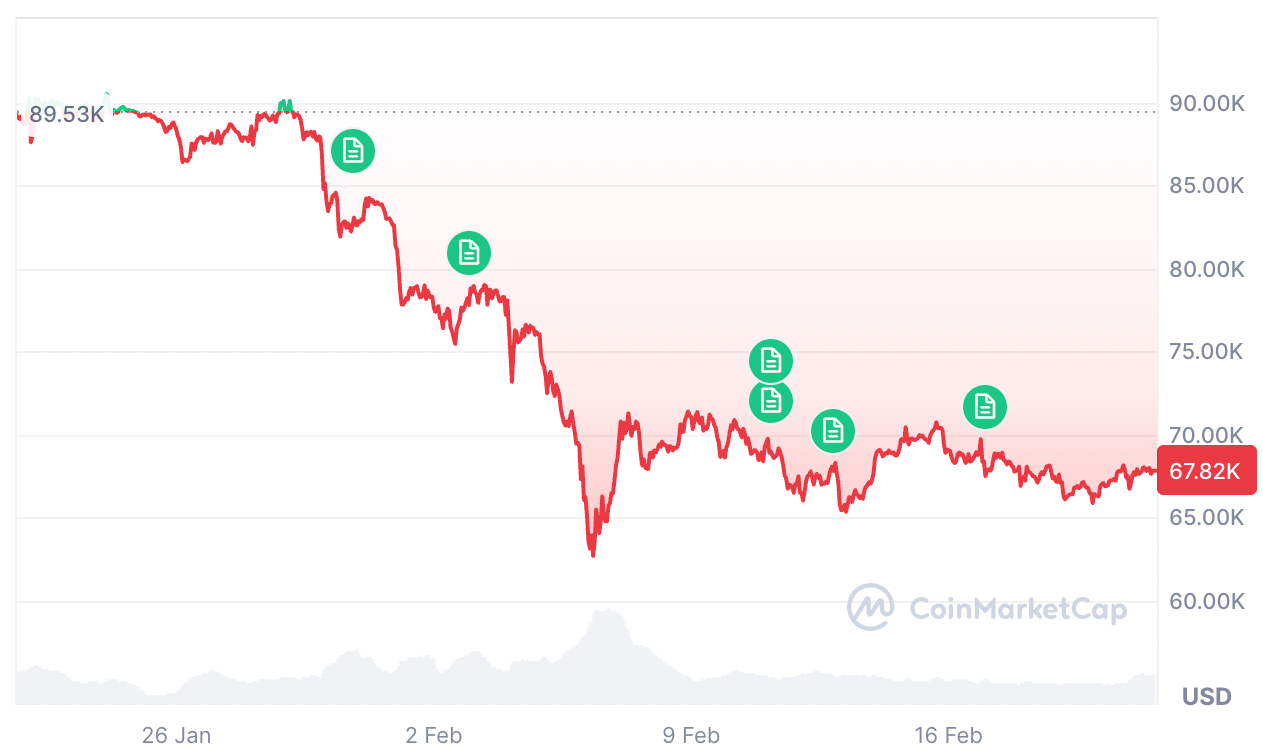
The overall number of crypto market participants calling for Bitcoin to enter new all-time high territory has tapered off, which crypto sentiment platform Santiment points out is a positive signal.
“Calls for Bitcoin to hit $150k to $200k, and even $50k to $100k, are drying up,” Santiment said in a report on Friday.
“This reduction in FOMO and ‘Lambo’ memes is actually a healthy market indicator. It shows that retail optimism is fading,” Santiment added.
Bitcoin sentiment bumps up to ‘neutral’
While prominent Bitcoin (BTC) advocates such as BitMEX co-founder Arthur Hayes and BitMine chair Tom Lee were openly calling for Bitcoin to reach as high as $250,000 during 2025, the asset’s price ended up reaching $126,100 in October, before entering a downtrend that ultimately led to ending the year lower than where it started.

The downtrend continued into the new year, with Bitcoin dropping to near $60,000 on Feb. 6, but has since edged up to $67,847 at the time of publication, according to CoinMarketCap.
Santiment said that the sentiment around Bitcoin, measured by the ratio of bullish to bearish social media comments, has recovered from “extreme bearishness” to “neutral territory,” which may make it harder for market participants to make trading decisions.
“Better to avoid trading in these scenarios or at least discount the significance of sentiment metrics in your analysis,” Santiment said.

Meanwhile, other indicators suggest that crypto investors are still fearful.
The Crypto Fear & Greed Index, which measures overall crypto market sentiment, stayed in “Extreme Fear” territory on Saturday, posting a score of 8, suggesting investors are extremely cautious.
Related: Bitcoin ignores US Supreme Court, Trump tariff strike amid talk of $150B refund
However, Santiment said the overall activity on the Bitcoin network is “flashing warning signs,” explaining that transaction volume, active addresses, and network growth are all “steadily declining.”
“These utility indicators suggest the network is being used less frequently. While not immediately bearish, this dormancy implies traders are sitting on their hands,” Santiment said, arguing that market expansion would show growing user participation.
Magazine: 6 massive challenges Bitcoin faces on the road to quantum security
TLDR:
- Aptos slashed staking rewards from 5.19% to 2.6%, cutting sell pressure on APT nearly in half immediately.
- The Aptos Foundation locked 210 million APT, removing roughly 18% of the total circulating supply from the market.
- Programmatic buybacks and a 32 million APT annual burn were introduced to create consistent token demand.
- Despite strong tokenomics reforms, the APT price saw no reaction due to weak retail interest and no clear narrative.
APT, the native token of the Aptos blockchain, recently received a major tokenomics upgrade. The changes addressed long-standing structural concerns around inflation and supply pressure.
However, the price showed little reaction following the announcement. Analysts point to a deeper problem rooted in weakened market confidence.
The fixes may improve the foundation, but demand has not followed. The central question now is whether these reforms came too late to matter this cycle.
What the Aptos Tokenomics Upgrade Actually Changed
Aptos cut staking rewards nearly in half, dropping from 5.19% to 2.6%. This move directly reduces the selling pressure that had weighed on APT for months.
The Aptos Foundation also locked 210 million APT, removing roughly 18% of the circulating supply. A hard cap of 2.1 billion tokens was also clarified for the market.
Beyond supply controls, the project introduced programmatic buybacks and a projected annual burn of 32 million APT. Grant issuance was shifted to a performance-based model, tightening how new tokens enter circulation.
Together, these changes represent a meaningful pivot in how the project manages its token economy. On paper, the reforms are serious and directly responsive to earlier criticism.
Crypto analyst account @ourcryptotalk noted the changes address structural issues it raised two months prior. The account stated that emissions cut nearly in half immediately reduces selling pressure.
It also noted the foundation lock removes roughly 18% of the circulating supply permanently. Buybacks, it added, create systematic demand.
Still, the market responded with indifference. Retail investors have not rotated into APT following the announcement.
Institutions have not signaled a clear preference for the asset either. On-chain activity has not produced the kind of demand shock that typically moves prices.
Why Price Ignored the News and What Comes Next
Markets generally do not reward projects for correcting past mistakes. The lack of price reaction reflects this well-established pattern in crypto.
Trust, once broken by poor tokenomics design and unlock cycles, requires more than adjusted numbers to rebuild. It requires a visible surge in usage and ecosystem activity.
Aptos also lacks a dominant narrative in the current market cycle. Move language is a technical feature, not a category-defining story.
Competing chains have captured niches in areas like real-world assets, gaming, and institutional infrastructure. Aptos has not yet claimed ownership of any single space.
Ourcryptotalk framed the remaining challenge clearly. The project needs live dashboards for burn, emissions, and buybacks to build transparency.
It also needs to route ecosystem fees into stakers or burns to make APT feel like true ownership. Without a killer narrative, the token risks fading even with improved supply mechanics.
If ecosystem growth accelerates while emissions remain suppressed, a supply squeeze could quietly develop. Without that growth, the tokenomics upgrade alone is unlikely to drive a sustained rally.
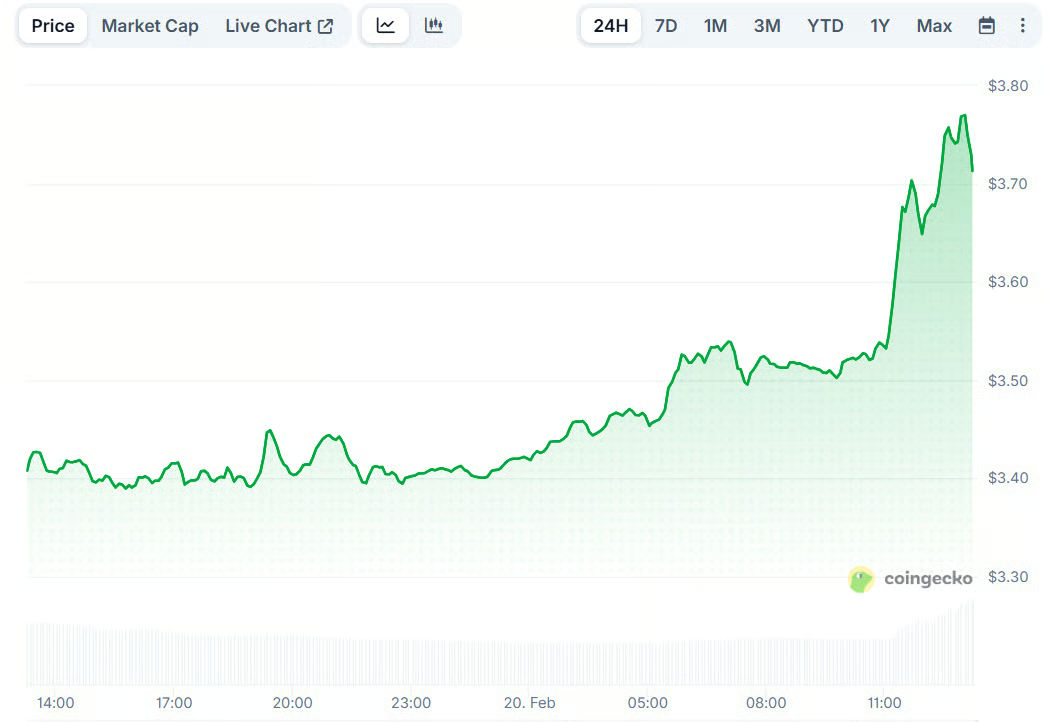
At one point, TRUMP’s market capitalization approached the psychological mark of $1 billion.
Several Trump-related meme coins experienced a significant resurgence on Friday, following an intriguing announcement made by the President of the United States.
However, the asset lost almost all gains in the following hours, perhaps driven by a blow against Trump from the US Supreme Court.
The Trump Effect or Just a Coincidence?
Official Trump (TRUMP) – the biggest meme coin related to the POTUS – jumped to almost $3.80 on Friday, its highest point since the beginning of February. Its market capitalization neared $900 million, solidifying it as the sixth-largest meme coin.
Other Trump-themed tokens, including Pepe Trump (PTRUMP), Super Trump (STRUMP), and SUI TRUMP (SUITRUMP), also headed north, albeit charting more modest gains.
Their revival coincides with the president’s pledge to direct the Secretary of War and other relevant departments to begin identifying and releasing government files concerning alien and extraterrestrial life. The topic has always fascinated the public, but a recent podcast featuring the former US leader Barack Obama has further amplified attention.
Asked about the existence of aliens, he affirmed they are real but clarified that he has never personally seen any. Moreover, Obama said they are not being kept at the notorious Area 51 “unless there’s this enormous conspiracy and they hid it from the president of the United States.”
It is important to note that Trump’s pledge on that front may not be the only factor fueling a resurgence for the aforementioned meme coins. The broader cryptocurrency market, where Bitcoin (BTC) and many altcoins have seen minor increases over the last 24 hours, could also have played a role.
You may also like:
What’s Next?
Some commentators on X noted TRUMP’s recent pump, suggesting it might have more fuel left for additional gains. The analyst who goes by the moniker Don claimed the meme coin “looks good,” hinting that its price structure signals potential upside to $13.29.
Nonetheless, investors and traders should be extremely cautious when dealing with such assets due to their infamous volatility. TRUMP, which saw the light of day in January last year, initially exploded above $70 only to crash by double digits mere days later.
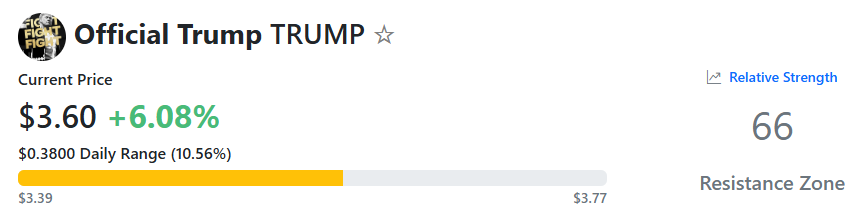
The asset’s Relative Strength Index (RSI) also indicates a possible correction ahead. The technical analysis tool measures the speed and magnitude of recent price changes and provides traders with an idea of potential reversal points. It ranges from 0 to 100, with ratios around and above 70 suggesting the token is overbought and due for a pullback. On the other hand, anything below 30 is considered a buying opportunity. Currently, the RSI stands just south of the bearish zone.
SECRET PARTNERSHIP BONUS for CryptoPotato readers: Use this link to register and unlock $1,500 in exclusive BingX Exchange rewards (limited time offer).

Evaporate pursues maiden Group 1 in 2026 Futurity Stakes

There’s a simple way to watch the Super Eights at the T20 World Cup for *FREE*

How the royal family brand can weather Andrew Mountbatten-Windsor’s arrest


-

 Video5 days ago
Bitcoin: We’re Entering The Most Dangerous Phase
-

 Tech6 days ago
Luxman Enters Its Second Century with the D-100 SACD Player and L-100 Integrated Amplifier
-

 Crypto World4 days ago
Can XRP Price Successfully Register a 33% Breakout Past $2?
-

 Sports4 days ago
GB's semi-final hopes hang by thread after loss to Switzerland
-

 Fashion16 hours ago
Weekend Open Thread: Boden – Corporette.com
-

 Video1 day ago
XRP News: XRP Just Entered a New Phase (Almost Nobody Noticed)
-
 Tech4 days ago
The Music Industry Enters Its Less-Is-More Era
-

 Business3 days ago
Infosys Limited (INFY) Discusses Tech Transitions and the Unique Aspects of the AI Era Transcript
-

 Entertainment3 days ago
Kunal Nayyar’s Secret Acts Of Kindness Sparks Online Discussion
-

 Video4 days ago
Financial Statement Analysis | Complete Chapter Revision in 10 Minutes | Class 12 Board exam 2026
-

 Tech3 days ago
Retro Rover: LT6502 Laptop Packs 8-Bit Power On The Go
-
 Sports2 days ago
Clearing the boundary, crossing into history: J&K end 67-year wait, enter maiden Ranji Trophy final | Cricket News
-

 Entertainment3 days ago
Dolores Catania Blasts Rob Rausch For Turning On ‘Housewives’ On ‘Traitors’
-

 Business3 days ago
Tesla avoids California suspension after ending ‘autopilot’ marketing
-
 NewsBeat6 days ago
The strange Cambridgeshire cemetery that forbade church rectors from entering
-

 Crypto World3 days ago
WLFI Crypto Surges Toward $0.12 as Whale Buys $2.75M Before Trump-Linked Forum
-

 Politics4 days ago
Eurovision Announces UK Act For 2026 Song Contest
-
 NewsBeat6 days ago
Man dies after entering floodwater during police pursuit
-

 Crypto World2 days ago
83% of Altcoins Enter Bear Trend as Liquidity Crunch Tightens Grip on Crypto Market
-

 NewsBeat7 days ago
UK construction company enters administration, records show