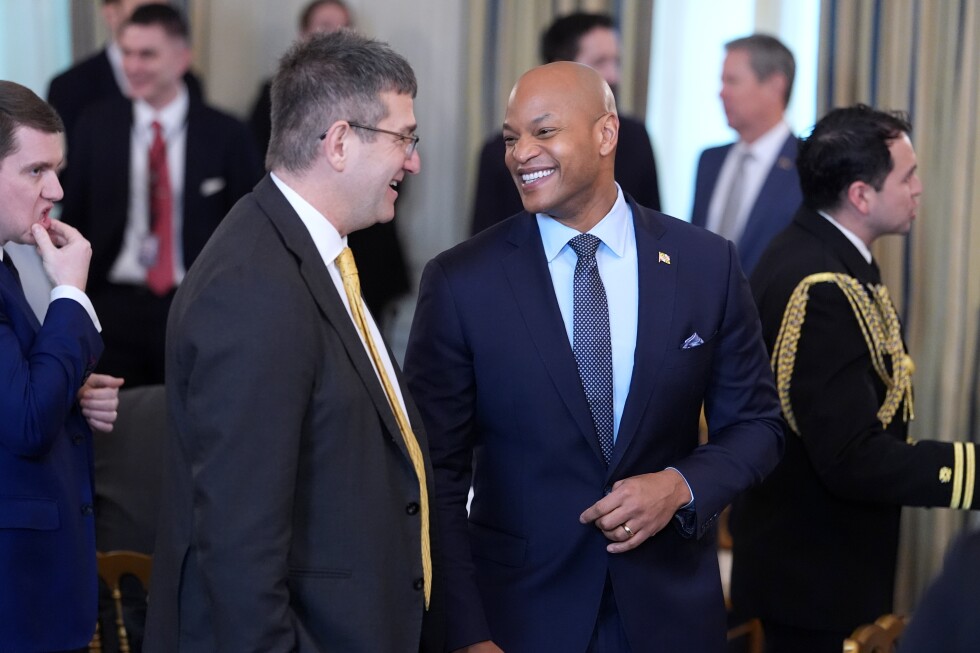
WASHINGTON (AP) — The annual dinner with governors at the White House is typically a chance for leaders from both parties to come together, socialize and spend a low-key evening with the president. But like many traditions during President Donald Trump’s second term, Saturday’s dinner has proven unusually controversial.
Ahead of this week’s gathering of the National Governors Association, Trump ridiculed the bipartisan group’s leadership, Republican Gov. Kevin Stitt of Oklahoma and Democratic Gov. Wes Moore of Maryland. He refused to invite Moore, along with Colorado Gov. Jared Polis, to a working event at the White House on Friday — only to relent at the last minute.
Even then, the event was cut short when Trump learned of the Supreme Court’s decision to strike down his sweeping tariff policy, leaving even some Republicans frustrated by the week’s turbulence.
“It was unfortunate that the Supreme Court came out with a bad ruling at that time,” said Louisiana Gov. Jeff Landry, a Republican and top Trump ally.
Advertisement
Dozens of Democrats had threatened to boycott the dinner if members of their party were blocked from the working meeting. But even after Moore’s attendance, some said they still wouldn’t show up Saturday.
“President Trump has made this whole thing a farce,” Massachusetts Gov. Maura Healey said in a statement explaining her decision to skip the dinner.
For all the turmoil surrounding the dinner, some Democrats said Friday’s meeting was useful. Moore said it offered a “chance for us to be able to share our thoughts and our perspectives and our ideas.”
New York Gov. Kathy Hochul said governors asked Trump what lessons were learned from the administration’s aggressive immigration enforcement in Minnesota, in which two U.S. citizens were killed within weeks of each other.
Advertisement
“The President said, ‘We’ll only go where we’re wanted,” Hochul said approvingly.
Those who have attended previous dinners said they offered a rare and helpful opportunity for governors to connect with the president and members of his Cabinet away from the pressure of daily governing. Some also said the dinner was a chance to connect with fellow governors from other parties whom they might not see very often.
Asa Hutchinson, the former Republican governor of Arkansas who briefly challenged Trump for the 2024 GOP presidential nomination, recalled being assigned to a table one year with then-Rhode Island Gov. Gina Raimondo and getting to know her family.
“It’s a glowing evening in the White House,” Hutchinson, who once chaired the NGA, said in an interview.
He followed in the footsteps of tonight’s opponent, Warrington, in trying to take down the reigning champion Anthony Cacace, who first defeated Warrington before he swatted Wood aside by TKO. Wood had knocked out Warrington at the Sheffield Arena in 2023, down on all three judges’ scorecards before landing a right hook that felled the ‘Leeds Warrior’. Warrington beat the referee’s count, but saw the contest waved off in the seventh, controversially and to his horror.
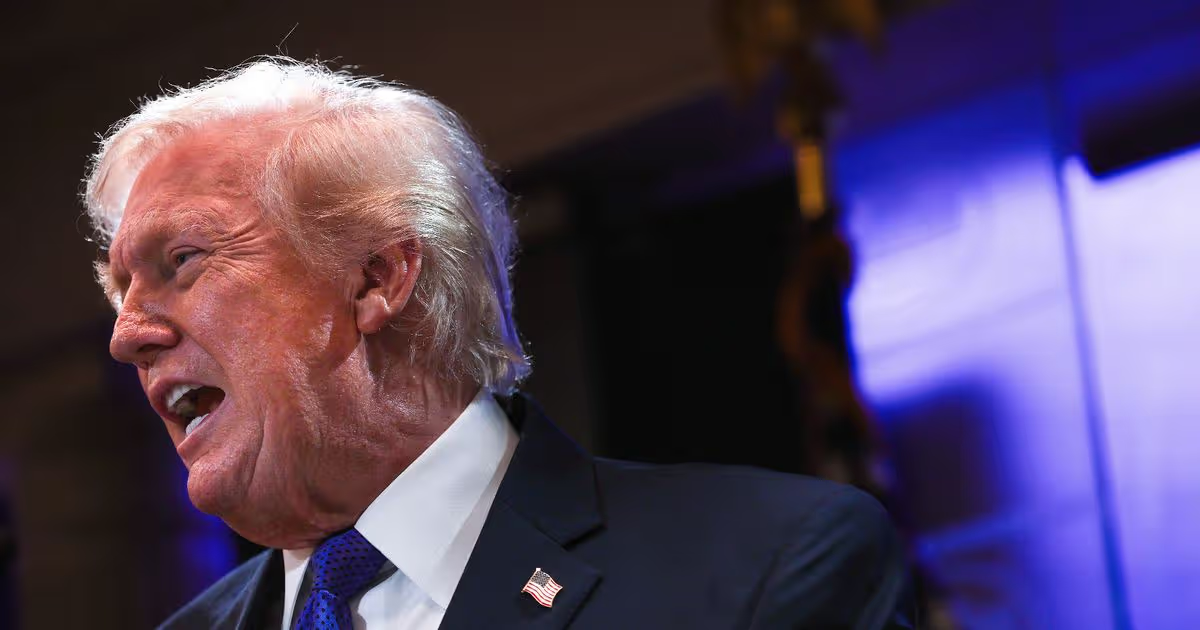
Donald Trump moved after a Supreme Court ruling deemed his use of a law was illegal.
17:57, 21 Feb 2026Updated 18:04, 21 Feb 2026
President Trump says he has ramped up tariffs on every country to the maximum allowed by US law after being humiliated by the Supreme Court’s ruling. During a televised meltdown last night, Trump declared he was replacing his illegal regime of retaliatory tariffs with a global 10 per cent levy.
It comes after the Supreme Court ruled his use of an obscure “emergency” law to impose them without consulting Congress was illegal. And tonight, Trump announced he was increasing that figure, reports the Mirror.
Labelling the highest court’s decision “ridiculous, poorly written, and extraordinarily anti-American”, he wrote on his Truth Social platform that he was hiking the global tariff rate to the maximum legal level of 15 per cent. However, he’s only allowed to do so for 150 days under the loophole his administration has found.
Advertisement
The UK’s biggest business organisation swiftly expressed dismay at the announcement and urged the Government to continue dialogue with US counterparts to keep the UK’s competitive advantage.
“We had feared that the President’s plan B response could be worse for British businesses and so it is proving,” William Bain, head of trade policy at the BCC said.
“This means an extra 5% increase in tariffs on a wide range of UK goods exports to the US, except those covered under the Economic Prosperity Deal.
“This will be bad for trade, bad for US consumers and businesses and weaken global economic growth. Businesses on both sides of the Atlantic need a period of clarity and certainty. Higher tariffs are not the way to achieve that.”
Advertisement
The UK Government repeated its assertion that it expects Britain’s “privileged trading position with the US” to continue, when approached for comment on the announcement of a new 15% rate.
Britain had received the lowest tariff rate of 10 per cent, and a subsequent agreement struck by Prime Minister Sir Keir Starmer and Mr Trump saw further carve-outs for the country’s steel industry and car manufacturers.
Questions remain over whether those deals still stand, although officials are understood to believe the changes would not have an impact on most of the UK’s trade with America, including preferential arrangements on steel, cars and pharmaceuticals.
A Government spokesperson said: “This is a matter for the US to determine but we will continue to support UK businesses as further details are announced.
Advertisement
“Under any scenario, we expect our privileged trading position with the US to continue and will work with the administration to understand how the ruling will affect tariffs for the UK and the rest of the world.”
Get more Daily Record exclusives by signing up for free to Google’s preferred sources. Click HERE.
A 37-year-old man is in hospital with life-threatening injuries, according to police
17:39, 21 Feb 2026Updated 18:03, 21 Feb 2026
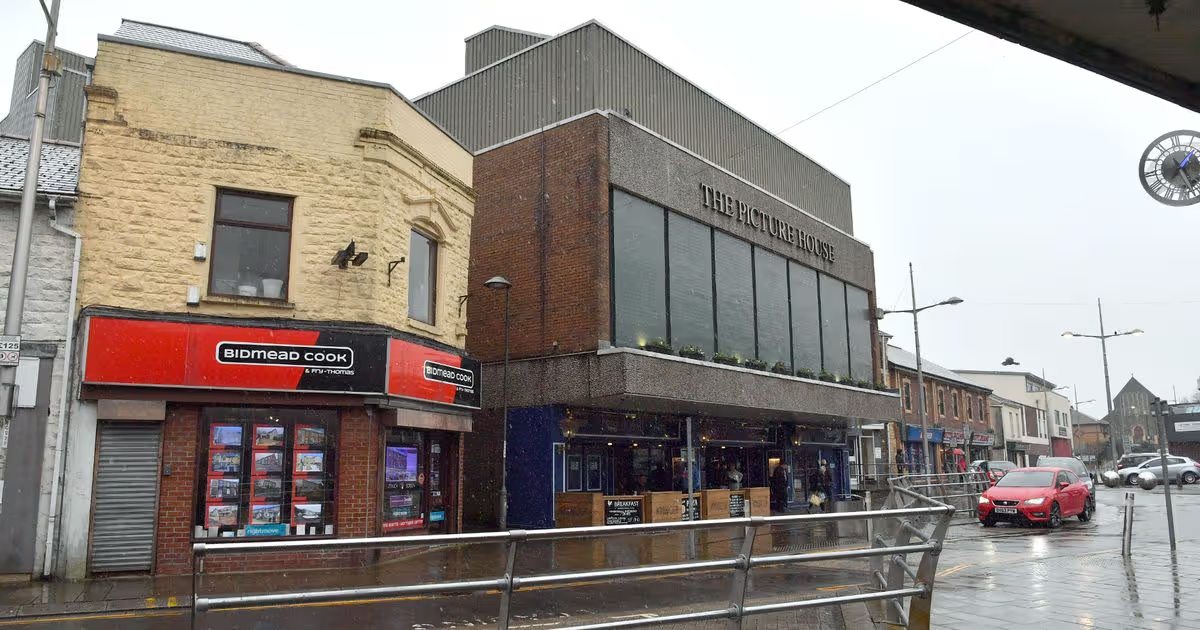
A man has been left with life-threatening injuries after an alleged assault outside a Wetherspoon’s pub. The incident, outside the Picture House pub in Ebbw Vale, Blaenau Gwent took place between 11.30pm on Friday, February 20 and 12.15am on Saturday, February 21, according to Gwent Police.
A 37-year-old man, from Ebbw Vale, has been taken to hospital with life-threatening injuries. Police were called after staff from the Welsh Ambulance Service treated a man had been assaulted on Bethcar Street.
The man’s family have been informed, and police have appealed for anyone who witness the incident to get in touch. For our free daily briefing on the biggest issues facing the nation sign up to the Wales Matters newsletter here.
Advertisement
Detective Inspector Elaine Newbury, from Gwent Police, said: “Our enquiries are ongoing to establish the circumstances of this alleged assault.
“While we believe this to be an isolated incident, we understand that reports of violence in our communities can be upsetting and unsettling.
“Our officers are in the area carrying out enquiries, collecting CCTV footage and gathering evidence; if you have any questions or information, then please do speak to them.”
There was a large police presence in the town and a number of local shops remained closed on Saturday for investigation work to be carried out.
Advertisement
Speaking before police released a statement about the incident, Richard Vaughan-Cobb who runs Fonehouse Ebbw Vale said: “Two members of our staff were unable to enter our premises this morning, and they were advised that the police were awaiting forensics and it was likely the cordon will not be lifted throughout the course of today.
“It is surprising how many independent businesses have been affected by this but it’s one of those things, the police need to do what’s needed.”
Police have asked for anyone who witnessed the alleged assault, or has relevant CCTV or dashcam footage, to get in touch.
You can assist the investigation by contacting Gwent Police via their website, call us on 101 or direct message them on their Facebook or X social media channels, quoting log reference 2600055384.
Advertisement
Alternatively, you can contact Crimestoppers, anonymously, on 0800 555 111, with information or visit their website.
Ensure our latest news and sport headlines always appear at the top of your Google Search by making us a Preferred Source. Click here to activate or add us as Preferred Source in your Google search settings
According to police, several dogs are loose, which “appear to be acting as a pack”. There are reported to be a few different breeds, possibly Daschund, Terrier, Spaniel, and Alsation.
Police are also trying to locate the owners and are keen to seize the dogs. Anyone with information has been asked to get in touch.
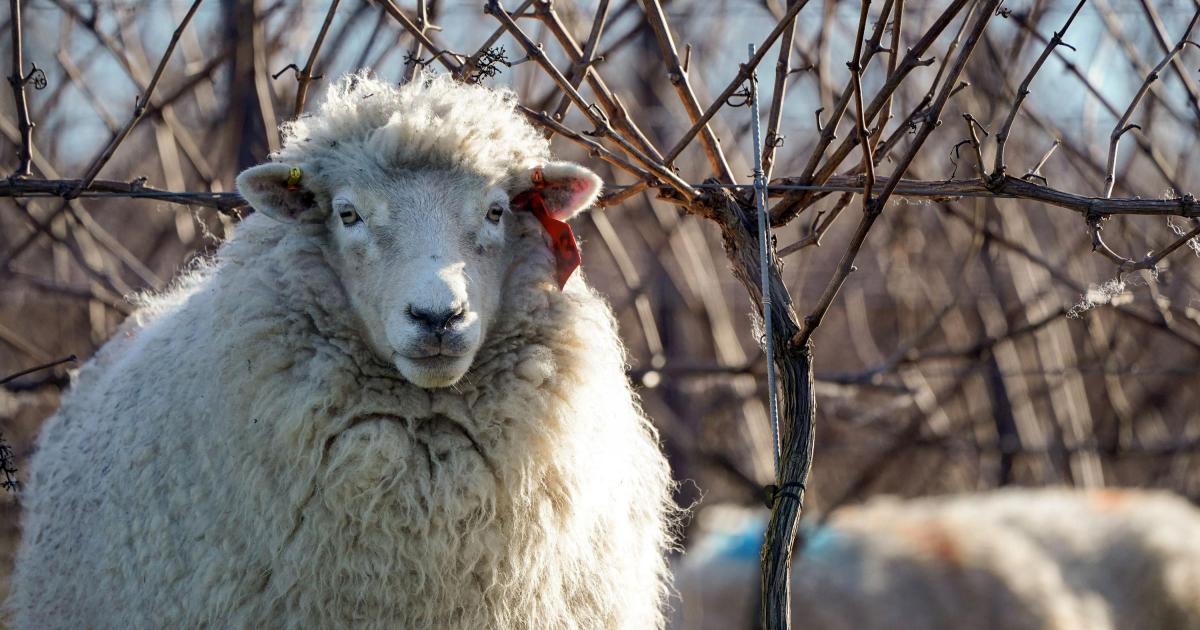
A police spokesperson said: “Many of you will be aware that there have been a high number of livestock worrying offences around Darwen and Edgworth.
Advertisement
“There are several dogs loose that appear to be acting as a pack. There are reported to be a few different breeds – possibly Daschund, Terrier, Spaniel and Alsation.
“We are currently out looking for the dogs with local farmers and are asking for members of the public to let us know if they see any loose dogs around the rural areas.
“You can update us on here until around 7pm today (February 21). After that, please call 101.
“We are extremely keen to seize these dogs and locate the owners.”
However, it wrote: “As an experienced BTP police officer used to dealing with a whole range of people, the panel found that, on the balance of probabilities, he probably would have known that this was an especially offensive use of language directed towards members of a minority community.”
In the third instalment of the cashless Belfast series, a spokesman from Campaign for Cash has spoken out about the “spreading disease” of cashless payments
A pro-cash campaigner has spoken to Belfast Live about his experiences — as well as his expectations — of a society moving towards a cashless future.
Advertisement
He warns Belfast residents to look towards other parts of the country that are a lot further along the digital path than Northern Ireland to see what is happening there. And he stresses the importance of holding onto cash as a viable payment option.
Martin Quinn, 52, from Sutton in South London is involved with the Campaign for Cash. The organisation is a grassroots group who campaigns for continued and expanded cash across the country.
He spoke to us highlighting the current landscape in the capital when it comes to cash, and said he wants physical money to remain a part of our spending habits.
Advertisement
Campaign for Cash spokesman Martin said: “It is almost impossible to spend your cash in some parts of the capital.
“In London, many of the chains are card only and people need to speak up or they will not have the option to spend their cash. It is like a disease, cashless payments are spreading.
“My long term worry is that any particular high street in the country, you won’t be able to spend your cash. We’ve lost thousands of bank branches in the last decade so I can see why businesses are going card only but this is detrimental in so many ways, it hits everybody else. A wide array of society want to use cash and it should not be taken off the table.”
Advertisement
Martin said the Campaign for Cash wanted people to be proud of the cash in their pocket and to be able to use it freely. The organisation has been around for several years now and arose in response to the rapid decline in cash usage accelerated by the COVID-19 pandemic and the increasing number of businesses going cashless.
He continued: “If there is a power outage or systems go down, and we don’t have the ability to spend cash, we’ll be walking around like zombies. People need to realise that they have a right to cash and they need to demand to have the ability to be able to spend it.
“Cash is especially popular in working class areas and with self service checkouts taking over in supermarkets, it is rare that cash is accepted at terminals. People don’t just want to spend cash, they need to be able to spend cash.
“We are sleep walking into a cashless society and people need to understand the implications of not having cash. There are concerns around privacy and not having the freedom of making a decision on the way you want to spend your money is not beneficial.”
Advertisement
Throughout the cashless Belfast series run by Belfast Live, many readers have expressed their concerns about the practice of denying cash on our comment sections. Quite a few have publicly stated that they will avoid businesses that don’t accept notes or coins, and Martin encourages this practice.
“If you want to spend your cash, I’d advise boycotting businesses that refuse cash and vote with your feet. If enough people deny businesses access to their wallets then decisions will be changed,” he said.
“Cash needs to be on a level playing field with card payments, it shouldn’t be either, or, we need to have both across the board. Why should a cash user be discriminated against? Both of these payments need to be accepted for resilience. Cash needs to be there as a continuous fail safe, it is part of the eco-system.
Advertisement
“Why is it only in emergency situations that these businesses who have gone cashless want cash? They seem to be happy to take it when this happens.”
While cash use has declined significantly in certain parts of the country, Northern Ireland remains more cash‑reliant than many other regions.
According to Link, Northern Ireland was the most cash heavy part of the UK in 2024. During that year, banking customers in Northern Ireland withdrew an average of £2,274. The second and third cash heaviest regions in the same period were Yorkshire and the Humber (£1,696) and the North-East (£1,682).
A significant portion of UK adults now live largely cashless lives, relying on contactless cards and mobile payments for everyday purchases. But as digital payments become the default for many, questions are being raised about accessibility, consumer choice and whether some people risk being left behind as cash continues to disappear from the high street.
Advertisement
The ongoing closure of bank branches on high streets is also playing a role in a move away from cash. With fewer physical banks available, both customers and businesses are increasingly reliant on digital payment systems. For some businesses, security concerns are another factor, as holding large amounts of cash on-site can pose risks — something contactless payments help to reduce.
Belfast Live will continue exploring this issue in more detail as we seek answers from businesses, campaigners and others to determine whether the move towards cashless payments across the board is inevitable.
What do you think about the decline of cash in Belfast? Are you a business or a consumer that wants to add to the series? Email Rob.Currell@reachplc.com
Want to see more of the stories you love from Belfast Live? Making us your preferred source on Googlemeans you’ll get more of our exclusives, top stories and must-read content straight away. To add Belfast Live as a preferred source, simply click here
Today, Laura and Paddy are joined by Gary O’Donoghue, Chief North America correspondent to discuss the US Supreme Court’s ruling to block President Donald Trump’s global tariffs.
Is this the beginning of the end of his tariffs, what’s Trump doing now, and what does it mean for where power lies in the US?
Laura has interviewed former UK Prime Minister Boris Johnson and former Chief of the Defence Staff Sir Tony Radakin ahead of the four-year anniversary of the beginning of the full scale invasion of Ukraine. Boris Johnson said the UK and its allies “did not take strong enough action,” and the UK and its allies should deploy non-combat troops to Ukraine right now.
Advertisement
Laura and Paddy dicuss Boris Johnson and Tony Radakin’s comments.
You can now listen to Newscast on a smart speaker. If you want to listen, just say “Ask BBC Sounds to play Newscast”. It works on most smart speakers.
You can join our Newscast online community here: https://bbc.in/newscastdiscord
Get in touch with Newscast by emailing newscast@bbc.co.uk or send us a WhatsApp on +44 0330 123 9480.
New episodes released every day. If you’re in the UK, for more News and Current Affairs podcasts from the BBC, listen on BBC Sounds: https://bbc.in/4guXgXd
Advertisement
Newscast brings you daily analysis of the latest political news stories from the BBC.
The presenters were Laura Kuenssberg and Paddy O’Connell. It was made by Chris Flynn with Kris Jalowiecki. The social producer was Grace Braddock. The technical producer was Dafydd Evans. The weekend series producer is Chris Flynn. The assistant editor is Chris Gray. The senior news editor is Sam Bonham.
Sources say consultation will begin on removing Andrew from line of succession
Carrington Walker and Emma Mackenzie Features Writer
17:42, 21 Feb 2026
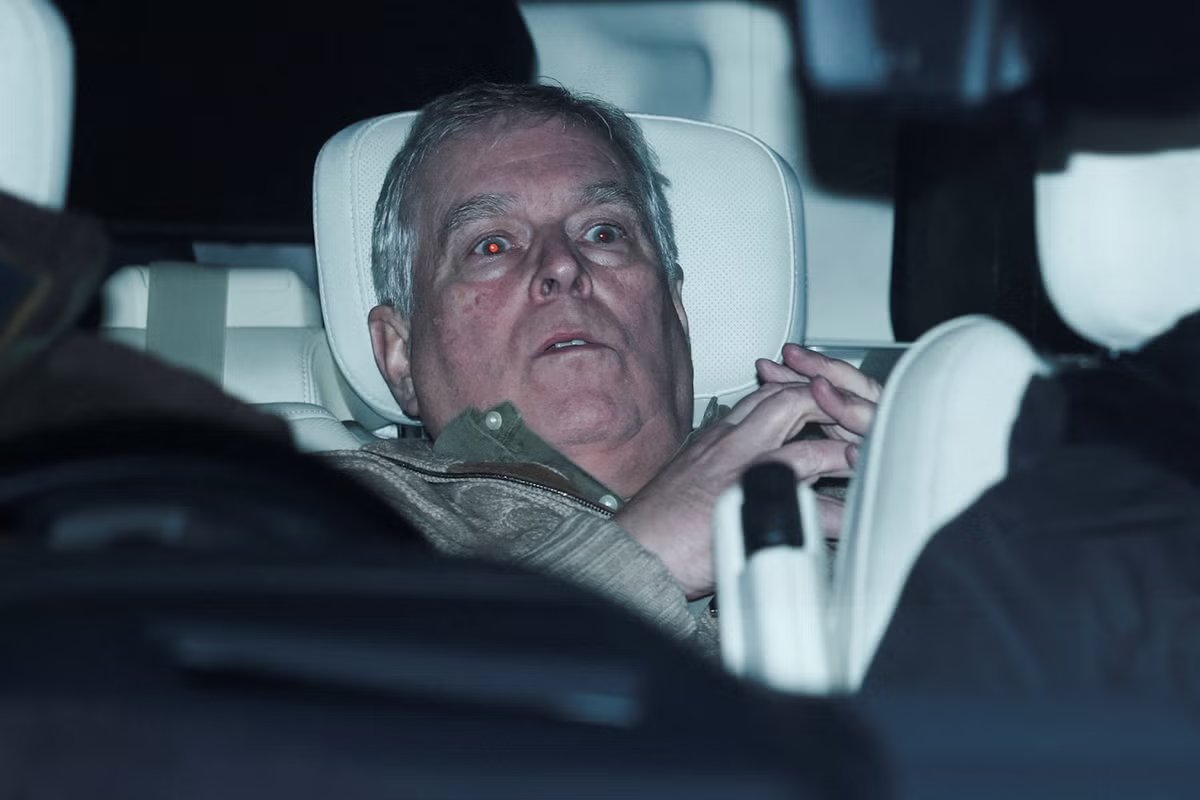
The shock arrest of Andrew Mountbatten Windsor on his 66th birthday this week has been compounded by more setbacks for the disgraced former prince.
Government insiders suggest that following the conclusion of any police inquiry into the King’s brother, discussions will begin regarding his removal from the line of succession. For several months, Andrew’s connections to convicted sex offender Jeffrey Epstein have been scrutinised, with the recent release of three million documents by the US Department of Justice casting fresh light on their association, reports the Mirror.
Advertisement
Certain emails exchanged from an account apparently belonging to Andrew with the paedophile financier suggested he may have disclosed confidential information from his time as UK Trade Envoy to Epstein. One particular email was sent on Christmas Eve 2010, with the account forwarding Epstein material concerning confidential investment prospects related to the reconstruction of Helmand Province, Afghanistan.
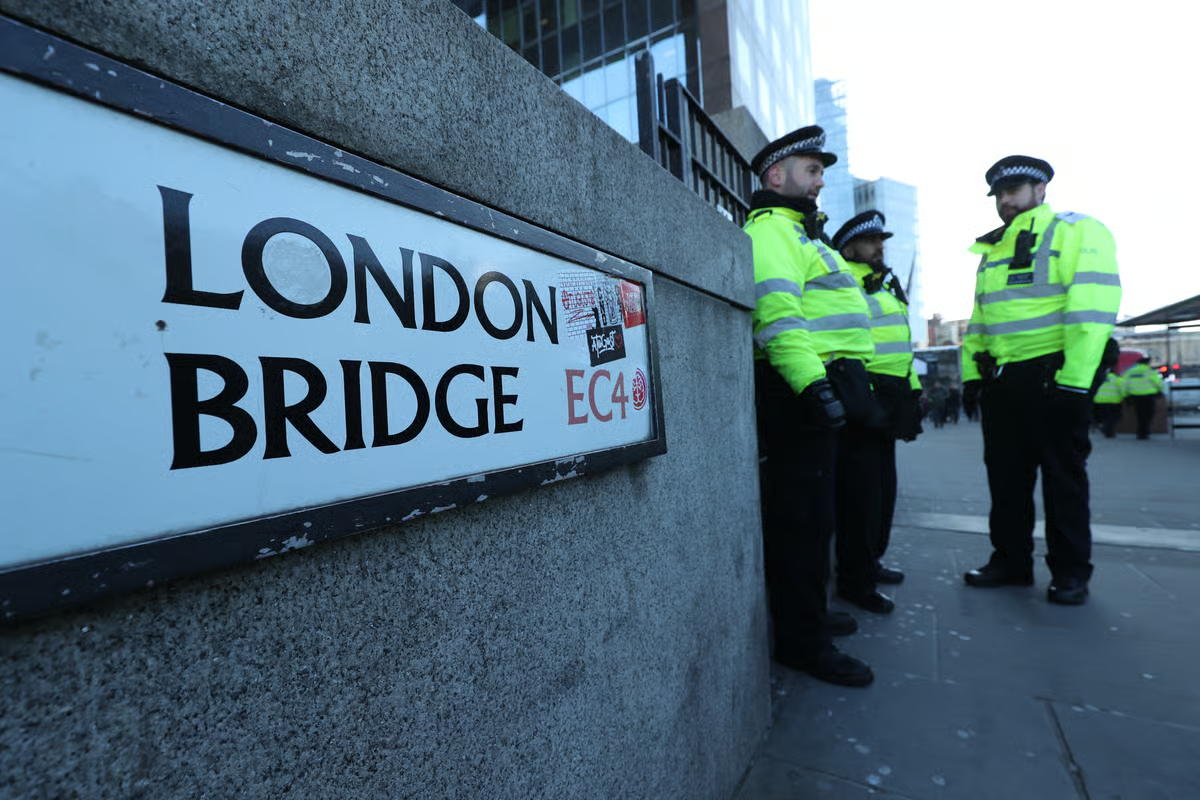
Andrew was detained on suspicion of misconduct in a public office, with searches conducted at a Norfolk property and his previous residence in Berkshire, Royal Lodge.
Ensure our latest stories always appear at the top of your Google Search by making us a Preferred Source. Click here to activate or add us as your Preferred Source in your Google search settings.
Advertisement
He has been released pending further investigation, and once this is completed, the Government will begin proceedings to formally remove him from the line of succession. This will necessitate an act of Parliament, alongside agreement from all 14 realms where King Charles serves as head of state.
The Times has published a detailed examination of Andrew’s “very long fall from grace” which the public has witnessed intensify in recent months, culminating in the monarch’s decision to strip his younger brother of royal titles and styles. The piece offers fresh revelations about the King’s brother during his younger years, as well as his dynamic with the late Queen.
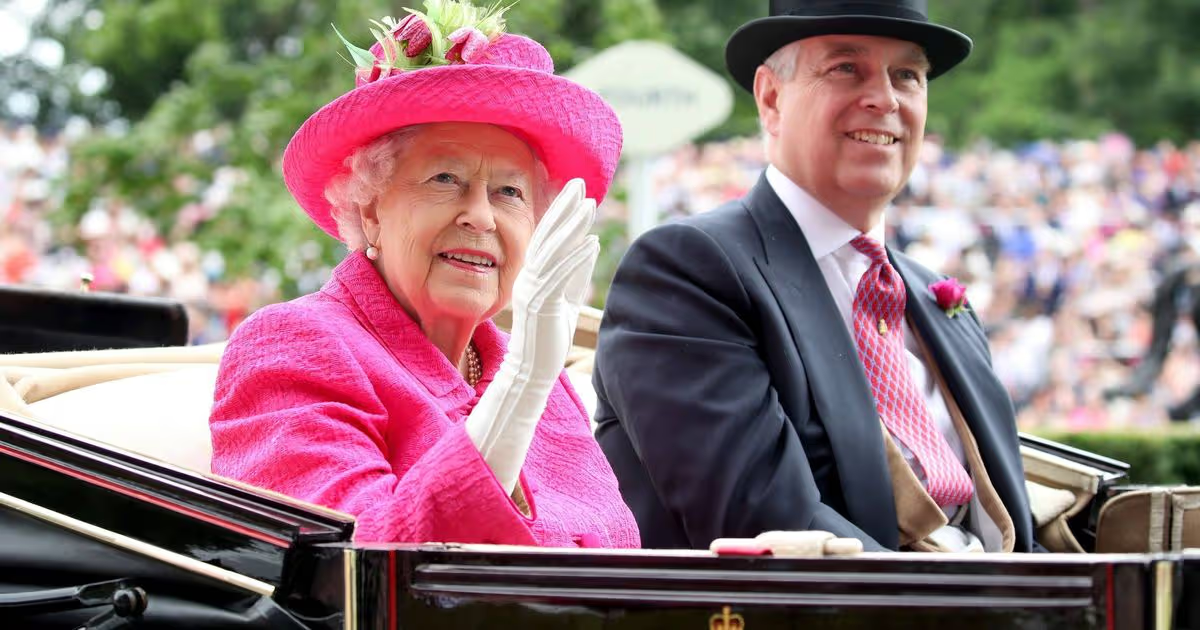
Often labelled the late Queen’s “favourite son”, one striking claim in the report concerns a remarkable response from the former monarch. The publication alleges that “as a young man his behaviour was so atrocious that a footman punched him in the face.”
Advertisement
Despite her widely documented affection for Andrew, “Queen Elizabeth refused his subsequent offer to resign on the grounds that her son had obviously deserved it.”
The report goes on to suggest that Andrew managed to test his mother’s patience, despite the fact she “indulged” him. “He spent his childhood annoying almost everyone. Even she was irritated by his habit of climbing onto the roof of Buckingham Palace to tinker with the TV aerial so she couldn’t watch the racing,” the publication alleges.
The allegation that a footman once gave Andrew a black eye was originally made by royal expert Ingrid Seward in her book ‘My Husband and I’. Seward wrote that on one “occasion when [Andrew’s] taunting so annoyed a young footman that he took a swipe at Andrew that deposited him on the floor and left him with a black eye,” the member of royal staff was left “fearing for his job.”
The footman approached the Queen directly, according to Seward, and offered his resignation, but she reportedly responded that “her son had obviously deserved it and the footman was on no account to be punished for Andrew’s bad behaviour”.
Advertisement
Yet one insider has cast doubt on whether Andrew truly was the late Queen’s “favourite”. Ailsa Anderson, who served as the late Queen’s Press Secretary from 2001 to 2013, told the BBC: “The media do say that he was the favourite son, but in my 12 years working for the late Queen I never saw her display any favouritism amongst any of her children, so I can’t really say that’s true.”
Following Andrew’s arrest early on Thursday from his temporary residence at Wood Farm on the Sandringham Estate, he was transported to Aylsham police station. A newly published report has disclosed that the majority of staff at Aylsham Police Investigation Centre were instructed to stay away that morning, whilst officers dealt exclusively with processing the former duke.
Reports suggest that staff were informed a “notable person” would be arriving just days before his arrest. Allegations have also emerged that an IT shutdown was implemented as part of the police operation, aimed at preventing news of the arrest from leaking out in advance.
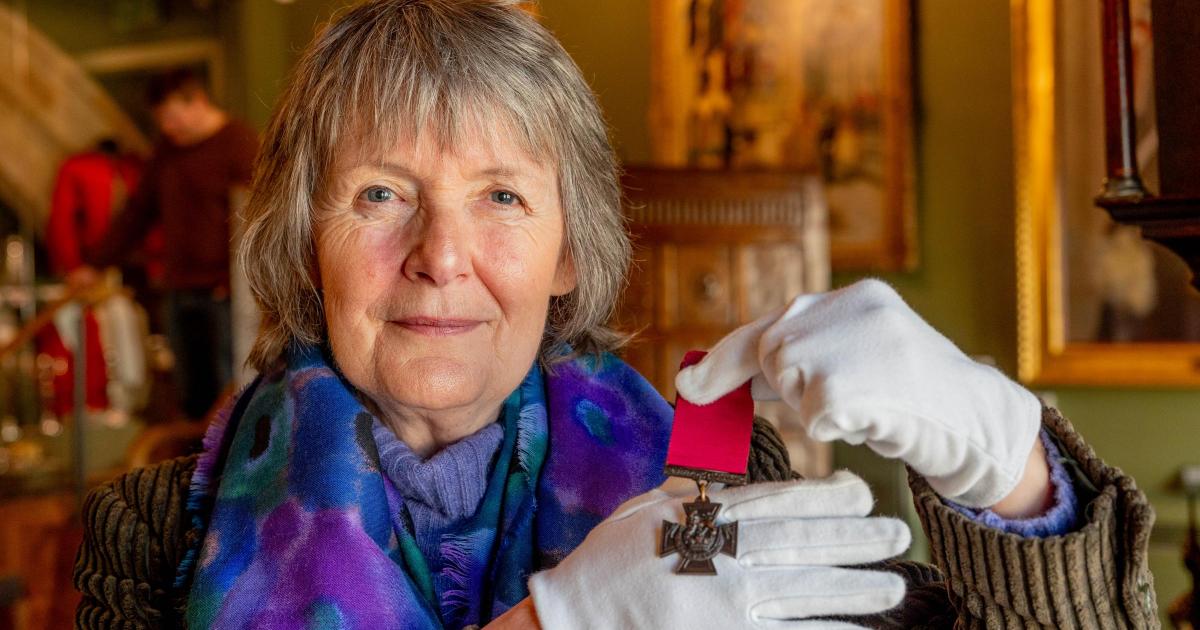
The medal belonged to Second Lieutenant Donald Simpson Bell and is on display at The Green Howards Museum in Richmond as part of the exhibition Battle Bowlers & Football Boots.
Born in Harrogate on December 3, 1890, Donald played as an amateur for Crystal Palace and Newcastle United before signing professionally for Bradford Park Avenue.
He was the first professional footballer to enlist in the British Army during the First World War, where he was awarded the Victoria Cross.
Donald Simpson Bell, the only professional footballer to be awarded the VC. (Image: SARAH CALDECOTT)
Alison Booth, his great-niece, said: “I often think that Uncle Don would be amazed to think his story and zest for life was still being displayed and documented 110 years later.”
Advertisement
His family were given special permission by the National Football Museum to hold his Victoria Cross during the visit.
He is the only professional footballer to be awarded the Victoria Cross. (Image: SARAH CALDECOTT)
Zoe Utley, head of collections at The Green Howards Museum, said: “It is always very special to hear from family members of Green Howards and introduce the next generations to family members they have never met.
“Objects have an incredible power to connect people with their ancestors and it is a pleasure to introduce Donald’s family to his story.”
After enlisting in 1915, Mr Bell served with the 9th Battalion, Green Howards (Alexandra, Princess of Wales’ Own Yorkshire Regiment) and was sent to France in November 1915.
Advertisement
He was awarded the Victoria Cross for his actions on July 5, 1916, during the Battle of the Somme, for single-handedly attacking and destroying a German machine gun post under heavy fire, saving many lives.
He died five days later performing a similar act of bravery.
He died running bravely into gunfire. (Image: SARAH CALDECOTT)
The Green Howards Museum has loaned the medal from the National Football Museum. (Image: SARAH CALDECOTT)
The exhibition explores the close relationship between football and military life within the Green Howards regiment.
It also highlights the contributions of women in football, the role of the sport in prisoner of war camps, and the achievements of Middlesbrough’s Wilf Mannion.
Advertisement
Objects on display have been loaned by the National Football Museum and The Players’ Foundations.
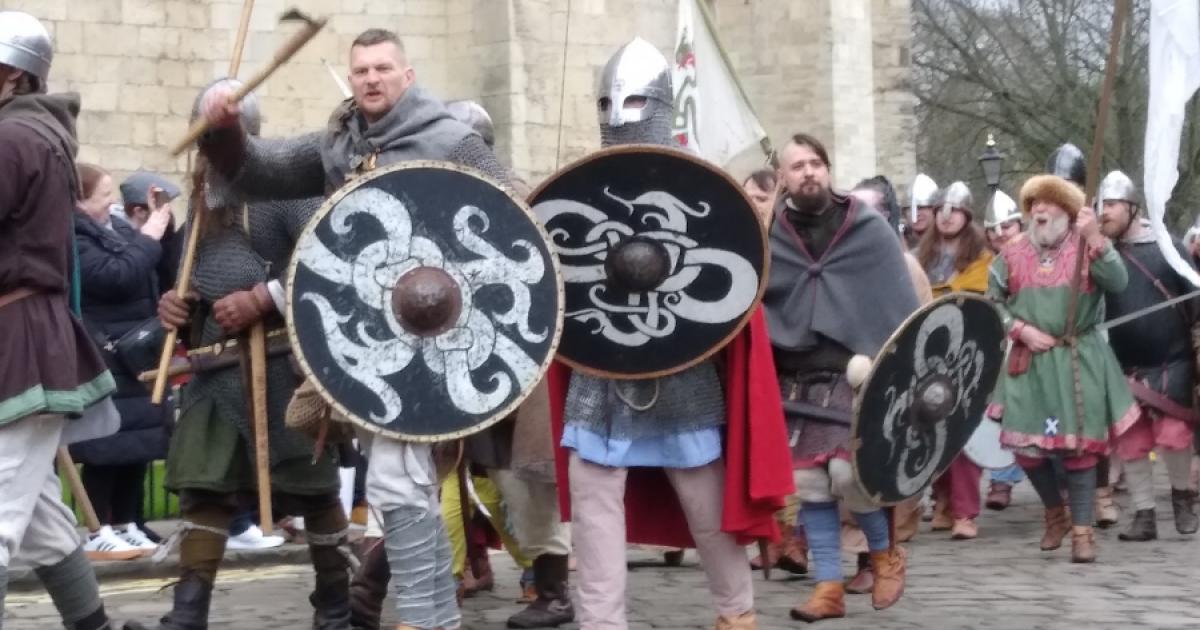
Vikings, Saxons, herbalists and others from the Viking era in England gathered in Deans Park next to York Minster.
They chanted Viking battle cries and shouted about Ragnorak and other Nordic God myths as they marched past the cathedral and past the Festival encampment to Coppergate and the Eye of York by Cliffords Tower.
Among the reenactors was one representing St Olaf of Norway with his Christian escort and cross bearer.
“St Olaf” (centre) with his cross-bearer and escort at the Jorvik Viking Festival (Image: Newsquest)
At the end of the march the march split into two sides to fight the Battle of York on the Eye of York in the big set piece climax of the 2026 festival.
Advertisement
Tickets for all the main events of the weeklong festival were sold out weeks in advance.
From late morning onwards the streets of York were full of companies of warriors going to the gathering place behind York Minster.
They had come from all over England, with some travelling from Somerset and Blackpool to take part in what is believed to be the biggest Viking festival in Europe.
As they mustered, the musicians who were to lead the march entertained crowds in Parliament Street.
Advertisement
Musicians entertain the crown before the March to Coppergate at the Jorvik Viking Festival (Image: Newsquest)
Watching the warrior horde assemble were Christine and Michael Platts of Wakefield, who had come to York to visit the Minster, noticed the Vikings and stopped to watch.
“It’s amazing,” said retired teacher Christine. “To see history come alive like this is what we need. It makes history more real.”
They are now planning to return next year specifically to see the 2027 festival.
Her teenage granddaughter Priya was so impressed by the standard of the costumes and what the re-enactors who formed the march were doing that she wanted to know how she could join in.
Advertisement
Viking and Saxon reenactors at the Jorvik Viking Festival (Image: Newsquest)
Among the reenactors were some dressed in Saxon costumes.
“At the end of it there is going to be a big fight. There needs to be two sides,” explained Saxon “Oswic” and “AEsc” who were in company with Viking “Gunnar Sigurdson”.
They were part of a Northumberland re-enactment group that draws its members from a wide area of Yorkshire and the North-east.
They included a group of three women specialising in Saxon and Viking herbs. Susan Davison, Kirstin Mclauchlin and Verity were there to help the wounded and injured following the battle and had a bit of spinning to do while the men fought.
Advertisement
Viking ladies ready to provide herbal first aid to the wounded and injured after the battle (Image: Newsquest)
Reenactors represented anyone from the Viking Era in England, roughly 793 to 1066, were among the marchers.
One young man arrived dressed as St Olaf (King of Norway 1015 to 1028) who died aged 35.
Shortly after 2.15pm, the hundreds in Viking and Saxon fighting gear left the park to the sound of horns and drums, marched through Minster Yard, round the Minster to Stonegate and passed the Viking encampment which has been in place all week.
Their route was lined with tourists, local people and visitors to the festival to see the spectacle.
Advertisement
From Parliament Street they marched past Jorvik Viking Centre, through Coppergate and past Clifford’s Tower to the Eye of York.