

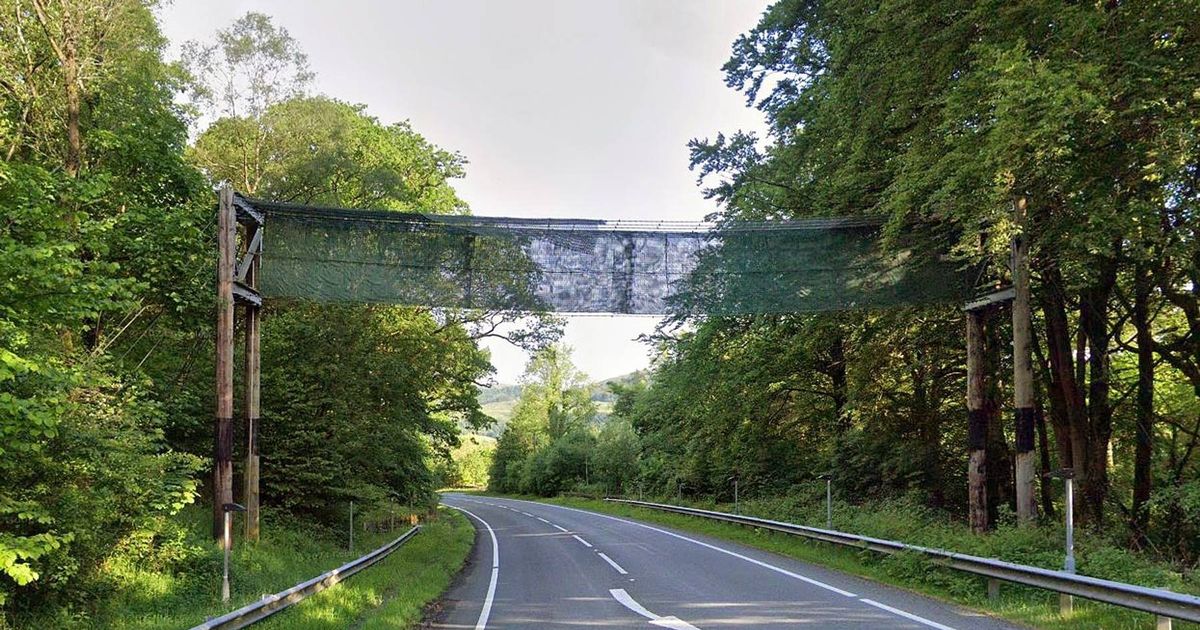
The structure has left locals puzzled since 2012 but a driver has worked out what it is
For 13 years, motorists travelling through south Gwynedd have been puzzled by an unusual structure overhead. Resembling a badminton net suspended across a 7.3-metre section of the A470, it appeared to have no clear function beyond catching drivers’ attention.
The structure was installed in 2012 between Dolgellau and Cross Foxes. It formed part of a range of environmental measures introduced during a £7.3m improvement scheme on the A470, carried out by civil engineering company Alun Griffiths.
Exasperated by the mystery, a Barmouth resident took to social media seeking answers. “Every time I drive that way, I wonder what it is,” she admitted. For the biggest stories in Wales first, sign up to our daily newsletter here
She discovered it was actually a bat bridge – and not, as some joked, designed for “fishing at high tide”. The installation was meant to offset the loss of woodland within the Meirionnydd Oakwoods.
Its purpose was to guide bats to fly at greater heights, thereby reducing collisions with vehicles. Since bats tend to follow hedgerows and woodland edges, their removal for road projects was believed to be leaving the creatures disorientated, reports North Wales Live.
The thinking was that bats, using sonar navigation, would recognise these “bridges” as linear features akin to the former hedgerows.
However, they weren’t inexpensive: a Highways Agency evaluation of a bat bridge spanning a Cornwall bypass revealed they cost upwards of £27,000 per flying mammal.
When the A470 bat bridge was constructed, the road became Wales’ first to meet the EU Habitats Directive requirements. Additional bat mitigation measures featured lighting and oversized 2.7-metre-diameter culverts beneath the carriageway.
One culvert incorporated a dormouse “rope bridge”, created to assist these charming rodents in safely navigating beneath the road. This followed habitat surveys conducted nine years previously, which identified potential evidence of hazel dormice in the neighbouring woodland – a European protected species.
Further provisions included otter ledges and ramps, alongside protective measures for a birch tree known to harbour Welsh Clearwing moths. Rare lichen specimens were also relocated to alternative sites.
Despite the commendable efforts – dormice were subsequently discovered breeding in the vicinity – the bat bridges presented two significant concerns. Firstly, local residents were baffled, as nobody had actually spotted bats near the road.
This doesn’t necessarily mean they weren’t present – the Meirionnydd Oakwoods are designated as a Special Area of Conservation (SAC) for bats, after all. Greater Horseshoe Bats – Britain’s most endangered bat species – alongside six other varieties inhabit the area, utilising the tree canopy for protection whilst hunting insects that flourish in the damp woodlands.
The second concern proved more challenging. Conservation scientists discovered that, despite initial optimism, the bridges proved ineffective.
Rather than mistaking them for trees, bats continued flying at dangerous heights above busy roads – often with fatal consequences.
Utilising bat detectors and night-time video surveillance, researchers from Leeds University observed that bats largely ignored the bridges, sticking to their traditional flight paths instead.
The Conservation Science Group at Cambridge University stated the bridges were “based on faith and not on science”.
Over £2m has been invested in constructing 15 bat bridges throughout Britain, with one in five located in Gwynedd.
Alongside the A470 bat bridge near Dolgellau, another was constructed on the A487 bypass in Groeslon, near Caernarfon, in 2010. This road passes through the Glynllifon SAC, which supports a lesser horseshoe bat colony.
Wales’ inaugural bat bridge was built on the A497 between Pwllheli and Criccieth during the road’s £5m upgrade in 2006, designed to assist six bat species in the vicinity.
Twelve months later, two additional bridges were put up alongside the A465 near Abergavenny to replace demolished structures.



