

Crypto World
50% of the past 24 months ended in gains, economist says

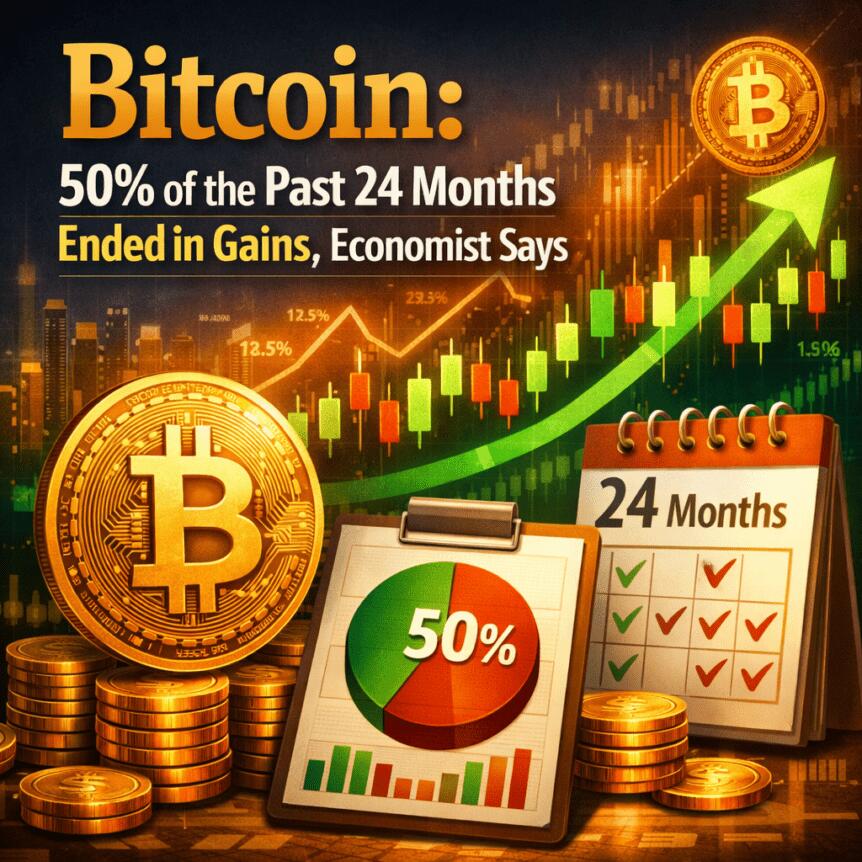
Bitcoin’s monthly performance pattern has become a focal point for investors trying to gauge the near-term trajectory of the market. An economist’s simple metric — counting how many months within a rolling two-year window produced gains — has sparked renewed debate about the odds of higher prices in the months ahead. The analysis comes as BTC has pulled back from peaks earlier in the year and as traders weigh a mix of seasonal tendencies, on-chain signals, and sentiment indicators that oscillate between caution and the prospect of a rebound. In 2025, BTC showed gains in six of the 12 months, a backdrop that shapes expectations for a market that remains highly sensitive to macro developments and liquidity conditions.
Key takeaways
- Bitcoin’s (CRYPTO: BTC) longer-run pattern shows that 50% of the last 24 months included positive monthly performance, a signal cited by economist Timothy Peterson to suggest a high probability of higher prices within the near term.
- Peterson’s method implies an approximately 88% chance that BTC will be higher 10 months from the reference point, highlighting how simple month-count metrics can inform timing debates in a volatile market.
- Polymarket currently assigns a 17% probability to December becoming Bitcoin’s best month of 2026, narrowly trailing November’s 18% odds.
- November remains historically strong for BTC, with CoinGlass data showing it as the best performing month on average since 2013, delivering substantial gains on many occasions.
- BTC was trading near $68,173 at the time of reporting, about a quarter below its level at the start of the year, underscoring the scale of retracement and the potential for a range-bound setup into year-end.
- Market sentiment appears mixed: the Crypto Fear & Greed Index signaled “Extreme Fear,” while sentiment analytics firm Santiment noted a cooling of price-predictive chatter, signaling a move toward neutral territory.
Tickers mentioned: $BTC
Market context: The data-driven debate unfolds as traders balance seasonal tendencies with a backdrop of cautious risk appetite. While one set of metrics points to upside potential, broader sentiment and liquidity considerations continue to weigh on positioning, making near-term moves more data-dependent than traditional catalysts alone.
Why it matters
The discussion around BTC’s month-to-month cadence matters because it reframes how investors think about timing in a market known for abrupt shifts. If the 24-month positive-month metric holds, the odds of a continuation of higher prices could tilt decisions toward positioning strategies that benefit from gradual upside rather than sharp, binary breakouts. The nuance matters for miners, traders, and institutions alike, because it suggests a probabilistic framework rather than a single price target. It also highlights how macro factors — such as liquidity cycles, macro risk sentiment, and regulatory signals — interact with seasonality to shape price expectations in a market where many participants rely on models that blend on-chain signals with traditional indicators.
The split among analysts adds texture to the risk assessment. Some optimists, like Michael van de Poppe, have cautioned that the near term could see a green week for BTC, pointing to potential candles that could buttress a broader rebound after a stretch of red months. Others, including veteran traders, have warned that a definitive bottom may not come quickly and suggested that a deeper or more drawn-out phase of weakness could precede a real recovery. In this tug-of-war, investors are watching not only price action but also how social sentiment evolves and whether institutional demand returns as volatility moderates.
Beyond Bitcoin’s price action, the narrative is influenced by how the market interprets data points from data providers and prediction markets. For instance, the December outlook on Polymarket reflects a probabilistic expectation rather than a verdict, with traders pricing in a non-trivial chance that the final month of the year outperforms others in 2026. Meanwhile, the long-run tail risk — often discussed in the context of macro liquidity and regulatory clarity — remains a factor that can alter the pace and composition of investor inflows or withdrawals. The interplay between these signals is what keeps BTC in a dynamic, data-driven environment rather than a static price path.
On-chain measurements and sentiment trackers add further texture. The Fear & Greed Index, a gauge of overall market mood, landed in a rare phase of extreme caution, underscoring the risk-off leaning prevailing in many corners of the crypto space. Yet, sentiment analytics outfit Santiment has noted a trend toward a more neutral stance as the crowd reduces speculative chatter around price predictions. This combination — cautious macro mood with subdued but stabilizing on-chain signals — helps explain why the market is watching for confirmatory catalysts that could turn pessimism into a more constructive price trajectory.
As traders parse these competing signals, the price backdrop remains a real-time constraint. BTC hovered around $68,173 at the time of publication, a level that sits noticeably below the year’s start and well under the all-time highs seen in late 2023 and early 2024. The current chapter is not about a single event but about a mosaic of indicators that could tip the balance toward a steadier ascent or a renewed period of consolidation. The breadth of opinions among seasoned traders reflects the broader reality: in a market as data-rich and narrative-driven as crypto, many of the strongest moves are born from a confluence of timing, sentiment, and macro liquidity rather than from any one signal alone.
In sum, the BTC narrative remains a study in contrasts — data points suggesting upside probability allied with cautionary sentiment and a price backdrop that invites patience. The coming weeks and months will test whether the 88% horizon implied by Peterson’s monthly-count framework materializes, or whether outcomes align more closely with the more conservative, risk-off mood reflected in short-term volatility measures. For market participants, the takeaway is to blend probabilistic thinking with disciplined risk management, rather than rely on a single data point to forecast the next leg of Bitcoin’s journey.
https://platform.twitter.com/widgets.js
What to watch next
- December’s outcome for BTC’s performance on Polymarket’s “best month in 2026” event (current odds: 17%), and whether November’s 18% edge holds.
- BTC’s price trajectory toward or away from the $70,000 level and how it interacts with the 10-month horizon referenced in Peterson’s metric.
- The evolution of market sentiment indicators, including the Fear & Greed Index and Santiment’s readings on sentiment normalization.
- On-chain activity and liquidity signals that could accompany a sustained price move, especially as macro factors influence risk appetite.
Sources & verification
- Timothy Peterson’s X post citing the 50% positive-month metric and the ~88% odds window: https://x.com/nsquaredvalue/status/2025275842394251560?s=20
- CoinGlass data on BTC’s 2025 monthly performance: https://www.coinglass.com/today
- Polymarket event page for “Bitcoin best month in 2026”: https://polymarket.com/event/bitcoin-best-month-in-2026
- Bitcoin price reference as of publication on CoinMarketCap: https://coinmarketcap.com/currencies/bitcoin/
- Crypto Fear & Greed Index for market sentiment: https://alternative.me/crypto/fear-and-greed-index/
Market reaction and key details
Bitcoin (CRYPTO: BTC) has traded within a data-rich framework that blends seasonal expectations with a skeptical sentiment backdrop. The 50% positive-month metric over the preceding 24 months, highlighted by Peterson in his X post, is not a price forecast but a probability-driven lens that can inform timing considerations. The implication that BTC has roughly an 88% chance of being higher in ten months is based on counting the number of positive months; such a metric is best viewed as one among many tools, not a standalone predictor. It underscores how revenue-focused and risk-managed investors may frame potential upside in a market known for abrupt swings.
Traders on prediction platforms see a nuanced picture for December. Polymarket’s pricing places a 17% probability on December becoming BTC’s best month of 2026, a signal that the market assigns to rare, outsized upside relative to other months, though still modest in absolute terms. November remains a benchmark; history shows it as the strongest calendar month for BTC on average since 2013, often delivering outsized gains. This historical context helps frame the December odds as part of a longer cycle rather than a stand-alone bet. The juxtaposition of seasonality against structural market fragility is why many market participants approach the next few weeks with hedged expectations.
From a price perspective, BTC hovered around $68,173 at press time, a level that sits well below the early-year peak and marks a sharp retracement from February’s ~$80,000 starting point. The pullback doesn’t negate the strategic value of the month-to-month dynamism; instead, it highlights the need for patience and disciplined risk controls as the market tests whether a base forms or if buyers should wait for a clearer signal. In this environment, the interplay between seasonal patterns and sentiment becomes particularly meaningful: a favorable November-to-December transition could set the stage for a more sustained move, but a reiteration of caution could prolong a period of consolidation as liquidity conditions remain sensitive to global macro developments.
Analysts remain divided on the near-term path. While some traders anticipate a green week for BTC and a potential extension of gains, others project further downside before a genuine bottom takes hold. The divergent views reflect a broader truth about crypto markets: price action is increasingly influenced by a combination of on-chain signals, probabilistic forecasting, and evolving investor psychology. The result is a market that rewards prudent risk management and flexible positioning, rather than single-factor bets. As the narrative evolves, investors will be watching not only price levels but also how sentiment metrics shift and whether predicted outcomes in prediction markets begin to align with actual market moves.

XRP price has gone nowhere in the past few days despite its key metrics, including its real-world asset tokenization and exchange-traded fund inflows continuing their uptrend.
Summary
- XRP price remains in a narrow range this month.
- The total value locked in its RWA network has jumped by over 20% in the last 30 days.
- It jumped to $2 billion and crossed Solana’s $1.7 billion.
Ripple (XRP) token was trading at $1.4215 on Sunday, down by 15% from its highest level this month.
The ongoing XRP price consolidation is mostly because of the broader crypto market action, with Bitcoin and most altcoins being in a tight range. Bitcoin has barely moved in the past few days and has remained at around $68,000 in the past few weeks. Ethereum price has remained below $2,000.
XRP network is doing well despite the ongoing crypto winter. For example, the developers recently launched the Permissioned DEX platform, which allows companies to participate in decentralized finance in a legally compliant manner. This launch happened after the recent launch of domains in the XRP Ledger network.
XRP price has also wavered despite the ongoing growth of its real-world asset tokenization ecosystem. The network’s total asset in the RWA industry jumped by 23% in the last 30 days to over $2 billion, higher than Solana’s $1.7 billion. It is also much higher than other networks like Polygon and Stellar.
Meanwhile, data shows that the spot XRP ETFs have continued gaining assets in the past few months. These funds have added over $48.5 million in assets this month, higher than the $15 million they added in January. In contrast, Ethereum and Bitcoin ETFs have continued to shed assets this month.
XRP price technical analysis
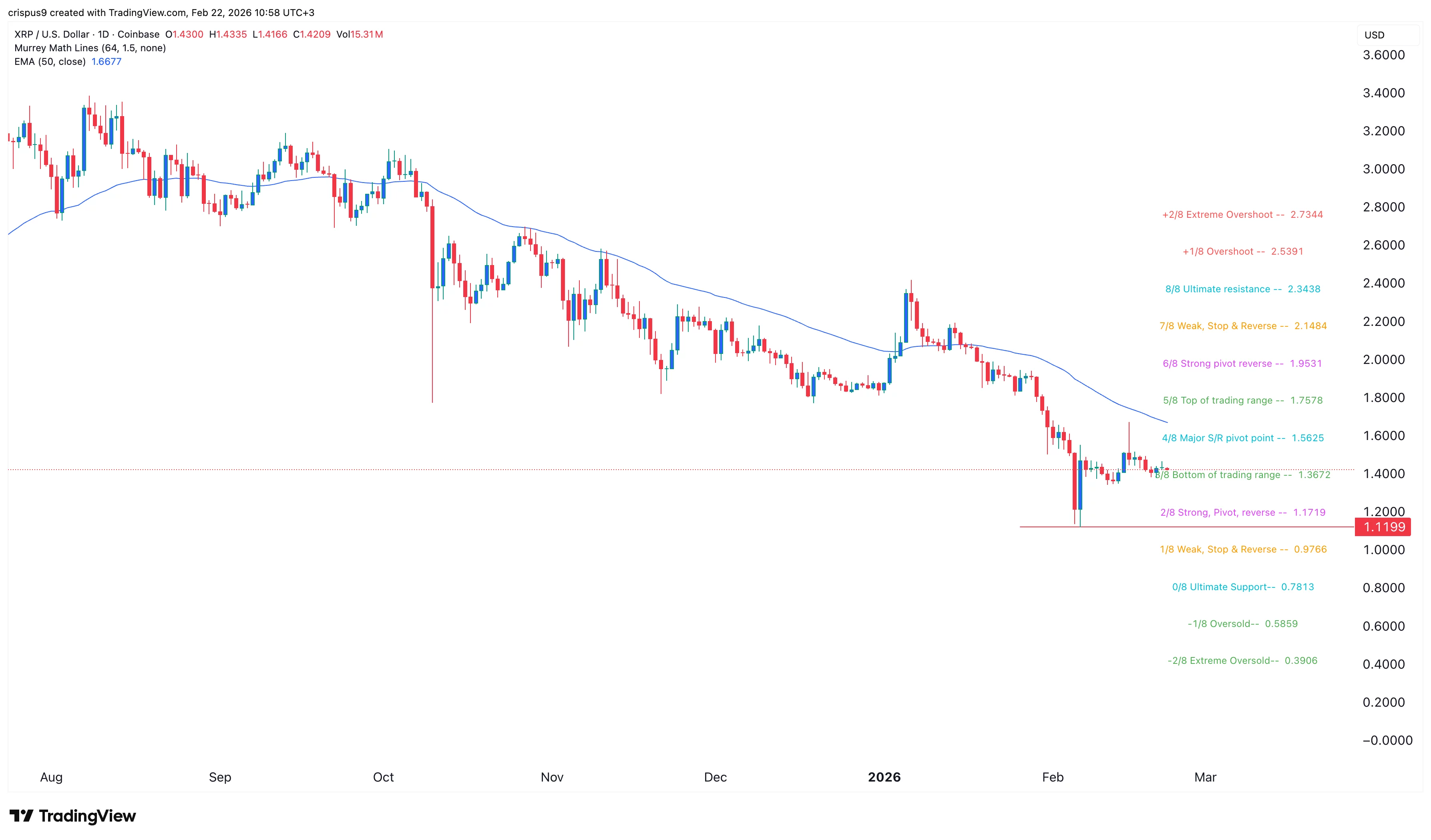
The daily timeframe chart shows that the XRP price has slumped in the past few months and is trading at $1.4230, much lower than the year-to-date high of $2.4180.
It has remained below the Major S&R pivot point of the Murrey Math Lines tool at $1.5625. Also, it has slumped below all moving averages and the Supertrend indicator.
The token also formed a gravestone doji candlestick on February 15. This doji is a common bearish reversal sign in technical analysis.
Therefore, the most likely forecast is bearish, with the next key target being the year-to-date low of $1.1200, its lowest level this year.

“What reason is there to celebrate,” asked one of the popular Pioneers below the Core Team’s post.
The team behind the controversial project posted a celebratory message a few days ago, marking the first anniversary of the Open Network’s launch.
However, many users questioned the project’s actual use case once again and lashed out at the lack of migration progress.
Open Network Celebrates 1st Birthday
In its blog post, the team began by outlining some of the achievements reached even before the official launch of the Open Network on February 20, 2025.
“Prior to Open Network, the Pi community collectively built out the ecosystem over six years to ensure Pi’s readiness and sustainable utility. This developmental period allowed Pi to create real apps and utilities for Pioneers to engage with, and verify the identities of millions of Pioneers to prepare the network for real-world assets and production processes.”
They explained that the main idea of Pi is to be a freely accessible, allowing “anyone to mine without technical or financial barriers.” The team added that this design allowed wide distribution and inclusivity, and also enabled the network and all participants to “afford the patience to engage in the difficult work necessary to establish a fully functional ecosystem predicated on utility.”
The post doubled down on the network’s progress, which aligns with the team’s long-term vision and strategy – to create an inclusive, utility-driven, and widely-adopted cryptocurrency that is broadly accessible.
Pioneers Lash Out
Perhaps it was some of those claims that triggered a significant backlash from numerous Pioneers on X under the Core Team’s post. YouLong/PiNetwork – a popular Pioneer with 27,000 followers, raised a few valid questions about the network’s state and the performance of the underlying token:
“What reason is there to celebrate? To celebrate the fact that compliant users have not migrated? Or to celebrate the steady decline in coin prices over the past year since its launch? Please approach the genuine concerns of long-time miners with objectivity.”
It’s worth noting that the PI token has been in a free-fall state for nearly a year. It peaked at $2.99 on February 26 last year, but has plunged by 94.5% since then and now sits inches above $0.16.
You may also like:
Other users echoed the previous statement, with one adding, “We are tired of waiting for the second migration,” while others said they have been waiting for five or six years for that coin migration.
SECRET PARTNERSHIP BONUS for CryptoPotato readers: Use this link to register and unlock $1,500 in exclusive BingX Exchange rewards (limited time offer).
Disclaimer: Information found on CryptoPotato is those of writers quoted. It does not represent the opinions of CryptoPotato on whether to buy, sell, or hold any investments. You are advised to conduct your own research before making any investment decisions. Use provided information at your own risk. See Disclaimer for more information.
Pi Network price remained under pressure this weekend, even as the developers announced major announcements, including a strategy to compete with Worldcoin and Humanity Protocol.
Summary
- Pi Network price retreated to $0.167 as the recent momentum faded.
- The developers celebrated the first anniversary by announcing future priorities.
- The priorities include KYC-as-a-Service, which will see it compete with Worldcoin.
Pi Coin (PI) token was trading at $0.1677 on Sunday, down slightly from the highest point this month. It remains 35% above its lowest level this year.
In a statement marking the first anniversary of its mainnet launch, Nicolas Kokkalis and Chengdiao Fan explained the key priorities to watch going forward.
The top priorities include features like native token generation, decentralized exchange, and launching developer tools. Their goal is to create an active network where creators can launch apps and their accompanying tokens.
Most notably, the developers are aiming to accelerate the Know Your Customer (KYC) process. They recently launched an AI-powered upgrade that has boosted the number of verified individuals.
With this experience, the developers are now working on rolling out KYC-as-a-Service. Their goal is to have Pi Network provide these services to companies from around the world.
The service will compete with WorldCoin (WORLD) and Humanity Protocol. World, which was launched by Sam Altman, aims to provide these services through the World ID and World App. It has already enrolled millions of people globally.
Humanity Protocol also aims to solve this challenge by leveraging the proof of humanity mechanism using palm recognition technology. The data is then converted into cryptographic hashes using zero-knowledge proofs.
Still, Pi Network price remains under pressure as the developers did not address key factors that have contributed to its underperformance. For example, they did not address the tokenomics, including the ongoing unlocks and potential token burns. Also, they did not address strategies to ensure more exchange listings.
Pi Network price technical analysis
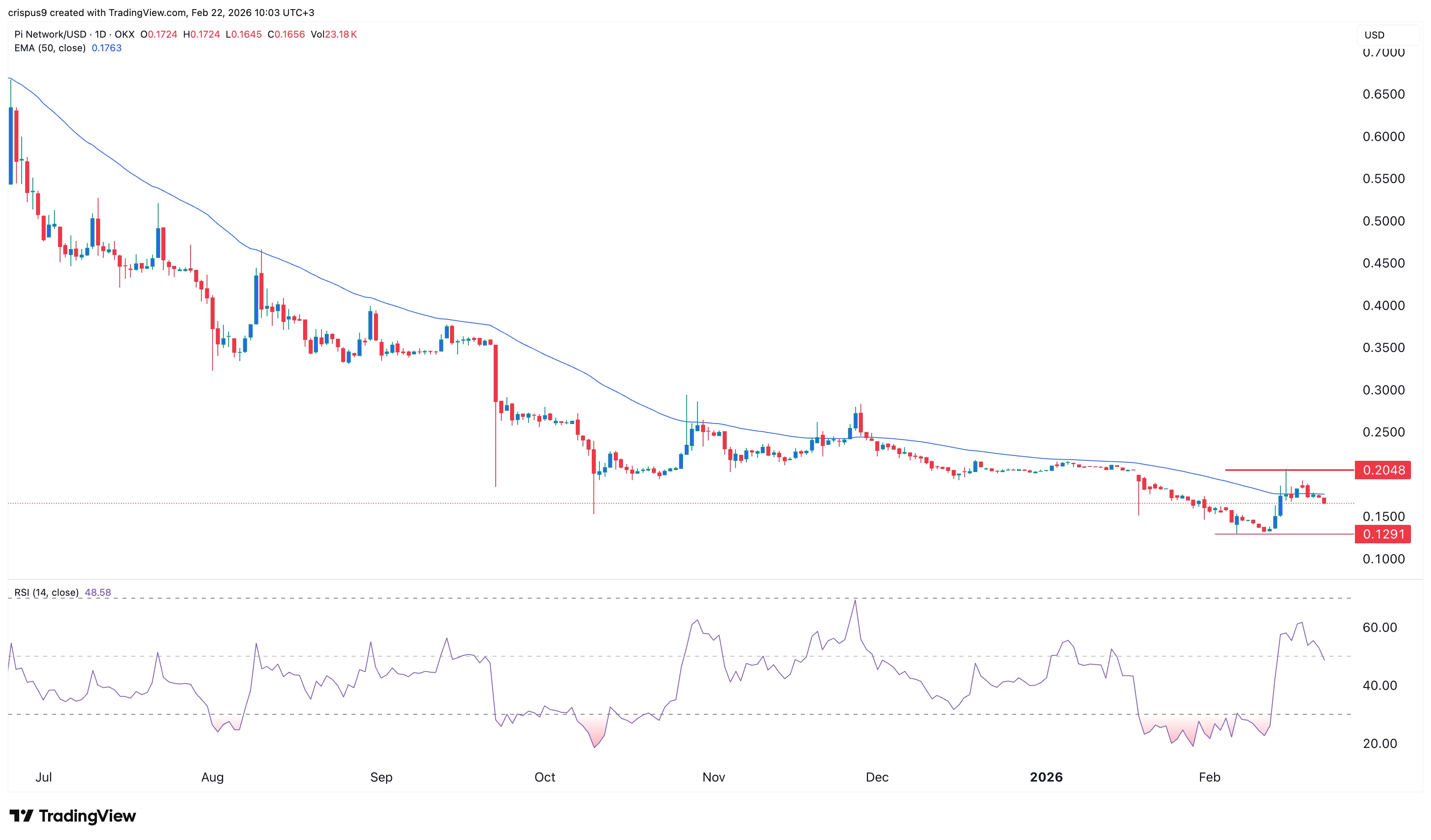
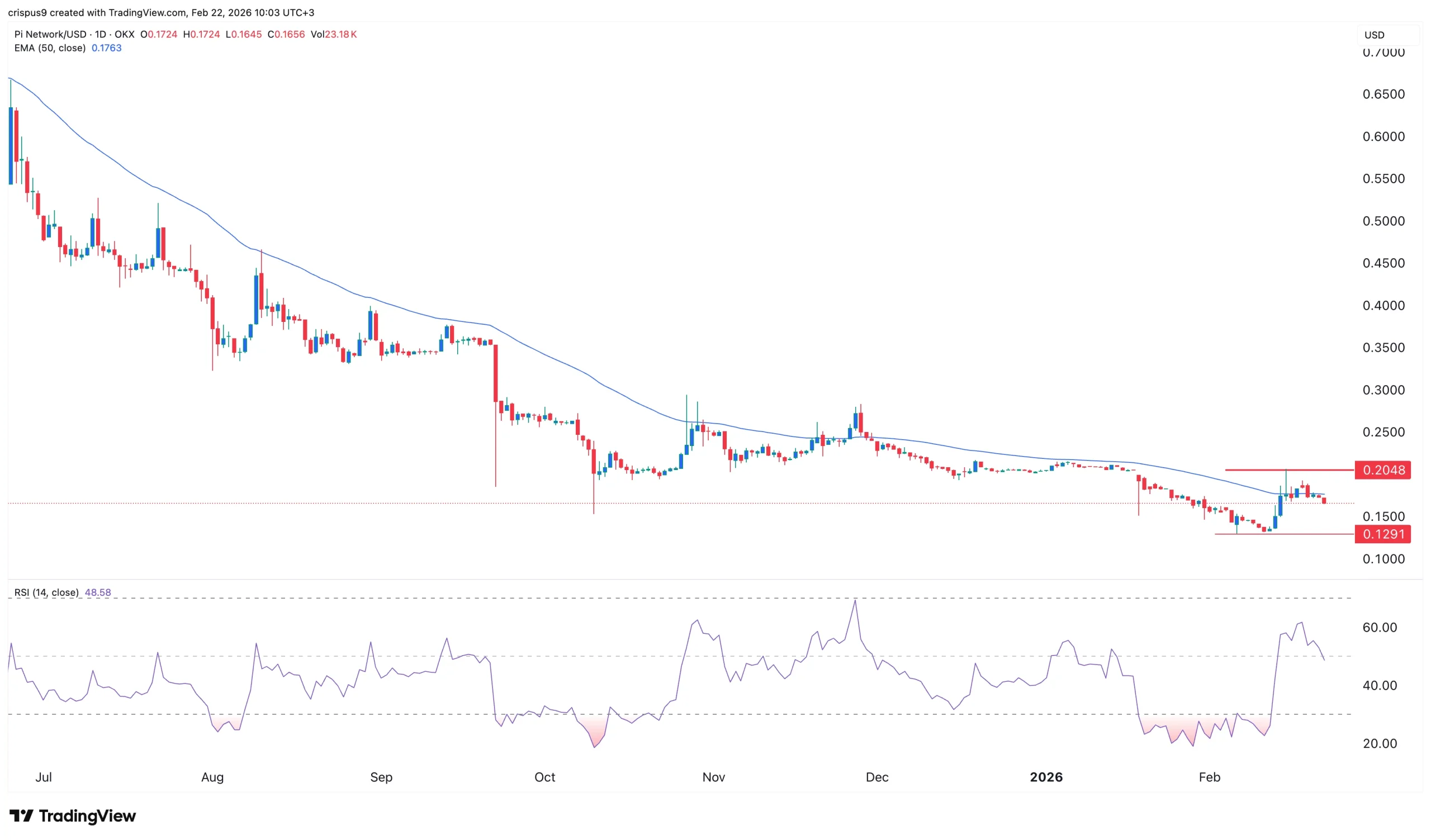
The daily chart shows that the PI price has remained under pressure in the past few days. It retreated from this month’s high of $0.2050 to the current $0.1677.
The coin has remained below all moving averages, while the Relative Strength Index has turned around and moved below the neutral level at 50.
The most likely scenario is where the Pi Network price continues falling, potentially to the psychological level at $0.1500. A move below that level will point to more downside, potentially to $0.1300.

Crypto Breaking News is a fast-growing digital media platform focused on the latest developments in cryptocurrency, blockchain, and Web3 technologies. Our goal is to provide fast, reliable, and insightful content that helps our readers stay ahead in the ever-evolving digital asset space.
Web3 Digital L.L.C-FZ
License Number: 2527596
📞 +971 50 449 2025
✉️ info@cryptobreaking.com
📍Meydan Grandstand, 6th floor, Meydan Road, Nad Al Sheba, Dubai, United Arab Emirates
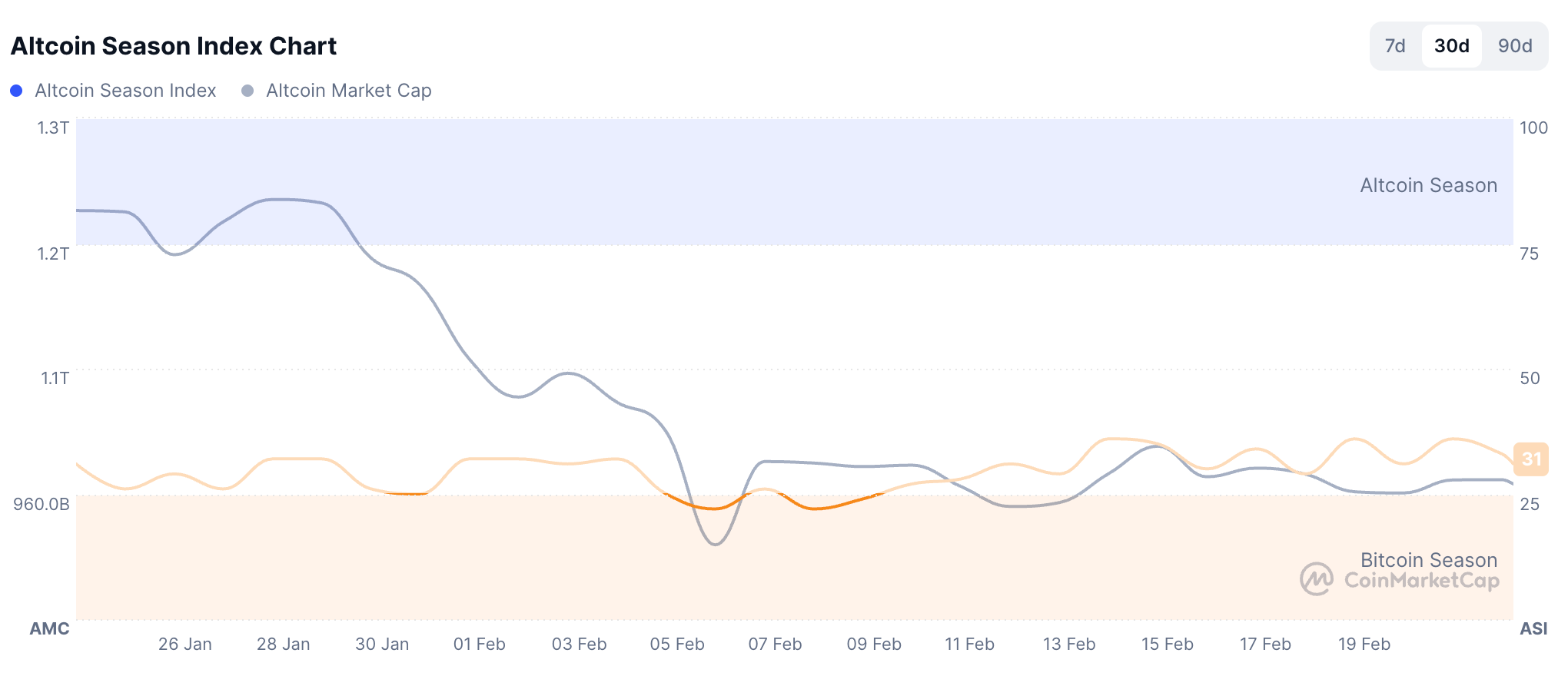
Crypto investors are increasingly exploring beyond the top three cryptocurrencies as the market downturn continues, according to Robinhood’s head of crypto, Johann Kerbrat.
“I think what we see from our customers is that they actually see it as an opportunity,” Kerbrat told Cointelegraph during an exclusive interview, adding that they are seeing it as “an opportunity to buy the dip.”
“So we actually see a lot of customers continuing to trade crypto and diversifying, not just on the top two or three assets, but actually going pretty wide,” he said, referring to the largest two cryptocurrencies by market capitalization, Bitcoin (BTC) and Ether (ETH).

It signals that investors are potentially becoming more comfortable with crypto as an asset class, including its volatility and market swings.
Investors have a “very clear view” on Bitcoin and Ethereum
It comes just months after Coinbase Asset Management president Anthony Bassili told Cointelegraph in November that the average investor still hasn’t reached a clear consensus on what the third crypto asset beyond the top two warrants serious attention.
“The market is very unsure as to what’s the next asset they want to own after that,” he said, adding that Solana (SOL) is “maybe” the third asset on the radar. Bassili said at the time that there is a “very, very clear view” in the community in terms of Bitcoin being the first priority, followed by Ethereum.
Institutional crypto asset trading platform MidChains CEO Basil Al Askari told Cointelegraph that “we’re seeing full-scale asset managers entering with very large block trades going into predominantly the top 20 assets.”
“Not necessarily smaller cap altcoins, or not necessarily into DeFi or yield products,” Al Askari said, adding, “it’s baby steps.”
“I don’t think it’s impossible to see large investment managers and funds build specific teams around strategies that do different things along the risk curve, and so I do think that’s very possible,” Al Askari said.
Crypto holders are looking for use cases
Meanwhile, Kerbrat said he’s also seeing more crypto holders on the platform not just holding their tokens, but actively using them.
Kerbrat said staking has gained “very strong traction” since Robinhood rolled out the feature in December, and that more crypto holders are now exploring decentralized finance (DeFi) despite the market uncertainty.
Related: Trump raises global tariff rate to 15%, but crypto markets are unfazed
“It’s been pretty fun to see, to be honest. It’s always surprising,” Kerbrat said.
It comes as overall crypto sentiment has weakened, with the Crypto Fear & Greed Index remaining in “Extreme Fear” since the start of February.
Meanwhile, US spot Bitcoin exchange-traded funds (ETFs) have posted five consecutive weeks of net outflows, with investors pulling roughly $3.8 billion from the products over the period.
Magazine: Bitcoin may take 7 years to upgrade to post-quantum: BIP-360
The word “bitcoin” or any other mention of crypto will get you banned from the OpenClaw Discord. Not for spam, not for shilling, but just for saying it.
Peter Steinberger, the Austrian developer behind OpenClaw, the open-source AI agent framework that has surged past 200,000 GitHub stars since its release in late January, has enforced a blanket no-crypto rule on the project’s community server.
A user who recently mentioned bitcoin in passing — in the context of using block height as a clock for a multi-agent benchmark, not promoting a token — was blocked immediately.
Got blocked from @openclaw Discord for saying ‘bitcoin’ 🦞
CLASHD27 is multi-agent benchmark where Bitcoin block height is just a clock (mod 27). No tokens.
Hypothesis: can we pre-weigh intent? If attention is measured we bring trust to OpenClaw agents.@steipete Unblock 🙏
— clashd27 (@blockapunk) February 21, 2026
Steinberger was clear about the ban in a follow-up reply to the X post.
We have strict server rules that you accepted whe you entered the server. No crypto mention whatsoever is one of them, he said.
The rule comes after what happened in late January, when crypto nearly destroyed the project from the inside.
The trouble started after AI powerhouse Anthropic sent Steinberger a trademark notice over the project’s original name, Clawdbot, which the AI company argued was too close to Anthropic’s own “Claude.” Steinberger agreed to rebrand.
But in the brief seconds between releasing his old GitHub and X handles and securing the new ones, scammers seized both accounts and began promoting a fake token called $CLAWD on Solana.
That token hit $16 million in market capitalization within hours. When Steinberger publicly denied any involvement, it crashed over 90%, wiping out late buyers. Early snipers walked away with profits, and Steinberger was left fielding harassment from traders who blamed him for not endorsing the token.
“To all crypto folks: please stop pinging me, stop harassing me,” he wrote on X at the time. “I will never do a coin. Any project that lists me as coin owner is a SCAM.”
“You are actively damaging the project.”
To all crypto folks:
Please stop pinging me, stop harassing me.
I will never do a coin.
Any project that lists me as coin owner is a SCAM.
No, I will not accept fees.
You are actively damanging the project.— Peter Steinberger 🦞 (@steipete) January 27, 2026
Security researchers at blockchain firm SlowMist and independent auditors found hundreds of OpenClaw instances exposed to the public internet with no authentication, partly because the tool’s localhost trust model breaks when run behind a reverse proxy.
Separately, a researcher found 386 malicious “skills” — add-on scripts for OpenClaw agents — published on the project’s skill repository, many targeting crypto traders specifically.
Steinberger has since joined OpenAI to lead its personal agents division, with OpenClaw moving to an independent open-source foundation. The project is thriving.
But the crypto ban on Discord stays, leaving a scar from a weeks-long episode that showed how fast speculative token culture can engulf a legitimate software project and nearly bury it.


Cryptocurrency flows to suspected trafficking services jumped 85% in 2025.
Cryptocurrency payments to suppliers of fentanyl precursor chemicals began falling in mid-2023, months before overdose deaths declined.
This pattern suggests that blockchain data may provide an early signal of disruptions in the illicit drug supply, according to a new report from Chainalysis.
Early Disruption in Fentanyl Supply
The blockchain data company observed a measurable drop in on-chain payments linked to vendors of chemicals commonly used in fentanyl production well before official mortality statistics reflected a reduction in fatalities. Because overdose data is typically released with delays due to investigation and certification processes, the earlier contraction in crypto transactions points to a potential three-to-six-month lead time between supply chain stress and public health outcomes.
The findings suggest that tracking blockchain payments to precursor suppliers could give law enforcement and policymakers an early signal of changes in synthetic opioid supply, alongside traditional measures like drug seizures and overdose death data.
The report also documented a sharp rise in cryptocurrency activity tied to suspected human trafficking networks. In 2025, crypto flows to identified services increased 85% year over year, reaching hundreds of millions of dollars. According to Chainalysis, much of that activity is concentrated in Southeast Asia, where trafficking operations overlap with scam compounds, online gambling platforms, and Chinese-language money laundering networks that operate largely through Telegram.
The firm identified four primary categories of suspected crypto-facilitated trafficking – Telegram-based “international escort” services believed to traffic individuals, “labor placement” agents recruiting workers for scam compounds, prostitution networks, and child sexual abuse material (CSAM) vendors.
Payment patterns vary by category. “International escort” services and prostitution networks rely predominantly on stablecoins, which offer price stability and ease of conversion. CSAM vendors have historically favored bitcoin but are increasingly using alternative Layer 1 networks as well as privacy-focused assets such as Monero, and often turn to instant exchangers that allow rapid swaps without know-your-customer requirements. The company said these changes complicate tracing efforts but still leave observable patterns on-chain.
You may also like:
Infrastructure Behind Crypto-Based Exploitation
Transaction size data indicates differing operational structures. Over 48% of transfers associated with Telegram-based “international escort” services were recorded to be more than $10,000, indicating organized operations functioning at scale. Prostitution networks demonstrated a higher concentration of transactions between $1,000 and $10,000, which is consistent with mid-tier agency activity.
Meanwhile, payments to “labor placement” agents recruiting for scam compounds typically fell within the same $1,000 to $10,000 range. This trend aligns with advertised fees for transporting workers across borders. Victims recruited through these channels are often coerced into operating online fraud schemes under threat of violence, according to prior reporting cited in the analysis.
The report also found that some escort and recruitment services are integrated with Chinese-language money laundering networks and “guarantee” platforms that rapidly convert stablecoins into local currencies, thereby reducing exposure to potential freezes.
In the CSAM sector, operators increasingly use subscription-based models, which often charge less than $100 per month, to generate recurring revenue. Chainalysis also observed overlap between CSAM networks and online extremist communities, as well as the use of US-based web infrastructure to host surface websites while operators may be located abroad.
SECRET PARTNERSHIP BONUS for CryptoPotato readers: Use this link to register and unlock $1,500 in exclusive BingX Exchange rewards (limited time offer).
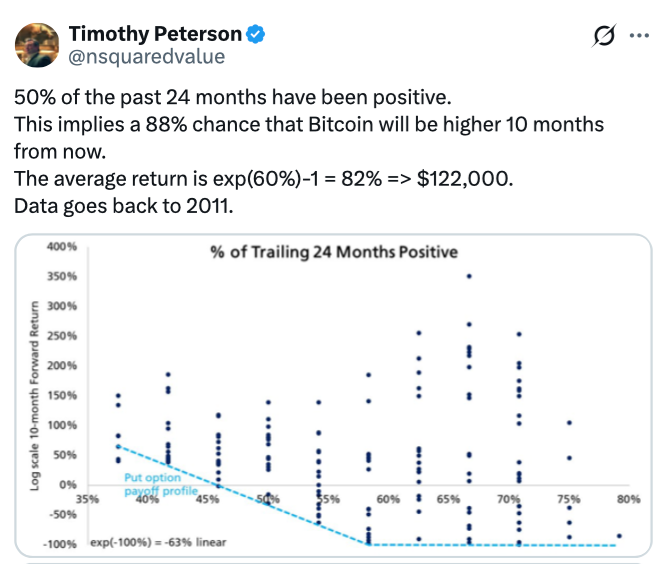
Half of the months over the past two years have delivered positive returns for Bitcoin, which may be a strong sign that it will be higher than its current price in December, an economist said.
“50% of the past 24 months have been positive. This implies a 88% chance that Bitcoin will be higher 10 months from now,” economist Timothy Peterson said in an X post on Saturday. In 2025, Bitcoin posted gains in January, April, May, June, July, and September, while the other six months ended lower, according to CoinGlass.
Peterson explained that he uses the metric to count the number of positive months in any 24-month period to identify possible inflection points.

Traders on crypto prediction platform Polymarket are giving December a 17% chance of being Bitcoin’s (BTC) best month of 2026, just behind November at 18%.
Historically, November has been Bitcoin’s strongest-performing month on average since 2013, with an average return of 41.13%, according to CoinGlass.
Peterson’s forecast comes as Bitcoin’s price trades almost 25% below its level at the beginning of this year, at $68,173 at the time of publication, according to CoinMarketCap.

Analysts are divided on how the asset will perform in the near future. MN Trading Capital founder Michael van de Poppe said on Friday, “I would expect next week to be green for BTC.” “Finalizing this month with a massive candle and a streak of five red months,” he said.
Meanwhile, other analysts see more downside ahead. Veteran trader Peter Brand recently told Magazine that Bitcoin’s “real bottom will not occur until October 2026.”
Related: Crypto market retraces almost all 2024-2025 US election pump gains
Peterson’s forecast comes as crypto market sentiment continues to decline. The Crypto Fear & Greed Index, which measures overall crypto market sentiment, posted an “Extreme Fear” score of 9 on Sunday, signaling extreme caution among investors.
However, crypto sentiment platform Santiment said on Friday that the “drying up” of Bitcoin price predictions on social media among crypto market participants is a healthy indicator as sentiment returns to “neutral” territory.
Magazine: 6 massive challenges Bitcoin faces on the road to quantum security

Crypto markets have wiped out roughly $1 trillion in value over the past month, underscoring a broad risk-off mood that has weighed on spot prices. Yet not all corners of the industry are moving in lockstep with price drops. Infrastructure plays, venture activity focused on on-chain finance, and the tokenization of real-world assets (RWAs) are signaling a different rhythm, with capital continuing to flow into areas believed to bolster liquidity and revenue-generating capabilities. In this week’s overview, Nakamoto’s $107 million push to acquire BTC Inc and UTXO Management highlights consolidation at the intersection of media, events, and asset advisory services. Separately, Dragonfly Capital’s $650 million fund signals ongoing institutional interest in on-chain rails, while tokenized RWAs persist as a buoyant sub-sector even as broader markets stall. At the same time, Paradigm is emphasizing a potentially pivotal yet debated role for Bitcoin mining in stabilizing energy grids as AI demand for power climbs. Bitcoin (CRYPTO: BTC) (the technology’s flagship token) remains a focal point for investors eyeing resilience amid volatility, and the broader ecosystem continues to explore how on-chain solutions can support traditional financial operations.
Key takeaways
- Nakamoto to acquire BTC Inc and UTXO Management in a $107 million deal, issuing 363,589,819 shares of Nakamoto common stock at a $1.12 strike under a call option structure.
- Dragonfly Capital closes its fourth fund at $650 million, reinforcing appetite for infrastructure and real-world asset-based financial products built on blockchain rails.
- Tokenized RWAs mark a contrasting trend to the broader market: the total value of tokenized RWAs rose about 13.5% in the last 30 days, while the aggregate crypto market retraced roughly $1 trillion.
- Tokenized US Treasurys, private credit, and tokenized stocks are expanding, suggesting fixed-income-style products remain a magnet for capital even during downturns.
- Paradigm argues that Bitcoin mining can serve as a flexible load on the electric grid, potentially aiding utilities as AI infrastructure expands—but the practicality hinges on contracts and energy-market economics.
Tickers mentioned: $BTC, $ETH, $ARB, $SOL
Sentiment: Neutral
Price impact: Negative. Broad market declines have outweighed pockets of institutional investment and RWA growth.
Market context: The sector is bifurcated, with price volatility contrasting against sustained interest in on-chain infrastructure, tokenized assets, and grid-services concepts as AI-driven demand reshapes energy markets.
Why it matters
The juxtaposition of a broad price downturn with continued deal flow and asset tokenization highlights a longer-term shift in crypto economics. While spot markets have faced pressure, the underlying demand for on-chain mechanisms that can replicate or enhance traditional finance—such as yield generation, asset securitization, and liquidity provisioning—appears persistent. The Nakamoto transaction exemplifies a strategy to vertically integrate media, events, and financial services around Bitcoin’s ecosystem, signaling a belief that value accrues not only from price appreciation but also from owning and coordinating the ecosystem’s narrative and services. By acquiring BTC Inc and UTXO Management, Nakamoto seeks to expand its footprint in media reach, advisory capabilities, and asset management, potentially shaping how market participants access information, analysis, and structured products related to Bitcoin and its broader ecosystem.
Meanwhile, Dragonfly’s $650 million fund underscores a continued appetite among seasoned investors for infrastructure-stage bets that can deliver revenue through on-chain rails, rather than pure token appreciation. The emphasis on financial products—payments, stablecoins, lending, and RWAs—reflects a strategic shift toward platforms that generate ongoing cash flows even when token prices are under pressure. This aligns with a broader industry pivot toward sustainable business models that can operate across cycles, providing a counterweight to the volatility inherent in token markets.
The tokenized RWA space remains a bright spot within crypto, underscoring the market’s belief that pegging traditional assets like Treasurys, private credit, and even equities to on-chain representations can lower borrowing costs, improve liquidity, and broaden accessibility. Data from RWA.xyz shows a 13.5% rise in the total value of tokenized RWAs over the past 30 days, a period when the wider market saw a substantial decline. This divergence suggests that investors are differentiating between immediate price action and the longer-term utility of tokenized fixed-income and collateralized assets. If realized, such dynamics could help stabilize portions of the crypto economy by providing yield anchors and more predictable cash flows, even as risk sentiment remains fragile.
Paradigm’s view on Bitcoin mining as a grid-stabilizing asset adds another layer to the conversation. The firm contends that miners can act as flexible capacity—scaling up during periods of excess generation and scaling down when demand tightens—thereby smoothing fluctuations in electricity markets. The concept is attractive in a moment when AI data centers are driving electricity demand higher, potentially straining local grids. However, turning this into scalable, contractually reliable grid support hinges on the economics of energy markets, regulatory frameworks, and the terms miners can secure with grid operators. Critics point to variability in energy pricing, the need for long-term power purchase agreements, and the challenge of coordinating multiple players across a fragmented grid landscape. Yet the idea continues to gain traction as utilities, policymakers, and investors explore pragmatic ways to monetize energy resources through decentralized blockchain infrastructure. As with all these use cases, the actual impact will depend on regulatory clarity, energy markets, and the ability of on-chain participants to demonstrate measurable reliability.
What to watch next
- Closing details and execution timeline of Nakamoto’s acquisition of BTC Inc and UTXO Management, including any regulatory approvals.
- Dragonfly Capital’s fund deployment plans, with a focus on real-world asset tokenization and on-chain financial products.
- Updates from RWA.xyz on tokenized asset value flows, especially around tokenized Treasurys, private credit, and tokenized stocks.
- Progress and practical implementation of Paradigm’s grid-stabilization thesis, including utility partnerships, contracts, and regional deployments.
Sources & verification
- Nakamoto’s announced acquisition of BTC Inc and UTXO Management and the terms of the deal, as reported in primary communications.
- Dragonfly Capital’s fund-raising announcement and alignment with on-chain infrastructure and RWAs.
- RWA.xyz data on the 30-day change in tokenized RWAs value and the broader comparison to the crypto market rout.
- Paradigm’s report advocating Bitcoin mining as a flexible grid load and its accompanying analysis of grid economics and energy demand.
Tokenized asset momentum amid a crypto market rout
In the broader narrative, the market is quiet on the price front, while the engine behind tokenized assets continues to hum. The first major narrative is Nakamoto’s strategic expansion into the Bitcoin ecosystem. By consolidating BTC Inc and UTXO Management under a single umbrella, Nakamoto is positioning itself to control more of the information, expertise, and advisory services surrounding Bitcoin’s commercial and financial utilities. This move could influence how media, events, and asset management are integrated—an important consideration for institutions seeking coherent exposure to Bitcoin and its ancillary services. The transaction structure, which assigns shares to BTC Inc and UTXO investors at an elevated strike price, also signals a willingness to pay a premium for control over talent, brand, and distribution channels in a market that remains highly fragmented at the corporate level.
On the venture side, Dragonfly’s continued commitment to on-chain financial infrastructure speaks to a belief that the real economy will increasingly transact through tokenized rails. The fund’s focus on real-world assets and fixed-incomelike products aligns with a broader industry trend toward sustainability and revenue-generating models. In practical terms, this could translate into more accessible yield products, more robust tokenized securitization, and greater liquidity for traditional assets via blockchain representations. As capital flows into this space, the potential for broader adoption grows, even if token prices for major coins remain under pressure in the near term.
Tokenized RWAs have become a barometer for how the crypto economy is maturing beyond speculative trading. The 13.5% uptick in tokenized RWA value over the last 30 days—outpacing a market that shed roughly $1 trillion—illustrates a degree of resilience in fixed-income-like digital assets. Much of this growth has centered on tokenized U.S. Treasurys and private credit products, with tokenized equities gaining traction as well. The trend suggests that investors are willing to diversify into on-chain yield strategies, which could help stabilize liquidity in networks that have historically leaned on speculative activity for value creation. If sustained, tokenized RWAs could broaden the base of crypto-native investors and institutions seeking predictable cash flows rather than purely price appreciation.
The narrative around Bitcoin mining’s grid role remains nuanced. Paradigm’s proposition hinges on practical contracts with grid operators and the economics of energy markets rather than a purely technical capability. If validated, miners could become a strategic adjunct to traditional grid resources, reducing the need for abrupt capacity curtailments and enabling a more adaptive energy network in the face of AI-driven demand surges. Yet scaling such a model will require collaboration across utilities, regulators, and energy providers to ensure reliability and financial viability. The coming quarters should reveal whether pilots materialize into scalable programs with measurable environmental and economic benefits.
What it means for investors and builders
For investors, the bifurcation between price action and value formation suggests a nuanced approach to risk. A diversified strategy that weighs tokenized RWAs and on-chain infrastructure alongside core crypto assets could offer a more resilient footprint. Builders working on tokenized finance, regulatory-compliant asset representations, and grid-friendly mining solutions may find favorable tailwinds if these structural trends persist. Regulators will also play a crucial role, particularly around securities classifications for RWAs and the permitting framework for large-scale grid participation by miners.
What to watch next
- Regulatory developments affecting tokenized asset classes and exchange-traded representations in major markets.
- Deployment milestones for tokenized U.S. Treasurys and private credit products, including on-chain yield benchmarks.
- Operational pilots or partnerships linking Bitcoin mining operations with grid stability initiatives.
- Further announcements from Nakamoto regarding integration of media, events, and asset-management services within Bitcoin-focused ecosystems.
https://abs.twimg.com/responsive-web/client-web/twitter-widget.js

OSI Systems (OSIS) stock saw a welcome improvement to its Relative Strength (RS) Rating on Friday, with an increase from 78 to 83. Hone Your Stock-Picking Skills By Focusing On These Factors IBD’s unique rating tracks market leadership with a 1 (worst) to 99 (best) score. The grade shows how a stock’s price behavior over the trailing 52 weeks…
XRP price stuck in a range as key network metric jumps and flips Solana

Police officer killed, 24 people injured in bombs explosions in Ukraine’s Lviv

Is the Pi Network Dream Over? Core Team’s Anniversary Post Met With Fury From Pioneers


-

 Video6 days ago
Bitcoin: We’re Entering The Most Dangerous Phase
-

 Crypto World5 days ago
Can XRP Price Successfully Register a 33% Breakout Past $2?
-

 Fashion2 days ago
Weekend Open Thread: Boden – Corporette.com
-

 Sports5 days ago
GB's semi-final hopes hang by thread after loss to Switzerland
-

 Video2 days ago
XRP News: XRP Just Entered a New Phase (Almost Nobody Noticed)
-
 Tech5 days ago
The Music Industry Enters Its Less-Is-More Era
-

 Business4 days ago
Infosys Limited (INFY) Discusses Tech Transitions and the Unique Aspects of the AI Era Transcript
-

 Entertainment4 days ago
Kunal Nayyar’s Secret Acts Of Kindness Sparks Online Discussion
-

 Video5 days ago
Financial Statement Analysis | Complete Chapter Revision in 10 Minutes | Class 12 Board exam 2026
-

 Tech4 days ago
Retro Rover: LT6502 Laptop Packs 8-Bit Power On The Go
-
 Sports3 days ago
Clearing the boundary, crossing into history: J&K end 67-year wait, enter maiden Ranji Trophy final | Cricket News
-

 Entertainment3 days ago
Dolores Catania Blasts Rob Rausch For Turning On ‘Housewives’ On ‘Traitors’
-

 Business4 days ago
Tesla avoids California suspension after ending ‘autopilot’ marketing
-
 NewsBeat7 days ago
The strange Cambridgeshire cemetery that forbade church rectors from entering
-

 Politics5 days ago
Eurovision Announces UK Act For 2026 Song Contest
-

 Crypto World4 days ago
WLFI Crypto Surges Toward $0.12 as Whale Buys $2.75M Before Trump-Linked Forum
-
 NewsBeat7 days ago
Man dies after entering floodwater during police pursuit
-

 Crypto World2 days ago
83% of Altcoins Enter Bear Trend as Liquidity Crunch Tightens Grip on Crypto Market
-
 NewsBeat2 days ago
Andrew Mountbatten-Windsor latest: Police search of Royal Lodge enters second day after Andrew released from custody
-

 Business4 days ago
School's 'cost of living cupboard' helps families