

Crypto World
Trump Unveils 10% Global Tariff After SCOTUS Ruling

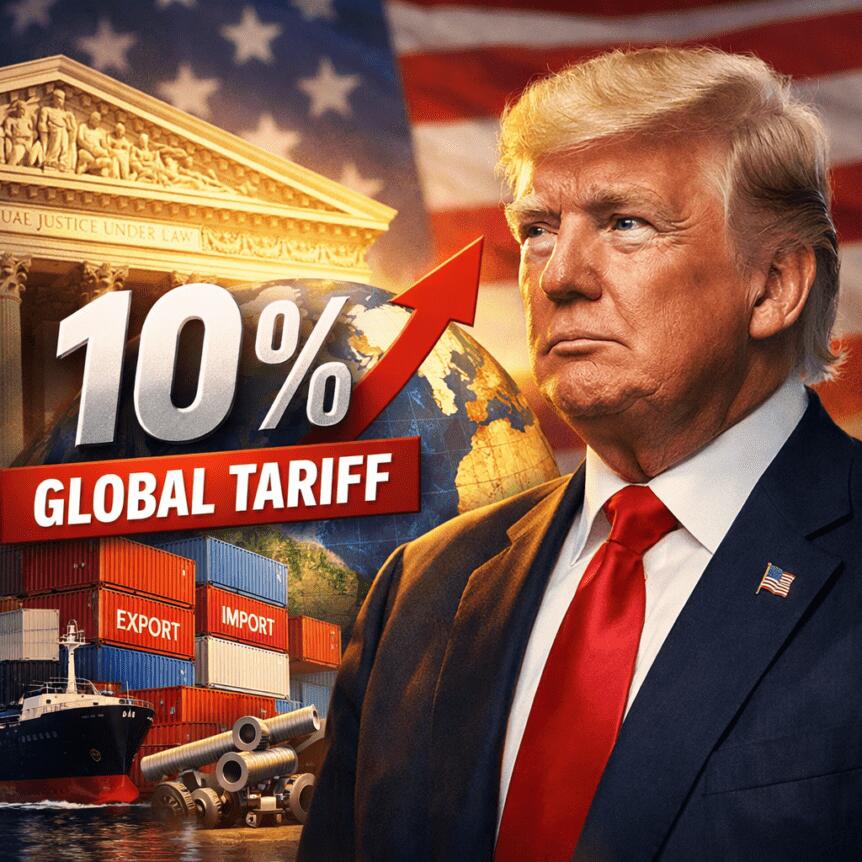
The United States Supreme Court ruled on Friday that President Donald Trump could not use national emergency powers to levy tariffs during peacetime, a decision that curbs a longstanding tool for unilateral trade action. The ruling clarifies that the International Emergency Economic Powers Act (IEEPA) cannot be wielded to impose broad tariffs in the absence of a declared emergency, a nuance that could steer future policy moves and trigger recalibrations across markets sensitive to policy signals. Moments after the decision, the White House signaled a shift: Trump announced a 10% global tariff to be imposed under other legal authorities, signaling a different approach to trade protectionism while the court’s opinion tightened the executive branch’s strategic levers. “Effective immediately. All national security tariffs under Section 232 and Section 301 tariffs remain fully in place. And in full force and effect. Today, I will sign an order to impose a 10% Global tariff under Section 122 over and above our normal tariffs already being charged.”
The ruling, published after hours of deliberation, underscored the framers’ intent to reserve broad taxing powers for Congress. The court’s language was blunt: “In IEEPA’s half-century of existence, no president has invoked the statute to impose any tariffs, let alone tariffs of this magnitude and scope.” The decision also cited Article I, Section 8 of the Constitution, which vests in Congress the power to lay and collect taxes, duties, imposts, and excises, highlighting the structural balance designed into fiscal authority. The jurisprudence around IEEPA has always been contentious, but the Court’s interpretation here narrows the scope of executive emergency powers in a peacetime context. The ruling arrives at a moment when tariff rhetoric has already unsettled markets, reinforcing investors’ emphasis on policy clarity and legislative oversight.
For crypto markets, the episode represents another data point in a long-running conversation about policy risk and asset prices. The debate over tariffs has historically correlated with risk-off moves across high-volatility assets, including digital tokens, as traders reassess exposure to policy shocks and the potential knock-on effects on global liquidity. A related analysis in the wake of tariff threats noted that Bitcoin decoupled somewhat from stock behavior in the face of policy headlines, illustrating that crypto assets can react differently to macro signals than traditional equities. Bitcoin decouples stocks-lose-3-5-t-amid-trump-tariff-war-and-fed-warning-of-higher-inflation. The broader takeaway is that even with partial decoupling, crypto markets remain sensitive to policy trajectories and the pace at which governments alter trade rules and economic assumptions.
The core of the Friday decision centers on the delicate balance between emergency authorities and constitutional checks. The Supreme Court’s perspective emphasizes that the executive branch cannot rely on a wartime-like authority to reshape peacetime trade dynamics without legislative backing. This is not merely a curtailment of a single tool; it signals a preference for congressional oversight when it comes to tariff structures and the revenue-raising powers that accompany them. The court’s phrasing draws a clear line: while emergency powers exist, their application must align with constitutional design and explicit statutory authorization. In practical terms, the ruling narrows the menu of options available to an administration seeking rapid, unilateral responses to perceived threats to national security or economic vitality.
From a governance standpoint, the decision does not eliminate tariff policy. Rather, it redirects the path—pushing the administration toward other legal authorities, such as the Trade Expansion Act of 1962 and the Trade Act of 1974. The President’s stated plan to invoke a 10% global tariff under different statutory authority does not erase the underlying policy aim; it alters the mechanism and potentially the scope of the measures. This shift will likely invite renewed scrutiny from Congress, as lawmakers weigh the costs and benefits of tariffs in a globalized economy where supply chains and inflation expectations are already under pressure. The White House’s assertion that the 10% tariff would operate “over and above our normal tariffs” underscores the potential for layered duties that could ripple through customs, manufacturing, and consumer prices if implemented in practice.
Why it matters
For investors and traders who monitor cross-asset dynamics, the ruling adds another layer to an ever-evolving policy backdrop. The legal floor established by the Court reinforces the idea that fiscal measures of this scale require explicit congressional authorization, potentially delaying or complicating tariff actions that might otherwise be deployed swiftly as a response to perceived national security threats. In crypto markets, where liquidity is often a barometer of risk sentiment, policy signals—whether from courts or lawmakers—can precipitate tighter or looser financial conditions. The episode also illustrates the ongoing tension between executive agility and legislative accountability in the realm of trade policy, a tension that can influence how crypto and other risk assets price in the near term.
Beyond immediate price moves, the case highlights a broader policy cadence: as the administration tests the boundaries of executive authority, investors are increasingly watching for transparency in the legislative process and for concrete, long-horizon plans that reduce ambiguity. The market’s appetite for clarity is particularly acute in the crypto space, where policy and regulation directly influence custody, cross-border flows, and the expansion of on-ramps and regulated venues. The discussion around IEEPA, additional tariff authorities, and potential regulatory responses across jurisdictions is likely to persist, shaping how individuals and institutions allocate capital across digital assets and traditional markets.
Moreover, the decision’s emphasis on constitutional borders may inform future debates around how the United States uses economic tools to shape trade policy. It underscores the importance of aligning executive actions with legislative authorization to ensure that policy changes withstand judicial scrutiny and political pushback. For builders and participants in the crypto economy, the takeaway is straightforward: while policy levers will continue to evolve, credible, well-justified regulatory frameworks will be central to the industry’s long-term viability and its ability to attract mainstream adoption and institutional investment.
The interplay between law, policy, and markets remains dynamic. In the near term, traders will be watching for the specific text and implementation details of the proposed 10% global tariff and for any accompanying regulatory guidance. The interplay between tariff policy and financial markets—crypto included—will continue to test the resilience of risk assets amid policy-induced volatility. As the day’s developments unfold, market participants will assess not only the immediate price action but also the longer arc of how the United States negotiates its economic interests in a deeply interconnected global economy.
What to watch next
- Official text and scope of the new 10% global tariff under Section 122, including which goods and sectors are affected.
- Any additional legal challenges or legislative actions related to tariffs and emergency powers.
- Immediate market reactions across crypto and equities, including liquidity shifts and volatility spikes.
- Policy updates from lawmakers on tariff authority and potential alternative measures.
Sources & verification
- Supreme Court ruling PDF: https://www.supremecourt.gov/opinions/25pdf/24-1287_4gcj.pdf
- White House X broadcast link: https://x.com/i/broadcasts/1oJMvRRqDBjxQ
- Bitcoin decouples stocks-lose-3-5-t-amid-trump-tariff-war-and-fed-warning-of-higher-inflation: https://cointelegraph.com/news/bitcoin-decouples-stocks-lose-3-5-t-amid-trump-tariff-war-and-fed-warning-of-higher-inflation
- President Trump signs reciprocal tariff executive order: https://cointelegraph.com/news/president-trump-signs-reciprocal-tariff-executive-order


A group of cryptocurrency exchanges linked to Russia is helping users move funds outside the reach of Western financial restrictions, according to a report released Saturday by blockchain analytics firm Elliptic.
Key Takeaways:
- Elliptic identified five Russia-linked crypto exchanges providing pathways to bypass Western sanctions.
- Only one platform is formally sanctioned, yet several processed large transactions with restricted entities.
- Activity has shifted across multiple services, suggesting enforcement actions redirect rather than halt flows.
The study identifies five trading platforms, most of them not formally sanctioned, that continue to provide channels for high-volume crypto transactions beyond the oversight of the traditional banking system.
The findings arrive as European officials consider tighter measures, including a potential blanket ban on crypto transactions involving Russia, amid concerns that new platforms are emerging to replace previously targeted operators.
Elliptic: Nearly 10% of Bitpapa Transactions Tied to Sanctioned Targets
Among the exchanges examined, only the peer-to-peer marketplace Bitpapa is under US sanctions.
The US Treasury’s Office of Foreign Assets Control (OFAC) designated the platform in March 2024 for alleged sanctions evasion.
Elliptic found that about 9.7% of Bitpapa’s outgoing transactions were linked to sanctioned entities and that the exchange frequently rotated wallet addresses to make monitoring more difficult.
The report also highlights ABCeX, an unsanctioned exchange operating from Moscow’s Federation Tower, the same building previously used by Garantex before US authorities seized its domains in March 2025.
Elliptic estimates ABCeX has processed at least $11 billion in crypto, with significant transfers flowing to Garantex and another exchange, Aifory Pro.
JUST IN: — Watcher.Guru (@WatcherGuru) February 10, 2026

 European Union proposes banning all crypto transactions with Russia to prevent sanctions evasion. pic.twitter.com/4FlGZJJorB
Another case involves Exmo, which said it exited the Russian market after the 2022 invasion of Ukraine by selling its regional operations to a separate entity, Exmo.me.
Elliptic’s analysis suggests operational ties remain: both services appear to share custodial infrastructure and pooled hot wallets.
The firm recorded more than $19.5 million in transactions between Exmo and sanctioned exchanges, including Garantex, Grinex and Chatex.
Rapira, registered in Georgia but maintaining a Moscow office, was also flagged after sending over $72 million directly to sanctioned exchange Grinex.
Authorities in Russia reportedly raided Rapira’s offices in late 2025 over suspected capital transfers to Dubai.
The fifth platform, Aifory Pro, operates cash-to-crypto services in Moscow, Dubai and Turkey.
The company reportedly offers virtual payment cards funded with USDT that allow Russian users to access services restricted by Western providers. Elliptic also traced nearly $2 million from Aifory Pro to the Iranian exchange Abantether.
Sanctions Shift Activity, Illicit Crypto Volume Hits Record High
Researchers say the network illustrates how enforcement actions can shift activity rather than eliminate it.
After the shutdown of Garantex, transaction volumes rose on other exchanges, according to data from multiple analytics firms.
Chainalysis reported that illicit crypto addresses received a record $154 billion in 2025, while TRM Labs produced a similar estimate of $158 billion.
As reported, Russia’s industrial crypto mining sector continued to expand in 2024, with the country’s two largest operators, BitRiver and Intelion, generating a combined $200 million in revenue and accounting for more than half of the legal market.
The post Elliptic Flags Network of Russian Crypto Platforms Bypassing Sanctions appeared first on Cryptonews.

The developer behind the fast-growing open-source AI agent framework OpenClaw has confirmed that any mention of Bitcoin or other cryptocurrencies on its Discord server can lead to removal.
In a Saturday post on X, a user revealed that they were blocked from OpenClaw’s Discord simply for referencing Bitcoin block height as a timing mechanism in a multi-agent benchmark.
In response, OpenClaw creator Peter Steinberger confirmed the action, writing that members had accepted “strict server rules” upon joining and that the community maintains a “no crypto mention whatsoever” policy.

Steinberger later agreed to re-add the user, asking them to email their username so he could restore their access to the server.
Related: Ethereum’s Trustless Agents standard is the missing link for AI payments
OpenClaw’s crypto problem began with a fake token
Trouble began during a rebrand after Steinberger received a trademark notice related to the project’s original name. In the short window between releasing old social accounts and claiming new ones, scammers seized the abandoned handles and promoted a Solana-based token called $CLAWD.
The token surged to roughly $16 million in market capitalization within hours before collapsing more than 90% after Steinberger publicly denied involvement. Early buyers accused the developer.
Steinberger responded at the time by warning users he would never launch a cryptocurrency and that any token claiming association with him was fraudulent. Security researchers later identified hundreds of exposed OpenClaw instances online and dozens of malicious plug-ins, many designed to target crypto traders.
OpenClaw has expanded rapidly since launching in late January, surpassing 200,000 GitHub stars within weeks and attracting a wide developer audience interested in autonomous agents.
Related: Deel taps MoonPay to roll out stablecoin salary payouts in UK, EU
Crypto firms bullish on AI agents
Industry leaders increasingly see crypto as the default payment rail for AI. Circle CEO Jeremy Allaire predicted that billions of agents will use stablecoins for routine payments within a few years
Earlier this month, Coinbase launched “Agentic Wallets” infrastructure that lets AI agents hold wallets and autonomously spend, earn and trade crypto onchain. Built on its AgentKit developer framework and powered by the x402 payments protocol, the system enables software agents to actively manage DeFi positions, rebalance portfolios, pay for compute and data services, and participate in digital marketplaces.
Magazine: The critical reason you should never ask ChatGPT for legal advice

US spot Bitcoin exchange-traded funds (ETFs) are facing their most sustained period of institutional friction this year.
This year, the funds have logged six weeks of outflows amid macroeconomic uncertainty that is driving capital toward traditional safe havens.
BlackRock, Fidelity Lead Bitcoin ETF Exodus Amid Macro Jitters
Since the start of 2026, the funds have bled nearly $4.5 billion, offset by just $1.8 billion of inflows during the first and third weeks of the year, according to data from SosoValue.
The bulk of the damage occurred during the past five-week stretch beginning in late January. That run alone erased roughly $4 billion from the ETF complex, triggered by Bitcoin’s recent price struggles.

The bleeding has been most pronounced among the category’s heavyweights. BlackRock’s iShares Bitcoin Trust (IBIT) has shed over $2.1 billion in the past five weeks, while Fidelity’s Wise Origin Bitcoin Fund (FBTC) saw more than $954 million walk out the door.
CryptoQuant analyst J.A. Maartun said Bitcoin ETF outflows are at $8.3 billion, down from their October all-time high, marking the weakest year since the funds launched.
Meanwhile, the current steady stream of withdrawals highlights a clear shift in institutional appetite from the aggressive momentum that defined the asset class in its first two years.
Over the past year, the US’s macro policies have prompted a broader de-risking among Wall Street allocators.
This has sparked a rotation out of digital assets and into precious metals like gold and silver. For context, gold and gold-themed ETFs have seen $16 billion in inflows during the past three months.
Still, market observers have pointed out that Bitcoin ETFs’ structural footprint remains largely intact.
Bloomberg senior ETF analyst Eric Balchunas noted that the larger picture remains historically bullish for the nascent asset class.
He noted that, despite recent outflows, the funds have significantly outperformed early market expectations, which had projected first-year inflows of just $5 billion to $15 billion.


Disclosure: The views and opinions expressed here belong solely to the author and do not represent the views and opinions of crypto.news’ editorial.
In 2026, global digital asset laws are shifting from implementation to operational, with a major focus on stablecoin oversight, tokenized real-world assets, and tax compliance. Here are the key changes during February from the United States, China, and the United Arab Emirates.
Summary
- From experimentation to enforcement: In 2026, digital asset policy is shifting from pilots to operational law with stablecoins, tokenized RWAs, and tax compliance at the center.
- U.S. pushes market structure clarity: The Clarity Act advances toward finalization, aiming to formalize CFTC oversight and solidify US’ leadership in crypto infrastructure.
- Diverging global models: China tightens state control around e-CNY and bans most RWAs, while Hong Kong and the UAE expand licensing regimes and regulated stablecoin frameworks.
The United States
In 2026, U.S. cryptocurrency legislation is entering a transformative phase focused on finalizing market structure and implementing the first major federal digital asset laws. The U.S. Clarity Act, aimed at implementation in 2026, is proposed U.S. legislation designed to establish a regulatory framework for digital assets, primarily granting the Commodity Futures Trading Commission jurisdiction over most digital assets. As William Quigley, a cryptocurrency and blockchain investor and co-founder of WAX and Tether (USDT), explained:
“The Clarity Act, which is expected to become law this year, aims to distinguish between commodities and securities, requiring exchanges and dealers to register with the CFTC and adhere to consumer protections.”
Treasury Secretary Scott Bessent called for a “spring signing” of the bill, noting that the 2026 midterm elections create significant urgency to pass the legislation before the political window closes.
Current legislative status of the Clarity Act
| Body | Version | Status (as of Feb 16, 2026) |
| House | H.R. 3633 | Passed (294-134) in July 2025 |
| Senate Agriculture | DCIA (S. 3755) | Advanced 12-11 on Jan 29, 2026 |
| Senate Banking | CLARITY Act (Senate Draft) | Stalled; Markup postponed since Jan 14, 2026 |
China
During February, Chinese authorities strengthened their rules on digital payments through the sovereign digital yuan (e-CNY) and controlled tokenization projects. New regulations prohibit the unauthorized issuance of yuan-pegged stablecoins (both domestically and offshore) and mandate strict vetting for tokenized real-world assets, reinforcing the dominance of the state-backed e-CNY. Key details regarding China’s 2026 stablecoin regulations are as follows:
Ban on unauthorized stablecoins: A February 6, 2026, notice issued by eight government agencies reiterated that all virtual currency activities are illegal, specifically targeting stablecoins that replicate sovereign money. Yifan He, the founder and CEO of Red Data Tech, explained:
“I think the most significant aspect is that the authorities removed stablecoin from the definition of cryptocurrencies. If you compare these two to the one from last November, stablecoin is no longer mentioned alongside cryptocurrencies and RWAs. The only mention is to state that ‘stablecoin pegged with fiat functions partially as money’. This is a huge policy shift regarding stablecoin. This might mean greenlighting Chinese banks in Hong Kong to apply for the HK stablecoin license.”
No yuan-pegged stablecoins: The new regulations ban any entity (including foreign ones) from issuing stablecoins pegged to the renminbi (RMB) offshore without explicit approval.
Offshore restrictions: Domestic Chinese entities and their subsidiaries are strictly prohibited from issuing virtual currencies or conducting RWA tokenization outside China without consent. As Yifan added:
“Helping illegal crypto business from inside China (even for projects outside China), including promotion, IT development, and advisory, will face severe criminal punishment. This goes next level.”
RWA tokenization rules: While some market participants see potential for a regulatory framework for tokenized, real-world assets (RWA), the 2026 rules impose strict oversight on this sector, requiring approval for any RWA tokenization, especially if it involves onshore assets. As Yifan He explained:
“In the circulars, RWAs are totally banned. In the past two days, many people from the RWA industry have tried to confuse people with RWA and ‘tokenized security’ and claim that the Chinese government officially gives a clear path to legalize RWAs. It is not. The path is now a total ban.”
Nevertheless, “it gives a clear path for ‘tokenized securities.’ This is the bright side of the circulars. But because it is about ‘securities,’ the issuance and trading must go through licensed entities. I don’t think this brings any opportunities to the market, tech companies, or crypto companies. This will be a new business for existing underwriters and stock exchanges. The IPOs and fundraising won’t be any easier. Especially, one major required step is that the owners of the assets to be ‘tokenized’ must receive approval from CSRC, literally exactly the same procedures as for Chinese companies to be listed in foreign stock markets,” pointed out Yifan.
Separation from Hong Kong: While mainland China maintains a strict ban, Hong Kong continues to pursue a separate, cautious pilot program for regulated, licensed stablecoin issuance, though this is expected to be under tight supervision.
Hong Kong is currently implementing a comprehensive multi-layered regulatory framework for digital assets, with several significant legislative milestones scheduled for 2026. The government aims to solidify the city’s position as a global digital asset hub by expanding licensing requirements to nearly all types of crypto service providers and aligning tax transparency with international standards.
For 2026, Hong Kong has prioritized the regulation of previously “over-the-counter” (OTC) and advisory services:
- New licensing bill: Regulators plan to submit a bill to the Legislative Council in 2026 to establish licensing regimes for four new categories: Virtual Asset (VA) Dealing (including OTC desks), VA Custodians, VA Advisory Services, and VA Asset Management.
- Stablecoin licenses: Following the passage of the Stablecoins Ordinance in 2025, the Hong Kong Monetary Authority (HKMA) is expected to issue the first batch of official stablecoin licenses in the first quarter of 2026.
- Banking standards: Effective January 1, 2026, Hong Kong will fully implement the Basel Committee standards for crypto assets, governing how banks manage capital requirements and credit risks when dealing with digital assets.
- Tax exemptions: Hong Kong is shifting toward high transparency for tax compliance while maintaining its competitive “no capital gains” environment. The government plans to submit a bill in 2026 to formally expand tax exemptions for funds and family offices to include “digital assets,” essentially promising a 0% tax rate on crypto profits for these qualifying institutional investors.
- CARF implementation: Legislation to implement the OECD’s Crypto-Asset Reporting Framework (CARF) is slated for completion in 2026.
The United Arab Emirates
As of February 2026, the UAE has strengthened its crypto regulatory framework, with the Dubai Financial Services Authority (DFSA) updating its rules on 12 January 2026 to shift token suitability assessments from the regulator to authorized firms. The Central Bank of the UAE (CBUAE) also approved a dirham-backed stablecoin for institutional use on February 13, 2026. The new rules aim to increase market flexibility while ensuring high standards of integrity for digital asset service providers.
DIFC Updates (DFSA): Effective January 12, 2026, the DFSA eliminated the “Recognized Crypto Tokens” list, requiring firms to conduct their own due diligence, assessment, and monitoring of tokens before listing.
Stablecoin regulation: The CBUAE approved the launch of a Dirham-backed stablecoin (DDSC) on the ADI Chain for institutional, payment, and settlement use cases as of 13 February 2026. Erhan Kahraman, Former Chief Editor of Cointelegraph Turkey, said:
“I don’t see any major impact on the use of stablecoins in the MENA region, simply because here, it’s used more as a ‘survival tool’ rather than a trading asset. I know that for the Western Hemisphere, stablecoins are the main tool for on- and off-ramping cryptocurrencies (i.e., you first buy USDT and then use it for trading). In contrast, people in MENA use stablecoins as a gateway to a) cross-border payments/remittances and b) to join the global job market as individuals.”
He continued: “Imagine this: a freelancer needs to provide multiple legal documents, such as a ‘Bank Confirmation Letter,’ only to start working for a foreign company (to receive USD or Euro). This is incredibly difficult to provide for underbanked or unbanked populations found in the MENA region. Stablecoins eliminate that barrier. When you find a job that pays in USDT, all they ever ask you about your financial situation is your crypto wallet address. I believe that is making a huge difference for the underbanked population.”
Investor protection: Retail client protections remain strict, with mandatory appropriateness assessments and a ban on certain marketing practices.
Taxation 2026: Crypto activity generating income is subject to corporate tax, while transfers of crypto are generally exempt from VAT, and mining rewards are treated as taxable income.
Compliance and licensing: UAE regulators are heavily focused on institutional-grade compliance and preventing financial crime, emphasizing robust governance for licensing, according to reports from 16 February 2026.

Bitdeer Technologies, a prominent Bitcoin mining operator backed by industry figure Jihan Wu, has sharply recalibrated its Bitcoin treasury, reporting a zero balance in its corporate holdings. In the latest weekly operations update, the company disclosed that its “pure holdings,” which exclude client deposits, have fallen to 0 BTC. The period saw the production of 189.8 BTC, all of which were sold, alongside an additional 943.1 BTC liquidated from existing treasury reserves. This marks a notable shift from earlier disclosures, when the treasury still held a substantial balance.
Key takeaways
- Bitdeer reports zero corporate Bitcoin in its treasury, after selling 189.8 BTC produced in the latest period plus 943.1 BTC drawn from reserves.
- A February update showed the treasury at 943.1 BTC, with 179.9 BTC sold from 183.4 BTC mined that week, leaving treasury holdings unchanged at that time.
- The company is pursuing a significant financing move, announcing plans to raise $300 million through a convertible senior note offering, with a possible expansion to $345 million.
- The notes, due in 2032, can be converted into stock, cash, or a mix, and are intended to fund data center expansion, AI cloud growth, mining hardware development, and general corporate needs.
- Meanwhile, Bitdeer is expanding its self-mining capabilities as demand for external mining hardware wanes, reflecting a broader industry shift toward hybrid AI/HPC revenue streams.
Tickers mentioned: $BTC, $MARA
Price impact: Negative. Bitdeer’s plan to raise convertible debt coincided with a sharp share decline, underscoring investor concern over liquidity and funding strategy.
Market context: The sector has been navigating tighter margins post-halving and a growing interest in hybrid models that blend Bitcoin production with AI and high-performance computing revenue streams. The move toward self-mining and AI services mirrors a broader trend as miners reassess balance sheets and diversify revenue sources.
Why it matters
The decision to liquidate the corporate Bitcoin treasury signals a potential pivot in Bitdeer’s capital strategy. By converting a portion of mined proceeds into cash, the company may be prioritizing liquidity to support ongoing operations and debt servicing, even as it seeks to scale data center infrastructure and AI-focused offerings. This shift underscores the tension between treasury exposure to Bitcoin’s price volatility and the need for predictable funding for growth initiatives in a capital-intensive industry.
Concurrently, the $300 million convertible debt offering marks a high-profile move to raise capital that could be immediately deployed to expand Bitdeer’s data center footprint and advance AI cloud capabilities. The convertible feature adds a layer of complexity for investors, as future equity dilution is possible if the notes are converted. The company has framed the financing as a tool to accelerate its expansion plans and hardware development while maintaining flexibility to adapt to market conditions.
Beyond Bitdeer, the mining landscape is undergoing a broader reorientation toward AI and computing services. MARA Holdings recently acquired a majority stake in Exaion, a French computing infrastructure firm, signaling a deeper foray into AI and cloud services. The deal positions the miner as a broader technology infrastructure provider, expanding its footprint beyond traditional hash power. This follows a wider industry pattern where several miners, faced with tighter margins, are pursuing hybrid models that leverage their energy and data-center assets to offer AI-enabled computing capacity.
Observers note that the industry is reconfiguring around demand for AI capacity and energy-efficient compute, rather than venerating hash price alone. Several peers are repurposing facilities for data-center use or pivoting toward AI infrastructure as a way to diversify revenue streams and hedge against mining cycles. The trend is underscored by moves within the ecosystem that include CoreWeave’s established shift toward AI infrastructure and other players repositioning assets to capture AI compute demand. For readers tracking this space, the evolving balance between traditional hashing revenue and AI-enabled services will likely define miners’ strategizing in 2024 and beyond.
The current environment remains nuanced: while Bitcoin mining remains a niche but essential component of the larger crypto economy, the capital-intensive demands of data centers and the strategic importance of AI capabilities push miners to blend their hardware with software services. This dual approach can help stabilize cash flows amid volatility in digital asset prices, energy costs, and regulatory considerations, while offering new avenues for growth in an increasingly digital and compute-driven landscape.
What to watch next
- Bitdeer’s next weekly update to confirm whether the treasury remains at zero and to track any changes in production or sales pace.
- Progress and timing of the $300 million convertible debt offering, including potential expansion and terms of conversion.
- Updates on Bitdeer’s data center expansion plans and the development of AI cloud initiatives tied to mining operations.
- Industry moves by peers, particularly MARA Holdings’ integration of Exaion and how AI/hpc ventures influence miner profitability across the sector.
- Regulatory or energy-cost developments that could impact mining economics and the viability of hybrid business models combining Bitcoin production with AI infrastructure.
Sources & verification
- Bitdeer weekly operational update showing 0 BTC in pure holdings and the 189.8 BTC produced and sold, plus 943.1 BTC liquidated from treasury — https://x.com/BitdeerOfficial/status/2025136775266550191
- Bitdeer Feb. 13 update indicating 943.1 BTC treasury the week prior and 179.9 BTC sold out of 183.4 BTC mined — https://x.com/BitdeerOfficial/status/2022530485876896182
- Cointelegraph report on Bitdeer’s convertible debt offering of $300 million with potential expansion to $345 million — https://cointelegraph.com/news/bitdeer-stock-drops-17-after-convertible-senior-note-offering
- MARA Holdings’ majority stake in Exaion article detailing the AI/data-center expansion angle — https://cointelegraph.com/news/mara-majority-stake-exaion-ai-data-centers-bitcoin-miner
- Related industry shifts toward AI infrastructure in crypto mining, including CoreWeave’s pivot — https://cointelegraph.com/news/crypto-mining-ai-data-centers-coreweave-infrastructure-shift
Bitdeer pivots from treasury to expansion amid AI pivot
Bitcoin (CRYPTO: BTC) has become the focal point of Bitdeer’s latest strategic recalibration, as the company logs a full liquidation of its corporate Bitcoin treasury even as it grows commitments to data centers and AI-enabled compute. In its most recent weekly update, Bitdeer disclosed that its pure holdings, excluding client deposits, dropped to zero BTC. The report shows 189.8 BTC mined during the period, all of which were sold, in addition to 943.1 BTC drained from the treasury reserves. This marks a clear departure from prior reporting where the treasury still contained BTC, albeit with ongoing sales tied to operating costs.
The prior update, issued on Feb. 13, had the treasury at 943.1 BTC, with 179.9 BTC sold from 183.4 BTC mined that week, leaving treasury holdings unchanged after the sale. The shift from treasury exposure to a cash-focused approach is a notable pivot for a company that, like many in the sector, has balanced the need for liquidity with the opportunistic exposure to Bitcoin’s price action. In context, mining firms frequently sell a portion of production to cover electricity and equipment costs, yet fully liquidating a treasury position is less typical and can indicate a more aggressive capital deployment strategy.
Meanwhile, Bitdeer disclosed plans to raise $300 million through a convertible senior note offering, with an option to expand the sale by an additional $45 million. The notes, due in 2032, can be converted into stock, cash or a combination of both. The financing is earmarked to accelerate data center expansion, fuel AI cloud growth, support mining-hardware development, and fulfill general corporate needs. The market reacted to the financing news with a notable drop in Bitdeer’s shares, underscoring investor concerns about debt dilution and the company’s ability to deploy proceeds effectively in a competitive landscape.
Beyond Bitdeer, the broader mining industry is undergoing a reorientation toward AI and high-performance computing. MARA Holdings—another prominent name in the space—announced a majority stake in Exaion, a French computing infrastructure firm, signaling a deeper plunge into AI and cloud services. The deal highlights a strategic shift from pure hash-rate generation to hybrid business lines that leverage existing energy and data-center assets for AI compute capacity. It reflects a broader trend in which miners, faced with the realities of halved block rewards and tighter margins, pursue diversified revenue streams to sustain growth.
Industry coverage also notes that other miners are repurposing facilities and energy infrastructure for data-center use, while some players have fully pivoted to AI infrastructure providers. The exchange between crypto mining and AI data services is increasingly viewed as a way to reconcile revenue volatility with an expanding demand for AI compute capacity. The long‑term outlook for miners may hinge on whether these hybrid models can deliver consistent cash flows, especially as regulatory pressures and energy costs continue to shape the economics of the sector.

US spot Bitcoin exchange-traded funds recorded a fifth consecutive week of net withdrawals, extending the longest negative streak since early 2025 as institutional demand softened alongside a broader pullback in digital assets.
Key Takeaways:
- Spot Bitcoin ETFs posted a fifth straight week of withdrawals, losing about $316 million and roughly $3.8 billion over the streak.
- Midweek selling outweighed Friday inflows, showing cooling institutional demand despite stable prices.
- Capital appears to be rotating within crypto funds, with Ether also seeing outflows while Solana and XRP products drew inflows.
Data from SoSoValue shows the 12 funds collectively lost about $316 million during the week ending Feb. 20.
Trading activity was compressed into four sessions due to the Presidents’ Day holiday, and the first three days all closed negative.
Bitcoin ETFs Post Heavy Midweek Outflows Despite Friday Rebound
Roughly $105 million exited on Tuesday, followed by $133 million on Wednesday and $166 million on Thursday.
A modest recovery on Friday, when $88 million flowed back into the products, was not enough to reverse the weekly trend. BlackRock’s IBIT led the rebound with about $64.5 million in inflows, while Fidelity’s FBTC added roughly $23.6 million.
The current run of outflows began the week of Jan. 20 and has removed around $3.8 billion from the Bitcoin ETF complex.
The last comparable stretch occurred nearly a year ago during a tariff-driven market sell-off that also weighed on risk assets.
While the duration of the streak matches that period, the magnitude has been smaller, with the heaviest withdrawals concentrated in late January when funds lost $1.33 billion and $1.49 billion in consecutive weeks.
Bitcoin's entire history in 89 seconds! — Sumit Gupta (CoinDCX) (@smtgpt) February 20, 2026
As of Feb 2026, the numbers:  Individuals: 13.15M BTC
  ETFs & Funds: 1.6M BTC
  Companies: 1.17M BTC
  Governments: 647K BTC
Institutions and companies are buying. But the majority of individuals are still HODLing! 
Video… pic.twitter.com/13kEHTr52Y
More recent weekly losses have ranged between roughly $316 million and $360 million.
Despite the withdrawals, the ETF market remains substantial. Cumulative net inflows since launch in January 2024 still total about $54 billion, and aggregate net assets stand near $85.3 billion.
Bitcoin has traded around $68,600, down more than 20% year to date and below a key onchain level identified by analysts as separating expansion from consolidation phases.
Ether funds showed a similar pattern, losing about $123 million during the week and extending their own five-week streak of withdrawals.
By contrast, newer products tied to Solana attracted approximately $14.3 million in inflows, while XRP-based funds recorded a modest $1.8 million gain.
The divergence suggests capital is rotating within crypto investment products rather than leaving the sector altogether, with investors repositioning across assets as sentiment remains cautious rather than panicked.
Trump Media Files for Bitcoin, Ether and Cronos ETFs With Staking Rewards
Last week, Trump Media and Technology Group filed applications for two cryptocurrency ETFs that would track Bitcoin, Ether and the Cronos (CRO) token, expanding the company’s involvement in digital assets.
The proposed “Truth Social Bitcoin and Ether ETF” would primarily follow the performance of the two largest cryptocurrencies, while the “Truth Social Cronos Yield Maximizer ETF” would provide exposure to CRO.
The Cronos-focused fund would also offer staking rewards, with Crypto.com serving as custodian and providing liquidity and staking services.
Trump Media has also signaled interest in integrating blockchain beyond ETFs.
The company recently said it intends to distribute a new digital token to shareholders on the Cronos network and previously disclosed plans for a corporate crypto treasury involving CRO.
The post Spot Bitcoin ETFs Log Fifth Straight Week of Outflows as Institutional Demand Cools appeared first on Cryptonews.
In contrast, PIPPIN has become the top performer once again, rocketing by 17% daily.
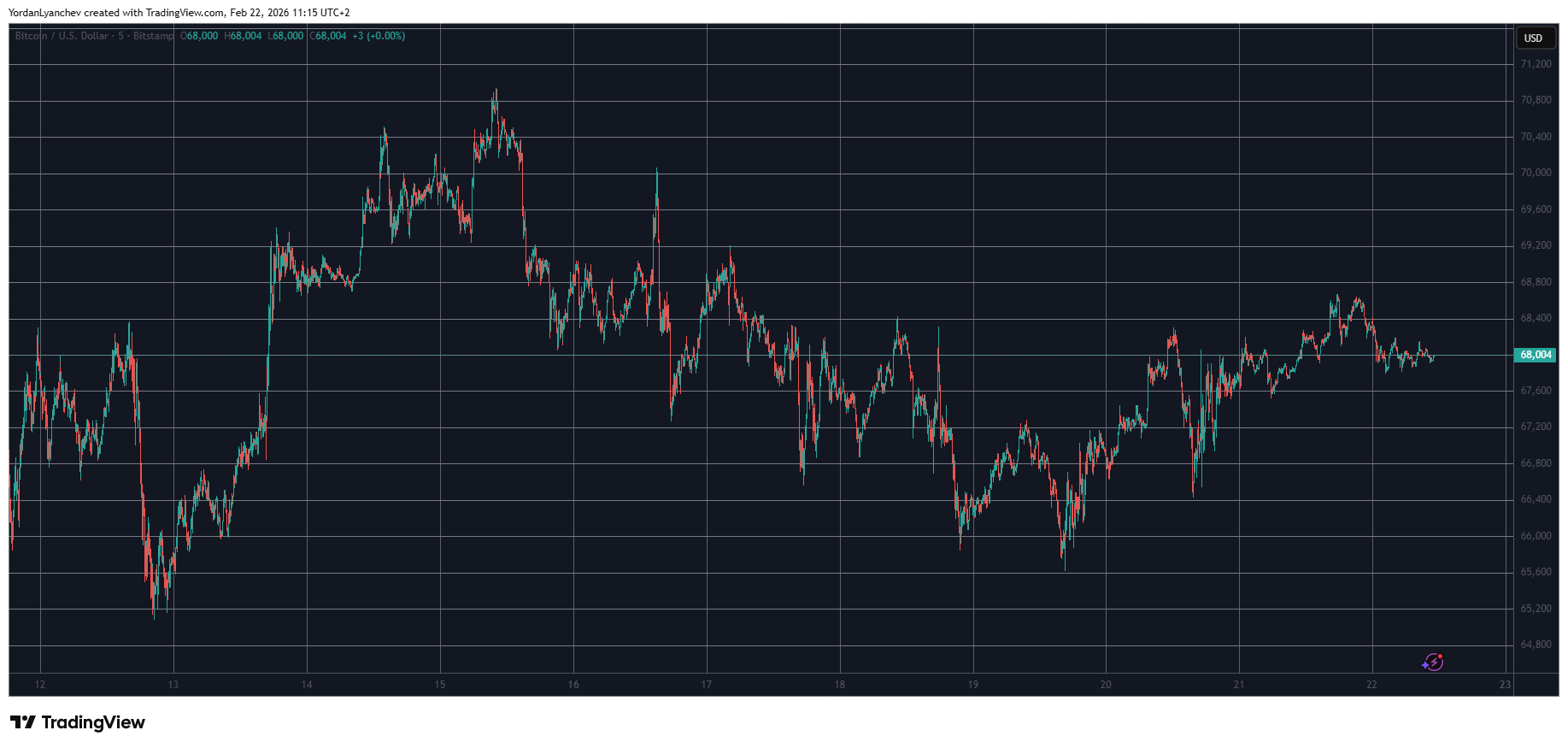
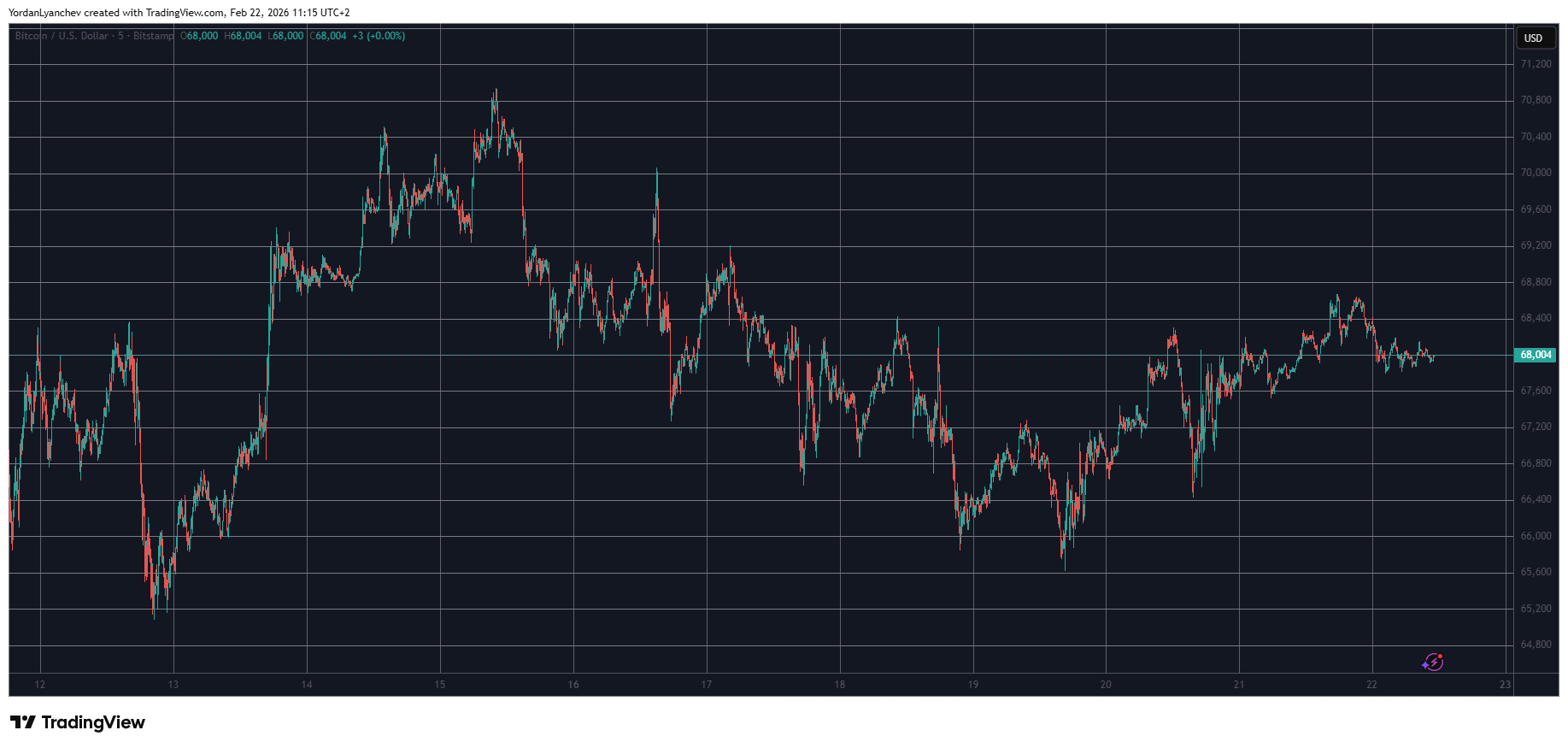
Despite all the latest developments on the tariff front in the US, bitcoin’s price has remained relatively stable during the weekend, and continues to trade around $68,000.
Most larger-cap alts have produced little to no volatility as well over the past day, but some, such as Pi Network’s native token, have slipped once again.
BTC Calm at $68K
Bitcoin marked some gains last weekend after it bounced from the then-low of $65,200. In just a few days, it jumped to almost $71,000 for the first time in about a week. This Sunday surge, though, came to an end as the business week began, and a few consecutive leg downs by the bears drove the asset down to $65,600 on Thursday.
It tried to rebound on Friday and Saturday again, as the bulls managed to take it to a local peak of $68,800. Interestingly, these minor gains came even after some controversial moves on the tariff front, a topic that has typically resulted in more volatility and price declines for BTC.
On Friday, the US Supreme Court ruled that many of Trump’s imposed tariffs were illegal. The POTUS was livid, calling the decision a “disgrace,” and quickly announced a global 10% tariff on top of the existing ones. On Saturday, he raised it to the maximum allowed of 15%.
Although bitcoin now trades below its weekend high, it’s still around $68,000. More volatility could be expected on Sunday evening when the futures markets open, similar to what happened several weeks ago during the EU tariff saga over Greenland.
For now, though, BTC’s market cap stands at $1.360 trillion on CG, while its dominance over the alts is at 56.6%.
PI Declines (Again)
Pi Network’s first anniversary after the launch of its Open Network has not had any positive effect on the underlying asset’s price performance. PI is among the poorest performers in the past 24 hours, losing 6% of value and struggling below $0.165.
Other notable losers include ETC (-8%), ARB (-7%), and ENA (-7%). In contrast, PIPPIN has jumped by more than 17% to almost $0.60.
Most larger-cap alts are also in the red, albeit in a more modest manner. DOGE, ADA, and HYPE have lost the most value (around 3% each), while XRP, LINK, and CC are down by 1%. ETH, SOL, TRX, and BCH have marked insignificant gains.
The total crypto market cap has remained above $2.4 trillion on CG.

SECRET PARTNERSHIP BONUS for CryptoPotato readers: Use this link to register and unlock $1,500 in exclusive BingX Exchange rewards (limited time offer).
Disclaimer: Information found on CryptoPotato is those of writers quoted. It does not represent the opinions of CryptoPotato on whether to buy, sell, or hold any investments. You are advised to conduct your own research before making any investment decisions. Use provided information at your own risk. See Disclaimer for more information.


Ethereum’s co-founder has been disposing of large amounts of ETH for several weeks now.
On-chain data from Arkham Intelligence and Lookonchain showed that Vitalik Buterin has resumed his selling spree of ETH with another multi-million dollar transfer.
The analysts explained that he had withdrawn another batch of 3,500 ETH (worth roughly $7 million at the time) from Aave with the likely intention to sell. At the time of the original post a few hours ago, he had already disposed of 571 ETH ($1.13 million).
After a two-week break, vitalik.eth(@VitalikButerin) is selling $ETH again!
8 hours ago, he withdrew 3,500 $ETH($6.95M) from Aave to sell.
So far, he has already sold 571 $ETH($1.13M).https://t.co/pMvkZHjIyDhttps://t.co/DYpg3yFecJ pic.twitter.com/jLCKLk6hE9
— Lookonchain (@lookonchain) February 22, 2026
CryptoPotato has reported a few similar instances in February alone, in which on-chain data indicated that he had begun disposing of some of his ETH fortune. A February 5 report showed that the project’s co-founder had sold off 2,961 ETH ($6.6 million at the time) in just three days.
A day later, Lookonchain informed that the total sales had grown to 6,183 ETH, which was valued at $13.2 million. The average exit price was $2,140.
Arkham Intelligence keeps a close eye on Buterin’s addresses, and a report from earlier this week noted that he still held more than 240,000 ETH, valued at around $467 million. However, that data was before today’s sell-offs.
Meanwhile, ETH’s price has been on a consistent downtrend for months. After it peaked at close to $5,000 in late August last year, it was violently rejected and ended 2025 at around $3,000. The late January/early February crash was brutal, pushing the asset to under $1,800.
You may also like:
Although it has recovered some ground since then, Ether still struggles below $2,000. Popular analyst Ali Martinez outlined the formation of a bullish flag yesterday for ETH, but with a major catch: the chart was inverted, showing in reality that ETH could be primed for another correction to under $1,400.
SECRET PARTNERSHIP BONUS for CryptoPotato readers: Use this link to register and unlock $1,500 in exclusive BingX Exchange rewards (limited time offer).
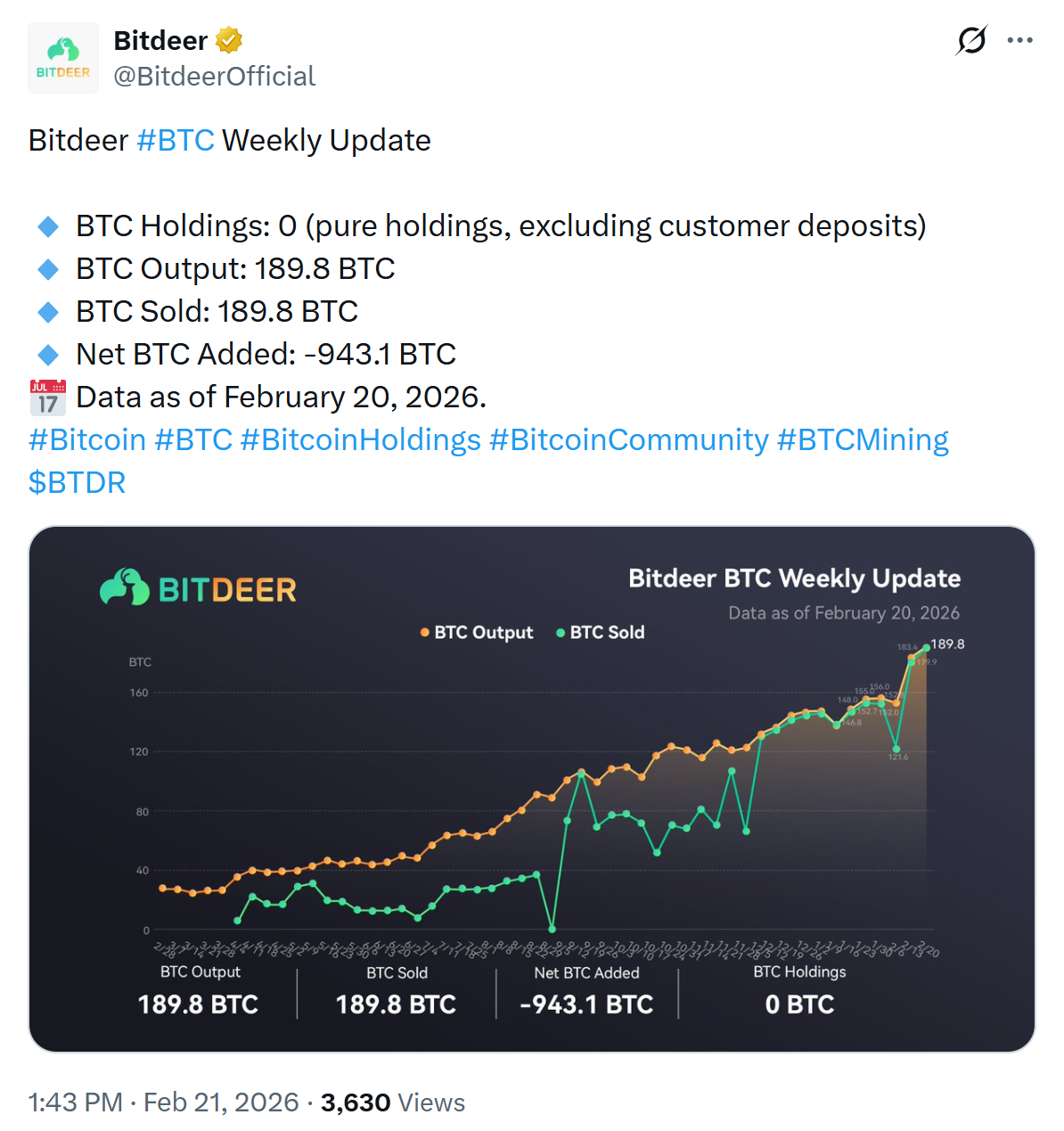
Bitcoin mining firm Bitdeer has sold all of its corporate Bitcoin holdings, reducing its treasury balance to zero, according to the company’s latest operational update.
In its latest weekly report, Bitdeer disclosed that its “pure holdings,” excluding customer deposits, have fallen to 0 Bitcoin (BTC). The report shows the company produced 189.8 BTC during the period and sold the full amount, alongside an additional 943.1 BTC, which was liquidated from its existing treasury reserves.
In its earlier update on Feb. 13, the miner still held 943.1 BTC, selling 179.9 BTC out of 183.4 BTC mined that week, leaving its treasury intact despite routine sales of newly mined coins.

Mining firms commonly sell a portion of production to fund electricity, hosting and equipment costs, but they also maintain a treasury balance to keep exposure to Bitcoin’s price appreciation. Fully liquidating reserves is less typical.
Cointelegraph reached out to Bitdeer for comment, but had not received a response by publication.
Related: Bitcoin mining difficulty rebounds 15% as US miners recover from winter outages
Bitdeer announces $300 million convertible debt raise
On Thursday, Bitdeer’s shares fell sharply after the company announced plans to raise $300 million through a convertible senior note offering, with an option to expand the sale by an additional $45 million. The notes, due in 2032, can later be converted into company stock, cash or a mix of both.
The company, founded by former Bitmain co-founder Jihan Wu, said the funds will support data center expansion, AI cloud growth, mining hardware development and general corporate needs.
Bitdeer has also been expanding its self-mining operations as demand for its mining hardware weakens, increasingly using its own rigs to mine Bitcoin rather than selling them to customers.
Related: Bitcoin miners chase 30 GW AI capacity to offset hashprice pressure
Bitcoin miners pivot to AI
On Friday, MARA Holdings purchased a majority stake in French computing infrastructure firm Exaion, moving deeper into artificial intelligence and cloud services. The deal gives MARA France a 64% ownership position while energy company EDF remains a minority shareholder and customer.
The transaction came amid a wider shift across the mining industry. Following the 2024 halving and tighter margins, several miners have adopted a hybrid model that combines Bitcoin production with AI and high-performance computing revenue.
Companies such as HIVE, Hut 8, TeraWulf and IREN are repurposing facilities and energy infrastructure for data-center use, while firms like CoreWeave have fully transitioned into AI infrastructure providers.
Magazine: Bitcoin may take 7 years to upgrade to post-quantum — BIP-360 co-author

Japanese financial conglomerate SBI Holdings is introducing a blockchain-based bond offering for retail investors, blending traditional fixed-income returns with cryptocurrency incentives.
Key Takeaways:
- SBI is issuing 10 billion yen in tokenized bonds recorded on a blockchain platform.
- Investors will earn fixed interest plus XRP rewards tied to their subscription amount.
- The launch reflects SBI’s broader push to integrate crypto assets into traditional finance.
The new issuance, called the SBI START Bonds, totals 10 billion yen (about $64.5 million) and will be recorded and managed onchain using the “ibet for Fin” platform developed by enterprise blockchain firm BOOSTRY.
The three-year securities carry an indicative annual yield ranging from 1.85% to 2.45%, with interest paid twice a year.
SBI Bond Investors to Receive XRP Rewards Alongside Interest Payments
In addition to fixed returns, eligible investors will receive XRP token rewards. Retail buyers and companies investing at least 100,000 yen (roughly $650) and holding an account with SBI VC Trade qualify for the bonus program.
According to the product details, investors will receive XRP equivalent to about 200 yen per 100,000 yen invested.
The rewards will be distributed at issuance and again alongside each interest payment through 2029.
The bonds are expected to begin secondary trading on March 25 via the Osaka Digital Exchange’s proprietary START trading system, marking another step in Japan’s gradual rollout of tokenized securities markets.
SBI’s move reflects its long-standing ties to the XRP ecosystem. The firm partnered with Ripple in 2016 and has since supported XRP-powered remittance services, including cross-border payments between Japan and the Philippines.
Chairman and CEO Yoshitaka Kitao has previously said SBI holds roughly 9% of Ripple Labs, underscoring the company’s strategic alignment with the network.
Founded in 1999 as part of SoftBank before becoming independent in 2006, SBI has grown into a major financial group with more than $8 billion in annual revenue.
BREAKING — X Finance Bull (@Xfinancebull) February 21, 2026
 SBI Ripple Asia just confirmed $XRP Ledger is being implemented by financial institutions worldwide!
We're buying this at these prices while global finance is being rebuilt on it
When every institution plugs in, the demand won't be quiet
YOU ARE STILL EARLY! https://t.co/AuuTxuWu9U pic.twitter.com/TADxEPqiIk
Over the years, the company has expanded beyond brokerage and banking into digital assets, stablecoins and blockchain infrastructure.
SBI has also worked with Circle to introduce the USDC stablecoin in Japan and signed a memorandum of understanding with Ripple to distribute its RLUSD stablecoin.
By pairing bonds with crypto incentives, the firm is testing whether traditional investors will adopt tokenized securities that offer familiar yields alongside blockchain-based settlement and rewards.
In August last year, Ripple signed a memorandum of understanding with SBI Holdings and its crypto arm SBI VC Trade to distribute its Ripple USD (RLUSD) stablecoin in Japan.
Ripple Secures UK Regulatory Approval Amid Global Expansion
The rollout comes amid Ripple’s broader expansion across regulated markets. Earlier this month, the company received approval from the UK’s financial regulator for an Electronic Money Institution license and crypto asset registration.
Ripple has also secured preliminary approval for a similar license in Luxembourg, positioning the firm to expand its payments services across Europe.
In the United States, Ripple applied for a national banking license with the Office of the Comptroller of the Currency in July 2025, joining a growing list of crypto firms seeking deeper integration with the traditional financial system.
In recent months, the company has also secured approvals in Dubai and Abu Dhabi and onboarded partners including Zand Bank and Mamo.
As reported, Ripple is also weighing whether to bring staking to the XRP Ledger (XRPL), a move that would push the decade-old blockchain deeper into the rapidly expanding world of decentralized finance.
The post SBI Holdings Launches 10B Yen Blockchain Bond With XRP Rewards appeared first on Cryptonews.

REITs, InvITs to play larger role in enhancing portfolio returns: Radhavi Deshpande

6 Modern War TV Shows That Are 10/10, No Notes

Phillipson Refuses to Say US Could Use UK Military Bases to Hit Iran

Smart energy pays enters the US market, targeting scalable financial infrastructure

Why Israel is blocking foreign journalists from entering

Software stocks enter bear market on AI disruption fear with ServiceNow plunging 10%

Gareth Soloway Shares What’s Next for Bitcoin, Ethereum, XRP, Gold, Silver & Stocks!

The $900 Billion Supreme Court ‘Rug Pull’ That Could Send Bitcoin Parabolic!

#dinero #enbuscadelosmejoresprecios #money #yosoydelos7mil #coin #movimientoelamorhacealmundogirar
-

 Video6 days ago
Bitcoin: We’re Entering The Most Dangerous Phase
-

 Crypto World5 days ago
Can XRP Price Successfully Register a 33% Breakout Past $2?
-

 Video2 days ago
XRP News: XRP Just Entered a New Phase (Almost Nobody Noticed)
-

 Fashion2 days ago
Weekend Open Thread: Boden – Corporette.com
-

 Sports5 days ago
GB's semi-final hopes hang by thread after loss to Switzerland
-

 Politics5 hours ago
Baftas 2026: Awards Nominations, Presenters And Performers
-
 Tech5 days ago
The Music Industry Enters Its Less-Is-More Era
-

 Business4 days ago
Infosys Limited (INFY) Discusses Tech Transitions and the Unique Aspects of the AI Era Transcript
-

 Entertainment4 days ago
Kunal Nayyar’s Secret Acts Of Kindness Sparks Online Discussion
-

 Video5 days ago
Financial Statement Analysis | Complete Chapter Revision in 10 Minutes | Class 12 Board exam 2026
-

 Tech4 days ago
Retro Rover: LT6502 Laptop Packs 8-Bit Power On The Go
-
 Sports3 days ago
Clearing the boundary, crossing into history: J&K end 67-year wait, enter maiden Ranji Trophy final | Cricket News
-

 Entertainment4 days ago
Dolores Catania Blasts Rob Rausch For Turning On ‘Housewives’ On ‘Traitors’
-

 Business4 days ago
Tesla avoids California suspension after ending ‘autopilot’ marketing
-
 NewsBeat7 days ago
The strange Cambridgeshire cemetery that forbade church rectors from entering
-

 Politics5 days ago
Eurovision Announces UK Act For 2026 Song Contest
-

 Crypto World4 days ago
WLFI Crypto Surges Toward $0.12 as Whale Buys $2.75M Before Trump-Linked Forum
-
 NewsBeat7 days ago
Man dies after entering floodwater during police pursuit
-

 Crypto World3 days ago
83% of Altcoins Enter Bear Trend as Liquidity Crunch Tightens Grip on Crypto Market
-
 NewsBeat2 days ago
Andrew Mountbatten-Windsor latest: Police search of Royal Lodge enters second day after Andrew released from custody