

Crypto World
Elliptic Flags Network of Russian Crypto Platforms Bypassing Sanctions


A group of cryptocurrency exchanges linked to Russia is helping users move funds outside the reach of Western financial restrictions, according to a report released Saturday by blockchain analytics firm Elliptic.
Key Takeaways:
- Elliptic identified five Russia-linked crypto exchanges providing pathways to bypass Western sanctions.
- Only one platform is formally sanctioned, yet several processed large transactions with restricted entities.
- Activity has shifted across multiple services, suggesting enforcement actions redirect rather than halt flows.
The study identifies five trading platforms, most of them not formally sanctioned, that continue to provide channels for high-volume crypto transactions beyond the oversight of the traditional banking system.
The findings arrive as European officials consider tighter measures, including a potential blanket ban on crypto transactions involving Russia, amid concerns that new platforms are emerging to replace previously targeted operators.
Elliptic: Nearly 10% of Bitpapa Transactions Tied to Sanctioned Targets
Among the exchanges examined, only the peer-to-peer marketplace Bitpapa is under US sanctions.
The US Treasury’s Office of Foreign Assets Control (OFAC) designated the platform in March 2024 for alleged sanctions evasion.
Elliptic found that about 9.7% of Bitpapa’s outgoing transactions were linked to sanctioned entities and that the exchange frequently rotated wallet addresses to make monitoring more difficult.
The report also highlights ABCeX, an unsanctioned exchange operating from Moscow’s Federation Tower, the same building previously used by Garantex before US authorities seized its domains in March 2025.
Elliptic estimates ABCeX has processed at least $11 billion in crypto, with significant transfers flowing to Garantex and another exchange, Aifory Pro.
JUST IN: — Watcher.Guru (@WatcherGuru) February 10, 2026

 European Union proposes banning all crypto transactions with Russia to prevent sanctions evasion. pic.twitter.com/4FlGZJJorB
Another case involves Exmo, which said it exited the Russian market after the 2022 invasion of Ukraine by selling its regional operations to a separate entity, Exmo.me.
Elliptic’s analysis suggests operational ties remain: both services appear to share custodial infrastructure and pooled hot wallets.
The firm recorded more than $19.5 million in transactions between Exmo and sanctioned exchanges, including Garantex, Grinex and Chatex.
Rapira, registered in Georgia but maintaining a Moscow office, was also flagged after sending over $72 million directly to sanctioned exchange Grinex.
Authorities in Russia reportedly raided Rapira’s offices in late 2025 over suspected capital transfers to Dubai.
The fifth platform, Aifory Pro, operates cash-to-crypto services in Moscow, Dubai and Turkey.
The company reportedly offers virtual payment cards funded with USDT that allow Russian users to access services restricted by Western providers. Elliptic also traced nearly $2 million from Aifory Pro to the Iranian exchange Abantether.
Sanctions Shift Activity, Illicit Crypto Volume Hits Record High
Researchers say the network illustrates how enforcement actions can shift activity rather than eliminate it.
After the shutdown of Garantex, transaction volumes rose on other exchanges, according to data from multiple analytics firms.
Chainalysis reported that illicit crypto addresses received a record $154 billion in 2025, while TRM Labs produced a similar estimate of $158 billion.
As reported, Russia’s industrial crypto mining sector continued to expand in 2024, with the country’s two largest operators, BitRiver and Intelion, generating a combined $200 million in revenue and accounting for more than half of the legal market.
The post Elliptic Flags Network of Russian Crypto Platforms Bypassing Sanctions appeared first on Cryptonews.


TLDR:
- Elliptic links five crypto exchanges to structured routes used for Russian sanctions evasion through P2P and broker networks.
- Wallet sharing between Russian and non-Russian platforms allows sanctioned funds to mix with compliant trading activity.
- Cash-to-crypto services now support cross-border trade payments and access to restricted foreign digital services.
- Blockchain data shows direct financial exposure between these exchanges and multiple sanctioned entities.
Russia-linked crypto services continue to create pathways around international sanctions, according to new blockchain intelligence findings. Several exchanges still provide transaction routes that bypass traditional banking oversight through cryptoasset conversions.
These platforms allow ruble-based funds to move across borders with limited visibility. The activity persists despite increasing regulatory scrutiny on Russia-focused crypto trading.
Five Crypto Exchanges Help Russia Evade Sanctions via Trading Networks
Data published by Elliptic shows that several crypto exchanges maintain financial links to sanctioned Russian entities. These services convert rubles into crypto assets and route them abroad through peer-to-peer and broker networks.
Bitpapa operates as a P2P exchange registered in the UAE but primarily targets Russian users.
U.S. authorities sanctioned the platform in March 2024 for supporting sanctions evasion. Elliptic reports that nearly 10 percent of Bitpapa’s outgoing crypto flows reached sanctioned entities, including direct exposure to Garantex.
Blockchain data also indicates that Bitpapa rotates wallet addresses to avoid detection by transaction monitoring systems.
This strategy obscures the Russian origin of funds when they reach overseas services. The approach complicates compliance checks for counterparties receiving those assets.
Another exchange, ABCeX, facilitates both order-book and P2P ruble trading. It operates from Moscow’s Federation Tower, previously linked to sanctioned platforms.
Elliptic estimates ABCeX processed at least $11 billion in crypto assets, with substantial transfers to Garantex and Aifory Pro.
Wallet Sharing and Cash-to-Crypto Routes Raise Compliance Risks
Elliptic also examined the operational structure of Exmo, which claimed to exit the Russian market after 2022.
The company stated that its Russian business transferred to a separate entity, Exmo.me. On-chain data, however, shows both platforms use the same custodial wallet infrastructure.
Deposits from both services pool into identical hot wallets, while withdrawals originate from the same addresses. This structure allows Russian-facing flows to mix with Western-facing operations.
Elliptic identified more than $19.5 million in direct transactions between Exmo-linked wallets and sanctioned entities, including Grinex and Chatex.
Rapira, incorporated in Georgia but operating from Moscow, also appears in the dataset. Elliptic reports that Rapira moved over $72 million in crypto assets to and from Grinex.
Russian authorities reportedly raided its Moscow offices during a capital flight investigation tied to Dubai transfers.
Aifory Pro specializes in cash-to-crypto services across Moscow, Dubai, and Türkiye. It acts as a payment agent for foreign trade, including transactions between Russia and China.
The firm also offers virtual and Apple Pay-enabled cards funded by USDT balances to access blocked services like Airbnb and ChatGPT.
Elliptic further identified financial links between Aifory Pro and Abantether, with nearly $2 million in cryptoassets transferred. These flows highlight growing intersections between Russian and Iranian crypto networks.
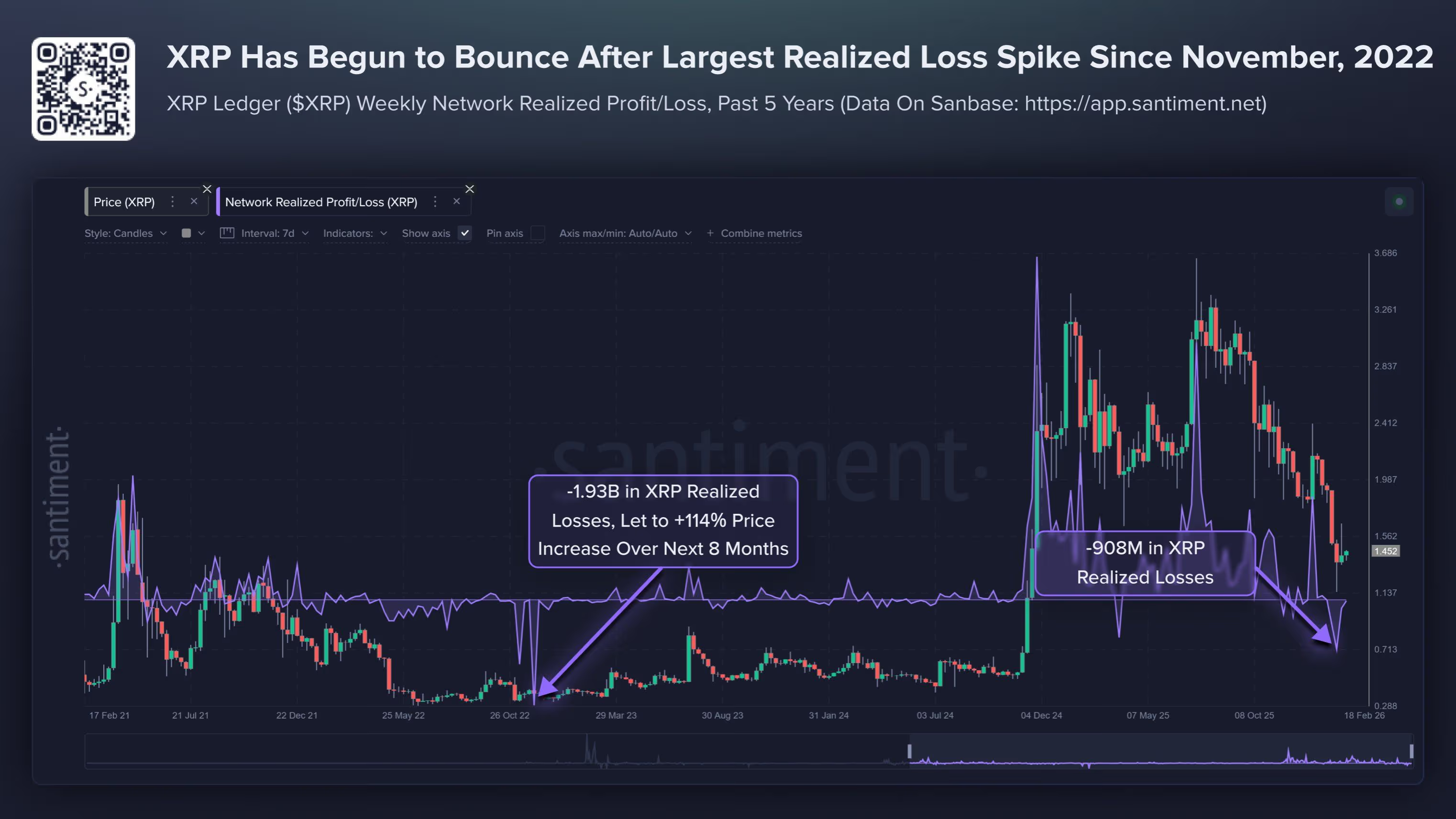
XRP has just logged its largest weekly realized loss spike since 2022, a sign that panic selling may have reached an extreme.
On-chain data shows roughly $1.93 billion in realized losses in a single week, meaning coins moved at prices below their original purchase levels. The last time losses of that magnitude were recorded, about 39 months ago, XRP went on to rally 114% over the following eight months.

Realized losses measure actual losses, not paper drawdowns. They spike when holders capitulate, choosing to lock in losses rather than wait for a rebound. Unlike unrealized losses, which can vanish if price recovers, realized losses represent final decisions.
That absorption piece matters.
For realized losses to surge into the billions, there must be aggressive selling pressure, but there must also be buyers willing to take the other side. Large capitulation events often coincide with liquidity stepping in at lower levels. Historically, these moments tend to cluster near market bottoms because much of the weaker positioning gets cleared out in one move.
When weak hands are flushed, the composition of holders shifts. The coins that change hands during capitulation typically move from short-term, emotionally driven traders to longer-term buyers with stronger conviction or better cost bases. That redistribution can create a more stable foundation for price.
However, context is key. The 2022 spike came after a prolonged drawdown and broader crypto deleveraging. Today’s environment includes macro uncertainty, shifting regulatory narratives and still-elevated volatility across majors. A realized loss spike increases the probability that sellers are exhausted, but it does not eliminate macro headwinds.
Another variable to watch is follow-through. In prior cycles, sustained recoveries required not just a single capitulation print but stabilization in spot demand and declining sell pressure in the weeks that followed. If realized losses remain elevated or quickly re-accelerate, that would suggest distribution is not finished.
For now, the data points to emotional extremes. Historically, that has been fertile ground for rebounds. Whether it becomes a durable trend shift depends on what happens after the panic subsides.
TLDR:
- SegWit’s soft fork structure detached signatures from transactions but increased protocol complexity for long-term maintenance.
- Developers argue soft forks restrict the range of upgrades compared with direct hard fork protocol changes.
- The debate reflects tension between backward compatibility and Bitcoin’s need for technical evolution.
- SegWit’s activation still influences how governance decisions are framed inside the Bitcoin community.
A long-running debate over Bitcoin’s SegWit upgrade has resurfaced after a developer published a detailed critique on X. The post challenges both the technical design of SegWit and the governance philosophy behind its activation.
It argues that the upgrade added complexity while restricting future network changes. The remarks have renewed discussion about how Bitcoin evolves and who controls that process.
SegWit criticism focuses on soft fork design and technical complexity
In a tweet, Calin Culianu described SegWit as an unnecessarily complicated solution to transaction signature handling.
He said the upgrade detached signatures from transactions through what he labeled extension blocks, increasing structural overhead for nodes.
According to his account, a direct redesign using a hard fork would have delivered a simpler and cleaner transaction format. He argued that the chosen method forced developers to rely on backward-compatible tricks instead of straightforward protocol changes.
SegWit activated in 2017 through a soft fork tied to Bitcoin Core version 0.13.1, according to historical release records.
The soft fork approach allowed older nodes to remain operational without recognizing the new rules.
Culianu said this design introduced long-term technical debt and made future upgrades harder to implement. He framed SegWit as a symbolic test that normalized complex upgrades rather than transparent protocol changes.
Bitcoin governance dispute centers on hard forks and network scalability
The post also criticized what it called a cultural shift toward rejecting hard forks entirely within Bitcoin development circles.
Culianu claimed this position emerged to preserve compatibility rather than to improve performance or transaction throughput.
He argued that soft forks limit the scope of possible upgrades, including those aimed at higher transaction capacity.
His comments linked SegWit’s design to broader resistance against expanding block space or altering core rules directly.
The developer suggested that avoiding hard forks reduced the risk of chain splits but also constrained innovation. He said this model made large-scale changes politically difficult, even when technical needs grew.
Community reactions on social platforms showed mixed responses, with some defending SegWit’s role in fixing transaction malleability.
Others echoed concerns that governance priorities had shifted away from scalability and toward strict conservatism. The discussion reflects ongoing tension between stability and adaptability in Bitcoin’s development path.
It also highlights how past technical choices continue to shape present debates over decentralization and network capacity.
Crypto World
ProShares’ stablecoin-ready ETF has $17 billion debut, sparking speculation about Circle
ProShares’ new ETF built for the fast-growing, $300 billion world of stablecoins had a massive launch, fueling speculation that one major stablecoin issuer may be involved.
The fund, called the ProShares GENIUS Money Market ETF (IQMM), is designed to hold short-term U.S. Treasuries and meet the reserve requirements laid out in the GENIUS Act, a federal law regulating stablecoin issuers in the U.S. It’s the first ETF structured specifically to fit those rules, and that positioning may have caught the attention of some of the largest players in crypto.
The ETF logged a whopping $17 billion in trading volume on its first day, suggesting that some large players were allocating to the fund. For context, BlackRock’s spot bitcoin ETF — one of the most anticipated launches in many years— saw $1 billion in first-day volume.
Circle moving funds or internal shuffle?
The massive volume has left analysts speculating about the source of the inflows.
Nate Geraci, president of The ETF Store, said in an X post that the heavy flows might signal a deal with a major U.S.-based stablecoin issuer. “Looking at assets, believe that would only leave Circle,” he said, referring to the company behind the $74 billion USDC token.
However, Circle’s main reserve fund for USDC, managed by BlackRock, hasn’t shown any major changes so far. It held nearly $64 billion in assets as of Friday, up from $59 billion at the end of January, data shows.
What’s more likely is that the initial volume came from ProShares’ own funds moving assets for cash management purposes.
Ben Johnson, head of client solutions for asset management at Morningstar, noted that one of ProShares’ leveraged ETFs, QTTT, moved $6 billion into IQMM on launch day. That kind of internal allocation would explain a large portion of the day-one activity.
Playbook for stablecoin reserves
Still, demand from stablecoin issuers is a real possibility. With over $300 billion in U.S. dollar stablecoins in circulation, a significant portion of those reserves could eventually be allocated to ETFs like IQMM.
Markus Thielen, founder of 10x Research, wrote in a Friday report that IQMM is “currently the only purpose-built tool” that meets the GENIUS Act rules while providing high-speed liquidity.
That could make it a go-to choice for U.S.-based issuers like Circle, Paxos and BitGo — and even for banks looking to issue their own tokenized deposits under the new law. Tether, which runs the largest stablecoin in the world with the $184 billion USDT token, has also rolled out a stablecoin with federal bank Anchorage Digital in the U.S. market.
As stablecoins become increasingly regulated with new tokens launching, tens of billions in additional assets could eventually flow into funds like IQMM, Thielen said.
TLDR:
- Bitdeer’s weekly update confirmed zero corporate Bitcoin holdings after selling both new output and reserves.
- The company mined 189.8 BTC and sold 1,132.9 BTC total during the reporting period ending February 20.
- Bitdeer now leads public miners in self-managed hashrate, surpassing Marathon Digital’s internal capacity.
- A $325 million convertible notes deal supported debt refinancing and data center expansion for mining and AI services.
Bitdeer disclosed that it now holds zero Bitcoin after selling its entire treasury position. The move followed a week in which the company mined Bitcoin and liquidated both new output and reserves.
The update placed Bitdeer at the top of publicly traded miners by self-managed hashrate. The announcement triggered a market reaction and renewed focus on miners’ balance sheet strategies.
Bitdeer Bitcoin holdings fall to zero after full liquidation
Bitdeer reported that its pure Bitcoin holdings dropped to zero as of February 20, 2026. The company clarified that the figure excludes customer deposits and reflects only corporate reserves.
Data shared through its weekly update showed Bitcoin output of 189.8 BTC during the period. Bitdeer sold the same 189.8 BTC and an additional 943.1 BTC from existing reserves.
The company posted the figures on its official X account, accompanied by a line chart. The chart tracked output, sales, net additions, and holdings from late January through February 20.
The update followed a $325 million convertible notes offering earlier this month. The funding aimed to refinance debt and support expansion of mining and AI cloud infrastructure.
Bitdeer linked the decision to higher operating costs and reduced reliance on volatile Bitcoin reserves. The firm has increased focus on liquidity management while scaling its data center footprint.
Self-managed hashrate surpasses Marathon as market reacts
Bitdeer’s self-managed Bitcoin hashrate has now surpassed that of Marathon Digital, also known as Mara. This milestone makes Bitdeer the publicly traded miner with the largest internally operated hashrate.
The company emphasized that self-managed capacity excludes hosted or customer-owned mining machines. This metric reflects only infrastructure controlled directly by Bitdeer.
The mining firm is owned by Jihan Wu, a long-time figure in the mining sector. His company has shifted toward vertical integration of mining and computing services.
Following the disclosure, Bitdeer shares fell about 2 percent to roughly $7.78. The decline reflected investor concern over dilution tied to the recent convertible debt issuance.
Company updates described the Bitcoin sales as part of a broader liquidity strategy. The approach prioritizes funding for energy costs and capital-intensive expansion projects.
Bitdeer continues to report weekly figures on production and asset movements. The firm has positioned transparency as a way to track operational performance in a competitive mining market.
Crypto World
When Will Ripple’s (XRP) Bull Run Resume? We Asked 4 AIs (And Their Answers Surprised Us)


The AI solutions agreed that XRP is currently hunting for a bottom. Also, a few of them put massive price targets for the asset.
Ripple’s cross-border token has been highly volatile since the US presidential elections in late 2024. At the time, it traded at $0.60, exploded to its 2018 all-time high of $3.40 in January 2025, plunged in the following months, before it skyrocketed to a new record of $3.65 in July.
Since then, it has been mostly downhill, with the asset currently sitting below $1.40 – or a 62% decline since the July peaks. Most recently, it was rejected at $2.40 in early January, dumped to $1.11 a month later, but has found some support at the aforementioned level.
Being more than 60% down in just several months puts it in a bearish territory. Consequently, we decided to ask ChatGPT, Gemini, Grok, and Perplexity how long it would take for XRP to reignite its bull run and head for new records.
Find a Bottom First
Before even having a theoretical chance of reversing its trend, XRP would need to bottom out first. OpenAI’s platform noted that the token is currently searching for it, which could happen by April, but before it does, it could face even harsher declines if history is any indication:
“Historically, February has been weak for XRP, and 2026 is no exception. The asset has posted losses in most Februarys, averaging declines and severe drawdowns in prior cycles.”
Nevertheless, ChatGPT and Perplexity agreed that several factors have aligned to suggest that XRP’s bottom might be rather close – a 50% month decline from January 6 to February 6 was met with immediate buying pressure, funding rates reached deeply negative levels, a development that preceded rallies in the past, and panic selling appears to have subsided.
Recovery and Run Reignition
Gemini and Grok were somewhat optimistic that XRP could indeed locate a bottom by spring 2026, which would open the door for the next phase – “base building and recovery.” In this neutral-to-cautiously bullish stage, XRP could regain some traction by the beginning of the summer season.
Gemini was even more specific, indicating that the asset would need to reclaim the 50-day EMA, currently located at around $1.80, to signal the traditional exit from bearish territory.
You may also like:
ChatGPT agreed to an extent, but warned that most of the highly anticipated bullish catalysts from the past few years, such as the SEC lawsuit resolution and the approval of spot XRP ETFs, are already behind the token, so it might be in search of new ones. As such, it was rather conservative in predicting a target for the summer, putting a base case around the $2.40 range.
“If XRP reclaims $2, the market will likely consider the bear phase technically over,” said Grok.
All AIs noted that a full-on bull phase wouldn’t start by at least Q3 of this year, most likely in Q4. Once it begins, though, they added that XRP is positioned to benefit a lot, indicating some massive targets for the longer-run.
“$8 by year-end 2026 in aggressive institutional adoption scenarios,” said ChatGPT
“$8-13 long-term consolidation breakout targets,” – noted Perplexity.
Binance Free $600 (CryptoPotato Exclusive): Use this link to register a new account and receive $600 exclusive welcome offer on Binance (full details).
LIMITED OFFER for CryptoPotato readers at Bybit: Use this link to register and open a $500 FREE position on any coin!
TLDR:
- SBI will issue Security Token bonds through blockchain instead of traditional depository systems used in Japanese capital markets.
- Retail investors can trade the bonds on a digital exchange platform starting in March 2026.
- Eligible bondholders will receive XRP benefits tied to their subscription and interest payment dates.
- The project supports Japan’s push to merge regulated finance with token-based settlement systems.
SBI Holdings has unveiled plans to issue its first Security Token bonds aimed at individual investors in Japan. The offering marks a shift from traditional bond management toward blockchain-based issuance and settlement.
Trading will begin on a digital marketplace designed for retail participation. The move signals a broader push to integrate tokenized assets into regulated capital markets.
Security Token bonds enter Japan’s retail market
SBI Holdings filed an amended shelf registration with the Kanto Local Finance Bureau to prepare the bond sale. The bonds will carry the nickname SBI START Bonds and operate under a digital transfer registration system.
Unlike conventional bonds recorded through Japan Securities Depository Center, the issuance will rely on blockchain infrastructure. SBI will use the ibet for Fin platform developed by BOOSTRY to manage the full lifecycle.
The digital system will handle issuance, administration, and redemption electronically. SBI said this approach removes paper-based processing and reduces reliance on legacy settlement workflows.
Retail trading will start on March 25, 2026, through the proprietary trading system START. The platform is operated by Osaka Digital Exchange and will allow individual investors to buy and sell the bonds in an open market.
XRP rewards and blockchain settlement model
Investors who purchase the Security Token bonds will receive XRP benefits linked to their subscription amounts. SBI confirmed that only domestic residents and corporations qualify for the incentive.
To receive the XRP, bondholders must open an account with SBI VC Trade and complete required procedures by the stated deadline. Distribution will occur on each interest payment date through 2029.
The company framed the reward structure as part of its broader digital asset strategy. SBI has expanded its blockchain operations through partnerships, investments, and proof-of-concept trials across Japan.
The group said tokenized bonds support its vision of an economy where transactions and settlements occur directly on blockchain networks. Officials also stated that growth in the Security Token bond market could help modernize Japan’s capital markets.
According to the company’s disclosure, the issuance will not materially affect consolidated financial results. SBI positioned the project as an infrastructure experiment rather than a revenue driver.
The bond launch follows a wider trend among Japanese financial firms to test tokenized securities under existing regulatory frameworks.
SBI described the initiative as a step toward linking traditional finance with on-chain settlement systems while keeping investor protections intact.

Bitcoin has drawn renewed attention from traders and analysts as data-driven signals suggest a potential upside path into 2027, even amid a recent stretch of muted sentiment. An informal metric developed by market economist Timothy Peterson points to an 88% probability that BTC/USD will be higher by early 2027, a claim grounded in monthly patterns dating back to 2011. If history repeats, the model implies a price near $122,000 per coin within ten months, positioning Bitcoin for what some view as an “average return” rather than a rapid meteoric rise. The narrative sits alongside a broader chorus of bullish commentary from major banks and market observers who continue to think Bitcoin can stage a substantial recovery in the coming year, even as risk-off currents persist across traditional markets.
Key takeaways
- An informal metric from Timothy Peterson suggests a roughly 88% chance BTC/USD will be higher by early 2027, based on historical frequency of positive months.
- Under this scenario, Bitcoin could reach about $122,000 per coin within ten months, which would equate to an “average return” given past performance since 2011.
- Despite a period of underperformance since late 2025, bullish forecasts remain active, with analysts highlighting inflection-point dynamics rather than precise price targets.
- Bernstein has surfaced a bulls-case target of around $150,000 for Bitcoin, underscoring continued institutional interest in a multiyear rally.
- Wells Fargo’s note flags potential capital inflows into Bitcoin and equities totaling about $150 billion by the end of March, suggesting further speculative appetite.
Tickers mentioned: $BTC
Sentiment: Bullish
Price impact: Positive. The convergence of upbeat forecasts and improving sentiment could support upside momentum for Bitcoin in the near term.
Trading idea (Not Financial Advice): Hold. While the setup leans toward upside, volatility and macro risk warrant a cautious stance until clearer directional signals emerge.
Market context: The market has been digesting a mix of technical signals and macro influences, with a notable divergence between short-term momentum and longer-horizon forecasts. The discussion around Bitcoin’s path centers on whether historical patterns can translate into a sustained rally despite periodic pullbacks and risk-on/risk-off cycles that characterize crypto liquidity and funding conditions.
Why it matters
The ongoing debate about Bitcoin’s trajectory sits at the intersection of on-chain behavior, macro liquidity, and evolving investor psychology. If Peterson’s 88% odds hypothesis holds, it would suggest that the crypto market has entered a phase where repeated positive monthly readings can precede a meaningful upside. The reference point of $122,000, anchored to a decade of price data, provides a tangible milestone that traders and risk managers can monitor against volatility spikes and pullbacks.
Institutional interest remains a persistent tailwind for the bull case. Bernstein’s recent analysis arguing for a $150,000 target signals that large-scale wealth and professional funds continue to view Bitcoin as a potential long-horizon hedge and return driver, not merely a speculative asset. At the same time, Wells Fargo’s note on potential inflows—citing a $150 billion expansion into Bitcoin and equities by the end of March—highlights the interplay between crypto markets and traditional asset streams. The combination of high-conviction targets and expected capital inflows underscores a continued re-pricing dynamic in which narrative and data-driven signals reinforce each other.
Nonetheless, the mood within the market remains fractured. Peterson’s own work cautions that the metric he discusses emphasizes inflection points rather than precise targets, and a survey cited in the report points to prevailing bearish sentiment in parts of the crypto ecosystem. The tension between a favorable long-term thesis and a wobbling near-term momentum is typical of a market navigating a transition from macro-tilted risk-off periods to periods of renewed speculative interest. In other words, the narrative is compelling, but the path to a sustained rally is likely to be choppy, with volatility continuing to reflect shifting risk appetites across both crypto and broader financial markets.
Beyond the headline forecasts, the story includes practical market dynamics that have featured in recent reporting. For example, even as some analysts flag upside potential, others point to recent price patterns and the episodic nature of Bitcoin’s momentum. There is also recognition that positive data points can coexist with caution about timing—investors are watching for concrete catalysts that could shift the trajectory from consolidation to a more pronounced up-leg. The crypto ecosystem has also seen episodes where large holders or “whales” participate in accumulation, offsetting sell pressure and contributing to sporadic surges in price. This pattern of selective accumulation has been noted in related coverage and remains a factor that traders monitor as they assess the probability of a sustained breakout. See for example commentary highlighting whale-driven V-shaped accumulation as a counterweight to sell-offs.
In this backdrop, the narrative remains nuanced: the macro backdrop is not uniformly bullish, but there is a persistent belief among a subset of market observers that Bitcoin’s longer-run risk-reward profile justifies continued interest. The expectation is that if the next few quarters deliver supportive price action and a stream of positive signals—on-chain activity, liquidity, and institutional participation—the market could sustain an upward drift that aligns with the optimism expressed by Bernstein and others. Meanwhile, the data points that have historically preceded rallies—such as a persistent sequence of higher months and improving on-chain metrics—will continue to be scrutinized as potential inflection signals rather than definitive price triggers.
Additional context comes from the broader conversation around crypto sentiment and risk appetite. The market’s mood can swing rapidly in response to macro news, regulatory developments, or shifts in funding conditions on major exchanges. The 2021–2022 era of rapid price appreciation followed by sharp corrections has conditioned market participants to weigh upside potential against the risk of retracements. In that sense, Peterson’s framework offers a lens to identify potential turning points, while Bernstein’s and Wells Fargo’s forecasts remind investors that price targets are only one piece of a complex puzzle. Investors facing this environment are likely to weigh multiple signals—price momentum, on-chain activity, institutional commentary, and macro indicators—before committing to meaningful exposure shifts.
Looking ahead, the interplay between these forecasts, market sentiment, and actual price action will be pivotal. The crypto market has shown resilience when liquidity returns and risk tolerance improves, yet the path to a durable rally requires sustained participation from both retail and institutional players. As analysts continue to publish scenarios that hinge on historical patterns repeating, traders should remain attentive to contingency setups, including potential catalysts that could accelerate or pause the rally. The balance of probabilities remains cautiously bullish, anchored by data-driven signals and the prospect of deeper institutional engagement, but never free of risk.
Sources and verifications discussed in this article include a pair of data-driven signals and commentary from market researchers and financial institutions, along with linked materials that capture the ongoing discourse around Bitcoin’s price path.
What to watch next
- Monitor BTC price action toward the $122,000 target within the next ten months and observe how monthly performance aligns with Peterson’s frequency-based metric.
- Track updates to Bernstein’s price scenario and Wells Fargo’s capital-flow expectations for Bitcoin and related equities, including any new investor communications or research notes.
- Watch for shifts in market sentiment as measured by surveys or social-media signals tied to crypto views, particularly around inflection-point indicators.
- Observe on-chain accumulation patterns, especially among large holders, as reported in relevant analyses and linked research notes.
Sources & verification
- Timothy Peterson’s X posts detailing the 88% odds via a trailing-month metric measuring frequency of positive months (data goes back to 2011).
- Bernstein’s analysis citing a $150,000 BTC target and framing Bitcoin’s decline as the “weakest bear case” in history.
- Wells Fargo’s note on potential $150 billion in inflows into Bitcoin and stocks by the end of March, highlighting growth in speculative participation.
- Reports and data on whale accumulation dynamics and related on-chain signals referenced in coverage surrounding V-shaped accumulation patterns.
- Historical discussion of Bitcoin price targets and market sentiment within the crypto narrative and linked market commentary.
Bitcoin momentum and the road ahead
Bitcoin (CRYPTO: BTC) has drawn renewed attention from traders and analysts as data-driven signals suggest a potential upside path into 2027, even amid a recent stretch of muted sentiment. An informal metric developed by market economist Timothy Peterson points to an 88% probability that BTC/USD will be higher by early 2027, a claim grounded in monthly patterns dating back to 2011. If history repeats, the model implies a price near $122,000 per coin within ten months, positioning Bitcoin for what some view as an “average return” rather than a rapid meteoric rise. The narrative sits alongside a broader chorus of bullish commentary from major banks and market observers who continue to think Bitcoin can stage a substantial recovery in the coming year, even as risk-off currents persist across traditional markets.
The analysis frames its outlook around a few core ideas. First, the notion that a substantial portion of monthly price action over the past two years has been positive—roughly half—creates a probabilistic backdrop for a potential upward swing. Peterson explains that his metric measures frequency, not magnitude, so it could still register a down-month even in a broader uptrend. Still, he notes the utility of the approach for identifying inflection points that might precede a new phase of price appreciation. In a post on X, he underscored that the method is informal but helpful for spotting transitions in momentum.
Second, a separate line of bullish thinking continues to gain attention from institutions. Bernstein’s research team has argued for a substantial upside with a $150,000 target, framing Bitcoin’s recent drawdown as a potential setup for a longer-term rebound. This view aligns with a segment of the market that sees Bitcoin as a multiyear hedging asset whose risk premium may be re-rated as liquidity conditions improve and macro narratives shift. Meanwhile, Wells Fargo’s note projects sizable inflows into Bitcoin and equities by the end of March, underscoring the belief that a broader wave of savings and speculative capital could re-enter risk assets in the near term. Analysts there highlighted the appeal of “YOLO” style trades in a climate of improved liquidity and improving sentiment among some investor cohorts.
Despite the sense of optimism, the market remains cautious. Peterson’s own work cautions that while the metric can help identify inflection points, it does not guarantee a particular price path. The broader sentiment picture includes pockets of bearishness, as evidenced by surveys and on-chain commentary, which means that buyers should be prepared for a choppy advance rather than a straight line higher. The fact that bullish scenarios coexist with continued caution is a reminder that Bitcoin’s price trajectory will be influenced by a blend of on-chain dynamics, macro trends, and evolving investor appetite.
As the calendar moves toward early 2027, the most pertinent questions revolve around whether the momentum signals can translate into sustained price gains and whether the demand side—institutional capital, wealth managers, and retail participants—will sustain a higher level of engagement. The references to the Bernstein and Wells Fargo analyses, coupled with Peterson’s frequency-based perspective, provide a framework for assessing how different catalysts—ranging from improved liquidity to renewed risk-appetite cycles—could align to support a longer-term uptrend. In a market where headlines oscillate between caution and confidence, the likely path forward is not a single, definitive move but a sequence of incremental advances punctuated by periods of consolidation. For traders and long-term holders alike, the question remains: where does the next decisive breakout come from, and how will risk controls shift as Bitcoin tests higher price levels?
For readers seeking a direct line of verification, the key pieces of evidence in this discourse include Peterson’s analysis shared on X, Bernstein’s bullish scenario, and Wells Fargo’s inflow projections, all of which sit alongside ongoing reporting on on-chain activity and macro risk signals that influence market direction.
TLDR:
- Crypto networks must formally recognize the quantum computing threat before technical mitigation efforts can move forward.
- Post-quantum cryptography already exists and can replace vulnerable signature schemes in major blockchain protocols.
- Expert-led teams will define standards and security levels for wallets and core crypto infrastructure.
- Implementation requires coordinated upgrades across protocols, wallets, and external blockchain services.
The quantum computing threat has moved back into focus after a warning from a leading cryptography figure in the crypto sector.
The message targets Bitcoin and other blockchains that still rely on traditional signature schemes. It outlines a structured path for how networks should prepare for a post-quantum future. The call stresses urgency but centers on coordination and technical readiness.
Quantum Computing Threat Prompts Call for Industry-wide Awareness
Eli Ben-Sasson, a co-founder of Zcash and chair of Starknet.io, shared a multi-step plan on social media to confront the quantum computing threat.
He said the first challenge lies in recognition. Networks must openly accept that large-scale quantum machines would weaken current cryptographic standards.
Education followed as the second priority. He urged developers and users to study both quantum progress and existing post-quantum cryptography options.
Ben-Sasson noted that secure alternatives already exist. He pointed to signature schemes and stronger hash requirements as areas ready for evaluation.
The post framed the issue as technical, not theoretical. It called on Bitcoin and other chains to treat quantum risk like any other core protocol vulnerability.
Post-quantum Cryptography Becomes a Development Priority
The third step focused on organizing expert teams. According to Ben-Sasson, blockchains must appoint specialists in post-quantum cryptography and fund their work.
He said collaboration should span multiple projects. Several parallel efforts would reduce reliance on a single standard or implementation.
Listening to technical feedback formed the fourth stage. Experts can define which cryptographic standards best fit blockchain systems and wallet infrastructure.
The final step centered on execution. Development teams should integrate new signature schemes into core protocols and external tools like wallets.
His comments highlighted infrastructure gaps. Wallet providers and node operators would need updates alongside consensus changes.
The message framed the quantum computing threat as a long-term engineering task. It did not suggest immediate disruption but warned against delay.
Social media reactions showed strong engagement from developers and security researchers. Many echoed the need for early testing and gradual deployment.
The discussion also reinforced a broader trend in crypto security. Networks increasingly prioritize resilience against future computing advances rather than current attack vectors.
Singapore-based Bitcoin miner Bitdeer has liquidated its entire BTC treasury, abandoning the industry’s standard holding strategy.
This drastic move comes as plunging mining profitability forces the company to restructure its debt and accelerate its AI pivot.
Why did this Bitcoin Miner dump its Holdings?
On February 20, the crypto mining company disclosed it held zero Bitcoin, completely draining its reserves. Notably, this excludes its customer deposits.
The firm confirmed that it had sold its entire recent output of 189.8 Bitcoin, and posted a massive net reduction of 943.1 Bitcoin.
Indeed, this aggressive sell-off highlights a deepening crisis for operators caught in a severe margin squeeze.
Following a temporary reprieve caused by US winter storms that knocked domestic mining fleets offline, the Bitcoin network experienced a rapid V-shaped recovery.
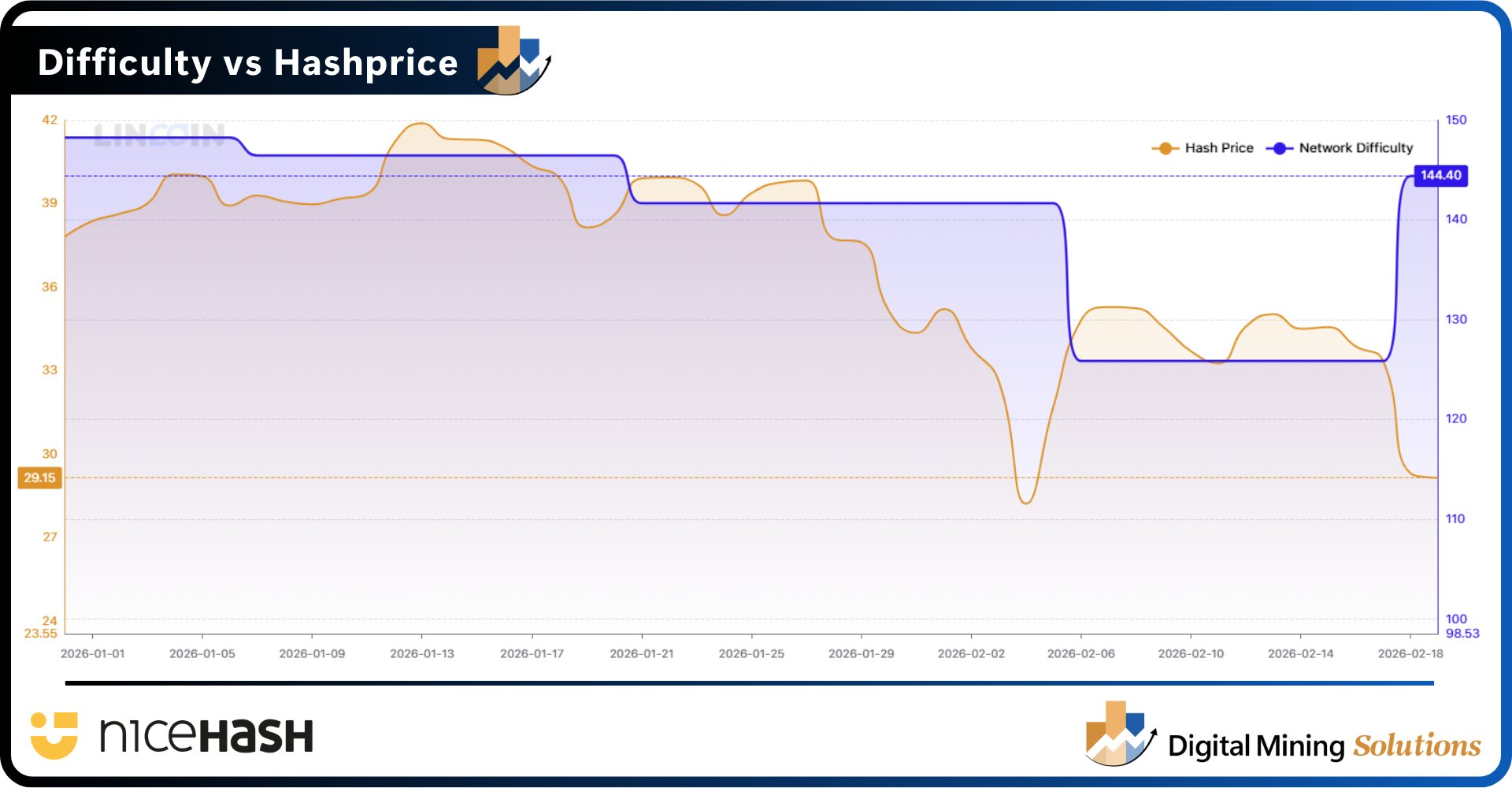
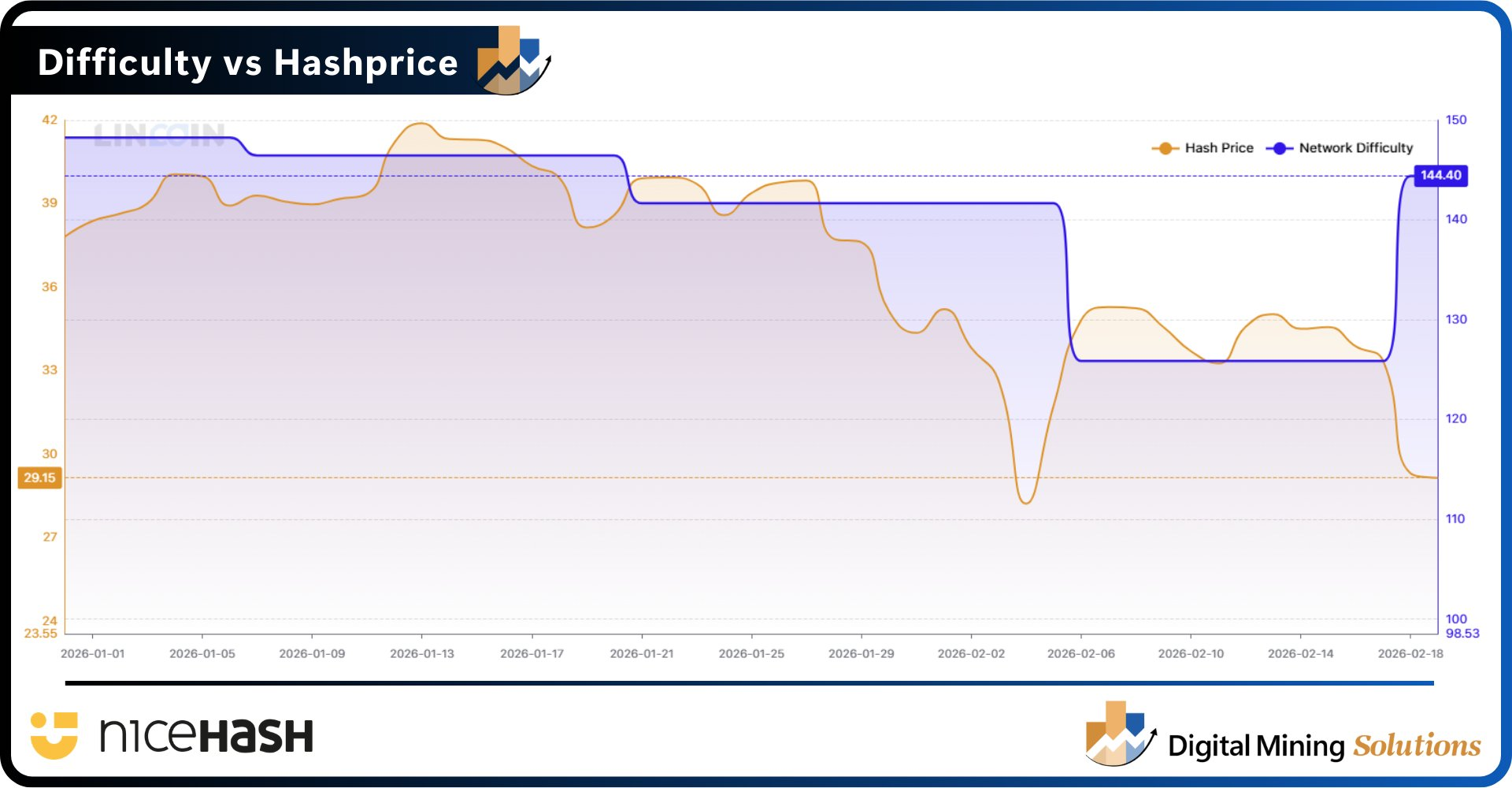
This week, network difficulty surged 14.7%. This is the largest upward adjustment since May 2021 and erases the operational relief miners experienced earlier in the year.
Consequently, mining profitability, measured by hashprice, plummeted to under $30 per petahash per day. The critical metric now sits inches above its all-time low, pushing production costs higher.
Bitdeer Seeks Funding for AI Pivot
To navigate the crunch, Bitdeer is turning heavily to Wall Street to fund its pivot into artificial intelligence.
On February 20, the company announced an upsized $325 million private sale of convertible senior notes.
The sale, expected to close on February 24, includes an option for the initial purchasers to purchase an additional $50 million in notes.
The financial maneuvering is highly defensive. Bitdeer will allocate $138.2 million to repurchase its existing 5.25% convertible senior notes due in 2029. This effectively extends the miner’s runway by restructuring its debt.
Another $29.2 million will fund capped call transactions, an insurance policy that protects existing shareholders from dilution if the stock price rises.
The remaining proceeds signal a clear strategic departure from pure-play crypto mining.
Bitdeer stated it will use the fresh capital to expand its high-performance computing and AI cloud businesses, develop proprietary ASIC mining rigs, and fund data center expansion.
Meanwhile, the treasury liquidation and strategic pivot occur alongside a paradoxical industry milestone: Bitdeer is now the largest publicly traded self-miner in the world.
Recent reports have revealed that Bitdeer’s self-managed hash rate reached 63.2 exahashes per second, surpassing competitor Marathon Digital’s 60.4 EH/s. This makes the Singapore-based firm the largest publicly traded company with the highest self-managed Bitcoin hashrate.

financial ratios

BBC Call the Midwife shares sad news as series pulled from schedule tonight

Report: 5 Crypto Exchanges Help Russia Dodge Western Sanctions


-

 Video6 days ago
Bitcoin: We’re Entering The Most Dangerous Phase
-

 Crypto World5 days ago
Can XRP Price Successfully Register a 33% Breakout Past $2?
-

 Video3 days ago
XRP News: XRP Just Entered a New Phase (Almost Nobody Noticed)
-

 Fashion2 days ago
Weekend Open Thread: Boden – Corporette.com
-

 Sports6 days ago
GB's semi-final hopes hang by thread after loss to Switzerland
-

 Politics8 hours ago
Baftas 2026: Awards Nominations, Presenters And Performers
-
 Tech5 days ago
The Music Industry Enters Its Less-Is-More Era
-

 Business5 days ago
Infosys Limited (INFY) Discusses Tech Transitions and the Unique Aspects of the AI Era Transcript
-

 Entertainment4 days ago
Kunal Nayyar’s Secret Acts Of Kindness Sparks Online Discussion
-

 Video5 days ago
Financial Statement Analysis | Complete Chapter Revision in 10 Minutes | Class 12 Board exam 2026
-

 Tech4 days ago
Retro Rover: LT6502 Laptop Packs 8-Bit Power On The Go
-
 Sports3 days ago
Clearing the boundary, crossing into history: J&K end 67-year wait, enter maiden Ranji Trophy final | Cricket News
-

 Business3 hours ago
Mattel’s American Girl brand turns 40, dolls enter a new era
-

 Entertainment4 days ago
Dolores Catania Blasts Rob Rausch For Turning On ‘Housewives’ On ‘Traitors’
-

 Business4 days ago
Tesla avoids California suspension after ending ‘autopilot’ marketing
-
 NewsBeat7 days ago
The strange Cambridgeshire cemetery that forbade church rectors from entering
-

 Politics5 days ago
Eurovision Announces UK Act For 2026 Song Contest
-

 Crypto World4 days ago
WLFI Crypto Surges Toward $0.12 as Whale Buys $2.75M Before Trump-Linked Forum
-
 Crypto World3 days ago
83% of Altcoins Enter Bear Trend as Liquidity Crunch Tightens Grip on Crypto Market
-

 Video2 hours ago
Bajaj Housing Finance: Good Time To Enter ?? Complete Analysis !!