

Connect with us

Entertainment

The Director of ‘How to Make a Killing’ Also Directed Aubrey Plaza’s Best Performance

Published

on

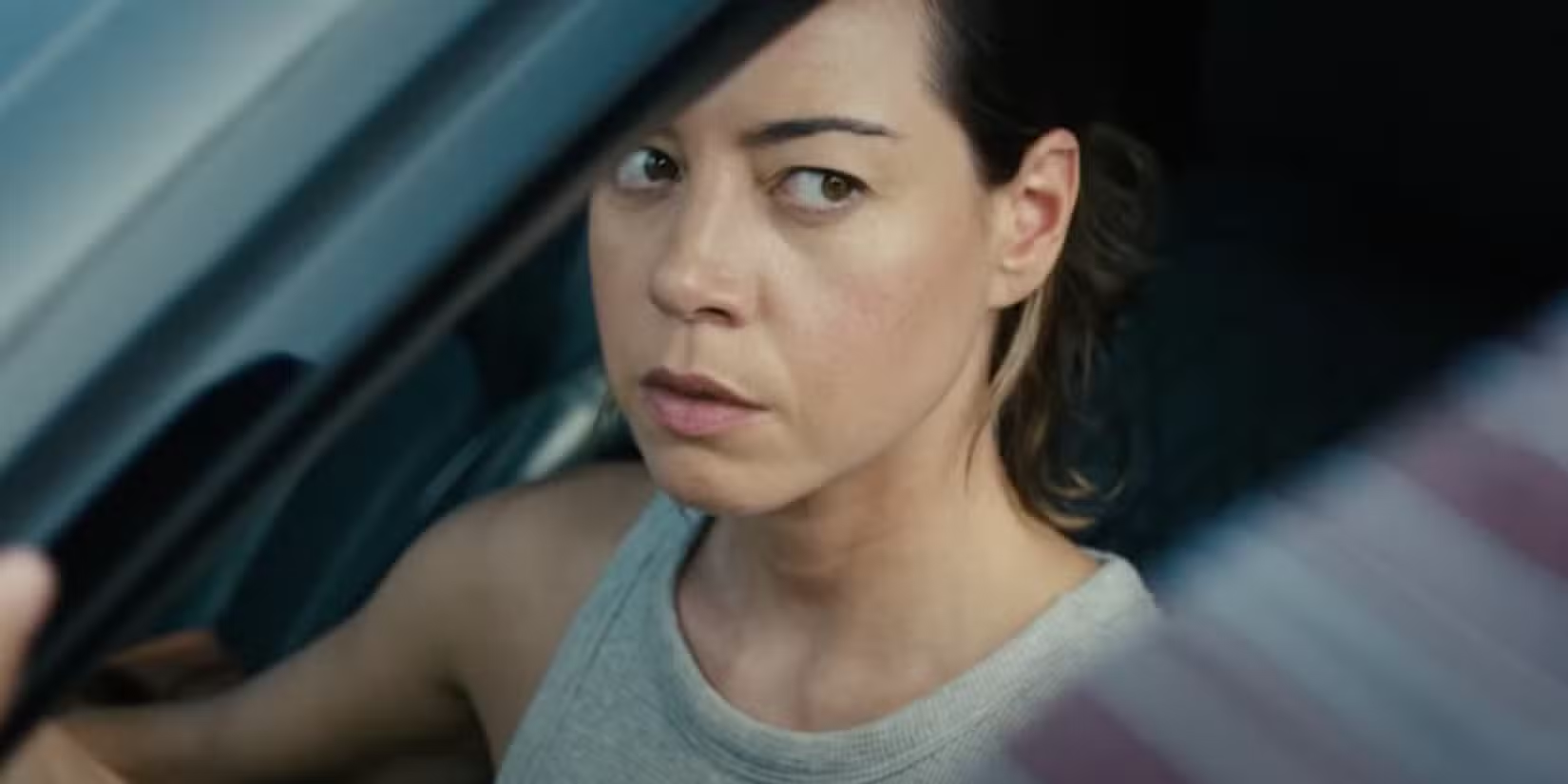
Aubrey Plaza as Emily the Criminal.

If you’re wondering whether Glen Powell and Margaret Qualley’s underhyped crime thriller How to Make a Killing is going to deliver anything more than hot-people-doing-crimes energy when it hits theaters this weekend, the easiest answer is hiding in director John Patton Ford’s filmography. Specifically, his last feature, a takedown of capitalism that orchestrated one of the most effective on-screen identity shifts of the last decade. He took Aubrey Plaza – long typecast as pop culture’s patron saint of disaffected, deadpanning weirdos – and turned her into something far more unsettling: a bonafide dramatic threat.

That transformation happened in Emily the Criminal, Ford’s lean, nerve-wracking thriller that doubles as the most honest student-loan horror movie ever made. It’s a film where debt is a living thing, a cancer slowly eating away at a person, forcing them to do uncharacteristically terrible (and clinically insane) things. Plaza plays the titular cash-strapped millennial who stops waiting for capitalism to reward her patience and starts testing how much it’ll let her get away with instead. Emily gives her the performance of her career, but it gives us a preview of how wild, ridiculous, and sharply insightful Ford’s storytelling can be. And now’s the perfect time for a re-watch.

Advertisement

Aubrey Plaza Breaks Bad in ‘Emily the Criminal’

When we first meet Emily Benetto in Emily the Criminal, she’s already losing. She’s $70,000 in student debt, locked out of stable employment by a minor assault charge, and stuck cycling through catering gigs where she delivers artisanal salads to tech workers whose salaries probably equal her loan bill. Early on, she bombs a job interview in spectacular fashion, unable to convincingly perform the optimism employers expect. It’s a small scene, but it establishes everything: Emily isn’t failing because she lacks ambition or ability, but because the system is rigged against her.

Her entry into crime happens almost accidentally. A coworker connects her with a low-level fraud ring run by Youcef (Theo Rossi), who recruits financially desperate young people to act as “dummy shoppers.” The job is simple: use a fake credit card to purchase expensive electronics, hand them off, and walk away with a few hundred dollars. Emily’s first attempt is shaky, but when it ends with her walking out of the store with cash in hand anyway, something shifts.

From there, the film turns the WTF meter all the way up to 10. Emily becomes more involved in Youcef’s operation, moving from small retail scams to higher-risk thefts that involve luxury cars and violent confrontations. But nothing deters her, and by the end of this thing, Emily’s become a twisted form of what the system wanted all along: an adaptable, opportunistic, ruthless entrepreneur driven by the bottom line. She is, finally, good at her job.

Advertisement

A Comedy Icon Becomes a Crime Thriller Antiheroine

Aubrey Plaza as Emily the Criminal.
Image via Roadside Attractions

Before Emily the Criminal, Plaza had perfected a very specific magic trick: making antisocial detachment aspirational. She delivered punchlines like she was doing audiences a favor by participating at all. Her run as April Ludgate on Parks and Recreation is still the clearest example of that. April treated every job and every interaction with an authority figure like mildly annoying inconveniences. She openly resented her coworkers, blankly endured small talk, and did it all with such flat calm that it somehow made it even funnier than if she’d pushed for the laugh. Emily the Criminal takes that familiar detachment and, for the first time, treats it as a survival skill instead of a joke.

Plaza plays Emily with blunt practicality. She never pushes you to sympathize with Emily, but she does make you understand how Emily justifies each step of her criminal undertaking. She pays attention. She listens. She adapts. And Plaza plays everything so controlled that you’re always guessing how Emily will handle the next risky grift-gone-wrong. It marks a clear shift in how the actress uses her screen presence. The same deadpan restraint that once made her feel aloof now makes her unpredictable, in the best way. As the film’s director, Ford didn’t create that ability, but he did build a vehicle that allowed her to use it fully.

In How to Make a Killing, you can see Ford playing with the same ideas he explored in Emily the Criminal. His characters don’t suddenly snap into moral gray zones, they slide into them, adjusting their reasoning until things that once seemed unthinkable start to feel like the most obvious choice. Sometimes, committing a crime is the best kind of problem-solving.

Advertisement

The Thread Between Ford’s Films

At least, that’s what Powell’s character believes. He plays Becket Redfellow, a working-class guy from New Jersey with a seriously complicated family history. His mother, Mary, was disowned by her ultra-wealthy upstate New York family when she got pregnant with him. On her deathbed, she tells him one line that drives the whole movie: “Get the life you deserve.” That’s basically Becket’s north star. Fast forward to adulthood, and Becket runs into his childhood crush, Julia (Qualley), who grew up in that same rich world. The reunion stirs something in him, and he starts poking around his family. Long story short: he figures that if he starts bumping off the Redfellow clan, he could end up inheriting the fortune he’s technically owed. It’s a black comedy crime story, but it’s smart about its social commentary. Ford finds ways to layer in critiques of class, capitalism, and the weird ways people justify wanting more than what they have in between the comedic mishaps and half-assed murder plots.

Its tie to Emily the Criminal is that both films are about characters who are pushed into morally gray spaces by circumstance. And in both cases, the thrill comes less from the crime itself and more from watching someone figure out how to survive and manipulate a system that’s stacked against them. Ford gets that. That’s why his work with Plaza was so electric, and why his new film is worth keeping an eye on. He understands that desperation can fuel some pretty fantastic cinematic fireworks.

Emily the Criminal is available to stream on Tubi in the U.S.

Advertisement


emily-the-criminal-movie-film-poster.jpg

Advertisement

Emily the Criminal


Release Date
Advertisement

August 12, 2022

Runtime

97 Minutes

Advertisement

Director

John Patton Ford

Writers
Advertisement

John Patton Ford


Advertisement

Advertisement


Advertisement

Source link

Continue Reading
Click to comment

Leave a Reply

Your email address will not be published. Required fields are marked *

Entertainment

Man Shot and Killed by Secret Service At President Trump’s Mar-a-Lago

Published

on

donald-trump-main-getty-1

President Donald Trump
Man Shot and Killed at Mar-a-Lago

Published

Advertisement


Advertisement

Advertisement

Source link

Continue Reading

Entertainment

Hailey Bieber Donates $20K to Eric Dane’s GoFundMe After ALS Death

Published

on

hailey-bieber-eric-dane-gofundme-main-getty-1

Hailey Bieber
$20K Donation To Eric Dane’s GoFundMe As Hollywood Rallies

Published

Advertisement


Advertisement

Advertisement

Source link

Continue Reading

Entertainment

Margot Robbie’s 136-Minute Gothic Romance Tops Guy Ritchie’s Subversive Spy Thriller at the Box Office

Published

on

Guy Ritchie in a suit on the red carpet

Despite losing the domestic box office crown to the animated film GOAT, director Emerald Fennell‘s controversial Wuthering Heights continues to lead the race globally. Both movies opened on the same day last week, with Wuthering Heights emerging as the clear frontrunner over the weekend. However, GOAT appears to have stronger legs, which isn’t entirely unexpected considering its mass appeal. Meanwhile, Wuthering Heights‘ divisive reviews appear to have exhausted the initial surge of attention. Debate over the film’s interpretation of Emily Brontë‘s classic novel has propelled interest over the last few days, but there’s a flip-side to controversy: those who miss the moment likely won’t have any urgency to watch the movie any longer. That said, Wuthering Heights continues to be the number one English-language movie at the worldwide box office, which was dominated this weekend by a handful of Chinese New Year releases.

Produced on a reported budget of $80 million, Wuthering Heights stars Margot Robbie and Jacob Elordi in the lead roles, alongside Shazad Latif and Alison Oliver. Robbie, who also serves as one of the film’s producers, is coming off three box-office underperformers whose poor hauls were offset by the global success of Barbie. Wuthering Heights managed to overtake all three underperformers — Babylon, Amsterdam, and A Big Bold Beautiful Journey — in its opening weekend alone. The film’s producers were offered a reported $150 million by Netflix, but they chose to go with Warner Bros.’ lower bid because they were determined to give the movie a theatrical release. W.B. is said to have spent $100 million on marketing the film, which means that it would need to gross around $350 million worldwide just to break even.

Advertisement

Here’s the Subversive Spy Movie Overtaken by ‘Wuthering Heights’

With more than $150 million at the worldwide box office so far, Wuthering Heights is the year’s highest-grossing English-language film, even though purists have criticized Fennell for misrepresenting the main themes of the source novel. It has now overtaken another period movie that subverted its genre: director Guy Ritchie‘s spy thriller The Man from U.N.C.L.E. Released in 2015, the movie was designed as a franchise-starter, but its underwhelming box office performance and mixed reviews put an end to those plans. Starring Henry Cavill, Armie Hammer, Alicia Vikander, and Hugh Grant, the movie ended its global run with $110 million against a reported budget of $84 million. It holds a 68% score on Rotten Tomatoes, while Wuthering Heights has dropped to 59% after 10 days of release. You can watch Fennell’s film in theaters. Stay tuned to Collider for more updates.


wuthering-heights-poster.jpg
Advertisement


Advertisement

Release Date

February 13, 2026

Runtime

136 Minutes

Advertisement

Director

Emerald Fennell

Advertisement

Writers

Emerald Fennell, Emily Brontë

Producers
Advertisement

Margot Robbie, Tom Ackerley, Emerald Fennell, Josey McNamara

Advertisement

Advertisement


Advertisement

Source link

Advertisement
Continue Reading

Entertainment

Shia LaBeouf Kisses Mystery Woman After Mia Goth Split

Published

on

022226_shia_lebeouf_kal

Shia LaBeouf
I Got A New Boo!!!
.. Packs on PDA at NOLA Bar

Published

Advertisement

Advertisement


Advertisement

Source link

Continue Reading

Entertainment

Netflix’s 10/10 Cyberpunk Sci-Fi Series Is a Forgotten Masterpiece

Published

on

Joel Kinnaman in Altered Carbon behind glowing lights, looking worried.

Although it’s one of the most celebrated subgenres of science fiction, cyberpunk is criminally underrepresented in live-action TV. Fans have a hard time finding any long-form content to watch that’s not animated, and are generally still waiting for a series that does it justice. The thing is, there is already one that most people forget about: Altered Carbon. Starring Joel Kinnaman and Anthony Mackie as the same character, this groundbreaking Netflix series left an indelible mark on streaming over its two seasons and is proof of the unexplored potential of the genre on TV. There may be more cyberpunk stories on the way for different streaming platforms now, but it all began with mercenary Takeshi Kovacs being re-sleeved.

‘Altered Carbon’ Has One of the Most Creative Worlds in Science Fiction

When thinking about cyberpunk, it’s usually the neon haze, fast-paced action, and interconnectedness between humans and technology that come to mind. All this is present in Altered Carbon, of course, but it also highlights other essential tropes of the genre, like the ever-expanding social gap between the rich and the poor, and how death isn’t the end in a world where the line between the human soul and raw data is blurred. In the series, this is mostly represented by the cortical stack, a disk-like device that stores one’s consciousness and may be inserted into different vacant bodies called sleeves.

Advertisement

That’s where protagonist Takeshi Kovacs comes in. Once part of a rebel group called the Envoys, he is re-sleeved and brought back to life after 250 years at the request of a man named Laurens Bancroft (James Purefoy). Part of the wealthy elite known as Meths (like Methuselah, not that other thing), Bancroft recruits Kovacs to investigate his own murder, which didn’t fully succeed thanks to his remote satellite backup (something only made available to absurdly rich individuals). If Kovacs succeeds, he gets to live again in his new sleeve, which is one hell of a prospect after centuries of pretty much not existing.

The series is based on the Richard K. Morgan novel of the same name, posing many of the same philosophical questions. While Meths live in impossibly tall buildings high above the clouds and may be perpetually re-sleeved inside clone bodies, people like Kovacs deal with different sleeves (that is, if they even get new ones) and live precariously in the darkness of the surface. Because of all that, notions like identity and morality become fluid, since death isn’t necessarily final, and your current body may very well not be the only one you’ll ever have.

‘Altered Carbon’ Broke New Ground in Live-action Cyberpunk on Streaming

There’s a reason there aren’t many live-action cyberpunk series around: the genre usually thrives in animation, which favors the surreal aesthetic and fast-paced narratives. Replicating it in live-action is a huge financial risk, since production costs are often higher than the average series’ budget, thanks to setting and CGI, for example. As Joel Kinnaman revealed at the time, Altered Carbon itself had “a bigger budget than the first three seasons of Game of Thrones.” That’s a risk not many are willing to take, of course, an investment that’s usually reserved for feature films with blockbuster potential.

Advertisement

So, when Netflix released Altered Carbon in 2018, it felt almost like a statement that not only could it compete with premium cable in both scale and tone, but also give audiences something they wouldn’t find on TV. It was the first proper live-action cyberpunk series in decades, effectively opening the doors to the genre for fans and newcomers alike. The series checks nearly all of cyberpunk boxes, including the pulpy noir feel of Takeshi Kovacs’ story, the existential sublayer that is intrinsic to it, and an R-rating mostly due to its gritty action sequences and adult themes.

Thanks to all that, Altered Carbon shaped what cyberpunk could be in a series. Its first season was acclaimed by audiences and critics thanks to its impressive visuals and futuristic pulpy detective story. Only in cyberpunk would you find the story of a man in a body that isn’t his, using an abandoned hotel managed by an Edgar Allan Poe AI (Chris Conner), for example. All that happening in live-action with live actors sets the series apart from other works of the genre in visual media. Season 2 then doubled down on what made the series special, but, unfortunately, it didn’t work out as well as Season 1 did.

Despite Being Short-Lived, ‘Altered Carbon’ Has Become a Cult Favorite for Fans of Cyberpunk

Joel Kinnaman in Altered Carbon behind glowing lights, looking worried.
Image via Netflix
Advertisement

Altered Carbon‘s sleeves are a unique narrative device, and having different actors playing the same character over the seasons seemed like a great way of keeping things fresh and adding star power to the series. Two years after Season 1, Kinnaman was replaced by Anthony Mackie as Takeshi Kovacs, and, while that would seem like a great idea at first, it didn’t translate on screen. Mackie’s version of Kovacs is more charming than Kinnaman’s brooding take, and many behind-the-scenes changes also affected how Season 2 felt to the audience, leaving behind the neon-drenched setting and pulpy noir atmosphere.

Altered Carbon is still regarded by fans as one of the best cyberpunk stories on streaming, despite its flaws, and rightly so. Perhaps if Season 2 had been given the same conditions as Season 1 to tell its story, the series could have gone on longer and become a classic. In the end, instead of the bold statement it was supposed to be about streaming’s potential, it became almost like a cautionary tale about how unstable the whole system may be. Regardless, Altered Carbon is still very much worth the watch, and is still the standard for what live-action cyberpunk can achieve.

Source link

Advertisement
Continue Reading

Entertainment

Steven Spielberg’s 10/10 Cult Sensation Reaches Free Streaming Next Month

Published

on

Steven Spielberg on the red carpet

The 1990s were a major decade for Steven Spielberg, who not only delivered the record-breaking blockbuster Jurassic Park, but also cemented himself as a “serious filmmaker” with movies such as Schindler’s List and Saving Private Ryan. Known to juggle multiple projects at the same time — he worked on Schindler’s List and Jurassic Park concurrently — Spielberg also put his stamp on a project few would remember he was involved with. The project in question is an animated series, which, like scores of other Cartoon Network gems from that era, is heading to a free streaming service this March. Several hits, such as Dexter’s Laboratory, The Powerpuff Girls, and Ben 10 are returning to streaming after being removed by HBO Max over the last few months.

Among them is the show on which Spielberg served as an executive producer: Pinky and the Brain. Created by Tom Ruegger, the show aired 65 episodes across four seasons, from 1995 to 1998. Such was Spielberg’s popularity at the time that the show was marketed as “Steven Spielberg Presents: Pinky and the Brain.” The cartoon followed the adventures of two mice who were first introduced as supporting characters on Animaniacs, another show that’ll return to streaming in March. One of the mice, Pinky, serves as a simple-minded sidekick to his megalomaniac companion, The Brain, who has only one goal in life: to take over the world. The Brain’s personality was modeled on the larger-than-life Orson Welles, while Pinky was given a Cockney accent.

Advertisement

When and Where To Watch ‘Pinky and the Brain’

Episodes generally revolved around The Brain coming up with a harebrained scheme to take over the world and invariably failing because of his own hubris or Pinky’s ineptitude. The characters later appeared in the single-season show Pinky, Elmyra & the Brain, which aired from 1998 to 1999, and in the Animaniacs revival that aired from 2020 to 2023. Pinky and the Brain will debut on the free Tubi streaming service on March 1, along with scores of other Cartoon Network titles, including fellow cult classics such as Courage the Cowardly Dog and Ed, Edd n Eddy. Stay tuned to Collider for more updates.


0393074_poster_w780.jpg
Advertisement


Advertisement

Release Date

1995 – 1998-00-00

Network
Advertisement

The WB

Directors

Kirk Tingblad, Charles Visser, Russell Calabrese, Al Zegler, Mike Milo, Audu Paden, Michael Gerard, Alfred Gimeno

Advertisement

Writers

Tom Sheppard, Wendell Morris, Gordon Bressack, Earl Kress, Jed Spingarn, Brett Baer, John P. McCann, Dave Finkel, David Finkel, John Ludin, Tom Minton, Rich Fogel, Bill Canterbury, Bill Matheny, Reid Harrison, Patric M. Verrone, John Loy, Gene Laufenberg, Bill Braunstein, Paul Rugg, Norm McCabe, Wayne Kaatz, Elin Hampton, David Fury

Advertisement


Advertisement


Advertisement

Source link

Advertisement
Continue Reading

Entertainment

The 23 best Amazon original movies streaming on Prime Video

Published

on


The streamer has produced Oscar winners and gut-busting comedies in equal measure.

Source link

Continue Reading

Entertainment

“Survivor 50” host Jeff Probst weighs in on season 49 stars Savannah and Rizo going back-to-back

Published

on


He also explains why the season 49 winner has no choice but to come clean.

Source link

Continue Reading

Entertainment

Vikings’ WR Rondale Moore Died From Suspected Self-Inflicted Gunshot Wound

Published

on

rondale-moore-main-getty-1

Vikings’ Rondale Moore
Died From Suspected Self-Inflicted Gunshot Wound

Published

Advertisement


Advertisement

Advertisement

Source link

Continue Reading

Entertainment

Sara Ramirez Pays Tribute to Eric Dane, Shares His Support for Trans Costar

Published

on

Sara Ramirez celebrated the life of their late Grey’s Anatomy costar Eric Dane by sharing how he once selflessly supported a guest star on the medical drama.

On Saturday, February 21, Ramirez, 50, became the latest Grey’s Anatomy cast member to pay tribute to Dane, who died at age 53 on Thursday, February 19, following a battle with the neurodegenerative disease ALS.

Ramirez posted a “broken heart emoji” via Instagram and shared a video from trans activist and actress Alexandra Billings, who played Donna Gibson in the classic Grey’s Anatomy season 3 episode “Where the Boys Are.” The powerful episode dealt with Dr. Mark Sloan (Dane) supporting Donna when she was diagnosed with breast cancer while in the midst of transitioning.

In a 15-minute tribute, Billings recalled the way Dane showed her empathy on set and fought for her when her lengthy monologue was supposed to be cut. Per Billings, she shared with Dane how her real-life doctor would “touch my knee or he would hold me” while she was going through the process of transitioning in the 1980s.

Advertisement
GREY'S ANATOMY


Related: Eric Dane Died on 20th Anniversary of His 1st ‘Grey’s Anatomy’ Episode

Eric Dane died on the 20th anniversary of his first appearance on Grey’s Anatomy. Dane’s loved ones confirmed his death in a statement on Thursday, February 19, following his battle with ALS, noting that the actor “spent his final days surrounded by dear friends, his devoted wife and his two beautiful daughters, Billie and Georgia, […]

“[The doctor] would let me know he saw me, no matter what we were talking about,” explained.

Advertisement

After sharing that memory, Dane held Billings’ hand during their scene to emulate the real support she’d received. Later, the director and writer informed Billings that they would have to cut her inspiring monologue for time reasons.

“[Eric] turns to me and he says very quietly, he says, ‘What are the five most important things you say in that monologue?’ … And I told him! I don’t remember what they were, but I told him one of them was about my wife, a line about my wife. And he said, ‘Say that and we’ll do a little improvisation,’” she remembered. “And he turned to the boom mic [operator] and he said, ‘What do you think?’ And from the back, you hear like little Muppets, ‘Yes, that’s a great idea!’ So they were all for it. And that’s what you see in the episode.”

Billings said that “it changed everything for me” when Dane fought for her character Donna to have that moment of catharsis.

“There was no reason in the world for him to do that. It didn’t have anything to do with him,” she said. “Time is money, especially in television. Eric Dane was one of the kindest, most empathetic humans I think I’ve ever worked with. I think that I could count on one hand the amount of times where I’ve left a set … and gone, ‘I can’t believe.’ Or, ‘That was extraordinary.’ And that was one of those times. Eric Dane showed everyone on that set what a true ally looks like. It’s not just talk.”

Advertisement
TCDGRA2EC080 Sara Ramirez Pays Tribute to Eric Dane Shares His Support for Trans Costar Alexandra Billings

Eric Dane in “Grey’s Anatomy.”
Adam Larkey / ABC / Courtesy Everett Collection

As she fought back tears, Billings went on, “An ally is present even when there’s danger in them being present. And that’s what Eric Dane did. I didn’t know him. I really didn’t know him but I absolutely knew him. And he will be missed. And I’m going to say something I didn’t get a chance to say to him: Thank you, Eric. Thank you. From all of us.”

Earlier this week, Patrick Dempsey admitted it was “hard to put into words” what his Grey’s Anatomy costar Dane’s death meant.

“He was the funniest man — he was such a joy to work with, and I want to just remember him in that spirit, because any time he was on set, he brought so much fun to it,” Dempsey recalled. “He had a great sense of humor. He was easy to work with. We got along instantly. First scene was him, you know, in all his glory, coming out of the bathroom with the towel on looking amazing, making you feel completely out of shape and insignificant.”

“We hit it off because it was never really any competition,” he added. “There was just this wonderful mutual respect, he’s wickedly intelligent, and I’m always going to remember those moments of fun that we had together and celebrate the joy that he did bring to people’s lives, and the real loss is for us who don’t have them anymore.”

Dane’s family announced on Thursday that he’d died nearly a year after going public with his ALS diagnosis. Per the Mayo Clinic, ALS is a nervous system disease that weakens nerve cells in both the brain and spinal cord and leads to a progressive loss of muscle control.

“[Eric] will be deeply missed, and lovingly remembered always,” his rep said. “Eric adored his fans and is forever grateful for the outpouring of love and support he’s received. The family has asked for privacy as they navigate this impossible time.”

Dane was survived by two daughters, Billie and Georgia, from his marriage to Rebecca Gayheart. A GoFundMe was set up to support his daughters on Friday, February 21, and has already raised more than $274,000 towards a $500,000 goal.

Advertisement

Source link

Advertisement
Continue Reading

Trending

Copyright © 2025