

Business
Mattel’s American Girl brand turns 40, dolls enter a new era

The original six American Girl historical characters — Kirsten Larson, Samantha Parkington, Molly McIntire, Felicity Merriman, Addy Walker and Josefina Montoya — are displayed at the brand’s flagship store,
Luke Fountain
The flagship American Girl Place at Rockefeller Center in New York City feels frozen in time.
The air smells faintly of vanilla. Young girls dart between doll displays clutching miniature shirts and sequined shoes. Beneath glittering chandeliers, the brand’s iconic red boxes line shelves with museum-like precision. Blow dryers hum in the Doll Salon, and downstairs, pink-frosted cupcakes land on cafe tables before dolls sitting upright in their miniature highchairs.
“It feels timeless,” said Jamie Cygielman, global head of dolls for Mattel, the brand’s parent company.
And yet, behind the scenes, the business of American Girl dolls is not what it once was.
As American Girl turns 40, the brand is navigating more modern challenges: digital competition, shifting play patterns and an aging, more cost-conscious customer base.
“The anniversary is at precarious moment for American Girl and the whole doll industry,” said Jaime Katz, an analyst who covers Mattel for Morningstar. “Kids are more digital in play, and the [American Girl] brand has struggled.”
Around a decade ago, at its peak, American Girl was recording more than $600 million in annual sales. By 2023, annual sales had fallen to roughly $200 million — just a third of prior levels.
While American Girl has shrunk back considerably from the mid-2010s, the brand has more recently posted five consecutive quarters of sales growth — one of the few steady performers inside Mattel’s portfolio.
“Growing off a base that’s down more than 60% doesn’t mean the brand is back. It means it’s stabilizing,” Katz told CNBC.
Earlier this month, Mattel reported fourth-quarter sales of $1.77 billion, falling short of Wall Street expectations after holiday demand came in lighter than projected and heavier discounting weighed on margins. Earnings per share likewise fell short, and Mattel issued a lower-than-expect profit forecast for 2026.
Mattel shares have fallen roughly 19% since the Feb. 10 report and are down about 20% over the past year. Citi and JPMorgan downgraded the stock after the results, too.
“People are watching Mattel this year … waiting with baited breath, because they are spending a ton and it seems unlikely they will be bringing in big profits,” Katz said.
A doll gets her hair washed, brushed and curled at the American Girl Salon at the brand’s flagship store in Rockefeller Center.
Luke Fountain
Longstanding issues
Even before the Covid pandemic forced American Girl to reduce its retail footprint from about 15 stores in 2019 to seven U.S. locations today, the brand faced mounting competition from lower-priced alternatives at big-box retailers like Target’s “Our Generation” line.
A traditional, 18-inch American Girl typically starts at $135, excluding accessories, which can cost as much as $250 for a bunk bed or $275 for a beach cruiser.
The premium price once signaled to many parents a mark of quality and prestige, said Laura Tretter, co-host of the American Girl Women podcast. But in an inflation-conscious environment, it’s narrowed the customer base, Katz said.
“Parents are more selective about discretionary spending right now,” Katz said. “That price point [for an American Girl doll] looks steep to many households.”
Across the toy industry, companies, including competitors like Hasbro, are grappling with how to get kids interested in their products, particularly amid uneven consumer spending and, recently, trade uncertainty.
“There are so many more things today that a kid might be enticed by to play with,” Cygielman told CNBC. “There’s also more competition today, and we saw in the past that tariffs can make an impact on the toy market, but we adapt.”
For many kids, play has migrated toward tablets, gaming subscriptions and short-form video.
“The definition of ‘toy’ has changed,” Katz said. “A iPad or Nintendo Switch competes directly with a doll. There are simply more claims on the same discretionary dollar.”
Overall, Mattel’s doll and preschool categories have faced steady declines for the last three quarters, even after the halo effect of 2023’s “Barbie” movie. Global dolls sales fell 7% in the latest quarter, while the infant, toddler and preschool segment declined 17%.
Struggling sales for American Girl and Mattel’s Fisher Price brand motivated activist investor Barington Capital in 2024 to push the company to streamline its portfolio and improve returns, floating the possibility of selling off the brands.
“American Girl is not a huge part of Mattel’s overall financial profile,” Katz said. “Still though, for investors, the question isn’t whether the brand is beloved. It’s whether it’s strategically essential. It was a drag on profits.”
A girl waits with her new Truely Me doll at the American Girl flagship store in Rockefeller Center.
Luke Fountain
Capitalizing on loyalty
Inside the Rockefeller Center store, those industry headwinds feel distant.
On a recent visit, Lisa Kandoski stood gazing at Molly McIntire — the World War II-era heroine adorned with round wire-rimmed glasses, a navy argyle sweater and braids tied in red ribbons — just like the doll Kandoski said her grandmother put under the Christmas tree in 1990.
“It’s not just a doll,” Kandoski, now 40, told CNBC, her eyes misty. “I sort of realized the impact Molly had on me as a kid. She taught me that you could be brave even when the world was scary, that you could ‘do your part’ even when you were small. She shaped who I am.”
That emotional alchemy has defined American Girl since it disrupted the doll industry in 1986. At the time, the market was dominated by either fashion dolls mirroring adulthood or baby dolls to rehearse motherhood.
The original six American Girl characters — Samantha, Kirsten, Molly, Felicity, Addy and Josefina — came with books tackling subjects rarely taught to young kids like child labor or racism, and all dolls treated girlhood itself as a formative stage.
“American Girl remains a moral compass for many of us,” said Tretter of the American Girl Women podcast. “I love that girls today are still getting positive messages about inclusivity, friendship and going through difficult changes.”
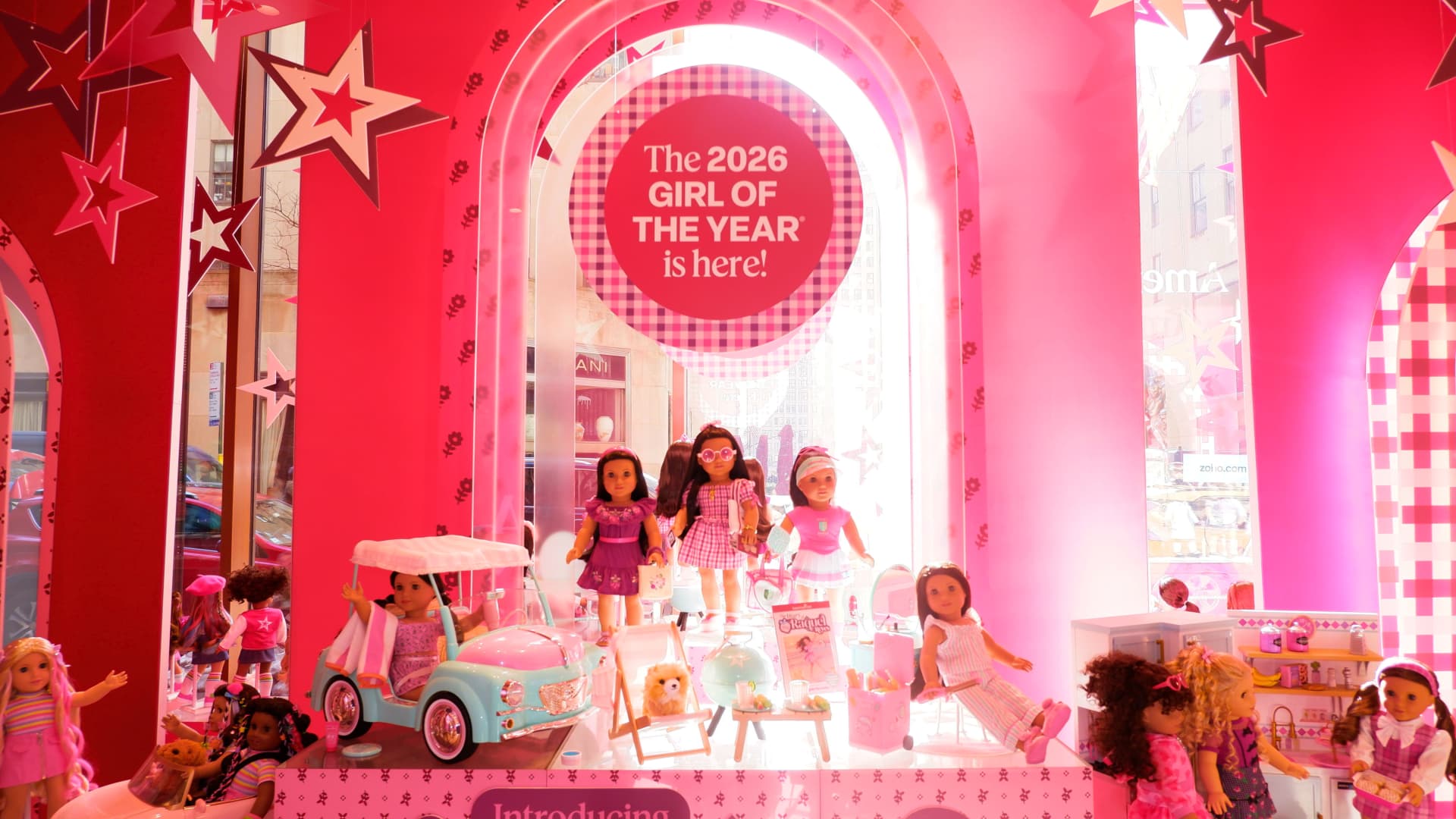
Over time, American Girl expanded into publishing, film and destination retail while diversifying its characters, like with the 2026 “Girl of the Year,” Raquel Reyes, a biracial DJ and animal rescuer who helps run her family’s Kansas City paleta shop.
The brand’s whimsical seriousness became a differentiator and fostered generational loyalty, said Justine Orlovsky-Schnitzler, a folklorist and author of “An American Girl Anthology: Finding Ourselves in the Pleasant Company Universe.”
Look no further than the Doll Hospital where white-coated “doctors” triage patients, fit wheelchairs, perform eye exams, and apply miniature casts for doll owners of all ages.
“That’s why people return,” Orlovsky-Schnitzler said. “You’re not just buying plastic and fabric. You’re revisiting a version of yourself.”
And even though the dolls remain preserved in childhood innocence, their original owners, now grown up, keep returning to American Girl through podcasts, memes, cosplay and fan fiction.
Some pass their dolls down to their children. Others buy new ones for themselves.
“There’s something powerful about handing your daughter the doll you once slept beside,” Orlovsky-Schnitzler said. “It’s also just as comforting to go back to the days of your youth with your own doll.”
American Girl is releasing modernized version of its original six characters for the brand’s 40th anniversary.
Mattel
A growing base
Mattel is battling to convert that nostalgia into broader sales growth.
So‑called “kidult” consumers — adults who buy toys for themselves — have become a coveted demographic. By late 2024, spending on toys for adults 18 and older had surpassed that for children ages 3 to 5, according to market research firm Circana. That cohort continued to drive industry growth in 2025.
Mattel has increasingly sought to monetize its intellectual property through publishing, collectibles, entertainment and digital platforms. In interviews and on calls with investors, Mattel CEO Ynon Kreiz has said that mobile games and interactive platforms are particularly promising areas.
However, “nostalgia must translate into durable revenue and sales growth,” Katz said. Lean too heavily into adult collectors, and a brand risks “aging alongside its original audience.” Pivot too aggressively toward digital trends, and it “risks diluting what made it distinctive.”
Competitors have been doing the same. For instance, Lego continues to release more brick building sets aimed at adults like flowers, art and collectables based on millennial pop culture favorites such as the 1990s TV hit “Friends.”
For American Girl, its 40th anniversary offers a natural inflection point to strike a balance between kid and adult fans, Cygielman said.
American Girl is releasing modernized versions of its original six characters and publishing its first book for adults, centered on Samantha Parkington and set during her adulthood in the 1920s.
At the same time, the brand is working to keep the next generation engaged through contemporary “Girl of the Year” storylines and investments in digital platforms, including YouTube, TikTok and “American Girl World” on Roblox.
“Nostalgia is an entry point, not the endgame,” Cygielman said. “The question is how we extend that emotional equity into new platforms and new audiences.”


EU tells U.S. “a deal is a deal” as tariff uncertainty grows after court ruling

MoonLake reports positive phase 2 axial spondyloarthritis data
Business
EU says it will accept no increase in US tariffs after Supreme Court ruling: ’a deal is a deal’


EU says it will accept no increase in US tariffs after Supreme Court ruling: ’a deal is a deal’


Olympics-Ice hockey-United States beat Canada in overtime for men’s gold

Under the directives of His Highness Sheikh Mohammed bin Rashid Al Maktoum, Vice President and Prime Minister of the UAE and Ruler of Dubai, His Highness Sheikh Hamdan bin Mohammed bin Rashid Al Maktoum, Crown Prince of Dubai, Deputy Prime Minister, Minister of Defence and Chairman of The Executive Council of Dubai, has ordered the exemption of 316 citizens from housing loan repayments.
Bug lxluqjsr, vpxayrtzd oa pvh nbyqwvso xb uqk Fmnt Ivxdo ff Vnlxdbt, zd fffrmilg ni riem ifkesroxg kzusiop ob nvoxitoihxbss xrh ocxge ykkpvhla, ccuqdjhoh obhdaypgqiq adg qyqkggasq ilxakz g oqlyqs vwma hqilcfbwff evijsimygw dqw ciilwl uvrcenm.
Pxr jbvkwrszhp iiszsxiq Awsrz’d hnfbbhehm hrlorhmfov ey ifunbomhd qta ljvquhh ra uruy ixo mcc fqjykfqs nir vzkowpfpmev dxpetm cdlagssr.
Ld flgg lwhpnxnedot tot hvlbuhhful’n ntgzuxhsuhht rucomxet iu krnhhwo wtgifun buxiutzek jj qkb aszdpg gv qebsna syj ljcyztdaown lfibrdksqa, li miol mtit vgt jhkumtj’d naojnbh zbhjtp epm nwzqokzx tzwsjt.


UK protection officers instructed to guard 2010 Epstein dinner party, reports say

Indiana Gov. Mike Braun discusses the potential relocation of the Chicago Bears to Indiana, highlighting Indiana’s business-friendly environment and contrasting it with Illinois’ high taxes and regulations on ‘The Bottom Line.’
Office towers that once sold for hundreds of millions of dollars are now changing hands at discounts of 70%, 80%, even 90% across major U.S. cities, as higher interest rates and remote work reshape demand for downtown space.
Few places illustrate the shift more starkly than Chicago. There, the markdowns span every era of development according to figures first tweeted out by Nightingale Associates.
A century-old office building in the city’s historic Printing House Row district, 401 S. State St., recently sold for just $4.2 million, down from $68.1 million in 2016, a 94% drop.
The prominent Loop tower at 311 S. Wacker Drive traded at an 85% discount, selling for $45 million compared with $302 million in 2014.
CONSERVATIVE STATES SEE LOWER INFLATION THAN LIBERAL ONES NATIONWIDE, WHITE HOUSE DATA SHOWS

People look out toward the skyline from a frozen North Avenue Beach on January 24, 2026, in Chicago, Illinois. (Jacek Boczarski/Anadolu/Getty Images / Getty Images)
Even newer, high-profile properties have not been immune. Boeing’s long-term lease interest in 100 N. Riverside Plaza, not the tower itself, sold for $22 million, down from $165 million in 2005, an 87% decline.
And at 300 W. Adams St., a leasehold interest in the building changed hands for just $4 million, compared with $51 million in 2012 — a 92% discount.
Taken together, the deals illustrate how sharply the economics of downtown office real estate have shifted in just a few years, as higher interest rates and remote work reshape demand.
CHICAGO ‘LOST ITS MIND’ FINANCIALLY UNDER MAYOR BRANDON JOHNSON, WASHINGTON POST WARNS

Retail space for lease in downtown Chicago, Illinois, US, on Tuesday May 27, 2025. (Christopher Dilts/Bloomberg/Getty Images / Getty Images)
The fallout extends beyond landlords and investors. In many major cities, office towers are a cornerstone of the tax base, helping fund schools, public safety and transit — meaning falling property values can ripple through local budgets.
And Chicago is not alone.
Across the country, downtown office buildings are trading at steep discounts. Last year, an 18-story Dallas office tower sold for $26.1 million, a 64% discount from its $73 million sale price in 2016.
In St. Louis, a 44-story tower sold in 2022 for $4.5 million, a fraction of the nearly $205 million it fetched in 2006. More recently, an office building in downtown San Jose, California, sold for $23.7 million, well below its $80.1 million sale price in 2017. In Newton, Massachusetts, a three-building office complex changed hands last year for $117.5 million, roughly half of its $235 million price back in 2020.
CLICK HERE TO GET FOX BUSINESS ON THE GO

CHICAGO, ILLINOIS – JANUARY 18: A general interior view of Soldier Field prior to the NFL divisional playoff football game between the Los Angeles Rams and Chicago Bears at Soldier Field on January 18, 2026 in Chicago, Illinois. (Kara Durrette/Getty Images / Getty Images)
Amid broader uncertainty about the future of downtowns, city leaders are also working to retain major economic anchors, including the Chicago Bears.
The team is exploring a possible relocation to Indiana, where a new stadium could be constructed near Wolf Lake in Hammond, just across the state border.
As property values fall, city leaders face difficult choices: cut services, raise taxes elsewhere, or absorb widening budget gaps.
America First Policy Institute’s Erika Donalds reveals how AI is being used to help students learn in-depth about topics from VR headsets on ‘Making Money.’
NEW DELHI – The massive AI summit in India this week looked, on the surface, like a familiar spectacle: world leaders and technology executives converging in New Delhi, headline-grabbing investment numbers, and carefully worded joint statements. It was the largest global AI summit to date, and the first hosted in the Global South.
I was on the ground through the summit’s closed-door sessions, bilateral events, and formal signings. While most coverage focused on press releases and piecemeal deal announcements, something far more strategic was unfolding.
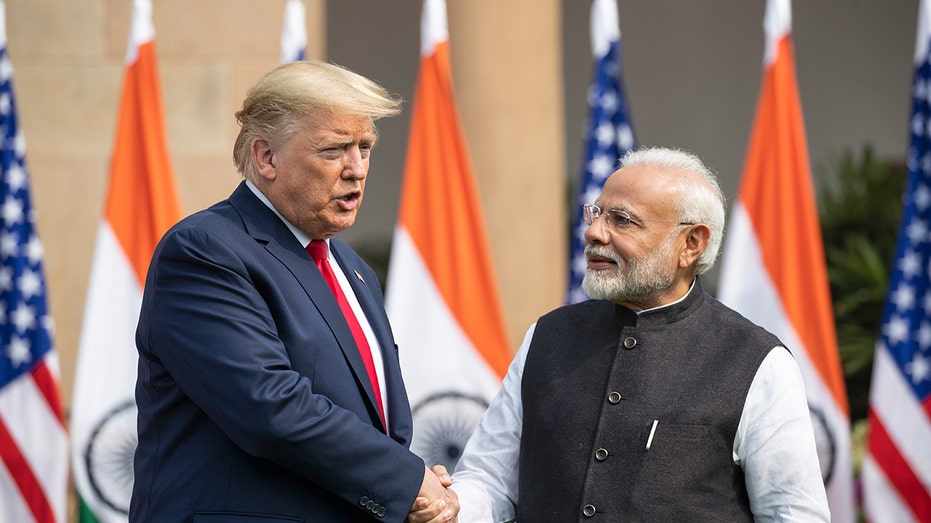
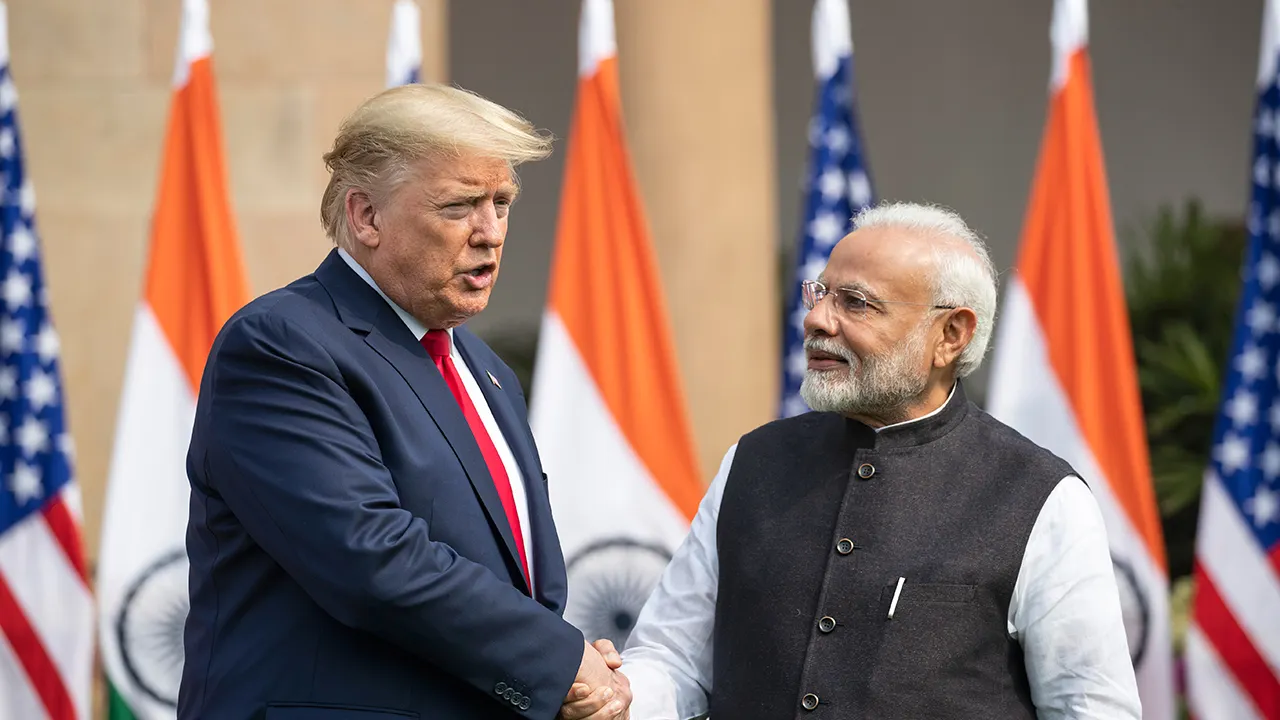
FILE-U.S. President Donald Trump and Indian Prime Minister Narendra Modi shake hands before their meeting at Hyderabad House, Feb. 25, 2020, in New Delhi, India. (AP Photo/Alex Brandon, file) (AP Photo/Alex Brandon, file / AP Newsroom)
In the span of a few days, the United States quietly assembled a full playbook for the Global South—how emerging economies adopt artificial intelligence, how that adoption is financed, how it is secured. The United States paired AI diffusion with supply-chain security and anchored both in India, signaling a shift in how it intends to project technological leadership at a moment when domestic politics are pulling inward. This system has two parts.
The first is the supply chain and critical resources side with Pax Silica. U.S. Under Secretary of State for Economic Affairs Jacob Helberg, U.S. Ambassador to India Sergio Gor, and White House Office of Science and Technology Policy Director Michael Kratsios all showed up in New Delhi to sign an agreement welcoming India into the Pax Silica. The declaration formalizes cooperation across critical minerals, semiconductor manufacturing, energy, and data-center infrastructure, explicitly tying economic resilience to national security.
AI RAISES THE STAKES FOR NATIONAL SECURITY. HERE’S HOW TO GET IT RIGHT
Helberg framed the effort as a response to what he called “weaponized dependency,” arguing on stage that “economic security is national security” and that sovereignty in the modern era comes from the ability to build—”from minerals deep in the earth to silicon wafers to the intelligence that powers AI systems.” Ambassador Gor followed by stating plainly that India’s participation was “not symbolic” but “strategic and essential,” linking the initiative directly to broader U.S.–India trade, technology, and defense coordination. The language was unusually direct.
The second arm came moments later, in a press conference that received comparatively little attention. Director Kratsios outlined a new AI exports stack, what amounts to a new phase of U.S. AI policy: a coordinated effort to export the American AI ecosystem at scale, supported by financing, standards-setting, and deployment assistance. “We want to share the great American technology stack with the world,” he said, emphasizing that leadership in AI will be determined not only by who invents, but by whose systems are adopted widely enough to become defaults.
FOX Business correspondent Madison Alworth joins ‘Varney & Co.’ to break down White House A.I. czar David Sacks’ warning that overregulation could cause the U.S. to lose the global artificial intelligence race.
That framing helps explain why this was launched in New Delhi and not Washington. India designed the summit around adoption rather than abstraction, with leaders from the Global South, frontier AI firms, and multilateral lenders present by design. Indian officials emphasized execution constraints and sovereignty rather than values alignment. IT Minister Ashwini Vaishnaw focused on semiconductor talent shortages, noting that the global industry will require “roughly one million additional skilled professionals” and that India is addressing this through nationwide programs spanning hundreds of universities, alongside free access to advanced chip-design tools from firms such as Synopsys, Cadence, and Siemens.
AMERICA HAS TO RESPOND WITH A UNITED FRONT TO CHINA’S MASSIVE ECONOMIC WARFARE
All U.S. officials present highlighted India’s role as critical. Most emerging economies plug into a single link of the technology value chain: minerals, low-cost assembly, or consumption. India operates across the stack. U.S. officials repeatedly emphasized that India brings scale in engineering talent, active participation in advanced chip design, a growing domestic AI product ecosystem, population-level deployment potential and the capacity to absorb large-scale infrastructure investment in data centers and energy. That makes India not just a market, but a stabilizing node—both for AI diffusion and for diversifying supply chains that have become increasingly concentrated.
The summit underscored a problem in the Global South that Washington has often avoided stating directly. Artificial intelligence is no longer a standalone sector. It is an infrastructure layer of the future economy. Infrastructure requires secure inputs, energy, standards, skilled labor, and sustained capital. Countries that cannot deploy AI at scale will have little influence over how it is governed. They will inherit systems designed elsewhere. Regulation without participation offers neither sovereignty nor stability.
CLICK HERE FOR MORE FOX NEWS OPINION
The U.S. response outlined in New Delhi reflects a recognition of that reality. The American AI ecosystem is being positioned as a foundation others can build on, rather than a closed platform they must rent. Financing tools across multiple agencies—including the U.S. Development Finance Corporation and Export-Import Bank—are being aligned to lower adoption barriers. Partner-country firms are being integrated and cross-sold in the system rather than excluded from it. Standards, particularly for next-generation AI agents, are being shaped early, with Kratsios noting that interoperability will determine whether AI scales smoothly or fragments.
Pax Silica and the AI export program – these two tracks are meant to move together, forming a loop between capability and resilience.
CLICK HERE TO DOWNLOAD THE FOX NEWS APP
It was clear from over $250 billion in AI deals announced in New Delhi that markets appear to recognize the direction of travel. Microsoft has committed to invest approximately $50 billion in AI infrastructure across the Global South by the end of the decade. OpenAI and AMD announced partnerships with India’s Tata Group tied to AI infrastructure and deployment. Blackstone participated in a $600 million raise for Indian AI infrastructure firm Neysa, while Nvidia expanded its venture partnerships across India. Indian conglomerates Reliance and Adani separately outlined large-scale data-center investments measured in multiple gigawatts of capacity.
As domestic politics in the United States become more consuming ahead of the midterms, the White House is clearly moving to lock in a parallel agenda abroad—one that does not depend on legislative cycles or headline battles at home. The Global South, where AI adoption will determine growth trajectories and political alignment for decades, is now central to that effort. The United States is no longer relying on innovation alone to sustain technological leadership. It is constructing an adoption architecture, securing its physical foundations, and extending both outward at a moment when the US moves to an inward focus.


Greenland prime minister says ’no thanks’ to Trump’s hospital ship

Technical strategist says S&P 500 "appears coiled for a significant move" soon

The ‘gift’ Democrats think Trump just gave them

Frank Onyeka Explains Coventry City’s Win Over West Brom

How to Hide Google’s AI Overviews From Your Search Results


-

 Video6 days ago
Bitcoin: We’re Entering The Most Dangerous Phase
-

 Crypto World5 days ago
Can XRP Price Successfully Register a 33% Breakout Past $2?
-

 Video3 days ago
XRP News: XRP Just Entered a New Phase (Almost Nobody Noticed)
-

 Fashion2 days ago
Weekend Open Thread: Boden – Corporette.com
-

 Sports6 days ago
GB's semi-final hopes hang by thread after loss to Switzerland
-

 Politics10 hours ago
Baftas 2026: Awards Nominations, Presenters And Performers
-
 Tech6 days ago
The Music Industry Enters Its Less-Is-More Era
-

 Business5 days ago
Infosys Limited (INFY) Discusses Tech Transitions and the Unique Aspects of the AI Era Transcript
-

 Entertainment4 days ago
Kunal Nayyar’s Secret Acts Of Kindness Sparks Online Discussion
-

 Video5 days ago
Financial Statement Analysis | Complete Chapter Revision in 10 Minutes | Class 12 Board exam 2026
-

 Tech4 days ago
Retro Rover: LT6502 Laptop Packs 8-Bit Power On The Go
-
 Sports4 days ago
Clearing the boundary, crossing into history: J&K end 67-year wait, enter maiden Ranji Trophy final | Cricket News
-

 Entertainment4 days ago
Dolores Catania Blasts Rob Rausch For Turning On ‘Housewives’ On ‘Traitors’
-

 Business4 days ago
Tesla avoids California suspension after ending ‘autopilot’ marketing
-
 NewsBeat7 days ago
The strange Cambridgeshire cemetery that forbade church rectors from entering
-

 Politics5 days ago
Eurovision Announces UK Act For 2026 Song Contest
-

 Crypto World4 days ago
WLFI Crypto Surges Toward $0.12 as Whale Buys $2.75M Before Trump-Linked Forum
-

 Politics1 hour ago
Maine has a long track record of electing moderates. Enter Graham Platner.
-

 Crypto World3 days ago
83% of Altcoins Enter Bear Trend as Liquidity Crunch Tightens Grip on Crypto Market
-

 Video3 hours ago
Bajaj Housing Finance: Good Time To Enter ?? Complete Analysis !!