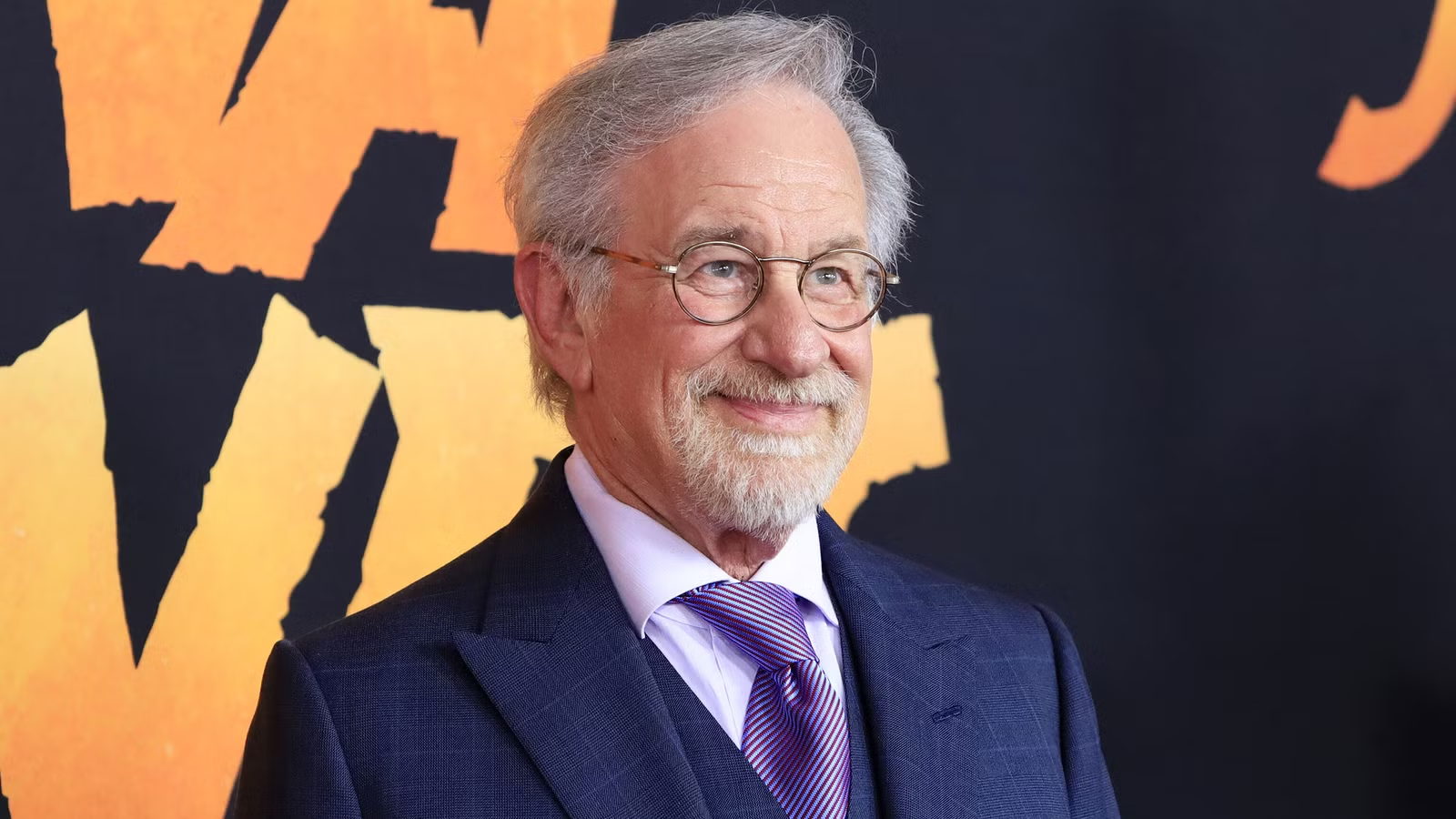
Steven Spielberg on the red carpetImage via DDP/INSTARimages
The 1990s were a major decade for Steven Spielberg, who not only delivered the record-breaking blockbuster Jurassic Park, but also cemented himself as a “serious filmmaker” with movies such as Schindler’s List and Saving Private Ryan. Known to juggle multiple projects at the same time — he worked on Schindler’s List and Jurassic Park concurrently — Spielberg also put his stamp on a project few would remember he was involved with. The project in question is an animated series, which, like scores of other Cartoon Network gems from that era, is heading to a free streaming service this March. Several hits, such as Dexter’s Laboratory, The Powerpuff Girls, and Ben 10 are returning to streaming after being removed by HBO Max over the last few months.
Among them is the show on which Spielberg served as an executive producer: Pinky and the Brain. Created by Tom Ruegger, the show aired 65 episodes across four seasons, from 1995 to 1998. Such was Spielberg’s popularity at the time that the show was marketed as “Steven Spielberg Presents: Pinky and the Brain.” The cartoon followed the adventures of two mice who were first introduced as supporting characters on Animaniacs, another show that’ll return to streaming in March. One of the mice, Pinky, serves as a simple-minded sidekick to his megalomaniac companion, The Brain, who has only one goal in life: to take over the world. The Brain’s personality was modeled on the larger-than-life Orson Welles, while Pinky was given a Cockney accent.
Advertisement
When and Where To Watch ‘Pinky and the Brain’
Episodes generally revolved around The Brain coming up with a harebrained scheme to take over the world and invariably failing because of his own hubris or Pinky’s ineptitude. The characters later appeared in the single-season show Pinky, Elmyra & the Brain, which aired from 1998 to 1999, and in the Animaniacs revival that aired from 2020 to 2023. Pinky and the Brain will debut on the free Tubi streaming service on March 1, along with scores of other Cartoon Network titles, including fellow cult classics such as Courage the Cowardly Dogand Ed, Edd n Eddy. Stay tuned to Collider for more updates.
Advertisement
Advertisement
Release Date
1995 – 1998-00-00
Network
Advertisement
The WB
Directors
Kirk Tingblad, Charles Visser, Russell Calabrese, Al Zegler, Mike Milo, Audu Paden, Michael Gerard, Alfred Gimeno
Advertisement
Writers
Tom Sheppard, Wendell Morris, Gordon Bressack, Earl Kress, Jed Spingarn, Brett Baer, John P. McCann, Dave Finkel, David Finkel, John Ludin, Tom Minton, Rich Fogel, Bill Canterbury, Bill Matheny, Reid Harrison, Patric M. Verrone, John Loy, Gene Laufenberg, Bill Braunstein, Paul Rugg, Norm McCabe, Wayne Kaatz, Elin Hampton, David Fury
The 1980s are often remembered for spectacular movies like Raiders of the Lost Ark, Platoon, and The Empire Strikes Back. But beyond the usual suspects, the ’80s also produced films that have matured beautifully over time. Like a well-cellared Bordeaux, some of the decade’s movies get even better years after it was produced. The entries on this list may have been misunderstood or overshadowed, but now time has revealed richer notes and complexity.
These are a collection of films that have aged so well since their release, becoming a reflection of the world today, even when they did not initially intend to. These movies need to be watched and experienced like you’re drinking the finest vintage wine on the menu, appreciating more as the years go by and your cinematic taste matures.
Advertisement
‘Near Dark’ (1987)
Bill Paxton in ‘Near Dark’Image via De Laurentiis Entertainment Group
A blend of vampire mythology and classic road movie, Near Darksees small-town teenager Caleb (Adrian Pasdar) being bitten by drifter Mae (Jenny Wright). He’s then pulled into a nomadic clan of violent vampires led by Jesse (Lance Henriksen), who roam highways and small towns. With a psychotic member, Severen (Bill Paxton), actively trying to kill him, Caleb tries to reconcile his new reality that sees his humanity withering away as he accepts his new, brutal family.
Near Dark was one of the many vampire movies released in the 1980s. While it flew under the radar because of the popularity of the other movies like The Lost Boysand Fright Night, it has really aged well thanks to Kathryn Bigelow‘s confident direction in her solo film debut. The performances are fantastic, especially from Lance Henriksen, who’s always charismatic, and Bill Paxton, whose manic work made this film unforgettable. Near Dark is filled with stunning visuals and a great genre blending of Western, horror and romance. It deserves to be included among the best vampire movies in cinema.
Advertisement
‘How to Get Ahead in Advertising’ (1989)
Image via Virgin Vision
How to Get Ahead in Advertising follows Denis Dimbleby Bagley (Richard E. Grant), a high-powered advertising executive who suddenly finds himself unable to write a campaign because of a moral crisis about his job’s manipulative nature. As Denis becomes increasingly paranoid, a boil with a face appears on his shoulder and starts to talk about his capitalist instincts, mocking his conscience and pushing him deeper into his thoughts.
The film has aged remarkably well because of its central theme about advertising that manipulates desire and distorts truth. It is even more relevant in today’s hyper-commercial, algorithm-driven world, where every content company is inundated with ads. Richard E. Grant, in one of his early leading roles, delivers a fearless performance, changing between a smug corporate man and a hysteric paranoid. The body horror aspect exaggerates the consumer culture to deliver a biting satire. It may be over-the-top when it was released, but this hyperbole is needed for today’s world.
Advertisement
‘My Neighbor Totoro’ (1988)
My Neighbor Totoro follows sisters Satsuki and Mei as they move to the countryside with their father while their mother recovers from a long-term illness. As they explore their new home, they encounter gentle woodland spirits, including the enormous, kind Totoro, and they ride on a magical Catbus, watching seeds sprout into trees together. Satsuki and Mei’s adventures with Totoro provide them with comfort during a difficult time for them.
The classic Ghibli film was already a favorite upon its release. With emotional purity at its core, Hayao Miyazaki treats childhood with respect rather than sentimentality. There’s no traditional villain or high-stakes conflict; instead, the emotional tension centers on childhood anxiety and sibling bonds. The animation remains lush and expressive, making it a cozy experience anytime you decide to watch it. Totoro itself has become an international cultural icon, not to mention Ghibli’s official mascot.
‘Thief’ (1981)
Image via United Artists
Advertisement
Thief follows Frank (James Caan), a strict and professional safecracker who hopes to complete one last score before living a legitimate life. When he’s drawn into a partnership with a powerful crime boss who promises financial backing, Frank is trapped in a job that doesn’t respect his independence, and his dream of a normal life begins to crumble.
Michael Mann is known today for crafting stylish, incredibly cool crime films like Heatand Miami Vice. However, he has already managed to do that in his film debut, one of cinema’s best heist thrillers. Mann’s neon-lit Chicago, paired with Tangerine Dream’s pulsing synth score, feels strikingly modern, making it a visual and sonic blueprint for decades of crime cinema. James Caan delivers an intense and vulnerable performance as Frank. Beyond the crime genre thrills, Thief also explores capitalism and the illusion of the American Dream with surprising depth, elements that are still incredibly relevant today.
‘The King of Comedy’ (1982)
Rupert, played by Robert De Niro, on a talk show in ‘The King of Comedy.’Image via 20th Century Studios
Advertisement
In The King of Comedy, Rupert Pupkin (Robert De Niro) is an aspiring stand-up comedian who believes he’s destined for stardom, despite having no real career or platform. Obsessed with late-night talk show host Jerry Langford (Jerry Lewis), Rupert fantasizes about being his friend. When he’s repeatedly brushed aside, he escalates to kidnapping Langford to get a shot at national television exposure.
This Martin Scorsese movie has aged spectacularly because it predicted our culture’s obsession with visibility and validation, especially with social media today. Pupkin feels like a prototype for influencer-era celebrity hunger who craves fame solely for recognition. Robert De Niro gives a committed performance, portraying Rupert not as a villain, but as a socially inept dreamer incapable of self-awareness. The film gained a second life in the 2010s after Jokerpractically ripped off this film’s storyline, which, in a way, also mirrored how Pupkin kidnapped Langford for fame. Alas, The King of Comedy is way superior to the DC villain origin story.
‘Paris, Texas’ (1984)
Harry Dean Stanton and Hunter Carson in Paris, TexasImage via Tobis Film
Advertisement
Paris, Texas begins with Travis Henderson (Harry Dean Stanton) emerging silently from the desert, disoriented after disappearing for four years. Slowly, he reconnects with his brother and young son, Hunter (Hunter Carson), attempting to rebuild a relationship that time and abandonment nearly erased. Travis and Hunter then travel together in search of Hunter’s estranged mother, Jane (Nastassja Kinski).
Revisited today, Paris, Texas never feels outdated, and its emotional aspects are earned through the characters’ journeys and the deliberate pacing. Wim Wenders clearly trusted the audience to be in Travis’ headspace and join his story. With beautiful visuals, a great guitar score, and iconic performances from Stanton and Kinski, the film has become a foundational American classic. The film has inspired numerous actors and filmmakers, with Michael Bay even including a reference to the film in one of the Transformersmovies.
‘Mishima: A Life in Four Chapters’ (1985)
Image via Warner Bros. Pictures
Advertisement
Mishima: A Life in Four Chapters reconstructs the final day of Japanese author Yukio Mishima (Ken Ogata). It also included stylized adaptations of three of his novels and flashbacks to his formative years. The film moves between black-and-white sequences, rich color sequences representing his fiction, and glimpses of his childhood and artistic evolution.
Paul Schrader considers it to be one of his best works alongside Taxi Driver, and it is with good reason. The film is an ambitious take on a controversial figure, but rather than flattening its subject into hero or villain, it embraces his contradictions as an artist and an ultranationalist. Its structure is unlike any other film that came before, and it has not been replicated since. Mishima is further elevated by Philip Glass‘ thunderous score and striking production design by Eiko Ishioka. Due to its controversial nature, the film was not screened in Japan until 2025.
‘The Thing’ (1982)
MacReady (Kurt Russell) holds a strand of heated wire to a dish of blood in ‘The Thing’ (1982).Image via Universal Pictures
Advertisement
Set in a remote Antarctic research station, The Thingfollows a group of American scientists who encounter a shape-shifting alien capable of perfectly imitating any living organism. After a Norwegian outpost is found destroyed, the team realizes the organism can replicate and replace them from within. As they don’t know who to trust, the men begin turning on one another, unsure who is still human.
Surprisingly, The Thing was not a critical favorite when it was released. Over time, the John Carpenter film reveals itself to be a towering work. Today, it stands as one of the best horror thrillers ever made. The creature design is grotesque and is scarier than any CGI creation, and the performances, led by Kurt Russell, are strong across the board. Carpenter is an expert at maintaining tone, and here it shows as the movie is constantly covered in bleakness and paranoia. The ambiguous ending is the cherry on top of why the film endures.
‘Videodrome’ (1983)
A man crouching in front of a TV set displaying an image of a woman’s mouthImage via Universal Pictures
Advertisement
Videodrome follows Max Renn (James Woods), the sleazy president of a small cable TV station, constantly searching for edgier, more provocative content to boost ratings. When he discovers a mysterious broadcast signal featuring extreme torture and violence, he becomes obsessed with tracking its origin. As Max investigates, the signal begins to distort his perception of reality, and he loses sight of what is real and media.
Videodrome was actively disliked by audiences when it was released, as evidenced by the D+ CinemaScore, although many critics agreed that the film was ahead of its time. Its once-bizarre premise about media addiction and desensitization now feels eerily prophetic. The depiction of Renn merging with television is extreme, showing how humans are now inseparable from technology in the digital age. The practical effects are excellent and add to the realism that makes it even scarier. Videodrome is now widely regarded as one of David Cronenberg‘s best films and a sharp cultural commentary on today’s world.
‘Blow Out’ (1981)
John Travolta as Jack Terry recording environmental sound outside on a cold nightImage via Filmways Pictures
Advertisement
Blow Out follows Jack Terry (John Travolta), a sound technician for low-budget horror films who accidentally records what may be evidence of a political assassination. While gathering ambient audio one night, he captures the sound of a car tire blowout just before a fatal crash involving a presidential candidate. As Jack syncs his audio with a photographer’s images, he uncovers a conspiracy far bigger than he anticipated.
Blow Out aged like fine wine because of how disturbingly modern it feels. Its obsession with truth versus perception and political cover-ups resonates even more today, when misinformation runs wild. John Travolta delivers one of his most layered performances as an idealistic and obsessive man pulled into a conspiracy. Brian De Palma’s direction, with his iconic split diopter shots and elaborate set pieces, puts the spotlight on the main character, making it an intense experience. It’s both a thriller and a tragic commentary on how truth can be drowned out by power, making it even sharper today than it was in 1981.
In one week, Scream 7 will slash into cinemas, unveiling the latest installment to hail from the 30-year-old franchise. With the story set around Neve Campbell’s Sidney Prescott, the project marks a return to the original film series after having gone off in a different direction in 2022’s Scream and 2023’s Scream VI. So far, the marketing team has made it abundantly clear that the masked killer known as Ghostface will have a new target in his sights — Sidney’s teenage daughter Tatum (Isabel May). Helmed by Kevin Williamson, who created the slasher universe and served as the scribe on the first, second, and fourth films, the new movie promises to delight fans of the original while also throwing in a group of new characters into the middle of the massacre.
Speaking of those newcomers, the ensemble list backing Campbell in Scream 7 includes Asa Germann (Gen V), Anna Camp (Pitch Perfect), Joel McHale (Community), Mark Consuelos (Riverdale), Sam Rechner (The Fabelmans), Celeste O’Connor (Madame Web), Ethan Embry (Empire Records), Michelle Randolph (Landman) and Mckenna Grace (Five Nights at Freddy’s 2). But they won’t be the only faces in Ghostface’s deadly path, as a multitude of characters from the previous films will also be making their return, with Matthew Lillard, Courteney Cox, Scott Foley, David Arquette, Mason Gooding, and Jasmin Savoy Brown confirmed to be in the mix.
Advertisement
Where To Stream All Six ‘Scream’ Movies for Free
With so many characters and stories weaving in and out of the plot of Scream 7, it might be a little bit hard to keep it all straight. Luckily, audiences can now head over to Pluto TV to stream all six of the Scream movies completely free of charge. As if its impressive docket of content wasn’t enough, the streamer is offering fans the opportunity to go on a trip down memory lane and have a six-film movie night that will jog your memory of the entire franchise. While we might not yet fully understand exactly how Williamson and his team will be bringing the deceased characters played by Arquette, Lillard, and Foley back, a nice refresher is just what the Scream-obsessed fan in your life ordered.
Will Scream 7 round out the franchise and mark the end of the film series? While it doesn’t seem overly likely, there’s always a chance that this could be the last one. Regardless, get a jump on the story by heading over to Pluto TV and streaming all six Scream films for free.
Advertisement
Advertisement
Release Date
December 20, 1996
Runtime
112 minutes
Advertisement
Writers
Kevin Williamson
Advertisement
Producers
Bob Weinstein, Cary Woods, Cathy Konrad, Harvey Weinstein
Us Weekly has affiliate partnerships. We receive compensation when you click on a link and make a purchase. Learn more!
Get in, fashionista! We’re going shopping for Rachel McAdams‘ dress, a.k.a. the cutest iteration of the anti-jeans trend. Her latest denim-colored dress style is sleek, timeless and seriously slimming, and we found a version that takes it up a notch. Not only is our pick flattering, but it’s also buttery-soft and stretchy. Seriously, it’s a dream!
After receiving a star on the Hollywood Walk of Fame, McAdams beamed as she headed to Jimmy Kimmel Live — and her polished midi, coupled with bright white heels and a chic handbag, made her shine even brighter. This understated dress style is a luxurious alternative to denim, especially since it totally feels like loungewear.
Advertisement
Like McAdams’ pick, the Newshows midi dress features buttons down the front, long sleeves and a classy collar. It even has a similar split hem! However, the dresses differ in comfort. McAdams’ look has a stiff, blazer-like construction, whereas the Amazon twin is mega stretchy, almost like a second skin. Whether you’re running errands or having a board meeting, you’ll be as cozy as you are classy.
Everyone wants to feel like a Parisian rich mom — and a cool one, at that. Luckily, all it takes are the right outfit pieces, and we’ve nailed down their style to a tee; it turns out, they don’t sacrifice comfort for class. Their elevated favorites are secretly so cozy, and we found 19 pieces […]
Advertisement
We also need to talk about the fact that the budget-friendly alternative is so flattering. The front buttons and ribbed-knit material visually elongate the torso, making you appear instantly taller and leaner. Better yet, this bodycon midi is fitted at the top and looser toward the legs, so you’ll have a snatched, defined waist from every angle.
Shoppers can’t get enough of the fit, feel and wear-everywhere style. One happy reviewer noted this dress was “forgiving,” while another said it “helps hide bulges.” One person summed it all up and wrote, “The ribbed knit material is soft, stretchy and hugs your body in all the right places. [It’s] warm without being too heavy. I love that this dress can be dressed up with heels or boots for a night out or worn casually with sneakers or flats. It’s incredibly versatile.”
Reviewers wear this sweater dress for daytime errands and formal events alike, so don’t be surprised if you rock it nonstop. It’s the easiest way to look sophisticated, rich and put together on the daily, from grocery trips to in-office days. You may just ditch your scratchy jeans for good!
Get the Newshows Bodycon Sweater Dress for $40 on Amazon! Please note, prices are accurate at the date of publication but are subject to change.
Advertisement
Not what you’re looking for? Shop other dresses on Amazon and don’t forget to check out Amazon’s Daily Deals here!
I’m a comfort connoisseur, but I don’t shell out triple digits for cashmere sweaters. That said, everyone thinks I do, since I wear cozy, high-end-looking styles on repeat. These 17 quiet luxury sweaters nail the aesthetic; these options appear identical to pricey wool yet start at just $10. Understated and luxe, these sweaters channel serious […]
Love it or argue about it for three straight hours — The Green Knight is one of those movies that refuses to leave your brain. Now, A24’s hypnotic medieval fantasy will be available to stream for free this March, giving audiences another chance to revisit (or finally experience) one of the studio’s most divisive releases.
Directed by David Lowery, the film reimagines the Arthurian legend of Sir Gawain with a moody, surreal twist. Dev Patel stars as Gawain, the reckless nephew of King Arthur who accepts a mysterious challenge from the towering, otherworldly Green Knight — a decision that sends him on a haunting journey through temptation, fear, honor, and self-doubt. The cast also includes Alicia Vikander in dual roles, Joel Edgerton, Sarita Choudhury, Sean Harris, and Ralph Ineson as the unforgettable Green Knight.
Upon release, the film sparked intense debate. Some praised its slow-burn atmosphere, philosophical depth, and painterly visuals. Others found its deliberate pacing and ambiguous ending frustrating. Either way, it became one of A24’s most talked-about projects — the kind of fantasy epic that feels more like a dream than a blockbuster.
Advertisement
Is ‘The Green Knight’ Worth Watching?
Image via A24
Collider’s review stated thatThe Green Knight was a darkly beautiful, hauntingly philosophical reimagining of the Arthurian legend — and a crowning achievement for director Lowery. Rather than delivering a straightforward tale of knightly triumph, the film unfolded as a meditative exploration of honor, mortality, and the uneasy space between glory and goodness. Patel’s performance was singled out as essential to the film’s power, grounding the mythic material in vulnerability and sincerity.
“The Green Knight is an astounding film, rich in its visuals, its storytelling, and its themes. For a filmmaker who is constantly challenging himself and finding humanistic values no matter the genre, The Green Knight is a crowning achievement for Lowery, and one that demands to be seen. It is a challenging film, but one where those who choose to meet those challenges and engage with the material will be richly rewarded from a story that has stood the test of time, and with a film that I believe will do the same.”
The Green Knight will stream for free on Kanopy next month.
Advertisement
Advertisement
Release Date
July 29, 2021
Advertisement
Runtime
130 minutes
Director
Advertisement
David Lowery
Writers
David Lowery
Advertisement
Producers
Aaron L. Gilbert, Macdara Kelleher, Edmund Sampson, James M. Johnston, Toby Halbrooks, Tim Headington, Jason Cloth, Theresa Page, Tomas Deckaj, Anjay Nagpal
An IKEA plush toy is officially swinging into resale madness … cause TMZ has learned some sellers are asking for serious cash after the retailer sold out.
The frenzy started after viral photos showed Punch, a monkey at Ichikawa City Zoo in Japan, clutching IKEA’s DJUNGELSKOG orangutan plush for comfort. The sweet moment blew up online, and shoppers rushed to grab the same stuffed sidekick.
Advertisement
Now? It’s a flipping frenzy. A quick scan of eBay shows listings as high as $350, with others going for $269.99, $240, and well over $100 … a huge markup from the toy’s original $20 IKEA price. Some sellers are even tacking on hefty shipping fees, pushing totals even higher.
IKEA saw a sharp spike in demand over the past several days, particularly in Japan, the United States and South Korea. We’re told stores in those regions are actively working to restock after inventory was wiped out.
Advertisement
Javier Quiñones, CEO and CSO of IKEA U.S. and now Commercial Manager at Ingka Group, tells TMZ … the orangutan plush has long been one of the retailer’s most sought-after toys, but Punch’s viral story has given it “a little extra love.”
Advertisement
TMZ has also learned … after seeing the social media buzz, IKEA Japan reached out directly to the zoo. Last Tuesday, the company donated several soft toys, including additional orangutans and storage items, to enhance areas for children visiting.
As for Punch, IKEA says it sincerely hopes he’ll eventually feel comfortable around the other monkeys and won’t need the plush for reassurance.
Advertisement
Until then, one monkey’s comfort toy is cashing in big.
One of my favorite I Think You Should Leave skits involves a burnt-out cop named Detective Crashmore, portrayed by the late, great Biff Wiff, who doesn’t even care if he dies “because everything has sucked lately.” He kicks down doors and pumps rooms full of lead before rattling off catchphrases like “You f****** suck!” He’s overtly angry, constantly butts heads with his commissioner, and arms himself to the teeth with comically large weapons before getting back to business after tragedy strikes.
While there’s no definitive way for me to prove it, I have reason to believe that Rutger Hauer’s Harley Stone in 1992’s Split Second was the inspiration for Detective Crashmore, because it’s basically the same character, aside from the fact that Split Second isn’t meant to be a parody.
Billed as a dystopian buddy cop science fiction action horror film, Split Second is an over-the-top exercise in swift and brutal justice, as our hero searches for answers in a string of serial slayings that have eluded him for years. While Split Second isn’t necessarily a comedy, Rutger Hauer’s cigar-smoking, coffee-swilling, gun-blasting Harley Stone is so deadpan in his badassery that I can’t help but imagine Biff Wiff studying this movie while preparing for the Tim Robinson sketch I love so much.
“He’ll Need Bigger Guns”
Set in 2008 London, Split Second wastes no time establishing Harley Stone as a hardened homicide detective who shoots first, asks questions later, and operates so firmly in his own lane that nobody can keep up with him or keep him under control on their best day. Coming in hot after his suspension is lifted, Harley is forced to let rookie officer and psychologist Dick Durkin (Neil Duncan) tag along on his investigations and report on any unstable behavior that he exhibits.
Fortunately for Harley, his insane theory about a serial killer ripping the hearts out of its subjects is proven correct, allowing Dick to brush aside any psychological concerns he may have originally had. All they know is that the killer’s activity is linked to lunar cycles, and may have origins in the supernatural, extraterrestrial, or occult.
Haunted by the case because the killer claimed the life of his partner, Foster McLaine (Steven Hartley), matters are complicated for Harley when his widowed wife, Michelle McLaine (Kim Cattrall) reenters his life and becomes one of the killer’s targets. With no solid leads to pursue, but every single comically large gun known to man at his disposal, Harley embarks with Dick on a blood-soaked quest to find the killer and end his reign of terror once and for all, making sure there’s plenty of collateral damage along the way.
Advertisement
Extreme Buddy Cop Energy
Harley and Dick are the ultimate odd couple in Split Second, and their chemistry works better than it has any right to. You don’t get the usual fighting-over-the-radio-station trope here, but watching Dick slowly transform from idealistic rookie to chain-smoking, gun-toting, coffee-chugging badass under Harley’s influence is such a satisfying payoff. As they close in on the killer, they move as one in their efforts to keep Michelle safe and finally crack the case that has been tormenting Harley for years.
Split Second’s violence is my favorite kind of violence because it’s so gratuitous you can’t take it seriously. Blood is bright red and splatters everywhere, hearts are theatrically ripped from chests, pentagrams are carved into bodies, and coffee cups get chugged and tossed with reckless abandon. It’s pulpy and melodramatic, but played completely straight, which makes it impossible not to fall in love with these characters. They’re so accustomed to living in this world that everything they do feels second nature, with zero pretension.
A total VHS-era classic, Split Second is one of those movies you throw on simply because it’s so over-the-top in every conceivable way that you can’t help but love it. Marketed as “Blade Runner meets Alien,” it doesn’t really play like either film, but it’s unique enough in its execution to have real staying power as the low-budget B movie it was always destined to be.
As of this writing, Split Second is currently streaming for free on Tubi.
Based on Catherine Ryan Howard‘s novel of the same name, 56 Days follows couple Oliver (Avan Jogia) and Ciara (Dove Cameron) as they start an intense relationship after meeting in a supermarket. Their romance is questioned after an unidentifiable body is found in a bathtub.
In addition to Jogia and Cameron, Megan Peta Hill, Dorian Missick, Karla Souza, Patch Darragh, Kira Guloien and Celeste Oliva make up the cast. Jesse James Keitel, Matt Murray, David Klein and Alec Albert also appear in the show.
The biggest twist on the show was the reveal that both Ciara and Oliver weren’t honest about their lives. Oliver previously went under a name but changed it after he killed a boy — and someone else took the fall. The man who was arrested for the crime was none other than Ciara’s brother.
Little Fires Everywhere, Big Little Lies and You are among the best-selling books that made their way to the small screen in the form of TV adaptations. Reese Witherspoon is at the center of many of the most successful TV shows based on books, thanks to her passion for bringing fresh stories to a new […]
Oliver assumed he set up a meet cute — except it was Ciara manipulating the situation. Her plan to get revenge took a turn when she developed feelings for Oliver. Ultimately they are able to overcome the lies and end up together — with a child.
Advertisement
As for the body in the bathtub? That was Oliver’s therapist Dan (Darragh), who convinced Ciara’s brother to take his own life in prison and blackmailed Oliver.
Prime Video
56 Days featured several book changes with the location being swapped to Boston over Dublin. There is also a COVID component that wasn’t included in the Prime Video series.
“Every single thread of the story pays off,” creators Lisa Zwerling and Karyn Usher told People in February about getting the author to sign off on the shifts. “Her book gave us such a sexy, emotional thrill-ride of a show. It was hugely important to us that she was happy.”
Jogia and Cameron broke down their favorite parts of bringing the show to life.
“Ciara could be this kind of manic pixie dream girl that’s gone off the rails if it was in someone else’s hands, who didn’t really see her as a sort of a — I hate this,” Cameron told The Wrap in February. “Yes, a person.”
Advertisement
Thank You!
You have successfully subscribed.
She continued: “I was gonna say complex, and I hate it when people use that word to define female characters. But, you know, she’s a wholly formed person.”
Cameron elaborated on her developing her character, adding, “There’s some gaps in her personality that she has sort of filled in with things that I think she needed to survive, that she ascertained and gathered from the world on her own, when she was sort of neglected as a glass child, because everything was going wrong in the family, but a true, fully formed person, and not for his consumption, right? Which is what the role so easily could have been.”
The 1980s brought us some of the best movies in pop culture history. Ghostbusters, Aliens and The Terminator are just a few titles from a long list of exceptional cinema.
This February, Watch With Us takes a look back at three ’80s movies that you should run back a second time on streamers like Prime Video and Tubi, and we ranked them.
For this list, we run the genre gamut: we’ve got horror, comedy and a scintillating erotic thriller.
At the top of our list is Hellraiser, that classic horror movie that spawned a franchise.
Reagan-era nostalgia reached its apex with Stranger Things because the 1980s are iconic for a reason. Something shifted in the pop culture landscape with the emergence of MTV and home video games, and cinema was right up there with producing defining media that has stood the test of time. So, Watch With Us put together a […]
Advertisement
British hedonist Frank (Sean Chapman) gets his hands on a mysterious puzzle box while traveling abroad, and when he opens it, he unleashes a portal to Hell that brings him the perfect synthesis of pleasure and pain. Unfortunately, to achieve this, his body is literally torn apart by a group of leather-clad demons. When Frank’s brother, Larry (Andrew Robinson), and his wife, Julia (Clare Higgins), move into Frank’s old house, they inadvertently bring Frank’s remnants back to life. Julia — Frank’s former lover — quickly becomes his servant, bringing Frank exactly what he needs to become whole again: human blood.
Before Butterball was relegated to delivering Uber Eats orders, he was one of the terrifying Cenobites in this cult classic horror from 1987. Though reaction was initially divided due to the admittedly extreme nature of the film, Hellraiser went on to become a franchise with nine sequels and a straight-to-streaming movie on Hulu in 2022. Hellraiser feels shocking to watch even in 2026 — the lurid practical effects, over-the-top performances and true thematic ambitiousness have allowed it to endure and feel fresh.
During the Great Depression, waitress Cecilia (Mia Farrow) is unhappily married to her brutish, neglectful husband Monk (Danny Aiello), who blows what little money she makes on booze and gambling. To escape the misery of her life, Cecilia seeks refuge in the movies. But when she becomes obsessed with the new film The Purple Rose of Cairo, she rewatches it enough times that her transfixion causes the lead character, Tom Baxter (Jeff Daniels), to emerge from the screen. Initially overjoyed at fiction and reality merging, Cecilia eventually realizes that the two were never meant to mix in such a way, and she has to get Tom back into his movie world.
Advertisement
Funny, sweet and inventive in equal measure, The Purple Rose of Cairo is a loving testament to the emotional power of movies and a compelling take on the line between reality and fiction. Everyone in the cast is superb, but Daniels shines in his breakout performance, and the chemistry between him and Farrow is warm and captivating. At a breezy and scant 84 minutes, The Purple Rose of Cairo manages not to waste a single minute of its time.
Thank You!
You have successfully subscribed.
Advertisement
Electronics store owner Bobby Grady (John Laughlin) moonlights taking surveillance jobs, and he’s hired by a businessman to spy on a fashion designer whom he suspects is committing white-collar crimes. However, Bobby’s investigation into Joanna Crane (Kathleen Turner) reveals her dabbling in something a bit more salacious — spending her nights as a fetish sex worker named China Blue. Bobby can’t help but be intrigued by Joanna, but his pursuit of her in a sexual and then romantic manner is complicated by one of Joanna’s particularly disturbed clients: a sexually deviant priest (Anthony Perkins) who has taken to stalking her.
It’s always the right time to watch a good horror movie. But October is prime spooky season, and to stream a merely OK horror movie just seems wrong. To avoid doing the scariest month of the year dirty, Watch With Us has compiled a list of the 10 best horror movies of the 1980s, when […]
Advertisement
Crimes of Passion still divides audiences to this day, although its reputation has grown in more recent years, with more and more regarding it as a classic of the erotic thriller genre. The film stands out with its distinct, expressive cinematography, colorful lighting and production design, plus the melodramatic score and Laughlin, Turner and Perkins positively chewing the scenery. If you enjoy provocative works of art that are daring, surreal and uncompromising in their exploration of human sexuality, try Crimes of Passion on for size.
The Irwin family is keeping the Crocodile Hunter’s spirit alive.
Sunday marked what would have been Steve Irwin‘s 64th birthday, and his family made sure the day didn’t pass without heartfelt tributes honoring the late wildlife icon.
Advertisement
Waiting for your permission to load the Instagram Media.
Bindi Irwinshared touching throwback photos of her dad and her brother, Robert Irwin, during their childhood days at the Australia Zoo. In her message, Bindi reflected how much she misses her dad and revealed her 4-year-old daughter, Grace, sweetly calls Steve her “guardian angel” … a nod to the way his legacy continues through the next generation.
Advertisement
Waiting for your permission to load the Instagram Media.
Robert also posted a nostalgic snapshot from when he was a young boy sitting with his dad, writing Steve remains a guiding light and daily inspiration in his life. It’s no secret Robert has followed closely in his dad’s conservation footsteps … and moments like this show just how personal that mission still is.
Advertisement
Waiting for your permission to load the Instagram Media.
Terri Irwin joined in on the celebration as well, sharing her own loving words about her late husband and encouraging fans to continue supporting wildlife conservation in his honor.
Advertisement
Steve tragically died in 2006 at age 44 after a stingray struck him while filming in Australia.
The first time you see Friday the 13th in a TV listing in the late 1980s, your brain does what horror-conditioned brains do: It conjures a dock, a machete, and a hockey mask catching moonlight in a woodsy setting. Then Friday the 13th: The Series premieres on October 3, 1987, and takes a route that no one expected.
There, you won’t find Jason Voorhees, Camp Crystal Lake, or any attempt to recreate the films scene-for-scene. Instead, there’s an antiques shop called Curious Goods and a collection of everyday objects that behave like they’ve signed paperwork in blood. From 1996 to 1999, Poltergeist: The Legacyborrowed its name from the Poltergeist film franchise. However, that show dealt with a secret organization battling supernatural forces. In both cases, the title opens the door. What’s inside is something else entirely.
Advertisement
‘Friday the 13th: The Series’ Tricked Its Audience
On syndicated television, attention is currency.A title like Friday the 13th does half the marketing for you. The show was originally going to be called The 13th Hour, but the final name carried instant recognition. That awareness got viewers to sample the premiere, and what kept them engaged was the intriguing structure.
The premise is deceptively flexible: Lewis Vendredi makes a deal with the devil, the antiques in his shop become cursed, then he dies. His niece Micki (Louise Robey) and distant cousin Ryan (John D. LeMay) inherit the store, sell off the inventory, and only afterward learn what those items actually are. With the help of occult expert Jack Marshak (Chris Wiggins), they begin tracking the antiques down and locking them in the shop’s vault.
Each episode revolves around a different object. A glove that heals by transferring illness in “Faith Healer,” a locket that resurrects the wearer at a cost in “Mesmer’s Bauble,” or other things like a music box, a camera, and a doll. The show becomes a rotating study of desire and consequence. The antiques don’t chase victims, but rather, they wait for someone to want something badly enough, putting them on the main characters’ radar.
Curious Goods Turns Human Weakness Into the Story Engine
Louise Robey as Micki on Friday the 13th: The Series.Image via Paramount Domestic Television
Advertisement
What gives the series its staying power isn’t spectacle, but its repetition with variation. Every object offers a shortcut, the user takes it, and the metaphorical price escalates. Many times, the character possessing a cursed object must use it to kill people, often with Jack, Micki, and Ryan coming in to prevent further deaths, such as in “Crippled Inside,” or “Vanity’s Mirror.” Because the objects are ordinary, the horror slides into domestic spaces like kitchens, bedrooms, or even office desks. A cursed antique isn’t a masked killer lumbering through the woods.
Over 72 episodes across three seasons, the trio accumulates scars. Ryan changes the most, drifting from wide-eyed heir to someone who understands how heavy the work is. Micki sacrifices relationships to stay on the hunt. Jack carries a lifetime of occult knowledge like a man who knows every wrong door in town and keeps knocking anyway.
The format almost functions like an anthology, but the core cast anchors it. Their weariness builds as their vault to contain the cursed objects fills. The shop remains open, selling only non-cursed goods, like a storefront trying to look normal while containing something profoundly not.
Advertisement
There Is a Very Loose Connection to the Friday the 13th Franchise
Jason Voorhees dons a hockey mask and stalks his victimImage via Paramount Pictures
Even though the show has no narrative ties to the films, the production lineage rings in the background. The series was created by Frank Mancuso Jr. and Larry B. Williams, and Mancuso had produced multiple Friday the 13th movies.
Then LeMay walked into Jason Goes to Hell: the Final Friday, and suddenly the separation felt thinner. Not because the stories connected, but because the same face carried history from one corner of horror into another. It played less like a crossover and more like an echo, proving that distant corners of horror culture can meet in subtle ways across time.
Behind the camera, other creative overlaps reinforced that sense of proximity. Writer/director Tom McLoughlinand music composer Fred Mollin worked on the films as well as the series. Even horror auteur David Cronenberg appeared in Jason X, and directed the episode, “Faith Healer.” Thus, the series carried the atmosphere of the film franchise, even while the stories walked a separate path.
Advertisement
‘Friday the 13th: The Series’ Is an Overlooked Horror Gem
The show ran from 1987 to 1990, producing 72 episodes. In the syndicated ecosystem of the late ’80s, that kind of episode count allowed a series to settle into living rooms and stay there. Viewers encountered it weekly — sometimes accidentally — and slowly recognized its rhythm.
As the seasons progressed, the storytelling deepened. Guest stars rotated in and out. Directors experimented with the formula. The cursed-object concept supported everything from body horror to psychological unraveling. Some episodes leaned pulpy while others lingered in moral dread, and that elasticity kept it from feeling stale. The series ended in 1990, and fans who hoped a final episode would bring Jason Vorhees and Camp Crystal Lake into the mix were sadly disappointed.
What remains is one of horror television’s strangest artifacts: a show that carried one of the most recognizable titles in slasher history and quietly built its own mythology instead. The real menace wasn’t a hulking figure in the woods, but the idea that evil could sit on a shelf, waiting for someone to believe they deserved more than fate had given them.