

Politics
The problem with ‘relative poverty’

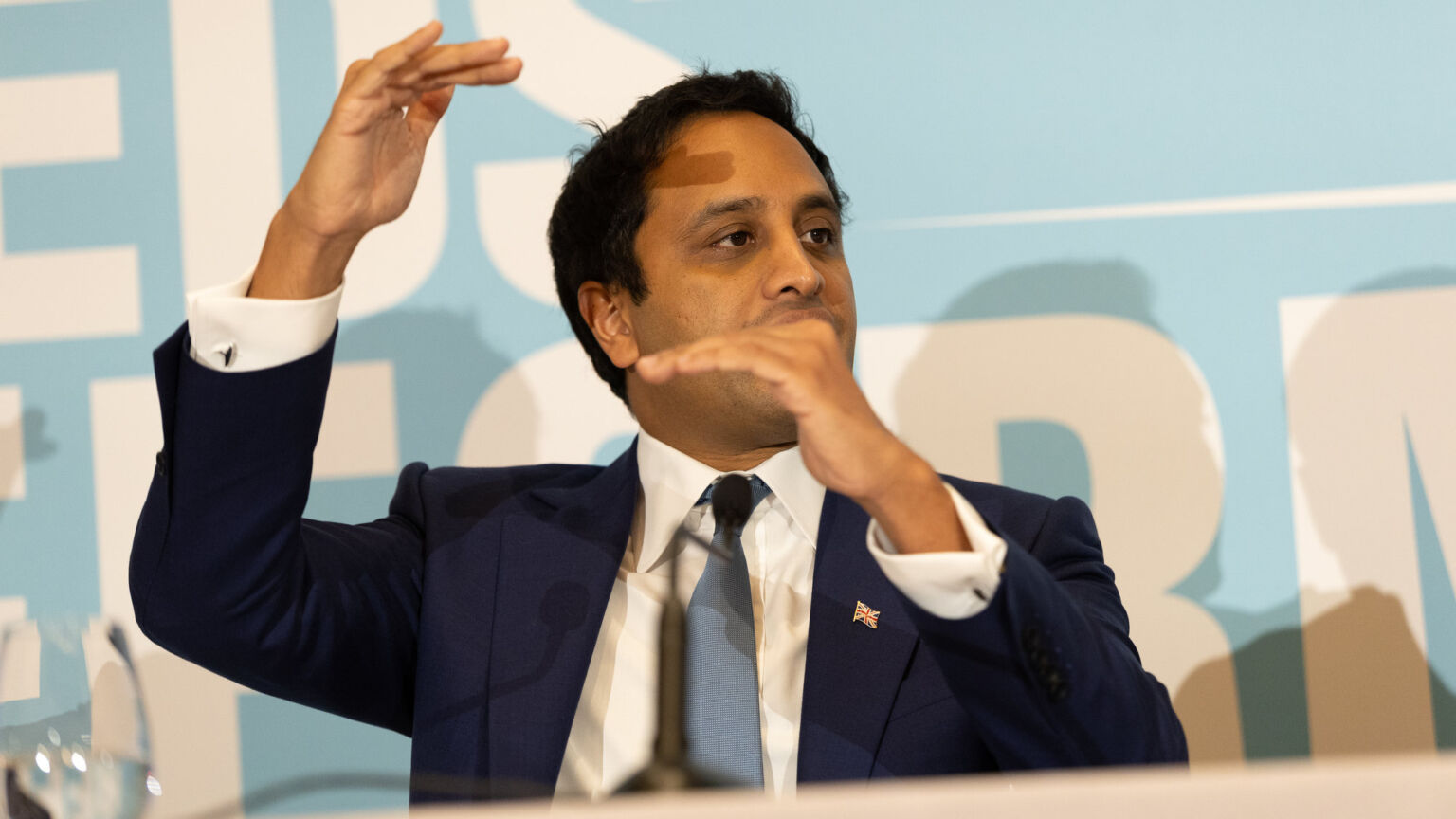
There is something operatic about the way the word ‘poverty’ is deployed in 2026. It is invoked with the gravity of a famine appeal, as though Darlington has quietly become Darfur and Croydon is one failed harvest away from catastrophe. When Reform UK’s Zia Yusuf told Sir Trevor Phillips on Sky News last Sunday that ‘real poverty does not exist in this country’, the metropolitan reaction was instantaneous – outrage on cue, moral denunciation on tap.
Yusuf argued that relative poverty means that ‘you could increase everybody’s incomes 10-fold and that statistic would stay the same’. He added that ‘absolute poverty does exist in very, very small pockets’ and that the focus should be on encouraging social mobility, rather than policies that seek to reduce poverty according to relative measures alone.
Among Yusuf’s loudest critics was Green Party leader Zack Polanski. He treated the remark as evidence of Reform letting ‘the cat out of the bag about who they are… lecturing that poverty and people’s every day struggles with rising bills and rent is exaggerated’. Left-wing publication the Canary went further, telling Yusuf: ‘Shut the fuck up, you oily, little nerd… You sound like a Star Trek android, and not the good one. We can tell you what poverty is, Zia, because most of us here at the Canary have experienced it.’ With prose like that, where to start!
What drives me mad is the way sections of the Russell Group-educated, comfortably insulated liberal class attempt to will absolute poverty into existence through definitional gymnastics. By leaning on concepts like ‘relative poverty’, they construct a permanent moral emergency in a country whose median income is high by global standards. A statistical threshold becomes a humanitarian catastrophe. It’s Dickens reborn.
My maternal grandmother is 89. She grew up in a two-up, two-down in Chadderton, Lancashire, with six siblings. The second bedroom was uninhabitable because there was a hole in the roof. All seven children slept on a single mattress on the floor of their parents’ room. They had an outdoor toilet shared by multiple families and no hot water. My great-grandfather, scarred by the horrors of the Second World War, drank heavily.
We often joke that my grandma is addicted to salt. When she was a child, the only food she could reliably count on was bread with salt or bread with brown sauce. She chose the salt. It wasn’t a preference in the modern sense. It was about survival.
That isn’t a quaint family anecdote. It is a reminder of a childhood shaped by deprivation, in an era when poverty meant malnutrition, when minor infections turned fatal, and when children died from conditions that today are either eradicated or easily treated. When she tells the story, she does so without self-pity. Her life was not an anomaly. Whole communities lived like that.
Meanwhile, my paternal grandparents knew rural, colonial-era Ghana. It was a place without infrastructure, safety nets or reliable public services. When I speak to my 93-year-old grandfather about his childhood, he reminds me thatg while his and my late grandmother’s families sat in the upper tiers of Ghanaian society, related to political leaders and hereditary chieftains, pay was low, infrastructure poor, disease rife and opportunity so limited that emigrating to Britain in the late 1950s – despite the racism and loss of status he would have to face – was still worth it.
Both of my surviving grandparents grew up in what would plainly qualify as absolute poverty in both the historical British and present-day global sense. They raised my parents amid regular power cuts, meaning homework by candlelight and no central heating. Strikes at the docks meant staples like sugar were scarce. This was not Victorian England, it was the 1970s. When I ask my grandparents, despite the economic, political and social challenges Britain has endured since 2008, whether life is better now or when they were children, they answer without pause: ‘Today.’
Official income data for 2023 to 2024 shows that 21 per cent of people in the UK were in relative poverty after housing costs, and 18 per cent were in absolute low income after housing costs. As the Institute for Fiscal Studies explains, relative poverty will always exist in an unequal society because it is defined as income below 60 per cent of the contemporary median. Meanwhile, the UK’s material wealth is substantial by international standards. Latest estimates place UK GDP per capita at around $52,600 in 2024, consistent with high-income OECD economies, but similar to the 2008 figure.
According to the Health Survey for England, around 64 per cent of adults in England were overweight or living with obesity in 2022, 29 percent were obese specifically. Government statistics show that in the most deprived areas, 71.5 per cent of adults are overweight or obese and 35.9 per cent are obese. Clearly, Britain’s deprivation problem is causing ill health, but not malnutrition.
I spend time on the airwaves every week as a broadcaster. The arguments dominating phone-ins are not about war, famine, infant mortality or sanitation. They are about whether it is unfair to fine parents for taking their kids on holiday during term time; whether children should be allowed smart phones; whether people with anxiety or depression should be allowed to queue jump at Alton Towers; whether too many people are going to university. Those are not the debates of a country facing widespread malnourishment or systemic destitution.
If you want to understand ‘real’ poverty, travel to the Global South. Or, if you are lucky enough to have living grandparents, listen to some of their stories. You will hear about hunger that was constant, children who did not survive, and illnesses that killed because there was no healthcare. This is not to deny that hardship exists in the UK – it does, and in one of the richest countries on Earth, this is a significant failure. But we should be honest about scale. As Yusuf said, it exists in ‘very, very small pockets’.
When national debates centre on queue-jumping, smartphone usage and social media, it is a sign of how far we have come within a single lifetime. My grandparents’ Britain was poorer and harsher. Ours, for all its flaws, is markedly more prosperous. For that I am grateful. The reaction to Zia Yusuf’s comments, however, suggests that this sense of perspective is not widely shared by our political and media class.
Albie Amankona is a broadcaster and financial analyst, best known for his work on Channel 5, BBC, ITV and Times Radio. Follow him on X: @albieamankona.

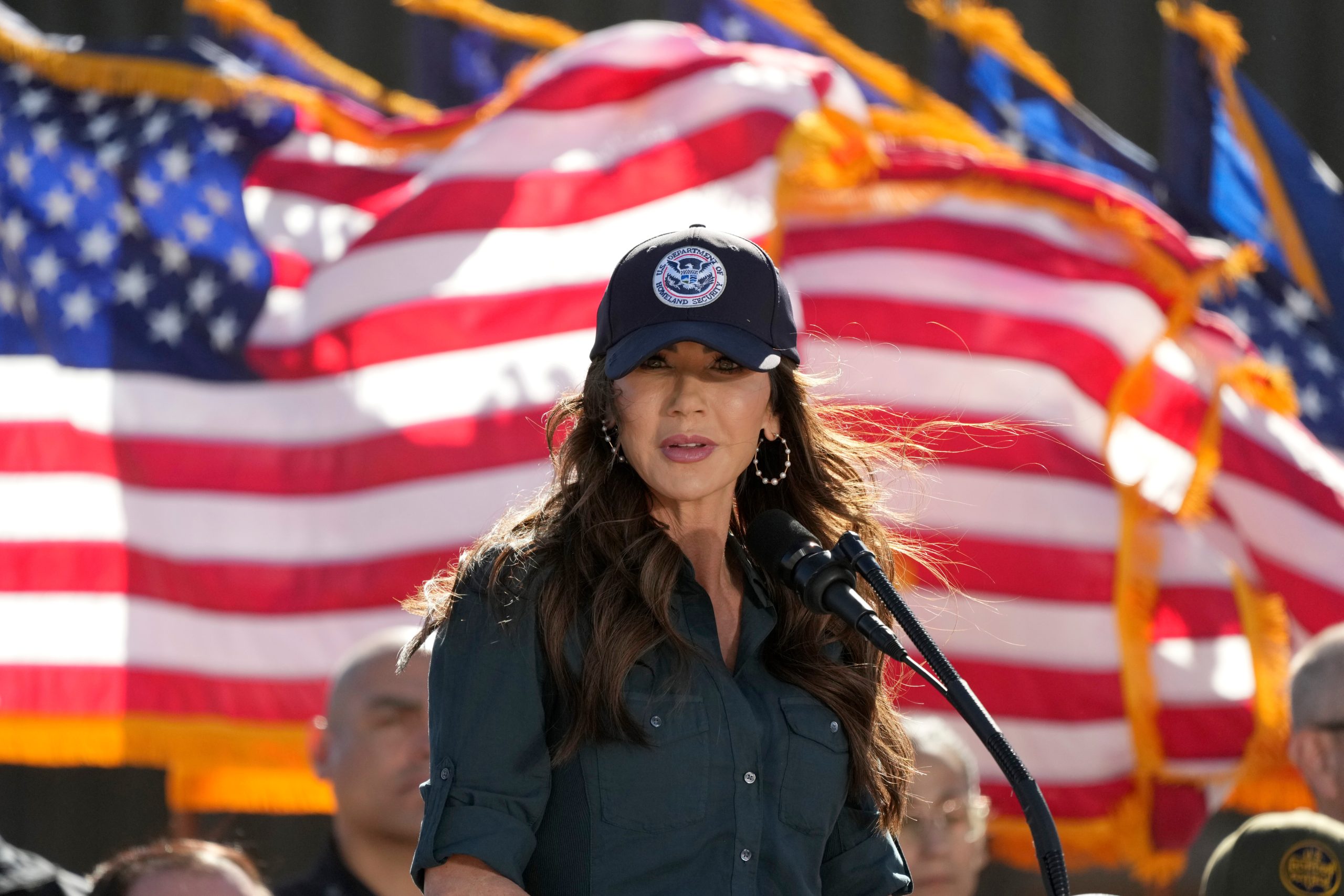

The Trump administration on Sunday halted disaster aid to states for long-term rebuilding projects in order to focus on emergency operations as the partial government shutdown enters its second week.
The Federal Emergency Management Agency “is scaling back to bare-minimum, life-saving operations only,” Homeland Security Secretary Kristi Noem said in a statement. “All non-emergency recovery work is paused.”
The funding freeze for projects stemming from past disasters adds a new source of uncertainty for states as they navigate the government’s shifting system for catastrophe response after President Donald Trump vowed to reduce aid for extreme weather.
It’s also a sign that political acrimony over Trump’s immigration crackdown has affected FEMA, which is housed with Immigration and Customs Enforcement under the Department of Homeland Security. Congressional Democrats have blocked a DHS spending bill over ICE’s aggressive tactics.
It’s the 11th time since 2003 that FEMA has suspended funding for long-term disaster-recovery projects, such as rebuilding public facilities, based on budget constraints.
The latest restriction was unusual because the agency had $7.1 billion available in its disaster fund in late January. Historically, FEMA has waited until the disaster fund drops to about $3 billion before it restricts spending.
FEMA officials told Congress last week that the fund had $9.6 billion, according to a senior congressional aide who was granted anonymity to discuss internal conversations. The fund’s balance increased in February because FEMA recovered aid that had been approved but not spent, the aide said.
On Sunday, Noem said DHS “must take emergency measures to preserve limited funds and personnel.” The announcement came days after FEMA employee travel was restricted by DHS.
Noem blamed Democrats for the shutdown, which she said forced her to halt the FEMA funding. Noem also suspended two DHS airport programs over the weekend that allowed some travelers to skip long lines at screening checkpoints and at customs entry stations. “These actions reflect the reality of operating without appropriations,” she said.
Noem, whose department includes the Transportation Security Administration, said she wanted to “refocus Department personnel on the majority of travelers.”
The TSA contradicted Noem hours after her announcement and said its PreCheck program at passenger screening checkpoints “remains operational with no change for the traveling public.”
That led some Democrats to criticize the administration for politicizing homeland security programs.
“These nitwits are at it again,” Rep. Bennie Thompson of Mississippi, the top Democrat on the House Homeland Security Committee, said in a statement, adding that the airport programs “REDUCE airport lines and ease the burden on DHS.”
Noem’s decision on FEMA funding will not affect operations at 44 active disaster sites, including those in a dozen Southern states that are recovering from a massive winter storm in late January. Nearly 2,800 disaster specialists were working across the country on Sunday, and another 4,400 were available to be deployed, according to a FEMA report.
But the funding restrictions could delay thousands of long-term disaster rebuilding projects. FEMA pays at least 75 percent of the cost of eligible projects. Many states and localities delay or halt work when FEMA stops its payments.
“States and communities will be forced to wait for long-term response work to continue,” Gregg Phillips, FEMA’s associate administrator for the Office of Response and Recovery, told a House Appropriations subcommittee on Feb. 11.
The FEMA disaster fund “has sufficient balances to continue emergency response activities for the foreseeable future,” Phillips said in written testimony submitted to panel. But if a disaster occurred, the fund “would be seriously strained.”
The funding restriction also threatens to further delay Trump’s decisions on granting 14 requests for disaster aid by governors and tribal leaders since Nov. 26.
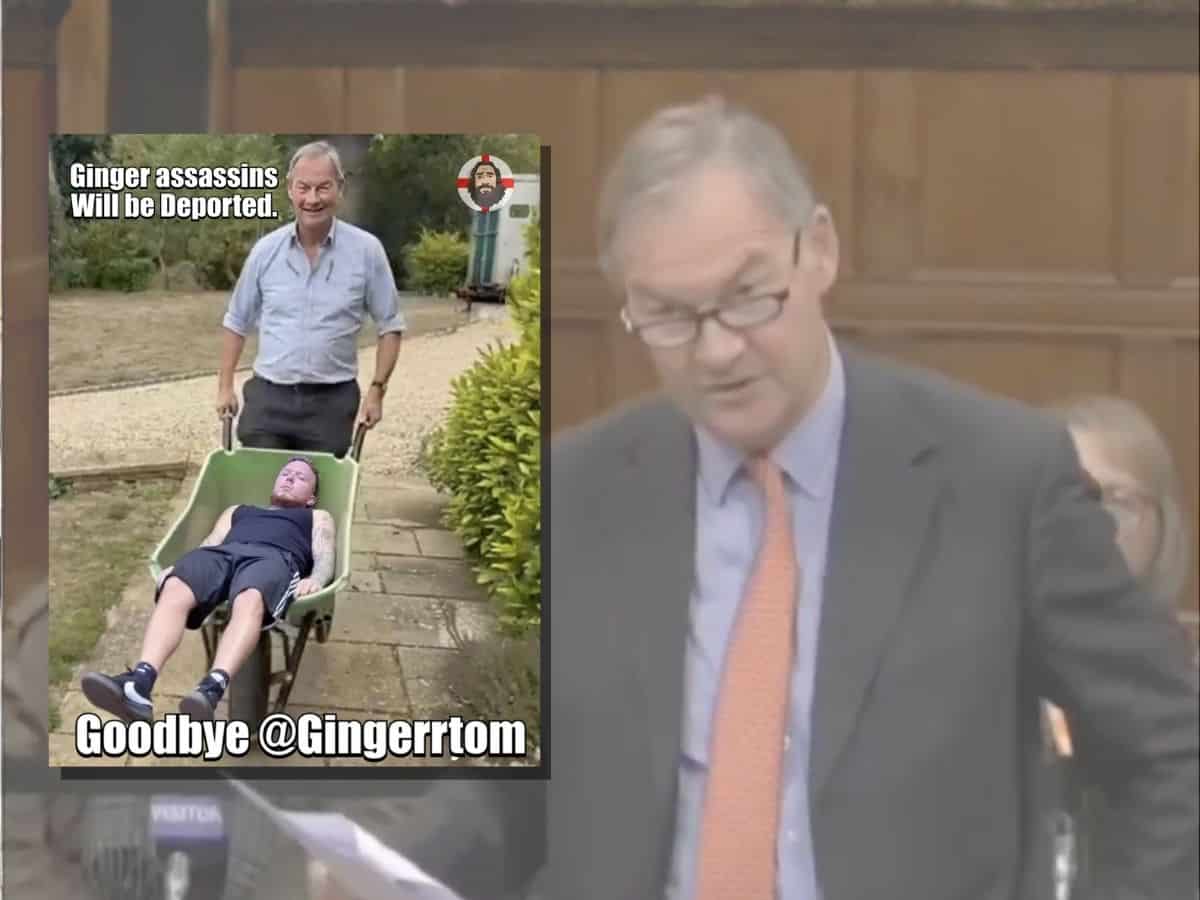
Restore leader Rupert Lowe recently argued that Twitter user ‘Ginger Tom’ should face jail time because of a tweet. The problem is Lowe previously said no one should face jail time because of a tweet.
In other words, he’s another ‘one rule for them and another for us’ politician:
Absolute hypocrite. https://t.co/z9sOQIDWPr
— Mukhtar (@I_amMukhtar) February 21, 2026
Rupert Lowe — Faceswapped
In the clip above, Lowe says (emphasis added):
I want to thank the more than 190,000 British people who signed the petition that we initiated, calling for an end to the creeping use of prison as a punishment for what people say online. A post that is deemed sharp criticism one month somehow becomes grossly offensive the next. It is arbitrary, it is inconsistent and it is fundamentally incompatible with a healthy democracy.
I don’t want people in prison for social media posts.
Lucy Connolly was imprisoned for one foolish social media post, soon deleted. Where is the fairness in that?
In Britain, nobody should ever be sent to prison for an offensive social media post, full stop.
To Lucy, and to every other person who has found themselves dragged through the system for a post online, you deserve better from your government and I sincerely hope today marks the beginning of a serious rethink in this house.
So this is pretty clear, right?
Apparently not.
First things first, we should note GT is notorious for doing ‘faceswaps’:
Let’s be honest, @gingerrtom has absolutely cooked Tommy Robinson. pic.twitter.com/VhsXDuaUQN
— Mukhtar (@I_amMukhtar) November 10, 2025
The faceswap which attracted Lowe’s attention was admittedly somewhat risque. The image below sees Lowe’s face superimposed on Charlie Kirk’s head at the moment of his assassination:
As a direct result of Reform labelling Restore Britain as ‘neo-nazi’ on national television, this vile death threat was posted online. A picture of me getting shot in the neck, just as Charlie Kirk was.
I am furious. Labelling millions of Brits as nazis has consequences. This… pic.twitter.com/hBMTkbN34U
— Rupert Lowe MP (@RupertLowe10) February 19, 2026
Lowe described this as a death threat, writing:
As a direct result of Reform labelling Restore Britain as ‘neo-nazi’ on national television, this vile death threat was posted online. A picture of me getting shot in the neck, just as Charlie Kirk was.
I am furious. Labelling millions of Brits as nazis has consequences. This dangerous and foul rhetoric is putting my team and I at risk.
I am getting the police involved about this threat to my life.
Tom later apologised for the tweet, and you know what — fair enough.
Every so often you need to ask if you’ve become too desensitised to the things you see online, and this may have been one of those times.
At the same time, Tom also highlighted the tweet from Lucy Connolly that Lowe defended:
Rupert Lowe didn’t have a single
issue with this social media post. pic.twitter.com/h8B8ayDKyX— G.T (@gingerrtom) February 20, 2026
Ginger Tom didn’t stop there either:
Online content worthy of a prison
sentence – Rupert Lowe edition: pic.twitter.com/0EuW1iGBGu— G.T (@gingerrtom) February 20, 2026
The receipts keep on coming
— G.T (@gingerrtom) February 20, 2026
Is this a death threat?
Do I go to the police now, is
that how it works? https://t.co/22bOwuJ5BX— G.T (@gingerrtom) February 21, 2026
Shifting opinions
Of course, there is another faceswap Rupert Lowe should be worried about.
Clearly someone has swapped his face from the body of a man who supports free speech to the body of a man who does not.
If Ginger Tom was responsible for that one, yeah — maybe we should get the police involved.
The guy has clearly become too powerful.
Featured image via X

On 21 February, we reported on the Guardian’s links to the Labour Together scandal. Said scandal saw a rogue Labour pressure group spying on journalists and media outlets, including the Canary. Specifically what we focussed on this Saturday were the links between Labour Together and Guardian journalist Pippa Crerar. As we noted, Crerar had avoided addressing the allegations against her.
Now, that’s changed:
Also – if a journalist is presented with an allegation it is their job in first instance to 1/ establish its veracity, usually by speaking to sources 2/ put the allegation to the individual concerned 3/ consider the motivation of the briefer. If the allegation doesn’t pass those… pic.twitter.com/x2jYKxOoTg
— Pippa Crerar (@PippaCrerar) February 21, 2026
Labour Together
Paul Holden is the investigative journalist who wrote The Fraud. His book details how Morgan McSweeney and Labour Together worked to prevent their own party from winning in 2019 (and also how they positioned Keir Starmer to take over).
To bring you up to speed, here’s what he reported on Crerar:
On the 8th of February, 2024, Pippa Crerar, the deputy political editor of The Guardian, sent me an email. Pippa Crerar’s email said that The Guardian was 24 hours away from running a story that would allege that I was under investigation by the UK security services for receiving information stolen by Russia from a hack of the Electoral Commission.
The story was nonsense.
I hadn’t received a single document from Russia. I would never receive a document from Russia. This is an unbelievable story.
When I told Pippa Crerar that the allegations were false, that in fact I would sue the Guardian for defamation if they reprinted that story, the story disappeared.
In the tweet above, Crerar is arguing that she was just doing her job by threatening to run this false and unverified story. To be fair, she was arguably just ‘doing her job’ — the problem is that it’s a shit job.
As commenter Flying Rodent highlighted:
I put it to you that if the hacks e.g. properly considered the motivation of the briefer and ditched stories if they thought they were bullshitty and self-serving, then Keir Starmer would not now be Prime Minister. pic.twitter.com/lMSjHhnRm5
— Flying_Rodent (@flying_rodent) February 21, 2026
This is how it works.
People in power use the media to disseminate information in ways which benefit them, and in return journalists get access to people in power.
Of course, this shouldn’t be how it works.
Journalists and politicians should loathe one another.
They certainly shouldn’t appear in photographs like this one featuring Emily Maitlis and Peter Mandelson:
Emily Maitlis NEVER trusted Petey Mandelson: pic.twitter.com/psoAwyjc7N
— LynnieB – #Your Party #Palestine #LFC (@LynnBraben) February 12, 2026
Of course, even accepting Crerar’s logic, her argument still doesn’t hold up:
You didn’t ’put the allegation’ to Paul though, did you @PippaCrerar ? You told him the Guardian were running a story the next day. And ‘none of the allegations’ were printed because he said he would sue. This rewording is entirely cynical and fails to address your role. pic.twitter.com/Mj86N4cek9
— dreams of widnes (@DWidnes) February 21, 2026
This defence of Crerar’s attempt to push the Labour Together smear on Paul Holden fails on its own terms : Crerar told Holden “we intend to” publish the rotten story as if it were true , and imo did not “establish its veracity ” and or “consider the motivation of the briefer” https://t.co/7youK7FGgL pic.twitter.com/17AraDGdil
— Solomon Hughes (@SolHughesWriter) February 21, 2026
Big issues
Novara’s Steven Methven noted there’s another issue even if you take Crerar’s word:
For me, the issue is that Crerar or her editors decided, rightly, not to run the story, presumably on the basis of her point 3 below and Holden’s reply.
But that means they had all the basis for a different story about malicious briefing against journalists from Labour Together… https://t.co/Ydlte59T0e
— Steven Methven (@StevenJMethven) February 21, 2026
Whichever way you cut it, it’s not a good look for the British establishment.
Featured image via Parliament
On Tuesday morning I was at Crawley Magistrates Court, where I pleaded (or is it ‘pled’?) guilty to a speeding offence from last September. I was already on nine points when it happened, although three of those had already come off my licence in November. That doesn’t count though.
Anyway, as expected, I was banned from driving or six months. Obviously, that is a bit of a blow but as John pointed out, if you do the crime, you do the time. You can imagine how that went down with me!
What I wasn’t expecting was to be in the media because of it. I saw a man sitting at the back of the court, but assumed he was a member of the public. As part of the proceedings, I was asked how much I had earned. A sixth sense told me not to reveal it in open court, so I asked the magistrates if I could pass them a note, which I then did.
As I walked out of the court I walked towards a man who had a video camera. “Who are you,” I asked. “I’m a court reporter,” he replied. Even then, I didn’t really expect it to get a lot of coverage – maybe a three line nib in the Daily Express. Boy was I wrong. By 3pm the Daily Mail had published a lengthy article detailing all my historical misdemeanours. They made five errors in the article, including the location of the offence, and the picture of the model of car I was driving. And then a similar article appeared on the Telegraph website. Both included a very unflattering picture of me walking out of the court. An LBC colleague whatsapped me to say: “Proof that you’re a celebrity”. Ha bloody Ha.
So why am I telling you all this? Because the experience I had that morning was a bit of a lightbulb moment, but not in the way you might be thinking.
When I looked on to the Court Serve website to check my case was listed for the day, I couldn’t believe the number of other similar speeding cases were listed. In each case, the person had already pleaded guilty.
No wonder the magistrates’ courts are clogged up. I looked at other courts and it was the same. At least half of the cases being heard were purely for sentencing for speeding offences. Surely this could have been done remotely and online? Of course, everyone should continue to have a right to their day in court, and be sentenced in person, but I fail to see why so many cases require an actual appearance. Am I alone in this?
Anyway, if you know anyone in Tunbridge Wells who might like to drive me around for the next six months, do let me know! John doesn’t fancy it. Can’t think why.

Have you ever been trapped on a train carriage with someone watching TikToks from their phone without headphones? Or seated on a plane by a passenger blasting music? Or even stuck in a doctor’s office waiting room as a fellow patient broadcasts radio commentary on a sports stream?
If so, you’ve experienced what some call “bare beating”. This term refers to the act of playing music, videos, podcasts or other audio out loud in public without headphones – essentially treating shared space like a personal living room.
“This. Is. Rude. There just is no other way to slice it,” said Nick Leighton, an etiquette expert and host of the Were You Raised by Wolves? podcast.
“You’re imposing your choices on a captive audience. Nobody decided they wanted to listen to that YouTube video, and yet here we are all having to endure it without our consent.”
Jodi R.R. Smith, the president of Mannersmith Etiquette Consulting, agreed, emphasising that bare beating is “unequivocally rude”.
“The presumption that everyone wants to listen to what you are listening to is simply unacceptable,” she said. “This is doubly so if others are unable to move away from you – at work, in an elevator, on public transportation, etc.”
In those tight quarters, what might even seem like low or moderate volume to you can feel disruptive to someone sitting inches away.
“Whether the distraction is visual, or noise related, when someone is intruding on another person’s public space, it’s not easy to look away and ignore,” said Diane Gottsman, the author of Modern Etiquette for a Better Life and founder of The Protocol School of Texas.
“Think of it this way: if a child was doing it in a public space, tight quarters or a restaurant, others would be annoyed and blame the parents for not adjusting the behaviour. When an adult does the same thing, it’s important for them to self adjust and be respectful of others in close proximity.”
Children might get grace for this behaviour because they aren’t as aware of social norms, but for adults who should know better, it’s simply rude. And depending on where you are, it might even be subject to legal penalties.
“Some people just aren’t mindful of how their behaviour affects others and simply have no idea how far phone speakers can carry sound,” Leighton said. “Spoiler alert: It’s way farther than you think.”

AleksandarGeorgiev via Getty Images
Indeed, “bare beaters” don’t necessarily have negative intent and are sometimes blissfully unaware.
“The reason people are doing this is because they are trying to pass the time or may not even realise their volume is offensive,” Gottsman said. “But when you’re sitting inches away from another person, even lower noises are amplified.”
There may even sometimes be understandable reasons for the behaviour. Someone with hearing difficulties may not realise how loud their device is, or they may be experiencing technical issues. Still, Gottsman said, unless it’s an emergency, the courteous move is to wait to listen to the audio when you’re in private.
“Of course, using earbuds and utilising captions is a reasonable option,” she added.
And while bare beating feels like a modern behaviour, it’s not entirely new.
“Forcing strangers to become your unwilling audience has been an issue that’s plagued humanity since the dawn of time,” Leighton said.
Smith pointed out that methods and norms have shifted over the decades.
“Back in the ’80s, being a DJ to those in your surrounding area was actually considered the norm,” she said.
“The person with the giant boombox would play it so that everyone nearby could enjoy the sound,” she said.
“But times change and nearly everyone has the ability to listen to what they like almost anywhere – so long as they are wearing headphones or earbuds.”
For those who flout modern etiquette rules by bare beating, sometimes all it takes is a gentle nudge.
Smith recalled a recent experience at an airport gate where a man was loudly streaming a soccer game on his phone as it was time to board.
“After a few minutes, I turned and asked him what he was watching,” she said. “He excitedly told me his favourite team was playing. I told him that I was having a hard time hearing the boarding announcements and asked if he could use earbuds. He gave his head a quick shake and looked around sheepishly.
“He had not realised how loud his phone was or how many people were giving him ‘the look.’ He apologised to me and the others around him as he put in his earbuds.”
Still, Gottsman emphasised that deciding whether to speak up is a judgment call.
“Is it rude to intrude on other people‘s personal space? The answer is yes,” she said. “But understand that we cannot determine another person‘s reaction, and if you can ignore it for a very short subway ride, it’s probably best to do so.”
Regardless of whether you choose to confront someone over this behaviour, the important thing is to avoid bare beating yourself. Remember: Just because you can press play doesn’t mean everyone else signed up to listen.
Keir Starmer’s Labour Party has been a massive failure. As a result, voters have started looking at the Green Party. In response, Labour have decided to knuckle down and offer policies which actually improve people’s —
— no —
— we’re just fucking with you.
They’ve gone with Yank-style attack ads:
Fuck sake so we are getting war on drugs from Labour, I thought they may be a bit more sane on this issue than that.
Harm reduction beats out criminalisation.
Experts on drug policy specifically state that poor underfunded execution of legislation/decriminalisation worsen drug… https://t.co/tFcPZiucgc
— JimmyTheGiant (@jimthegiant) February 21, 2026
Greens Vs the War on Drugs II
Labour is asking you to imagine what it must be like to live in a country where drugs are plentiful and easy to get hold of. The problem is we already live in a country where drugs are plentiful and easy to get hold of.
The War on Drugs was won by drugs.
There’s an obvious parallel to all this, and it’s the Prohibition Era in the United States. During that time, they made it illegal for citizens to drink alcohol. Did that stop people drinking?
No, of course not.
But it did give organised crime access to fast, easy cash, and this is precisely what’s happened here with drugs.
To be clear, the Greens aren’t saying you should be able to buy smack from a vending machine. They’re proposing a system in which drugs are treated seriously, but are available for people to partake of in a controlled fashion. Under Keir Starmer, you can buy crack from a guy called ‘Spez’ and OD under a motorway bridge.
Which sounds more grown up to you?
Oh, and if you think Starmer is the man who can finally end the War on Drugs, we’ve got bad news for you; you’re on drugs right now.
You are literally smoking crack.
You are off your head.
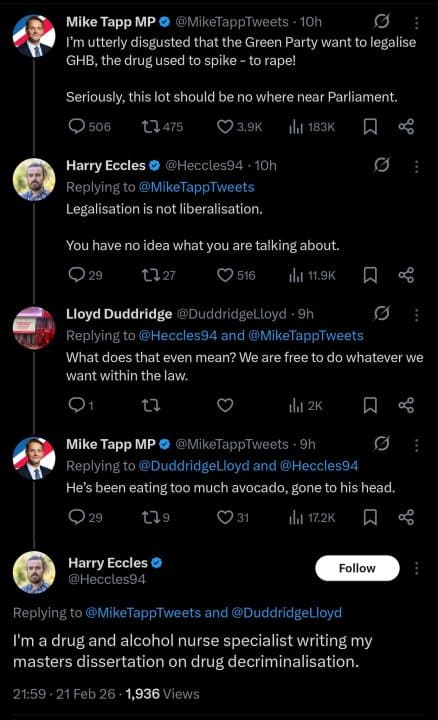
And speaking of people who are off their heads, please take a gander at this exchange involving Labour’s Mike Tapp:

That same conversation devolved into this, by the way:
Don’t think you’re on particularly solid ground here Mike, they are literally calling Labour the Paedo Party on the doorstops https://t.co/DStFbLeRz9
— Matt Zarb-Cousin (@mattzarb) February 22, 2026
Mike Tapp — the great defender of women. Here he is refusing to say a bad word about Epstein associate Donald Trump:
.@MikeTappTweets refuses to say that the US should not attack Denmark and Greenland.
Moments later he declares that sticking to international law is what we stand for as a country. pic.twitter.com/5JsmGSLEfQ
— Saul Staniforth (@SaulStaniforth) January 5, 2026
Oh, and let’s not forget this either:
2 years ago, when people were calling him boring, Keir Starmer impishly implied that he had tried drugs as a young man (“I had a good time”).
In 2020, he said he supported decriminalising cannabis.
But now? He wants police to crack down on smoking weed.
What a joke!
— Ash Sarkar (@AyoCaesar) March 28, 2023
How serious do you think Starmer is about preventing drug use when he’s openly admitted to enjoying drugs?
Bad VS Worse
As bad as Labour’s take is, it’s still not as bad as this:
This is full blown libel.
I hope Zack Polanski sues her. An AI-generated image that could be mistaken as a real image of Zack Polanski advocating for children to snort drugs, this is another level of libel. https://t.co/61HpH7fVYq
— ruva🌼 (@ruviexo) February 22, 2026
Earlier this year, we covered that Samantha Smith spoke out against deepfakes on X/Twitter. We agreed with her then and we still do, but it seems like Smith isn’t against all fakery — just that which impacts her personally.
Be prepared for more of this anyway.
Whether it’s the Labour Party or the reactionary right, there are forces in this country who are zealously opposed to anything getting better.
Featured image via Barold
Democrats are frothing at the mouth to center President Donald Trump’s tariff chaos in their affordability messaging as they charge into the midterms.
The party was already planning to slam Republicans over the economy on the campaign trail, riding the playbook that helped propel New Jersey Gov. Mikie Sherrill, Virginia Gov. Abigail Spanberger and NYC Mayor Zohran Mamdani to victories last year. Then, on Friday, the Supreme Court in a remarkable rebuke slapped down Trump’s tariffs — declaring illegal his favorite lever to bend the global economy to his will.
But for Democratic strategists and party officials who spoke with POLITICO, it’s not just the high court’s ruling that could open a new avenue — it’s also Trump’s doubling down, moving to levy 15 percent tariffs worldwide under a different authority. “Now we have a new data point that Trump is not going to relent,” said a person familiar with Democrats’ strategies, granted anonymity to speak candidly.
Democratic operatives see it as a massive windfall.
“It’s such a gift,” the person familiar said. “The gift of it is how politically inept it is.”
Doug Herman, a Democratic strategist based in California, said Trump’s renewed tariff saber-rattling provides “tailor-made” messaging on affordability for Democrats. “Every American has borne the cost of these Trump tariffs,” he said. “It’s the kind of thing that everybody needs to take advantage of in their campaigns.”
The crop of potential Democratic 2028 presidential candidates leapt into action immediately. Illinois Gov. JB Pritzker released an “invoice” demanding that the White House pay more than $8.6 billion in “past due” tariff revenue, which he calculated out to $1,700 per family in his state. “The President owes you an apology — and a refund,” Pete Buttigieg said on X. California Gov. Gavin Newsom told reporters that Trump “should return that money immediately.”
“They imposed a sales tax on the American people,” veteran Democratic strategist James Carville told POLITICO. “What did you get? Nothing.”
That messaging — branding the tariffs as illegal taxes that Trump must repatriate to voters (which, he said Friday, he did not intend to do) — is expected to become a core component of Democrats’ strategy as they fight to retake majorities in Congress.
“I wouldn’t be surprised if tariffs made it in 50 percent of our paid advertising,” said one Democratic strategist working on House campaigns. Another who works on Senate campaigns said they’re preparing to rev up their ads on affordability as well.
“We have a very clear line that we can draw from [voters] struggling to make ends meet, and things that Trump is doing intentionally,” Third Way’s Matt Bennett said. “It is a uniquely easy story for Democrats to tell.”
It’s also not lost on the party that the states whose economies have been hit hardest by the tariffs are home to some of the most contentious Senate races that could make or break the GOP’s majority. “We’ve not only lost our markets and gotten lower prices selling corn and soybeans, particularly soybeans, but we have also, at the same time right now, we have the misfortune of having very high inputs, a lot of uncertainty,” Iowa Democratic Party Chair Rita Hart told POLITICO. “We’re talking about real hardship where people are going to be really negatively affected financially.”
Trump, of course, is not on the ballot in November, but multiple Democratic operatives told POLITICO they’re planning to skewer any Republican who has defended his tariffs. “It’s this very, very easy to understand action that the president took, and that congressional Republicans backed,” the Democratic strategist working on Senate races said. So the line for Dem candidates will be cut and dried: “This is where my opponent is not fighting for you,” they said.
The RNC is fully prepared to defend against any Democratic attacks. “The Supreme Court’s decision does not change the reality: President Trump’s trade agenda is working, and Republicans are united in strengthening the economy for American families,” RNC spokesperson Kiersten Pels said in a statement. “His tariffs have helped lower inflation, raise wages, and drive historic investment into U.S. manufacturing and energy. As we head into the midterms, Republicans are focused on building on these gains and putting workers first — while Democrats oppose the policies bringing jobs back home.”
The White House, too, is brushing off the idea that Democrats have been handed a messaging victory.
“President Trump has powerfully used tariffs to renegotiate broken trade deals, lower drug prices, and secure trillions in manufacturing investments for American workers — all things Democrats have promised to do for decades,” White House spokesperson Kush Desai said in a statement. “It’s not surprising Democrats care more about having a phony talking point than these tangible victories for the American people, because talking is all Democrats have ever been able to do.”
But the economic picture over the last year has soured, with key indicators released Friday showing slowed growth and rising inflation. Recent polls find that costs and the economy remain a central concern going into November. And though Trump is visiting battleground states to pitch his economic message, he has thus far struggled to acknowledge voters’ concerns. In Georgia on Thursday, the day before the Supreme Court’s ruling came down, Trump claimed he had “won affordability” and told voters his tariffs were “the greatest thing that’s happened in this country.”
On Tuesday, Trump will stand before Congress for his State of the Union address — one of the largest platforms that the presidential bully pulpit provides. Trump said last week he would focus on the economy in those remarks.
Democrats have a tsunami of counterprogramming planned — including anti-SOTU rallies. Multiple Democrats, including Senate Minority Leader Chuck Schumer, will bring as their guests some small business owners who’ve been affected by Trump’s tariffs, guaranteeing the issue will be front and center, regardless of the substance of the president’s remarks
DCCC Chair Suzan DelBene (D-Wash.) previewed what this messaging will sound like on the campaign trail. “House Republicans rubber stamped President Trump’s tariffs and are responsible for the painful affordability crisis they have unleashed on American families,” DelBene said in a statement. “Voters will not soon forget Republicans are the reason everything is more expensive.”
Like this content? Consider signing up for POLITICO’s Playbook newsletter.
The UK recently woke up to the fact that we’re facing a Student Loan crisis. The crisis is that interest on debt is so high most students will never pay their loan off, and will suffer a massive tax on their earnings as a result.
If you were wondering what Labour will do to fix this issue, the answer is…
*DRUM ROLL*
…sweet fuck all:
Bridget Phillipson, the education secretary, is asked what she’s going to do about the scandal of student loans/debt.
Phillipson blames the Tories for the mess but explains the govt won’t be doing anything to sort it out. pic.twitter.com/TiH7DsmklO
— Saul Staniforth (@SaulStaniforth) February 22, 2026
Crisis
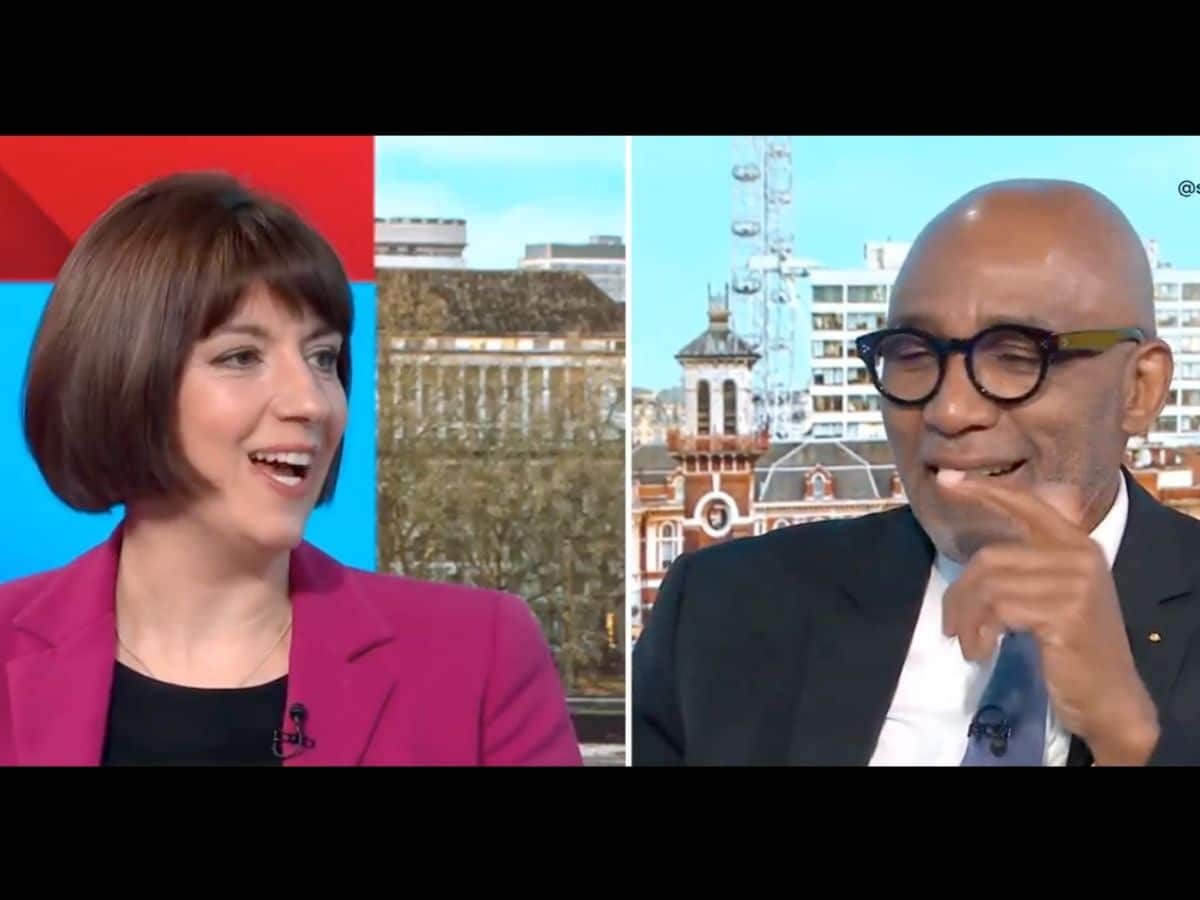
Trevor Phillips put the following to the education secretary:
What are you going to do to help the graduates stuck on the so-called Plan 2 loans, which came in in 2012, and which means that some of them… owe more than they’ve borrowed?
Honestly, you can just stop reading at this point, because the answer is ‘nothing‘.
Here’s how Phillipson responded:
Look, I recognise the challenges of the system that’s there. I would just point out, I gather the Tories have had something to say about this today.
Phillips quite obviously agrees with what the Tories have said, because he noted:
They’re going to do what sounds completely reasonable, which is not to punish people for getting a degree.
Phillipson hit back:
Which might sound a bit more reasonable if they hadn’t been the people that had introduced this system in the first place.
Blaming past governments is fine when you’re trying to get elected, but it has a limited shelf life when you’re in power.
If Phillipson said ‘the Tories caused this mess, but we’re going to fix it’, then fair enough; what she actually said was ‘the Tories caused this mess, and we’re going to ignore it and hope no one blames us‘.
In terms of actual solutions, Phillipson did say they plan to bring in “maintenance grants for less well-off students”. When asked if this Labour government will provide relief to graduates who’ve been stuck with “massively expensive loans” for 12-14 years, Phillipson said:
Look, I get the problem. I see the issue. In reality, as a government, you have to look at a question of priorities and what you can do and how fast you can do it… Given the shape of what we have in the public finances, this is really hard. But I do find it a bit rich that the people who design-
Good lord.
YOU.
ARE.
IN.
GOVERNMENT!
If you can’t come up with a solution, step down, because you’re clearly not up to the job.
Phillipson had a similar car crash on the BBC:
#bbclaurakk on student debt “This is not a tolerable situation, is it”
Phillipson “it is really difficult”
“you’ve made it harder”
“no”
Phillipson later admits the govt is freezing the thresholds & they don’t have any plans to help graduates but its all the Tories fault pic.twitter.com/N0MTxUMabJ
— Saul Staniforth (@SaulStaniforth) February 22, 2026
Student Loan tax
As HG wrote for the Canary on 18 February:
Martin Lewis has accused the Labour Party of turning student loans into a tax on young people.
At the Autumn budget, Labour froze the student loan repayment thresholds for Plan 2 loans at £29,385 from April 2026.
Lewis pointed out that this was either a targeted tax rise on young people, or a:
“retrospective rewriting of the terms of a private contract.”
HG added:
Rachel Reeves claimed the freeze was “fair and reasonable” – which is, of course, bullshit.
Mainly because rich kids who had the bank of mummy and daddy to pay their tuition fees up front are now exempt from this additional tax.
Essentially, if your parents are rich, you’ll earn a significant percentage more than your peers, even if you get paid the same. We could have flipped this and said ‘if your parents are poor you’ll earn less‘, but let’s face it — even moderately well off people can’t afford to pay their kids’ tuition fees up front.
As noted, this is not a new issue. Labour have had over a decade to prepare for this. It’s certainly the case that the 2019 Labour Manifesto was better than Starmer’s offering in that it set out to abolish future fees, but even Corbyn’s Labour didn’t have a plan for existing graduates.
A Labour problem
Every year, there are more and more people who are suffering this unfair tax.
And the more of us there are, the harder it will be for these coward politicians to ignore us.
Because I’m telling you now, I won’t be voting for any politician who plans to maintain a 9% tax on my salary.
Featured image via Trevor Phillips

Alzheimer’s is a horrible disease that has uniquely devastating effects on the people who have it and their loved ones.
Common symptoms include memory loss; struggling to plan, complete tasks or solve problems; feeling confused; experiencing new problems with speaking and writing; misplacing items; making poor judgment calls; social withdrawal; and more.
While those symptoms are ones we often hear about, they aren’t the only ones. There’s a symptom that many caregivers aren’t aware of and think is a result of “bad” caregiving: agitation.
“It’s critical to first appreciate that agitation is a symptom of brain changes caused by Alzheimer’s disease, not poor caregiving,” said Dr. Richard Stefanacci, the medical director of Inspira LIFE, a senior living program.
“The brain damage from Alzheimer’s makes people prone to agitation regardless of how loving caregivers are,” said Stefanacci, who also specialises in older populations and Alzheimer’s.
According to information the Alliance of Aging Research sent to HuffPost, “agitation” in this sense can present itself in a variety of ways: pacing, trying to leave, angry outbursts, profanity, hitting, mood swings, throwing items and more.
Caregivers may blame themselves, AAR continued, thinking it’s a result of their burnout, introducing a new routine or not being patient enough.
Dr. Nikhil Palekar, the director of the Stony Brook Center of Excellence for Alzheimer’s Disease at Stony Brook Medicine, said there’s a stigma when it comes to this specific symptom.
“Caregivers often feel they might be doing something wrong, which is causing their loved one with Alzheimer’s to react in an uncooperative, hostile or agitated manner, without realizing that agitation in Alzheimer’s is very common, with rates ranging from 56% in early stages to 68% in the moderate-severe stage of the disease,” he said.
How Alzheimer’s can cause agitation symptoms
Like with other Alzheimer’s symptoms, it all comes down to the brain.
“Alzheimer’s disease is the result of brain damage to areas of the brain that control emotions, decision-making and behavioral responses,” Stefanacci said.
“This neurological damage explains why people with Alzheimer’s may react strongly to situations that wouldn’t have bothered them before the disease progressed to this point.”
More specifically, we’re looking at neurotransmitters. “Alzheimer’s disease results in dysregulation and a decrease in three neurotransmitters (chemical messengers) in the brain – serotonin, norepinephrine and dopamine – resulting in symptoms of agitation,” Palekar said. Keeping in mind that those neurotransmitters help with mood, motivation, energy, anxiety and more, this makes sense.
We also have to consider environmental factors. For example, the holiday season – or other high-commotion events – can exacerbate agitation and its causes.
“Large gatherings with unfamiliar faces, disrupted routines, unusual foods and changes to previously familiar environments can cause agitation in someone with Alzheimer’s, especially [in] later stages of the disease,” Stefanacci continued.
“Most critical is to make adjustments and accommodations to reduce the stress, such as maintaining routine and familiarity.”
There is hope for Alzheimer’s agitation
Whether you experience agitation from Alzheimer’s or love someone who does, know that hope is not lost. Below, doctors share tips and other helpful information that can help you manage this symptom together:
Create and maintain routines
Consistent daily schedules with meals, activities and bedtime are key, according to Stefanacci. When you do have to prepare your loved one for a change, he encourages doing it ahead of time if/when you can and trying to maintain other routines.
Avoid arguing when possible
If the person with Alzheimer’s has a harmless belief, Stefanacci recommended not arguing with them about it. Rather, he said to focus on the emotion behind what they’re saying and remember that you can’t reason with an Alzheimer’s-damaged brain.
Use calming approaches
While difficult at times, staying calm and helping the person with Alzheimer’s stay calm is important. Speak in a calm, reassuring voice, play familiar music they enjoy and reduce confusing noise, Stefanacci said.
Know that there are helpful treatments available
It’s easy to feel hopeless when someone has Alzheimer’s, and to think that small interventions won’t make a difference. That’s understandable – and thankfully not true.
“This symptom can be effectively treated with behavioural interventions as well as medication, which is FDA-approved for the treatment of agitation in Alzheimer’s disease,” Palekar said.
To get to that point, he recommended discussing any agitation-like symptoms with the patient’s medical provider.
Similar to the tips above, Palekar listed some specific, non-pharmacological interventions that can decrease agitation, too:
-
Maintaining a daily routine and structure
-
Reducing noise and clutter
-
Gentle touching
-
Soothing music
-
Reading
-
Walking (ideally outside in the sunlight)
-
Staying busy with distractions, like snacks, objects or fun activities
-
Avoiding stimulants, such as caffeine, late in the day.
Take care of yourself as a caregiver
Being a caregiver is hard work, to understate it. Stefanacci urges these individuals to seek support from other caregivers, support groups and counselling. He also mentioned giving yourself permission to simplify or skip holiday traditions that are simply too overwhelming.
In short, it’s “normal” for someone with Alzheimer’s to show agitation – and that’s on Alzheimer’s, not anything the caregiver has done.
As someone with Alzheimer’s or their loved one, know that you are not alone, and that people are available and want to support you.
As promoted by Carol Vorderman, StopReform.Vote have endorsed the Green Party’s Hannah Spencer in the Gorton & Denton by-election:
StopReformUK.vote backs the Green Party
StopReformUK.vote provide regular updates on who to vote for in local and national elections. As is clear from their name, their aim is to prevent Reform from winning seats. In aid of that, they promote the candidate with the best chance of winning.
Vorderman included the following message with her post:
BREAKING: The Official TACTICAL VOTE to beat Reform in Gorton and Denton is
HANNAH SPENCER…
GREEN PARTY
…This is based on accurate and recent polling in the constituency.
Our tactical voting website is StopReformUK.vote
Formerly branded as StopTheTories.voteWe annihilated the Tory party with tactical voting in 2024 general election and Reform is EASILY beatable with tactical voting too.
The Canary CEO Steve Topple wrote about StopTheTories.vote in relation to the 2023 local elections:
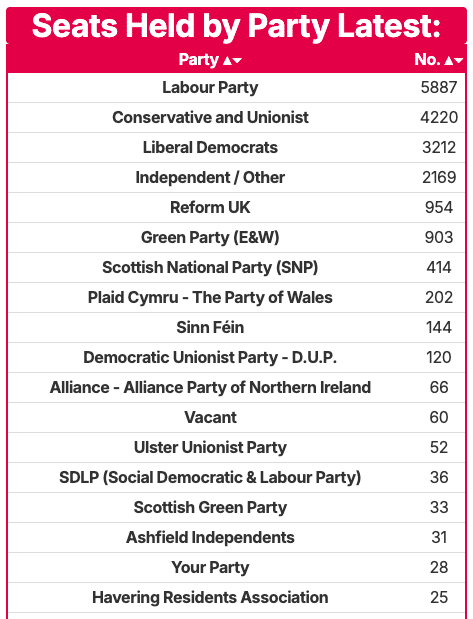
Currently, the larger parties – along with other groups – hold the following numbers of seats:
- Tories – 3,363
- Labour – 2,140
- Lib Dems – 1,221
- Independents – 954
- Green Party – 240
- Residents Associations – 112
So, it’s surely time to try and boot some of these Tories out. While Labour is no opposition in the national government, in some local areas their councillors do good work. Meanwhile, the Green Party will be hoping to build on its success in 2022. However, if your primary goal in these local elections is to remove your Tory councillors, then one website can direct you to who best to vote for to do that.
The above figures were the seats being contested in the 2023 local elections. The overall picture is currently as follows (ignoring parties with under 25 seats):

Clearly there has been a big shift away from the Tories. What people like Vorderman want to avoid is a shift towards Reform UK.
‘A very real threat’
In her post, Vorderman finished:
As it stands, there is a very real risk of Reform winning in this seat as the rest of the vote is largely split between Labour and Green. We are urging Labour, Lib Dem, and other party supporters who do not want a Reform MP, to lend their vote to the Green Party this time. We have carried out extensive research, and it points to this being our best chance of stopping a very real threat from Reform.
Please share to help spread the word!
You can sign up to receive “the latest tactical voting advice” from StopReformUK.vote here.
Featured image via StopReformUK.vote

Noem restricts disaster aid over shutdown targeting ICE

Team USA honors Johnny Gaudreau after defeating Canada to win the gold medal

Judelow and Chuck Nasty Join Money SMP…


-

 Video6 days ago
Bitcoin: We’re Entering The Most Dangerous Phase
-

 Crypto World5 days ago
Can XRP Price Successfully Register a 33% Breakout Past $2?
-

 Video3 days ago
XRP News: XRP Just Entered a New Phase (Almost Nobody Noticed)
-

 Fashion2 days ago
Weekend Open Thread: Boden – Corporette.com
-

 Sports6 days ago
GB's semi-final hopes hang by thread after loss to Switzerland
-

 Politics14 hours ago
Baftas 2026: Awards Nominations, Presenters And Performers
-
 Tech6 days ago
The Music Industry Enters Its Less-Is-More Era
-

 Business5 days ago
Infosys Limited (INFY) Discusses Tech Transitions and the Unique Aspects of the AI Era Transcript
-

 Entertainment4 days ago
Kunal Nayyar’s Secret Acts Of Kindness Sparks Online Discussion
-

 Video5 days ago
Financial Statement Analysis | Complete Chapter Revision in 10 Minutes | Class 12 Board exam 2026
-

 Tech4 days ago
Retro Rover: LT6502 Laptop Packs 8-Bit Power On The Go
-
 Sports4 days ago
Clearing the boundary, crossing into history: J&K end 67-year wait, enter maiden Ranji Trophy final | Cricket News
-

 Business8 hours ago
Mattel’s American Girl brand turns 40, dolls enter a new era
-

 Business4 hours ago
Law enforcement kills armed man seeking to enter Trump’s Mar-a-Lago resort, officials say
-

 Entertainment4 days ago
Dolores Catania Blasts Rob Rausch For Turning On ‘Housewives’ On ‘Traitors’
-

 Business5 days ago
Tesla avoids California suspension after ending ‘autopilot’ marketing
-

 Politics6 days ago
Eurovision Announces UK Act For 2026 Song Contest
-

 Tech3 hours ago
Anthropic-Backed Group Enters NY-12 AI PAC Fight
-

 NewsBeat2 hours ago
Armed man killed after entering secure perimeter of Mar-a-Lago, Secret Service says
-

 Crypto World4 days ago
WLFI Crypto Surges Toward $0.12 as Whale Buys $2.75M Before Trump-Linked Forum