

Crypto World
XRP Drops 69% From ATH and Tests Key Support Zone; Is a Reversal Coming?


TLDR:
- XRP has dropped 69% from its recent all-time high of $3.66 and is currently trading around $1.39.
- The $0.66 price level is a critical support threshold — a weekly close below it invalidates the bullish outlook.
- Santiment data recorded $1.93B in weekly realized losses, the largest spike for XRP since November 2022.
- Analysts cite upside targets of $2, $3, $5, and $10-plus if XRP holds above its key accumulation zone.
XRP is trading around $1.39 after recording a 69% correction from its recent all-time high of $3.66. The asset has posted a -3.76% decline in the last 24 hours and an -8.78% drop over the past seven days.
Trading volume stands at approximately $1.43 billion within the same 24-hour window. The token is currently testing a historically significant demand zone that analysts say previously served as a multi-year accumulation area.
XRP Retests Multi-Year Accumulation Zone After Sharp Decline
The current price action places XRP at a technically important level. The token broke below the $2 support zone and is now retesting what analysts describe as a high-timeframe demand area.
This zone previously acted as the upper boundary of a multi-year accumulation range before the 835% rally.
Crypto analyst Crypto Patel noted on social media that the current structure mirrors a classic breakout-retest setup. The price tested this same support region before the prior explosive move. That historical parallel has drawn attention from traders watching the $0.86–$0.66 range closely.
According to the analysis, the $0.66 level acts as the key line for bullish continuation. A weekly close below that price would technically invalidate the bullish outlook. For now, XRP remains above that threshold while sentiment stays cautious.
The confluence of the multi-year breakout retest and the accumulation zone creates what analysts see as a strong demand area. Whether price holds or breaks lower from here will likely set the tone for the next major move.
On-Chain Data Shows Largest Realized Loss Spike Since November 2022
On-chain data from Santiment recorded $1.93 billion in weekly realized losses among XRP holders. This marks the largest spike of this kind since November 2022. The data point reflects a notable capitulation event among market participants.
Crypto Patel referenced the Santiment figures in a post on X, pointing out that extreme capitulation events have historically coincided with local price bottoms.
The November 2022 comparison is relevant because that period also preceded a recovery phase for many digital assets.
Realized losses occur when holders sell at prices lower than their cost basis. A spike of this size shows that a large portion of the market exited positions at a loss. Such behavior often marks a shift from weak hands to stronger holders.
Upside targets cited in the analysis range from $2 to $3, extending further to $5 and beyond $10 from the accumulation zone.
These levels represent potential resistance points if buyers step in and the price recovers. The next major confirmation will come from how XRP closes on a weekly basis near current levels.



Bithumb CEO admited past mistakes following the latest 620,000 BTC blunder which has prompting further investigations into system flaws.
South Korea’s financial authorities are facing criticism after failing to spot major flaws in Bithumb’s systems that led to an unprecedented Bitcoin error.
Despite repeated inspections by the Financial Services Commission (FSC) and the Financial Supervisory Service (FSS), a vulnerability remained that allowed a single employee to trigger massive coin transfers without detection.
Bithumb Crypto Mishap
According to Rep. Kang Min-guk of the People Power Party, the FSC reviewed Bithumb once in 2022 and twice in 2025, while the FSS carried out three inspections during the same period. Despite this, none identified discrepancies between actual holdings and accounting records.
On February 6, a promotional event went wrong when users were mistakenly credited with 2,000 BTC each instead of coins worth 2,000 won (worth approximately $1.38). This error caused the system to register a total of 620,000 bitcoins being “distributed” to users, which is far more than the exchange’s actual holdings of about 42,800 BTC.
As reported by The Korea Times, the country’s lawmakers said the mistake exposes deeper weaknesses in internal controls, ledger management, and regulatory supervision. Rep. Han Chang-min of the Social Democratic Party questioned whether regulators’ inspections were largely procedural and noted attempts to place responsibility on Bithumb.
The FSS has extended its probe through February and is investigating potential violations involving investor protection, anti-money laundering (AML), and system flaws.
Bithumb CEO Lee Jae-won acknowledged two smaller prior errors that were recovered, which the FSS will also review.
You may also like:
Meanwhile, an emergency team from the authorities and the Digital Asset eXchange Alliance (DAXA) is reviewing asset verification and internal controls at some of the country’s other prominent exchanges, such as Upbit, Coinone, Korbit, and GOPAX. Results are expected to influence both DAXA’s self-regulatory rules and future crypto legislation.
Lost and Found
The latest setback comes a month after the Gwangju District Prosecutors’ Office reported that Bitcoin seized in a criminal case had gone missing, but authorities have now recovered all 40 billion won worth of the lost cryptocurrency. Prosecutors said the 320.8 bitcoins were returned from the hacker’s electronic wallet to the office’s wallet on February 17, apparently voluntarily, after the hacker was unable to cash them out.
The coins had originally been confiscated from the daughter of a couple arrested for operating an illegal overseas gambling site worth 390 billion won between 2018 and 2021, who had converted their criminal proceeds into Bitcoin. Officials said the BTC were lost last August when prosecutors accidentally accessed a phishing site while checking the wallet, which exposed the funds.
Authorities have been tracking the hacker and monitoring domestic and international exchanges to prevent further losses.
Binance Free $600 (CryptoPotato Exclusive): Use this link to register a new account and receive $600 exclusive welcome offer on Binance (full details).
LIMITED OFFER for CryptoPotato readers at Bybit: Use this link to register and open a $500 FREE position on any coin!


The idea that Layer 1 blockspace has become a commodity may be premature, according to Bitwise CIO Matt Hougan, who argues that institutional behavior tells a very different story.
Hougan pushed back on what he described as an “increasing view in crypto that L1 blockspace is a commodity.
Institutional Capital Clusters on Top-Tier Chains as On-Chain Prediction Markets Redefine Information Edge
According to the Bitwise executive, if infrastructure were truly commoditized, capital and development would be evenly distributed across chains.
Instead, the vast majority of institutional building is taking place on very few chains (Ethereum, Solana, etc.).
“…basically, zero interest in building on the twentieth largest L1,” he explained.
Networks like Ethereum and Solana continue to dominate mindshare, liquidity, and developer activity, even as newer Layer 1s compete aggressively on fees and throughput. Hougan offered a simpler explanation for today’s low-fee environment.
“Top-tier L1s built more bandwidth than the market can use at the moment, so fees are rock-bottom.”
However, he cautioned that the current equilibrium may not last.
“The real question is what happens when demand scales as stablecoins/tokenization/DeFi grow into the trillions,” he wrote. “I’m not sure we know the answer yet.”
If blockchain-based financial infrastructure expands to support trillions of dollars in tokenized assets and on-chain settlement, today’s excess capacity could quickly tighten. Such an outcome could potentially reshape the economics of leading networks.
Prediction Markets as a “Reg FD for the Internet Age,” Hougan Argues
Beyond infrastructure, Hougan also weighed in on another contentious topic: insider trading concerns surrounding crypto-based prediction markets.
“The insider trading worries about prediction markets are basically backwards,” he wrote. “Prediction markets are a markets-based extension of Reg FD, putting us all on a level playing field.”
Regulation Fair Disclosure (Reg FD) was designed to prevent selective disclosure of material information to favored investors.
Hougan argues that prediction markets extend that principle by publicly pricing probabilities around major events.
He reflected on how hedge funds historically extracted “alpha” during pivotal legislative moments in Washington, D.C., hiring lobbyists and consultants to gather private intelligence from Capitol Hill.
Today, however, retail investors can track live probabilities on platforms like Polymarket, including markets tied to the potential passage of legislation such as the Clarity Act.
“For liquid markets, those odds are probably as good or better than anything the lobbying complex can provide. It’s a more even playing field,” Hougan said.
He acknowledged that risks remain, citing the need to aggressively police insider trading in prediction markets. Still, he emphasized that the impact balance is dramatically positive and egalitarian.
Therefore, there are two debates here:
- Whether L1s are commoditized and
- Whether prediction markets enable unfair advantages
Both debates revolve around how power is distributed in financial systems. According to Matt Hougan, institutional concentration on top-tier chains reflects economic reality rather than pure commoditization.
Meanwhile, open prediction markets represent a rare instance where information asymmetry may actually be shrinking.
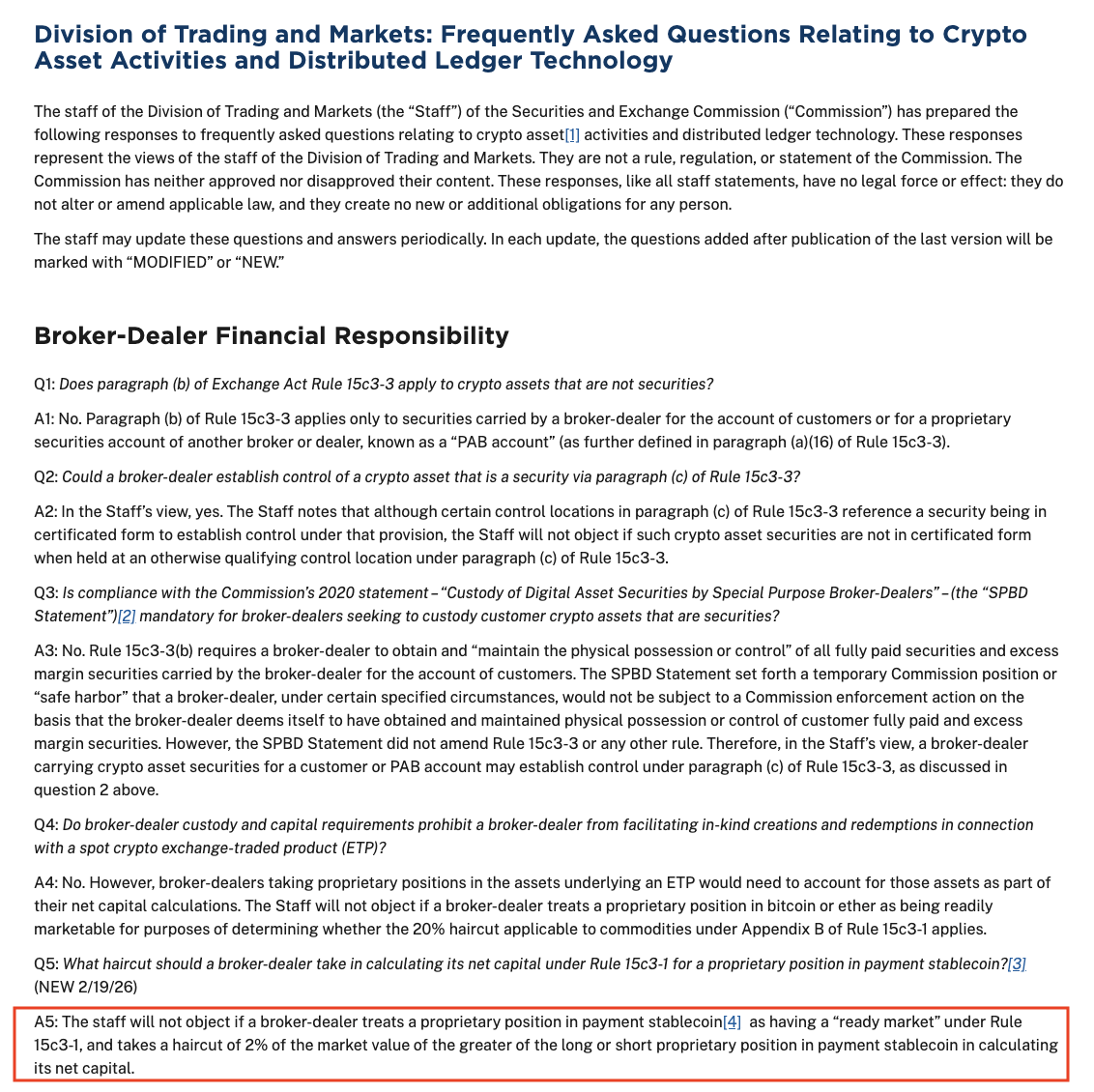
The US Securities and Exchange Commission (SEC) staff last week clarified that broker-dealers can apply a 2% “haircut” to their stablecoin holdings without objection from the SEC.
Previously, broker-dealers were uncertain whether to apply a 100% haircut to their dollar-pegged stablecoins, meaning that they did not count the tokens toward their net capital under existing regulations.
The clarification came in the form of a posting by the staff of the SEC’s Division of Trading and Markets as a “Frequently Asked Questions Relating to Crypto Asset Activities and Distributed Ledger Technology.”
In response, Commissioner Hester Peirce said: In my view, a 100% haircut would be unnecessarily punitive given the underlying reserve assets that back payment stablecoins.”
The SEC requires broker-dealers to maintain minimum levels of net capital to meet financial obligations and absorb potential losses from market downturns and volatility, according to the staff’s clarification.

For example, if a broker-dealer holds $100 million in stablecoins, a 2% haircut allows them to count $98 million toward their net capital requirements. Celebrating the clarification as positive for the financial system, Peirce said:
“Stablecoins are essential to transacting on blockchain rails. Using stablecoins will make it feasible for broker-dealers to engage in a broader range of business activities relating to tokenized securities and other crypto assets.”
The clarification means broker-dealers can hold stablecoins without worrying about excess net capital requirements, and can treat the tokens similarly to money market funds, vehicles that hold low-risk cash equivalents like US Treasurys and certificates of deposit.
In a social media post over the weekend, Marc Baumann, CEO of crypto intelligence company 51, called the SEC staff communication “a big deal,” adding that “Wall Street can now actually hold and use stablecoins without destroying their capital ratios.”
Related: SEC leaders seek to clarify how tokenized securities interact with existing regulation
Stablecoins gain traction in the United States, but not all US officials are convinced
The stablecoin market cap recently hit a snag, falling by about $6 billion from the December 2025 peak of over $300 billion.
However, the market still has a $295 billion market cap, which has steadily grown since 2023, according to data from RWA.XYZ.
United States President Donald Trump signed the GENIUS stablecoin bill into law in July 2025, which was considered a landmark moment for the crypto industry.

The stablecoin market capitalization was just north of $252 billion at the time of signing and surged following the passage of the bill, according to data from RWA.XYZ.
Despite the meteoric surge in stablecoins and their implications for US dollar dominance in global financial markets, Neel Kashkari, president of the Federal Reserve Bank of Minneapolis, maintains that stablecoins and crypto have no real use cases.
“I could send any one of you $5 with Venmo, or PayPal, or Zelle, so what is it that this magical stablecoin can do? ” he said on Thursday.
Magazine: How crypto laws changed in 2025 — and how they’ll change in 2026
TLDR:
- A 300bps rate drop could erase nearly $234B in annual MMF income.
- Even 5% MMF rotation may release $390B into higher-yield alternatives.
- STRC’s 11.25% yield positions it for institutional inflows during easing.
- New STRC issuance could translate into large-scale Bitcoin purchases.
Yield Tsunami Bitcoin is gaining attention after investor Adam Livingston projected a sharp capital rotation toward Bitcoin-linked yield vehicles.
In a detailed post on X, Livingston argued that ongoing Federal Reserve rate cuts could erase hundreds of billions in annual income from U.S. money market funds.
He contends that falling short-term yields may push pensions, insurers, and endowments toward higher-yielding listed structures tied to Bitcoin exposure.
Rate Cuts and the Projected $234 Billion Income Compression
Livingston stated that U.S. money market funds hold roughly $7.79 trillion as of mid-February 2026. He noted that current yields near 4.5% to 5% reflect the prior hiking cycle.
However, he argued that an additional 75 to 100 basis points of cuts could reduce front-end rates toward 3% or lower.
According to his calculations, a 300-basis-point decline across $7.79 trillion equates to about $233.7 billion in lost annual income. He described this as a large-scale compression event for conservative capital pools. As yields fall, institutions dependent on fixed income cash flows may reallocate capital.
In his tweet, Livingston called this shift a “trillion-dollar yield tsunami” moving toward Bitcoin-aligned assets. He referenced historical data from the post-2008 and 2020 easing cycles. During those periods, alternative credit and private structures experienced accelerated asset growth.
He further cited estimates suggesting that even a 5% rotation from money market funds could release nearly $390 billion. A portion of that capital, he argued, may seek liquid high-yield instruments offering double-digit returns.
STRC Structure and the Bitcoin Treasury Feedback Loop
Livingston identified Strategy’s Variable Rate Series A Perpetual Stretch Preferred Stock, trading under STRC, as a potential beneficiary.
The security reportedly pays 11.25% annualized, distributed monthly. It trades near $100 par value and includes a rules-based monthly reset feature.
He reported that STRC has a notional value of about $3.46 billion with average daily trading volume near $128 million.
According to the post, dividend coverage is supported by cash reserves and the strategy’s Bitcoin treasury. The company currently holds more than 717,000 BTC.
Livingston estimated that a 0.5% capture of projected alternative inflows could generate $2 to $4 billion in new STRC issuance.
At Bitcoin prices near $68,000, he calculated that each $1 billion raised could acquire roughly 14,700 BTC. Larger inflows would increase that figure proportionally.
He also modeled broader scenarios. A 5% rotation from money market funds with a 10% STRC capture rate could imply $39 billion in inflows.
That level, based on his figures, would represent hundreds of thousands of additional BTC purchases. Yield Tsunami Bitcoin remains central to his thesis that rate compression may indirectly expand institutional Bitcoin exposure through listed yield vehicles.
TLDR:
-
- A single $618,000 BTC-to-USDC swap on THORChain exposed every transaction detail to the public in real time.
- GemWallet’s 50 basis point fee was written directly into the transaction memo, visible on-chain to anyone worldwide.
- THORChain allows users to swap assets without creating an account, submitting an ID, or seeking any permission.
- Every swap ever executed on THORChain remains permanently traceable, dating all the way back to its first transaction.
- A single $618,000 BTC-to-USDC swap on THORChain exposed every transaction detail to the public in real time.
THORChain recently showcased blockchain transparency through a live transaction on its network. A user swapped 8.99 BTC, worth roughly $67,393, for 611,637 USDC in under 17 minutes.
The swap totaled approximately $618,000 moving across chains. Every detail of this trade remained publicly visible to anyone with an internet connection.
What the Transaction Revealed About On-Chain Visibility
THORChain shared the transaction publicly, noting that every detail was traceable without any permission required.
The sending wallet address, destination address, exact amounts, fees, and processing time were all recorded permanently on a public blockchain. No compliance department or regulatory body controls access to this data.
The transaction memo also showed that GemWallet processed the swap and charged 50 basis points as a service fee.
That fee was written directly into the transaction instructions, not buried in a terms of service document. Anyone on earth could verify this at the moment it happened.
THORChain posted about the event, stating: “There is no compliance department to call, no freedom of information request to file, no company deciding what data you are allowed to see.”
This reflects a core design principle of public blockchain infrastructure. The data exists on-chain and remains accessible indefinitely.
This level of auditability extends beyond a single transaction. Every swap ever executed on THORChain traces back to the network’s first transaction, all publicly accessible without creating an account or submitting identification documents.
How THORChain Contrasts With Traditional Financial Systems
THORChain draws a direct comparison between its model and traditional finance. In conventional systems, users cannot meaningfully audit the infrastructure they trust with their money.
Access also requires clearing increasingly complex identity verification processes before any transaction can occur.
According to THORChain, opacity and gatekeeping come bundled together in traditional finance. Users are told this is simply how financial infrastructure must function. The protocol presents itself as evidence that this assumption does not hold.
The protocol operates under a model where full transparency and permissionless access coexist by default. A user can make a swap without asking anyone for permission, without creating an account, and without submitting any identification. Both features run simultaneously within the same system.
THORChain noted: “Full transparency and no gatekeepers are not mutually exclusive. They can coexist, and on a public blockchain they do by default.”
This positions the network as a functional alternative to systems where financial data remains controlled and access remains conditional. The transaction itself serves as a working example rather than a theoretical argument.
TLDR:
- USDT 60-day market cap change has fallen below -$3B for only the second time in crypto market history.
- The first instance occurred in late 2022, aligning precisely with Bitcoin’s cycle bottom near the $16,000 level.
- Three single-day USDT outflows exceeding -$1B have each coincided with local bottoms or sharp Bitcoin volatility.
- Historical data shows Bitcoin entered strong recovery phases once USDT outflows stabilized after peak liquidity stress.
USDT is flashing a rare on-chain signal that has only appeared twice in crypto market history. The stablecoin’s 60-day market cap change has dropped below -$3 billion.
This level was last reached in late 2022, when Bitcoin bottomed near $16,000. That period marked one of the most severe liquidity contractions in the digital asset market.
Now, this same metric is triggering again in early 2026, with Bitcoin trading between $65,000 and $70,000.
USDT Outflows Mirror Patterns From the 2022 Cycle Bottom
The 60-day USDT market cap contraction has only breached -$3 billion on two occasions. The first came during the late 2022 market collapse, a period of forced selling and maximum fear.
The second is occurring now, in early 2026, after Bitcoin’s recent all-time high run.
On a daily basis, USDT has recorded three separate instances of single-day outflows exceeding -$1 billion. Each of those episodes lined up with either local market bottoms or sharp Bitcoin volatility clusters. That pattern is difficult to ignore given the current market conditions.
Analyst CrptosRus qouting MorenoDV_ flagged this development on X, noting the historical weight of the signal. “The 60-day Market Cap Change has dropped below -$3B, on only two occasions,” the post read. “The first occurred in late 2022, precisely as Bitcoin was carving its cycle bottom near $16K.”
Large-scale USDT redemptions at this rate typically reflect institutional or major holder exits from the broader crypto ecosystem.
Historically, these exits tend to cluster near exhaustion points rather than at the start of prolonged downtrends.
Liquidity Conditions Now Determine Bitcoin’s Next Move
Stablecoins function as the dry powder of the crypto market. When USDT supply grows, it points to fresh capital entering the ecosystem. When it contracts sharply, it reflects risk-off behavior, liquidity withdrawal, or forced redemptions.
For Bitcoin, a liquidity-sensitive asset, USDT supply trends carry measurable weight. The current 60-day contraction points to sustained capital outflows and structural tightening in crypto-native liquidity. That creates a fragile environment for price stability.
However, past cycles offer some useful context here. Once forced deleveraging completed and USDT flows stabilized, Bitcoin moved into strong medium-term recovery phases. The normalization of liquidity conditions preceded meaningful upside in prior cycles.
The current setup presents a conditional risk-reward scenario. If USDT contraction continues, downside pressure may extend further.
If flows flatten or reverse, the asymmetry shifts rapidly toward upside potential. Extreme liquidity stress has historically marked opportunity, but only once selling exhaustion is confirmed by stabilizing on-chain flows.
Digital asset company New Frontier Labs has partnered with BitGo Bank & Trust National Association, the entity that crypto infrastructure company BitGo will use to issue and provide custodial services for the FYUSD stablecoin, a dollar-pegged token for Insitutional investors in the Asia region.
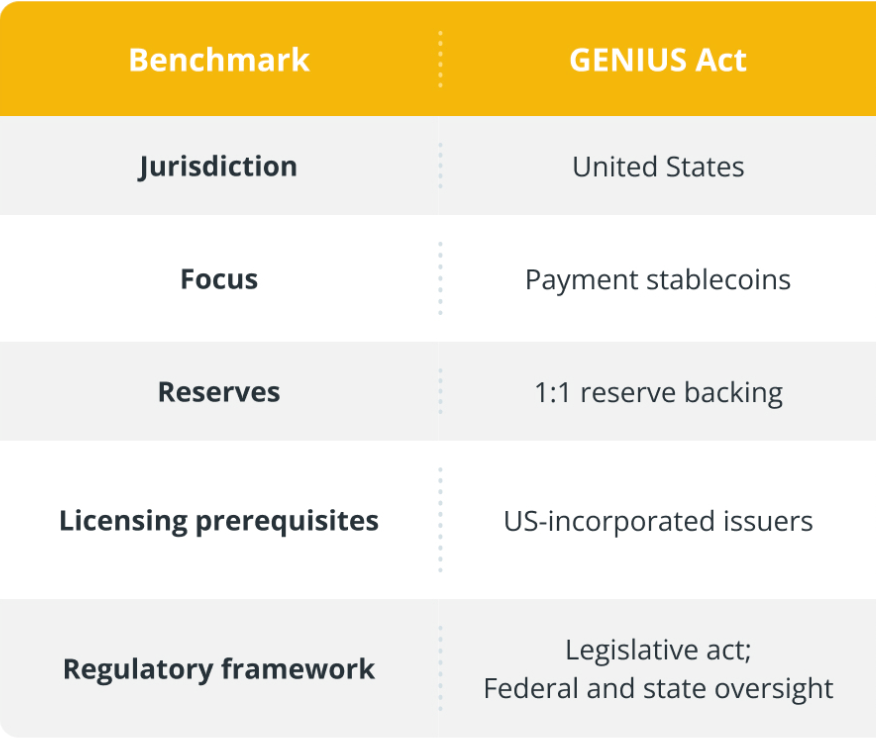
BitGo’s announcement said FYUSD is compliant with the GENIUS Act stablecoin regulatory framework. The regulations include 1:1 backing with cash deposits held by a custodian or short-term US government debt instruments, anti-money laundering (AML) requirements and know-your-customer (KYC) checks.

The company also developed “Fypher,” a suite of stablecoin infrastructure tools that provides a “programmable settlement” layer for the FYUSD token that allows it to be used by autonomous AI agents for commercial transactions.
US Treasury Secretary Scott Bessent has touted stablecoins as a way to preserve US dollar dominance by reducing settlement times, transaction costs and democratizing access to US dollars for individuals without access to traditional banking infrastructure.
Related: 21Shares taps BitGo for expanded regulated staking, custody support across US, Europe
Stablecoins are down from the market cap peak of over $300 billion
The total market capitalization of stablecoins is over $295 billion at the time of this writing, according to RWA.XYZ, down from the peak of over $300 billion recorded in December.

Stablecoin issuer Tether, the issuer of the USDt (USDT) dollar-pegged token, is on-track for the steepest monthly drop in USDt circulating supply since the collapse of the FTX crypto exchange in 2022. At time of writing, circulating supply was 183.64 billion USDT, CoinMarketCap data showed.
While USDt remains the world’s largest stablecoin by market capitalization, its circulating supply is down $1.5 billion so far in February, data from Artemis shows. This is shaping up to be the second month of ramped up user redemptions, following a $1.2 billion drop in January.
Stablecoin redemptions could signal a broader contraction in the crypto market, as investors liquidate their positions and move their holdings off-chain, potentially into other investments.
However, spokespeople for Tether told Cointelegraph that the data represent short-term positioning, rather than a long-term trend of sustained outflows and market contraction.
Magazine: Bitcoin payments are being undermined by centralized stablecoins
Crypto World
Ethereum RWAs Hit $15B as Tokenized Gold and Treasury Products Fuel Institutional Growth
TLDR:
- Ethereum’s RWA market surpassed $15B in 2025, marking more than 3x growth within a single calendar year.
- Tether Gold and Paxos Gold combined to add over $4B in new tokenized gold value on-chain this year.
- BlackRock BUIDL, Ondo USDY, and WisdomTree posted triple to four-digit growth in Treasury-backed products.
- Syrup USDC and USDT scaled to $2.3B combined, proving strong demand for yield on idle stablecoins.
RWAs on Ethereum have crossed the $15 billion mark, reflecting more than triple growth within a single year. The surge is largely driven by tokenized funds, gold products, and yield-bearing stablecoins.
Institutions are no longer testing the waters — they are committing real capital. This shift marks a turning point for on-chain finance, as real-world asset tokenization moves from concept to active deployment across major financial players.
Tokenized Gold and Treasury Products Lead the Charge
Tokenized gold has scaled at an aggressive pace over the past year. Tether Gold grew from roughly $500 million to $2.7 billion during this period.
Paxos Gold also climbed to around $2.3 billion in total value. Together, gold products alone added over $4 billion in new on-chain value.
Treasury-backed products followed a similar trajectory. Ondo USDY, BlackRock BUIDL, Janus Henderson, Superstate, and WisdomTree all posted triple- to four-digit growth rates.
These are not small or speculative positions—institutions are directing meaningful capital toward these products. The numbers reflect a structural shift, not a temporary trend.
Crypto analyst Ted, posting under the handle @TedPillows, noted the pace of this growth. He wrote that RWAs on Ethereum “just crossed $15B” and described it as “more than 3x growth in a single year.”
His observation pointed to tokenized funds and short-duration U.S. Treasuries as the primary catalysts behind the move.
The appeal of Treasury products lies in their familiarity and yield. These instruments offer stable returns while settling on-chain with full transparency.
As a result, they attract both traditional finance firms and crypto-native protocols seeking low-risk allocations.
Yield Products and DeFi Integration Expand the RWA Market
New yield products have also contributed to the RWA market’s expansion. Syrup USDC and USDT scaled to approximately $2.3 billion combined within a short period. The speed of that growth points to strong existing demand for yield on idle stablecoins.
These products work because they plug directly into decentralized finance as collateral. Stablecoins parked in RWA-backed instruments can earn returns that were previously unavailable on-chain. This creates a practical use case that goes beyond speculation.
Ethereum continues to hold around 60% of the RWA market share. Stablecoins on Ethereum alone exceed $160 billion, which means RWAs at $15 billion still represent a relatively small portion of the broader base. There is room for continued expansion as more assets come on-chain.
Ted framed it plainly: “This is no longer pilots or experiments.” Settlement is transparent, programmable, and increasingly efficient.
The infrastructure supporting RWAs on Ethereum is maturing, and capital flows are following that maturity in real time.

Healthy governance in decentralized organizations hinges on disagreement, not uniform assent. That perspective, articulated by Dr. Michael Egorov, founder of Curve Finance, frames a rising discourse around the vitality of on-chain decision-making. In practice, disagreements are not only tolerated but expected as a feature of how these communities steer protocol direction through smart contracts and member voting. Two recent episodes illuminate this dynamic: a long-running governance debate over a grant to Swiss Stake AG—the company behind Curve’s development—and a December 2025 clash within the Aave ecosystem that turned on how fees from a CoW Swap integration should be allocated and who controls related intellectual property. Taken together, the episodes underscore that healthy friction can drive accountability and innovation in decentralized governance.
Key takeaways
- Disagreement within DAOs is a sign of engagement and vitality, not dysfunction, according to key voices in the space.
- The Swiss Stake AG grant controversy at Curve’s governance forum highlighted how large sums can provoke heated debate and turnout, with revised proposals attracting strong participation.
- IP rights and attribution emerged as a flashpoint in the Aave ecosystem, illustrating how governance structures handle ownership of brand assets and code assets in a decentralizing environment.
- Empirical observations from external analyses show that turnout in many DAOs remains concentrated among a relatively small, active cohort, prompting debates about inclusive participation.
- Experts argue that giving DAOs clearer legal recognition could reduce disputes by enabling more straightforward interaction with traditional financial and corporate frameworks.
Tickers mentioned: $CRV, $AAVE
Sentiment: Neutral
Market context: The episodes sit within a broader trend of on-chain governance evolving from experimental phases toward more structured, if still highly contested, governance models. As DAOs experiment with funding, IP, and external integrations, the debate over how to balance participation with accountability is increasingly central to long-term sustainability.
Why it matters
DAO governance is quickly becoming a standard mechanism for steering open-source finance and non-custodial protocols. The Curve-related discussions demonstrate that communities are willing to revisit and revise proposals when members feel the financial or strategic stakes are high. In practice, the process involves not only voting but a cycle of proposal disclosure, debate, revision, and turnout that tests the resilience of on-chain governance. The central question is how to retain broad engagement while ensuring that proposals are not merely the product of a narrow cadre of active participants. In this sense, the Curve saga reflects a broader governance design challenge: how to translate on-chain votes into outcomes that stakeholders can trust and implement.
The Aave dispute adds another layer to the governance conversation: who owns the fruits of a protocol’s development and how that ownership translates into control of branding, IP, and related assets when the DAO delegates or distributes funds. The decoupling of development work from governance, and the tension over whether IP should reside in a DAO-controlled bucket or remain with a development entity, frames a key governance dilemma for DeFi projects that seek both rapid innovation and robust democratic oversight. Taken together, these cases suggest that the next phase of on-chain governance will involve not just votes but governance-in-ownership—how legal and organizational structures map onto code and communities.
Experts also argue that the current friction underscores the potential benefits of clearer legal recognition for DAOs. If DAOs could attain formal recognition—own business entities, hold bank accounts, and interact with traditional financial systems—the risks around disputes over ownership and control could be reduced. In Egorov’s view, the law has not yet fully caught up with the pace of decentralized technology, and greater regulatory clarity could help align on-chain governance with real-world operations without stifling innovation.
What to watch next
- Follow the amendment cycle for the Swiss Stake AG grant, including any new drafting rounds or updated voting timelines in Curve’s governance portals (e.g., the amendment of the 2026 proposal).
- Monitor Aave governance discussions surrounding IP governance and branding assets as the community debates next steps after the December 2025 discussions.
- Track regulatory developments related to DAO recognition and access to traditional financial rails that could impact how DAOs interact with lawyers, banks, and custodians.
- Observe whether future governance events increase turnout beyond the levels seen in prior analyses and how protocol communities address representation and inclusivity concerns.
- Watch for new analyses or empirical studies on turnout and governance participation to gauge whether the anecdotal trends around active participation persist or shift over time.
Sources & verification
- Curve governance page detailing Swiss Stake AG grant proposal and related discussions.
- News coverage and archival material on the 2025 revised Swiss Stake AG grant proposal ( turnout and voting results).
- Aave governance thread discussing CoW Swap integration and tokenholder questions about fees and IP control.
- Cointelegraph coverage on Aave founder strategy after governance vote and the broader governance discourse surrounding IP and brand assets.
- LamprosTech analysis on DAO voter turnout in 2025 and its implications for governance structures.
DAO governance in practice: what this means for the ecosystem
The debates around Swiss Stake AG’s Curve grant and the Aave IP dispute illustrate a broader trend: governance deliberations are increasingly treated as an ongoing process rather than a one-off decision. These cases underscore how communities must continuously negotiate the balance between ambitious, well-funded initiatives and the need for broad-based participation and accountability. The existence of firm positions on grants and IP signals that communities are not merely rubber-stamping proposals; they are dissecting the long-term implications of funding and ownership in a way that aligns incentives across actors—developers, token holders, and users.
Importantly, the discussions also highlight that governance is not purely about abstract vote counts. They touch on practical outcomes—how funds are allocated, who holds decision-making power over branding and code, and how disputes between on-chain governance and off-chain management are resolved. As these ecosystems mature, the interplay between what is coded on-chain and what is recognized legally off-chain will become a defining factor in the durability of these platforms. That ongoing evolution will require thoughtful design, transparent processes, and, perhaps most crucially, a willingness to admit missteps and iteratively improve governance structures to reflect changing technologies and community expectations.
Market reaction and key details
The ongoing governance episodes underscore a core reality of crypto markets: governance decisions can materially influence investor sentiment and strategic direction, even when the financial impact appears indirect. For participants, watching how the Curve ecosystem handles the Swiss Stake AG grant and how Aave navigates IP-related governance questions will offer insights into how other DAOs might approach similar challenges. The balance between active participation and practical execution remains delicate; successful governance will likely hinge on clear processes, transparent communications, and the ability to translate on-chain votes into concrete, auditable outcomes.
TLDR:
- Buterin defines security as minimizing divergence between user intent and actual system behavior at all times.
- Perfect security is impossible because human intent is too complex to capture in any single mathematical definition.
- Good security systems rely on redundant, overlapping specifications that approach user intent from multiple distinct angles.
- LLMs can approximate user intent as one layer of security but should never act as the sole decision-making authority.
Security, as Ethereum co-founder Vitalik Buterin sees it, is not about adding more steps to a process. It is about minimizing the gap between what a user intends and what a system actually does.
Buterin shared this perspective in a detailed post on X, connecting security directly to user experience. His framework draws on type systems, formal verification, and even large language models as tools to close that gap.
Security and User Experience Share the Same Definition
Buterin argues that security and user experience are not separate disciplines. Both aim to reduce the divergence between user intent and system behavior.
The only real difference is that security focuses on tail-risk situations — cases where divergence carries a large downside.
These tail-risk situations become more dangerous when adversarial behavior is involved. A bad actor can exploit any gap between what the user intended and what the system executed. That gap, however small, becomes the attack surface.
Buterin wrote, “Perfect security is impossible. Not because machines are flawed, or even because humans designing them are flawed, but because the user’s intent is fundamentally a complex object.” This framing shifts responsibility from pure engineering toward understanding human cognition itself.
The Problem of Representing Intent in Mathematical Terms
A straightforward goal like sending one ETH to a contact named Bob already carries hidden complexity. Representing Bob as a public key or hash introduces the risk that the key does not actually correspond to Bob. Even the definition of ETH becomes contested in the event of a hard fork.
More abstract goals make the problem even harder. Preserving a user’s privacy, for instance, goes well beyond encrypting messages.
Metadata patterns, message timing, and communication graphs can leak substantial information even when content is fully encrypted.
Buterin draws a direct comparison to early work in AI alignment, noting that robustly specifying goals is one of the hardest parts of the problem. The challenge of defining user intent in security is structurally identical to that challenge.
Redundant Specifications as the Core Design Principle
Buterin’s proposed solution centers on redundancy. Good security systems ask users to specify their intent in multiple overlapping ways, and only act when those specifications align. This pattern appears across many existing tools.
Type systems in programming require a developer to describe both what the code does and what shape the data takes at each step.
Formal verification adds mathematical properties on top of that. Transaction simulations ask users to review expected outcomes before confirming an action.
Post-assertions, multisig setups, spending limits, and new-address confirmations all follow this same structure. Each layer approaches intent from a different angle — action, expected effect, risk level, and economic bound. Together, they reduce divergence without any single layer being foolproof.
How Large Language Models Fit Into This Framework
Buterin also addresses the role of LLMs within this redundancy model. A general-purpose LLM functions as an approximation of human common sense. A fine-tuned model can serve as a closer approximation of a specific user’s normal behavior patterns.
That said, Buterin is clear that LLMs should never serve as the sole determinant of intent. Their value comes from the angle they offer — one that is structurally different from traditional, rule-based specifications. That difference increases the practical value of the redundancy.
The broader takeaway is straightforward. Security should make low-risk actions easy and high-risk actions harder to complete. Getting that balance right, rather than adding friction across the board, is the actual engineering challenge.

Exclusive-New US military-led group aided Mexico’s hunt for ’El Mencho’ cartel boss

$1.3B Error Sparks Probe Into Weak Financial Oversight

Before ‘Train Dreams,’ Its Director Made His Stunning Debut With a ‘Fallout’ Star


![Tom Lee Just Said The UNTHINKABLE About Bitcoin & Ethereum! [2026 Realistic Prediction]](https://wordupnews.com/wp-content/uploads/2026/02/1771796524_maxresdefault-80x80.jpg)


-

 Video6 days ago
Bitcoin: We’re Entering The Most Dangerous Phase
-

 Crypto World5 days ago
Can XRP Price Successfully Register a 33% Breakout Past $2?
-

 Video3 days ago
XRP News: XRP Just Entered a New Phase (Almost Nobody Noticed)
-

 Fashion2 days ago
Weekend Open Thread: Boden – Corporette.com
-

 Sports6 days ago
GB's semi-final hopes hang by thread after loss to Switzerland
-

 Politics15 hours ago
Baftas 2026: Awards Nominations, Presenters And Performers
-
 Tech6 days ago
The Music Industry Enters Its Less-Is-More Era
-

 Business5 days ago
Infosys Limited (INFY) Discusses Tech Transitions and the Unique Aspects of the AI Era Transcript
-

 Entertainment4 days ago
Kunal Nayyar’s Secret Acts Of Kindness Sparks Online Discussion
-

 Video6 days ago
Financial Statement Analysis | Complete Chapter Revision in 10 Minutes | Class 12 Board exam 2026
-

 Tech5 days ago
Retro Rover: LT6502 Laptop Packs 8-Bit Power On The Go
-
 Sports4 days ago
Clearing the boundary, crossing into history: J&K end 67-year wait, enter maiden Ranji Trophy final | Cricket News
-

 Business9 hours ago
Mattel’s American Girl brand turns 40, dolls enter a new era
-

 Business5 hours ago
Law enforcement kills armed man seeking to enter Trump’s Mar-a-Lago resort, officials say
-

 Entertainment4 days ago
Dolores Catania Blasts Rob Rausch For Turning On ‘Housewives’ On ‘Traitors’
-

 Business5 days ago
Tesla avoids California suspension after ending ‘autopilot’ marketing
-

 Tech4 hours ago
Anthropic-Backed Group Enters NY-12 AI PAC Fight
-

 Politics6 days ago
Eurovision Announces UK Act For 2026 Song Contest
-

 NewsBeat3 hours ago
Armed man killed after entering secure perimeter of Mar-a-Lago, Secret Service says
-

 Crypto World4 days ago
WLFI Crypto Surges Toward $0.12 as Whale Buys $2.75M Before Trump-Linked Forum