Connect with us

Tech

Can I Still Be a Product Manager?

Published

on

I remember the first time I sat in a sprint planning meeting. I was a junior product manager and felt on top of the world. I had my roadmap ready. I had my user stories written. I felt prepared.

Then the lead engineer started talking.

He asked whether the API endpoints were ready to receive the payload. He mentioned something about refactoring the legacy code before we could touch the database schema. He looked at me, waiting for an answer. I stared back, completely blank. I had no idea what he was talking about.

In that moment, the heavy cloud of Imposter Syndrome settled over me. I thought I had made a huge mistake. I thought that because I could not write a single line of Java or Python, I had no business telling engineers what to build.

Advertisement

If you are reading this, you are probably feeling that same fear. You are looking at job descriptions that list “Computer Science degree preferred” and wondering if you should quit before you start.

I am here to tell you to stop worrying. I have been in this industry for over a decade. I have led products used by millions of people. And to this day, I still cannot code.

The short answer is yes. You can absolutely be a successful product manager without knowing how to code. In fact, sometimes it is actually an advantage. Let’s talk about why.

Advertisement

The Myth of the Technical Genius

There is a common misconception in the tech industry. People think a Product Manager is just a CEO who knows how to code. This idea comes from the early days of software, when the lines between engineering and management were blurry.

Today, the roles are very different.

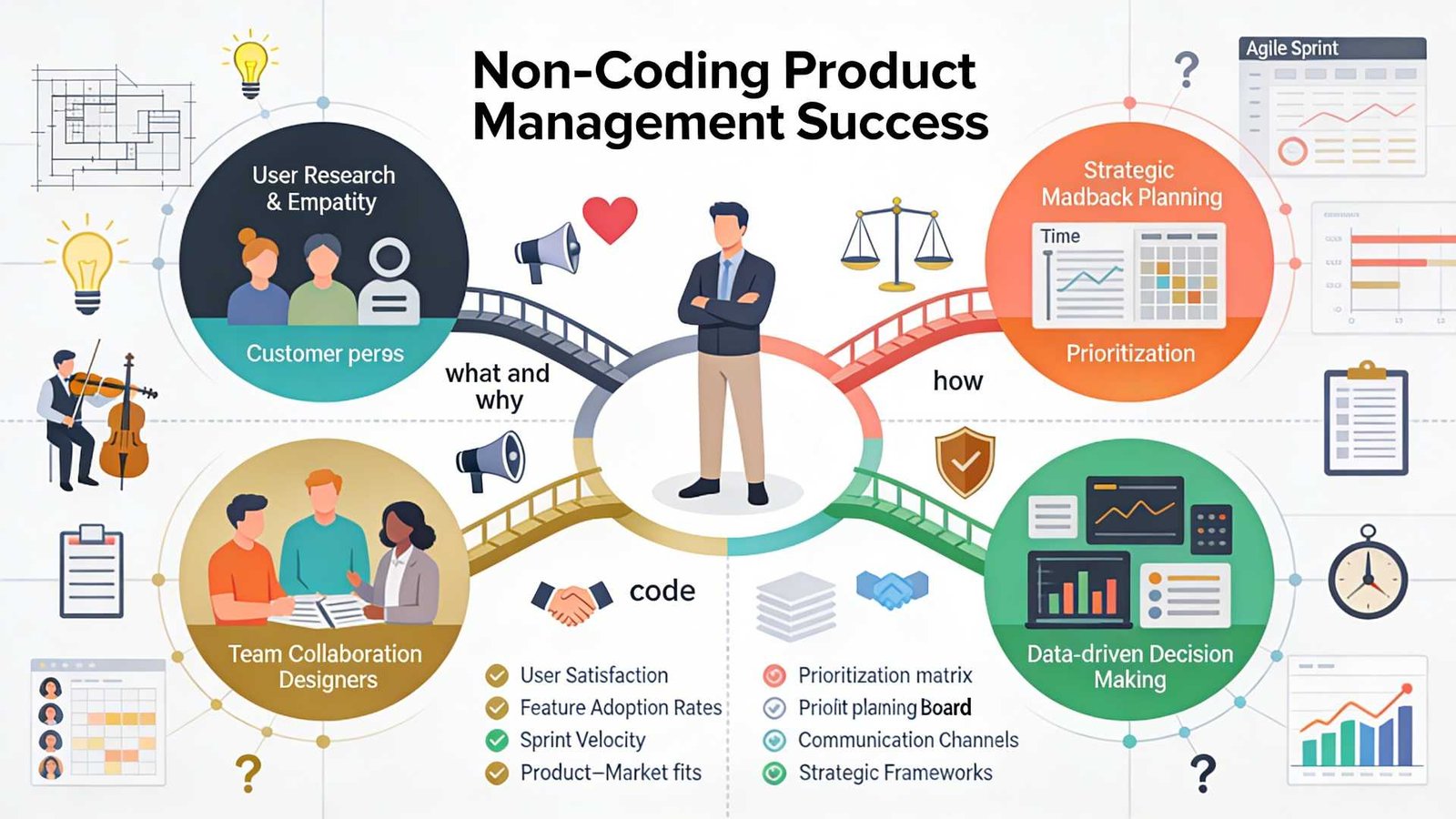
The job of an engineer is to answer the question: “How do we build this?”

The job of a product manager is to answer the question: “Why are we building this, and who are we building it for?”

Advertisement

If you spend all your time worrying about how, you will forget about the why. A non-technical product manager brings a different perspective. You are not bogged down by the code’s limitations. You are focused on the user’s pain points.

Your goal is not to write the software. Your goal is to deliver value to the customer and the business. You need to be the voice of the user, not the server’s.

Why Non-Technical PMs Are Often Better

It might sound strange, but not knowing how to code can actually make you a better product manager.

When you have a technical background, it is easy to fall into the “solution trap.” A user tells you they have a problem. If you are an engineer at heart, your brain immediately jumps to the technical solution. You start thinking about database tables and logic flows.

Advertisement

But a great PM needs to fall in love with the problem, not the solution.

As a non-technical product manager, you are forced to ask more questions. You have to ask “why” five times to understand the root cause because you cannot just assume a fix. This curiosity leads to deeper user insights. You rely on data, customer interviews, and market research rather than your own assumptions about how the software works.

You also become a better delegator. You have to trust your engineering team. This builds a healthy relationship. Engineers hate being micromanaged by a PM who thinks they can code better than them. When you admit you don’t know the code, you empower the engineers to own the technical decisions. You tell them what needs to happen, and you let them decide how to make it happen.

Bridging the Gap: Tech-Literacy vs. Coding

Now, let’s be realistic. You cannot be completely ignorant of technology. You are building software, after all.

Advertisement

You do not need to be a coder, but you do need to be “tech-literate.” Think of it like being an architect for a house. The architect does not need to know how to wire the electrical panel or weld the pipes. But they need to know that pipes go in the walls and that electricity is dangerous if handled incorrectly.

Here is what you actually need to understand:

1. Understand the Vocabulary

You need to speak the language. If an engineer says the “server is down,” or the “API is broken,” you need to know what that implies for the user. Learn the difference between front-end (what users see) and back-end (data and logic). Understand what a database does. This helps you communicate.

2. Understand Feasibility

You need to develop a sense of how hard things are. If you ask for a button to move two pixels to the left, that is usually easy. If you ask for that button to suddenly predict the future using AI, that is hard. As you work with teams, you will learn to estimate effort even if you cannot write the code yourself.

Advertisement

3. Understand Trade-offs

Engineering is all about trade-offs. We can build it fast, but it might be buggy. We can build it perfectly, but it will take six months. Your job is to help the team make these decisions based on business value. You don’t need code to understand that a two-month delay might kill the product launch.

The Skills That Actually Matter

If you take coding off the table, what should you focus on? The best product managers I know share a specific set of skills that have nothing to do with GitHub repositories.

Deep User Empathy

Can you put yourself in the customer’s shoes? Can you feel their frustration when the app is slow? This is your superpower. You need to be the user’s champion in a room full of people discussing technical constraints.

Ruthless Prioritization

You will always have fewer resources than you want. You will have a list of ten features and only enough time to build two. The skill of saying “no” is far more valuable than the skill of writing Java. You need to review the data and decide what offers the most value right now.

Advertisement

Communication and Storytelling

You need to rally the team. You have to convince stakeholders that your roadmap is the right one. You need to explain complex features to the sales team in simple words. This requires high emotional intelligence and excellent communication skills.

Strategic Thinking

Where is the market going? What are competitors doing? How does this product fit into the company’s long-term vision? These are the questions you get paid to answer.

If you feel your foundation in these areas is weak, focusing on them is a better use of time than learning C++. Structured learning can significantly accelerate this process. For example, the Product Management Course at Techcanvass focuses heavily on these core competencies. It covers the entire lifecycle from planning to execution, which is exactly what hiring managers look for.

How to Work with Engineers When You Can’t Code

The biggest fear for a non-technical product manager is losing the engineering team’s respect. I used to worry about this every day. Over time, I learned that engineers do not respect you for your coding skills. They respect you for bringing clarity.

Advertisement

Here is how to win them over:

Be Honest: Never pretend to know something you don’t. If they use an acronym you don’t know, ask for clarification. Say, “I am not familiar with that term. Can you explain it to me in simple terms?” They will appreciate the honesty.

Focus on the “What” and “Why”: Bring them clear requirements. Engineers hate vague instructions. If your user stories are clear and your acceptance criteria are solid, they will love you.

Shield Them: Protect your team from noise. If upper management is demanding changes every day, it is your job to push back. If you protect their time so they can code in peace, they will be your biggest allies.

Advertisement

Bring Data: When you ask for a feature, back it up with numbers. Don’t say “I think we should do this.” Say “Data shows 40% of users drop off at this screen, so we need to fix it.” Engineers respond well to logic and data.

When Should You Learn Technical Concepts?

While you don’t need to code, getting a certification or taking a course that covers the basics of software development lifecycles (SDLC) is very helpful.

You should understand concepts such as project management software, Agile, and Scrum. You should know how data flows through a system. You should understand what an API is.

But there is a difference between learning these concepts and learning to write syntax. You want to reach a level where you can draw a box on a whiteboard and label it “Database,” not a level where you can query that database yourself.

Advertisement

If you are looking to break into the field or move up to a Senior role, focus on certifications that validate your management skills first. A strong foundation in business analysis and product lifecycle management will serve you better than a coding bootcamp. The Techcanvass product management course is designed to bridge that gap, giving you the vocabulary and the strategic tools without forcing you to become a developer.

Conclusion

So, let’s go back to the original question. Can you be a Product Manager if you don’t know how to code?

Yes. A thousand times, yes.

The world is full of brilliant engineers who can build anything. But the world is short on people who can figure out what needs to be built. The world needs people who can listen to users, analyze markets, and lead teams with empathy.

Advertisement

Do not let the “technical” requirement in a job description scare you away. Your value lies in your vision, your strategy, and your ability to execute.

You are not there to write the code. You are there to write the future of the product.

Source link

Advertisement
Continue Reading
Click to comment

Leave a Reply

Your email address will not be published. Required fields are marked *

Tech

Skip The Steam Machine And Build This Better Alternative That May Save You Money

Published

on


We may receive a commission on purchases made from links.

The Steam Machine promises to be an interesting gaming console, delivering the flexibility and performance of an entry-level gaming PC without the complexity of Windows. Note that isn’t the first time that Valve made a Steam Machine, as this console’s first iteration arrived in 2014. Unfortunately, the first-generation console flopped hard, and the gaming company pulled the last of the Linux consoles from its platform in 2018.

Advertisement

One of the reasons that the original Steam Machine didn’t take off was the lack of gaming developer support for the Linux-based SteamOS that it used. This has changed, however, with the arrival of the Steam Deck and the Proton compatibility layer, which allows non-Linux native titles to run on the handheld console. This meant that, slowly but surely, gamers can ditch Windows (which has its fair share of bugs and other issues) while enjoying titles primarily made for PC.

Steam Deck’s success led Valve to announce a second-generation Steam Machine in late 2025, with the console originally expected to arrive in early 2026. Unfortunately, the company announced that it will delay the launch of the gaming PC console. So, if you cannot wait for the new Steam Machine to arrive and instead want to build your own, these are the components that you should look at.

Advertisement

A comparable CPU

The Steam Machine will come with a 6-core AMD Zen 4 x86 processor that can hit up to 4.8 GHz and comes with a 30-watt TDP. This means that it won’t be based on the newer Ryzen 9000 series, which uses the newer Zen 5 architecture. So, we will look at processors that use the older Zen 4 architecture without an integrated GPU, have six cores, and has a boost clock speed of around 4.8 GHz that you can purchase from Amazon or Newegg.

That limits us to the following options: the Ryzen 5 8400F, the Ryzen 5 7500F, and the Ryzen 5 7400F. These chips all have 6 cores (12 threads), have a 4.7 GHz boost clock (except for the Ryzen 5 7500F which can hit 5.0 GHz), and 32 MB of L3 Cache (except for the Ryzen 5 8400F which only has 16 MB). All of them also have a TDP of 65 watts, which is the lowest that we could find. The Ryzen 5 8400F is currently priced at $143.92 on Amazon, making it the cheapest option. The Ryzen 5 7400F, which was initially launched as a China exclusive, is now available on Newegg for $147.59, while the slightly faster Ryzen 5 7500F costs $163.99.

Given these options, we suggest picking up the Ryzen 5 7400F, which is priced at the middle of the pack. It only has a slightly lower boost clock than the 7500F while costing about $15 less. And even though the 8400F is more affordable, you’re going to appreciate the 32 MB L3 Cache of the 7400F, which helps improve minimum frame rates to deliver smoother gameplay.

Advertisement

Which AMD GPU should you get?

Valve said that its latest gaming PC console will come with a semi-custom GPU, meaning we won’t be able to find a 1:1 analog for it. Nevertheless, the company specced the Steam Machine with an AMD RDNA 3 graphics card with 28 CUs (or Compute Units), 8GB GDDR6 VRAM, a maximum sustained clock speed of 2.45 GHz, and a 110-watt TDP. Since Valve uses an RDNA 3 GPU, that means we’re limiting our options to AMD Radeon RX 7000-series GPUs.

If we look at all the discrete GPUs under the 7000 desktop series family, there are two models that are close to Valve’s specifications: the AMD Radeon RX 7600 and the RX 7600 XT, both of which have 32 CUs. The latter has a 2.47 GHz Game Frequency, nearly matching what the Steam Machine has, but has a maximum memory size of 16 GB. On the other hand, the non-XT version matches the semi-custom GPU’s 8 GBs of VRAM but has a much lower 2.25 GHz Game Frequency. Both GPUs also require a higher TDP — 190W for the RX 7600 XT and 165W for the RX 7600.

However, the 7600 XT is quite expensive, with the cheapest model we can find costing well over $500.  Because of this, we’re picking the $274.99 Asus Dual Radeon RX 7600 EVO OC GPU on Amazon, which has a similar 8GB of VRAM and a lower TDP. While it’s possible that Valve will choose a laptop GPU, we’re not going to go in that direction because most consumers cannot purchase that as a standalone unit.

Advertisement

Finding compatible memory, storage, and motherboard

Valve said that the Steam Machine will come with 16 GBs of SO-DIMM DDR5 laptop memory, although it’s unclear if it will have one or two RAM sticks. But because we’re using desktop components, we will just stick with two 8GB DDR5 RAM sticks. Since memory modules are prohibitively expensive at the moment, we’ll get the most affordable unit we can find — the Patriot Viper Venom 16 GB (2 x 8 GB) DDR-6000, which costs $199.99 on Newegg.

For storage, the Steam Machine is available with either a 512 GB or 2 TB SSD — since we’re trying to keep our costs down, we’ll stick with a 512GB SSD. The console also uses the smaller 2230 form factor for its storage, but we’re going with the larger 2280 instead, because it’s cheaper. So, for our storage, we picked the Patriot P400 Lite M.2 PCIe Gen 4 x4 500 GB SSD, which will set us back $80.99 on Newegg. If you can afford to spend a little bit more, it’s wiser to get at least 1TB so that you don’t run out of space for installing all your favorite titles.

Advertisement

Finally, we need to get a motherboard that will accommodate all our chosen components so far. Unfortunately, the smaller Mini ITX motherboards are out of our budget, so we’ll stick with the most affordable compatible Micro ATX motherboard instead. But even though we’re on a budget, we’re avoiding the most basic chipsets like the A620 because we’re still building this for gaming. For that reason, we’re picking the ASRock B650M-HDV/M.2, which costs $99.99 on Amazon.

Advertisement

Which PSU, case, and cooler should we get?

AMD recommends a minimum 550-watt power supply for the AMD Radeon RX 7600, so we’ll stick with that for safety. Even though we want a compact build, SFX power supplies built for small form factor (SFF) PCs are quite expensive and will cause us to go overbudget. So, we’ll instead go for the MSI MAG A550BN, which is a cheap but reliable PSU, costing only $54.99.

Now that we have power, we need to put everything inside a case. While we’d love to stick with an SFF case, these are just too expensive. So, we’re going one size up with the Cooler Master MasterBox Q300L, which just costs $39.99 on Amazon and Newegg. It can accommodate a PSU up to 160 mm, ensuring that the MSI MAG A550BN will fit inside it. It also gives us the option to install a 240mm radiator for an AIO liquid cooler, but since we don’t want to spend too much on any component, we’re sticking with air cooling.

Speaking of cooling, we still need to get a CPU cooler because the AMD Ryzen 5 7400F is a tray processor, meaning it doesn’t come with a stock cooler. We also deliberately kept it last so that we know how much clearance we need with the PC case. Cooler Master says that the MasterBox Q300L has 159 mm of space for an air cooler, meaning one of the best air coolers on the market, the Thermalright Peerless Assassin 120 SE, with its 155 mm height, would fit in the system. More importantly, it’s quite affordable at just $38.90.

Advertisement

How much will the full build cost?

Our build comes out at a total of $937.43. This might surprise you, especially as we tried to keep our costs down, but that is difficult with the current cost of RAM and storage. In fact, PCPartPicker shows that our RAM module’s price increased by 300% since 2025, while our SSD’s cost doubled in the same period. If we bought these components at their original prices, our cost would just be around $750. Nevertheless, you can still get some savings if you catch a sale on all the other parts. Alternatively, you can buy some of these PC parts in the used market to save money, as long as you know what to look for when doing so.

Valve said that it will not subsidize the cost of the console (unlike PlayStation and Xbox), but it claims that it’s aiming for “great value” on “the entry-level side of things.” This will be difficult, though, with RAM and SSD prices out of control. Leaks from third-party retailers suggest prices from $949 to $1,070, although some analysts have suggested a lower price. The company still hasn’t confirmed what the final cost of the console will be, but we expect it to be higher than early estimates. 

Although the savings you get when you go through the DIY route is quite small, it still offers a couple of advantages. For one, you can set your own specs — if you have extra cash, you can opt for more powerful components that will allow you to enjoy faster frame rates and play more demanding games on your living room TV. Another bonus of a custom build is that you can update it later, allowing you to enjoy your DIY Steam Machine for longer.

Advertisement


Source link

Advertisement
Continue Reading

Tech

Metilis Gravity Furnace Might be the Coolest Robot Watch Winder Ever

Published

on

Metilis Gravity Furnace Robot Watch Winder
A gravity-wielding winder appears, which resembles a sci-fi gadget rather than something you’d want on your desk. Metilis refers to it as the Gravity Furnace, which will come as no surprise. This single-watch winder spins automatic watches with the precision of a Swiss watchmaker, but instead of a boring wooden box, it resembles a chunky robot from an old-school anime.


Collectors of automatic watches will understand that you have to keep these bad boys moving when they’re not on your wrist or it just stops working. Standard winders do the work quietly inside an oak case, rotating the watch in smooth cycles, but the Gravity Furnace is unique. It’s designed around a robot arm that wraps around and rotates the watch, all encased in a full-metal shell with sharp pieces and modular panels that can be swapped out for a new look. It has an industrial air, as in, “I’ve got a garage full of tools.” There are adjustable side plates, odd antenna-like pieces, and even swappable metal or rubber feet to give it a unique look.

Sale


Apple Watch SE 3 [GPS 40mm] Smartwatch with Starlight Aluminum Case with Starlight Sport Band – S/M…
  • HEALTH ESSENTIALS — Temperature sensing enables richer insights in the Vitals app* and retrospective ovulation estimates.* You’ll also get a daily…
  • GREAT BATTERY LIFE — Enjoy all-day, 18-hour battery life. Then charge up to twice as fast as SE 2* and get up to 8 hours of battery in just…
  • ALWAYS-ON DISPLAY — Now you can read the time and see the watch face without raising your wrist to wake the display.

You have to open the large metal door by hand; there are no finicky buttons for this thing, and when you do, it clicks shut with this delightfully satisfying sound. The touch screen comes to life in a deep blue tone, and from there you can play with the settings. It’s very simple: do you want to wind the watch every day, every now and then, or just let it run on its own? You can even give it a manual spin if it needs some extra TLC. The UI is a little rough around the edges, and I’m sure there are some spelling errors in there, but once you get the feel of it, you’re golden.

Advertisement

Metilis Gravity Furnace Robot Watch Winder
The power comes from two USB-C ports, which are useful for charging your phone, and there’s an internal battery that’s coupled with a real-time clock, so it keeps nice and accurate even when not plugged in. The motors are also extremely quiet; you don’t want a noisy humming object to distract you as you work. When it’s finished, it returns the watch to its proper position, allowing you to read the time.

Metilis Gravity Furnace Robot Watch Winder
The Gravity Furnace costs $800, which is a lot for a watch winder, especially since there are cheaper multi-watch winders available. The weight is also an issue, as moving it to your desk is similar to moving a little boulder. There are still certain parts of the prototype that don’t look finished, but that’s part of the appeal.

Source link

Continue Reading

Tech

Telegram Disputes Russia’s Claim Its Encryption Was Compromised

Published

on

Russia’s domestic intelligence agency claimed Saturday that Ukraine can obtain sensitive information from troops using the Telegram app on the front line, reports Bloomberg. The fact that the claims were made through Russia’s state-operated news outlet RIA Novosti signals “tightening scrutiny over a platform used by millions of Russians,” Bloomberg notes, as the Kremlin continues efforts to “push people to use a new state-backed alternative.”

Russia’s communications watchdog limited access to Telegram — a popular messaging app owned by Russian-born billionaire Pavel Durov — over a week ago for failing to comply with Russian laws requiring personal data to be stored locally. Voice and video calls were blocked via Telegram in August. The pressure is the latest move in a long-running campaign to promote what the Kremlin calls a sovereign internet that’s led to blocks on YouTube, Instagram and WhatsApp… Foreign intelligence services are able to see Russia’s military messages in Telegram too, Russia’s Minister for digital development, Maksut Shadaev, said on Wednesday, although he added that Russia will not block access to Telegram for troops for now.

Telegram responded at the time that no breaches of the app’s encryption have ever been found. “The Russian government’s allegation that our encryption has been compromised is a deliberate fabrication intended to justify outlawing Telegram and forcing citizens onto a state-controlled messaging platform engineered for mass surveillance and censorship,” it said in an emailed response.

Source link

Advertisement
Continue Reading

Tech

NASA’s Perseverance Rover Can Now Pinpoint its Location on Mars

Published

on

NASA Perseverance Mars Global Localization GPS
NASA’s Perseverance rover has just reached a small but significant milestone on Mars. After five years of carefully traveling about the bottom of Jezero Crater, the rover now knows exactly where it is without having to rely on a crew on Earth. A new system called Mars Global Localization has made the task possible in less than two minutes, with accuracy to within ten inches.


Engineers at NASA’s Jet Propulsion Lab came up with the idea of allowing the rover to match what it sees on the ground to the super precise maps acquired from space. Perseverance begins by capturing a full 360-degree panorama with its cameras, similar to the vision you get when spinning around in a circle. It then stitches that together to provide a circular perspective from above, similar to a bird’s-eye view. The software then compares that to some ultra high-resolution topography maps taken by the Mars Reconnaissance Orbiter.


LEGO Technic NASA Mars Rover Perseverance Building Toys – STEM Model Kit for Boys & Girls, Ages 10+ Years…
  • Feed a passion for science and technology – Kids can learn more about the challenges of space exploration with this LEGO Technic NASA Mars Rover…
  • Conduct a test flight – This advanced building kit for kids ages 10 and up includes a buildable toy version of NASA’s Ingenuity helicopter, which…
  • AR brings the mission to life – The accompanying augmented reality app experience lets kids dive into the details of the rover and its mission

Matching up the features between the two is quick since the program just looks for similar rocks, ridges, and slopes in both the rover’s perspective on the ground and from space. And once it finds a match, the rover is quite accurate. The entire operation is powered by an outdated processor from the Ingenuity helicopter, which is far faster than the technology in the rover. That’s why it can all be done in two minutes.

NASA Perseverance Mars Global Localization GPS
Perseverance had previously become trapped as it drove larger distances. The visual odometry was attempting to follow how the rocks around it moved in the camera frames, but the wheel simply slipping on the soft soil was causing the position to shift over time. After a few hundred feet, the position could shift by more than a hundred feet. So the team would send it more photographs, and the specialists on Earth would manually align them with the images from space, which could take a full day or longer.

Mars Global Localization changes all of that because the rover can now determine its position immediately after a drive, make any necessary corrections, and simply keep going. With it linked with the existing AutoNav system, which can already handle obstructions, the rover can just keep going. The more ground it traverses per Martian day, the faster it will pass through Jezero Crater and beyond.

Advertisement


The technology underwent extensive testing prior to its debut. The engineers tested it on data from 264 previous rover pauses and found that it correctly identified every single one by comparing old photographs to space maps. Then it saw its first real use on February 2, 2026, and it worked again a few weeks later. One of the first times it was utilized was in a somewhat dull section of the crater rim known as Mala Mala, where there aren’t many fascinating landmarks to look at, but the system still managed to pinpoint the location within the target margin of error.

Source link

Advertisement
Continue Reading

Tech

NASA’s crewed Artemis II launch gets pushed back again, this time due to a helium issue

Published

on

It looks like a March launch is no longer in the cards for Artemis II, NASA’s first crewed trip to the moon’s vicinity since the final Apollo mission over 50 years ago. While preparations were underway at the Kennedy Space Center for a launch as soon as March 6, the space agency says it ran into an issue with the flow of helium to its SLS rocket’s upper stage this weekend and it now has to roll the rocket from the launch pad back to the Vehicle Assembly Building (VAB) to figure out what’s wrong and fix it. A media briefing is planned for sometime this week to discuss the problem and what’s next.

But in a post on X, NASA Administrator Jared Isaacman confirmed the rollback will “take the March launch window out of consideration.” NASA noted on its blog that the current effort “potentially preserves the April launch window, pending the outcome of data findings, repair efforts, and how the schedule comes to fruition in the coming days and weeks.” It’s a four-mile trip back to the VAB that will take hours to carefully transport the massive rocket and the Orion spacecraft. NASA says it’s eyeing February 24 for this trek.

The issue occurred overnight in the early hours of February 21, when NASA says it observed “interrupted flow of helium to the SLS (Space Launch System) rocket’s interim cryogenic propulsion stage.” The space agency explained:

The upper stage uses helium to maintain the proper environmental conditions for the stage’s engine and to pressurize liquid hydrogen and liquid oxygen propellant tanks. The systems worked during NASA’s Artemis II wet dress rehearsals, but teams were not able to properly flow helium during normal operations and reconfigurations following the wet dress rehearsal that concluded Feb. 19. Operators are using a backup method to maintain the environmental conditions for the upper stage engines and the rocket, which remains in a safe configuration.

The Artemis II crew — Commander Reid Wiseman, Pilot Victor Glover, Mission Specialist Christina Koch and Canadian Space Agency astronaut Jeremy Hansen, Mission Specialist — had just entered quarantine a day before the issue arose. NASA says the astronauts have since come out of quarantine.

Advertisement

At the start of this year, NASA announced an accelerated timeline for Artemis II, which was previously set for April 2026 after experiencing delays in 2024. For this 10-day mission, which will be the first crewed flight of the SLS rocket, the Artemis II astronauts will take a trip around the moon in the Orion spacecraft. While it initially targeted early February, the launch was pushed to March due to issues that popped up during the wet dress rehearsal. Now, we’re back to the beginning with a possible April launch, but that’ll depend on the fix being a quick one.

Source link

Continue Reading

Tech

Your AI-generated password looks unbreakable, but researchers say it could fall in hours on old computers

Published

on


  • AI-generated passwords follow patterns hackers can study
  • Surface complexity hides statistical predictability beneath
  • Entropy gaps in AI passwords expose structural weaknesses in AI logins

Large language models (LLMs) can produce passwords look complex, yet recent testing suggests those strings are far from random.

A study by Irregular examined password outputs from AI systems such as Claude, ChatGPT, and Gemini, asking each to generate 16-character passwords with symbols, numbers, and mixed-case letters.

Advertisement

Source link

Continue Reading

Tech

Crime blotter: Man accused of stealing 60 iPhones from Walmart

Published

on

A Best Buy employee is accused of a MacBook discount scam, a man is wanted in the theft of MacBooks, and a campaign report says an ex-Senator improperly spent on Apple products, all in this week’s Apple Crime Blotter

Close-up of a person's hands cuffed behind their back while another person's hands secure the metal handcuffs, suggesting an arrest or detention in an indoor setting
Man in handcuffs

The latest in an occasional AppleInsider, looking at the world of Apple-related crime.
Continue Reading on AppleInsider | Discuss on our Forums

Source link

Continue Reading

Tech

4 Ways To Check Apple Store Gift Card Balance (2026)

Published

on

Apple Store gift cards are a convenient gifting option for many people, since they allow a person to buy whatever they want. If you recently received an Apple Store gift card, but aren’t sure of its balance, there are plenty of ways to check it from different devices like your iPhone, MacBook, or even a Windows laptop. Here’s how.

1. Use Apple’s Website

The easiest way to check your Apple Store gift card balance is by heading to the official Apple website. To do this:

  1. Go to the Apple Support website.
  2. Sign in with your Apple ID.
  3. Enter the PIN of your gift card.
    Screenshot of the website used to check Apple Store gift card balance

That’s it. You should now see the remaining balance on your gift card.

2. Check Balance on iPhone & iPad

  1. Open the App Store on your iPhone.
  2. Click on the profile button on the top right.
  3. Your balance would be visible underneath your name.

3. Check Balance on MacBook

  1. Open the App Store on your Mac.
  2. Tap on your name located at the bottom left corner.
    Image to check apple store gift card balance from macbook
  3. Your balance should appear underneath the Apple ID.

4. Check Balance on Windows

If you’re using a Windows device and want to check your balance there, you can do so with the iTunes website.

  1. Head to the iTunes website and sign in with your account.
  2. Navigate to Account > View My Account.
  3. Look for your gift card balance.

Frequently Asked Questions (FAQs)

Is the Apple Card balance the same as the Apple gift card balance?

No, Apple Card balance is different, and can be checked by going to the Wallet app.

Advertisement
Where can I redeem an Apple gift card?

An Apple gift card can be used to purchase Apple products, such as hardware and accessories, at any Apple Store or through Apple’s online store in certain regions.

Advertisement

Source link

Continue Reading

Tech

Nvidia could launch its first laptops with its own processors later this year

Published

on

Nvidia is preparing to re-enter the consumer PC market with laptops powered by its own processors, potentially launching before the end of this year. The development, first reported by the Wall Street Journal, marks a significant expansion for the company, which currently dominates graphics chips and AI data-center hardware.

Nvidia’s shift toward full PC processors

Nvidia is developing Arm-based system-on-a-chip processors tailored for laptops. Unlike its traditional role of supplying discrete GPUs that work alongside CPUs from Intel or AMD, these new chips combine CPU, GPU, and dedicated AI acceleration into a single unit. According to the report, major PC manufacturers such as Dell and Lenovo are already working on laptop models that integrate Nvidia’s new processors.

The goal is to build lighter, more power-efficient laptops capable of delivering strong AI performance and competitive battery life. These systems are expected to directly challenge Apple’s MacBooks, which have set the benchmark for energy-efficient performance through Apple Silicon.

This move represents a major strategic shift for Nvidia

While the company has become the backbone of modern artificial intelligence, its presence inside everyday consumer computers has decreased over the last decade. By introducing complete laptop processors, Nvidia is positioning itself to compete directly with Intel, AMD, and Qualcomm as AI-powered computing becomes the new standard.

The broader industry is transitioning to architectures optimized for on-device AI tasks such as real-time language processing, image generation, and local inference. Nvidia’s entry into full laptop processors aligns with this shift and could significantly reshape the Windows PC landscape.

Advertisement

What users can expect

For consumers, Nvidia-powered laptops could mean thinner designs, longer battery life, and improved AI features integrated directly into Windows. While Nvidia’s graphics capabilities have always been a strength, the real advantage could come from cohesive hardware integration similar to what Apple achieved with its unified memory architecture.

However, early devices may face challenges, especially around software compatibility and balancing thermal efficiency with performance – common issues for first-generation platforms.

The first laptops featuring Nvidia’s processors are expected to arrive later this year, with broader availability in 2026. Analysts will be watching closely to see how Nvidia prices these systems and how they perform against established competitors. If successful, Nvidia could rapidly become a major force in consumer PCs once again, marking one of the most significant shifts in the PC processor market in more than a decade.

Source link

Advertisement
Continue Reading

Tech

Google is sunsetting the weather app on Android

Published

on

Google is quietly saying goodbye to one of Android’s most familiar mini-apps. The company is phasing out the long-standing Google Weather experience and replacing it with a redesigned weather interface inside Google Search, as reported by 9to5Google.

If you have ever tapped the sun-and-cloud shortcut on your home screen to quickly check the forecast, you have already used what many consider Android’s default weather app. Despite feeling like a standalone app, it was actually a full-screen weather experience built into the Google app. However, that shortcut is now being redirected to a new Search-based weather page, and the change appears to be rolling out widely after months of testing.

The original interface was simple and recognizable. It opened into a clean, full-screen feed with Google’s iconic “Froggy” background, showing current conditions, a 10-day forecast, and quick switching between saved cities. For many Android users, it became the fastest way to check the weather without installing a third-party app.

The replacement keeps most of the same information, but the experience is changing. Instead of a self-contained full-screen app, tapping the shortcut now opens a Google Search results page that includes the weather card alongside other search elements. The redesigned page still shows forecasts, air quality data, and detailed weather metrics. It also introduces an AI-generated summary alongside the usual hourly and 10-day forecasts. However, the experience now behaves like a typical web results page, complete with additional links and search content as you scroll.

Interestingly, Pixel phone owners are mostly unaffected. Those devices already ship with a dedicated Pixel Weather app, meaning the change primarily impacts non-Pixel Android users who relied on the shortcut as their main built-in weather tool. That said, for non-Pixel users, if you prefer quick, dedicated weather tools, this shift might nudge you toward third-party apps. Nonetheless, it is another sign that Google’s future on Android increasingly revolves around Search as the hub for everyday information.

Advertisement

Source link

Continue Reading

Trending

Copyright © 2025