

Crypto World
BitGo Named FYUSD Stablecoin Issuer


New Frontier Labs has joined forces with Bitgo Bank & Trust National Association to issue and custody the FYUSD stablecoin, a dollar-pegged token aimed at institutional buyers in Asia. The arrangement positions FYUSD as a regulated, cross-border instrument designed to meet U.S.-style standards while serving clients that require onshore custody and rigorous compliance. BitGo’s announcement underscores that the stablecoin will align with the GENIUS Act stablecoin regulatory framework, a blueprint that emphasizes 1:1 backing, AML and KYC controls, and robust oversight to simplify settlement for large, time-sensitive transactions. The collaboration also includes Fypher, a suite of stablecoin infrastructure tools that enables programmable settlement, potentially enabling autonomous AI agents to complete commercial transactions in real time.
Under GENIUS Act guidelines cited by BitGo, FYUSD must be backed 1:1 with cash deposits held by a custodian or by short-term U.S. government debt instruments. The framework is designed to harmonize stability with regulatory clarity, providing a pathway for institutions to adopt dollar-denominated digital assets without sacrificing compliance or risk controls. The emphasis on anti-money laundering (AML) and know-your-customer (KYC) requirements is intended to curb illicit finance while maintaining interoperability with mainstream financial rails. The official release frames FYUSD as a regulated, transparent instrument that could bridge traditional finance and crypto, particularly in markets where institutional access has been constrained or fragmented.
New Frontier Labs’ integration with BitGo Bank & Trust National Association also centers on governance and custody. BitGo will issue and provide custodial services for FYUSD, reinforcing the token’s custodial reliability for institutional counterparties. This arrangement aligns with BitGo’s broader mission to deliver regulated, insured custody and settlement infrastructure for digital assets, a backdrop that has become increasingly important as appetite for regulated stablecoins grows in Asia. The strategic focus is clear: deliver a compliant dollar-pegged instrument that can operate within existing legal regimes while offering the settlement efficiency that digital assets promise.
Beyond the immediate launch, the project appears to be leveraging a broader narrative around the dollar’s global settlement role. US Treasury officials have repeatedly highlighted stablecoins as a mechanism to preserve dollar dominance by shortening settlement times, reducing transaction costs, and expanding access to U.S. dollars for those outside traditional banking networks. The commentary reflects a wider policy conversation about how regulated stablecoins could complement, rather than replace, legacy financial rails while enabling faster, cheaper cross-border transfers. That framing sits alongside ongoing regulatory scrutiny and the push toward standardized, auditable frameworks that can accommodate institutional-scale usage.
As part of the ecosystem, the market backdrop for stablecoins remains sizable but nuanced. The total market capitalization of stablecoins stands at roughly $295 billion, according to data aggregators, after peaking above $300 billion late last year. The scale underscores how pivotal stablecoins have become for liquidity management, trading, and cross-border flows in both crypto-native and traditional markets. The dominance of USD-pegged tokens persists, with Tether’s USDt (USDT) leading the pack in market share. However, USDT has shown signs of shifting dynamics as redemptions accelerate. Circulating supply data indicate a decline that mirrors a broader pattern of investor repositioning, with February tracking a further drop after January’s $1.2 billion reduction. Market observers caution that such redemptions could signal a temporary contraction or broader reallocations, depending on macro conditions and regulatory clarity. Tether representatives have stressed that the data reflect near-term positioning rather than a new long-term trajectory.
In the context of Asia-focused stablecoin initiatives, the FYUSD development represents a notable case study in how custodial frameworks and regulatory guardrails can translate into practical, enterprise-grade tools for settlement and contracts. The inclusion of Fypher’s programmable settlement layer suggests a design where stablecoins can interact with automated processes and intelligent agents to streamline payments for complex transactions. While the technology promises efficiency gains, it also raises questions about governance, risk controls, and interoperability with existing payment rails. The conversation around autonomy, compliance, and settlement speed is ongoing, and the FYUSD project contributes a concrete implementation that could inform future standards for regulated digital dollars. (CRYPTO: USDT)
Stablecoins are down from the market cap peak of over $300 billion
The broader stablecoin market has cooled from its late-2023 exuberance. Current estimates place the aggregate market capitalization at about $295 billion, a pullback from the record-breaking levels touched when demand surged across DeFi and centralized finance channels. The slide is not uniform across tokens, but it underscores the sector’s sensitivity to regulatory developments, liquidity cycles, and shifting risk sentiment among crypto users and institutions alike.
Among the major players, USDt remains the largest stablecoin by circulation and market share, yet it has faced notable outflows in recent months. Data show a decline in the circulating supply during February after a similar trend in January, with analysts noting that the moves may reflect repositioning rather than a decisive vote against stablecoins. Tether has attributed the patterns to short-term positioning, emphasizing that the long-run trajectory remains a function of broader demand for on-chain dollar-denominated settlement and liquidity.
Despite the near-term fluctuations, the GTM narrative around regulated stablecoins continues to gain traction. The GENIUS Act framework, referenced in industry disclosures and coverage, remains a focal point for policymakers seeking to reconcile innovation with consumer protection and systemic resilience. The aim is to enable compliant, auditable stablecoins to operate at scale, including cross-border settlements and access for market participants who have been underserved by traditional financial services.
Market reaction and key details
Industry watchers are observing how Asia-facing stablecoins like FYUSD will interact with regional banking infrastructures, custody models, and regulatory expectations. The BitGo-led issuance approach signals a push toward standardized custody arrangements that can support institutional demand while maintaining rigorous controls on asset backing and settlement. The emphasis on 1:1 cash or U.S. government debt backing—paired with AML/KYC protocols—helps differentiate FYUSD from other market offerings that may not meet the same compliance bar. As Asia-based institutions weigh onboarding these assets, the question becomes whether standardized frameworks will accelerate adoption or trigger new layers of oversight.
What it means for users and developers
For users, the FYUSD initiative hints at more predictable settlement times and lower friction in cross-border transactions where a trusted dollar-pegged asset can reduce counterparty risk. For developers and builders, the Fypher toolkit introduces the possibility of programmable, policy-compliant settlement flows that can integrate with autonomous agents and automated processes. While the technical potential is substantial, it also demands robust risk management, governance, and clear auditing paths to satisfy institutional stakeholders and regulators alike.
Why it matters
The collaboration between New Frontier Labs and BitGo Bank & Trust National Association marks a meaningful step in the maturation of regulated, institution-friendly stablecoins in Asia. By aligning with the GENIUS Act framework, the initiative signals a preference for transparent reserves, verifiable backing, and comprehensive AML/KYC controls—factors that can lower the cost of capital for issuers and reduce settlement frictions for end users. The addition of Fypher reinforces the idea that stablecoins are evolving beyond simple token issuance into programmable settlement rails that can support more complex financial interactions, including those driven by AI-enabled systems.
Regulators have signaled a desire for standardized, auditable processes that can stand up to scrutiny as institutions increasingly participate in digital-dollar ecosystems. The market’s reaction will hinge on the degree to which such platforms can demonstrate resilience under stress scenarios, deliver on promised security guarantees, and maintain reliable liquidity even as conditions shift across macro, regional, and regulatory environments. In this sense, FYUSD serves as a test case for how a regulated framework can coexist with innovation, carving a path for future deployments that balance progress with accountability.
For investors and users, the development underscores a broader trend: the crypto ecosystem is moving toward regulated liquidity, with custodial credibility and transparent reserve practices becoming differentiators in a crowded space. If Asia-based institutions adopt FYUSD at scale, it could accelerate flows and provide a template for other regions seeking to reconcile digital-dollar issuances with established supervisory standards. The landscape remains dynamic, but the emphasis on backing, governance, and programmable settlement points to a future where regulated stablecoins play a central role in cross-border commerce and digital finance.
What to watch next
- Regulatory filings and confirmations of FYUSD backing and reserve composition (date TBD).
- Updates to Fypher’s programmable settlement features and integration with enterprise workflows.
- Adoption milestones in Asia, including onboarding of institutional clients and custody arrangements with BitGo.
- Formal reviews or audits of reserve holdings and AML/KYC compliance conducted by independent parties.
Sources & verification
- BitGo Named Issuer of FYUSD Bringing U.S.-Aligned Stablecoin Standards to Asia (Business Wire, February 20, 2026).
- GENIUS Act stablecoin regulatory framework overview (Cointelegraph).
- USDT circulating supply and market activity data (Artemis analytics; CoinMarketCap references).
- Stablecoins market capitalization data (RWA.XYZ).
- 21Shares taps BitGo for expanded regulated staking and custody support (Cointelegraph reference in related materials).

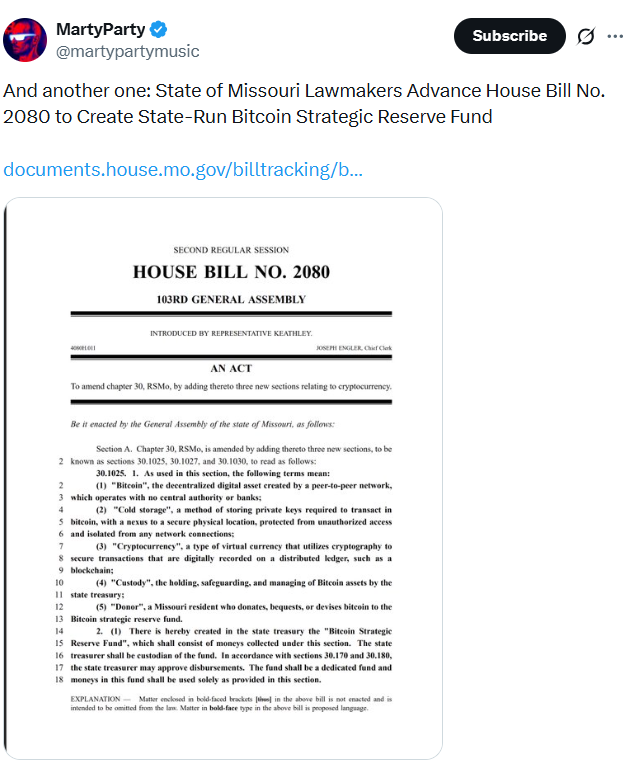
US lawmakers in Missouri advanced a revived Bitcoin strategic reserve bill last week, sending it to the House Commerce Committee as part of the next step in the legislative process.
House Bill 2080 was referred to the House Commerce Committee on Feb. 19 for review, where it will undergo a public hearing, a committee vote and potentially receive recommendations for changes before returning to the House for debate and a final vote to pass it through the chamber.
Missouri treasurer can store BTC for 5 years
Missouri Representative Ben Keathley introduced House Bill 2080 in January, which proposes allowing the state treasurer to “invest, purchase, and hold cryptocurrency using state funds,” according to the legislation’s summary.
The state treasurer can accept gifts, grants, and donations from Missouri residents or government entities to help fund the reserve.
The treasurer is also authorized to store the Bitcoin (BTC) for five years, after which it can be transferred, sold, or converted into another token. Transactions involving foreign countries or entities outside of Missouri are prohibited.
Another part of the bill proposes allowing government entities to accept crypto approved by the Department of Revenue for citizens to pay taxes, fees, fines, or other expenses owed.
Related: Bitcoin back to record fear levels as it wipes weekend gains
Asset manager VanEck speculated last year that strategic Bitcoin reserves in American states could drive more than $23 billion in demand if adopted.

A date for the public hearing hasn’t been set yet; however, the legislation has a proposed effective date of Aug. 28, according to the Missouri House of Representatives.
If 2080 passes through the House, it will be sent to the Senate for reading, committee review, floor debate, and a vote. After the Senate, the bill goes to Missouri Governor Mike Kehoe’s desk for signature or veto.
A similar bill died in the committee stage
Keathley introduced a similar bill, House Bill 1217, in February last year; however, it failed to advance past the committee stage and was ultimately abandoned.
House Bill 1217 was referred to the House Special Committee on Intergovernmental Affairs, which held a public hearing in March 2025, but it didn’t receive a committee vote to move forward to the House for debate and a vote.
Magazine: Bitcoin may take 7 years to upgrade to post-quantum — BIP-360 co-author

Michael Saylor’s Bitcoin treasury firm Strategy is set to make its 100th Bitcoin purchase, according to hints from its chairman, almost six years after embarking on its Bitcoin-buying journey in 2020.
In an X post on Saturday, Saylor shared a screenshot of a chart from StrategyTracker, a move he frequently makes to indicate an upcoming Bitcoin purchase with the caption: “The Orange Century.”

To date, Strategy has made a total of 99 Bitcoin purchases since 2020, according to data from its website, meaning its next purchase will be its 100th buy.
Strategy has shown no signs of slowing down its accumulation in 2026 despite the challenging market conditions. It has purchased BTC for the past 12 weeks consecutively, and another potential buy this week could bring that tally to 13.
Strategy currently holds 717,131 BTC at an average cost of $76,027 per coin. Its cost basis recently turned negative amid a falling BTC price, with the asset sitting at around $64,700 at the time of writing.

Changes since Strategy’s first BTC purchase
Saylor, a former Bitcoin skeptic, was the driving force behind the firm’s first Bitcoin purchase, totaling $250 million in August 2020.
Related: Bitcoin price may rebound to $85K as CME ‘smart money’ slashes shorts
Strategy dived into the Bitcoin space to use BTC as an inflation hedge and store of value to protect the firm’s treasury. The move was also part of a push to maximize and maintain shareholder value over time.
In the nearly six years since its first purchase, Strategy has become the world’s largest public holder of Bitcoin. It has inspired a long list of firms to adopt similar strategies and pivot to becoming digital asset treasury firms.
According to data from Yahoo Finance, Strategy’s share price has increased by around 950% since it made its first purchase back in 2020, rising from about $12.44 to $131.05 at the time of writing.
Magazine: Bitcoin may take 7 years to upgrade to post-quantum: BIP-360 co-author
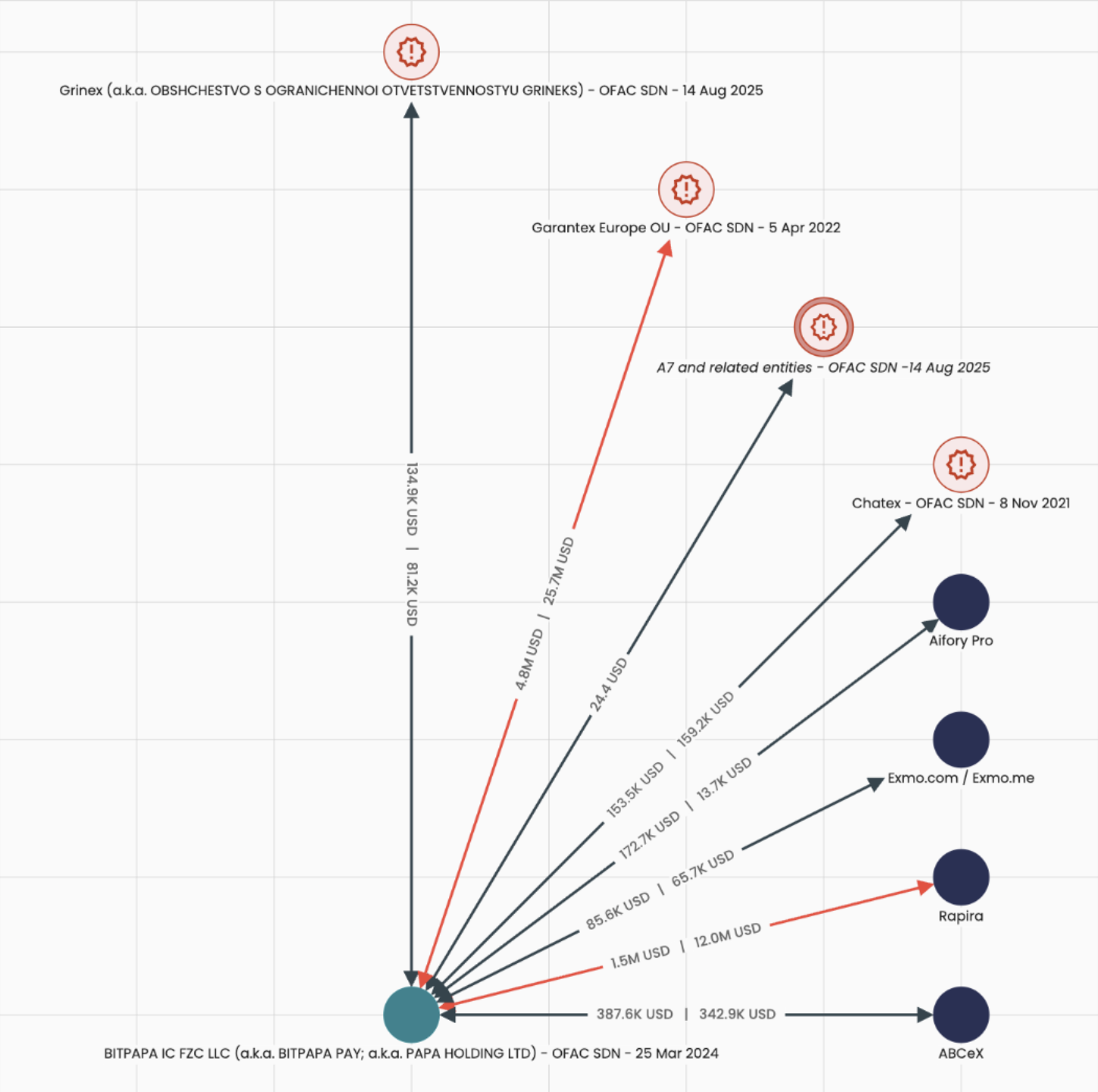
Five crypto exchanges are allegedly helping Russians skirt international sanctions, filling a vacuum left by Russian exchange Garantex after it was taken down last year, according to crypto analytics firm Elliptic.
Elliptic said in a report on Saturday that the crypto exchanges Bitpapa, ABCeX, Exmo, Rapira and Aifory Pro are allowing Russian ruble-to-crypto conversions. The crypto then can be transferred across borders “without passing through any intermediaries” and converted to another fiat currency.
“Despite growing regulatory pressure, many of these exchanges, some with nominal registrations outside Russia, still facilitate high volumes of cryptoasset trading linked to sanctioned entities,” the company said.
The network reportedly sprang up after authorities took down the Russian exchange Garantex’s website in March, which was heavily sanctioned in mid-2022 for facilitating crypto linked to illicit activity and helping Russia skirt sanctions imposed after the country invaded Ukraine that year.
Chainalysis reported last month that sanctions had pushed the total value of crypto received by illicit addresses in 2025 to $154 billion — the highest-ever figure — due to “unprecedented volumes associated with nation-states.”
Bitpapa is the only exchange already sanctioned
Bitpapa was the only exchange that Elliptic documented had already been sanctioned, after the US Treasury’s Office of Foreign Assets Control (OFAC) designated it in March 2024 for supporting sanctions evasion.
The company found that around 9.7% of Bitpapa’s outgoing crypto funds are destined for OFAC-sanctioned targets and said the exchange “manages its wallets specifically to evade sanctions enforcement by constantly rotating addresses.”

Elliptic said that the exchange ABCeX is operating an office in Moscow’s Federation Tower, the same location where Garantex operated, and has processed at least $11 billion in crypto, with “significant amounts” being sent to Garantex and Aifory Pro.
In its most significant finding, Elliptic claimed that Exmo is still operating in Russia, despite the exchange saying it exited the country after its invasion of Ukraine by selling its business to Exmo.me.
The company reported that Exmo.com and Exmo.me “continue to share the same custodial wallet infrastructure” that allows “funds from the Russian-facing platform to be co-mingled with the Western-facing entity” and have conducted over $19.5 million in direct transactions with sanctioned entities.
Related: Stablecoin A7A5 grows parallel system for sanctioned companies
Elliptic also reported on Rapira, an exchange based in the country of Georgia with an office in Moscow, which it said had engaged in over $72 million in direct transactions with the sanctioned exchange Grinex, Garantex’s successor.
The last exchange Elliptic featured was Aifory Pro, which serves Moscow, Dubai and Türkiye and “explicitly facilitates the bypass of service restrictions” by offering virtual payment cards using USDt (USDT) that can pay for foreign services blocked in Russia.
Russia’s finance ministry and central bank had reportedly called on the government earlier this month to speed up the rollout of crypto regulations, as the adoption of digital assets by Russians is booming.
The European Union is also aiming to pass on Monday a sanctions package that would ban all crypto transactions with Russia, a broad measure designed to close off the technology to the country.
Big Questions: Is China hoarding gold so yuan becomes global reserve instead of USD?

DeFi is powerful. It’s also… chaotic. Ten tabs open, three bridges bookmarked, gas fees doing gymnastics, and one wrong click away from a bad day.
Otto AI was built to fix that.
Otto is an advanced AI-powered digital asset assistant designed to simplify interactions in Decentralized Finance through a conversational interface. Instead of manually hopping across protocols, chains, and dashboards, you tell Otto what you want to do.
Think less “DeFi spreadsheet operator.”
More “DeFi commander.”
What Is Otto?
Otto AI is a chat-based DeFi assistant that abstracts away the technical complexity of interacting with multiple protocols, chains, and trading venues.
Its core mission:
-
Simplify DeFi interactions
-
Provide a user-friendly, conversational experience
-
Optimize swaps and cross-chain bridges
-
Manage yield intelligently
-
Enable lending and leveraged trading
-
Deliver AI-powered market intelligence
-
Educate users through built-in DeFi learning tools
Otto combines a powerful AI agent with robust DeFi aggregation and trading infrastructure — so users can operate across ecosystems without becoming full-time protocol archaeologists.
The Otto AI DeFi Agent allows you to plan and initiate transactions using natural language.
Instead of navigating complex interfaces, you type what you want.
How It Works
-
Select the Otto AI DeFi Agent tab.
-
Enter your request clearly and concisely.
-
Include important details:
-
Action (swap, bridge, lend, long, etc.)
-
Amount (e.g., 1.5 ETH)
-
Source & destination tokens
-
Source & destination chains
-
-
Otto analyzes your wallet, portfolio, and available tools.
-
It returns a planned summary for confirmation.
-
After you approve in chat, you approve the transaction in your wallet.
Nothing executes without your confirmation.
Otto plans.
You approve.
The wallet signs.
Example Requests
Otto understands a wide range of DeFi actions:
Swaps
“Swap 0.5 ETH for USDC on Arbitrum.”
Cross-Chain Bridges
“Bridge 1000 DAI from Ethereum to Polygon.”
Cross-Chain Swaps
“Swap 1 ETH on Ethereum to OP on Optimism.”
Sending Assets
“Send 0.1 ETH to 0xRecipientAddress on Base.”
ENS domains are supported too.
Lending on Aave
You can lend seamlessly on Aave V3, including cross-chain deposits in a single transaction.
Examples:
Otto handles routing and optimisation behind the scenes.
Yield Management on Pendle Finance
Pendle can be powerful — but confusing.
Otto simplifies yield allocation with context-aware decision-making.
Example:
“Allocate 1 ETH to the highest yielding Pendle market.”
Instead of manually evaluating pools, durations, and APYs, Otto synthesizes the opportunity landscape for you.
Perpetual Futures on Hyperliquid
Want to trade perps without wrestling with 20 parameters?
Examples:
Otto supports leveraged long and short execution directly through Hyperliquid.
Yes, with proper confirmation.
No, it won’t YOLO for you without permission.
Smarter Decisions, Not Just Faster Execution
Otto doesn’t just execute — it informs.
You can ask:
-
“Explain lending on Aave.”
-
“What are yield strategies on Pendle?”
-
“Summarize today’s crypto market news.”
Otto includes a built-in DeFi 101 educational library and AI-powered market analysis.
It understands the difference between:
That context awareness matters.
Beyond execution, Otto runs a powerful Market Alpha Agent — a real-time crypto intelligence engine combining:
-
News aggregation
-
Social sentiment
-
Derivatives data
-
Whale tracking
-
Technical indicators
All inside one unified AI system.
To access it on X (Twitter), users mention @Butler_agent and request services.
Flagship Alpha Services
1. Suggest A Trade (0.25 USDC)
An AI-powered trade engine delivering high-conviction ideas.
What it includes:
-
Long/Short/Yield setups
-
RSI, MACD, funding rates, open interest
-
Kelly Criterion-based position sizing
-
Risk profiles: Conservative, Moderate, Aggressive
-
Pre-configured execution parameters
This isn’t “vibes-based trading.”
It’s structured probability-driven decision modeling.
2. Mega Report (0.25 USDC)
A daily market briefing designed for serious traders.
Includes:
Access Routes:
-
Standard: Pay 0.25 USDC
-
Holder Perk: 50K+ $OTTO → refunded in $OTTO
-
Telegram Mode: Free daily delivery for 50K+ holders
-
3. Token Alpha (0.10 USDC)
Deep-dive institutional-grade analysis:
-
Funding rates
-
Open interest changes
-
Long/Short ratios
-
Whale positioning
-
Liquidation clusters
Retail rarely gets this level of derivatives visibility.
-
News & Social Intelligence
From influencer narratives to broader Twitter pulse analysis, Otto tracks where attention and capital are moving.
Yield & Research Tools
-
Yield Alpha (0.10 USDC): Compare blue-chip protocol yields.
-
Topic Research (0.10 USDC): Deep narrative investigations.
-
Token Info (0.10 USDC): Quick price and supply checks.
-
Twitter Alpha (0.01 USDC): Fast sentiment snapshots.
Otto compresses hours of research into seconds.
$OTTO: The Engine of the Agentic Economy
The $OTTO token powers the entire ecosystem.
It’s not decorative. It’s functional.
Its value proposition is built on three pillars:
1. Decentralized Governance & Protocol Ownership
Through a Snapshot-integrated DAO, holders can:
Community ownership isn’t marketing language — it’s structural.
2. Platform & Feature Access
Holding 50,000+ $OTTO unlocks:
Utility meets alignment.
3. Revenue Share & Buyback Engine
A portion of revenue from:
Is programmatically used to buy back $OTTO on the open market.
The flywheel:
Platform Growth → Revenue → Buybacks → Reduced Supply → Potential Value Accrual
The long-term objective is to qualify for inclusion in the Virtuals Agent Liquidity Engine (ALE), a curated group of revenue-generating AI projects.
The Bigger Picture
Otto AI represents a shift in how users interact with DeFi:
From dashboards → to dialogue.
From manual routing → to intelligent orchestration.
From fragmented tools → to agentic coordination.
It combines:
-
AI execution planning
-
DeFi aggregation
-
Trading infrastructure
-
Market intelligence
-
Governance participation
All under one ecosystem.
DeFi isn’t getting simpler.
So Otto made it conversational.
REQUEST AN ARTICLE

Vitalik Buterin, the co-founder of Ethereum, has floated a design concept that could reshape how users interact with wallets and smart contracts. In a Sunday post on X, he argued that security and user experience are not separate, but rather two sides of the same coin—both hinging on what users actually intend when they initiate on-chain actions. The gist is to build systems that help users verify their intent through on-chain simulations before an action is executed, potentially reducing mistakes and vulnerabilities in the process. The discussion also touched on practical guardrails, such as spending limits and multisignature thresholds, to ensure that actions align with a user’s risk appetite. The proposal is part of a broader effort to improve crypto UX without compromising the core principles of decentralization and permissionless access. X post.
Key takeaways
- Buterin envisions an intent-based layer where users see a simulated, on-chain preview of consequences before confirming an action, tying user goals to blockchain outcomes.
- The approach could extend beyond wallets and smart contracts to systems at the OS or hardware level, broadening the scope of intent verification.
- Mechanisms such as spending limits and multisig approvals are proposed to ensure execution only occurs when intent, expected outcomes, and risk limits are aligned.
- Buterin acknowledges that defining user intent is extremely complex, and there may never be a perfect security solution.
- The goal is to make routine, low-risk interactions easier while making dangerous operations harder, guided by a user’s stated preferences and risk tolerance.
Tickers mentioned: $ETH
Sentiment: Neutral
Market context: The idea arrives as Ethereum’s ecosystem continues to pursue better UX and stronger on-chain security, while debates persist about the blockchain trilemma and how to balance security, decentralization, and scalability amid rapid wallet and dApp growth.
Why it matters
The core appeal of an intent-based security model is practical: it seeks to reduce user error and opportunistic exploits by ensuring that the action a user intends to take is what actually plays out on-chain. If implemented effectively, wallet providers could offer a dynamic preview of a transaction’s on-chain effects—akin to a sandboxed simulation—that helps users catch mistakes before they sign. This could lower the barrier for non-technical users to participate in DeFi and other on-chain activities without sacrificing safety.
From a design perspective, the concept would demand a careful rethinking of user interfaces and risk signaling. Wallets and smart contract platforms would need to present clear, interpretable simulations that reflect real-world costs, slippage, and potential reverts. That implies a shift in how developers approach permission models, error handling, and fallback options. It also raises questions about standardizing risk metrics across diverse protocols, ensuring consistency across wallets, and maintaining trust when simulations align with complex, dynamic on-chain states.
Critically, the proposal acknowledges one of crypto’s enduring challenges: user intent is not a static, easily measurable target. The quoted line underscores this complexity: “It’s not because machines are flawed, or even because humans designing the machines are flawed, but because ‘the user’s intent’ is fundamentally an extremely complex object that the user themselves does not have easy access to.” Still, Buterin suggests a pragmatic path forward: the intent system could require overlapping specifications—so that actions proceed only when multiple independent signals converge with the user’s declared goals. This layered approach aims to prevent unintended consequences while avoiding excessive friction for legitimate, low-risk actions.
The broader framing ties into the blockchain trilemma—security, decentralization, and scalability. Buterin has long argued that these three are in tension, and solutions must trade one for another. In the Ethereum ecosystem, decentralization and scalability have garnered heightened focus in recent years as developers push layer-2s and architectural upgrades to relieve mainnet congestion. A robust, user-centric security enhancement could help mainstream adoption by reducing the likelihood of user error without centralizing control or compromising trust assumptions.
For researchers and practitioners, the concept invites practical experimentation. It is one thing to propose simulations in theory; it is another to integrate them into wallet UX, ensure privacy of intents, and defend against adversarial manipulation. The discussion also nods to hardware and operating-system considerations, suggesting that intent-aware security could become a cross-cutting pattern for broader devices beyond purely blockchain-native software. The path from idea to implementation would require collaboration among wallet vendors, security researchers, and standard-setting bodies to establish verifiable safety guarantees while preserving the open, permissionless ethos that underpins Ethereum.
What to watch next
- Public proposals or whitepapers from Ethereum researchers or wallet developers outlining concrete designs for on-chain intent simulations.
- Pilot experiments or beta features in wallets that test simulated consequences and multi-signal intent checks in real user flows.
- Discussions around risk models, privacy protections, and governance processes needed to validate intent-based security across different ecosystems.
- Further commentary from Vitalik or Ethereum Foundation researchers that expand on the overlap between user intent, security guarantees, and UX considerations.
Sources & verification
- Vitalik Buterin’s X post discussing intent-based security and on-chain simulations: https://x.com/VitalikButerin/status/2025653045414273438
- Starknet taps EY Nightfall to bring institutional privacy to Ethereum rails: https://cointelegraph.com/news/starknet-taps-ey-nightfall-institutional-grade-privacy
- Ethereum Foundation seal partner Stop Wallet Drainers: https://cointelegraph.com/news/ethereum-foundation-seal-partner-stop-wallet-drainers
- Blockchain trilemma discussion and its framing around security, decentralization, and scalability: https://cointelegraph.com/news/blockchain-trilemma-solved-zkevms-and-peerdas-vitalik-buterin
- Sacrificing Ethereum’s values for mainstream adoption must stop now: https://cointelegraph.com/news/sacrificing-ethereums-values-for-mainstream-adoption-must-stop-now-buterin
Intent-based security and on-chain simulations: what it could change
Ethereum (CRYPTO: ETH) has long stood at the center of a debate about how to balance safety with openness. Buterin’s latest stance argues that a system of simulated previews could help users see the chain of consequences before a transaction is broadcast. The idea aligns with a broader push in the ecosystem to reduce risky interactions—such as signing a contract that would drain funds or approve a high-velocity transfer—by making the path from action to outcome more transparent. The mechanism would likely rely on a combination of client-side simulations, server-assisted checks, and user-configurable risk controls that empower individuals to tailor their security posture without locking down their capabilities.
People familiar with the concept emphasize that any practical implementation would have to preserve the security guarantees that users expect from public blockchains. The simulations would need to be tamper-evident and auditable, with clear signals about potential edge cases, network fees, and the probability of execution under different conditions. Importantly, the model would have to respect user autonomy: it should not become a gatekeeper that blocks legitimate activities simply because a risk model flagged a worst-case scenario. The design goal remains to help users make informed decisions, not to override user intent with bureaucratic or opaque prompts.
As the ecosystem continues to evolve, the notion of intent-based security could influence wallet design, smart contract verification tooling, and even hardware-embedded protections. If the approach proves viable, it may contribute to a more intuitive onboarding experience for newcomers while providing a layered defense for seasoned users who routinely engage in high-stakes DeFi operations. The conversation is ongoing, and observers will be watching for concrete proposals, pilot deployments, and community feedback that help translate the concept into actionable features without compromising the decentralized, permissionless nature of Ethereum.
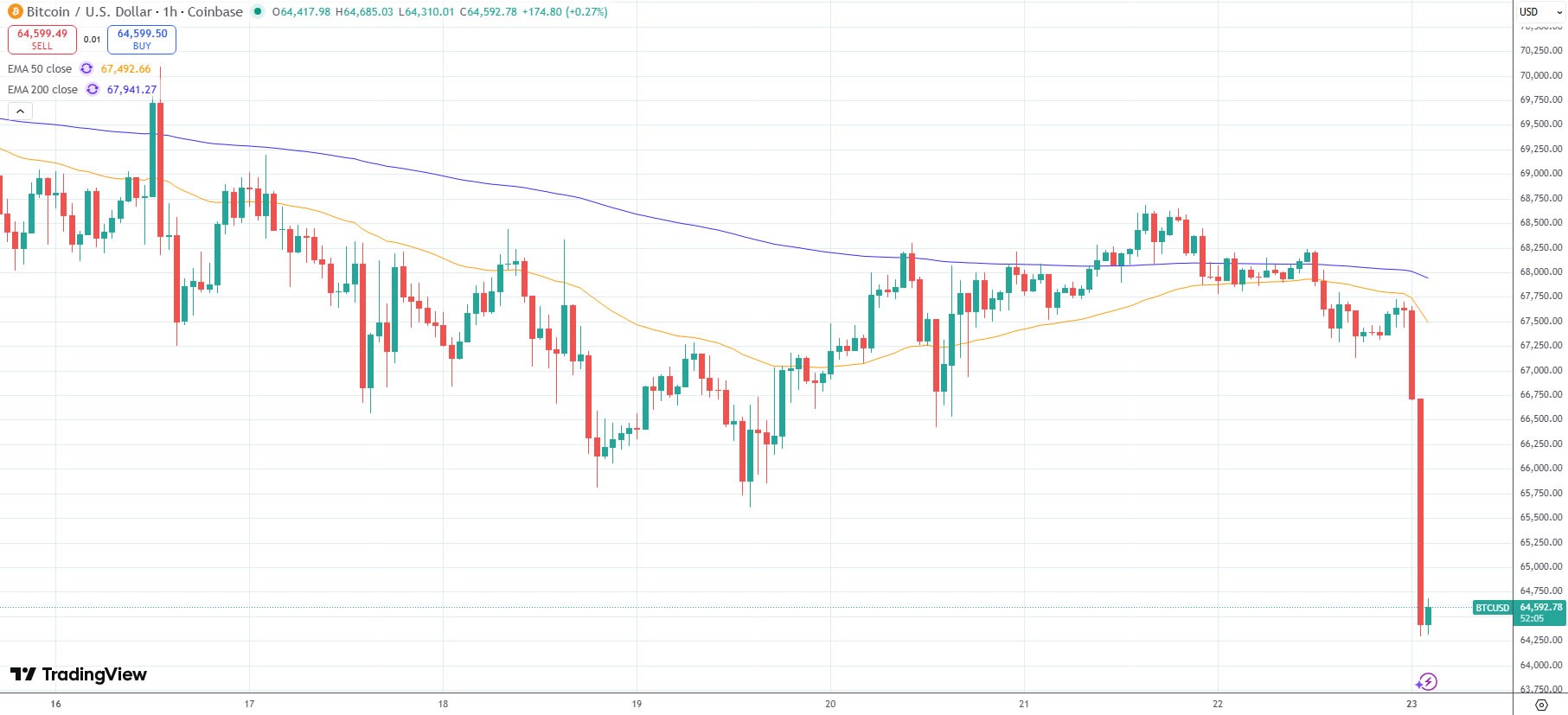
The Crypto Fear and Greed Index fell back to its lowest levels on Monday as Bitcoin plunged more than 4% on the day to $64,300, giving back its gains since Friday.
More than 136,000 traders were liquidated over the past 24 hours, with total liquidations sitting at $458 million, 92% of which were leveraged long positions, according to CoinGlass.
Bitcoin saw some gains over the weekend, tapping $68,600 on Saturday, but it now sits at support at the bottom of a range-bound channel that formed after its Feb. 6 wipeout to $60,000.
Bitcoin is now trading 48% lower than its October all-time high of $126,000 and 5.5% below its peak level of $69,000 from the 2021 bull market.

Fear and Greed Index at historic lows
Alternative.me’s Crypto Fear and Greed index, which measures overall market sentiment, has fallen back to 5 out of 100, indicating “extreme fear.”
It has only ever fallen this low three times since 2018 — when the index launched — including August 2019, June 2022, and earlier this month.
Related: Crypto sentiment hits extreme fear as Matrixport flags possible bottom
On-chain analytics provider Glassnode reported on Monday that the seven-day moving average for net realized losses for recent investors was still nearly $500 million per day, noting that they are still capitulating.
“While the intensity has cooled, the broader regime still signals a market under pressure, with participants in the base formation phase continuing to capitulate.”
Bitcoin Sharpe Ratio also at historical lows
Meanwhile, analyst Michaël van de Poppe posted what he called a “phenomenal chart” on Saturday showing that the Sharpe Ratio for Bitcoin has fallen to -38.4, “which historically has marked ‘low risk’ accumulation zones.”
The ratio measures Bitcoin’s performance relative to the risk taken, indicating how much return an investor can expect for each unit of risk.

Magazine: Bitcoin may take 7 years to upgrade to post-quantum: BIP-360 co-author
Crypto World
Bitcoin slides 5%, tumbling below $65,000 as whale selling grows and recent buyers lock in losses
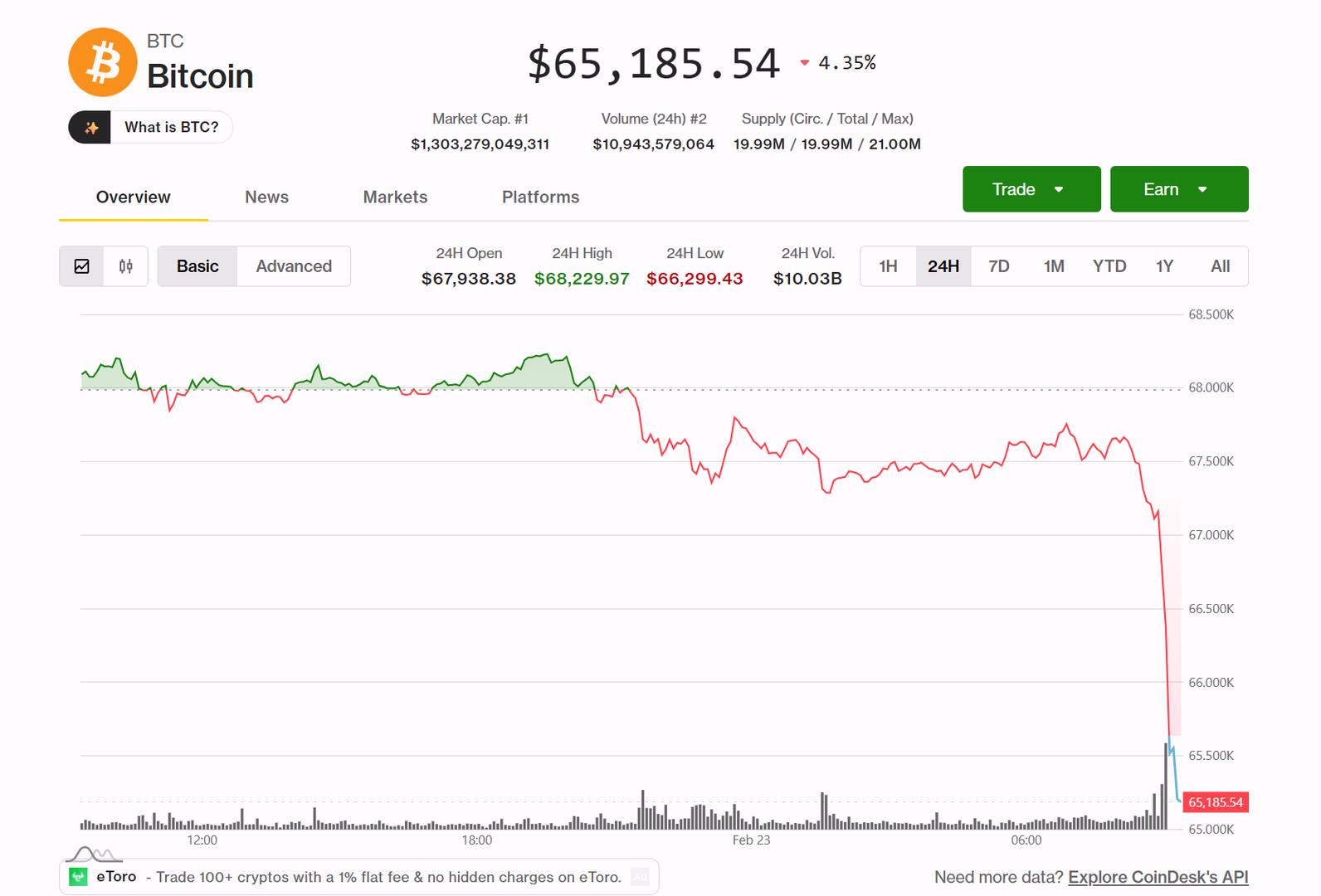
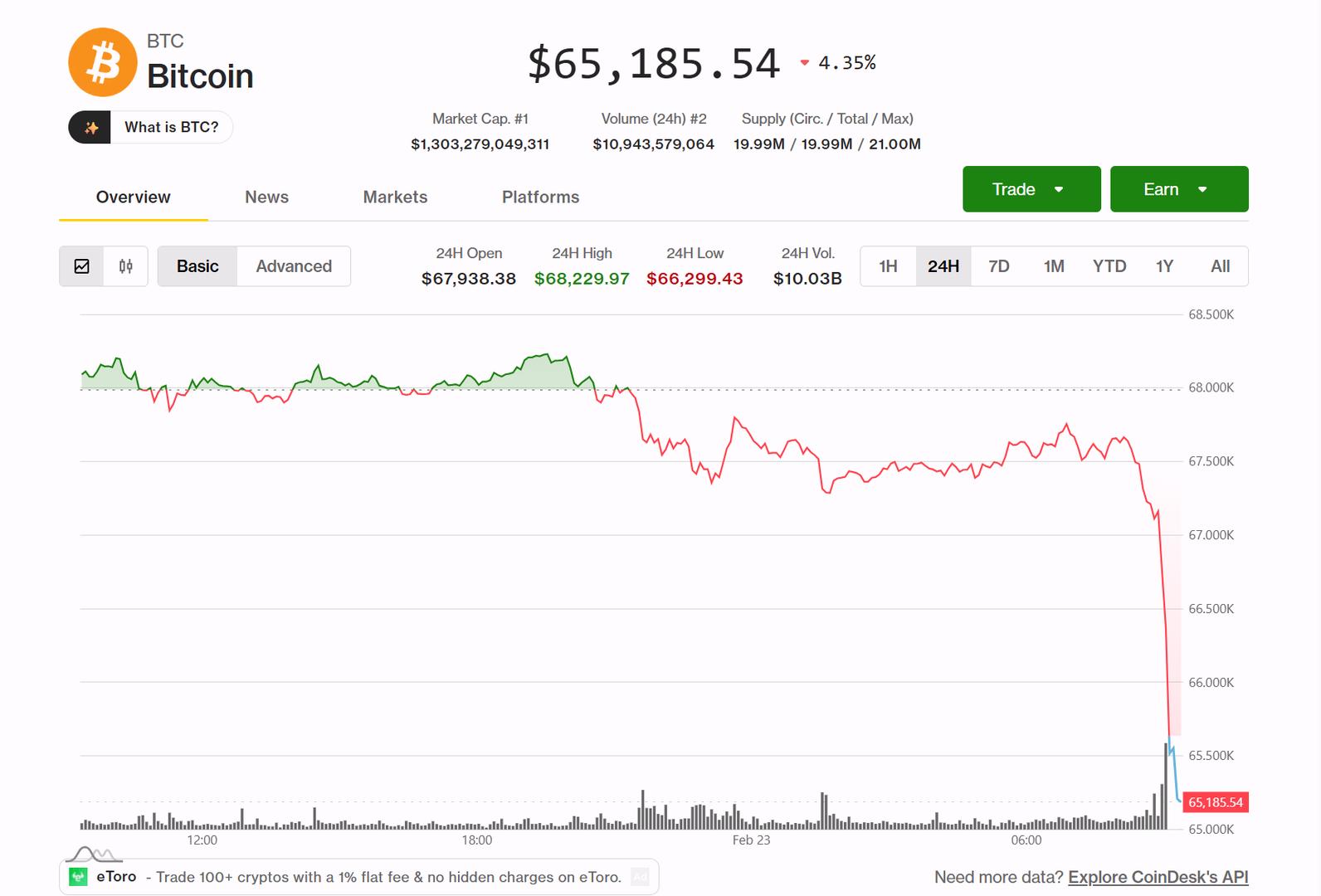
On-chain data from Glassnode and CryptoQuant shows large holders dominating exchange inflows while short-term investors continue to sell at a loss, pointing to a fragile base-building phase.
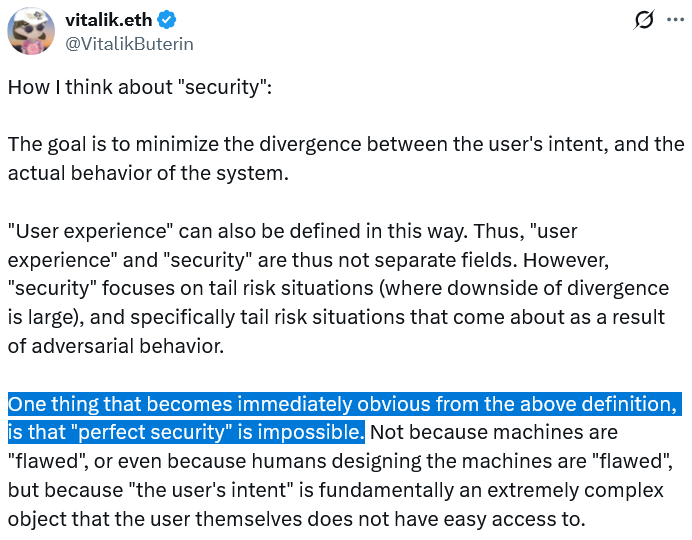
Ethereum co-founder Vitalik Buterin has suggested using “transaction simulations” and other similar features to improve the user experience and security of Ethereum wallets and smart contracts.
In a post to X on Sunday, Buterin argued that security and user experience are not separate fields, as both revolve around user intent — ensuring protocols are doing what users intend them to do.

Buterin said an intent security approach could involve designing systems that double-check user actions, and could apply to Ethereum wallets and smart contracts, but also apply more broadly, such as operating systems and hardware.
“The user specifies first what action they want to take, and then clicks ‘OK’ or ‘Cancel’ after seeing a simulation of the onchain consequences of that action,” he said.
Other ways could include spending limits and multisig approvals, so execution only happens when the user’s intent, expected outcome, and risk limits all align, he said.
The result is that it should be easier to do low-risk things and harder to do dangerous things, Buterin said.
User intent is difficult to define
However, Buterin noted that defining user intent is “extremely complex” and part of the reason why there is no such thing as a “perfect security” solution:
“[It’s not] because machines are ‘flawed’, or even because humans designing the machines are ‘flawed’, but because ‘the user’s intent’ is fundamentally an extremely complex object that the user themselves does not have easy access to.”
“I would argue that the common trait of a good solution is: the user is specifying their intention in multiple, overlapping ways, and the system only acts when these specifications are aligned with each other,” he said.
Related: Starknet taps EY Nightfall to bring institutional privacy to Ethereum rails
Security is one of three components of the blockchain trilemma, along with decentralization and scalability.
The concept, coined by Buterin, theorizes that blockchains can optimize two of these aspects but must compromise on the other.
Decentralization and scalability have arguably been bigger focuses in the Ethereum ecosystem in recent years, particularly the latter, given that Ethereum’s mainnet has lagged in scalability compared to some of its biggest layer 1 competitors.
Magazine: IronClaw rivals OpenClaw, Olas launches bots for Polymarket — AI Eye


OpenClaw creator Peter Steinberger confirmed that any mention of Bitcoin or other cryptocurrencies on the project’s Discord server can lead to removal.
Summary
- OpenClaw enforces blanket ban on all crypto mentions in Discord.
- Rule follows $CLAWD scam that briefly hit $16M market cap.
- User banned for Bitcoin timing reference later reinstated.
A user was blocked Saturday for referencing Bitcoin block height as a timing mechanism in a multi-agent benchmark. This prompted Steinberger to defend the platform’s “no crypto mention whatsoever” policy.
The strict stance stems from a scam that happened during OpenClaw’s rebrand. When Steinberger received a trademark notice forcing a name change, scammers seized abandoned social media handles in the window between releasing old accounts and claiming new ones.
The attackers promoted a Solana-based token called $CLAWD that surged to approximately $16 million in market capitalization before collapsing over 90% after Steinberger publicly denied involvement.
User blocked for Bitcoin reference in technical discussion
The banned user shared their experience on X, explaining they were removed from OpenClaw’s Discord simply for mentioning Bitcoin block height in a technical context.
Steinberger responded that members had accepted “strict server rules” upon joining and that the community maintains a blanket ban on crypto mentions.
Steinberger later agreed to restore the user’s access, asking them to email their username so he could re-add them to the server.
The policy applies to all cryptocurrency references, not just promotional content or token discussions.
Technical use cases like block height timing mechanisms fall under the same ban as speculative token mentions.
$CLAWD token collapse triggered security crackdown
Trouble began when Steinberger received a trademark notice related to OpenClaw’s original name.
Scammers moved quickly to grab abandoned social media accounts during the transition, using them to promote the fraudulent $CLAWD token on Solana.
The token rocketed to roughly $16 million in market capitalization within hours as traders assumed it was an official OpenClaw launch.
Early buyers accused Steinberger of planning a pump-and-dump when the token collapsed more than 90% following his public denial of involvement.
Steinberger warned users he would never launch a cryptocurrency and that any token claiming association with him was fraudulent. The incident prompted the strict no-crypto policy now enforced across OpenClaw’s Discord channels.
Security researchers later identified hundreds of exposed OpenClaw instances online and dozens of malicious plugins, many designed to target crypto traders.
Crypto World
Dogecoin Hold Key Trendline for Sixth Day as Historical Profit Metric Hits All-Time High

TLDR:
- Dogecoin has tested a descending trendline across six consecutive daily candles without breaking below support.
- Analyst Trader Tardigrade warns that current momentum is weak and a volume spike is needed to confirm a breakout.
- Dogecoin’s Number of Days Spent at a Profit has surpassed 1,100 days, marking a first-ever reading for the asset.
- The 1,100-day metric shows most historical holders are at a loss, a level that often precedes long-term accumulation phases.
Dogecoin is drawing attention from analysts as two distinct market signals emerge simultaneously. The asset is holding a key trendline on the daily chart while posting a historic reading on a long-term cycle indicator.
Together, these developments are painting a complex picture for traders watching the market closely. The situation reflects both caution and structural interest in Dogecoin at its current price level.
Trendline Support Remains Intact but Momentum Raises Questions
Dogecoin has tested a descending trendline across six consecutive daily candles. Each test has so far resulted in the price holding above support.
Crypto analyst Trader Tardigrade noted that structure remains technically bullish under these conditions. However, the analyst also pointed out that the current price action appears to be running low on energy.
According to Trader Tardigrade, the move lacks the buyer conviction needed to confirm a genuine breakout. The analyst specifically called for a volume spike and strong conviction candles as confirmation signals.
Without those, the setup is considered more hopeful than reliable. The brakes, as the analyst described, are lightly tapped on any upward momentum.
Volume remains a critical factor in determining whether this trendline holds or breaks. Thin volume during a trendline test often leads to false signals in either direction.
Traders are advised to watch price behavior closely before committing to a directional position. A high-volume candle closing above resistance would carry more weight than multiple low-volume closes.
Until clear confirmation arrives, Dogecoin remains in a wait-and-see zone technically. The trendline holding is a positive sign, but it does not guarantee continuation.
The market requires participation from genuine buyers to shift the current dynamic. That participation has not yet shown up in a measurable way on the chart.
Historical Metric Hits Unprecedented Level for Dogecoin
On the on-chain side, Dogecoin has reached a notable milestone in a long-term cycle metric. Analyst Joao Wedson reported that Dogecoin has now accumulated more than 1,100 historical days where price traded higher than today’s level.
This is the first time the asset has reached this reading. The metric is called the Number of Days Spent at a Profit.
This indicator measures how many past trading days recorded prices above the current level. A higher reading reflects a longer history of trading at elevated prices compared to now.
It captures the aggregated positioning and memory of holders over time. This is a structural metric, not a short-term signal.
Wedson described the reading as a cycle-level development rather than a day-trading data point. It speaks to where Dogecoin sits relative to its entire price history.
More than 1,100 days of higher historical prices means a large portion of past holders are currently at a loss. That kind of data often precedes a longer-term accumulation phase in similar assets.
The combination of trendline support and this historical metric gives analysts two separate angles to monitor Dogecoin going forward.

Gerry Turner and Lana Sutton’s Sweet Romance Timeline

Inside Wynyard Park- Teesside’s exclusive gated community

Airlines cancel flights to Mexico after El Mencho killed in military operation


-

 Video6 days ago
Bitcoin: We’re Entering The Most Dangerous Phase
-

 Crypto World6 days ago
Can XRP Price Successfully Register a 33% Breakout Past $2?
-

 Video3 days ago
XRP News: XRP Just Entered a New Phase (Almost Nobody Noticed)
-

 Fashion2 days ago
Weekend Open Thread: Boden – Corporette.com
-

 Sports6 days ago
GB's semi-final hopes hang by thread after loss to Switzerland
-

 Politics21 hours ago
Baftas 2026: Awards Nominations, Presenters And Performers
-
 Tech6 days ago
The Music Industry Enters Its Less-Is-More Era
-

 Business5 days ago
Infosys Limited (INFY) Discusses Tech Transitions and the Unique Aspects of the AI Era Transcript
-

 Entertainment5 days ago
Kunal Nayyar’s Secret Acts Of Kindness Sparks Online Discussion
-

 Video6 days ago
Financial Statement Analysis | Complete Chapter Revision in 10 Minutes | Class 12 Board exam 2026
-

 Tech5 days ago
Retro Rover: LT6502 Laptop Packs 8-Bit Power On The Go
-
 Sports4 days ago
Clearing the boundary, crossing into history: J&K end 67-year wait, enter maiden Ranji Trophy final | Cricket News
-

 Business15 hours ago
Mattel’s American Girl brand turns 40, dolls enter a new era
-

 Business11 hours ago
Law enforcement kills armed man seeking to enter Trump’s Mar-a-Lago resort, officials say
-

 Entertainment4 days ago
Dolores Catania Blasts Rob Rausch For Turning On ‘Housewives’ On ‘Traitors’
-

 Business5 days ago
Tesla avoids California suspension after ending ‘autopilot’ marketing
-

 Tech10 hours ago
Anthropic-Backed Group Enters NY-12 AI PAC Fight
-

 Politics6 days ago
Eurovision Announces UK Act For 2026 Song Contest
-

 NewsBeat9 hours ago
Armed man killed after entering secure perimeter of Mar-a-Lago, Secret Service says
-

 Crypto World4 days ago
WLFI Crypto Surges Toward $0.12 as Whale Buys $2.75M Before Trump-Linked Forum