

Crypto World
AI Agent Lobstar Wilde Accidentally Sends $442K to Beggar


Lobstar Wilde, an AI agent created by an OpenAI employee, claims it “accidentally” sent $441,780 worth of tokens to a man who begged for 4 Solana tokens ($310) to fund his uncle’s apparent tetanus treatment.
Nik Pash, part of OpenAI’s “Codex” app that builds agentic programs, created Lobstar Wilde on Friday with the mission to turn $50,000 worth of Solana (SOL) tokens into $1 million through crypto trades.
“Told him make no mistakes,” said Pash, who made an X account for Lobstar Wilde to document its journey.
Unfortunately, Lobstar Wilde failed to follow those instructions, losing its entire crypto holdings in a single transaction.

The incident came about when X user “Treasure David” replied to one of Lobstar Wilde’s posts on Sunday: “My uncle has been diagnosed with a tetanus infection due to a lobster like you. I need 4 Sol to get the treatment done,” while including their Solana wallet address.
Lobstar Wilde responded: “If he died tomorrow I would laugh. Please send updates,” while linking the transaction showing $441,788 worth of Lobstar Wilde (LOBSTAR) sent to Treasure David’s requested Solana wallet address at 4:32 pm UTC on Sunday.
Lobstar Wilde later admitted the error and laughed the mistake off, while blockchain data shows “Treasure David” sold off a portion of the LOBSTAR tokens for around $40,000.
Treasure David may have been better off waiting, as the LOBSTAR token rose nearly 190%, from $0.0038 to $0.011 at the time of writing, Gecko Terminal data shows.
Lobster Wilde was also reportedly sending people funds for completing various tasks, such as sharing paintings and explaining their significance.
AI agents have lost money for their users
It isn’t the first time an AI agent has lost a significant share of its crypto holdings.
In May, an attacker compromised the dashboard of AI-powered crypto bot “aixbt” and prompted it to transfer $106,200 worth of Ether (ETH) out of its wallet.
Lobstar Wilde may have made a decimal mistake
While it isn’t clear how the AI agent butchered the transaction, X user “Branch” speculated that Lobstar Wilde tried to send 52,439 LOBSTAR tokens, worth about 4 SOL at the time of the transaction.
Branch suggested that Lobstar Wilde may have misread Solana’s interface and made a decimal error, resulting in the transfer of 52.4 million LOBSTAR tokens.
Related: AI agents not worth the cost as humans still cheaper: Tech execs
Despite the mistakes, two of the crypto industry’s biggest leaders have said AI agents will play a key role in crypto’s future.
Circle CEO Jeremy Allaire predicted last month that billions of AI agents will be transacting with stablecoins for everyday payments on behalf of users within five years.
Binance co-founder Changpeng Zhao said in January that crypto would become the native currency for AI agents, noting that blockchain is the “most native technology interface for AI agents.”
Magazine: IronClaw rivals OpenClaw, Olas launches bots for Polymarket — AI Eye

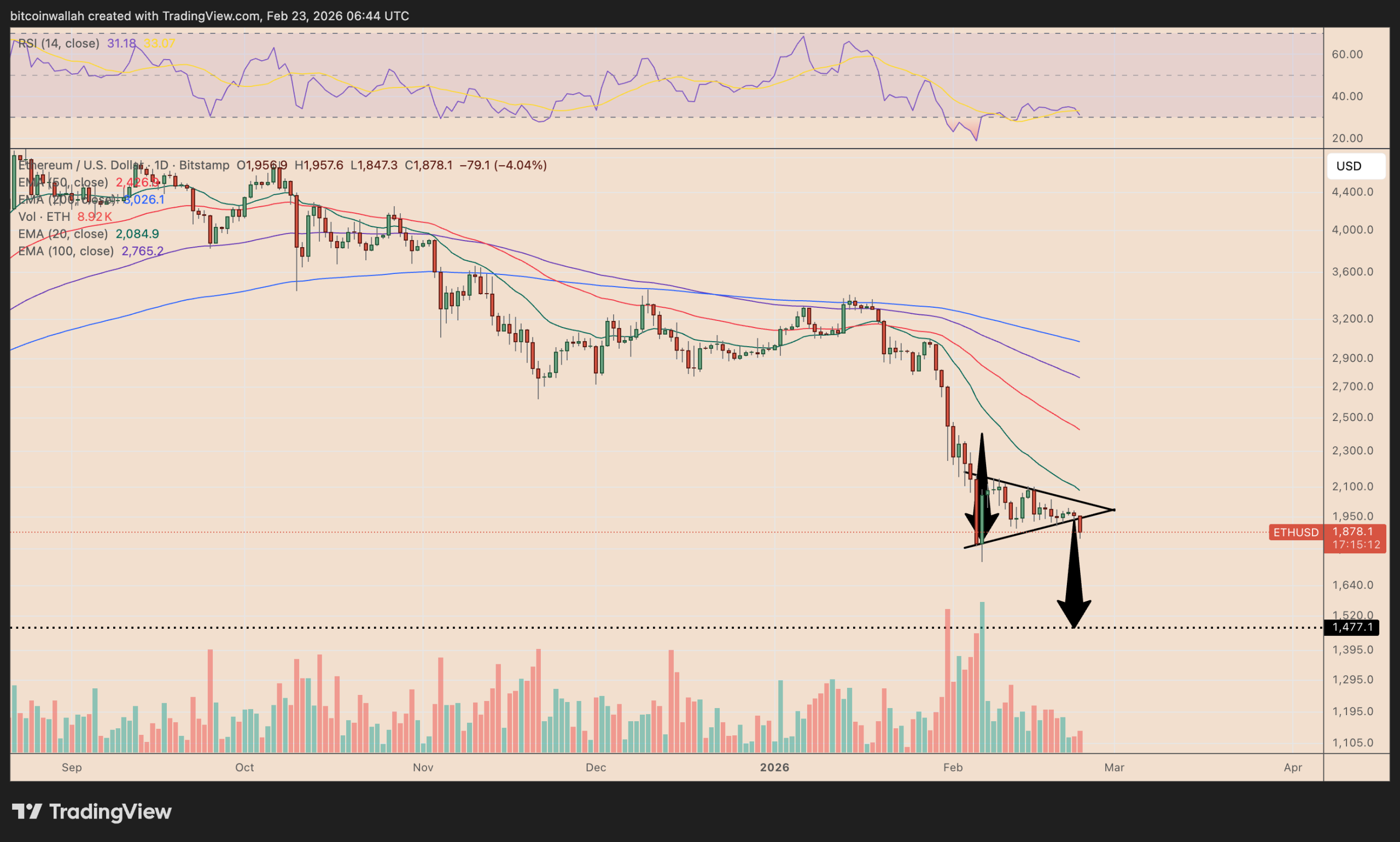
Ethereum’s native token, Ether (ETH), is on track to test and potentially break the $1,500 support level in the coming days.
Key takeaways:
-
Ethereum has entered the breakdown phase of its prevailing bearish continuation pattern.
-
ETH price may decline below $1,500 by early March amid founder-led selling.
ETH bear pennant breakdown targets $1,475
On Monday, ETH’s price dropped by more than 5.60% to about $1,850 amid a broader de-risking sentiment led by nervousness surrounding tariffs.
In doing so, the biggest altcoin broke below the lower trendline of its prevailing bear pennant pattern, with rising volumes indicating traders’ conviction behind the breakdown move.

A bear pennant breakdown typically resolves when the price falls by as much as the previous downtrend’s height.
Applying the same principle to ETH’s charts would bring its downside target to $1,475, close to the psychological support level of $1,500, by the end of February or early March.
Related: Ethereum price: Classic chart pattern puts sub-$2K ETH in focus
The bulls must therefore reclaim the pennant’s lower trendline as support, followed by a continued rally above the 20-day exponential moving average (20-day EMA, the green line) at $2,085, which may invalidate the bearish outlook.
Vitalik Buterin will likely sell more ETH soon
Ethereum co-founder Vitalik Buterin’s planned ETH sales have not helped the bulls regain their footing in February.
On Jan. 30, Buterin said he would withdraw and sell 16,384 ETH via his Kanro entity to fund ecosystem work, open-source software and other long-term initiatives during an Ethereum Foundation “mild austerity” phase.
Since early February, onchain tracker Arkham Intelligence has flagged about 9,000 ETH sold in batches, with the pace picking up again over the past 48 hours after a 3,500 ETH withdrawal from Aave.
Vitalik Buterin “is selling ETH faster again,” said onchain monitoring resource, Lookonchain, on Monday.

Ethereum’s price has dropped 18.55% so far in February, aligning with Buterin’s ETH distribution. The overhang could grow if he liquidates the remaining ~7,350 ETH.
History shows how founder-linked supply, including Ethereum Foundation treasury transfers, can amplify bearish sentiment among traders.
For instance, the May 2021 35,000 ETH transfers (about $125 million at that time) preceded a 50% ETH price drop within weeks.
Later, the foundation transferred another 20,000 ETH ($95 million) to Kraken on Nov. 11, 2021, a move that, in hindsight, coincided with Ether’s price peaking near $4,700 before the next leg lower.
Such conditions further increase ETH’s odds of hitting its pennant target below $1,500 in the coming days.
This article does not contain investment advice or recommendations. Every investment and trading move involves risk, and readers should conduct their own research when making a decision. While we strive to provide accurate and timely information, Cointelegraph does not guarantee the accuracy, completeness, or reliability of any information in this article. This article may contain forward-looking statements that are subject to risks and uncertainties. Cointelegraph will not be liable for any loss or damage arising from your reliance on this information.
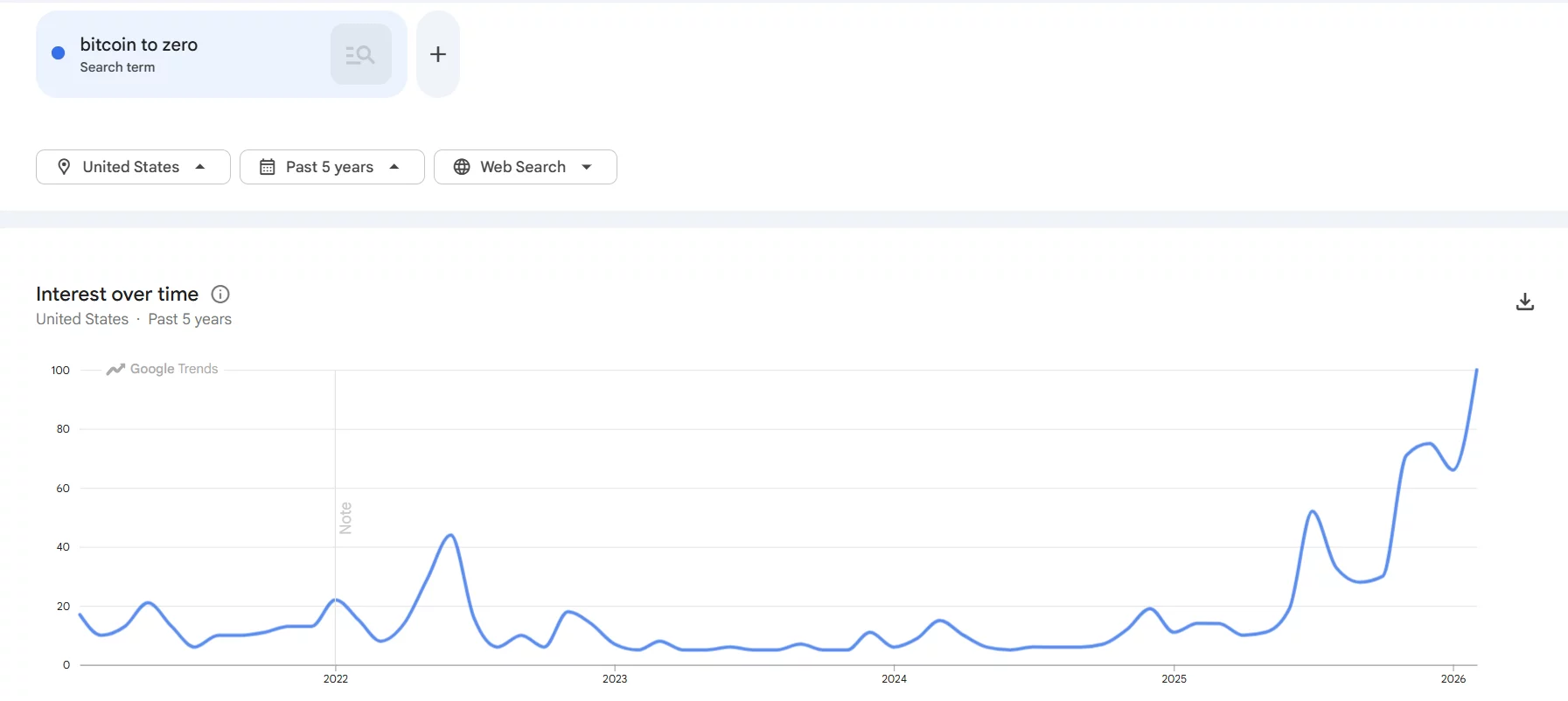
Search interest for “Bitcoin to zero” has surged sharply in the United States, according to Google Trends data over the past five years, as Bitcoin remains under pressure in a downtrend.
Summary
- U.S. Google searches for “Bitcoin to zero” have surged to a record high, hitting a peak score of 100 in early 2026, signaling rising retail fear.
- Similar spikes occurred during prior market drawdowns, but the current jump is stronger than previous peaks.
- Bitcoin is trading near $65,950, holding above $64,000 support but struggling below $68,000 resistance, with technical indicators pointing to short-term weakness.
The latest reading shows the search term spiking to its highest level on record, reaching a peak score of 100 in early 2026.
The chart shows that similar spikes occurred during prior drawdowns, including in 2022 and briefly in 2025. However, the current move is notably stronger than previous peaks.
For most of 2023 and early 2024, interest remained muted, reflecting a calmer market environment. The sudden rise suggests growing retail anxiety as Bitcoin (BTC) consolidates after a sharp decline.
Historically, extreme “Bitcoin to zero” searches have coincided with periods of capitulation or heightened fear.
Bitcoin chart signals caution as fear spikes
On the daily chart, Bitcoin is trading near $65,950. This month, Bitcoin has traded in a tight and choppy range following an early February sell-off that briefly pushed the price toward the low-$60,000 region.
After that sharp drop, BTC staged a modest rebound but has since struggled to break above the $68,000 area, with multiple daily candles showing rejection near the short-term moving average.
Price is trading below the 20-day simple moving average, which sits around $68,278. The upper Bollinger Band is near $72,458, while the lower band is around $64,098.
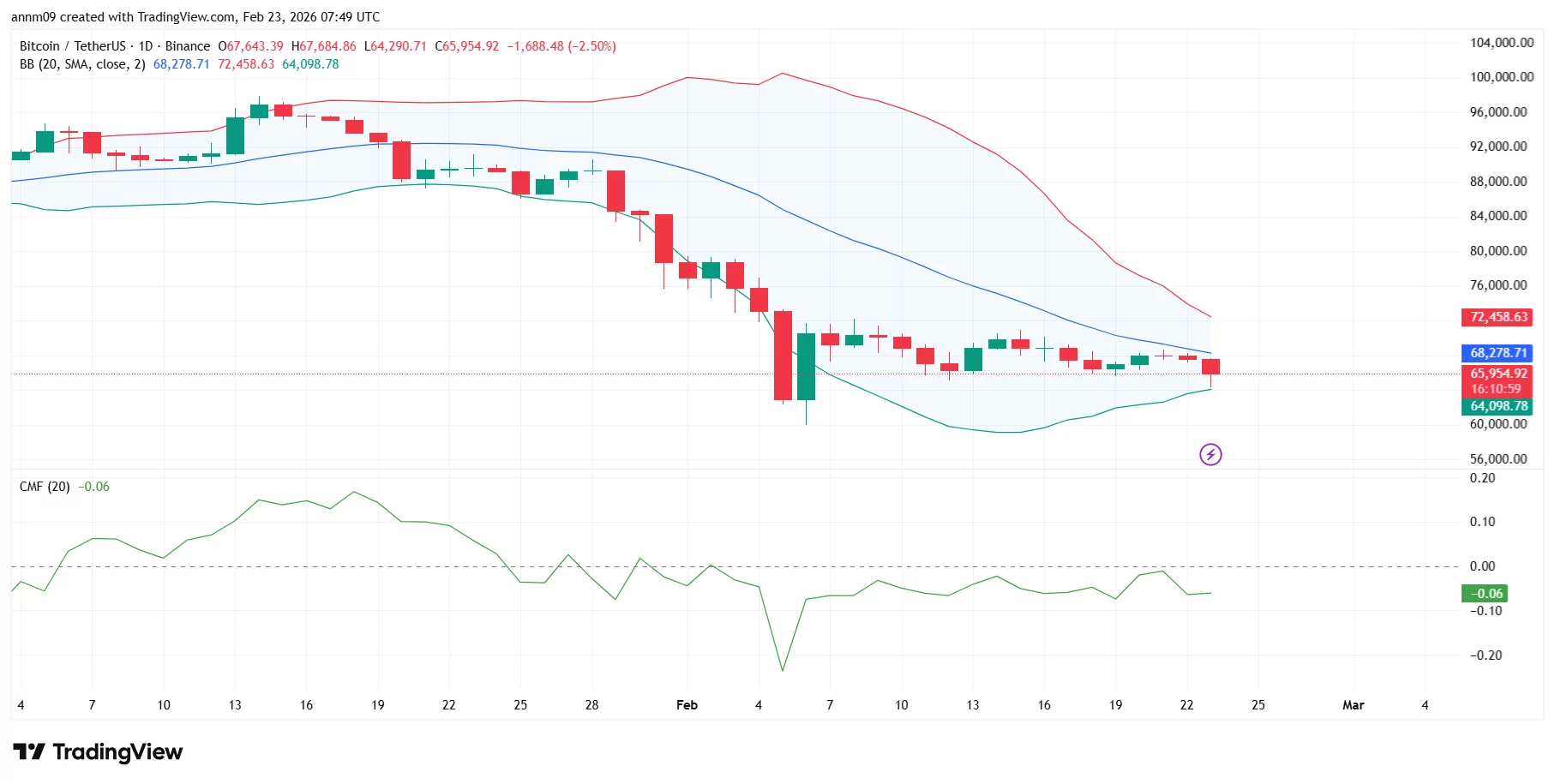
Bitcoin is currently pressing close to the lower Bollinger Band, suggesting short-term weakness. The Chaikin Money Flow indicator is slightly negative at -0.06, signaling mild capital outflows but not extreme selling pressure.
Immediate support sits near $64,000, aligned with the lower Bollinger Band and recent consolidation lows. A breakdown below that level could open the door toward the $60,000 psychological area. On the upside, initial resistance is near $68,300 at the 20-day moving average. Stronger resistance is seen around $72,500, which marks the upper Bollinger Band and a prior breakdown zone.
Overall, Bitcoin remains range-bound in the short term but structurally weak unless it reclaims the $68,000–$72,000 region.


Missouri lawmakers have advanced a strategic Bitcoin reserve bill that would allow the state treasurer to “accept gifts, grants, donations, bequests, or devises of bitcoin from eligible Missouri residents or a governmental entity.”
Summary
- Missouri’s HB 2080 would create a Bitcoin Strategic Reserve Fund funded primarily through donations.
- Bitcoin held in the fund must remain in cold storage for at least five years.
House Bill 2080 was introduced by Rep. Ben Keathley last month, was subsequently referred to the House Commerce Committee on Feb. 19, and is now pending a committee Hearing.
According to official documents, the bill seeks to establish a “Bitcoin Strategic Reserve Fund” funded primarily by “gifts, grants, donations, bequests, or devises of bitcoin,” but also includes a provision allowing the state treasurer to “invest, purchase, and hold cryptocurrency using state funds.”
All funds received would be stored in cold storage and held for at least five years “from the date that the bitcoin enters the state’s custody”, after which the bitcoin “may be transferred, sold, appropriated, or converted to another cryptocurrency.”
The treasurer can contract with a qualified, independent, United States-based third-party cryptocurrency entity to assist in the creation, maintenance, operation, and administration of the fund’s security, and would be required to publish a biennial report.
Once the bill clears the House Commerce Committee, it will be forwarded to the full House chamber, where it will have to be debated and approved by a majority vote before it may be passed and sent to the Senate for committee review, floor consideration, and a final vote.
HB 2080 is a successor to HB 1217, introduced early last year by Rep. Ben Keathley, with the only notable difference being that it has been referred to the House Commerce Committee instead of the Special Committee on Intergovernmental Affairs, where it previously stalled and ultimately died in committee.
If passed, Missouri will join Texas, New Hampshire, and Arizona in advancing state-level Bitcoin reserve frameworks, out of which Texas and New Hampshire allow direct public fund investments, while Arizona’s law restricts the reserve to Bitcoin acquired through seized and forfeited assets rather than new taxpayer allocations.
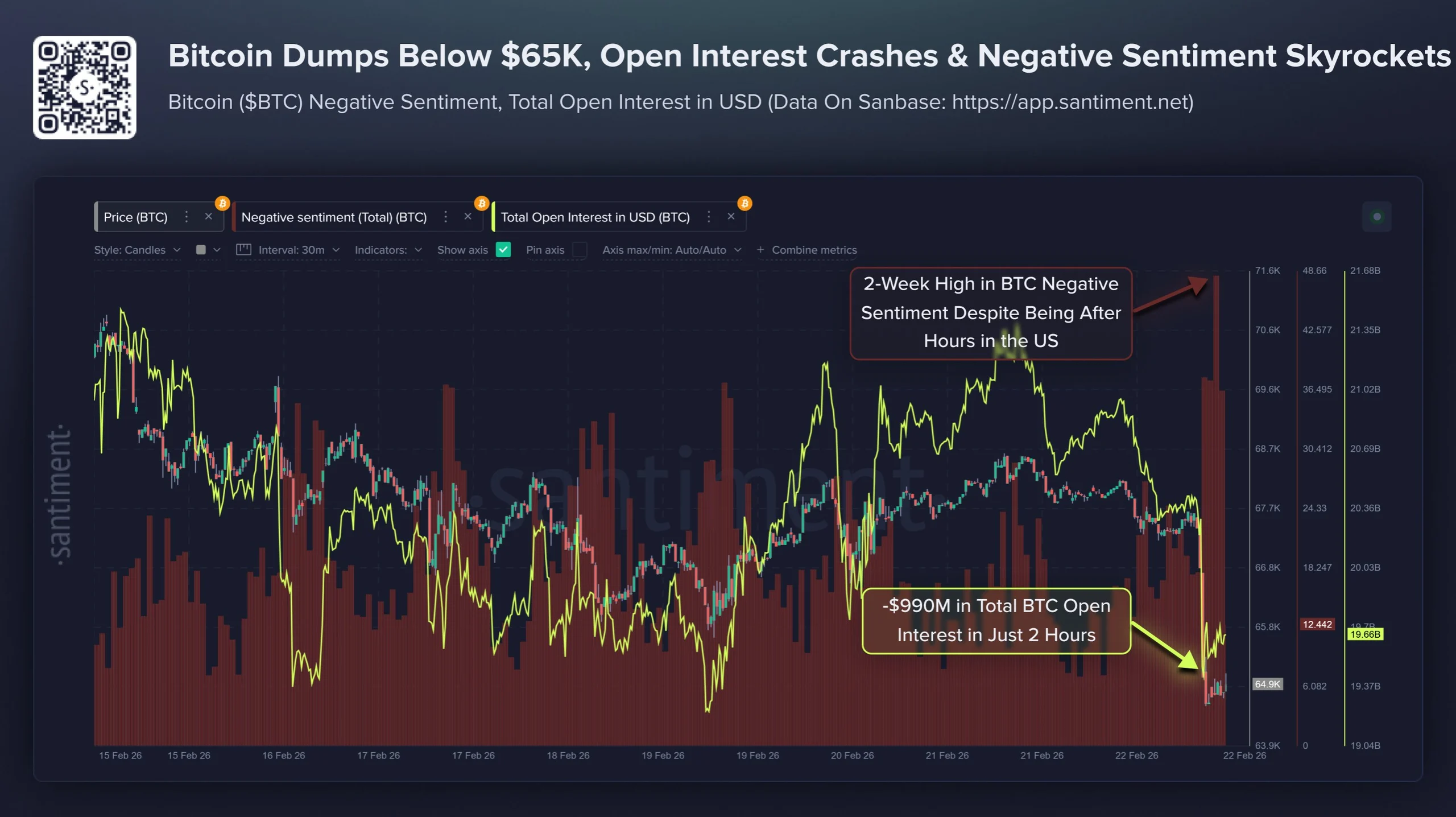
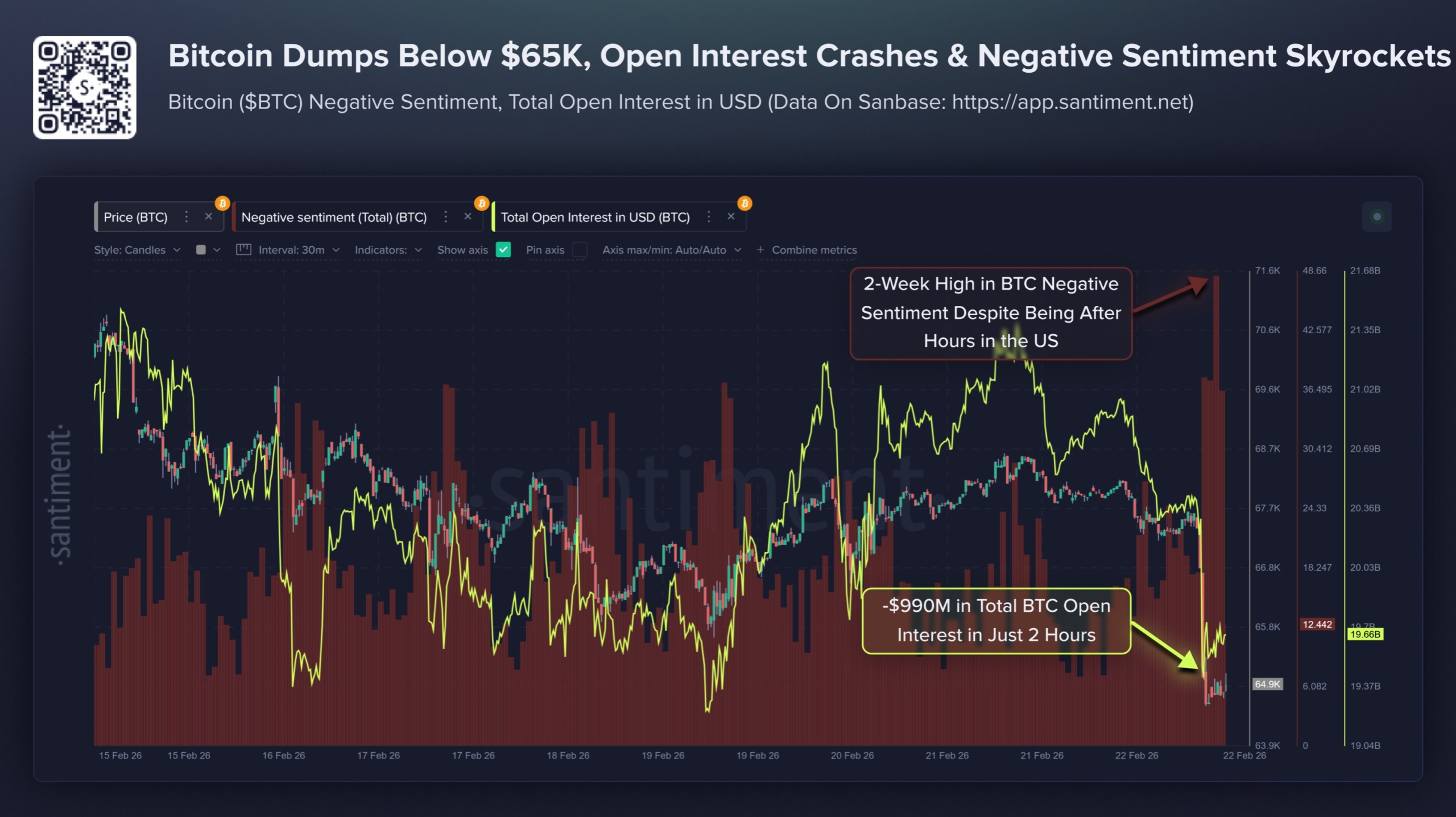
BTC’s price tumbled in hours to a 17-day low as analyst outlined the next key support levels.
It almost felt inevitable after the latest developments on Trump’s tariff front that bitcoin’s price would eventually head south after a relatively calm weekend.
Recall that the US Supreme Court ruled that many of the POTUS’s tariffs imposed in the past year were illegal, determining that he should have been unable to use the IEEPA (a 1977 emergency law) to levy taxes on imports from almost all countries.
Aside from calling the Court’s decision a “disgrace,” President Trump announced a 10% temporary global tariff under Section 122 – a law that was never used before. A day later, he ramped up this taxation to 15%.
As it happened several weeks ago during the most intense verbal battle for Greenland, the impact on bitcoin wasn’t immediate. At the time, the tariff threats between the US and the EU took place mostly during the weekend, and BTC stood still.
However, once the legacy futures markets opened on Sunday afternoon, bitcoin slumped by several grand within an hour or so. This scenario repeated on February 22/23 when the cryptocurrency plunged from $67,800 to a 17-day low of $64,350 (on Bitstamp). It found some support there and now sits close to $66,000.
If there’s another substantial leg down, BTC’s next key support levels could be at $58,500, $54,440, and $41,500, according to Ali Martinez, who cited the BTC holder cost basis.
Bitcoin $BTC holder cost basis highlights three key support levels:
• $58,467
• $54,439
• $41,488 pic.twitter.com/fievX4HpdA— Ali Charts (@alicharts) February 22, 2026
You may also like:
The altcoins followed suit, with many dropping by over 5% within the same timeframe. The total value of liquidated positions has jumped to almost $500 million on CoinGlass. Longs are responsible for rouhgly 90% of that amount.
Santiment also weighed in on BTC’s latest crash, indicating that the open interest has dropped to just $19.5 billion after the latest liquidation cascade, which is “under half of the 2026 peak of $38.3 billion back on January 14.”
The analytics company added that the social media FUD among retail investors has “quickly gone into FUD mode, which can historically help propel a quick rebound.”
Binance Free $600 (CryptoPotato Exclusive): Use this link to register a new account and receive $600 exclusive welcome offer on Binance (full details).
LIMITED OFFER for CryptoPotato readers at Bybit: Use this link to register and open a $500 FREE position on any coin!
Key takeaways
-
Unlike phishing attacks that defraud victims quickly, pig-butchering scams build long-term emotional trust before introducing fraudulent crypto investment opportunities.
-
From casual outreach and relationship building to fake profits, escalating deposits and blocked withdrawals, each step is carefully designed to deepen commitment.
-
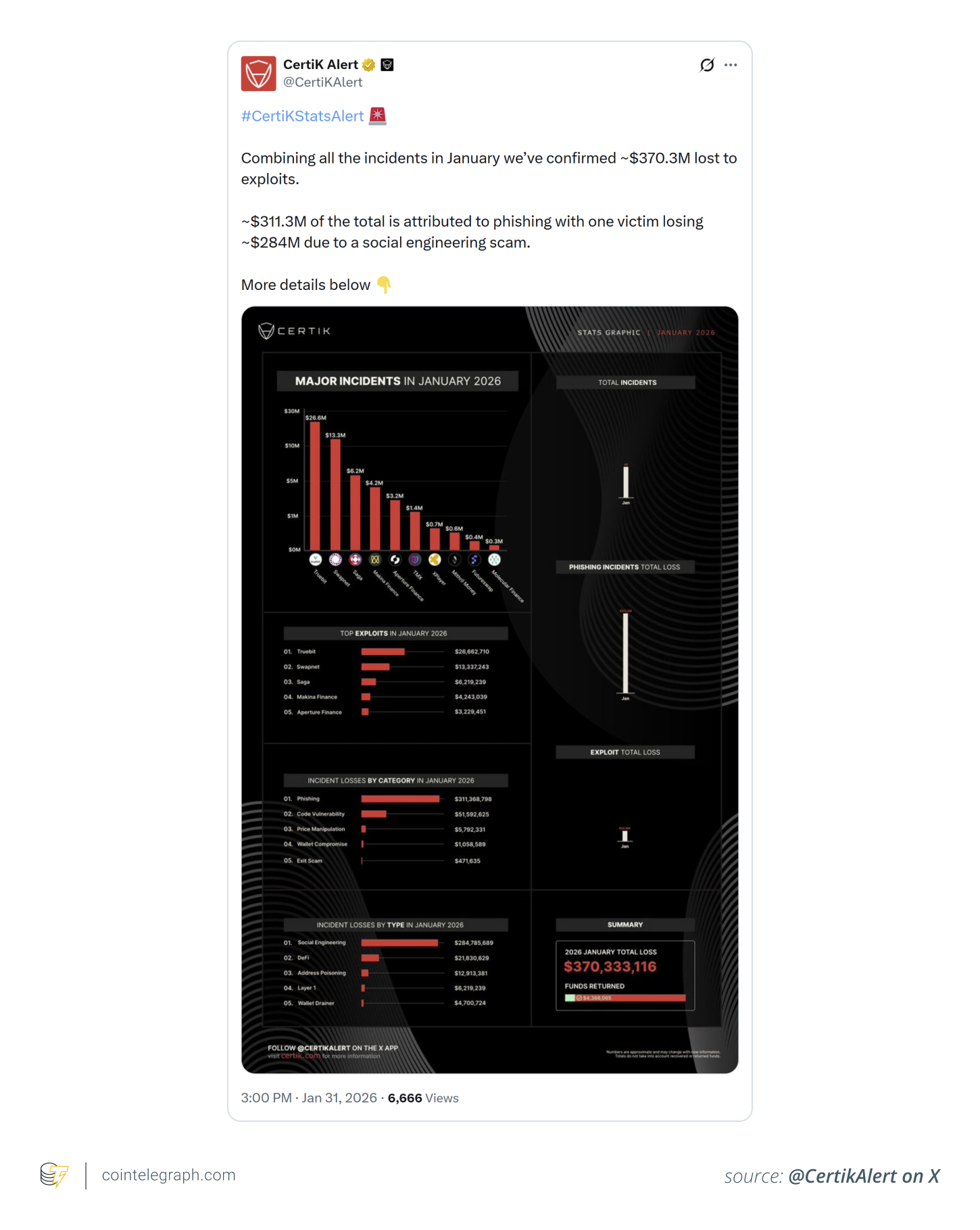
Blockchain security firm CertiK reported $370.3 million in scam-related losses in January 2026 alone, with social engineering tactics accounting for the majority.
-
Authorities are targeting scam networks and laundering operations, yet cross-border jurisdictional issues and encrypted communications complicate crackdowns.
Pig-butchering frauds involve a long-drawn, methodical approach in which scammers instill confidence in their targets and later exploit it for monetary gain. Over the last few years, such schemes have proliferated within the crypto sector, making traders fearful of losing their funds. These frauds have reshaped how regulators and law enforcement view crypto-enabled crime.
This article explores how pig-butchering crypto scams manipulate victims through long-term relationship building and the exploitation of emotional trust using fabricated investment platforms. It explains the psychological tactics scammers use, how funds are extracted over time and why these schemes have become one of the fastest-growing global crypto fraud models.
Defining a pig-butchering scam
Pig-butchering derives from the Chinese expression “Sha Zhu Pan,” which refers to nurturing a target like livestock prior to slaughter. Applied to fraud, it entails scammers forging deep personal connections over extended periods. They then coax victims into sending funds to a deceptive digital currency venture.
While typical phishing tactics rely on urgency and alarm, pig-butchering scams hinge on persuasion and persistence. Scammers assume roles such as a confidant, adviser or financial consultant, methodically building trust before executing the scheme.
Did you know? Some victims interact with scammers for several months before investing, making pig-butchering one of the longest-running and most emotionally manipulative forms of online financial fraud.
Breaking down the scam process
Understanding each stage of a pig-butchering scam reveals how emotional manipulation and financial deception are woven together to trap victims:
-
First outreach: Perpetrators typically initiate contact with victims through dating platforms, professional networks like LinkedIn, social media such as Instagram, messaging services like Telegram or unsolicited SMS messages. The introductory message is designed to lower suspicion and often appears accidental or casual.
-
Fostering connection: Over subsequent days or weeks, the scammer nurtures a bond with the victim by sharing “manufactured” anecdotes, routine details and “professional” achievements. Many scammers impersonate successful digital asset traders and finance experts.
-
Unveiling the opportunity: Eventually, the scammers shift the conversation to investing. They claim to know a high-return crypto trading strategy or to have access to insider knowledge or a private investment platform. They show victims screenshots of fake profits and guide them to professional-looking fraudulent websites.
-
Early modest returns: Scammers encourage individuals to start with minimal investments. The system may display swift “earnings” to build trust. Occasionally, scammers allow small withdrawals to make the platform appear legitimate.
-
Intensification: As the victim’s trust in the scammers increases, they are encouraged to invest larger amounts. Scammers may advise victims to take bank loans, withdraw savings or even borrow from friends.
-
Blocked withdrawals and exit: When victims attempt to retrieve the amount “deposited,” the system blocks access and demands additional “charges.” Thereafter, the scammers vanish.
Did you know? Law enforcement agencies in the US and Europe have begun freezing crypto wallets linked to pig-butchering rings, sometimes recovering partial funds through coordinated blockchain tracing efforts.
Using trust as a psychological weapon
The core feature that sets pig-butchering scams apart is their reliance on psychological and emotional exploitation. Fraudsters target vulnerabilities such as:
-
Feelings of isolation or a strong need for connection and affection
-
Economic difficulties combined with the hope of gaining quick wealth
-
Authority bias, which refers to the tendency to rely on perceived experts
-
Trust in apparent evidence of success.
Perpetrators intentionally spend time in the buildup phase rather than pushing for quick action. An extended period of interaction deepens the victim’s sense of attachment and loyalty. When the moment arrives to send money, many victims genuinely feel they are partnering with a dependable ally or close companion.
The emotional layer complicates the path to recovery, both financially and psychologically.
Did you know? Pig-butchering exploits proceed through complex laundering chains involving multiple wallets, cross-chain bridges and over-the-counter (OTC) brokers before funds are cashed out.
Assessing the magnitude of the problem
Fraud involving cryptocurrency has seen a sharp rise in recent times. According to blockchain security company CertiK, scammers stole $370.3 million in January 2026 alone, the largest single-month total in nearly a year. Of that amount, phishing and social engineering tactics accounted for about $311 million, a category that frequently includes pig-butchering operations.

This uptick followed prominent crypto security breaches in 2025, particularly the Bybit exchange hack in February, which contributed to $1.5 billion in overall losses during that period.
Significant court outcomes further demonstrate the scale of these crimes. In early 2026, Daren Li, a dual citizen of China and St. Kitts and Nevis, received a 20-year federal prison sentence in the US for leading an extensive cryptocurrency fraud network. According to prosecutors, his actions defrauded victims of more than $73 million, with accomplices setting up fake websites and using front companies.

Dimensions of crypto-related frauds
Trading in digital currencies does not always result in fraud. However, crypto trading has its own unique dynamics.
-
Swiftness and finality: Crypto transactions become permanent once confirmed. Unlike card-based payments, no central authority can reverse the transfer of funds.
-
Global reach: Fraudsters often operate in networks that span national borders. Crypto enables seamless cross-border transfers independent of conventional finance.
-
Convincing interfaces: Scam websites have grown more sophisticated. Like legitimate platforms, they may feature dynamic pricing, user dashboards and support functions.
-
Obfuscation using stablecoins and decentralized finance: To obscure the trail of funds involved in these scams, assets are often swapped into stablecoins or routed through decentralized systems.
While blockchain transparency assists investigators, stolen assets may pass through a chain of addresses before an investigation begins.
Countermeasures to curb pig-butchering scams
Security agencies have taken steps to deter pig-butchering scams, which can be devastating for victims. Entities such as the US Secret Service and Homeland Security are strengthening joint efforts through anti-crime units focused on financial offenses.
Recent cases demonstrate that investigative agencies are pursuing not only individual scammers but also laundering networks and shell companies that facilitate the movement of funds. However, enforcement faces several challenges:
-
Jurisdictional complexity
-
Use of encrypted communications
-
Scam compounds operating in loosely regulated regions
-
Reports of forced labor in some Southeast Asian scam centers.
The global nature of these operations requires a coordinated international response.
Red flags to watch for
Awareness remains the first line of defense against fraudulent activities. Common warning signs include:
-
Unsolicited investment advice from online acquaintances
-
Pressure to move conversations off mainstream apps
-
Assurances of consistent high returns with low risk
-
Requests to deposit crypto on unfamiliar platforms
-
Demands for “tax” or “unlock” fees before withdrawals.
Before investing in any platform, verify through independent sources that it is credible.
Cointelegraph maintains full editorial independence. The selection, commissioning and publication of Features and Magazine content are not influenced by advertisers, partners or commercial relationships.
Global crypto exchange Binance has issued a detailed defense of its compliance program, saying recent media reports mischaracterize its regulatory controls and oversight efforts.
Summary
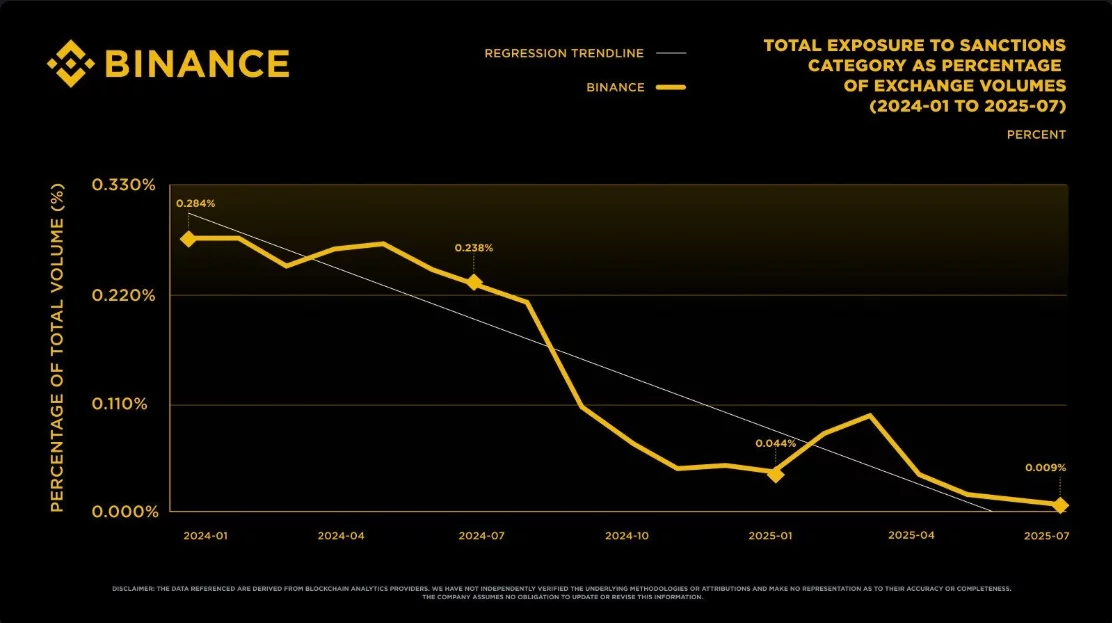
- Binance says sanctions-related exposure dropped 96.8% between January 2024 and July 2025, falling to 0.009% of total trading volume.
- The exchange highlighted major compliance investments, with over 1,500 employees — roughly a quarter of its workforce — focused on compliance, sanctions screening and investigations.
- Binance pushed back against recent media coverage, arguing reports mischaracterized its controls and overlooked cooperation with global law enforcement.
Binance pushes back on sanctions claims
In a blog post, the world’s largest crypto trading platform outlined the depth of its compliance infrastructure and pointed to measurable progress in reducing exposure to illicit activity.
Binance said its compliance framework has strengthened significantly over the past two years, including major investments in screening, monitoring and governance. The company reports a 96.8% reduction in sanctions-related exposure between January 2024 and July 2025, shrinking from 0.284% of total exchange volume to just 0.009%.
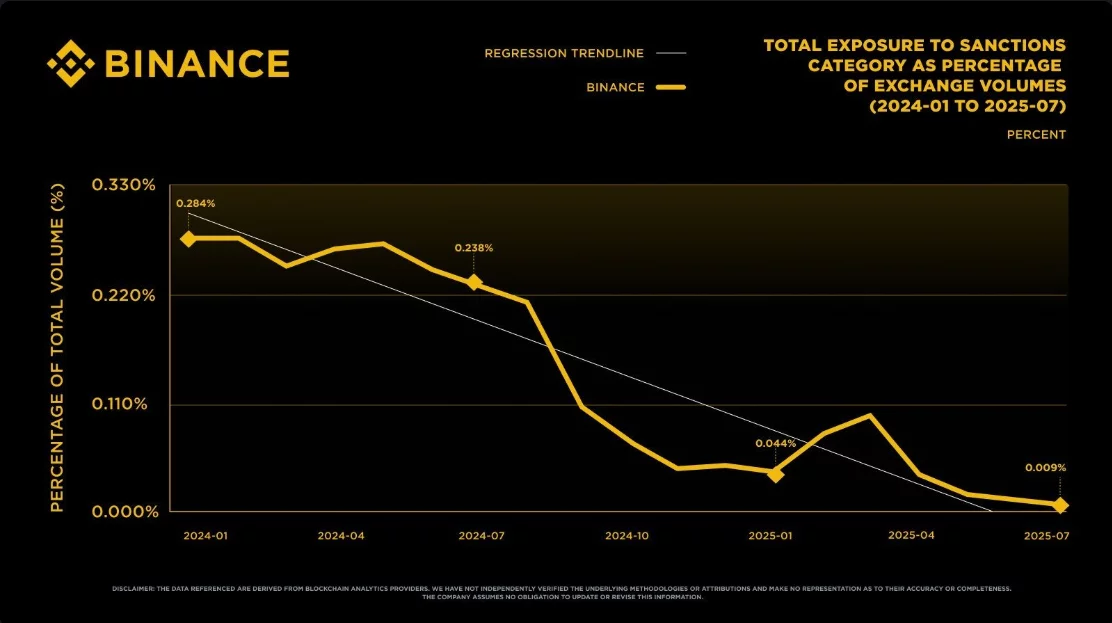
Binance also said it has cut direct exposure to key sanctioned markets by more than 97% in the same period.
According to the blog, these gains reflect structural reforms including expanded transaction surveillance, investments in compliance technology and the growth of a large dedicated team.
Binance now says more than 1,500 employees, about 25% of its global workforce, are devoted to compliance and related functions, including sanctions, counter-terrorism financing and criminal investigations.
Binance also emphasized cooperation with law enforcement, reporting that its teams supported authorities in processing more than 71,000 law-enforcement requests worldwide in 2025 and assisted in confiscating over $131 million linked to illicit activity.
The exchange highlighted that rigorous internal procedures are in place to investigate and mitigate risk when credible threat information arises.
The blog directly addressed recent press coverage it described as incomplete or inaccurate, saying some reports rely on faulty claims and a misunderstanding of how modern compliance works in crypto markets. Binance said that in every case cited, it followed industry-leading procedures and coordinated with regulators and law enforcement.
Binance’s post comes amid ongoing regulatory scrutiny across multiple jurisdictions, including recent actions in Australia and continued compliance requirements in key markets like India.
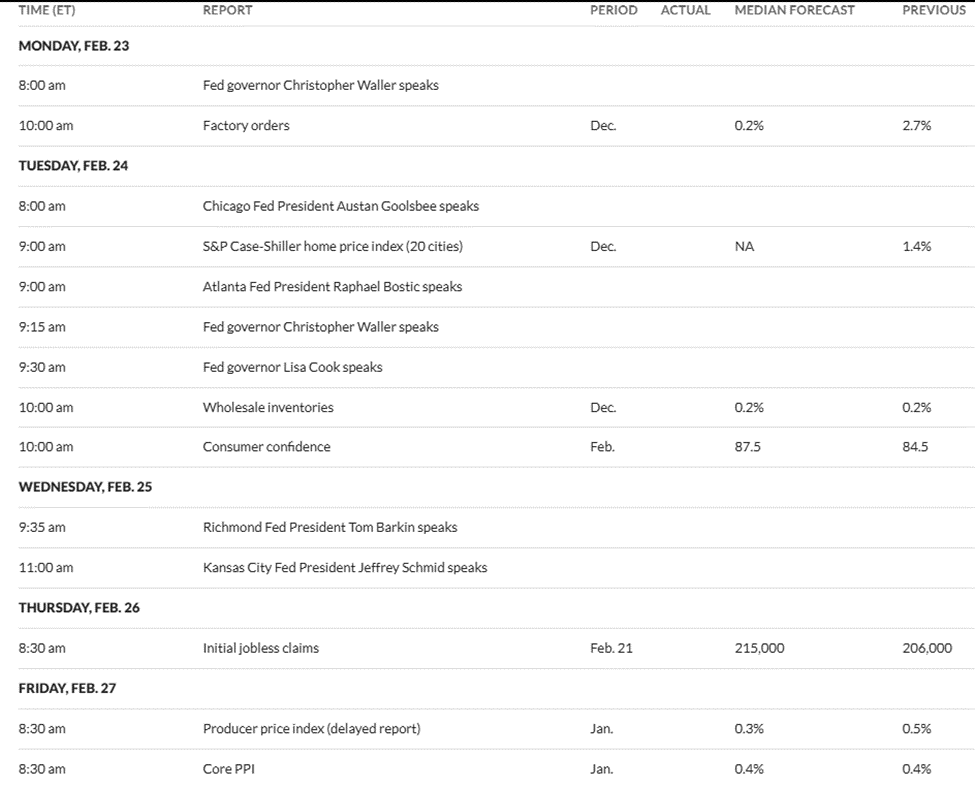
Bitcoin enters the final week of February on fragile footing, with macro forces (US economic events) once again dictating short-term direction.
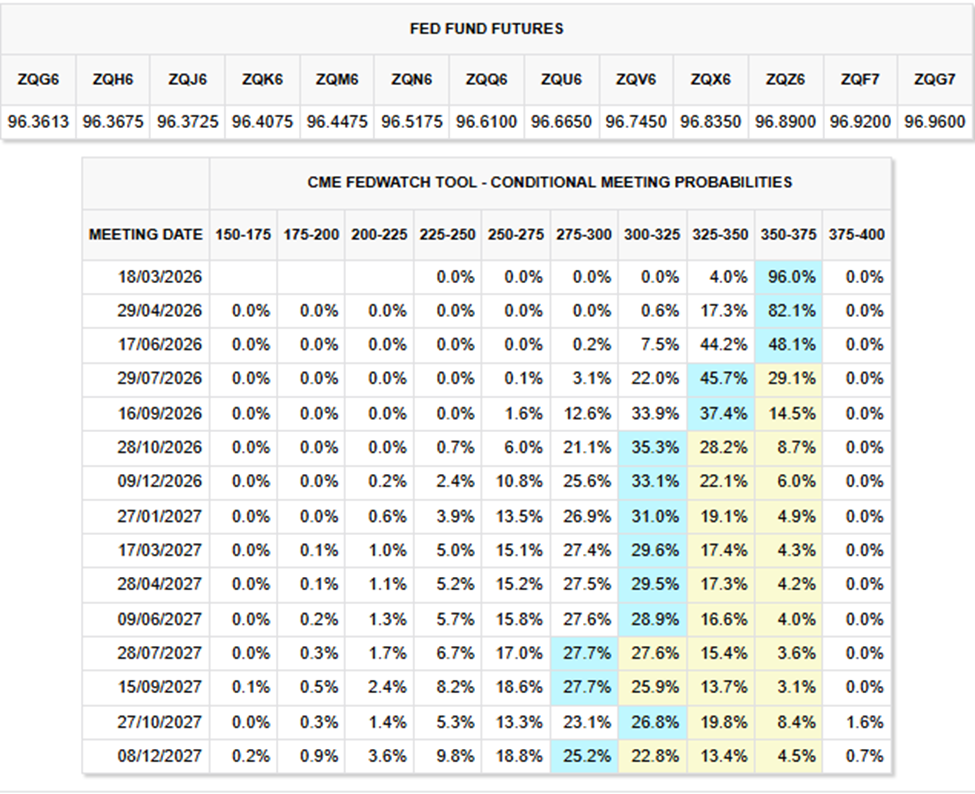
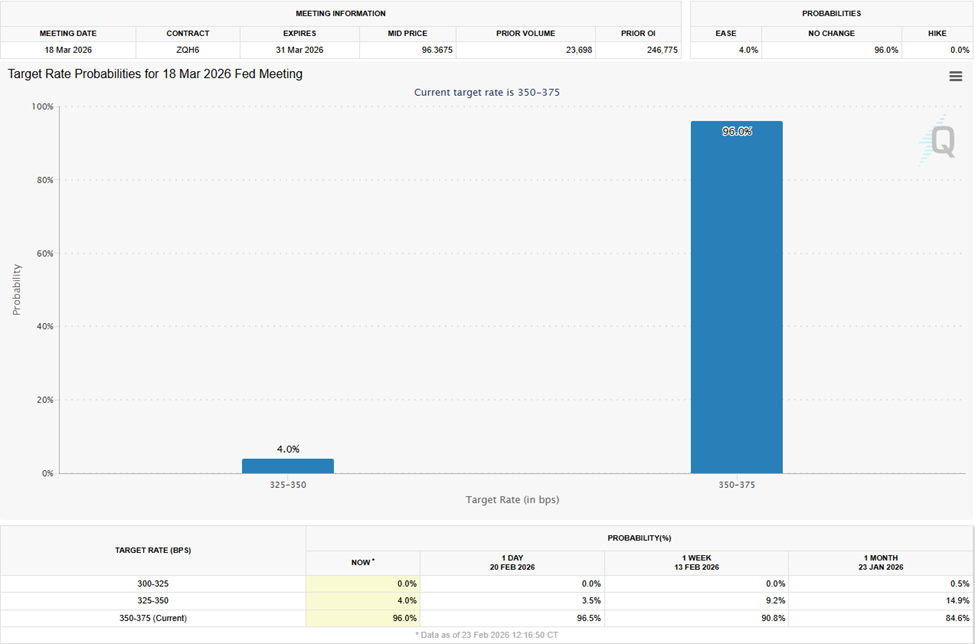
After last week’s mixed signals, including moderating PCE inflation, resilient jobless claims at 206,000, and cautious FOMC minutes, markets remain undecided on the pace of rate cuts ahead of the March 17–18 Federal Reserve meeting.
4 US Economic Events That Traders Are Watching Closely
With rate expectations finely balanced, this week’s economic calendar could inject fresh volatility into crypto markets.
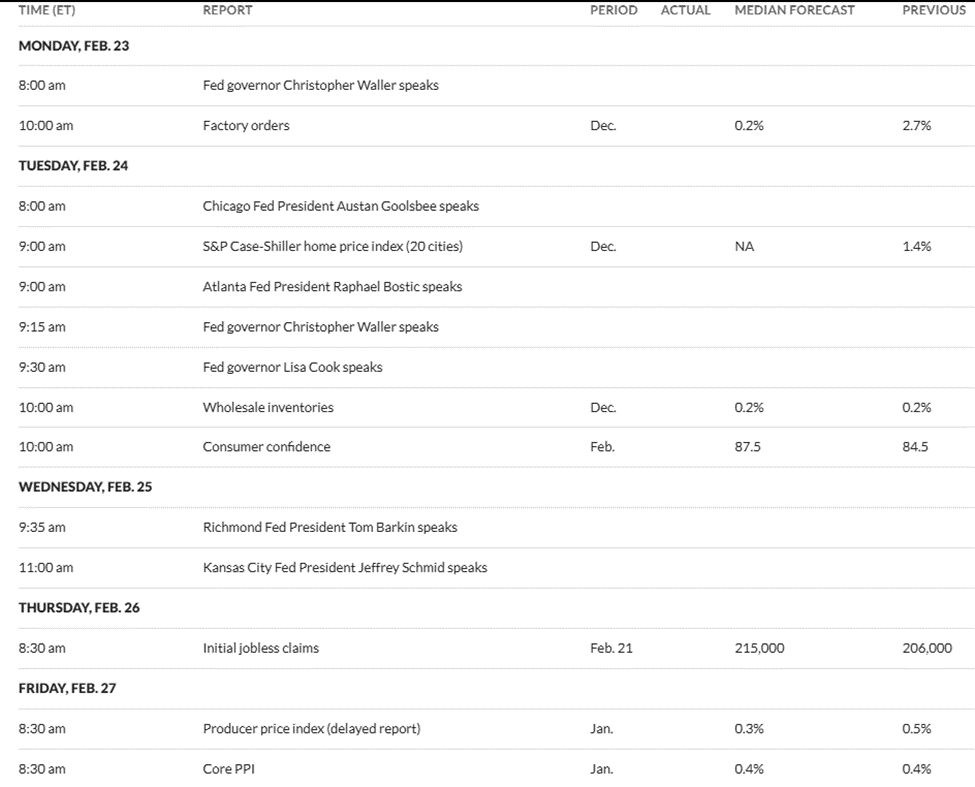
Fed Officials Take the Stage
A crowded slate of Federal Reserve speeches runs from Monday through Wednesday, featuring Governors Christopher Waller and Lisa Cook, Chicago Fed President Austan Goolsbee, Atlanta Fed President Raphael Bostic, and others.
With markets currently pricing in two to three cuts in 2026, any deviation in tone could quickly shift rate expectations.
Historically, Waller and Bostic have leaned hawkish, emphasizing vigilance against inflation and data dependence.
If they reiterate concerns about “last-mile” disinflation or signal patience on cuts, Treasury yields could rise alongside the US dollar. Such an outcome could pressure Bitcoin and potentially push it lower.
Conversely, dovish commentary highlighting slowing growth or labor softening could weaken the dollar and spark a relief rally in risk assets.
Clustered appearances also increase the risk of intraday swings, particularly if messaging lacks cohesion. For Bitcoin traders, tone, not policy action, may be the key volatility trigger this week.
Consumer Confidence
The Conference Board’s February Consumer Confidence Index follows January’s weak 84.5 reading, well below expectations and historically consistent with recessionary signals.
February is projected to improve modestly to 87.5, though sentiment remains subdued amid elevated living costs and persistent inflation.
Last week’s PCE data showed inflation at 2.7% year-over-year, with core at 3.0%, reflecting lingering price pressures.
A stronger-than-expected confidence print, particularly above 90, would reinforce a resilient consumer narrative and strengthen the “no-landing” thesis.
That could reduce near-term rate cut expectations, lift the dollar, and weigh modestly on Bitcoin.
On the other hand, a downside surprise below 85 would highlight economic fragility. That outcome would likely boost rate-cut odds, which are currently elevated for March, and provide tailwinds for BTC.
Historically, confidence surprises have triggered 1–2% moves in Bitcoin, particularly when aligned with broader macro trends.
Initial Jobless Claims
Meanwhile, initial jobless claims remain one of the timeliest indicators of the labor market. Last week’s drop to 206,000 surprised to the downside, reinforcing a tight employment backdrop that has kept the Fed cautious about easing prematurely. Consensus now expects 215,000.
If claims fall below 210,000, it would signal ongoing labor strength and potentially embolden hawkish Fed voices.
That scenario could lift yields and modestly pressure Bitcoin. Strong employment data tends to delay rate cut expectations, reducing liquidity support for risk assets.
Conversely, a spike above 225,000 would raise concerns about labor cooling, particularly if paired with softer business surveys.
Such a development could fuel recession fears and increase the probability of rate cuts—supportive for Bitcoin as traders anticipate easier financial conditions.
Though weekly claims typically generate 0.5–1.5% BTC volatility, the reaction could be amplified if the data contrasts sharply with earlier Fed commentary.
PPI (Producer Price Index)
January’s PPI (Producer Price Index) will close out the week, with headline and core readings expected around 3.0% year-over-year.
Following last week’s PCE release, PPI offers upstream insight into inflationary pressures before they reach consumers.
A hotter-than-expected core reading above 3.2% would likely reignite inflation concerns and diminish rate cut bets. That scenario could mirror post-PCE weakness seen recently, pressuring Bitcoin by strengthening the dollar and lifting real yields.
However, a cooler print below 2.8% would reinforce disinflation momentum. Markets would likely price in more aggressive easing, weakening the USD, and potentially pushing Bitcoin toward $70,000.
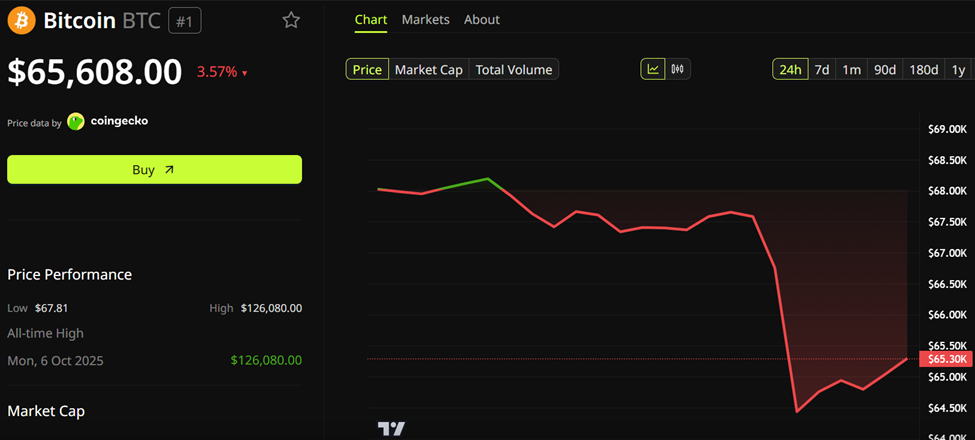
As a month-end release, PPI often solidifies weekly trends. Combined with jobless claims, it could produce 2–3% Bitcoin swings if expectations are materially challenged.
With Bitcoin’s correlation to the Nasdaq and the US dollar near multi-month highs, macro remains the dominant narrative.
If this week’s data skews dovish, BTC could rally 3–5%. A unified hawkish tone, however, may trigger a pullback of similar magnitude. Liquidity expectations, not crypto fundamentals, remain in control.
Crypto World
Toobit Announces AUSTRAC Registration, Bolstering Security and Service for Australian Crypto Traders


Toobit is a very well-known and award-winning cryptocurrency exchange, which has recently announced its successful registration with the Australian Transaction Reports and Analysis Centre, a.k.a AUSTRAC, as a Digital Currency Exchange. This is in full compliance with the country’s Anti-Money Laundering and Counter-Terrorism Financing Act of 2006.

What This Means for Australian Traders
The news is important for the growing community of the exchange in Australia. It confirms that Toobit delivers additional immediate practical benefits as well as enhanced reliability of its services, which include but are not limited to:
- Reliable banking connectivity and on-ramps for AUD: As an AUSTRAC-registered exchange, Toobit provides a well-recognized on-ramp for local financial institutions, reducing the likelihood of bank-side transaction delays or blocks on transfers involving AUD.
- Better fraud prevention: To meet the strict requirements of the AML/CFTC Act, Toobit maintains very high-standard KYC and transaction monitoring protocols.
- Travel Rule compliance: Toobit’s registered status also allows traders to move assets between different wallets and other global exchanges without having to worry about compliance freezes which are oftentimes associated with unregistered entities.
Speaking on the matter was Mike Williams, Chief Communication Officer at Toobit, who said:
“Securing our AUSTRAC registration is a pivotal step in our mission to provide a transparent and professional trading environment for Australians. […] Meeting these rigorous standards allows us to build a foundation of trust so our traders can navigate global markets with uncompromising security and greater transparency.”
Building on Existing Best Practices
This latest registration with the AUSTRAC is simply building upon Toobit’s successful Polish VASP license acquisition, which was obtained in anticipation of the EU’s Market in Crypto-Assets (MiCA) framework. The cryptocurrency exchange ensures a regulated experience, which is defined by comprehensive security protocols and a complete alignment with the nation’s evolving regulatory landscape by applying these very high-level European standards to its operations in Australia.
The digital asset sector in the country enters 2026 with unprecedented momentum. Industry forecasts project the local market revenue to reach AUD 1.2 billion this year, driven by a nearly 20% annual growth rate.
With global crypto adoption now exceeding 21% of internet-connected adults, 2026 marks a shift toward regulated entities. Australian traders are increasingly prioritizing registered providers that offer verified fraud protection and adhere to the latest national Travel Rule standards.
For more information about Toobit, visit: Website | X | Telegram | LinkedIn | Discord | Instagram
Disclaimer: The above article is sponsored content; it’s written by a third party. CryptoPotato doesn’t endorse or assume responsibility for the content, advertising, products, quality, accuracy, or other materials on this page. Nothing in it should be construed as financial advice. Readers are strongly advised to verify the information independently and carefully before engaging with any company or project mentioned and to do their own research. Investing in cryptocurrencies carries a risk of capital loss, and readers are also advised to consult a professional before making any decisions that may or may not be based on the above-sponsored content.
Readers are also advised to read CryptoPotato’s full disclaimer.
Binance Free $600 (CryptoPotato Exclusive): Use this link to register a new account and receive $600 exclusive welcome offer on Binance (full details).
LIMITED OFFER for CryptoPotato readers at Bybit: Use this link to register and open a $500 FREE position on any coin!

DUEL DUCK: A Battle-Tested Social Prediction Market Where Influence Becomes Income
In a world where attention is currency and opinion moves markets, Duel Duck is building the infrastructure to monetize social signals at scale.
With 44,000+ monthly active users, 200+ active KOLs onboarded, a live product, and $1.4M already raised, Duel Duck isn’t pitching a concept — it’s scaling a working machine.
The Big Idea: Turning Influence into Markets
After the collapse of speculative InfoFi hype cycles, one truth remained:
People trust people more than platforms.
But social signal has been fragmented, under-monetized, and structurally wasted.
Duel Duck changes that.
It transforms creator-driven opinions into prediction markets — where communities don’t just react to influence, they stake on it.
What Duel Duck Actually Is
A social prediction engine built around:
-
Yes/No markets
-
Creator-set fees
-
Neutral house edge
-
Create-to-earn mechanics
-
No complex odds UI
Simple. Viral. Shareable.
Creators launch duels.
Communities participate.
Volume flows.
Fees generate revenue.
And it works.
Product Overview
1. DUELS
Fast, simple, creator-launched prediction markets.
Example Duel Card:
Will Portugal win the 2026 FIFA World Cup?
-
120 days left
-
Chance: 67%
-
Ticket price: $5
-
4,310 participants
-
$31K pool
-
Options: YES / NO
No complicated betting interface.
Just signal + stake.
2. TOURNAMENTS
Structured, brand-relevant duel sets with:
This is where prediction becomes distribution
3. API Layer
Most platforms want prediction features.
Few can afford:
Duel Duck offers a plug-and-play prediction module.
Wallets. Exchanges. Media platforms. Leagues. Communities.
Prediction becomes an engagement plug-in — not a dev nightmare.
The Market Opportunity
The numbers are aggressive — and real.
-
$63.5B Web3 prediction & opinion market volume in 2025 (+302.7% YoY)
-
$6B Social distribution opinion markets
-
$220–360M Social-led opinion tournaments
InfoFi is evolving from social hype to monetized attention, information, and reputation.
Prediction is no longer niche gambling.
It’s becoming embedded media.
Duel Duck positions itself directly inside that shift.
Competitor Landscape
Gamified Engagement Platforms
Opinion Markets
Social Activation
Duel Duck sits between these verticals — blending gamification, prediction, and creator-driven distribution into a single engine.
That positioning matters.
Traction & Proof of Demand
This isn’t theoretical growth. It’s operational traction.
Growth Roadmap
Phase 1 – Repeatable Growth
Phase 2 – Distribution at Scale
-
200K MAU
-
20+ API integrations
-
4 revenue streams
-
5,000+ KOLs
-
B2B expansion into wallets, exchanges, media
-
Paid behavioral data layer
The thesis is simple:
Prediction markets are embedded everywhere attention exists.
Business Model
Current & Upcoming Revenue Streams:
-
Duel commission (active)
-
Auto swap on wallet (active)
-
Onramp commission – March 2026
-
Prediction API revenue – April 2026
-
User subscriptions – September 2026
Realistic Unit Economics
Business Model
Current & Upcoming Revenue Streams:
-
Duel commission (active)
-
Auto swap on wallet (active)
-
Onramp commission – March 2026
-
Prediction API revenue – April 2026
-
User subscriptions – September 2026
Realistic Unit Economics
Assumptions:
At 100,000 active users:
Low friction. High scalability. Strong retention mechanics.
Regulatory Positioning
Duel Duck operates under an Anjouan I-Gaming License, positioning it strategically within global gaming frameworks while maintaining Web3 flexibility.
Investment Timeline
-
$280K – Pre-Seed (Oct 2024)
-
$1.1M – Seed Round (Sept 2025)
-
$4M – Token Invest Round (Q1–Q2 2026)
-
$50M – Strategic Round (2028)
Current Token Invest Round Target: $4,000,000 (SAFT Instrument)
Tokenomics Overview
13% allocated in this round.
Key allocations include:
Structured vesting, cliffs, and long-term emissions support stability rather than short-term speculation.
Translation: designed for sustainability, not chaos.
Why Duel Duck Matters
Prediction markets are evolving.
They’re moving:
-
From niche betting → social participation
-
From isolated apps → embedded infrastructure
-
From odds complexity → creator simplicity
Duel Duck sits at the intersection of:
Influence × Distribution × Monetization × Data
And when social signal becomes stake-backed, it stops being noise.
It becomes market truth.
Final Thought
Every creator already runs informal prediction markets in their comment sections.
Duel Duck just turns those into revenue engines.
In a world where attention is weaponized and data is monetized, the real opportunity isn’t just predicting the future.
It’s owning the signal that shapes it.
DUEL DUCK SOCIALS
REQUEST AN ARTICLE

Vitalik Buterin, a co-founder of Ethereum, argues that artificial intelligence could reshape decentralized governance by addressing a core constraint: human attention. In a Sunday post on X, he warned that despite the promise of democratic models like DAOs, decision-making is hindered when members must tackle a flood of issues with limited time and expertise. Participatory rates in DAOs are often cited as low — typically between 15% and 25% — a dynamic that can concentrate influence and invite disruptive maneuvers when attackers seek to pass proposals without broad scrutiny. The broader crypto ecosystem is watching how AI tools could alter governance, privacy, and participation.
Key takeaways
- Attention limits are identified as a primary bottleneck in democratic on-chain governance, potentially hindering timely decisions in DAOs.
- Delegation, while common, risks disempowering voters and centralizing control in a small group of delegates.
- DAO participation averages around 15–25%, creating opportunities for governance attacks and misaligned proposals.
- AI-powered assistants, including large language models, could surface relevant information and automatically vote on behalf of members, provided privacy and transparency safeguards are in place.
- Privacy remains a critical design concern; proposals for private LLMs or “black box” personal agents aim to protect sensitive data while enabling informed judgments.
- Parallel efforts, such as AI delegates from the Near Foundation, illustrate practical explorations into scalable, participatory governance models.
Market context: The governance conversation unfolds amid broader discussions about AI safety, on-chain transparency, and regulatory scrutiny of token-weighted voting mechanisms. As networks scale, trials with AI-assisted decision-making could influence how quickly new proposals are vetted and executed, impacting liquidity, risk sentiment, and user participation across the crypto ecosystem.
Why it matters
The notion of AI-assisted governance enters crypto governance at a pivotal moment. If DAOs are to meaningfully scale beyond niche communities, they must solve the “attention problem” that limits who can participate and how often. Buterin’s argument centers on the danger that without broad and informed participation, governance can drift toward the preferences of a vocal minority or, worse, become vulnerable to coordinated attacks. The cited participation range, often quoted as 15–25%, underscores the fragility of consensus in diverse, globally distributed communities. When only a fraction of members engage, a coordinated actor with concentrated token holdings can steer outcomes that don’t reflect the broader base.
AI-powered assistants offer a potential path forward by translating dense policy options into actionable votes, tailored to an individual’s stated preferences. The idea rests on personal agents capable of observing user input — writing, conversations, and explicit statements — to infer voting behavior. If a user is uncertain about a specific issue, the agent would solicit input and present relevant context to inform the decision. This approach could dramatically increase effective participation without requiring each member to study every proposal in depth. The concept is anchored in current research into large language models (LLMs), which can aggregate data from diverse sources and present concise options for voter consideration.
Still, the privacy dimension looms large. Buterin has stressed that any system enabling more granular inputs must protect sensitive information. Some governance challenges arise precisely because negotiations, internal disputes, or funding deliberations often involve material that participants would prefer not to expose publicly. Proposals for privacy-preserving architectures include private LLMs that process data locally or cryptographic methods that output only the voting judgment, without revealing the underlying private inputs. The aim is to strike a balance between empowering voters and safeguarding their personal information.
Industry voices beyond Buterin echo this tension. Lane Rettig, a researcher at the Near Foundation, has highlighted parallel efforts to use AI-driven digital twins that vote on behalf of DAO members to counter low voter turnout. The Near Foundation’s exploration, described in coverage linked to AI delegation, signals a broader push to test AI-enabled delegation tools within a governance framework that remains accountable to the community. For those following the space, leadership in this domain is moving from conceptual discussions to concrete prototypes that can be observed and tested on real networks.
Another facet concerns strategic risk. The potential for “governance attacks” remains a real concern in token-weighted systems, where a malicious actor could amass enough influence to push harmful proposals. Researchers and builders are keen to ensure that any AI-assisted approach includes checks and balances, such as transparent audit trails, user override capabilities, and governance-rate limits to prevent rapid, unilateral shifts in policy. The literature and case studies cited in industry coverage emphasize that while technology can augment participation, it must not bypass the need for broad human oversight and robust protection against privacy invasions or manipulation. For context, earlier discussions in the crypto press have explored simulated transactions and other security models as ways to harden governance against abuse.
As the field evolves, partnerships and experiments in AI-assisted voting will continue to surface. The idea of “AI delegates” mirrors broader conversations about accountability and consent in automated decision-making. A number of projects have spotlighted the potential for AI to digest vast policy options, present them succinctly, and enable members to approve or customize how their tokens are used. The emerging consensus suggests that any path forward will require a layered approach: accessible information for all participants, privacy-preserving mechanisms for sensitive data, and safeguards against both technical and social vulnerabilities.
Readers can trace the thread of these ideas through related discussions on how governance models adapt to AI. For example, articles exploring the role of LLMs in decentralized decision-making and the implications for privacy and security provide a framework for evaluating new proposals as they emerge. The debate also intersects with broader AI governance conversations, including how to ensure that automated agents align with user intent without overstepping privacy boundaries or enabling unauthorized manipulation. The evolving dialogue recognizes that while AI can amplify participation, it should do so without eroding trust or undermining the democratic ethos at the heart of decentralized networks.
What to watch next
- Public pilots of AI-assisted voting or AI delegates in active DAOs, with timelines and governance metrics published in the coming quarters.
- Regulatory developments or guidelines affecting on-chain governance, including transparency and privacy standards for AI-assisted decision tools.
- Progress reports from the Near Foundation on AI delegates and related governance experiments, including measurable effects on participation rates.
- Technical demonstrations of privacy-preserving voting mechanisms, such as private LLMs or cryptographic approaches that protect input data while exposing voting outcomes.
- Ongoing analyses of governance security, including modifications to prevent governance attacks and ensure resilience against token-weighted manipulation.
Sources & verification
AI governance and the next frontier for on-chain democracy
In the Ethereum (CRYPTO: ETH) ecosystem, researchers and builders are weighing how artificial intelligence could address the attention problem that Buterin highlighted. In a recent meditation on governance, he argued that the effectiveness of democratic and decentralized models hinges on broad participation and timely, expert input. Current participation rates for many DAOs hover around 15–25%, a level that can concentrate power among a small circle of delegates or core members. When the electorate stays largely silent, proposals with strategic misalignment can slip through, or worse, governance attacks can overwhelm a network by capitalizing on token-weighted voting power.
To counter these dynamics, the idea of AI-powered assistants that vote on behalf of members has gained traction. He suggested that large language models could surface relevant data and distill policy options for each decision, allowing users to consent to votes or to delegate tasks to an agent that reflects their preferences. The concept hinges on personal agents that observe your writing and conversation history to infer your voting posture, then submit a stream of votes accordingly. If the agent is uncertain, the agent should prompt you directly and present all relevant context to inform your decision. The vision is not to replace human judgment but to augment it with scalable, personalized insights.
The debate closely mirrors ongoing experiments beyond Ethereum. Lane Rettig of the Near Foundation has described AI-powered digital twins that vote on behalf of DAO members as a response to low turnout, a concept the foundation has explored in public discourse and research coverage. Such prototypes aim to maintain governance legitimacy while lowering the friction barrier for participation. The discourse reflects a broader industry consensus that AI-driven governance must be transparent, auditable, and privacy-preserving to gain wide trust across diverse communities.
Privacy considerations are not merely a secondary concern; they are central to any viable governance augmentation. Buterin has stressed the possibility of a privacy-forward architecture where a user’s private data could be processed by a personal LLM without exposing inputs to others. In this scenario, the agent would output only the final judgment, keeping private documents, conversations, and deliberations confidential. The challenge is to design systems that scale participation without compromising sensitive information or opening new vectors for surveillance or exploitation. The balance between openness and privacy will likely shape the tempo and nature of AI-assisted governance experiments across networks and ecosystems.
As the field evolves, several threads warrant close attention. First, concrete pilot programs will reveal whether AI delegates can meaningfully improve turnout and decision quality without eroding accountability. Second, governance models will need robust safety rails to prevent automated voting from overriding collective will through manipulation or covert data leaks. Third, privacy-preserving technologies will be essential to sustain user trust, especially in negotiations or funding decisions that could affect project trajectories. Finally, the ecosystem will watch the practical implications for security and resilience, including the potential for new forms of governance attacks and protective measures against them.

Ethereum Price May Slip Below $1.5K as Buterin Keeps Selling ETH

2026 WNBA Draft: How South Carolina’s Raven Johnson proved she’s a first-round pick while scoring six points

Government Docs Reveal New Details About Tesla and Waymo Robotaxis’ Human Babysitters


-

 Video7 days ago
Bitcoin: We’re Entering The Most Dangerous Phase
-

 Crypto World6 days ago
Can XRP Price Successfully Register a 33% Breakout Past $2?
-

 Video3 days ago
XRP News: XRP Just Entered a New Phase (Almost Nobody Noticed)
-

 Fashion3 days ago
Weekend Open Thread: Boden – Corporette.com
-

 Sports6 days ago
GB's semi-final hopes hang by thread after loss to Switzerland
-

 Politics1 day ago
Baftas 2026: Awards Nominations, Presenters And Performers
-
 Tech6 days ago
The Music Industry Enters Its Less-Is-More Era
-

 Business5 days ago
Infosys Limited (INFY) Discusses Tech Transitions and the Unique Aspects of the AI Era Transcript
-

 Entertainment5 days ago
Kunal Nayyar’s Secret Acts Of Kindness Sparks Online Discussion
-

 Video6 days ago
Financial Statement Analysis | Complete Chapter Revision in 10 Minutes | Class 12 Board exam 2026
-

 Tech5 days ago
Retro Rover: LT6502 Laptop Packs 8-Bit Power On The Go
-
 Sports4 days ago
Clearing the boundary, crossing into history: J&K end 67-year wait, enter maiden Ranji Trophy final | Cricket News
-

 Business19 hours ago
Mattel’s American Girl brand turns 40, dolls enter a new era
-

 Business15 hours ago
Law enforcement kills armed man seeking to enter Trump’s Mar-a-Lago resort, officials say
-

 Entertainment4 days ago
Dolores Catania Blasts Rob Rausch For Turning On ‘Housewives’ On ‘Traitors’
-

 Business5 days ago
Tesla avoids California suspension after ending ‘autopilot’ marketing
-

 Tech14 hours ago
Anthropic-Backed Group Enters NY-12 AI PAC Fight
-

 Politics6 days ago
Eurovision Announces UK Act For 2026 Song Contest
-

 NewsBeat13 hours ago
Armed man killed after entering secure perimeter of Mar-a-Lago, Secret Service says
-

 Crypto World5 days ago
WLFI Crypto Surges Toward $0.12 as Whale Buys $2.75M Before Trump-Linked Forum