

Politics
Alexander Bowen: The minimum wage would make more sense if it wasn’t the same across the country


Alexander Bowen is a trainee economist based in Belgium, specialising in public policy assessment, and a policy fellow at a British think tank.
A national minimum wage is killing the North.
It might sound slightly hyperbolic but it’s true enough.
What this article is not, is an argument against the concept of a minimum wage generally or in the UK’s specific case. Articles about Sweden and Denmark not having a minimum wage, something that alongside being functionally wrong, have been done to death. So too has the trite journalistic insistence that disemployment is basic supply and demand – we have more than enough evidence that this isn’t the case, though it may be approaching the hinge point where it may be.
On Friday, the FT’s John Burn-Murdoch dropped a data deep dive on the death of the UK’s graduate premium – that with the graduate share of the workforce going from 20 to 40 per cent the graduate premium has been almost arithmetically slashed from 80 to 40 per cent. Importantly something that has not happened anywhere else – the Netherlands or the US, with HE expansions larger than our own, have seen their graduate premia rise 30 and 15 percentage points respectively – something Murdoch in part attributes to the minimum wage.
It’s something that the regional data clearly bares out too. In Northern Ireland the minimum wage is now 77 per cent of the median wage, in Wales 76 per cent, and in Yorkshire 75 per cent. In London, the only region where the graduate premium has not collapsed, it sits at just 52 per cent.
The national minimum wage has genuinely collapsed the premium for graduates in all but one place – and what actually is basic supply and demand is that if there is only one place where your labour is valued, then you will, if you can, move there. In having a national minimum wage, we have adopted a system then where graduates are incentivised to chase their premium, and leave their home regions, whilst near minimum wage workers, buoyed by commanding near-median wage and enjoying vastly lower living costs, are oversupplied in the regions that need them least.
In competition economics there’s a fairly simple test that is used to assess what constitutes a market – SSNIP, a Small but Significant Non-transitory Increase in Prices. Put simply it asks whether an imaginary monopoly selling a given product could raise prices by 5 or 10 per cent or whether customers would substitute away from it and to an entirely different product instead – if the answer is yes then the original company is not a monopoly. For a demonstration, imagine a scenario where one company sold all of the Chinese food in England and they raised prices by 10 per cent, so long as customers substituted their Chinese with an Indian then Chinese and Indian food would be one market with no monopoly.
Where we have gone so wrong with the minimum wage is in defining the labour market not based on a rational test, like substitution, but on a simple feeling that it ought to be national and it ought to be uniform. We know that this is not the case particularly at the bottom end.
Whilst a childless 30-something working in elite professional services might be able to freely pick between Leeds, London, Manchester or anywhere else, the realities of near minimum wage work and the social condition of the people doing that work, is that the fixed cost of relocation, economic and social, exceeds any gain from marginally higher pay. Nobody is relocating across the country to chase 50p more an hour. So long as that’s the case then we don’t have a national minimum wage labour market so we ought not have a nationally set minimum wage.
We have much too little evidence on what specifically this is doing in the UK, but what similar national pay systems are doing in other countries with stark regional inequalities is well documented.
Until 2015, neither Germany nor Italy had a minimum wage relying instead on national sectoral bargaining where unions negotiate conditions that apply to every worker in the industry everywhere. There was one core difference though – the Germans who acquired their unequal region, East Germany, realised that the system could not stand.
They broke down their national pay bargaining system creating opening and hardship clauses letting specific firms in specific areas negotiate different pay conditions. Keeping East Germans in work meant being honest and acknowledging that their productivity was lower. Coupled with midi and mini jobs, beneficial arrangements for marginally productive workers who would otherwise have no job, the Germans were able to keep people in work.
The Italians who, lacking the sudden absorption aspect of Germany’s reunification, have been unable to allow for any deviation from national wage setting and have paid the consequences. In the productive North workers are paid the same as in the South, yet face vastly higher living costs meaning the most productive workers are rewarded with the lowest purchasing power and businesses are left severely understaffed. In the South the inversive is true too – with wages outstripping their productivity businesses have no incentive to create jobs.
You are left then, thanks to the nationalised nature of the system, with an understaffed and underpaid North and an overpaid and unemployed South. It has huge consequences too – one NBER paper estimates the cost of having a nationally set policy as being 2.5 million jobs worth 14 percentage points less employment in the South and 100€ a month in aggregate earnings.
Now we might not have the same sectoral pay bargaining system as Italy, but given our regional inequalities are nearly as vast, the extent to which the minimum wage now more or less matches graduate salaries, and our exponentially greater issue with housing costs in our most productive regions, it seems hard to say we are not now seeing similar issues.
The national pay scales (with their pitiful ‘London adjustments’) used in the public sector are even likelier to run up against the same Italian issue. A fun test I always like to run is to look at jobs in the Treasury at the Darlington Campus and in Whitehall then look at the price of a pint at the pub closest to the office; add in the closeness of the wage and the progressivity of the tax system and you are left with a worker doing the exact same thing in Darlington buying 11,000 pints for the 6,500 or so that the Whitehall worker can buy. A real pay disparity that anyone can see is plainly unsustainable.
So, without sounding like someone who might sit in Labour’s House of Peoples and Nations and Regions and Communities, or whatever banal name they will devise should they ever do what they said they would to the House of Lords, fixing the minimum wage means looking again at devolution. It means advocating for something Conservatives have been unwilling to do so far and it means giving Wales, Scotland and Northern Ireland new powers – or at least this one, granting them the right to set their own minimum wage.
Yes, the SNP might do what it has often done, not least during Covid, of making its policy half-a-percent different to England for the sake of simple showboating, but if they want to embrace disemployment then on their record let it stand.
That kind of devolution has a useful function too – allowing us to measure the direct consequences of policies without needing to try them nationally or create some pseudo-doppelgänger Britain. The Scots for instance are currently demonstrating the upper limits of income tax, raising rates above England and reducing their own revenues, whilst Wales (despite the insistence of the beloved Education Secretary) has served as a 15-year natural experiment of the difference Labour makes to pupil’s learning (a substantially negative one).
As for England’s regions, given the current devolved settlement, it means broadening the Low Pay Commission’s mandate so that it can set a different minimum wage in each region it identifies. If it believes, and can prove, that Surrey’s minimum wage workers constitute one labour market and are not an extension of London then let it set a Surrey-specific minimum wage and if it believes the opposite then let it set that.
A minimum wage can work perfectly well in markets – but for it to work we need to actually use markets.

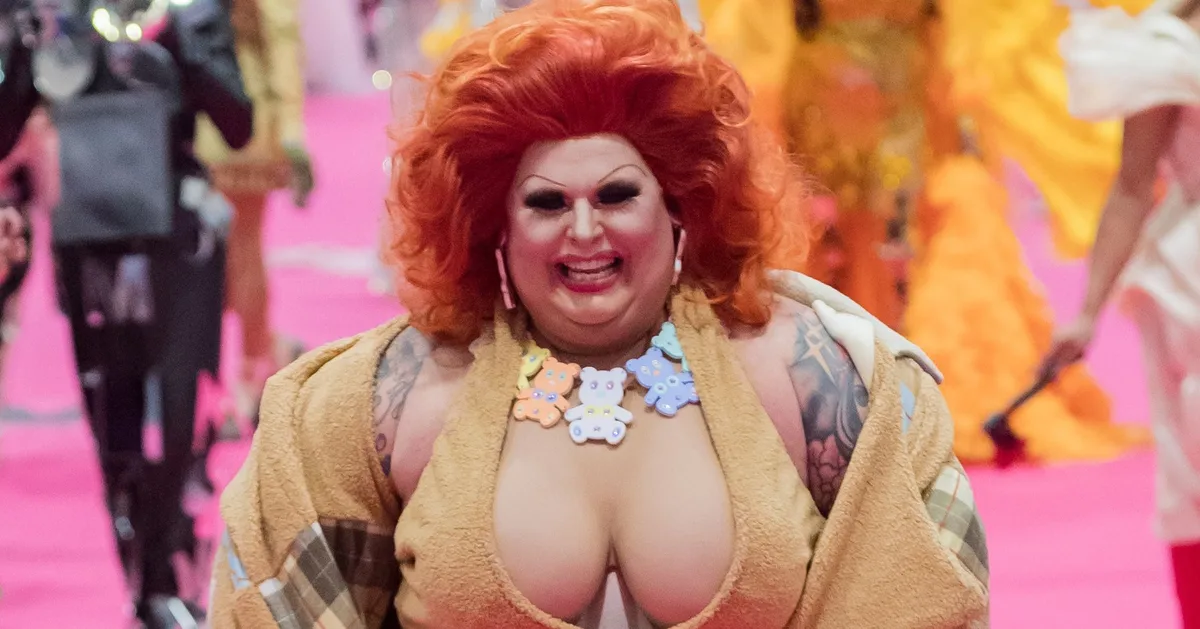
The drag world is in mourning following the death of the Australian performer Maxi Shield.
Internationally, Maxi – the drag alter-ego of Kristopher Elliot – will be best known to RuPaul’s Drag Race fans for her appearance on the inaugural season of the reality show’s Down Under iteration, where she finished in sixth place.
Last year, she shared that she had been diagnosed with cancer, with her death at the age of 51 being announced on Sunday evening.
A post on the company of the Australian company Wigs By Vanity read: “It’s with the heaviest of hearts that we share the news that our dearest sister, Maxine, has passed away.
“We are all mourning the loss of an incredible icon, friend, and our beloved sister. Thank you for the laughs, the cackles, and the magic you brought into our lives.”
Season one winner Kita Mean was among those paying tribute, remembering Maxi as “the kindest queen that has ever been” and celebrating her “love for drag”, “wicked sense of humour” and “giving spirit”.
“There will forever be a void in my heavy heart where your fabulousness hit me like a tonne of bricks,” Kita said. “Your strength over the last few months has been incomprehensible and I will go forward with such pride in my heart knowing I was friends with the best sister in the business.
“I love you so much… may your spirit rest in peace.”
Fellow competitor Anita Wigl’it also wrote: “I am very saddened to hear that our beloved Maxi Shield has passed on. You have been an absolute delight of a friend and sister.
“I’ll remember you for so many things; cackling about our friends, plotting the wonderful things that we are going to do in our careers, your support, constantly laughing, your wonderful stories, talking about men, the time you dressed as Penguin, the love you have for everyone. I love you my friend.”
Maxi was a prolific figure on the Australian drag scene, and was notably among the performers at the closing ceremony of the 2000 Olympics in Sydney.
She was also a regular fixture at the city’s Mardi Gras celebrations each year, and played a lead role in the 2023 comedy The Winner Takes It All.
Before he became president, Donald Trump was notorious for using personas to engage with the media. Now, people are speculating that Trump has revived one of his old pseudonyms:
🚨 NO WAY 😭
“John Barron” just called @CSPAN to complain about the Supreme Court nuking Trump’s tariffs.
Yes — that John Barron.
The fake name Trump used for decades.They cut him off mid-call.
💀You cannot make this up. 😂🥴 pic.twitter.com/iOPLRebnYa
— Brian Allen (@allenanalysis) February 22, 2026
John Barron
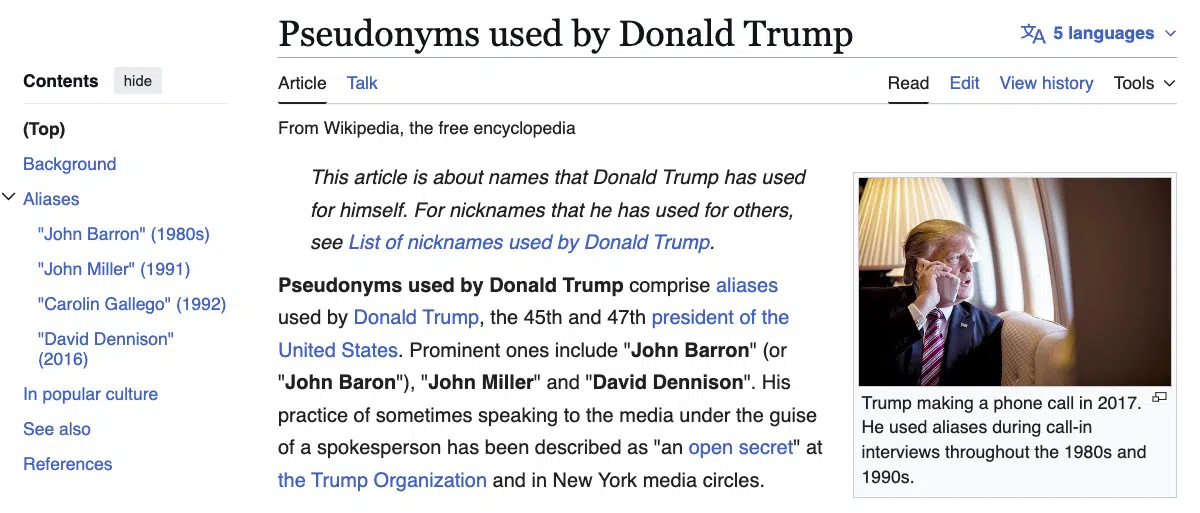
When we say Trump was ‘famous’ for deploying personas, we weren’t exaggerating. There is literally a Wikipedia article on the topic:
 As you can see, those aliases are in order:
- John Barron.
- John Miller.
- Carolin Gallego (??).
- David Dennison.
Here’s what that same page says about the John Barron persona:
Trump used the alias “John Barron” (sometimes “John Baron”) throughout the 1980s, with its earliest known usage in 1980 and its last acknowledgment in 1990. According to The Washington Post, the name was a “go-to alias when [Trump] was under scrutiny, in need of a tough front man or otherwise wanting to convey a message without attaching his own name to it”. Barron would be introduced as a spokesperson for Trump, and is even described as a vice president of the Trump Organization in an article by Robert D. McFadden.
This is how that section ends:
Some New York editors recalled that “calls from Barron were at points so common that they became a recurring joke on the city desk”.
Trump stopped using the pseudonym after he was compelled to testify in court proceedings that John Barron was one of his pseudonyms. The Washington Post suggested that Trump might have used the pseudonym longer if not for the “lawsuit in which he testified, under oath in 1990, that ‘I believe on occasion I used that name.’”
And here’s what caller ‘John Barron’ said in the clip at the top:
Well, this is John Barron, and you have… Look, this is the worst decision you’ve ever had in your life, practically. Jack – and Jack’s going to agree with me, right? But this is a terrible decision, and you have Hakeem Jeffries, who – he’s a dope – and you have, Chuck Schumer, who can’t cook a cheeseburger. Of course, these people are happy. Of course, these people are happy.
But true Americans will not be happy. And you have the woman earlier. I assume she’s a woman. She’s a Democrat. But she said… she’s disgraced. She’s devastated.
Confusing, unclear stuff.
In other words, believing it could be him is easy.
But is it?
Journalist Mehdi Hasan suggested it must be a phoney:
Surely it’s an impersonator, right? Right?? https://t.co/TuH5BLNUiC
— Mehdi Hasan (@mehdirhasan) February 22, 2026
It’s certainly true that the caller doesn’t sound exactly like Trump, but then again, neither does Trump at this point.
The man has aged dramatically over the past 12 months, and he’s lost more and more impulse control.
Given that, is it so hard to imagine a sundowning Trump reviving one of his old personas?
Yes, it is, actually.
I’m Carolin Gallego – thanks bigly for reading this article.
Featured image via the Canary
Politics
Newsom Calls Trump A ‘Punch-Drunk Boxer’ For Lashing Out At Supreme Court Over Tariffs Ruling
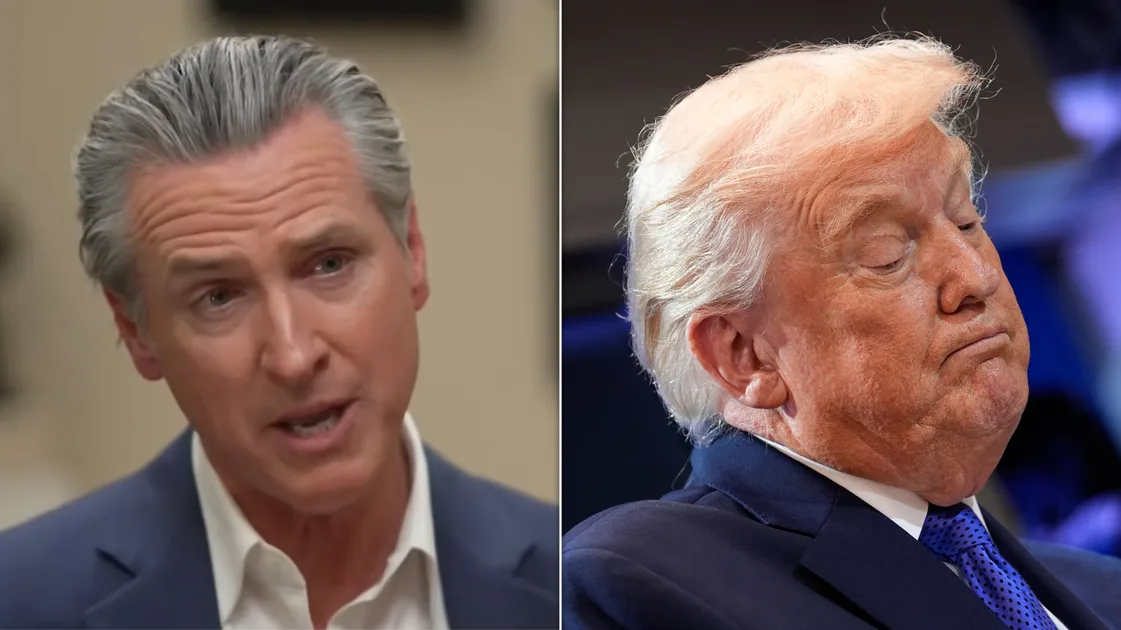
California Governor Gavin Newsom accused President Donald Trump of flailing after he admonished the US Supreme Court for striking down his sweeping tariffs last week.
On Friday, the court ruled Trump didn’t have the emergency power to impose the sweeping tariffs, prompting him to sign an executive order on Friday night stating he could bypass Congress and impose a 10% tax on global imports.
Then on Saturday, Trump posted on Truth Social that he was raising the global tariff to 15%.
“Based on a thorough, detailed, and complete review of the ridiculous, poorly written, and extraordinarily anti-American decision on Tariffs issued yesterday, after MANY months of contemplation, by the United States Supreme Court, please let this statement serve to represent that I, as President of the United States of America, will be, effective immediately, raising the 10% Worldwide Tariff on Countries, many of which have been “ripping” the U.S. off for decades, without retribution (until I came along!), to the fully allowed, and legally tested, 15% level,” Trump wrote.
“The whole thing is a farce,” Newsom told CNN’s Dana Bash in an interview that aired Sunday. “I talk about petulance. It was 10% two days ago, maybe 20% tomorrow. I mean, this is madness.”
Newsom also said Trump was flailing.
“He’s a punch-drunk boxer,” Newsom said. “He’s just trying to hit anything, a shadow, and he’s a shadow of himself. He’s lost a step or two.”
Newsom said Trump’s tariffs were ”always an illegal act,” and that he needs to return the money.
“He needs to refund that money with interest,” Newsom said. “He could do that in a nanosecond. They could do that electronically.”
Newsom then likened Trump and Treasury Secretary Scott Bessent to the 1994 screwball comedy “Dumb & Dumber,” and said the pair had “wrecked this economy.”
“[Trump’s] entire economic paradigm is mass deportations, tax cuts for billionaires and tariffs. And he’s been exposed. He’s a fraud. And by the way, the tariff? This is a self-dealing operation. This is about his personal portfolio,” Newsome added.
Watch a clip from Newsom’s “State of the Union” interview below.

A spokesperson for Bafta has responded to the backlash over two key omissions from the “in memoriam” section of this year’s awards show.
Every year, the Baftas pays tribute to those from the movie industry who have died over the last 12 months, with this year’s tributes being accompanied by a touching performance from Jessie Ware.
In a statement to the Daily Mail, a Bafta rep said: “We honour those within the sector in which their work was most closely associated. Our TV Awards take place later this spring.”
Last week, it was also confirmed that Eric had died at 53, having been diagnosed with amyotrophic lateral sclerosis (ALS) in 2025.

BITEBACK TO PUBLISH IAIN DALE’S UNFILTERED AUTOBIOGRAPHY
Biteback Publishing has acquired Iain Dale’s searingly honest autobiography, offering a rare, honest look at failure, imposter syndrome and the art of broadcasting.
Award-winning broadcaster Iain Dale has led a life full of incident and success but also some very public failures. In this refreshingly honest account of his life and careers in business, politics and media, he tells all for the first time.
With the same raw candour that earns him 750,000 weekly listeners, he recounts his journey from driving a combine harvester at age eight to driving the national conversation on LBC, taking in his encounters with a host of household names, including HM Queen Elizabeth II, Sir Cliff Richard, Kylie Minogue, Joan Rivers, Jennifer Saunders, the Duchess of York, Olivia Newton-John, Terry Pratchett and twelve of our fifty-eight Prime Ministers.
He also reflects movingly on coming out at age forty, coming to terms with his thwarted political aspirations, and the heartbreaking phone-ins that have made him ‘the friend they’ve never met’ to millions.
This is the ultimate insider’s guide to the corridors of power and the pressures of the studio. Whether he’s nearly throwing up on Margaret Thatcher, coming to blows with senior MPs or accidentally calling the Archbishop of Canterbury something less than pious on live radio, this is Iain Dale off-air and unfiltered.
One of Britain’s leading political commentators and a celebrated broadcaster, Iain Dale presents the evening show on LBC Radio and is a regular contributor to Good Morning Britain, Question Time and Newsnight. His podcasts include Where Politics Meets History and the award-winning For the Many. He is a regular columnist for the Telegraph, the Evening Standard and the i paper.
Iain has written or edited more than fifty books, including Why Can’t We All Just Get Along…, The Prime Ministers and, most recently, Margaret Thatcher, selling more than a million copies in the past twenty-five years. He is a visiting professor of politics and broadcasting at the University of East Anglia.
Olivia Beattie, Editorial Director at Biteback, acquired world English rights from Gordon Wise at Curtis Brown.
Dale said: ‘You only get one chance of writing an autobiography, and I’m delighted that my old firm Biteback have taken it on. It is very much warts and all and includes all the various scrapes I’ve been involved in, as well as telling what it’s really like to be a radio presenter. The whole book is anecdote-tastic and is designed to entertain. I don’t flinch about possibly going into too much detail about certain aspects of my life, hence the title of the book. I can’t wait for it to appear in July and to promote the hell out of it throughout the summer and autumn.’
Beattie said: ‘Everyone at Biteback has missed Iain enormously since he stepped down as MD in 2018, so it feels like a wonderful homecoming to be welcoming him back with this very personal memoir. This is trademark Iain, with all the right ingredients – his candour and raw emotion and sense of humour – and we’re really looking forward to sharing it with a wider audience.’
Have I Said Too Much? will be published on 15 July 2026, supported by a major publicity campaign.
Price: £22 hardback
ISBN: 9781837360581
For more information please contact Ruth Killick on publicity@ruthkillick.co.uk
Signed copies can be ordered HERE
Buy from Amazon HERE

No 10 fast-tracked security vetting for Mandelson despite known links to Epstein
“Peter Mandelson’s security vetting as US ambassador was fast-tracked despite his known links to Jeffrey Epstein, The i Paper can reveal. Photos of Mandelson show he had security clearance to view “top secret” material within three and a half weeks of his role being announced, when such checks typically take several months. Insiders say the Foreign Office was asked to complete the former Labour peer’s security screening as quickly as possible to get him in post, under pressure from No 10 officials. The photographs and insider reports raise new questions about how quickly officials vetted Mandelson and whether they could have discovered his close connections to the convicted sex offender earlier. A senior Government source said that Mandelson’s vetting was done through the normal process but without the usual waiting period, because the most important roles are fast-tracked through the vetting system. A Government spokesman said: “No part of the vetting process was removed, or skipped in the case of Peter Mandelson. It is normal practice for vetting sponsors to expedite applications, and they can request that cases are prioritised based on operational deployment deadlines.” This is the first admission by the UK Government that Mandelson’s security vetting was fast-tracked, despite the publicly known concerns over his links to Jeffrey Epstein.” – The i
- Evidence in Epstein UK flight investigation ‘destroyed’ – The Times
- Epstein hid secret files in storage units across US – Daily Telegraph
- Andrew & Mandelson should be investigated for TREASON, senior MP demands & calls for special probe into Epstein links – The Sun
- Parliament ‘must launch a Treason probe into Andrew and Mandelson’, senior MP – Daily Express
Comment:
- Charles, William & the royals have to convince us right now monarchy is worth sticking with… I know what they need to do – Rod Liddle, The Sun
> Yesterday:
Britain faces billion-pound bill if Chagos deal collapses
“Britain faces paying billions in compensation if Donald Trump collapses Sir Keir Starmer’s Chagos deal, The Telegraph can reveal. Ministers are concerned that Mauritius will sue if the Government cancels a treaty to give away the Chagos Islands, following opposition from the White House. This week, the US president changed his position on the deal for the third time, arguing that Sir Keir was making a “big mistake” and should not “give away” Diego Garcia, the joint US-UK military base there. As part of the deal, Britain will pay Mauritius £35bn over the next century to rent back the base and fund Mauritius’s development. However, Mr Trump’s intervention means the deal could be cancelled entirely, with officials privately admitting that it cannot go ahead without the United States’ support. Two Whitehall sources told The Telegraph that if Britain is forced to withdraw from the treaty, it will likely face legal action from Mauritius that could trigger a compensation bill worth billions… If the deal is cancelled, officials believe Mauritius will try to recoup the money anyway in the international courts.” – Daily Telegraph
- Britain could pay billions if Trump collapses Chagos deal – The Times
- Ex-defence secretary accuses Nigel Farage of ‘performing Maga stunt’ with failed Chagos ‘aid mission’ – The Independent
- Farage: My Chagos aid mission has been blocked – Daily Telegraph
Comment:
- Sir Keir must not allow Mauritius to force through the Chagos deal – Telegraph View
- Is Starmer’s 15th U-turn on the horizon? – Andrew Pierce, Daily Mail
Streeting must be sacked to reset Government, allies tell Starmer
“Wes Streeting should be sacked as part of the Downing Street reset, allies of Sir Keir Starmer have said. The Prime Minister is being told by his supporters to assert his authority and dispose of the “distracting” Health Secretary to get his premiership back on track. Sir Keir will return to Parliament after recess on Monday. He is seeking to stabilise his premiership following a bruising start to the year. He is conducting a wholesale overhaul of No 10 after the Lord Mandelson scandal pushed his Government to the brink, with the clear-out already costing him two of his most senior aides. Sources close to four Cabinet ministers have now turned the spotlight on Mr Streeting, telling The Telegraph he is becoming increasingly unpopular with Government colleagues after months of bitter briefing wars with No 10. They said the attacks on Downing Street were interfering with Labour’s agenda and could not be allowed to continue, with one warning: “The situation is clearly unsustainable.” Mr Streeting, a prominent figure on the Labour Right, is widely seen as a potential challenger to Sir Keir and has been accused on multiple occasions of plotting a coup against the Prime Minister.” – Daily Telegraph
- Sir Keir Starmer ‘drawing up plans to sack rival Wes Streeting for plotting to take his job’ – Daily Mail
- Keir Starmer ‘readies plans to SACK Wes Streeting for plotting to take his job’ – GB News
Comment:
- The Streeting/Milburn era must end to give the NHS a fresh start – HSJ
- Britain has been broken by bad ideas before: but seldom by so many at once – Robert Tombs, Daily Telegraph
> Today:
News in brief:
- Can Reform UK fix Prevent? – Dominic Adler, UnHerd
- Labour is trapped in a statist doom-loop – Eliot Wilson, The Critic
- Can Reform really make Britain Christian again? – Lois McLatchie Miller, The Spectator
- Equating the Greens with Reform will ruin Labour – Jonn Elledge, The New Statesman

The 2026 Baftas ceremony brought some of the biggest stars in Hollywood to London on Sunday night.
And, of course, a star-studded awards ceremony means plenty of A-list red carpet photos for us all to pore through afterwards.
One Battle After Another led the way when it came to both nominations and wins at this year’s Baftas, with cast members Teyana Taylor and Chase Infiniti delivering some of the stand-out looks of the evening, with Benicio Del Toro and Leonardo DiCaprio also looking smart on the night.
Elsewhere, Jessie Buckley and Paul Mescal were out representing their tear-jerking drama Hamnet, two-time winner Robert Aramayo was looking dapper and Sinners faves like Wunmi Mosaku, Michael B Jordan and Miles Caton pulled out all the stops on the red carpet, too.
But it wasn’t just about the nominees this year, with presenters including HuffPost faves Hannah Waddingham, Riz Ahmed, Erin Doherty and Aimee Lou Wood.
Check out the must-see red carpet snaps from the 2026 Baftas below…
Chase Infiniti
Nominated – Best Actress

Jessie Buckley

Robert Aramayo
Winner – Best Actor and Rising Star

Teyana Taylor
Nominated – Best Supporting Actress

David Fisher/Shutterstock
Wunmi Mosaku
Winner – Best Supporting Actress

Anthony Harvey/Shutterstock
Erin Doherty

Hannah Waddingham

Timothée Chalamet

Paul Mescal and Gracie Abrams
Nominated – Best Supporting Actor

Emma Stone
Nominated – Best Actress

Riz Ahmed

Aimee Lou Wood

Jesse Plemons and Kirsten Dunst

Matt Baron/BEI/Shutterstock
Alan Cumming

Renate Reinsve
Nominated – Best Actress

Anthony Harvey/Shutterstock
Michael B Jordan

Matt Baron/BEI/Shutterstock
Tom Blyth

Kathryn Hahn

David Fisher/Shutterstock
Regé-Jean Page

Anthony Harvey/Shutterstock
Sadie Sink

Carey Mulligan
Nominated – Best Supporting Actress

Archie Madekwe
Nominated – Rising Star

Anthony Harvey/Shutterstock
Bobby Cannavale and Rose Byrne
Nominated – Best Actress

Kate Hudson
Nominated – Best Actress

Anthony Harvey/Shutterstock
Stormzy

Gillian Anderson

Ethan Hawke

Harry Melling

Jessie Ware

Emily Watson
Nominated – Best Supporting Actress

Odessa A’zion
Nominated – Best Supporting Actress

Joe Alwyn

Anthony Harvey/Shutterstock
Leonardo DiCaprio

Chloe Zhao
Nominated – Best Director

Wagner Moura

Monica Bellucci

Jacobi and Noah Jupe

Anthony Harvey/Shutterstock
Cillian Murphy

David Fisher/Shutterstock
David Jonsson

David Fisher/Shutterstock
Miles Caton
Nominated – Rising Star

Alessandro Galatoli/ZUMA Press Wire/Shutterstock
Inga Ibdsdotter Lileaas
Nominated – Best Supporting Actress

David Fisher/Shutterstock
Maggie Gyllenhaal

Anthony Harvey/Shutterstock
Jaime Winstone

Benicio Del Toro
Nominated – Best Supporting Actor

Stellan Skarsgård
Nominated – Best Supporting Actor

Maya Rudolph

Minnie Driver

Warwick Davis

Mia McKenna-Bruce

Milly Alcock

David Fisher/Shutterstock
Jenna Coleman

Glenn Close

Sheila Atim

Maura Higgins

Anthony Harvey/Shutterstock
Audrey Nuna

Rei Ami

Kerry Washington

Little Simz

Harry Lawtey

Anthony Harvey/Shutterstock
Russell Tovey

Anthony Harvey/Shutterstock
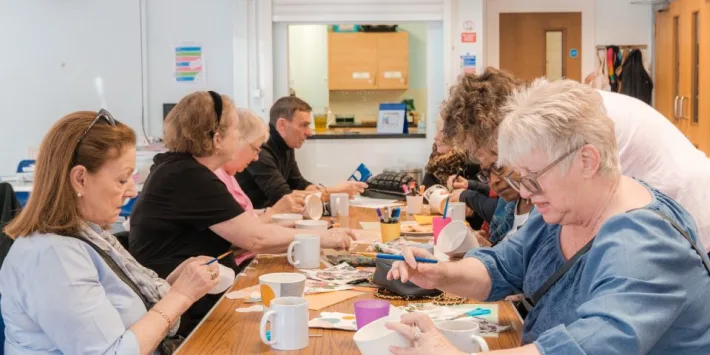


Clare Miller, Chief Executive
| Clarion Housing Group
Clarion’s Five New Giants of Opportunity sets out the conditions society must get right for people to thrive, showing how connectedness, resilience, trust, sufficiency and health are rooted in housing and demand collaboration for impact
Health outcomes are shaped long before someone reaches a GP surgery or hospital. They are shaped by the homes people live in, their communities, and whether daily life supports or undermines long, healthy lives.
As Clarion marked its 125th anniversary last year, we brought together residents, partners and experts to look beyond immediate pressures and ask what will shape wellbeing over the coming decades. The result was the Five New Giants of Opportunity report, which sets out five conditions society must get right for people to thrive: health, connectedness, resilience, trust and sufficiency, with housing sitting at the centre of all five. Health is the defining giant of our time, and if the government is serious about shifting from reactive healthcare to prevention, housing policy must be treated as core health policy.
Too often, poor housing and poor health are locked in a vicious circle. Cold, damp or overcrowded homes drive respiratory illness, anxiety and long-term conditions. That limits people’s ability to work, deepens poverty and increases pressure on public services. The NHS spends an estimated £1.4bn a year treating illnesses linked to cold or damp homes, rising to £15.4bn once wider costs such as lost productivity are included.
Our own evidence shows how this plays out in communities. Clarion’s survey of more than 2,000 residents shows that health is now the biggest barrier to employment for unemployed working-age people. Nearly half of residents report a disability or long-term condition, while 15 per cent experience chronic loneliness. These pressures are seen daily in GP surgeries, hospitals, and local authorities.
Much of this challenge is structural. A significant proportion of the nation’s social housing was built quickly after the war. Many homes are now ageing, overcrowded and harder to keep warm, safe and healthy. Without sustained investment, the consequences do not disappear; they simply reappear elsewhere in the system, often at higher cost.
We see the benefits when that investment is made. Last year alone, Clarion invested £418m in improving and maintaining homes, with more than 15,500 households benefiting from retrofit upgrades to reduce cold, damp and associated health risks. More than three quarters of our homes now meet EPC C or above, but millions of homes nationally still fall short. Home quality directly affects energy bills, household finances and long-term health outcomes.
Housing’s contribution to health goes beyond bricks and mortar. Last year, Clarion supported more than 1,500 residents into employment and over 5,600 into training, alongside providing wellbeing spaces that attracted more than 36,000 visits to support mental health and reduce isolation.
Policy certainty means the question is no longer whether housing can support prevention, but how fast and at what scale. Long term rent stability and access to low cost finance should help unlock delivery alongside our colleagues in the NHS and local government.
We welcome the government’s 10-Year Health Plan for England and its emphasis on care delivered closer to home. Housing providers, rooted in neighbourhoods and trusted by residents, are well placed to support this shift as the NHS strengthens its role as an anchor institution within local communities.
Health does not stand alone. It is inseparable from whether people feel connected rather than isolated, resilient rather than exposed to shocks, able to trust institutions, and confident that their home and income are sufficient to live well. These are the Five New Giants of Opportunity. Tackling them together, and recognising housing as foundational to all of them, offers government one of the most effective routes to improving health outcomes and building a more resilient society.
Read the Five New Giants of Opportunity report here.

Paul Mescal and Gracie Abrams were looking very loved up as they posed for photographers together on their way into this year’s Bafta Awards.
On Sunday night, Paul and Gracie attended the Baftas as a couple, where the Irish star had been nominated in the Best Supporting Actor category for his performance in Hamnet.
The pair were first rumoured to be dating back in 2024, and in that time, they’ve been snapped together on a number of occasions (including last week, when they were pictured at an event with Sir Paul McCartney, who the Normal People actor is currently gearing up to play in Sam Mendes’ ambitious four-movie Beatles project).
However, it’s fair to say that the Oscar nominee and That’s So True singer have never been sighted looking quite as amorous as they were at this year’s Baftas, with many outlets referring to the event as the pair’s official “hard launch”.

Anthony Harvey/Shutterstock
Rumours about Paul and Gracie’s romance first began in August 2024, when TMZ published pictures of the two dining together in London.
Since then, Paul has been spotted in the crowd at Gracie’s concerts, while last summer, they really got fans talking when they shared a loved-up snap on Instagram.
Next month, Paul is due attend the recently-renamed Actor Awards, where he’s once again been nominated in the Best Supporting Actor category for Hamnet.
He and co-stars Jessie Buckley, Joe Alwyn, Noah Jupe and Emily Watson are also in the running for the Outstanding Performance By A Cast In A Motion Picture prize.

Anthony Harvey/Shutterstock
However, he was noticeably absent when the nominees for this year’s Oscars came out last month, with many voicing their upset at Paul being snubbed.
Paul previously won a TV Bafta for his break-out performance in Normal People, while his work in the emotional drama Aftersun earned him a Bafta Scotland award.
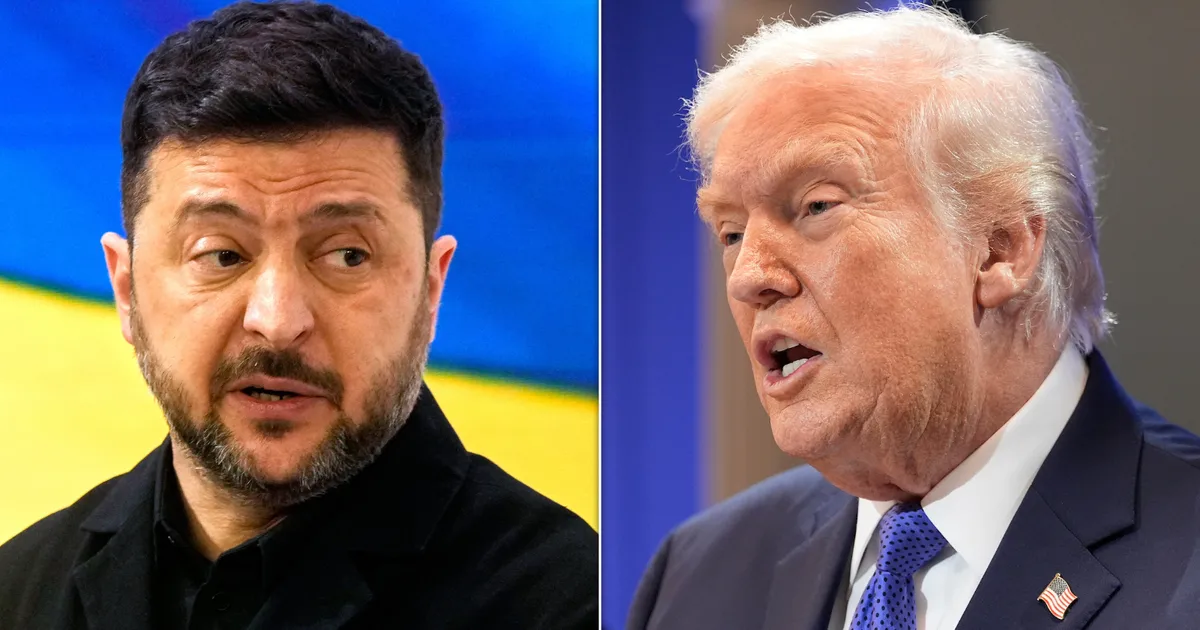
Volodymyr Zelenskyy has delivered a brutal slapdown to Donald Trump over his claims about what triggered the Ukraine war.
The US president has repeatedly suggested that Ukraine itself began the conflict – a notoriously wrong Kremlin talking point.
In actual fact, the conflict began almost four years ago to the day with Russian president Vladimir Putin sending Russian tanks into Ukraine.
Trump has also claimed that Zelenskyy is a dictator for not holding elections while his contract faces daily bombardment from Russia.
In an interview with the BBC’s international editor Jeremy Bowen, Zelenskyy hit back at the president.
Bowen asked him: “Donald Trump says different things at different times, but among the things he said is that you’re a dictator and that you started the war. It’s not helpful is it, for you?”
Laughing, Zelenskyy replied: “I’m not a dictator and I didn’t start the war. That’s it.”
Asked if he could trust Trump on security guarantees for Ukraine, Zelenskyy pointed out that he will not be the US president forever.
“It’s not only President Trump, we are talking about America,” he said. “As presidents we have fixed terms. We want guarantees for 30 years, for example. Congress is needed. Presidents change, but institutions stay.”
Elsewhere in the interview, Zelenskyy also claimed that Putin has “already started” World War 3.
“The question is how much territory he will be able to seize and how to stop him,” he said. “Russia wants to impose on the world a different way of life and change the lives people have chosen for themselves.”

LeBron James endorses Jaylen Brown for MVP

How Monzo for Under 16s could help your kids learn key money-saving skills

Netflix boss defends bid for Warner Bros as Paramount deadline looms

Smart energy pays enters the US market, targeting scalable financial infrastructure

Why Israel is blocking foreign journalists from entering

Bitcoin: We’re Entering The Most Dangerous Phase

How to Build Wealth | Smart Loans & Asset Planning | Telugu Podcast | CFP Ram Prasad | Part – 1

Yellow coin? The hot new crypto? Uh.. yes please?! #animation

Do it on the HOLI, financial problems will go away…|#ytshortsvideo #facts #viralshorts #ytstudioes
-
 Video7 days ago
Bitcoin: We’re Entering The Most Dangerous Phase
-

 Crypto World6 days ago
Can XRP Price Successfully Register a 33% Breakout Past $2?
-

 Video3 days ago
XRP News: XRP Just Entered a New Phase (Almost Nobody Noticed)
-

 Fashion3 days ago
Weekend Open Thread: Boden – Corporette.com
-

 Sports6 days ago
GB's semi-final hopes hang by thread after loss to Switzerland
-

 Politics1 day ago
Baftas 2026: Awards Nominations, Presenters And Performers
-
 Tech6 days ago
The Music Industry Enters Its Less-Is-More Era
-

 Business5 days ago
Infosys Limited (INFY) Discusses Tech Transitions and the Unique Aspects of the AI Era Transcript
-

 Entertainment5 days ago
Kunal Nayyar’s Secret Acts Of Kindness Sparks Online Discussion
-

 Video6 days ago
Financial Statement Analysis | Complete Chapter Revision in 10 Minutes | Class 12 Board exam 2026
-

 Tech5 days ago
Retro Rover: LT6502 Laptop Packs 8-Bit Power On The Go
-
 Sports4 days ago
Clearing the boundary, crossing into history: J&K end 67-year wait, enter maiden Ranji Trophy final | Cricket News
-

 Business21 hours ago
Mattel’s American Girl brand turns 40, dolls enter a new era
-

 Business17 hours ago
Law enforcement kills armed man seeking to enter Trump’s Mar-a-Lago resort, officials say
-

 Entertainment4 days ago
Dolores Catania Blasts Rob Rausch For Turning On ‘Housewives’ On ‘Traitors’
-

 Business5 days ago
Tesla avoids California suspension after ending ‘autopilot’ marketing
-

 Tech16 hours ago
Anthropic-Backed Group Enters NY-12 AI PAC Fight
-

 Politics6 days ago
Eurovision Announces UK Act For 2026 Song Contest
-

 NewsBeat15 hours ago
Armed man killed after entering secure perimeter of Mar-a-Lago, Secret Service says
-

 Crypto World5 days ago
WLFI Crypto Surges Toward $0.12 as Whale Buys $2.75M Before Trump-Linked Forum