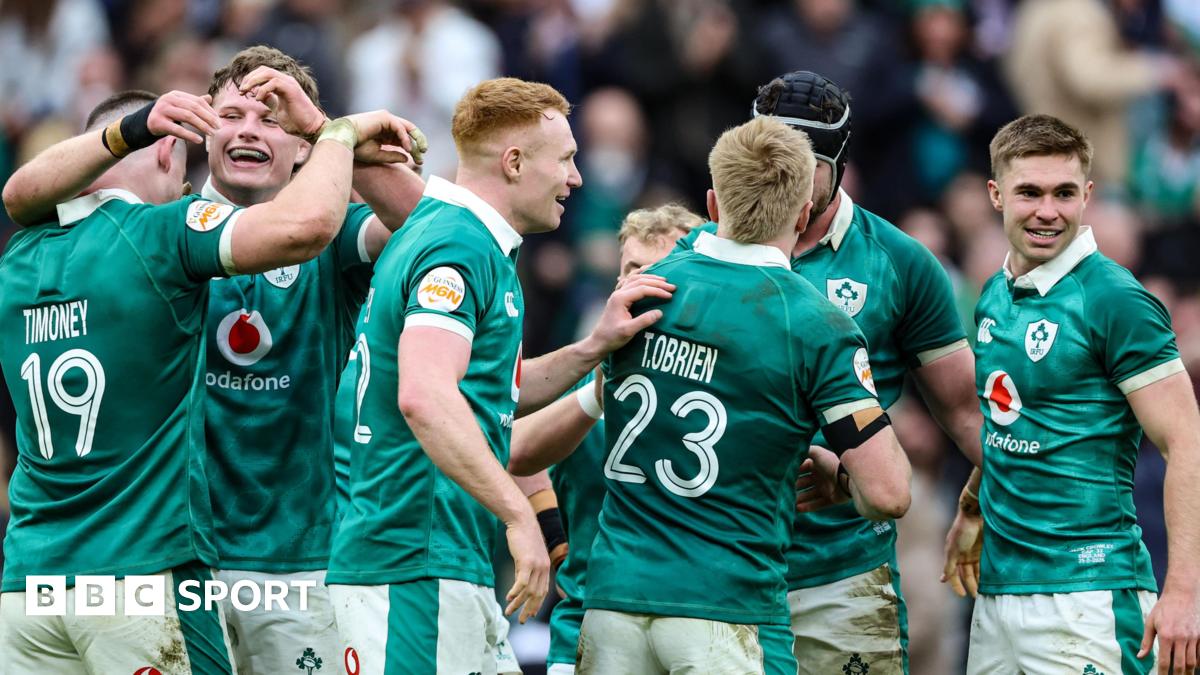
Farrell was also pleased with how his more seasoned Test players stepped up after questions over their form as they supplemented headline-stealing displays from Stuart McCloskey and Rob Baloucoune.
“Caelan [Doris] was back to his best, Joe McCarthy was outstanding,” observed Farrell, who also praised player of the match Jamison Gibson-Park.
“Josh [van der Flier] was immense in that first half, wasn’t he? You know, with his line running and stuff like that.
“They know they’ve a responsibility. We said before the game, big-game players turn up and make big-team performances happen.
Advertisement
“They set great examples, but for the lads that I just mentioned, for Rob Baloucoune to come here and do that, you know you’re on for a good day when he’s got a poach, a turnover ball…just his belief to take people on, and for Stu to dominate at this type of level, it was a joy to see.”
With McCloskey and Baloucoune establishing themselves in the Test arena, experienced players recapturing their form and the likes of Mack Hansen, Hugo Keenan and Andrew Porter still to return from injury, Farrell’s squad suddenly seems in good shape 18 months out from the 2027 Rugby World Cup in Australia.
“That’s the point. That’s the best part of it,” he said.
“We know that and we have to take a bit of stick along the way. I suppose a win like this gets people a little bit back on board.
Advertisement
“As long as we know where we’re going.”
Ireland host winless Wales on 6 March (20:10 GMT) before finishing the campaign against fellow Triple Crown chasers Scotland in Dublin on 14 March (14:10).
Man City came out as 2-1 winners over Arsenal at the Etihad Stadium in a big boost to their title hopes
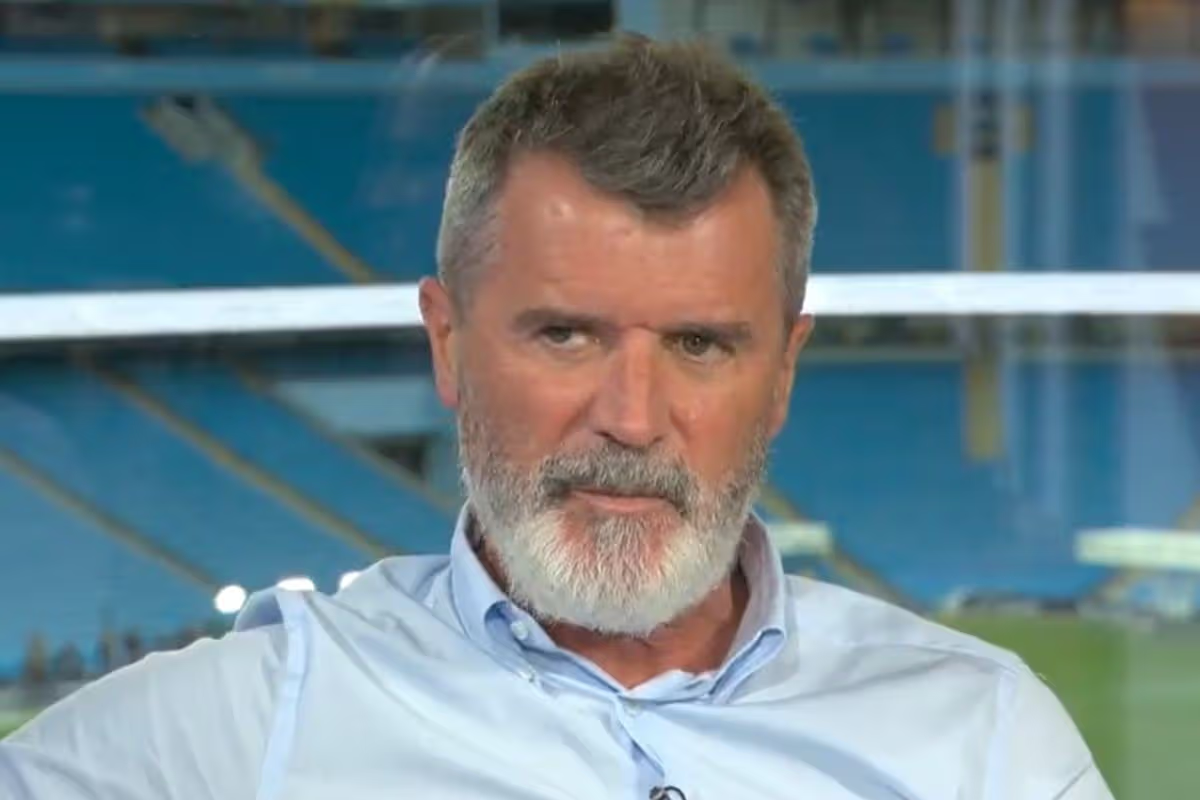
Roy Keane is sticking with his prediction that Arsenal will clinch the Premier League title this season, despite their defeat to Manchester City in the pivotal top-of-the-table clash. City came out as 2-1 winners, closing the gap between the two teams to just three points.
Recent weeks have seen the margin steadily shrink, with City now in a position to leapfrog Mikel Arteta’s side in the standings, should they win their midweek clash.
Advertisement
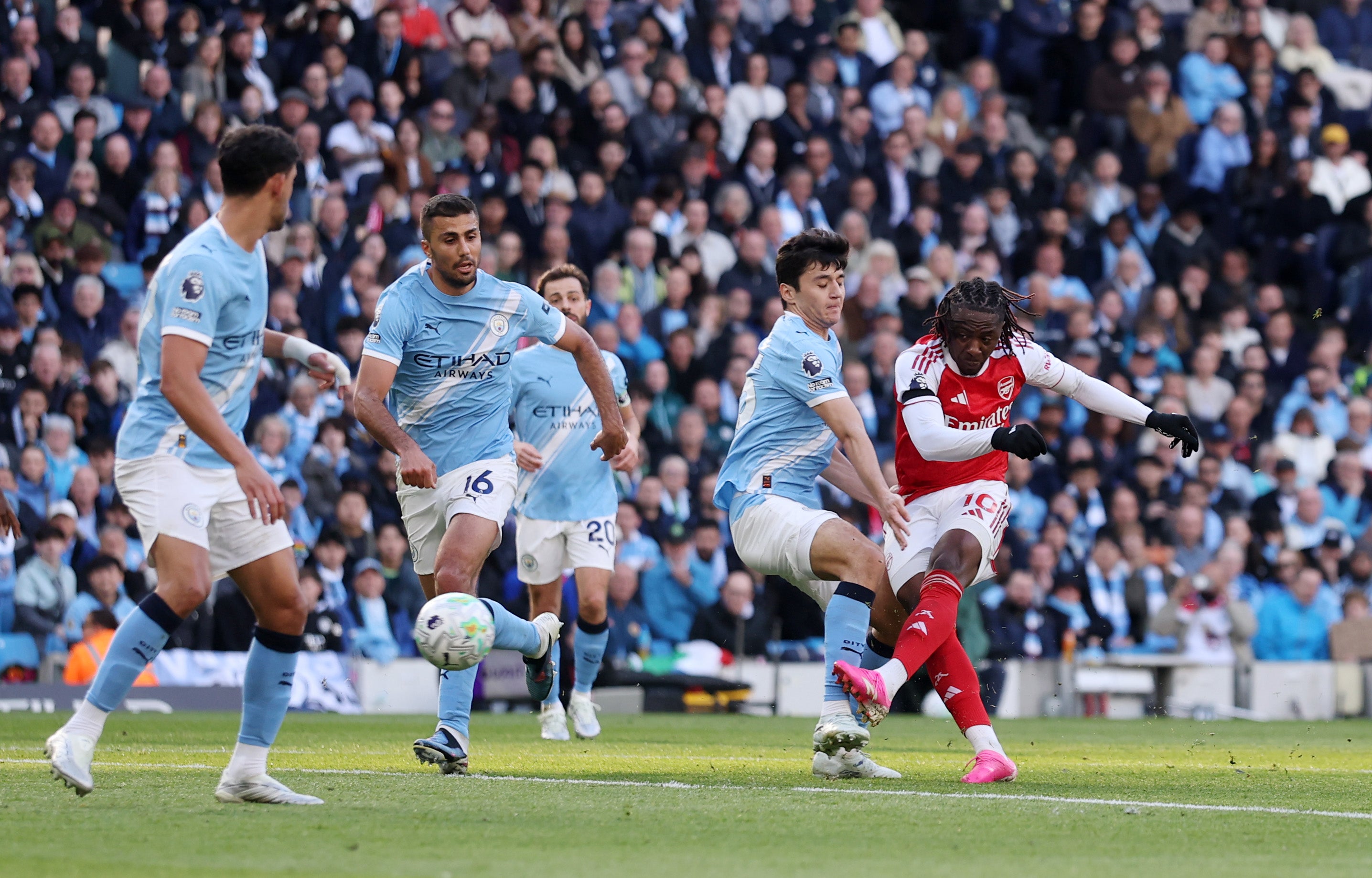
Rayan Cherki put City ahead at the Etihad Stadium, only for Kai Havertz to level things up just two minutes later. Arsenal did create opportunities to take the lead, but Erling Haaland‘s second-half strike ultimately proved decisive.
Get MEN Premium now for just £1 HERE – or get involved in our City WhatsApp group by clicking HERE. You can also join our City Facebook page by clicking HERE and don’t miss out on our brilliant selection of newsletters HERE.
With the gap narrowing and City holding a game in hand, opinion is shifting on who the favourites are to lift the trophy come the end of the campaign.
Speaking following the final whistle, former City defender Micah Richards told Sky Sports: “I have said if Man City win today, this is the game, they will win the League. I have always said that.”
Advertisement
Former Arsenal and City midfielder Patrick Vieira was of the same view, stating: “There’s still 15 points on the table but if I had to answer the question I will say it, it will have to be Blue today,” he said.
Gary Neville echoed similar sentiments, saying: “For the first time this season I am probably going to say they will win the League.”
“I don’t care. I am going to stick with Arsenal, of course I am going to stick with them,” he said.
“No doubt the belief is not as strong as it was before the game, obviously City have got the momentum but I am going to have to stick with Arsenal because I called them at the start of the season.”
Man City’s midweek fixture sees them face second-from-bottom Burnley at Turf Moor on Wednesday evening. Victory would see the champions leapfrog Arsenal at the top of the table.
Both teams will then have five Premier League games of the season remaining.
Advertisement
Sky Sports, HBO Max, Netflix and Disney+ with Ultimate TV package
This article contains affiliate links, we will receive a commission on any sales we generate from it. Learn more
Sky has upgraded its Ultimate TV and Sky Sports bundle to now include HBO Max, Netflix, Disney+, discovery+ and Hayu, as well as 135 channels and full Sky coverage of the Premier League and EFL.
Sky broadcasts more than 1,400 live matches across the Premier League, EFL and more with at least 215 live from the top flight alongside Formula 1, darts and golf.
Dec 7, 2024; Charlotte, NC, USA; Clemson Tigers defensive end T.J. Parker (3) reacts after a play during the third quarter against the Southern Methodist Mustangs in the 2024 ACC Championship game at Bank of America Stadium. Mandatory Credit: Bob Donnan-Imagn Images
Minnesota Vikings fans and pundits are hyperfixated on the club drafting a safety, cornerback, or defensive tackle on Thursday night, as the roster calls for it. But what if they don’t? What if the Vikings get funky? The following is a look at the Vikings’ dark horse draft outcomes, even if they’re somewhat unrealistic.
Three surprises. One draft. Anything can happen.
Always remember: a team like the Atlanta Falcons drafted Michael Penix Jr. two years ago after handing Kirk Cousins a $180 million contract.
Advertisement
The Unexpected Paths Minnesota Could Still Explore
.. and the stuff on Thursday that would make you scratch your head.
NFL Network reporter Stacey Dales interviews Notre Dame running back Jeremiyah Love during the NFL Scouting Combine, Feb 28, 2026, at Lucas Oil Stadium in Indianapolis, Indiana, as he speaks on his college production and draft outlook while evaluators and media gather around during one of the league’s key pre-draft events. Mandatory Credit: Kirby Lee-Imagn Images
1. A Splashy Trade Up the Draftboard for Love, Styles, or Downs
The premise of this article is dark-horse draft outcomes that could unfold: strange, unprecedented, unexpected, and thrilling.
Here, the Vikings would bet it all on Jeremiyah Love (RB, Notre Dame), Sonny Styles (LB, Ohio State), or Caleb Downs (S, Ohio State). All three play non-premium positions, but Minnesota disregards “smart person” logic to obtain the best football player.
Advertisement
For example, if Love is available between pick 6 and 10, the Vikings could send a basket of draft picks to a a team in Top 10 and secure the draft’s top playmaker. Love would then cook in Kevin O’Connell’s offense, likely forcing him to run the football at a normal NFL clip.
This option will be expensive and probably won’t happen because Minnesota needs all of its draft picks to onboard young talent. Still, this would be the ultimate “all in” move.
SI.com‘sWill Ragatz wrote about the notion of trading up this week, “Jeremiyah Love would be an incredibly fun addition to the Vikings’ offense, but I’m not sure he’ll even fall far enough to be a realistic trade-up candidate for Minnesota. The one that stands out as a possibility is Ohio State safety Caleb Downs.”
“He could potentially slide a bit because of the positional value of safeties and the fact that he didn’t run at the combine or OSU’s pro day. It’s possible Brian Flores loves Downs and thinks he has a chance to be an All-Pro in the Vikings’ scheme.”
Advertisement
It’s worth noting that Minnesota would likely have to donate a fortune to land Love or Downs, including next year’s 1st-Rounder.
Ragatz continued, “With that said, I don’t think the Vikings will want to part with the draft capital required to move up from 18 to, say, the Chiefs’ pick at No. 9. But if Downs falls out of the top 10, it might be worth making some calls to see about the price on moving up 5-7 spots.”
“Ultimately, I don’t think it’s particularly likely they go up or land Downs.”
2. Picking an Offensive Lineman
Advertisement
Christian Darrisaw’s torn ACL recovery has concerned Vikings fans, Brian O’Neill is on deck for 2027 free agency, Will Fries’s guaranteed money runs out after the 2026 season, and Minnesota doesn’t have a starting center.
Those concerns are perhaps easily fixable, but what if the Vikings’ offensive line situation is causing distress behind closed doors? They could pick offensive tackle Spencer Fano from Utah or the best interior offensive lineman in the draft, Penn State’s Olaivavega Ioane.
Penn State offensive lineman Olaivavega Ioane (71) lines up against Boise State during the Fiesta Bowl, Dec 31, 2024, at State Farm Stadium in Glendale, Arizona, battling in the trenches throughout a postseason matchup as both teams compete in one of college football’s premier bowl games. Mandatory Credit: Mark J. Rebilas-Imagn Images
Minnesota proved in the last draft that it was serious about the trenches with Donovan Jackson. What if they make it two years in a row?
Sadly, an offensive tackle selection would signal significant fears about Darrisaw’s future, whether that’s accurate or not.
3. Drafting an EDGE with Greenard, Van Ginkel, and Turner on the Roster
Advertisement
Do the Vikings need an EDGE rusher? They do not. Is EDGE one of the most important spots in the NFL? It is.
Interim general manager Rob Brzezinski has vowed to select the best player available on Thursday night, and that might just be an outside linebacker like Keldric Faulk (Auburn) or T.J. Parker (Clemson). Think of it this way: Jonathan Greenard has been the subject of trade rumors; he wants a new contract. The upcoming season is scheduled to be Andrew Van Ginkel’s last in Minnesota.
EDGE rushers break the bank in free agency; positions like safety and running back do not. EDGE is a premium position.
Auburn defensive end Keldric Faulk (15) celebrates a defensive stop against South Alabama, Sep 13, 2025, at Jordan-Hare Stadium in Auburn, Alabama, reacting with energy as the Tigers build a lead before halftime in a home matchup during the early portion of the college football season. Mandatory Credit: Jake Crandall/Advertiser-USA TODAY NETWORK via Imagn Images
There’s a world where Brian Flores pounds the table for another pass rusher. It really wouldn’t be that weird.
Of course, the need for an OLB would explode through the roof if Minnesota traded Greenard during the draft. Texans EDGE Will Anderson just secured a contract worth $50 million per season; Greenard could reasonably ask for $35 million. Would the Vikings have that in their budget?
Mohamed Salah had struck Liverpool’s first goal at Everton’s new stadium just two-and-a-half minutes after Iliman Ndiaye thought he had given the hosts a deserved lead, only to see his strike disallowed for an offside in the build-up.
Everton responded well in the second half and pulled themselves level when Beto slid in to finish Kiernan Dewsbury-Hall’s cross, which left Liverpool turning to their third-choice goalkeeper Freddie Woodman after an injury to Giorgio Mamardashvili.
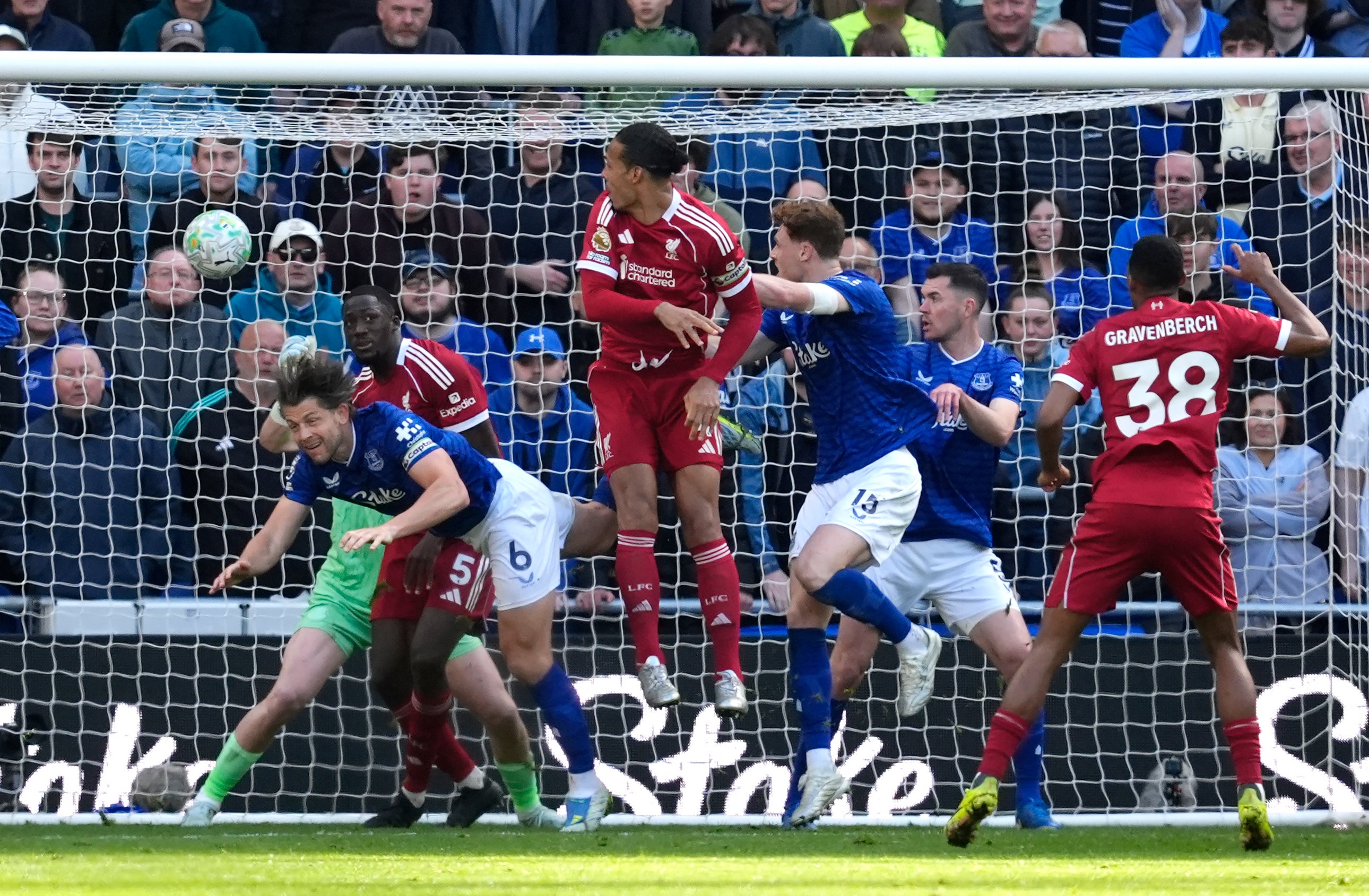
Substitute Rio Ngumoha had a very late chance to win the derby for Liverpool but, in the last minute of 11 minutes of stoppage time, Van Dijk rose to head in a corner and secure a famous win for the visitors.
It leaves Liverpool seven points clear of sixth-placed Chelsea in the race for the final Champions League spot, with five games of the season remaining. Chelsea lost 1-0 to Manchester United last night.
Advertisement
Has Van Dijk’s latest Merseyside derby winner wrapped up top-five race?
Virgil van Dijk’s first goal for Liverpool came as he rose from an inswinging corner from the left to head in a late winner against Everton in the FA Cup third round. Eight years on from the captain’s dramatic debut at Anfield, Van Dijk provided another historic Merseyside derby moment when he headed in Liverpool’s winner at the Hill Dickinson Stadium.
Liverpool have conceded seven goals in stoppage-time in the Premier League this season, losing games at Crystal Palace, Chelsea, Bournemouth, Wolves and against Manchester City. But this was a call-back to Liverpool’s run at the start of the season, when they won games late on against Bournemouth and Newcastle. Liverpool are often involved in late drama, but Arne Slot could reflect that it was about time it went his side’s way.
It could be crucial in the race to finish in the top-five, which is what Liverpool’s failed Premier League title defence has come down to after recent exits from the Champions League and FA Cup. After Chelsea’s defeat at home to Manchester United last night, Liverpool have opened up a seven-point advantage over the sixth-placed Blues with five games to go. That is surely insurmountable.
Advertisement
Aston Villa grabbing a late winner in a 4-3 thriller against Sunderland is a further blow to Chelsea’s chances of qualifying for the Champions League. With five games to go there is still room for some twists and turns, but anything other than a win for Liam Rosenior’s side at Brighton on Tuesday could mean the race for the top five is realistically over.
(PA)
Mohamed Salah makes more history in final derby
Part of Mohamed Salah’s legacy at Anfield is his outstanding record against Liverpool’s two biggest rivals: Manchester United and Everton. On his last Merseyside derby, Salah made sure to bag himself another record, and write his name into the history of this fixture one last time before he leaves Liverpool at the end of the season.
Just a couple of moments after Iliman Ndiaye thought he had scored the first Merseyside derby goal at the Hill Dickinson Stadium, Salah was clinical as he finished first-time from Cody Gakpo’s excellent ball across the face of goal. After scoring Liverpool’s last goal at Goodison Park, he had their first in Everton’s new home.
It also took Salah level with Steven Gerrard for the most Premier League goals in the Merseyside derby, with nine. Like this one, many of those finishes had been slipped, cooly, past Jordan Pickford, leaving England’s No 1 with no chance.
Advertisement
Everton could rue losing the ball in the build-up, with Dwight McNeil giving it away as the hosts looked to build from the back. But Liverpool, and Salah, were ruthless. It rather compounds the strangeness of Arne Slot’s decision not to start him against Paris Saint-Germain in midweek.
Goalkeeper crisis for Liverpool after Mamardashvili injury
Liverpool could enter a crucial stretch of their season down to their third-choice goalkeeper after Giorgio Mamardashvili was stretchered off with an injury sustained when Beto slid in to score Everton’s equaliser. It was unclear if Beto or the recovering Andy Robertson collided with Mamardashvili, but the Georgia international was left in serious pain. Arne Slot later said he went to hospital due to a “big wound, an open wound”.
It meant Freddie Woodman made just his second appearance for Liverpool, and Premier League debut for the Reds, as a second-half substitute. With Everton pushing for a winner, it was difficult circumstances for the 29-year-old to come into, and they was a nervous moment as he had to come out from his box to head away after Virgil van Dijk guided the ball back to him.
Advertisement
Woodman may now be required to play a significant part in Liverpool’s run-in as they aim to finish in the top-five and qualify for the Champions League. Alisson Becker may not return before the end of the month and Liverpool’s No 1 has been out since March with his own injury issues. Woodman’s only previous appearance for Liverpool came in the 3-0 defeat to Crystal Palace in the Carabao Cup earlier this season and he may need to face the Eagles again when they travel to Anfield next weekend.
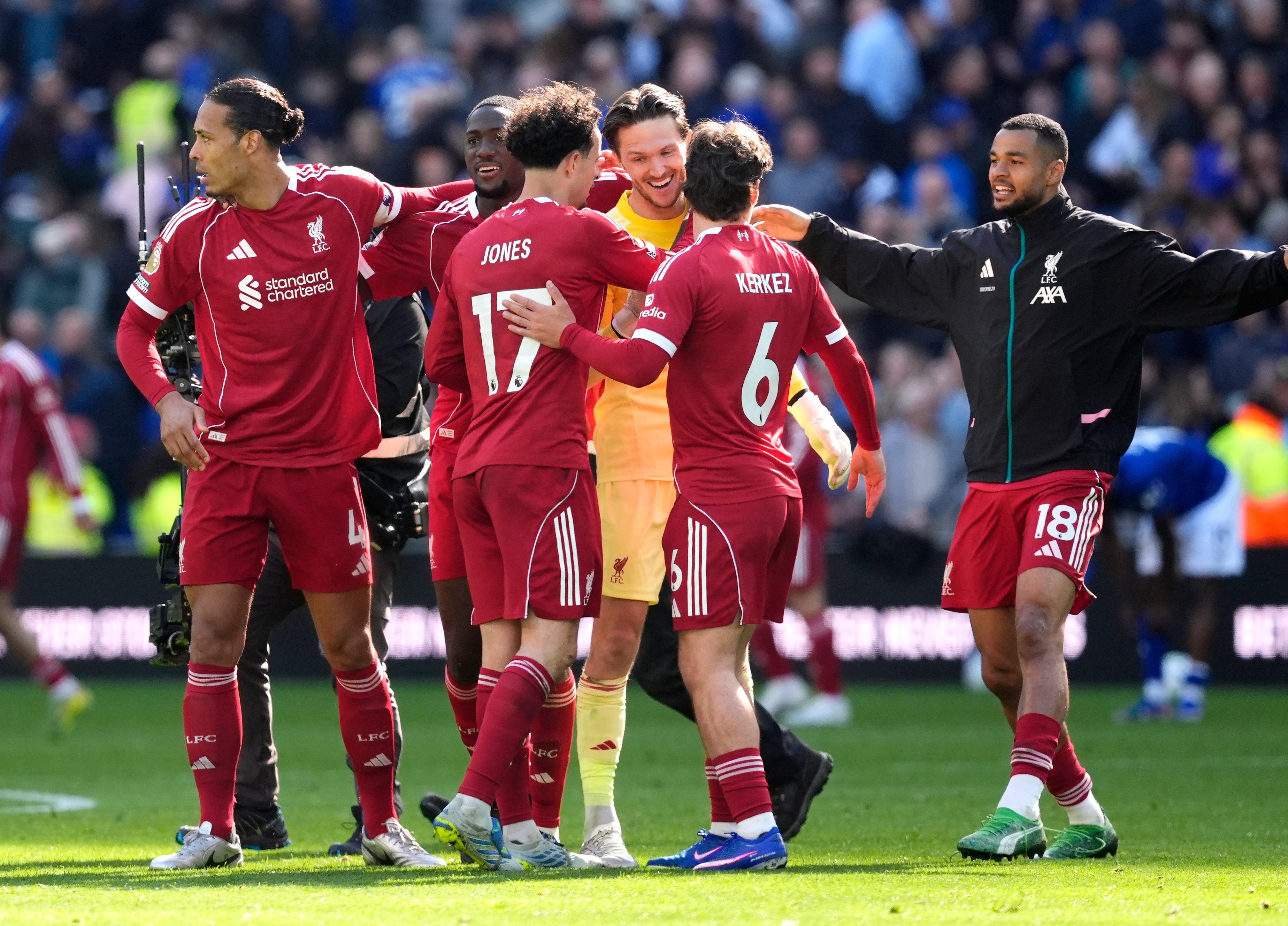
That would be another big challenge for an inexperienced goalkeeper, but it was telling Liverpool’s players surrounded Woodman to celebrate victory at the full-time whistle. Slot, however, said Liverpool could have Mamardashvili back sooner than expected. “It’s not going to be a long-term injury. Let’s see if he is available for next week,” Slot said. “We’ve had almost in all positions our problems and now even two goalkeepers being out.”
Liverpool players congratulate goalkeeper Freddie Woodman following the 2-1 win (PA)
Anonymous Isak and Wirtz struggle to make an impact
With Hugo Ekitike sidelined for the rest of the season, and much longer, this was another difficult day for Liverpool’s two other expensive signings in Alexander Isak and Florian Wirtz. Neither looked ready for the frantic nature of a Merseyside derby away from home, with Isak still working his way up to full fitness and Wirtz still adjusting to the physicality of the Premier League.
Both were quiet in the early spell where Everton were on top. Isak managed just two touches in the first 40 minutes of the game, before firing straight at Jordan Pickford shortly before half-time in his only sight of goal. Wirtz managed to find Isak at one stage and send him through on goal, but Jarred Branthwaite was quite easily able to get across and muscle the striker off the ball.
Advertisement
Liverpool lost control in the second half and when Everton equalised it came following another sustained period of pressure. Arne Slot eventually reacted by withdrawing Isak for Rio Ngumoha in the 72nd minute, and then Wirtz for Alexis Mac Allister as part of a double-change in the 84th minute. Neither had made an impact and the changes could have come much earlier.
Beto makes amends but Everton rue missed chances
With Everton roared on by a feverish atmosphere in the first Merseyside Derby at the Hill Dickinson Stadium, Liverpool would have been expecting their neighbours to make a lightning start. Still, they did not look prepared for how Everton would fly out of the traps and Arne Slot’s side were very fortunate to not fall behind early on.
Giorgi Mamardashvili first made an important stop to deny Beto’s header before Everton twice got in behind the Liverpool defence. Kiernan Dewsbury-Hall was played in with a ball over the top and demanded a penalty after stand-in right back Curtis Jones came in from the side and challenged him with his shoulder. Beto was slipped through but was closer to the corner flag than the goal with his finish as he opened up his body and looked for the far corner.
Advertisement
Iliman Ndiaye’s goal ended up being a hugely deflating moment, as Everton went from thinking they had taken a deserved lead to going behind just two-and-a-half minutes later. But Beto made amends in the second half as he slid in to score Everton’s equaliser. After their earlier let-offs, Liverpool were once again caught out by the ball over the top, with Dewsbury-Hall finding space and shrugging aside Ibrahima Konate before firing the ball across.
Manchester City produced a crucial 2-1 victory over Arsenal at the Etihad Stadium on Sunday, tightening the Premier League title race and cutting the gap at the top to just three points. Despite the defeat, Arsenal remain league leaders, but City’s win adds significant pressure heading into the final stretch of the season, especially with Pep Guardiola’s side still holding a game in hand.
Cherki sparks early City dominance
Advertisement
Manchester City started brightly and took the lead through Rayan Cherki, who produced a moment of individual brilliance. The midfielder danced through Arsenal’s defensive line before finishing clinically to put the hosts ahead. The goal reflected City’s early intensity and attacking intent in a high-stakes encounter.
However, Arsenal responded quickly, taking advantage of an error from City goalkeeper Gianluigi Donnarumma, whose mistake gifted the visitors an equaliser and brought the game back into balance.
Advertisement
Haaland delivers decisive blow
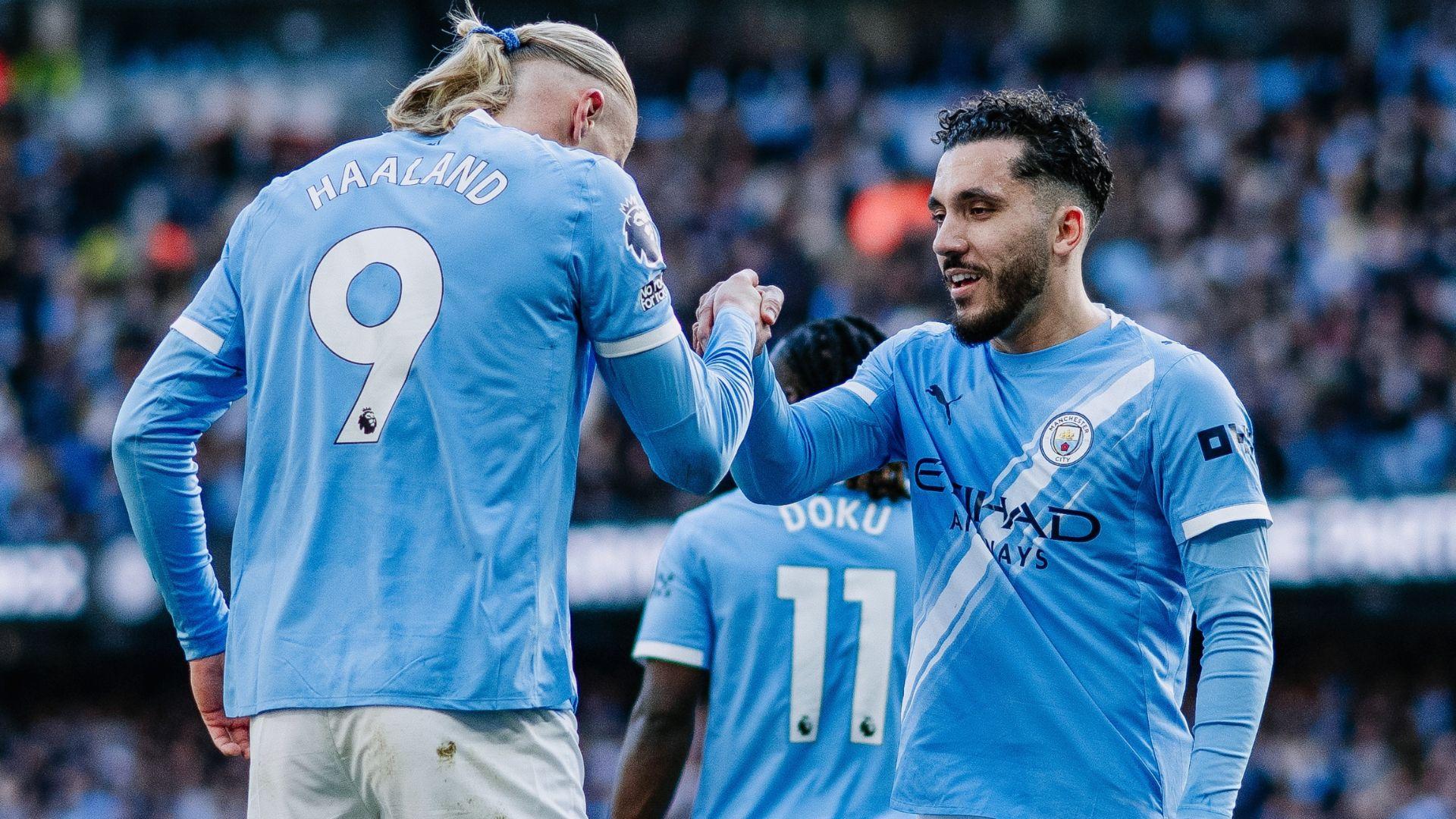
After a competitive first half, City regained control in the second period. The breakthrough came in the 65th minute when Nico O’Reilly delivered a precise cross into the box, finding Erling Haaland, who made no mistake with a clinical finish to restore City’s lead.
Advertisement
Haaland’s goal proved to be the decisive moment in a tightly contested match, showcasing his ability to deliver in crucial moments of the title race.
Arsenal fight but fall short
Advertisement
Arsenal continued to push for another equaliser but were unable to break down City’s defensive structure in the closing stages. Despite spells of pressure, they lacked the final cutting edge needed to rescue a point at the Etihad.
The result keeps Arsenal at the top of the table, but their lead has been reduced, increasing pressure as the season approaches its decisive phase.
Advertisement
Title race intensifies
With this victory, Manchester City have firmly re-entered the title race conversation. The gap is now just three points, and with a game in hand, Guardiola’s side are in a strong position to challenge for top spot.
Advertisement
Arsenal, meanwhile, will need to respond quickly to avoid losing momentum in what is shaping up to be a dramatic Premier League title finish.
The 2026 NFL draft is fast approaching, so it’s time to start looking at the Vikings’ draft options. Having previously looked at safety, we now turn our attention to another position that has been a popular choice in the mock drafts.
How Minnesota Can Attack DT across All Three Days
Defensive tackle is a position the Vikings need to strengthen, in terms of potential starters and depth. Here, we look at some of the Vikings’ draft options through the different rounds.
The Potential First Rounders
At one point, my 2026 Vikings draft crush, yet another injury heading into the combine has seen the excitement that was building for Caleb Banks. The talent is unquestionable; he wowed at the combine while carrying an injury, but his lengthy injury history (including multiple foot injuries) is a major red flag.
Advertisement
Banks can be a complementary pass-rush option early in his career, and can be a very good player in both phases if he can stay healthy. Right now, that is a big if, which makes pinpointing where he becomes good value in the draft difficult. I don’t think you can draft him at 18, but if the Vikings trade back, then he becomes an option.
Feb 25, 2026; Indianapolis, IN, USA; Florida defensive lineman Caleb Banks (DL02) speaks during the NFL Scouting Combine at the Indiana Convention Center. Mandatory Credit: Kirby Lee-Imagn Images
Peter Woods offers an ideal blend of size, strength, and athleticism. His explosive first step and ability to convert speed to power make him disruptive at the line of scrimmage. He created a lot of pressures in college, but his pass-rush repertoire needs fine-tuning to make sure he turns those pressures into sacks – especially entering the pro ranks.
Woods was expected to be a top-half first-round pick entering the 2025 season, but after a disappointing year, his draft stock has fallen. He is also a player who becomes a better option if the Vikings trade back.
The most solid option of the potential first-rounder is Kayden McDonald. He is a big, powerful nose tackle who can be the cornerstone of the Vikings’ stout run defense. You know what you are getting with McDonald, which includes a limited pass-rush profile. For that reason, 18 is too high for him, so we are yet again looking at a trade back to make McDonald feel like a viable option.
Advertisement
Day 2 Represents Plenty of Good Options
A big argument for not drafting a DT in the first round is that the drop off on Day 2 isn’t too steep – all three of the listed potential first rounders may even make it to Day 2. Lee Hunter highlights the choices here, a player who showed steady improvement across four seasons.
He excels in run defense, but his improvement in pass-rush situations is what caught the eye over the past year and saw his draft stock climb.
Christen Miller is another round-two prospect with a strong frame, good length, and rare twitch for an interior defender. His quick first step, leverage, and processing ability make him a reliable run defender. He has raw power but needs to develop a pass-rushing skillset if he is to become a top player.
Another big guy in the middle is Domonique Orange. The Vikings have shown interest in the massive defensive line prospect during the pre-draft process. He has elite power potential, supported by impressive weight-room strength. He has first-step explosiveness; however, his hand speed and pass-rush finesse are limited.
He is the guy who can be the immovable object in the middle that the rest of the defensive line works around. Two more names to look out for in a similar mold on Day 2 are Darrel Jackson Jr and Rayshaun Benny.
Advertisement
The Best of the Rest On Day 3
Dontay Corleone, known as “The Godfather,” was one of the most dominant run defenders in 2022, using his size and strength to control the line of scrimmage. He also showed great pass-rushing skills early in his career, but the production faded in recent seasons. Four years on, and the outlook isn’t so good, and a blood clot issue in 2024 adds some concern. He offers rare quickness for a nose tackle and would be worth a gamble from the fifth round onwards.
Oct 4, 2025; Cincinnati, Ohio, USA; Cincinnati Bearcats defensive lineman Dontay Corleone walks off the field after defeating the Iowa State Cyclones at Nippert Stadium. Mandatory Credit: Aaron Doster-Imagn Images
A couple of other options at nose tackle worth looking at in the later rounds are Deonte Capehart and Tim Keenan. Capehart is a long, experienced defensive tackle, but he must use his length more consistently when stacking and rushing. Limited twitch and slower block-shedding cap his ceiling, though he can contribute as a rotational run defender. Keenan is a similar story whose strength and leverage make him a solid run defender who could be used in the rotation, but would need to develop his pass rushing to become more than that.
Proud UK Viking. Family Man. Enjoy writing about my team. Away from football an advocate for autism acceptance.
Minnesota Vikings head coach Kevin O’Connell observes pregame warmups ahead of facing the Seattle Seahawks, with Nov 30, 2025 marking the matchup at Lumen Field in Seattle, Washington. O’Connell evaluated his team during preparations before kickoff in the late-season contest. Mandatory Credit: Kevin Ng-Imagn Images.
The Minnesota Vikings will answer all your draft questions in four short days, with the event kicking off in Pittsburgh on Thursday night. Minnesota is scheduled to pick nine times from Thursday through Saturday, several more picks than last year. So, these are the main questions facing the franchise.
Five questions. One draft. Answers are on the way.
The Biggest Decisions Still Hanging Over Minnesota’s Draft Plan
Interim Rob Brzezinski will run the draft for the very first time as the top guy.
Advertisement
Minnesota Vikings edge rusher Jonathan Greenard (58) closes in on Chargers quarterback Justin Herbert (10) during first-half action, Oct 23, 2025, at SoFi Stadium in Inglewood, California, collapsing the pocket with speed and power as Minnesota’s defense applies pressure and disrupts the timing of the Los Angeles passing attack. Mandatory Credit: Gary A. Vasquez-Imagn Images
5. Are Any Existing Players Traded?
The Vikings arguably have three main trade candidates at the moment:
Jordan Addison (WR)
Jonathan Greenard (OLB)
J.J. McCarthy (QB)
Addison and McCarthy probably won’t be traded, but Greenard is somewhat fair game, especially after his former employer, the Houston Texans, extended Will Anderson’s contract for three years and $150 million on Friday. That deal places Greenard in the $35 million-per-season range, which the Vikings may not be able to afford.
In theory, Minnesota could ship Greenard to an EDGE-needy team for a 2nd-Round pick and draft a rookie replacement.
4. What’s the New Center’s Name?
Advertisement
Unless the Vikings just love Blake Brandel, a new center is likely on the way from the draft. In tiers, these are the options:
Tier 1 —
Sam Hecht (Kansas State)
Connor Lew (Auburn)
Logan Jones (Iowa)
Jake Slaugther (Florida)
Tier 2 —
Parker Brailsford (Alabama)
Pat Coogan (Indiana)
The Tier 1 options will probably be drafted from Round 2 through 4; Tier 2 is after Round 4. Jones and Slaughter are “old” rookies who should be more game-ready than most. Lew is 20, and Hecht is a normal rookie age.
3. Who’s the New Running Back?
If one assumes that Notre Dame’s Jeremiyah Love will be picked in the Top 10 or before the Vikings’ draft pick, Minnesota must choose between these runners:
Advertisement
Jadarian Price (Notre Dame | R2)
Mike Washington Jr. (Arkansas | R3)
Jonah Coleman (Washington | R3)
Emmett Johnson (Nebraska | R4)
Kaytron Allen (Penn State | R5)
Nick Singleton (Penn State | R5)
Demond Claiborne (Wake Forest | R6)
Adam Randall (Clemson | R6)
Le’Veon Moss (Texas A&M | R7)
The Vikings have met with several rookie tailbacks in the last two months; a new one is probably on the way. Aaron Jones and Jordan Mason are scheduled for 2027 free agency.
Nebraska running back Emmett Johnson (21) crosses the goal line for a touchdown against USC during first-half action, Nov 16, 2024, at the Los Angeles Memorial Coliseum in Los Angeles, California, finishing the run with momentum as he breaks through the defense to help Nebraska build an early offensive surge. Mandatory Credit: Gary A. Vasquez-Imagn Images
It’s worth noting that Johnson is from Minneapolis and has openly campaigned to be drafted by the Vikings. Our Brevan Bane on Johnson: “Johnson’s fit would be in the same realm of what Demond Claiborne would bring, just in a different style. The pass protection isn’t there, but Johnson would be an elusive back to Jordan Mason’s more power-running style.”
“With Johnson in the backfield, assuming Jordan Mason extends with the Vikings after 2026 (and also that Aaron Jones is gone after this year), Minnesota would still lack a running back that can either pass protect really well or truly turn on the burners. He’s different enough from Jordan Mason to not make the backfield completely redundant, but still lacks in some of the same areas that Mason does, although beating him in others.”
2. Will the Vikings Continue to Gloss Over CB?
Fact: In 2022, the Vikings needed a cornerback; they drafted a safety in Round 1 instead.
Fact: In 2023, the Vikings needed a cornerback; they drafted a wide receiver in Round 1 instead.
Advertisement
Fact: In 2024, the Vikings needed a quarterback and an edge rusher; they drafted a safety in Round 1 instead.
Fact: In 2025, the Vikings needed a cornerback; they drafted a guard in Round 1 instead.
Does this pattern just continue? Does defensive coordinator Brian Flores really not need elite corners for his defense to flourish? How good would the defense be if he picked one?
1. Alas, Who’s the Pick at 18?
Advertisement
This year’s Vikings draft is extremely tricky to predict if one doesn’t expect it to be as simple as drafting Dillon Thieneman of Oregon. They could draft a cornerback, defensive tackle, tight end, wide receiver, or a safety like Thieneman, and no one would be too flabbergasted.
Toledo Rockets safety Emmanuel McNeil-Warren (7) celebrates a third-down stop against Louisville during the third quarter, Dec 23, 2025, at Flagler CU Stadium in Boca Raton, Florida, reacting with visible energy after halting the drive as teammates rally around him during a key moment in the Boca Raton Bowl matchup. Mandatory Credit: Jeff Romance-Imagn Images
As an example, Minnesota’s pick could be any man from this list:
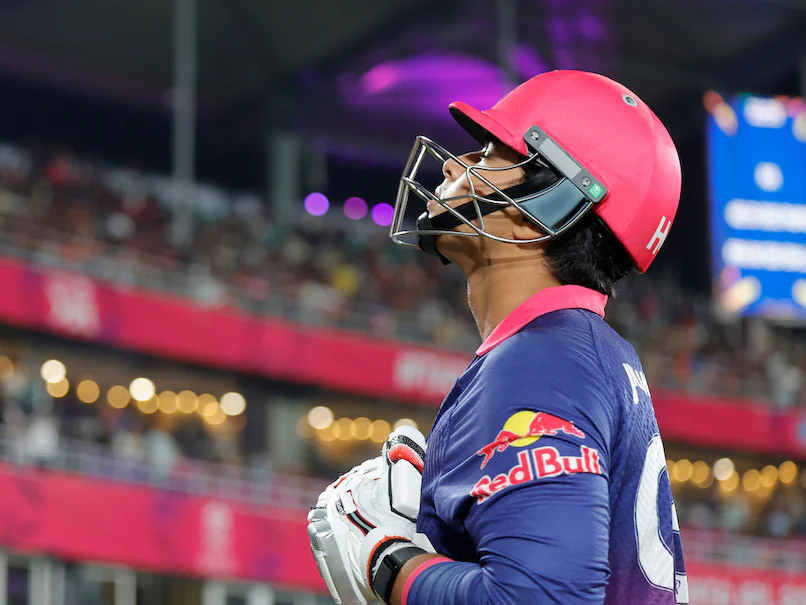
The 15-year-old Vaibhav Sooryavanshi has made a confident statement about his approach to the game and long-term ambition of representing India at the senior level, while also underlining his belief in his ability to change matches in pressure situations. Speaking on Doordarshan, Sooryavanshi reflected on his mindset at the crease and the conversations he has had with his family regarding his cricketing journey. Emphasising his self-belief, he said he remains focused on utilising his skills to influence games whenever he is at the crease.
“For whatever duration I am on the ground, as long as I am using my skills, dominate and play, I can snatch the match from opponents’ hands. I also spoke to my father. He said I have fulfilled half of his dream, but half is still left. I need to play in the World Cup for the senior Indian team. Of course, every player shares the same dream: to play for the seniors and win for their country, India. That is my focus for India,” Sooryavanshi said.
Former India cricketer Saba Karim, who also featured in the discussion, praised Sooryavanshi’s natural striking ability and compared his raw power to some of the best batters seen at a young age.
Advertisement
However, he made a distinction between power and technical refinement, suggesting that the youngster’s biggest strength lies in his natural ability rather than structured coaching.
“The power I saw in Sachin Tendulkar at a similar age, Vaibhav Sooryavanshi has more power than that. I am talking about power, not technique. This boy’s bat speed, his swing, his high back-lift, that is unbelievable. And no coach can teach that. You get that by birth.”
In the Indian Premier League (IPL) 2026 so far, Rajasthan Royals opener Vaibhav Sooryavanshi has smashed 246 runs in six matches at a staggering strike rate of 236.53.
(Except for the headline, this story has not been edited by NDTV staff and is published from a syndicated feed.)
Advertisement
Featured Video Of The Day
IPL 2026 | Delhi Capitals Wins By 6 Wickets Against Mumbai Indians: Redemption For Sameer Rizvi
The league table never lies, apparently. It may do now. A supposed title decider ended with the side still in second nevertheless possessing the advantage. It has been Arsenal’s title to lose for months, but perhaps this defeat means it is being lost.
They had retreated down the tunnel at the Etihad Stadium as Manchester City went on their lap of honour, a bare-chested Erling Haaland letting his hair run free, Pep Guardiola directing kisses to the crowd, Gianluigi Donnarumma beating the badge on his chest, relieved the biggest error of his season had become a footnote, not the faulty footwork that determined the destination of the trophy.
An epic game delivered a massive momentum shift to Manchester. In their last four matches against domestic opponents, Arsenal have lost to City twice, Southampton and Bournemouth. In their last four fixtures, City have beaten Arsenal twice, Liverpool and Chelsea. They are peaking when it matters. “We are alive,” said Guardiola, who had warned it would be all over with defeat. “I’m happy because we can extend the hope.”
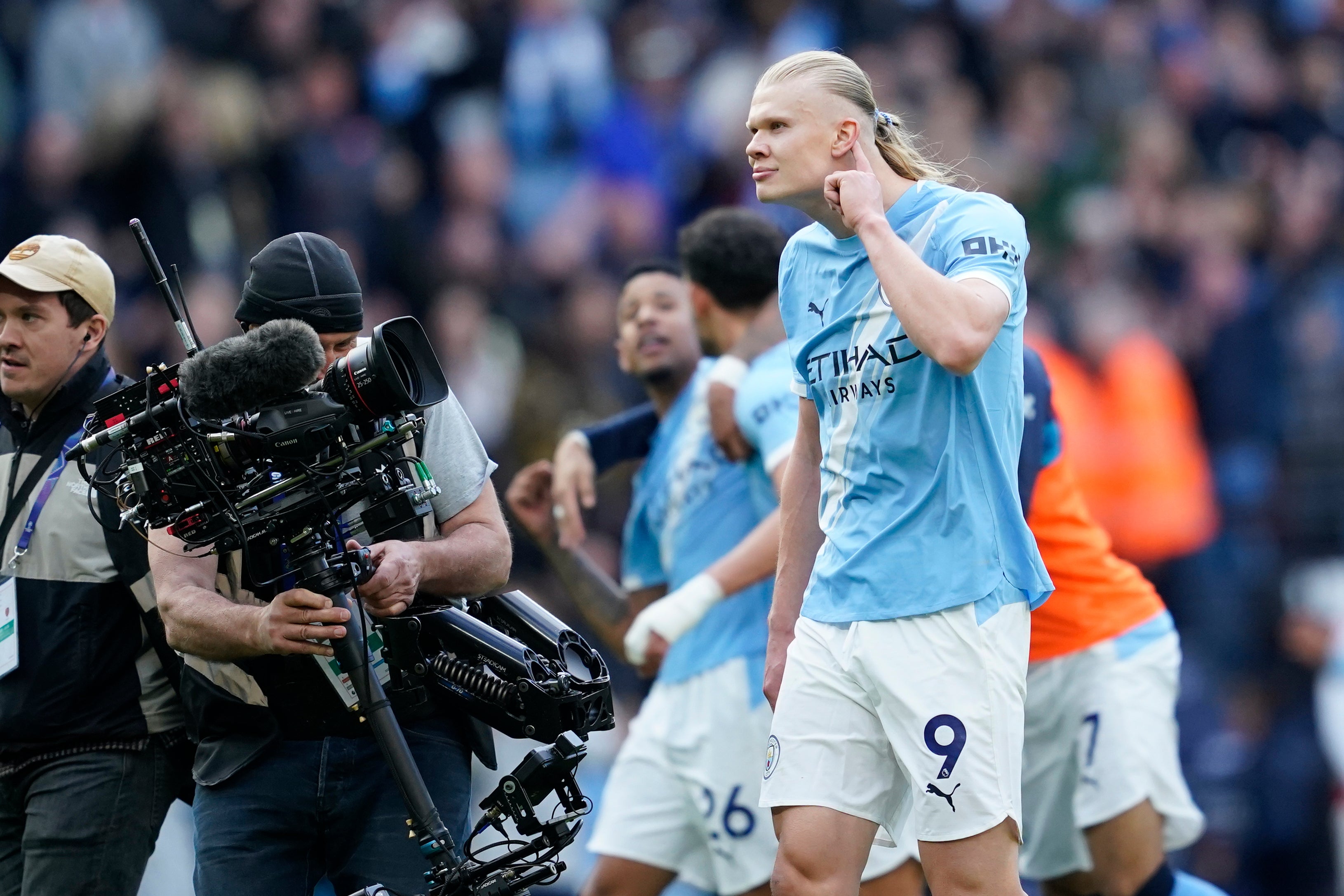
Where there was Haaland, there was hope. City had the big man for the big occasion. Three years ago, Haaland – along with Kevin de Bruyne – decided a similar clash with Arsenal. History repeated itself when the striker contorted his giant frame to hook in a shot.
Advertisement
He had hit the post earlier. He had not scored in the Premier League for two months. He has had a barren 2026 but his last two home games have yielded a hat-trick against Liverpool and now this, perhaps the most seismic of his 158 City goals.
Erling Haaland provided the key moment for Man City (AP)
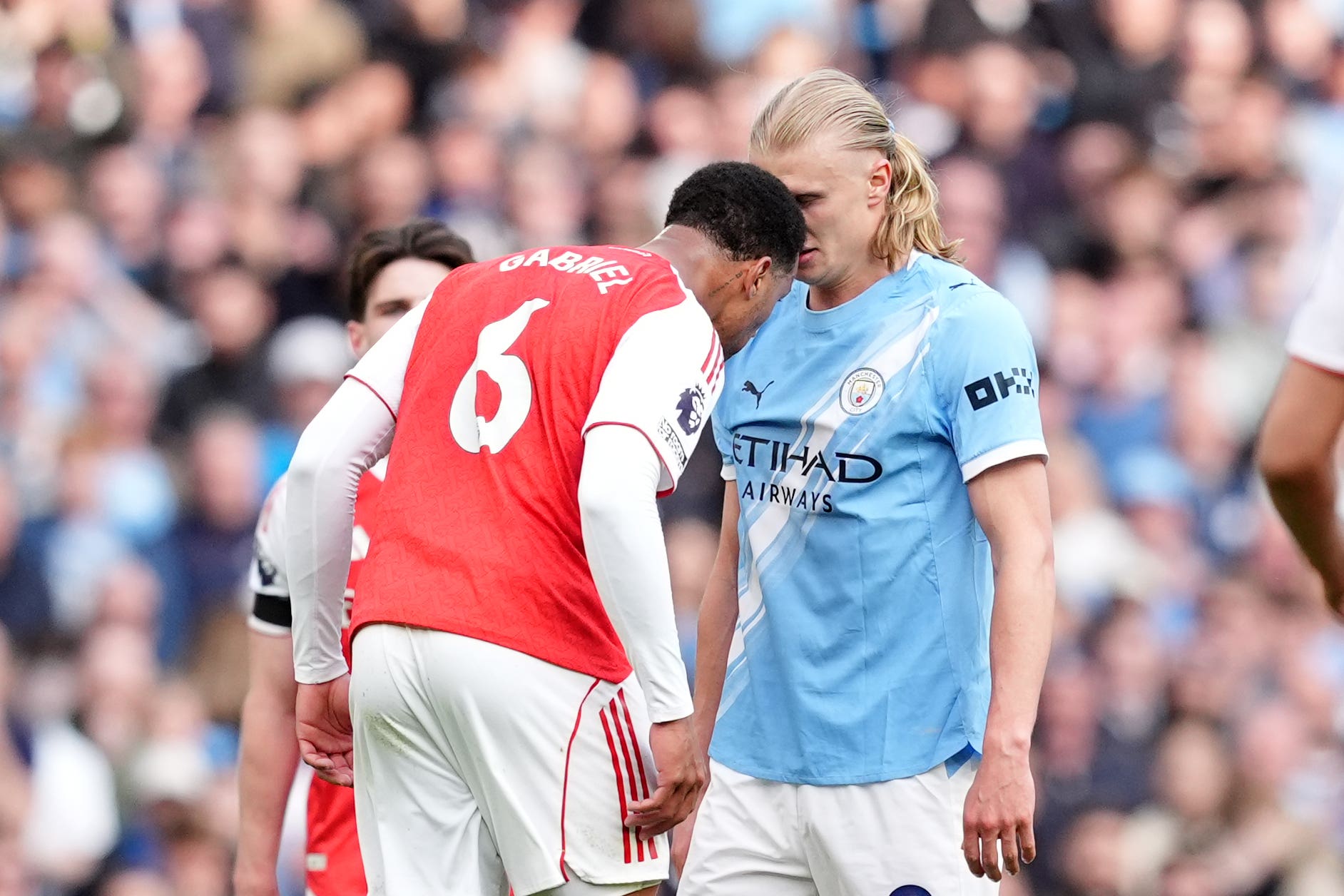
He also nearly managed to goad Gabriel into a red card for a ‘headbutt’ (PA)
He was too much of a handful for Gabriel Magalhaes, who ripped his shirt tugging the Norwegian and somehow escaped a red card for aiming a headbutt at him. “I think if I fell on the floor, which I will not do unless someone really attacks me, it will maybe be a red card,” said Haaland. His honesty did not cost City. But Arsenal, the supposed defensive masters, were frayed in other respects, caught crucially on a counter-attack.
The talismanic Nico O’Reilly, Arsenal’s Carabao Cup final nemesis, was his provider, with a low cross after running the ball out from his own half. A move begun by Donnarumma – this time his distribution was good – was finished by Haaland. He was there at the end, too, hoofing the ball clear from the edge of his own box. It amounted to a marauding display. “Today he fought like an animal,” said his captain, Bernardo Silva.
Donnarumma had particular grounds to be grateful to the warrior-striker. The goalkeeping error in the Carabao Cup final came from Arsenal and it was costly. This stemmed from City, but it was not. Kai Havertz scored a Champions League final winner against them, but when it seemed he had delivered a goal of a similar magnitude in the Premier League, Haaland ensured otherwise. “The difference was in both boxes,” lamented Arteta.
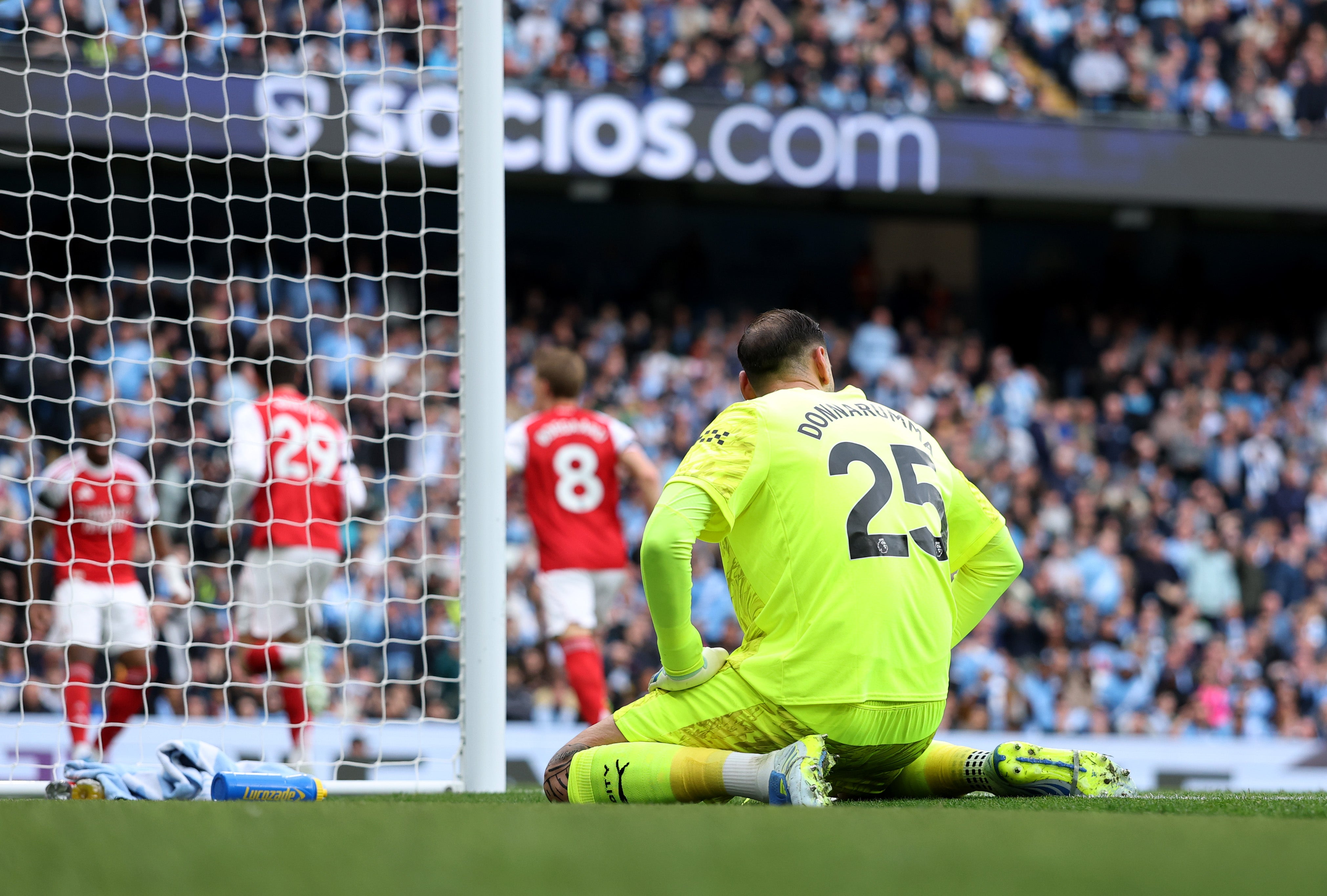
Gigi Donnarumma made a huge error early in the game (Getty)
Each had scored from inside them as they traded goals in 107 seconds. Rayan Cherki, who had already hit the woodwork, weaved his way between Gabriel and Declan Rice, and angled his shot in off the far post.
But Arsenal were bolder than many expected. They did not come just to nullify City, and Arteta used their physical power to press high. It yielded a remarkable goal. Havertz charged down Donnarumma’s clearance, the ball flying in. It was a reminder that Donnarumma is no Ederson, no typical Guardiola goalkeeper. It revived the old criticism about his shortcomings with the ball at his feet. “The mistake from Gigi is our mistake,” said Guardiola. He could be forgiving because the Italian was to have a redemptive second half: a superb save from Havertz, the quick ball out that led to City’s second goal.
Advertisement
Which rendered it tougher for an Arsenal side who have only scored four times in six games. They scarcely fashioned their latest effort with creativity. And yet they were agonisingly close to more.
Havertz was denied by Donnarumma. Eberechi Eze struck one post with a shot, Gabriel the other with a header that deflected off O’Reilly. Havertz headed just over in the 95th minute. They could scarcely have come closer. “The margins,” sighed Arteta. “We hit the post [with Eze], I look at the images, it is incredible how the ball doesn’t go in.”
Eberechi Eze was agonisingly close to scoring (Getty)
Part of the frustration for him may be that Arsenal were far better than they were against Bournemouth, and that he did much right. Choosing both Eze and Odegaard added flair; one almost scored, the other nearly assisted. Havertz looked a vast upgrade on the dropped Viktor Gyokeres. And yet it still was not enough.
Guardiola, Arteta’s boss for three-and-a-half years, can still be the boss when it matters. The business end of the season often brings the best from him. The strangest, too. He had slapped his thighs in irritation.
He went through his repertoire of extraordinary – at times, indescribably weird – gestures on the touchline. When he complained Gabriel did not see red, he got his seventh yellow card of the campaign. He may get his seventh Premier League title.
Advertisement
Arteta’s first could remain elusive. “We go again,” he said. But they may be second again.
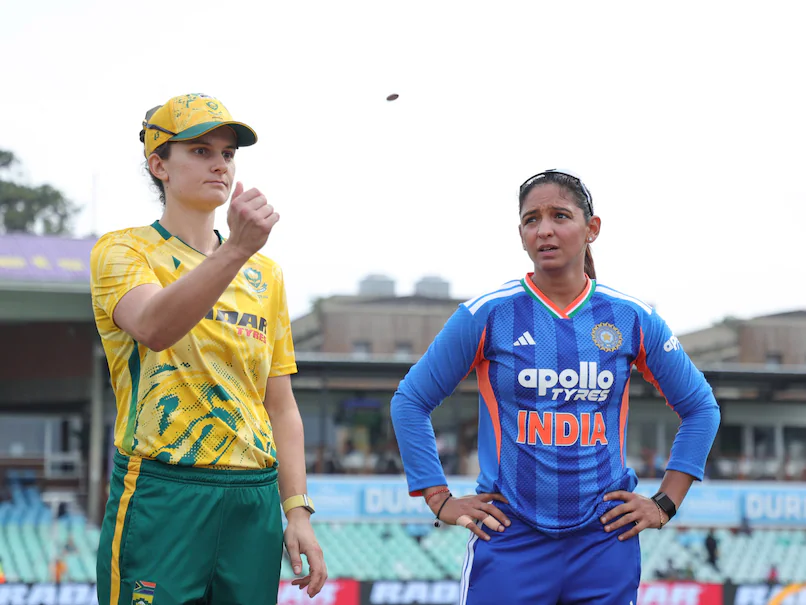
India captain Harmanpreet Kaur admitted her team is going through a tough phase but stressed the need to stick together and bounce back after suffering their second successive defeat to South Africa in the women’s T20 International series here on Sunday. India went down meekly by eight wickets in the second women’s T20I to trail 0-2 in the five-match series here on Sunday. Asked to bat first, India were all out for 147 and SA chased down the target quite comfortably, reaching 148 for 2 in 17.1 overs.
“Tough time. We as a team need to stay together,” Harmanpreet said at the post-match presentation.
“Hopefully, we’ll go (to Johannesburg for the third match on April 22) with positive approach. T20 format is like that: it’s about staying together.” Harmanpreet rued that her team could not do well in the death-over batting and powerplay bowling.
Advertisement
“I think with bat, we were not able to contribute way we wanted. Last ten overs of the innings we did not bat well. We need to think how we go about next three matches. When you’re not getting the shots, rotating strike is a key point. We were discussing… we can rotate strike and it can help us through that time. But it’s a time when things didn’t work.
“Powerplay, while bowling, is not going our way.” Opener Shafali Verma was the lone bright spot for India with a 38-ball 57, which was studded with seven fours and two sixes.
“Shafali been a great talent for us. Attacking batter. Hope she’ll continue for us,” the skipper said.
South Africa captain Laura Wolvaardt said restricting India to 147 all out was a good job done by her side.
Advertisement
“Pretty good catching, one or two put down, but we took one or two good ones as well. After start they had, restricting them was great,” she said.
“Area we struggled with last season (death bowling), bowlers identified bowling slower ones into the wicket was helping. It’s something we’ve talked a lot about. Being present on the cricket field. Little things showing on the field.” “(We’re in) great position to be in. But India, world champs in ODI cricket, they’ll come back pretty hardly. Switch off tomorrow and then be ready for the next one.”
(Except for the headline, this story has not been edited by NDTV staff and is published from a syndicated feed.)
Featured Video Of The Day
Tushar Deshpande’s Brilliant Final Act Ensures Thrilling Win For RR Over Gujarat Titans
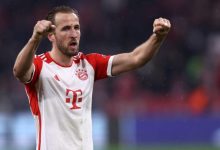
Bayern Munich came from behind to beat VfB Stuttgart at the Allianz Arena and secure the Bundesliga title for a record 35th time.
The Bavarians, who have been dominant this season with only one defeat, needed just a draw to be confirmed champions after Borussia Dortmund lost to Hoffenheim on Saturday.
However, Stuttgart made a bright start and nearly delayed the celebrations. Chris Führich opened the scoring in the 21st minute with a fine curling effort that left the home fans stunned.
Advertisement
Bayern reacted quickly. Raphaël Guerreiro equalised 10 minutes later, before Nicolas Jackson, filling in for Harry Kane, put the hosts ahead just two minutes after the equaliser.
Alphonso Davies added a third goal before half-time, reacting smartly inside the box to guide the ball past Alexander Nübel after a pass from Luis Díaz.
Kane, who replaced Jamal Musiala at the break, made an instant impact. The England striker scored Bayern’s fourth goal just seven minutes into the second half, taking his league tally to 32 for the season.
Advertisement
Stuttgart managed a late reply through Chema Andrés in the 88th minute, but it was not enough to stop Bayern’s celebrations.
The victory means Bayern have now won 13 titles in the last 14 seasons, underlining their dominance in German football. They remain on course for a possible treble, with important semi-final clashes against Bayer Leverkusen in the DFB-Pokal and Paris Saint-Germain in the UEFA Champions League still to come later this month.











































You must be logged in to post a comment Login