

Crypto World
Missouri lawmakers advance revived Bitcoin strategic reserve bill to committee



Missouri lawmakers have advanced a strategic Bitcoin reserve bill that would allow the state treasurer to “accept gifts, grants, donations, bequests, or devises of bitcoin from eligible Missouri residents or a governmental entity.”
Summary
- Missouri’s HB 2080 would create a Bitcoin Strategic Reserve Fund funded primarily through donations.
- Bitcoin held in the fund must remain in cold storage for at least five years.
House Bill 2080 was introduced by Rep. Ben Keathley last month, was subsequently referred to the House Commerce Committee on Feb. 19, and is now pending a committee Hearing.
According to official documents, the bill seeks to establish a “Bitcoin Strategic Reserve Fund” funded primarily by “gifts, grants, donations, bequests, or devises of bitcoin,” but also includes a provision allowing the state treasurer to “invest, purchase, and hold cryptocurrency using state funds.”
All funds received would be stored in cold storage and held for at least five years “from the date that the bitcoin enters the state’s custody”, after which the bitcoin “may be transferred, sold, appropriated, or converted to another cryptocurrency.”
The treasurer can contract with a qualified, independent, United States-based third-party cryptocurrency entity to assist in the creation, maintenance, operation, and administration of the fund’s security, and would be required to publish a biennial report.
Once the bill clears the House Commerce Committee, it will be forwarded to the full House chamber, where it will have to be debated and approved by a majority vote before it may be passed and sent to the Senate for committee review, floor consideration, and a final vote.
HB 2080 is a successor to HB 1217, introduced early last year by Rep. Ben Keathley, with the only notable difference being that it has been referred to the House Commerce Committee instead of the Special Committee on Intergovernmental Affairs, where it previously stalled and ultimately died in committee.
If passed, Missouri will join Texas, New Hampshire, and Arizona in advancing state-level Bitcoin reserve frameworks, out of which Texas and New Hampshire allow direct public fund investments, while Arizona’s law restricts the reserve to Bitcoin acquired through seized and forfeited assets rather than new taxpayer allocations.



Brent, WTI fell ~3–5% Monday after Trump’s 15% tariffs and easing Iran war risk.
Summary
- Brent and WTI declined sharply, testing key technical support levels as futures markets repriced lower demand from higher U.S. import tariffs.
- Trump lifted temporary tariffs from 10% to 15% on all U.S. imports after a Supreme Court ruling, a move analysts say will weigh on trade, industry and fuel consumption.
- Iran–U.S. nuclear talks in Geneva cut perceived war risk, reducing the geopolitical premium in crude even as Goldman Sachs still expects a 2026 surplus with modest WTI forecast tweaks.
Oil prices declined sharply on Monday as markets reacted to increased U.S. tariffs and developments in diplomatic negotiations with Iran, factors that analysts said are reshaping near-term expectations for crude demand and supply.
Brent and West Texas Intermediate (WTI) crude both fell, testing key technical support levels, according to market data.
President Donald Trump raised temporary tariffs from 10% to 15% on all U.S. imports over the weekend, according to a White House announcement. The increase followed a U.S. Supreme Court ruling that struck down the previous tariff program.
Financial markets responded with gold prices rising and U.S. equity futures declining. Market analysts stated that oil prices were affected by the same risk-averse trading sentiment. Higher tariffs typically reduce trade volumes, weaken industrial output, and suppress fuel demand, factors that are considered bearish for crude prices, according to commodity analysts.
A third round of nuclear negotiations between the United States and Iran is scheduled for Thursday in Geneva, Oman’s foreign minister confirmed. Iranian officials have indicated the country may offer concessions on its nuclear program in exchange for sanctions relief, according to diplomatic sources.
Concerns about potential military conflict in the Middle East had recently supported higher oil prices, but that geopolitical risk premium has diminished as traders assign a lower probability to supply disruptions from the region, market observers said.
Goldman Sachs forecasts the global oil market will remain in surplus in 2026, assuming no major disruption to Iranian supply, the investment bank stated in a research note. The bank revised its fourth-quarter price forecasts, citing lower inventories among Organisation for Economic Co-operation and Development (OECD) countries as a factor in its WTI adjustment.
Market direction remains uncertain in the short term due to unresolved factors including tariff policy, Iran diplomacy, and the Russia-Ukraine conflict, suggesting continued volatility in oil prices, according to market analysts.
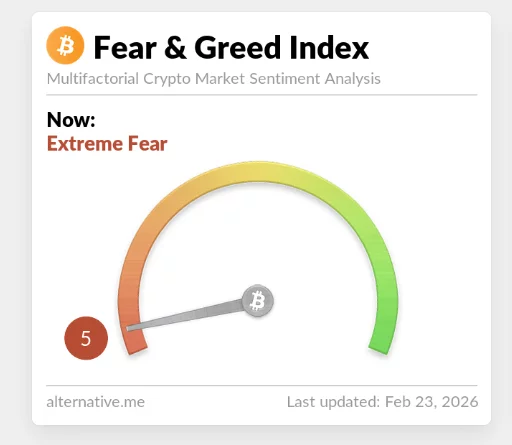
Crypto markets are flashing deep stress signals as geopolitical tensions surrounding a potential U.S. strike on Iran intensify and liquidity continues to drain from the system.
Summary
- The Crypto Fear & Greed Index has plunged to 5, signaling extreme panic as geopolitical tensions around a potential U.S. strike on Iran intensify.
- Bitcoin has dropped below key technical levels, while the broader crypto market has erased over $2.22 trillion — down more than 50% from its peak, marking one of the largest drawdowns in history.
- Despite the selloff, shrinking USDT supply down over $3 billion in 60 days suggests liquidity contraction that has historically appeared near late-stage market bottoms.
Iran strike fears spill into crypto markets
The Crypto Fear & Greed Index has plunged to 5 — “Extreme Fear”, one of the lowest readings in years, showing panic-level sentiment. Historically, such extreme readings have only appeared during major market dislocations, including the 2020 COVID crash and the 2022 bear market lows.
The collapse in sentiment mirrors Bitcoin’s sharp drop below key technical levels, reinforcing the view that traders are positioning defensively amid geopolitical uncertainty.
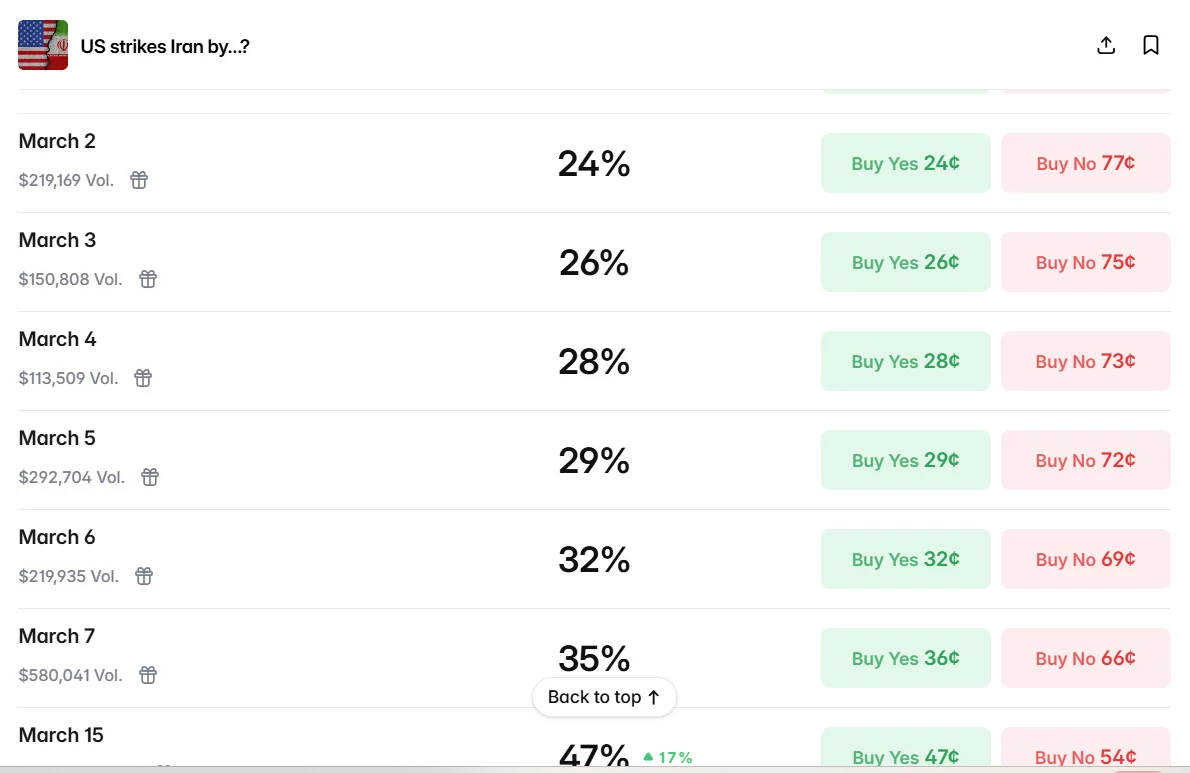
At the same time, prediction market Polymarket shows rising bets on possible U.S. military action in early March, with probabilities climbing steadily day by day, reflecting growing geopolitical uncertainty priced into markets.
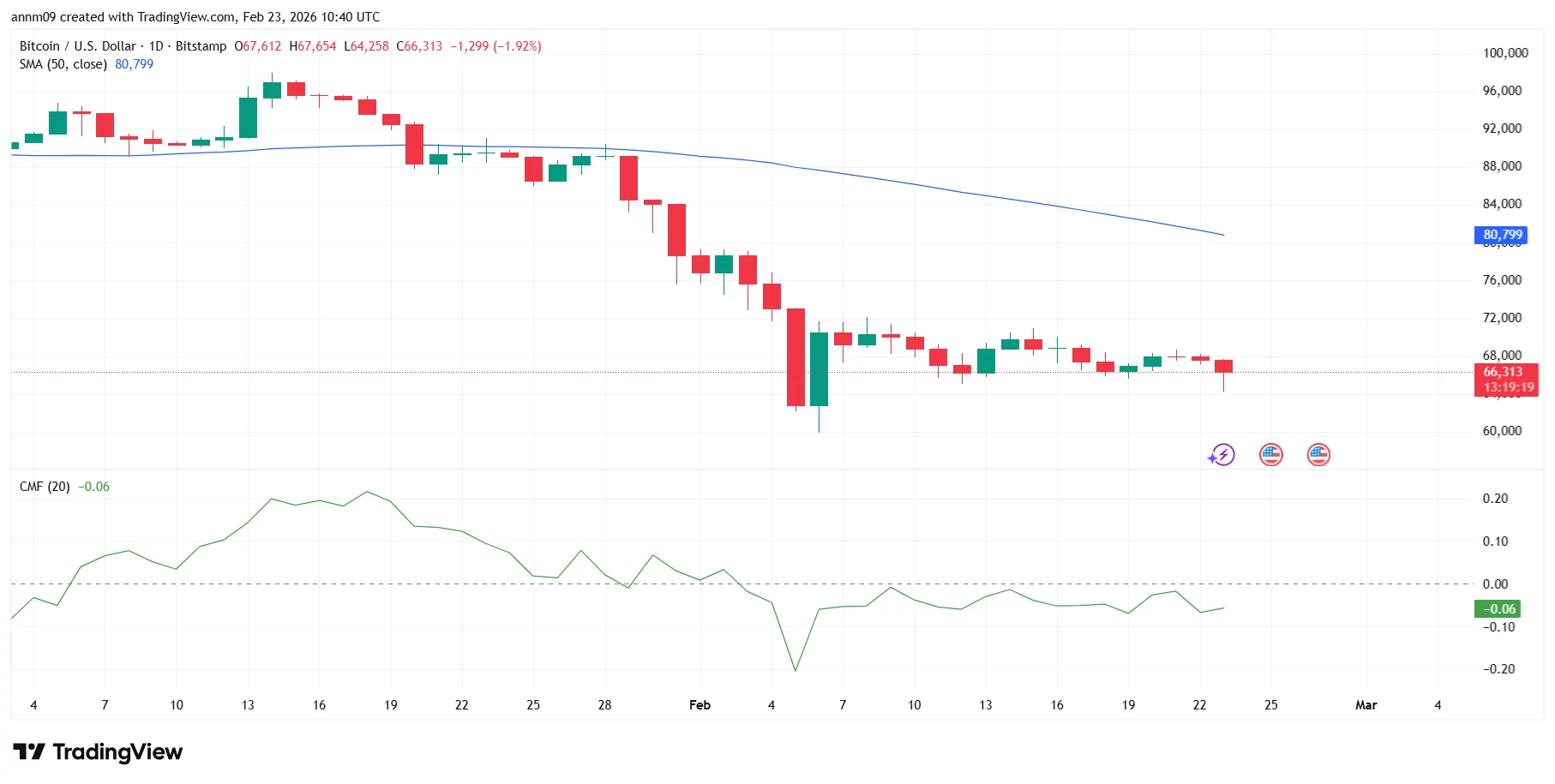
Meanwhile, price action mirrors the anxiety. Bitcoin has fallen sharply from recent highs and is trading well below its 50-day moving average, while the broader crypto market has shed more than $2.22 trillion, down over 50% from its peak.
In a widely shared post, Coin Bureau warned that “CRYPTO MAY BE HEADING TOWARD ITS LARGEST CRASH EVER,” noting that the current drawdown is now the second-biggest dollar loss in history, just $60 billion shy of the all-time record.
Yet liquidity data suggests a more nuanced picture. Another Coin Bureau analysis highlighted that USDT supply has fallen by more than $3 billion in 60 days, a contraction last seen during the FTX collapse.
Historically, shrinking stablecoin supply signals capital leaving the market but similar conditions in 2022 marked Bitcoin’s cycle bottom.
Ultimately, while a potential U.S. strike on Iran could trigger another wave of short-term volatility, the data suggests markets may already be pricing in extreme risk. With sentiment at capitulation levels, over $2.22 trillion erased, and stablecoin liquidity contracting to levels previously seen near cycle lows, the conditions resemble late-stage selloffs more than the early phases of a collapse.


South Korea’s central bank has reportedly renewed its push to keep Korean won-pegged stablecoin issuance in the hands of commercial banks, warning lawmakers that privately issued digital tokens could undermine monetary policy and create new foreign-exchange and financial-stability risks.
In a report submitted to South Korea’s National Assembly Strategy and Finance Committee, the Bank of Korea (BOK) described won stablecoins as “currency-like substitutes” and said their introduction must account not only for industrial benefits but also for monetary policy, foreign exchange stability and financial risks, according to local reporting.
The central bank reiterated concerns that stablecoins could be used to bypass foreign exchange regulations, including prior reporting requirements, and argued that allowing non-bank entities to issue them independently could conflict with Korea’s separation of banking and commerce principles.
It added that banks, which are subject to capital, governance and compliance standards, should be permitted first, with any expansion beyond banks proceeding gradually after risk assessments.
The report lands as lawmakers debate a delayed stablecoin framework, with one of the main sticking points being who should be eligible to issue won-pegged tokens and how much control banks should hold in any issuing entity.
Cointelegraph reached out to the Bank of Korea for more information, but had not received a response by publication.
Central bank proposes safeguards against stablecoin risks
The bank reportedly said programmable stablecoins could support digital asset innovation and function as payment tools, but it also floated structural safeguards, including a bank-centered consortium model and a statutory interagency policy body that could coordinate approvals and supervision across regulators.
The BOK reportedly cited the United States’ GENIUS Act framework as an example of cross-agency supervision that involves the Treasury Department, Federal Reserve and the Federal Deposit Insurance Corporation.
Related: Wemade taps Chainlink for Korean won stablecoin infrastructure
Debate stalls broader stablecoin framework
The BOK’s report echoes its earlier warnings, which argue that banks should lead the rollout for stablecoin issuance since they are already subject to strict regulatory requirements. However, that approach has faced pushback from industry participants and some lawmakers.
Sangmin Seo, the chair of the Kaia DLT Foundation, previously told Cointelegraph that the argument for banks leading the stablecoin rollout lacks a “logical foundation.” Seo said that establishing clearer rules for issuers could minimize risks.
On Nov. 25, 2025, regulators remained split over whether banks should hold a majority stake in stablecoin issuers, leading to a delay in legislation initially expected in October.
On Dec. 15, lawmakers said they expected a resolution in January. However, a final legislative timeline has yet to be announced.
Magazine: Hong Kong stablecoins in Q1, BitConnect kidnapping arrests: Asia Express


Final bottom predictions have been revised lower to $35,000-$45,000 as global liquidity conditions deteriorate.
Bitcoin fell briefly below $65,000 on Monday following US President Donald Trump’s proposal to increase global tariffs to 15%.
Alongside tariff-driven uncertainty, data suggest that the asset is currently trading in a phase with maximum psychological damage to traders.
BTC Enters “Psychological Torture” Phase
The asset is now in Stage 4 of the cycle, following a sequence driven by liquidity dynamics, leverage positioning, and recurring patterns in investor psychology, according to the analysis by Doctor Profit. The analyst stated that Stage 1 unfolded during Bitcoin’s rally between $115,000 and $125,000, a period which witnessed euphoric sentiment, extreme buying appetite, aggressive leverage, and widespread belief that downside risk had disappeared.
This phase typically ends with sideways consolidation at high levels or brief upside spikes and masks underlying market fragility. Stage 2 began when Bitcoin broke below the psychologically critical $100,000 level, triggering stress among short-term investors and leveraged traders. The move was described as fast and deliberate, designed to limit reaction time. The sharp October 10 crash was cited as a defining example that produced the largest liquidation event in crypto history within hours.
Stage 3 followed as the fastest and most severe phase, which confirmed the bear market through an extreme drawdown of 38% from the all-time high. Doctor Profit described this stage as the most brutal, which saw panic and depression, as investors were unable to hedge or de-risk in time.
During this period, BTC lost 50% of its market cap as a result of the rapid “mechanical repricing.” The analyst now places the market in Stage 4, a long sideways period defined by low volatility but high psychological stress. This phase is described as exhausting rather than violent, and price is expected to move within a defined range that allows market makers to generate liquidity on both sides while gradually wearing down participants.
Doctor Profit characterized Stage 4 as a weak-hands selling zone, where frustration, regret, and anxiety dominate, and where most short-term holder capitulation occurs as retail investors exit at a loss after missing earlier selling opportunities. He further explained that a breakdown into Stage 5, the full capitulation phase, is more likely to occur in a few months rather than imminently, while short-term bounces within the $57,000-$60,000 range remain possible.
You may also like:
Capitulation Before Recovery
Stage 5 is projected as the most emotional phase, and is often associated with systemic stress or black swan events. Revised downside targets are now between $35,000 and $45,000 amid broader macro and liquidity concerns.
The final Stage 6 would involve stabilization and structural reversal, as selling pressure fades and large players accumulate while retail investors anticipate even lower prices. Doctor Profit concluded that while the fastest downside may be over, the most damaging psychological phase has begun, which is consistent with patterns observed across previous Bitcoin cycles.
Binance Free $600 (CryptoPotato Exclusive): Use this link to register a new account and receive $600 exclusive welcome offer on Binance (full details).
LIMITED OFFER for CryptoPotato readers at Bybit: Use this link to register and open a $500 FREE position on any coin!

The Bitcoin price fell more than -5% overnight, which caused the asset known as ‘digital gold’ to break below the psychological $65,000 level after President Trump announced plans to raise global tariffs to 15%.
Tariff concerns have been at the root of much of the recent woes across the crypto markets, with Trump regularly sparking mass liquidations with talk of financial sanctions on China, the EU, and others.
This recent move triggered a sharp risk-off rotation across asset classes, causing a -3.2% slump across the total crypto market and leading to the Fear & Greed Index to drop to 5/100, a level not seen since the COVID crash of March 2020.
As of mid-morning on this Monday trading session, BTC USD has recovered slightly from its daily drop, reclaiming $65,000 and now trading at $65,700.

Why Are Trump’s Tariffs Rattling Crypto Markets?
The sell-off intensified after President Trump utilized Section 122 of the 1974 Trade Act to impose a 15% tariff on imports, overriding a prior Supreme Court rejection of similar measures, which has caused uproar across the US.
This regulatory unpredictability has spooked risk assets, causing a decoupling from regional stock markets. Jeff Mei, COO at BTSE, stated that the “sudden uptick in tariff rates is causing investors to sell crypto assets in anticipation of a more serious market decline.”
Beyond trade economics, geopolitical fears are compounding the selling pressure. With prediction markets pricing in potential military strikes against Iran, traders are liquidating speculative positions to secure capital.
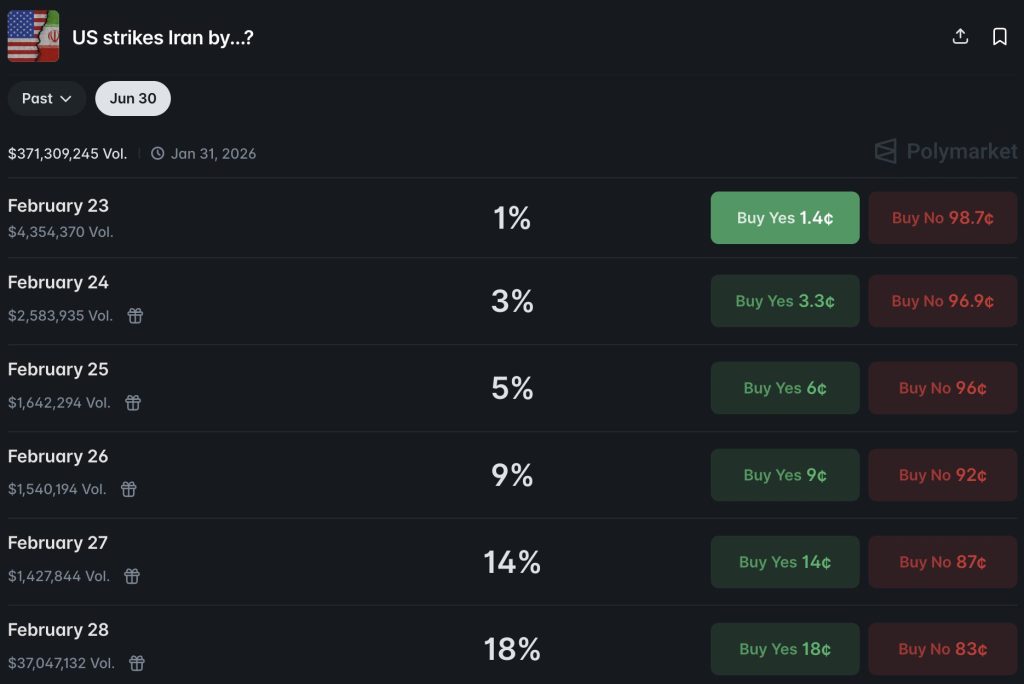
The combination of aggressive trade policy and continued military provocations has created a hostile environment for risk-on assets like crypto.
At the same time, gold is back trading above $5,000 and looking set for a new all-time high while the S&P500 is trading just below its own previous highs, underscoring how crypto is the biggest casualty of the global economic situation.
DISCOVER: Next Crypto to Explode in 2026
ETF Outflows Signal Institutional Caution for the Bitcoin Price
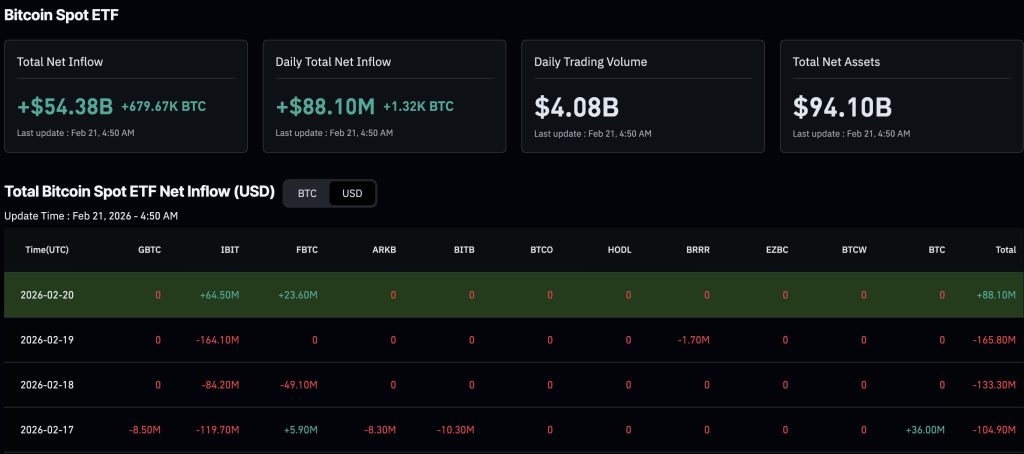
Institutional appetite appears to be waning alongside retail sentiment. According to CoinGlass data, US spot Bitcoin ETFs recorded nearly $320 million in net outflows last week, marking the fifth straight week of negative flows amid cooling demand.
While Gold gained +2.6% last week, continuing to act as a traditional safe-haven asset, Bitcoin has seemingly shed its “digital gold” narrative amid this ongoing volatility.
Markus Thielen, head of research at 10x Research, noted that the drop is driven less by a single headline and more by weak liquidity, suggesting the market is in a “typical bear-market phase” characterized by uncertainty and low conviction.
What Happens Next for Us?
The technical picture has obliterated immediate support levels. While traders were previously buying crash protection near $67,000, that floor has now crumbled.
This weakening price action is lending credibility to Standard Chartered, slashing its Bitcoin price prediction for 2026 to just $50,000.
Standard Chartered warns Bitcoin could drop to $50K
Price now near $65K
Are you buying this dip… or waiting for capitulation? $BTC $ETH— FlashNews (@FlashNewsInvest) February 13, 2026
Thielen expects further downside, potentially testing that $50,000 level before a true bottom can be formed.
Prediction markets verify this bearish outlook. Polymarket shows that 62% of users believe that Bitcoin USD will fall below $50,000 this year, aligning with Standard Chartered’s prediction.
Bulls must quickly reclaim $67,500 to prevent another cascading liquidation after more than $500M was wiped out in the past 24 hours.
EXPLORE: Best New Crypto Presales in 2026
The post Bitcoin Price Falls Below $65K as Trump Tariff Concerns Spark Risk-Off Move appeared first on Cryptonews.
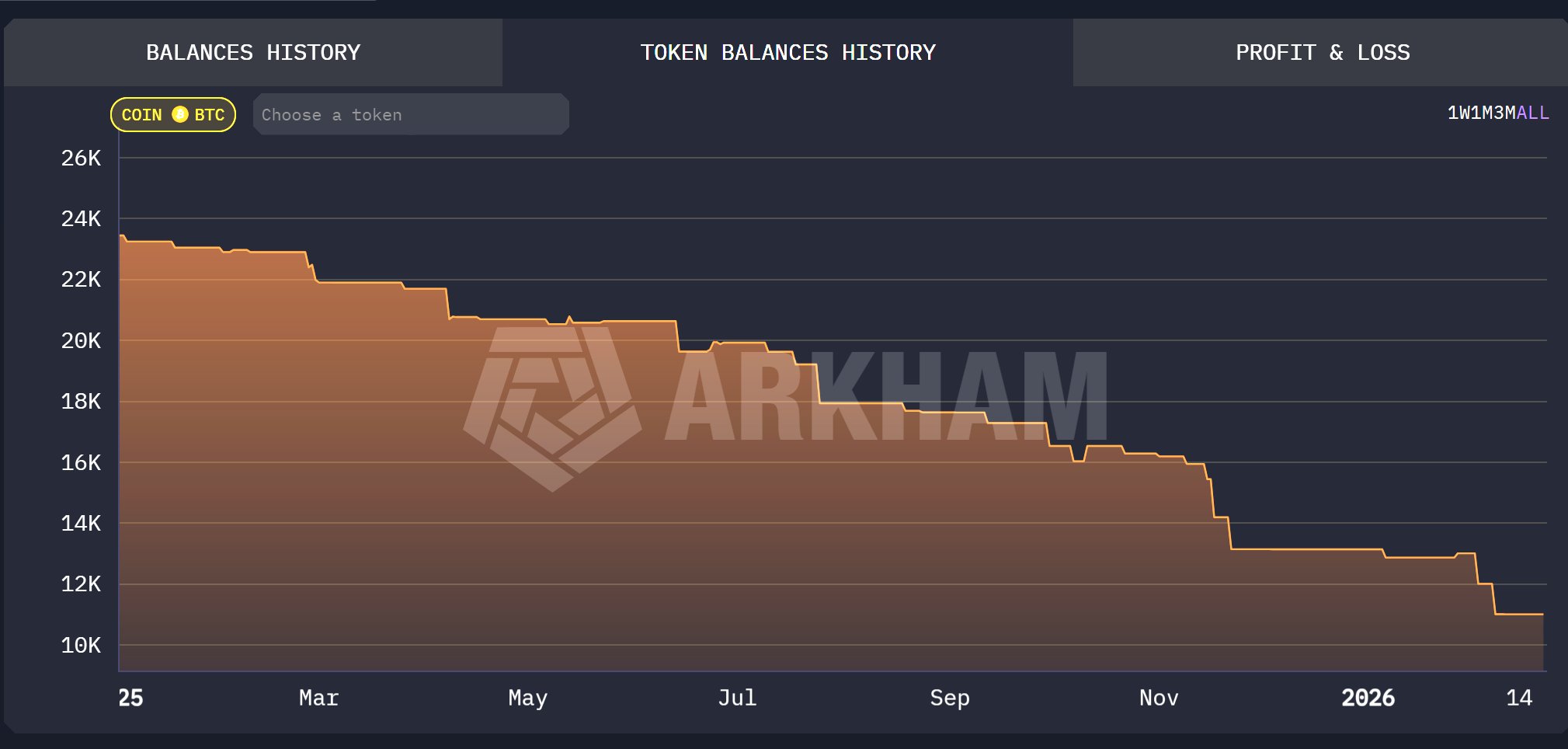
Gemini co-founder Tyler Winklevoss says crypto sentiment is so bad he’s “optimistic,” even though the exchange he runs with his brother Cameron is forced into a sharp reset and Winklevoss Capital appears to have been steadily selling Bitcoin for the last 12 months.
Despite his public bullish sentiment, onchain trackers including Arkham reveal that the Winklevoss Capital wallet has been reducing its Bitcoin (BTC) exposure over the past year, from about 23,000 BTC in February 2025 to fewer than 11,000 BTC in February 2026.
Gemini’s latest filing with the US Securities and Exchange Commission (SEC) on Tuesday showed that it expected net revenue of between $165 million and $175 million for 2025, up from $141 million in 2024, with about 600,000 monthly transacting users, a 17% year‑on‑year increase.

At the same time, projected operating expenses have soared to between $520 million and $530 million, versus $308 million a year earlier.
Related: Crypto investors’ interest moves ‘pretty wide’ beyond majors as dip drags: Exec
On Feb. 5, Gemini announced that it would cut up to a quarter of its staff, exiting the United Kingdom, European Union and Australia to concentrate on the US and Singapore markets.
Less than two weeks later, the company parted ways with its chief operating officer, chief financial officer and chief legal officer, saying that Cameron Winkelvoss would be taking on more responsibilities.
Shrinking market share and strategic pivot
According to a Sunday report by Bloomberg, Gemini’s spot market share shrank to around 0.1% of global spot crypto trading in January, down from 0.6% in June 2025, and its market value has fallen from almost $4 billion to under $700 million since last year’s public listing.
Citing people familiar with the matter, Bloomberg reported that Gemini had let go of additional US staff and was now focused on a pivot toward a new Commodity Futures Trading Commission (CFTC) regulated prediction markets platform, and custody and credit card services.
The company’s 8‑K filing confirmed the senior leadership shakeup and noted that Cameron Winklevoss would absorb many of the outgoing chief operating officer’s duties, while interim executives step into the chief financial officer and general counsel roles.

Cointelegraph reached out to Gemini to confirm the reported additional layoffs, strategic pivot and BTC sales, but had not received a response by publication.
Bleak market sentiment piles on pressure
Gemini’s restructuring comes against a backdrop of unusually bleak sentiment across the crypto market.
Miners such as Bitdeer have liquidated their BTC treasuries, US-based spot Bitcoin ETFs have bled for the past five weeks and popular sentiment gauges like the Crypto Fear & Greed Index have sunk to extreme fear levels, coinciding with Google searches for “Bitcoin going to zero” being at their highest since 2022.
Related: Gemini exit a ‘blow for policymakers’ with UK crypto hub ambitions
A handful of high‑profile investors remain long Bitcoin, however, including Japan’s Metaplanet, which has repeatedly doubled down on its BTC accumulation strategy despite market conditions, and US Bitcoin treasury pioneer Strategy, the largest publicly listed owner of BTC at 717,131, which hinted at its 100th Bitcoin buy on Sunday.
High-frequency trader and BitMEX co-founder Arthur Hayes also posted his portfolio on Monday. He remains heavily weighted toward BTC alongside gold, oil and other assets, while macro analysts such as Lyn Alden remain long but expect a grinding market rather than a sharp rally in the near term.
Magazine: Bitcoin’s ‘biggest bull catalyst’ would be Saylor’s liquidation — Santiment founder
Crypto World
Bitcoin (BTC) balances on Binance hit highest since November 2024: here’s what it means
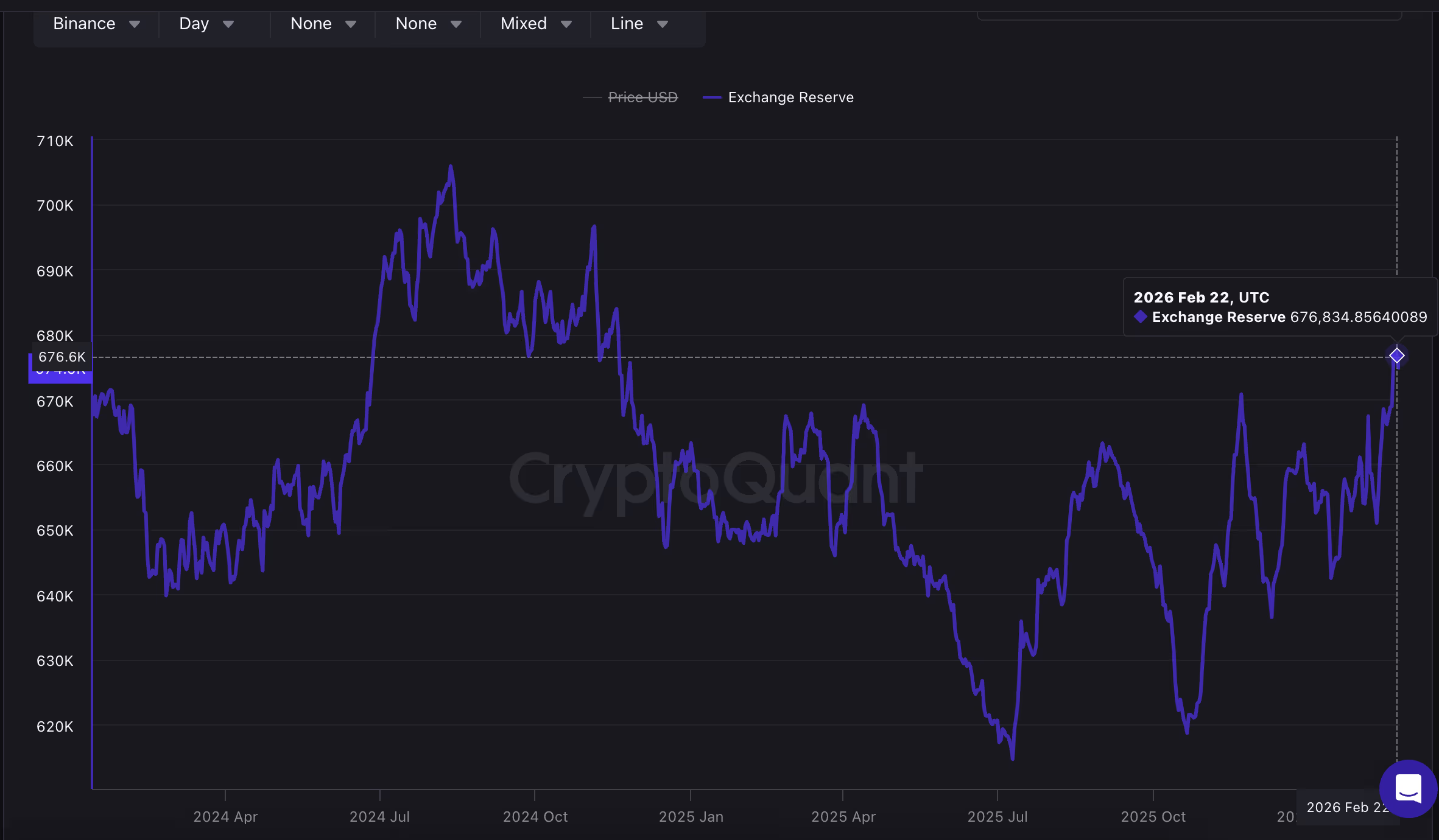
The number of bitcoin held in wallets tied to the cryptocurrency exchange Binance continues to rise, according to data from CryptoQuant.
The tally rose to 676,834.84 BTC ($44.53 billion) on Sunday, a level last seen in November 2024. That marks a 9.3% rise from the multi-month low of 618,782 in November. CoinDesk reached out to Binance for comment.
Rising balances signal investor intent to sell or use coins as margin in derivatives trading, with both typically leading to increased price turbulence.

The weekend high likely stemmed from a renowned whale moving large amounts of BTC to Binance.
Blockchain intelligence firm Arkham said Sunday that a crypto whale, possibly Garret Jin, operating on Hyperliquid’s cross-chain asset tokenization and bridging infrastructure Hyperunit, transferred $760 million in bitcoin to Binance. The large transfer happened roughly six days after the entity moved half a billion dollars of ether to Binance.
It is unclear whether the whale has since liquidated coins, but the possibility cannot be ruled out, as bitcoin fell from $67,600 to $64,400 during Asian hours early Monday. Since then, it has recovered slightly to trade around $65,850.


$TRUMP, $MELANIA plunged ~90–93% from peaks, wiping out retail while insiders took profits.
Summary
- Official $TRUMP and $MELANIA are down about 91–99% from highs, with $TRUMP near $3.7 and $MELANIA around $0.12 after the selloff.
- Market trackers estimate more than $4.3b in retail losses, while roughly 45 whale and insider wallets extracted about $1.2b by selling into early hype.
- On-chain data shows early wallets rotated into stables before liquidity thinned, and large unlock schedules plus concentrated holdings now overhang prices and may add further selling pressure.
Cryptocurrency tokens bearing the Trump brand name have declined sharply from their peak values, with the primary token falling approximately 92% and a related token experiencing similar losses, according to market data and on-chain tracking services.
The tokens, which reference U.S. President Donald Trump and associated branding, attracted significant retail investor participation following their launch before experiencing steep price declines, according to reports from cryptocurrency market analysts.
On-chain data indicates that a limited number of early wallet addresses realized substantial profits before the price decline accelerated, according to blockchain tracking services. Transaction records show that certain addresses transferred significant token holdings into stablecoin assets during the early trading period, while subsequent purchasers experienced losses as market liquidity decreased.
The token structure included locked allocations scheduled for gradual release over time, according to project documentation. Market analysts have noted that the release of these locked tokens could create additional selling pressure as supply enters circulation.
The price collapse has prompted calls for regulatory examination from market observers and investor advocacy groups in multiple jurisdictions. Questions have been raised regarding the marketing practices and token economic structures employed in the launches, particularly concerning projects associated with public figures.
Trading activity and social media discussion increased as losses mounted, with some token holders criticizing project operators and alleging preferential treatment for early participants. The token launches have renewed debate regarding the risks associated with celebrity-endorsed cryptocurrency projects.
Several cryptocurrency exchanges and market makers have reportedly begun implementing stricter listing criteria and enhanced scrutiny for projects with similar token distribution models, according to industry sources.
Blockchain data shows that addresses identified as early participants continue to hold token positions that have not yet been liquidated, according to on-chain analytics providers. The presence of these holdings represents potential future selling pressure on token prices.
The tokens were launched with promotional campaigns emphasizing brand association, though specific marketing claims and project promises were not independently verified at the time of launch. Retail participation was substantial during the initial trading period, according to transaction volume data.
Regulatory authorities in several countries have been contacted by investor groups requesting investigation into the token launches, though no formal enforcement actions have been announced as of this report.
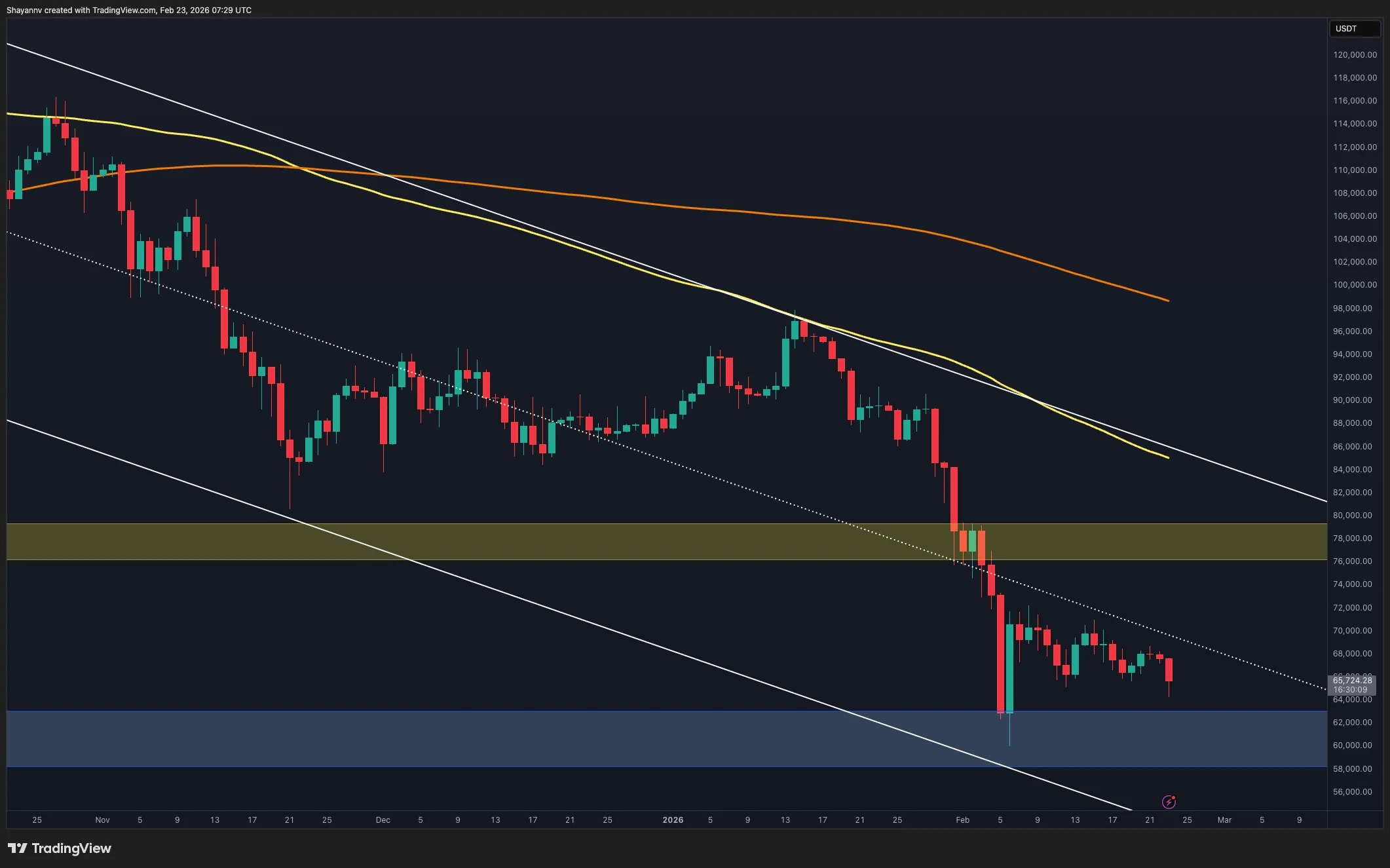
Bitcoin’s recent price action reflects renewed weakness after failing to sustain momentum above the $70K region. The rejection at this key psychological threshold has shifted short-term sentiment back toward caution, as sellers regained control and forced the price beneath recent daily lows.
Bitcoin Price Analysis: The Daily Chart
On the daily timeframe, BTC recently faced a clear rejection at the $70K threshold, where selling pressure intensified and pushed the asset back below the recent daily lows. This breakdown highlights the continued presence of sellers at higher levels and reinforces the fragile nature of the current recovery attempts.
With the price slipping back under short-term structure, the market appears to be lacking strong bullish momentum. At this stage, Bitcoin is likely to remain in a broader consolidation phase between the $60K support zone and the $75K resistance area. A decisive breakout beyond either boundary will be required to establish the next sustained directional move, while continued rejection near $70K keeps the short-term bias cautious.
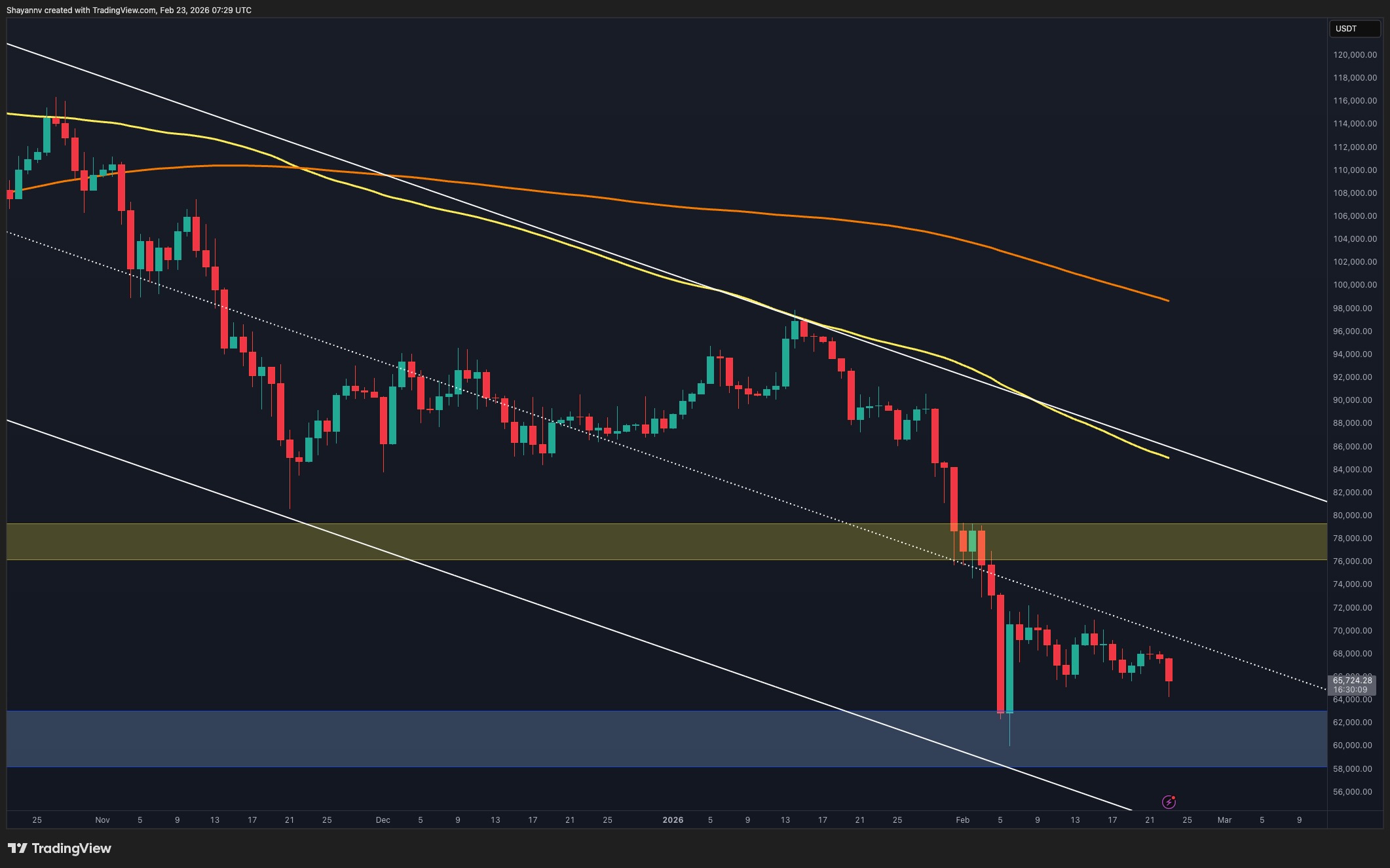
BTC/USDT 4-Hour Chart
On the 4-hour timeframe, Bitcoin had been compressing inside a symmetrical triangle following the sharp bounce from the $60K low. That structure has now resolved to the downside, with the price breaking below the ascending support trendline and accelerating lower.
The breakdown confirms short-term bearish continuation and shifts focus back toward the lower boundary of the broader demand area. Any rebound toward the underside of the broken triangle support or toward the $74K–$76K prior supply region would likely be viewed as a corrective retest unless buyers can generate strong follow-through.
At the moment, short-term structure favors sellers, and the market is searching for a new equilibrium level after the failed compression.

Sentiment Analysis
The liquidation heatmap shows a dense liquidity cluster above the current price around the $69K–$70K region, which previously acted as a magnetic zone during consolidation. This cluster absorbed the price multiple times before the recent drop, highlighting how overhead liquidity continues to cap upside attempts.
At the same time, slight liquidity bands have formed below the market in the $62K–$65K range. The recent sharp move downward tapped into part of this liquidity pocket, triggering liquidations and fueling volatility. The presence of remaining liquidity beneath the current price suggests that further sweeps cannot be ruled out, especially if momentum remains weak.
Overall, Bitcoin is positioned between overhead liquidity that acts as resistance and lower liquidity pockets that may attract price in the short term. The interaction with these zones, combined with the broader bearish channel structure, will determine whether Bitcoin stabilizes above $60K or extends its corrective phase deeper.

Binance Free $600 (CryptoPotato Exclusive): Use this link to register a new account and receive $600 exclusive welcome offer on Binance (full details).
LIMITED OFFER for CryptoPotato readers at Bybit: Use this link to register and open a $500 FREE position on any coin!
Disclaimer: Information found on CryptoPotato is those of writers quoted. It does not represent the opinions of CryptoPotato on whether to buy, sell, or hold any investments. You are advised to conduct your own research before making any investment decisions. Use provided information at your own risk. See Disclaimer for more information.


Bitdeer (BTDR) a Singapore-based bitcoin mining and AI infrastructure company has reduced its bitcoin treasury stash to zero, marking a sharp break from the miner playbook of hoarding coins as a signal of conviction seen by the likes of Strategy (MSTR).
The company reported BTC holdings of zero as of Feb. 20, excluding customer deposits. It produced 189.8 BTC on their weekly update and sold the entire amount. Instead of positioning bitcoin as a balance sheet reserve, Bitdeer is turning production into liquidity.
Bitdeer said the decision to sell bitcoin should not concern the broader market, in a post on X, noting it is evaluating multiple powered land acquisition opportunities and believes it is prudent to prepare liquidity now, while continuing to grow hash rate and mine more bitcoin for shareholders.
Operationally, growth remains intact for the company. Bitdeer mined 668 bitcoin in January, up 430% year over year, and increased its self mining hash rate to 63.2 EH per second (EH/s), with total proprietary hash rate reaching 65.1 EH/s.
Bitdeer is accelerating its push into AI infrastructure, rolling out NVIDIA GB200 NVL72 systems in Malaysia and advancing conversions of several sites in the U.S. and Europe from crypto mining to AI data centers.
AI expansion is far more capital intensive than incremental mining buildouts, requiring large scale GPU clusters and data center upgrades.
Bitdeer recently priced a $325 million convertible notes offering and a $43.5 million equity raise to fund datacenter expansion, HPC and AI cloud growth, and ASIC development.
Unlike bitcoin mining, which is tied to price cycles and halvings, AI and HPC contracts can offer more predictable revenue streams. The pivot also represents an attempt by miners to be valued less as leveraged bitcoin proxies and more as digital infrastructure and AI plays.
Peers are moving in the same direction. Riot Platforms (RIOT) recently sold $200 million worth of bitcoin to fund operations and AI expansion. While Bitfarms (BITF) are dropping its “bitcoin company” identity and doubled down on AI in the U.S. MARA Holdings (MARA) is also expanding into HPC and AI through a planned 64% stake in France based Exaion.
Bitdeer shares are down 1% in pre-market, trading at $7.70 per share.

The Best Way To Cook Rhubarb To Stop It Going Mushy

Cloud9 sweeps Sentinels to reach LCS Lock-In grand final

Harry Maguire: Why Man Utd fans should be glad if defender stays

Smart energy pays enters the US market, targeting scalable financial infrastructure

Why Israel is blocking foreign journalists from entering

Bitcoin: We’re Entering The Most Dangerous Phase

How to Build Wealth | Smart Loans & Asset Planning | Telugu Podcast | CFP Ram Prasad | Part – 1

Yellow coin? The hot new crypto? Uh.. yes please?! #animation

Do it on the HOLI, financial problems will go away…|#ytshortsvideo #facts #viralshorts #ytstudioes
-
 Video7 days ago
Bitcoin: We’re Entering The Most Dangerous Phase
-

 Crypto World6 days ago
Can XRP Price Successfully Register a 33% Breakout Past $2?
-

 Video3 days ago
XRP News: XRP Just Entered a New Phase (Almost Nobody Noticed)
-

 Fashion3 days ago
Weekend Open Thread: Boden – Corporette.com
-

 Sports6 days ago
GB's semi-final hopes hang by thread after loss to Switzerland
-

 Politics1 day ago
Baftas 2026: Awards Nominations, Presenters And Performers
-
 Tech6 days ago
The Music Industry Enters Its Less-Is-More Era
-

 Business5 days ago
Infosys Limited (INFY) Discusses Tech Transitions and the Unique Aspects of the AI Era Transcript
-

 Entertainment5 days ago
Kunal Nayyar’s Secret Acts Of Kindness Sparks Online Discussion
-

 Video6 days ago
Financial Statement Analysis | Complete Chapter Revision in 10 Minutes | Class 12 Board exam 2026
-

 Tech5 days ago
Retro Rover: LT6502 Laptop Packs 8-Bit Power On The Go
-
 Sports4 days ago
Clearing the boundary, crossing into history: J&K end 67-year wait, enter maiden Ranji Trophy final | Cricket News
-

 Business22 hours ago
Mattel’s American Girl brand turns 40, dolls enter a new era
-

 Business18 hours ago
Law enforcement kills armed man seeking to enter Trump’s Mar-a-Lago resort, officials say
-

 Entertainment5 days ago
Dolores Catania Blasts Rob Rausch For Turning On ‘Housewives’ On ‘Traitors’
-

 Business5 days ago
Tesla avoids California suspension after ending ‘autopilot’ marketing
-

 Tech17 hours ago
Anthropic-Backed Group Enters NY-12 AI PAC Fight
-

 Politics6 days ago
Eurovision Announces UK Act For 2026 Song Contest
-

 NewsBeat16 hours ago
Armed man killed after entering secure perimeter of Mar-a-Lago, Secret Service says
-

 Crypto World5 days ago
WLFI Crypto Surges Toward $0.12 as Whale Buys $2.75M Before Trump-Linked Forum