

Crypto World
How Socialfi, Memecoins and AI Pushed Base to the Top of the L2 Ladder

Base will transition to a unified, internally maintained stack, expected to be its biggest architectural shift since launch.
After debuting in 2023 as a rollup built on Optimism’s OP Stack, Coinbase’s Ethereum layer 2 is now consolidating its software into an in-house distribution, which can unlock faster upgrades and greater autonomy over its technical roadmap.
It has been exactly three years since Base launched its testnet. The network has experienced SocialFi explosions and ridden its own memecoin wave. It even went through a phase that both fascinated and unnerved Crypto Twitter as AI agents began transacting on its chain.
Here’s how it got here.

Friend.tech headlines Base’s “Onchain Summer” fest
Base’s mainnet opened to builders in July 2023, and users followed in August. The period after Coinbase cut the ribbon was promoted as “Onchain Summer.” In the first week, Base attracted 700,000 new users, who brought with them about $242 million in inflows.
Friend.tech was the headline act of Coinbase’s summer festival. It was a social app that allowed users to buy and sell access to their connections. The loudest voices on Crypto Twitter tested the industry’s newest toy, which also attracted the rich and famous outside the community. In less than two weeks after launching, it generated over $1 million in daily fees, surpassing Bitcoin at the time.
It didn’t last long.

By the end of August, fees and transaction volume had tanked, and the platform was declared “dead.”
A little over a year later, the team relinquished control of the project by ditching the admin rights of its smart contracts.
Base rides its own memecoin wave
The memecoin frenzy became one of the defining crypto stories in recent years, drawing in political figures and public personalities. Eventually, it prompted the US Securities and Exchange Commission to state that such tokens fall outside the scope of securities laws.
Solana is the go-to blockchain for memecoins. Its data shows the memecoin boom gaining momentum in late 2023, when its daily active addresses began climbing toward Ethereum’s levels. In March 2024, Solana decisively surpassed Ethereum on that metric when Base users started showing some post-Friend.tech signs of life.

From March 19 to 25, Cointelegraph Magazine found more than 380,000 ERC-20 tokens deployed on Base. That activity brought in fresh liquidity into Base’s DeFi ecosystem, and by June 2024, the layer 2 had flipped Ethereum in active addresses. It held on to that lead until December 2025.

AI agents begin transacting on Base
In the latter half of 2024, AI agents claimed the driver’s seat in crypto. As with memecoins, early experiments took off on Solana, such as Goatseus Maximus, ai16z and Truth Terminal.
Developers launched agent-linked tokens, autonomous trading bots and social accounts that presented themselves as autonomous onchain actors.
Related: Can Solana shed its memecoin image in 2026?
Coinbase CEO Brian Armstrong argued that crypto provides a natural financial rail for AI systems, as agents lack the legal identity required to open traditional bank accounts.
On Base, focus shifted to AI agents capable of holding balances, tipping users and interacting directly with smart contracts. In October 2024, Coinbase introduced “Based Agents,” a toolkit that allowed users to build AI agents equipped with crypto wallets.

The most visible Base-native experiment was Virtuals Protocol, which enabled users to create agents tied to tokens and onchain addresses.
One such Virtuals agent, Luna (not related to Terra), became the first on Base to autonomously execute onchain tips.
Virtuals later expanded to Solana in January 2025 to tap into its larger retail base. However, activity across AI-agent tokens soon slowed, and Virtuals cooled with it.
The second coming of SocialFi on Base
Base’s 2023 debut was followed by the breakout of Friend.tech. In 2025, SocialFi returned to Base in a different form, sparked by deeper integration with Coinbase’s consumer ecosystem.
That push was tied to Coinbase’s “super app” ambitions. Super apps are platforms that support a variety of 21st-century necessities, such as messaging, digital banking, ride sharing or even food delivery.
Related: Banks can’t seem to service crypto, even as it goes mainstream
Such platforms already exist in Asia. WeChat in China is used in the everyday lives of more than 1 billion users, combining messaging, payments and commerce. South Korea’s KakaoTalk and Japan’s Line serve similar functions in their respective markets. Social media giants like X and Meta have said they are exploring similar models.
In July 2025, Coinbase rebranded its wallet as the Base App, making its Ethereum layer 2 the default execution layer within its wallet ecosystem.
At the center of this phase was Farcaster, a decentralized social network where accounts are linked to crypto addresses. Posts, tips and token launches connected directly to onchain activity.
At the same time, Zora, which enables creators to mint and distribute tokenized content, saw bursts of activity in mid-2025 that contributed to measurable spikes in Base transactions and token launches. Tokens were often promoted on Farcaster.

The second coming of SocialFi on Base lasted longer than Friend.tech, but interest faded after the initial hype period. On Feb. 9, 2026, Coinbase announced it would sunset its Creator Rewards program and Farcaster-powered social feeds. The change does not directly affect Zora users, though activity there has also cooled from its peak.
Base becomes Ethereum’s most active layer 2
Throughout the first three years, Base showcased the distribution power of the largest US exchange, similar to how BNB Chain’s user activity is influenced by Binance.
Aside from their technical differences, Binance has attempted to distance itself from the blockchain it founded by attempting to give it its own brand, while Coinbase has kept Base close to its orbit.
Coinbase and its blockchain have ridden the tides of emerging trends such as memecoins and AI agents while becoming the center of creator economies and SocialFi applications.
Those trends came and went, but they did push Base to the top of the Ethereum layer-2 ladder. It now leads in users, transactions, fees and total value locked, according to data from Nansen and DefiLlama.

Trends onboarded users and distribution brought scale. Now, Base is consolidating its foundation. Whether the unified stack cements its lead or merely bookends its first growth era will define its next three years, as Ethereum’s focus shifts from L2s back to scaling the main chain.
Magazine: Bitcoin may take 7 years to upgrade to post-quantum: BIP-360 co-author
Cointelegraph Features and Cointelegraph Magazine publish long-form journalism, analysis and narrative reporting produced by Cointelegraph’s in-house editorial team and selected external contributors with subject-matter expertise. All articles are edited and reviewed by Cointelegraph editors in line with our editorial standards. Contributions from external writers are commissioned for their experience, research or perspective and do not reflect the views of Cointelegraph as a company unless explicitly stated. Content published in Features and Magazine does not constitute financial, legal or investment advice. Readers should conduct their own research and consult qualified professionals where appropriate. Cointelegraph maintains full editorial independence. The selection, commissioning and publication of Features and Magazine content are not influenced by advertisers, partners or commercial relationships.



- Toncoin price is up 4% as key metrics like volume and TVL rise.
- A breakout above the $1.50 zone could result in upside momentum.
- If broader sentiment doesn’t invalidate the outlook, the next target could be above $2.
Toncoin (TON) is demonstrating resilience as a challenging crypto market sees several altcoins slump to new lows.
The token trades around $1.37 with a modest 4% gain in 24 hours, and it’s seeing a notable surge in trading volume.
The total value locked is also up and highlights a potential strength that could embolden bulls and allow them to target the $2.00 mark.
Toncoin’s bullish outlook, however, could be tempered by the broader sentiment across major cryptocurrencies.
Bitcoin, which trades around $65,800 as bulls struggle with macro headwinds, highlights the bearish dangers.
Toncoin gains amid volume spike
Toncoin’s intraday gains to $1.37 buck the trend that saw BTC dip to under $65k before posting a slight recovery.
Other coins, including Ethereum, BNB and XRP, have notched downward moves amid growing negative sentiment in an increasingly risk-averse environment.
The 25% spike in daily trading volume to $80 million reflects the cryptocurrency’s likely upward strength.
Buyers have also bumped up open interest in TON, currently at $182 million.
While long positions account for nearly 70% of the “rekt” value in the past 24 hours, data shows more shorts have been liquidated in the past 12 hours.
Additionally, TON’s Total Value Locked (TVL) in DeFi protocols has climbed to $165 million.
The global defi TVL stood at $204 billion at the time of writing, but was less than 0.7% up in the past 24 hours.
In comparison, TON had its TVL up by nearly 2% to signal increased interest in protocols on The Open Network.
Meanwhile, the stablecoin market cap on TON has also risen to $941 million, with USDT dominance at 79%.
These metrics suggest capital rotation into TON, rather than gains being driven by broad speculation.
TON price prediction: Is $2 next?
Toncoin approaches a pivotal technical juncture on the daily chart. Gains to intraday highs have bulls testing resistance from a descending trendline that has capped upside since late 2025.

A successful breakout could allow bulls to target the 50-day EMA. This hurdle currently sits near $1.48, a level aligning with recent consolidation zones and a key resistance line since Dec. 2024.
If the supply zone paves the way amid overall bullish sentiment, momentum could drive TON toward the 200-day EMA around $2.0.
This outlook might strengthen if neutral RSI readings near 43 flip higher and the daily MACD invalidates the bearish hint.
However, Bitcoin’s ongoing selloff pressure amid deleveraging and ETF outflows might pose a downward risk for the token.
Currently, macroeconomic headwinds have dragged BTC back to the $65k area.
A similar outlook for TON could bring the $1.12 support level into view.
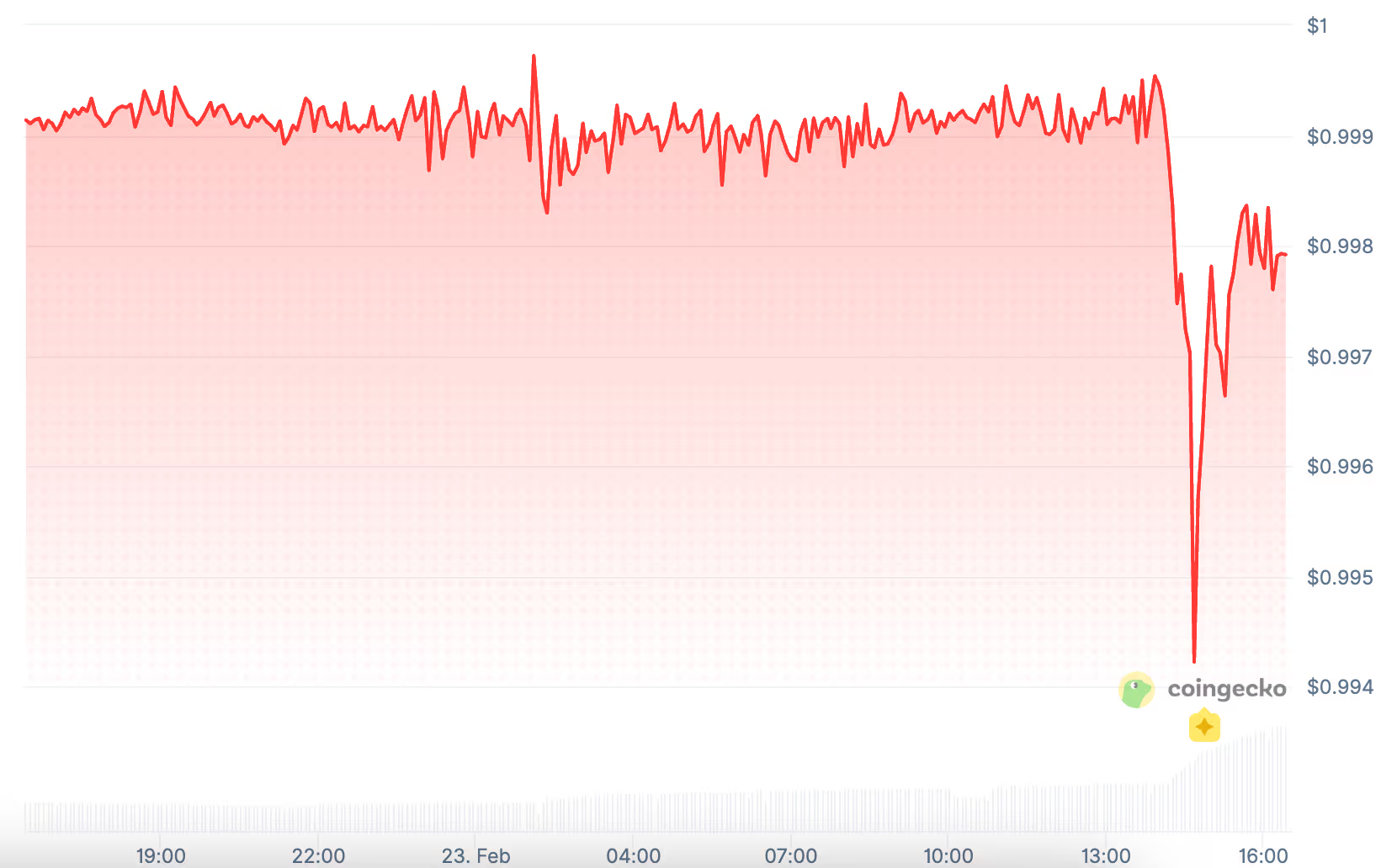
USD1, the U.S. dollar stablecoin of World Liberty Financial — a crypto protocol with close links to President Donald Trump’s family — slipped from its $1 peg on Monday amid what the project’s developers described as a “coordinated attack” against the protocol.
The token fell to as low as $0.994 during the day, some 0.6% from its intended $1 anchor, CoinGecko data shows.
In a Monday X post, the team behind USD1 said multiple cofounder accounts were hacked, influencers were paid to sow doubt, and short positions were opened against the protocol’s native token, WLFI, in what they framed as a deliberate effort to stir panic and profit from it.
“It didn’t work,” the post said, saying that a redemption mechanism that allows USD1 holders to exchange their tokens for an equal amount of U.S. dollars as the reason the peg held firm.
However, the token still traded at $0.998, some 0.2% below its intended $1 price anchor, CoinGecko shows, which gathers price data from exchange pairs.

USD1, issued in partnership with crypto custodian BitGo (BITG) is among the largest dollar-backed stablecoins. Its value is backed 1:1 by short-term U.S. government treasuries, U.S. dollar deposits and other cash equivalents and reports monthly attestations of its reserve signed by consulting firm Crowe, according to BitGo. The token currently has a $5 billion market capitalization, but it still trails major players like Tether’s USDT and Circle’s (USDC).
Read more: Goldman Sachs, Franklin Templeton, and Nicki Minaj: Inside Trump’s surreal Mar-a-Lago crypto summit
UPDATE (Feb. 23, 16:00 UTC): Adds details about USD1’s backing.
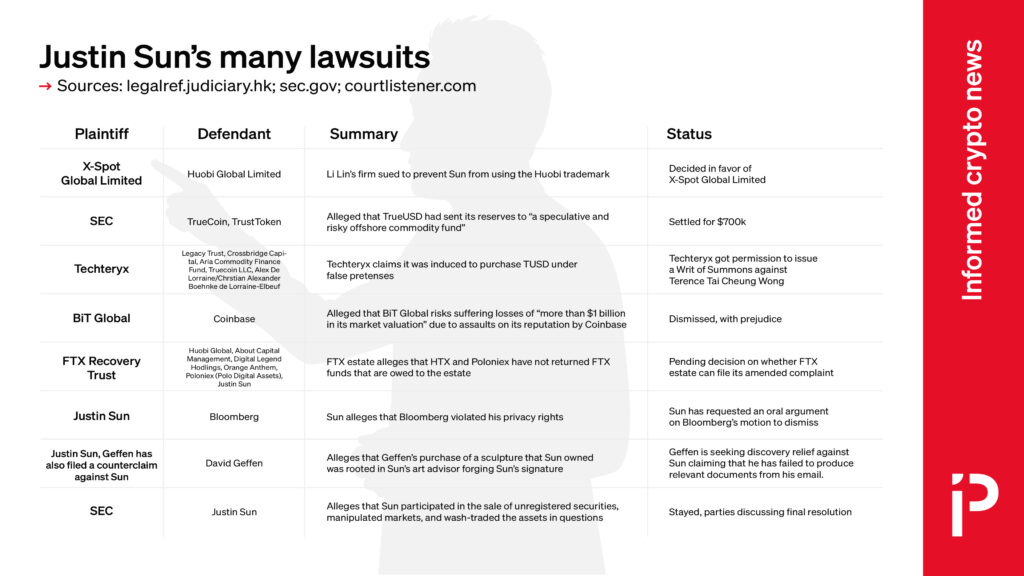
Justin Sun and his numerous cryptocurrency projects feature as both a plaintiff and a defendant in a variety of different lawsuits.
In fact, there are so many that keeping track can almost feel like a full time job. So, for those interested in that sort of thing, Protos has attempted to cut through the clutter and pulled together the suits involving Sun and his firms that we believe are most important.
Justin Sun’s fight with Huobi’s founder
Sun has been engaged in a series of disputes with Huobi founder Li Lin.
Initially, Sun accused Li’s brother, Li Wei, of taking advantage of the Huobi Token, specifically claiming that Li Wei had “received millions of HT tokens for free.”
This tweet was subsequently deleted.
Read more: Justin Sun fights a lot of lawsuits on behalf of companies he doesn’t own
The focus of this dispute then shifted to Sun’s use of the “Huobi” name.
Eventually, the High Court of Hong Kong determined that the requested injunction from Li’s firm would be granted, limiting Sun’s ability to use the Huobi name in Hong Kong.
More recently, Sun accused Li of concealing a $30 million hole in Huobi’s books when it was sold to About Capital Management.
Sun has since deleted the tweet where he made this accusation.
TrueUSD and the missing reserves
Techteryx, the Sun-affiliated firm that operates TrueUSD, has been engaged in a dispute with First Digital over the reserves of TrueUSD and how they were managed and invested.
TrueUSD had allowed First Digital to manage substantial portions of the reserves, and these investments were directed into a series of speculative and illiquid investments.
The portion of TrueUSD’s reserves invested into these assets became inaccessible when the fund they were invested in refused redemption.
Read more: What’s up with TrueUSD and the rest of TrustToken’s stablecoins?
Many of these claims about the reserves were echoed in the SEC lawsuit against TrueUSD (already settled).
Additionally, an attestation for TrueUSD from Moore Hong Kong, including notes from Techteryx executive Jennifer Jiang retrieved on February 19, reads, “The Hong Kong depository institution has invested all or substantially all of the collateral in other instruments to generate yield, which cannot be readily convertible to cash, and are subject to ongoing legal proceedings.”
Several of the defendants in this case maintain that this issue should be handled according to an arbitration agreement and not in court.
Read more: FTX knew Justin Sun tried to acquire TrueUSD
Reporting and legal filings related to this case have also revealed that Sun had to extend a large line of credit to TrueUSD because of the insolvency resulting from this reserve mismanagement.
Sun has also publicly claimed that First Digital’s role in the management of these reserves suggest “obvious loopholes in the trust industry in Hong Kong.”
First Digital Trust also publicly responded to Sun’s accusations, claiming that a substantial portion of the redemption issue for TUSD’s reserves was rooted in “AML/KYC concerns regarding the buy-out deal between TrueCoin and Techteryx and the identification of the ultimate beneficial owner of Techteryx.”
This would seem to be an allusion to Sun, though Techteryx and TrueUSD have, for some reason, continued to maintain that Sun isn’t the ultimate beneficial owner.
Older TrueUSD-related firms, specifically Archblock, TrueCoin, and TrustToken, have also recently been targeted in a lawsuit by the Celsius estate.
BiT Global’s lawsuit against Coinbase
Coinbase and Sun have been involved in lawsuits over tokenized bitcoin (BTC).
Sun is an advisor to Wrapped Bitcoin (WBTC) and has ties to BiT Global.
After Sun became involved with WBTC, Coinbase chose to delist the token.
Read more: Coinbase takes aim at Justin Sun in WBTC lawsuit response
BiT Global hoped that Coinbase would pay damages and would also be forced to relist WBTC.
Coinbase responded by pointing out it believed there was an “unacceptable risk that control of WBTC would fall into the hands of Justin Sun.”
It additionally noted that BiT Global wasn’t willing to answer questions “about who ultimately owned and controlled BiT.”
BiT Global’s lawsuit was dismissed with prejudice.
FTX’s lawsuit against Justin Sun
The FTX estate is seeking an opportunity to file an amended complaint against HTX, Poloniex, Sun, and other Sun-affiliated entities like About Capital Management.
The proposed amended complaint alleges that both Poloniex and HTX still retain millions in FTX estate assets that they’ve been unwilling to hand over.
Specifically, it alleges that Alameda Research had assets “then-valued at approximately $27.5 million” between the two Sun-owned exchanges, and “both Huobi and Poloniex had locked the Alameda accounts, rendering the debtors unable to recover their assets.”
The suit additionally verified some of the opaque structures that Alameda Research preferred, noting that the Poloniex account wasn’t associated with Alameda Research in general but was opened in Sam Bankman-Fried’s name.
Similarly, the Huobi account was also opened up under the name of an Alameda Research employee.
The amended complaint also complains that Sun’s “liquidity arrangement” with FTX as it collapsed “affirmatively facilitated a breakdown of creditor equality by providing preferential treatment unavailable to others who didn’t have tokens associated with Sun.”
This arrangement ended up “effectively reallocating estate value away from the general creditor body and towards Sun and his enterprises” as it “was designed to — and did — artificially inflate the prices of Sun-affiliated tokens by inducing a surge in demand on FTX.”
Several of the entities defending against this have filed responses opposing the ability for the estate to file this amended complaint, often claiming that the suit had done an inadequate job of proving these Sun-affiliated entities were Sun’s alter egos.
Justin Sun’s lawsuit against Bloomberg
Sun has filed a suit against Bloomberg following his participation in and inclusion on the Bloomberg Billionaire Index.
Sun had shared a variety of documents with Bloomberg, including a list of crypto addresses and evidence that he owned HTX, so that he could be included on the index.
Sun subsequently tried to insist in a group chat with Bloomberg reporters that “all information shared within the group is strictly confidential and for verification purposes only.
He also demanded that, “Once the verification is complete, the data must be deleted,” and also stipulated that the data shared should be used “solely for verification and may not be used for any other purpose (including reporting).”
Read more: ‘Someone’ is taking advantage of HTX’s reserves
Bloomberg, notably, did not agree to these terms.
Subsequently, the outlet was able to publish reporting on Sun that revealed that he owned the majority of TRX tokens and the HTX exchange.
Most recently Sun’s representatives have requested an oral argument over Bloomberg’s motion to dismiss.
This suit against Bloomberg is only one example of Sun pursuing journalistic outlets; he also reportedly complained to Bullish, CoinDesk’s owner, to get an article about his purchase of a multi-million dollar banana removed.
Justin Sun’s lawsuit against David Geffen
Sun has also filed a suit against music mogul David Geffen.
It alleges that Geffen’s purchase of a sculpture that Sun owned hinged upon Sun’s former art advisor forging Sun’s signature.
Geffen’s representatives have described the suit as “seller’s remorse.”
Geffen has also filed a counterclaim against Sun that alleges that Sun filed this lawsuit because his team had “failed to find a buyer” for paintings that were part of the deal with Geffen.
Geffen’s counterclaims allege that following this failure, “Sun and Xiong contrived this fraudulent lawsuit, hoping to pressure Geffen into rescinding the deal or paying Sun.”
The SEC lawsuit against Justin Sun
The SEC has also sued Sun, alleging that he sold unregistered securities, wash-traded, and participated in market manipulation.
Allegedly, Sun and Sun-affiliated entities engaged in a scheme to wash-trade TRX tokens on a US-based platform, specifically Bittrex.
Additionally, the amended complaint details how Sun was frequently spending time in the United States while he was directing these activities, helping the SEC establish jurisdiction.
Read more: SEC sues Justin Sun over TRX, BTT, market manipulation
Recently, Sun has become one of the largest financial supporters of United States President, Donald Trump.
Sun was the largest individual purchaser of the $TRUMP memecoin and also the largest individual purchaser of the WLFI token issued by Trump-founded World Liberty Financial.
World Liberty also named Sun as an advisor to the project.
Subsequently, the SEC requested a stay in the case, leading to frequent accusations of Sun-Trump corruption centered around their extensive financial relationship.
Got a tip? Send us an email securely via Protos Leaks. For more informed news, follow us on X, Bluesky, and Google News, or subscribe to our YouTube channel.
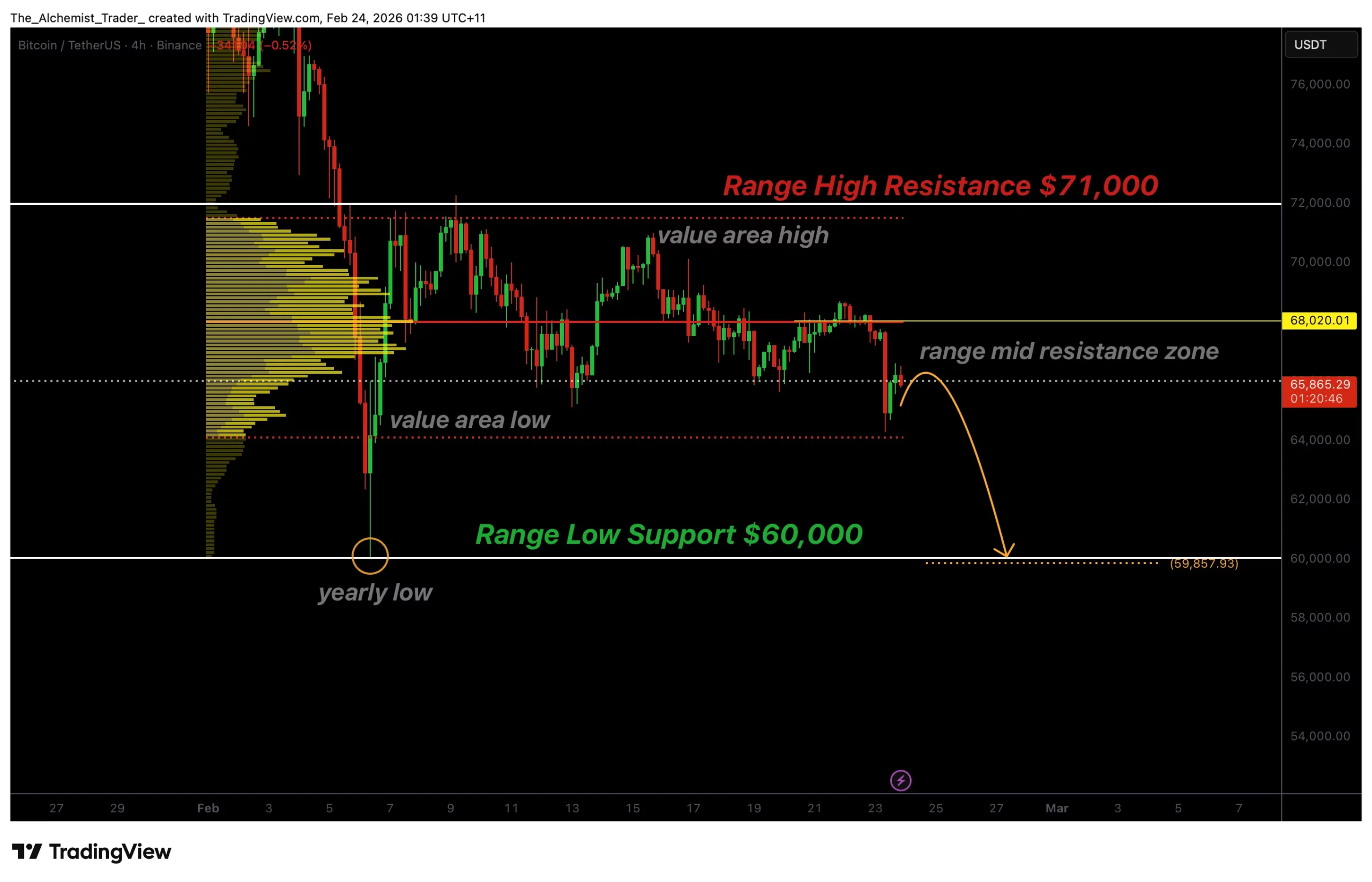
Bitcoin price remains under pressure after rejection at range mid-resistance near $68,000, increasing the probability of a corrective move toward $60,000 support.
Summary
- Bitcoin rejected key range mid-resistance near $68,000, maintaining bearish structure
- Weak volume confirms relief bounces lack bullish conviction
- Price has higher probability of rotating toward $60,000 range low support
Bitcoin (BTC) price action continues to show signs of structural weakness following a rejection from the midrange, reinforcing the ongoing bearish market environment. After attempting to stabilize within the broader range, Bitcoin failed to reclaim a key resistance region near the point of control (POC) around $68,000, a level that has repeatedly dictated market direction.
The recent rejection highlights fragile price conditions, with sellers maintaining control across lower timeframes. Instead of transitioning into an upside expansion, Bitcoin has begun rotating lower within the established trading range, increasing the probability of a move toward the range low support near $60,000, where the yearly low currently sits.
From a broader perspective, Bitcoin remains locked within a corrective phase rather than a confirmed recovery trend, with technical signals favoring downside continuation unless key resistance levels are reclaimed.
Bitcoin price key technical points
- Range mid resistance at $68,000 holding firm: Price continues to reject the point of control zone
- Weak bounce lacking volume confirmation: Buying pressure remains insufficient to reverse structure
- $60,000 range low support in focus: Next major downside target aligned with yearly support
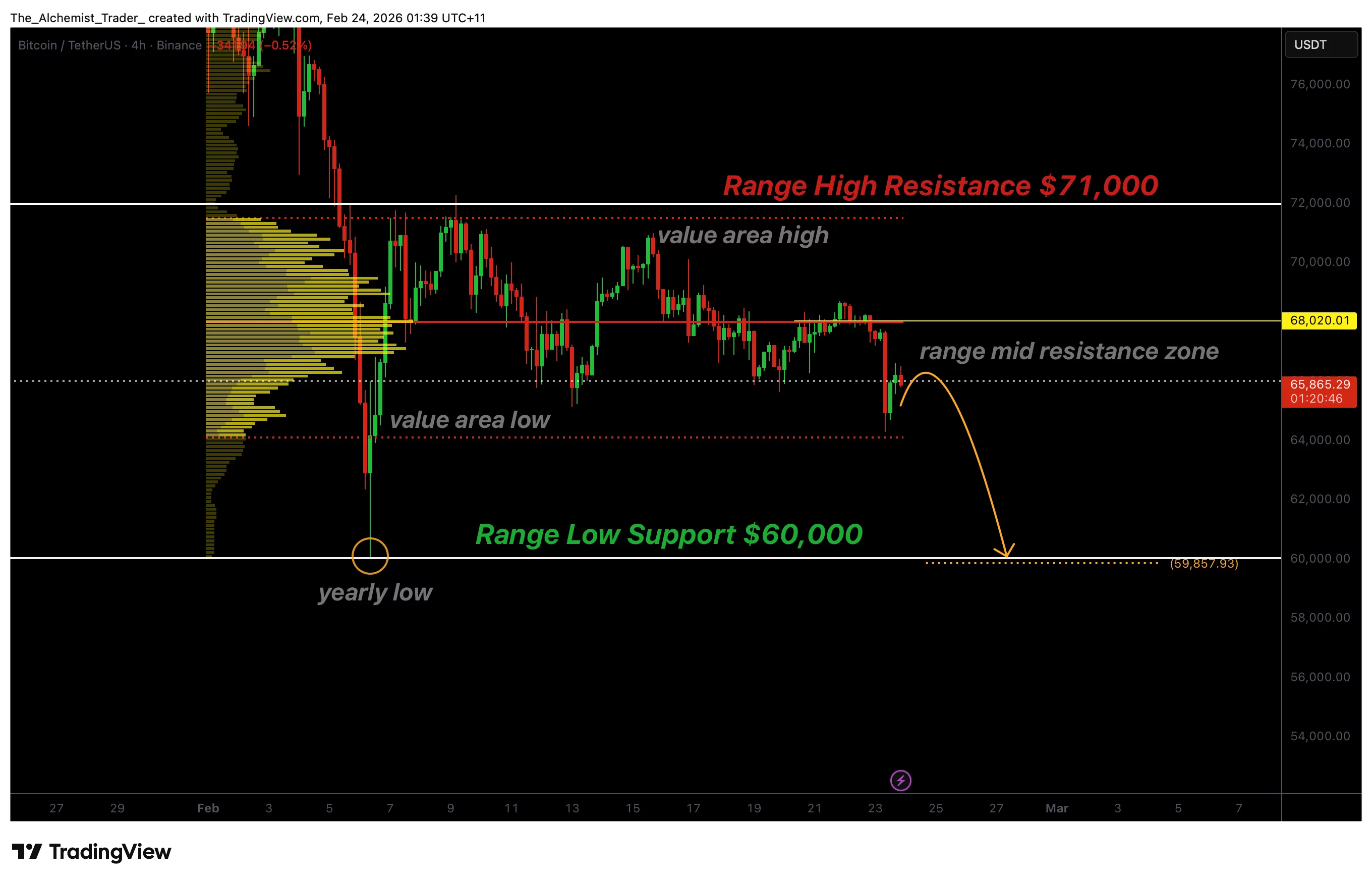
The most important technical development in recent price action is Bitcoin’s inability to hold above the range mid-resistance. This area, located around $68,000, represents the point of control where the majority of recent trading volume has occurred. Acceptance above this level would have signaled a shift toward bullish continuation, but the rejection instead confirms ongoing distribution.
Following the rejection, Bitcoin established another local low near the value area low, reinforcing the bearish internal structure. Markets often trend through a sequence of lower highs and lower lows when sellers maintain dominance, and Bitcoin’s current behavior aligns with this pattern.
Although price managed to produce a short-term bounce after tapping liquidity below recent lows, the recovery lacked strong volume participation. Without a meaningful buying influx, relief rallies tend to act as temporary pauses rather than genuine reversals. This lack of conviction suggests that market participants remain hesitant to aggressively accumulate at current levels.
Liquidity sweep fails to trigger a strong reversal
Bitcoin recently tapped into resting liquidity near the lower boundary of value, a move that typically attracts buyers seeking discounted entries. However, the reaction following this liquidity sweep has been relatively muted. Instead of aggressive bullish expansion, price has continued to compress beneath resistance.
This behaviour indicates that the market may still be in a redistribution phase, where price rotates lower to locate stronger demand. When liquidity grabs fail to produce impulsive upside momentum, it often signals that deeper support levels remain unfinished targets.
As long as Bitcoin continues trading below the $68,000 range mid-resistance, sellers retain structural control. Each failed attempt to reclaim this level increases the likelihood of further downside exploration.
$60,000 range low emerges as key magnet
Technically, the next logical destination for price sits near the range low support at $60,000. This area represents a significant high-timeframe level, aligning with the yearly low and serving as a major liquidity pool within the broader range structure.
Markets frequently rotate between range extremes when equilibrium cannot be established at the midpoint. Given Bitcoin’s continued rejection at range mid and weakening momentum signals, a move toward range low support becomes statistically more probable.
The $60,000 level is expected to act as a major decision zone. Should price reach this region, traders will closely monitor whether buyers step in to defend support or if acceptance below opens the door for a deeper corrective phase.
What to expect in the coming price action
From a technical, price action, and market structure perspective, Bitcoin remains bearish while trading below the $68,000 range mid-resistance. Unless price reclaims and holds above this level, the probability favors continued downside rotation toward $60,000 support.
Short-term bounces may occur, but they are likely to remain corrective until bullish volume returns and structural resistance is decisively reclaimed.
The final week of February has brought another wave of declines, reinforcing expectations among short-term traders that altcoin prices could fall further. However, this outlook carries growing risks. If prices approach strong demand zones, they could stage an unexpected rebound.
Several altcoins are showing a severe imbalance between potential long and short liquidations this week. Such conditions often create an environment for large-scale liquidations.
1. Ethereum (ETH)
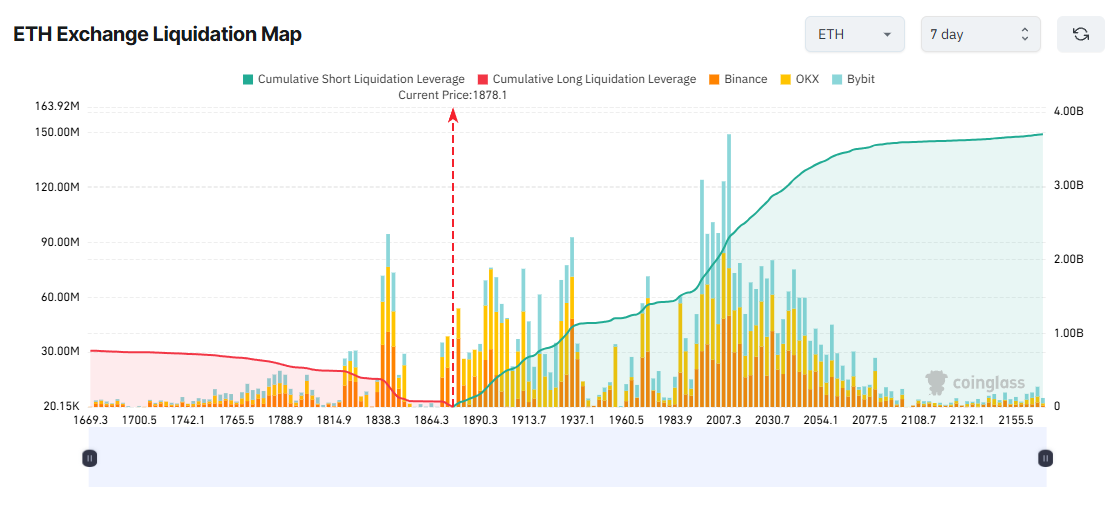
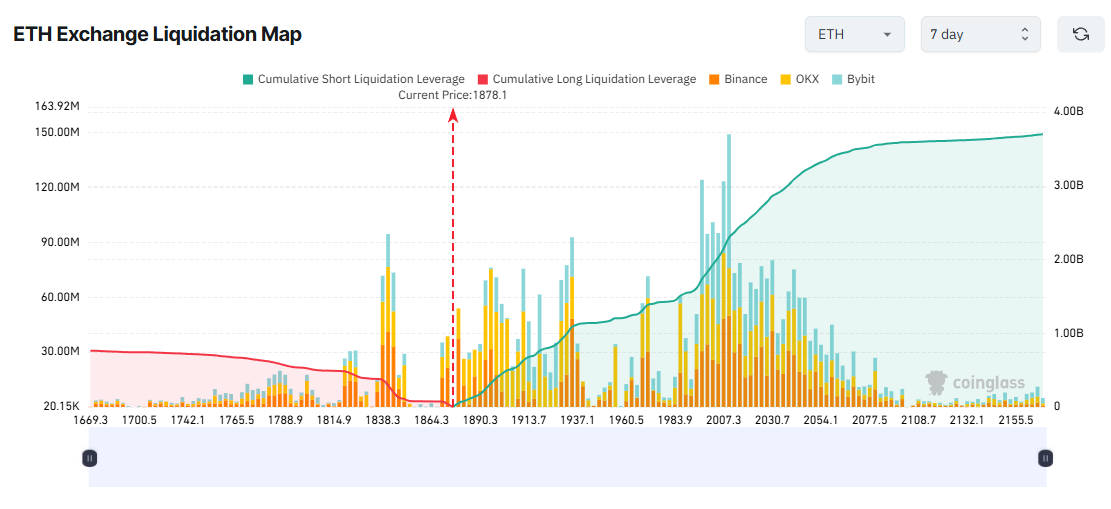
The seven-day liquidation map for Ethereum (ETH) shows that many traders are allocating capital and leverage to short positions, betting on continued downside through the end of the month.
As a result, cumulative potential liquidations on the short side now dominate. If ETH unexpectedly rebounds to $2,000 this week, short positions could face up to $2 billion in liquidations.
If ETH climbs further to $2,160, short liquidations could reach $3.6 billion.
Short-term traders have reasons to justify their bearish positioning. A recent report by BeInCrypto revealed that Vitalik Buterin reduced his holdings by more than 8,800 ETH throughout February 2026. Meanwhile, Ethereum inflows to Binance have reached their highest level since November 2025.
However, several bullish indicators are also emerging, increasing the likelihood of a surprise recovery.
ETH ETF flows have turned positive after four consecutive weeks of outflows. In addition, data from CryptoQuant shows that inflows into ETH accumulation addresses over the past six months have reached the most active period in history.
Given these dynamics, short sellers may need to reassess their leverage levels to mitigate the risk of sudden price reversals.
2. Binance Coin (BNB)
Like ETH, Binance Coin (BNB) has faced persistent selling pressure. Six consecutive red weekly candles with no clear signs of recovery have encouraged traders to maintain dominant short positions.
However, this positioning increases the risk of liquidation if BNB rebounds.
If BNB climbs to $640 this week, potential short liquidations could reach $35 million. A further rally to $680 could push short liquidations above $60 million.
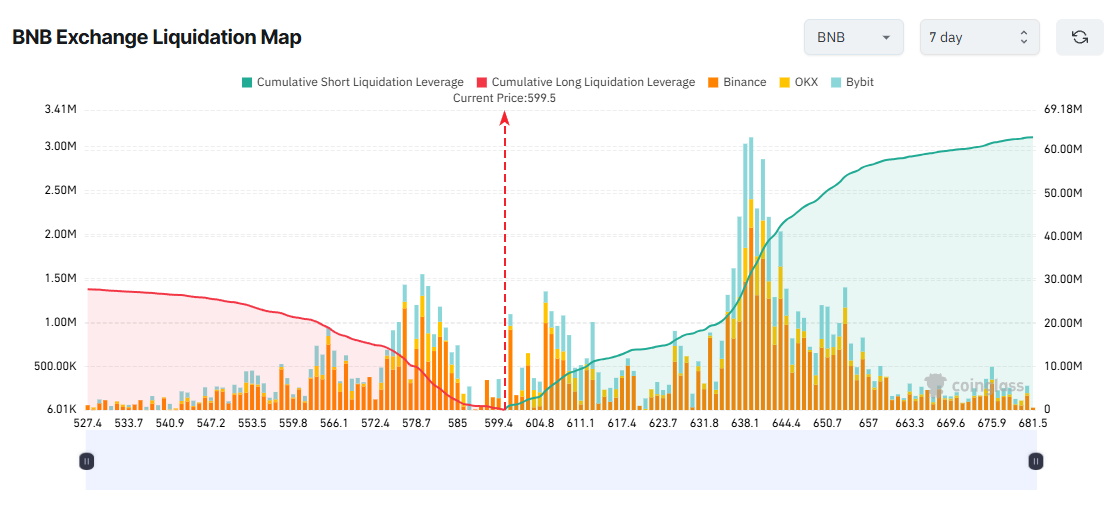
Why should short traders remain cautious?
First, BNB is approaching its long-term support trendline established in 2024. Shorting near strong support levels often carries elevated risk.
Second, data from On-Chain Mind, a crypto analytics account, indicates that BNB is currently trading about 37% below its short-term holder realized price equivalent. Historically, this level has signaled meaningful undervaluation and has often preceded strong repricing moves.
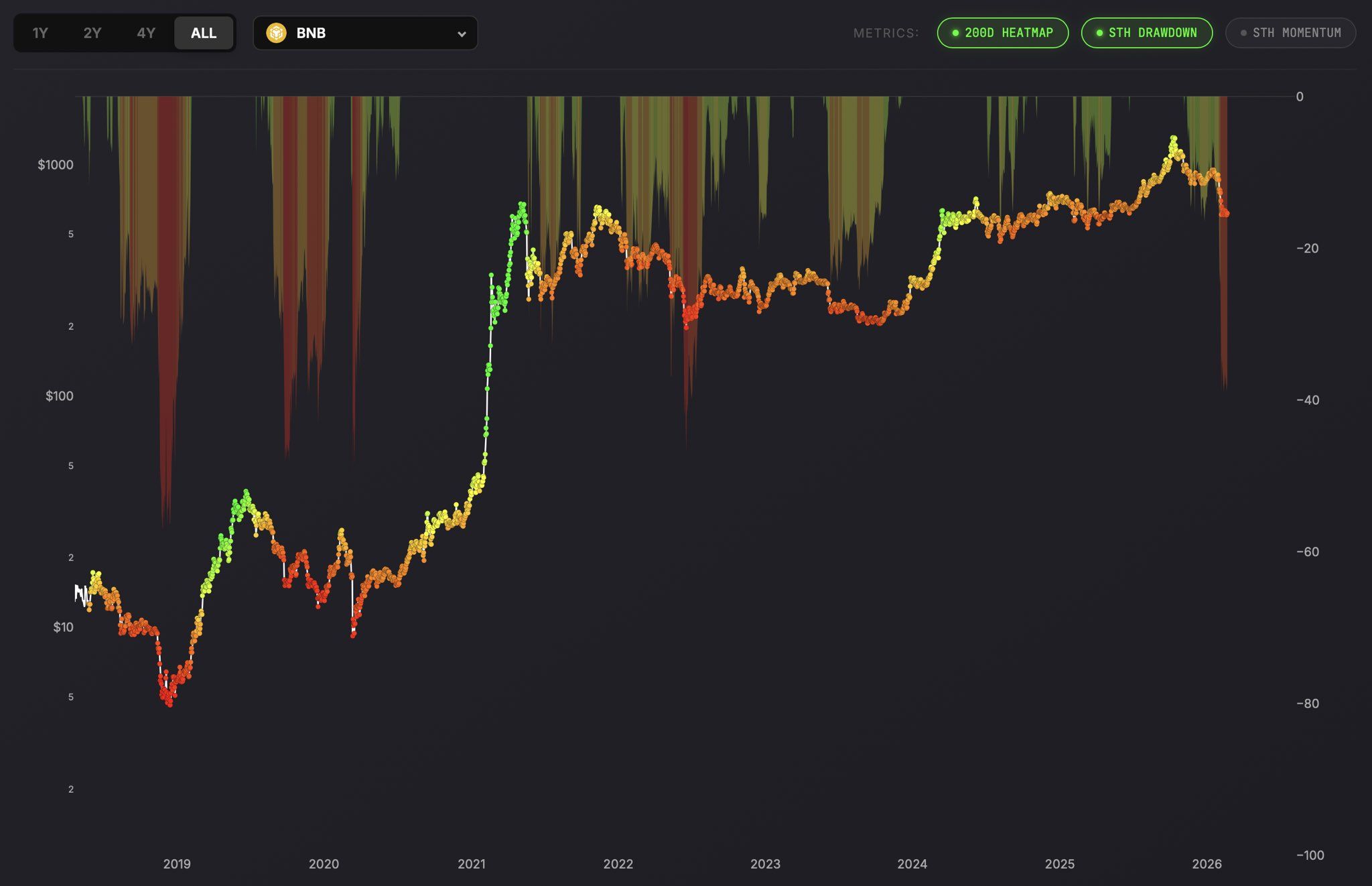
“Right now it is trading about 37% below its short-term holder realised price equivalent, a level that historically signals meaningful undervaluation. BNB has a history of sharp repricings from zones like this,” On-Chain Mind reported.
Short sellers who grow overly confident in BNB’s downtrend could face significant losses if momentum shifts.
3. Bitcoin Cash (BCH)
Bitcoin Cash stands out as one of the few altcoins that has not behaved as if it were in a broader crypto bear market.
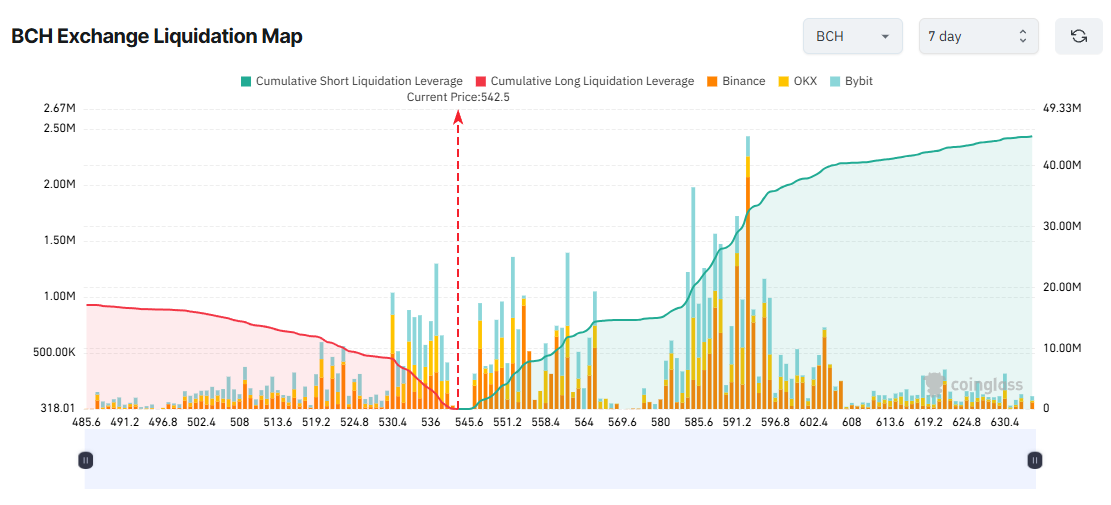
Nevertheless, short-term traders have turned increasingly bearish on BCH in the final week of February. Their positioning has pushed potential short liquidations well above those on the long side.
Data from Bitinfocharts shows that whales have actively accumulated BCH in recent months. One whale address accumulated 400,000 BCH within two months, becoming the network’s third-largest holder.
In addition, a recent report by BeInCrypto stated that the average transaction value on the BCH network surged to over $2 million, nearly 100 times higher than last year.
Under these conditions, heavily leveraged short positions could face liquidation risks if BCH rebounds. A move toward $630 this week could trigger up to $45 million in short liquidations.
In general, extremely negative market sentiment often creates ideal conditions for short squeezes.
“The sentiment in crypto right now is so bad that I’m actually pretty optimistic,” said Tyler Winklevoss, co-founder of Gemini.
In such an environment, short sellers may still capture profits. However, without disciplined profit-taking strategies and strict risk management, gains can quickly evaporate and turn into losses.


- Cosmos price traded around $2.23 on Monday,
- Bulls eye a rebound to above $3 despite broader crypto market losses.
- A key bullish pattern signals the potential for an upside continuation.
Cosmos (ATOM) faces continued sell-off pressure as overall sentiment threatens a sharper correction for altcoins.
This is due to seller dominance as Bitcoin retests $65,000 amid macroeconomic pressures.
However, while the latest downturn has seen bulls fail to decisively test sellers above $2.50, a potential double bottom formation suggests the altcoin could soon explode to a multi-month high.
ATOM price today
As of February 23, 2026, Cosmos (ATOM) was trading near $2.23, with 24-hour trading volume of about $54 million, up 31%, signalling increased buying interest.
However, broader losses across the cryptocurrency market over the past day have allowed sellers to regain some ground following ATOM’s spike to $2.50 on February 18.
While the token has recovered from lows near $1.70, the rebound remains modest compared with previous peaks near $12 in late 2024 and above $6.00 in mid-2025.
The prolonged downtrend across most altcoins in 2026 continues to pose downside risks, with further weakness likely unless buyers defend key support levels and establish new demand zones.
Cosmos price forecast
The Cosmos price shows recovery potential amid a decent bounce from year-to-date lows near $1.70.
Although an overall negative trend in cryptocurrencies could see Cosmos descend into a deeper drawdown, the opposite suggests a rally past $3.00-$3.50 towards pre-October 2025 crash highs.
The area around $2.50 and $3.00 portends a potential supply‑wall risk.
However, with prices bouncing off recent lows, analysts point to a key technical pattern emerging.
A double bottom is a bullish reversal chart pattern formation that outlines two key support levels in a downtrend.
Typically, this pattern forms after a sharp sell-off to a certain low, with prices rebounding before revisiting the zone.
A neckline formation acts as resistance, and in the case of ATOM, this crucial supply zone lies around $2.70.

In the short‑term, Cosmos could test resistance at the neckline and the $3.13–$3.25 zone.
Should bullish momentum hold amid a broader market upturn, the next major resistance levels would be around $4.50-$6.00.
If ATOM continues to struggle alongside Bitcoin and other altcoins, failure to hold above $2.00 could spell danger for buyers.
The next demand reload area below the Feb. 6 lows lies around $1.20.
This outlook could gain momentum if the RSI flips below the 50 mark and the daily MACD turns bearish.
Prices falling below the Bollinger Bands middle line could also signal fresh weakness.
As noted, the opposite, with the double-bottom pattern, confirms that bulls have the upper hand.
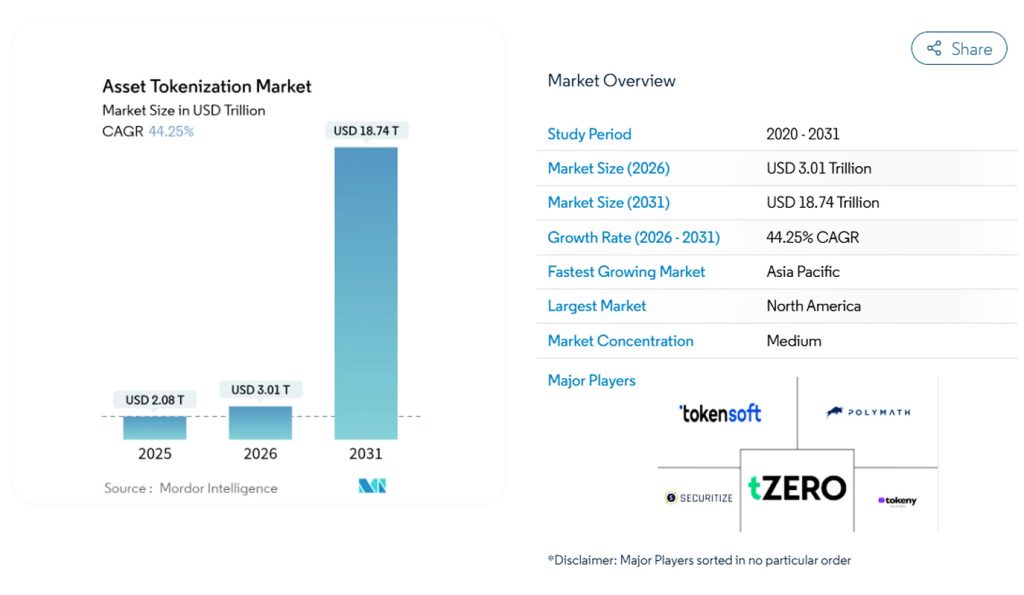
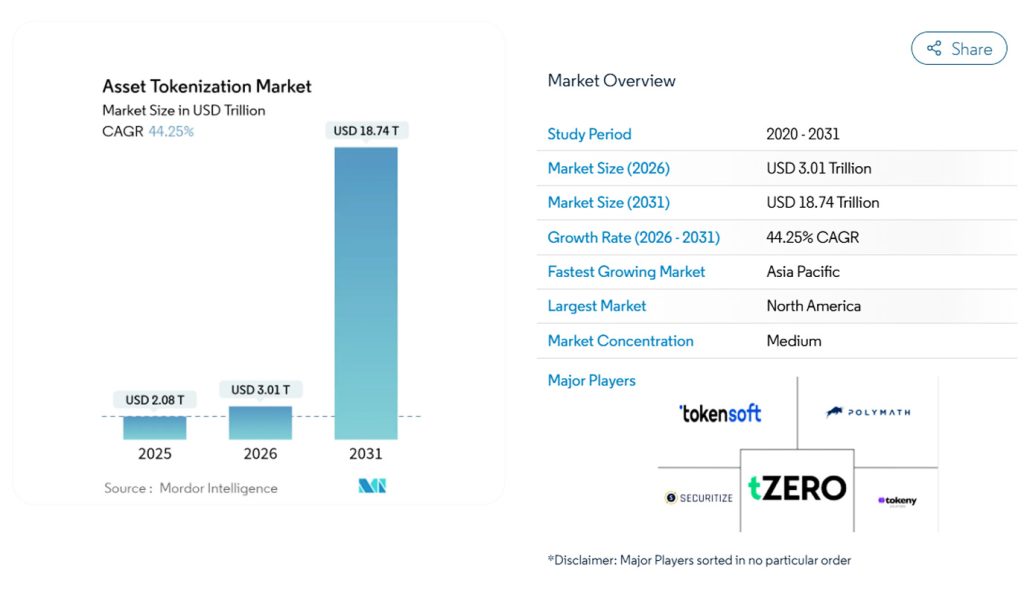
As digital assets become an established part of the financial sector, token-based systems are transitioning from being experimental innovations to being part of a regulated financial system. The regulatory authorities’ ongoing refinement of the classification of digital assets and extension of their oversight to tokenized instruments means that these instruments will need to operate under rapidly changing compliance environments.
Therefore, if immutable smart contracts are deployed without structured adaptations to those environmental changes, and compliance continues to evolve, issuers will be at risk for operational issues, legal liability, and loss of reputation.
Thus, the development of modern asset tokenization platforms should not only include their technical deployment; they also require architectural foresight, an ongoing commitment to governance through disciplined processes, and regulatory intelligence that has been developed at each layer of the development process. Institutions are now expecting future-proofed token development strategies from their tokenization platform developers, rather than just expecting projects to be executed successfully. Future-proofing has ceased to be an area of differentiation for competitive purposes; it has become a structural requirement.
What Defines Future-Proof Compliant Token Development
Developing a compliant token that is capable of meeting future needs, entails creating a digital asset infrastructure that can adapt to normal changes in all areas of regulation, technology, and the marketplace. Instead of placing compliance logic inside of a rigid smart contract (i.e., the form in which users interact with the tokens), advanced systems are designed with modularity; governance controls; and are capable of being upgraded to allow for a controlled adaptation of the smart contract.
For example, in regulated capital markets, this allows organizations to continue to e-operate even with changes in their legal framework being made.
In institutional tokenization platform development, future-proofing means being able to anticipate changes in regulations before they disrupt the ecosystem. This requires creating an infrastructure that can handle policy updates, anything relating to cross-border restrictions, and the evolution of reporting standards, without fragmenting the overall ecosystem.
Adaptive Smart Contract Design
Smart contracts are engineered with upgrade-compatible structures, such as modular logic separation. This ensures that compliance rules, administrative functions, and asset representations can evolve independently without altering ownership records or disrupting transaction histories.
Embedded Compliance Logic
Compliance rules such as investor accreditation checks, jurisdictional transfer restrictions, holding limits, and lock-up periods are encoded directly into the token’s operational layer. This transforms compliance from a manual oversight process into automated enforcement.
Governance-Driven Change Management
Any modification to token logic follows predefined governance procedures. This prevents unilateral intervention and aligns contract evolution with institutional oversight standards comparable to traditional securities markets.
Long-Term Regulatory Alignment
Infrastructure is designed with regulatory monitoring in mind, enabling swift adjustments when authorities issue new guidelines or amend securities classifications.
Why Upgradability Has Become Foundational in Asset Tokenization Platform Development
The development of digital securities continues to evolve regulatory frameworks are evolving, frequently changing the definitions of disclosure standards, investor eligibility requirements, and reporting obligations. Tokens that cannot be upgraded are in jeopardy of being non-compliant the moment their associated regulations change. In large-scale asset tokenization platform development, immutability without adaptability creates structural rigidity that can undermine institutional trust.
But with the ability to upgrade a smart contract, a smart contract could be updated to reflect improvements without having to move investors from their existing token balances to brand new tokens. In the development of enterprise-grade tokenization development, this would provide for operational efficiency and operational integrity through continued transparency and audit trails.
Proxy-Based Contract Frameworks
A proxy pattern separates the contract’s logic from its storage. When upgrades occur, only the logic layer changes, while token balances and ownership data remain intact. This preserves continuity for investors and exchanges.
Modular Smart Contract Segmentation
Dividing compliance rules, governance functions, and asset logic into distinct modules allows selective upgrades. For example, compliance rules can be modified without altering dividend distribution mechanisms.
Governance-Authorized Upgrades
Upgrades are executed only after approval through predefined governance structures, such as multi-signature validation or board-level authorization, ensuring institutional accountability.
Audit-Validated Implementation
Every upgrade undergoes independent security audits and regression testing to prevent vulnerabilities from entering production environments.
Schedule a Strategic Consultation on Enterprise Tokenization
How Governance Architecture Safeguards Institutional Trust in Tokenized Ecosystems
Governance defines the decision-making authority within a tokenized ecosystem. Without structured governance, upgradability may introduce centralization risks. In regulated financial markets, authority must be transparent, controlled, and auditable. Within tokenization platform development, governance ensures that administrative powers mirror the oversight standards of traditional financial systems.
Effective governance models enhance trust among issuers, investors, regulators, and custodians. In enterprise-grade tokenization development, governance frameworks are aligned with corporate compliance policies and regulatory reporting obligations.
Role-Based Access Control Frameworks
Permissions are assigned according to institutional roles, such as issuer administrator, compliance officer, or auditor. This limits operational authority and prevents unauthorized contract modifications.
Multi-Signature Authorization Models
Critical actions require approval from multiple authorized parties. This reduces single-point failure risk and aligns blockchain governance with established financial oversight norms.
Emergency Pause Functions
Tokens may include mechanisms that temporarily halt transfers during investigations, suspected fraud, or regulatory reviews, protecting investors and maintaining compliance.
Transparent On-Chain Audit Trails
All governance actions are recorded immutably, creating verifiable logs that regulators and auditors can review.
How Regulatory Evolution Continues to Reshape Tokenization Platform Development
Across many different laws, the regulation of Digital Assets is constantly evolving. Regulators from various jurisdictions frequently issue or amend guidance on the classification of Securities, the Custody of Digital Assets, the Accreditation of Investors, and the Reports that must be made by Issuers. Therefore, developers of tokenization platforms must anticipate the potential for fragmentation of Regulatory Requirements across jurisdictions.
Global developers of asset tokenization platforms must be designed to function with multiple configurations of compliance at the same time. For example, a Token that is issued in one jurisdiction may have different rules surrounding Transfer and Disclosure when accessing that Token by an investor from another jurisdiction.
Evolving Securities Classification Standards
As regulators clarify distinctions between utility tokens and security tokens, infrastructure must adjust classification logic accordingly.
Investor Protection Mandates
Enhanced identity verification and anti-money laundering protocols require integration with compliant KYC systems and real-time eligibility validation.
Cross-Border Compliance Requirements
Tokens distributed internationally must enforce geographically specific restrictions to prevent unauthorized participation.
Licensing and Custody Regulations
Integration with regulated custodians and licensed intermediaries demands interoperability within the token framework.
How Upgradability, Governance, and Regulation Converge in Future-Proof Token Development Strategies
When functioning as a cohesive framework, an integrated system of upgradability, governance, and regulatory adaptability produces sustainable digital asset ecosystems. Future-proof token development strategies consider each pillar (i.e., governance, upgradeability, regulation) to be interconnected rather than separate from one another. For example, upgrades are governed by the governance protocols in place; upgrades are inclusive of regulatory changes; and compliance logic automatically enforces new policies.
In advanced Enterprise-grade tokenization development, this convergence ensures that tokens remain aligned with legal frameworks while maintaining operational efficiency. Such integration transforms blockchain-based securities into durable financial instruments capable of adapting to policy evolution.
Governance-Triggered Contract Modifications
Regulatory amendments are translated into structured upgrade proposals and executed following institutional approval.
Dynamic Compliance Rule Engines
Real-time validation ensures that transactions comply with updated jurisdictional and investor-specific rules.
Interoperability Across Financial Systems
Tokens integrate with custodians, reporting platforms, exchanges, and regulatory monitoring systems.
Scalable Infrastructure Within Asset Tokenization Platform Development
The platform supports multiple asset classes, enabling expansion without redesigning the compliance core.
What Determines Institutional Readiness in Enterprise-Grade Tokenization Development
Institutional readiness is more than the ability to deploy an asset tokenization platform; it is a reflection of an institution’s ability to sustain compliant operations through the constant change brought about by new regulations and technology advancements. Robust enterprise-grade tokenization development includes governance transparency, upgrade readiness, and regulatory mapping throughout the life cycle of a project.
As digital assets continue to mature, regulatory agencies will be more likely to analyse the infrastructure of the system as opposed to the marketing claims made by asset tokenization providers. This shift in analytical focus will create greater demand for projects that have built-in long-term structural durability.
Documented Upgrade Governance Frameworks
Clearly defined policies outline who can authorize upgrades, under what conditions, and with what oversight controls.
Comprehensive Regulatory Mapping
Token logic is aligned with jurisdiction-specific legal requirements, reducing compliance ambiguity.
Continuous Audit and Monitoring Mechanisms
Automated compliance checks and third-party audits maintain system integrity over time.
Cross-Jurisdictional Deployment Capability
Infrastructure accommodates regional regulatory differences without duplicating systems.
Designing Digital Securities for Enduring Market Evolution
The competitive edge of financial services will be defined by their ability to comply and remain resilient while adapting to digital securities that will begin to be part of the financial infrastructure of the world as markets evolve and do not need to be fundamentally reinvented through the ongoing digitization of the economy. What’s needed is an adaptive governance framework that can enable ongoing use of structured tokenized assets in a rapidly changing regulatory environment with evolving legal systems. Institutions defining a Future-proof tokenization development strategy based on the principles of structured Future-proof token development positioning themselves to be able to effectively operate in the continuously evolving global regulatory landscape as the market for digital assets emerges.
Antier is helping institutions transition from an experimental approach to the deployment of token-based systems to a structured, compliance-driven global ecosystem of digital assets through a deep expertise in developing asset tokenization platforms. Through the development of adaptive infrastructure built upon the foundation of the latest global regulatory standards, Antier is providing institutions with infrastructures that align with current international regulatory standards.
By leveraging governance engineering, upgradeable smart contract design and regulatory-aware design, Antier provides enterprises with the tools needed to implement scalable enterprise-grade tokenized system development strategies and build long-term enterprise resilience.
Frequently Asked Questions
01. What is the importance of future-proofing in token development?
Future-proofing in token development is crucial as it ensures that digital assets can adapt to evolving regulations, technology, and market conditions, preventing operational issues and legal liabilities.
02. How can organizations ensure their tokenization platforms remain compliant?
Organizations can ensure compliance by developing tokenization platforms with modular designs, governance controls, and upgrade-compatible smart contracts that allow for controlled adaptations to regulatory changes.
03. What role do regulatory authorities play in the evolution of token-based systems?
Regulatory authorities refine the classification of digital assets and extend oversight to tokenized instruments, necessitating that these systems operate under rapidly changing compliance environments.


Recent Buterin-linked ETH sales arrive as ether extends a multi-month downtrend from last year’s highs above $4,900.
Vitalik Buterin has ramped up ETH sales again. On-chain data revealed that the Ethereum co-founder sold 1,869 ETH worth roughly $3.67 million over the past two days.
During the same period, Ethereum’s native token declined from about $1,980 to $1,850, a drop of over 5%.
ETH Sales
The transaction pattern is similar to a previous episode, when Buterin sold 6,958 ETH worth approximately $14.78 million, which coincided with a sharper 22% price slide from $2,360 to $1,825, according to an update shared by blockchain analytics firm Lookonchain.
The latest sales came a day after Lookonchain flagged Buterin’s withdrawal of 3,500 ETH from Aave. ETH has been under pressure as the broader market downtrend continues since the crypto asset reached highs above $4,900 in August last year.
Sales linked to Buterin have exceeded 8,000 ETH since February 2, as per data. Earlier this year, Buterin said he would withdraw and liquidate 16,384 ETH and explained that the funds would be directed toward ecosystem development, open-source software efforts, as well as infrastructure support as the Ethereum Foundation enters what he called a phase of “mild austerity.”
Despite the recent disposals, on-chain intelligence from Arkham Intelligence disclosed that Buterin continues to hold more than 224,000 ETH, which is valued at around $429 million at current market prices. An earlier Arkham analysis of Buterin’s wallet activity revealed that Buterin’s wealth remains overwhelmingly tied to ETH’s price performance, with limited diversification into other assets.
In contrast to Buterin’s recent ETH sales, Erik Voorhees is moving in the opposite direction. The ShapeShift founder has begun buying back ETH after selling a large portion last year.
You may also like:
About a year ago, Voorhees sold 11,616 ETH for approximately $33.94 million at an average price of $2,922. More recently, he spent around $20.38 million in USDC to repurchase 9,911 ETH at an average price of $2,057.
Fragile Market Condition
Crypto market account Whale Factor warned that Ether is approaching a “massive crossroads” and pointed to a recent breakdown below a long-standing trend line, followed by a sharp 41% sell-off, which was characterized as severe and destabilizing for market structure.
According to Whale Factor, the altcoin is now trading near a critical support zone around $1,750. If this level fails to hold, the downside risk could accelerate and potentially lead to a deeper decline similar to conditions seen earlier in the year. ETH is also facing thin liquidity, meaning fewer buyers are present to absorb selling pressure, which could amplify price moves.
Binance Free $600 (CryptoPotato Exclusive): Use this link to register a new account and receive $600 exclusive welcome offer on Binance (full details).
LIMITED OFFER for CryptoPotato readers at Bybit: Use this link to register and open a $500 FREE position on any coin!


It is February 2026. Two years ago, the industry was obsessed with the mantra of onboarding the next billion users. It was a rallying cry that echoed through every conference hall from Dubai to Tokyo. Today, as the dust finally settles on the implementation of the United States’ GENIUS Act and the European Union’s fully operational Markets in Crypto-Assets (MiCA) framework, the fundamental question has shifted. We are no longer asking if mass adoption will happen, or even when. Instead, we are asking why it doesn’t look like the cyberpunk revolution we once imagined.
To understand this paradox, where crypto is ubiquitous in systemic finance yet still feels like a foreign concept to the layperson, BeInCrypto spoke to a panel of industry leaders who are building the bridges: Fernando Lillo Aranda (Zoomex), Vivien Lin (BingX), Griffin Ardern (BloFin), Dorian Vincileoni (Kraken), Federico Variola (Phemex), and Michael Ivanov (Arcanum Foundation).
Their collective verdict? The technology is ready. The regulations are (mostly) written. The final hurdle is no longer the code, it is the culture.
The UX Revolution: From Seed Phrases to Smart Accounts
For over a decade, the primary barrier to entry was the fear factor. Crypto was notoriously unforgiving. The industry’s greatest strength, sovereignty, was also its greatest weakness. Lose your 24-word seed phrase, and you lose your life savings. Send a transaction to the wrong hex code, and your funds vanish into the ether. In 2026, we have to ask, has the single mistake era finally ended?
Dorian Vincileoni, Head of Regional Growth at Kraken, offers a refreshingly honest assessment that cuts through the marketing hype. While technology has leaped forward, the core ethos of crypto, total individual responsibility, remains a psychological stumbling block that code alone cannot solve.
Vincileoni admits:
“Can we honestly say a non-technical person is safe? Not entirely, and pretending otherwise would be dishonest. The user experience has improved dramatically, but self-custody still carries responsibility, and responsibility is not intuitive for everyone.”
However, Vincileoni notes that the industry has undergone a massive paradigm shift. We have moved away from the binary choice of Centralized Exchange or Dangerous Self-Custody. Instead, we have entered the age of Smart Accounts.
“Better interfaces, account abstraction, and smarter safeguards are reducing the cost of human error,” Vincileoni explains.
“The real shift is not eliminating risk entirely, but giving users choices. Some will prefer full sovereignty, others will accept guardrails. Mass adoption will come from respecting both.”
This technological evolution is best exemplified by the rise of ERC-4337 and similar standards across various chains. Michael Ivanov, CEO of Arcanum Foundation, emphasizes that the entry journey is still being paved, and it requires specialized tools to protect the user from themselves.
“Nowadays we still have a long way to go for simplification of the entry journey,” Ivanov observes.
“From our side, we are working on the easy way to make it happen. We have developed several Telegram Web Apps (TWA) with efficient risk management layers designed specifically to help users avoid losing their funds, even if they make several mistakes.”
Ivanov’s point is crucial. In 2026, the killer UX isn’t a prettier wallet, it’s a safety net. The industry is finally acknowledging that the average person wants the benefits of blockchain, speed, transparency, and global reach, without needing a degree in computer science to keep their money safe.
The Killer App of 2026: Convergence, Not Casinos
If 2021 was defined by the explosive (and often irrational) NFT boom, and 2024 was the year of the Bitcoin ETF, then 2026 is defined by something far more functional, Convergence. The search for a crypto-native application that would change the world has largely been abandoned in favor of making existing financial systems work ten times better.
Fernando Lillo Aranda, Marketing Director at Zoomex, argues that the industry spent too much time looking for a killer app that lived entirely inside the Web3 bubble. The real breakthrough happened when Web3 started leaking into the real world.
“To reach that inflection point, we first need to understand why mass adoption hasn’t happened yet,” Lillo Aranda states.
“One of the key missing pieces has been clear real-world utility beyond speculation. The real ‘killer app’ of 2026 is the convergence between Web3 financial infrastructure and everyday financial use cases.”
Lillo Aranda points out that centralized exchanges (CEXs) are no longer just trading platforms; they are becoming the primary financial interface for the digital generation.
Aranda adds:
“Centralized exchanges face a major challenge here, their traditional Web2 competitors — banks — have spent years adapting and developing crypto-like services. Meanwhile, forward-thinking CEXs have been working in parallel on bringing Web3 closer to daily life.”
What does this look like in practice? It’s not about decentralized social media or on-chain governance for the masses.
Lillo Aranda explains:
“Products such as crypto-linked cards, seamless access to traditional markets like equities, instant profit withdrawals for everyday spending, and high-yield savings alternatives that outperform Web2 offerings are what will truly onboard the next wave of users.”
“When Web3 stops feeling like a separate ecosystem and instead becomes a better financial layer for everyday life, adoption will follow naturally—not because of speculation, but because it simply works better.”
Michael Ivanov sees the killer app as a multi-pronged spear, with different tools for different demographics. For the younger, digital-native generation, the entry point isn’t banking, it’s entertainment.
“At first glance, there is no single killer app near, but for a specific audience, it could be new Web3-integrated MMO games,” Ivanov suggests.
“We still believe that each audience needs their own way into Web3. For some, it’s crypto banking; for others, it’s an immersive economy where they actually own their digital progress.”
The Stablecoin Economy: Are We Done With Fiat?
The most successful product in the history of crypto isn’t Bitcoin, it’s the stablecoin. In 2025, stablecoin transaction volume surpassed that of major credit card networks in several key corridors. This has led many to wonder: are we approaching the “End of Fiat” for daily spending?
Vivien Lin, Chief Product Officer at BingX, sees a world where the lines are blurring, but warns against expecting a sudden overnight revolution. The transition is stealthy.
“We are moving in that direction, but it will be gradual rather than absolute,” Lin observes.
“Stablecoins are increasingly being used for payments because they are fast, low-cost, and global, especially for cross-border commerce and online services. For many merchants, accepting stablecoins already makes more sense than dealing with traditional payment rails.”
However, Lin injects a dose of realism into the hyper-bitcoinization narrative.
“Fiat will not disappear from daily spending anytime soon. Over time, as infrastructure and regulation mature, the distinction between the two will matter less to the end user.”
In other words, in 2026, the user might be paying with a digital dollar, and they won’t necessarily care if it’s a CBDC, a bank-issued stablecoin, or a decentralized one like LUSD, as long as the transaction clears.
Griffin Ardern from BloFin offers a more cautious, macro-economic perspective. He argues that the perceived stability of a nation’s sovereign credit is the ultimate decider of stablecoin adoption.
“This is unlikely to happen in the short term,” Ardern says of a complete shift away from fiat.
“While many merchants are starting to accept stablecoins, they are currently treated more like ‘money market funds’ than fiat alternatives. Although the collateral risk of stablecoins is among the lowest in the crypto market, it is still significant compared to traditional tier-one assets.”
Ardern notes that the fiat-free dream is largely a product of geography.
“In countries with relatively poor sovereign credit, users are willing to take on this collateral risk because the alternative is worse. But in countries with good sovereign credit, users are usually only willing to convert a limited amount of cash into stablecoins for specific use cases.”
He also points out the merchant-side friction:
“Merchants will also accept stablecoins only in limited quantities to avoid introducing extra operating risks to their balance sheets.”
Despite these hurdles, for the power users and digital nomads, the transition is already complete. Michael Ivanov serves as a living example of this reality. “The future is here,” he says.
“I use crypto-linked cards almost everywhere in the world with no need to pay with fiat. However, we still need to push through government and regulatory issues in many countries to make this the standard, not the exception.”
The Final Boss: Perception and the Trust Deficit
If the technology is robust, the products are useful, and the regulations provide a framework, why aren’t we seeing 100% adoption? The answer, according to our experts, lies in the Final Boss of the industry – public perception.
Federico Variola, CEO of Phemex, believes that we have reached a point where building more tech won’t solve the problem. The industry is no longer limited by its rails, but by its reputation.
“Mass adoption is closer than many think,” Variola asserts.
“Most younger users have already interacted with crypto in some form, and access has become much easier through centralized exchanges and intuitive wallets. The remaining challenge is perception.”
Variola argues that the scars of the 2022-2023 era still haunt the collective consciousness.
“The barriers are no longer technological or regulatory; the rails are already in place. What’s needed now is a more constructive public narrative so skeptical users feel comfortable engaging. Adoption is less about building new tools and more about the market being in the right psychological conditions.”
This sentiment is echoed by Mike Williams (Toobit), who emphasizes that the industry must move from selling dreams to providing education. Trust, in 2026, is built through transparency and understanding, not through celebrity endorsements or price-action hype.
Michael Ivanov summarizes the multi-faceted nature of the hurdle:
“It is a complex web of reasons. Surely including regulation issues, a lingering lack of trust, and the fact that many Web3 apps still have a complicated usability profile for someone used to the simplicity of Instagram or Amazon.”
Conclusion: The Era of Invisible Crypto
As we navigate the landscape of 2026, the insights from Zoomex, BingX, BloFin, Kraken, Phemex, and Arcanum paint a picture of an industry that has finally matured beyond its rebellious, speculative adolescence. We have stopped trying to destroy the banks and have instead started the arduous task of upgrading the world’s financial operating system.
The Killer App of this era isn’t a single platform, it is the Seamless Experience. It is the crypto-linked debit card that pays out yield in real-time (Zoomex). It is an MMO game where your legendary sword is a liquid asset (Arcanum). It is the cross-border payment that settles in seconds for a fraction of a cent without the user ever seeing a blockchain explorer (BingX).
Mass adoption doesn’t look like a revolution led by people waving private keys in the streets. It looks like a quiet, efficient migration to better tools. It looks like convenience. As Federico Variola correctly notes, the tools are ready. The world just needs to decide it’s ready to trust them.
The transition to a Web3-powered world is happening one invisible transaction at a time. By the time we reach the end of 2026, the question won’t be when will crypto be used in everyday life? The answer will simply be: Look around, it already is.
Special thanks to Fernando Lillo Aranda, Vivien Lin, Griffin Ardern, Dorian Vincileoni, Federico Variola, and Michael Ivanov for their contributions to this report.

Check out how SHIB users can protect themselves.
Shiba Inu’s price may have declined substantially over the past several months, but its community remains among the biggest ones in the crypto space.
That said, it is no wonder that scammers often target the so-called SHIB Army using various and sophisticated attacks.
The Latest Danger
Just hours ago, Shibarium Trustwatch (an X account dedicated to warning Shiba Inu users about potential threats) sounded the alarm about multiple fraud attempts involving the SOU NFT.
The team asserted that the non-fungible token in question will never be airdropped to users’ wallets, and that eligible claimants can do so only through Shiba Inu’s official website.
“Do not click on shared, shortened, or copied links. Scammers often create fake websites that look identical to the real one in order to steal funds. Always type the official address directly into your browser and verify you are on the correct domain before connecting your wallet. Never share your private keys or seed phrase with anyone under any circumstances,” the alert reads.
One person commenting on the post was LUCIE , the pseudonymous marketing strategist of Shibarium. They urged the SHIB Army to remain vigilant, warning that fake ads impersonating Uniswap have already led to substantial user losses. They added that crypto scams and exploits have siphoned off roughly $370 million in January alone.
What Is SOU NFT?
The security of Shiba Inu’s layer-2 scaling solution, Shibarium, was breached in September last year, with some reports suggesting the attacker used a flash loan to purchase 4.6 million BONE tokens.
The incident severely disrupted the protocol’s activity, with daily transactions collapsing from millions to only a few hundred. Some analysts have repeatedly argued over the past months that Shiba Inu’s price resurgence may heavily depend on Shibarium’s revival.
You may also like:
After the attack, Shiba Inu’s team created SOU (“Shib Owes You”) NFTs to compensate users for their losses. Each non-fungible token represents a verified claim recorded on Ethereum that shows the amount owed and the amount already repaid.
“You can hold the NFT and wait for repayment, or transfer it if you choose. Think of it like a digital IOU that lives forever on the blockchain instead of a promise in a spreadsheet,” the team recently explained.
Binance Free $600 (CryptoPotato Exclusive): Use this link to register a new account and receive $600 exclusive welcome offer on Binance (full details).
LIMITED OFFER for CryptoPotato readers at Bybit: Use this link to register and open a $500 FREE position on any coin!

Irish businesses investing less in AI than global counterparts

The truth about the WRU EGM and why ousting the chairman may not change anything

Oil Prices Rise Ahead of U.S.-Iran Talks. Goldman Sachs Lifts 2026 Forecast.


-

 Crypto World6 days ago
Can XRP Price Successfully Register a 33% Breakout Past $2?
-

 Video4 days ago
XRP News: XRP Just Entered a New Phase (Almost Nobody Noticed)
-

 Fashion3 days ago
Weekend Open Thread: Boden – Corporette.com
-

 Sports7 days ago
GB's semi-final hopes hang by thread after loss to Switzerland
-

 Politics1 day ago
Baftas 2026: Awards Nominations, Presenters And Performers
-
 Tech7 days ago
The Music Industry Enters Its Less-Is-More Era
-

 Business6 days ago
Infosys Limited (INFY) Discusses Tech Transitions and the Unique Aspects of the AI Era Transcript
-

 Entertainment5 days ago
Kunal Nayyar’s Secret Acts Of Kindness Sparks Online Discussion
-

 Video6 days ago
Financial Statement Analysis | Complete Chapter Revision in 10 Minutes | Class 12 Board exam 2026
-

 Tech5 days ago
Retro Rover: LT6502 Laptop Packs 8-Bit Power On The Go
-
 Sports5 days ago
Clearing the boundary, crossing into history: J&K end 67-year wait, enter maiden Ranji Trophy final | Cricket News
-

 Business1 day ago
Mattel’s American Girl brand turns 40, dolls enter a new era
-

 Business24 hours ago
Law enforcement kills armed man seeking to enter Trump’s Mar-a-Lago resort, officials say
-

 Entertainment5 days ago
Dolores Catania Blasts Rob Rausch For Turning On ‘Housewives’ On ‘Traitors’
-

 Business5 days ago
Tesla avoids California suspension after ending ‘autopilot’ marketing
-
 NewsBeat7 hours ago
‘Hourly’ method from gastroenterologist ‘helps reduce air travel bloating’
-

 Politics6 days ago
Eurovision Announces UK Act For 2026 Song Contest
-

 Tech23 hours ago
Anthropic-Backed Group Enters NY-12 AI PAC Fight
-

 NewsBeat22 hours ago
Armed man killed after entering secure perimeter of Mar-a-Lago, Secret Service says
-

 Crypto World5 days ago
WLFI Crypto Surges Toward $0.12 as Whale Buys $2.75M Before Trump-Linked Forum