

Crypto World
What Makes Tokenization Platform Development Future Proof

As digital assets become an established part of the financial sector, token-based systems are transitioning from being experimental innovations to being part of a regulated financial system. The regulatory authorities’ ongoing refinement of the classification of digital assets and extension of their oversight to tokenized instruments means that these instruments will need to operate under rapidly changing compliance environments.
Therefore, if immutable smart contracts are deployed without structured adaptations to those environmental changes, and compliance continues to evolve, issuers will be at risk for operational issues, legal liability, and loss of reputation.
Thus, the development of modern asset tokenization platforms should not only include their technical deployment; they also require architectural foresight, an ongoing commitment to governance through disciplined processes, and regulatory intelligence that has been developed at each layer of the development process. Institutions are now expecting future-proofed token development strategies from their tokenization platform developers, rather than just expecting projects to be executed successfully. Future-proofing has ceased to be an area of differentiation for competitive purposes; it has become a structural requirement.
What Defines Future-Proof Compliant Token Development
Developing a compliant token that is capable of meeting future needs, entails creating a digital asset infrastructure that can adapt to normal changes in all areas of regulation, technology, and the marketplace. Instead of placing compliance logic inside of a rigid smart contract (i.e., the form in which users interact with the tokens), advanced systems are designed with modularity; governance controls; and are capable of being upgraded to allow for a controlled adaptation of the smart contract.
For example, in regulated capital markets, this allows organizations to continue to e-operate even with changes in their legal framework being made.
In institutional tokenization platform development, future-proofing means being able to anticipate changes in regulations before they disrupt the ecosystem. This requires creating an infrastructure that can handle policy updates, anything relating to cross-border restrictions, and the evolution of reporting standards, without fragmenting the overall ecosystem.
Adaptive Smart Contract Design
Smart contracts are engineered with upgrade-compatible structures, such as modular logic separation. This ensures that compliance rules, administrative functions, and asset representations can evolve independently without altering ownership records or disrupting transaction histories.
Embedded Compliance Logic
Compliance rules such as investor accreditation checks, jurisdictional transfer restrictions, holding limits, and lock-up periods are encoded directly into the token’s operational layer. This transforms compliance from a manual oversight process into automated enforcement.
Governance-Driven Change Management
Any modification to token logic follows predefined governance procedures. This prevents unilateral intervention and aligns contract evolution with institutional oversight standards comparable to traditional securities markets.
Long-Term Regulatory Alignment
Infrastructure is designed with regulatory monitoring in mind, enabling swift adjustments when authorities issue new guidelines or amend securities classifications.
Why Upgradability Has Become Foundational in Asset Tokenization Platform Development
The development of digital securities continues to evolve regulatory frameworks are evolving, frequently changing the definitions of disclosure standards, investor eligibility requirements, and reporting obligations. Tokens that cannot be upgraded are in jeopardy of being non-compliant the moment their associated regulations change. In large-scale asset tokenization platform development, immutability without adaptability creates structural rigidity that can undermine institutional trust.
But with the ability to upgrade a smart contract, a smart contract could be updated to reflect improvements without having to move investors from their existing token balances to brand new tokens. In the development of enterprise-grade tokenization development, this would provide for operational efficiency and operational integrity through continued transparency and audit trails.
Proxy-Based Contract Frameworks
A proxy pattern separates the contract’s logic from its storage. When upgrades occur, only the logic layer changes, while token balances and ownership data remain intact. This preserves continuity for investors and exchanges.
Modular Smart Contract Segmentation
Dividing compliance rules, governance functions, and asset logic into distinct modules allows selective upgrades. For example, compliance rules can be modified without altering dividend distribution mechanisms.
Governance-Authorized Upgrades
Upgrades are executed only after approval through predefined governance structures, such as multi-signature validation or board-level authorization, ensuring institutional accountability.
Audit-Validated Implementation
Every upgrade undergoes independent security audits and regression testing to prevent vulnerabilities from entering production environments.
Schedule a Strategic Consultation on Enterprise Tokenization
How Governance Architecture Safeguards Institutional Trust in Tokenized Ecosystems
Governance defines the decision-making authority within a tokenized ecosystem. Without structured governance, upgradability may introduce centralization risks. In regulated financial markets, authority must be transparent, controlled, and auditable. Within tokenization platform development, governance ensures that administrative powers mirror the oversight standards of traditional financial systems.
Effective governance models enhance trust among issuers, investors, regulators, and custodians. In enterprise-grade tokenization development, governance frameworks are aligned with corporate compliance policies and regulatory reporting obligations.
Role-Based Access Control Frameworks
Permissions are assigned according to institutional roles, such as issuer administrator, compliance officer, or auditor. This limits operational authority and prevents unauthorized contract modifications.
Multi-Signature Authorization Models
Critical actions require approval from multiple authorized parties. This reduces single-point failure risk and aligns blockchain governance with established financial oversight norms.
Emergency Pause Functions
Tokens may include mechanisms that temporarily halt transfers during investigations, suspected fraud, or regulatory reviews, protecting investors and maintaining compliance.
Transparent On-Chain Audit Trails
All governance actions are recorded immutably, creating verifiable logs that regulators and auditors can review.
How Regulatory Evolution Continues to Reshape Tokenization Platform Development
Across many different laws, the regulation of Digital Assets is constantly evolving. Regulators from various jurisdictions frequently issue or amend guidance on the classification of Securities, the Custody of Digital Assets, the Accreditation of Investors, and the Reports that must be made by Issuers. Therefore, developers of tokenization platforms must anticipate the potential for fragmentation of Regulatory Requirements across jurisdictions.
Global developers of asset tokenization platforms must be designed to function with multiple configurations of compliance at the same time. For example, a Token that is issued in one jurisdiction may have different rules surrounding Transfer and Disclosure when accessing that Token by an investor from another jurisdiction.
Evolving Securities Classification Standards
As regulators clarify distinctions between utility tokens and security tokens, infrastructure must adjust classification logic accordingly.
Investor Protection Mandates
Enhanced identity verification and anti-money laundering protocols require integration with compliant KYC systems and real-time eligibility validation.
Cross-Border Compliance Requirements
Tokens distributed internationally must enforce geographically specific restrictions to prevent unauthorized participation.
Licensing and Custody Regulations
Integration with regulated custodians and licensed intermediaries demands interoperability within the token framework.
How Upgradability, Governance, and Regulation Converge in Future-Proof Token Development Strategies
When functioning as a cohesive framework, an integrated system of upgradability, governance, and regulatory adaptability produces sustainable digital asset ecosystems. Future-proof token development strategies consider each pillar (i.e., governance, upgradeability, regulation) to be interconnected rather than separate from one another. For example, upgrades are governed by the governance protocols in place; upgrades are inclusive of regulatory changes; and compliance logic automatically enforces new policies.
In advanced Enterprise-grade tokenization development, this convergence ensures that tokens remain aligned with legal frameworks while maintaining operational efficiency. Such integration transforms blockchain-based securities into durable financial instruments capable of adapting to policy evolution.
Governance-Triggered Contract Modifications
Regulatory amendments are translated into structured upgrade proposals and executed following institutional approval.
Dynamic Compliance Rule Engines
Real-time validation ensures that transactions comply with updated jurisdictional and investor-specific rules.
Interoperability Across Financial Systems
Tokens integrate with custodians, reporting platforms, exchanges, and regulatory monitoring systems.
Scalable Infrastructure Within Asset Tokenization Platform Development
The platform supports multiple asset classes, enabling expansion without redesigning the compliance core.
What Determines Institutional Readiness in Enterprise-Grade Tokenization Development
Institutional readiness is more than the ability to deploy an asset tokenization platform; it is a reflection of an institution’s ability to sustain compliant operations through the constant change brought about by new regulations and technology advancements. Robust enterprise-grade tokenization development includes governance transparency, upgrade readiness, and regulatory mapping throughout the life cycle of a project.
As digital assets continue to mature, regulatory agencies will be more likely to analyse the infrastructure of the system as opposed to the marketing claims made by asset tokenization providers. This shift in analytical focus will create greater demand for projects that have built-in long-term structural durability.
Documented Upgrade Governance Frameworks
Clearly defined policies outline who can authorize upgrades, under what conditions, and with what oversight controls.
Comprehensive Regulatory Mapping
Token logic is aligned with jurisdiction-specific legal requirements, reducing compliance ambiguity.
Continuous Audit and Monitoring Mechanisms
Automated compliance checks and third-party audits maintain system integrity over time.
Cross-Jurisdictional Deployment Capability
Infrastructure accommodates regional regulatory differences without duplicating systems.
Designing Digital Securities for Enduring Market Evolution
The competitive edge of financial services will be defined by their ability to comply and remain resilient while adapting to digital securities that will begin to be part of the financial infrastructure of the world as markets evolve and do not need to be fundamentally reinvented through the ongoing digitization of the economy. What’s needed is an adaptive governance framework that can enable ongoing use of structured tokenized assets in a rapidly changing regulatory environment with evolving legal systems. Institutions defining a Future-proof tokenization development strategy based on the principles of structured Future-proof token development positioning themselves to be able to effectively operate in the continuously evolving global regulatory landscape as the market for digital assets emerges.
Antier is helping institutions transition from an experimental approach to the deployment of token-based systems to a structured, compliance-driven global ecosystem of digital assets through a deep expertise in developing asset tokenization platforms. Through the development of adaptive infrastructure built upon the foundation of the latest global regulatory standards, Antier is providing institutions with infrastructures that align with current international regulatory standards.
By leveraging governance engineering, upgradeable smart contract design and regulatory-aware design, Antier provides enterprises with the tools needed to implement scalable enterprise-grade tokenized system development strategies and build long-term enterprise resilience.
Frequently Asked Questions
01. What is the importance of future-proofing in token development?
Future-proofing in token development is crucial as it ensures that digital assets can adapt to evolving regulations, technology, and market conditions, preventing operational issues and legal liabilities.
02. How can organizations ensure their tokenization platforms remain compliant?
Organizations can ensure compliance by developing tokenization platforms with modular designs, governance controls, and upgrade-compatible smart contracts that allow for controlled adaptations to regulatory changes.
03. What role do regulatory authorities play in the evolution of token-based systems?
Regulatory authorities refine the classification of digital assets and extend oversight to tokenized instruments, necessitating that these systems operate under rapidly changing compliance environments.

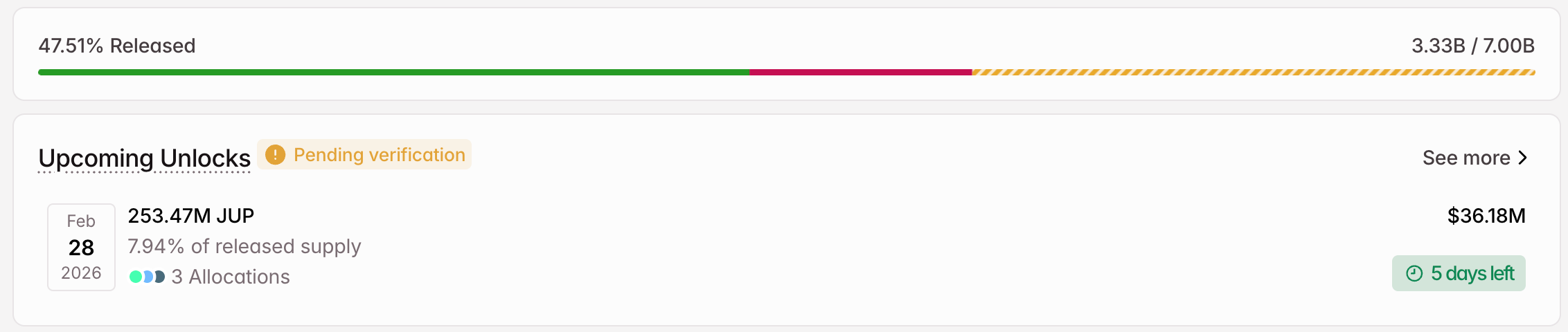
The crypto market will welcome tokens worth more than $317 million in the final week of February 2026. Three major projects, Jupiter (JUP), Humanity (H), and Grass (GRASS), will release previously restricted tokens into circulation.
Token unlocks are crucial events in the crypto market, influencing liquidity, price volatility, and overall investor sentiment. So, here’s a breakdown of what to watch.
1. Jupiter (JUP)
- Unlock Date: February 28
- Number of Tokens to be Unlocked: 253.47 million JUP
- Released Supply: 3.33 billion JUP
- Total supply: 7 billion JUP
Jupiter is a decentralized liquidity aggregator on the Solana blockchain. It optimizes trade routes across multiple decentralized exchanges (DEXs) to provide users with the best prices for token swaps with minimal slippage.
On February 28, Jupiter will unlock 253.47 million JUP, valued at approximately $36.18 million. The altcoins represent 7.94% of its released supply. This marks a substantial increase from Jupiter’s usual monthly unlock of 53.47 million tokens.
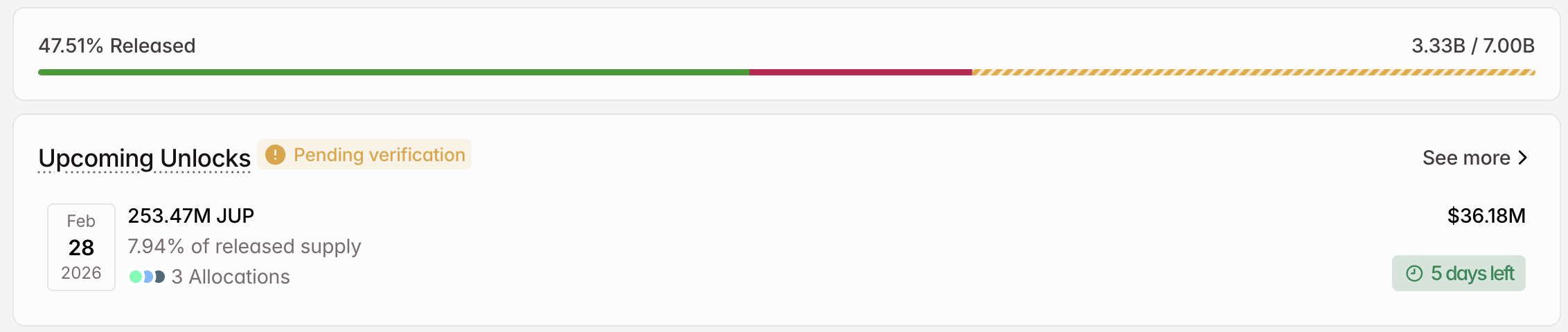
Jupiter will direct 38.89 million JUP to the team. Furthermore, mercurial stakeholders will get 14.58 million JUP altcoins.
Notably, the team has reserved the largest portion, 200 million JUP, for Jupuary. It is Jupiter’s yearly airdrop initiative aimed at rewarding users and long-term community supporters.
2. Humanity (H)
- Unlock Date: February 25
- Number of Tokens to be Unlocked: 105.36 million H
- Released Supply: 2.41 billion H
- Total supply: 10 billion H
Humanity (H) is a decentralized identity protocol that utilizes biometric palm recognition, zero-knowledge proofs, and blockchain to verify the authenticity of real human users without exposing their personal data. It features a native Proof of Humanity (PoH) consensus mechanism.
On February 25, the protocol will unlock 105.36 million tokens. The tokens are worth $16.74 million and account for 4.37% of the released supply.
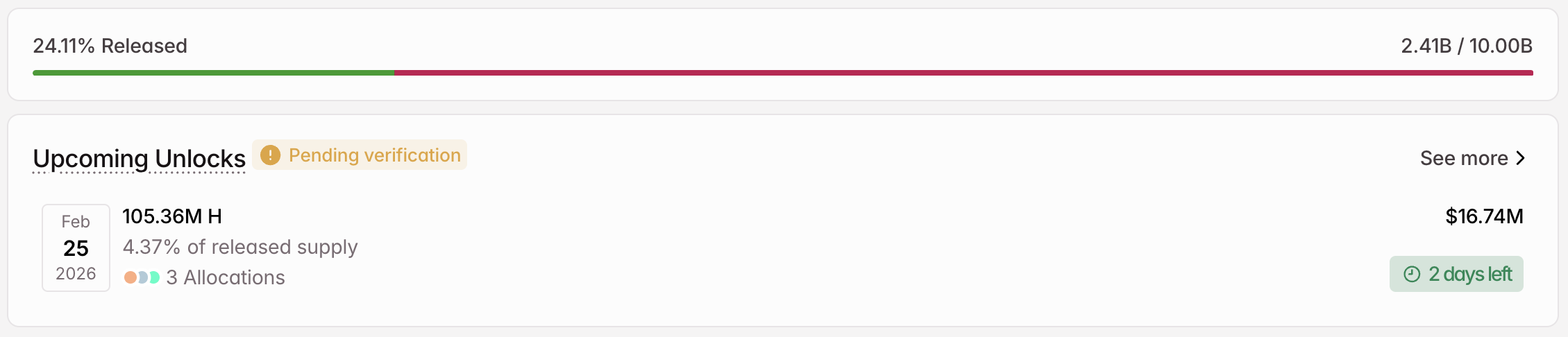
The team will split the released supply three ways. The ecosystem fund will receive 50 million H. Furthermore, Humanity will allocate 42.86 million altcoins to identity verification rewards and 12.50 million to the foundation operations treasury.
3. Grass (GRASS)
- Unlock Date: February 28
- Number of Tokens to be Unlocked: 55 million GRASS
- Released Supply: 416.54 million GRASS
- Total supply: 1 billion GRASS
Grass enables users to monetize unused internet bandwidth. It leverages blockchain to reward participants in a privacy-preserving manner, fostering a global network for accessible data sourcing.
The project will release 55 million tokens on February 28. The supply is worth approximately $9.33 million. It represents 13.15% of the released supply.
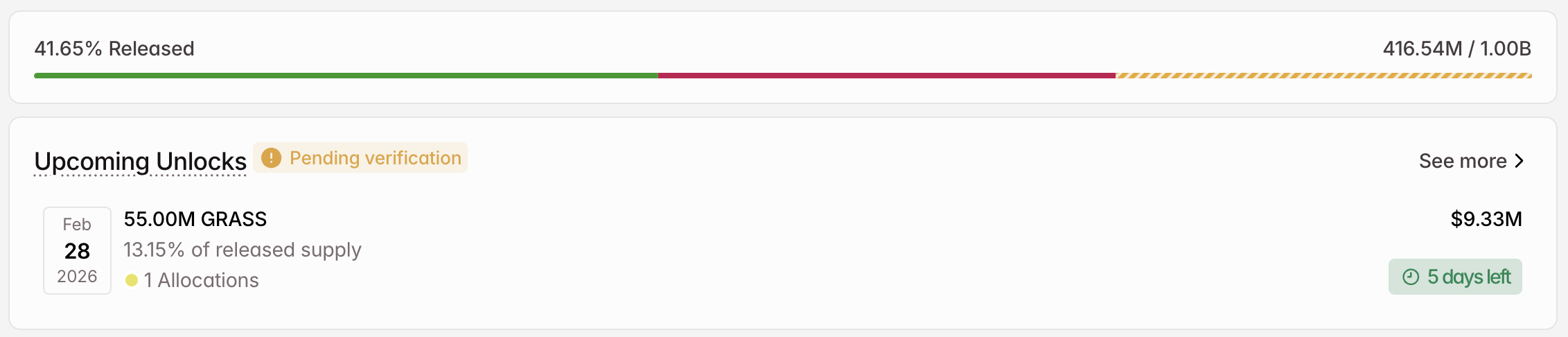
The contributors will receive the entire unlocked supply. In addition to these, other prominent unlocks that investors can look out for in the final week of February include Plasma (XPL), Kamino (KMNO), EigenCloud (EIGEN), and more.
Meme coin volatility is back in focus as the third week of February 2026 delivers explosive short-term rallies. While large-cap assets struggle to establish a clear direction, select low-cap tokens are posting double- and even triple-digit gains.
However, with rapid price expansions comes heightened correction risk. Thus, BeInCrypto has analysed three such meme coins that are pivotal to watch in the final week of February.
Siren (SIREN)
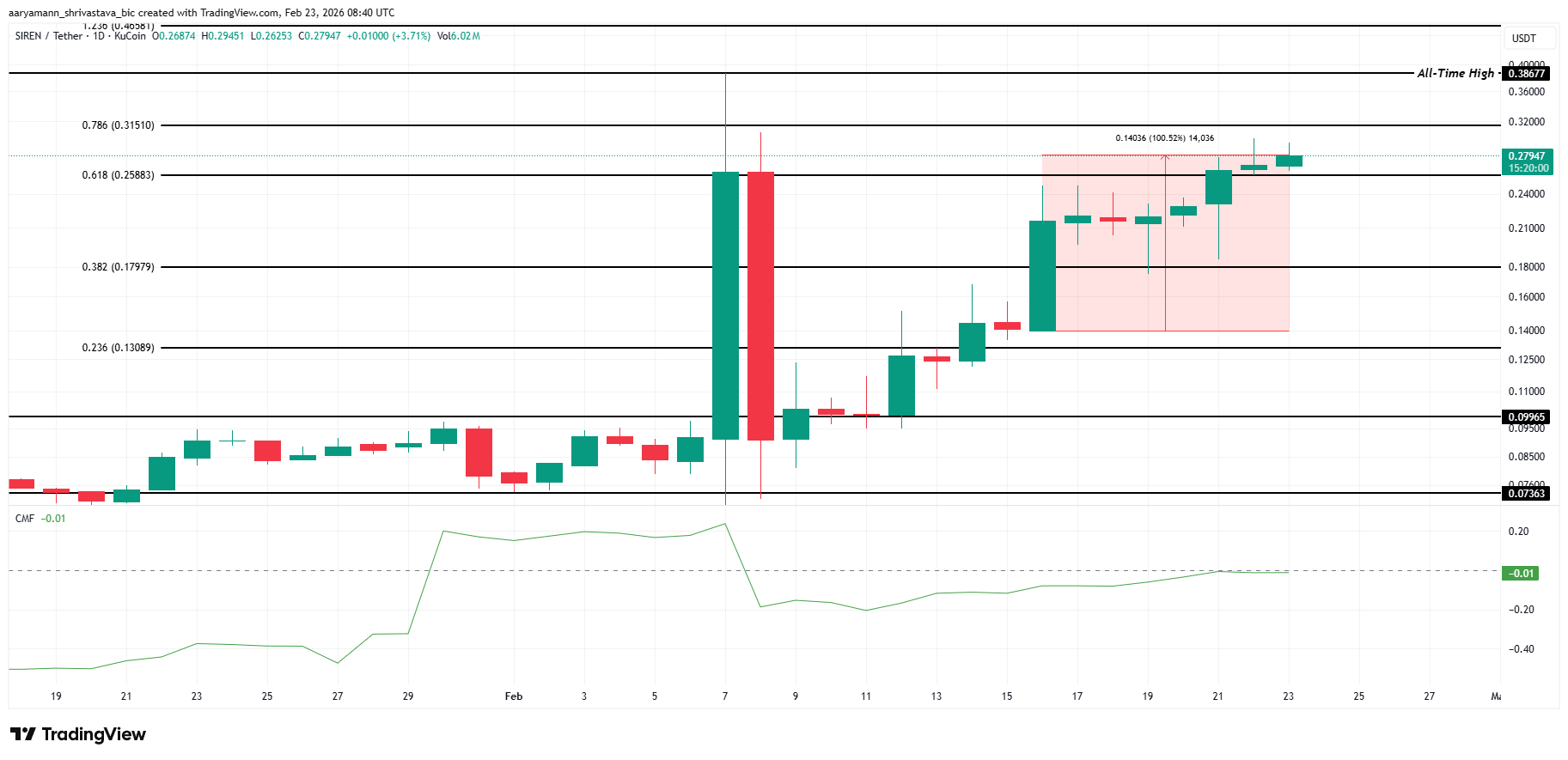
SIREN price has surged 100.5% over the past week, trading at $0.279 at the time of writing. The meme coin is benefiting from renewed investor optimism. Declining exchange outflows indicate holders are retaining tokens, a signal often associated with strengthening short-term bullish momentum in crypto markets.
The Chaikin Money Flow indicator has climbed above the zero line, reflecting rising capital inflows. Sustained buying pressure could support further upside. If momentum continues, SIREN price may retest its all-time high of $0.386. A breakout above that level could open the path toward $0.465.
Want more token insights like this? Sign up for Editor Harsh Notariya’s Daily Crypto Newsletter here.
However, rapid gains increase the likelihood of profit taking. A shift in sentiment could push SIREN below the $0.258 support level. Losing this threshold would weaken the bullish structure. In that scenario, the meme coin could decline toward $0.179, delaying any attempt to reach new highs.
Not in Employment, Education, or Training (NEET)
NEET price surged 75% in the past 24 hours, trading at $0.0249 at the time of writing. The sharp rally caught the broader crypto market off guard. Elevated trading volume and social media traction have fueled momentum, positioning the altcoin for potential continuation if demand remains steady.
Sustained buying pressure has strengthened NEET’s short-term structure. A confirmed move above $0.0258 could support further upside toward $0.0329 in the coming days. The meme coin’s base of 14,100 holders relative to its $24 million market cap signals active community participation, often a catalyst for volatility.
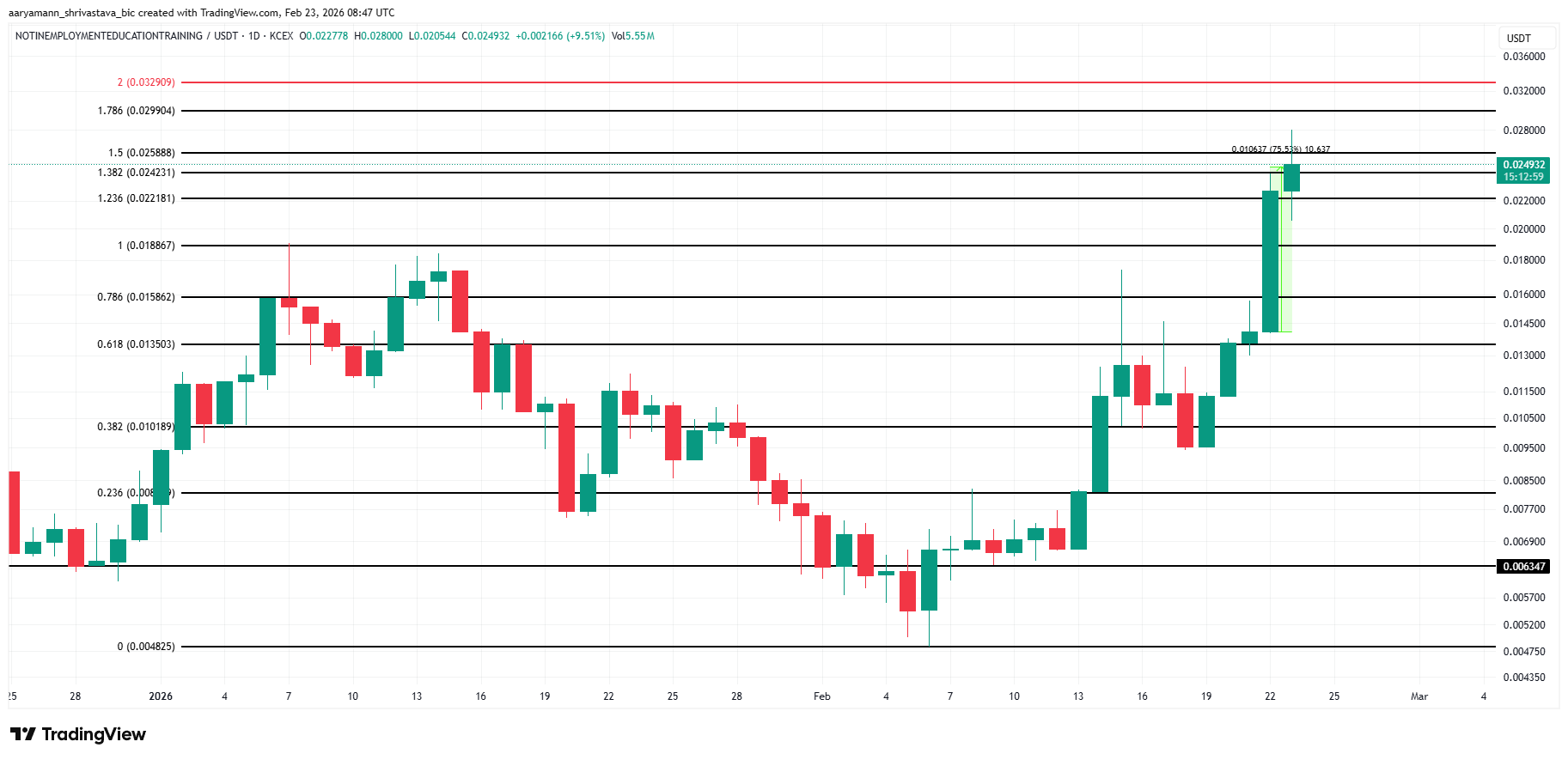
However, rapid price expansion increases correction risk. If buying pressure fades, profit booking may trigger a pullback. Holding $0.0188 support would preserve recovery prospects. A breakdown below that level could drive NEET toward $0.0158, invalidating the bullish outlook and signaling broader weakness.
BAN emerged as one of the stronger-performing meme coins this week, rising 34% despite broader crypto market weakness. This divergence from overall market losses highlights relative strength. Sustained decoupling from bearish sentiment could attract short-term traders seeking alternative upside opportunities in volatile digital assets.
BAN’s correlation with Bitcoin stands at -0.34, indicating it often moves opposite the leading cryptocurrency. This inverse relationship can benefit BAN during Bitcoin pullbacks. Continued negative correlation may support the ongoing uptrend, potentially driving BAN price toward $0.1617 and extending gains to $0.1835.
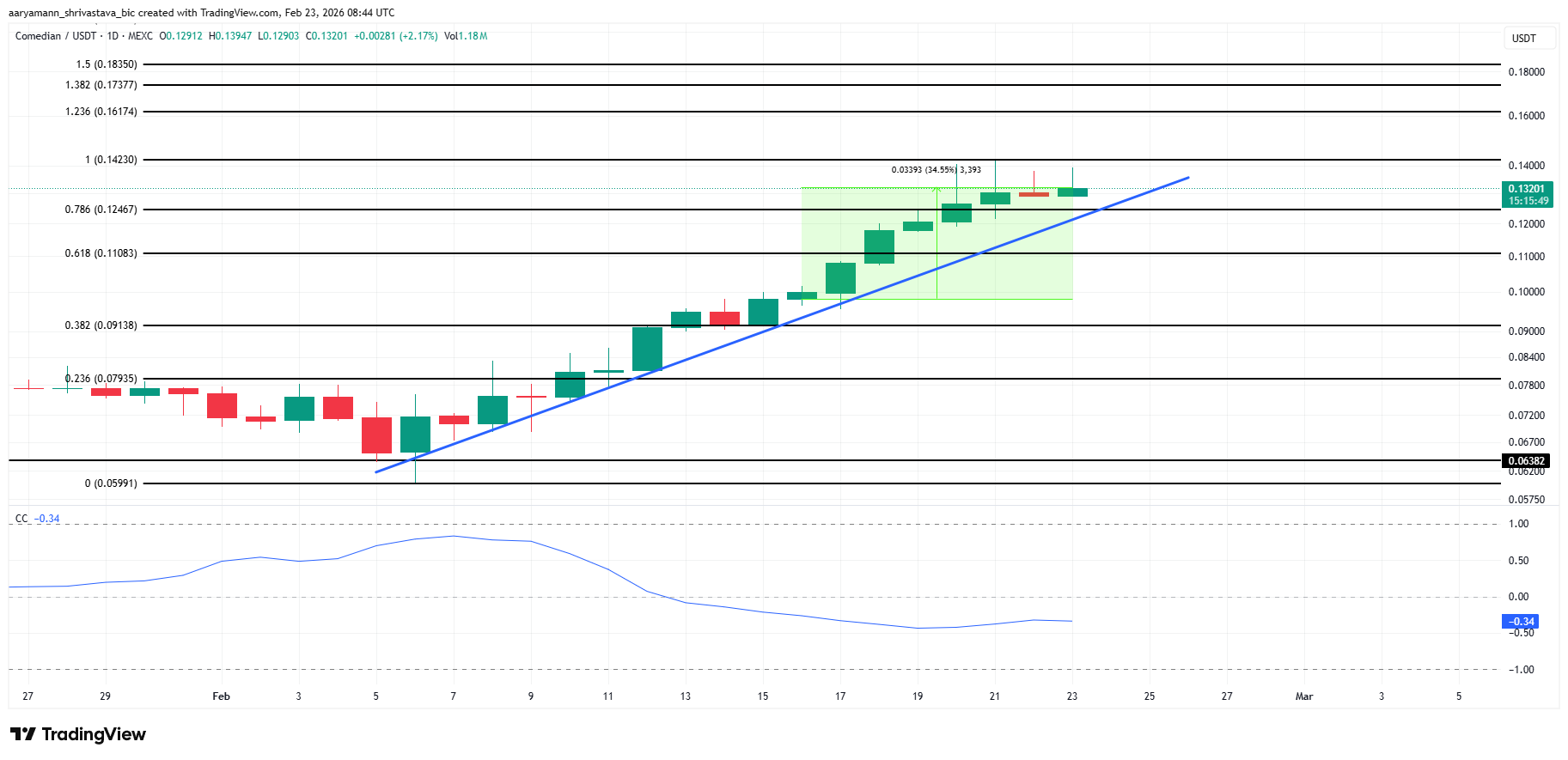
However, improving Bitcoin price momentum could alter this dynamic. If broader crypto sentiment strengthens, BAN’s inverse correlation may limit upside. A decline below $0.1108 would weaken the bullish structure. Sustained selling pressure could push the meme coin toward $0.0913, invalidating the current recovery outlook.

Editor’s note: As the AI boom accelerates, Nvidia sits at the heart of the conversation about how quickly hardware and software teams scale deployment. This editorial provides a concise context for the press release that follows, focusing on the broader market momentum, the role of data centers in AI infrastructure, and the potential implications of forward guidance for investors and traders in tech and beyond. While this note does not add new facts, it frames the lens through which Nvidia’s earnings will be digested by crypto traders and institutional investors who closely watch AI spending trends, capex cycles, and regional risks.
Key points
- Nvidia continues to be a focal point for AI infrastructure spend, with hyperscalers driving data center demand.
- Rubin, Nvidia’s next-generation platform, is a key area of investor focus alongside the Blackwell ramp and gross margin trajectory.
- Geopolitical risk remains a consideration, with export controls in China presenting potential upside if restrictions ease.
- Forward guidance and near-term revenue expectations are closely watched as drivers of momentum in the AI trade.
Why this matters
Nvidia’s earnings preview signals how AI infrastructure investment could shape market dynamics across technology, finance, and enterprise computing. The year ahead will test whether data center demand, platform innovations, and global capex cycles sustain the AI momentum that has underpinned recent market rally attempts and portfolio allocations.
What to watch next
- Rubin ramp progress and its impact on long-term profitability.
- Any developments on China export restrictions and potential upside if eased.
- Guidance clarity on 2027 AI infrastructure spending and data center revenue trends.
Disclosure: The content below is a press release provided by the company/PR representative. It is published for informational purposes.
Nvidia Earnings Set to Test AI Trade Momentum
Nvidia Earnings Set to Test AI Trade Momentum
Abu Dhabi, United Arab Emirates – February 23, 2026: Nvidia’s upcoming earnings report is poised to become one of the most significant events on the global financial calendar, reflecting its position at the centre of the artificial intelligence revolution.
“In the same way Apple once defined the smartphone era, Nvidia now represents the AI era,” said Zavier Wong, Market Analyst at eToro. “Its earnings are no longer just a tech sector event — they are a market-wide catalyst that can influence diversified portfolios globally.”
Wall Street expects quarterly revenue of approximately USD $65–66 billion, representing around 68% year-on-year growth, with earnings per share forecast at USD $1.52–1.53. Data centre revenue is projected to approach USD $60 billion, underscoring sustained demand from hyperscalers including Microsoft, Amazon, Google and Meta. Collectively, these companies are expected to allocate between USD $650–660 billion in capital expenditure in 2026, much of which is tied directly to AI infrastructure.
Beyond US technology giants, sovereign AI investment is emerging as a meaningful growth driver. Countries such as the UAE and Saudi Arabia, alongside several European nations, are accelerating domestic AI cloud development. This segment alone could contribute more than USD $20 billion to Nvidia’s annual revenue in 2026, providing further diversification of its revenue base.
Demand continues to be supported by Nvidia’s Blackwell architecture, which management has previously indicated is effectively sold out through mid-year. Market attention is now turning toward Rubin, the company’s next-generation platform unveiled at CES. Gross margins are expected to recover toward the mid-70% range following temporary pressure during the Blackwell ramp-up, a key signal for long-term scalability and profitability.
However, China remains a notable risk factor. Current guidance assumes no H20 chip sales into the region, meaning any easing of export restrictions would represent upside potential. For now, restrictions continue to act as a headwind.
Nvidia shares have traded broadly flat over the past six months, and investors are increasingly focused on forward guidance rather than headline results.
“The real driver of Nvidia’s share price is guidance,” Wong added. “Markets want confirmation that AI infrastructure spending is still in its early innings, especially as questions grow around the sustainability of industry-wide capex.”
Investors are looking for Q1 FY2027 revenue close to USD $75 billion, gross margins back in the mid-70% range, and clearer visibility on the Rubin ramp. Meeting those expectations could reignite momentum across the AI trade, while any shortfall may trigger volatility extending well beyond Nvidia itself.
Media Contact:
PR@etoro.com
About eToro
eToro is the trading and investing platform that empowers you to invest, share and learn. We were founded in 2007 with the vision of a world where everyone can trade and invest in a simple and transparent way. Today we have 40 million registered users from 75 countries. We believe there is power in shared knowledge and that we can become more successful by investing together. So we’ve created a collaborative investment community designed to provide you with the tools you need to grow your knowledge and wealth. On eToro, you can hold a range of traditional and innovative assets and choose how you invest: trade directly, invest in a portfolio, or copy other investors. You can visit our media centre here for our latest news.

FIFA World Cup organizers are reportedly considering moving this year’s tournament out of Mexico after the death of a crypto-laundering Mexican cartel kingpin led to a wave of violence from his supporters.
Nemesio Oseguera Cervantes, otherwise known as “El Mencho,” ran the Jalisco New Generation Cartel (CJNG) and was killed on Sunday during clashes between his organization and Mexican authorities.
The 59-year-old was reportedly injured during a firefight in the town of Tapalpa, and died while being transported to Mexico City.
His death resulted in an outpouring of violence from supporters. This included the burning of vehicles and buildings across the country, including in Guadalajara, a scheduled host of this summer’s World Cup.
As a result, rumours began to circulate that the city could be pulled from the tournament’s list of venues. Indeed, the host of Ticket Talk, Scott Friedman, claims a contact within FIFA informed him that games will be moved out of Mexico if the situation doesn’t improve in the next week or two.
Bitcoin investor and private fund founder Mike Alfred also claimed that “credible chatter” informed him that the cartel violence has led FIFA to consider moving games slated to take place in Mexico to the US and Canada.
Read more: Up to 127 years for CEO who laundered Mexican cartel funds with bitcoin
The violence has led to countries issuing warnings against travelling to affected regions of Mexico, and the US warning its citizens in the Jalisco region to seek shelter and stay inside.
FIFA is yet to publicly comment on the situation in Mexico. Protos has reached out to FIFA for comment and will update this piece should we hear back.
El Mencho laundered drug funds with crypto brokers
Cervantes founded the CJNG after working his way up the cartel ranks, killing rivals along the way. It was a notoriously violent, heavily armed organization that has been responsible for numerous massacres.
The drug lord was designated as a Kingpin in 2015 and his drug trafficking enterprise was recognised as one of the most powerful criminal groups in Mexico.
The US reward for information leading to his arrest was set at $15 million.

Read more: UK ‘El Chapo’ faces 120 years in US prison over bitcoin-for-drugs ring
Studies led by TRM Labs found that the CJNG has been utilizing crypto to convert drug funds into stablecoins. It was then sent to various wallets, withdrawn from exchanges, or spent as crypto.
In 2022, the Drug Enforcement Administration reportedly discovered that the CJNG had used Binance to move up to $40 million worth of cryptocurrency made through its cocaine and methamphetamine sales.
A Mexican broker was sentenced to eight years in prison for organizing a series of crypto laundering hubs across the US that took cash from the CJNG’s drug sales and converted it into crypto.
TRM Labs has also documented how Chinese money laundering brokers help out these cartels, as well as Chinese suppliers that sell them drug-related chemicals in exchange for crypto.
Got a tip? Send us an email securely via Protos Leaks. For more informed news, follow us on X, Bluesky, and Google News, or subscribe to our YouTube channel.
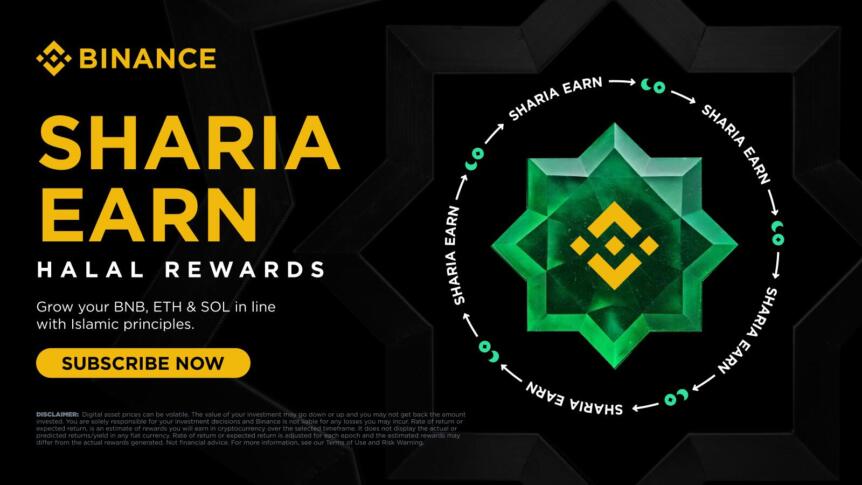
Editor’s note: The mix of rapid crypto adoption and stringent governance in MENAP demands thoughtful, values-driven innovation. This editorial preview examines how structured, Sharia-aligned products can widen access without compromising transparency or risk controls. By highlighting Binance’s Sharia Earn initiative, we explore how Islamic finance principles and blockchain technology intersect to create clearer contracts, responsible yield, and broader participation. In a region projected to host trillions in Islamic finance assets, responsible design is not optional—it’s essential for sustainable growth.
Key points
- Sharia Earn provides defined contracts, governance oversight, and halal investment channels within Binance’s framework.
- Certified by Amanie Advisors and designed with a Wakala structure and underlying Binance Earn tech.
- Launched with BNB, ETH, and SOL as the initial assets.
- Ramadan-driven campaign highlights the move toward compliant, transparent product design in the region.
Why this matters
Structured, values-aligned innovation in MENAP helps turn digital finance into a trusted, inclusive ecosystem. By coupling Islamic finance tenets with blockchain mechanics and governance oversight, Sharia Earn demonstrates how new products can deliver clarity on risk, returns, and eligibility. With Islamic finance assets forecast to reach trillions by 2029, this approach could broaden participation while preserving sharia compliance and investor protection.
What to watch next
- Ramadan campaign impact on awareness and adoption of Sharia Earn.
- Ongoing governance reviews by Sharia scholars and the Amanie Advisors framework.
- Any future product iterations designed to maintain compliance while expanding access.
Disclosure: The content below is a press release provided by the company/PR representative. It is published for informational purposes.
Designing an Inclusive Financial Future: Why Structured, Values-Aligned Innovation Matters in MENAP
As digital assets continue to mature globally, the conversation in the Middle East is shifting. It is no longer just about access to crypto. It is about how that access is structured. In a region where financial systems have long been shaped by strong governance frameworks and clearly defined compliance standards, innovation cannot be disruptive. It must be inclusive by design. That is where structured, Sharia-aligned financial innovation enters the picture, as a framework for clarity, transparency, and broader participation. This approach is especially significant considering that global Islamic finance assets are projected to reach US$9.7 trillion by 2029, growing at an average annual rate of 10%*, highlighting the vast potential for growth within Sharia-compliant financial markets.
Across the region, millions of potential users remain cautious about digital assets, not due to a lack of interest, but because they want greater clarity on how returns are generated, what mechanisms underpin yield products, how risk is structured, and which governance standards apply. “Financial freedom must be built on trust and clarity,” said Tarik Erk, MENAT Lead & Senior Executive Officer, Abu Dhabi at Binance, “In this region, inclusive growth in digital finance requires products that align with structured financial principles and transparent mechanisms. When innovation is built responsibly, participation expands.”
Introducing Sharia Earn: Where Islamic Finance Meets Blockchain Technology
This is where Sharia-aligned frameworks offer something meaningful: defined contractual structures, clear underlying mechanisms, and governance oversight. Binance’s Sharia Earn product was developed within such a structured framework. It is where two financial systems meet: Islamic finance and blockchain technology. Certified by Amanie Advisors, the product ensures that all deployed funds are channeled into ventures and assets that are halal (permissible) under Islamic law. The product launched with major digital assets including BNB, ETH, and SOL. Rather than positioning itself as a niche offering, Sharia Earn reflects a broader shift toward formalized, compliance-driven product design in the region.
Bridging technology and values responsibly
This is also where Binance as a crypto infrastructure becomes relevant. Building financial freedom responsibly requires more than access; it requires trusted rails, clear frameworks, and compliant innovation that users can understand. At its core, Sharia Earn sits at the intersection of blockchain technology through decentralization and programmability; and Islamic finance through a value-based framework. According to product details, Sharia Earn is built using underlying technology from existing Binance Earn products (including locked products and staking mechanics), with the structure reviewed by Sharia scholars and implemented through a purpose-fit Wakala agreement.
Ramadan: A Timely Moment for Responsible Financial Innovation
Ramadan is often described as a month of reflection and intentionality, values that naturally translate into how people think about money: purpose, discipline, and responsibility. As part of its Ramadan campaign period, Binance is also spotlighting Sharia Earn. But the bigger story is not the boost, it’s the direction where ethical and compliant product design becomes a catalyst for broader participation.
Financial freedom, in the context of modern digital finance, doesn’t simply mean “more products.” It means more meaningful choices, built with the safeguards, transparency, and structures that diverse communities require. Sharia-compliant innovation is one of the examples of how that can be achieved in the region by bridging technology and values.
*Source: LSEG Islamic Finance Development Indicator 2025 / ICD Islamic Finance Report.

Editor’s note: Ramadan is a high-stakes period for shoppers in the UAE and GCC, where staple goods can swing on global supply dynamics as well as seasonal demand. This editorial overview examines how easing prices for wheat, sugar, coffee, and cocoa—driven by improved production and steady shipments—could influence household budgets this year. While retailers anticipate busier shopping periods, prices may hold more gently than in recent years if supply conditions stay favorable. The following press release outlines current commodity trends and what they could mean for Ramadan shoppers.
Key points
- Wheat prices down 5% YoY; supply forecasts revised higher; exports and harvests improving.
- Sugar down >10% in month, ~35% YoY; India quotas and Brazil export flows support supply.
- Arabica coffee around $2.80/lb, 27% YoY drop; Brazil harvest expectations improving.
- Cocoa around $3,200/ton, down 69% YoY; West Africa weather improving, ICE stocks at multi-month highs.
Why this matters
As Ramadan approaches, easing input costs and rising supplies may translate into lower retail costs for key Ramadan staples. The trends suggest the season could be cheaper than last year, offering relief to households in the UAE and GCC while producers navigate a more predictable supply landscape.
What to watch next
- Monitor wheat export volumes and forecasts (SovEcon, IKAR, India exports, Argentina crop) from press content.
- Watch sugar price movements, Indian export quotas, and weather conditions affecting production.
- Track Arabica coffee price moves and Brazil harvest developments for 2026/27.
- Observe cocoa inventories and ICE price trends as West Africa and South America conditions evolve.
Disclosure: The content below is a press release provided by the company/PR representative. It is published for informational purposes.
Consumers May See Cheaper Ramadan as Commodity Prices Ease with Stronger Global Supply
Abu Dhabi, United Arab Emirates – February 23, 2026
Ramadan marks one of the busiest periods of the year for retailers across the UAE and the wider GCC. However, there is good news for consumers: several staple ingredients for the holy month, such as wheat, sugar, coffee, and cocoa, are entering the season at relatively soft prices as global supply conditions improve.
While consumer demand typically strengthens ahead of Ramadan, global markets are currently responding more to supply developments than seasonal buying patterns. What that means is that this Ramadan has potential to be cheaper than last year.
The price of wheat, a core staple in Arab households, used in dishes such as harees and khubz, has come under mild downward pressure in recent sessions. Wheat prices are down 5% YoY; a modest dip. Futures are trading near $5.6 per bushel, easing from a three-month high earlier in February when a cold wave raised concerns about crop damage in parts of the U.S. Plains. As weather conditions improved, supply expectations stabilised. Russian production forecasts have been revised higher, with SovEcon estimating 85.9 million tons and IKAR projecting close to 91 million tons for 2026. India has also approved 2.5 million tons of wheat exports following strong harvests, while Argentina is reporting a near-record crop of around 28 million tons. Together, these developments are supporting global supply.
Sugar prices are down more than 10% over the past month and nearly 35% YoY, trading at around 13.46 U.S. cents per pound. Brazil continues to play a key role in global pricing, with strong export flows keeping markets well supplied. Improved weather conditions have further reduced production risks. In India, the world’s second-largest exporter, authorities recently increased the export quota by 500,000 tons to support market stability.
Arabica coffee, or gahwa, a central part of Ramadan gatherings, has eased to around $2.80 per pound, its lowest level since July 2025, and prices are now 27% lower YoY. Prices are under pressure as Brazil, the world’s largest producer, anticipates a strong 2026/27 harvest following improved rainfall. Brazil’s Conab forecasts output at 66.2 million bags, with some private estimates even higher. However, supplies from the current 2025/26 season remain relatively tight, which may limit the discount that consumers will ultimately see in shops
The staple that has seen the greatest price fall is cocoa. Cocoa is now around $3,200 per tonne, its lowest level since June 2023. Prices are down a whopping 69% YoY, representing a significant correction from 2025’s supply-driven spike. As the weather improves in West Africa and yields rise in South America, global supply is increasing. Intercontinental Exchange (ICE) inventories have climbed to multi-month highs, signalling ample availability. For UAE consumers, cocoa’s stability is particularly relevant given the popularity of chocolate-based desserts during Ramadan and the continued buzz around the now-viral “Dubai Chocolate”. The market has shifted from last year’s supply shortages to expectations of more balanced conditions, reducing price pressure for now.
Commenting on the broader trend, Sam North, Market Analyst at eToro, said: global markets are entering 2026 with improving production outlooks and stronger supply visibility. While short-term volatility cannot be ruled out, current fundamentals suggest that markets are well positioned to absorb seasonal Ramadan demand. It is worth noting that food producers typically secure raw materials in advance, meaning current futures prices are not immediately reflected in retail costs. Nevertheless, easing input prices support the prospect of a comparatively less expensive Ramadan this year, should softer trends persist.
Media Contact: PR@etoro.com
About eToro
eToro is the trading and investing platform that empowers you to invest, share and learn. We were founded in 2007 with the vision of a world where everyone can trade and invest in a simple and transparent way. Today we have 40 million registered users from 75 countries. We believe there is power in shared knowledge and that we can become more successful by investing together. So we’ve created a collaborative investment community designed to provide you with the tools you need to grow your knowledge and wealth. On eToro, you can hold a range of traditional and innovative assets and choose how you invest: trade directly, invest in a portfolio, or copy other investors. You can visit our media centre here for our latest news.
The project is reportedly being led by Israeli tech entrepreneur Liran Tancman, who is working as an adviser to the recently established peacekeeping organization.
The so-called “Board of Peace,” created by U.S. President Donald Trump and established during the World Economic Forum last month, is exploring launching a U.S.-dollar-pegged stablecoin in Gaza, FT reported today, Feb. 23.
Led by Israeli tech entrepreneur Liran Tancman, the initiative reportedly aims to alleviate cash shortages in the war-torn region.
“This will not be a ‘Gaza Coin’ or a new Palestinian currency, but a means to allow Gazans to transact digitally,” a person familiar with the project told the FT.
The project is in preliminary stages, but sources told the FT that it is expected to be tied to the U.S. dollar. How the asset would be introduced in the region remains unclear.
The initiative involves collaboration with the 14-member National Committee for the Administration of Gaza (NCAG) and the Office of the High Representative, led by Nickolay Mladenov, which are both working with the Board of Peace. The Board and NCAG are tasked with deciding the regulatory framework and access to the stablecoin, per the report.
Tancman, serving as an unpaid adviser to the Board of Peace, recently spoke at a meeting of the organization in Washington, stating more broadly that NCAG was working on building “a secure digital backbone, an open platform enabling e-payments, financial services, e-learning, and healthcare with user control over data.”
As Reuters recently reported, Israel’s military has officially accepted death toll reports from Gaza health officials that estimate around 70,000 Palestinians, most of whom were women and children, have been killed in Israeli attacks since October 2023.
This article was generated with the assistance of AI workflows.
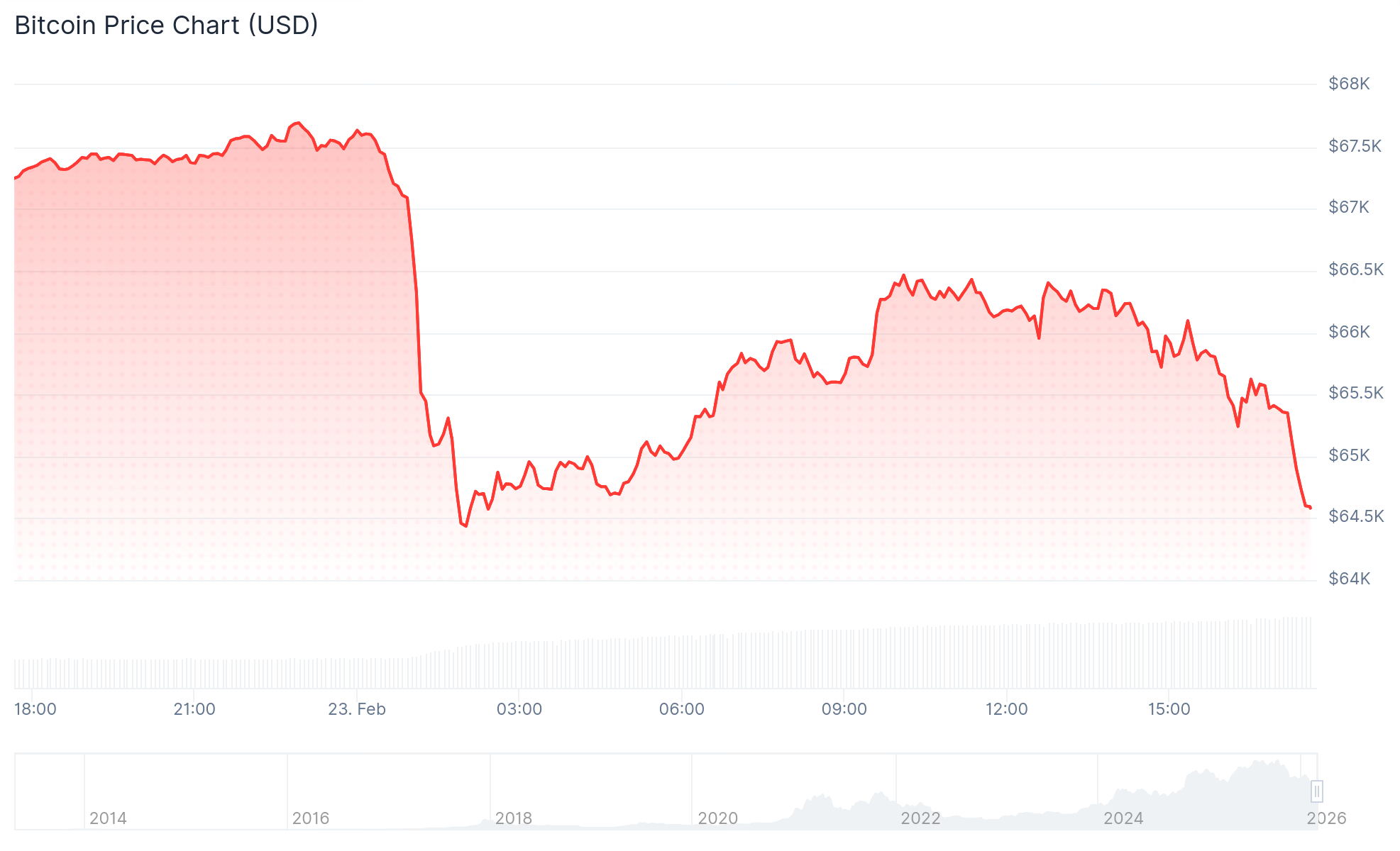
BTC dropped sharply late Sunday and failed to recover Monday as broad losses rip through crypto amid tariff-driven macro uncertainty.
Crypto markets pulled back once again today as traders reacted to a fresh wave of global tariff threats from U.S. President Donald Trump, once again stoking uncertainty around global trade.
Total crypto market capitalization slid over 3% over the past 24 hours to roughly $2.29 trillion.
Bitcoin (BTC) fell from around $67,600 to around $64,400 on Sunday evening eastern time. Though BTC managed to bounce back over $66,000 Monday morning, it has since fallen back and is trading around $64,600 at press time.

Meanwhile, Ethereum (ETH), the second largest crypto asset by market cap, followed Bitcoin’s sharp fall. ETH is down over 4% on the day and trading around $1,850.
The remaining top-10 crypto assets are seeing moderate 24-hour losses between 2%-6%. Dogecoin (DOGE) is faring the best among large-caps, down only 1.3%, but weekly losses are on the higher side at 7%.
Next Major Trigger
Analysts at glassnode noted that net realized profit and loss trends indicate ongoing market pressure.
In an X post today, the analysts pointed out that the seven-day average of net realized profit and loss for recent investors went from a loss of $1.24 billion per day on Feb. 6 to a loss of $0.48 billion per day, showing that people buying in the base formation phase are still selling at a loss.

Analysts at Keyrock said in a Monday blog post the next major market trigger could be NVIDIA’s earnings on Feb. 25, noting that equity markets are highly sensitive to AI-driven growth expectations.
“Given the equity market’s sensitivity to AI-driven growth expectations, guidance will likely have an outsized impact on tech, which Bitcoin has been tracking close to, and broader risk sentiment,” they said.
The Crypto Fear & Greed Index has slid to 5, deep in “extreme fear” territory, signaling that investor sentiment is once again at one of its lowest points in recent weeks.
Big Movers and Liquidations
Looking at the top-100 assets by market cap, POL (ex-MATIC) led gainers, up 3.3%, followed by tokenized gold assets Tether Gold and PAX Gold, both up about 1.4%.
On the downside, tokens of two of the largest decentralized trading protocols, Hyperliquid (HYPE) fell 8.2% and pumpfun (PUMP), led daily losses, both down about 9%. Commentators noted that the price pressure came after a tweet from ZachXBT teasing an upcoming investigation into “one of crypto’s most profitable businesses.”
According to CoinGlass data,nearly 139,000 traders were liquidated over the past 24 hours, with total losses of around $503.1 million. Bitcoin accounted for $231.3 million, Ethereum for $127 million, and other altcoins totaled $33.78 million. Long positions made up $426.5 million of the total, while shorts accounted for $76.5 million.
ETFs and Macro Conditions
Spot Bitcoin exchange-traded funds (ETFs) recorded $315.86 million in outflows over the past week ending Feb. 20, while spot Ethereum ETFs lost a net $123.37 million, according to SoSoValue data.
On the macro side, the European Commission told the U.S. to stick to last year’s trade deal after the Supreme Court struck down Trump’s emergency tariffs, Reuters reported on Sunday, Feb. 22. Trump hit back with temporary global tariffs, first 10% then up to 15% over the weekend, leaving markets dealing with an unpredictable trade scene.
Meanwhile, U.S. Treasury yields barely moved at the start of the week. The 10-year yield dipped just under 1 basis point to 4.077%, the 30-year slipped slightly to 4.723%, and the 2-year nudged up to 3.482%, per data from CNBC.
Crypto World
Solana Company starts building high-speed infrastructure to prepare SOL for next ‘super cycle’
Solana Company (HSDT) said it plans to build a high-speed infrastructure network across the Asia-Pacific region to support the growth of the Solana blockchain and diversify its revenue streams.
The initiative, called the “Pacific Backbone,” will connect Seoul, Tokyo, Singapore and Hong Kong with a low-latency cluster designed to support staking, validation and trading services on Solana.
The move targets institutional demand across the region, which has become a hotspot for crypto adoption, cross-border payments and digital asset development.
The buildout aims to make Solana’s infrastructure more accessible and reliable for market makers, high-frequency traders, and financial institutions, according to a press release.
The company said the project will begin immediately, with performance optimization and additional product launches expected in the next 12 to 18 months. These include DeFi tools, liquid staking, automated market makers and execution services tailored to traditional finance firms entering the space.
Joseph Chee, CEO of Solana Company, said the expansion will help prepare for what he called Solana’s “next super cycle.”
The goal is to reduce reliance on external service providers, reduce latency, and provide a compliant infrastructure that meets institutional requirements in regulated markets.
Solana, the firm said, processes over 3,500 transactions per second and supports millions of daily active wallets. Solana Company is currently the second-largest Solana treasury firm, with 2.3 million SOL, or over $180 million, in its treasury.
Solana Company’s shares are down 13.3% in today’s trading session to $1.76, amid a wider cryptocurrency market drawdown. Solana itself is down nearly 6% in the last 24-hour period, while BTC is down more than 4%.
CoinDesk has reached out to Solana Company for comment but hasn’t heard back at the time of writing.


- Polygon price rose about 5% in the past 24 hours.
- The token continues to hold above $0.10.
- A surge in transactions, stablecoin adoption and POL burning is helping price gains.
Polygon (POL), formerly MATIC, has stabilized above the $0.10 support level despite ongoing market volatility.
As macroeconomic and geopolitical headwinds pressure Bitcoin and Ethereum prices lower, POL is showing great resilience.
The token has gained in the past 24 hours and trends among top performers on the day, outpacing several of its layer 2 peers. Can bulls reclaim key levels and push higher despite overall market weakness?
Why is Polygon price up today?
POL’s uptick today includes a notable rise to intraday highs above $0.11. The token revisited prices around $0.10 but showed resilience amid its bounce from under the psychological level.
Bitcoin’s dip to $65k looks to have allowed for some capital rotation into small cap tokens, including POL.
While this looks to be a plausible reason for the bounce, Polygon’s upward move largely stems from recent momentum, helped by robust stablecoin volume and deflationary dynamics.
The L2 has seen a huge leap in terms of USDC transactions on the network, leading to Ethereum scaling solutions.
.@USDC activity is exploding on Polygon
(#1 chain for transactions) pic.twitter.com/76xh4jenGP
— Polygon | POL (@0xPolygon) February 13, 2026
DeFiLlama data shows the stablecoin market cap on Polygon stood at around $3.26 billion at the time of writing.
Analysts have noted that more than 100 million POL tokens have been burned on the Polygon network.
The token burn means a cut in circulating supply and potential upward price pressure.
In the past 30 days, about 32.6 million POL have been burned, slashing net issuance.
“Every transaction on Polygon generates fees,” the team wrote on X. “ From each fee: base fees are burned and priority fees are shared among validators, block producers, and stakers.”
The more activity there is, the more fees generated and the more POL burned and permanently removed from circulation. The token’s price could strengthen long-term amid this move.
POL price forecast
Polygon price appears to be riding the above bullish catalysts.
Trading volume rose more than 30% in the past 24 hours on Monday, hitting over $84 million.
In terms of short-term price forecast, POL currently eyes resistance at $0.12. This aligns with the horizontal hurdle of an ascending triangle pattern, and points to a potential uptick to highs of $0.30.
If bulls strengthen above $0.14 and decisively breach $0.20, continuation amid broader market gains will help galvanize this trajectory.
A breakdown of a similar outlook however, saw Polygon’s token plummet to recent lows. In this case, rejection at $0.12 or $0.14 could fuel further declines, with bears likely to eye $0.09 as the initial target.

Tesco F&F launches new fluffy cardigan in a range of spring colours

A $44,000 Bill Shows the Dysfunction in California’s Home-Insurance Market

3 Key Crypto Token Unlocks to Watch in Late February


-

 Crypto World6 days ago
Can XRP Price Successfully Register a 33% Breakout Past $2?
-

 Video4 days ago
XRP News: XRP Just Entered a New Phase (Almost Nobody Noticed)
-

 Fashion3 days ago
Weekend Open Thread: Boden – Corporette.com
-

 Sports7 days ago
GB's semi-final hopes hang by thread after loss to Switzerland
-

 Politics2 days ago
Baftas 2026: Awards Nominations, Presenters And Performers
-
 Tech7 days ago
The Music Industry Enters Its Less-Is-More Era
-

 Business6 days ago
Infosys Limited (INFY) Discusses Tech Transitions and the Unique Aspects of the AI Era Transcript
-

 Entertainment5 days ago
Kunal Nayyar’s Secret Acts Of Kindness Sparks Online Discussion
-

 Video6 days ago
Financial Statement Analysis | Complete Chapter Revision in 10 Minutes | Class 12 Board exam 2026
-

 Politics2 hours ago
Nick Reiner Enters Plea In Deaths Of Parents Rob And Michele
-

 Tech5 days ago
Retro Rover: LT6502 Laptop Packs 8-Bit Power On The Go
-
 Sports5 days ago
Clearing the boundary, crossing into history: J&K end 67-year wait, enter maiden Ranji Trophy final | Cricket News
-

 Business1 day ago
Mattel’s American Girl brand turns 40, dolls enter a new era
-

 Business1 day ago
Law enforcement kills armed man seeking to enter Trump’s Mar-a-Lago resort, officials say
-

 Entertainment5 days ago
Dolores Catania Blasts Rob Rausch For Turning On ‘Housewives’ On ‘Traitors’
-

 Business6 days ago
Tesla avoids California suspension after ending ‘autopilot’ marketing
-
 NewsBeat9 hours ago
‘Hourly’ method from gastroenterologist ‘helps reduce air travel bloating’
-

 Politics6 days ago
Eurovision Announces UK Act For 2026 Song Contest
-

 Tech1 day ago
Anthropic-Backed Group Enters NY-12 AI PAC Fight
-

 NewsBeat1 day ago
Armed man killed after entering secure perimeter of Mar-a-Lago, Secret Service says