

Crypto World
XRP price forms gartley pattern at $1.30: Bullish bottom?

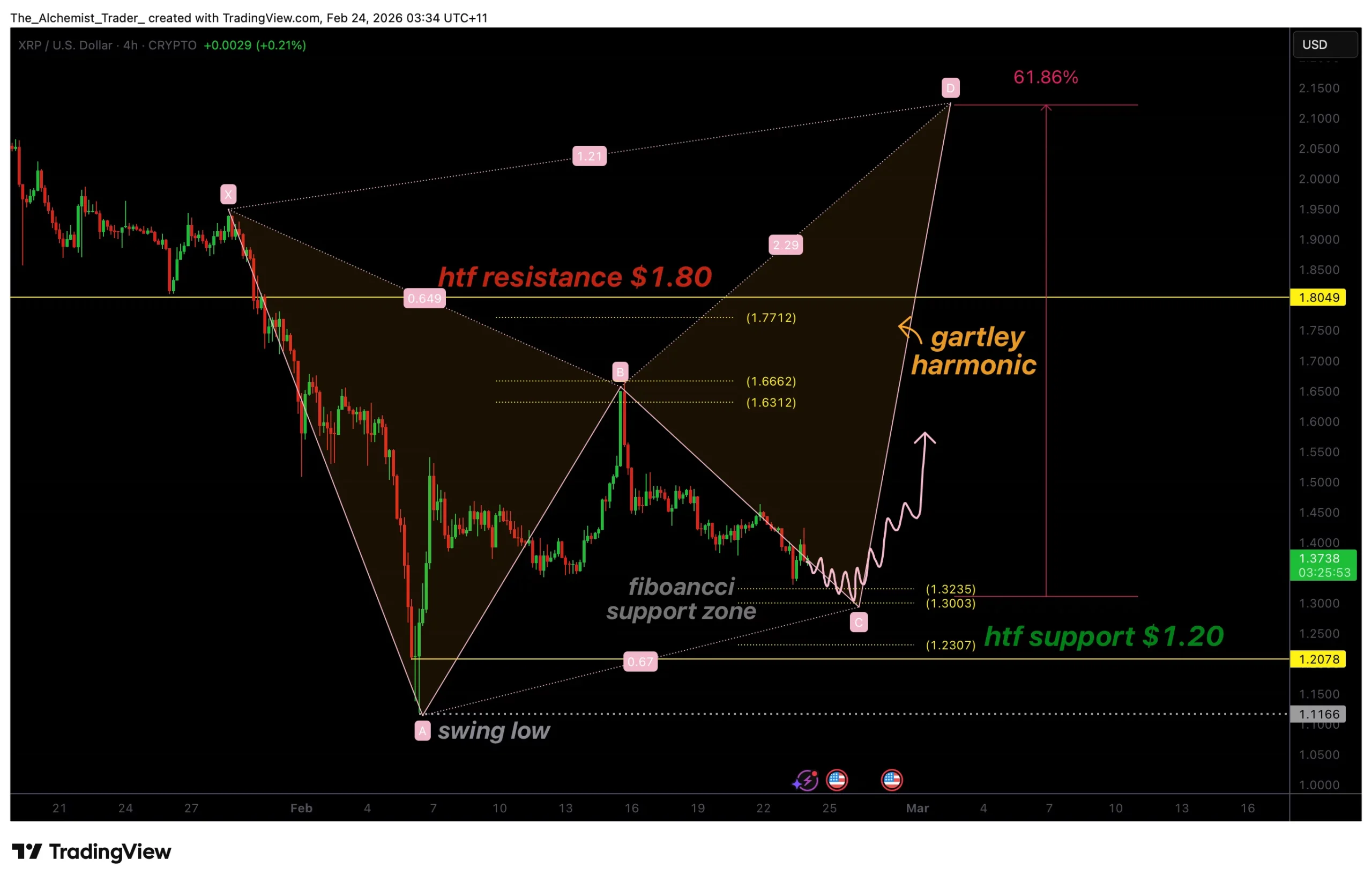
XRP price is forming a potential Gartley harmonic pattern near $1.30 support, signaling a possible bullish bottom as price rotates within a broader range.
Summary
- XRP developing Gartley harmonic pattern near $1.30 support
- Holding above $1.20 keeps bullish reversal structure valid
- Completion of leg D could trigger a strong upside rally
XRP (XRP) price action is beginning to show technical structure as a potential Gartley harmonic pattern develops near the $1.30 region. After weeks of rotational trading between high-timeframe resistance near $1.80 and strong support around $1.20, the market now appears to be transitioning into a pattern-driven consolidation phase that could precede a larger directional move.
Harmonic patterns, particularly the Gartley structure, rely heavily on Fibonacci relationships and precise price pivots. Recent XRP movements align closely with these technical requirements, with price rejecting key Fibonacci levels and forming recognizable swing structures. This evolving setup raises the question whether XRP is establishing a bullish bottom within its current range.
While confirmation is still required, the ongoing formation suggests a growing upside potential if support continues to hold.
XRP price key technical points
- Gartley pattern forming near $1.30: Fibonacci reactions are shaping harmonic structure development
- Range environment intact: XRP continues rotating between $1.80 resistance and $1.20 support
- Potential 60% upside projection: Completion of leg D could trigger a strong bullish rally
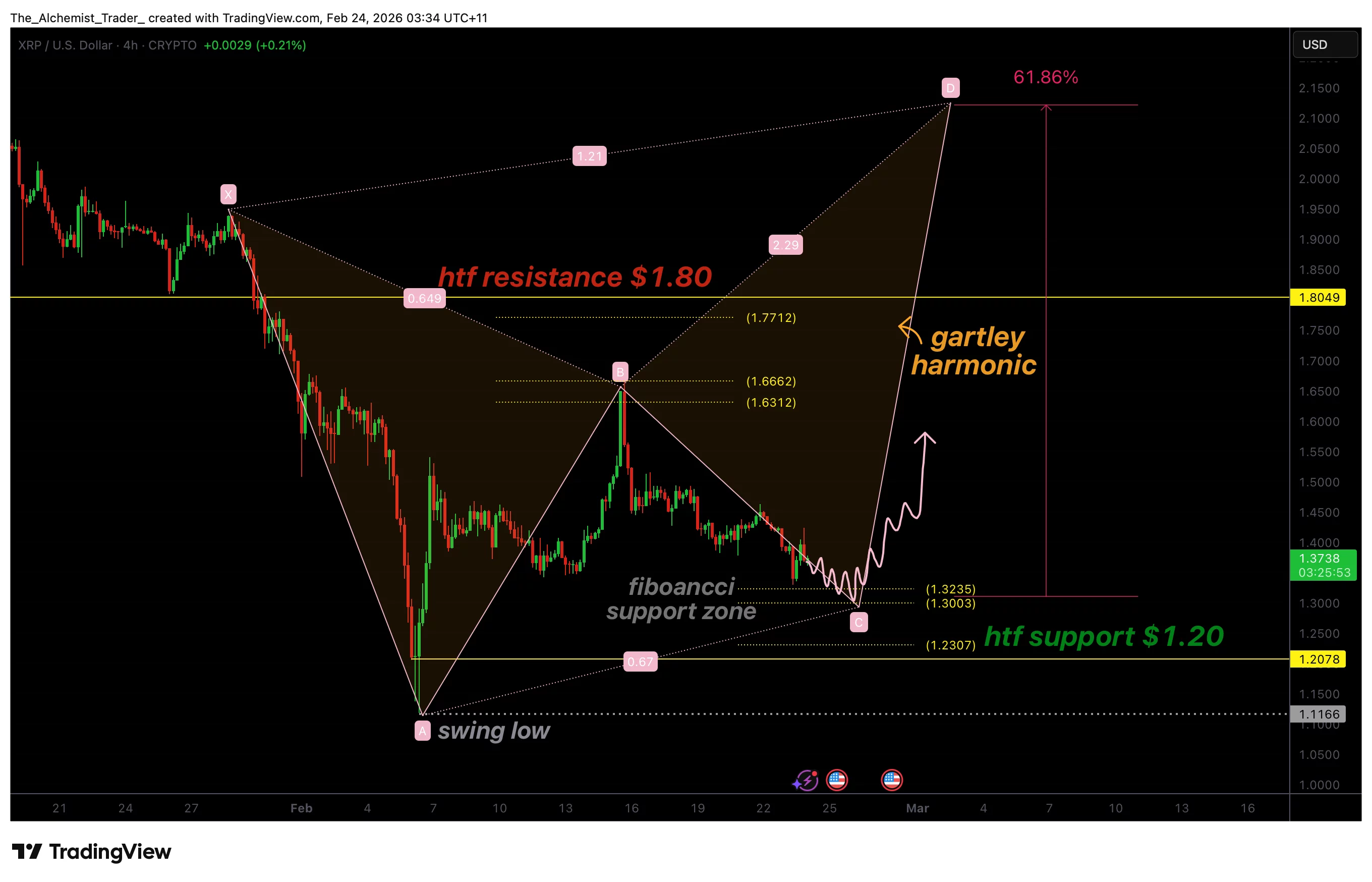
XRP has spent recent months trading within a well-defined range, oscillating between high-timeframe resistance at $1.80 and major structural support at $1.20. Rather than trending impulsively, price has displayed rotational behavior, a condition that often allows harmonic patterns to develop naturally.
The latest corrective move saw XRP reject the 0.618 Fibonacci retracement, an important technical reaction that supports the formation of a Gartley pattern. Price is currently trading below a local Fibonacci support zone, aligning with expectations for the ongoing development of the pattern’s internal legs.
In harmonic analysis, a Gartley pattern typically unfolds through multiple measured swings labeled X, A, B, C, and D. XRP appears to be progressing through the latter stages of this structure, with several clean pivots already established. These pivots reflect strong technical reactions at Fibonacci levels, reinforcing the validity of the developing setup.
Support defense critical for pattern validation
For the Gartley pattern to remain valid, XRP must continue to hold above the high-timeframe support near $1.20. This level represents a critical point of invalidation. Acceptance below it would weaken the harmonic structure and increase the probability of a deeper corrective move.
However, as long as price maintains support and reacts positively near the 0.618 Fibonacci region, the pattern continues to mature. The immediate focus shifts toward the completion of leg C, which typically precedes the impulsive move toward leg D, the final stage of the harmonic formation.
The significance of this stage lies in market psychology. Harmonic patterns often develop during periods of uncertainty, where both buyers and sellers test liquidity extremes before a clearer directional bias emerges. XRP’s repeated reactions at key Fibonacci zones suggest that market participants are actively responding to these technical levels.
Upside potential builds toward leg d completion
If XRP successfully completes leg C and establishes support in the current technical region, the probability increases for a bullish expansion toward the projected completion of leg D. Based on harmonic measurements, this move could represent a rally of approximately 60% from current price levels.
The projected upside aligns with higher resistance areas within the broader range structure, potentially revisiting zones closer to $1.80 and beyond. Importantly, this scenario does not require an immediate breakout but instead reflects a structured recovery within the existing market framework
Momentum confirmation will likely come through sustained higher lows, improved trading volume, and continued respect of Fibonacci retracement levels. These factors would signal that buyers are gaining confidence and positioning ahead of a larger move.
What to Expect in the Coming Price Action
From a technical, price-action, and market-structure perspective, XRP’s developing Gartley pattern suggests a bullish bottom may be forming near $1.30. As long as price remains above the $1.20 high-timeframe support and holds the 0.618 Fibonacci region, the probability favors completion of leg C followed by a rally toward leg D.

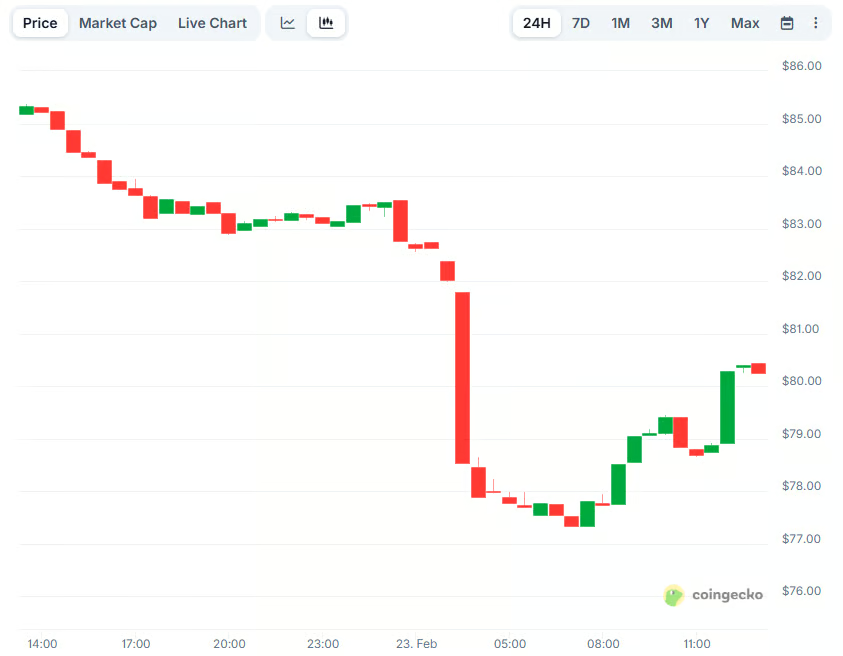
SOL is “basically trading in a big no man’s land,” one popular analyst argued.
Solana’s SOL has been on a severe downfall lately, with its valuation plummeting by almost 40% over the past month alone.
According to some analysts, the bears are yet to reveal their full potential, envisioning a slump below $10 in the near future.
SOL HODLers, Beware
The leading altcoin was among the worst-affected cryptocurrencies following the latest market slump caused by Trump’s renewed tariff saga. Just a few hours ago, SOL briefly dipped to roughly $77 before snapping back above $80, meaning a 6% loss for the day.
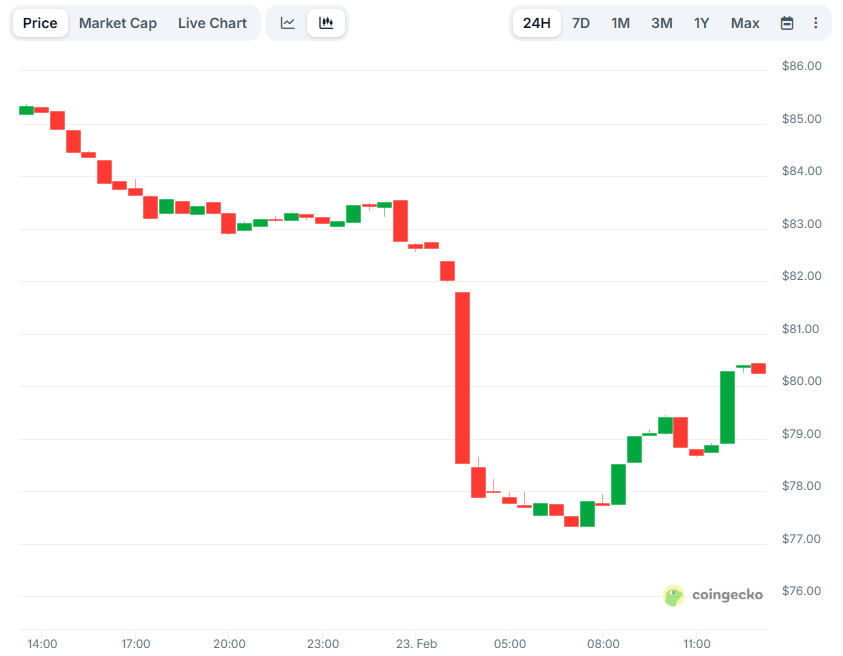
The renowned analyst on X, Ali Martinez, observed the asset’s recent performance, claiming “the super trend indicator” has flashed a sell signal on the monthly chart. He noted that the last time this pattern appeared was in January 2022 and preceded a brutal 95% decline. Applying a decline of that magnitude to today’s levels would imply a staggering crash to approximately $4.
Moreover, Martinez warned investors to pay close attention to the $76 support zone. He believes that breaking below it could open the door to a further pullback to $53, $35, and $23.
Sjuul | AltCryptoGems also made bearish predictions recently. He argued that SOL “truly looks compromised on the high time frame” and is “basically trading in a big no man’s land.” The analyst claimed that as long as the price remains suppressed beneath the $110 resistance, SOL faces the risk of a deep retracement to as low as $20.
How About a Short-Term Bounce?
Despite the broader crypto market’s depressed condition and SOL’s substantial correction, the asset’s Relative Strength Index (RSI) suggests a rebound could be on the way.
You may also like:
The technical analysis tool gauges the speed and magnitude of recent price movements, offering insight into whether a potential trend reversal may be developing. It ranges from 0 to 100, and ratios below 30 indicate that SOL is oversold and could be on the verge of a rally. Data shows that the RSI has dipped well below that zone on a weekly scale.

X user Mags revealed that the asset’s weekly RSI has reached the same level it was in December 2022, when SOL was trading around $8. In the following months, it posted a major bull run, and the analyst wondered if history was about to repeat itself.
Solana’s recent exchange netflow is another factor worth observing. Toward the end of 2025 and into early 2026, inflows exceeded outflows, suggesting that investors were moving funds from self-custody to centralized platforms. This shift is considered a bearish signal because it can be interpreted as a pre-sale step. In recent weeks, however, the trend has reversed with outflows surpassing inflows.

Binance Free $600 (CryptoPotato Exclusive): Use this link to register a new account and receive $600 exclusive welcome offer on Binance (full details).
LIMITED OFFER for CryptoPotato readers at Bybit: Use this link to register and open a $500 FREE position on any coin!


Analyst says public XRPL metrics are down 50–80%, but private institutional flows may explain the apparent decline.
XRP Ledger activity has dropped steeply, with public metrics showing active users, payment volume, and sender accounts falling between 50% and 80% within weeks, according to market watcher Arthur.
The data has sparked debate over whether the network is weakening or simply shifting activity away from public dashboards after a new institutional trading feature went live.
Public XRPL Stats Fall
In a thread posted on X on February 23, Arthur said active users with tags fell to about 38,000 from more than 200,000, while payment volume dropped to roughly 80 million XRP from over 2.5 billion. Additionally, unique sending accounts slid to about 3,000 from above 40,000, with the analyst describing the figures as “bad” but arguing they may not reflect real network demand.
He linked the drop to the February 18 activation of XLS-81, a permissioned decentralized exchange system that allows regulated entities to trade inside restricted pools. Transactions routed through those channels do not appear on public trackers. Furthermore, he suggested the late-2025 spike in activity came from retail flows visible on-chain, whereas institutional flows could now be moving privately.
At the same time, the XRP advocate criticized viral price forecasts, such as a February 22 post from trader CryptoBull2020 predicting XRP could hit $15 by March and $70 by May. He argued that liquidity and macro conditions matter more than social media optimism.
The asset was trading near $1.39 at the time of writing, down about 2% in the last 24 hours, 5% in seven days, and 27% over the past month. Across the last year, it has fallen by more than 46% and is now more than 60% below its July 2025 peak of $3.65.
By comparison, Bitcoin (BTC) has mostly ranged sideways recently, according to pseudonymous analyst Darkfost, which they said has limited direction across altcoins.
You may also like:
Darkfost also reported that more than 31 million XRP moved into wallets on Binance in a single day, largely from large holders. They estimated the transfers could represent about $45 million in potential sell pressure if the funds reach the market.
Loss Data and Valuation Metrics Offer Mixed Signals
A recent report from Santiment adds longer-term context, saying XRP recorded its largest realized loss spike since 2022 after falling from about $3.60 to near $1.10 earlier this month. The firm noted that similar spikes previously came right before a 114% price rise within eight months, though it did not predict that pattern would repeat.
In another analysis, Santiment compared MVRV ratios to rank Ethereum as the most undervalued major crypto at -14.3%, followed by Bitcoin at -6.9%, with XRP at -4.1%. The metric measures whether holders are in profit or loss relative to their cost basis.
Binance Free $600 (CryptoPotato Exclusive): Use this link to register a new account and receive $600 exclusive welcome offer on Binance (full details).
LIMITED OFFER for CryptoPotato readers at Bybit: Use this link to register and open a $500 FREE position on any coin!
Ethereum faces imminent risk of collapse to $1,475 after co-founder Vitalik Buterin executed a massive sell-off of nearly 9,000 ETH this week.
The high-profile wallet activity coincides with a broader technical breakdown, as the asset struggles to maintain support above $1,850 amidst rising sell volume and widespread market de-risking.
- Vitalik Buterin sold roughly 9,000 ETH, leaving a supply overhang of over 7,350 ETH in the updated wallet balance.
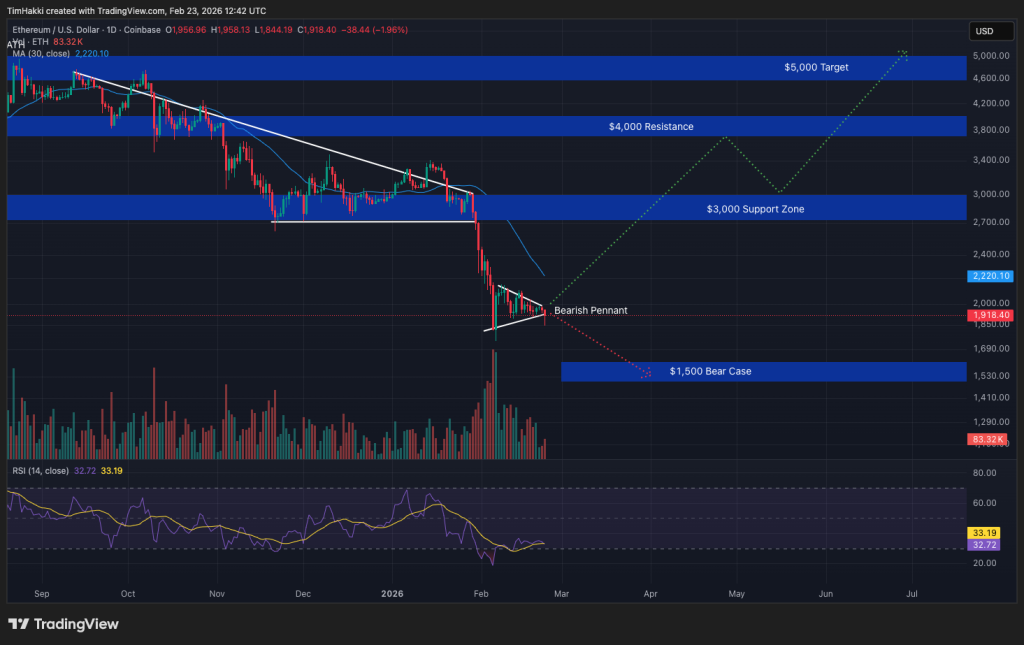
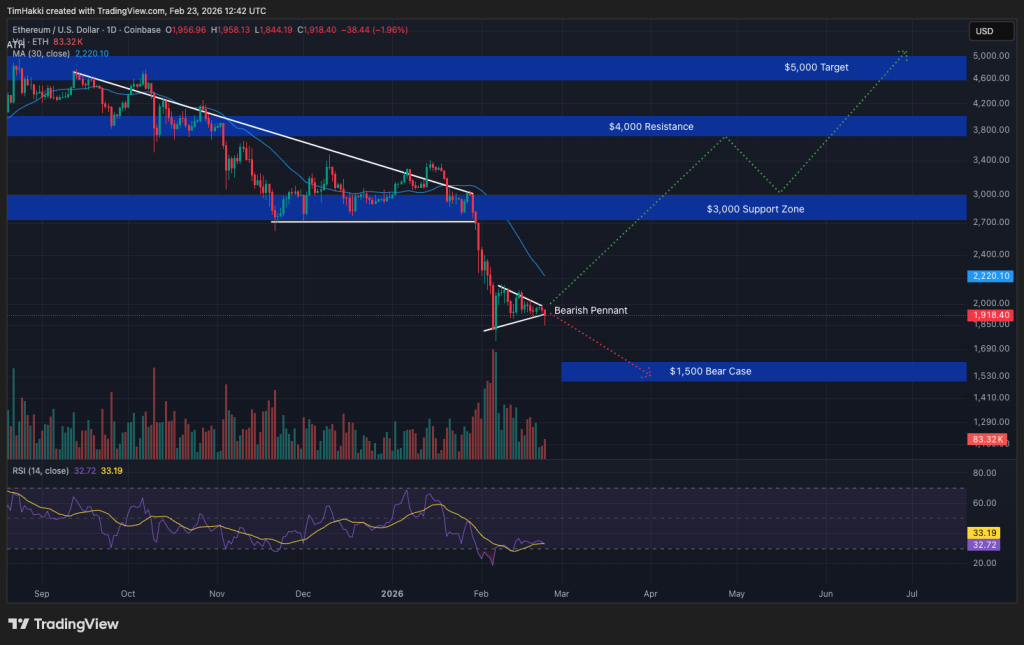
- Ethereum has officially entered a bear pennant breakdown, technically targeting a slide to $1,475 by early March.
- The sell-off aligns with a broader market retreat, significantly threatening the psychological $1,500 support level.
Why Is Founder Selling Triggering Alarm?
The market’s sharp reaction stems from both the volume of the sale and historical precedent. Founder-led selling often acts as a bearish signal for retail traders, and previous sales by Buterin have preceded price declines of almost 23%.
With roughly 7,350 ETH still remaining in the wallet, traders fear a continued supply overhang could suppress price action throughout the week.
This localized selling pressure compounds macro headwinds. Broad market sentiment has already shifted due to nervousness surrounding tariffs, which recently caused a de-risking event across major altcoins.
While long-term institutional holders like Consensys maintain significant treasuries, the immediate liquidity shock from a founder sale creates a tangible drag on short-term momentum.
Discover: The best meme coins in the world right now
Technical Breakdown Points to $1,475 Bottom
The price action on the charts confirms the bearish narrative. Ethereum has entered the “breakdown phase” of a prevailing bear pennant pattern.
Early on Monday UTC, ETH dropped approximately 5.60% in 24 hours to hover near $1,850, slicing through the pennant’s lower trendline. Rising trading volumes accompanied the move, indicating strong conviction from sellers.
According to standard technical analysis principles, a bear pennant breakdown typically resolves when the price falls by a magnitude equal to the previous downtrend’s height.
Applying this to the current chart suggests a downside target of $1,475, precisely aligning with the psychological support zone of $1,500.
While Buterin continues to advocate for protocol improvements, recently backing censorship resistance upgrades, these long-term fundamentals are currently overshadowed by chart weakness.
Can Ethereum Hold Critical Support?
The path forward depends heavily on whether buyers can defend the sub-$1,800 region.
If the bearish momentum continues, a test of $1,475 appears inevitable by early March. Conversely, invalidating this outlook requires a swift reclaim of the pennant’s lower trendline and a sustained close above the $2,000 resistance level.
Despite the current gloom, some analysts, including those at Intellectia.ai, suggest that a 2026 return to $3,000 remains firmly feasible once this correction exhausts itself.
Discover: The next crypto to explode
The post Ethereum Faces $1,500 Downside as Vitalik Buterin Sells 9,000 ETH appeared first on Cryptonews.
Welcome to the US Crypto News Morning Briefing—your essential rundown of the most important developments in crypto for the day ahead.
Grab a coffee — because stablecoins may be about to reshape the US bond market. A new Standard Chartered report suggests rising demand for Treasury bills from digital dollar issuers could quietly force Washington to rethink how it finances its debt.
Crypto News of the Day: Stablecoin Demand Could Force Washington to Rethink US Debt Strategy
Stablecoins may soon reshape the US Treasury market, potentially forcing a radical shift in debt issuance, according to a new report from Standard Chartered.
The bank projects that stablecoin issuers could generate between $0.8 trillion and $1 trillion of fresh demand for Treasury bills (T-bills) by the end of 2028.
This trend, when combined with Federal Reserve purchases, could push total short-term Treasury demand to $2.2 trillion.
The report warns that the Treasury could use this emerging excess demand as justification to increase T-bill issuance while reducing long-term bond supply. Such a move could, in effect, allow the US government to suspend all 30-year bond auctions for the next three years.
“We think the US Treasury may use this potential excess demand as a reason to issue more T-bills,” wrote Geoff Kendrick in the latest Standard Chartered report, highlighting stablecoin issuers as increasingly significant buyers of short-term US debt.
Emerging market stablecoins are expected to drive the majority of this demand. Standard Chartered estimates that two-thirds of projected T-bill demand will come from emerging markets, representing net new demand. Meanwhile, stablecoins in developed markets largely substitute for existing holdings.
This pattern highlights the growing role of digital assets in global capital flows and their influence on traditional fixed-income markets.
The potential implications for the Treasury yield curve are substantial. Shifting roughly $9 billion from long-term bonds to T-bills could initially flatten the US Treasury curve.
Yield Curve Risks Mount as Treasury Weighs Expanding T-Bill Share
Standard Chartered notes, however, that long-term premia, fiscal deficit concerns, and market sentiment could influence investor reaction over time.
The bank cautions that a bull flattening at the front end may be the immediate response, but structural factors, including term premia and rollover risk, could shape yields differently in the longer term.
Treasury Secretary Scott Bessent could leverage this scenario to increase the share of T-bills within the overall debt portfolio.
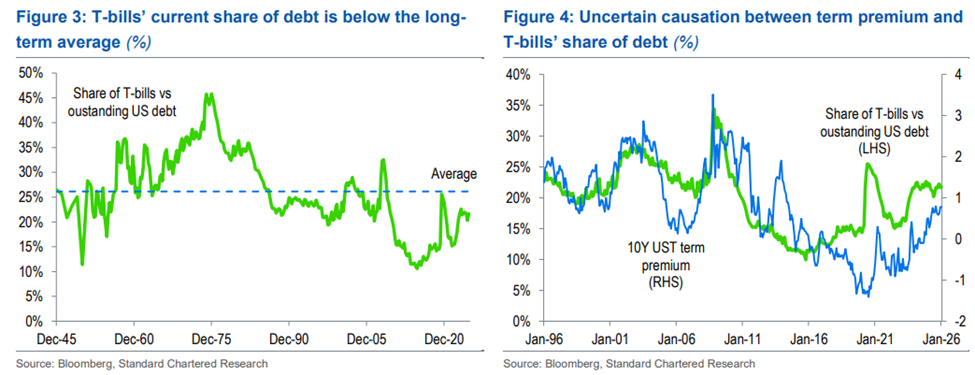
Raising the T-bill share by just 2.5% over three years would generate roughly $900 billion of additional T-bill supply, offsetting the projected excess demand.
This could ease scarcity at the front end of the curve while keeping the 10-year Treasury yield manageable.
The report also notes that historically, T-bills have averaged 26.1% of outstanding marketable debt. This is well above the Treasury Borrowing Advisory Committee’s recommended 15–20% range, suggesting room for an increase.
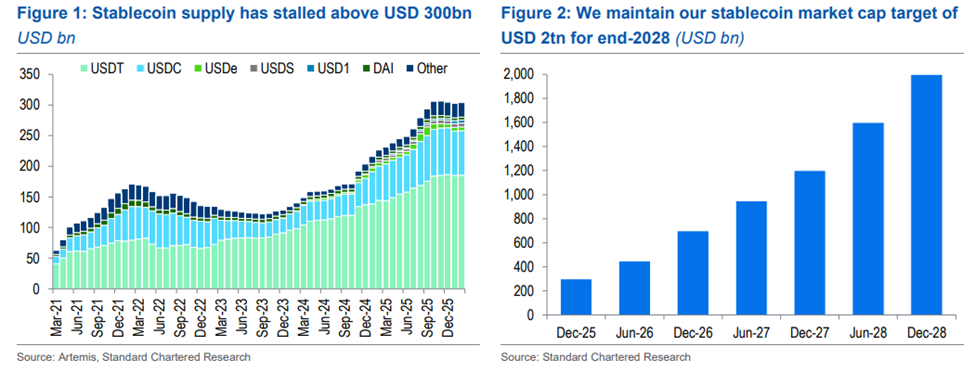
Despite short-term stagnation, stablecoin market capitalization is projected to reach $2 trillion by the end of 2028. Growth has recently stalled at around $304 billion, influenced by weaker digital asset markets and regulatory delays following the US GENIUS Act.
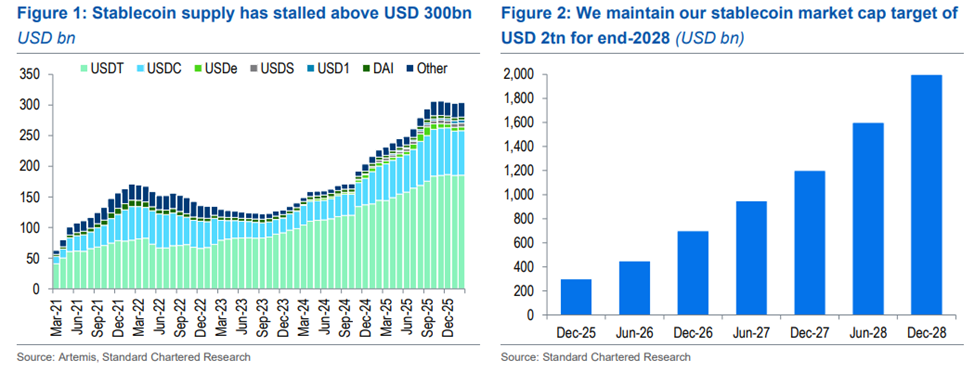
However, Standard Chartered considers these factors cyclical rather than structural. Stablecoin demand, combined with ongoing Fed Reserve Management Purchases and replacement of maturing mortgage-backed securities, could therefore drive a historic reshaping of short-term US debt markets.
The report concludes that while suspending 30-year bond auctions would not be unprecedented—the Treasury paused them from 2002 to 2006—the current deficit environment differs markedly.
Chart of the Day
Byte-Sized Alpha
Here’s a summary of more US crypto news to follow today:


Bitwise Asset Management Chief Investment Officer Matt Hougan took to social media to defend Bitcoin (BTC) against a wave of criticism, arguing that skeptics judging the asset as a failed store of value are ignoring the volatile “teenage phase” necessary for any new monetary asset to mature.
His comments were a direct challenge to a growing narrative, amplified by a nearly 50% drawdown from its all-time high and recent headlines questioning the cryptocurrency’s purpose.
Bitcoin’s Volatility Meets Institutional Impatience
The debate reignited after Bloomberg published a report framing the current market downturn as an “existential” struggle for Bitcoin, asking what the asset is actually for if it fails as a hedge, payment rail, or speculative vehicle.
Former Merrill Lynch trader Tom Essaye, quoted in the Bloomberg piece, added fuel to the fire, stating flatly that “Bitcoin is not replacing gold, it’s not digital gold” and dismissing its utility as an inflation or chaos hedge.
Hougan responded to these takes, rejecting the premise that Bitcoin must emerge from nothing as a fully formed, gold-like asset. He described Bitcoin in 2009 as “100% speculation,” projecting a future in 2050 where it is “0% speculation” and owned by central banks.
“You cannot travel from 100% speculation to 0% speculation without ticking every gradient in between,” Hougan posted. “The reason it doesn’t fit any individual box right now is it’s in the uncomfortable middle. But that’s a necessary part of the journey.”
His defense comes at a time when the price action of the king cryptocurrency is testing investor patience. The asset recently shed thousands of dollars off its value, following U.S. President Donald Trump’s announcement of a 10% temporary global tariff.
Meanwhile, Google searches for “Bitcoin is dead” have spiked to levels not seen since the FTX collapse in late 2022, a metric that some traders view as a contrarian signal that a bottom may be forming.
A Historical Precedent for Price Swings
Hougan’s argument is rooted in a historical parallel he first detailed in a 2018 Forbes article, which he recirculated amid the current debate. At the time, he pointed to gold’s performance after the U.S. left the gold standard in 1971.
Following Nixon’s decision, gold was set loose from its moorings, experiencing massive volatility as it fought to establish itself as an independent store of wealth. Furthermore, in 1974, the precious metal rose 73%, only to fall 24% in 1975. In 1981, it lost 33% of its value after being up 121% just two years prior.
“If you had asked someone in 1975 if gold was a store of value, they’d have pointed to that 24% drop,” Hougan implied in his prior analysis. He argued that Bitcoin is following the same trajectory: a rapidly appreciating price that slows over time, accompanied by high-but-declining volatility.
“Either you believe it’s literally impossible to create a digital store of value, or you have to imagine it passing through exactly this teenage state,” insisted the Bitwise CIO.
His framework suggests the current drawdown, which has seen BTC fall roughly 50% from its October 2025 peak near $126,000, fits the pattern of an asset class maturing rather than failing.
The post Matt Hougan: BTC Is Still in Its ‘Teenage State’ appeared first on CryptoPotato.
Crypto World
NEAR Launches Near.com super app, touting AI capabilities and confidential transactions
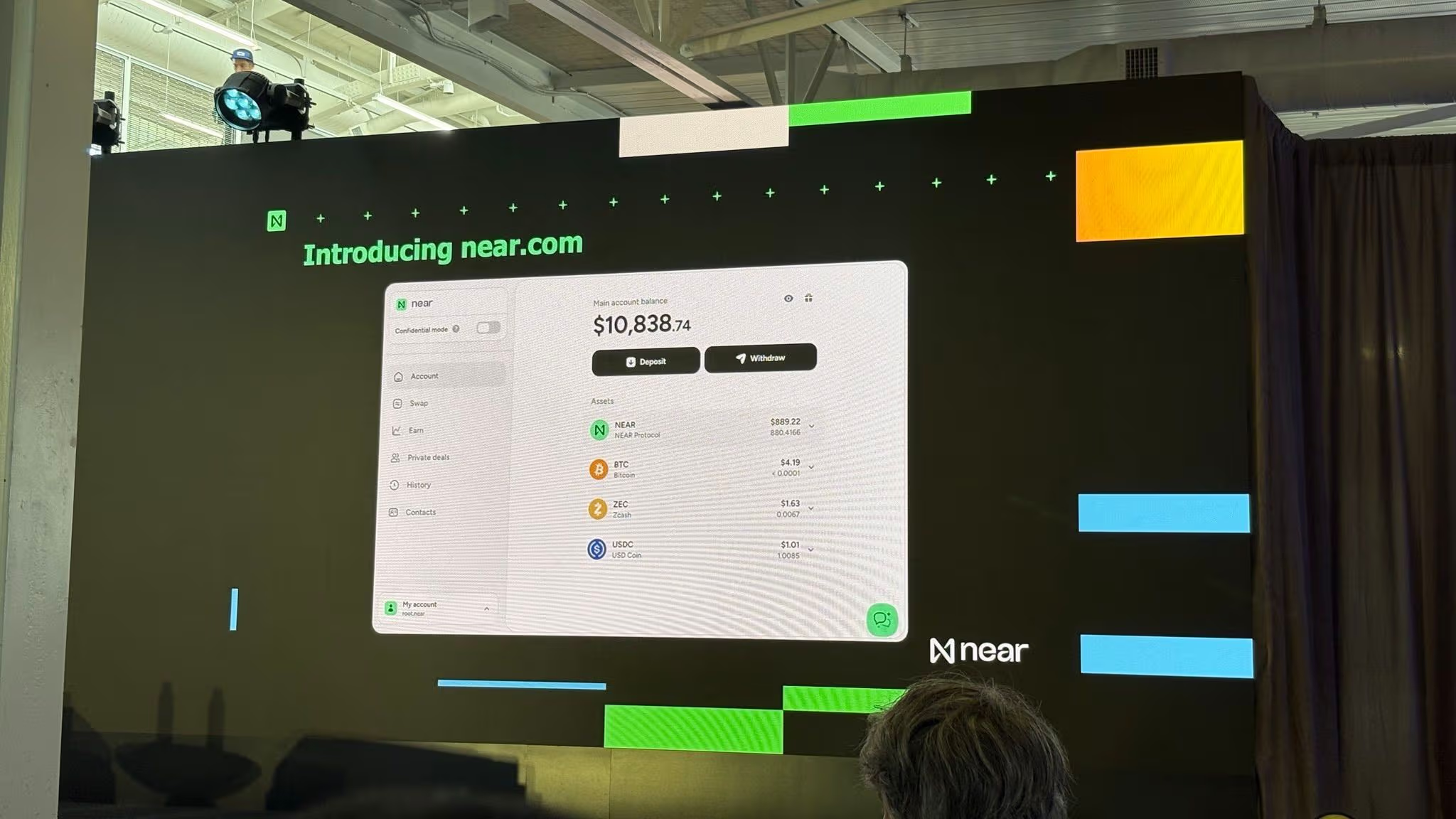
San Francisco, CA – NEAR is launching Near.com, a new crypto wallet and consumer app that aims to make blockchain technology feel as simple as using a traditional finance app, while positioning itself at the intersection of crypto and artificial intelligence (AI).
Polosukhin previously co-authored the paper that introduced the transformer model, the architecture underpinning modern AI systems like ChatGPT and many other large language models, and has increasingly focused on how blockchain infrastructure can support the next wave of AI-driven applications.
“We are entering the world where AI is becoming our interface to compute,” Polosukhin said during the presentation.
NEAR token is down nearly 3% over the last 24 hours.
At its core, Near.com is designed to remove much of the friction that has long made crypto confusing for everyday users. Instead of worrying about gas fees, private keys or switching between different blockchains, users can manage their assets in one place.
“You don’t need to think about blockchains. You don’t need to think about gas, keys,” Polosukhin said. “You just use it as your main wallet.”
Near.com supports a range of digital assets, including bitcoin, stablecoins, NFTs and other tokens. The idea is to bring together activity that is typically spread across multiple wallets and networks into a single, streamlined interface.

But NEAR’s ambitions extend beyond building just another wallet. The company is betting that the next big wave in crypto will come from its convergence with AI.
As AI agents become more capable, like booking travel, managing emails or handling online purchases, they will increasingly need the ability to transact. That’s where crypto infrastructure comes in. Blockchains can provide programmable payments, global transfers and automated settlement without relying on traditional intermediaries.
Polosukhin argued that as AI systems begin interacting with each other, they effectively become “economic actors,” software programs that negotiate, pay and coordinate tasks. In that world, crypto becomes the financial layer that allows these agents to operate.
Near.com is designed to serve as that layer, acting as both a user-friendly wallet for people and an economic backend for AI-driven activity.
A key part of the announcement is privacy. One of blockchain’s longstanding tradeoffs is transparency: transactions are typically visible to anyone. While that openness can build trust, it can also expose sensitive financial information.
“Everything you do onchain is transparent,” Polosukhin said. “That’s not realistic for usual use cases, for day-to-day usage.”
To address this, NEAR introduced a “confidential mode” within Near.com. The feature allows balances, transfers and trading activity to remain private within the network’s security framework. The company says this makes the wallet more practical not only for individuals and businesses, but also for AI agents that may need to transact without revealing strategy or sensitive data.
The launch signals a broader shift for NEAR.
“We have the stack. We have all the components. We have the product,” Polosukhin said. “Now we’re switching … to how we actually scale adoption — how we bring this to billions of people around the world.”
Read more: Most Influential: Sam Altman
Crypto World
Kraken’s Sponsorship of ‘Trump Accounts’ Highlights Crypto’s Growing Political Footprint


The initiative showcases Kraken’s Wyoming roots and the increasing ties between crypto firms and policymakers.
Kraken’s decision to fund savings accounts for every child born in Wyoming this year is being viewed as the latest move aligning the exchange with the crypto-friendly Trump administration.
The cryptocurrency exchange currently ranks as the sixth largest globally by 24-hour trading volume, with about $1 billion traded over the past day – behind Binance, Bybit, OKX, Coinbase, and Bitget, according to CoinGecko.
Last week, Kraken said it would sponsor “Trump Accounts” for every child born in Wyoming in 2026, essentially pledging a financial contribution to each account as part of a savings program introduced by President Donald Trump.
While the exchange framed the plan as a way to grow financial opportunity for families, experts say it also underscores its close relationship with Wyoming (where it is headquartered), as well as the Trump administration.
Trump Ties
Jamie Green, COO at Superset, told The Defiant that funding the accounts is about “maintaining goodwill in the jurisdiction” that afforded Kraken its most significant banking license. In 2020, Wyoming approved Kraken’s plan to launch Kraken Bank, making it the first crypto company in the U.S. to receive an SPDI charter – a state banking license that lets it hold and safeguard digital assets.
However, Green said the move could invite political backlash, as opposed to regulatory scrutiny. “The greater risk is political. Democrats and progressive critics will cite this as further evidence of a cozy relationship between crypto firms and the White House,” he added.
Jesse Powell, Kraken’s co-founder, publicly backed Trump during the 2024 campaign, announcing in June of that year that he had personally donated $1 million to the president’s re-election bid, according to a congressional staff report.
Reuters also reported last year that Payward Inc., Kraken’s parent company, hired the Trump-aligned lobbying firm Ballard Partners in late 2024, joining several crypto companies that hoped to shape policy under the new administration.
“Being visibly Trump-aligned is an asset today – and a liability when political winds change,” Green said.
Wyoming’s Crypto Influence
Daniel Bara, director of the Olympus Association, told The Defiant that the move reflects Kraken’s long-standing relationship with Wyoming – a state that has often served as a testing ground for crypto policy and where initiatives launched are closely watched by other states.
“Wyoming built one of the first regulatory frameworks in the country that treated digital assets as a legitimate financial category,” Bara said. Earlier this year, the state also launched FRNT, the first U.S. state-issued dollar-backed stablecoin, managed by Franklin Templeton and available through partners including Kraken.
And in March 2025, Wyoming Senator Cynthia Lummis and Congressman Nick Begich introduced the BITCOIN Act – legislation that would establish a U.S. Strategic Bitcoin Reserve and codify a national digital asset policy.
“Committing $1.2 million to fund Trump Accounts for every child born in the state this year reflects the depth of that relationship,” Bara said. “And for a company preparing for a public offering, that kind of visible community investment likely carries weight.”
A Growing Convergence
From a broader standpoint, experts said that Kraken’s move aligns with a larger shift of crypto firms deepening ties with policymakers.
“We have a sitting president who has launched a meme coin, a DeFi platform, and has interests in Bitcoin mining,” Christopher Perceptions, lead at Jubilee Labs and a strategic advisor to Wisconsin State Senator Dora Drake, said. “The convergence is here, and the tidal wave is still gathering momentum.”
Bara added that just a few years ago, crypto companies largely operated outside the political system or rebelled against it. “Now you have hundreds of millions flowing into super PACs, companies relocating to regulatory-friendly states, and corporate sponsorships tied to federal initiatives,” he said.


A top economist has sounded a major warning on key assets like stocks, gold, silver, and the crypto market.
Summary
- Stocks and crypto prices could be at risk of a bigger dive in the near term.
- Mark Zandi, a top economist, highlighted some major risks facing the market.
- He pointed to the slowing economy, valuation, and concerns in the Treasury market.
The stark warning as these assets have become highly volatile in the past few weeks or months. Crypto prices have sunk, with Bitcoin (BTC) and most altcoins being in a technical bear market.
American stocks have also wavered, with the S&P 500 Index remaining below its all-time high. It has barely moved this year. Similarly, the Dow Jones and Nasdaq 100 indices have remained in a tight range lately. Gold and silver prices have also pulled back from their all-time highs.
Mark Zandi warns on stocks, gold, silver, and crypto prices
In a statement on Sunday, Mark Zandi, the top economist at Moody’s, warned that the financial market was fraught and that it may experience a sharp pullback soon.
He pointed to the ongoing complacency among investors, who are using dips as buyiyyng opportunity. Also, he pointed to the increasing speculation, where investors believe that prices will rally in the future because they did so in the past.
Zandi has identified more risks in the market. For example, he observed that the US economy was growing below its potential, with the real GDP growing by slightly above 2%. The estimated potential is about 2.5%.
At the same time, the labor market has flatlined, with the unemployment rate remaining above 2%. The economy added less than 200,000 jobs last year, the smallest increase in years.
Zandi also pointed to the ongoing woes in the Treasury market, where long-term bond yields have continued rising in the past few months. Hedge funds have increased their leverage in the market, leading to more risk as the US public debt continues rising.
Zandi also believes that the stock market has become highly overvalued and disconnected from the economy.
Two major risks persist
Stock and crypto prices are vulnerable amid major risks in the market. The first major risk is that Donald Trump may launch an attack against Iran anytime soon.
In a statement last week, Trump noted that he was considering a limited strike to push the Iranians to the negotiating table. Iran, on the other hand, has warned that any attack will lead to a wider war that may lead to a wider war in the region.
A war would lead to more volatility in the stock and crypto markets by stimulating inflation in the US. A high inflation rate, on the other hand, would make it hard for the Federal Reserve to cut interest rates.
There are also trade risks as Donald Trump considers responding to his Supreme Court loss last Friday. He announced a global tariff of 15% using another rule that allows the president to levy tariffs for 150 days.

TLDR
- ProShares recorded $17 billion in first-day trading volume for its new GENIUS money market ETF.
- The firm confirmed that internal fund allocations contributed to the early surge in activity.
- The GENIUS ETF follows federal rules for stablecoin reserve standards under the GENIUS Act.
- Analysts observed that the debut outpaced previous high-profile ETF launches across the market.
- Tokenized money market funds continued to gain traction as institutions explored blockchain settlement.
ProShares opened its GENIUS-branded money market ETF with heavy trading and strong early flows as firms continued exploring tokenized fund structures, and the launch drew wide market attention as cash-management demand persisted and blockchain rails expanded. The surge placed new focus on how issuers used internal allocations while investors assessed broader shifts. The event also advanced discussion around how digital cash products could interact with regulated funds.
GENIUS ETFs and Early Market Activity
ProShares reported $17 billion in first-day volume for its Genius Money Market ETF, and the firm confirmed internal transfers fueled much of the total. The company used cash from existing funds to support treasury operations, and this move highlighted how issuers managed liquidity across products.
Bloomberg tracked the debut and compared it with other launches, and analysts noted the sharp difference in volume. The debut exceeded the first-day totals of new crypto and ESG ETFs, and it shifted attention to cash strategies.
The GENIUS structure aligned with federal requirements for payment-stable assets, and the fund held short-duration government securities. The law set clear reserve and disclosure standards, and issuers applied these rules to maintain consistent oversight. Market observers watched activity closely, and early trading showed strong operational utility. The ETF advanced its role as a treasury tool, and issuers framed the approach as a way to streamline internal flows.
Tokenized Funds Enter Broader Use Cases
Tokenized money market funds gained traction as firms tested blockchain settlement, and the products offered yield while operating within compliance frameworks. Issuers presented them as interest-bearing complements to digital dollars, and adoption increased across institutional channels.
JPMorgan Chase strategists noted that tokenized fund shares could work as collateral, and they suggested the model preserved yield during transfers. One strategist said, “You can post money-market shares and not lose interest,” and firms continued building pilots.
The growth of tokenized vehicles aligned with rising stablecoin usage, and institutions explored both products for payments and custody. Funds positioned themselves as regulated alternatives, and issuers stressed transparency requirements. The Bank for International Settlements described tokenized money funds as fast-growing instruments, and the bulletin referenced their use in settlement trials. The report added context as markets evaluated new rails.
Regulatory Alignment and Current Developments
The GENIUS Act shaped how issuers structured reserves, and fund operators adopted those guidelines for liquidity portfolios. The law reinforced the role of high-quality assets, and managers applied these standards across new launches.
Firms also expanded product research, and issuers examined how tokenized versions might fit into custody systems. The approach strengthened administration flows, and providers continued monitoring regulatory updates.
ProShares used the GENIUS branding to reflect compliance, and the ETF’s early volume elevated attention on regulated cash tools. The debut arrived as digital asset firms explored new pathways, and issuers weighed operational benefits.
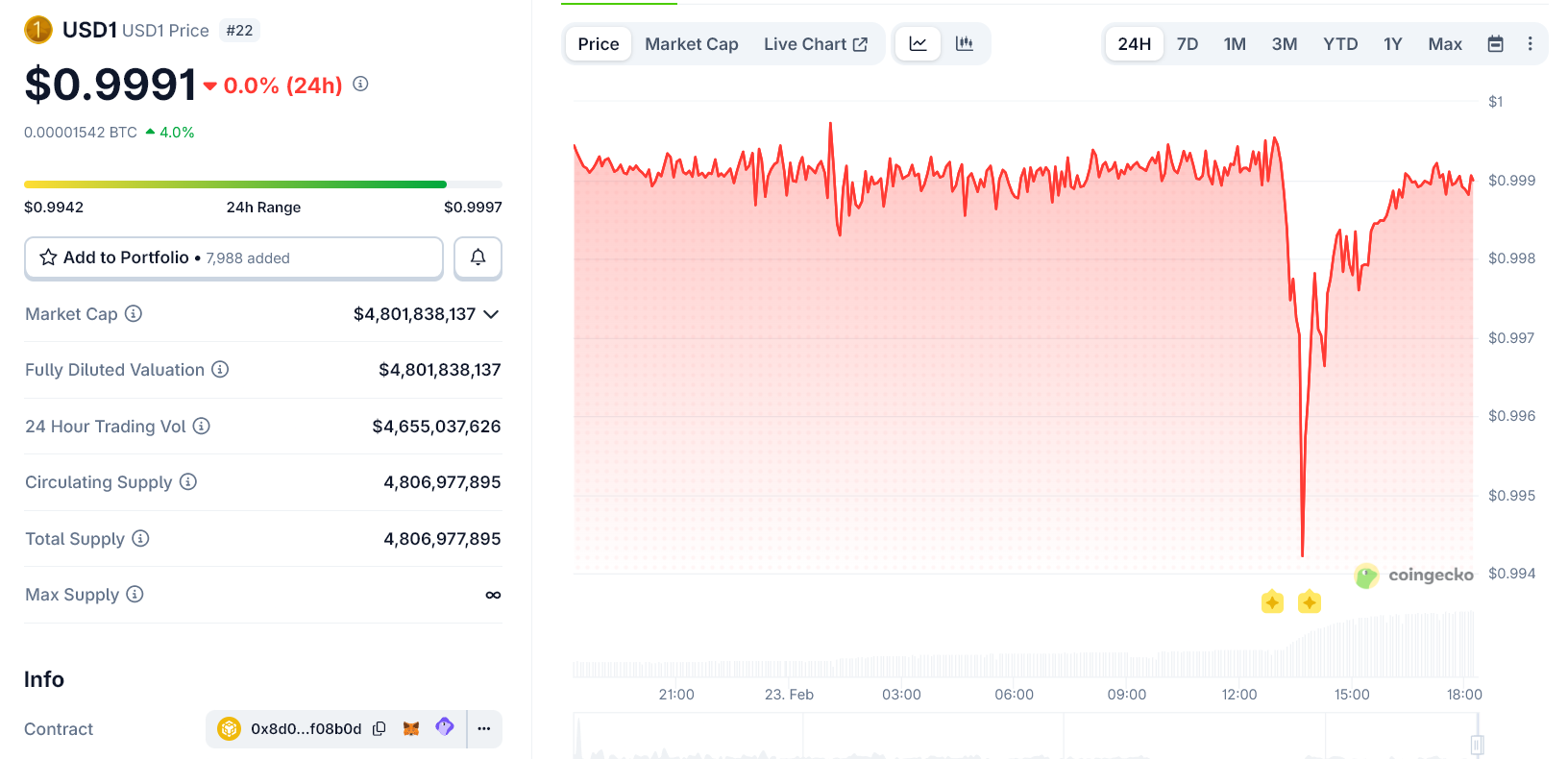
The USD1 stablecoin briefly lost its dollar peg on February 23, falling to around $0.994 before quickly recovering. The token now trades close to parity, suggesting the disruption lasted only minutes.
USD1 is issued by World Liberty Financial (WLFI), a DeFi project linked to business entities associated with Donald Trump and his family. The stablecoin currently has a market capitalization near $4.8 billion.
World Liberty Financial’s Stablecoin Depeg Triggers Speculation
WLFI responded within hours. The company said attackers compromised several cofounder accounts, spread false information, and opened short positions to profit from panic selling.
Despite the rapid recovery, the incident triggered widespread concern across the crypto community.
Some users compared the sudden depeg to early warning signs seen before the collapse of algorithmic stablecoins such as TerraUSD in 2022.
However, USD1 differs structurally. WLFI says it maintains full 1:1 reserves, unlike TerraUSD’s algorithmic design, which relied on arbitrage mechanisms rather than direct asset backing.
Meanwhile, unverified reports circulated on social media claiming that Eric Trump deleted older promotional posts related to USD1 during the volatility.
Screenshots have circulated online, but no independent confirmation has verified these claims.
Separately, blockchain investigator ZachXBT said he plans to release findings later this week on alleged insider trading involving a major crypto company.
He did not name the firm. Still, some social media users speculated that WLFI could be involved. There is no evidence supporting this claim at the time of writing.
Stablecoins rely heavily on confidence. Even brief depegs can trigger rapid selling if users fear insolvency or reserve weakness.
USD1’s quick recovery suggests that redemptions and liquidity mechanisms functioned as designed. Nevertheless, the incident reflects how quickly market sentiment can shift, especially for newer stablecoins tied to high-profile figures.
The company has not disclosed technical details of the alleged attack.
The coming days, including any investigation disclosures, will likely determine whether the event remains a short-lived market shock or develops into a broader credibility test for USD1.

Sales of short-term period delay treatments surge, pharmacy reveals
Form 144 Hinge Health For: 23 February
95% Crash on the Way?


-

 Crypto World6 days ago
Can XRP Price Successfully Register a 33% Breakout Past $2?
-

 Video4 days ago
XRP News: XRP Just Entered a New Phase (Almost Nobody Noticed)
-

 Fashion3 days ago
Weekend Open Thread: Boden – Corporette.com
-

 Sports7 days ago
GB's semi-final hopes hang by thread after loss to Switzerland
-

 Politics2 days ago
Baftas 2026: Awards Nominations, Presenters And Performers
-
 Tech7 days ago
The Music Industry Enters Its Less-Is-More Era
-

 Business6 days ago
Infosys Limited (INFY) Discusses Tech Transitions and the Unique Aspects of the AI Era Transcript
-

 Politics3 hours ago
Nick Reiner Enters Plea In Deaths Of Parents Rob And Michele
-

 Sports2 hours ago
Women’s college basketball rankings: Iowa reenters top 10, Auriemma makes history
-

 Entertainment5 days ago
Kunal Nayyar’s Secret Acts Of Kindness Sparks Online Discussion
-

 Video7 days ago
Financial Statement Analysis | Complete Chapter Revision in 10 Minutes | Class 12 Board exam 2026
-

 Tech6 days ago
Retro Rover: LT6502 Laptop Packs 8-Bit Power On The Go
-
 Sports5 days ago
Clearing the boundary, crossing into history: J&K end 67-year wait, enter maiden Ranji Trophy final | Cricket News
-

 Business1 day ago
Mattel’s American Girl brand turns 40, dolls enter a new era
-

 Business1 day ago
Law enforcement kills armed man seeking to enter Trump’s Mar-a-Lago resort, officials say
-

 Entertainment5 days ago
Dolores Catania Blasts Rob Rausch For Turning On ‘Housewives’ On ‘Traitors’
-

 Business6 days ago
Tesla avoids California suspension after ending ‘autopilot’ marketing
-
 NewsBeat11 hours ago
‘Hourly’ method from gastroenterologist ‘helps reduce air travel bloating’
-

 Politics7 days ago
Eurovision Announces UK Act For 2026 Song Contest
-

 Tech1 day ago
Anthropic-Backed Group Enters NY-12 AI PAC Fight