



The price of oil has changed a lot in the last few weeks. There have been dips as well as peaks, but generally, since the the start of the US-Israeli attacks on Iran at the end of February, the black stuff has been getting more expensive.
As a direct result, petrol and diesel prices in the UK have also rocketed.
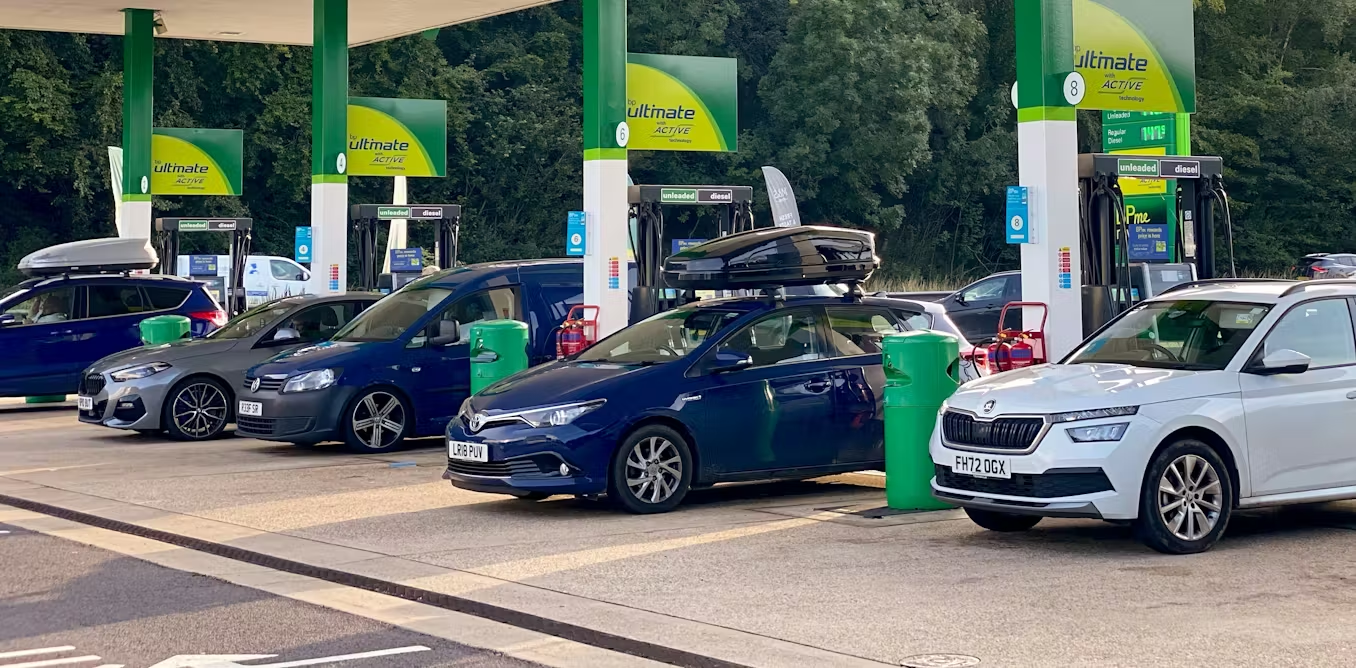
Motorists have felt the steep rise on petrol station forecourts, while some fuel sellers have been accused of profiteering and ripping off customers. There have also been calls for the government to intervene to prevent costs from spiralling out of control.
But what can it actually do to bring petrol prices down?
One option might be to impose price caps, setting a legal limit on what motorists can be charged for a litre of fuel. But a major problem with this idea comes down to a lack of supply.
Taking the Strait of Hormuz as a perfect example, if fewer tankers from Kuwait and Qatar are getting through, that means there is less oil available. As stocks runs low, it is impossible for everyone to get the same amount of fuel at the same price as before.
If price caps were introduced (with the supplier taking on the full impact of the discount), the countries and firms with oil to sell would naturally shift their sales to countries willing to pay higher prices. So a price cap would probably lead to empty petrol pumps in the UK.
There have already been shortages in France, where one major fuel provider implemented its own price cap and was subsequently inundated with customers.
In contrast, high fuel prices may persuade households to cut down on consumption, which is helpful when there is less oil available. After all, people don’t switch from travelling by car to public transport (which is often less convenient) unless there is a good reason to do so. High fuel prices are a good reason.
Research suggests that in the UK, a 10% increase in petrol prices can lead to a reduction in demand of up to 5%. So, high prices are a way of adjusting consumption to cope with the lower supply.
Duty calls
In the longer term, households might invest in a way which reduces their dependence on future fossil fuel consumption. Maybe, instead of a big SUV, the next family car will be be smaller or electric.
In the short term, though, demand for petrol and diesel will remain. Not all commuting and travelling can be cancelled or postponed. People need to get to work, children need to go to school.
A more promising policy intervention could be temporary fuel duty discounts – reducing the proportion of fuel costs which ends up in the Treasury. Unlike with price caps, oil exporters’ incentives to sell in the UK are not diminished by reducing fuel duty. So fuel duty cuts wouldn’t cause supply issues.
EPA/Stringer
The issue here is that fuel duty cuts reduce government revenue at a time when it is already seriously stretched. Fuel duty receipts account for almost 2% of UK government income.
Also, the measure is not very targeted. Wealthy households with multiple vehicles would benefit more than a single mother struggling to pay for petrol to get to work.
Making allowances
Another option, favoured by some economists, is based on one-off transfers of money from the state directly to some motorists.
Instead of fuel duty cuts, the government could pay out a fixed sum to those in particular need (much like the winter fuel allowance for heating bills). This could be paid to households under a certain income threshold that own a car.
When a similar transfer scheme for gas was implemented in Germany in 2022 after Russia shut off gas pipelines, firms and households received compensation based on past consumption. Germany was able to reduce its gas consumption by about 20% during that time.
Unlike a fuel duty cut, compensation does not change depending on the amount of fuel bought. So the incentive to cut down on fuel consumption wherever possible remains.
Indeed, households that leave the car at home will profit, as they keep the transfer. This is as it should be: households that use less fuel get rewarded, while those that need it still have some support.
Many economists like this proposal because it keeps prices as an accurate reflection of supply shortages, while providing targeted relief. Neither price caps nor fuel duty cuts achieve this.




















































You must be logged in to post a comment Login