

Crypto World
Nvidia Earnings Set to Test AI Trade Momentum


Editor’s note: As the AI boom accelerates, Nvidia sits at the heart of the conversation about how quickly hardware and software teams scale deployment. This editorial provides a concise context for the press release that follows, focusing on the broader market momentum, the role of data centers in AI infrastructure, and the potential implications of forward guidance for investors and traders in tech and beyond. While this note does not add new facts, it frames the lens through which Nvidia’s earnings will be digested by crypto traders and institutional investors who closely watch AI spending trends, capex cycles, and regional risks.
Key points
- Nvidia continues to be a focal point for AI infrastructure spend, with hyperscalers driving data center demand.
- Rubin, Nvidia’s next-generation platform, is a key area of investor focus alongside the Blackwell ramp and gross margin trajectory.
- Geopolitical risk remains a consideration, with export controls in China presenting potential upside if restrictions ease.
- Forward guidance and near-term revenue expectations are closely watched as drivers of momentum in the AI trade.
Why this matters
Nvidia’s earnings preview signals how AI infrastructure investment could shape market dynamics across technology, finance, and enterprise computing. The year ahead will test whether data center demand, platform innovations, and global capex cycles sustain the AI momentum that has underpinned recent market rally attempts and portfolio allocations.
What to watch next
- Rubin ramp progress and its impact on long-term profitability.
- Any developments on China export restrictions and potential upside if eased.
- Guidance clarity on 2027 AI infrastructure spending and data center revenue trends.
Disclosure: The content below is a press release provided by the company/PR representative. It is published for informational purposes.
Nvidia Earnings Set to Test AI Trade Momentum
Nvidia Earnings Set to Test AI Trade Momentum
Abu Dhabi, United Arab Emirates – February 23, 2026: Nvidia’s upcoming earnings report is poised to become one of the most significant events on the global financial calendar, reflecting its position at the centre of the artificial intelligence revolution.
“In the same way Apple once defined the smartphone era, Nvidia now represents the AI era,” said Zavier Wong, Market Analyst at eToro. “Its earnings are no longer just a tech sector event — they are a market-wide catalyst that can influence diversified portfolios globally.”
Wall Street expects quarterly revenue of approximately USD $65–66 billion, representing around 68% year-on-year growth, with earnings per share forecast at USD $1.52–1.53. Data centre revenue is projected to approach USD $60 billion, underscoring sustained demand from hyperscalers including Microsoft, Amazon, Google and Meta. Collectively, these companies are expected to allocate between USD $650–660 billion in capital expenditure in 2026, much of which is tied directly to AI infrastructure.
Beyond US technology giants, sovereign AI investment is emerging as a meaningful growth driver. Countries such as the UAE and Saudi Arabia, alongside several European nations, are accelerating domestic AI cloud development. This segment alone could contribute more than USD $20 billion to Nvidia’s annual revenue in 2026, providing further diversification of its revenue base.
Demand continues to be supported by Nvidia’s Blackwell architecture, which management has previously indicated is effectively sold out through mid-year. Market attention is now turning toward Rubin, the company’s next-generation platform unveiled at CES. Gross margins are expected to recover toward the mid-70% range following temporary pressure during the Blackwell ramp-up, a key signal for long-term scalability and profitability.
However, China remains a notable risk factor. Current guidance assumes no H20 chip sales into the region, meaning any easing of export restrictions would represent upside potential. For now, restrictions continue to act as a headwind.
Nvidia shares have traded broadly flat over the past six months, and investors are increasingly focused on forward guidance rather than headline results.
“The real driver of Nvidia’s share price is guidance,” Wong added. “Markets want confirmation that AI infrastructure spending is still in its early innings, especially as questions grow around the sustainability of industry-wide capex.”
Investors are looking for Q1 FY2027 revenue close to USD $75 billion, gross margins back in the mid-70% range, and clearer visibility on the Rubin ramp. Meeting those expectations could reignite momentum across the AI trade, while any shortfall may trigger volatility extending well beyond Nvidia itself.
Media Contact:
PR@etoro.com
About eToro
eToro is the trading and investing platform that empowers you to invest, share and learn. We were founded in 2007 with the vision of a world where everyone can trade and invest in a simple and transparent way. Today we have 40 million registered users from 75 countries. We believe there is power in shared knowledge and that we can become more successful by investing together. So we’ve created a collaborative investment community designed to provide you with the tools you need to grow your knowledge and wealth. On eToro, you can hold a range of traditional and innovative assets and choose how you invest: trade directly, invest in a portfolio, or copy other investors. You can visit our media centre here for our latest news.



Crypto.com said it received conditional approval from the U.S. Office of the Comptroller of the Currency (OCC) to establish a national trust bank, setting the stage for the exchange to expand its custody services under federal oversight.
The planned Foris Dax National Trust Bank, doing business as Crypto.com National Trust Bank, would operate as a limited-purpose national trust bank. It would not accept deposits or issue loans, instead offering services such as custody, staking and trade settlement for digital assets, including those on its in-house Cronos blockchain.
While Crypto.com already runs a qualified custodian, Crypto.com Custody Trust Co., regulated by New Hampshire’s banking department, the OCC charter brings its institutional offerings under a single federal framework.
That matters for issuers of exchange-traded funds (ETFs), asset managers and other institutional clients, who often prefer custodians with national oversight, which can streamline compliance and operational processes.
The national charter offers that one-stop-shop structure, though only for trust services, not for traditional banking.
Crypto.com filed its application with the OCC in October. While conditional approval is not final, it marks a significant step forward. Last week, Striple’s stablecoin firm Bridge won initial approval to form a national trust bank as well.
These approvals see the firms join a growing group of crypto firms looking to build within a federal framework. In December BitGo, Circle, Ripple, Paxos, and Fidelity Digital Assets all received similar conditional approvals.

TLDR
- Solana Company has started building a high-speed infrastructure network across the Asia Pacific region.
- The Pacific Backbone will connect Seoul, Tokyo, Singapore, and Hong Kong with low-latency systems.
- The network will support Solana staking validation and trading services for institutional clients.
- HSDT holds about 2.3 million SOL in its corporate treasury.
- The company plans to launch DeFi tools, liquid staking, and execution services within 18 months.
Solana Company has begun constructing a high-speed infrastructure network across the Asia-Pacific. The project aims to strengthen Solana staking, validation, and trading services. Executives say the buildout prepares SOL for its next “super cycle.”
Pacific Backbone Connects Key Asian Financial Hubs
The initiative, called Pacific Backbone, links Seoul, Tokyo, Singapore, and Hong Kong. It will operate a low-latency cluster for institutional users.
The company said it will start construction immediately. It expects optimization and product launches within 18 months.
Planned services include DeFi tools, liquid staking, and automated market makers. The firm will also provide execution services for finance partners.
Joseph Chee said the expansion prepares Solana for future growth. He described the plan as positioning for the next super cycle.
The network targets market makers and high-frequency trading firms. It seeks to cut latency and reduce reliance on outside providers.
Solana processes over 3,500 transactions per second. The blockchain supports millions of daily active wallets.
HSDT Expands Treasury Strategy and Regional Operations
HSDT trades on Nasdaq and backs the infrastructure push. Pantera Capital and Summer Capital co-led its $500 million funding round.
Cosmo Jiang said the roadmap will improve regional staking performance. He added it should diversify revenue across Asia.
Solana Company holds about 2.3 million SOL in treasury. The stake is worth more than $180 million at current prices.
The firm partnered with Anchorage Digital and Kamino on a lending venture. The venture lets institutions borrow against natively staked SOL.
Public companies have maintained steady SOL staking levels. Data shows treasury valuations have fallen to record lows.
HSDT shares fell over 8% in Monday trading. The stock has dropped more than 90% since September.
The buildout focuses on compliant infrastructure for regulated Asian markets with strict standards. Engineers will deploy state-of-the-art hardware across each data center location in the region.
The cluster will support validators, staking pools, and trading desks across major hubs. Management said the network will capture more stakeholder value internally for the company.
The company continues operating its neurotech and medical device units alongside blockchain initiatives. It rebranded from Helius Medical Technologies in September to pursue a Solana strategy.
Shares traded at $1.76 during the latest session on the Nasdaq exchange. Other crypto stocks also posted losses on Monday during early market hours.
Solana declined nearly 6% during the past 24 hours. Bitcoin also fell more than 4% over the same period.

TLDR
- Strategy completed its 100th Bitcoin purchase with a 592 BTC acquisition worth about $39.8 million.
- The company increased its total Bitcoin holdings to 717,722 BTC after the latest buy.
- Strategy funded the purchase through the market sales of its Class A common stock.
- The firm reported an average purchase price of $67,286 per Bitcoin for the latest tranche.
- MSTR stock traded lower in pre-market hours following the SEC filing disclosure.
Strategy confirmed its 100th Bitcoin acquisition in a new SEC filing on February 23, 2026. The company purchased 592 Bitcoin for about $39.8 million between February 17 and February 22. The disclosure arrives as MSTR stock trades lower and Bitcoin hovers near $66,000.
Strategy Expands Bitcoin Holdings With 592 BTC Purchase
Strategy reported that it paid an average of $67,286 per Bitcoin, including fees and expenses. The purchase increased total holdings to 717,722 Bitcoin.
The company funded the acquisition through at-the-market sales of Class A common stock. During the same week, it sold 297,940 shares for about $39.7 million and used the proceeds for the purchase.
Strategy stated that about $7.8 billion in shares remain available under the program. The company has used this mechanism for prior Bitcoin purchases.
One week earlier, Strategy disclosed the purchase of 2,486 Bitcoin for about $168 million. That transaction carried an average price of $67,710 per coin.
With the latest addition, Strategy reported total acquisition costs of about $54.56 billion. The company’s average purchase price across all holdings stands at $76,020 per Bitcoin.
At market prices near $66,000, the position reflects an unrealized loss based on reported averages. The gap equals roughly $10,000 per coin, or about $7 billion overall.
Michael Saylor, co-founder and executive chairman, previewed the milestone on social media. He wrote “The Orange Century” before the company released the filing.
Strategy began accumulating Bitcoin in August 2020 and has reported each transaction. The filings list purchase dates, amounts, and average prices.
MSTR Stock Reaction and Market Context
MSTR stock traded lower in pre-market hours following the disclosure. Shares have declined more than 50% year over year.
Bitcoin fell below $65,000 before recovering toward $66,000. The drop triggered over $360 million in leveraged liquidations across crypto markets.
Strategy stated that its holdings represent more than 3.4% of Bitcoin’s 21 million supply cap. The concentration places the company among the largest corporate holders.
Industry data lists 193 public companies that hold Bitcoin on their balance sheets. The group includes miners, exchanges, and firms with treasury allocation programs.
Saylor recently described the current phase as a “crypto winter.” He said it appears milder than prior cycles and may prove shorter.


The seemingly daily disruption of business models by advances in artificial intelligence continued Monday, sending stock market averages and crypto prices sharply lower.
Today’s victim (in addition to the usual ones) was IBM, after Anthropic said Claude code can automate COBOL modernization.
“COBOL [Common Business-Oriented Language] is everywhere,” said Anthropic. “It handles an estimated 95% of ATM transactions in the U.S.. Hundreds of billions of lines of COBOL run in production every day, powering critical systems in finance, airlines, and government.”
“The developers who built these systems retired years ago, and the institutional knowledge they carried left with them,” the company continued. “We aren’t exactly minting replacements—COBOL is taught at only a handful of universities, and finding engineers who can read it gets harder every quarter.”
“Modernizing a COBOL system once required armies of consultants spending years mapping workflows,” Anthropic continued. “Tools like Claude Code can automate the exploration and analysis phases that consume most of the effort in COBOL modernization.”
Think of “armies of consultants” as IBM, and the stock’s reaction is understandable. A bit less than an hour before the close, IBM was lower by 11.2%.
IBM’s decline, along with what’s now becoming regular AI-related tumbles in the overall software sector and private equity, has helped pull the Dow, S&P 500 and Nasdaq all lower by more than 1%.
“It’s becoming increasingly clear how pivotal the times we are in right now truly are,” wrote The Kobeissi Letter.
Tied at the hip in recent months to moves in software, crypto prices were under extreme pressure Monday, with many majors now within range of retouching their lows from the Feb. 5 panic.
Bitcoin was lower by 5% over the past 24 hours to $64,000, with ether (ETH) and solana (SOL) down similarly.
Coinbase (COIN), Strategy (MSTR), Circle (CRCL) and Galaxy Digital (GLXY) were all down 4%-7%.
The only names in the green were those bitcoin miners now running AI infrastructure business models, with IREN (IREN) ahead 5%, Cipher Mining (CIFR) up 3.4%, CleanSpark (CLSK) up 1.5%, and Hut 8 (HUT) gaining 0.7%.
Also moving higher on Monday were precious metals — gold gaining 3.2% to $5,243 per ounce and silver higher by 6.5% to $87.69.

Bitcoin (CRYPTO: BTC) closed a weekly candle below its 200-week exponential moving average for the first time since October 2023, ending an 882-day uptrend. The break redraws the deck for long-term traders, shifting attention to on-chain cost bases and how Bitcoin has historically interacted with this guardrail during prior cycles. The move underscores the risk of a longer, more drawn-out recovery, even as market focus rests on the asset’s price behavior around key macro and on-chain metrics.
Key takeaways
- Bitcoin closed below the 200-week EMA near $67,628, snapping an extensive uptrend that had persisted since late 2023 and signaling a potential shift in the long-run trend line.
- Historical recoveries back above the 200-week EMA varied in duration: roughly 14 weeks in 2018, about eight weeks after the Covid liquidity shock in March 2020, and nearly 30 weeks in 2022; the average spell below the EMA has hovered around 17–18 weeks.
- On-chain momentum has cooled. Liveliness, the metric that compares coin days destroyed to coin days created, has declined below its 30-day and 90-day moving averages, suggesting reduced spending activity and slowed capital rotation.
- The realized price band around $55,000 remains a central reference, with the shifted realization near $42,000 projecting the metric forward and highlighting deeper demand zones during drawdowns.
- A reclaim of the 200-week EMA would reestablish the long-term trend above a critical threshold; failure to reclaim keeps the focus on the $55,000 realized price and the lower band near $42,000 as potential liquidity zones.
Tickers mentioned: $BTC
Market context: The move comes amid a broader environment where on-chain indicators and macro liquidity shape risk sentiment. Traders are watching whether Bitcoin can stabilize near long-term anchors while macro noise—ranging from regulatory signals to liquidity cycles—adds a layer of caution to the next leg of any potential rally.
Why it matters
The weekly break below the 200-week EMA is not a call to panic; rather, it reframes the path of the next recovery. The 200-week EMA has functioned as a long-run dividing line between expansion and deeper correction. When price has dipped beneath it in past cycles, the duration before reclaiming the line varied, but the pattern often culminated in a prolonged accumulation phase rather than an immediate, V-shaped bounce. The current scenario awaits a similar test of resilience, with market participants evaluating whether history will repeat or diverge in a markedly different macro environment.
On-chain activity adds another layer to the interpretation. Liveliness, which measures the balance of coin days created versus destroyed after adjusting for internal transfers, has cooled from its earlier peak. A decline here points to a slowdown in active spending and a shift in capital rotation—factors that can slow the speed at which Bitcoin reclaims macro-level supports. The reading echoes past cycles where similar rollovers preceded extended periods of accumulation, a signal that investors may need to weather a more drawn-out corrective phase before new highs emerge.
Meanwhile, the realized price bands—around $55,000—and the shifted realized price near $42,000 provide a framework for identifying demand zones. These levels have historically delineated the major caches of value during drawdowns and have served as anchors for long-term investors seeking to accumulate on-chain cost bases. The convergence of price with these bands, especially while hovering between the 200-week EMA and the realized price cluster, has during prior cycles signaled a protracted period of consolidation before a renewed uptrend.
There is a broader ecosystem thread to track as well. A referenced analysis suggests that if Bitcoin can reclaim the 200-week EMA, the path toward reestablishing a long-term uptrend remains intact, with the threshold serving as a barometer for macro confidence. Conversely, failing to recapture the EMA keeps the focus on the $55k realized price and the lower $42k band, where liquidity concentration could come into play and influence the next move. The dynamic between these levels will likely shape market expectations for the next several months.
In the narrative of market storytelling, observers may recall related discussions around Bitcoin’s troughs and rallies. For instance, a separate analysis explored signals from Tether that some see as potential hints of a bottom or a prelude to a larger rally. While not deterministic, such signals contribute to the mosaic of factors traders weigh when assessing the durability of any price move and the potential for renewed demand as the market digests both on-chain and macro inputs.
What to watch next
- Watch for a weekly close back above the 200-week EMA (around $67,600) to signal a potential reversion of this test and the resilience of long-term support.
- Monitor shifts in on-chain liveliness: a sustained move above the key moving averages could indicate renewed activity and capital rotation supporting a longer-term revival.
- Track the realized price zone around $55,000 and the lower band near $42,000 for any congestion or liquidity concentration that could influence the next leg of the cycle.
- Observe potential catalysts—whether macro liquidity conditions soften, or on-chain fundamentals return to a more active phase—that could accelerate re-entry into the longer-term uptrend.
- Keep an eye on related market signals and sentiment indicators, including the behavior of other assets and ETF-related flows that may impact Bitcoin’s risk appetite in coming months.
Sources & verification
- Bitcoin price behavior around the 200-week EMA and corresponding price levels cited in the summary analysis.
- On-chain liveliness metrics and their interpretation in relation to price cycles, as discussed by market observers.
- Public posts and analyses referencing the 200-week EMA as a guide to long-term trend dynamics, including remarks by market commentators on potential resistance if the EMA loses its role as support.
- Realized price data and related interpretations of demand zones and liquidity bands used to frame the current accumulation context.
- Related discussions exploring signals such as those around Tether and Bitcoin bottom signals, which provide context for broader market narrative dynamics.
Bitcoin’s long-term trend in focus
Bitcoin’s recent weekly close beneath the 200-week EMA has nudged the market into a phase where long-horizon considerations gain prominence. The line, which traders monitor as an indicator of secular momentum, has historically separated periods of expansion from deeper contractions. The current reading does not automatically imply a new bear market; instead, it emphasizes the need for patience as the market tests whether prevailing on-chain and macro conditions can sustain a move back above the trend line.
From a broader perspective, the real guiding question is the durability of demand zones around the realized price bands. If that demand proves resilient and buying interest returns with conviction, a re-acceleration could unfold, with the 200-week EMA reclaim acting as a catalyst. If not, investors may expect a more protracted period of consolidation, during which accumulation phases could stretch across multiple quarters as market players calibrate entries and risk exposure in light of evolving liquidity conditions.
The central takeaway remains: the interaction between price, on-chain activity, and long-term trend markers will continue to shape Bitcoin’s trajectory. While a single weekly candle below a key moving average does not doom the market, it does reset the frame for what comes next, demanding disciplined risk assessment and a keen eye on the dynamics of demand, liquidity, and macro sentiment that drive the space.
Crypto World
IoTeX bridge exploit raises debate over losses and recovery prospects as CEO offers 10% bounty


IoTeX offered a 10% white-hat bounty to the hacker or hackers who exploited a private key on its cross-chain bridge ioTube, siphoning millions of dollars, in exchange for the voluntary return of funds within 48 hours.
With this move, IoTeX is offering the $440,000 if the malicious actor or actors return roughly $4.4 million they stole, according to an IoTeX X post, to which IoTeX co-founder and CEO Raullen Chai pointed “as a source of truth” on Monday.
Chai told CoinDesk that the team sent an onchain message offering not to pursue legal action or share identifying information with law enforcement if the remaining funds are returned.
“This is regarding the ioTube bridge exploit on Feb. 21, 2026,” Chai said in the message. “All fund movements across Ethereum, IoTeX, and bitcoin have been fully traced.”
The message states that exchange deposits have been flagged and frozen and offers a 10% bounty for the return of remaining funds.
Chai also said IoTeX is rolling out a new chain version, Mainnet v2.3.4, requiring node operators to upgrade. The update includes a default blacklist of malicious externally owned account (EOA) addresses.
“This blacklist contains a list of malicious or problematic EOA addresses that will be filtered by the node,” Chai said.
The offer comes after a Feb. 21 exploit in which a compromised validator owner private key enabled unauthorized control over ioTube’s bridge contracts.
IoTeX said the incident is “under control,” saying that its Layer 1 blockchain was not affected and that the breach was isolated to the Ethereum-side infrastructure of the bridge.
The IOTX token fell roughly 22% following the exploit, dropping from $0.0054 to below $0.0042 before partially rebounding.
Cross-chain bridges have been one of crypto’s main failure points, with several high-profile exploits in recent years. According to industry reports, more than $3.2 billion has been lost due to cross-chain bridge hacks, making them a prime target for advanced threat actors.
Responsibility and key control
IoTeX framed the exploit as an operational issue specific to the bridge rather than a failure of its Layer 1 network.
“IoTube is IoTeX’s own cross-chain bridge built and maintained by their team,” Nick Motz, CEO of ORQO Group and CIO of Soil, told CoinDesk. “The breach came down to a compromised validator owner private key on the Ethereum side, which is fundamentally an operational security failure, not a smart contract vulnerability discovered by an outside actor.”
Motz agreed that IoTeX’s Layer 1 was not compromised but said user funds were entrusted specifically to the bridge.
“When you build and operate the bridge infrastructure and the key management is what fails, it’s difficult to separate yourself from that outcome,” he said.
Nanak Nihal Khalsa, co-founder of human.tech, said responsibility in crypto often comes down to key custody.
“Yes, whoever holds the private key is responsible for securing it,” Khalsa said. “Is that a reasonable responsibility? It’s hard to say. But that’s how the industry works right now.”
He added that liability norms remain unsettled compared to traditional finance and called for stronger wallet and multisig setups to reduce similar risks.
The estimates diverge
On-chain analysis by security firm PeckShield estimated more than $8 million worth of assets were affected, saying the attacker swapped funds into ether (ETH) and began bridging them to bitcoin via THORChain.
“The hacker has swapped the stolen funds to $ETH and has started bridging them to #BTC via #Thorchain,” the firm wrote.
Another onchain investigator, Specter, said on X that “the private key of @iotex_io may have been compromised,” resulting in an estimated $4.3 million loss.
“Once assets are routed through THORChain […] recovery becomes extremely difficult,” Motz said.
IoTeX said it has identified four bitcoin addresses holding 66.78 BTC worth roughly $4.3 million at current prices and that the addresses are being monitored in cooperation with exchanges.
A CoinDesk review of those addresses on Feb. 23 confirmed they held roughly 66.6 BTC.
IoTeX did not immediately respond to CoinDesk’s request for comment.
“Containment is not the same as recovery,” he added. “The assets with actual market value were swapped and bridged. Those are, in my assessment, unlikely to be recovered.”
Khalsa similarly cautioned that recovery prospects are uncertain. “It’s hard to predict how much, if any, can be recovered,” he said.
IoTeX revised its figure upward to approximately $4.3 million, reflecting the direct asset drain but excluding minted tokens. Motz said broader estimates may better capture the severity of the breach.
“Private key compromise rather than smart contract bugs is emerging as a dominant attack vector,” Motz said, noting that such incidents target operational security rather than audited code.
Before offering the 10% bounty, IoTeX said a compensation plan would be in place within the next 48 hours.
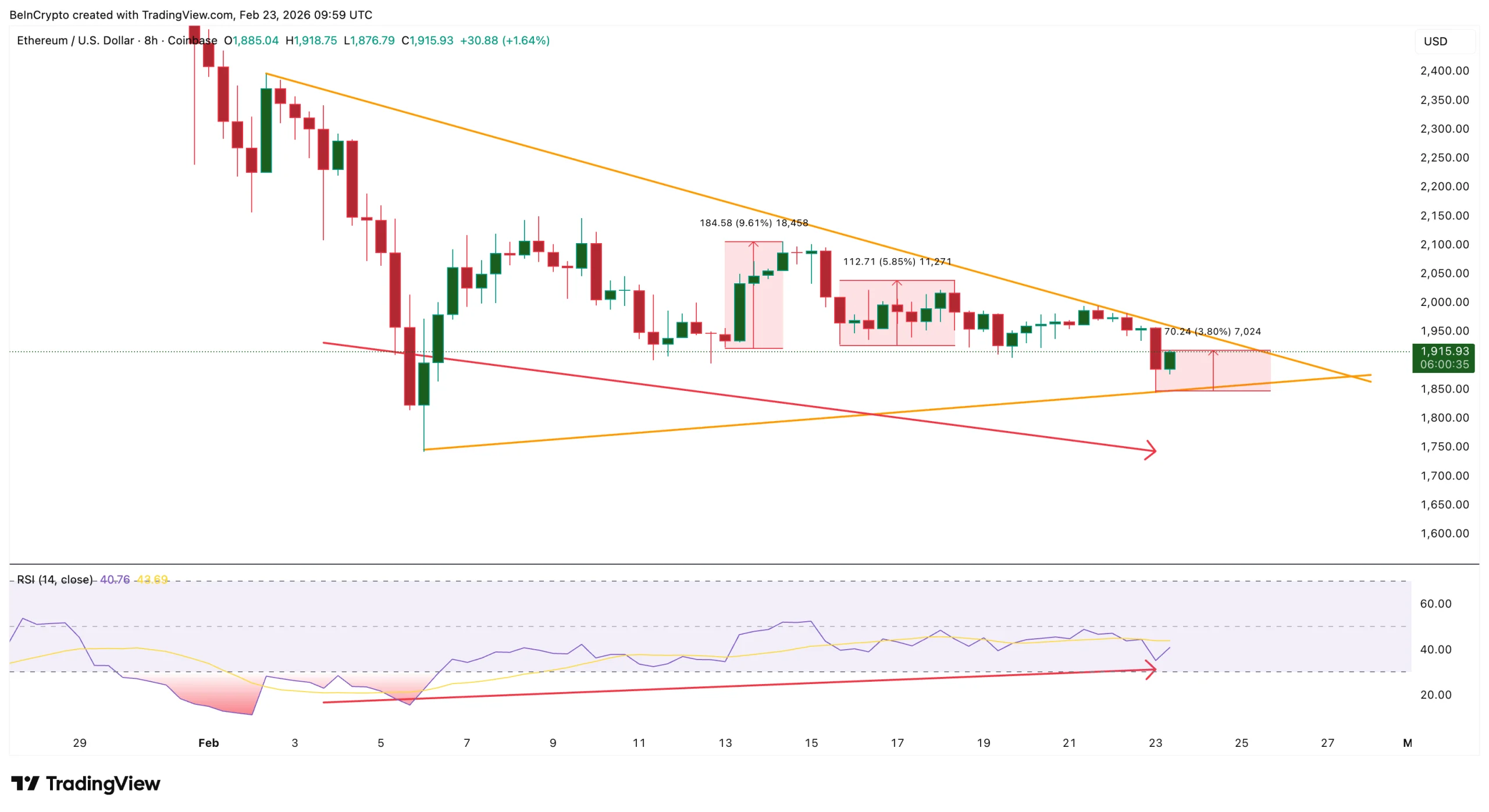
Ethereum is already showing early signs of recovery. Since a recent low near $1,840, Ethereum has climbed nearly 4%, signaling that buyers are beginning to step back in. This rebound is not happening randomly. The bounce setup has been quietly building for weeks.
Several underlying signals now point to a shift. Selling pressure has collapsed sharply. Derivatives traders have turned aggressively bearish without adding new positions. At the same time, long-term holders have started buying again after weeks of selling. Together, these forces suggest the current Ethereum bounce could extend further.
Ethereum Bounce Setup Emerges As Bullish Divergence Builds
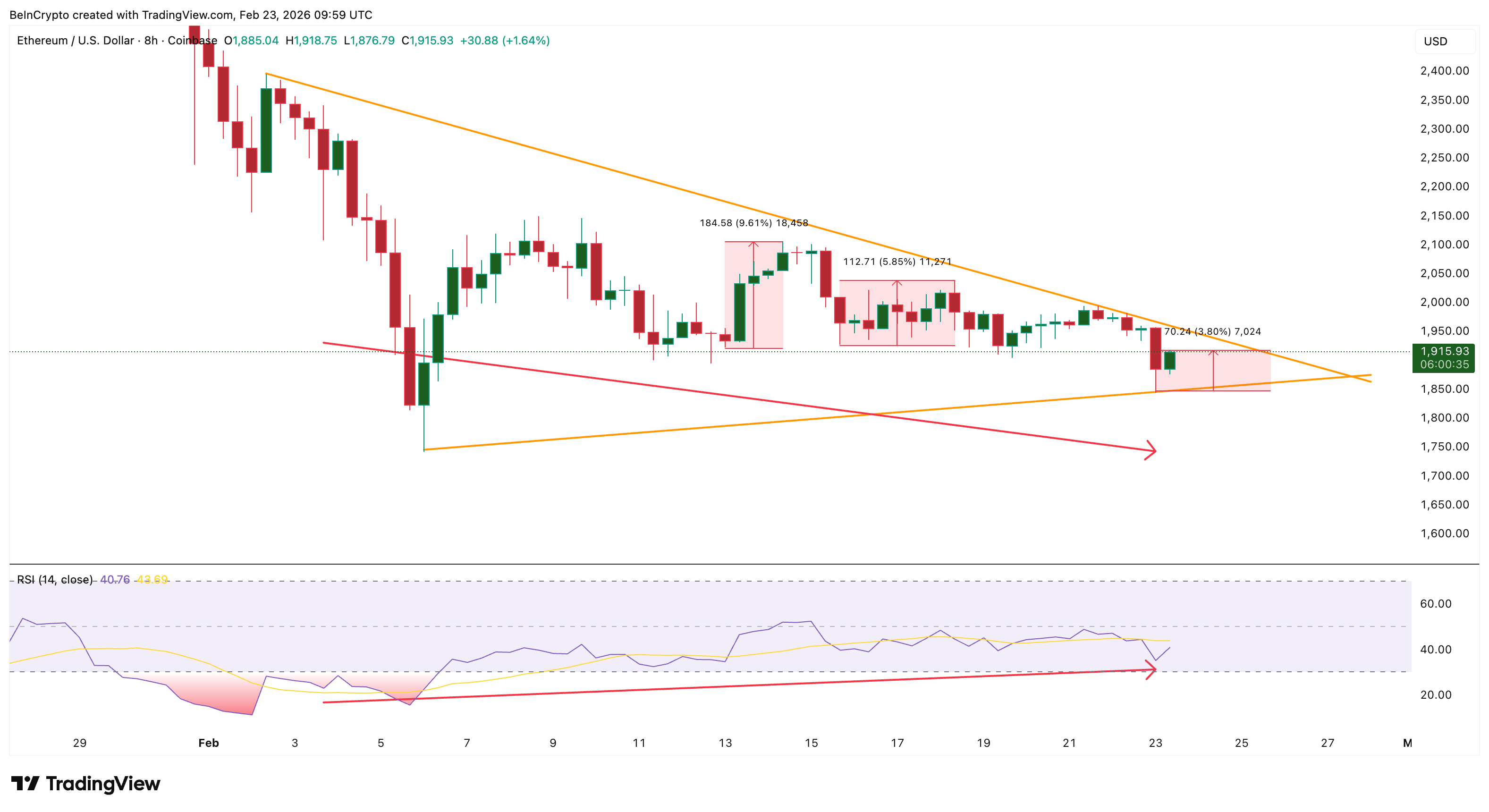
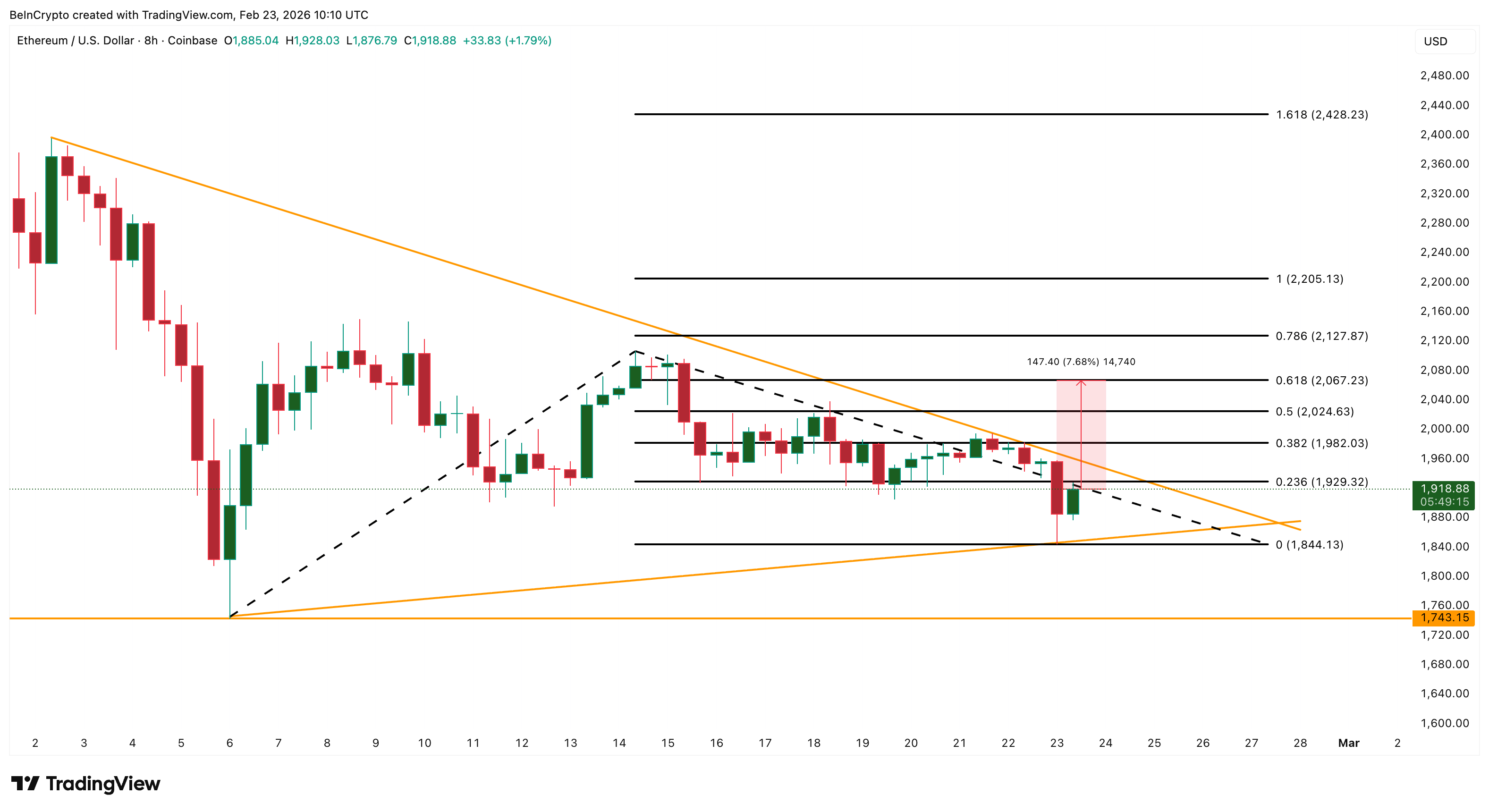
Ethereum’s short-term chart shows a symmetrical triangle. This pattern reflects indecision, where buyers and sellers are fighting for control.
At the same time, a bullish divergence has appeared between price and the Relative Strength Index (RSI). The RSI is a momentum indicator that measures whether selling pressure is strengthening or weakening. Between early February and today (February 23), Ethereum’s price has made lower lows, but the RSI has made higher lows. This pattern often signals that selling pressure is fading.
Want more token insights like this? Sign up for Editor Harsh Notariya’s Daily Crypto Newsletter here.
This same signal worked recently. Between February 3 and February 13, a similar divergence triggered a nearly 10% rebound. Another divergence between February 3 and February 15 led to a 6% move higher.
Ethereum has already started responding again. The recent 4% rebound shows buyers reacting to weakening downside momentum. But technical signals alone are not enough. The bigger question is what changed underneath the surface.
Selling Pressure Collapses 90% Even As Price Fell, Reveals Another Catalyst
The most important shift comes from exchange inflows. Exchange inflow measures the number of coins moving into exchanges. When coins move into exchanges, it usually signals intent to sell.
On February 7, Ethereum exchange inflows peaked near 1.06 million ETH. Since then, inflows have collapsed to just 126,000 ETH. This represents an almost 90% drop in potential selling pressure.
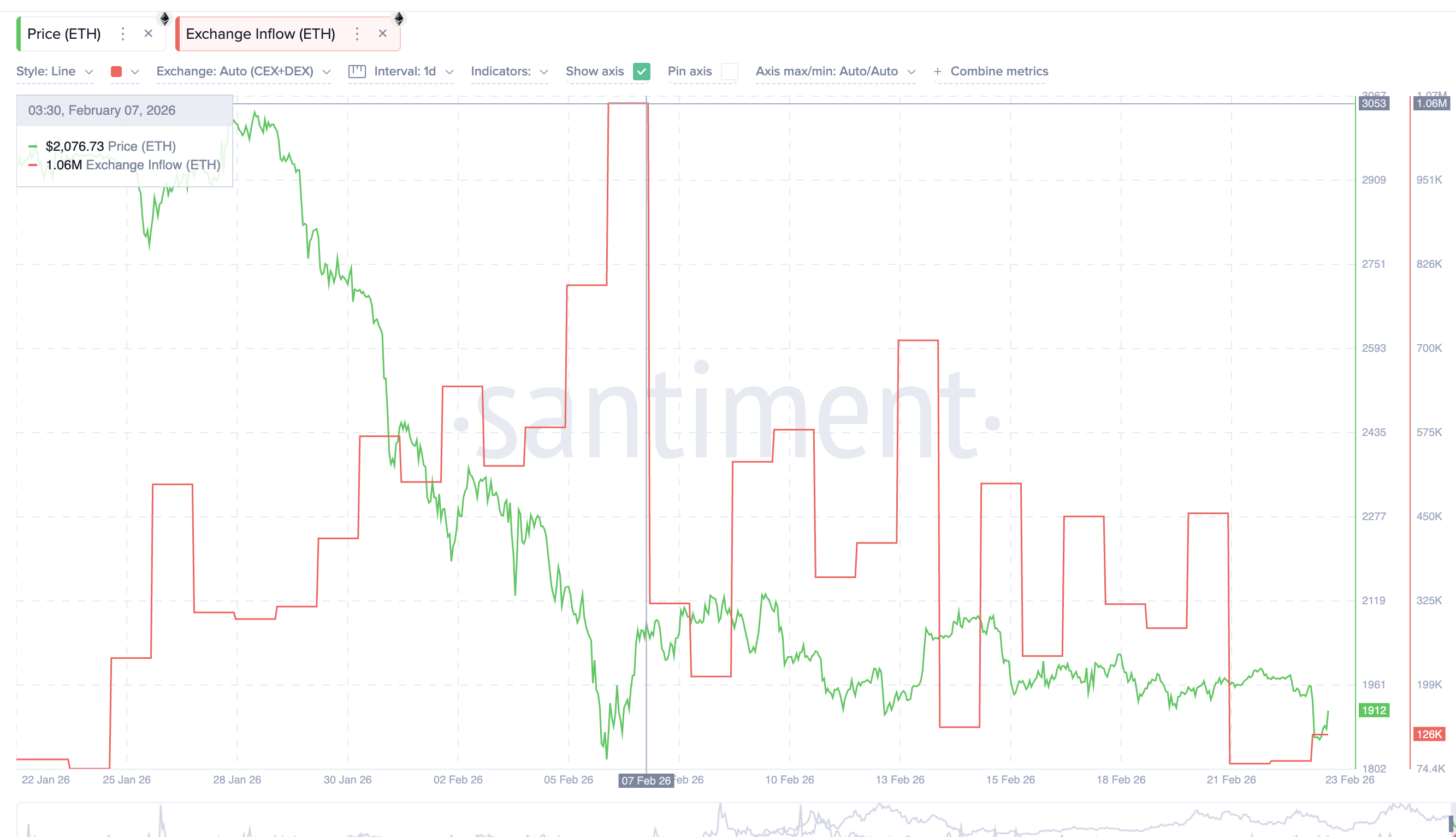
This change becomes even more important when compared to price. During the same period, Ethereum’s price still fell roughly 14%. Normally, price drops when selling pressure rises. But here, the price dropped while the selling pressure disappeared.
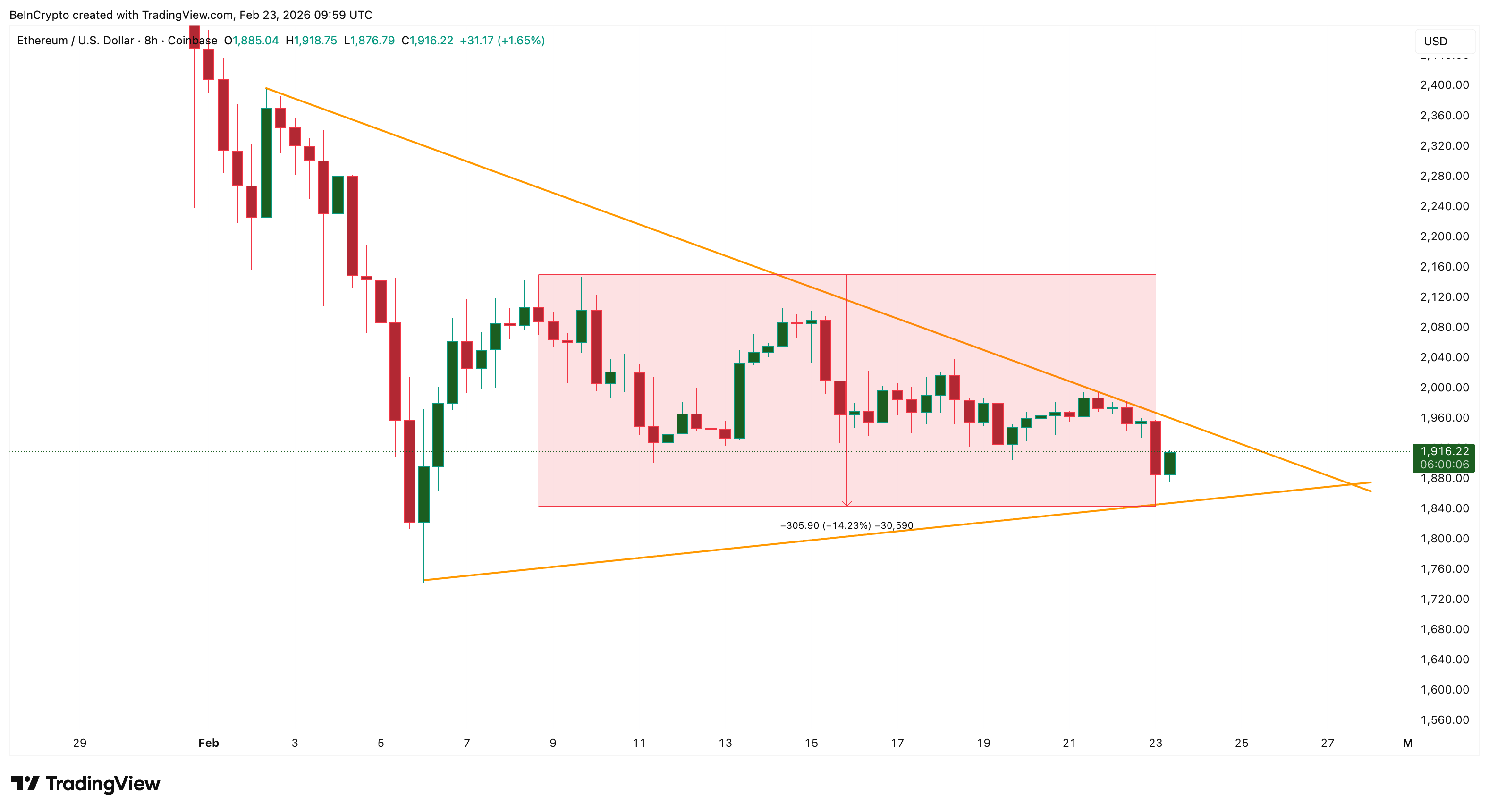
This shows the decline was not driven by aggressive spot selling. Instead, it suggests the weakness came from another source. That source appears to be derivatives traders. Ethereum’s funding rate has turned deeply negative. When funding is negative, short sellers are paying to maintain bearish positions.
Since February 7, funding rates dropped from slightly positive levels to around -0.02%. This marks one of the most bearish sentiment flips in recent weeks.
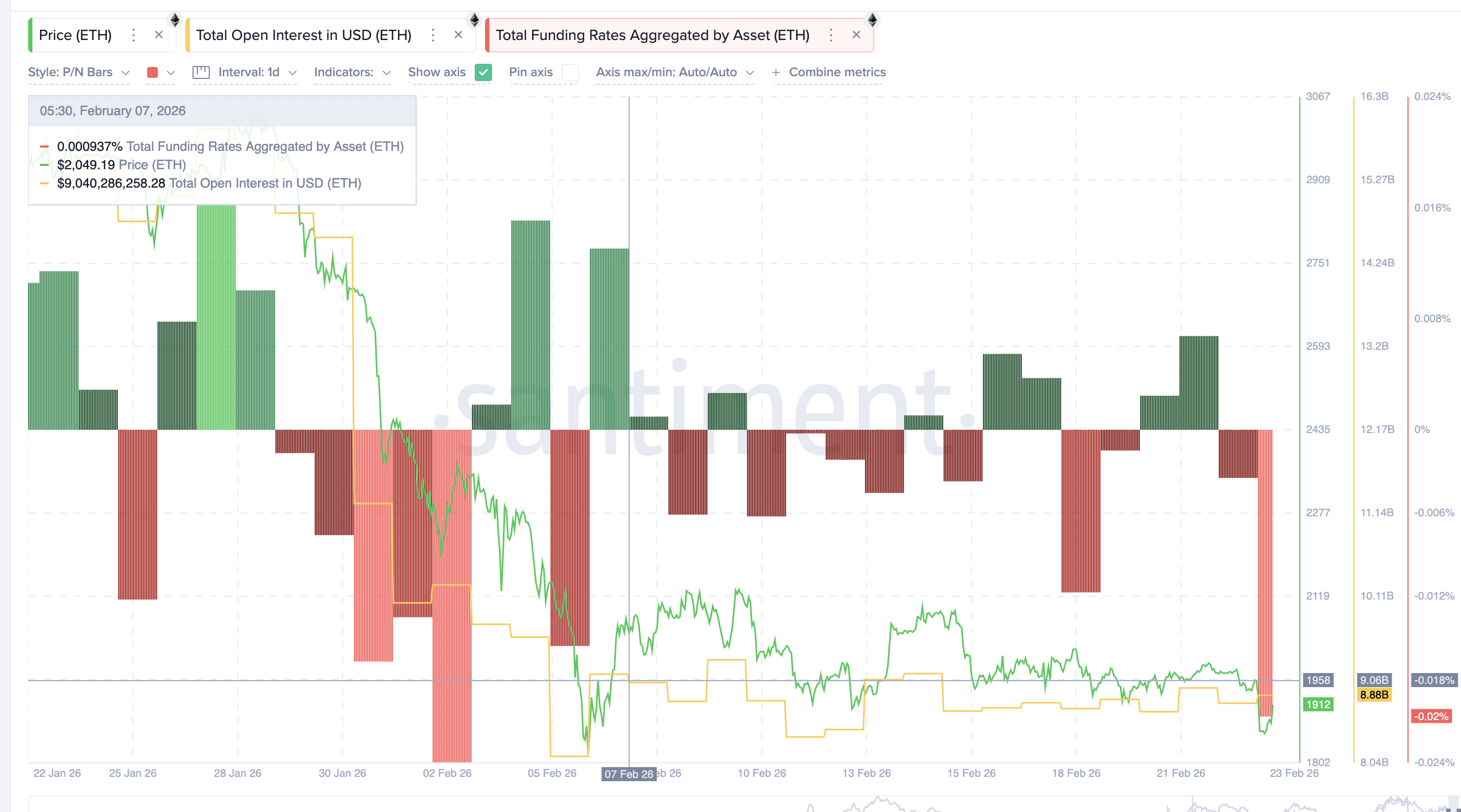
However, open interest tells a different story. Open interest measures the total value of active futures positions. During this period, open interest stayed mostly flat, falling only slightly from around $9.06 billion to $8.88 billion.
This combination is important. It shows that new short positions are not aggressively entering. Instead, existing traders have turned bearish, and long positions have likely exited.
This type of setup can be unstable. When bearish sentiment rises without large new positions, the market becomes vulnerable to a short squeeze. A short squeeze happens when rising prices force short sellers to close positions, pushing the price even higher.
This helps explain why Ethereum’s bounce could extend beyond a simple short-term rebound.
Long-Term Holders Suddenly Turn Buyers After Weeks of Selling
Another important shift comes from long-term holders. The Hodler Net Position Change metric measures whether long-term investors are buying or selling.
Between February 3 and February 20, this metric stayed negative. This showed sustained selling from experienced investors. At its peak, long-term holders sold more than 41,000 ETH on a net basis. But this trend has now reversed. Over the past two days, the metric turned positive, reaching a net accumulation of over 6,000 ETH.
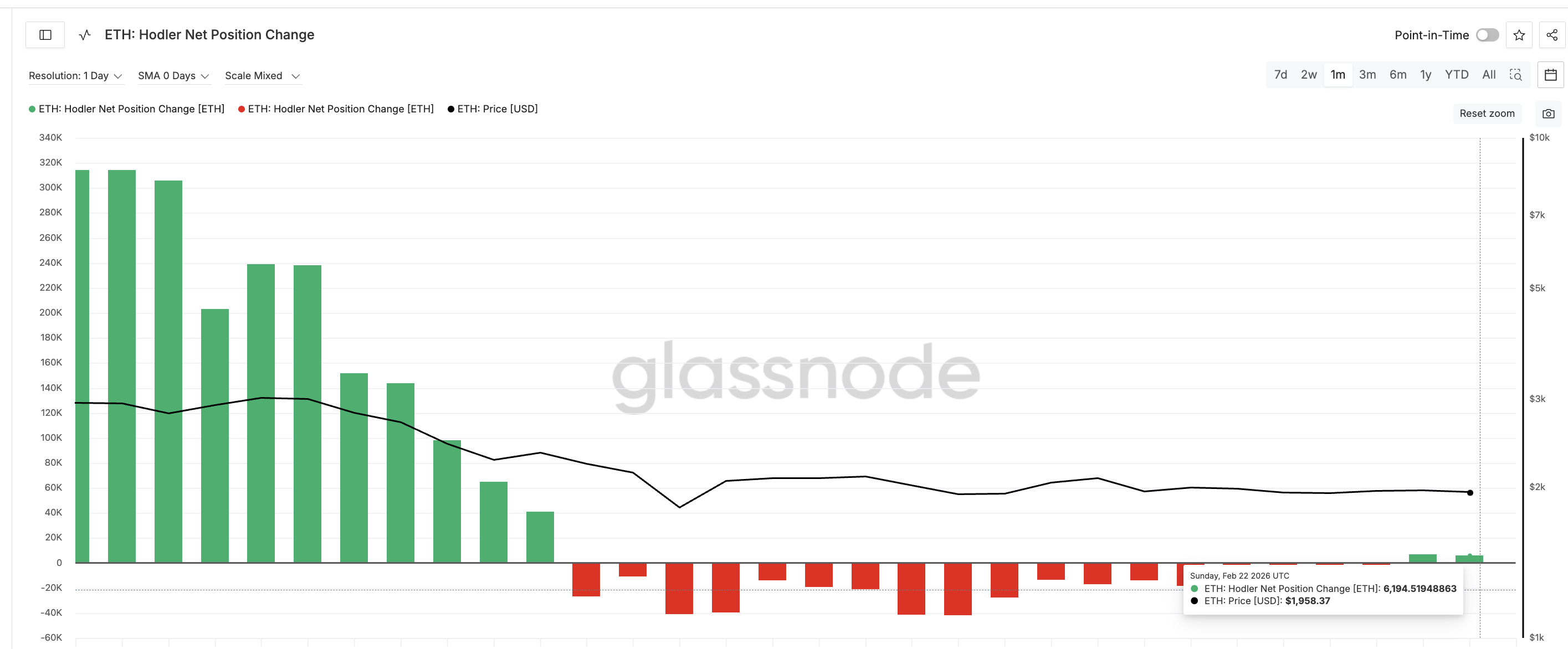
This confirms that experienced investors have resumed buying. This type of accumulation often happens near local bottoms, when long-term investors position early before broader recoveries begin.
With selling pressure falling, bearish derivatives sentiment stretched, and long-term buyers returning, Ethereum’s bounce setup now has stronger structural support.
Ethereum Price Faces Key Breakout Levels That Could Extend Bounce
Ethereum now faces several important resistance levels. The first key level sits at $1,920. Breaking above this level would confirm strengthening momentum. The next resistance appears at $2,020, followed by a major barrier near $2,060, a key technical level, where it can experience the most resistance.
If Ethereum breaks above $2,060, the bounce could accelerate toward $2,200 and potentially even $2,420.
However, the bullish setup depends on holding support. The critical downside level remains $1,840. If Ethereum falls below this level, the bounce structure would fail. In that case, the next downside target sits near $1,740.
For now, Ethereum’s bounce is no longer just a simple relief rally. Selling pressure has collapsed by nearly 90%. Bearish sentiment increased without strong conviction. And long-term holders have quietly returned as buyers.
These combined forces suggest Ethereum’s current rebound may be the early stage of a larger move — with the next breakout level now becoming the decisive trigger.


The FT token arrives after the project raised close to $300 million in funding.
The Flying Tulip (FT) token became transferable and began trading today, Feb. 23, marking the token generation event (TGE) for the latest DeFi project linked to Andre Cronje, a systems architect best known for building early DeFi protocols Yearn Finance and Fantom.
Data from CoinGecko shows that despite an initial dip to around $0.08, FT has spent its first hours trading sideways around the $0.10 mark, implying a fully diluted valuation of around $1 billion.
FT Public Sale, Explained
Flying Tulip’s public sale price was set at $0.10, but it wasn’t a standard token sale. The project’s tokenomics make $0.10 something like a floor price for the asset trading on the open market, as public sale participants have the right to break even on their investment at any time.
Early buyers didn’t just get regular tokens but received ftPUTs, which are non-fungible tokens with a built-in perpetual put option, which gives holders the right, under certain rules, to redeem their tokens at the public sale price of $0.10, instead of having to sell them on the open market.
As Cronje explained earlier this month in an X post, given the project’s tokenomics, “Flying Tulip FDV is not standard FDV.” Typically, FDV is calculated by multiplying total token supply multiplied by current token price.
But Flying Tulip departs from that model because each FT token is only created if it is backed by a corresponding put option, leaving no path for unbacked supply to enter circulation. When tokens are redeemed, they’re also removed from circulating supply.
That tokenomics design means every token is effectively collateralized by its own $0.10, making the system “closer to a NAV valuation than FDV,” Cronje highlighted, adding, “this is something new, and aligns participation far more than any previous model.”
Flying Tulip is positioned as a DeFi “super app,” aiming to bring spot trading, perpetual derivatives and lending into a single interface.
Ahead of the launch, Flying Tulip wasn’t short on cash. The project had already pulled in $200 million in September last year from backers including Brevan Howard and DWF Labs, then added another tens of millions through later rounds and public sales on platforms such as Impossible Finance and CoinList.
SOL is “basically trading in a big no man’s land,” one popular analyst argued.
Solana’s SOL has been on a severe downfall lately, with its valuation plummeting by almost 40% over the past month alone.
According to some analysts, the bears are yet to reveal their full potential, envisioning a slump below $10 in the near future.
SOL HODLers, Beware
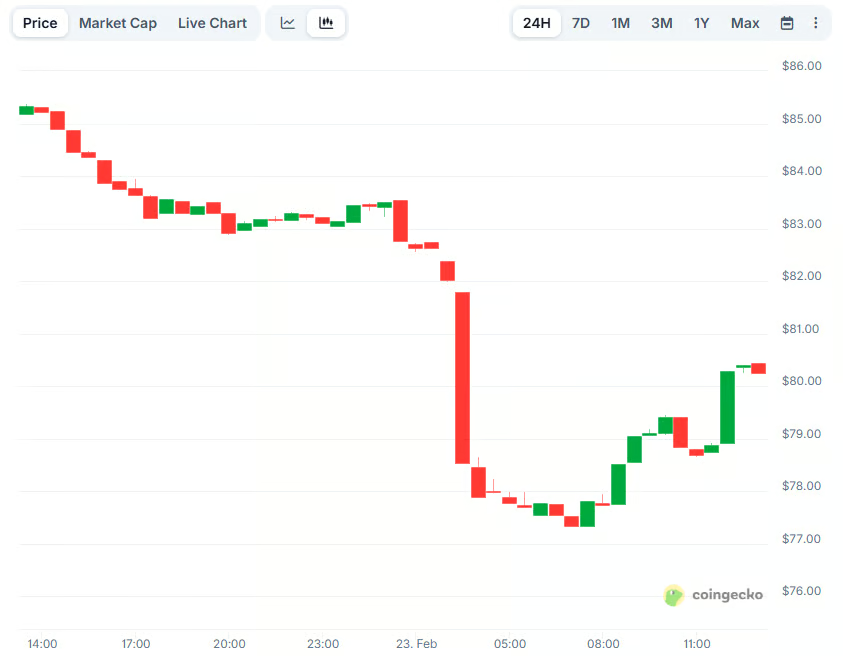
The leading altcoin was among the worst-affected cryptocurrencies following the latest market slump caused by Trump’s renewed tariff saga. Just a few hours ago, SOL briefly dipped to roughly $77 before snapping back above $80, meaning a 6% loss for the day.
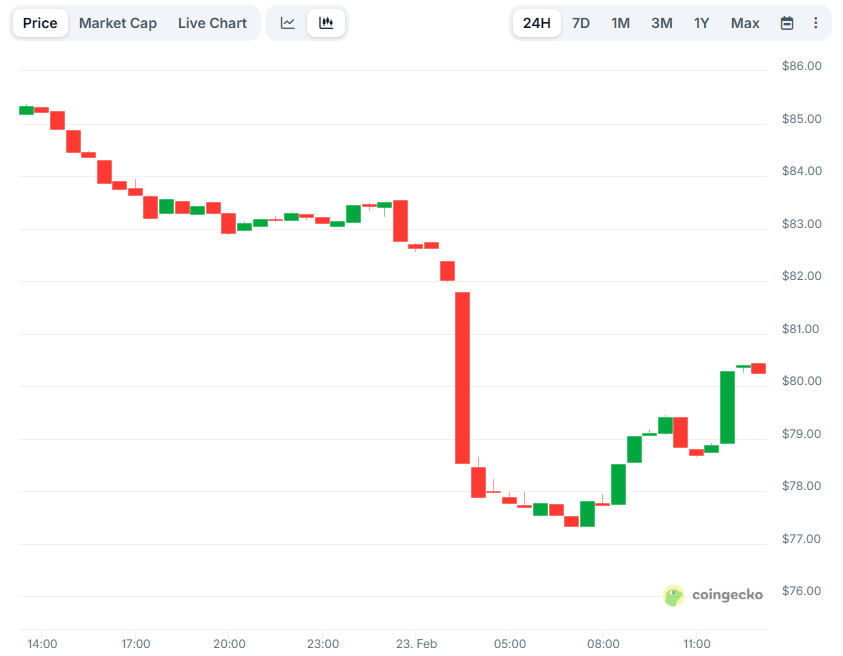
The renowned analyst on X, Ali Martinez, observed the asset’s recent performance, claiming “the super trend indicator” has flashed a sell signal on the monthly chart. He noted that the last time this pattern appeared was in January 2022 and preceded a brutal 95% decline. Applying a decline of that magnitude to today’s levels would imply a staggering crash to approximately $4.
Moreover, Martinez warned investors to pay close attention to the $76 support zone. He believes that breaking below it could open the door to a further pullback to $53, $35, and $23.
Sjuul | AltCryptoGems also made bearish predictions recently. He argued that SOL “truly looks compromised on the high time frame” and is “basically trading in a big no man’s land.” The analyst claimed that as long as the price remains suppressed beneath the $110 resistance, SOL faces the risk of a deep retracement to as low as $20.
How About a Short-Term Bounce?
Despite the broader crypto market’s depressed condition and SOL’s substantial correction, the asset’s Relative Strength Index (RSI) suggests a rebound could be on the way.
You may also like:
The technical analysis tool gauges the speed and magnitude of recent price movements, offering insight into whether a potential trend reversal may be developing. It ranges from 0 to 100, and ratios below 30 indicate that SOL is oversold and could be on the verge of a rally. Data shows that the RSI has dipped well below that zone on a weekly scale.

X user Mags revealed that the asset’s weekly RSI has reached the same level it was in December 2022, when SOL was trading around $8. In the following months, it posted a major bull run, and the analyst wondered if history was about to repeat itself.
Solana’s recent exchange netflow is another factor worth observing. Toward the end of 2025 and into early 2026, inflows exceeded outflows, suggesting that investors were moving funds from self-custody to centralized platforms. This shift is considered a bearish signal because it can be interpreted as a pre-sale step. In recent weeks, however, the trend has reversed with outflows surpassing inflows.

Binance Free $600 (CryptoPotato Exclusive): Use this link to register a new account and receive $600 exclusive welcome offer on Binance (full details).
LIMITED OFFER for CryptoPotato readers at Bybit: Use this link to register and open a $500 FREE position on any coin!


Analyst says public XRPL metrics are down 50–80%, but private institutional flows may explain the apparent decline.
XRP Ledger activity has dropped steeply, with public metrics showing active users, payment volume, and sender accounts falling between 50% and 80% within weeks, according to market watcher Arthur.
The data has sparked debate over whether the network is weakening or simply shifting activity away from public dashboards after a new institutional trading feature went live.
Public XRPL Stats Fall
In a thread posted on X on February 23, Arthur said active users with tags fell to about 38,000 from more than 200,000, while payment volume dropped to roughly 80 million XRP from over 2.5 billion. Additionally, unique sending accounts slid to about 3,000 from above 40,000, with the analyst describing the figures as “bad” but arguing they may not reflect real network demand.
He linked the drop to the February 18 activation of XLS-81, a permissioned decentralized exchange system that allows regulated entities to trade inside restricted pools. Transactions routed through those channels do not appear on public trackers. Furthermore, he suggested the late-2025 spike in activity came from retail flows visible on-chain, whereas institutional flows could now be moving privately.
At the same time, the XRP advocate criticized viral price forecasts, such as a February 22 post from trader CryptoBull2020 predicting XRP could hit $15 by March and $70 by May. He argued that liquidity and macro conditions matter more than social media optimism.
The asset was trading near $1.39 at the time of writing, down about 2% in the last 24 hours, 5% in seven days, and 27% over the past month. Across the last year, it has fallen by more than 46% and is now more than 60% below its July 2025 peak of $3.65.
By comparison, Bitcoin (BTC) has mostly ranged sideways recently, according to pseudonymous analyst Darkfost, which they said has limited direction across altcoins.
You may also like:
Darkfost also reported that more than 31 million XRP moved into wallets on Binance in a single day, largely from large holders. They estimated the transfers could represent about $45 million in potential sell pressure if the funds reach the market.
Loss Data and Valuation Metrics Offer Mixed Signals
A recent report from Santiment adds longer-term context, saying XRP recorded its largest realized loss spike since 2022 after falling from about $3.60 to near $1.10 earlier this month. The firm noted that similar spikes previously came right before a 114% price rise within eight months, though it did not predict that pattern would repeat.
In another analysis, Santiment compared MVRV ratios to rank Ethereum as the most undervalued major crypto at -14.3%, followed by Bitcoin at -6.9%, with XRP at -4.1%. The metric measures whether holders are in profit or loss relative to their cost basis.
Binance Free $600 (CryptoPotato Exclusive): Use this link to register a new account and receive $600 exclusive welcome offer on Binance (full details).
LIMITED OFFER for CryptoPotato readers at Bybit: Use this link to register and open a $500 FREE position on any coin!

Days of our Lives 2-Week Spoilers Feb 23-Mar 6: Alex Explodes in Anger & Owen Makes His Comeback

So, Prince William is ‘not in a calm state’ over Andrew Mountbatten-Windsor. Surprise!

Who is Hatu Sheikh?


-

 Crypto World7 days ago
Can XRP Price Successfully Register a 33% Breakout Past $2?
-

 Video4 days ago
XRP News: XRP Just Entered a New Phase (Almost Nobody Noticed)
-

 Fashion3 days ago
Weekend Open Thread: Boden – Corporette.com
-

 Sports7 days ago
GB's semi-final hopes hang by thread after loss to Switzerland
-

 Politics2 days ago
Baftas 2026: Awards Nominations, Presenters And Performers
-
 Tech7 days ago
The Music Industry Enters Its Less-Is-More Era
-

 Sports4 hours ago
Women’s college basketball rankings: Iowa reenters top 10, Auriemma makes history
-

 Politics5 hours ago
Nick Reiner Enters Plea In Deaths Of Parents Rob And Michele
-

 Business6 days ago
Infosys Limited (INFY) Discusses Tech Transitions and the Unique Aspects of the AI Era Transcript
-

 Entertainment5 days ago
Kunal Nayyar’s Secret Acts Of Kindness Sparks Online Discussion
-

 Video7 days ago
Financial Statement Analysis | Complete Chapter Revision in 10 Minutes | Class 12 Board exam 2026
-

 Tech6 days ago
Retro Rover: LT6502 Laptop Packs 8-Bit Power On The Go
-
 Sports5 days ago
Clearing the boundary, crossing into history: J&K end 67-year wait, enter maiden Ranji Trophy final | Cricket News
-

 Business1 day ago
Mattel’s American Girl brand turns 40, dolls enter a new era
-

 Business1 day ago
Law enforcement kills armed man seeking to enter Trump’s Mar-a-Lago resort, officials say
-

 Entertainment5 days ago
Dolores Catania Blasts Rob Rausch For Turning On ‘Housewives’ On ‘Traitors’
-
 NewsBeat12 hours ago
‘Hourly’ method from gastroenterologist ‘helps reduce air travel bloating’
-

 Business6 days ago
Tesla avoids California suspension after ending ‘autopilot’ marketing
-

 Politics7 days ago
Eurovision Announces UK Act For 2026 Song Contest
-

 Tech1 day ago
Anthropic-Backed Group Enters NY-12 AI PAC Fight