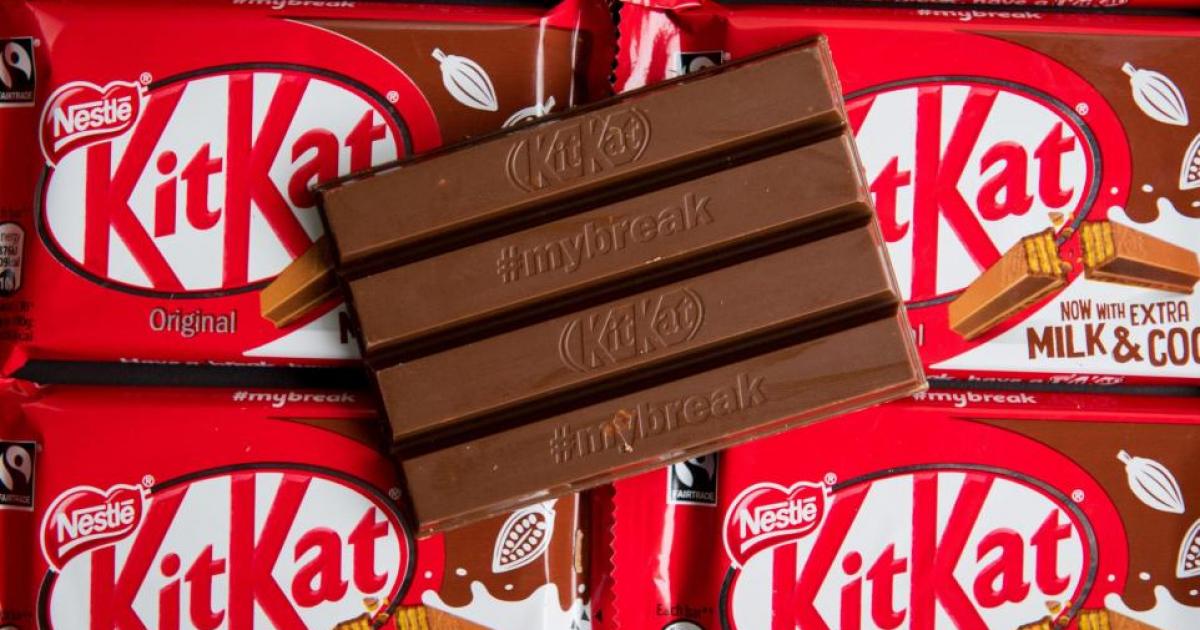
The brand new bar has finally been spotted on shelves, incorporating new and existing flavours to create an original treat in anticipation of Formula 1.
KitKat Chunky’s new bar consists of a marbled caramel chocolate coating, with the standard crispy wafer inside.
It was announced in partnership with Formula 1 and is one of a number of products tailored towards the upcoming speed contest.
Advertisement
Stop the scroll. Start your engines 🏁 The NEW KitKat Chunky Caramel flavour bar, an innovation that celebrates the global partnership between KitKat and Formula 1 ️🍫 Created using our advanced technology, the new bar features a unique and distinctive marbling effect which is… pic.twitter.com/H7Zu6FNshr
The brand also recently released small race-car-shaped chocolate bars, signed off as ‘Official Chocolate Bar of Formula 1’.
Stephanie Scales, Marketing Manager for KitKat, Nestlé UK & Ireland, said: “Formula 1 brings unmatched energy and global cultural relevance, and we wanted to translate that into something that KitKat fans and Formula 1 lovers could enjoy.
“With its striking marbled effect and smooth caramel flavour, it’s poised to capture attention and generate real excitement for shoppers.”
Advertisement
The bar is also part of an on-pack promotion, allowing shoppers to win F1 prizes until April.
These include a full expenses paid trip to the Grand Prix in Monaco or Britain.
In the UK, KitKat is an absolute staple. The “Have a break” tagline has been used since the 1950s, successfully positioning the product as a staple for breaks.
It is bought by more than 60% of households annually and is considered the most global chocolate brand, with massive, consistent production (over 4 million bars a week in York alone).
Advertisement
The bars are being sold individually and in multi-packs, and are available across UK stores now.
The scheme, a 70-home project by Gleeson Homes, will be built on land near Buckingham Terrace in Leeholme, Durham.
It will include a mix of bungalows, and two, three, and four-bedroom houses, with seven homes designated as affordable.
Objections centred on issues such as infrastructure, accessibility to services, highway safety, flooding, contamination, tree loss, and the impact on wildlife.
Advertisement
Traffic and infrastructure concerns
One resident said: “The potential 180 extra vehicles will have such a significant impact to cause extreme concern and high risk to all through the added congestion.”
Another said: “There is no infrastructure to support the existing residents of Leeholme, nevermind to support the application for a further 70 houses.”
Loss of green space
Advertisement
A resident wrote: “I am writing to formally object to the proposed development of 70 dwellings on the greenfield space.”
They said the site “functions as a community green space used daily by local residents—dog walkers, families, and children.”
Environmental impact
Concerns about wildlife and the natural environment were also raised.
Advertisement
A resident said: “The relatively high percentage of trees to be removed on the proposed site would have a huge impact to the visual aesthetics and character of the location.”
Flooding and contamination
Other objections highlighted historical issues with flooding and ground contamination.
One resident said: “There is a history of flooding at the south of the proposed development.”
Advertisement
Another raised health concerns, saying: “The houses that were demolished on site in the late 80s contained asbestos that was never removed from the site.”
“This will lead not only to significant and widespread contamination within the houses, but also presents significant long term health hazards…”
Ground instability and sustainability
Residents questioned the suitability of the land, with one noting: “Local knowledge indicates that temporary properties built here in the 1970s were removed due to ground instability.”
Advertisement
Others said the development was unsustainable.
One objection stated: “Leeholme itself has no employment and basic facilities… Its simply not sustainable.”
Education and services
Concerns were also raised about pressure on schools and other services.
Advertisement
One resident said: “The nearest secondary school is King James in Bishop Auckland, last year it was 150 over capacity and this year 173 with literally no space for one more chair.”
Councillor James Stephenson, of Reform Shildon and Dene Valley, supported residents’ concerns.
He said: “Leeholme does not offer the range of services, employment opportunities or public transport links required to support an additional 70 dwellings.”
“The impacts of safety and congestion are likely to be significant.”
Advertisement
However, not all councillors were opposed.
Councillor Michael Ramage, Independent member for Shildon and Dene Valley, supported the development.
He said: “The development will be for the greater good and of benefit to a significant number of constituents, who have not voiced objections, and in my view, would be for the economic good of the area.”
Dr. Peter Attia, a medical influencer whose emails with the late sex offender Jeffrey Epstein were revealed in the latest U.S. Justice Department release of files, has resigned a post with CBS News.
Attia, podcast host and author of “Outlive: The Science & Art of Longevity,” was one of a group of people named last month by CBS News editor-in-chief Bari Weiss as a contributor to network programming. He was the subject of a “60 Minutes” profile that ran on the network last October.
But shortly after the appointment, Attia’s name surfaced in hundreds of Epstein documents. While Attia said he was guilty of no wrongdoing and did not attend any of Epstein’s sex parties, he admitted in an apology earlier this month that some of his emails were “embarrassing, tasteless and indefensible.”
Despite some public pressure, CBS News did not cut ties with Attia after the documents surfaced. Instead, Attia resigned from the network on his own, according to published reports confirmed by CBS News on Monday.
Advertisement
Attia is one of several public figures, including some in the corporate and public sectors, whose relationships with Epstein have surfaced in recent weeks, causing resignations.
This group of talented musicians played several innovative and energetic sets of Scottish Dance Music during their first spot featuring a few of John’s own compositions including Linsey and Troy’s Wedding March.
Biggar Accordion & Fiddle Club members met on Sunday, February 8, with guests the John Burns Scottish Dance Band.
Advertisement
But before that members were entertained by local musicians, with accordionists Andrea Balderson, Adam Gibb, Jim Gold, Sam Gray, Marshall Harkness, Fin Hope, James Milner, James Watson and Scott Wilson.
On fiddle were Gilbert Logan and Sarah Wilson and on piano Keith Dickson, Jim Gold and Dorothy Lawson. On drums were Andrew Barrie, Fin Hope, Tom Hope and Alex Lyall.
Guest bandleader, accordionist John Burns, who now stays in Shotts, was ably accompanied by Stuart Cameron on second accordion, Neil Ferguson on fiddle, Craig Paton on piano and Alan Sutherland on drums.
This group of talented musicians played several innovative and energetic sets of Scottish Dance Music during their first spot featuring a few of John’s own compositions including Linsey and Troy’s Wedding March.
Advertisement
During the second half, this well-organised band performed Jean Peyronnin’s Marche Aux Etoiles (March to the Stars), as a Boston Two-Step, which was well received by the club’s attentive audience.
As always, thanks to the ladies who provided the half time buffet and to Andrew Barrie on the bar. On Sunday, March 8, the club will meet again at Biggar Bowling Club at 2pm with guests Rory Matheson and his Scottish Dance Band from Glasgow.
*Don’t miss the latest headlines from around Lanarkshire. Sign up to our newsletters here.
And did you know Lanarkshire Live had its own app? Download yours for free here.
Airing last night, the show stars Natalie Dormer as none other than Sarah Ferguson, and Mia Mckenna-Bruce as Jane Andrews, a working class woman who found herself elevated to becoming Fergie’s royal ‘dresser’ – before being tried and convicted for murdering her boyfriend, Thomas Cressman.
The story became a sensation in the early Noughties, and had all the hallmarks of a salacious story: the royals, a brutal death and a tabloid press fuelling it all.
The Lady has been described by its showrunner, Debbie O’Malley, as a “toxic fairytale”, and it certainly is that. Jane Andrews’ fall from grace, from Buckingham Palace all the way to the Old Bailey – is tragic and compelling. But how much of it really happened? We dive into Andrews’ life, with the help of court reports and interviews.
A working-class background
Advertisement
Jane Andrews arriving at the Old Bailey in London (Peter Jordan/PA)
PA Archive
Andrews was born in April 1967 in Cleethorpes, Lincolnshire. Her family was working class: her father worked as a joiner, and her mother as a social worker. Jane was bright and got a place at the local grammar school, before the family’s debts forced them to move to Grimsby.
“I remember one day we didn’t have enough to buy a loaf of bread and Mum had us looking down the sides of the settee and in our coats for money to scrape together,” she said in a 2003 interview. Around this time, she also started to struggle with her mental health, with depression, panic attacks and an eating disorder; she tried to take her own life for the first time at the age of 15.
Advertisement
She also began the pattern that would haunt her life, of seeking unhealthy relationships for validation. “I would sleep with someone, possibly on the first date, because I was frightened if I didn’t they would go,” she told the Guardian. “I allowed men to do anything they wanted to me.”
At Grimsby, the young Andrews enrolled at Hereford Secondary School – but her continual truancy affected her grades, and an abortion she had at the age of 17 traumatised her further. Eventually, after receiving only her O-levels, she abandoned A-levels to study fashion at the Grimsby College of Art.
Irene Smith, one of her lecturers, told the Telegraph later that she remembered her as somebody whose primary motivation was “to get out of Grimsby”.
“I had no doubt when I was teaching her that she would move on quickly. She knew what she wanted in life, and she had a particular style,” she said. “She desperately wanted to get on. She was really, really determined to succeed.”
Advertisement
Natalie Dormer as Sarah Ferguson,Caroline Fabar as Ruth and Ella Bruccoleri as Angela
Jonathan Ford/Left Bank/Sony Pictures Television
After graduating, the young Andrews worked as a sales assistant for Marks & Spencer in Grimsby, when she saw an advertisement for a personal dresser in The Lady magazine. She applied, and six months later got an interview with the Duchess of York, Sarah Ferguson, who at that point was pregnant with Princess Beatrice.
The pair got on well, and Andrews ended up with the job, starting in July 1988.
“I was running away from all the horrible things in my past that Grimsby represented,” she said later. “I arrived at King’s Cross with a suitcase and £10 in my pocket. I got in a taxi and said, ‘Side door of Buckingham Palace’ and the driver made a joke.” Upon arrival, she found flowers waiting for her, along with a card saying ‘Welcome to the team’, signed, ‘The Boss.’
Advertisement
Andrews quickly learned to fit in, dropping her northern accent so fast that Fergie later jokingly called her ‘Lady Jane’. She also loved the job – although she found it demanding, and newspaper reports later labelled her a grasping social climber for her attempts to fit in.
“I was a country bumpkin,” she told the Guardian. “Suddenly, I was at Balmoral mixing with the royals, having long chats with Princess Diana. I was 21 years old and of course I enjoyed it. If my accent changed it was only because people made fun of the way I said ‘bath’ and ‘grass’. Fergie was headstrong, but she was good to me.”
Natalie Dormer as Sarah Ferguson
Jonathan Ford/Left Bank/Sony Pic
She also fell in love: in April 1989, Andrews met IBM executive Christopher Dunn-Butler. He was 21 years her senior, but that didn’t seem to matter: Andrews called him “happy-go-lucky”, and within three months, he had proposed, and the pair married in August 1990.
Advertisement
After a few years, though, the marriage struggled. Andrews had a few affairs, and described the pair as being “more like good friends” rather than a couple. But soon after, she met Greek shipping magnate Dimitri Horne.
They fell in love, and she moved in with him – to a flat the Duchess had rented for her. At this time, the pair were closer than ever, bonding over their failed marriages (hers to Andrew was foundering around the same time) and travelling around the world together. In an introduction to one of her books, the Duchess included a tribute to Andrews, “whose loyalty and kindness knows no bounds.”
However, more trouble was on the horizon. Her relationship with Horne was struggling; when he told her he wanted to end their affair, she reportedly started breaking things around the flat, leading him to give a statement to police.
“On the mantelpiece in the living room was a cup and saucer that I knew was very special to him and I smashed it. I went through his journal with a black marker pen and blanked out all the references to myself. I picked up his telephone and smashed that as well,” she told the Guardian. “I’m ashamed of what I did. I’ve never done that to anyone else’s possessions.”
Advertisement
She attempted suicide again, but survived. In November 1997, she was made redundant from her job at the palace.
Mia Mckenna-Bruce as Jane Andrews
Jonathan Ford/Left Bank/Sony Pictures Television
After this news (apparently the result of cost-cutting exercises on the part of the palace), Andrews sank into a deep depression. She felt she had been badly treated by Fergie, her employer, who had apparently told her weeks ago that, “I’ll never get rid of you”, and didn’t tell her about the redundancy in person.
After some difficulty finding a job, she eventually got one with Knightsbridge jewellers Theo Fennell (father of Emerald) and Annabel Jones, which was where she eventually met Thomas Cressman in 1998.
Advertisement
He was a successful businessman: his father was the former director of Aston Villa, and he himself had worked as a stockbroker. The pair fell head over heels; later reports claimed that Andrews saw a life with him as a means to get back into high society, and became obsessed with the idea of a proposal.
“It was such a complex relationship that we had,” Andrews told the Guardian. “I was the ultimate in insecurity. He was the ultimate in commitment-phobia. I would threaten to leave. He would tell me to leave. Then he would reel me back in. He knew which carrots to dangle. He knew which strings to pull.”
It was volatile, too, with Andrews alleging that Cressman had an interest in kink and BDSM, and enjoyed humiliating and hurting her.
In the summer of 2000, the pair went on holiday to the south of France, but things ended in disaster. Reports suggested that Andrews had been expecting a proposal, only for Cressman to tell her he wasn’t planning on proposing at all – though Andrews herself disputes this.
Advertisement
Things escalated on their return to Cressman’s flat in Fulham. At one point, he phoned the police, telling the operator that, “we are rowing, someone is going to get hurt unless… I would like [the] police to come and split us up.”
Nobody did, and later, his body was found. Andrews had beaten him with a cricket bat and stabbed him with a kitchen knife, before going on the run. She was later found in a car in Cornwall, having taken an overdose.
Mia Mckenna-Bruce as Jane Andrews
James Pardon/Sony Pictures Television/Left Bank
Andrews went on trial for the murder in 2001, amid a storm of tabloid interest. At the trial, Andrews’ defence reiterated her claim that Cressman had been sexually and physically violent towards her – and added that her depression “would have heightened her sense of fear and helplessness.”
Advertisement
Cressman’s family hit back, describing them as a “whole tissue of lies,” and eventually the jury convicted Andrews of murder rather than manslaughter.
“In killing the man you loved, you ended his life and ruined your own,” the judge told her during the sentencing.
Ultimately, Andrews was sentenced to life in prison, starting her sentence in HMP Bullwood Hall in Essex. There was an escape in 2009, where she jumped the walls after being transferred to an open prison, and holed up in a nearby Premier Inn with her family, until she was caught and brought back.
Despite repeated attempts to appeal the sentence, Andrews remained incarcerated until her release in 2019. Upon her release, she found work in a supermarket, but lost the job when her identity was discovered. Now 57, she apparently works as a charity-funded animal hospital: a quiet life, for a woman whose tragic story has been dragged through the media yet again.
Advertisement
Harriet Wistrich, CEO of Centre for Women’s Justice, who represented Jane Andrews at her appeal in 2003, added that “she long ago served her prison sentence and has attempted to move on, but due to her past employment with the now discredited section of the Royal family, she continues to be the subject of media interest, intensified each time when yet another one-sided TV programme is made about her case.
“Jane has not contributed to ‘The Lady’ despite it purportedly being about her life, nor has she contributed to any of the previous multiple TV documentaries made about her. The public are thus presented with a one-sided view that fails to explore why a vulnerable woman in her circumstances may have been driven to kill.”
Crash victim Claire was described as ‘beautiful, funny, smart and loving’
Husna Anjum and Rob Kennedy
20:50, 23 Feb 2026
A mum lost her life when a driver smashed into her at “unbelievable speed”. Claire Laybourne was returning from taking her mum to a trip to the theatre as part of her Christmas present, she cautiously overtook a broken down car on the A19 in North Tyneside.
Ryan Scott then drove onto the scene at 114mph in a car he wasn’t insured to drive. Chronicle Live reports that although the car’s emergency braking system kicked in, he was still doing 88mph when he smashed into Claire’s car.
Advertisement
Claire was fatally injured and her mother badly hurt as “cowardly” Scott fled the scene on foot, Newcastle Crown Court heard. The 28-year-old, formerly of Chasedale Crescent, Cowpen, Blyth, has been jailed for ten years.
It was around 10.30pm of December 5 last year that Claire, mum of seven-year-old George and 22-year-old Faye, had been out with her mum, Heather Appleby, for a meal followed by a show at Sunderland Empire theatre. They were returning home, with Claire, 39, driving her VW T-Roc north on the A19.
It was raining and there were no street lights on the road, as they approached the Holystone turn off. A man had broken down shortly before the turn off in his Volvo and his car had come to a stop in the left hand lane and he had put his hazard lights on to warn others of the obstruction.
Claire, of Hebburn, saw the broken down car and slowed to 20 to 30mph indicating to overtake it. As a motorist behind her prepared to do the same, he checked his wing mirror.
Glenn Gatland, prosecuting, said: “As he did so, he heard a very loud engine noise which he described as shocking him. He saw the vehicle passing him at an ‘unbelievable speed’, in his words, with such magnitude it caused his van to rock from side to side with wind resistance.
“He then heard a bang ‘like a bomb going off’.” The Skoda Fabia driven by Scott had smashed into the Claire’s car, lifted off the ground, cleared the full height of the T-Roc then hit a barrier, spinning through 360 degrees a number of times.
Mr Gatland said data from the Skoda showed that seconds before the impact, it was doing 114mph with 100% acceleration, meaning it was going at the maximum possible speed. An automated braking system had activated, reducing its speed to 88mph at the point of impact.
Advertisement
After the crash, a witness spoke to Scott at the scene before he ran away north up the A19, not looking back. Claire, who had suffered extensive fractures to the base of her skull and multiple rib fractures, was airlifted to hospital but subsequently died with her family at her bedside.
Her mum suffered broken ribs, bleeding on the brain, severe whiplash, cuts and bruises. In a victim impact statement, Heather said: “Emotionally, I am a complete mess.
“I feel terrible guilt because Claire and I had been to see a show at the Sunderland Empire and she was taking me home when the accident happened. The show was a treat from Claire for me as an early Christmas present.
Advertisement
“We had had a great night out with a lovely meal before the show. This was the sort of thing Claire and I enjoyed doing.
“We were very close, she was my only daughter and she was my best friend. I feel guilty because I survived when she had so much more living to do.

“I am still getting flashbacks from the aftermath from the accident although I do not remember the actual collision. I have horrible nightmares.
“I close my eyes and all I can see is Claire next to me holding her hand while she was dying and I could do nothing to help her. I am terrified every time I have to go in a car.
“If it’s dark or raining, I just sit and cry in the back seat. Losing my daughter in such a senseless way is something I can’t come to terms with.
“I am sure everyone thinks that their daughter is wonderful, but my girl truly was. The loss of Claire is something I don’t think I’ll ever get over but the loss to her partner Ben, her daughter Faye and her little boy George is truly horrendous.
“Claire was beautiful, funny, smart and loving. She was the kindest person I’ve ever known and it was a privilege to be her mother.”
Advertisement
Claire’s daughter, Faye, 22, who lives in New Zealand, said: “My mam was the most loving, kind and happy person you could ever meet. She had a way of making people feel loved, welcomed and cared for, and she was deeply loved by so many.
“She left a lasting impact on everyone who knew her, and the loss of her has been felt far beyond our immediate family. My mam was the kindest person I’d ever met, she was never involved in any confrontation, earning her the nickname ‘Can’t confront Claire’.
“My mam loved and accepted everyone for who they were. She lit up every room she walked in too, if she was smiling so was everybody else in the room.
“I really did think that with us having such a small age gap that we would have forever together. I was so privileged to have a mam, and a best-friend in one even though everyone thought we were sisters.
Advertisement
“The way my mam was taken from us has caused unimaginable pain. Her death was sudden, violent and unfair.
“We were robbed from the chance to say goodbye, and she was robbed from the chance to live the life she deserved. Knowing that the person responsible chose to leave her there has added a level of trauma and heartbreak that is hard to put into words.
“Our family has been permanently broken by this loss. There is an empty space that can never be filled.
“This is not something that time will heal. It is something we will carry with us every day for the rest of our lives.
Advertisement
“I want the court to understand that my mam was not just a name or a statistic. She was a loving mother, a happy and caring person and someone who mattered deeply.
“Her life had meaning, and her death has caused lifelong pain to those she left behind especially her children.”
Claire’s fiance, Ben Dewar, added: “There are no words that can truly describe, express and explain the impact Claire’s death has had on our family. Claire was my partner, my soulmate, and my person.
“She was kind, caring, funny, loving, and full of warmth. She had a way of lighting up every room she entered and made people feel safe and valued simply by being herself.
Advertisement
“The impact on our son, George, has been devastating. He has lost his mam, the person who should have been there to guide him, comfort him, and watch him grow, to be there for all of his milestone moments in life.
“George and Claire were so close. He was the apple of her eye.
“Explaining to a seven-year-old, in the family room of the RVI that his mam is going to die, to watch him struggle to breathe and sob uncontrollably and for him to ask “why my mam” is the hardest moment of my life, one that again I replay in my head a thousand times a day. He gripped my hand tightly at Claire’s funeral, offering me the support Claire would usually be there to give.
“George is unable to sleep in his own room since Claire was killed. He seeks the reassurance dad is there and holds me tightly when I eventually come to bed.”
Advertisement
Ben added: “We were planning to get married this September. I had booked a trip to New York for her 40th birthday.
“The loss of Claire has left a permanent void in my life. I am lost without her.
“I live with constant sadness, sadness that she is gone, sadness that our future together will never be fulfilled, and sadness that I have lost the person who was my home. There is not a minute that passes where I do not feel her absence in every room.
“Claire was deeply loved by everyone she met. She truly touched so many people.
Advertisement
“She mattered. Our life together mattered.
“The impact of her death is not temporary — it is lifelong, we have the life sentence in all of this. It affects how I live, how I parent, how I see the future, and who I am as a person.”
Scott, who has 13 previous convictions, pleaded guilty to causing death by dangerous driving, causing serious injury by dangerous driving, causing death while uninsured and failing to stop after an accident. Jailing him for ten years and banning him from driving for 13 years and eight months, Judge Tim Gittins branded his decision to flee “cowardly”.
Advertisement
He said of Claire’s death: “It was unnecessary, wholly avoidable, simply because of your arrogant decision to drive and to drive in that manner.”
When Scott was arrested the following day he tested positive for cocaine but prosecutors could not prove if he had taken it before or after the crash. The judge said while he suspected he had taken it before the collision he disregarded it from his decision on sentence.
The court heard Scott had only past his driving test last summer and had been using his friend’s car for a few days before the accident. He told police in interview of the conditions that night: “I could hardly see mate, it was f****** bucketing”.
He said he adapted to the conditions by putting his wipers on faster. Penny Hall, defending, said groundworker Scott had used his friend’s car to go shopping and having caused the collision through his excessive speed, he “panicked” and fled the scene.
Advertisement
She added that he is remorseful, has insight and it’s his first time in prison. The court heard references from friends and family speak highly of him and he had a troubled childhood.
Geno Auriemma broke a tie with Tara VanDerveer for most appearances by a coach in The Associated Press women’s basketball Top 25 on Monday when UConn was again a unanimous No. 1.
Auriemma has the Huskies ranked for the 655th time. UConn was atop all 31 ballots from the national media panel. The Huskies (29-0) are the last unbeaten team in Division I basketball and have won 45 consecutive games dating to last season.
The top five teams remained unchanged in the rankings this week with UCLA, South Carolina, Texas and Vanderbilt following the Huskies.
The rest of the top 10 changed as Michigan, Louisville, Duke and Ohio State all lost games last week.
Advertisement
LSU moved up one spot to sixth with Oklahoma jumping up four places to seventh. Michigan dropped two spots to eighth and Iowa was ninth. The Hawkeyes moved up four places after beating the Wolverines on Sunday. Louisville was 10th.
Duke, which ended its 17-game winning streak Sunday in a loss to Clemson, dropped to 12th, and Ohio State was 13th.
Falling Lady Vols
Tennessee dropped out of the poll for the first time this season after losing last week to Ole Miss, Texas A&M and Oklahoma. The Lady Vols have dropped seven of nine games for the first time in school history. Tennessee had been ranked for the past 31 polls.
“We’ve had an incredibly tough stretch,” coach Kim Caldwell said after Sunday’s loss to Oklahoma. “You just (have to) be honest with your team, and they can handle it or they cannot. And sometimes the honesty is not good and sometimes the honesty is good.”
Advertisement
The schedule doesn’t get any easier for the Lady Vols with regular season games left against LSU and Vanderbilt.
Welcome back
Princeton re-entered the poll this week at No. 25. The Tigers (21-3) fell out last week after losing to Columbia on Feb. 13. The Lions have beaten the Tigers twice this season, and Princeton’s other loss came to No. 14 Maryland.
Conference supremacy
The SEC remained the top conference with nine teams in the poll. The Big Ten is next with seven. The Big 12 has four teams, the Atlantic Coast Conference has three and the Ivy League and Big East each have one.
Games of the week
No. 8 Michigan at No. 13 Ohio State, Wednesday. The two rivals meet with Big Ten Conference seeding on the line. The Wolverines lost their last game, falling at then-No. 13 Iowa on Sunday. The Buckeyes have dropped two of their last three games.
Advertisement
No. 12 Duke at No. 21 North Carolina, Sunday. The Blue Devils beat the Tar Heels in the first meeting earlier this month and will look to wrap up the ACC regular season crown with another victory.
The incident happened at Ramsgate, Kent in 2022 when police were called to an ‘incident’
Husna Anjum Senior Live News Reporter and Charlie Bradley
22:28, 23 Feb 2026Updated 22:29, 23 Feb 2026
Police have charged a man with murder following an investigation into the death of a 13-week-old child almost four years ago.
On July 15, 2022, emergency services raced to Queen Street in Ramsgate, Kent, to come to the aid of the infant. Tragically, the youngster passed away in hospital.
Tyla Wharmby of Prestedge Avenue, was charged with murder and causing grievous bodily harm with intent on Monday (February 23).
The 24-year-old will soon appear in court. After the child’s death, a man was arrested at the time and later bailed.
Kent Police charged Wharmby this week following its investigation.
Advertisement
Want to see more of the stories you love from Belfast Live? Making us your preferred source on Google means you’ll get more of our exclusives. To add Belfast Live as a preferred source, simply click here
Her ability to ratchet up debt by an impossibly extravagant lifestyle is itself a world away from the home life of the late Queen and her generation, but there comes a day of reckoning, and Sarah Ferguson pays her dues by apparently using the last shreds of her royal status to get her accustomed treatment. If she had wanted to redeem herself, she would now be leading a life of monastic simplicity in some country hideaway, but nope, even in adversity she wants “love and attention”. What she should be trying for is Lenten austerity, preferably in a convent. Instead of that, she’s reported to have managed to secure a hideyhole in the UAE with her friend the Crown Prince of Bahrain, Salman bin Hamad Al Khalifa. What, do you suppose, will come of that?
“Want to go again?” a choreographer asks Charli XCX at the start of the mockumentary The Moment. It’s the latest entry in the pop star’s rapidly expanding cinematic empire, propelled by the stratospheric cultural impact of her 2024 album, Brat.
He is asking if she’s ready to practise a gyrating, strobe-heavy routine one more time. But this question also gestures towards the central conceit of the film: what if “Brat summer” was pushed beyond its natural expiry date? Not to explore “the tension of staying too long”, as Charli has described it, but in a cynical attempt to further monetise this fleeting moment of pop cultural hype.
Conceived by Charli, The Moment offers a semi-fictionalised mockumentary account of the post Brat summer comedown. It positions her at the centre of several cynical attempts to extend its lifespan through questionable endorsement deals, social media posts and an ill-fated concert film. The film’s events map eerily onto the real post-Brat timeline, inviting knowing audiences to question the boundary between fiction and reality.
Charli’s uncertain response to the choreographer’s question − “Err … yeah?” – from the floor of her rehearsal space (in that starriest of destinations, Dagenham) crystallises the film’s knowing subversion of dominant trends in the female-oriented pop star documentary.
Advertisement
The trailer for The Moment.
As cultural theorist Annelot Prins has outlined in a paper, pop star documentaries like Lady Gaga’s Five Foot Two (2017), Kesha’s Rainbow (2020) and Taylor’s Swift’s Miss Americana (2020) tend to present “empowering narratives of talented and hardworking women who used to be constrained by different factors but overcame them with resilience […] and are now self-determined agents”.
This approach to female celebrity has continued in a recent glut of arena concert films released by stars including Swift, Beyoncé and Olivia Rodrigo. These arena spectaculars combine polished tour footage with backstage glimpses into the creative process. It’s a combination of intimacy and polish engineered to confirm their authentic talent in the face of the relentless commercial demands of the pop world.
The “resilient pop documentary” is part of a wider trend identified by feminist media scholars: representations of celebrity women overcoming setbacks such as sexual assault (Kesha), addiction (Demi Lovato) or illness (Lady Gaga).
Feminist sociologist Angela McRobbie’s work shows how these images of “resilient” female celebrities block collective resistance to misogyny, racism and classism, by making women believe they can overcome oppression through “self-management and care”.
This is a pattern that these documentaries repeat with their emphasis on the creative survival of the damaged female pop star. The Moment invokes and satirises these narrative templates by showing Charli’s fictionalised self’s inability to control the runaway momentum of her own stardom.
Resilience to reflexivity
While The Moment has been positioned as Charli’s pivot from pop to the silver screen, it extends the subversions of her oft-forgotten first cinematic venture: 2022’s Charli XCX: Alone Together.
Advertisement
Inverting The Moment’s narrative structure, Alone Together opens with Charli’s preparations for her first arena tour, charting the effects of its abrupt cancellation in the wake of COVID. The remainder of the film depicts Charli’s production of her fourth studio album over the course of a whirlwind six-weeks of the first lockdown.
This ambitious undertaking could have provided the perfect opportunity to emphasise Charli’s resilience, but Alone Together takes a difference tack. It focuses on the emotional toll the album’s production took on Charli and emphasises the digital spaces of care and community that enabled her and her fans to survive the pandemic.
While The Moment and Alone Together approach subversion differently, both knowingly undermine the resilience typically celebrated in pop star documentaries, exposing the endless performance of “overcoming” on which female pop stardom relies. The ending of Alone Together positions Charli as the unmoved consumer of the final album. A post-credit sequence shows her immediately at another loose end. “I just feel a bit, like, bored … What am I going to do now?” she says to camera, laughing.
Advertisement
The trailer for Alone Together.
The Moment’s closing scenes echo Alone Together’s feeling of anti-climax by ending with the trailer for the Brat concert film and its invitation to “be a 365 Party Girl from the comfort of your own home”. Hilariously, this is soundtracked by the Verve’s Bitter Sweet Symphony – an overplayed Britpop anthem that confirms the fictional XCX’s fall from cool in pursuit of mass appeal.
The film’s quasi-documentary style compounds its challenge to the forms of authenticity upon which resilient pop stardom relies. In a voice note to her team, Charli explains that she is completing the film to “kill Brat” and free herself to pursue other creative endeavours. Here, the film uses the intimate framing used to convey authentic agency in the conventional pop documentary. This serves to blur the paper-thin line between the “real” post-Brat hype engineered by Charli and the trite, opportunistic spectacle she embraces in The Moment.
That we are left with no clear sense of what the difference truly is signals that, far from being a “shallow” take on pop celebrity, The Moment turns the conventions of the pop star documentary against themselves. In doing so, the film cleverly exposes the artificiality inherent in even the most seemingly authentic of pop performances.
Taken together, these two films cement Charli XCX’s status as our best chronicler of contemporary female pop stardom and the role of her film texts in exposing the artifice at play in supposedly “authentic” resilient pop cultural performance.
Advertisement
Looking for something good? Cut through the noise with a carefully curated selection of the latest releases, live events and exhibitions, straight to your inbox every fortnight, on Fridays. Sign up here.