

Crypto World
ProShares’ GENIUS ETF Sees $17B Surge as Tokenized Fund Models Expand


TLDR
- ProShares recorded $17 billion in first-day trading volume for its new GENIUS money market ETF.
- The firm confirmed that internal fund allocations contributed to the early surge in activity.
- The GENIUS ETF follows federal rules for stablecoin reserve standards under the GENIUS Act.
- Analysts observed that the debut outpaced previous high-profile ETF launches across the market.
- Tokenized money market funds continued to gain traction as institutions explored blockchain settlement.
ProShares opened its GENIUS-branded money market ETF with heavy trading and strong early flows as firms continued exploring tokenized fund structures, and the launch drew wide market attention as cash-management demand persisted and blockchain rails expanded. The surge placed new focus on how issuers used internal allocations while investors assessed broader shifts. The event also advanced discussion around how digital cash products could interact with regulated funds.
GENIUS ETFs and Early Market Activity
ProShares reported $17 billion in first-day volume for its Genius Money Market ETF, and the firm confirmed internal transfers fueled much of the total. The company used cash from existing funds to support treasury operations, and this move highlighted how issuers managed liquidity across products.
Bloomberg tracked the debut and compared it with other launches, and analysts noted the sharp difference in volume. The debut exceeded the first-day totals of new crypto and ESG ETFs, and it shifted attention to cash strategies.
The GENIUS structure aligned with federal requirements for payment-stable assets, and the fund held short-duration government securities. The law set clear reserve and disclosure standards, and issuers applied these rules to maintain consistent oversight. Market observers watched activity closely, and early trading showed strong operational utility. The ETF advanced its role as a treasury tool, and issuers framed the approach as a way to streamline internal flows.
Tokenized Funds Enter Broader Use Cases
Tokenized money market funds gained traction as firms tested blockchain settlement, and the products offered yield while operating within compliance frameworks. Issuers presented them as interest-bearing complements to digital dollars, and adoption increased across institutional channels.
JPMorgan Chase strategists noted that tokenized fund shares could work as collateral, and they suggested the model preserved yield during transfers. One strategist said, “You can post money-market shares and not lose interest,” and firms continued building pilots.
The growth of tokenized vehicles aligned with rising stablecoin usage, and institutions explored both products for payments and custody. Funds positioned themselves as regulated alternatives, and issuers stressed transparency requirements. The Bank for International Settlements described tokenized money funds as fast-growing instruments, and the bulletin referenced their use in settlement trials. The report added context as markets evaluated new rails.
Regulatory Alignment and Current Developments
The GENIUS Act shaped how issuers structured reserves, and fund operators adopted those guidelines for liquidity portfolios. The law reinforced the role of high-quality assets, and managers applied these standards across new launches.
Firms also expanded product research, and issuers examined how tokenized versions might fit into custody systems. The approach strengthened administration flows, and providers continued monitoring regulatory updates.
ProShares used the GENIUS branding to reflect compliance, and the ETF’s early volume elevated attention on regulated cash tools. The debut arrived as digital asset firms explored new pathways, and issuers weighed operational benefits.

Based, a Web3 consumer app for trading and spending crypto, has raised $11.5 million in a Series A round led by Pantera, with participation from Coinbase Ventures, Wintermute Ventures and Karatage.
The company said the fresh capital will be used to expand into new markets and build out its onchain financial infrastructure.
Launched eight months ago, Based combines perpetuals trading, prediction markets and real-world crypto spending into a single interface. Built natively on Hyperliquid’s execution environment, the platform seeks to pair institutional-grade speed and liquidity with a consumer-focused experience.
Beyond its app, Based is also extending its technology stack to power third-party venues such as HyENA, a Hyperliquid-native perpetuals platform.
“Most crypto products today are built for traders or builders, not for everyday people who want a complete financial life onchain,” said co-founder and CEO who goes by Edison, in a press release shared with CoinDesk. “We’re building Based so anyone, anywhere can access global markets and also use those funds to purchase things they actually need without jumping through hoops.”
Read more: Bitcoin will ‘massively’ outperform gold over 10 years, says Pantera’s Dan Morehead
Crypto World
U.S. Treasury may boost T-Bill issuance as stablecoins eye $2 trillion market cap: StanChart
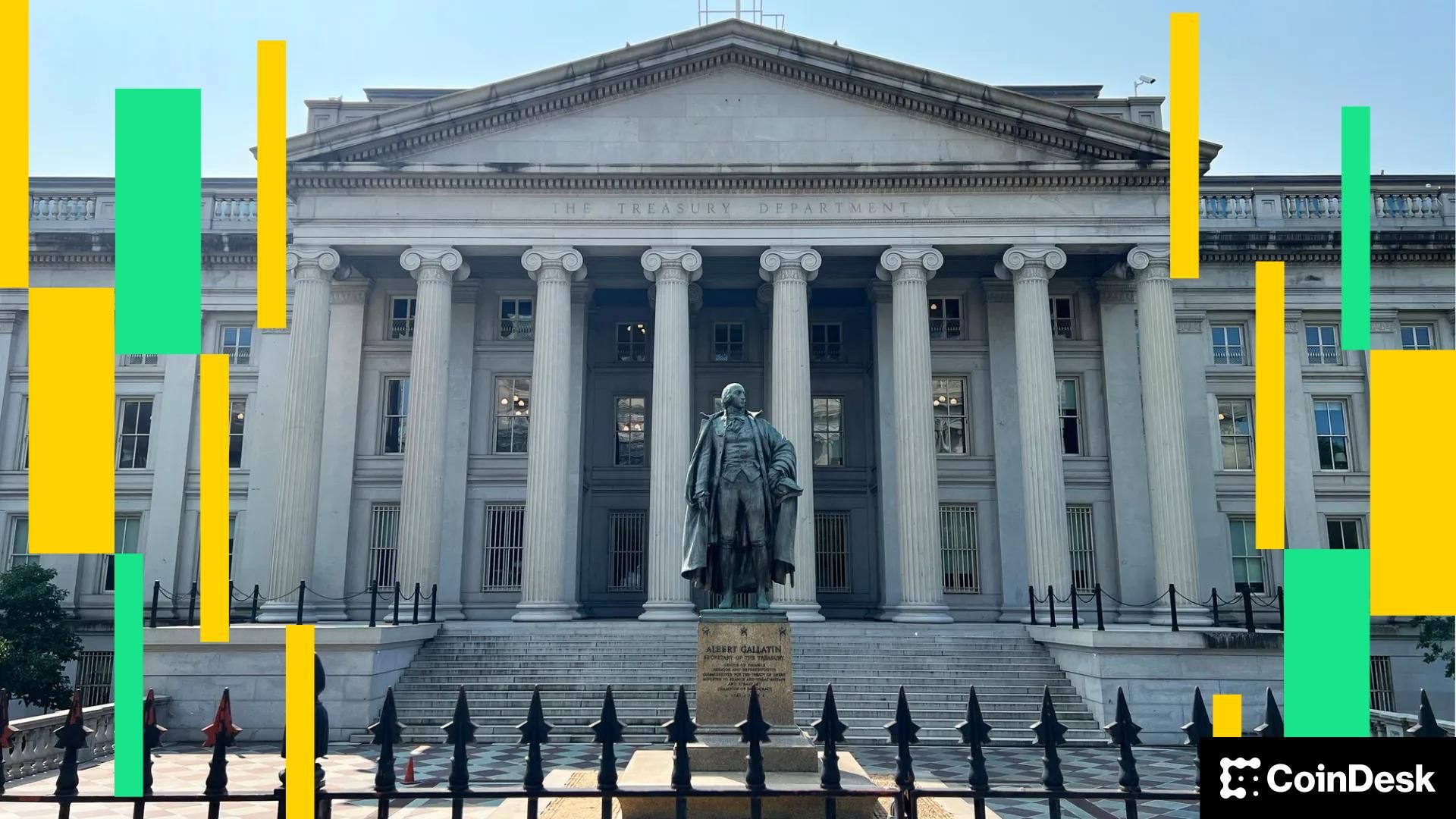
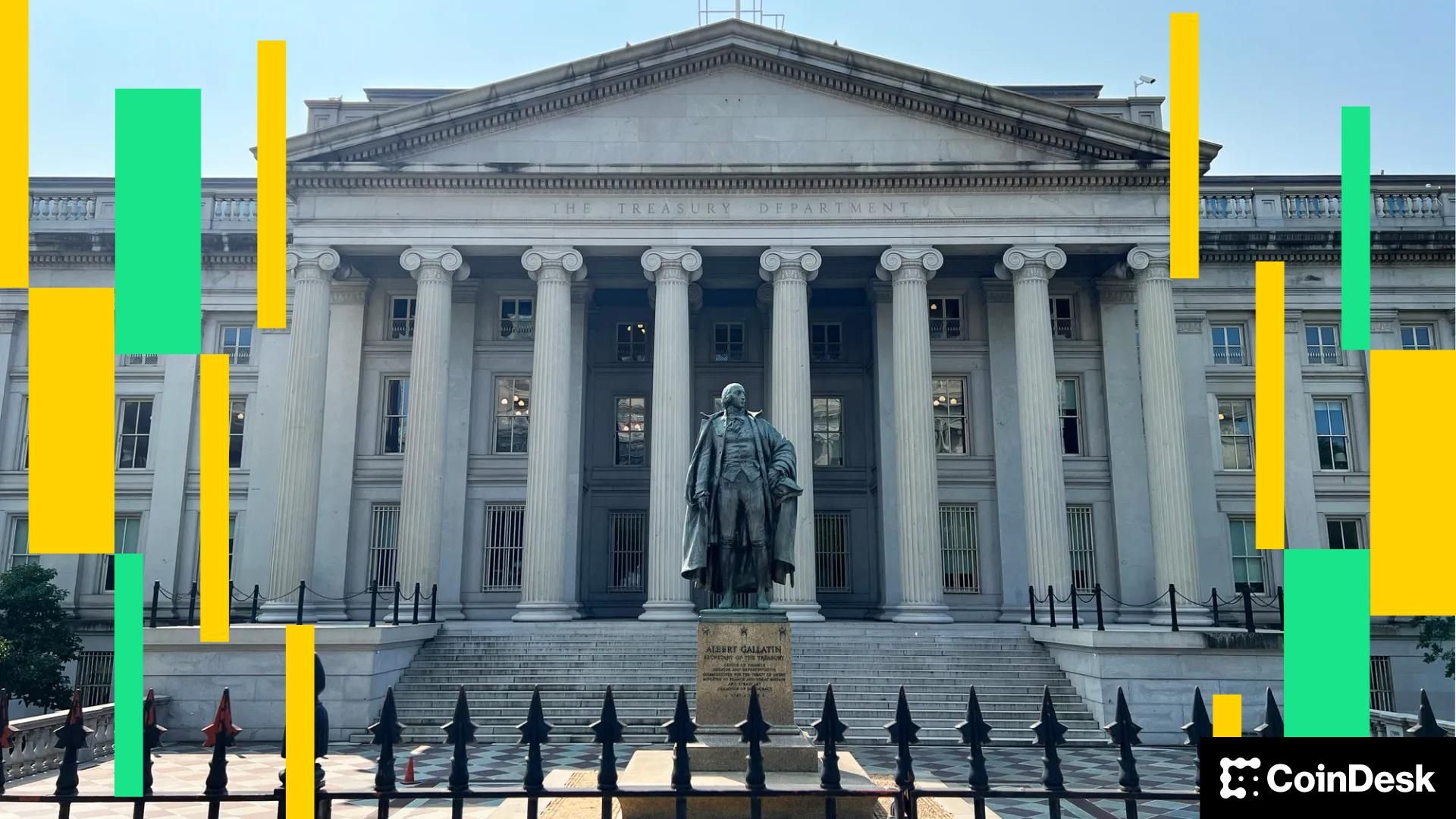
Standard Chartered still expects the stablecoin market to reach $2 trillion by the end of 2028, which should translate into around $1 trillion in new Treasury bill demand, the bank said in a Monday report.
As of early 2026, the total stablecoin market capitalization is roughly $300-$320 billion.
“This will result in c. $0.8-$1.0 trillion of fresh demand for T-bills (for use as reserves) from stablecoin issuers over that period,” wrote Geoff Kendrick, head of digital asset research, and U.S. rates strategist John Davies.
Combined with $1-$1.2 trillion in projected Federal Reserve buying, total new T-bill demand could hit about $2.2 trillion through 2028, the report said. That compares with roughly $1.3 trillion in net new supply if bills’ share of total debt remains unchanged, implying a potential shortfall of $0.9 trillion.
Stablecoin issuers such as Tether and Circle (CRCL) have become major buyers of short-term U.S. government debt, holding tens of billions of dollars in Treasury bills as reserves backing tokens such as USDT and USDC.
Tether alone has disclosed T-bill holdings that rival those of mid-sized sovereign investors, while Circle also keeps a significant share of its reserves in short-dated Treasuries via money market funds.
As the stablecoin market grows, issuers typically park new inflows into T-bills to earn yield while maintaining liquidity, effectively channeling crypto-driven capital into U.S. government financing and reinforcing demand at the front end of the yield curve.
The Treasury said in its February 4 Quarterly Refunding Announcement (QRA) that it “is monitoring SOMA purchases of Treasury bills and growing demand for Treasury bills from the private sector,” a trend Standard Chartered expects to intensify.
The analysts said the projected excess demand gives Treasury Secretary Scott Bessent scope to lift T-bills’ share of issuance. Raising that share by 2.5 percentage points over three years would create about $0.9 trillion in additional bill supply, offsetting the gap.
Reallocating that amount from longer-dated bonds could effectively suspend 30-year auctions for three years and ease upward pressure on long-term yields, according to the report.
While not its base case, the bank expects the 10-year yield to reach 4.6% by end-2026, as the analysts warned of rising risks of front-end scarcity.
Stablecoin growth has recently stalled just above $300 billion, up from $238 billion in April 2025, as crypto prices weakened and post-GENIUS Act issuance slowed. Bitcoin has fallen more than 50% from its $126,000 October 2025 peak, dampening trading-driven demand. Standard Chartered views these headwinds as cyclical and maintains that stablecoins could add nearly $1 trillion in incremental T-bill demand by 2028, reshaping U.S. rate markets.
Read more: Standard Chartered sees bitcoin sliding to $50,000, ether to $1,400 before recovery


ProCap Financial, (BRR), which calls itself the first publicly traded agentic finance firm, has begun its share repurchase program aimed at closing the discount between its stock price and net asset value (NAV).
The company said it bought 148,241 BRR shares in the open market on Feb. 20. That implies a purchase price in the area of $2.30 per share, for a total amount of roughly $341,000. It’s not exactly a mammoth purchase, given the company has raised more than $750 million from investors and currently holds more than 5,000 bitcoin worth about $335 million on its balance sheet.
The company further said the shares were purchased at roughly a 35% discount to the net asset value of the bitcoin it holds.
“We were able to buy $1.00 of our stock for approximately $0.65 last week,” said
Chairman and CEO Anthony Pompliano. “We plan to aggressively buy as much of our stock as we can as long as the market will sell us shares at a substantial discount to NAV.”
BRR shares are modestly outperforming other bitcoin treasury companies in U.S. Monday morning trade, rising 3% to $2.42.
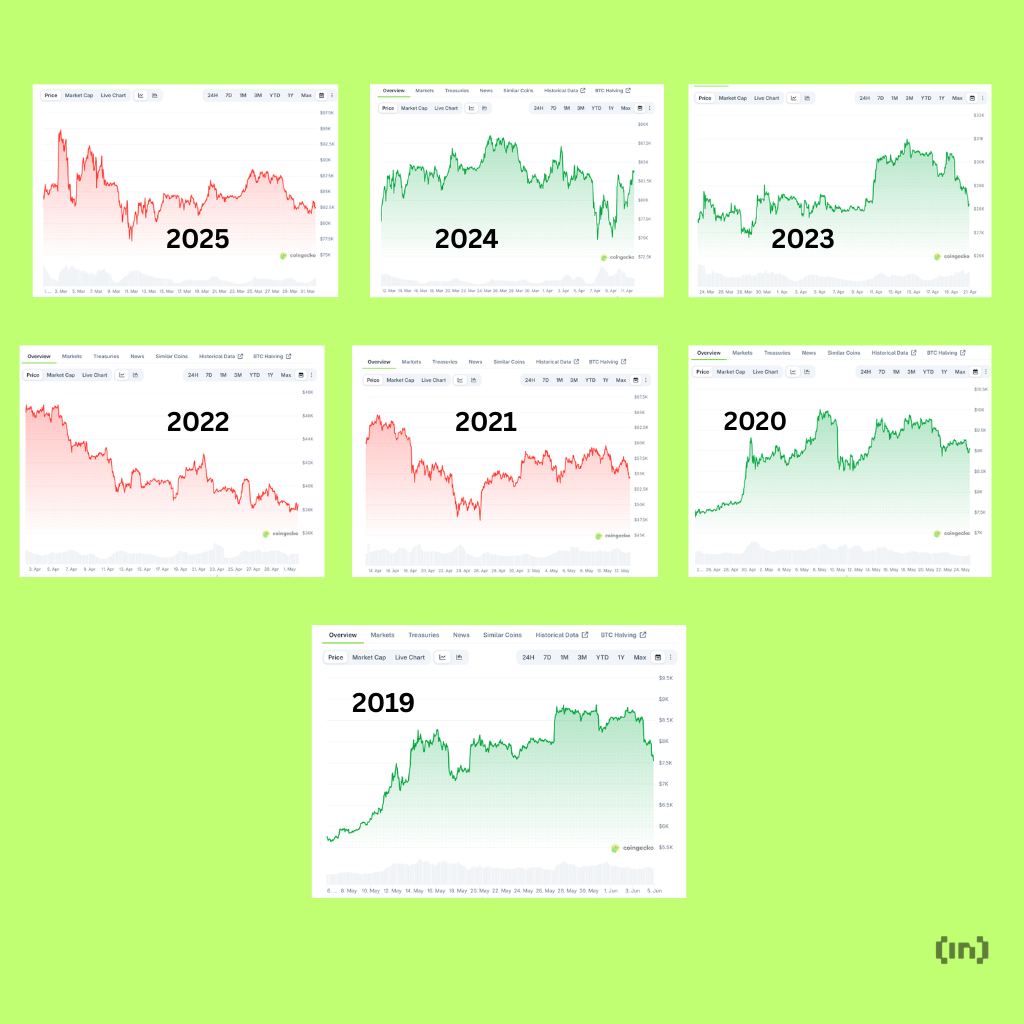
Bitcoin’s often-cited “Ramadan rally” setup may be fading in 2026. However, the volatility pattern many traders have watched in recent years still appears to be present.
To be clear, the holiest month in Islam has nothing to do with digital assets. Crypto trades on global liquidity, macro news, positioning, and sentiment.
Still, when looking at the last seven Ramadan periods (2019–2025), Bitcoin showed a surprisingly consistent shape in six of seven cases: an early sharp move, then choppy trading, then a later pullback or fade. The main exception was 2020, when a stronger macro recovery trend dominated.
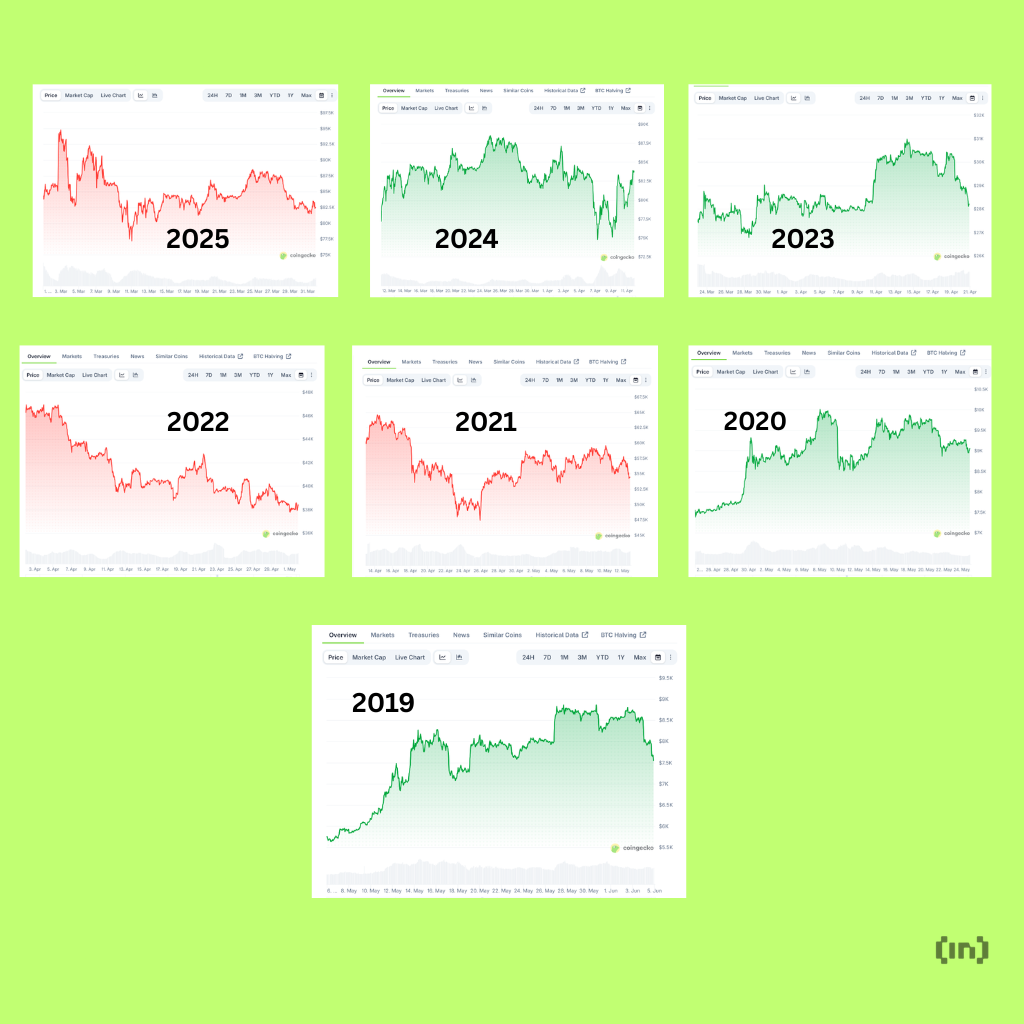
What the Last Seven Ramadans Showed
The pattern was not “Bitcoin always goes up in Ramadan.” That is not true.
Instead, the recurring pattern was more specific: Bitcoin often saw front-loaded volatility, usually with a strong early move, followed by mid-period exhaustion and a weaker finish. In some years, Bitcoin still ended Ramadan higher overall. But even then, price often pulled back after a mid-Ramadan peak.
That makes this less of a directional pattern and more of a timing-and-structure pattern.
What Looks Different in 2026
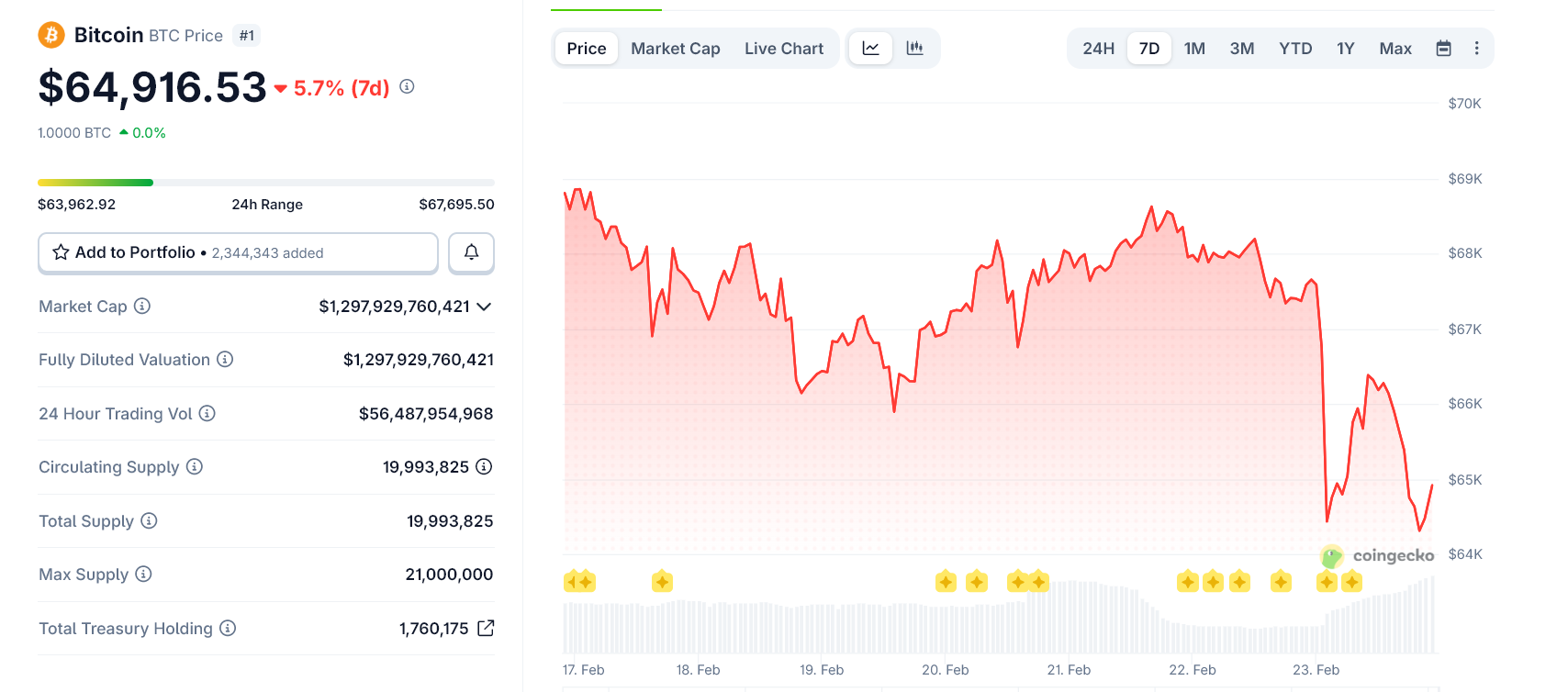
This year’s first week looks different in one important way. Bitcoin did not open with a clean rally. It opened with chop, then a sharp flush, and only after that started a bounce attempt.
That means the pattern is still familiar in shape — fast move, emotional swing, unstable recovery — but the sequence has changed. The market looks weaker than the stronger Ramadan years, at least so far.
On-Chain Data Shows Why Bitcoin Remains Weak in Q1
The on-chain picture is mixed.
First, the Binance Buying Power Index has dropped to a level that previously appeared near compressed, exhausted conditions.
That is a contrarian positive. It suggests a relief bounce can happen if selling pressure fades.
Also, network activity has stayed weak for six straight months. That is a structural warning. It suggests demand and participation remain soft, which can make rallies fragile.
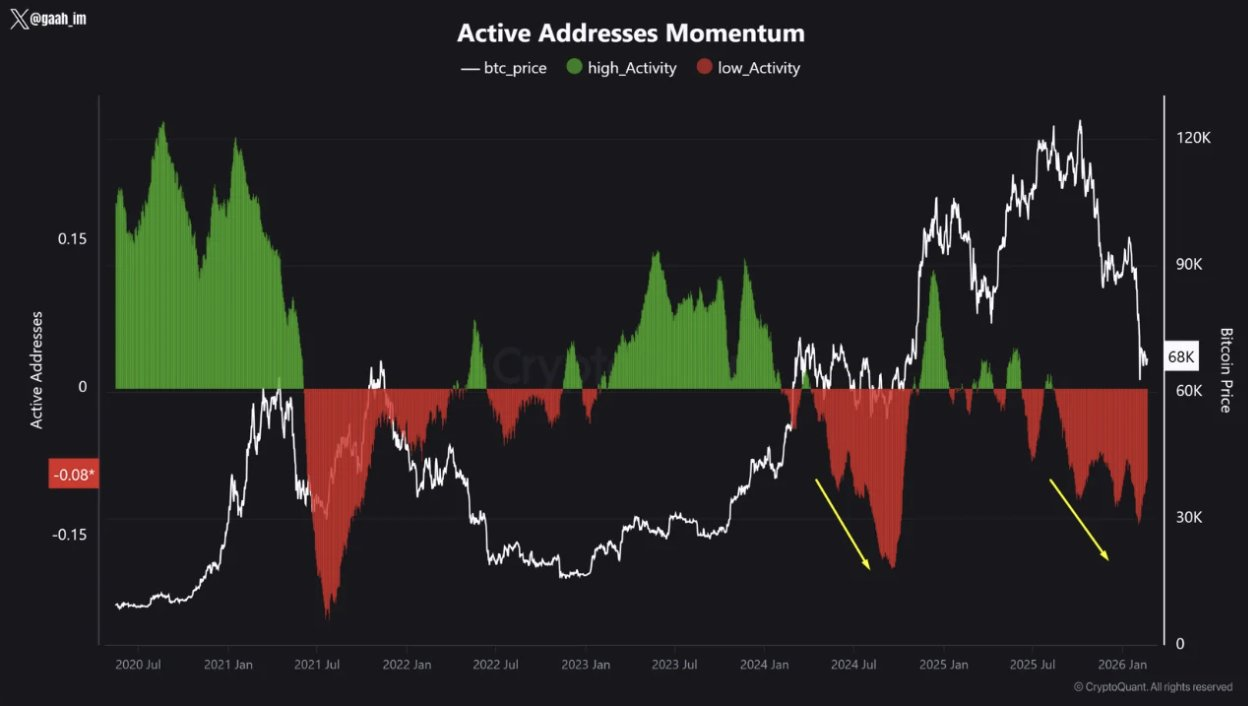
Third, short-term holder realized losses remain negative, even after the worst capitulation cooled.
In simple terms, panic selling has slowed, but many recent buyers are still exiting at a loss. That usually points to base formation, not a confirmed uptrend.
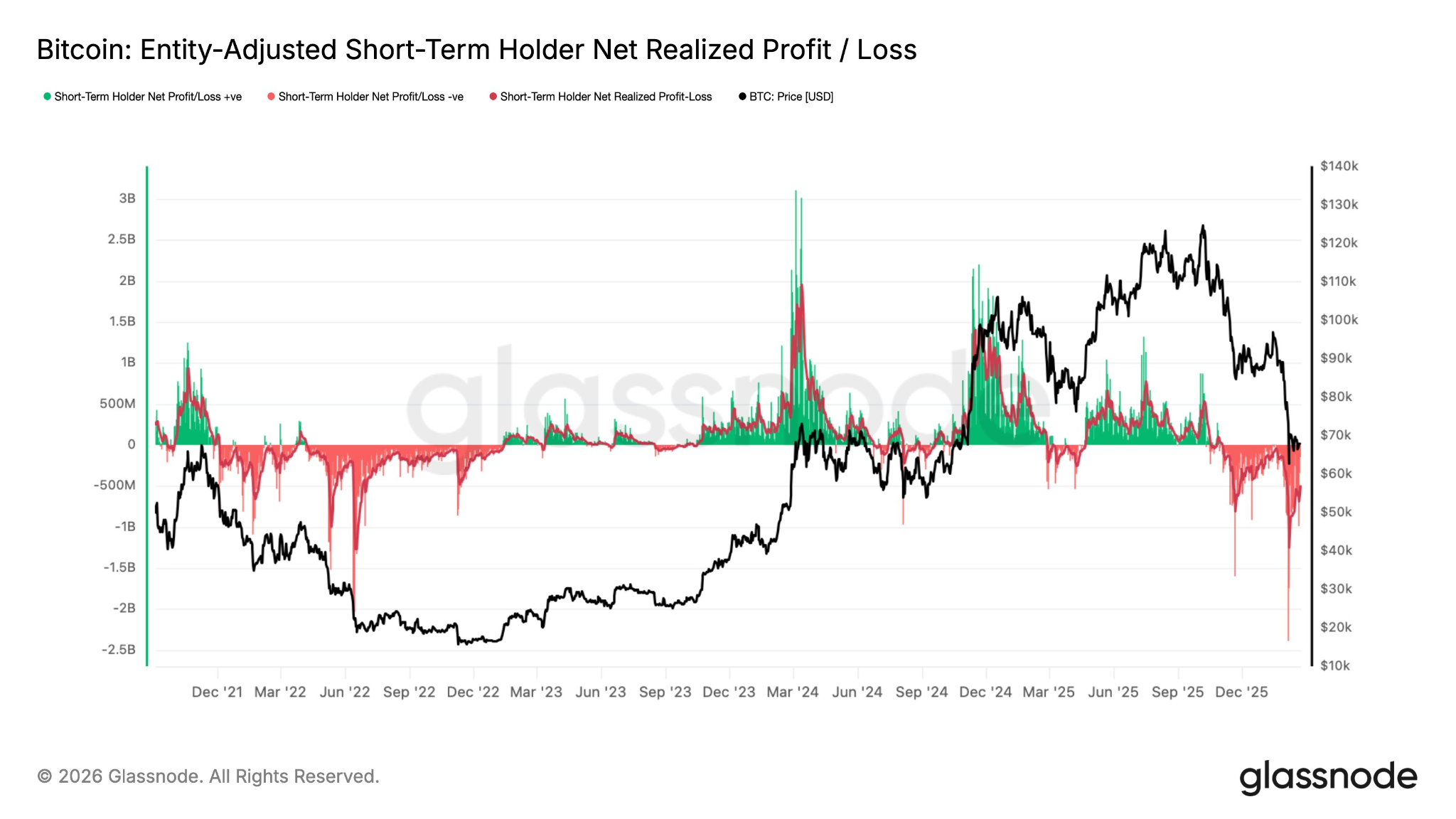
Overall, a relief bounce or choppy recovery attempt is plausible for Bitcoin in the coming weeks, especially if the Binance buying power signal plays out.
But the on-chain demand + STH P/L backdrop suggests that upside may initially be fragile and resistance-heavy.
In short, the old Ramadan “rally” narrative looks weaker in 2026. Yet the broader pattern of early volatility, sharp swings, and uncertain follow-through remains visible.


Analysis shows sanction-linked wallets amassed major stablecoin balances, underscoring compliance challenges industrywide.
Binance has reported a reduction in its exposure to sanctioned entities, citing a 97% decline since January 2024.
The announcement follows accusations of sanctions violations and claims that investigators were dismissed for raising compliance concerns.
Binance Outperforms Global Peers
Recent reports from Fortune claimed that several investigators were terminated after flagging over $1 billion in transactions linked to Iranian counterparties, primarily involving Tether’s USDT on the Tron blockchain over 18 months.
In addition to the investigators’ terminations, the report indicated that during the last three months, at least four senior compliance employees have been let go or pushed out.
Separately, blockchain analytics platform Elliptic noted in January that wallets tied to the Central Bank of Iran had accumulated more than $500 million in USDT, indicating a growing reliance on stablecoins to bypass banking restrictions.
In response, Binance outlined its compliance measures in a blog post, describing its program as the “best-in-class” and continuously strengthening. Data shared by the exchange shows that sanctions-related exposure as a percentage of total exchange volume fell from 0.284% in January 2024 to 0.009% by July 2025, representing a 96.8% decline.
Direct connection to the four largest Iranian cryptocurrency exchanges also dropped by 97.3% over the period, from $4.19 million to approximately $0.11 million, surpassing ten major global exchange peers in risk reduction. In 2025 alone, the firm says it processed over 71,000 requests from authorities and supported more than $131 million in confiscations.
You may also like:
These developments come as Binance continues to operate under compliance reforms agreed to during its settlement with U.S. authorities, after the exchange pleaded guilty to anti-money laundering and sanctions violations, paying $4.3 billion in penalties.
Binance Denies Allegations
According to Binance, the recent reporting on its sanctions compliance status is based on incomplete and mischaracterized information that does not reflect the full record.
The company shared that the two entities referenced in the reports underwent structured internal reviews, which confirmed they were not on any sanctions lists while using the platform and that their transactions did not trigger alerts from industry-standard monitoring tools.
Binance added that as soon as new information was discovered, it went on to activate its compliance protocols and took appropriate action.
The exchange also denied accusations that it had dismissed investigation staff for working on these cases, clarifying that some relevant employees departed after an internal review found breaches of company data protection and confidentiality guidelines.
Former Binance CEO Changpeng Zhao also dismissed the claims on social media, stating,
“You can put a negative narrative on anything by talking to an ‘anonymous source’ who is ‘unhappy’ or paid to FUD.”
Binance Free $600 (CryptoPotato Exclusive): Use this link to register a new account and receive $600 exclusive welcome offer on Binance (full details).
LIMITED OFFER for CryptoPotato readers at Bybit: Use this link to register and open a $500 FREE position on any coin!

Bitcoin has faced a tougher trading stretch, dipping under 75,000 for 18 sessions and testing the market’s nerve as policy and macro signals diverge. The asset briefly retraced to around 64,200 after a broad stock retreat, while a decision by the Trump administration to raise baseline import tariffs to 15% added fresh uncertainty. Yet history cautions against assuming a permanent top when liquidity is in flux: Bitcoin has repeatedly outperformed other risk assets during stressed macro cycles, aided by persistent mining activity and a growing cohort of professional traders using volatility to adjust exposure. In this environment, Bitcoin remains a focal point for liquidity dynamics and institutional positioning, with fundamentals showing resilience even as headlines churn.
Key takeaways
- Historical data suggests Bitcoin often outperforms during trade wars and liquidity injections, even when macro fears are elevated.
- Mining activity has proven resilient, and a shift to net long positions on CME futures signals professional traders are adding exposure on dips.
- Policy shocks, such as tariffs implemented in early April 2025, coincide with sharp price moves—Bitcoin hit a five-month low near 74,600 before staging a subsequent rally.
- The U.S. Federal Reserve’s liquidity facilities have historically been a source of indirect support, with peak repo-like operations sometimes foreshadowing price rebounds in BTC.
- Hashrate recovery and profitable mining hardware at modest electricity costs have reduced tail risks from miner capitulations, helping sustain network fundamentals.
- Market positioning by large speculators flipped from net short to net long on BTC futures, a signal that has sometimes preceded major price bottoms.
Tickers mentioned: $BTC, $NVDA, $ORCL, $MARA, $CRWV
Sentiment: Bullish
Price impact: Positive. Dip-buying by institutions and improving mining fundamentals could support a move back toward key benchmarks.
Trading idea (Not Financial Advice): Hold. Given mixed macro cues, a cautious stance is warranted until price action and policy signals provide clearer direction.
Market context: Liquidity conditions and regulatory developments are shaping near-term outcomes, with network health and futures positioning acting as important indicators for BTC’s trajectory.
Why it matters
Bitcoin’s resilience amid policy jitters matters because it tests the narrative of crypto as a hedge in times of macro stress. When governments signal tighter control or aggressive tariff actions, liquidity dynamics often determine whether risk assets liquidate or rotate into alternatives with unique inflation-hedging characteristics. The fact that miners’ revenue streams have remained resilient, and that professional traders have shifted toward net long exposure on futures, adds a layer of credibility to the idea that BTC can stabilize and recover rather than cascade lower during periods of uncertainty.
Another dimension is the health of the mining sector. With 2024 and 2025 ASICs continuing to operate profitably at practical energy costs around $0.07 per kilowatt-hour, miners have less incentive to withdraw from the network even as AI-fueled tech equities face tighter funding. This reduces systemic risk linked to hash rate collapse and supports on-chain activity. The interplay between policy developments and the macro funding environment remains a central driver for BTC, and current data points suggest a favorable tilt for a potential retest of higher levels in the near term. For readers tracking the broader ecosystem, recent company dynamics—such as MARA’s stake in Exaion—underscore how mining-related investments are increasingly intertwining with data-center and AI-capital narratives.
In parallel, a shift in trader positioning has emerged as a recurring theme. A CFTC report published last week highlighted that large speculators on CME Bitcoin futures moved from a net short to a net long posture, a pattern that has, in past cycles, preceded sizeable price bottoms. While no single indicator confirms a bottom, the combination of improving miner fundamentals, a potential stabilization of liquidity metrics, and a cautious, yet constructive, positioning backdrop can augur a more constructive tone for the BTC market in the weeks ahead. The price action already reflected a bounce from the mid-60ks toward the 75k area in the near term, and market participants will be watching how this dynamic interacts with ongoing macro developments and policy updates.
What to watch next
- The latest CME Bitcoin futures positioning data from the CFTC showing net long shifts among large speculators.
- Hashrate and miner profitability trends, especially at around $0.07/kWh energy costs.
- Policy developments—new tariffs or liquidity actions—that could impact risk sentiment.
- Upcoming earnings or funding moves in the AI hardware and data-center space, including Nvidia results.
- Price action around the $75,000 level and whether BTC tests this midpoint in the coming weeks.
Sources & verification
- Executive orders on reciprocal tariffs issued in early April 2025 and subsequent tariff actions affecting major trading partners.
- CFTC report detailing the shift from net short to net long on CME Bitcoin futures.
- HashRateIndex data on miner gross profits at a power cost of $0.07/kWh.
- Bitcoin’s price responses during the 2020 COVID-19 crash and subsequent multi-month rally to the $42,000 level.
- Industry reference to MARA’s stake in Exaion and the broader mining sector’s status.
Bitcoin resilience amid policy jitters and miners’ rebound
Bitcoin (CRYPTO: BTC) has weathered a fresh bout of volatility as traders reassess risk in a climate of heightened policy scrutiny. After drifting below the psychological 75,000 mark for 18 sessions, the digital asset touched a low near 64,200 as global equities pulled back. The catalyst was a wave of tariff actions announced in early April 2025, including reciprocal duties across many trading partners and a 34% levy targeting China by April 9. The immediate backdrop was, in many ways, a reminder of how macro policy can ripple through risk assets even asBitcoin continues to attract a dedicated pool of long-term holders and enthusiasts. Yet the price reaction also underscored a familiar pattern: when liquidity conditions tighten, BTC often behaves unlike traditional equities, with the potential for outsized rebounds when sentiment stabilizes.
From a structural perspective, Bitcoin’s network has shown considerable resilience. The mining sector—with ASICs deployed in 2024 and 2025—has remained profitable at modest energy costs, reducing the risk of mass capitulations that could threaten hash rate. The observable improvement in the hashrate relative to earlier delays helped counter fears of a miner “death spiral” and supported on-chain activity. This improvement matters more than flat price moves because a robust hash rate underpins transaction throughput and security, which in turn sustains confidence among holders and developers alike. For investors following the mining landscape, the narrative has shifted from existential risk to a more nuanced assessment of profitability and supply dynamics, with miners continuing to contribute to BTC’s forward resilience.
The macro narrative around policy and liquidity remains a central force. The U.S. Federal Reserve’s liquidity facilities—lending against Treasuries to smooth funding markets—have historically influenced risk appetite, even if not always framed as direct injections. In past episodes, peaks in such operations have often coincided with safer moments for risk assets, including BTC, as market participants anticipate a policy environment that will eventually stabilize. In the current cycle, traders are poring over data on repo-like operations and balance-sheet conditions to gauge whether a more accommodative liquidity backdrop could re-emerge, providing a tailwind for BTC in the weeks ahead. The discussion around liquidity is complemented by linked policy moves, such as the tariff actions described above, which can amplify risk-off or risk-on impulses depending on how the broader economy absorbs the shocks and whether policymakers offer mitigants or liquidity backstops.
Adding another layer to the story, institutional players have started to reallocate exposure during pullbacks. A recent analysis noted that professional traders used the dip to add Bitcoin exposure, with long positions on CME futures expanding at a pace that historically signals a renewed appetite for BTC among sophisticated funds. That shift aligns with the broader narrative of a maturing market where liquidity, hedging demand, and macro risk sentiment converge to form potential baselines for a recovery. In parallel, the data points cited in industry commentary—such as MARA’s stake in Exaion—highlight how capital moves within the mining and AI infrastructure ecosystem can influence both sentiment and the capital flows into related hardware and data-center ventures. For traders and observers, this confluence of mining fundamentals, futures positioning, and policy dynamics provides a clearer, albeit still uncertain, path toward higher levels if the catalysts align.
Looking ahead, the near-term trajectory will likely hinge on how quickly the macro environment absorbs tariff signals, how the liquidity backdrop evolves, and whether Bitcoin can sustain a momentum lead beyond the 75,000 threshold. The market has shown a capacity to rally after drawdowns tied to policy shocks, as evidenced by the 38% rebound observed in the month following the initial low. If this dynamic persists, BTC could carve a path back toward the mid- to upper-70s in the coming weeks, aided by a combination of supportive hashrate trends, a possible shift in futures positioning, and any signs that macro liquidity will re-enter the system with a clear framework. In the meantime, investors will be watching for more granular signals—from CME futures data to mining profitability metrics—that can help distinguish a temporary bounce from the beginning of a sustained upcycle.
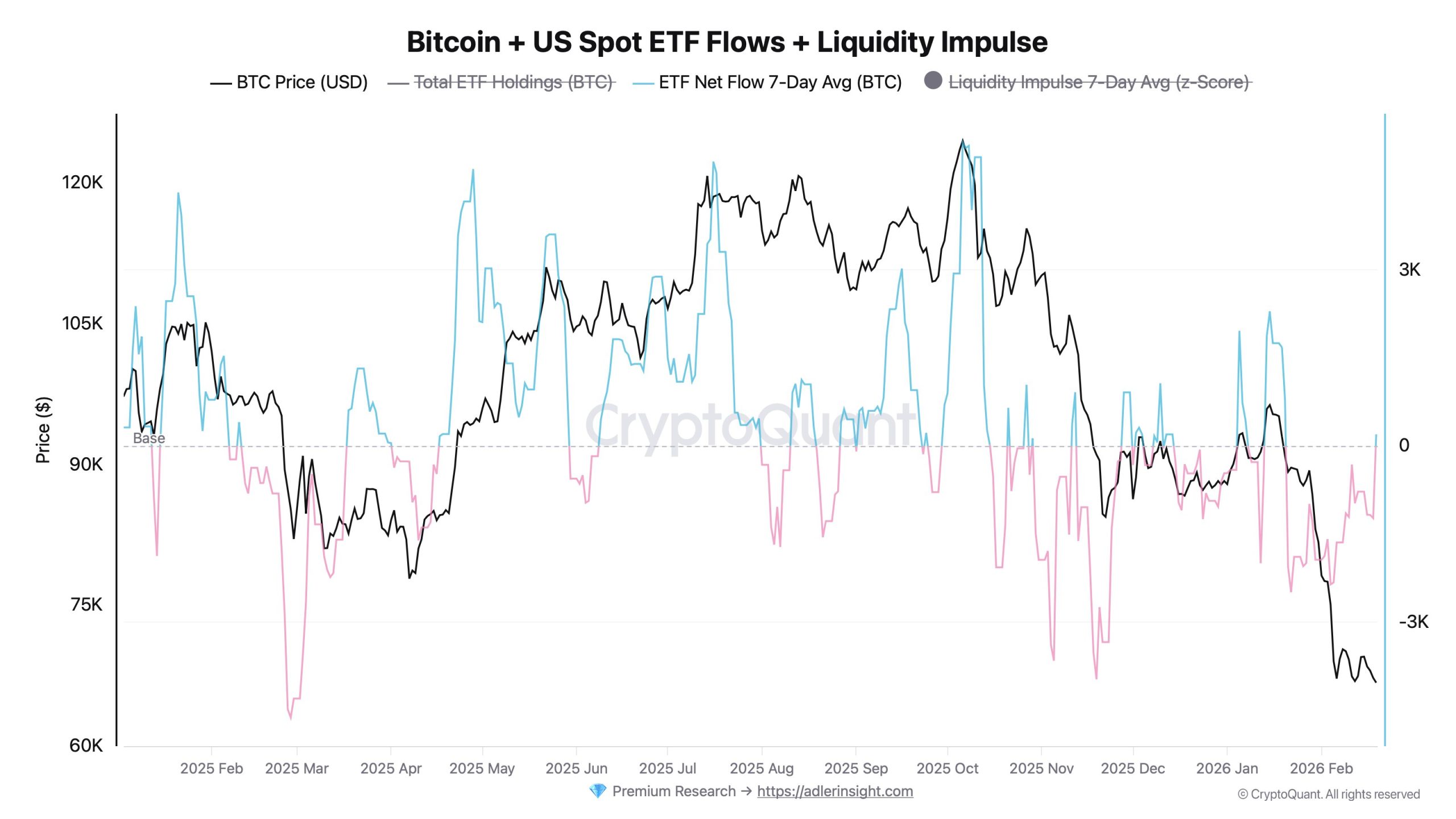
Spot Bitcoin exchange-traded funds (ETFs) are on track to post a fourth consecutive month of net outflows as Bitcoin (BTC) approaches a fifth negative monthly close in February. The slowdown is visible across the shrinking fund balances and the bearish rolling net flow data, especially when measured against competing asset ETFs.
With Bitcoin price and the spot ETF holdings trending lower since October, investors are searching for answers on what the future may hold for BTC.
Bitcoin ETFs dominate headlines
Net assets held in US spot Bitcoin ETFs peaked near $170 billion in October 2025 and now stand at $84.3 billion. The cumulative net inflows have fallen to roughly $54 billion from the $63 billion all-time high. Since July 2025, cumulative net flows have totaled just $5 billion, underscoring the sharp drop in capital inflows.
Bitcoin researcher Axel Adler Jr. tracked seven sessions between Feb. 12 and Feb. 19 and found the net ETF outflows totaled 11,042 BTC. Feb. 12 marked the largest single-day reduction at 6,120 BTC, or about $416 million. The Feb. 17 and Feb. 18 sessions saw back-to-back outflows of 1,520 and 1,980 BTC, respectively. Only two sessions were positive, with the Feb. 6 session adding 5,900 BTC to the funds.

Adler said that three consecutive positive sessions are needed to confirm renewed accumulation in the ETFs. Until then, the flows continue to act as a source of supply for the market.
The macroeconomic data align with the cooling trend. The ETFs have shed about 87,000 BTC since November 2025, including roughly 15,000 BTC in February. The total ETF balances now sit near 1.26 million BTC, down from the 1.36 million BTC peak.

The selling pressure from the largest BTC funds has been measured. BlackRock’s IBIT holdings declined to 759,000 BTC from 806,000 BTC, a 6% reduction. Fidelity’s FBTC dropped to 186,000 BTC from 213,000 BTC, a 12.6% decline.
Bitcoin price has fallen far more sharply than the ETF balances, while the spot market demand has appeared insufficient to fully absorb the broader market pressure.
Gold steals the spotlight from the BTC ETFs
Over the past two years, the Bitcoin and gold ETFs have rotated leadership based on the 90-day rolling flows. The Bitcoin 90-day inflows peaked near $16 billion in March 2024, cooled to $3 to $4 billion between June and October, and then surged to $21.6 billion in December 2024.

The gold ETFs took a different route. The flows stayed negative until July 2024, then accelerated to $30 billion by April 2025. During March and April 2025, the Bitcoin 90-day flows slipped to negative $2 billion.
Gold peaked again at $36 billion in October 2025, while the Bitcoin inflows faded into the final quarter. In January 2026, the gold flows reached $29 billion before easing to $21 billion by mid-February as Bitcoin flows remained in negative territory.
The data show a repeated handoff between the two assets. The periods of weakening Bitcoin ETF demand aligned with the surges in gold inflows, particularly between March and October 2025.
In relative terms, the gold ETFs captured incremental capital as investors leaned toward the asset with smaller price swings and the longer track record during risk-off phases.
Related: Bitcoin ETFs shed $166M as BTC heads for worst start in years
“Restrictive digestion” hits the Bitcoin demand
ITC Crypto founder Benjamin Cowen classifies the first quarter of 2026 as a “late-cycle restrictive digestion” phase for the equities and the crypto markets.
The US Federal Reserve ended quantitative tightening in December 2025, halting the balance sheet runoff, but the monetary policy remains restrictive relative to the market growth expectations. The federal funds rate still sits above the 2-year Treasury yield, while the 10-year yield trades near 4.1% and the 10-year real yield holds around 1.7%–1.8%, keeping the financial conditions tight.
The positive real yields mean investors can earn inflation-adjusted returns in the fixed income markets, raising the opportunity cost of holding non-yielding assets such as Bitcoin.

Cowen noted that in the prior tightening cycles, Bitcoin price weakened before equities showed stress. In 2019, BTC price rolled over months ahead of the broader weakness in equities.
Historically, the durable ETF inflows have followed the falling real yields or a clear easing cycle. Neither condition has developed yet, which may explain the slowdown in demand for Bitcoin ETFs since October 2025.
Related: Bitcoin ignores US Supreme Court Trump tariff strike amid talk of $150B refund
This article does not contain investment advice or recommendations. Every investment and trading move involves risk, and readers should conduct their own research when making a decision. While we strive to provide accurate and timely information, Cointelegraph does not guarantee the accuracy, completeness, or reliability of any information in this article. This article may contain forward-looking statements that are subject to risks and uncertainties. Cointelegraph will not be liable for any loss or damage arising from your reliance on this information.

Disclosure: The views and opinions expressed here belong solely to the author and do not represent the views and opinions of crypto.news’ editorial.
If institutional activity feels like it has quietened down in the current crypto market, that’s a signal, not a red flag. The period of headline-driven adoption, such as overly hyped announcements, symbolic pilot programs, and flashy token allocations designed more for marketing rather than exposure, is slowly winding down.
Summary
- Less noise, more capital discipline: Institutional crypto hasn’t slowed — it’s matured. The hype cycle is fading, replaced by strategic, long-term allocation.
- From validation to integration: Institutions are no longer asking if crypto belongs. They’re deciding how it fits — with custody, governance, and compliance now foundational.
- Regulation as an adoption engine: Clear frameworks in regions like the UAE and beyond are turning crypto from a narrative trade into permanent financial infrastructure.
What’s replacing it is far more meaningful and mature, and crypto is being absorbed into institutional finance as a system, rather than a spectacle. Serious capital has not left the market. What has changed is the communication strategy: fewer forward-looking vague announcements without execution, and a greater focus on actions that speak for themselves. It was only recently that the world’s largest asset manager, BlackRock, announced its first play with decentralized finance by listing its tokenized Treasury fund on Uniswap.
Public companies ramping up Bitcoin and Ethereum stack
In previous crypto cycles, institutional engagement was often loud by necessity. Crypto needed validation. Firms wanted to show they were “early,” innovative, or at least paying attention.
Allocations were framed as bold bets rather than portfolio decisions. Even modest exposure was marketed as a philosophical stance. The proof is in the pudding when you look at public companies stacking Bitcoin and Ether for their treasuries. More than 1.1 million Bitcoin (BTC) have now been scooped up, worth just under $77 billion. At the same time, public firms hold roughly 6.17 million Ethereum (ETH), valued at around $12.35 billion.
That phase served a purpose. But it was never going to be permanent. Today’s institutional crypto looks different because it is different. It’s no longer about proving crypto deserves a seat at the table. It’s about deciding where it sits.
Capital continues to flow, but increasingly through private structures, regulated platforms, and long-term strategies that are not designed for headlines. The absence of noise doesn’t reflect uncertainty. It reflects confidence.
One of the strongest signals of this shift is the rapid professionalisation of the market. Institutions are no longer asking whether crypto “works.” They’re refining how to hold it, secure it, and integrate it responsibly into existing investment frameworks. That vision may have passed the point of no return.
Institutional crypto is here to stay
Big four accounting firm PricewaterhouseCoopers said in a recent report that institutional interest in crypto has “crossed the point of reversibility.” Custody is no longer an afterthought. Neither is governance. Risk management, asset segregation, internal controls, auditability, and compliance are now foundational layers, and crypto infrastructure has evolved rapidly to meet those demands.
That evolution is deeply bullish. The more crypto conforms to institutional standards without losing its core advantages, portability, transparency, and settlement efficiency, the more capital it can absorb. What once lived on the margins as a specialist trade is steadily becoming a normalised asset class. This is also where a critical distinction has emerged: speculation versus investment.
Institutions no longer need to engage with crypto as a narrative trade, driven by cycles, sentiment, or social media momentum. Instead, they’re increasingly treating it as a strategic allocation, one that behaves differently from traditional assets, but still earns its place through risk-adjusted performance.
That move alone changes everything. When Bitcoin or crypto assets are evaluated alongside equities, commodities, and fixed income, rather than against hype expectations, they stop being experimental.
They become addictive. Even small, disciplined allocations can matter materially over long horizons, especially in a world where portfolio diversification is harder, not easier. The UAE offers a clear case study of how this plays out in practice. Far from chasing attention, the region has built one of the most institutionally coherent crypto frameworks globally. Licensing regimes are clear. Regulatory expectations are defined. Custody and market infrastructure have been treated as prerequisites, not afterthoughts.
This clarity has created a gravitational pull for serious participants. For firms operating in the region, including platforms like MidChains, the value isn’t just regulatory approval. It’s the ability to serve institutions that are ready to engage at scale, with confidence, and without uncertainty hanging over every allocation decision. That matters more than hype ever could.
Globally, regulation is playing a similarly constructive role. While often framed as a constraint, regulation is increasingly acting as an adoption engine. Clear rules allow institutions to move from “can we?” to “how do we?”
Crypto needs defined lanes to thrive
Crypto doesn’t need regulatory ambiguity to thrive. It needs defined lanes. As those frameworks solidify, engagement becomes less theatrical and more durable. Institutions don’t announce every bond purchase or FX hedge. Crypto is moving toward that same operational normalcy, and that’s a sign of success, not stagnation.
The future of institutional crypto won’t be shaped by dramatic announcements or sudden waves of capital. It will be built through infrastructure, liquidity depth, and integration into the financial system’s core rails.
And when that happens, the impact will be far larger than any headline cycle. Quiet accumulation, disciplined exposure, and institutional-grade infrastructure aren’t signs that crypto’s moment has passed. There are signs that crypto is becoming permanent. Institutional crypto isn’t stepping back. It’s just getting started.

Crypto.com said it received conditional approval from the U.S. Office of the Comptroller of the Currency (OCC) to establish a national trust bank, setting the stage for the exchange to expand its custody services under federal oversight.
The planned Foris Dax National Trust Bank, doing business as Crypto.com National Trust Bank, would operate as a limited-purpose national trust bank. It would not accept deposits or issue loans, instead offering services such as custody, staking and trade settlement for digital assets, including those on its in-house Cronos blockchain.
While Crypto.com already runs a qualified custodian, Crypto.com Custody Trust Co., regulated by New Hampshire’s banking department, the OCC charter brings its institutional offerings under a single federal framework.
That matters for issuers of exchange-traded funds (ETFs), asset managers and other institutional clients, who often prefer custodians with national oversight, which can streamline compliance and operational processes.
The national charter offers that one-stop-shop structure, though only for trust services, not for traditional banking.
Crypto.com filed its application with the OCC in October. While conditional approval is not final, it marks a significant step forward. Last week, Striple’s stablecoin firm Bridge won initial approval to form a national trust bank as well.
These approvals see the firms join a growing group of crypto firms looking to build within a federal framework. In December BitGo, Circle, Ripple, Paxos, and Fidelity Digital Assets all received similar conditional approvals.
TLDR
- Solana Company has started building a high-speed infrastructure network across the Asia Pacific region.
- The Pacific Backbone will connect Seoul, Tokyo, Singapore, and Hong Kong with low-latency systems.
- The network will support Solana staking validation and trading services for institutional clients.
- HSDT holds about 2.3 million SOL in its corporate treasury.
- The company plans to launch DeFi tools, liquid staking, and execution services within 18 months.
Solana Company has begun constructing a high-speed infrastructure network across the Asia-Pacific. The project aims to strengthen Solana staking, validation, and trading services. Executives say the buildout prepares SOL for its next “super cycle.”
Pacific Backbone Connects Key Asian Financial Hubs
The initiative, called Pacific Backbone, links Seoul, Tokyo, Singapore, and Hong Kong. It will operate a low-latency cluster for institutional users.
The company said it will start construction immediately. It expects optimization and product launches within 18 months.
Planned services include DeFi tools, liquid staking, and automated market makers. The firm will also provide execution services for finance partners.
Joseph Chee said the expansion prepares Solana for future growth. He described the plan as positioning for the next super cycle.
The network targets market makers and high-frequency trading firms. It seeks to cut latency and reduce reliance on outside providers.
Solana processes over 3,500 transactions per second. The blockchain supports millions of daily active wallets.
HSDT Expands Treasury Strategy and Regional Operations
HSDT trades on Nasdaq and backs the infrastructure push. Pantera Capital and Summer Capital co-led its $500 million funding round.
Cosmo Jiang said the roadmap will improve regional staking performance. He added it should diversify revenue across Asia.
Solana Company holds about 2.3 million SOL in treasury. The stake is worth more than $180 million at current prices.
The firm partnered with Anchorage Digital and Kamino on a lending venture. The venture lets institutions borrow against natively staked SOL.
Public companies have maintained steady SOL staking levels. Data shows treasury valuations have fallen to record lows.
HSDT shares fell over 8% in Monday trading. The stock has dropped more than 90% since September.
The buildout focuses on compliant infrastructure for regulated Asian markets with strict standards. Engineers will deploy state-of-the-art hardware across each data center location in the region.
The cluster will support validators, staking pools, and trading desks across major hubs. Management said the network will capture more stakeholder value internally for the company.
The company continues operating its neurotech and medical device units alongside blockchain initiatives. It rebranded from Helius Medical Technologies in September to pursue a Solana strategy.
Shares traded at $1.76 during the latest session on the Nasdaq exchange. Other crypto stocks also posted losses on Monday during early market hours.
Solana declined nearly 6% during the past 24 hours. Bitcoin also fell more than 4% over the same period.

Matthew Tkachuk talks Trump phone call

Razer Blackshark V3 X review: a barebones but sensible budget version of the best gaming headset on the market

JPMorgan sees strong first-quarter growth in dealmaking, trading


-

 Crypto World7 days ago
Can XRP Price Successfully Register a 33% Breakout Past $2?
-

 Video4 days ago
XRP News: XRP Just Entered a New Phase (Almost Nobody Noticed)
-

 Fashion3 days ago
Weekend Open Thread: Boden – Corporette.com
-

 Sports7 days ago
GB's semi-final hopes hang by thread after loss to Switzerland
-

 Politics2 days ago
Baftas 2026: Awards Nominations, Presenters And Performers
-
 Tech7 days ago
The Music Industry Enters Its Less-Is-More Era
-

 Sports5 hours ago
Women’s college basketball rankings: Iowa reenters top 10, Auriemma makes history
-

 Politics6 hours ago
Nick Reiner Enters Plea In Deaths Of Parents Rob And Michele
-

 Business6 days ago
Infosys Limited (INFY) Discusses Tech Transitions and the Unique Aspects of the AI Era Transcript
-

 Entertainment5 days ago
Kunal Nayyar’s Secret Acts Of Kindness Sparks Online Discussion
-

 Video7 days ago
Financial Statement Analysis | Complete Chapter Revision in 10 Minutes | Class 12 Board exam 2026
-

 Tech6 days ago
Retro Rover: LT6502 Laptop Packs 8-Bit Power On The Go
-
 Sports5 days ago
Clearing the boundary, crossing into history: J&K end 67-year wait, enter maiden Ranji Trophy final | Cricket News
-

 Business1 day ago
Mattel’s American Girl brand turns 40, dolls enter a new era
-

 Business1 day ago
Law enforcement kills armed man seeking to enter Trump’s Mar-a-Lago resort, officials say
-

 Entertainment5 days ago
Dolores Catania Blasts Rob Rausch For Turning On ‘Housewives’ On ‘Traitors’
-
 NewsBeat13 hours ago
‘Hourly’ method from gastroenterologist ‘helps reduce air travel bloating’
-

 Business6 days ago
Tesla avoids California suspension after ending ‘autopilot’ marketing
-

 Politics7 days ago
Eurovision Announces UK Act For 2026 Song Contest
-

 Tech1 day ago
Anthropic-Backed Group Enters NY-12 AI PAC Fight