

Crypto World
What Supreme Court tariff ruling means for global trade, U.S. economy


The Supreme Court struck down President Donald Trump’s tariffs on Friday, but the trade tax turmoil is far from over. Fallout over the ruling is already threatening to further strain global trade relations, and the U.S. economy is likely to suffer, economists told CNBC.
In 6-3 decision, the high court ruled that President Trump did not have the legal authority to implement his sweeping tariffs imposed last April under the International Emergency Economic Powers Act, or IEEPA.
Trump later leveled new tariffs up to 15% effective immediately on an array of U.S. trading partners, further escalating global trade tensions. European Union leaders expressed dismay over the new tariffs, arguing that the U.S. policy shift would upend trade deals already reached with the EU as well as the U.K. last year. On Monday, the EU again postponed a key vote on its deal with the U.S.
The pushback against the latest U.S. tariff threat underscores deep frustration over the president’s erratic trade policies, and could push foreign governments to scale back U.S. trade and lead businesses to curb expansion, investment and hiring.
The result might hobble the U.S. economy. “It shifts how trade is done with the largest economy in the world, and that has economic consequences,” Mike Reid, head of U.S. economics at Royal Bank of Canada told CNBC, referring to the Supreme Court ruling and new tariff push.
Downside
The trade war drama is likely to contribute to a climate of caution among businesses and foreign governments alike, said Mark Zandi, chief economist at Moody’s Analytics, leading to “nothing but downside,” for the U.S. economy.
“Businesses don’t know” what’s going to happen next, Zandi told CNBC. “They’re going to invest less, they’re going to hire less, they’re going to be less aggressive in their expansions,” limiting U.S. growth.
Foreign governments could react similarly amid rising uncertainty, leading them to “continue to pull away from the U.S,” according to the economist.
“They’ve got to be pulling their hair out over all of this,” Zandi said. “Perceptions of the U.S. are increasingly that we’re a poorly managed economy, and objectively speaking, they’re right. It’s a bit of a mess that feels like it’s getting messier.”
That perception could lead to efforts to divert trade away from the U.S. to a variety of other trading partners, including China.
China’s exports grew 6.6% in U.S. dollar terms last December compared to the same month a year earlier, topping analyst expectations and sending the nation’s annual trade surplus to a record, according to Chinese customs data. Imports increased at their fastest pace in three months, the same data showed.
Trump trade taxes
The Trump administration will continue implementing its trade policy, and now plans to use a variety of sections in the Tariff Act of 1974, according to U.S. Trade Representative Jamieson Greer.
President Trump is pointing to section 122 of the Tariff Act to justify his new tariffs enacted this weekend, although that section limits their effectiveness to 150 days, until mid July, after which they would have to be approved by Congress.
But the administration is likely to use sections 232 and 301 of the Tariff Act to supplement its new section 122 tariffs, meaning the U.S. could continue to impose tariffs against its foreign trading partners over the next few years, at least.
Others say neither investors nor economists shouldn’t sound the alarm just yet.
The implementation of the new trade taxes “implies little change in the effective tariff rate or our inflation forecasts in the near term,” Citigroup economist Veronica Clark said in a note to clients.
“Eventual Section 301/232 tariffs could have an impact on certain goods prices in the future, but details are still highly uncertain,” Clark wrote. “While a 10% Section 122 tariff would likely have lowered the effective tariff rate by 3-4 [percentage points], a 15% tariff should keep the effective tariff rate essentially unchanged (if anything, lower by ~1pp or so).
While the total impact of the new tariffs remains uncertain, a few things are clear, Zandi said.
“The U.S. is pulling away from the world, and the rest of the world is now pulling away from the U.S.,” the economist said. “Deglobalization is a weight on the economy, and ultimately, the end state is a weakened economy.”
— With additional reporting provided by CNBC’s Alex Harring

Crypto World
Jamie Dimon says ‘watch out’ as lofty asset prices add to economic risks: ‘My anxiety is high’
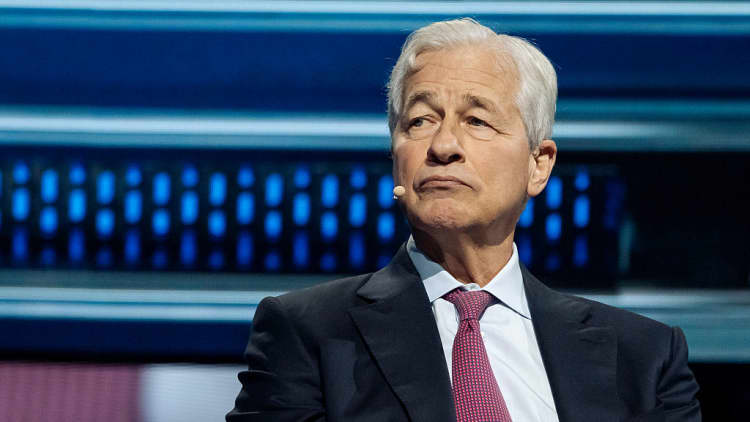
Jamie Dimon, chief executive officer of JPMorgan Chase & Co., during the 2025 IIF annual membership meeting in Washington, Oct. 16, 2025.
Samuel Corum | Bloomberg | Getty Images
JPMorgan Chase CEO Jamie Dimon said Monday that he was anxious over the U.S. economy, citing elevated asset prices and a competitive environment in banking that reminded him of the pre-2008 crisis years.
Even as economists tout the Trump administration’s tax and deregulatory policies as boosting economic growth this year, Dimon said during an annual investor update that his own tendencies were to consider what could go wrong when expectations are riding high.
“My own view is people are getting a little comfortable that this is real, these high asset prices and high volumes, and that we won’t have any problems,” said Dimon, who was dressed in black and wore a brace on one of his hands.
Inevitably, Dimon said, the economic cycle will turn, leading to a wave of borrower defaults that would broadly affect lenders, and often impacting industries few people expect, he said.
“There will be a cycle one day… I don’t know what confluence of events will cause that cycle. My anxiety is high over it,” Dimon said. “I’m not assuaged by the fact that asset prices are high. In fact, I think that adds to the risk.”
While fears over how artificial intelligence models from Anthropic and OpenAI could disrupt a myriad of industries — especially software firms — have churned markets in recent weeks, the broader S&P 500 isn’t far off from its all-time record level.
At the same time, concerns over loans to software companies at the nexus of AI worries have walloped private credit lenders after Blue Owl spooked markets last week when it announced it had to sell assets to satisfy investors clamoring to exit one of its funds.
The episode, which dragged down the shares of larger alternative asset managers including Apollo, KKR and Blackstone, led some market observers to wonder if the start of a broader downturn in credit had begun.
Doing ‘dumb things’
“There’s always a surprise in a credit cycle,” Dimon said. “The surprise has often been which industry” is impacted most, he said. “You didn’t expect utilities and phone companies in ’08, ’09, and this time around, it might be software, because of AI.”
Dimon also said that he endorsed his deputies’ comments about private credit from earlier in the investor event.
Troy Rohrbaugh, co-head of the firm’s commercial and investment bank, said that he didn’t think issues would likely be contained to private credit lenders, but instead be “more broad-based.”
“At this point, it feels a bit isolated to a handful of situations, but that could quite easily change, and we’re prepared for that,” Rohrbaugh said.
In response to a question from the veteran banking analyst Mike Mayo, Dimon said the current environment felt similar to the three years leading into the 2008 financial crisis in that “everyone is making a lot of money, people were leveraging, the sky was the limit.”
The JPMorgan chief said that some financial firms were “doing some dumb things” that involved chasing interest income, which is made through lending and investing activities, though he didn’t name the companies doing so.
“You feel stupid when everyone’s coining money and everyone’s great… it does feel really good,” Dimon said.
“And then when I think about all the factors taking place,” Dimon added, “I take a deep breath and say `watch out’.”
Dimon also addressed the perennial question of CEO succession at JPMorgan, which he built into the world’s largest bank by market capitalization over his two-decade tenure.
While he has often given a specific time frame for the number of years he had remaining as CEO, he avoided doing so on Monday.
“I was told to say this very specifically,” Dimon said to scattered laughter among the analysts in attendance. “I’m here for a few years as CEO, and maybe few after that as executive chairman.”

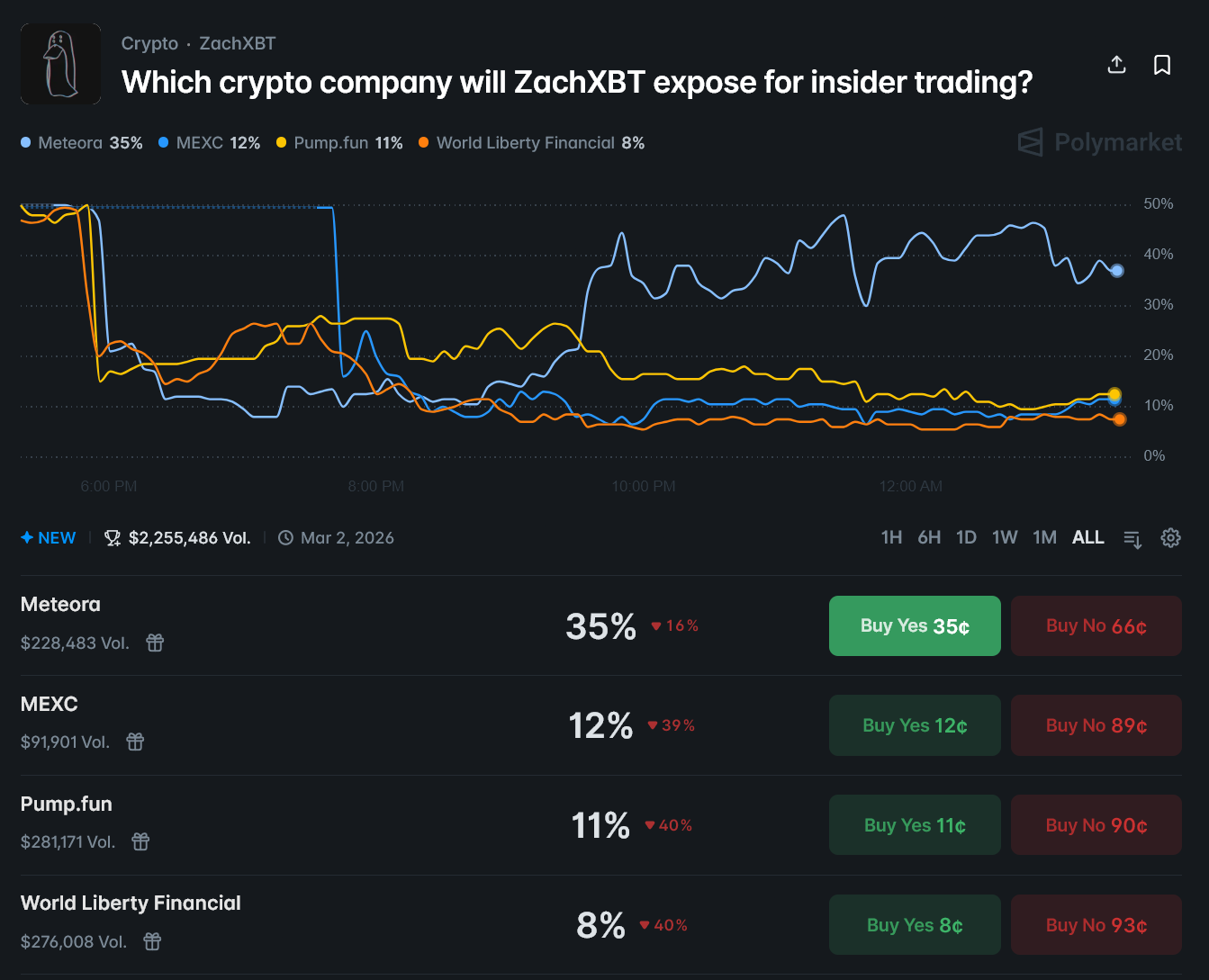
A cryptic post from blockchain investigator ZachXBT triggered a surge of betting activity on Polymarket, with more than $2.2 million traded on a market asking which crypto company he will expose in an upcoming insider-trading investigation.
ZachXBT wrote on X that a “major investigation” will be released on February 26 into one of crypto’s most profitable businesses, alleging insider trading. He did not name the company.
Within hours, traders piled into prediction bets. Polymarket shows Meteora leading the odds, followed by MEXC, Pump.fun, and World Liberty Financial (WLFI).
Why Polymarket Traders are Betting on Meteora and MEXC
Meteora has drawn heavy attention because of its role as a Solana-based trading infrastructure tied to high-volume meme coin liquidity.
It has also faced scrutiny in community discussions around politically linked meme coin activity, including Trump-related tokens.
MEXC appears on the list because it has repeatedly been mentioned in social media debates around listing behavior, whale activity, and alleged insider-style trading patterns in meme coin markets.
That does not prove wrongdoing, but it helps explain why bettors quickly priced it as a candidate.
Pump.fun and Whale Scrutiny Keep It in the Frame
Pump.fun also drew bets because it sits at the center of the meme coin launch economy.
The platform has been under intense community scrutiny over early-wallet activity, sniping, and whether some participants gained unfair advantages during launches.
Separately, recent online discussion has focused on claims that Hayden Davis may have been an early whale in the PUMP token launch.
However, Pump.Fun later refuted those claims, calling them baseless.
Those claims remain part of broader market speculation unless backed by direct evidence or formal findings.
World Liberty Financial Added after USD1 Depeg Scare
WLFI likely entered the betting conversation after USD1 briefly depegged earlier on February 23 before recovering.
WLFI blamed a coordinated attack, saying hackers compromised cofounder accounts, spread fear, and opened short positions.
That episode, plus fresh rumor cycles around WLFI and politically linked crypto projects, appears to have pushed the company onto traders’ radar.
For now, the Polymarket market reflects sentiment and speculation, not confirmation of ZachXBT’s target.

Backpack Exchange on Monday unveiled a novel incentive for its upcoming Backpack token: committed stakers of at least 12 months can swap tokens for equity in the exchange at a fixed ratio—20% of the company today. CEO Armani Ferrante disclosed the plan in a post on X, signaling a shift toward a token structure designed to emphasize long-term commitment rather than speculative utility. The move aligns with Backpack’s broader strategy as it eyes a potential United States IPO, and ties token unlocks to regulatory milestones, product launches, and other milestones that could unlock the rest of the supply for early backers and the team.
Key takeaways
- Long-term staking converts into equity: users who hold Backpack tokens for at least one year may exchange their stake for equity representing 20% of the company today.
- Structured token unlocks tied to milestones: the supply is 1 million tokens, with 25% unlocked at the Token Generation Event (TGE) and 62.5% slated for distribution to users ahead of the IPO, while the remaining 37.5% would unlock post-IPO for the team and investors.
- Tokenomics aimed at reducing sell pressure: Backpack emphasizes an inverted model that prioritizes user ownership and alignment with long-term growth rather than insider-first allocations.
- Foundational critique of centralized promises: Ferrante argues that many past token launches offered “false promises” of utility, and positions this plan as a more accountable approach to token utility.
- Regulatory and product milestones drive progress: the plan is designed to keep token unlocks in step with regulatory approvals and the rollout of new products, including recent on-chain stock tokenization efforts.
Tickers mentioned:
Sentiment: Neutral
Market context: The move arrives amid broader industry experimentation with tokenized equity and milestone-based token unlocks as projects edge toward traditional financing routes, including potential IPOs, while navigating an evolving regulatory landscape.
Why it matters
The Backpack project is venturing beyond the conventional token model by tying a portion of its equity directly to user participation. By offering an equity exchange for token staking, the company is attempting to fuse governance, financial upside, and product loyalty into a single instrument. If successful, this approach could recalibrate how users perceive token utility, moving away from short-lived hype cycles toward genuine ownership stakes in a platform’s growth trajectory.
Ferrante has positioned the plan as a corrective to perceived excesses in the crypto boom-and-bust era. In a bold assertion, he described a crypto landscape that has become “the most centralized” in its history, where “the more centralized something is, the less meaningful a token is.” The strategy, he suggests, aims to counterbalance that trend by anchoring token value to company equity and tying unlocks to milestones rather than speculative trading alone. While the message leans toward a principled stance on token design, it also acknowledges the practical need to maintain a viable path to decentralization as the product matures.
The proposed structure signals a broader industry shift: tokenized equity as a pathway for user incentivization and as a bridge to potential public-market access. Backpack’s approach would anchor a significant portion of the token supply to user-driven value creation, a model that could influence how future crypto platforms think about long-term incentives and governance. However, the roadmap remains conditional on regulatory approvals and the successful execution of product milestones, which adds a layer of risk for token holders and early backers alike.
Backpack’s emphasis on preventing early insider dominance also speaks to a growing insistence on fairness and sustainability in token distribution. The plan to allocate a substantial share of tokens to users before an IPO, with insiders and investors receiving allocations later, is designed to reduce immediate sell pressure and foster a longer horizon for value realization. If the strategy resonates with the market, it could encourage a more patient, utility-driven participation from both retail and professional users.
“I came into crypto because I believe it’s going to change the world … But somewhere along the way, amidst the booms, the busts, the moonshots, the decentralization theater, and the straight up scams, we lost our way. I don’t know about you, but I’m just tired of false promises.”
Backpack’s tokenomics also dovetail with its broader business moves. The company has previously announced plans to unlock tokens in stages as part of a path toward a potential US IPO, and it has pursued on-chain stock tokenization through a partnership with a registered transfer agent. The token distribution plan underscores a concerted effort to align incentives with the company’s regulatory and product milestones, rather than relying solely on passive liquidity or speculative drivers.
What to watch next
- Timing and criteria for the Token Generation Event, including the 25% unlock and the milestone-based releases before the IPO.
- Progress toward regulatory approvals and the practical milestones that unlock the remaining supply.
- Details surrounding the equity-exchange mechanism for stake-holders and how the fixed ratio will be applied in practice.
- Status of the on-chain tokenization of stocks and any regulatory considerations that accompany that initiative.
- Any updates about the company’s IPO journey and how token liquidity will evolve post-IPO.
Sources & verification
- Backpack CEO Armani Ferrante’s X post announcing the 20% equity offer for year-long token staking.
- Cointelegraph report outlining Backpack’s token unlocks tied to IPO ambitions and the initial 25%/62.5%/37.5% schedule.
- Backpack tokenomics overview detailing the supply and milestone-based unlocks.
- Announcement of the partnership with Superstate to bring tokenized stocks on-chain.
- Background on Backpack’s leadership and prior ventures related to the crypto landscape.
What the article means for investors and users
Backpack’s approach narrows the gap between a conventional equity stake and a crypto token by offering actual equity in exchange for token staking. If realized, it would create an explicit counterweight to the typical risk-reward profile of early-stage exchanges that often rely on mere token liquidity rather than tangible ownership or governance influence. For users, it could translate into more meaningful participation in a platform’s success, turning long-term commitment into a measurable stake in the company’s outcomes.
From a market perspective, the plan contributes to a broader discussion about how to align incentives as crypto platforms transition toward regulated milestones. While it introduces potential benefits, it also raises questions about valuation, governance rights, and the practical mechanics of converting tokens into equity—issues that regulators will scrutinize as the project progresses toward an IPO.
What to watch next
- Whether the Token Generation Event occurs on a defined timeline and how milestones influence ongoing unlocks.
- Regulatory developments in the US that could impact both the token structure and the eventual IPO process.
- Operational readiness to support tokenized equity and the technology to ensure secure, auditable exchanges between tokens and equity.
Backpack’s equity-for-stake plan: a closer look at the tokenomics
The essence of Backpack’s model is to anchor token value to real company equity, a move that could reshape incentives in the crypto exchange space. By design, the first 62.5% of tokens are slated for user distribution ahead of the IPO, with the remaining 37.5% reserved for insiders and investors post-IPO. The 25% at the Token Generation Event acts as a foundation for early adoption, while milestone unlocks before the IPO encourage continued product development and regulatory alignment. The structure aims to avoid the insider-dominant dynamics that can accelerate sell pressure and erode retail confidence in a token’s long-term viability.
Critically, the plan reflects a broader push in crypto to demonstrate tangible value beyond hype. Ferrante’s comments about centralized trends and false promises point to a deliberate attempt to combine utility with governance and economic upside. Whether this model gains traction depends on execution—timely regulatory clarity, robust product milestones, and transparent reporting to token-holders about how equity allocations translate into real-world ownership and voting rights. As Backpack proceeds, observers will be watching how the equity outcomes interact with on-chain capabilities and the pace at which decentralization goals are realized after the IPO.
In the near term, users will be assessing the practical mechanics of staking, the fixed equity ratio, and how liquid the equity component will be in a pre-IPO environment. It remains to be seen how this approach will interact with the broader market sentiment around new token launches and the appetite for long-horizon bets tied to traditional corporate milestones. The alignment of token unlocks with regulatory milestones could, if successful, serve as a blueprint for future tokenized equity initiatives within crypto exchanges and beyond.
Backpack’s token-to-equity plan signals a shift in crypto tokenomics and IPO ambitions


Arthur Hayes outlines hard-asset portfolio, mixing commodity equities, BTC, ETH, ZEC, HYPE and physical gold.
Summary
- Hayes’ equity book spans gold, silver, copper and uranium miners, major oil producers, defense stocks and Latin American energy names, positioned for inflation and geopolitical risk.
- His crypto stack includes BTC, ETH, ZEC and HYPE, combining large-cap “monetary” assets with a privacy play and a DeFi/perps bet tied to Hyperliquid.
- Hayes also holds physical gold, reinforcing a barbell between commodities, energy and crypto aimed at protecting against monetary debasement and macro shocks.
BitMEX co-founder Arthur Hayes disclosed details of his investment portfolio, revealing holdings that span commodity-linked equities, cryptocurrencies, and physical gold, according to a statement shared by Hayes.
The portfolio includes positions in gold, silver, and copper mining companies; uranium mining firms; major oil producers; defense-related stocks; and Latin American energy companies, Hayes stated. The equity allocation focuses on commodity producers and sectors associated with inflationary environments, geopolitical developments, and energy supply dynamics.
In digital assets, Hayes reported holdings in bitcoin, ethereum, Zcash, and HYPE. The cryptocurrency allocation includes large-capitalization assets as well as smaller-cap positions, according to the disclosure.
Hayes also confirmed ownership of physical gold, adding tangible asset exposure to the portfolio alongside digital and equity holdings.
The allocation represents a combination of commodity and energy equities on one side and cryptocurrency assets on the other, with physical gold serving as an additional component. The structure indicates diversification beyond digital assets into traditional commodity-related investments.
Hayes encouraged others to share their investment positions, characterizing the disclosure as a contribution to broader market discussion rather than investment advice, according to his statement.
BitMEX, a cryptocurrency derivatives exchange, was co-founded by Hayes in 2014. The platform has been among the most prominent venues for bitcoin derivatives trading.
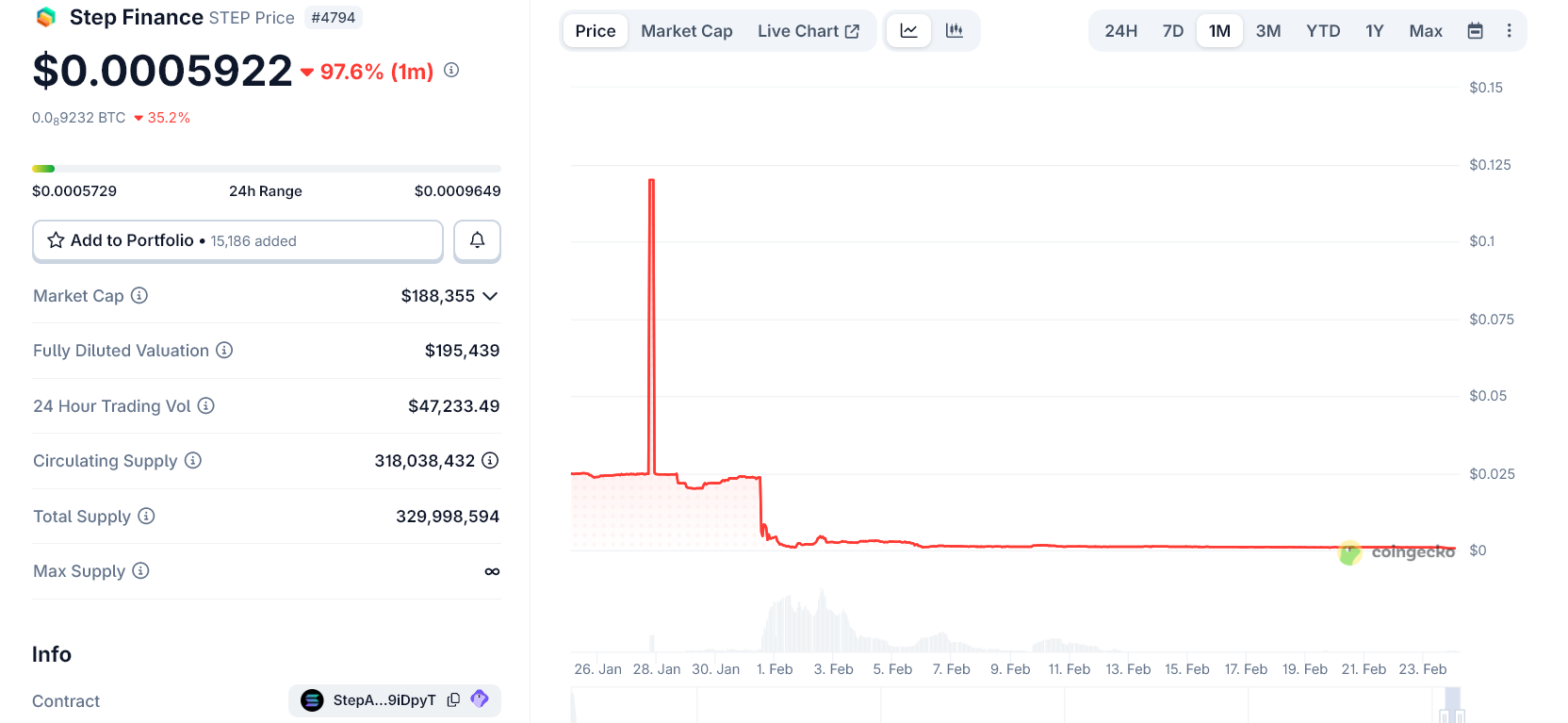
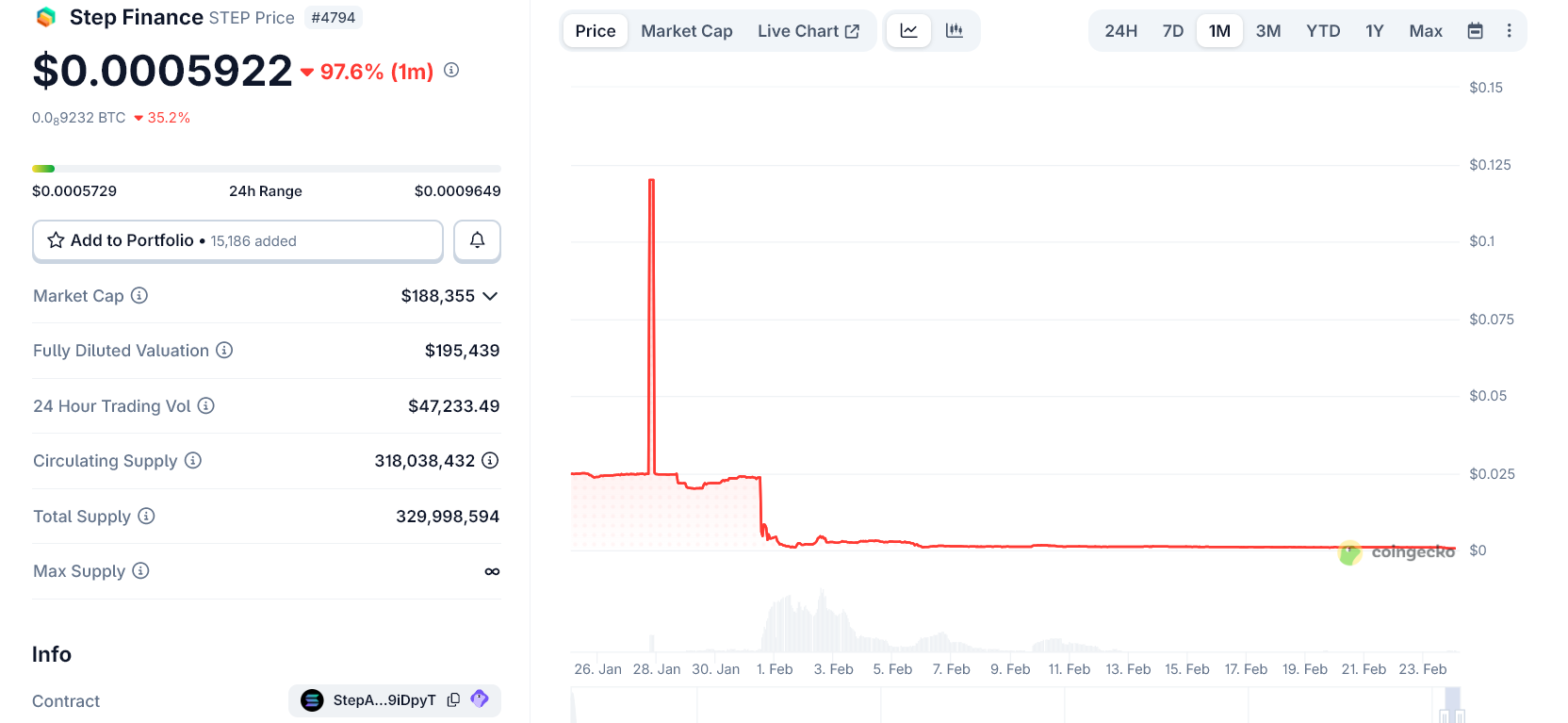
Step Finance and SolanaFloor, two early Solana ecosystem platforms, have announced they are shutting down operations effective immediately after the treasury hack that hit Step Finance at the end of January.
Step Finance said it explored financing and acquisition options after the breach but could not secure a viable path forward.
A Tragic End to Solana’s Early Ecosystem Platforms
The shutdown also includes Remora Markets, another Step-linked platform.
Step said it is working on a buyback for STEP holders using a pre-incident snapshot and a redemption process for Remora rToken holders, adding that Remora tokens remain backed 1:1.
Meanwhile, SolanaFloor said it will stop publishing new content but keep its existing website, videos, and newsletters online as an archive.
The media outlet said it tried to continue operating after the events affecting its parent company, Step Finance, but could not find a sustainable route.
The closures follow a major hack disclosed in late January that drained Step Finance’s treasury and triggered a sharp loss of confidence.
The attack reportedly compromised devices linked to executives, giving attackers access to treasury wallets and leading to a multimillion-dollar loss in SOL.
That breach was a fatal blow because Step Finance depended on treasury resources to support operations and ecosystem expansion.
After the hack, STEP token value collapsed, and the company faced mounting pressure to stabilize finances while maintaining multiple products.
Step Finance was one of Solana’s original DeFi infrastructure names. It built a widely used portfolio dashboard that helped users track wallets, yield positions, LPs, and broader on-chain activity across Solana in one place.
For many users during Solana’s growth years, Step served as a core utility layer.
SolanaFloor played a different but equally important role. It became one of the most visible Solana-focused media and analytics platforms, covering ecosystem launches, market trends, NFTs, DeFi, and project updates.
Together, the shutdowns mark the loss of two long-standing Solana brands.

TLDR
- Crypto funds recorded $288 million in net outflows last week, extending a five-week streak to $4 billion.
- Bitcoin led the losses with $215 million in outflows, while short-Bitcoin products attracted $5.5 million in inflows.
- The United States accounted for $347 million in withdrawals, while Europe and Canada posted combined inflows of $59 million.
- Trading volumes dropped to $17 billion, marking the lowest weekly level since July 2025.
- Ethereum, multi-asset products, and Tron also saw outflows, while XRP, Solana, and Chainlink recorded minor inflows.
Crypto investment products extended their losing run to five consecutive weeks as investors withdrew billions from the sector. CoinShares reported $288 million in net outflows last week, which pushed the total to about $4 billion over five weeks. Trading volumes also fell sharply, which reflected reduced market participation even as prices steadied.
Bitcoin Leads Outflows as Crypto Funds Face Pressure
Bitcoin recorded $215 million in outflows last week, which accounted for most of the weekly losses. This selling trend continued from previous weeks and kept pressure on overall crypto funds.
At the same time, short-Bitcoin products attracted $5.5 million in inflows, which marked the highest inflow among tracked assets. This shift showed that some traders positioned for further downside as Bitcoin remained rangebound.
Data also showed that Bitcoin traders increased leverage during the recent consolidation phase. Bitcoin represented over 40% of the $500 million in liquidations recorded on Monday.
Ethereum followed with $36.5 million in outflows during the same period. Multi-asset products and Tron also posted losses, with $32.5 million and $18.9 million withdrawn, respectively.
Meanwhile, select altcoins posted minor gains despite broader weakness across crypto funds. XRP added $3.5 million, while Solana and Chainlink drew $3.3 million and $1.2 million.
Regional Flows Show Diverging Investor Behavior
The United States led regional outflows with $347 million withdrawn from digital asset products. In contrast, Europe and Canada recorded combined inflows of $59 million during the week.
Switzerland led European inflows with $19.5 million added to crypto investment products. Canada and Germany followed with inflows of $16.8 million and $16.2 million.
This pattern matched recent regional trends reported in earlier market updates. European investors continued to buy during price weakness, while U.S. investors reduced exposure.
Trading volumes across digital asset products dropped to $17 billion last week. This figure marked the lowest weekly level since July 2025.
Tim Sun, senior researcher at HashKey Group, addressed the broader market stance in earlier comments. He said crypto assets remain “firmly anchored at the far end of the risk curve.”
Sun also stated that “increased uncertainty has dampened the willingness of ‘sidelined’ capital to enter the market.” He added that without sustained liquidity support, “any periodic bounces are more likely to be technical recoveries rather than trend reversals.”

Cross-chain bridges are the quiet workhorses of crypto. They move capital from one ecosystem to another, chasing higher APYs, better incentives, and fresh narrative momentum. But while most traders focus on yield percentages, the real game is understanding the risk layer beneath the bridge.
Because in DeFi, yield doesn’t just come from opportunity.
It often comes from risk mispricing.
Let’s break it down.
The Real Reason People Bridge
Nobody bridges for fun. They bridge for:
-
Higher farming incentives on new chains
-
Token emissions boosted by liquidity mining
-
Early-stage protocols with outsized rewards
-
Arbitrage between liquidity pools
-
Governance token airdrop positioning
Capital flows where rewards are highest. When liquidity is thin and incentives are strong, early movers capture disproportionate upside.
That’s the alpha.
But the bridge itself? That’s the blind spot.
The Hidden Risk Layer
Bridging introduces a stacked risk model that most yield farmers underestimate:
1. Smart Contract Risk
Bridges are some of the most complex contracts in crypto. They lock assets on one chain and mint representations on another. Complexity increases attack surface.
History has shown that bridges are prime targets for exploits. Billions have been lost across multiple incidents.
2. Custodial & Validator Risk
Some bridges rely on multisigs or validator sets. If governance is weak or keys are compromised, assets can vanish.
If you don’t know who controls the bridge, you don’t know your real counterparty.
3. Liquidity & Redemption Risk
Bridged assets are often synthetic representations. If liquidity dries up or redemption mechanisms fail, your “stable” asset may not be so stable.
In extreme conditions, bridged tokens can depeg from their native counterparts.
4. Chain-Level Risk
Bridging into a newer chain often means lower security assumptions. Fewer validators, lower economic security, and less battle testing.
High APY sometimes equals high fragility.
Why Yield Exists in the First Place
Here’s the uncomfortable truth:
If a chain is offering 30%+ stablecoin yields, it’s rarely because they love you.
It’s because:
-
They need liquidity.
-
They are bootstrapping an ecosystem.
-
They are compensating you for security uncertainty.
-
They are emitting inflationary rewards.
Yield is a risk payment. The question is whether that risk is priced correctly.
Where the Hidden Alpha Lives
Now here’s where things get interesting.
The best capital allocators don’t avoid bridge risk entirely. They understand it better than the crowd.
Hidden alpha appears when:
1. Incentives Outpace Perceived Risk
If the market overestimates bridge danger relative to actual security posture, rewards can outweigh downside probability.
This happens especially after a bridge improves audits, decentralizes validators, or hardens architecture—but sentiment hasn’t caught up.
2. Liquidity Migration Cycles
Early capital into emerging chains captures boosted emissions before APY compresses.
Bridging early (but intelligently) often yields exponential returns relative to late entrants.
3. Arbitrage Between Trust Assumptions
Not all bridges are equal. Some are fully trust-minimized. Others are closer to custodial wrappers.
Understanding architectural differences creates opportunity when markets price them similarly.
Knowledge asymmetry = alpha.
Practical Risk Framework Before You Bridge
Before chasing that juicy APY, ask:
-
Who secures this bridge?
-
Has it been audited? By whom?
-
How decentralized is the validator set?
-
What’s the total value locked relative to the security model?
-
What happens if redemption fails?
-
Can I exit quickly under stress?
If you can’t answer those, you’re not yield farming.
You’re gambling.
Strategic Approach to Bridging for Yield
Instead of going all-in:
-
Size positions based on bridge trust assumptions.
-
Diversify across multiple bridging solutions.
-
Avoid compounding unrealized bridge risk.
-
Monitor liquidity depth for exit pathways.
-
Treat bridged assets as risk-tiered, not equivalent to native assets.
Professional capital allocators don’t chase APY blindly.
They price systemic exposure.
Final Thought
Bridging is neither inherently reckless nor inherently brilliant.
It’s a tool.
For the uninformed, it amplifies the downside.
For the informed, it amplifies opportunity.
Yield is rarely “free.”
But when you understand the structural risk beneath the bridge, you stop being the liquidity… and start extracting it.
That’s where the hidden alpha lives.
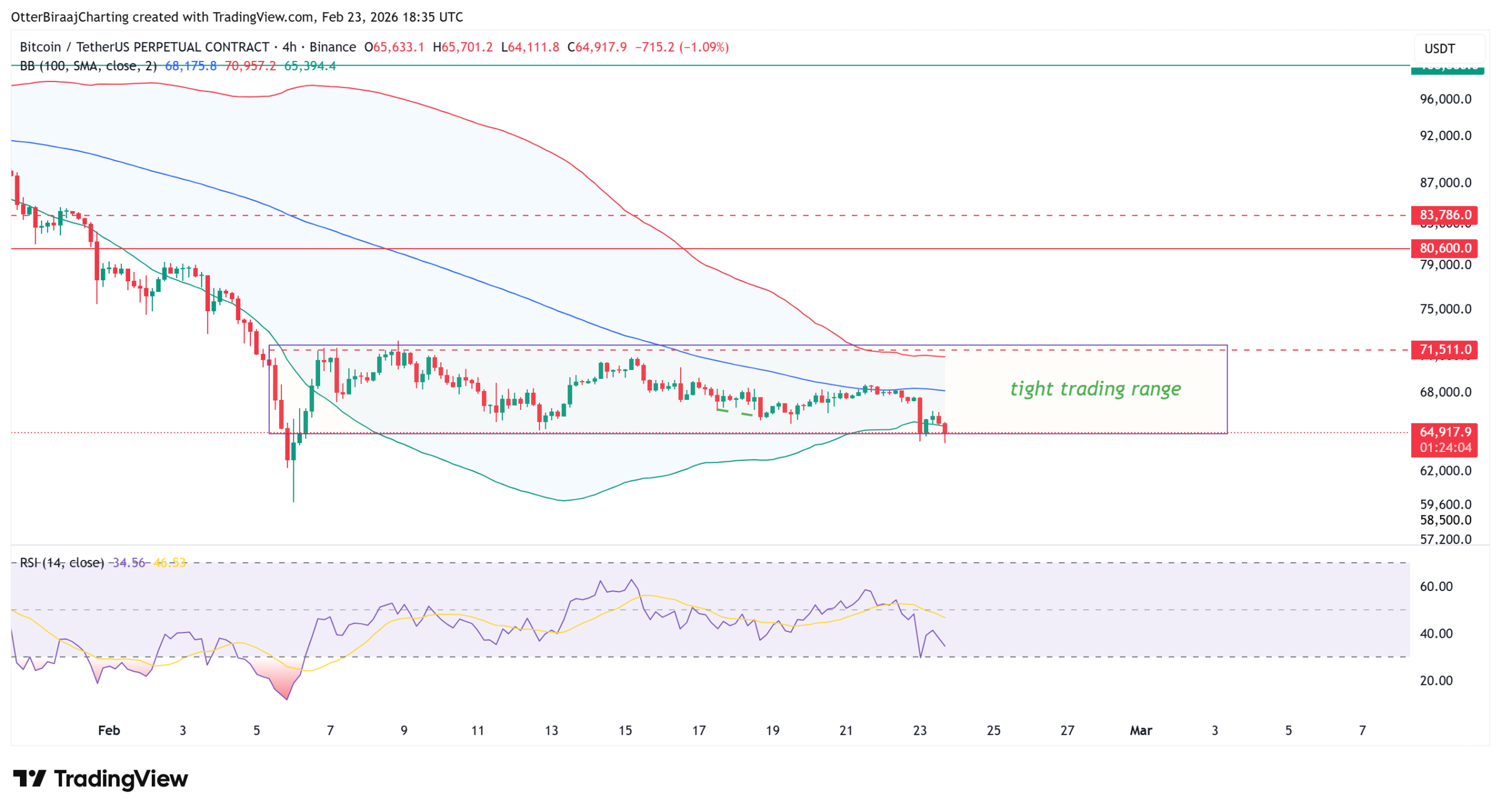
Bitcoin (BTC) slid to a weekly low of $64,111 during the New York trading session on Monday, taking out the range lows that were initially set on Sunday evening. Despite the weakness, the price action continues to rotate closely within the three-week range between $65,000 and $71,000.
Derivatives data outlines a clear lack of bearish follow-through for a deeper correction, while the liquidity positioning may frame the next move on the opposite side of the current trading range.
Bitcoin traders may target the upside liquidity next
The recent price drop swept liquidity around $64,000 and liquidated roughly $240 million in long positions. Despite the sell-off, Bitcoin has remained within the established range that has been in place since Feb. 6. A sideways trend often builds pressure for an expansion, especially as the volatility compresses.

The Bollinger Bands have tightened, signaling reduced volatility and the potential for an expansive move.
The liquidity data shows a clear asymmetry. Roughly $1 billion in long positions face liquidation if the price tags $63,000. In contrast, more than $3.5 billion in short positions are vulnerable near a $70,000 retest. This creates a visible liquidity magnet on both ends of the range, though the concentration is notably denser on the upside.

Bitcoin open interest, which tracks the total value of outstanding futures contracts, has flattened near the local lows. Traders are not aggressively adding new exposure after the drop, possibly sidelined at the moment.
The funding rates have turned negative on the four-hour chart, meaning that the short sellers are paying the longs. This shift indicates that the positioning has tilted defensively while the price continues to hold the range support, opening the possibility of a short squeeze if the upside liquidity is targeted.

Trader Lennaert Snyder noted that Bitcoin “finally grabbed the $64,500 liquidity,” adding that reclaiming the $67,751 high may open the door toward $76,971, with partial profit targets along the way. A rejection near that level invites short-term downside toward the range lows.
Related: Bitcoin treasuries log rare selling streak as BTC trades near $66K
BTC may tag $63,000 before recovery
The one-hour chart highlights the order block around $63,000, a zone where the large buyers previously stepped in. The order blocks mark areas of concentrated activity and can act as an inflection point on retests.

A brief sweep into the $63,000 region clears the remaining long liquidity and tests that demand zone. If the buyers defend it, the price may rotate back toward the mid-range and potentially the $70,000 resistance cluster.
Meanwhile, TexasWest Capital founder Christopher Inks pointed to the developing bullish relative strength index (RSI) divergence on the daily chart, alongside the rising volume and a wick below the range support.
A positive daily close above the reclaimed level may strengthen the case for another attempt at the range highs.

Related: Bitcoin traders diverge over BTC price strength with $60K in sight
This article does not contain investment advice or recommendations. Every investment and trading move involves risk, and readers should conduct their own research when making a decision. While we strive to provide accurate and timely information, Cointelegraph does not guarantee the accuracy, completeness, or reliability of any information in this article. This article may contain forward-looking statements that are subject to risks and uncertainties. Cointelegraph will not be liable for any loss or damage arising from your reliance on this information.

Spot Bitcoin ETFs are on track for a fourth consecutive month of net outflows as BTC approaches another negative monthly close in February, underscoring a demand lull for regulated, spot-linked exposure. Data through mid-February show ETF holdings ebbing from a peak in late 2025, with total assets sitting around $84.3 billion on the day, down from an October 2025 high near $170 billion. The trajectory also reveals a slowdown in cumulative inflows, which have slipped to roughly $54 billion from a $63 billion all-time high. Since July 2025, net inflows have totaled only about $5 billion, highlighting a marked shift in capital allocation to crypto-focused funds. Meanwhile, Bitcoin’s price has slid more sharply than its ETF balances, suggesting the market is absorbing selling pressure without a commensurate bounce in ETF demand.
Key takeaways
- US spot Bitcoin ETFs have declined from about $170 billion in October 2025 to roughly $84.3 billion, signaling waning investor appetite for regulated BTC exposure.
- Cumulative net inflows have plunged to around $54 billion from a $63 billion peak, with only about $5 billion of inflows since July 2025, indicating a sustained slowdown in new capital input.
- Over seven sessions from Feb. 12 to Feb. 19, ETF outflows totaled 11,042 BTC, with Feb. 12 recording a single-day drop of 6,120 BTC (about $416 million at the time).
- Balance reductions among leading participants are sizable: BlackRock’s IBIT holdings fell to 759,000 BTC from 806,000 BTC, a roughly 6% decline, while Fidelity’s FBTC dropped to 186,000 BTC from 213,000 BTC, or about 12.6%.
- Gold ETFs have displaced some attention as risk-on markets ebb and flow, with flows rotating between BTC and gold over the past two years while macro yields remain a focal point for risk appetite.
Tickers mentioned: $BTC, $IBIT, $FBTC
Sentiment: Bearish
Price impact: Negative. Bitcoin’s price has dropped more sharply than ETF holdings, suggesting selling pressure is not yet being countered by renewed ETF demand.
Market context: The ETF flows unfold against a backdrop of a cooling macro environment. The Federal Reserve ended quantitative tightening in December 2025, halting the balance-sheet runoff, yet policy remains restrictive relative to growth expectations. The 2-year Treasury yield persists above 2-year rate expectations, while the 10-year yield trades around 4.1% with the 10-year real yield near 1.7%–1.8%, maintaining tight financial conditions that constrain non-yielding assets like Bitcoin. In this environment, real yields provide an inflation-adjusted return elsewhere, raising the opportunity cost of holding BTC for some investors.
Why it matters
The persistence of outflows in spot Bitcoin ETFs matters because these products are often viewed as liquidity proxies for the broader crypto market. A sustained decline in ETF AUM can indicate a mismatch between price signals and the willingness of institutions to deploy capital through regulated vehicles. The current pattern—outflows outpacing price declines—suggests that, at least for now, soft demand from ETF products is not rekindling upside momentum for Bitcoin. In practice, this means the spot ETF framework may continue to act as a source of supply in the near term, potentially suppressing price recoveries even when spot demand revives in other market segments.
Macro forces are clearly in play. The retreat in ETF inflows coincides with a regime in which real yields remain elevated and monetary policy stays comparatively tight. As Benjamin Cowen notes, the first quarter of 2026 could be characterized as a “late-cycle restrictive digestion” phase for both equities and crypto, where investors demand higher clarity on inflation, growth, and policy trajectories before reaccelerating risk assets. The interplay between rate expectations and risk sentiment is particularly relevant for BTC, which historically has shown sensitivity to changes in real yields and liquidity conditions. The absence of a clear easing signal for yields or balance-sheet expansion has contributed to a cautious stance among ETF buyers and larger holders alike. Cowen’s macro assessment, drawing on research and market cycles, emphasizes that durable ETF inflows historically arrive when real yields decline or policy relaxation appears imminent, conditions that have not yet materialized.
From a broader asset-allocation perspective, the Bitcoin-versus-gold dynamic remains a recurring theme. Over the past two years, the flows into Bitcoin and gold ETFs have alternated as investors sought a balance between liquidity, volatility, and duration of drawdowns. Gold’s inflows surged during risk-off periods, while Bitcoin’s exposure lagged, reflecting a preference for assets perceived as less volatile or offering longer-standing track records in uncertain times. This rotation underscores that macro risk appetite, rather than BTC-specific catalysts alone, often drives ETF flows. Investors watching for catalysts in 2026 should consider how shifts in macro policy, inflation expectations, and risk sentiment could tilt the balance back toward crypto ETFs or push further capital toward more traditional hedges like gold.
In the near term, the lack of a sustained shift in ETF inflows may keep BTC price action more dependent on macro headlines and on-chain signals rather than fund-flow-driven recuperation. The market will likely pay close attention to any signs of three consecutive positive ETF sessions, which many observers consider a potential signal of renewed accumulation, as well as any shifts in the policy stance that could reopen the tap on liquidity. The ongoing story is not solely about the price of Bitcoin but about how institutional appetite for regulated exposure evolves as the macro landscape matures through 2026.
What to watch next
- Monitor for three consecutive days of net ETF inflows or a sustained turnaround in holdings, which could signal renewed institutional demand for spot BTC exposure.
- Watch for any policy shifts from the Federal Reserve or commentary from officials that could alter the path of real yields and liquidity conditions.
- Track changes in the BTC price relative to ETF AUM and rolling net flows to gauge whether price action starts to outpace or lag the flows again.
- Observe movements in competitor assets, such as gold ETFs, for signs of continued rotation or a rebalancing that favors one category over the other during risk-on or risk-off phases.
- Assess updates from major ETF issuers and custodians, particularly around new product launches or changes in holdings, for indications of evolving investor demand.
Sources & verification
- Seven-session BTC ETF net outflows and the Feb. 12 single-day drop (6,120 BTC) analysis by Axel Adler Jr on X: https://x.com/AxelAdlerJr/status/2024397434818859427?s=20
- Bitcoin ETF assets and CheckOnChain data showing IBIT and FBTC holdings changes: https://charts.checkonchain.com/btconchain/etfs/etf_balance_0/etf_balance_0_light.html
- FBTC holdings data corroborating the decline from 213,000 BTC to 186,000 BTC: https://charts.checkonchain.com/btconchain/etfs/etf_balance_0/etf_balance_0_light.html
- Bold.report flow comparisons between Bitcoin and Gold inflows: https://bold.report/compare/flows/
- Macro risk memo from Benjamin Cowen outlining the late-cycle digestion framework for 2026: https://www.benjamincowen.com/reports/macro-risk-memo-feb-2026
- Cointelegraph coverage and Bitcoin price context linked for price reference: https://cointelegraph.com/bitcoin-price
Bitcoin ETF outflows persist as macro conditions weigh on BTC demand
Bitcoin ETF dynamics reveal that even with a lower price baseline than late-2025 peaks, the appetite for regulated spot exposure remains constrained. The first substantial wave of outflows began to dominate the narrative as October’s peak enthusiasm receded. Data show that, through the February period, major ETF products continued to be light on new capital, with several days registering net decreases in asset under management. The scale of these outflows—11,042 BTC across a seven-day window—emphasizes a market where traders and institutions are assessing whether BTC can re-enter a more favorable risk-reward equation or whether the current regime will persist longer than anticipated.
BlackRock and Fidelity—two of the largest ETF providers with significant spot BTC offerings—have not been immune to the shift in demand. IBIT’s holdings declined to about 759,000 BTC while FBTC slipped to around 186,000 BTC, illustrating that even heavyweight participants are managing exposure in line with broader market sentiment. The observed pattern—BTC price falling more than ETF balances—suggests that price discovery is being driven more by market liquidity and order flow than by the absorption of new ETF inflows. In other words, the ETF structure may be acting as a pressure valve, releasing BTC onto the market even as buyers remain cautious rather than aggressively expanding exposure.
The phenomenon is taking place alongside a broader cross-asset flow environment. Gold ETFs, which have historically competed with Bitcoin during risk-off phases, have been increasingly in the spotlight as investors sought instruments with different risk profiles and volatility characteristics. The rotation between BTC and gold flows, documented in recent flow-tracking studies, implies a nuanced investor stance: seek yield or capital preservation in more familiar assets during periods of macro uncertainty, then pivot as conditions shift. This dynamic underscores a key theme for 2026—macro-driven capital allocation can overshadow single-asset narratives, even in a space as attention-grabbing as cryptocurrency.
Insurance for risk? For now, the answer appears to be a cautious stance. The macro backdrop—where the Fed halted QT but policy remains tight—means investors must balance inflationary expectations, growth trajectories, and the opportunity costs of holding non-yielding assets. The narrative that “durable ETF inflows are likely to materialize only after real yields retreat or policy easing emerges” remains a guiding hypothesis for market participants. In practice, that means the market is likely to continue to weigh BTC exposure against the relative attractiveness of other assets, with ETF inflows sensitive to shifts in rate expectations and liquidity conditions rather than outright price gains alone.
The coming months will be telling. If BTC begins to see three or more consecutive positive ETF sessions or if macro indicators tilt toward easier policy, ETF demand could reassert itself. Conversely, if the real-yield environment remains supportive of safer assets or if risk sentiment deteriorates, BTC may face continued headwinds regardless of technical indicators or on-chain signals. The evolving interplay between ETF flows, macro policy, and price action will remain central to how investors structure crypto exposure in 2026.
TLDR
- Ripple USD has reached a market capitalization of $1.56 billion with 1.55 billion tokens in circulation.
- RLUSD is now less than $500 million away from achieving the $2 billion market cap milestone.
- Ripple minted $40 million worth of RLUSD on Ethereum earlier this week.
- Daily trading volumes for RLUSD have remained above $43 million, with several sessions exceeding $100 million.
- RLUSD has maintained its $1 peg despite broader weakness in the crypto market.
Ripple’s USD (RLUSD)-backed stablecoin approaches a new supply milestone as market capitalization reaches $1.56 billion. Circulating supply stands at 1.55 billion tokens, according to CoinMarketCap data. The token now sits less than $500 million away from the $2 billion level.
Ripple USD Supply Growth Nears $2 Billion Mark
Ripple USD recorded a $40 million mint on Ethereum earlier this week. The mint increased total supply while daily trading volume stayed above $43 million.
Data shows RLUSD has maintained volumes above $100 million on several recent sessions. At the same time, the token has held its $1 peg during broader crypto market weakness.
Ripple has expanded RLUSD distribution through regulated financial channels. The company continues to position the stablecoin within traditional finance infrastructure.
Deutsche Bank integrated Ripple technology for cross-border payments this week. The integration supports Ripple’s broader push into regulated payment systems.
Société Générale also expanded its MiCA-compliant euro stablecoin onto the XRP Ledger. This move connects European regulated assets with Ripple’s blockchain network.
Ripple has outlined plans for a Japan rollout with SBI Holdings. Market participants track this expansion as part of RLUSD’s international growth.
The company also continues its pursuit of a U.S. National Trust Charter. Regulatory approval would support further institutional adoption of Ripple USD.
Institutional Strategy Supports RLUSD Expansion
Ripple has spent nearly $3 billion on acquisitions tied to financial infrastructure. Executives describe the strategy as focused on compliance and institutional utility.
The company has referred to its approach as “boring is better” in prior statements. This positioning emphasizes oversight and integration over speculative growth.
RLUSD differs from XRP because its growth depends on circulating supply. Each new token enters circulation through minting tied to demand.
Supply growth reflects usage across payment and settlement channels. Ripple links this expansion to partnerships with regulated financial entities.
Recent market conditions have pressured many crypto assets. However, RLUSD has remained stable and preserved its dollar peg.
Trading activity has continued even during periods of broader asset declines. Volume data supports consistent liquidity across major exchanges.
If current minting trends continue, RLUSD could cross $2 billion by early Q2 2026. The projection follows current supply growth patterns and institutional integrations.

Mader half-year profit up 17 pc

Jamie Dimon says ‘watch out’ as lofty asset prices add to economic risks: ‘My anxiety is high’

Labour accused of anti-semitic caricature


-

 Crypto World7 days ago
Can XRP Price Successfully Register a 33% Breakout Past $2?
-

 Video4 days ago
XRP News: XRP Just Entered a New Phase (Almost Nobody Noticed)
-

 Fashion3 days ago
Weekend Open Thread: Boden – Corporette.com
-

 Sports7 days ago
GB's semi-final hopes hang by thread after loss to Switzerland
-

 Politics2 days ago
Baftas 2026: Awards Nominations, Presenters And Performers
-
 Tech7 days ago
The Music Industry Enters Its Less-Is-More Era
-

 Sports8 hours ago
Women’s college basketball rankings: Iowa reenters top 10, Auriemma makes history
-

 Politics9 hours ago
Nick Reiner Enters Plea In Deaths Of Parents Rob And Michele
-

 Business6 days ago
Infosys Limited (INFY) Discusses Tech Transitions and the Unique Aspects of the AI Era Transcript
-

 Entertainment6 days ago
Kunal Nayyar’s Secret Acts Of Kindness Sparks Online Discussion
-

 Video7 days ago
Financial Statement Analysis | Complete Chapter Revision in 10 Minutes | Class 12 Board exam 2026
-

 Tech6 days ago
Retro Rover: LT6502 Laptop Packs 8-Bit Power On The Go
-
 Sports5 days ago
Clearing the boundary, crossing into history: J&K end 67-year wait, enter maiden Ranji Trophy final | Cricket News
-

 Business2 days ago
Mattel’s American Girl brand turns 40, dolls enter a new era
-

 Business1 day ago
Law enforcement kills armed man seeking to enter Trump’s Mar-a-Lago resort, officials say
-

 Entertainment5 days ago
Dolores Catania Blasts Rob Rausch For Turning On ‘Housewives’ On ‘Traitors’
-

 Business6 days ago
Tesla avoids California suspension after ending ‘autopilot’ marketing
-
 NewsBeat17 hours ago
‘Hourly’ method from gastroenterologist ‘helps reduce air travel bloating’
-

 Politics7 days ago
Eurovision Announces UK Act For 2026 Song Contest
-

 Tech1 day ago
Anthropic-Backed Group Enters NY-12 AI PAC Fight