
Entertainment
‘Bosch’ and ‘The Lincoln Lawyer’s Reunion Just Set Up the Perfect Franchise Crossover

Editor’s note: The below contains spoilers for The Lincoln Lawyer Season 4 finale.
Author Michael Connelly recently delivered a blockbuster announcement in the form of a new Harry Bosch novel coming this November. The Hollow will feature a crossover that includes The Lincoln Lawyer‘s Mickey Haller, given that both characters exist in a shared universe. In other words, Connelly just handed Prime Video and Netflix the ultimate franchise crossover between Bosch and The Lincoln Lawyer. Unfortunately, legal rights and ownership issues make the possibility of Harry Bosch and Mickey Haller sharing the screen a little more complicated.
What’s the Connection Between ‘Bosch’ and ‘The Lincoln Lawyer’?

In Connelly’s books, Harry Bosch and Mickey Haller are related as biological half-brothers, sharing the same father, J. Michael “Mickey” Haller Sr. Bosch was the product of an affair between Haller Sr. and Bosch’s mother, Marjorie Phillips Lowe. Haller Jr. eventually learns his familial connection to Detective Bosch in the 2008 book, The Brass Verdict, the second book to feature Haller following The Lincoln Lawyer in 2005.
The Brass Verdict features Bosch and Haller teaming up to solve a Hollywood lawyer’s murder, where Haller eventually learns that Bosch is his older half-brother. Meanwhile, Bosch already knows about Mickey’s existence and their shared relationship with Haller Sr. Unfortunately, they were unable to have a relationship in the past, as Bosch was placed in the foster care system after his mother was murdered. Bosch and Haller, both based in Los Angeles, have been crossing over in Connelly’s books for years.
A Crossover Between ‘Bosch’ and ‘The Lincoln Lawyer’ Is More Complicated Than You Think
Both Prime Video’s Bosch and Netflix’s The Lincoln Lawyer have already adapted storylines where their respective protagonists cross over in the source material. However, since Amazon owns the rights to Bosch, and Netflix controls the streaming rights for Lincoln Lawyer, the shows have worked around this legal hurdle by replacing Bosch and Mickey with other characters. Netflix’s The Lincoln Lawyer adapted the plot of The Brass Verdict, but included Detective Griggs (Ntare Guma Mbaho Mwine) as a replacement for Harry Bosch. Meanwhile, Bosch: Legacy Season 2 adapted Connelly’s book, The Crossing, which also features Mickey Haller, but used Honey Chandler (Mimi Rogers) as Haller’s stand-in.

‘The Lincoln Lawyer’s Fate Has Been Sentenced at Netflix
Production is set to begin sooner than you may think.
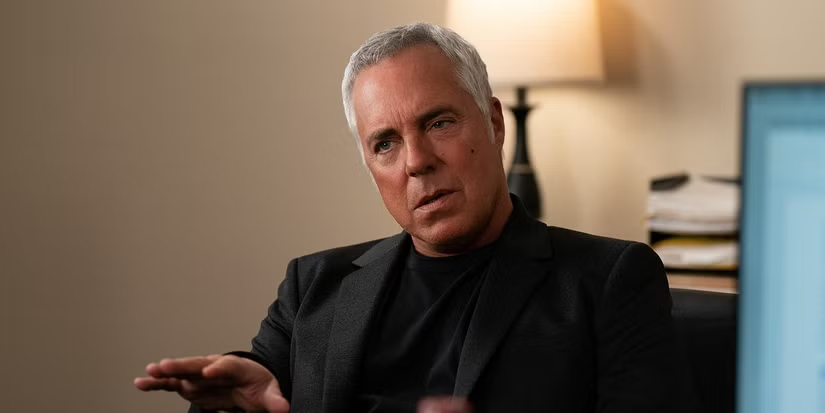
Recently, The Lincoln Lawyer did confirm that Mickey Haller (Manuel Garcia-Rulfo) indeed has a long-lost sibling in the show’s Season 4 finale, but it’s not Harry Bosch (Titus Welliver); instead, “The Law of Innocence” reveals Allison (Cobie Smulders) as Mickey’s long-lost sister. The Lincoln Lawyer Season 5, which will adapt the book Resurrection Walk, appears to be using Smulders’s Allison as the show’s latest Bosch stand-in, given that Resurrection Walk is another Mickey Haller novel where Bosch appears.
What’s Preventing a Crossover Between ‘Bosch’ and ‘The Lincoln Lawyer’?

Unfortunately, Netflix’s and Amazon’s respective ownership of Bosch and The Lincoln Lawyer make a potential onscreen adaptation of The Hollow highly improbable. Bosch and its spin-offs are co-produced and owned by Amazon MGM Studios, and they stream on Amazon’s Prime Video. Meanwhile, The Lincoln Lawyer is co-produced by A+E Studios and David E. Kelley, and the series streams on Netflix, so Netflix owns and controls the streaming rights for the hit legal series.
However, in an October 2024 interview with TV Insider, The Lincoln Lawyer co-showrunner Ted Humphrey didn’t completely rule out the possibility of a future crossover, but he did point out that it would take Netflix and Amazon figuring out a way for it to happen: “Unless they figure out some way for Netflix and Amazon to join forces… I guess you’d never say never, but at the moment it would seem impossible, yes.”
Considering the streaming competitors’ involvement in the television versions of Connelly’s literary characters, the likelihood of these two streaming giants striking a deal to allow a major crossover event appears close to nil, but the idea is not necessarily unprecedented. Disney-owned Marvel Studios and Sony Pictures did reach a deal over the Sony-owned Spider-Man movie franchise, which allowed Tom Holland‘s Spidey to appear in the MCU starting with Captain America: Civil War. Despite Connelly’s new book announcement keeping the idea fresh and ever-present in fans’ minds, the idea of an MCU-style crossover between Bosch and The Lincoln Lawyer still remains a fun scenario for viewers to consider.

Continue Reading
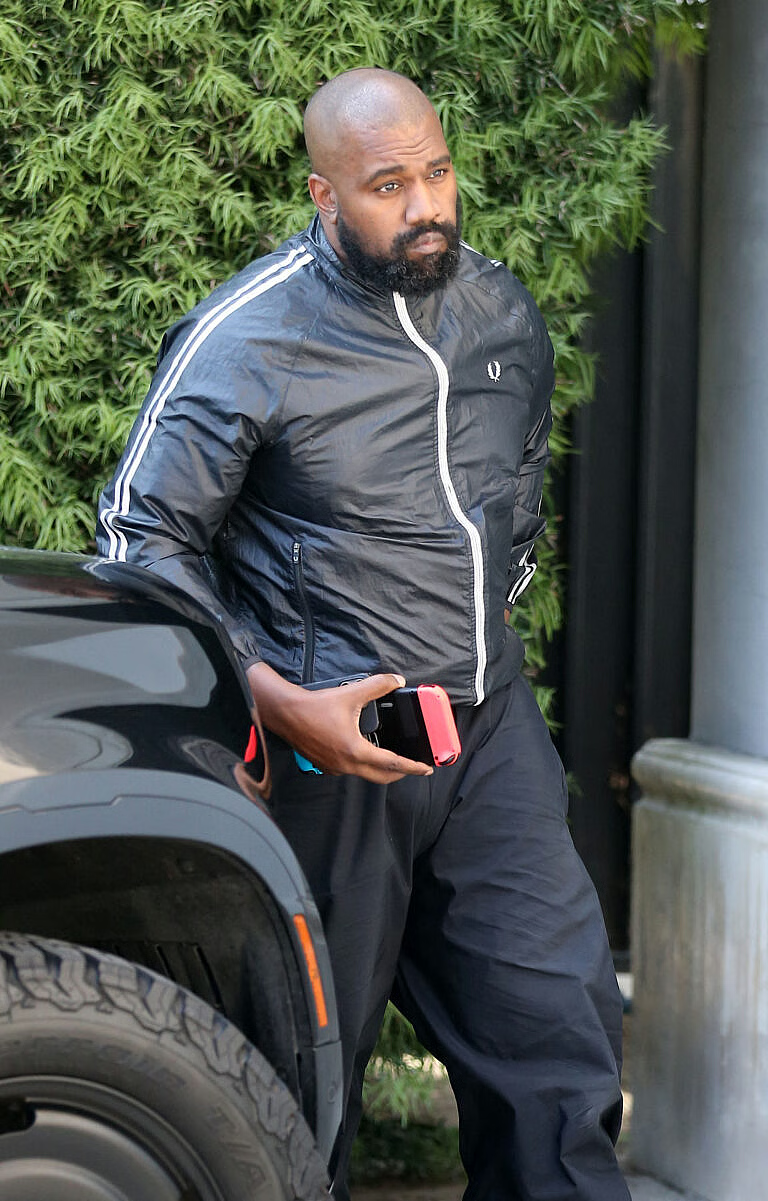
Kanye West‘s attempt to link his controversial anti-Semitic statements to bipolar disorder has been supported by some top medical experts.
In an apology earlier in the year, the rapper expressed remorse for his behavior and claimed that his “reckless” actions were linked to a car crash 25 years ago, which he says left him with trauma and contributed to his bipolar disorder.
Kanye West’s claims have now been given some credibility by experts, who say they are consistent with the symptoms and diagnosis of bipolar disorder.
The Rapper’s Antisemitism Apology Was Supported By A Medical Expert

Ever since West renounced his anti-Semitic actions and attributed them to his alleged bipolar disorder in an apology post, speculation has swirled over whether he truly meant it and whether his behavior was actually caused by the illness.
His medical explanation has now been supported by a medical expert who spoke with The Daily Mail about the behavior of people living with bipolar disorder.
“People with severe bipolar disorder can act in ways completely out of character,” said Prof David Curtis of UCL Genetics Institute, per the Daily Mail.
The medical expert also claimed that individuals living with this illness may become “impulsive, reckless, or even psychotic,” and will often display unpredictable behavior if and when they suffer a manic episode.
“What Ye describes fits perfectly with a diagnosis of bipolar disorder and need not reflect latent antisemitism or extremist ideology,” Curtis added.
“During a manic episode, it is possible to lose touch with reality entirely. People may do things they would never normally do. This is not an expression of belief – it is illness,” he continued.
Kanye West’s Apology Wasn’t Accepted By Top UK Officers

West’s excuse was also seemingly not well received by top officials in the UK, where he had been expected to headline that summer’s Wireless Festival before his visa was revoked.
UK Education Secretary Wes Streeting condemned it as “appalling” that West appeared to use bipolar disorder as a defense for his behavior.
The same sentiment was echoed by Shadow Home Secretary Chris Philp, who claimed that West’s past anti-Semitic actions reflected a “pattern of behavior” and had caused irreparable distress to Jewish communities across the world.
Education Secretary Bridget Phillipson also criticized the rapper, describing his past comments as “completely unacceptable and absolutely disgusting.”
“There is no place for that kind of hatred, bigotry, or antisemitism from him or from anyone else,” she added.
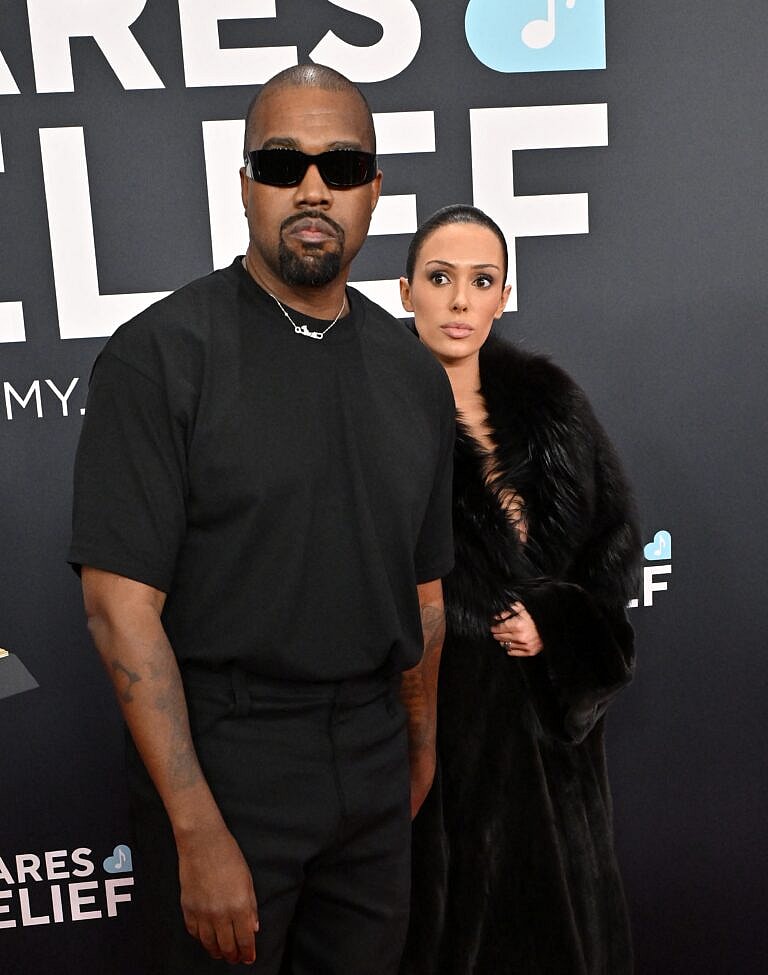
Following an outcry from multiple quarters, West was banned from the UK and could no longer headline the Wireless Festival, which was expected to attract 50,000 people per day.
The decision ultimately led to the cancellation of the festival, as announced in a post by the organizers earlier in the week.
It marked the first time the festival had been canceled in its 21-year history, though its staging was already on shaky ground after several sponsors pulled out.
PayPal, a payment provider known to partner with Live Nation UK Festivals, was among the major sponsors to withdraw, while companies like Diageo and Pepsi had done so earlier.
Following the cancellation of the event, ticket costs were automatically refunded to fans who had planned to attend.
The Rapper’s Past Anti-Semitic Actions
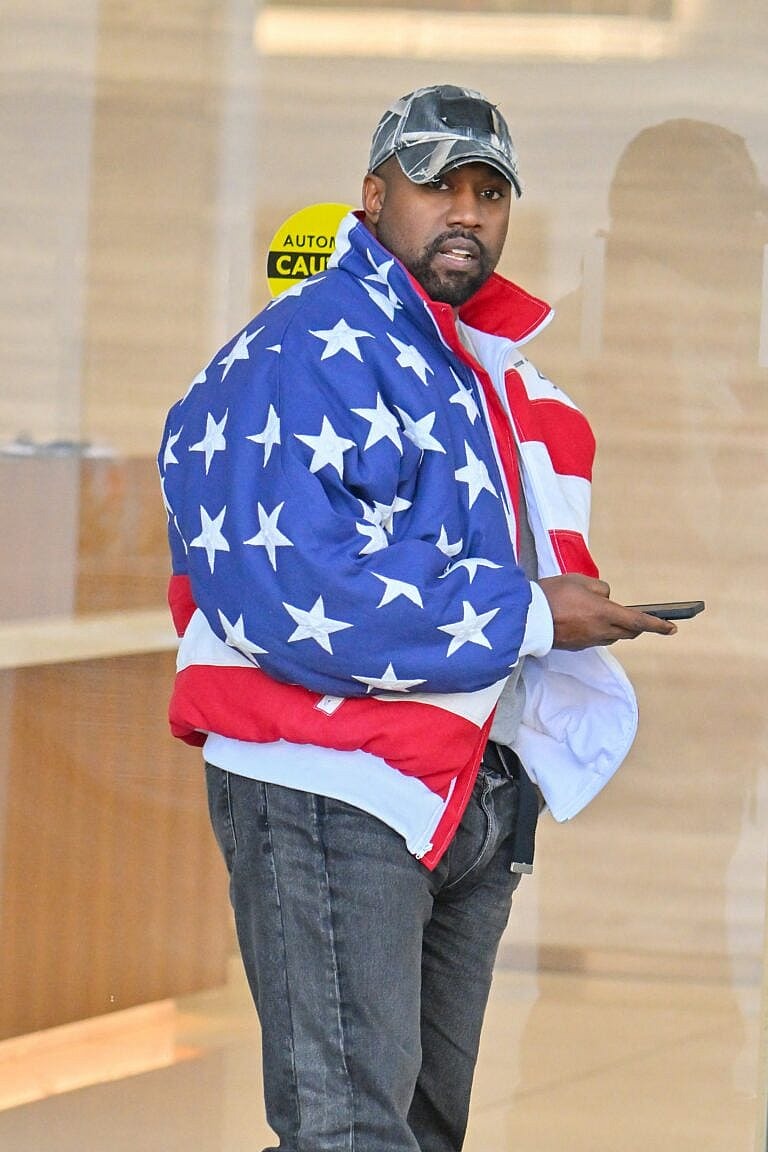
West has had a history of targeting Jews with hate speech. In October 2022, things took a serious turn when the rapper made a tweet, stating that he planned to go “death con [sic] 3 on Jewish people.”
The tweet was followed by several other controversial remarks by West, claiming Jews controlled everything. He also boldly stated that his then-business partner, Adidas, won’t drop him even if he says “anti-Semitic sh-t.”
The shoe giant swiftly dropped him shortly after, along with multiple top brands, a development that deeply affected the rapper financially.
Despite this, West still doubled down on his remarks in February 2025 with a rant in which he claimed he would never apologize for his comments about Jews.
The rapper pushed things further by selling a shirt featuring a swastika and releasing a song titled “Heil Hitler,” in which he branded himself a “Nazi.”
Kanye West Reportedly Asked For $15 Million To Headline UK Festival

While the exact amount Kanye West initially requested to headline the festival had remained unclear, a source recently revealed that the rapper both asked for and received a $15 million fee.
“He (West) asked for and got $15 million (£11 million) to play those three nights at Wireless,” the insider told the Daily Mail.
With the festival now canceled following Kanye West’s ban, it remains unclear whether the organizers will receive a refund, though the same source believes the rapper may return the fee due to a clause in his contract.
“‘Live Nation should be able to get all $15million back as their contracts say that it is the responsibility of the artist to get a visa,” added the insider.
“Because the decision was made by the Home Secretary, they believe that they can get their money back… good luck getting Kanye to pay you back,” they continued.
In the meantime, West has yet to address his visa ban, which was put in place by the UK Home Office.

Zendaya and Sydney Sweeney are facing renewed attention as “Euphoria” season three finally rolls out after years of delays, casting changes, and ongoing behind-the-scenes speculation.
What should have been a celebratory return quickly turned into a talking point after fans noticed subtle but telling moments at the Los Angeles premiere.
From Zendaya’s brief red carpet appearance to Sweeney’s separate interactions with castmates, the event only fueled rumors that tensions may be lingering as the show makes its long-awaited comeback.
Zendaya Sparks Buzz After Quick Exit At ‘Euphoria’ Premiere

Zendaya’s appearance at the Los Angeles premiere immediately caught attention, but not for the usual reasons.
The actress, who has been balancing multiple major projects, arrived in a striking gown and posed briefly for photos.
However, her time on the carpet was noticeably short. She greeted a few familiar faces, including Hunter Schafer and creator Sam Levinson, before being quickly escorted away by her team.
She also chose not to speak with reporters, which didn’t go unnoticed by fans watching the event unfold.
For many, her swift exit felt telling. Zendaya has been involved in other high-profile projects, including “Dune: Part Three” and “The Drama,” and some fans interpreted her limited engagement as a sign she may be distancing herself from the HBO series.
The lack of visible interaction with Sweeney on the carpet only added fuel to speculation that tensions between the co-stars have not cooled.
Zendaya Reportedly Caught In Tension With Sydney Sweeney

Zendaya’s rumored distance has become even more noticeable as talk of friction between her and Sweeney continues to grow.
According to a production insider who spoke to the Daily Mail, differences on set may have contributed to the situation.
The source claimed, “Zendaya was definitely making more money than Sydney. Zendaya was the name coming on to the project and that wasn’t easy for Sydney, especially since she’s now a bigger name than she once was.”
The same insider described contrasting experiences working with both actresses. They described Zendaya as “very well liked” and “a pleasure to have around set,” adding, “She’s a total professional and very down to Earth, very kind and appreciative.”
On the other hand, Sweeney reportedly developed a reputation that divided opinion. While the source noted that many crew members enjoyed working with the actress, they also admitted, “When Sydney is on set, she definitely has a lot of demands as far as what she wants and needs to work, so that can be difficult for some.”
Zendaya Linked To Wider Cast Divide Involving Alexa Demie

Zendaya is not the only one being pulled into rumors of division among the cast. Another insider claimed that Sweeney and Alexa Demie have had their own issues behind the scenes.
“If there were any issues with anyone, Alexa Demie and Sydney would avoid each other. And people could tell there was no love lost between them; they definitely don’t like each other,” the source said.
Despite those claims, the two actresses appeared friendly during the premiere, even sharing a brief hug on the red carpet. However, fans online quickly labeled the interaction as “awkward” and “fake” after clips circulated.
Later at an after-party, Demie spoke warmly about her bond with several cast members, but noticeably did not include Sweeney.
“I’m always giggly when I get together with Hunter, Maude, and Z,” she told Vogue, referring to Zendaya, Hunter Schafer, and Maude Apatow.
“When any of us get together, it’s so special and fun. We know each other for so long now. We’re family and it’s pure fun to be with them,” she continued.
The omission only added to speculation that relationships within the group may have shifted.
Zendaya Navigates Past Dynamics With Jacob Elordi On Set

Zendaya’s history with co-star Jacob Elordi has also resurfaced as part of the broader conversation about on-set dynamics.
The two were previously linked romantically, sparking headlines after being spotted together in 2019 and early 2020.
While their relationship didn’t last, insiders say they managed to keep things professional when working together.
“Jacob and Zendaya were always professional with each other,” a source told the Daily Mail. They added that while the pair may not be close, they remain respectful, with interactions staying polite but limited.
The source also noted, “Jacob had great chemistry with everyone on set. He was well-liked and didn’t cause much of a problem,” suggesting that any past relationship did not create major disruptions during filming.
Zendaya’s current relationship with Tom Holland also reportedly caused no issues on set, with Holland occasionally visiting during production without any tension.
Zendaya Rumored Rift With Creator Sam Levinson Adds To Drama

Zendaya’s name has also been tied to ongoing speculation about tension with “Euphoria” creator Sam Levinson.
Reports previously suggested that their relationship became strained during the long delay between seasons, particularly as Levinson focused on another project.
An insider described his working style as intense, explaining, “Sam rubs people the wrong way. He is very intense and meticulous. Not everyone runs that way on set, but Sam wants what he wants.”
They added, “He is on his own time, his own wavelength and wants his story to be told by him and not take any notes or ideas from others.”
Meanwhile, Zendaya’s reduced behind-the-scenes involvement has also raised questions. After serving as an executive producer on earlier seasons, she is reportedly not credited in the same role for season three.
Recently, she hinted that the show may be nearing its end, saying, “I think so” when asked if the current season would be the last.
Levinson, however, appeared less certain, telling Entertainment Tonight at the premiere, “I’ve written every season of Euphoria like it’s the last season,” and adding, “If this is our last season, I’m happy.”
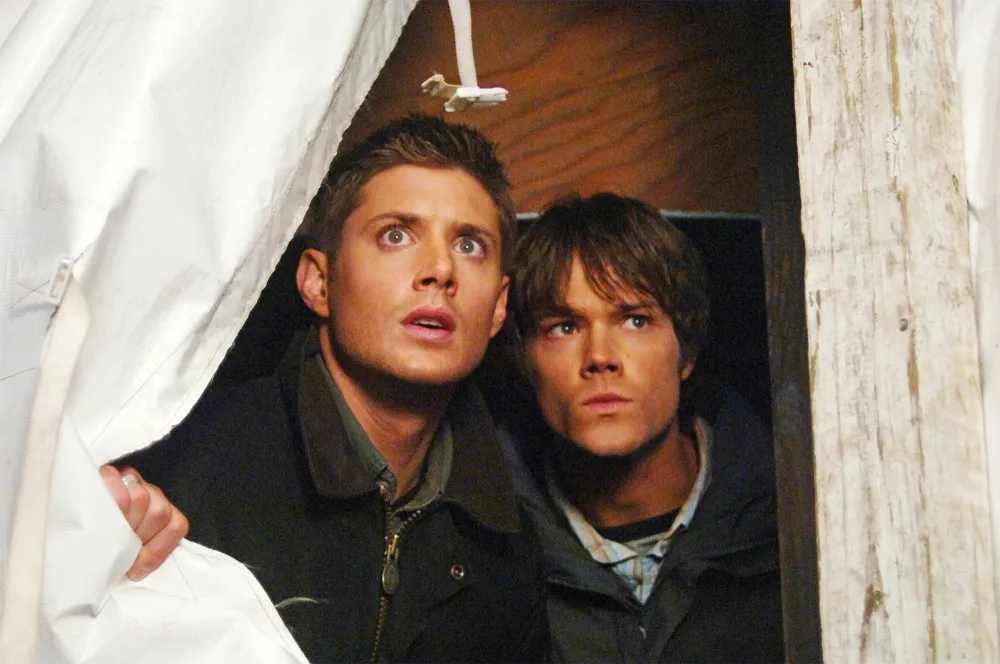

Jensen Ackles and Jared Padalecki in ‘Supernatural’ The CW
Jared Padalecki and Jensen Ackles won Us over when they played brothers on Supernatural — and they have remained booked and busy since The CW show came to an end.
Padalecki and Ackles played the monster-hunting duo from 2005 to 2020. After appearing in over 300 episodes of the hit series, Padalecki exclusively told Us Weekly that he felt he would “never really say goodbye” to his character.
“We really have become a family,” he said at the time about the journey. “Over 15 years, we’ve cut the fat. We didn’t fire anybody but if they didn’t like being there, they move on. So the people that are there want to be there.”
Ackles felt the same way, which inspired him to expand the Supernatural universe. (The Winchesters series ran from 2022 to 2023 and focused on Dean (Ackles) and Sam’s (Padalecki) parents in the ’70s.)
“It’s a long journey,” Ackles teased during a TV Critics’ Association press tour panel that same year. “I don’t think it’s ever going to be over. It’s just going to go away for a while. I don’t know how long.”
Outside of Supernatural, Padalecki and Ackles have scored a plethora of opportunities — some of which even allowed them to cross paths again with each other or their former costars. Keep scrolling for an extensive breakdown of their ongoing list of TV projects:
‘Walker’ Universe

Jared Padalecki, Ashley Reyes and Coby Bell in ‘Walker’ The CW
Padalecki initially remained at The CW after wrapping up Supernatural. He was cast as the lead on the Walker, Texas Ranger reboot from 2020 to 2024, where he also served as executive producer. After Walker inspired the Walker: Independence prequel, Padalecki had an unnamed cameo in one episode.
Ackles, meanwhile, joined Walker as a director, but also scored a cameo in the role of Miles Vyas.
‘Fire Country’ Franchise

Jared Padalecki in ‘Fire Country’ Sergei Bachlakov/CBS
Season 3 of CBS’ hit series Fire Country introduced Padalecki as Camden Casey in a three-episode arc meant to set up a potential spinoff. Fire Country: Surfside would follow Padalecki as a California firefighter dealing with the aftermath of his brother’s death in the field.

CBS’ Fire Country isn’t just a show about inmates fighting fires — there’s an impressive guest star list as well. The show, which premiered in 2022, follows Bode (Max Thieriot) as he gets a chance to shorten his prison sentence by volunteering for the California Conservation Camp Program. Bode gets assigned to his hometown where […]
‘The Boys’

Jensen Ackles in ‘The Boys’ Prime Video
Ackles’ role as Soldier Boy on The Boys was a shocking departure for those of Us who loved him as Dean on Supernatural. The shakeup, however, paved the way for Ackles to score his own prequel series titled Vought Rising — and a guest spot on the Gen V spinoff.
Padalecki joined in on the fun with a role in the fifth and final season alongside Misha Collins. The opportunity reunites Padalecki with Ackles and creator Eric Kripke, who was part of Supernatural before coming onboard The Boys.
Unnamed Medical Drama

After working with showrunner Anna Fricke on Walker, Padalecki reunited with her on an untitled series for CBS about a headstrong country doctor practicing a unique style of improvisational medicine. The show is in development as part of Padalecki’s ongoing first-look deal and CBS officially opened a writers’ room to further develop the show in late 2025.
‘Big Sky’

Jensen Ackles in ‘Big Sky’ ABC
A guest role in season 2 led to Ackles joining the main cast of Big Sky as Beau Arlen alongside Reba McEntire.


‘The Winchesters’

Drake Rodger, Meg Donnelly, Nida Khurshid and JoJo Fleites in ‘The Winchesters’ Eliot Brasseaux/The CW
Ackles found a way to return to his roots with The Winchesters, a Supernatural spinoff set in an alternate continuity. The actor narrated the show as his character Dean and served as an executive producer alongside wife Danneel Ackles.

Justin Hartley‘s CBS series Tracker has won over its audience because of the intriguing cases — and the impressive guest stars. Tracker, which premiered in February 2024, is centered around a survivalist named Colter (Hartley) who travels the country helping people and law enforcement tackle a variety of mysteries. As the series unfolds, viewers learn […]
‘Tracker’

Jensen Ackles in ‘Tracker’ Sergei Bachlakov/CBS
Proving once again that Ackles knows what his fans want, he signed on to play Justin Harley‘s onscreen brother on Tracker. In addition to the Smallville reunion, the introduction to Ackles as Russell paved the way for some fun Easter eggs.
‘Countdown’

The Prime Video series stars Ackles as Mark, a LAPD officer who is recruited to join a secret task force of undercover agents from all branches of law enforcement to investigate a suspicious murder that takes place in broad daylight.
Patrick J. Adams finally has his hands on some of Meghan Markle’s famous jam.
Posting via Instagram on Thursday, April 9, Adams shared that his former Suits costar, 44, sent him her famous As Ever collection after he admitted he missed out the first time she sent out the jam.
Adams, 44, shared a closeup photo of five As Ever branded jams, including orange marmalade, raspberry spread and strawberry spread.
“Worth the wait! Thank you @meghan for the deliciousness,” Adams captioned the post.

Meghan Markle and Patrick J. Adams sparked a close bond after costarring as love interests — twice. Some fans may not realize that the actors were originally paired for a 2008 pilot titled Good Behavior. “I think when we worked together the first time [on Good Behavior], there was this uncomfortable, getting to know each […]
The actor also thanked Amanda Hirsch’s podcast “Not Skinny But Not Fat” for “helping raise awareness about my jamlessness.”
During his appearance on the podcast on March 31, Adams admitted he “did not get a jam” after Meghan launched the product despite playing her love interest on Suits for seven seasons.
“I didn’t get anything,” he joked. “I don’t have enough followers, I don’t think.”
Podcast host Hirsch, 37, disclosed she had received jam from the Duchess of Sussex and was treating it as treasure that could not be taken out of its original packaging.
“You’re treating it like a champagne?” Adams asked. “It’s gonna go bad,” he added. “How long do preserves last? It’s going to go bad.”
Two days after the podcast episode was released Meghan reacted to Adams’ remarks about his lack of jam via the comments section on the “Not Skinny But Not Fat” podcast’s Instagram page.

“Jam’s en route for you @patrickjadams & @sleepinthegardn,” Meghan wrote, tagging the actor and his wife, Troian Bellisario, while promising to send the product to him.
Meghan also mentioned other members of her former costar’s family in the comment.
“Hugs to those beautiful babies. Send my love to your mom ❤️,” Meghan wrote, referencing Adam and Bellisario’s three daughters, Aurora, 7, Elliot, 4, and Imogen, 2 months, as well as the actor’s mother.
Prior to marrying Prince Harry in 2018, Meghan starred on Suits where she played Rachel Zane, who was the main love interest of Adams’ character Mike Ross. Both actors departed the legal drama in season 7, which aired in 2018.
Meghan’s jam was the first product the company teased back when it was named American Riviera Orchard in early 2024.
Meghan sent out personalized jars of jam to 50 of her famous friends, including Abigail Spencer, Chrissy Teigen, Kris Jenner and Mindy Kaling.
In an episode of Meghan’s Netflix show, With Love, Meghan, Kaling said receiving the jam was “one of the most glamorous moments of my life.”
Kaling also pointed out that the jam jars had numbers on them, prompting her to wonder whether there was a ranking system when it came to who received them and in which order.
“As a very hierarchical person, I was like, who are these people?” Kaling, who received jar number 19 of 50, said on the show. “Does having a lower number make me more special?”

As one of the most powerful figures in modern TV, Ryan Murphy has created a slate of genre-defining shows that consistently dominate both ratings and the cultural conversation. This year alone has already seen the release of the sci-fi body horror The Beauty and the biographical romance anthology Love Story, both of which have earned generally favorable responses from critics and audiences alike. That’s not all from Murphy in 2026, however, as his biggest fantasy series is set to return this fall after a lengthy wait, much to the excitement of longtime fans.
Having last aired in 2024, American Horror Story is back in production in New York City with some fan-favorites confirmed to return for the show’s 13th run. While primarily described as a horror anthology, the series has long incorporated elements of fantasy and the supernatural, including witchcraft, demons, vampires, and ghosts. The new season was originally expected to premiere on Halloween, October 31, 2026; however, as Murphy recently teased on Instagram, American Horror Story Season 13 may arrive sooner than anticipated.
The 13th installment of the iconic horror series turns its gaze back to Miss Robichaux’s Academy for Exceptional Young Ladies. About 24 hours ago, Murphy made the announcement, revealing the show’s return window and confirming Sarah Paulson‘s return as Cordelia Goode. “AHS 13,” the iconic director wrote. “The Return of @mssarahcatharinepaulson as Cordelia Goode. The Supreme Rises. And yes, we have rebuilt the entire Robichaux Academy. Coming this September.”
Who Stars in ‘American Horror Story’ Season 13?
Last Halloween, Murphy revealed the cast list for the highly anticipated Season 13 on Instagram, and, as American Horror Story fans know, it is similar to that of the Coven and Apocalypse seasons. The cast list includes Paulson, Evan Peters, Angela Bassett, Kathy Bates, Emma Roberts, Billie Lourd, Gabourey Sidibe, Leslie Grossman, new addition Ariana Grande, and, surprisingly, Jessica Lange. Lange, in a February 2025 interview, claimed she would not return to the series; however, on April 6, 2026, Murphy posted first-look photos of the actress dolled up like Constance Langdon, standing in front of the window of her beloved Murder House. The Instagram post’s caption read: “American Horror Story, Season 13. Day One. The return of Jessica Lange!”
American Horror Story returns this year with Season 13. You can see the first look image of Paulson above and the other posts with Roberts and Lange on Ryan Murphy’s official Instagram page. Stick with Collider for the latest entertainment updates.

- Release Date
-
October 5, 2011
- Directors
-
Alfonso Gomez-Rejon, Jennifer Lynch, Michael Uppendahl, Loni Peristere, Gwyneth Horder-Payton, Ryan Murphy, David Semel, Howard Deutch, Michael Lehmann, Angela Bassett, Jeremy Podeswa, Max Winkler, Michael Rymer, Paris Barclay, Axelle Carolyn, Anthony Hemingway, Craig Zisk, Elodie Keene, Jennifer Arnold, Jessica Yu, John Scott, Laura Belsey, Liz Friedlander, Maggie Kiley
- Writers
-
Halley Feiffer, Ned Martel, Crystal Liu, Charlie Carver, Kristen Reidel, Adam Penn, Douglas Petrie, Todd Kubrak, Reilly Smith, Jay Beattie, Dan Dworkin, Joshua A. Green, Akela Cooper, Asha Michelle Wilson
:max_bytes(150000):strip_icc():format(jpeg)/SciFi-Series-tout-4f34854dec244c0db0b94d16246a4227.jpg)
The streamer features shows with versions of the future filled with space tourism, cannibalism, and cultural collapse.
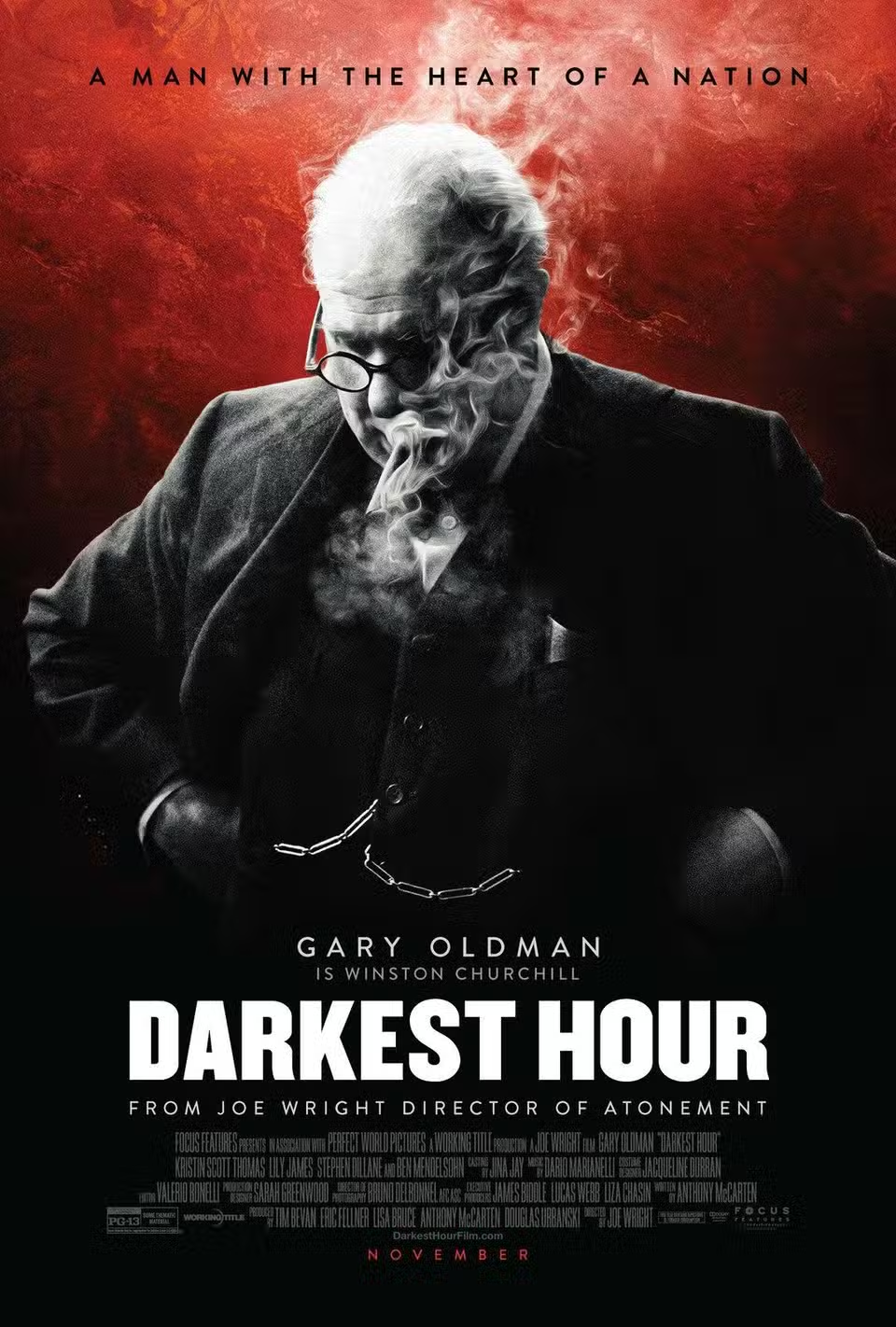
Of all the characters that deserve the chance of a second adaptation in HBO’s upcoming Harry Potter series, Sirius Black is high on many people’s lists. It will be at least two years until we first see how the series chooses to reinvent one of the most intricate characters in the novels, with the movies unable to dedicate enough time to his brief, three-book run. Of course, Black was played in the movies by the great Gary Oldman, and remains one of his more memorable cinematic performances.
However, the peak of Oldman’s career came after his time in the Wizarding World, when he finally took home the Academy Award for Best Actor for his portrayal of British wartime prime minister Winston Churchill in director Joe Wright‘s Darkest Hour. One of six nominations the film earned at the 90th Academy Awards, Darkest Hour also picked up a second prize for Best Makeup and Hairstyling, awarded to Kazuhiro Tsuji, David Malinowski, and Lucy Sibbick. Set in the early days of World War II, the film follows Oldman’s newly appointed prime minister as he faces the tough decision to either negotiate with the opposition or forge a legacy for himself that will be remembered forever.
At the box office, Darkest Hour was a huge success, no doubt thanks to the positive discourse around Oldman’s lead performance. Against a reported budget of $30 million, the movie grossed a huge $150 million worldwide, split between a $56 million domestic haul and $94 million from overseas markets. Almost a decade since the film’s theatrical debut, anyone looking to watch this WWII biopic will have to hurry, as Darkest Hour is officially leaving Netflix on May 1, 2026.
How Did Critics React to ‘Darkest Hour’?
The years since its Academy Awards success haven’t been kind to Darkest Hour, due mainly to many thinking it was chosen to win Oscars in the place of more deserving nominees. However, at the time it was released, Darkest Hour was nothing short of a critical darling. Scoring a “certified fresh” rating of 84% on review aggregator Rotten Tomatoes, the consensus from critics on the site reads, “Darkest Hour is held together by Gary Oldman’s electrifying performance, which brings Winston Churchill to life even when the movie’s narrative falters.”
Darkest Hour is set to leave Netflix on May 1, 2026. Make sure to stay tuned to Collider for all the latest streaming stories.

- Release Date
-
November 22, 2017
- Runtime
-
125minutes
- Director
-
Joe Wright
- Writers
-
Anthony McCarten


Paulina Porizkova is showing off her stunning figure in a vibrant red bikini ahead of her 61st birthday.
Taking to Instagram on Thursday, April 9, Porizkova flaunted her abs in the swimwear as she shared an empowering message about aging.
“I’m trying on this new super cute summer bikini and I’m reminded how far I’ve traveled in self-acceptance. I will be 61 tomorrow,” she said via the social media clip. “And I understand that this might sound crazy to you, but 40 years ago when I was 21 and when I was at the height of my career and supermodel-dom, that was when I felt the most insecure.”
Porizkova explained that there were several factors in her younger years that caused her to be insecure.
“[It was] partly because [of] the endless comparisons to other models by the people who employed me. I never seemed to be good enough,” she explained. “And of course, partly because my self-worth was entirely tied to my looks.”
Porizkova said she was leaving behind the insecurities to embrace her current age.
“So today I’m trying on this cute summer bikini and I flex muscles that I’ve been working my cellulite butt off for. And not necessarily so I can look best in this bikini, but to feel my best in this sixth decade,” she said.
She then joked, “You know, actually? Who am I kidding? I kicked my workout up like 10 notches because I do want to look my best this summer, but not necessarily in a bikini… in a wedding dress.”
Porizkova has often been candid about aging, beauty and body positivity via her social media posts.
Last month, Porizkova stripped down to lingerie for a shoot she shared via her Instagram, telling her followers that “good light and posing” is the secret to looking great.
“Smoke and mirrors, folks. That’s how you make it look good for a moment,” the model captioned the March 12 post. “The truth is, gravity takes its toll. But! Gravity has also built your strength so you can hold your head higher than ever.”
In July 2025, Porizkova shared another sizzling lingerie snap via her Instagram and spoke about the effort she’d put in to maintain her figure.
“This is 60 years of sometimes healthy eating, sometimes not,” she captioned the post. “60 years of sometimes working out, sometimes not. 60 years of doing the right things followed by doing the wrong things and over again and again.”
Porizkova added that she’s still learning things in life, even when she thinks she’s “figured” everything out.
She continued, “The beauty of 60 is that now I understand the importance is IN the lesson, not passing the exam.”
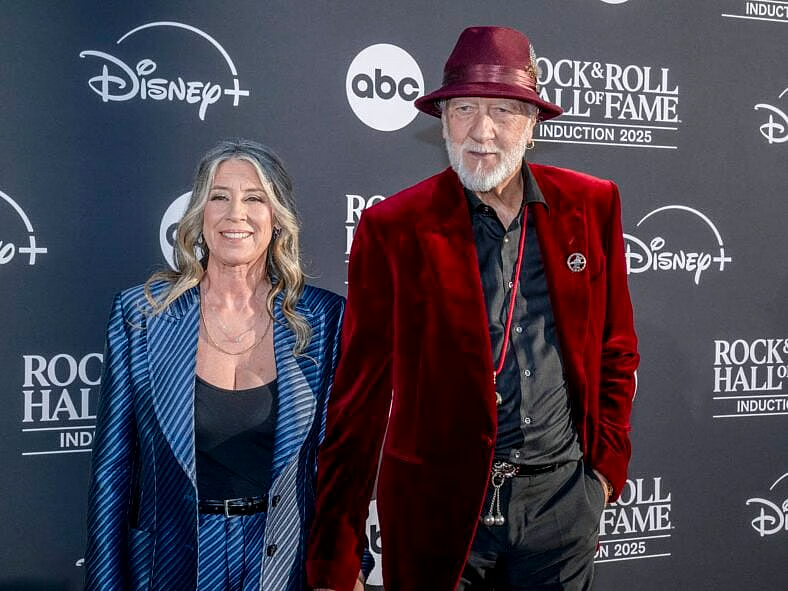
Mick Fleetwood is celebrating love once again, as he marries for the fifth time. The Fleetwood Mac drummer has been married four times before to three different women, with his last divorce finalized in 2015. Now, he appears to have found happiness again, embracing a new chapter with his longtime partner, Elizabeth Jordan.
Mick Fleetwood Married In Secret
Mick Fleetwood is celebrating his marriage to Elizabeth Jordan, sharing the news on social media. On March 28, the 78-year-old drummer took to Instagram to share a few snapshots, writing that he was enjoying his honeymoon in the South Pacific.
One of the photos shows the couple, who appeared to be dressed in their wedding attire, posing for a snapshot with Fleetwood concealing their faces from the camera with his fedora. In another photo, the newlyweds were captured mid-kiss, with Jordan’s back facing the camera. Two other photos showed the musician enjoying the view and the crystal blue waters.
It isn’t known when the wedding occurred, but as musician Mike Lawson revealed on Threads last year, as reported by the Daily Mail, they were engaged in March 2025. “Mick Fleetwood just texted and said he is marrying his girlfriend of five years, Elizabeth. How cool, finding love and making that commitment is beautiful. Congrats!” Lawson wrote.
The Couple Has Been Together Since 2023

According to reports, Fleetwood and Jordan have been together since 2023, making their relationship public at the Grammy Awards, where the drummer performed a tribute to her late Fleetwood Mac bandmate, Christine McVie, who died of a stroke in 2022.
Jordan is a licensed realtor based in Hawaii and owns a property management company with properties in New York, California, and Maui. Moreover, she serves as the director for the Mick Fleetwood Foundation, a non-profit organization that Fleetwood launched in 2023 to promote and fund music education in schools.
Mick Fleetwood Has Been Married Five Times

Fleetwood has had a well-documented romantic history, with the latest union with Jordan marking his fifth marriage.
His first wife was Jenny Boyd, whom he married in 1970 and divorced six years later. However, the couple reconciled briefly, marrying for a second time in 1977 and divorcing again in 1978. They share two daughters, Amy and Lucy.
Fleetwood had an affair with bandmate Stevie Nicks while he was married to Boyd, with the drummer describing that time as “very bright and crazy” in his 2014 memoir “Play On: Now, Then, and Fleetwood Mac.” Nicks also acknowledged the affair publicly, admitting that the song “Sara” was about Fleetwood.
In 1988, Fleetwood tied the knot with Sara Recor, who was one of Nicks’ closest friends. The drummer had an affair with Recor while he was with Nicks, which strained the friendship. However, the two later reconciled. Fleetwood and Recor divorced in 1995.
Fleetwood’s third wife was Lynn Frankel, marking his fourth marriage. They married in 1995 and welcomed twin daughters, Tessa and Ruby, in 2002. They separated in 2013, and their divorce was finalized in 2015.
Online Users React To Mick Fleetwood’s Fifth Marriage
Many fans were surprised to hear about Fleetwood’s marriage and expressed their reactions on social media.
“I don’t think there’s a reasonable limit for rock stars,” one wrote, noting the drummer’s fifth time getting married. “People who marry that many times are the ultimate optimists. Congrats to them,” another added. “Still a good looking man and she is very pretty. Best of luck to both of them,” one wrote.
“He will never break the chain,” one user commented, referencing Fleetwood Mac’s classic song, “The Chain.” “Fifth time lucky!” said another.
Fleetwood Mac Conquered The Music World
Fleetwood Mac was formed in London in 1967, with the original lineup consisting of founder and vocalist Peter Green, drummer Mick Fleetwood, guitarist Jeremy Spencer, and bassist John McVie. Green left the band in 1970, and McVie’s wife, Christine McVie, joined as a keyboardist.
Fleetwood Mac moved to the U.S. in 1974, and Stevie Nicks and Lindsey Buckingham joined that same year. With the latest additions, the band found a new voice. Their 1977 album “Rumours,” which was a massive commercial and critical success, remains one of the best-selling albums in history.
Fleetwood Mac was inducted into the Rock & Roll Hall of Fame in 2012, cementing their status as one of the defining bands of their generation.
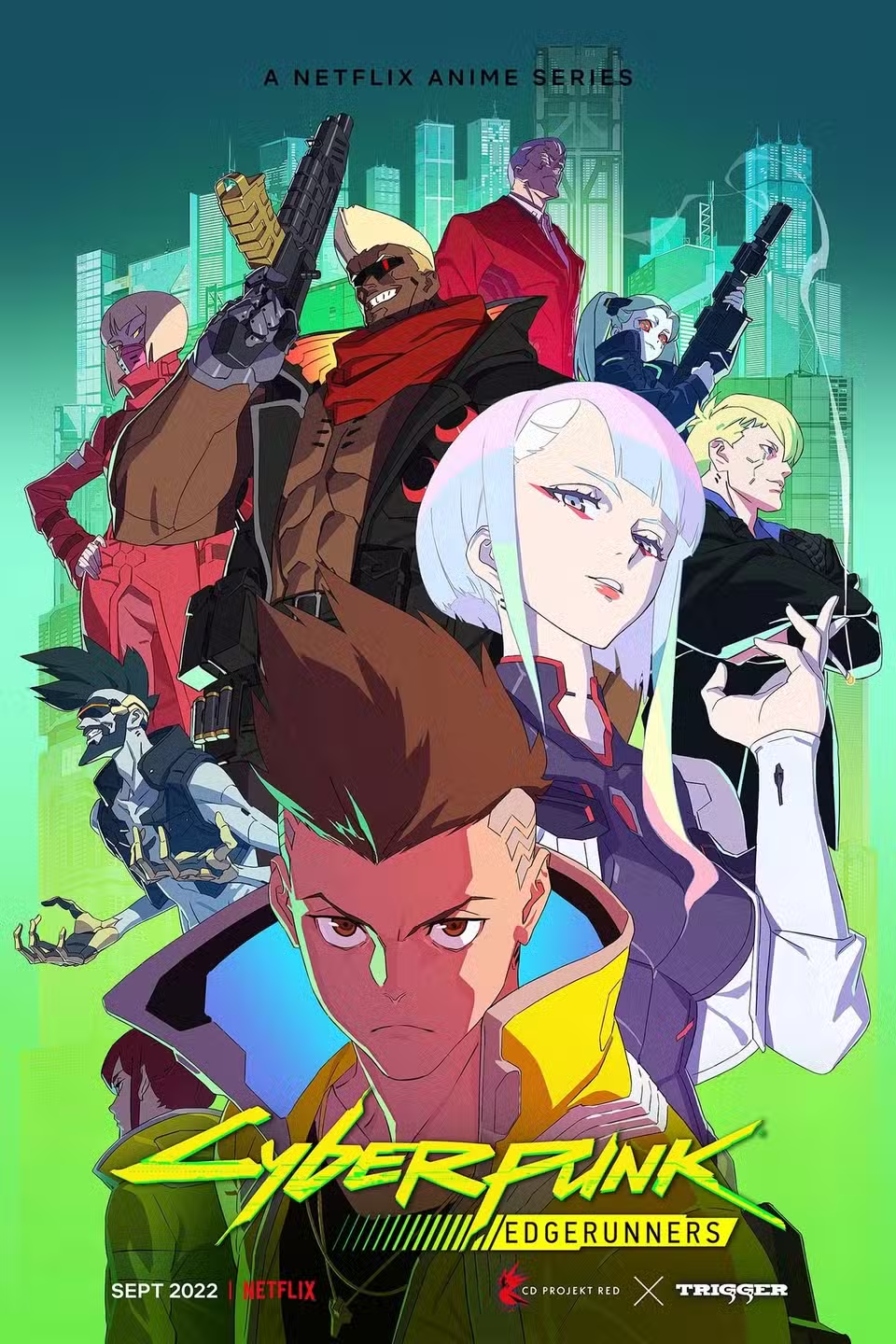
At a time when Netflix wasn’t taking risks, Altered Carbon had the makings of a sci-fi classic. Adapted from Richard Morgan’s book of the same name, the series showcases a cyberpunk future where the rich have become so powerful that not even death can stop them. This dark sci-fi series shows the worst-case scenario of how bodily autonomy can be disregarded — bodies are just flesh vessels to be used and discarded. Altered Carbon had a lot of potential, like so many Netflix series, but faded into purgatory. However, another show is just as relevant thematically while somehow being an even darker depiction of sci-fi.
Pivoting off the success of CD Projekt Red’s video game, Cyberpunk 2077, Netflix released an anime set in the same world. Cyberpunk: Edgerunners ran for 10 episodes and maintains all the hallmarks of the most emotionally traumatizing anime. With the use of animation, the series plumbs the depths of darkness that Altered Carbon could only dream of.
‘Cyberpunk: Edgerunners’ is What Sci-Fi is All About
Just as Altered Carbon demonstrates the dangers of the uber-rich, Cyberpunk: Edgerunners wastes no time in showing the dystopian landscape of a world controlled by corporations. This is established early on in Cyberpunk 2077 when the protagonist V saves a woman wealthy enough to pay for the privatized Trauma Team, while others cannot. Even so, viewers don’t need to have played the game to understand Edgerunners, and in many ways, it hammers home the themes even better.
Edgerunners follows David Martinez, a poor teenager in Night City, a city run by corporations. His mother, Gloria, works as a paramedic, but that isn’t enough to help her son pull himself up by his bootstraps. David is looked down on at his private school because he can’t afford the upgrades to his school software. Things take a turn for the worse when Gloria is killed in a drive-by shooting, and their lack of funds directly impacts her quality of care.
In a thinly veiled criticism of capitalism, David’s only recourse is to become an Edgerunner. Arming himself with cybernetic upgrades, he becomes a mercenary for hire in a world that doesn’t accept anything but the ultrarich. As David tries to make his way in the world, he falls in with a found family, including Lucy, a netrunner.
David finds his place, but Night City is still unforgiving. Edgerunners makes no secret about its disdain for corporations and demonstrates how capitalism victimizes everyone. The series is a 10/10 when it comes to storytelling, but its animation is where the series really shines. Edgerunners benefits from the mesmerizing animation style as David goes through love, loss, and sacrifice. The visual beauty of the series accompanies the futile actions of the characters. As viewers fall in love with these nuanced people, they are all subjected to the inhumanity of living in Night City.
Edgerunners takes the fascinating lore of ripperdocs, cybernetic implants, and cyberpsychosis, elevating it beyond its original form. The first season is short and sweet, but viewers can catch it on Netflix before the release of Season 2.

- Release Date
-
2022 – 2022
- Network
-
Netflix
- Writers
-
Mike Pondsmith, Yoshiki Usa, Masahiko Otsuka
- Franchise(s)
-
Cyberpunk
NewsBeat13 seconds ago
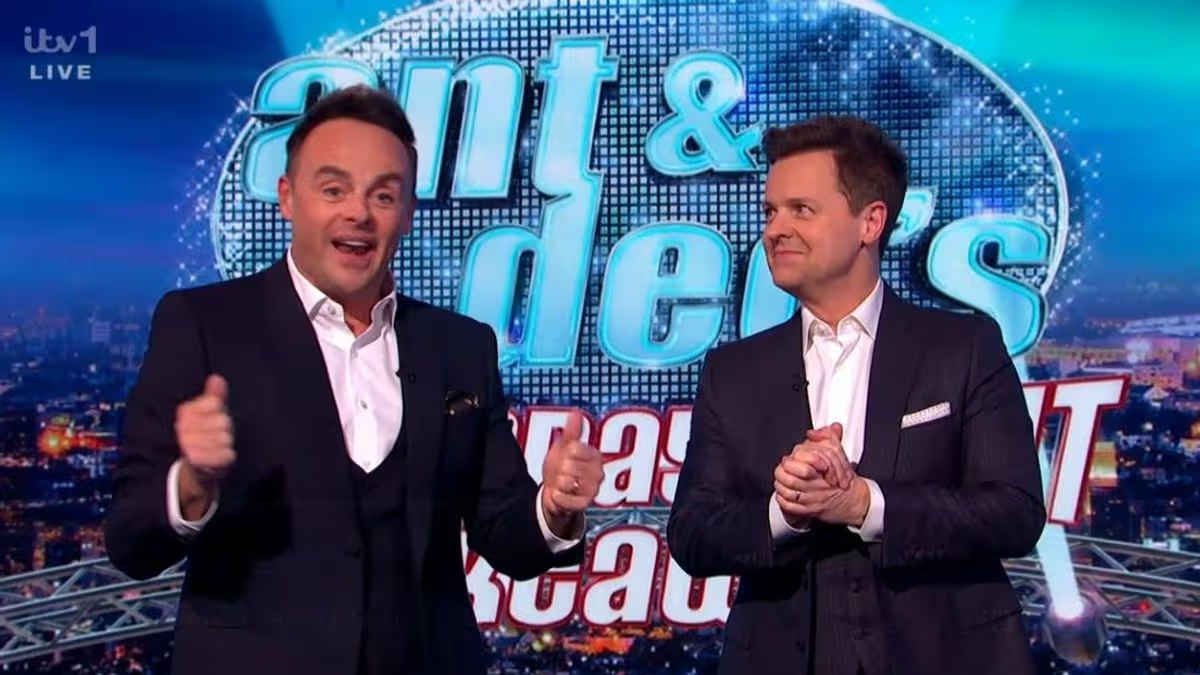
ITV fans beg for iconic Ant and Dec show to return after nostalgic post
Business1 minute ago
Form S-1/A Bitcoin Depot Inc For: 10 April

Crypto World1 minute ago
A Developer Just Built Quantum-Safe Bitcoin Without Changing a Single Line of the Protocol: Is This the Fix BTC?


-

 Fashion7 days ago
Weekend Open Thread: Spanx – Corporette.com
-

 Business5 days ago
Three Gulf funds agree to back Paramount’s $81 billion takeover of Warner, WSJ reports
-

 Sports6 days ago
India men’s 4x400m and mixed 4x100m relay teams register big progress | Other Sports News
-

 Business6 days ago
Expert Picks for Every Need
-

 Tech3 days ago
How Long Can You Drive With Expired Registration? What Florida Law Says
-

 Business5 days ago
No Jackpot Winner, Prize to Climb to $231 Million
-

 Fashion4 days ago
Massimo Dutti Offers Inspiration for Your Summer Mood Board
-

 Fashion3 days ago
Let’s Discuss: DEI in 2026
-

 Crypto World2 days ago
Bitcoin recovers as US and Iran Agree a Ceasefire Deal
-

 Business6 days ago
Akebia Therapeutics, Inc. (AKBA) Discusses Pipeline Progress and Strategic Focus on Kidney Disease Treatments at R&D Day – Slideshow
-

 Crypto World24 hours ago
Canary Capital Files SEC Registration for PEPE ETF
-

 Politics6 days ago
The UK should not pay a penny in slavery reparations
-

 Fashion7 days ago
Frugal Friday’s Workwear Report: Hammered Metallic Button Sweater Vest
-

 Tech4 days ago
Samsung just gave up on its own Messages app
-

 Tech4 days ago
Haier is betting big that your next TV purchase will be one of these
-

 Fashion7 days ago
Weekly News Update, 4.3.26 – Corporette.com
-
Sports7 days ago
A Kevin O’Connell Theory Can Now Be Retired
-

 NewsBeat7 days ago
Kemi Badenoch talks ‘spring cleaning’ Reform defections
-

 Tech4 days ago
Gamer Restores the Original PlayStation Portal From Two Decades Ago
-
 Tech7 days ago
Flat tire? Dead battery? Speedy’s serves stranded Seattle riders as a quicker e-bike picker-upper
You must be logged in to post a comment Login