DEIR AL-BALAH, Gaza Strip (AP) — Friday marks six months since Gaza’s ceasefire deal took effect, a milestone largely lost in the confusion over the new and even more fragile ceasefire in the Iran war.
The ravaged Palestinian territory of 2 million people has seen the most intense fighting stop between Israeli forces and Hamas-led militants. But most of the ceasefire work remains to be done, from disarming Hamas and ending its two-decade rule to deploying an international stabilization force and beginning vast reconstruction. Gaza residents are in limbo, with limited aid entering through a single, Israeli-controlled border post.
Such challenges could represent what’s to come in the latest war, as U.S. President Donald Trump’s approach to peacemaking appears to be stopping bombardment and leaving the bigger picture for others to work out.
Whether Trump can force through that kind of deal on Iran, with more actors in play and global markets quivering at every statement, is yet to be seen.
The Board of Peace goes quiet
Focusing on a deal’s details is crucial. Already the Iran war’s two-week ceasefire has created deadly confusion over Lebanon as Israel insists the deal doesn’t apply there and continues to attack the Iranian-backed Hezbollah, while Iran insists it does and threatens to upend the agreement. Israel made a surprise announcement Thursday authorizing direct negotiations with Lebanon, despite the lack of diplomatic ties.
Not long ago, the U.S.-created and Trump-led Board of Peace kicked off with $7 billion in pledges and sweeping intentions of resolving not only Gaza but other conflicts that emerge around the world.
Nine days after the board’s initial meeting, the U.S. and Israel attacked Iran.
The Board of Peace has not met again, and it’s still waiting for Hamas to respond to its proposal on disarming, a major concession and perhaps the hardest step. Hamas’ charter calls for destroying Israel.
A U.S. official said Hamas has not been given a definite deadline to respond to the proposal but added that “patience is not unlimited.” The official was not authorized to comment publicly and spoke on condition of anonymity.
The lack of a deadline can weaken pressure to act. Meanwhile, diplomacy is busy putting out different flames.
Board of Peace director Nickolay Mladenov told the U.N. Security Council last month that the world should not lose sight of Gaza as a new war flared. The choice in Gaza is between “a renewed war, or a new beginning; the status quo, or a better future,” he added. “There is no third option.”
‘It’s as if there’s no ceasefire at all’
Palestinians might suggest a third option: neglect.
Six months into the Gaza ceasefire that took effect on Oct. 10, little beyond the largely silenced explosions has changed.
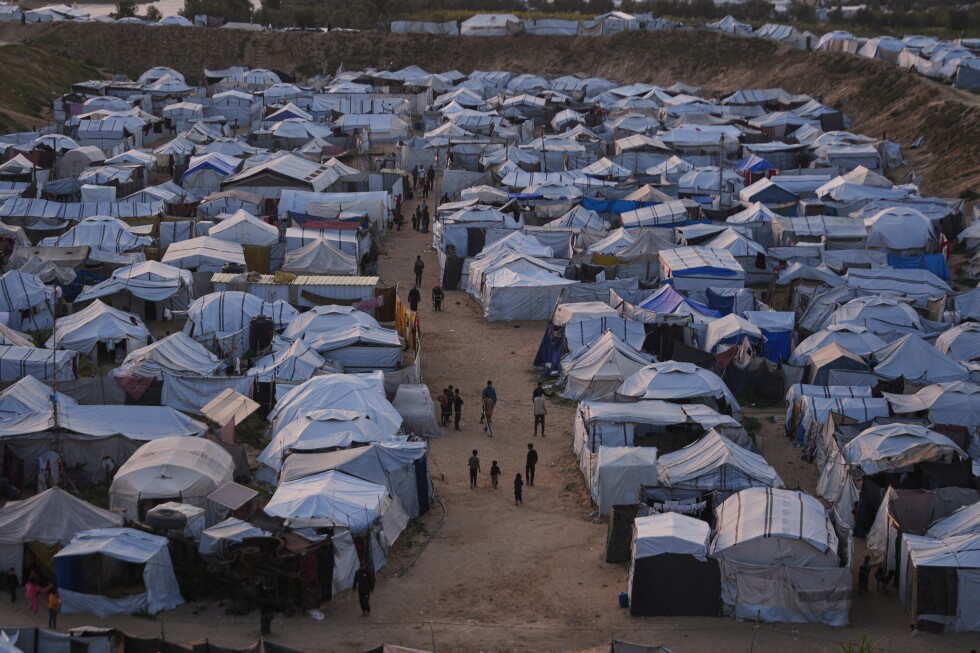
Vast tent camps house most of the territory’s population. Other residents shelter in damaged apartment buildings. Health workers and other humanitarian workers say there has been little progress in the expected surge of medical supplies and other aid.
Sign up for Morning Wire:
Our flagship newsletter breaks down the biggest headlines of the day.
The U.S. 20-point ceasefire plan for Gaza is largely failing on the humanitarian front, five international aid groups said in a scorecard released Thursday. They said conditions have deteriorated further in Gaza since the Iran war began.
“During the first two weeks of March 2026, trucks entering Gaza declined by 80%, and the price of basic goods increased dramatically,” they said. Medical evacuations have stalled.
Palestinians expressed fading hopes for any immediate improvement in their lives.
“There is pollution and disease. It’s as if there’s no ceasefire at all,” said Maysa Abu Jedian, a displaced woman from Beit Lahiya.
“The war is still ongoing and life is still terrible as it is,” said Eyad Abu Dagga, also sheltering in a camp in Khan Younis.
Tents rippled in the breeze, and children played on the sand against a backdrop of shattered buildings.
While the heaviest fighting has subsided, Israeli forces have carried out airstrikes and fired on Palestinians near military-held zones. Militants have carried out shooting attacks on troops, and Israel has said its strikes are in response to that and other ceasefire violations.
As of Thursday, Israeli attacks have killed 738 people in the six months since the ceasefire, according to Gaza’s Health Ministry. The ministry, part of the Hamas-led government, maintains detailed casualty records that are seen as generally reliable by U.N. agencies and independent experts. It does not give a breakdown of civilians and militants.
Funerals for two cousins were held Friday in Gaza City, a day after they were killed. “We were standing idly, drinking coffee, next to each other. We suddenly saw a (projectile) hitting the men,” said Anwar Saleh, an eyewitness. Israel’s military said it had struck a “terrorist” in northern Gaza.
Overall, the health ministry says 72,317 Palestinians had been killed since the war in Gaza began with the Oct. 7, 2023, Hamas-led attack on Israel.
‘Sustained diplomatic pressure at the highest levels’
Unwavering focus on Gaza, once at the heart of a passionate international outcry, has been lost with the rise of a new regional war. That, too, has decreased pressure for progress on the ceasefire.
The humanitarian groups’ scorecard notes that any forward movement on aid issues in the Palestinian territory has “generally required sustained diplomatic pressure at the highest levels, particularly from the United States. That pressure, however, has not been applied consistently or at the scale needed to secure full implementation.”
The Trump administration is not the only player to be distracted. The entire Middle East, including key Gaza mediators Egypt and Qatar, now focuses on Iran and that war’s effects on their economies.
With the added uncertainty over Israel’s renewed war with Hezbollah in Lebanon, there could be even less interest from countries to contribute troops to a Gaza stabilization force. One of the few confirmed troop contributors, Indonesia, already has seen three of its peacekeepers in southern Lebanon killed in recent days.
___
Anna reported from Lowville, New York. Associated Press writers Matthew Lee in Washington and Edith M. Lederer at the United Nations contributed.
___
Find more of AP’s coverage at https://apnews.com/hub/israel-hamas-war























































You must be logged in to post a comment Login