

Crypto World
Standard Chartered Holds to $2T Stablecoin Call, Cuts T-bill Impact

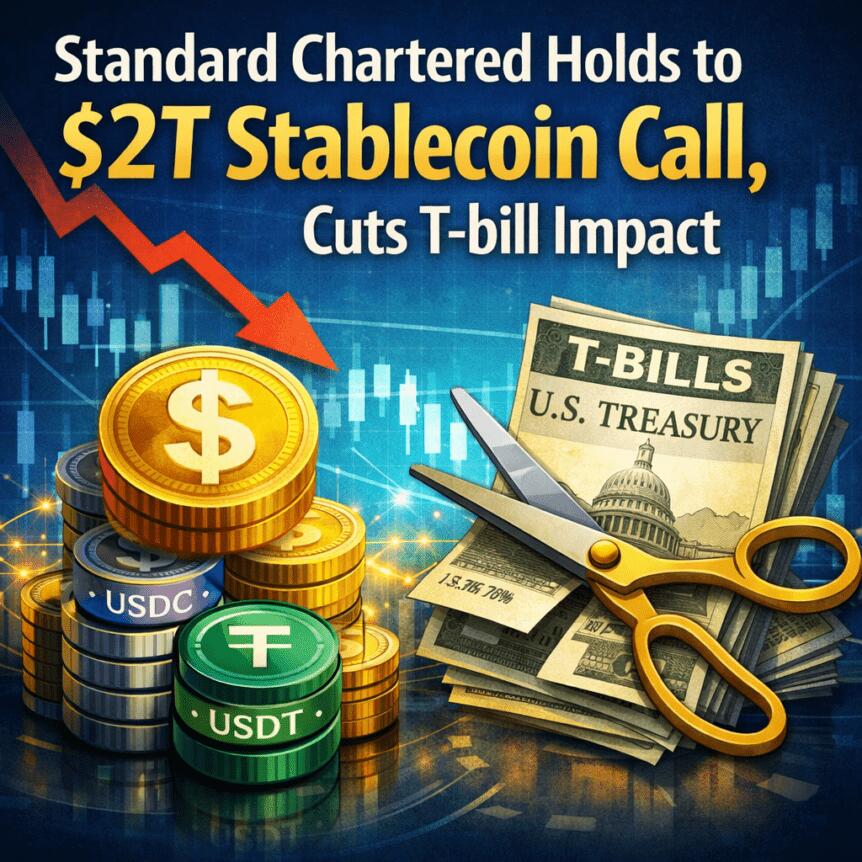
Standard Chartered’s newest briefing sticks to a bullish view on stablecoins, arguing that the sector will swell to about $2 trillion in market capitalization by late 2028, even as near-term demand for U.S. Treasuries eases. The bank’s analysts, Geoffrey Kendrick and John Davies, contend that dollar-backed stablecoins such as Tether’s USDt (USDT)(CRYPTO: USDT) and Circle’s USDC (USDC)(CRYPTO: USDC) will remain the bedrock of a shift in reserve management that could lift Treasury bill demand toward the $2.2 trillion mark by 2028. The note comes despite a cooling in the overall crypto cycle that has kept the dollar-stablecoin market cap hovering near $300 billion in recent months.
In making the case, the analysts point to policy momentum in Washington that they say underpins the thesis. The GENIUS Act, signed into law in 2025, is cited as a potential catalyst for broader acceptance and clarity around stablecoins, which in turn could influence both institutional wallet allocations and sovereign appetite for short-duration Treasuries. The report argues that the structural shift remains intact even if the pace of near-term demand is tempered by market cycles.
“We see these issues as cyclical rather than structural, and we continue to expect stablecoin market cap to reach $2 trillion by end-2028,” the Standard Chartered note states, framing a longer-run reallocation of liquidity toward crypto-enabled reserves as a core driver of T-bill demand.
Stablecoins may drive Treasury to issue more bills despite lowered demand
Standard Chartered’s forecast envisions a substantial uplift in T-bill demand driven by stablecoins acting as reserve assets. The bank now sees stablecoins generating an additional $800 billion to $1 trillion in fresh T-bill demand by late 2028, a sizeable downgrade from the $1.6 trillion projected in April 2025, even after GENIUS Act provisions took effect. The fundamental idea is that as stablecoins grow as credible cash-equivalents, institutions and cash-rich entities will prefer Treasuries as collateral or reserve holdings, prompting a broader issuance program by the Treasury.
The piece underscores that the Treasury may respond to this reserve-driven demand by issuing more T-bills. It cites Treasury Secretary Scott Bessent’s remarks in early February, which framed the GENIUS Act as a potentially important financing tool for the U.S. government, aligning policy with the evolving liquidity landscape created by stablecoins. The quarterly refunding announcement on the same day highlighted “growing demand for Treasury bills from the private sector,” the bank notes, signaling a potential loop where rising demand for crypto-backed reserves could spur additional government debt supply.
“Stablecoin-related demand, in conjunction with the Fed’s recent decision to commence RMPs [reserve management purchases] and replace its maturing MBS [mortgage-backed securities] with T-bills, could arguably cause T-bills to become overly scarce.”
Beyond the stablecoin thesis, Standard Chartered has not abandoned itsBitcoin(BTC)(CRYPTO: BTC) outlook. While the bank previously carried a bullish longer-run target, it recently trimmed its price forecast for 2026 from $150,000 to $100,000, acknowledging that BTC could dip toward $50,000 before any meaningful recovery unfolds. The downgrade illustrates the bank’s approach to balancing aggressive longer-term premises with near-term macro uncertainties.
In tandem with these macro considerations, the bank’s researchers maintain that the stablecoin storyline remains a key driver of liquidity and risk sentiment in crypto markets. The broader takeaway is that the relationship between sovereign debt management, central-bank operations, and the crypto ecosystem is evolving in a way that could rewire how liquidity is allocated in the coming years, even as the sector continues to navigate cycles of volatility and regulatory scrutiny.
Source: Standard Chartered
Market context
The forecast arrives as a broader crypto environment continues to digest policy signals and investor appetite for digital assets. The GENIUS Act is a central thread in this narrative, offering a legislative framework that could reduce regulatory friction for stablecoins while clarifying their role in institutional reserve practices. At the same time, the Fed’s reserve management purchases and its ongoing balance-sheet adjustments—alongside a possible reweighting of Treasuries in private-sector liquidity pools—shape the backdrop against which stablecoins could influence T-bill issuance and market depth.
Why it matters
The projection matters because it links stablecoin growth to sovereign debt management and macro liquidity dynamics. If stablecoins become a routine, preferred form of reserve or collateral, banks, institutions, and non-bank financials may channel more liquidity into Treasuries, potentially altering demand curves for T-bills and influencing credit conditions across markets. For crypto users and builders, the interplay between regulatory clarity, stablecoin infrastructure, and central-bank liquidity programs could translate into a more robust on-ramp to digital-asset ecosystems and a longer horizon of institutional participation.
From an investor perspective, the narrative signals that stablecoins are not simply a payments convenience but a bridge between the crypto world and traditional finance. The possibility of more T-bill issuance to accommodate rising secure-lien demand could keep risk-free yields anchored while offering new channels for liquidity and collateral management. Yet the path remains contingent on how regulators implement policy, how successfully stablecoins maintain reserve health, and how swiftly the broader market absorbs shifts in risk sentiment.
What to watch next
- Details on GENIUS Act implementation and regulatory guidance as 2025–2026 unfolds.
- Updates from the Treasury’s refunding calendar and any reported private-sector demand signals.
- Federal Reserve communications about reserve management purchases and any shifts in MBS-to-T-bill reallocation.
- Progress in stablecoin reserve frameworks, including regulatory clarity on collateral and liquidity requirements (SEC developments).
Sources & verification
- Standard Chartered report outlining a $2 trillion stablecoin market by end-2028 and the projected impact on T-bill demand.
- References to the GENIUS Act and its role in shaping stablecoin policy.
- Treasury quarterly refunding announcements and statements on private-sector demand for T-bills.
- Federal Reserve actions related to reserve management purchases (RMPs).
- SEC discussions on stablecoin exemptions or haircuts for broker-dealers.

Crypto venture firm Framework Ventures has partnered with mortgage services company Better to help it launch a $500 million plan to integrate with the decentralized finance protocol Sky, formerly MakerDAO.
Better said on Monday that Framework would help it provide $500 million in credit to Sky’s stablecoin ecosystem, enabling it to launch tokens tied to mortgages that would generate yield.
Framework Ventures co-founder Vance Spencer said real-world assets are “one of the most important frontiers in decentralized finance, and government-backed conforming mortgages are one of the largest real-world asset classes in the world.”
The plan comes amid a broader interest in tokenization from traditional finance companies, with firms such as BlackRock dabbling in tokenization for money market funds.
Tokens only for accredited investors, but will expand
Fortune reported on Monday that Framework also struck a deal to buy 10% of Better’s stock, currently valued at about $45 million, and that the planned tokens would initially be available only to accredited investors.
Better founder and CEO Vishal Garg said that it would issue the tokens and then would be “figuring out how do we get this in the hands of consumers,” but did not say when the tokens would be launched.
Fortune reported that the retail-focused tokens would be named “Home Token,” citing a person familiar with the plans.
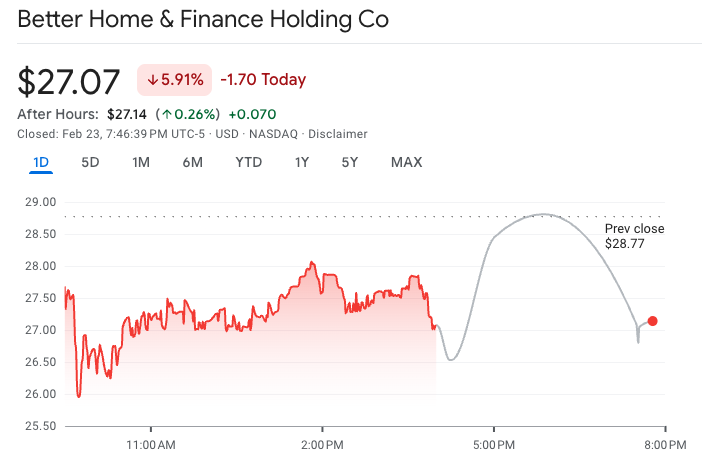
It comes as shares in the Nasdaq-listed Better (BETR) have struggled after hitting a peak of over $86 in late October.
Its stock has since sunk, ending trading on Monday at around $27, down nearly 17% so far this year.

Related: Backpack pledges 20% equity to token stakers amid IPO plans
Garg explained to Fortune that its push into crypto was driven by the promise of lower fees and operating costs, and that there are “so many different layers of intermediation that we’re going to be able to take out.”
“If we’re able to finance at a much lower cost than anyone else in the mortgage market, we’re going to be able to offer consumers a much cheaper mortgage than anybody else in the market,” he added.
Magazine: Bitcoin’s ‘biggest bull catalyst’ would be Saylor’s liquidation — Santiment founder


Crypto.com has secured conditional approval from the Office of the Comptroller of the Currency (OCC) to charter a national trust bank.
With this move, the cryptocurrency exchange and financial services platform joins a growing list of digital asset firms that received similar approvals last year.
As previously reported by BeInCrypto, Crypto.com applied for a national trust bank charter in October 2025. The OCC granted conditional approval in February 2026, marking a significant milestone for the company.
It’s worth noting that conditional approval represents a preliminary stage in the chartering process. The applicant must satisfy the OCC’s regulatory and operational requirements before obtaining full approval.
“Crypto.com today announced that it has received conditional approval from the Office of the Comptroller of the Currency (OCC) to charter Foris Dax National Trust Bank, d.b.a. Crypto.com National Trust Bank,” the announcement read.
Crypto.com emphasized that the approval does not affect the ongoing operations of Crypto.com Custody Trust Company. That entity will continue to operate as a qualified custodian regulated by the New Hampshire Banking Department as a non-depository trust company.
“This conditional approval is the latest testament to both our commitment to compliance and to providing customers trusted and secure services they expect from Crypto.com. This milestone brings us a major step closer to meeting leading institutions’ needs for a one-stop-shop qualified custodian under a gold standard of federal oversight,” said Kris Marszalek, Co-Founder and CEO of Crypto.com.
Firms such as Ripple, Circle, Paxos, and Fidelity Investments also received conditional approval for their national trust bank charter applications in December 2025. Meanwhile, BitGo went a step further, securing full approval from the OCC late last year to convert its state trust company into a national trust bank.
In addition, Trump-backed DeFi project World Liberty Financial’s subsidiary submitted its application to the OCC in January to establish World Liberty Trust Company, National Association (WLTC). The proposed institution would function as a national trust bank structured to facilitate stablecoin-focused activities.
The move by cryptocurrency firms into federally chartered banking structures reflects deeper integration of digital asset companies into the US financial regulatory framework. A national trust charter provides federal legal status, enhances custody capabilities, and may strengthen institutional credibility. Operating under OCC supervision centralizes oversight at the federal level.
However, this trend has also raised concerns. The American Bankers Association (ABA) and the Independent Community Bankers of America (ICBA) have pushed back against the OCC granting conditional approvals. They warn that broadening crypto charters may blur the boundaries of US banking and create new challenges.


Strategy (formerly MicroStrategy) co-founder and executive chairman Michael Saylor said he does not believe quantum computing represents Bitcoin’s (BTC) greatest security threat at the moment.
This statement comes as the quantum computing narrative continues to be a focus of debate among crypto circles. Some argue that it has already started to impact Bitcoin’s valuation and institutional exposure.
Michael Saylor Dismisses Quantum Threat to Bitcoin
During an appearance on Natalie Brunell’s Coin Stories podcast, Saylor weighed in on growing concerns over quantum computing. He said the broader cybersecurity community generally agrees that any meaningful quantum-related risk remains at least a decade away. Saylor added that it’s not a “this decade thing.”
“Whether or not there will be a quantum threat or a quantum risk is a question that is yet to be decided. But there’s certainly no consensus that there is any threat right now or that there will be a threat materializing anytime soon,” he commented. “I don’t actually think that the quantum, you know, narrative is the greatest security threat to Bitcoin right now. I don’t think it has been.”
He emphasized that major breakthrough quantum capabilities would not catch the industry off guard. If a quantum threat materialized, global banking systems, internet infrastructure, consumer devices, artificial intelligence (AI) networks, and crypto protocols, including Bitcoin, would coordinate software upgrades to quantum-resistant cryptography.
Previously, Saylor has suggested that Bitcoin’s greatest threat comes from ambitious opportunists pushing for changes to the protocol.
“The software does change. If you’ve got 30 versions of Bitcoin core in an asset which is 17 years old, do the math in your head and figure out how long it takes for versions of this stuff to roll out. The nodes will upgrade, the hardware will upgrade, the wallets will upgrade, the exchanges will upgrade. How will they upgrade? Well, wait 10 years. There will be global consensus about the best way to deal with it. There is no global consensus right now because there isn’t a credible threat right now,” he added.
Saylor also downplayed fears of Bitcoin facing isolated vulnerability. He noted that major corporations, financial institutions, and governments worldwide rely on digital systems that would face similar exposure in the event of a credible quantum breakthrough.
Companies such as Google, Microsoft, Apple, Coinbase, and BlackRock, alongside global governments and major banks, would all be confronting the same challenge.
“When and if it materializes, I expect that there will be some software or hardware or both reaction to it. The crypto community is actually the most sophisticated cybersecurity community,” he remarked. “So I think that the crypto security community will be the first, you know, to perceive the threat and to react to the threat, and they’ll be leading the way.”
From Wall Street to Core Devs: Crypto Braces for the Quantum Era
While the technical threat may be distant, institutional capital appears to be pricing in uncertainty. Shark Tank investor Kevin O’Leary recently stated that many institutions are capping their Bitcoin exposure due to concerns over quantum computing.
Christopher Wood, Global Head of Equity Strategy at Jefferies, has removed Bitcoin from his model portfolio over similar fears. Meanwhile, analysts including Willy Woo and Charles Edwards argue that quantum-related uncertainty could be contributing to Bitcoin’s relative underperformance against gold and weighing on its price.
As the debate intensifies, defensive measures are accelerating across the industry. Ethereum has incorporated post-quantum readiness into its planned 2026 protocol priorities update. Coinbase and Optimism are also actively planning post-quantum security enhancements.
On the Bitcoin side, developers have merged Bitcoin Improvement Proposal 360 (BIP 360) into the official BIP GitHub repository.


Ethereum prices have tanked to bear market lows and are currently at a long-term demand zone, say analysts.
“Ethereum is sitting at a 5-year demand zone,” said analyst Merlijn The Trader on Monday. “Historically, this range has been accumulation, not distribution,” he added.
Ether prices are currently back at April 2025 levels, where it crashed briefly below $1,500. They are also back to long-term lows between July 2022 and November 2023, which was a deep bear market and accumulation zone. However, they could wallow around this level for months yet.
Nevertheless, the analyst remains confident that “momentum is building for a potential explosive run.”
ETHEREUM IS SITTING AT A 5-YEAR DEMAND ZONE.
Perfect entries don’t exist.
Historically, this range
has been accumulation, not distribution.You don’t need the exact bottom.
You need exposure before expansion.Big bases don’t drift.
They reprice. pic.twitter.com/0TQ23J2Lnx— Merlijn The Trader (@MerlijnTrader) February 23, 2026
Ethereum is a long-term investment
Investor ‘StockTrader Max’ said that Ethereum is no longer a “get rich quick” asset that turned early holders into millionaires overnight. They also observed that ETH was still in a five-year accumulation zone.
“If you own ETH to make a lot of money by next week or month, then you will likely be disappointed. Ethereum is an asset that should be held in many portfolios with a time horizon of years and NOT months.”
Fellow analyst ‘Sykodelic’ identified a “nice hidden bullish divergence printed on the weekly chart.” A hidden bullish divergence is when the RSI (relative strength index) makes a lower low, but the price makes a higher low. “It means that momentum was actually stronger, but price absorbed it better,” they said before adding:
“The last time this happened, ETH rallied 100%.”
“Crypto has a lot of tailwinds, but the price action is terrible,” said Fundstrat’s Tom Lee.
His Ethereum DAT BitMine continues to buy the dip and stake, adding a further 51,162 ETH over the past week, according to a Monday update.
You may also like:
“In the midst of this ‘mini crypto winter,’ our focus continues to be on methodically executing our treasury strategy and steadily acquiring ETH and, in turn, optimizing the yield on our ETH holdings,” he said.
ETH Price Dips Again
Ether could not hold above $1,900 and has fallen back to $1,830 at the time of writing during the Tuesday morning Asian trading session.
The asset is now not far away from its Feb. 6 low and does not appear to be ready for a move to the upside yet, despite all of the positive fundamentals.
Binance Free $600 (CryptoPotato Exclusive): Use this link to register a new account and receive $600 exclusive welcome offer on Binance (full details).
LIMITED OFFER for CryptoPotato readers at Bybit: Use this link to register and open a $500 FREE position on any coin!


For many businesses, payment systems are still viewed as a supporting function rather than a strategic one.
As long as invoices are eventually paid and transactions clear, few executives question how payment infrastructure affects daily operations. That mindset is starting to change.
Rising cross-border trade, remote work, global supplier networks, and digital-first business models are forcing companies to rethink how money moves through their organizations.
In this shift, crypto payments are increasingly being evaluated not as a speculative asset, but as a practical tool for improving cash flow visibility, settlement speed, and operational flexibility.
Can Crypto Payments Improve Cash Flow Operations for UK Businesses?
Cash Flow Challenges in Modern Businesses
 Cash flow remains one of the most persistent challenges for growing businesses. Delayed settlements, currency conversion friction, and limited banking hours create gaps between when value is delivered and when funds become usable. For companies operating internationally, these gaps multiply.
Traditional payment rails often involve multiple intermediaries, each adding processing time and fees. Cross-border payments can take several business days to settle, leaving funds temporarily locked and reducing liquidity.
For small and mid-sized businesses, this delay can directly affect inventory planning, payroll timing, and supplier relationships.
The issue is not only speed, but predictability. When businesses cannot reliably forecast when funds will be available, financial planning becomes conservative and growth opportunities are missed.
Why Crypto Payments Are Being Reconsidered?
For many businesses, payment systems are still seen as a support function rather than a strategic one. But is it time to rethink how these systems are integrated into operations?
Crypto payments are increasingly being reconsidered not just as speculative assets, but as practical tools to address inefficiencies in traditional payment infrastructures.
These systems help businesses streamline complex and costly processes, offering significant improvements in payment handling.
Unlike traditional banking, which is constrained by regional cycles and fixed hours, a crypto payment processor operates continuously, enabling faster settlements and greater transparency.
This is especially valuable for businesses needing predictable cash flow and seamless cross-border payments.
With the rise of stable digital assets, crypto payments are becoming not only viable but essential for improving cash flow management and reducing friction in global business operations.
Impact on Cash Flow Management
 One of the most immediate effects of crypto payments is improved cash flow timing. Faster settlement means funds become available sooner, reducing the need for short-term financing or extended credit lines.
This improvement has downstream effects. Suppliers can be paid more quickly, often resulting in better pricing or stronger partnerships. Inventory cycles become shorter. Finance teams gain clearer visibility into incoming and outgoing funds.
For digital businesses operating on thin margins, even small reductions in settlement delays can have a measurable impact on working capital efficiency.
Operational Efficiency and Automation
Beyond cash flow, crypto payments can simplify operational processes. Traditional payment workflows often rely on manual reconciliation, delayed confirmations, and fragmented reporting across multiple systems.
Modern crypto payment infrastructure increasingly exposes transaction states through APIs, allowing payments to integrate directly into accounting, order management, and fulfillment systems. This enables automation that would be difficult to achieve with legacy payment rails.
When payment confirmation is reliable and machine-readable, businesses can reduce manual checks, minimize errors, and focus resources on exceptions rather than routine processing.
Platforms such as OxaPay illustrate how crypto payment systems are being adapted for business use, emphasizing automation, multi-currency support, and predictable settlement rather than consumer speculation.
Cross-border Operations and Global Reach
For businesses with international customers or suppliers, crypto payments can reduce geographic friction.
Traditional cross-border payments often involve multiple conversions, regional compliance steps, and varying processing times depending on destination.
Crypto-based systems offer a more uniform settlement layer, allowing businesses to standardize payment workflows across regions. This consistency simplifies expansion into new markets and reduces operational complexity as companies scale globally.
While regulatory considerations still apply, many businesses see crypto payments as a complementary option rather than a replacement, used strategically where traditional systems introduce the most friction.
Risk Management and Transparency
 Another area where crypto payments are influencing operations is transparency. Blockchain-based transactions provide clear, auditable records that can be verified independently.
For finance teams, this can improve traceability and reduce disputes. Transparency also supports better internal controls.
When transaction states are observable and deterministic, businesses can define clearer rules for reconciliation, refunds, and exception handling.
That said, adopting crypto payments still requires thoughtful risk management. Businesses must evaluate custody models, compliance requirements, and integration quality. The goal is not novelty, but operational reliability.
Moving From Experimentation to Strategy
The early phase of crypto adoption in business focused heavily on experimentation. Today, the conversation is becoming more pragmatic.
Executives are asking whether crypto payments can solve specific problems in their payment stack rather than whether crypto itself is a trend.
For many organizations, the answer depends on use case. In environments where speed, predictability, and cross-border efficiency matter, crypto payments are increasingly being incorporated into broader payment strategies.
The most successful implementations treat crypto payments as infrastructure. They are integrated quietly into operations, improving outcomes without disrupting existing workflows.
Conclusion
Crypto payments are no longer just a talking point for innovation teams. They are influencing how businesses manage cash flow, automate operations, and expand globally.
As payment systems become a more visible component of operational strategy, businesses that evaluate crypto payments through a practical, risk-aware lens are better positioned to benefit.
The shift is not about replacing traditional systems overnight, but about using modern payment tools where they create real operational value.
For many digital and global businesses, crypto payments are becoming less about experimentation and more about execution.
Crypto World
Tether-backed crypto exchange is ditching the ‘retail’ label to build the secret plumbing for Europe’s biggest banks


Spain’s largest cryptocurrency exchange, Bit2Me, moved 5.3 billion euros (around $6.24 billion) in trading volume in 2025, an eightfold jump since 2023, as it shifted from a consumer-facing platform to backend infrastructure for banks and law enforcement.
That volume was accompanied by growth in business-to-business revenue, which jumped from 18% of the total in 2023 to 27% in 2025. Crypto-backed loans, a relatively new offering, rose 672% in a single year, with the company’s CFO, Pablo Casadio, saying he sees the crypto industry entering a financial infrastructure phase that the company is taking advantage of, given its backing.
The exchange, backed by various banks including Bankinter, Unicaja, and Cecabank as well as telecom giant Telefónica and Tether, made $25 million in revenue last year.
Read more: Spanish bank Bankinter joins BBVA and Tether with stake in crypto exchange Bit2Me
Much of that came from a new API product that allows institutions to effectively outsource their crypto operations. Spanish wholesale bank Cecabank, which also holds a stake in the company, has integrated Bit2Me’s infrastructure to offer digital asset services to other regional banks, complementing a similar liquidity deal with BBVA’s Turkish crypto subsidiary, Garanti BBVA Kripto.
The exchange became the first in Spain to secure an EU Markets in Crypto Assets (MiCA) license and spent 3,000 hours on regulatory-compliant work and 2.5 million euros ($2.9 million) to achieve it, Bit2Me executives told reporters during a briefing.
The effort temporarily pushed its EBITDA into negative territory, but opened doors that few crypto firms can access and allowed it to start expanding. The company last week started expanding into the Portuguese market, with plans to enter Italy, France and Germany in the near future.
Bit2Me also unveiled that it has been eyeing the U.S. and Middle East markets, which are far more competitive. “If we do anything, it needs to be done the way we did it in Spain, everything by the book,” Andrei Manuel, the platform’s COO and co-founder, said during the briefing attended by CoinDesk.
Turning siezed crypto to fiat
It has also been acting as a “crypto liquidator” for the Spanish government. Bit2Me has built a pipeline to convert confiscated digital assets into euros, working directly with Interpol, Europol and national police, its executives added.
The system leverages blockchain analytics firm Chainalysis to ensure traceability. In 2025, Bit2Me processed 1.5 million euros ($1.76 million) in seized crypto on behalf of agencies that include Interpol, Europol, and Spanish police. These funds are converted into fiat currency for the state.
While other governments still auction off crypto through third parties, Spain’s direct liquidation model mirrors the U.S. Marshals Service’s deal with Coinbase.
Crypto World
Will Ethereum price drop below $1,500 as multiple bearish patterns emerge amid crypto market crash?
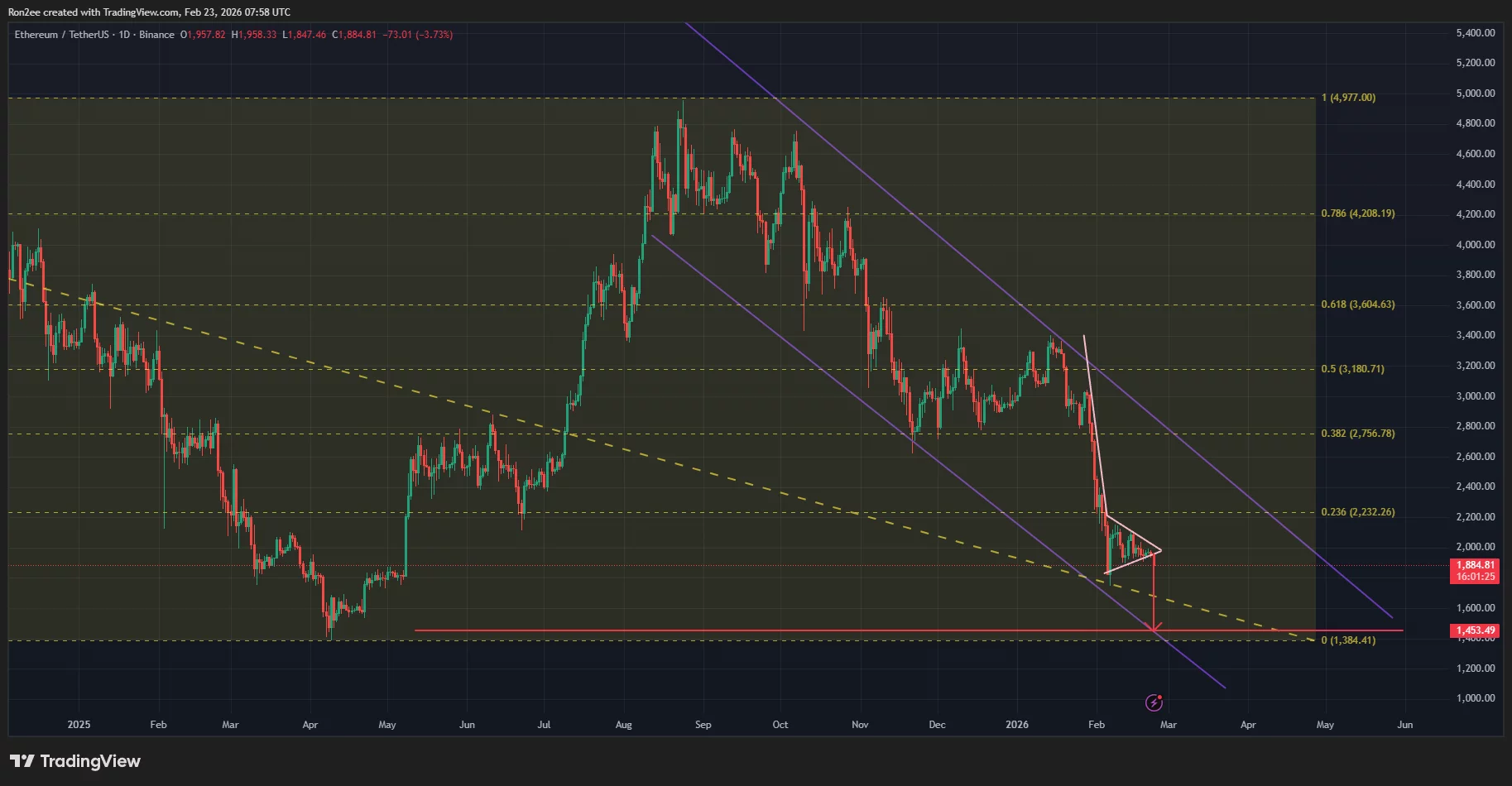
Ethereum price formed a bearish engulfing candle on Monday and dropped over 6% amidst a market-wide crash led by Bitcoin.
Summary
- Ethereum price fell over 6% on Monday amid a broader crypto market blood bath.
- Multiple bearish patterns seem to suggest more potential downside over the coming weeks.
- Ethereum ETFs have hit a 5-week outflow streak.
According to data from crypto.news, Ethereum (ETH) price fell 6.3% to $1,855 on Monday during early Asian hours before stabilizing at $1,874 at press time. Ethereum price tanked amid a broader market crash as fresh U.S. tariff threats on all trading partners and potential military escalation in the U.S. and Iran conflict hurt investor appetite for crypto assets.
Notably, Bitcoin (BTC), the bellwether of the market, has dropped below the $65,000 psychological support level, wiping out millions of leveraged long positions with the shock extending to other major crypto assets such as Ethereum. CoinGlass data show that nearly $108 million worth of ETH long positions were liquidated in the past 24 hours.
On the daily chart, Ethereum price has formed a bearish engulfing candle amid its drop today. The largest altcoin in the market has so far fallen roughly 45% from its yearly high and 62% from its all-time high of $4,946 reached in August 2025.
ETH’s price action has formed a bearish pennant pattern characterized by a flag-like pole and a triangle formation at the bottom. A breakout from such patterns has historically been followed by massive downside risks.
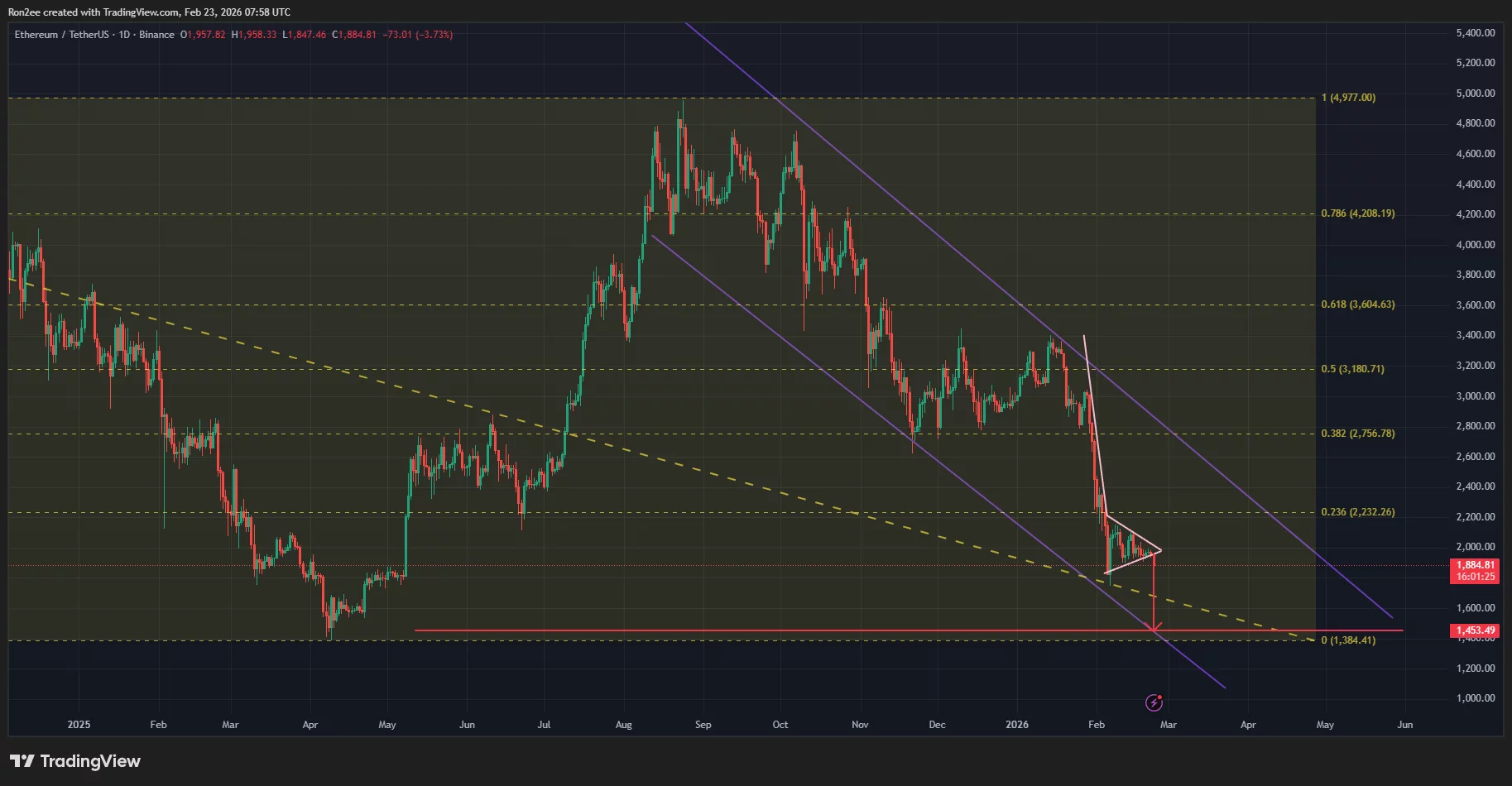
At the same time, zooming out the chart also shows the formation of a multi-month descending parallel channel, another bearish pattern in technical analysis.
Based on these technical indicators, Ethereum could drop to $1,450 if it were to respect the lower boundary of the descending channel pattern. This would mean loss of the $1,500 level, which is an important psychological support.
A breach of the $1,500 psychological floor would represent a significant structural breakdown, likely triggering a cascade of stop-losses. Given the current macro-driven volatility, it could result in a rapid capitulation phase in the coming sessions as liquidity dries up at lower levels.
ETH investors have turned bearish
The bearish prediction for Ethereum could gain further traction from the lackluster demand for its exchange-traded products over recent weeks. Data from SoSoValue shows that the nine-spot Ethereum ETFs have recorded back-to-back outflows for the fifth consecutive week, totalling around $1.38 billion.
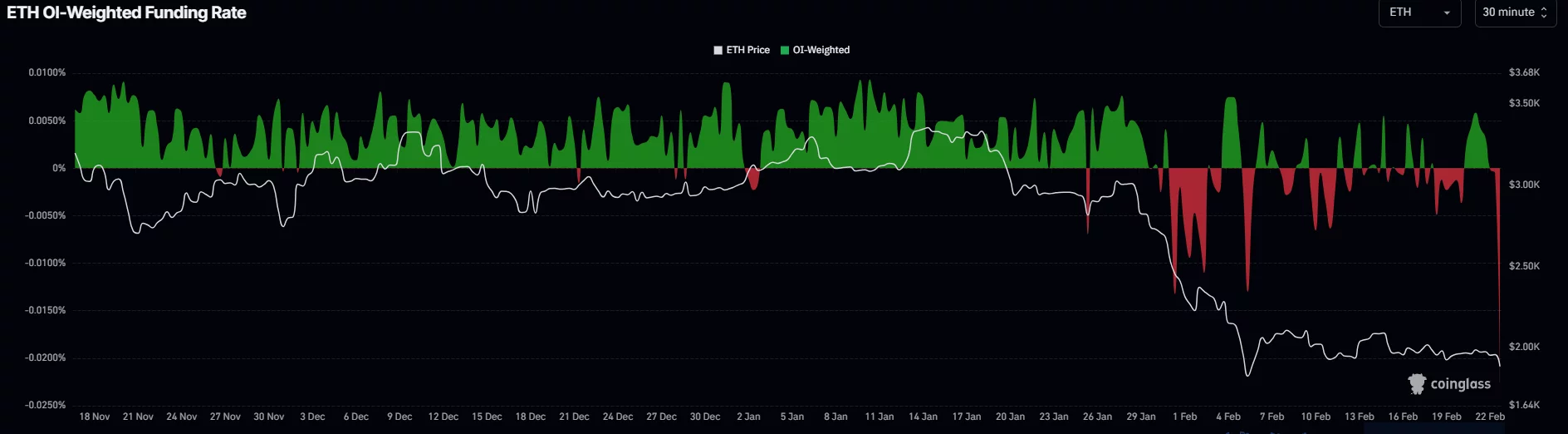
Meanwhile, the weighted funding rate, which measures the cost of holding short positions, has fallen deeply into the red territory, suggesting that Ethereum bears are increasingly betting on further price declines while paying a premium to long holders.
Disclosure: This article does not represent investment advice. The content and materials featured on this page are for educational purposes only.


Macro jitters from an emerging AI disruption trade are compounding crypto-native weakness, with majors posting 8-11% weekly losses across the board.
Bitcoin slid to around $62,900 on Tuesday, down 2.1% on the day and 7.5% on the week, extending a grinding move lower that has so far refused to produce either a clean breakdown or a strong bounce.
The price action has pinned the market inside the $60,000-to-$70,000 band that formed after the Feb. 5 flush — a range that is starting to feel less like a base and more like a holding pattern waiting for a catalyst.
Altcoins are faring worse. Ethereum traded near $1,829, down 8% on the week. XRP fell 10.8%, Solana’s SOL shed 11.3%, and dogecoin dropped nearly 10%. The underperformance across majors reflects a market where risk appetite is shrinking toward bitcoin and even that bid is thinning.
CryptoQuant flagged sell-side pressure among altcoins at five-year highs, suggesting holders are actively distributing into a market where buyers remain scarce outside of the largest cap.
That kind of structural selling tends to grind prices lower without the dramatic liquidation candles that attract dip buyers, making it a slower bleed that is harder for momentum traders to position around.
FxPro chief market analyst Alex Kuptsikevich said in an email bitcoin’s recent attempt at recovery is shaping up as consolidation rather than reversal. He pointed to a bearish pennant forming on the daily chart, noting that a move below the mid-$65,000 area would confirm downside continuation while a break above $70,000 would invalidate the pattern.
More broadly, he described the $60,000-to-$70,000 range as historically significant — a zone that acted as the ceiling for the entire 2021 cycle and now appears to be serving as a battlefield between long-term accumulators and newer holders cutting losses.
AI fears return
Adding to the pressure is a macro dynamic that has nothing to do with crypto directly but is draining the same pool of risk capital.
A Citrini Research report flagged an emerging “AI scare trade” this week, warning of widespread economic disruption from artificial intelligence across delivery, payments, and software sectors. The note triggered selling in tech-adjacent equities as investors reassessed which companies benefit from AI adoption and which face displacement risk.
That kind of broad risk recalibration tends to hit crypto on a lag. Digital assets don’t always sell off in lockstep with equities, but they are sensitive to the same shifts in liquidity and positioning that drive risk-off moves — and right now, the mood in both markets is pointing the same direction.
Bitcoin is now 48% below its October all-time high and sitting 5.5% below its 2021 peak of $69,000. The longer it trades in this range without reclaiming higher ground, the more the technical picture tilts toward the bears.
Satlantis has launched as a Bitcoin-native events and ticketing platform that embeds Lightning wallets directly into user accounts and events, allowing organizers to issue tickets and receive payments in Bitcoin without relying solely on traditional payment processors.
According to an announcement shared with Cointelegraph, the platform functions similarly to services like Luma and Eventbrite, offering ticket tiers, attendee management and event pages, but automatically generates a unique Bitcoin (BTC) wallet for each event to facilitate direct payments and withdrawals.
Satlantis also integrates with Stripe to process fiat payments and said it plans to add stablecoin support, allowing organizers to accept Bitcoin, traditional currency or both through a single dashboard.
According to Satlantis’s crowdfunding page, investors in the startup include Bitcoin Opportunity Fund and Timechain Capital, a venture capital fund dedicated to Bitcoin infrastructure projects.
Using Lightning Network to cut fees
The company said its model is a way to reduce ticketing fees and expand access in regions where traditional payment rails are limited, using Bitcoin’s Lightning Network to enable low-cost, cross-border transactions.
The Lightning Network is a layer-2 protocol built on Bitcoin that enables faster, lower-cost transactions by processing payments off-chain.
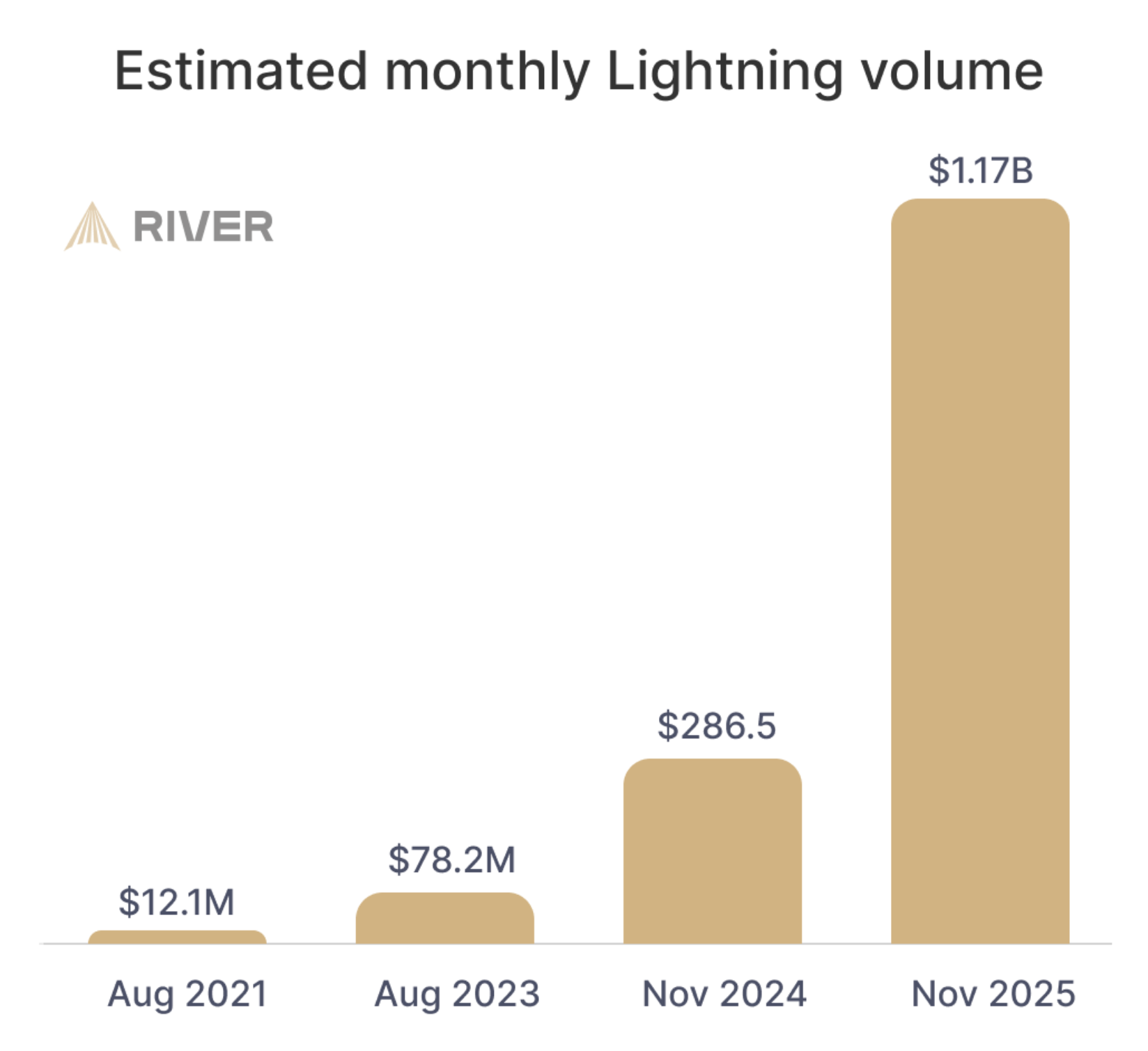
According to data cited recently by River marketing director Sam Wouters, the network’s transaction volume reached an estimated $1.1 billion across 5.2 million transactions in November.

Related: How many people actually pay with Bitcoin? Real use cases revealed
Crypto’s expanding role in ticketing and live events
Efforts to integrate cryptocurrency into ticketing predate many current Web3 platforms, with sports teams and travel companies experimenting with digital-asset payments for more than a decade.
In sports, the Sacramento Kings became the first NBA team to accept Bitcoin for tickets and merchandise in 2014. The Dallas Mavericks followed in 2019 after owner Mark Cuban signaled plans to support crypto payments, ultimately allowing fans to purchase game tickets with Bitcoin.
Beyond payment acceptance, blockchain companies are also experimenting with how live events are financed and settled. TIX, the onchain settlement network behind KYD Labs, aims to turn tickets into tokenized real-world assets that can be used to access upfront capital and automate repayment flows.
Major sporting bodies have also explored blockchain-based ticket-linked products. FIFA, the global governing body for soccer, has experimented with non-fungible token (NFT) initiatives tied to its tournaments. NFTs are unique blockchain-based tokens that verify ownership of a specific digital asset.
Ahead of the 2026 World Cup, FIFA sold “right-to-buy” NFTs granting holders a reserved window to purchase match tickets at face value if certain conditions are met. The tokens are not tickets themselves but can be traded on FIFA’s NFT marketplace.

Magazine: Is China hoarding gold so yuan becomes global reserve instead of USD?


Global cryptocurrency platform Crypto.com has received conditional approval from the Office of the Comptroller of the Currency to launch a federally regulated trust bank in the United States.
Summary
- Crypto.com received conditional approval from the OCC to form a national trust bank focused on digital asset custody.
- The bank will offer regulated custody, staking, and settlement services but will not accept deposits or issue loans.
- The move reflects a wider industry push toward federal oversight and institutional-grade crypto infrastructure.
With this approval, announced on Feb. 13, the company can move ahead with its plan to establish Foris Dax National Trust Bank. Once fully authorized, the entity will operate under the name Crypto.com National Trust Bank.
The bank will mainly focus on providing institutional and corporate clients with trade settlement services, multi-chain staking, and digital asset custody.
Path toward federal oversight and institutional custody
Crypto.com initially applied for the charter in October 2025. To meet the operational, governance, and capital requirements necessary for a national trust bank, the company has since collaborated closely with regulators.
Before it can begin full operations, Crypto.com must satisfy several pre-opening conditions tied to the approval. These include finalizing its risk management systems, enhancing internal controls, and confirming that its compliance frameworks are fully in place.
Once approved, the trust bank will not operate like a traditional commercial bank. It will not accept cash deposits or issue consumer loans. Instead, it will serve as a qualified custodian, offering regulated storage and management of digital assets for institutional investors.
The planned services include custody of cryptocurrencies, staking across multiple blockchains, and settlement infrastructure. This includes support for Crypto.com’s own Cronos network alongside other major digital asset protocols.
The company said its existing custody business in New Hampshire will continue operating without disruption during this transition.
Leadership response and broader industry trend
Commenting on the development, CEO Kris Marszalek said the approval reflects the company’s long-term focus on compliance and security. He added that the charter brings Crypto.com closer to becoming a “one-stop shop” custodian for institutions seeking federal oversight.
The decision puts Crypto.com alongside a growing list of crypto firms seeking national trust bank status. Companies including Circle, Ripple, Paxos, and Fidelity Digital Assets have already received conditional or full approval for similar structures.
According to analysts, this change is a reaction to the growing institutional demand for regulated custody. Large investors are favoring platforms that adhere to federal regulations as U.S. regulations become more transparent.
Under OCC oversight, Crypto.com plans to lower counterparty risk, improve transparency, and appeal to traditional financial institutions that require qualified custodians.
If the charter is finalized, the company would gain nationwide coverage without depending on multiple state licenses. Compliance would be streamlined, and its institutional presence would expand.

MAHA People Are Mad At RFK Jr. And For Good Reason As He Reverses Stance On Glyphosate

Framework Ventures to Help Better With DeFi Play

Festus Akinbusoye: Why London’s Low Traffic Neighbourhoods are failing the working class


-

 Crypto World7 days ago
Can XRP Price Successfully Register a 33% Breakout Past $2?
-

 Video4 days ago
XRP News: XRP Just Entered a New Phase (Almost Nobody Noticed)
-

 Fashion3 days ago
Weekend Open Thread: Boden – Corporette.com
-

 Politics2 days ago
Baftas 2026: Awards Nominations, Presenters And Performers
-

 Sports12 hours ago
Women’s college basketball rankings: Iowa reenters top 10, Auriemma makes history
-

 Politics13 hours ago
Nick Reiner Enters Plea In Deaths Of Parents Rob And Michele
-

 Business6 days ago
Infosys Limited (INFY) Discusses Tech Transitions and the Unique Aspects of the AI Era Transcript
-

 Entertainment6 days ago
Kunal Nayyar’s Secret Acts Of Kindness Sparks Online Discussion
-

 Video7 days ago
Financial Statement Analysis | Complete Chapter Revision in 10 Minutes | Class 12 Board exam 2026
-

 Tech6 days ago
Retro Rover: LT6502 Laptop Packs 8-Bit Power On The Go
-
 Sports5 days ago
Clearing the boundary, crossing into history: J&K end 67-year wait, enter maiden Ranji Trophy final | Cricket News
-

 Business2 days ago
Mattel’s American Girl brand turns 40, dolls enter a new era
-

 Business2 days ago
Law enforcement kills armed man seeking to enter Trump’s Mar-a-Lago resort, officials say
-

 Entertainment5 days ago
Dolores Catania Blasts Rob Rausch For Turning On ‘Housewives’ On ‘Traitors’
-
 NewsBeat20 hours ago
‘Hourly’ method from gastroenterologist ‘helps reduce air travel bloating’
-

 Business6 days ago
Tesla avoids California suspension after ending ‘autopilot’ marketing
-

 Politics7 days ago
Eurovision Announces UK Act For 2026 Song Contest
-

 Tech2 days ago
Anthropic-Backed Group Enters NY-12 AI PAC Fight
-

 NewsBeat1 day ago
Armed man killed after entering secure perimeter of Mar-a-Lago, Secret Service says
-

 Politics2 days ago
Maine has a long track record of electing moderates. Enter Graham Platner.