

Crypto World
Nansen to Set Up Operations in Bhutan’s Gelephu Mindfulness City



On-chain analytics platform Nansen is establishing an operational presence in Bhutan’s Gelephu Mindfulness City (GMC). The move marks another step in the small Himalayan kingdom’s push to build a sovereign digital asset ecosystem.
More broadly, the deal underscores Bhutan’s accelerating ambition to build a sovereign-backed digital asset jurisdiction from the ground up. For Nansen, it is a bet that the next wave of growth will come from exactly that kind of ecosystem.
Not a Relocation
Under the collaboration announced Tuesday, Nansen plans to incorporate a local entity in GMC and hire a Bhutan-based team. In addition, the company will develop on-the-ground analytics capabilities to support the special administrative region’s expanding digital asset infrastructure.
The move is not a relocation. Nansen CEO and co-founder Alex Svanevik told BeInCrypto the company is keeping its Singapore headquarters intact.
“We’re not leaving Singapore — this is an additional entity,” Svanevik said. “We chose GMC because of the vision behind it. Most crypto-friendly jurisdictions are optimizing for what exists today. Bhutan is building something fundamentally different — a values-driven economic zone with digital assets baked into the foundation, not bolted on as an afterthought.”
Why Bhutan
Established as a purpose-built special administrative region in southern Bhutan, GMC is designed around sustainable economic development. The region has attracted attention for its integration of digital assets at the sovereign level. That includes holding crypto in its strategic reserves and developing a regulatory framework purpose-built for the sector.
For Svanevik, that sovereign-level commitment is the key differentiator.
“GMC has crypto in its strategic reserves, a progressive regulatory framework purpose-built for digital assets, and genuine sovereign conviction behind it. That’s rare. We want to be pioneers in that ecosystem,” he said.
Expanding Beyond Analytics
The partnership reflects a broader shift in Nansen’s own strategy. The company in January rolled out AI-powered trade execution on Base and Solana and launched its AI agent on the web, moving beyond its roots as a wallet-labeling and analytics tool toward a full-stack on-chain trading platform.
“Nansen is becoming an AI-first platform for on-chain investing — analytics, trading execution, and AI agents working together,” Svanevik said. “In GMC’s ecosystem, that positions us well as the infrastructure matures around custody, tokenization, and institutional liquidity.”
Nansen currently tracks over 500 million labeled wallet addresses across major blockchains.
Building Blocks, Not Hype
Still, the Nansen collaboration is the latest in GMC’s series of digital asset partnerships, spanning custody infrastructure, tokenization, institutional liquidity, and legal frameworks.
Jigdrel Singay, a board director at GMC, framed the approach as deliberately incremental.
“At GMC, we are focused on building the supporting layers — data, governance, and human capability — that enable innovation to develop responsibly,” Singay said.
Svanevik described Bhutan’s model as forward-looking rather than reactive.
“Bhutan is building something genuinely new — a jurisdiction designed for the future of finance, not retrofitted from the past,” he said.
Meanwhile, specific details on team size, office setup, and hiring timelines are still being finalized. Svanevik said the operational buildout will take shape over the coming months.



Lawmakers in Arizona have taken a significant step toward formalizing state-level engagement with digital assets by advancing legislation that would create a Digital Assets Strategic Reserve Fund, allowing the state to hold, invest and potentially lend seized cryptocurrencies.
Summary
- Arizona lawmakers advanced Senate Bill 1649, which would create a Digital Assets Strategic Reserve Fund allowing the state to hold, invest and potentially lend seized cryptocurrencies.
- The fund would be administered by the State Treasurer and capitalized using confiscated or forfeited crypto assets rather than taxpayer funds.
- Eligible assets include Bitcoin, XRP and DigiByte, marking a notable step toward formal state-level recognition of digital assets.
Arizona senate backs crypto reserve fund
The measure, Senate Bill 1649 (SB1649), cleared the Senate Finance Committee in a 4–2 vote and was subsequently approved by the Senate Rules Committee, moving it closer to a full Senate vote.
Under the proposed law, the Arizona State Treasurer would administer the reserve, using assets that have been confiscated, forfeited or surrendered through criminal or civil enforcement actions. Instead of relying on taxpayer dollars to acquire crypto on the open market, the fund would be capitalized with these seized holdings.
Eligible assets named in the bill include Bitcoin (BTC), XRP (XRP) and DigiByte, alongside other digital assets that meet specified “fair value” criteria such as stablecoins and non-fungible tokens.
The inclusion of XRP in the reserve’s eligibility framework marks a notable development for the token, as it would represent one of the first instances of a U.S. government entity formally recognizing it as a potential reserve asset.
While the legislation does not require the state to immediately purchase or hold these assets, it establishes a legal structure for doing so in the future.
The bill’s progress highlights a broader trend in U.S. crypto policy, with several states exploring ways to integrate digital assets into public finance strategies.
However, similar initiatives in Arizona have faced pushback in the past from Governor Katie Hobbs, who has expressed caution about exposing state funds to cryptocurrency volatility. SB1649 must still pass both chambers of the legislature and survive executive review before becoming law.
Crypto World
Ethereum Foundation starts 70,000 ETH staking process to fund operations, bolster network
The Ethereum Foundation has started staking part of its treasury holdings, putting around 70,000 ETH to work as part of its plan to support ongoing operations in the Ethereum ecosystem.
The staking commenced with a 2,016 ETH deposit, and uses Dirk and Vouch, open-source validator tools developed by infrastructure firm Attestant, the Foundation said.
Dirk functions as a distributed signer that allows for coordination across multiple jurisdictions and reduces single points of failure, while Vouch handles validator duties.
The decision follows the public release of the Foundation’s treasury policy last year to manage crypto and fiat holdings in a way that balances long-term sustainability with Ethereum-aligned values such as decentralization, open-source access and user privacy.
Rather than letting ETH sit idle, the Foundation now plans to earn staking rewards and redirect those back into funding protocol research, ecosystem development, and community grants.
Based on the CoinDesk Composite Ether Staking Rate (CESR), the current staking yield of the Ethereum validator population is around 2.808%. Data from Arkham Intelligence shows the Ethereum Foundation currently has 172,650 ETH it could deploy, along with an additional 10,000 wrapped ether (WETH).
The staking setup uses a combination of hosted infrastructure and self-managed hardware, including minority clients, spread across several countries, the Foundation said.


The Hashgraph Group, a Swiss technology company building on the Hedera network, launched TrackTrace, a platform aimed at helping prepare for upcoming European Union product-compliance requirements tied to digital product passports.
TrackTrace is designed to improve supply-chain visibility by tracking goods and recording product data, including emissions-related information, in a way that can be used for compliance reporting and authenticity checks, the company said in a Tuesday announcement.
The platform builds verifiable audit trails for product-specific data, sustainability credentials, durability and reparability, while incorporating agentic artificial intelligence (AI) to automate workflows for compliance reporting.
The blockchain-based solution comes in response to the EU’s Ecodesign for Sustainable Product Regulation (ESPR), which went into effect on July 18, 2024. The ESPR creates a framework for product-specific rules that can include a Digital Product Passport (DPP) to standardize how key product information is recorded and shared across multiple supply chains.
A major early milestone is the EU’s battery passport requirement under the EU Battery Regulation, which is set to apply from Feb. 18, 2027, for certain categories including electric-vehicle and industrial batteries above 2 kilowatt-hours.
DPP requirements will extend to textiles, apparel, iron, steel and other priority items starting July 2027.
Related: EU to ban anonymous crypto accounts and privacy coins by 2027
EU climate targets drive data demands
The EU’s Green Deal aims to transform the bloc into a more resource-efficient economy and cut emissions by at least 50% by 2030. It also aims to reach net carbon neutrality by 2050 through the European Climate Act.
“The European Green Deal strives to establish the first climate-neutral continent by 2050 and needs infrastructure it can trust to transform Europe into a modern, efficient, and sustainable economy,” wrote Stefan Deiss, co-founder and CEO at The Hashgraph Group.
“With TrackTrace built on Hedera, we deliver that critical trust data infrastructure layer that enables companies to comply with DPP regulation, while strengthening global supply chain integrity and fostering the transition to a sustainable, transparent, and circular economy.”
Businesses targeting EU markets will have to rely on solutions such as TrackTrace to ensure compliance with the ESPR.
The Hashgraph Group said it is working with PwC on digital product passport implementations for enterprise clients and that TrackTrace can support traceability across a product’s lifecycle. Cointelegraph reached out to The Hashgraph Group for more details on the collaboration.
Related: Bitcoin treasuries log rare selling streak as BTC trades near $66K
TrackTrace builds on identity tools
TrackTrace has integrated The Hashgraph Group’s existing decentralized identity solution, IDTrust, to provide verifiable credentials in a decentralized manner.
This enables the linkage between physical events and digital records in a tamper-proof environment, where digital business processes and immutable data audit trails are anchored on the Hedera network.
Hedera claims to be the world’s most energy-efficient distributed ledger technology (DLT) that is governed by a council of leading global organisations including Dell, Deutsche Telecom, EDF, FedEx, Google, Hitachi, IBM, Mondelēz and Standard Bank, among over 30 Hedera Council members.
Competing supply chain traceability solutions include the blockchain-based IBM Sterling Transparent Supply, TraceX, Circular for batteries and plastics, and TrusTrace for fashion and textile traceability.
Magazine: How crypto laws changed in 2025 — and how they’ll change in 2026
PIPPIN continues to defy the overall market crash, while BCH has dumped the most from the larger caps.
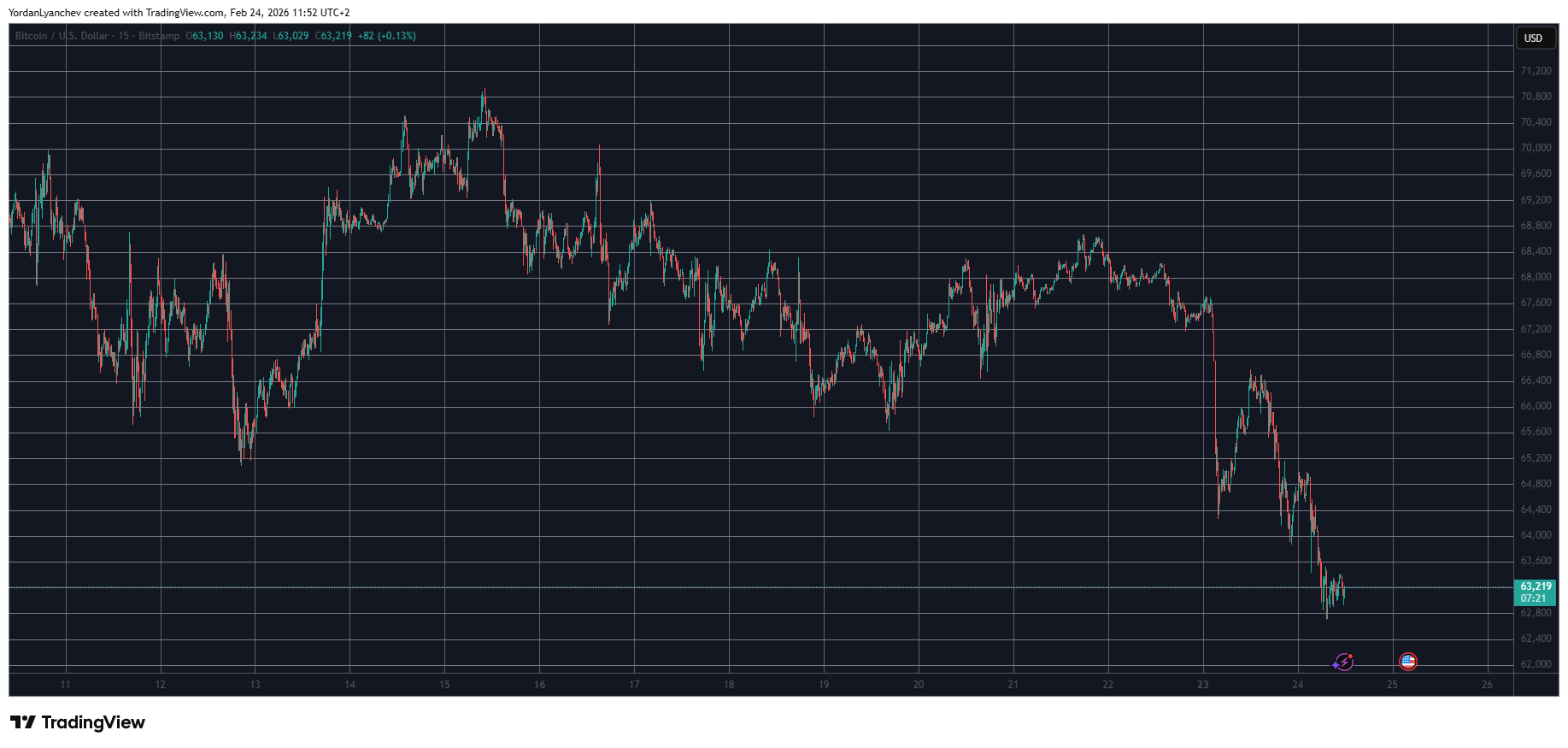
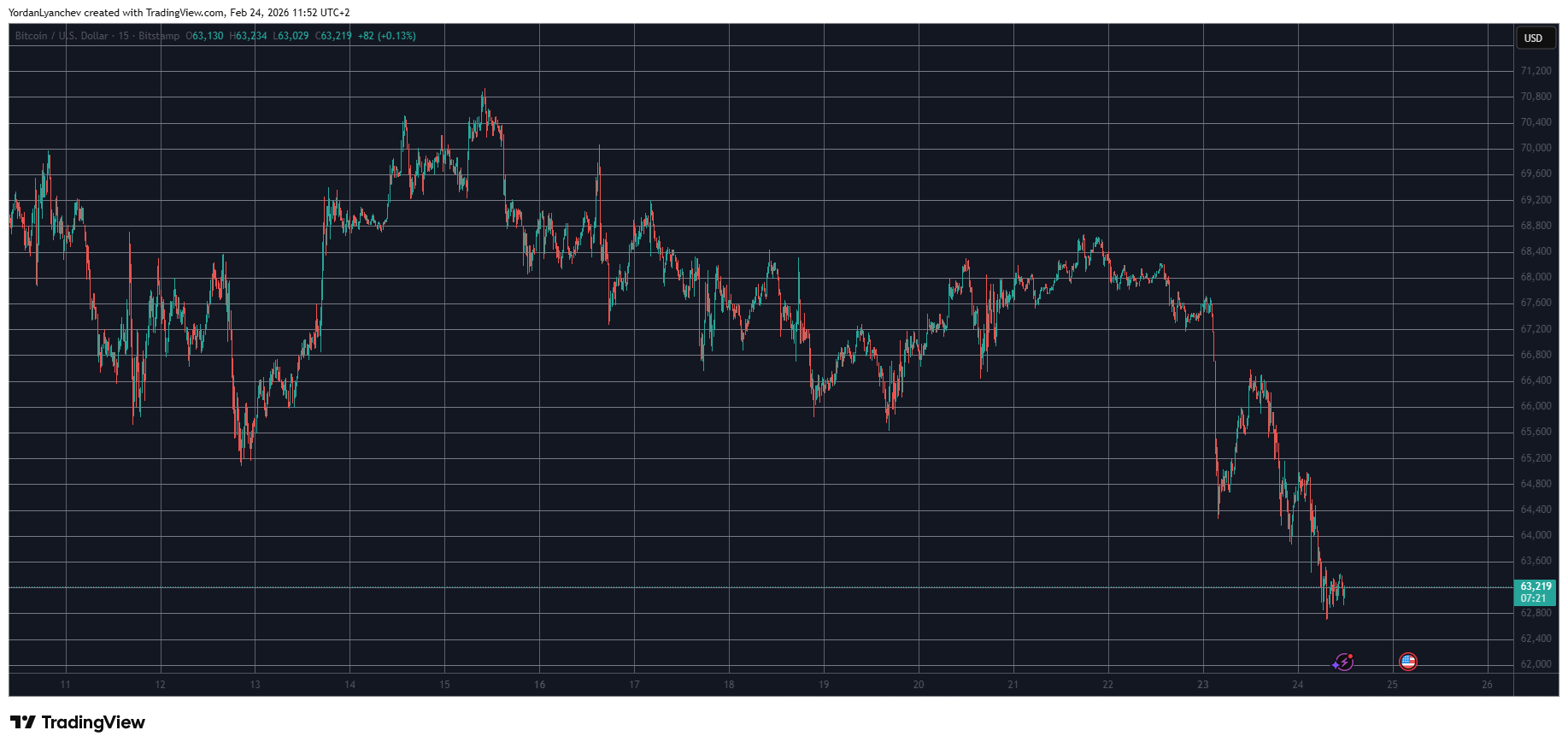
Bitcoin’s price continues its underwhelming performance, dropping to another multi-week low of under $63,000 earlier today.
The altcoins are bleeding out as well, with another day of multiple losses of more than 3%. Some, such as BCH, have dumped by over 10%.
BTC Slides Again
BTC was rejected at over $70,000 at the beginning of the previous business week, and its bounce-off attempt was halted in its tracks. The following few days were less volatile, as the cryptocurrency remained sideways between $67,000 and $68,500. It slipped to $65,600 on Thursday, but quickly rebounded and stood close to $69,000 during the weekend.
Despite the most recent developments on the tariff front, which included a new global taxation after the US Supreme Court ruled against Trump, BTC remained relatively stable at first. However, it nosedived once the legacy futures markets opened late on Sunday.
In just over an hour, it dumped from $67,700 to $64,400, leaving millions in liquidations. It bounced off to $66,500 mid-day, but the bears resumed control of the market and drove it south hard once again. Earlier today, the asset dipped below $63,000 for the first time since the February 6 crash, when it plunged to $60,000.
It trades inches above that line now, with its market cap dumping to $1.260 trillion. Its dominance over the alts has also been hit hard and is below 56% on CG now.
Alts Tumble
Ethereum continues to lose value rapidly as well, dumping by 5% daily to just over $1,800. XRP is down by 4.5% and struggles to remain above $1.30. BNB, SOL, and TRX have marked similar losses, while DOGE, ADA, and HYPE have plunged by over 5%.
Bitcoin Cash has dropped the most from the larger caps. The asset has shed over 11% of value and now sits below $485. ZEC, RAIN, UNI, SUI, WLFI, and many others are deep in the red as well.
In contrast, PIPPIN continues to chart gains, surging to a new all-time high of $0.80 after another 11.5% daily jump.
The total crypto market cap, though, has lost more than $150 billion since Sunday and is down to $2.260 trillion on CG.

Binance Free $600 (CryptoPotato Exclusive): Use this link to register a new account and receive $600 exclusive welcome offer on Binance (full details).
LIMITED OFFER for CryptoPotato readers at Bybit: Use this link to register and open a $500 FREE position on any coin!
Disclaimer: Information found on CryptoPotato is those of writers quoted. It does not represent the opinions of CryptoPotato on whether to buy, sell, or hold any investments. You are advised to conduct your own research before making any investment decisions. Use provided information at your own risk. See Disclaimer for more information.
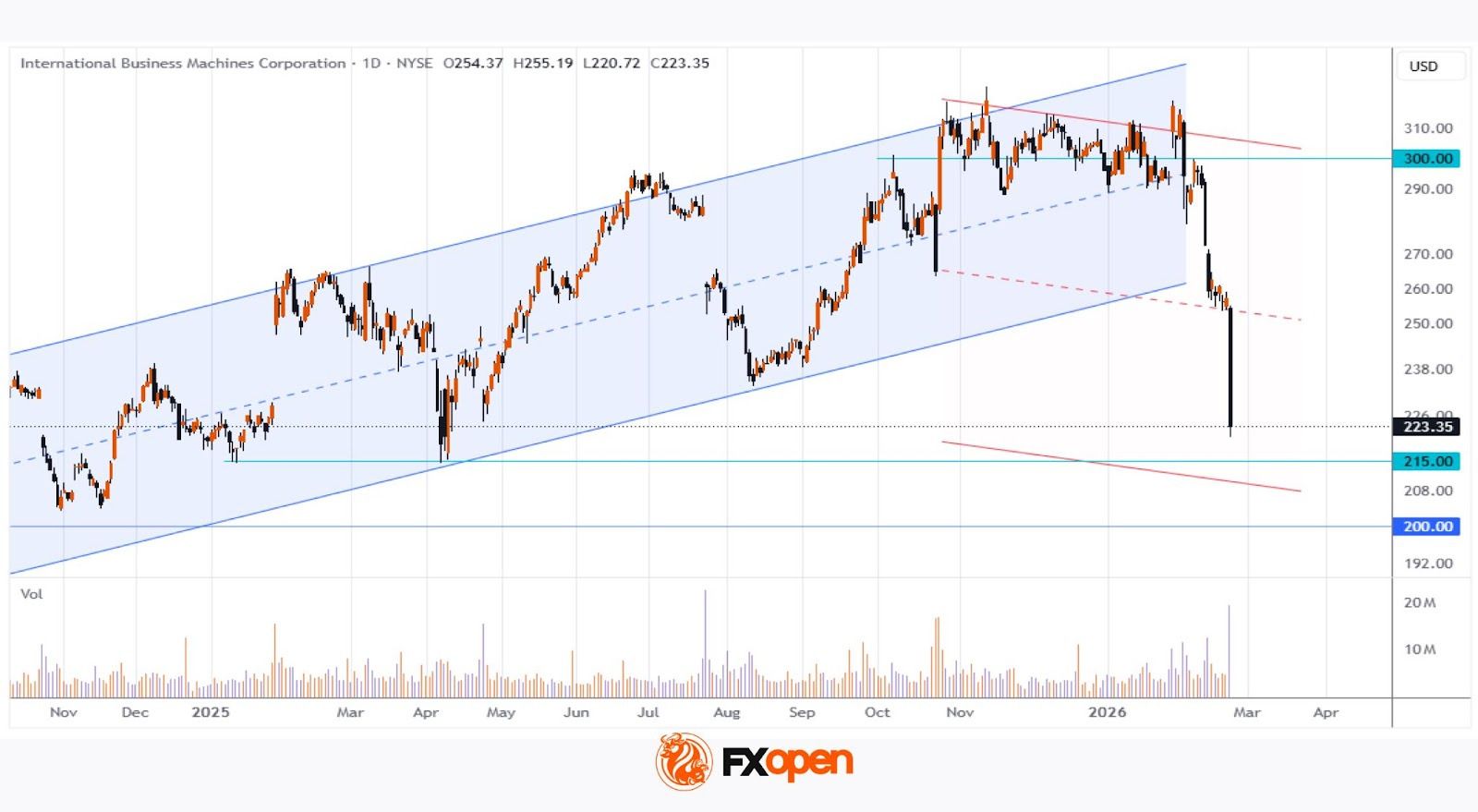
Yesterday, shares in IBM Corporation opened above $254 but closed below $224. By some estimates, this marked the company’s largest single-day decline in the past 25 years. Since the start of February, the stock has fallen by roughly 27%, its worst monthly performance since 1968.
Why Did IBM’s Share Price Drop?
The main trigger was an announcement by Anthropic about the launch of a new AI tool, Claude Code, designed to modernise legacy COBOL code.
This is particularly significant for IBM, as much of “Big Blue’s” business is tied to mainframes processing transactions for banks and government institutions in COBOL. Traditionally, upgrading such systems required “armies of consultants” and multi-billion-dollar budgets.
The new AI solution promises to automate this process, making it faster and more cost-effective. This not only poses a direct threat to IBM’s services and support revenues, but also reignites concerns that AI could reshape the entire technology sector, rendering established business models less sustainable.
Technical Analysis of IBM Shares
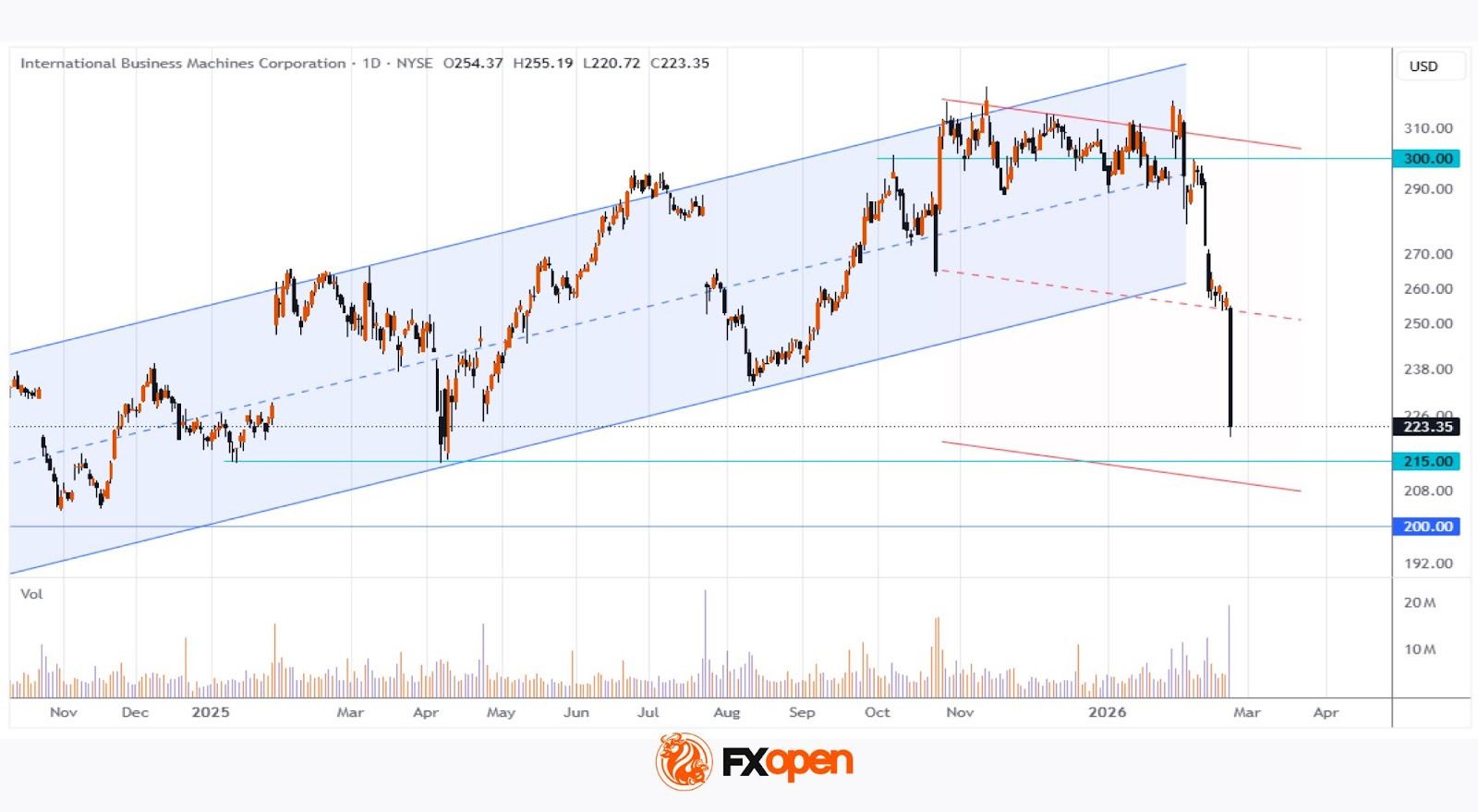
Throughout 2025, IBM stock traded within an ascending channel, but the psychological $300 level proved to be strong resistance. The price attempted to secure a foothold above it for several months, without success. The earnings release on 28 January turned into a bull trap and marked the beginning of an extraordinary sell-off, accompanied by rising volume on bearish candles — a sign of market weakness.
At the same time, several major analysts (including those at Goldman Sachs and Jefferies) have maintained or reiterated their “Buy” ratings. Their optimism is based on the view that panic surrounding Anthropic’s tool may be overstated, while IBM’s financial fundamentals remain solid.
Although the sharp downward momentum may continue in the near term, a support zone could emerge where several technical levels converge:
→ the psychological $200 mark;
→ the 2025 low around $215;
→ the lower boundary of an increasingly clear channel (shown in red).
Buy and sell stocks of the world’s biggest publicly-listed companies with CFDs on FXOpen’s trading platform. Open your FXOpen account now or learn more about trading share CFDs with FXOpen.
This article represents the opinion of the Companies operating under the FXOpen brand only. It is not to be construed as an offer, solicitation, or recommendation with respect to products and services provided by the Companies operating under the FXOpen brand, nor is it to be considered financial advice.


Decentralized finance (DeFi) portfolio tracker Step Finance said it will wind down operations effective immediately.
The Solana-based platform was subject to a hack at the end of January, which saw 261,854 SOL, worth roughly $27 million at the time, stolen.
Step said it was unable to secure a viable outcome following the hack after it “explored every possible path forward, including financing and acquisition opportunities,” in a post on X on Monday.
The project is working on a buyback for holders of native token STEP based on a snpashot of holdings and value prior to the incident.
STEP lost nearly 96% of its value following the incident, and is a further 36% lower in the last 24 hours after the closure announcement.
Step Finance was founded in 2021 and offered an aggregation of yield farms, liquidity provider (LP) tokens and other DeFi positions from a single platform.
Affiliate projects SolanaFloor, a Solana-focused media outlet, and tokenization platform Remora Markets, will also close.

TLDR:
- Ethereum Foundation stakes 70,000 ETH to generate yield for ecosystem operations.
- Validators use Dirk and Vouch for distributed signing and client diversity risk mitigation.
- Type 2 withdrawal credentials allow flexible balance management across validator accounts.
- EF launches a dedicated DeFi team to expand ecosystem projects and protocol research.
Ethereum Foundation Treasury Staking Initiative marks a new phase in the organization’s capital management strategy.
The Ethereum Foundation has started staking part of its treasury in line with its previously announced Treasury Policy.
On February 24, 2026, the Foundation confirmed a 2,016 ETH deposit. It also stated that about 70,000 ETH will be staked, with rewards directed back into the treasury to support ongoing operations.
Treasury Deployment and Validator Configuration
Through a post shared by the Ethereum Foundation’s official account, the organization confirmed the rollout of its Treasury Staking Initiative.
The update stated that approximately 70,000 ETH will be committed to staking. Rewards generated from validators will return to the Ethereum Foundation treasury.
The Ethereum Foundation selected open-source tools developed by Attestant. Dirk will function as a distributed signer across several geographic regions. This structure reduces single points of failure and supports validator continuity during localized disruptions.
Vouch will coordinate multiple Beacon and Execution client pairings. Its configuration strategies are designed to reduce client diversity risk. The Ethereum Foundation confirmed the use of minority clients to strengthen network resilience.
Infrastructure will combine hosted services with self-managed hardware across multiple jurisdictions. This approach distributes operational responsibility.
It also aligns with the Foundation’s stated objective of maintaining geographic and technical diversity within its validator set.
Validator Credentials and Operational Structure
The Ethereum Foundation confirmed that validators use Type 2 (0x02) withdrawal credentials. These credentials allow validator balances to move between accounts through consolidations. As a result, signing-key custody can be adjusted more efficiently.
Each validator can hold a maximum effective balance of 2,048 ETH. This configuration lowers the total number of required signing keys to about 35. Reduced key management simplifies operational oversight without changing staking exposure.
Like 0x01 credentials, exits can be triggered by the withdrawal address even if validators are offline. This setup provides additional operational flexibility. It ensures withdrawal authority remains independent from validator uptime.
The Ethereum Foundation also stated it will build blocks locally instead of using proposer-builder separation sidecars.
By participating directly in consensus through solo staking, the Ethereum Foundation earns ETH-denominated yield.
The organization confirmed that staking rewards will help fund protocol research, ecosystem development, and community grants while operating within Ethereum’s native economic framework.


Software stocks have faced notable market headwinds amid growing investor fears regarding artificial intelligence disruption.
The broader equity pullback is also raising concerns for Bitcoin (BTC), which has closely tracked software stocks.
Why Are Software Stocks Down?
According to the Global Markets Investor, the iShares Expanded Tech-Software Sector ETF (IGV) has fallen 15% in February alone, putting it on pace for its worst monthly performance since 2008. The ETF is now testing its April 2025 lows and sits roughly 35% below its peak.
“Software stocks are having their WORST month since the Great Financial Crisis,” the post read.
Artificial intelligence sits at the center of the recent drawdown, with investors selling shares of companies perceived as vulnerable to disruption by advancing AI tools. Two major developments in recent days have accelerated the downturn.
On February 20, Anthropic introduced “Claude Code Security,” a new capability embedded within Claude Code. The tool scans codebases for security vulnerabilities and recommends targeted patches for human review, aiming to detect and fix issues that traditional security tools may overlook.
The announcement triggered an immediate reaction across cybersecurity stocks. According to The Kobeissi Letter, CrowdStrike erased $20 billion in market value within two trading sessions. Furthermore, IBM shares fell more than 10%.
“The software selloff continues, w/cybersecurity stocks particularly hard hit following the release of Anthropic’s Claude Code Security due to fears that this code-focused tool will change the industry. This indicates that there is nowhere to hide when it comes to software stocks. Even the Goldman Sachs basket of supposedly AI-immune software stocks has come under heavy pressure recently,” said Holger Zschaepitz, Senior Editor at the Economic and Financial desk of the German daily Die Welt and its Sunday edition Welt am Sonntag.
Pressure intensified again on Monday after Citrini Research published a report. The report presents a hypothetical scenario set in June 2028 in which AI automation drives higher corporate profits.
At the same time, it models significant disruption to white-collar employment, weaker consumer demand, rising credit stress, and structural economic challenges.
“What follows is a scenario, not a prediction. The sole intent of this piece is modeling a scenario that’s been relatively underexplored. Hopefully, reading this leaves you more prepared for potential left tail risks as AI makes the economy increasingly weird,” the report read.
Following the report’s release, shares of delivery, payments, and software companies moved lower.
Rising Tech Volatility Tightens Grip on Bitcoin
The impact is not confined to traditional equity markets. Grayscale observed that Bitcoin’s price action closely mirrored US software stocks during the latest wave of selling.
Several market participants have highlighted the correlation between US software stocks and Bitcoin. This suggests that, rather than behaving as a hedge, Bitcoin has at times traded like a high-beta extension of the tech sector.
Thus, if software stocks continue to weaken, Bitcoin may also remain under pressure. Prolonged weakness in high-growth equities can contribute to tighter financial conditions through wealth effects, higher equity risk premia, increased volatility, and systematic deleveraging across high-beta assets, including cryptocurrencies.
However, a divergence remains possible. If investors begin to view Bitcoin as a monetary hedge against structural AI-driven labor disruption, currency debasement, or policy responses such as aggressive stimulus, its correlation with software equities could weaken.


Canaan Inc. (CAN), a manufacturer of bitcoin mining hardware and an operator of crypto mining infrastructure, said it bought a 49% equity interest in a joint venture tied to several mining projects in West Texas from Cipher Mining (CIFR) for $39.75 million in stock.
The transaction covers Cipher’s stake in the ABC Projects, which include Alborz LLC, Bear LLC and Chief Mountain LLC. The rest of the venture is owned by WindHQ, according to a Monday statement.
The purchase was funded through the issuance of 806.4 million Class A ordinary shares, equivalent to 53.8 million American depositary shares, and makes Cipher, a U.S.-based bitcoin mining company that develops and operates large-scale data centers, a major shareholder in Singapore-based Canaan. The shares are subject to a six-month lock-up.
Canaan shares fell 6% on Monday, while Cipher shares rose 4%. Cipher is scheduled to report fourth-quarter earnings before the market opens on Feb. 24.
The sites collectively operate 120 megawatts of energized power capacity and support approximately 4.4 exahashes per second (EH/s) of hashrate. Fleet efficiency stands at roughly 25.7 joules per terahash (J/TH).
As part of the agreement, Canaan also purchased 6,840 Avalon A15Pro mining rigs that were previously deployed at Cipher’s Black Pearl facility, which is being converted into an AI and high-performance computing data center.
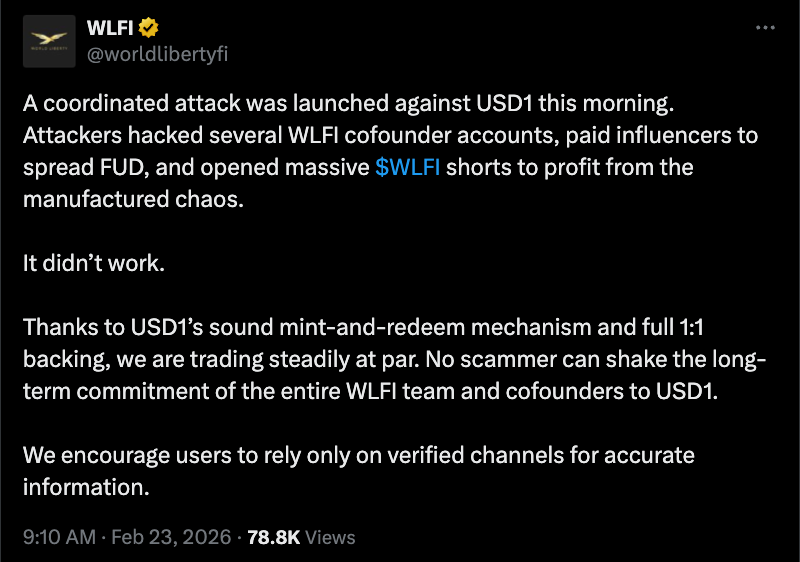
World Liberty Financial, the crypto company backed by US President Donald Trump and his sons, reported being targeted by hackers, “paid influencers” and short sellers in an effort to “manufacture chaos” against the USD1 stablecoin.
In a Monday X post, World Liberty said the attack, which happened earlier in the day, failed after hackers targeted “several WLFI cofounder accounts,” opened “massive shorts” against the company’s WLFI token, and “paid influencers to spread FUD [fear, uncertainty, and doubt].”
The price of WLFI dipped by about 7% amid the “manufactured chaos,” according to the company, but was trading at $0.1128 at the time of publication. USD1 similarly dropped to about $0.994, briefly losing its peg to the US dollar, before returning to more than $0.999.
“Thanks to USD1’s sound mint-and-redeem mechanism and full 1:1 backing, we are trading steadily at par,” said World Liberty. No scammer can shake the long-term commitment of the entire WLFI team and cofounders to USD1.”

The attack came just days after a World Liberty-organized crypto forum at Trump’s private Mar-a-Lago resort in Florida, which included speakers from the US government, crypto and banking industries, and former Binance CEO Changpeng Zhao, whom the president pardoned in October 2025. Forbes reported on Feb. 9 that Binance holds about 87% of the USD1 in circulation, worth about $4.7 billion at the time.
Related: OCC Comptroller says WLFI charter review will remain apolitical
Ties between WLFI and Binance are still under scrutiny
Some US lawmakers are questioning potential connections between World Liberty and Binance entities after Trump’s pardon of Zhao.
The former CEO had been barred from a leadership role at Binance as a result of a 2023 deal with US authorities in which he later served four months in prison, but the presidential pardon would effectively allow him to legally return. Zhao said in January that there were “no business relationships whatsoever” between himself and the Trump family, and he did not intend to return to lead Binance.
Both Bloomberg and The Wall Street Journal have reported that Binance helped create USD1. The stablecoin was also used to settle a $2 billion investment by UAE-based company MGX into Binance in March 2025, leading to conflict of interest accusations due to WLFI’s ties to the president’s family.
Magazine: Bitcoin’s ‘biggest bull catalyst’ would be Saylor’s liquidation: Santiment founder
Bostic: U.S. may face higher unemployment Fed cannot offset

Arizona advances bill to hold Bitcoin and XRP in state reserve

10 Greatest Sci-Fi Shows That Are Only 5 Seasons


-

 Video4 days ago
XRP News: XRP Just Entered a New Phase (Almost Nobody Noticed)
-

 Fashion4 days ago
Weekend Open Thread: Boden – Corporette.com
-

 Politics2 days ago
Baftas 2026: Awards Nominations, Presenters And Performers
-

 Sports16 hours ago
Women’s college basketball rankings: Iowa reenters top 10, Auriemma makes history
-

 Politics17 hours ago
Nick Reiner Enters Plea In Deaths Of Parents Rob And Michele
-

 Business6 days ago
Infosys Limited (INFY) Discusses Tech Transitions and the Unique Aspects of the AI Era Transcript
-

 Entertainment6 days ago
Kunal Nayyar’s Secret Acts Of Kindness Sparks Online Discussion
-

 Tech6 days ago
Retro Rover: LT6502 Laptop Packs 8-Bit Power On The Go
-
 Sports5 days ago
Clearing the boundary, crossing into history: J&K end 67-year wait, enter maiden Ranji Trophy final | Cricket News
-

 Business2 days ago
Mattel’s American Girl brand turns 40, dolls enter a new era
-

 Crypto World4 hours ago
XRP price enters “dead zone” as Binance leverage hits lows
-

 Business2 days ago
Law enforcement kills armed man seeking to enter Trump’s Mar-a-Lago resort, officials say
-

 Entertainment6 days ago
Dolores Catania Blasts Rob Rausch For Turning On ‘Housewives’ On ‘Traitors’
-
 NewsBeat1 day ago
‘Hourly’ method from gastroenterologist ‘helps reduce air travel bloating’
-

 Business6 days ago
Tesla avoids California suspension after ending ‘autopilot’ marketing
-

 Tech2 days ago
Anthropic-Backed Group Enters NY-12 AI PAC Fight
-

 NewsBeat2 days ago
Armed man killed after entering secure perimeter of Mar-a-Lago, Secret Service says
-

 Politics2 days ago
Maine has a long track record of electing moderates. Enter Graham Platner.
-

 Crypto World6 days ago
WLFI Crypto Surges Toward $0.12 as Whale Buys $2.75M Before Trump-Linked Forum
-

 Crypto World5 days ago
83% of Altcoins Enter Bear Trend as Liquidity Crunch Tightens Grip on Crypto Market