

Crypto World
Software Stocks Under Stress: Is Bitcoin at Risk?



Software stocks have faced notable market headwinds amid growing investor fears regarding artificial intelligence disruption.
The broader equity pullback is also raising concerns for Bitcoin (BTC), which has closely tracked software stocks.
Why Are Software Stocks Down?
According to the Global Markets Investor, the iShares Expanded Tech-Software Sector ETF (IGV) has fallen 15% in February alone, putting it on pace for its worst monthly performance since 2008. The ETF is now testing its April 2025 lows and sits roughly 35% below its peak.
“Software stocks are having their WORST month since the Great Financial Crisis,” the post read.
Artificial intelligence sits at the center of the recent drawdown, with investors selling shares of companies perceived as vulnerable to disruption by advancing AI tools. Two major developments in recent days have accelerated the downturn.
On February 20, Anthropic introduced “Claude Code Security,” a new capability embedded within Claude Code. The tool scans codebases for security vulnerabilities and recommends targeted patches for human review, aiming to detect and fix issues that traditional security tools may overlook.
The announcement triggered an immediate reaction across cybersecurity stocks. According to The Kobeissi Letter, CrowdStrike erased $20 billion in market value within two trading sessions. Furthermore, IBM shares fell more than 10%.
“The software selloff continues, w/cybersecurity stocks particularly hard hit following the release of Anthropic’s Claude Code Security due to fears that this code-focused tool will change the industry. This indicates that there is nowhere to hide when it comes to software stocks. Even the Goldman Sachs basket of supposedly AI-immune software stocks has come under heavy pressure recently,” said Holger Zschaepitz, Senior Editor at the Economic and Financial desk of the German daily Die Welt and its Sunday edition Welt am Sonntag.
Pressure intensified again on Monday after Citrini Research published a report. The report presents a hypothetical scenario set in June 2028 in which AI automation drives higher corporate profits.
At the same time, it models significant disruption to white-collar employment, weaker consumer demand, rising credit stress, and structural economic challenges.
“What follows is a scenario, not a prediction. The sole intent of this piece is modeling a scenario that’s been relatively underexplored. Hopefully, reading this leaves you more prepared for potential left tail risks as AI makes the economy increasingly weird,” the report read.
Following the report’s release, shares of delivery, payments, and software companies moved lower.
Rising Tech Volatility Tightens Grip on Bitcoin
The impact is not confined to traditional equity markets. Grayscale observed that Bitcoin’s price action closely mirrored US software stocks during the latest wave of selling.
Several market participants have highlighted the correlation between US software stocks and Bitcoin. This suggests that, rather than behaving as a hedge, Bitcoin has at times traded like a high-beta extension of the tech sector.
Thus, if software stocks continue to weaken, Bitcoin may also remain under pressure. Prolonged weakness in high-growth equities can contribute to tighter financial conditions through wealth effects, higher equity risk premia, increased volatility, and systematic deleveraging across high-beta assets, including cryptocurrencies.
However, a divergence remains possible. If investors begin to view Bitcoin as a monetary hedge against structural AI-driven labor disruption, currency debasement, or policy responses such as aggressive stimulus, its correlation with software equities could weaken.

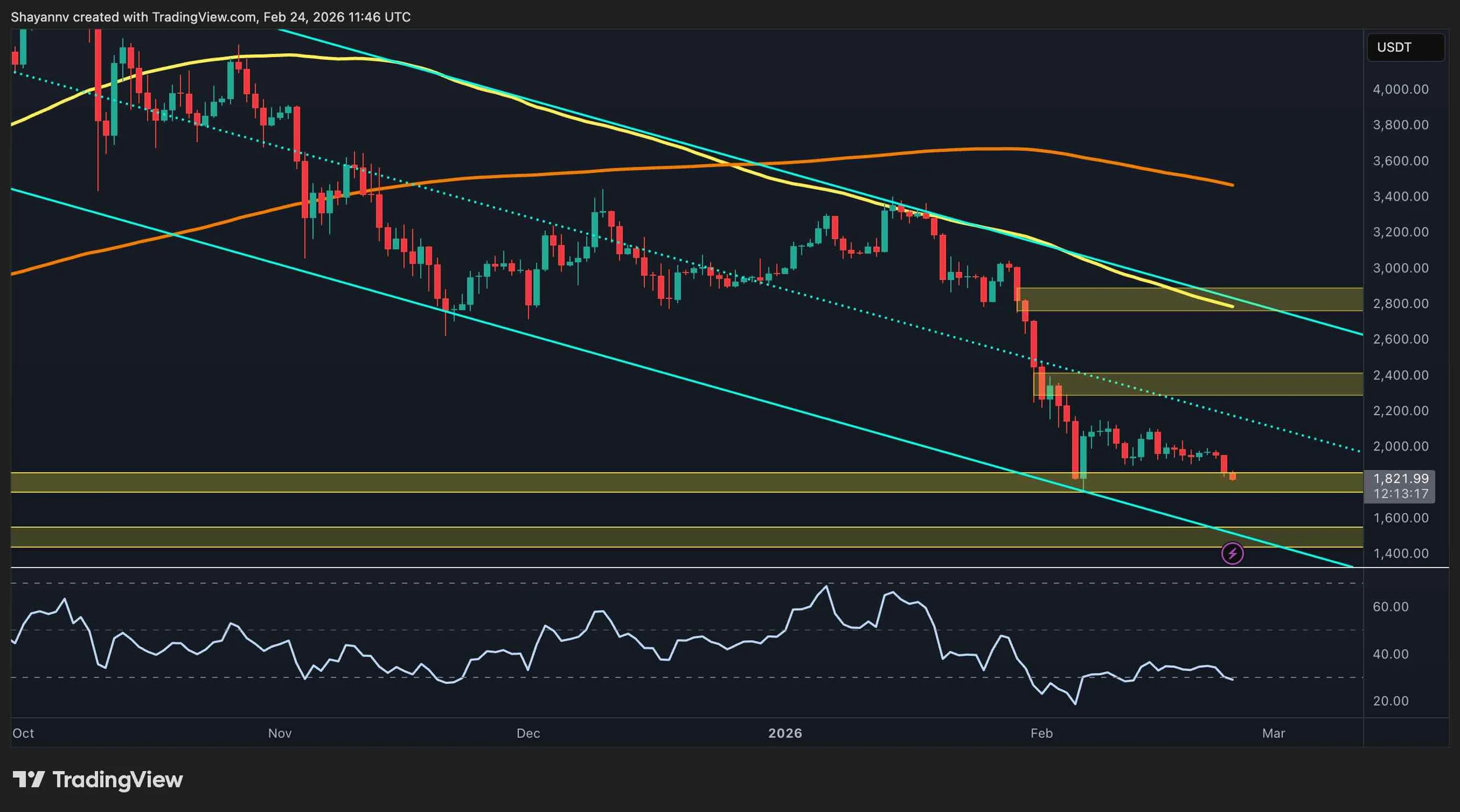
Ethereum remains under sustained downside pressure after the February liquidation cascade, with the price now stabilizing around the mid-$1,800s.
The broader structure still reflects a cyclical correction rather than a completed bottom, but short-term momentum has cooled, and the market is attempting to build a base above a major higher-timeframe demand region.
Ethereum Price Analysis: The Daily Chart
On the daily chart, ETH trades within a well-defined descending channel, with the price currently hugging the lower half of the structure near $1,800–$1,850. The breakdown from the $2,300–$2,400 support block and the rejection well below the declining 100-day and 200-day moving averages confirm a bearish medium-term trend, while the daily RSI remains depressed near oversold territory, consistent with a strongly extended move.
The immediate technical focus is the horizontal demand band around $1,750–$1,800, and sustained consolidation above this area could allow a mean-reversion bounce toward the $2,000–$2,200 zone, whereas a decisive loss of it would open the door toward deeper supports closer to $1,500–$1,600 and the lower boundary of the channel.
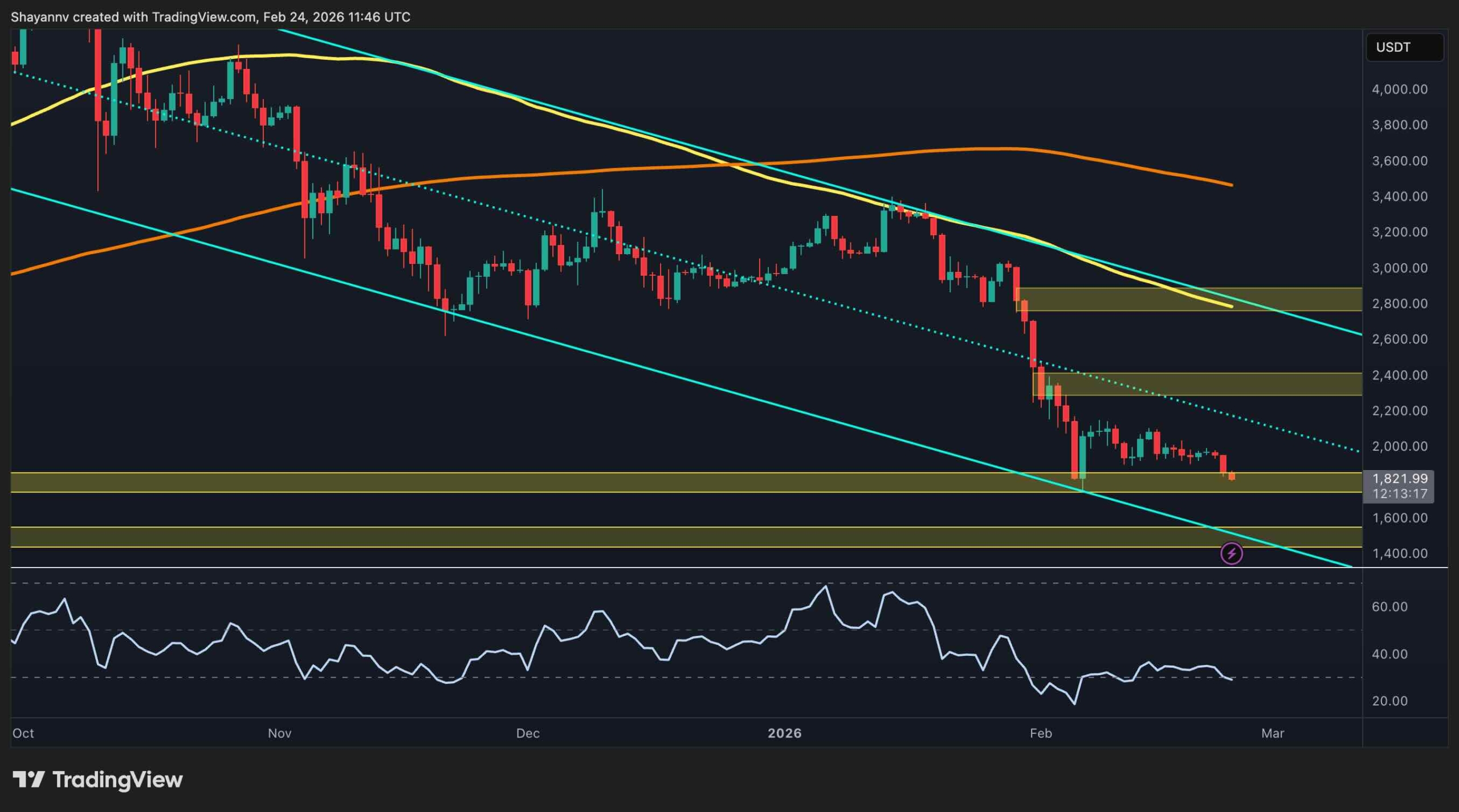
ETH/USDT 4-Hour Chart
On the 4-hour chart, the prior ascending support line originating from the early-February low has been broken, and the asset is now consolidating just below that trendline inside the same $1,750–$1,850 demand zone. Short-term momentum is weak but no longer accelerating lower, with the RSI flattening after an oversold print, which often precedes either a sideways consolidation or a corrective rebound.
As long as the market holds above the recent intraday lows around the $1,750 mark, the structure allows for a retracement back toward $1,900–$1,950, where the former range floor and short-term moving averages converge. Failure to defend the $1,780 area would likely trigger another round of selling toward the next liquidity pocket below $1,700.

On-Chain Analysis
Perpetual futures positioning reflects a markedly defensive stance: funding rates across major exchanges have flipped sharply negative and remain below zero after the recent decline, indicating that short positions are paying longs and that the derivatives market is skewed toward bearish exposure.
This shift follows a prolonged period of mostly positive funding during the prior uptrend, suggesting that a large portion of the current move has been driven by aggressive shorting and long liquidations rather than organic spot selling alone.
While persistent negative funding can reinforce downside pressure if spot demand stays weak, in combination with an oversold technical backdrop, it also creates the preconditions for a short squeeze should price stabilize and buyers step in around the present support cluster.

Binance Free $600 (CryptoPotato Exclusive): Use this link to register a new account and receive $600 exclusive welcome offer on Binance (full details).
LIMITED OFFER for CryptoPotato readers at Bybit: Use this link to register and open a $500 FREE position on any coin!
Disclaimer: Information found on CryptoPotato is those of writers quoted. It does not represent the opinions of CryptoPotato on whether to buy, sell, or hold any investments. You are advised to conduct your own research before making any investment decisions. Use provided information at your own risk. See Disclaimer for more information.
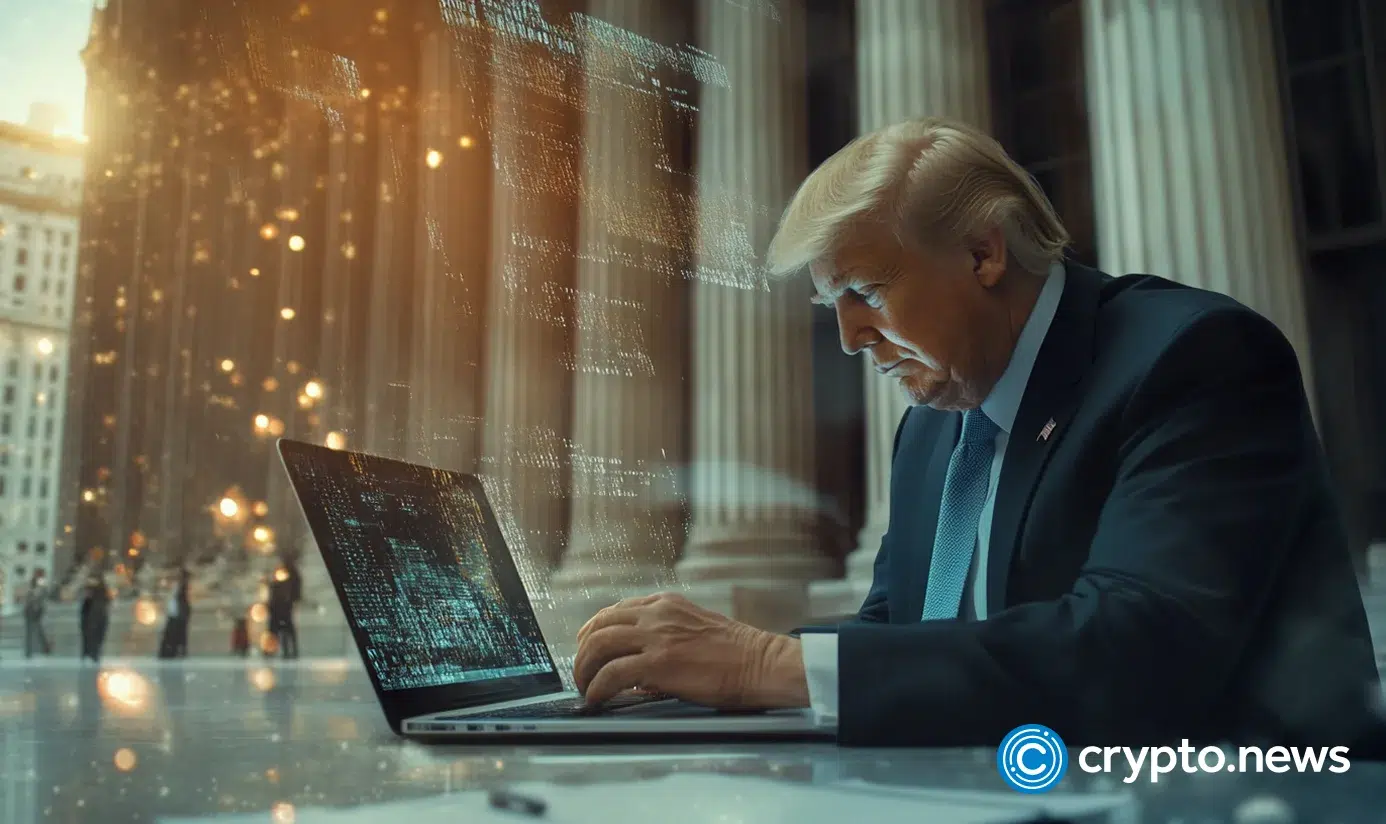
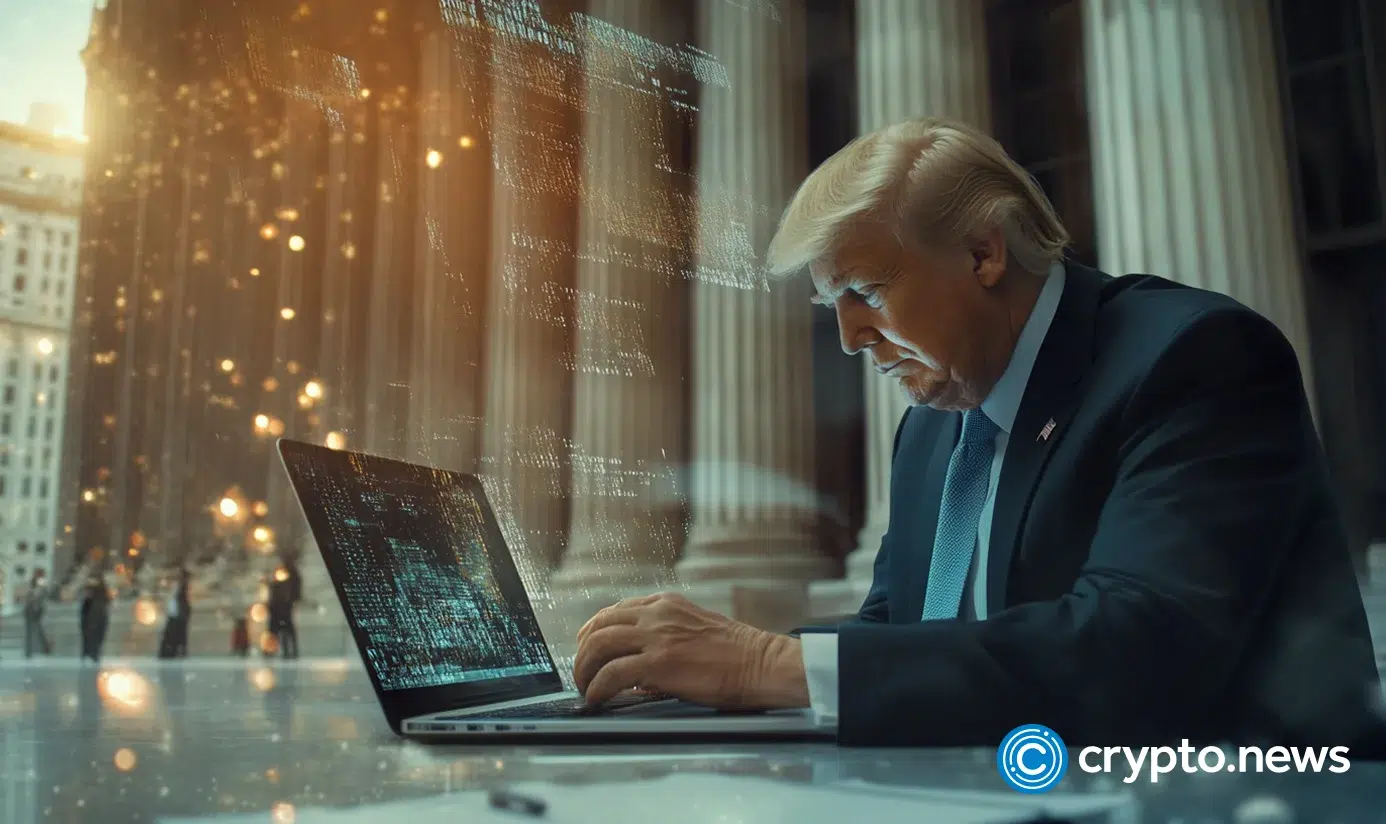
BTC swung violently around tariff headlines as ‘tariffs’ mentions spiked across crypto social media.
Summary
- Santiment data shows three major tariff announcements in the past year each triggered sharp jumps in “tariffs” mentions on X, Reddit and Telegram, aligning with key BTC inflection points.
- April 2025’s country-specific tariffs (60% on China, 25%-40% on Mexico, EU, Japan, India) saw retail discourse surge near a local market bottom, while a later 100% China tariff coincided with a BTC peak and 4‑month drawdown.
- Trump’s latest 15% global tariff, imposed despite a Supreme Court ruling against such measures, again sparked “tariffs” social dominance and fresh BTC selloffs, underscoring elevated macro and legal uncertainty.
Mentions of “tariffs” have spiked across cryptocurrency social media platforms following President Donald Trump’s announcement of a 15% global tariff on imports, according to data from market intelligence firm Santiment.
The surge in social media discussion mirrors previous episodes that coincided with significant price movements in Bitcoin markets, Santiment reported. Over the past year, three separate tariff announcements generated large increases in discourse across platforms including X, Reddit, and Telegram, each occurring near notable market shifts.
In April 2025, Trump introduced country-specific tariffs, including a 60% tariff on China and tariffs ranging from 25% to 40% targeting Mexico, the European Union, Japan, and India. Social media engagement around tariffs increased sharply as retail traders reacted to the policy announcement, according to Santiment. The spike in retail-driven discourse coincided with heightened volatility across cryptocurrency markets, the firm stated. That period aligned with a market bottoming process, with prices later stabilizing and recovering.
Five days after Bitcoin reached an all-time high, Trump announced a 100% tariff on Chinese imports. Social media volume spiked again, though the tariff was rescinded two days later. That period marked a peak before Bitcoin entered a four-month decline, according to market data.
The most recent announcement of a 15% global tariff follows a Supreme Court ruling declaring tariffs illegal, adding uncertainty to markets. Social media discussion surrounding tariffs has surged again, coinciding with renewed Bitcoin selloffs, Santiment data showed.
The geopolitical backdrop includes a legal dispute between federal authority and presidential power, extending uncertainty beyond economic policy into questions of institutional stability, analysts noted.
Santiment’s data indicates that large retail discourse spikes often coincide with emotionally charged phases in market cycles. The pattern observed over the past year shows extreme retail activity has aligned with local market bottoms, while aggressive policy announcements near price peaks have preceded extended corrections.
Bitcoin’s response to the current tariff situation will depend on broader liquidity conditions and macroeconomic stability, market observers stated. Until clarity emerges around policy enforcement and legal resolution, volatility is expected to remain elevated, according to market analysts.
Crypto World
Cipher Digital (CIFR) sinks premarket after revenue miss, bets big on hyperscale future


Cipher Digital (CIFR) shares fell about 5% in premarket trading after the company reported fourth-quarter results that missed Wall Street expectations and highlighted its shift away from bitcoin mining and toward high-performance computing (HPC) data centers.
The company, formerly known as Cipher Mining, reported fourth-quarter revenue of $60 million, below analyst estimates of $84.4 million. Adjusted earnings per share came in at a loss of $0.14, wider than the forecast loss of $0.06. Cipher posted an adjusted net loss of $55 million for the quarter.
Management pointed to 2025 as a transformative year as it pivots away from bitcoin mining and toward long-term HPC infrastructure. During the quarter, Cipher secured 600 megawatts of contracted capacity, including a 15-year, 300 megawatt (MW) lease with Amazon Web Services and a 10-year, 300 MW lease with Fluidstack and Google.
The company also raised $3.73 billion through three senior secured bond offerings to finance construction at its Barber Lake and Black Pearl data center projects, both of which remain on schedule.
Cipher divested its 49% stakes in three mining joint ventures for about $40 million in stock, further simplifying its structure as it transitions to a data center-focused business model.
Crypto World
Does Vitalik Buterin Even Like His Chain? Sells 10,000+ ETH as Ethereum Price Tests $1,800
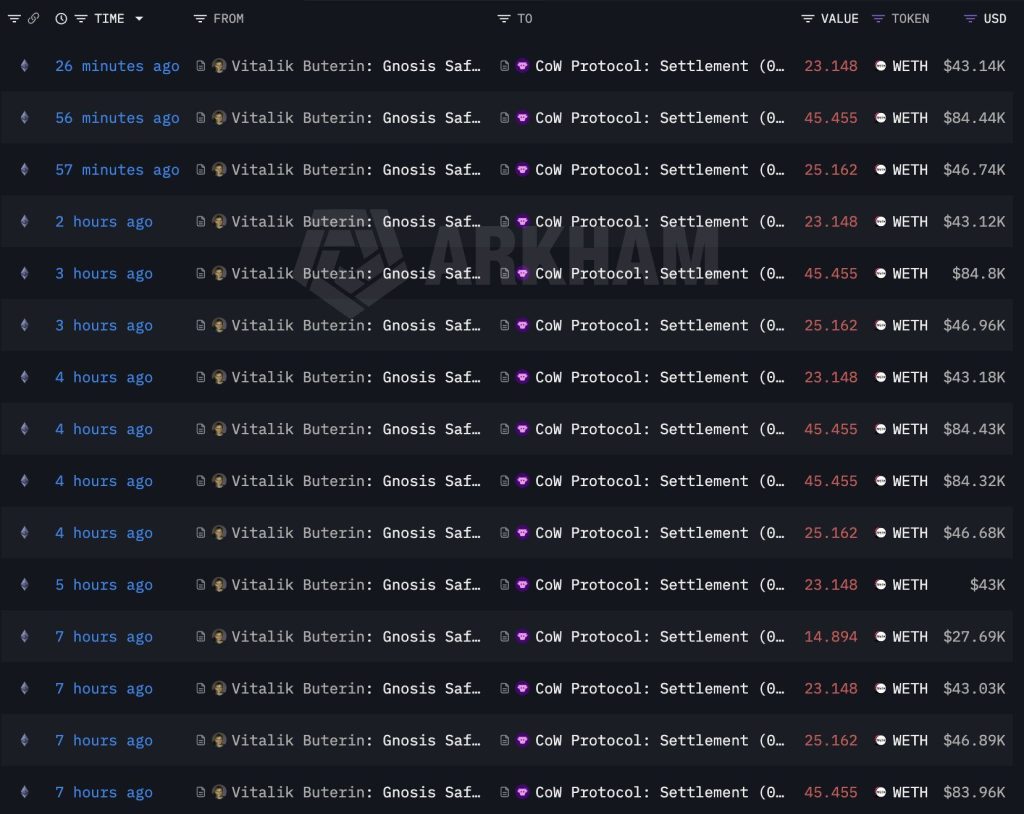
Vitalik Buterin has been selling as Ethereum price tumble. And some might think that he doesn’t like his chain or even crypto at all.
On chain data shows the Ethereum co founder liquidated 10,723 ETH, worth about $21.7M, since early February. The sales come at a sensitive moment, with Ether struggling to defend the $1,825 support zone.
The timing has raised eyebrows, but Buterin has said past sales are meant to fund open source work; steady founder selling during a weak market naturally feeds bearish sentiment.
Key Takeaways
- $21.7 Million Liquidated: Buterin has sold a total of 10,723 ETH since February 2, averaging a sale price of approximately $2,027 per token.
- Recent Acceleration: Data shows 3,765 ETH ($7.08 million) was sold in just the three days leading up to Feb. 24.
- Bearish Market Structure: The sales coincide with a 38% drop in ETH value over the last 30 days, currently testing support near $1,825.
The Ethereum Offloading Triggering Alarm?
A founder selling almost always spooks the market, no matter the reason, and Buterin said the funds are going toward open source and security-focused projects. Still, more than 10,000 ETH hitting the market creates real sell pressure.
Traders are not just reacting to the $21.7M already sold. They are watching what could come next. The original allocation was 16,384 ETH, meaning roughly 6,000 ETH may still be unloaded.
The sales began on February 2 and continued through the month. The most aggressive selling occurred recently, with 3,765 ETH sold for $7.08 million between Feb. 21 and Feb. 24.
The average execution price across these three weeks sits at $2,027. With Ethereum currently trading around $1,825, Buterin effectively front-ran the latest 10% leg down.
Ethereum Price Could Dip To $1,500 Is Very Likely Now
Ethereum’s structure has clearly weakened after losing the $2,000 psychological level.
The daily chart shows a confirmed bear flag breakdown. RSI is hovering near oversold, but MACD has not flashed a bullish crossover, so momentum still favors sellers.
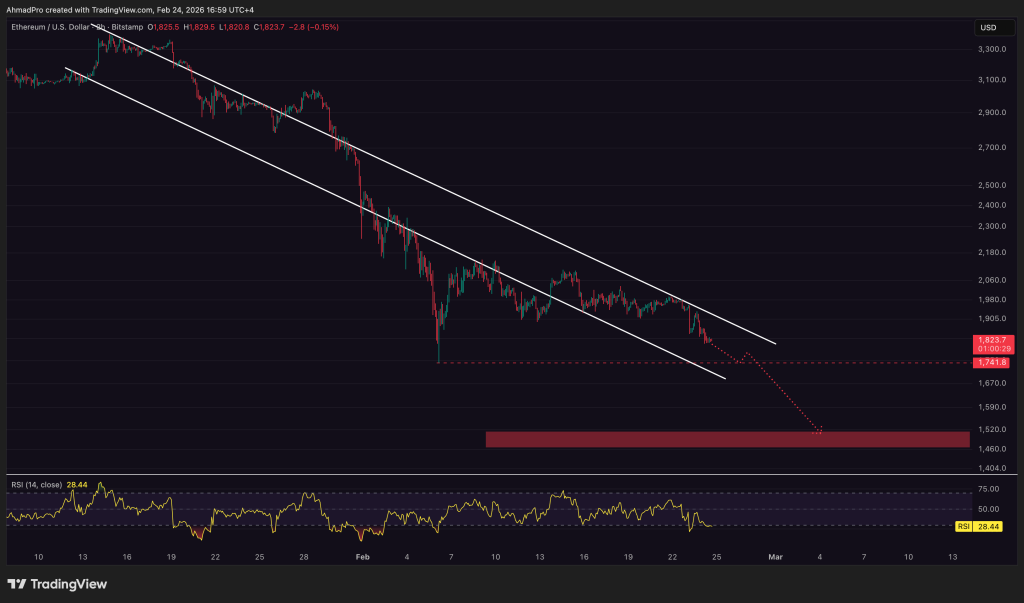
Immediate support sits around $1,800. A daily close below that opens the door to the $1,500 zone, where liquidity previously built up. The 50-day EMA has also crossed below the 200-day EMA, forming a classic death cross that reinforces the downtrend.
To invalidate the bearish setup, bulls would need to reclaim $2,150 with strong volume. Until that happens, rallies are likely to face selling pressure, especially with continued founder distribution adding supply.
Watch the $1,780 to $1,820 range closely. A bounce could shape a double bottom. A clean break lower, and $1,475 becomes the next logical target.
Discover: Here are the crypto likely to explode!
The post Does Vitalik Buterin Even Like His Chain? Sells 10,000+ ETH as Ethereum Price Tests $1,800 appeared first on Cryptonews.

TLDR
- Amazon is investing $12 billion in data centers across northwest Louisiana, in Caddo and Bossier Parishes
- The project will create 540 full-time jobs and is being developed with STACK Infrastructure
- Amazon will fund 100% of construction costs plus up to $400 million in local water infrastructure
- 2026 capital spending is forecast at $200 billion, up from $131 billion in 2025
- AMZN is down 11% year-to-date; Wall Street has a Strong Buy consensus with a $282.21 average price target
Amazon is spending $12 billion to build data centers in Louisiana, marking one of its largest single-state infrastructure commitments to date.
The facilities will be built across Caddo and Bossier Parishes in the northwest of the state, in partnership with STACK Infrastructure. Amazon says it will cover 100% of the construction costs and is working with local utility Southwestern Electric Power Company on power infrastructure needs.
The project is expected to create 540 full-time jobs, with additional roles needed for ongoing support — electricians, HVAC technicians and similar trades.
Addressing Local Concerns
Data center projects have faced resistance in some communities due to strain on power grids and high water usage. Amazon is moving to address both.
The company plans to invest up to $400 million in public water infrastructure near the sites and says water use will be limited to cooling and operational purposes. It has also pointed to prior solar investments in Louisiana that added up to 200 MW of carbon-free energy to the state’s grid.
Part of a Much Bigger Spending Plan
The Louisiana announcement fits into Amazon’s broader capital expenditure strategy. During Q4 earnings earlier this month, Amazon said it expects to spend $200 billion in 2026 — up sharply from $131 billion in 2025.
That number hit AMZN stock hard. The stock dropped after the earnings release and is now down about 11% year-to-date, closing Monday at $205.27 after a 2.3% single-day drop.
Asked whether the $12 billion Louisiana figure sits inside that $200 billion plan, Amazon gave a non-committal answer — saying it “regularly makes investment announcements at the federal, state, and local level” that “often occur over many years.”
Tech companies as a group have committed at least $630 billion in capital spending this year, driven by AI infrastructure demand. Louisiana is becoming a notable destination — Meta Platforms has also chosen the state for its Hyperion data center, part of a $27 billion joint venture with Blue Owl Capital.
What Wall Street Thinks
Despite the stock’s slide, analyst sentiment on AMZN remains firmly positive. Out of 43 analysts covering the stock, 40 rate it a Buy and three say Hold. The average price target is $282.21 — implying around 37.5% upside from current levels.
AMZN stock is down 11% year-to-date as of the latest close.
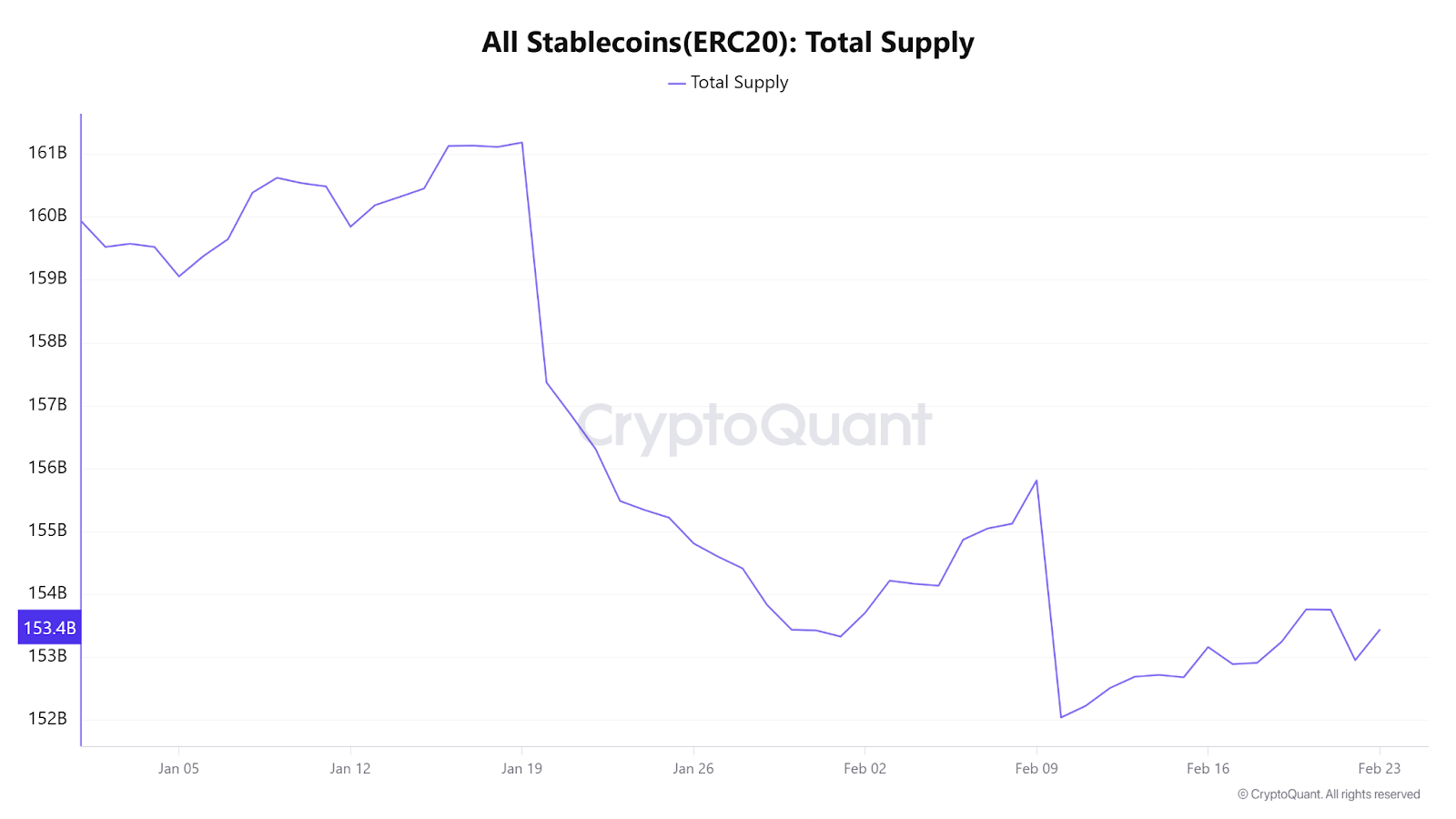
Shrinking crypto market liquidity is a concerning sign for crypto asset valuations, as investors gravitate towards safe-haven assets like precious metals amid growing global trade uncertainty.
The stagnating stablecoin supply is presenting a “notable headwind” for Bitcoin (BTC) and the broader crypto ecosystem, according to Matrixport. “Stablecoins serve as the primary liquidity rail within digital assets and stagnation in supply often signals that capital is being off-ramped back into fiat rather than redeployed within crypto markets,” said the digital asset platform in a Tuesday X post.
The stablecoin supply has fallen by $5.6 billion year-to-date, from $159 billion on Jan. 1, to $153.4 billon on Tuesday, according to analytics platform CryptoQuant. Stablecoin reserves on the leading crypto exchange, Binance, also shrank by 19% since November 2025, Cointelegraph reported earlier on Tuesday.

Bitcoin no longer trading like “digital gold,” says CryptoQuant CEO
Bitcoin also appears to be decoupling from gold in the short term. BTC’s 90-day Pearson correlation with gold has turned negative, falling near -0.75, according to analytics platform CryptoQuant.
The Pearson correlation measures how closely the returns of Bitcoin and gold move together at a given period, with a -1 marking a perfect negative correlation.
“Bitcoin is in a ‘not digital gold’ period,” said Ki Young Yu, the founder and CEO of CryptoQuant, in a Tuesday X post.

Tariff uncertainty, precious metal rotation are thinning crypto liquidity: analyst
The backdrop has been complicated by renewed tariff uncertainty. On Saturday, US President Donald Trump announced a global tariff plan that has fueled uncertainty, with a 10% rate taking effect while an increase to 15% has been discussed.
Related: Tether USDT supply set for biggest monthly decline since 2022 FTX collapse
The renewed geopolitical concerns are accelerating the crypto capital exodus towards precious metals, according to crypto exchange Bitget’s chief analyst, Ryan Lee.
The tariff fears are limiting the upside of digital assets, which are now competing with other defensive and growth assets, the analyst told Cointelegraph, adding:
“The ongoing slide in Bitcoin and Ethereum reflects a broader risk-off macro backdrop, where tariff uncertainty, geopolitical tensions, and capital rotation into precious metals and AI-linked equities have thinned crypto liquidity and weakened narratives.”
Crypto market upside will remain limited until “recovery catalysts” such as clearer US policy or more “constructive” Federal Reserve signals emerge on interest rate cuts, added Lee.
Related: Bitcoin treasuries log rare selling streak as BTC trades near $66K
The precious metal rotation is also visible in the charts, as gold and silver rose 19% and 21% year-to-date, respectively, while Bitcoin’s price fell by 27%, according to TradingView.

Tokenized real-world-assets (RWAs) are also showing signs of a rotation towards safe-haven assets, as Tehter Gold’s (XAUT) value rose 20% to $2.7 billion during the past 30 days, while holders increased by 33%, data from RWA.xyz shows.

The tokenized commodities market surpassed $6 billion on Feb. 11, logging an 53% increase in less than six weeks, as more gold investment moved on the blockchain.
Magazine: Bitcoin’s ‘biggest bull catalyst’ would be Saylor’s liquidation — Santiment founder

Russian authorities have opened a criminal case against Pavel Durov, the co‑founder and chief executive of Telegram, in what state media describe as an investigation into the alleged facilitation of terrorist activities. Rossiyskaya Gazeta, the official government newspaper, reported on February 24, 2026 that the Federal Security Service (FSB) is pursuing the case, with Kremlin spokesperson Dmitry Peskov confirming that the matter rests on materials produced by the FSB as part of its operational duties. The development marks a significant escalation in Russia’s ongoing scrutiny of Telegram, coming as state regulators previously tightened restrictions on the platform in early February. Telegram has not publicly responded to the reports by the time of publication, and attempts by media and Reuters could not secure an immediate comment from the company.
Key takeaways
- The case centers on allegations that Telegram facilitated terrorist activities, with the FSB providing the core evidentiary basis for investigators.
- Roskomnadzor, Russia’s communications watchdog, expanded and intensified restrictions on Telegram in early February, signaling a broader push to curb perceived extremist content on the platform.
- Telegram has reportedly refused to remove material flagged as extremist content, and authorities are considering whether the platform itself could be designated extremist, which would carry additional legal risks for users and the service.
- Analysts warn that a formal label of extremism could complicate or criminalize certain financial transactions on the platform, including payments for premium services and advertising, if such activity is deemed to facilitate prohibited activity.
- Pavel Durov argues the pressure is a broader political maneuver aimed at steering users toward a state-backed messenger, MAX, and he has pointed to similar attempts in other countries, including Iran, where authorities have sought to restrict usage while many citizens continue to favor Telegram for privacy and free expression.
Market context: The case in Russia emerges amid a broader global tightening of regulation around encrypted messaging services and online content moderation. Regulators in multiple jurisdictions are weighing how to balance security concerns with privacy and freedom of expression, a dynamic that increasingly intersects with fintech and digital payments as platforms expand into financial services and commerce.
Why it matters
The investigation underscores the vulnerability of large messaging platforms to state demands for content control in environments where authorities maintain broad powers to regulate information flows. For Telegram users in Russia and abroad, the case raises questions about access, censorship, and the potential criminalization of routine platform use in the event of extremism labeling. While Telegram has built a reputation for privacy protections and opposition to state surveillance, governments exploring how to police content on messaging apps could reconfigure the operating risks for the service and its users. The tension also highlights how geopolitical friction can spill over into digital platforms that cross borders, complicating compliance for a service with a global user base.
Beyond the immediate regulatory landscape, the incident feeds into a longer-running debate about how tech platforms should be regulated when they serve as conduits for information, finance, and social organization. Durov’s public comments and the high-profile nature of the investigation may influence both user sentiment and the strategic choices Telegram makes as it navigates competing demands from regulators, advertisers, and users who prize a degree of privacy and uncensored communication. The ongoing scrutiny also has implications for developers, investors, and policymakers who watch how platforms respond to perceived security risks while balancing civil liberties on an increasingly complex digital stage.
From a geopolitical perspective, the Russian case sits at the intersection of domestic policy and international diplomacy. Durov has framed the pressure as part of a broader effort to promote a state-controlled alternative messenger, a theme that has resonances in other jurisdictions where authorities seek to shape the digital communications landscape. While Russia emphasizes extremism and national security, observers note that the outcomes could influence global norms around the governance of encrypted messaging apps, particularly for platforms that operate across a mosaic of regulatory regimes and market priorities.
What to watch next
- Any formal public statements from the FSB or Roskomnadzor outlining the charges, evidence, or procedural steps in the case against Durov.
- Developments in Russia’s regulatory stance toward Telegram, including whether the platform faces further restrictions or a potential extremism designation.
- Responses from Telegram regarding the investigation, including any new compliance measures or policy changes in Russia or elsewhere.
- Related legal actions or investigations in other countries, such as France, where Durov has faced inquiries, and any outcomes that could affect cross-border service provisions.
- Any changes in the global regulatory environment for encrypted messaging services and how those shifts could impact user access and platform opportunities in the crypto and digital payments space.
Sources & verification
- Rossiyskaya Gazeta report detailing the FSB-led criminal probe and referencing the Kremlin spokesperson’s confirmation.
- Statement attributed to Dmitry Peskov confirming the investigation and referencing FSB materials.
- Roskomnadzor’s reported tightening of Telegram restrictions in early February as covered by major Russian tech outlets.
- Public reporting on Telegram’s response or lack thereof, and coverage of Durov’s broader legal exposure, including investigations abroad.
Russian case against Durov sheds light on Telegram’s regulatory pressure
Russia’s latest move against Telegram places Pavel Durov at the center of a high-stakes intersection between digital freedom, security, and the state’s capacity to police online content. The FSB’s involvement signals a level of scrutiny that goes beyond routine regulatory complaints, elevating the Telegram platform into the realm of criminal investigations when linked to alleged facilitation of extremist activity. Rossiyskaya Gazeta’s reporting on February 24, 2026, describes a case that is being handled with the involvement of the country’s premier security institution, a development that could have lasting implications for both the platform’s operations in Russia and its reputation globally.
The Kremlin’s confirmation, via Dmitry Peskov, that the investigation rests on FSB materials, reinforces the perception that Moscow regards Telegram as a strategic communications channel with potential cross-border impact. While the exact charges remain undisclosed in public materials, the use of criminal procedures in this context signals a hardening stance toward platforms that resist state-directed content moderation. The case aligns with a broader push by Roskomnadzor to tighten the screws on messaging apps, particularly those with robust privacy features and the capacity to host large volumes of user-generated content outside centralized control.
Telegram’s stance has been consistently positioned as a defense of user privacy and a refusal to remove content that authorities deem extremist or harmful. This friction is illustrated by the ongoing tension surrounding content moderation, with Russian regulators insisting on compliance and the platform resisting what it views as overreach. The numbers cited by state-connected outlets—namely, that roughly 155,000 channels, chats, and bots have not been removed in response to local requests—underscore the scale of Telegram’s footprint in Russia and the challenge regulators face in enforcing content rules across a platform that migrates between jurisdictions and languages. The broader implication is that a potential extremism designation could alter Telegram’s business model, affect user access, and complicate any monetization strategy anchored to the platform’s freedom of use.
Industry observers have flagged that the extremism label could carry far-reaching consequences beyond speech restrictions. German Klimenko, a former adviser to the Russian president on internet policy, warned that such a designation could criminalize payments related to Telegram Premium subscriptions and advertising on the platform. This kind of impact would affect not just end users but also service providers and advertisers who rely on Telegram as a channel for outreach and revenue. The possibility of criminal penalties or significant legal exposure for seemingly routine activities signals a broader risk landscape for digital platforms operating in regulated environments where state interests are closely aligned with national security imperatives.
Durov has publicly framed the investigation as part of a broader strategy to push users toward a state-backed messenger known as MAX, a claim that dovetails with his long-standing emphasis on privacy and freedom of expression. He has drawn parallels with other jurisdictions, including Iran, where authorities have attempted to restrict access to messaging apps while users continue to rely on them. In a February post on his Telegram channel, Durov argued that restricting citizens’ freedom is not a legitimate response and reiterated Telegram’s mission to defend privacy and speech rights in the face of pressure. This framing places Telegram’s predicament within a broader debate about how states balance security concerns with civil liberties in the digital era.
The legal and political dynamics surrounding Durov’s case extend beyond Russia’s borders. Durov’s international exposure—captured in ongoing inquiries abroad and previously including an arrest in France in 2024 and a travel ban that was lifted in 2025—illustrates how actions in one jurisdiction can resonate across multiple regulatory environments. The French developments, though not resolved in the public sphere at the time, emphasize that Telegram’s legal and regulatory challenges are not confined to a single country. As regulators and lawmakers reassess the balance between security, privacy, and platform openness, Telegram’s approach to compliance and user protection will likely shape the trajectory of encrypted messaging apps in the coming years. In the Russian context, the FSB-backed investigation remains a focal point for observers seeking to gauge how far the state will go in policing online communications and what this means for services that operate globally but must navigate local laws.


XRP products gained ~$3.5m last week while crypto funds lost ~$288m.
Summary
- Crypto investment products saw ~$288m in weekly outflows, extending a five-week streak that has pulled about $4b from digital asset funds amid the lowest trading volumes since mid‑2025.
- BTC products lost ~$215m last week, taking YTD outflows to ~$1.3b, while ETH, TRX and multi‑asset products saw ~$36.5m, ~$18.9m and ~$32.5m exit respectively; short‑BTC vehicles drew ~$5.5m in fresh capital.
- XRP drew ~$3.5m of inflows on the week and ~$33.4m the week before, lifting month‑to‑date and YTD inflows to about $105m and $151m; SOL added ~$3.3m and LINK ~$1.2m over the same period.
XRP (XRP)-linked investment products attracted approximately $3.5 million in net capital inflows last week, even as broader cryptocurrency products experienced outflows totaling $288 million, according to the latest CoinShares weekly flow report.
The data marks the fifth consecutive week of net withdrawals from crypto investment vehicles, pushing cumulative outflows to approximately $4 billion over this period, the report stated. Trading volumes have declined to their lowest levels since July 2025.
The United States represented the largest source of global outflows, with investors withdrawing $347 million in a single week, according to the report. In contrast, Switzerland recorded $19.5 million in inflows, Canada added $16.8 million, and Germany attracted $16.2 million, totaling approximately $59 million in combined inflows.
Bitcoin-linked investment products recorded $215 million in outflows during the week, pushing year-to-date withdrawals to around $1.3 billion, the data showed. Ethereum-related products experienced $36.5 million in weekly outflows, while Tron-related products recorded $18.9 million in outflows and multi-asset products saw $32.5 million exit. Short-Bitcoin products attracted $5.5 million in inflows, according to CoinShares.
XRP remained among the few cryptocurrencies to attract new capital during the market pullback, drawing $3.5 million in fresh inflows last week and $33.4 million the week prior, the report stated. The token’s month-to-date inflows reached $105 million, with year-to-date inflows totaling $151 million.
Solana-linked products recorded inflows of $3.3 million last week, bringing its month-to-date total to approximately $41.6 million and its year-to-date figure to about $102.5 million, according to the data. Chainlink products attracted $1.2 million in inflows.
The divergence in flows suggests investors are reallocating capital within the cryptocurrency sector rather than exiting entirely, according to market analysts. XRP trades at a lower price point than Bitcoin, potentially lowering barriers to entry for some investors. The token has also benefited from regulatory clarity following legal proceedings, analysts noted.
Total crypto trading volume fell to its lowest level since mid-2025, reflecting reduced market participation, the CoinShares report indicated.


DOGE has slid below key weekly MAs, risking a drop toward $0.06 on weak volume and downside Bollinger pressure.
Summary
- DOGE trades below weekly 8 EMA, 34 EMA, 50 SMA and 200 SMA, keeping structure bearish until reclaimed.
- Price sits near the lower Bollinger Band with low volume, reinforcing downside risk toward the analyst’s $0.06 target.
- DOGE recently broke below the Oct. 10 crash low; next support aligns with the August 2024 bottom near prior weekly demand.
A cryptocurrency analyst has warned that Dogecoin (DOGE) could decline to $0.06, citing technical indicators that suggest continued downside pressure, according to a chart analysis posted on social media.
The analyst shared a weekly chart from TradingView showing the memecoin trading below multiple key moving averages on the Coinbase exchange, according to the post reviewed by NewsBTC.
The technical setup shows Dogecoin trading beneath the 8-period exponential moving average (EMA), 200-period simple moving average (SMA), 34-period EMA, and 50-period SMA, according to the chart. The positioning below these indicators suggests the weekly structure remains weak unless the price can reclaim those levels, the analyst stated.
Bollinger Bands displayed on the same chart place the asset closer to the lower band than the midline, consistent with downside pressure on the weekly timeframe, according to the analysis. The analyst’s $0.06 target would represent a move below the displayed lower Bollinger Band, framing the projection as a deeper continuation scenario.
The chart indicates continued low trading volume, with the price sliding after failing to hold higher levels visible earlier in the cycle, according to the data.
The token has fallen below the October 10 crash low, the chart shows. The next support level could be near a previous price point visited three weeks ago, which also marked the August 2024 bottom, according to the analysis.
The analyst’s thesis rests on the premise that the asset remains below near-term and medium-term trend references, with buyers needing to reclaim weekly indicator levels, starting with the EMA 8, to invalidate the bearish outlook.
Dogecoin, originally created as a satirical cryptocurrency, has experienced significant volatility throughout its trading history and remains one of the most widely traded memecoins by market capitalization.
TLDR:
- Bitcoin remains trapped in the $64K–$67K range, failing multiple attempts to breach $70K.
- Macro rotation favors commodities, gold, and industrials, pressuring high-beta assets.
- Crypto derivatives show weak conviction: low basis, rising put skew, declining open interest.
- Short-term recovery bids are absent; the market is defensive, and early positioning lacks institutional support.
Bitcoin continues to trade within a tight $64,000–$67,000 range, unable to reclaim the $70,000 level after a recent liquidation event.
Market analysts at Wintermute note that BTC is increasingly behaving like a high-beta growth asset, moving in line with some large-cap altcoins.
Institutional demand remains muted, derivatives signal weakening conviction, and the broader macro backdrop is undergoing what many now describe as a structural regime change heading into 2026.
Macro Forces Are Driving a Broader Market Rotation
For much of this cycle, individual catalysts—tariff headlines, Fed commentary, and earnings results—drove short-term market reactions.
That framework is now breaking down, according to Wintermute’s latest market update. Investors are beginning to price in deeper, slower-moving structural forces that cannot be resolved with a single policy pivot.
Two concurrent trades are reshaping the macro landscape. The AI rerate is compressing growth multiples as software moats face reassessment.
Meanwhile, deglobalization continues as the Trump administration signals tariffs are structural, not temporary.
These forces are eroding the valuation premium embedded in globally integrated, software-leveraged growth businesses.
As a result, gold, hard commodities, industrials, and defense are outperforming. Growth assets are being sold off, and Bitcoin sits directly in the path of that rotation.
The Federal Reserve remains paralyzed between sticky inflation and slowing growth. It cannot cut rates without risking inflation, and it cannot tighten without threatening growth. That paralysis is shaping the entire trade environment right now.
Crypto Derivatives Signal Weak Conviction as Selling Dominates Flow
Bitcoin has now failed the $70,000 level multiple times since the liquidation cascade two weeks ago. The absence of a recovery bid tells a clearer story than the range itself. Liquidity is thin, and price action lacks directional conviction throughout the week.
Ethereum also dipped below $1,900, a psychologically notable level for the market. However, Wintermute analysts point to $1,600 as the more technically relevant support zone for ETH to watch going forward.
Derivatives data paints a cautious picture across the board. Basis is sitting at multi-month lows, put skew is elevated and rising, and open interest has been declining since October.
These metrics confirm that institutional demand has not returned despite price stabilization seen at the earlier $85,000–$95,000 range.
On the trading desk, Wintermute reported that flow skewed heavily toward selling activity through the week. A brief midweek signal emerged when high-net-worth individuals stepped into select altcoins. That appetite faded quickly, however, leaving the market in a defensive posture.
The marginal activity remains protection-driven rather than conviction-driven, suggesting the market is not yet ready to reward early positioning in this environment.

Breaking Bad loses record 13-year IMDb perfect score for this bizarre reason

(VIDEO) USA Women’s Hockey Team Declines Trump State of the Union Invitation After Olympic Gold Win

Is ETH Building a Base at $1.8K or Preparing for $1.5K?


-

 Video4 days ago
XRP News: XRP Just Entered a New Phase (Almost Nobody Noticed)
-

 Fashion4 days ago
Weekend Open Thread: Boden – Corporette.com
-

 Politics2 days ago
Baftas 2026: Awards Nominations, Presenters And Performers
-

 Sports19 hours ago
Women’s college basketball rankings: Iowa reenters top 10, Auriemma makes history
-

 Politics20 hours ago
Nick Reiner Enters Plea In Deaths Of Parents Rob And Michele
-

 Business7 days ago
Infosys Limited (INFY) Discusses Tech Transitions and the Unique Aspects of the AI Era Transcript
-

 Entertainment6 days ago
Kunal Nayyar’s Secret Acts Of Kindness Sparks Online Discussion
-

 Tech6 days ago
Retro Rover: LT6502 Laptop Packs 8-Bit Power On The Go
-
 Sports5 days ago
Clearing the boundary, crossing into history: J&K end 67-year wait, enter maiden Ranji Trophy final | Cricket News
-

 Business2 days ago
Mattel’s American Girl brand turns 40, dolls enter a new era
-

 Crypto World6 hours ago
XRP price enters “dead zone” as Binance leverage hits lows
-

 Business2 days ago
Law enforcement kills armed man seeking to enter Trump’s Mar-a-Lago resort, officials say
-

 Entertainment6 days ago
Dolores Catania Blasts Rob Rausch For Turning On ‘Housewives’ On ‘Traitors’
-

 Business6 days ago
Tesla avoids California suspension after ending ‘autopilot’ marketing
-
 NewsBeat1 day ago
‘Hourly’ method from gastroenterologist ‘helps reduce air travel bloating’
-

 Tech2 days ago
Anthropic-Backed Group Enters NY-12 AI PAC Fight
-

 NewsBeat2 days ago
Armed man killed after entering secure perimeter of Mar-a-Lago, Secret Service says
-

 Politics2 days ago
Maine has a long track record of electing moderates. Enter Graham Platner.
-

 Crypto World6 days ago
WLFI Crypto Surges Toward $0.12 as Whale Buys $2.75M Before Trump-Linked Forum
-

 Crypto World5 days ago
83% of Altcoins Enter Bear Trend as Liquidity Crunch Tightens Grip on Crypto Market