Escalating geopolitical tensions have had a bearing on the marine insurance market
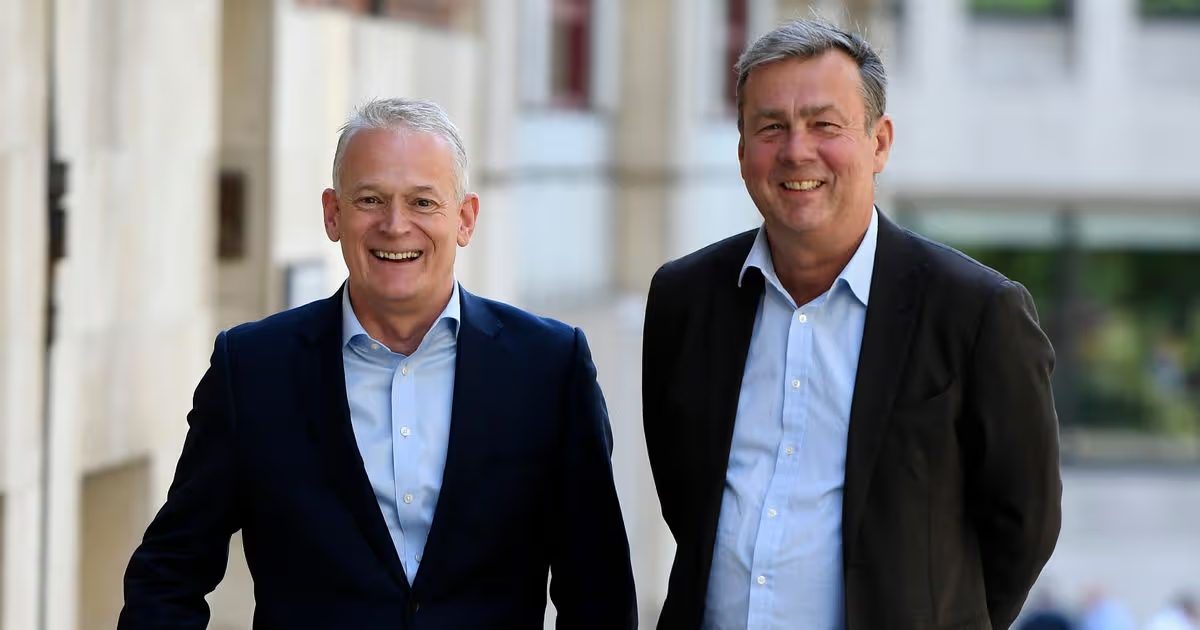
NorthStandard managing directors Paul Jennings (left) and Jeremy Grose(Image: GRAHAM FLACK)
Shipping insurer NorthStandard has revealedf a year of “intense challenges” amid a significant expected rise in its premium income. The Tyneside-based mutual, which is among the world’s largest of its type, says premium income could rise by more than 5% to $930m (£689.3m) in the year to February 20.
It comes as global geopolitical tension has escalating further in the last year, creating a higher risk environment for insurers. Sanctions, tariffs and attacks on vessels have presented challenges.
NorthStandard, which employs about 300 people on Tyneside, has maintained the size of its poolable tonnage – the volume of ships it insurers – at 270million gross tonnes. It said the flat number came after a renewal that focussed on rebalancing its global risk portfolio.
Meanwhile, free reserves are projected to pass $900m (£667m), up from $800m (£593m) in February last year and well above the S&P Global requirements to keep its AAA capital status.
Advertisement
Paul Jennings, managing director of NorthStandard, said: “We are grateful for our members’ continued support and loyalty. Strong Member retention and commitment during renewal reflects the value and importance they place on the high levels of expert service NorthStandard teams deliver daily around the world.”
Bosses said that diversification efforts had helped boost results, pointing to the group’s Coastal & Inland-Sunderland Marine joint product for hull and protection and indemnity which is said to have been popular. NorthStandard has traditionally provided insurance for the operators of large, ocean going vessels involved in global trade, but more recently it has also eyed opportunities in the renewables sector – including via a partnership with NIORD/Norwegian Hull Club.
And in autumn last year, North Standard began recruitment of a new Upstream Energy and Marine & Energy Liabilities team. Jeremy Grose, managing director of NorthStandard, said further diversification will also drive premium growth next year, as ‘churn’ from newbuilds replacing older vessels could stymie premium growth.
He added: “Diversification, leaner operations, sound investments and consolidation have created the critical mass to open new offices and overhaul our digital services. We have also expanded our risk management tools, introduced a range of AI-led initiatives across our business, and broadened the scope of our loss prevention products for the direct benefit of our members.”
Advertisement
Elsewhere, NorthStandard said it had been focussed on driving maritime decarbonisation through its team of in-house experts offering guidance on alternative fuel options. That has included some of its members signing up to the BetterSea digital fuel pooling marketplace and supporting others with access to fuel performance analytics tools. The organisation is also a founding member of the Martime Nuclear consortium that launched only last month and focuses on the development of safe and efficient nuclear-powered vessels.
Looking ahead, Mr Jennings added: “Our focus is to support Members with the stability, strength, and innovation NorthStandard is known for. This year’s results prove our strategy is working and we intend to keep leading our industry forward.”
Peter Moore has called on the governing body to “sort out” their structures ahead of the summer spectacular
Former Liverpool CEO Peter Moore has expressed his disappointment with FIFA’s current ticketing strategy for the 2026 World Cup. Moore is far from the first in the space to voice concerns, as watching football in person becomes increasingly difficult for the average fan.
Moore, who served as Liverpool’s CEO from 2017 to 2020, has called on FIFA to reconsider its ticketing approach, stating that it is “completely detached from the very soul of football.”
Moore has urged FIFA to “sort out” its ticketing strategy before it’s too late. He expressed concern that the current model prioritises revenue over the reality of the average, passionate football supporter. These are the fans who save for years to attend the World Cup, travelling across continents and bringing the spirit, colour, and noise to the games.
Moore, who has attended five World Cups, described them as “life chapters” about culture, connection, and unity through football. He emphasised that the issue of ticket pricing carries significant weight given his extensive experience in the sports and entertainment industries.
Advertisement
During his career, Moore has held senior roles at Reebok, Sega, Microsoft, and Electronic Arts (EA). He recalled standing “shoulder to shoulder” with FIFA during its 2015 controversy when senior officials were charged with bribery, racketeering, and money laundering. Despite many sponsors distancing themselves from FIFA, EA continued to work with them, keeping millions of fans connected to football and the World Cup during a time of low trust in the organisation.
The controversy of dynamic pricing
FIFA’s ticket pricing for the upcoming World Cup has already sparked controversy. The Football Supporters’ Association (FSA) has criticised the ticket pricing policy as excessively expensive and unfair to fans. The introduction of dynamic pricing, a model that the FSA has urged FIFA to abandon, is one of the main reasons behind the increase.
A recent investigation revealed the high costs fans would face, including flights, tickets, and accommodation, to attend the World Cup. Moore echoed the FSA’s sentiments, stating that the current approach feels detached from the essence of football. He argued that football should not be a luxury product reserved for the highest bidder, but rather, it belongs to the people.
The future of FIFA ticket pricing strategy
While public criticism may not be enough to force FIFA to reconsider its pricing model, the results it produces might. FIFA claimed in January to have received half a billion ticket requests for the World Cup.
Advertisement
If a large proportion of tickets are held outside genuine fan demand, there is a risk that stadiums may not be full for many matches. This could pose a significant issue for FIFA, even if revenues reach record levels, especially given its ambition to deliver the biggest and best World Cup in history.
Moore concluded by saying, “The World Cup should unite the world, not divide it by price. Football deserves better. And so do the fans. Come on, FIFA, sort this out… It’s not too late.”
NEW YORK — Texas Pacific Land Corp. shares jumped more than 10% in morning trading Friday, climbing to $417.06 as investors appeared to shake off recent volatility tied to the passing of a major shareholder and renewed optimism around the company’s diversification into AI infrastructure and data centers on its vast West Texas holdings.
Texas Pacific Land Stock Surges 10% as Permian Royalty Giant Rebounds on AI Data Center Hopes and Water Growth
The Dallas-based land and royalty company, listed on the NYSE as TPL, added $39.16, or 10.36%, by 11:12 a.m. EDT. The sharp rebound followed a steep sell-off earlier in the week after the announcement of the death of Murray Stahl, founder of Horizon Kinetics Asset Management, TPL’s largest shareholder. Shares had plunged as much as 15-17% on Thursday amid the news and broader energy sector weakness linked to easing Middle East tensions.
Texas Pacific Land owns roughly 900,000 acres in the Permian Basin, generating revenue primarily through oil and gas royalties, produced water royalties, and water sales to drilling operators. The business model is asset-light with exceptionally high margins — often exceeding 60% net — because the company collects royalties without bearing drilling or operating costs.
In its fourth-quarter and full-year 2025 results released in February, TPL reported record performance. Full-year revenue reached $798.2 million, net income hit $481.4 million or $6.97 per diluted share, and free cash flow stood at $498.3 million. Oil and gas royalty production averaged 34.6 thousand barrels of oil equivalent per day for the year, rising to a quarterly record of 37.5 thousand Boe/d in the fourth quarter. Water sales revenue climbed to $169.7 million annually, with Q4 alone delivering $60.7 million on 1.0 million barrels per day of volumes.
The company also raised its regular quarterly dividend by 12.5% to $0.60 per share and entered a new $500 million revolving credit facility while completing a three-for-one stock split in late 2025. Adjusted EBITDA for 2025 reached $687.4 million.
Advertisement
Analysts have grown increasingly bullish on TPL’s non-traditional growth avenues. In February, KeyBanc raised its price target sharply to $639 from $350 while maintaining an Overweight rating, citing opportunities in power generation, data centers and strong water segment trends. Other targets range widely, with consensus around $487 and some lower figures near $390, reflecting debate over valuation amid high multiples.
A key catalyst has been TPL’s strategic pivot toward AI and digital infrastructure. In December 2025, the company invested $50 million in Bolt Data & Energy, a platform chaired by former Google CEO Eric Schmidt. The partnership aims to develop large-scale “Closed Loop Energy Data Hubs” on TPL land, leveraging the company’s natural gas resources for power generation and treated water for cooling. TPL holds equity stakes, warrants and rights of first refusal for land and water supply to these projects.
Management has highlighted ambitions for gigawatt-scale data center development, potentially transforming surface acreage into high-value AI infrastructure. Reports of potential involvement from major tech players, including Google, have fueled investor excitement even as traditional energy exposure remains core.
Water services continue to provide a resilient revenue stream less directly tied to oil prices. Produced water royalties and sales volumes set records in 2025, benefiting from higher drilling activity in the Permian. TPL has also explored desalination opportunities to expand its water portfolio sustainably.
Advertisement
Despite the positive long-term narrative, the stock has experienced significant swings. It surged over 50% year-to-date through early 2026 on royalty strength and data center buzz but pulled back sharply in recent sessions. Thursday’s drop followed Stahl’s passing; Horizon Kinetics holds millions of shares, and the activist-leaning investor had played a key role in modernizing TPL’s governance and strategy in prior years. Horizon continued buying shares even after the news, purchasing additional units on April 8.
The company remains debt-light with substantial cash and liquidity. Its fortress balance sheet allows opportunistic investments and resilience during commodity downturns, a point emphasized by CEO Ty Glover on recent earnings calls.
TPL’s land position gives it unique leverage in the Permian, one of the world’s most productive oil basins. Operators drilling on or near its acreage pay royalties on production, while surface rights enable additional income from easements, water and now potential tech infrastructure. This diversified model has helped TPL outperform traditional energy plays during periods of price volatility.
Challenges persist. Revenue remains sensitive to drilling activity, rig counts and commodity prices, even with royalty structures providing downside protection. Some analysts caution that elevated valuations assume continued robust operator spending and successful execution on new initiatives like data centers, which remain in early stages. Recent operator capital discipline and fluctuating rig counts have raised questions about near-term growth sustainability.
Advertisement
Broader market context includes recovering oil prices after a brief dip tied to Middle East developments, though energy stocks overall showed mixed performance Friday. TPL’s outsized move suggests company-specific catalysts — particularly AI-related speculation — are driving the rebound.
Upcoming events include a shareholder office and field visit in Midland on May 18, 2026, with an RSVP deadline already passed. The gathering offers investors a closer look at operations, water assets and potential development sites.
Founded originally in the 19th century and restructured as a modern corporation, Texas Pacific Land has evolved from a legacy land trust into a high-margin royalty and resource play. It maintains a lean structure with minimal overhead, allowing most incremental revenue to flow to the bottom line.
Insider and institutional interest remains notable. Major holders like Horizon Kinetics have demonstrated ongoing confidence through purchases, while short interest hovers around 6% of float. The stock’s beta near 1.0 indicates it moves with the broader market but amplifies energy and growth themes.
Advertisement
Technical analysts noted Friday’s surge broke short-term resistance after the recent pullback, with elevated volume signaling renewed buying interest. Longer-term charts show the shares well above 2025 lows despite volatility.
As TPL prepares Q1 2026 results in coming weeks, focus will center on royalty production trends, water volumes, progress with Bolt Data & Energy and any updates on surface development. Guidance or commentary on 2026 outlook could further influence sentiment.
The company’s story blends old-economy energy royalties with forward-looking bets on AI power and data infrastructure needs. In an era of surging electricity demand from data centers and hyperscalers, TPL’s land, water and energy resources position it uniquely at the intersection of traditional resources and next-generation technology.
While risks around execution, commodity cycles and high valuations remain, Friday’s rally underscores investor willingness to price in diversification potential. With Permian activity resilient and new revenue streams emerging, Texas Pacific Land continues to attract attention as both a defensive royalty play and a speculative growth name in the evolving energy-AI landscape.
Songkran, Thailand’s iconic water festival, fosters family unity and joy. Celebrated in April, it offers meaningful connections, creating lasting memories across generations through shared experiences and cultural traditions.
Songkran: A Festival of Family Unity
Songkran is deeply rooted in family traditions, serving as a vibrant celebration of joy and connection. This iconic water festival, celebrated in Thailand every April, transforms cities into living classrooms of shared experiences and lasting memories. Beyond the water fights, Songkran fosters a deeper sense of togetherness among families, strengthening bonds across generations.
Celebrating in the Heart of Thailand
In Bangkok, Songkran offers family-friendly experiences at locations like centralwOrld and Siam Square, blending tradition with safety. While Khao San Road is energetic, families can find designated splash zones that prioritize safety with crowd control and shaded areas. These spaces provide peace of mind for parents, allowing everyone to fully enjoy the festivities.
Embrace Diversity in Celebrating Songkran
Exploring beyond the capital, Chiang Mai offers spiritual experiences with ceremonies at ancient temples, promoting family teamwork and unity. In Pattaya, the lively Wan Lai festival showcases water-themed activities perfect for families seeking fun in the sun. Ayutthaya’s ancient ruins offer a unique cultural backdrop, transforming Songkran into a celebration of renewal, unity, and shared family joy.





















































You must be logged in to post a comment Login