

Crypto World
Telegram CEO facing Russia probe over terrorism-facilitation claims


Russian authorities have opened a criminal case against Pavel Durov, the co‑founder and chief executive of Telegram, in what state media describe as an investigation into the alleged facilitation of terrorist activities. Rossiyskaya Gazeta, the official government newspaper, reported on February 24, 2026 that the Federal Security Service (FSB) is pursuing the case, with Kremlin spokesperson Dmitry Peskov confirming that the matter rests on materials produced by the FSB as part of its operational duties. The development marks a significant escalation in Russia’s ongoing scrutiny of Telegram, coming as state regulators previously tightened restrictions on the platform in early February. Telegram has not publicly responded to the reports by the time of publication, and attempts by media and Reuters could not secure an immediate comment from the company.
Key takeaways
- The case centers on allegations that Telegram facilitated terrorist activities, with the FSB providing the core evidentiary basis for investigators.
- Roskomnadzor, Russia’s communications watchdog, expanded and intensified restrictions on Telegram in early February, signaling a broader push to curb perceived extremist content on the platform.
- Telegram has reportedly refused to remove material flagged as extremist content, and authorities are considering whether the platform itself could be designated extremist, which would carry additional legal risks for users and the service.
- Analysts warn that a formal label of extremism could complicate or criminalize certain financial transactions on the platform, including payments for premium services and advertising, if such activity is deemed to facilitate prohibited activity.
- Pavel Durov argues the pressure is a broader political maneuver aimed at steering users toward a state-backed messenger, MAX, and he has pointed to similar attempts in other countries, including Iran, where authorities have sought to restrict usage while many citizens continue to favor Telegram for privacy and free expression.
Market context: The case in Russia emerges amid a broader global tightening of regulation around encrypted messaging services and online content moderation. Regulators in multiple jurisdictions are weighing how to balance security concerns with privacy and freedom of expression, a dynamic that increasingly intersects with fintech and digital payments as platforms expand into financial services and commerce.
Why it matters
The investigation underscores the vulnerability of large messaging platforms to state demands for content control in environments where authorities maintain broad powers to regulate information flows. For Telegram users in Russia and abroad, the case raises questions about access, censorship, and the potential criminalization of routine platform use in the event of extremism labeling. While Telegram has built a reputation for privacy protections and opposition to state surveillance, governments exploring how to police content on messaging apps could reconfigure the operating risks for the service and its users. The tension also highlights how geopolitical friction can spill over into digital platforms that cross borders, complicating compliance for a service with a global user base.
Beyond the immediate regulatory landscape, the incident feeds into a longer-running debate about how tech platforms should be regulated when they serve as conduits for information, finance, and social organization. Durov’s public comments and the high-profile nature of the investigation may influence both user sentiment and the strategic choices Telegram makes as it navigates competing demands from regulators, advertisers, and users who prize a degree of privacy and uncensored communication. The ongoing scrutiny also has implications for developers, investors, and policymakers who watch how platforms respond to perceived security risks while balancing civil liberties on an increasingly complex digital stage.
From a geopolitical perspective, the Russian case sits at the intersection of domestic policy and international diplomacy. Durov has framed the pressure as part of a broader effort to promote a state-controlled alternative messenger, a theme that has resonances in other jurisdictions where authorities seek to shape the digital communications landscape. While Russia emphasizes extremism and national security, observers note that the outcomes could influence global norms around the governance of encrypted messaging apps, particularly for platforms that operate across a mosaic of regulatory regimes and market priorities.
What to watch next
- Any formal public statements from the FSB or Roskomnadzor outlining the charges, evidence, or procedural steps in the case against Durov.
- Developments in Russia’s regulatory stance toward Telegram, including whether the platform faces further restrictions or a potential extremism designation.
- Responses from Telegram regarding the investigation, including any new compliance measures or policy changes in Russia or elsewhere.
- Related legal actions or investigations in other countries, such as France, where Durov has faced inquiries, and any outcomes that could affect cross-border service provisions.
- Any changes in the global regulatory environment for encrypted messaging services and how those shifts could impact user access and platform opportunities in the crypto and digital payments space.
Sources & verification
- Rossiyskaya Gazeta report detailing the FSB-led criminal probe and referencing the Kremlin spokesperson’s confirmation.
- Statement attributed to Dmitry Peskov confirming the investigation and referencing FSB materials.
- Roskomnadzor’s reported tightening of Telegram restrictions in early February as covered by major Russian tech outlets.
- Public reporting on Telegram’s response or lack thereof, and coverage of Durov’s broader legal exposure, including investigations abroad.
Russian case against Durov sheds light on Telegram’s regulatory pressure
Russia’s latest move against Telegram places Pavel Durov at the center of a high-stakes intersection between digital freedom, security, and the state’s capacity to police online content. The FSB’s involvement signals a level of scrutiny that goes beyond routine regulatory complaints, elevating the Telegram platform into the realm of criminal investigations when linked to alleged facilitation of extremist activity. Rossiyskaya Gazeta’s reporting on February 24, 2026, describes a case that is being handled with the involvement of the country’s premier security institution, a development that could have lasting implications for both the platform’s operations in Russia and its reputation globally.
The Kremlin’s confirmation, via Dmitry Peskov, that the investigation rests on FSB materials, reinforces the perception that Moscow regards Telegram as a strategic communications channel with potential cross-border impact. While the exact charges remain undisclosed in public materials, the use of criminal procedures in this context signals a hardening stance toward platforms that resist state-directed content moderation. The case aligns with a broader push by Roskomnadzor to tighten the screws on messaging apps, particularly those with robust privacy features and the capacity to host large volumes of user-generated content outside centralized control.
Telegram’s stance has been consistently positioned as a defense of user privacy and a refusal to remove content that authorities deem extremist or harmful. This friction is illustrated by the ongoing tension surrounding content moderation, with Russian regulators insisting on compliance and the platform resisting what it views as overreach. The numbers cited by state-connected outlets—namely, that roughly 155,000 channels, chats, and bots have not been removed in response to local requests—underscore the scale of Telegram’s footprint in Russia and the challenge regulators face in enforcing content rules across a platform that migrates between jurisdictions and languages. The broader implication is that a potential extremism designation could alter Telegram’s business model, affect user access, and complicate any monetization strategy anchored to the platform’s freedom of use.
Industry observers have flagged that the extremism label could carry far-reaching consequences beyond speech restrictions. German Klimenko, a former adviser to the Russian president on internet policy, warned that such a designation could criminalize payments related to Telegram Premium subscriptions and advertising on the platform. This kind of impact would affect not just end users but also service providers and advertisers who rely on Telegram as a channel for outreach and revenue. The possibility of criminal penalties or significant legal exposure for seemingly routine activities signals a broader risk landscape for digital platforms operating in regulated environments where state interests are closely aligned with national security imperatives.
Durov has publicly framed the investigation as part of a broader strategy to push users toward a state-backed messenger known as MAX, a claim that dovetails with his long-standing emphasis on privacy and freedom of expression. He has drawn parallels with other jurisdictions, including Iran, where authorities have attempted to restrict access to messaging apps while users continue to rely on them. In a February post on his Telegram channel, Durov argued that restricting citizens’ freedom is not a legitimate response and reiterated Telegram’s mission to defend privacy and speech rights in the face of pressure. This framing places Telegram’s predicament within a broader debate about how states balance security concerns with civil liberties in the digital era.
The legal and political dynamics surrounding Durov’s case extend beyond Russia’s borders. Durov’s international exposure—captured in ongoing inquiries abroad and previously including an arrest in France in 2024 and a travel ban that was lifted in 2025—illustrates how actions in one jurisdiction can resonate across multiple regulatory environments. The French developments, though not resolved in the public sphere at the time, emphasize that Telegram’s legal and regulatory challenges are not confined to a single country. As regulators and lawmakers reassess the balance between security, privacy, and platform openness, Telegram’s approach to compliance and user protection will likely shape the trajectory of encrypted messaging apps in the coming years. In the Russian context, the FSB-backed investigation remains a focal point for observers seeking to gauge how far the state will go in policing online communications and what this means for services that operate globally but must navigate local laws.



It may be “crypto winter,” but it’s a “stablecoin summer” as digital dollar adoption booms, payments giant Stripe said Tuesday in its annual letter.
Bridge, the stablecoin orchestration platform Stripe acquired in 2024, saw transaction volume more than quadruple last year, according to the letter.
The firm also said it will “soon” launch the mainnet of Tempo, the payments-focused blockchain it is developing with crypto firm Paradigm and started testing in December.
Stripe has increasingly focused on bringing crypto technology to its payment network, seeing stablecoins as an alternative for cross-border transfers and programmable payments. Stablecoins are a $300 billion class of cryptocurrencies tied to fiat money like the U.S. dollar that use blockchains for faster, cheaper settlement.
Their utility has led to stablecoins decoupling from crypto market cycles, the payment firm wrote. While bitcoin fell 50% from its October peak, and lost 6% over 2025, stablecoin payment volume doubled to about $400 billion, with around 60% resulting from business-to-business transactions, it said, citing a recent report by McKinsey and Artemis.
“Stablecoin payments are advancing quietly and inexorably as real-world uptake continues apace,” the firm wrote in the letter.
Highlighting the rising stablecoin demand, Meta (META), the parent company of Facebook, Instagram and Whatsapp plans to launch its own stablecoin later this year with an outside partner, CoinDesk reported on Tuesday.
Stripe said businesses processed $1.9 trillion on its platform last year, up 34% from 2024. The company also announced a tender offer valuing it at $159 billion.
Read more: Stripe’s stablecoin firm Bridge wins initial approval of national bank trust charter
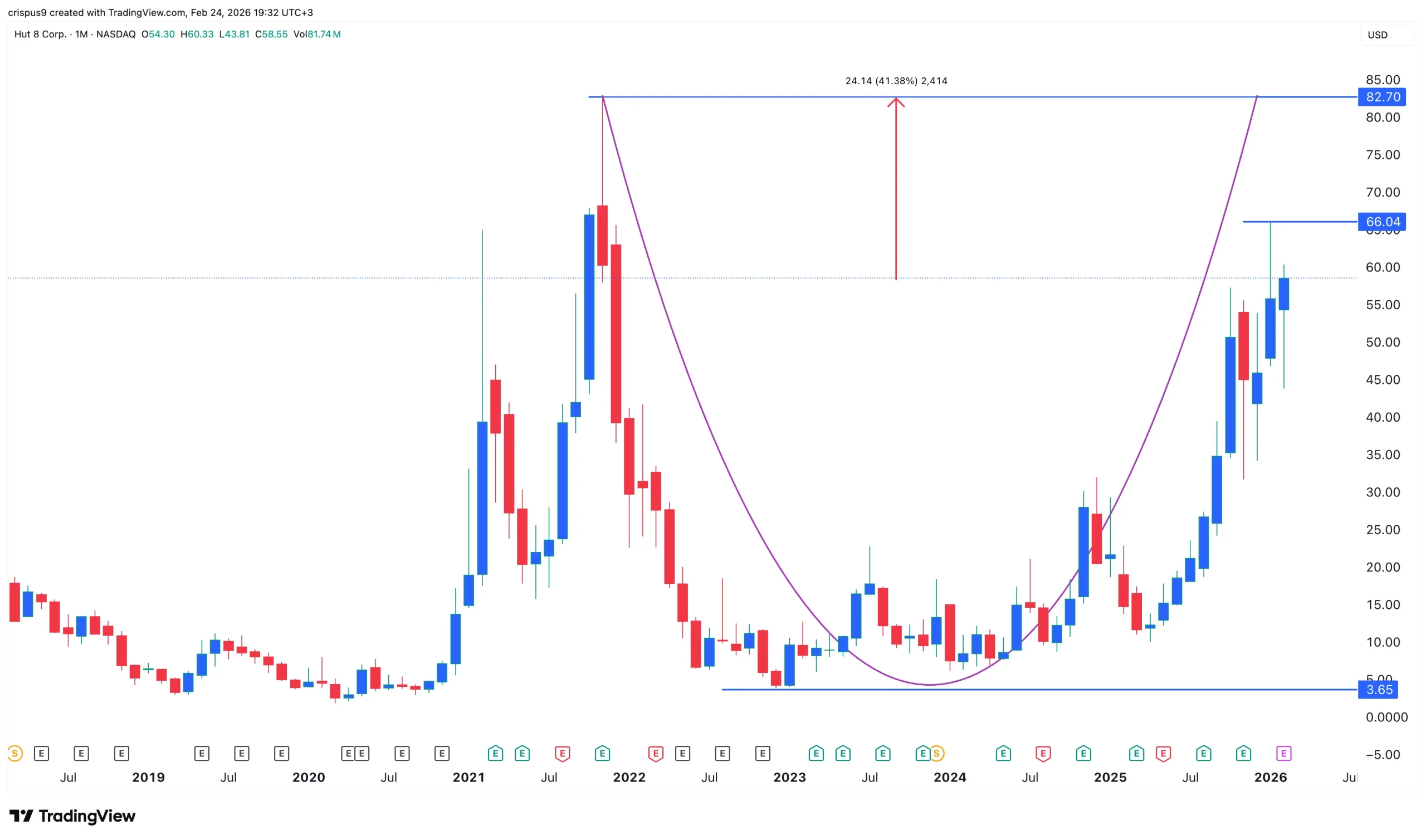
Hut 8 stock price has risen for three consecutive months and is nearing its highest level this year as the company prepares to publish its financial results.
Summary
- Hut 8 share price has jumped for three consecutive months.
- The company has formed a cup-and-handle pattern.
- It will publish the financial results later on Tuesday.
Hut 8, a top company in the Bitcoin (BTC) mining and an upcoming artificial intelligence data center industry, rose to $57, up by over 1,285% from its lowest level in 2023. This surge has brought its market capitalization to over $6.2 billion.
Hut 8 has done well despite the ongoing Bitcoin price crash because of its pivot to the data center industry. It recently entered a major deal with Anthropic, the creator of Claude.
This deal will see it build the River Bend campus, which will have a capacity of 2,295 megawatts of infrastructure in three tranches. The deal will be worth billions of dollars in the next few years.
The next key catalyst for the Hut 8 stock price will be the upcoming earnings, which will come out on Tuesday.
Data compiled by Yahoo Finance shows that the revenue will be $95 million, up by 200% from the same period in 2024. Its annual revenue will be over $241 million, up by 48% on an annual basis.
Its deal with Anthropic and Google will help it grow its revenue this year to over $425 million, up by 76% on an annual basis. Analysts also expect the earnings-per-share will be a loss of 15 cents from a profit of 1.55 in the same period in 2024.
Wall Street analysts are largely bullish on the company. Some of the mosy bullish ones are HC Wainwright, Roth Mkm, and KBW, which have placed a target of $80, $80, and $75m respectively. The average target among analysts is $64, up by 12% from the current level.
Hut 8 stock technical analysis
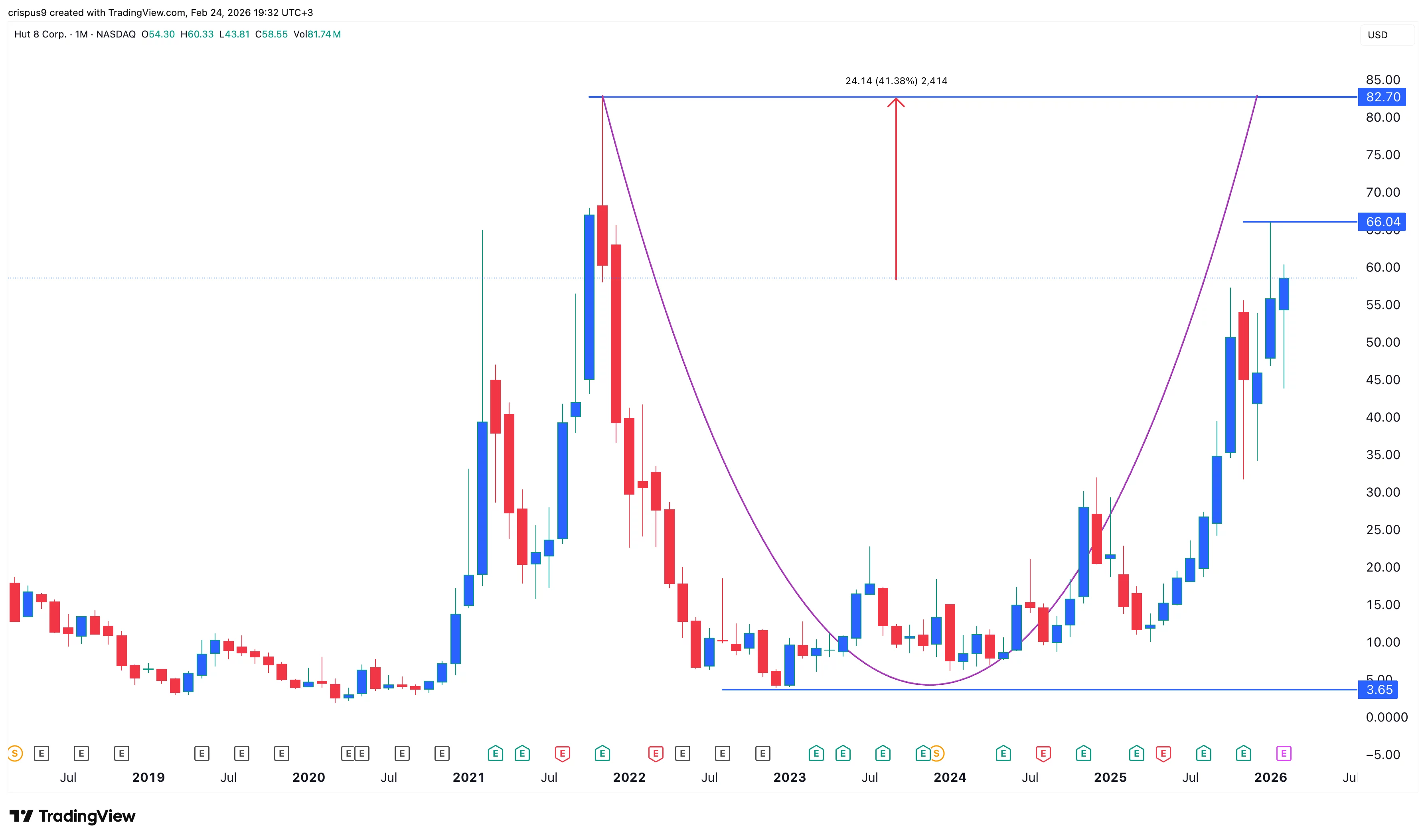
The monthly timeframe chart shows that Hut 8 share price has staged a strong comeback in the past few years. It has jumped from a low of $3.65 in 2023 to the current level.
The stock has jumped in the last three consecutive months and is nearing its highest level this year at $66. It has also moved above the 50-month moving average.
A closer look shows that it has formed a cup-and-handle pattern whose upper side is at $82.70, its highest level on record. Such a move will mark a 40% increase from the current level.
The caveat, however, is that this pattern has formed on the monthly chart, meaning that its outcome may take months or years to complete.

TLDR
- Kraken introduced regulated perpetual futures that track tokenized versions of major U.S. stocks and indices.
- The exchange made these products available to eligible users in more than 110 countries.
- The initial listings include tokenized versions of the S&P 500, the Nasdaq 100, Apple, Nvidia, Tesla, and the GLD gold ETF.
- The new perpetuals offer 24/7 trading and allow leverage of up to 20x for global users.
- Kraken stated that xStocks tokens remain fully backed 1:1 by the underlying assets.
Kraken introduced regulated perpetual contracts for tokenized equities and expanded access to 24/7 trading, and the launch broadens digital market offerings and follows its acquisition of xStocks in December. The move arrives as perpetual activity grows across global crypto markets.
Kraken expands perpetuals tied to tokenized U.S. stocks
Kraken released regulated perpetuals that track tokenized versions of major U.S. stocks, indices, and a gold ETF. The exchange made the products available to eligible users in more than 110 countries.
The initial lineup includes digital representations of the S&P 500, the Nasdaq 100, and stocks such as Apple and Nvidia. It also lists Tesla and the gold ETF SPDR Gold Shares (GLD) as tokenized assets.
The firm said the contracts take cues from crypto perpetuals, which run without expiry and operate continuously. It added that the structure enables long and short positioning with high leverage.
The company described the products as fully collateralized through xStocks’ framework. It noted that tokens remain backed 1:1 by the referenced assets.
Tokenized U.S. stocks and round-the-clock futures access
Kraken stated that the supported assets trade 24/7 and offer leverage up to 20x. It said this model provides continuous pricing even when U.S. exchanges close.
The exchange explained that tokenization anchors prices to underlying assets held in custody. It added that this backing helps maintain market alignment during global sessions.
Kraken highlighted its intent to rebuild equities trading for crypto-native environments. “This is what it looks like when traditional markets are rebuilt for a crypto-native, always-on world,” said Mark Greenberg.
The firm positioned the launch as part of a broader plan to expand its equities catalog. It confirmed that more stocks and ETFs will enter the platform in the coming months.
Growing competition in tokenized equities
Data from The Block showed over $600 billion in decentralized perpetual volume during January. It reported that Hyperliquid reached nearly $200 billion in monthly activity.
Perpetuals have grown as traders seek constant access and flexible capital use. The model continues to attract platforms developing new markets.
Ondo Finance recently announced plans to release perpetuals tied to its tokenized stocks. The firm signaled rising interest in expanding choices across tokenized assets.
The U.S. Securities and Exchange Commission (SEC) has approved a special request from asset manager WisdomTree allowing shares of its Treasury Money Market Digital Fund to trade at $1 with a dealer on an intraday basis, regardless of the fund’s end-of-day net asset value.
Until now, investors in the fund, which trades under the ticker WTGXX, had to transact at the end of the day at the fund’s NAV, as is standard for traditional mutual funds. The new structure allows trades to occur around the clock through a broker-dealer acting as principal, with instant settlement on blockchain rails.
WisdomTree said the approval required exemptive relief from the SEC and regulatory clearance from FINRA to expand the activities of its broker-dealer subsidiary. Under the new model, trades occur against the dealer’s inventory rather than directly with the fund, enabling 24/7 liquidity while keeping the fund’s primary structure intact.
“This is a true innovation and improvement in the investor experience, and it demonstrates how blockchain can serve as a new set of rails for capital markets,” Will Peck, WisdomTree’s head of digital assets, said in a statement on Tuesday.
WisdomTree also introduced continuous dividend accrual for the fund, allocating interest based on how long each wallet held shares throughout the day. The feature tracks wallet activity onchain, ensuring that even mid-day transfers don’t miss a share of the yield.
The firm plans on making the functionality available to institutions first via its Connect platform, with potential retail access later through its Prime app.
The change marks a step in the broader push to tokenize parts of capital markets. Several large banks and asset managers have piloted blockchain-based systems to issue and settle traditional assets, aiming to cut settlement times and reduce operational friction. Tokenization refers to representing financial instruments as digital tokens on a blockchain, allowing ownership to move in near real time.
Money market funds backed by U.S. Treasuries have become a key test case. More than $10 billion worth of tokenized U.S. Treasuries are now in circulation, according to data provider rwa.xyz.
At the forefront is BlackRock and Securitize’s BUIDL fund, which holds over $2 billion in total value locked, a metric that reflects the dollar value of assets committed to the product onchain. Other offerings include products from stablecoin issuer Circle (CRCL) and Ondo Finance.
With the SEC’s approval, WisdomTree joins a growing group of firms seeking to bring traditional cash management tools onto blockchain infrastructure while staying within the existing regulatory framework.


- PI price rose slightly on Tuesday, with buyers testing resistance above $0.16.
- Holder balances on centralized exchanges have reduced by over 700,000 PI tokens over the last 24 hours.
- The technical outlook for PI is mixed amid overall bearish sentiment.
Pi Network’s token is showing some resilience amid broader crypto market weakness, with price retesting resistance above $0.16 despite key losses for Bitcoin and major altcoins.
The PI token traded to its intraday highs on a slight uptick in daily volume as on-chain data reveals a sharp decrease in token balances on centralized exchanges (CEXs).
While the upward move from lows of $0.13 on February 11 suggests bullish resilience, PI must extend gains above the latest barrier level to give buyers an upper hand.
Testing the key level amid broader crypto sentiment means a potential downward flip could follow if profit-taking deals mount.
Pi Network sees over 700,000 PI exit exchanges
PiScan data reveals CEX balances have shrunk sharply in the past 24 hours, with more than 778,434 PI tokens leaving CEXs such as OKX, Bitget, and MEXC.
The outflows suggest strong holder conviction, and are key to the reduced selling pressure currently helping bulls hold the advantage.
Net outflows indicate accumulation rather than distribution.
Buyers could capitalize on this outlook to drive prices higher, more likely if the broader market sentiment improves.
Despite CEX outflows, the PI price is signalling upside potential amid Pi Network’s Open Network expansion.
The project has accelerated its KYC verifications and mainnet migrations.
Meanwhile, the Pi Core Team sees milestones such as the release of details on the Ecosystem Token Design as crucial steps.
The Pi Request for Comment (PRC) for community input is among ecosystem developments that are adding to investor confidence.
Pi Network technical outlook
Despite the intraday gains, Pi Network’s price remains 9% down this past week.
The token is also in the red over the past month and year-to-date time frames, about 11% and 20%, respectively.
PI’s technical picture shows sentiment is largely bearish, with oscillators neutral. However, moving averages are leaning “strong sell”.

Bulls could muster upward momentum if prices stabilize above the $0.15. Support here and increased volume could allow PI to target $0.18 and then $0.27.
However, bears may yet dominate if bulls fail to hold above a downtrend line going back to the October 10, 2025, crash.
Should short-term losses accelerate below $0.15, major support lies around $0.13, an area that marked PI’s all-time low on Feb 11.
Indicators like MACD and RSI on the daily chart are offering a mixed outlook.
The MACD suggests a bearish crossover, while the RSI sits at 46 and outlines a possible leg up.
PI price, like most cryptocurrencies, will likely track risk asset sentiment and performance in the short term. Macroeconomic and geopolitical factors will be key catalysts.


- Crypto.com gains credibility after conditional approval from the OCC.
- Cronos (CRO) remains far below its peak, but fundamentals are stabilising.
- The regulatory approval strengthens Cronos’ long-term investment case.
Cronos (CRO) is once again in focus as regulatory progress at Crypto.com reshapes the long-term narrative around the ecosystem.
The token has spent much of the past year trading under pressure, mirroring broader market uncertainty and fading risk appetite.
Recent developments in the United States, however, have injected a new layer of strategic significance into CRO’s outlook.
Crypto.com has secured conditional approval from the Office of the Comptroller of the Currency (OCC) to establish a nationally regulated trust bank.
This approval does not mean full operational status yet. It does, however, signal regulatory acceptance at the highest federal level.
That signal alone carries weight in a market where regulatory clarity often defines winners and losers.
Crypto.com’s regulatory progress in the US
The planned Crypto.com national trust bank will not operate like a traditional retail bank.
It will, for instance, not accept deposits or issue loans.
Its role is focused on digital asset custody, settlement, and staking services under federal oversight.
This positioning places Crypto.com closer to the infrastructure layer of institutional finance rather than consumer banking.
For the broader crypto market, the conditional approval suggests Crypto.com is on track to become a federally regulated custodian before committing serious capital.
It also reduces reliance on fragmented state-by-state licensing. From a credibility standpoint, this is a meaningful step forward.
For Cronos, the implications are indirect but important.
Cronos exists as part of the Crypto.com ecosystem. Any expansion in regulated services strengthens the ecosystem’s long-term utility.
That utility underpins demand, even if price reactions are not immediate.
CRO price analysis
Cronos (CRO) is currently trading far below its all-time high.
The token peaked near $0.97 during the 2021 bull market, but today it trades closer to the $0.07 range. That decline reflects both market cycles and shifting sentiment around exchange tokens.
Despite the drawdown, however, Cronos maintains a multi-billion-dollar market capitalisation.
Liquidity remains steady, though daily trading volumes are modest compared to previous cycles. While short-term momentum remains weak, long-term positioning is beginning to look more nuanced.
How the OCC approval feeds into Cronos’ price outlook
The conditional OCC approval does not directly change CRO’s tokenomics, nor does it alter supply or introduce immediate new use cases.
What it does is reinforce the ecosystem’s regulatory durability, which matters as capital becomes more selective.
Following the approval, institutional staking, custody, and settlement services could eventually intersect with Cronos-based activity.
Even if adoption grows slowly, the direction is clear.
For long-term holders, the narrative around Cronos is shifting from speculative growth to regulated infrastructure alignment.
As Crypto.com moves closer to full approval, attention on Cronos is likely to increase.
The price recovery will, however, still depend on broader market cycles, although the path forward now looks more credible than it did a year ago.
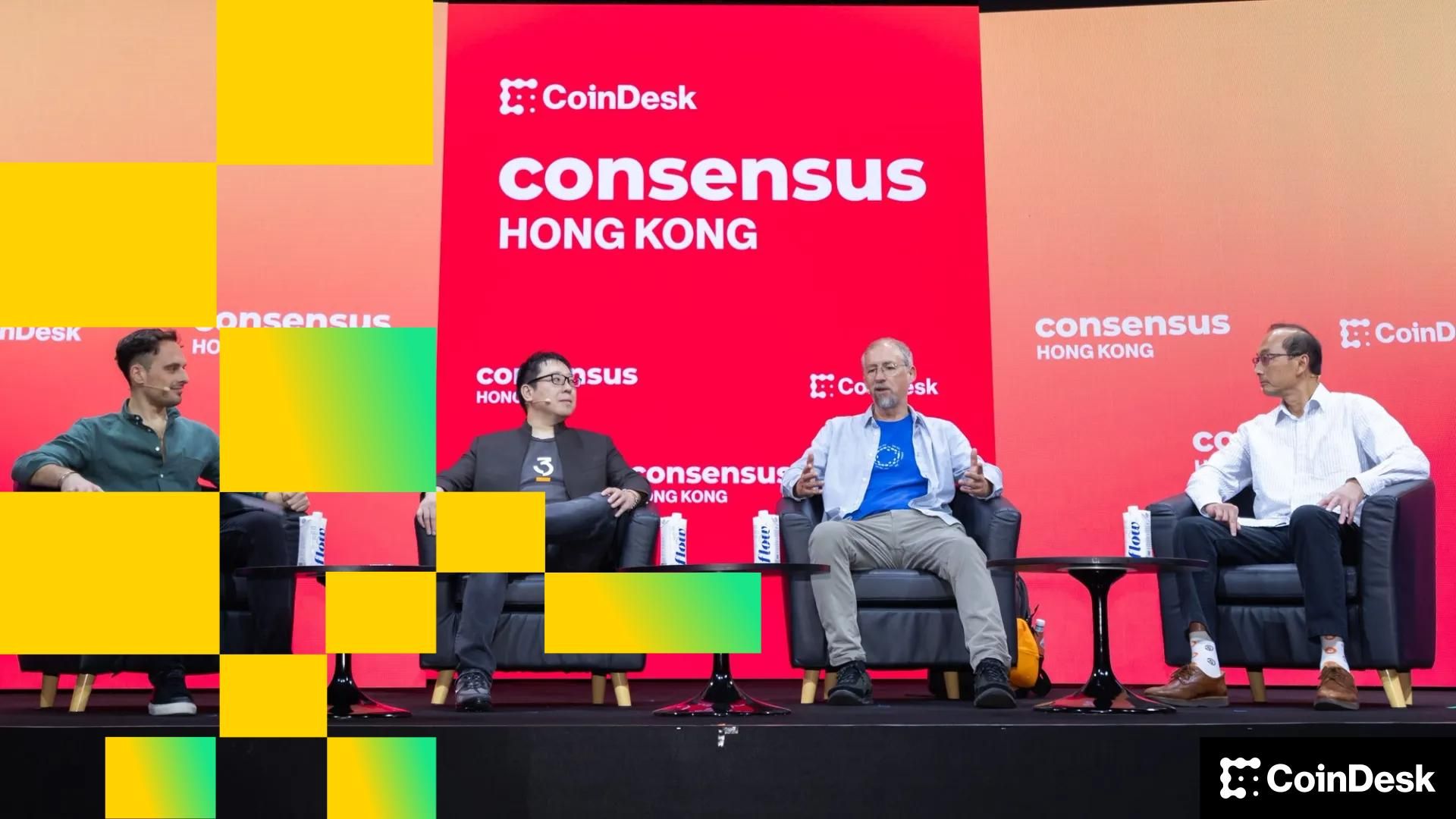
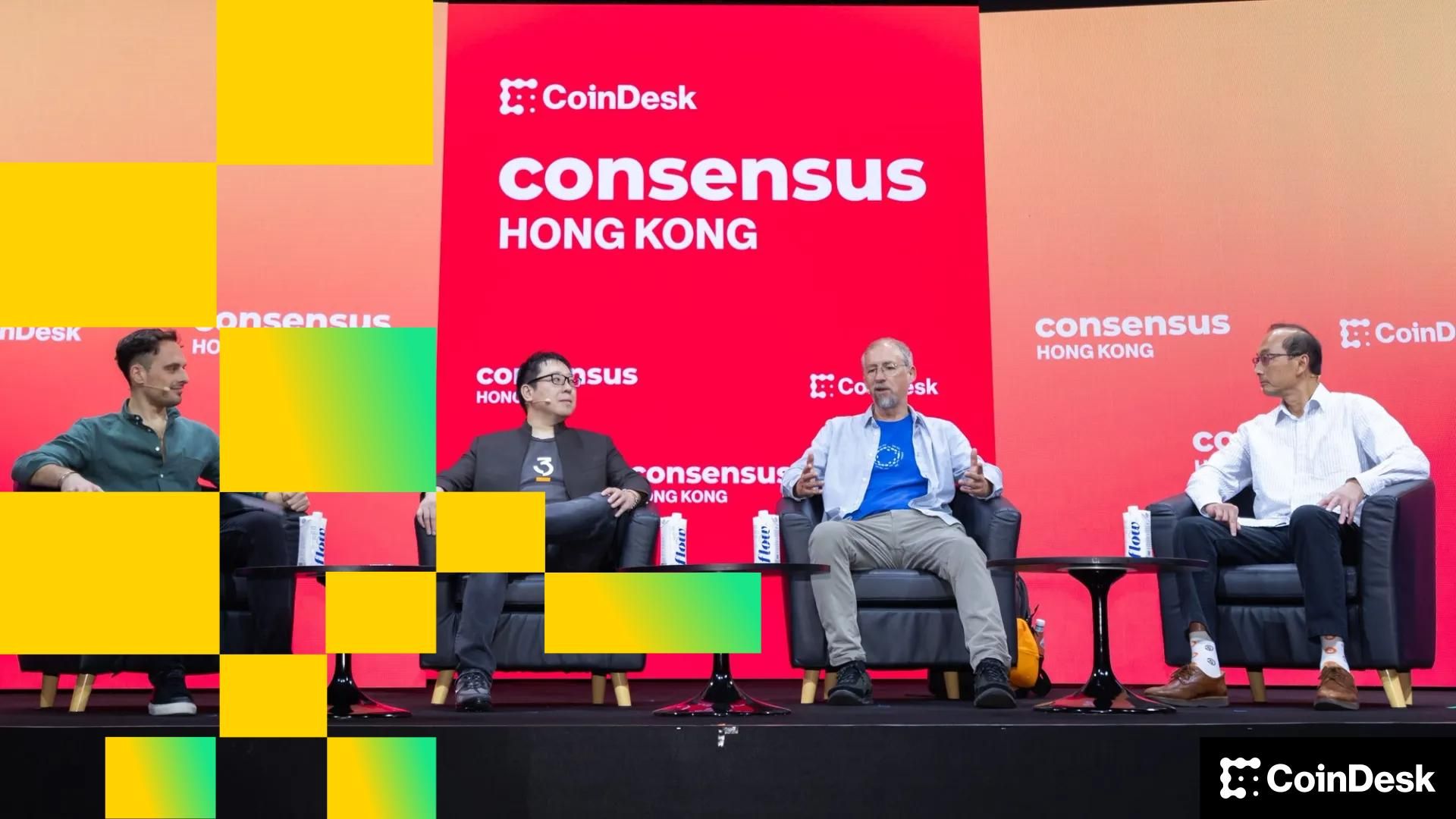
Undaunted by the plunge in bitcoin and the even worse price action for bitcoin treasury companies, Adam Back, the CEO of Bitcoin Standard Treasury Company (BSTR), says shareholder approval for a public listing could come as soon as April.
The public listing would come via a SPAC merger with Brandon Lutnick’s Cantor Equity Partners I (CEPO).
BSTR intends to debut with 30,000 bitcoin on its balance sheet. Of that total, 25,000 coins will be contributed by Back and other founding shareholders. A further 5,000 BTC will be contributed in-kind by early investors.
The merger plans were announced in the summer of 2025 amid a frenzy of hastily formed crypto treasury companies that hoped to mimic the success of Michael Saylor’s Strategy.
Since, though, the price of bitcoin has crashed to $63,000, and the performance of crypto treasury companies has been far worse, with many prominent ones vaporizing 90% or more of investor capital.
Speaking with CNBC on Monday, Back said a weaker bitcoin price could benefit BSTR ahead of its listing. Launching at a lower reference price would enable the company to accumulate more bitcoin at discounted levels, potentially strengthening its balance sheet and increasing long-term upside if market conditions improve.
Addressing bitcoin’s recent decline, Back noted that it occurred despite what he characterized as a favorable regulatory backdrop in the United States. He attributed the pullback to broader macroeconomic factors, including geopolitical tensions and tariff-related uncertainty, which have weighed on risk assets more broadly.
Back added that bitcoin treasury companies play a supportive role in the market. Their core strategy centers on acquiring and holding bitcoin, though he acknowledged that the pace of accumulation typically slows during bear markets. Ultimately, he said, bitcoin treasury companies are taking bitcoin off the market, which is a long-term bullish catalyst.
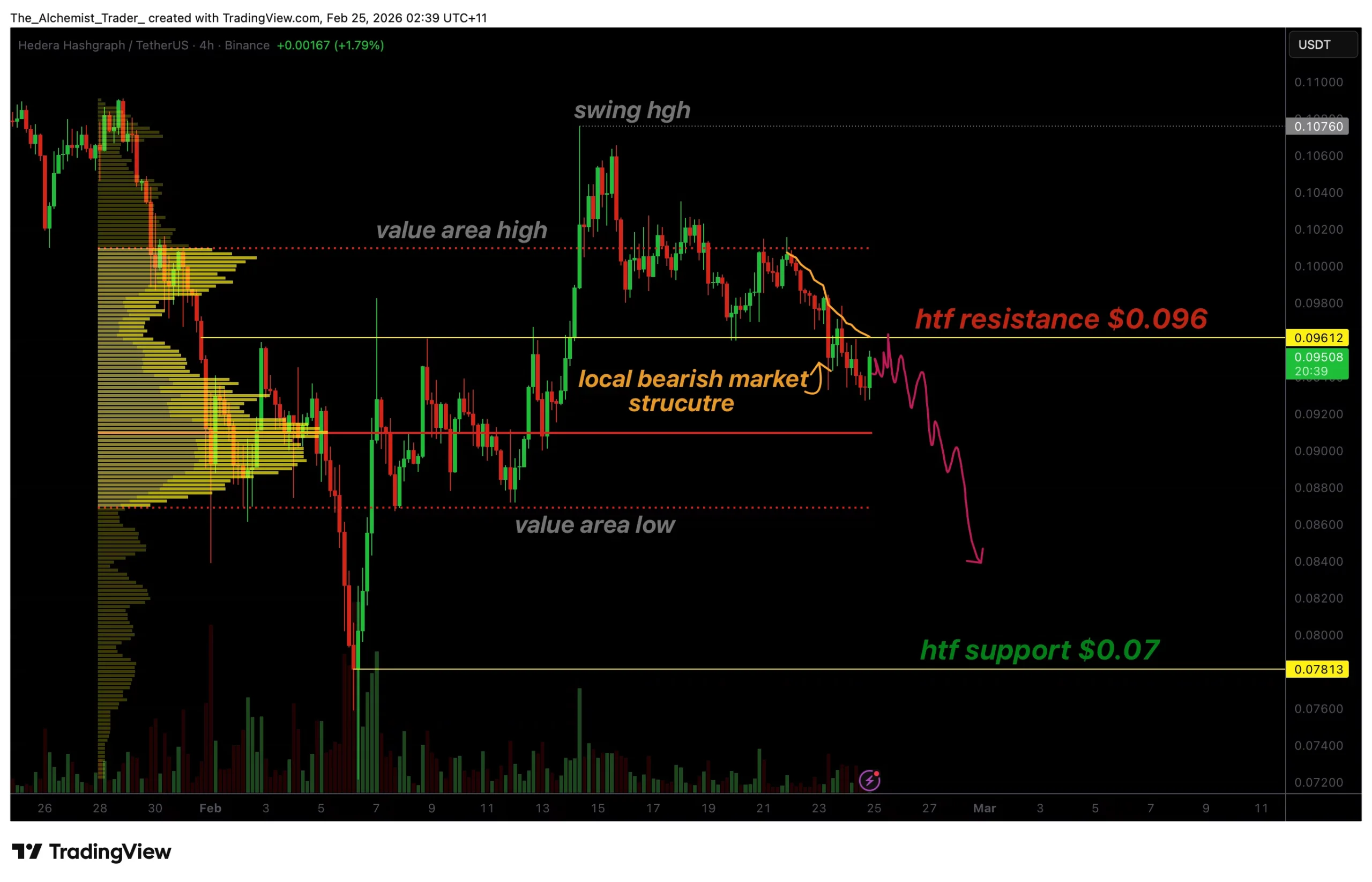
HBAR price faces downside risk after losing key support at $0.09, with bearish intraday structure increasing the probability of a corrective move toward $0.07.
Summary
- $0.09 support flipped into resistance confirms bearish structure
- Loss of point of control could accelerate downside momentum
- $0.07 high-timeframe support becomes next downside target
Hedera (HBAR) price action is showing early signs of structural weakness following a decisive loss of high-timeframe support near the $0.09 level. What previously acted as a strong demand zone has now transitioned into resistance, marking an important shift in market structure.
This transition is technically significant. When former support flips into resistance, it often signals a change in market control from buyers to sellers. Recent price movements suggest that HBAR is now undergoing a bearish retest of this level, a common market behavior that frequently precedes continuation to the downside.
As long as HBAR trades below $0.09, the broader technical outlook favors further corrective movement, with the next major support region located near $0.07 coming into focus.
HBAR price key technical points
- $0.09 support flipped into resistance: Structural breakdown confirms bearish shift
- Point of control under threat: Loss of key volume support could accelerate downside momentum
- $0.07 high-timeframe support targeted: Next major demand zone within current range
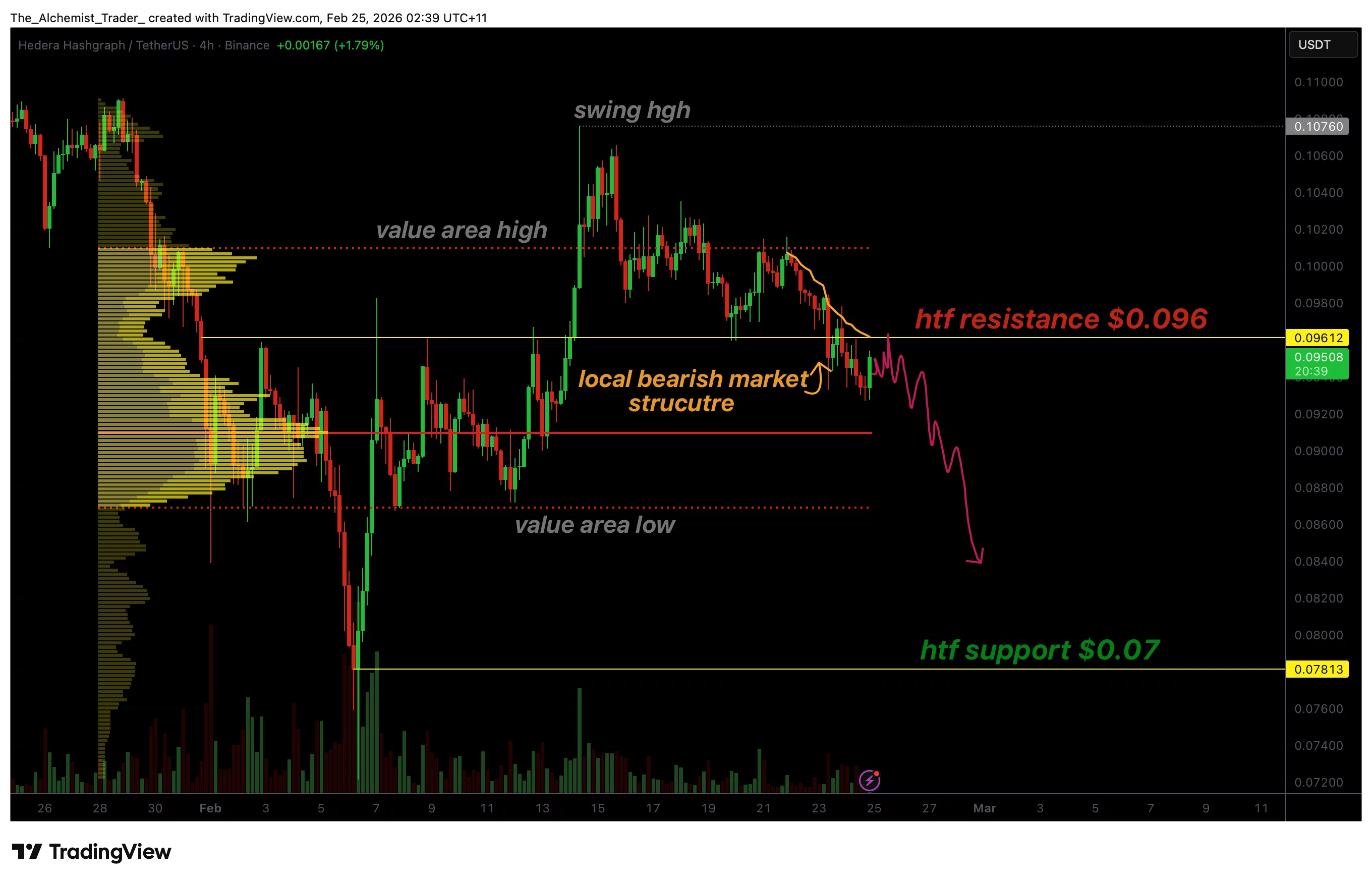
HBAR’s recent price action has been technically constructive in defining market direction. The confirmed loss of the $0.09 level represents a major structural development. Markets often respect these transitions strongly, as participants who previously bought at support may begin selling when price retests the level from below.
The current bounce toward resistance appears corrective rather than impulsive. Instead of establishing higher highs, price is forming a potential lower high within the intraday structure. This behavior aligns with a bearish retest scenario, where temporary upward movement allows sellers to re-enter positions before continuation lower.
From a market structure perspective, maintaining acceptance below $0.09 keeps sellers firmly in control. Until this level is reclaimed, bullish continuation remains unlikely in the short term.
Point of control becomes critical volume support
Another important level to monitor is the point of control (POC), which represents the area of highest traded volume within the broader range. The POC often acts as a final area of equilibrium before price transitions into expansion.
If HBAR loses acceptance around this level, it would signal that the market has abandoned its last major volume-based support. This development could significantly increase downside momentum.Below the POC lies a region of relatively thin volume, meaning fewer historical transactions exist to slow price movement. When markets enter low-volume zones, price tends to move quickly as liquidity gaps allow accelerated rotations toward lower value areas.
This technical dynamic strengthens the probability of a move toward the value area low and ultimately the $0.07 high-timeframe support.
Bearish retest suggests lower high formation
From a price action standpoint, the current local bounce appears to be a bearish retest rather than a trend reversal. Intraday structure continues to favor lower highs and weakening momentum, suggesting that the market is preparing for another rotational move downward.
Bearish retests typically occur after structural breakdowns, allowing price to revisit former support levels before sellers resume control. HBAR’s inability to reclaim resistance supports this interpretation.
If price forms a confirmed lower high beneath $0.09, it would further validate the bearish continuation thesis. This setup increases the likelihood that HBAR rotates toward deeper support levels as part of a broader corrective phase.
What to expect in the coming price action
From a technical, price action, and market structure perspective, HBAR remains vulnerable while trading below the $0.09 resistance. The current rebound appears corrective within a bearish intraday trend. A loss of the point of control could trigger accelerated downside movement toward the $0.07 high-timeframe support.
Unless buyers reclaim higher value and invalidate the lower-high structure, the probability favors continued downside rotation in the near term.
XRP Ledger recorded multiple breakthrough metrics in February. These figures reflect Ripple’s effectiveness in attracting attention and accelerating adoption on its underlying blockchain.
However, XRP’s price remained stuck below $1.4 during the final week of February, despite several positive signals that predicted an upcoming recovery.
Activity on XRP Ledger Increased in February After Upgrades
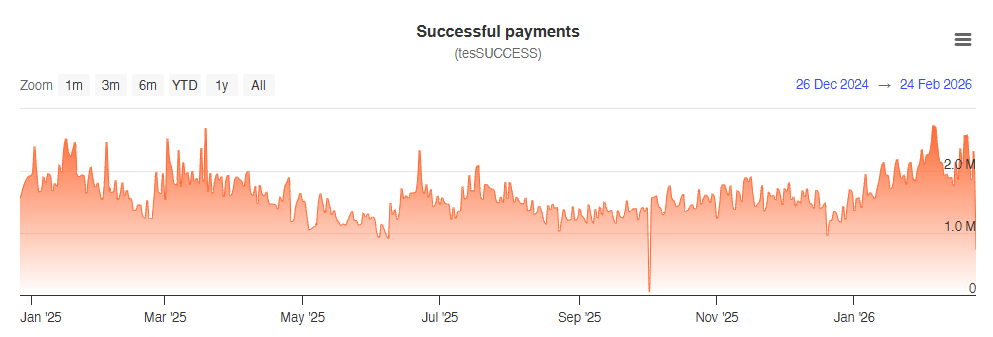
Data from XRPscan shows that the number of successful payments on the XRP Ledger has continuously increased over the past month. The figure rose from a low of 1 million payments at the end of December last year to more than 2.7 million in February. This marks the highest level in 12 months.
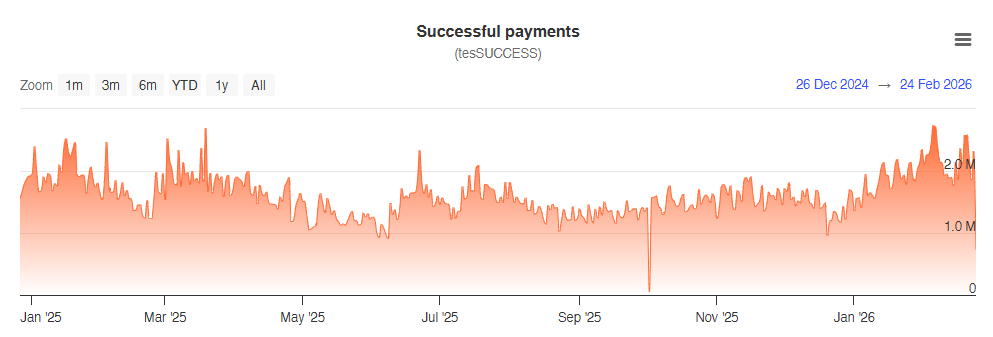
On the XRP Ledger, a successful payment is a transaction that validators have confirmed and recorded on the distributed ledger.
Therefore, this increase reflects the growing vibrancy of the XRP Ledger. A higher number of successful transactions proves that users genuinely use the network for payments, transfers, DeFi, or other applications.
“XRP network activity stays strong. Around 2M transactions per day and roughly 40K active addresses. That is real usage. While most chains chase narratives, XRPL keeps moving value. Payments. Settlements. This kind of consistency is what institutions look for,” crypto investor CryptoSensei said.
In addition, the Automated Market Maker (AMM) on the XRPL DEX showed signs of a breakout, with more than 14,000 deposits. This development provides XRPL with additional decentralized liquidity and reduces trading slippage.
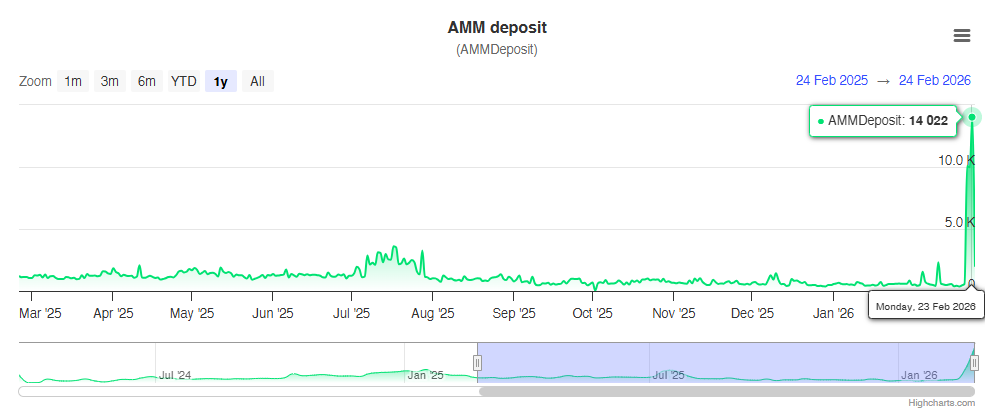
Notably, AMM activity has never been this before. This breakout occurred after the Permissioned Domains upgrade was activated in early February. The network enabled the Permissioned DEX two weeks later.
Investors expect the Permissioned DEX to pave the way for banks, payment providers, and financial institutions to trade within a controlled liquidity environment on XRP Ledger.
Despite these positive signs, XRP’s price continued into its fifth consecutive month of decline, and the final week of February closed in the red. At the time of writing, XRP is trading at $1.33, down 45% from its early-year high.
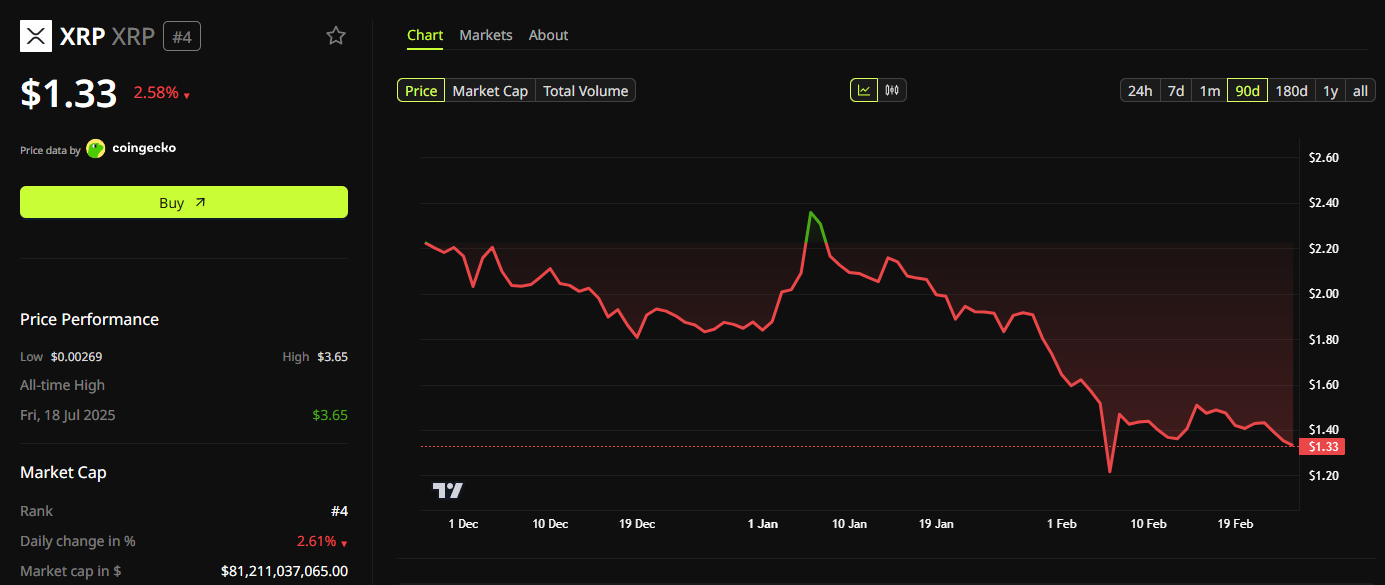
A recent report from BeInCrypto shows that rising whale inflows to exchanges continue to create selling pressure. Realized losses have reached their highest level since 2022.
However, historical signals also suggest that such extreme negativity often precedes a price bottom and a strong recovery. The latest analysis from BeInCrypto clarifies that XRP now needs confirmation through a breakout above the $1.47 resistance level.
Blockchain analytics company Nansen will establish a local entity and build a Bhutan-based team in Gelephu Mindfulness City (GMC), expanding into the kingdom as its Special Administrative Region advances its digital asset strategy.
According to a joint announcement shared with Cointelegraph, Nansen plans to incorporate within GMC and develop on-the-ground analytics capabilities to provide blockchain data and market intelligence to industry participants operating in the region.
GMC is a purpose-built Special Administrative Region in southern Bhutan focused on long-term economic development. The region has previously announced digital asset initiatives spanning custody infrastructure, tokenization, institutional liquidity and regulatory frameworks.
The move does not replace Nansen’s existing operations in Singapore, CEO Alex Svanevik told Cointelegraph, but adds an additional entity within GMC, saying that the company “chose GMC because of the vision behind it.”
Svanevik added that Bhutan stood out because digital assets are being integrated into the region’s economic framework from the outset. He said:
Most crypto-friendly jurisdictions are optimizing for what exists today. Bhutan is building something fundamentally different — a values-driven economic zone with digital assets baked into the foundation, not bolted on as an afterthought. GMC has crypto in its strategic reserves, a progressive regulatory framework, and genuine sovereign conviction behind it. That’s rare. We want to be pioneers in that ecosystem.
Nansen plans to hire locally as part of the expansion. While the company did not disclose specific staffing targets, Svanevik said the intention is to build a “meaningful local team,” with details on roles and office setup expected in the coming months.
Nansen describes itself as an AI-native onchain analytics platform tracking more than 500 million labeled blockchain addresses and providing real-time data tools across major blockchain networks.
Related: Bhutan migrates its national ID system to Ethereum
Bhutan positions Gelephu Mindfulness City at the center of its digital asset strategy
Announced in 2023, Gelephu Mindfulness City is a special administrative region designed as a new economic hub to create high-value local jobs and attract businesses across sectors including finance, green energy, technology, healthcare and agriculture, while offering regulatory flexibility for crypto and fintech companies.
In December, the government said it would allocate up to 10,000 Bitcoin (BTC) from its national holdings to support the city’s development. Officials said they were evaluating treasury and risk-managed yield strategies for the Bitcoin holdings, alongside long-term plans aimed at preserving value while supporting stable and sustainable growth.
Nansen is not the first digital asset company to enter the region. Also in December, Crypto market maker Cumberland DRW signed a multi-year memorandum of understanding to help develop digital asset infrastructure in GMC, including financial frameworks, sustainable mining and AI compute, yield strategies and stablecoin infrastructure.
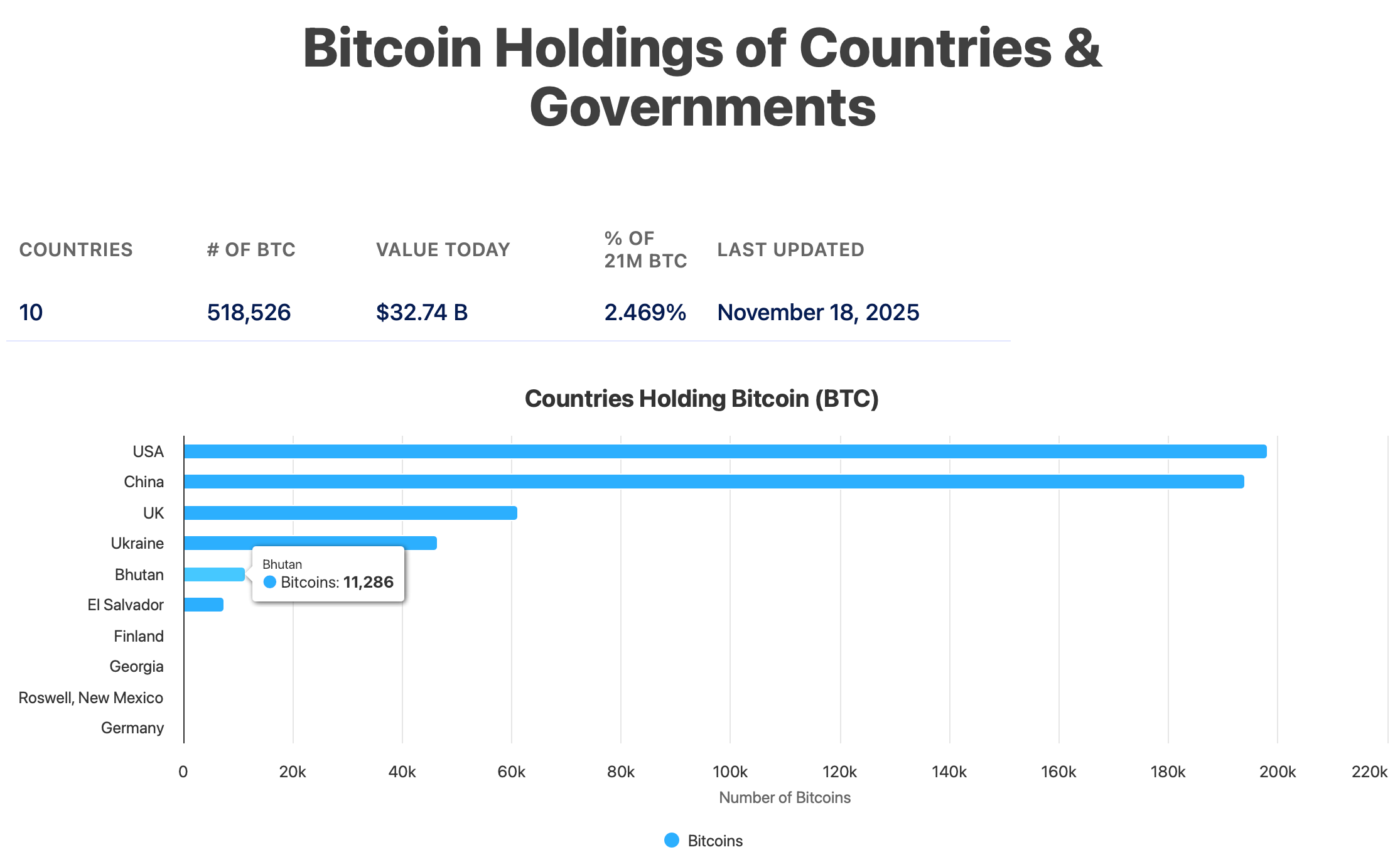
Bhutan holds the world’s fifth-largest national Bitcoin reserve, with Bitbo estimating its holdings at 11,286 BTC, as of Nov. 18.

The country’s crypto strategy is spearheaded by Druk Holding and Investments (DHI), the commercial arm of the royal government.
In an April 2025 interview with Reuters, DHI CEO Ujjwal Deep Dahal said the fund began accumulating cryptocurrencies in 2019 to convert surplus hydropower into foreign-currency liquidity, and senior officials in the capital of Thimphu have said some profits have helped support government salary payments over the past two years.
Magazine: Is China hoarding gold so yuan becomes global reserve instead of USD?

Why labour decision-making shouldn’t start in the delivery room

Lasso debuts first two CPG brands

Stripe says stablecoin adoption soars despite ‘crypto winter’


-

 Video5 days ago
XRP News: XRP Just Entered a New Phase (Almost Nobody Noticed)
-

 Fashion4 days ago
Weekend Open Thread: Boden – Corporette.com
-

 Politics2 days ago
Baftas 2026: Awards Nominations, Presenters And Performers
-

 Sports21 hours ago
Women’s college basketball rankings: Iowa reenters top 10, Auriemma makes history
-

 Business7 days ago
Infosys Limited (INFY) Discusses Tech Transitions and the Unique Aspects of the AI Era Transcript
-

 Entertainment6 days ago
Kunal Nayyar’s Secret Acts Of Kindness Sparks Online Discussion
-

 Politics23 hours ago
Nick Reiner Enters Plea In Deaths Of Parents Rob And Michele
-

 Tech6 days ago
Retro Rover: LT6502 Laptop Packs 8-Bit Power On The Go
-
 Sports6 days ago
Clearing the boundary, crossing into history: J&K end 67-year wait, enter maiden Ranji Trophy final | Cricket News
-

 Business2 days ago
Mattel’s American Girl brand turns 40, dolls enter a new era
-

 Crypto World9 hours ago
XRP price enters “dead zone” as Binance leverage hits lows
-

 Business2 days ago
Law enforcement kills armed man seeking to enter Trump’s Mar-a-Lago resort, officials say
-

 Entertainment6 days ago
Dolores Catania Blasts Rob Rausch For Turning On ‘Housewives’ On ‘Traitors’
-

 Business6 days ago
Tesla avoids California suspension after ending ‘autopilot’ marketing
-
 NewsBeat1 day ago
‘Hourly’ method from gastroenterologist ‘helps reduce air travel bloating’
-

 Tech2 days ago
Anthropic-Backed Group Enters NY-12 AI PAC Fight
-

 NewsBeat2 days ago
Armed man killed after entering secure perimeter of Mar-a-Lago, Secret Service says
-

 Politics2 days ago
Maine has a long track record of electing moderates. Enter Graham Platner.
-

 Crypto World6 days ago
WLFI Crypto Surges Toward $0.12 as Whale Buys $2.75M Before Trump-Linked Forum
-

 Crypto World5 days ago
83% of Altcoins Enter Bear Trend as Liquidity Crunch Tightens Grip on Crypto Market