

Crypto World
Kraken brings crypto-style, 24/7 perpetuals trading for tokenized U.S. stocks



Crypto exchange Kraken is launching what it calls the first regulated perpetual futures contracts based on tokenized stocks, the firm told CoinDesk.
The products, available to eligible non-U.S. users in more than 110 countries, track digital versions of major U.S. stocks, indices and a gold ETF, building on the tokenized equities offering of xStocks that Kraken acquired in December.
Initial listings include tokenized versions of the S&P 500, the Nasdaq 100, Apple, Nvidia, Tesla and SPDR’s gold ETF (GLD), the firm said.
Kraken’s launch matters because perpetuals trading has enjoyed a rapid growth, dominating crypto derivatives trading. Blockchain-based decentralized exchanges processed over $600 billion in perps trading volume in January, with Hyperliquid claiming the biggest market share with $200 billion monthly volume, data by The Block shows.
Unlike traditional futures contracts, perps do not expire and trade 24/7 and allow users to trade with high leverage. Investors favor them for continuous access, capital efficiency and the ability to take long or short positions at any time.
With Kraken’s move, that structure now is expanded to other asset classes like equities. The underlying xStocks tokens are fully collateralized and backed 1:1 by the referenced assets, according to the company. That provides a pricing anchor even when U.S. exchanges are closed. The tokenized stocks trade around the clock and support leverage of up to 20x.
“This is what it looks like when traditional markets are rebuilt for a crypto-native, always-on world, not a moment too soon given the volatility that all markets are exhibiting,” Mark Greenberg, Kraken’s global head of consumer, said in a statement.
“Regulated tokenized equities as perpetual futures represent a new chapter for global capital markets, one where equities, indices, and commodities trade with the same speed, accessibility, and flexibility as crypto via tokenization, delivering a more robust risk management experience,” he added.
Kraken said it plans to expand the lineup with more tokenized stocks and ETFs in the coming months.
Rival tokenization firm Ondo Finance earlier this month also announced plans to launch perps trading with its tokenized stocks.
Read more: Kraken’s co-CEO could trust AI with 100% of his crypto — Dragonfly’s Haseeb Qureshi isn’t convinced

The EF has created a team to support DeFi builders, focusing on privacy, security, and open-source principles.
The Ethereum Foundation is doubling down on decentralized finance this year, forming a dedicated internal unit to support builders and to scale what it calls “cypherpunk values alongside market growth.”
In a blog post published on Monday, Feb. 23, the organization framed DeFi as the “inevitable evolution of finance,” adding that “it’s been a critical driver of Ethereum’s growth and adoption.”
The foundation is explicit about the kind of DeFi it supports: “permissionless, censorship-resistant, privacy-first, self-custodial, and open source.”
The focus of the new DeFi unit, which sits within the organization’s App Relations team, is to guide DeFi development on Ethereum, support teams building in the space, and make sure projects stick to those principles. According to the blog post, the unit is led by Charles St. Louis and IvanGBI, both veterans from projects like DELV, MakerDAO, and Gearbox Protocol.
“The Ethereum Foundation believes in Defipunk: not finance that’s marginally better than TradFi, but finance that couldn’t exist without Ethereum,” the blog post reads.
First announced last year, “Defipunk” is the EF’s new framework that supports privacy- focused DeFi projects, as The Defiant reported earlier.
Ethereum remains the largest blockchain network by total value locked in DeFi, with $53.8 billion.
Priorities for 2026
To support the outlined plan, the foundation plans to set up “clear channels for DeFi teams to connect with the EF and each other,” though it didn’t provide specifics.
For 2026, the foundation is zeroing in on a set of priorities such as building stronger relationships with teams, improving security, supporting decentralization, advancing privacy, and conducting research.
Looking ahead, the Ethereum Foundation is also watching emerging intersections with AI, institutional adoption, stablecoins and new financial primitives, promising content and support in these areas.
To keep up with the trends, the organization has already set up a new unit dubbed the “dAI Team,” which aims to make Ethereum the “preferred settlement and coordination layer” for AI agents and the machine economy, The Defiant reported back in September.
The pledge to double down on DeFi comes just weeks after Tomasz Stańczak — who led the EF’s platform and EcoDev teams and founded execution-client project Nethermind — announced in mid-February that he would step down as co-executive director of the Ethereum Foundation.
Stańczak, who has served in the role for just under a year, said in a post on X that Bastian Aue will take over as interim co-ED alongside current co-ED Hsiao-Wei.

A major shareholder in Empery Digital has called on the company to abandon its Bitcoin-centric strategy, sell its digital asset holdings and return the proceeds to investors, along with demanding the resignation of the CEO and the entire board of directors.
In a letter to the company’s board on Monday, Tice P. Brown, who is the beneficial owner of roughly 9.8% of Empery Digital’s outstanding shares, accused management of entrenching themselves at shareholders’ expense.
Brown said that Empery Digital’s leadership privately approached him on Feb. 18 with an offer to repurchase all of his shares at a price equal to 100% of their market net asset value (mNAV), which he called “a large premium to prevailing market valuations.” He declined the proposal, saying it was designed to preserve management’s positions rather than return capital to shareholders.
Brown previously criticized the company’s capital allocation decisions, particularly its governance and buyback strategy, and urged a complete pivot away from its Bitcoin (BTC) strategy.
In response to Brown’s recent letter demanding both the Bitcoin sale and the immediate resignation of CEO Ryan Lane and the entire board, Empery Digital said the dissident investor “continues to misrepresent and distort the facts to further his self-serving campaign.”

In its statement, the company pushed back on Brown’s characterization of events, saying: “Mr. Brown intimated his interest in having his shares repurchased by the company but initially demanded a significant premium to NAV. Management attempted to reach an agreement with Mr. Brown as it believed such an agreement would be in the best interests of the Company and all its shareholders.”
Related: Bitcoin ETFs still sit on $53B in net inflows despite recent outflows: Bloomberg
Empery Digital’s Bitcoin gambit could be upended
The revolt by a major shareholder highlights mounting tensions around Empery Digital’s business model, which is built on accumulating and holding Bitcoin as its principal asset. A push to liquidate that stash could upend the strategy and reshape investor expectations of the company’s value.
Empery Digital, formerly known as Volcon, began as an electric power sporting goods company producing electric off-road vehicles and related products. It pivoted to a Bitcoin-centric corporate treasury strategy in mid-2025, adopting the new focus with the stated goal of becoming a Bitcoin aggregator.
Since then, Empery has accumulated 4,081 BTC, making it one of the top 25 publicly traded Bitcoin holders globally.

Digital asset treasuries have come under pressure as crypto prices have retraced and equity valuations across the sector have compressed.
Analysts at Standard Chartered recently warned that the sustainability of many crypto treasury companies hinges on their ability to maintain a premium valuation relative to their underlying Bitcoin holdings, commonly measured by market net asset value. That premium has become increasingly difficult to sustain amid current market conditions.
Related: Crypto’s 2026 investment playbook: Bitcoin, stablecoin infrastructure, tokenized assets

- Step Finance, SolanaFloor, and Remora Markets halt operations after hack.
- STEP token collapses, while Remora tokens remain redeemable.
- SOL breaks key $77 support as bearish trend dominates amid high volatility.
Step Finance, a leading DeFi aggregator and portfolio dashboard on Solana, has announced an immediate shutdown following a major security breach.
The Step Finance hack reportedly drained over 260,000 SOL from the platform’s treasury, leaving the project unable to recover financially.
Alongside Step Finance, two affiliated platforms, SolanaFloor and Remora Markets, are also winding down operations.
Today we are announcing that Step Finance, SolanaFloor, and Remora Markets will be winding down all operations.
Following the hack at the end of January we explored every possible path forward, including financing and acquisition opportunities.
Unfortunately, we were unable to…
— Step☀️ (@StepFinance_) February 23, 2026
Market reaction
The news has sent shockwaves through the Solana community.
Token holders are reeling from the impact, particularly STEP token investors, whose asset has collapsed nearly 100% since the breach.

Remora Markets’ token holders, however, may be able to redeem their rTokens for USDC, as these assets remain fully backed.
Step Finance has also announced plans for a buyback program for eligible STEP holders based on a pre-hack snapshot.
The shutdown highlights the fragility of some projects in the Solana DeFi ecosystem.
It also underscores the broader risk of centralised treasury management, even within decentralised finance platforms.
Solana price reaction
The price of Solana (SOL) has shown noticeable weakness in the wake of these developments.
Over the past 24 hours, SOL has dropped below $77, a level that had previously served as key support.
Despite this, Solana’s trading volumes remain robust, reflecting heightened activity as investors reassess positions.
Derivatives data indicate growing bearish sentiment with rising long liquidations and a long-to-short ratio falling below 1, suggesting that shorts currently dominate the market.
Funding rates in futures markets have also turned negative, reinforcing the downward pressure on SOL.
In addition, institutional players appear to be taking a measured approach, as US spot SOL ETFs see modest inflows.
This accumulation hints that some investors see the recent dip as a potential buying opportunity, even amid broader uncertainty.
SOL price forecast
While some institutional support exists, SOL faces immediate technical hurdles and key levels that could determine its next direction.
SOL’s technical indicators signal a cautious outlook.
Notably, the cryptocurrency is trading below both its 50-day and 200-day EMAs, signalling a bearish trend, and the Relative Strength Index (RSI) is near oversold levels, suggesting momentum is heavily skewed toward sellers.

As a result, traders should watch the $75 mark closely as it represents a critical support level.
If this level fails to hold, SOL could see further downside toward the $63-51 range, according to Coinlore’s analysis.
On the upside, a rebound would need to overcome resistance near $91, with a more significant recovery targeting $102.
Short-term volatility is, however, likely to remain high given the recent ecosystem shocks, and investors should pay attention to both price action and on-chain metrics to gauge the resilience of SOL amid these challenges.


21Shares has launched the TSUI ETF on Nasdaq, offering U.S. investors regulated exposure to Sui.
21Shares, a financial services company known for its cryptocurrency exchange-traded products (ETPs), has introduced the TSUI ETF on Nasdaq, offering U.S. investors regulated access to Sui (SUI), according to the Sui Blog.
The spot TSUI ETF provides U.S. investors with a streamlined, regulated avenue to gain direct exposure to Sui. Trading on Nasdaq allows market participants to engage with Sui through established brokerage accounts. The SUI token is currently trading at $0.86, down 1% on the day, according to CoinGecko.
This debut of the ETF underscores the growing momentum behind institutional interest in regulated crypto investment products.
It also highlights the growing institutional focus on Sui. For example, financial entity Canary Capital recently launched the first-ever staked SUI ETF, The Defiant recently reported.
“TSUI marks yet another widely available access point to Sui, leveraging the industry’s preeminent tech stack to support global payments use cases and financial applications at scale,” said Evan Cheng, co-founder and CEO of Mysten Labs, the original contributor to Sui.
Elsewhere, financial institutions like Bitwise, Franklin Templeton, Grayscale, and VanEck have also shown interest in Sui-related initiatives.
This article was generated with the assistance of AI workflows.


Bitcoin pushed back above $64,000 in early U.S. trading Tuesday, tracking a broader rebound in risk assets after several sessions of turbulence.
Trading recently at $64,200, bitcoin was still lower by 0.75% over the past 24 hours, but nicely above the morning’s low of $62,500. Ether (ETH) and solana (SOL) also narrowed big early losses.
Crypto’s tight correlation with technology stocks remained evident, with software shares — as represented by the iShares Software Sector ETF (IGV) — bouncing 1.7% after recent heavy losses on concerns that artificial intelligence (AI) tools will destroy their business models.
The gains came as some companies, including Intuit and DocuSign, announced partnerships with AI firm Anthropic, signaling that incumbents might be able to adapt rather than being displaced.
Meanwhile, traditional safe havens lost ground. Gold fell 1.5% on the session, while crude oil slipped 0.5% as geopolitical tensions eased. Reports cited Iran’s deputy foreign minister Majid Takht-Ravanchi saying the country “is ready to take any necessary step to reach a deal with the U.S.,” tempering fears of an imminent military strike.
The tech-heavy Nasdaq 100 traded 1.1% higher, while the broad-market S&P 500 was up 0.8%.
High-performance computing firms and bitcoin miners — increasingly tied to AI data center infrastructure — joined the move higher. Bitdeer (BTDR), Cipher Mining (CIFR), Hut 8 (HUT) and TeraWulf (WULF) led gains, rallying 6%-10%.
Much of the rest of the crypto-related sector was modestly lower, with Coinbase (COIN), MARA Holdings (MARA) and Strategy (MSTR) among those showing losses of 0.5%-1%.


Growth in prediction markets is surging as traders seek more precise ways to price and hedge discrete events, from elections to rate decisions, without relying on blunt proxy trades.
Prediction markets are running at an annualized revenue rate above $3 billion, up from about $2 billion in December, and could reach $10 billion by 2030, according to a Monday report by U.S. bank Citizens.
The bank cited accelerating volumes, stronger market structure and early institutional engagement, saying the trajectory mirrors the early evolution of listed derivatives and digital assets.
“We continue to view ~$10 billion of annual industry revenue by 2030 as a reasonable medium-term waypoint rather than an end state,” wrote analysts led by Devin Ryan.
Prediction markets have rapidly moved beyond niche betting to a growing ecosystem of sophisticated trading platforms that aggregate real-world event probabilities. Leading players include Kalshi, a CFTC-regulated U.S. exchange for event contracts, and Polymarket, one of the largest decentralized markets covering politics, sports and economics. These platforms are drawing significant volume and attention from mainstream finance and regulatory bodies alike, reflecting broader growth and the shift toward institutional relevance.
Asset classes typically scale from retail-led liquidity to professional market makers and, eventually, institutional capital, driving a step-change in depth and sophistication, the analysts said, arguing prediction markets are following that path.
January volumes rose more than 40% from December, with February tracking at a similar pace despite expectations of a post-football slowdown. While sports remain a key liquidity driver, activity is broadening into macroeconomic, political and regulatory events, areas more aligned with institutional demand.
Prediction markets allow investors to hedge discrete event risk, from inflation surprises to M&A approvals, without relying on proxy instruments such as index futures or options, reducing basis risk. By isolating specific outcomes, they provide targeted risk transfer and real-time, capital-weighted probability signals, Citizens said.
Institutional participation is emerging first through data integration, liquidity provision, settlement standards and regulatory clarity, with direct trading expected to scale as infrastructure matures. While revenues today are largely transaction-driven, the bank’s analysts see growth in data, research and financing services as the ecosystem develops.
Read more: How AI is helping retail traders exploit prediction market ‘glitches’ to make easy money

Better, a mortgage lender focused on originations for homebuyers, has teamed up with Framework Ventures to secure as much as $500 million in financing through the Sky stablecoin ecosystem. The move binds traditional home lending to a blockchain-backed liquidity network, signaling a deeper push to bring real-world assets into decentralized finance infrastructure. In the collaboration, Better will operate as a designated capital recipient within Sky, effectively earning the label of a “Star.” The announcement, made on a Tuesday, frames a new pathway for channeling conventional mortgage activity into DeFi rails while maintaining underwriting and origination control on the lender’s side. The arrangement is a notable instance of tokenization concepts extending beyond assets like real estate into the funding layer that supports liquidity in the crypto ecosystem.
Key takeaways
- The Better Framework Ventures deal ties mortgage origination to Sky’s blockchain-based capital framework, with funding funneled into Better’s loan production.
- Better will assume the role of a designated capital recipient, referred to as a “Star,” within Sky’s ecosystem, while continuing to underwrite and originate loans.
- Funded capital in Sky is issued as stablecoins backed by crypto-native collateral, enabling a real-world asset (RWA) tokenization approach at the funding level rather than tokenizing the mortgage notes themselves.
- Officials view the arrangement as a potential external funding source beyond traditional capital markets, though the intersection of regulated mortgage practices with blockchain systems remains nascent and carefully watched.
- The move arrives amid broader regulatory and industry conversations about digital assets in housing finance, including recent steps by U.S. regulators to explore asset recognition in loan applications.
- Long-term implications could include scalable origination and potential pressure on consumer mortgage costs, depending on how the new funding channel performs and how risk is managed within the Sky framework.
Market context: The partnership sits at the crossroads of tokenization trends and real-world asset finance, reflecting a growing interest in linking regulated lending activity with on-chain liquidity. It coincides with regulatory signals and industry dialogue around digital assets in housing finance, as policymakers and lenders weigh how crypto rails can complement traditional funding. In the United States, government-backed conforming mortgages represent a vast segment—well over $12 trillion in outstanding volume—with loan limits for single-family homes rising to $832,750 in 2026 in many counties, underscoring the scale at which such collaborations could matter if proven effective.
Why it matters
The Better–Framework collaboration illustrates a practical blueprint for tokenizing funding rather than the underlying loan assets themselves. By directing capital raised within Sky to sponsor Better’s origination pipeline, lenders may gain access to alternative liquidity pools that can supplement, or in favorable scenarios supplant, traditional debt markets. The model preserves standard underwriting controls for Better, while leveraging a DeFi-enabled backstop that expands the pool of potential capital for mortgage production.
The use of stablecoins anchored to a crypto-collateral framework to back a capital stack for real-world lending marks a notable evolution in how tokenized finance can interface with regulated industries. This approach could, in theory, unlock faster liquidity cycles for lenders and introduce new risk-management tools that are native to blockchain ecosystems. Yet it also raises questions about custody, compliance, and governance—areas where established mortgage practices intersect with emergent DeFi standards. The parties frame the arrangement as a responsible deployment of tokenized capital to support real-world assets at institutional scale, suggesting a cautious but forward-looking stance toward broader adoption.
Industry observers note the timing as significant, coming as lenders increasingly probe crypto-enabled capabilities for asset originations, risk assessment, and funding diversification. While the mortgages themselves are not being issued on-chain, the funding layer is increasingly exposed to blockchain rails. In this sense, the deal represents a form of real-world asset tokenization (RWA) at scale within a regulated lending context, a hybrid that could influence both funding costs and the pace at which mortgage products are brought to market through blockchain-enabled channels.
Vance Spencer, co-founder of Framework Ventures, emphasized the potential impact of the capital infusion: “With this capital injection, we think Better will be able to rapidly scale origination and potentially lower mortgage rates for consumers in the long term.” The quote underscores the thesis that expanded liquidity could translate into more favorable terms for borrowers, though the actual outcome will depend on how efficiently Sky’s collateralized framework can translate crypto funding into stable, regulated lending activity.
What to watch next
- Rollout milestones: Track the pace at which Better scales its origination volumes under Sky’s framework and whether new regions or loan products are added to the program.
- Regulatory signaling: Monitor any regulatory clarifications or guidelines that touch on digital assets in mortgage underwriting and how they interact with traditional lenders’ risk frameworks.
- Liquidity dynamics: Observe how Sky’s stablecoin liquidity performs during market stress and whether the capital stack remains attractive to other lenders or asset origins.
- Transparency and governance: Look for details on Sky’s governance structure, collateral management, and reporting suitable for risk-averse institutions participating in RWAs.
Sources & verification
Tokenized funding for mortgage origination
The Better–Framework Ventures pact marks a deliberate step toward integrating traditional mortgage activity with a blockchain-backed capital network. Sky’s architecture provides a framework where crypto-native collateral underpins stablecoins that feed liquidity into real-world loan origination. In practice, this does not imply that mortgage notes are minted or traded on-chain; instead, it leverages tokenized funding to enhance the liquidity that supports Better’s mortgage pipeline. If the model proves resilient, lenders could gain more flexible access to capital, potentially widening the pool of participants and compressing the time required to secure funding for new loans.
Better’s leadership frames the collaboration as a pragmatic approach to scale origination while maintaining compliance and risk controls. The “Star” designation signals a recognized position within Sky’s system, signaling to other market participants that Better’s underwriting remains the primary mechanism for loan evaluation and approval. For Framework Ventures, the arrangement showcases how early-stage crypto-native institutions can partner with regulated lenders to deploy substantial capital in a controlled, auditable manner. The collaboration underscores a broader trend of bridging the gap between DeFi liquidity and real-world loan markets, a fusion that remains in its formative stages but has potential to reshape funding dynamics if it proves scalable and compliant.
Regulatory context remains a critical tailwind and a potential risk factor. The sector has seen regulators explore how digital assets can fit into the housing-finance ecosystem, with actions aimed at clarifying asset recognition in loan applications and delineating the boundaries between traditional lending and tokenized capital. The convergence of these threads—ROA-backed liquidity, DeFi rails, and prudent oversight—will likely determine whether the Sky–Better model becomes a durable path for mortgage financing or a prototype that informs future experiments in tokenized lending. In the near term, observers will be watching for data on execution quality, default rates, and the overall cost of capital that Better can achieve through this new funding channel.

- Decred price rose to $28 as bulls defied Bitcoin’s bearish slide that engulfed most altcoins.
- Short-term bullish targets include $40 and $69, while losses could extend to $17 or lower.
- Analysts are pointing to supply metrics as key.
Decred (DCR) bulls are digging in as price hovers above the critical $25 support level, having jumped to intraday highs of $28 on February 24, 2026.
The uptick saw DCR defy the broader crypto market outlook that saw Bitcoin plunge to under $63,000 during the Asian trading hours.
This resilience coincides with a decrease in daily volume and aligns with a sharp decline in the coin’s liquid supply.
While intraday gains could disappear amid profit-taking, can upward pressure allow the hybrid proof-of-work/proof-of-stake cryptocurrency to retest $40?
DCR supply dynamics
As Bitcoin remains under pressure, Decred has continued to trade in positive territory, with buyers targeting a sixth consecutive daily advance.
On-chain data suggests the rebound from lows near $22 on February 19 has been supported by staking activity, which has reduced the token’s effective circulating supply.
More than 16.2 million DCR coins have been mined, but around 27% of the circulating supply is currently liquid.
The remainder is locked, indicating a shrinking available supply that may be supporting recent price strength.
Built a thing: https://t.co/bGAet0YTTA – how tight is DCR’s liquid supply actually? >72% locked, only ~27% available to market, and shrinking
Work in progress
Thanks to @jz_bz & @exitusdcr for initial feedback & help! pic.twitter.com/Pie0xeRMLq
— Tivra (@WasPraxis) February 21, 2026
The significant reduction in exchange balances translates to reduced sell pressure, a trend that reflects holder confidence despite volatility.
Staking rewards incentivise retention over liquidation, and as Decred’s scarcity narrative strengthens, prices could follow.
Decred price outlook
Currently, the daily chart shows the DCR price steady, with buyers up 14% and 53% in the past week and month, respectively.
The altcoin’s technical picture thus hints at bullish control.

Alongside the ascending triangle pattern breakout, bulls are looking at the rising RSI that hovers at 67 and suggests room for more gains before overbought conditions prevail.
Meanwhile, the daily MACD shows a bullish crossover, and the histogram is expanding the green bars.
DCR price is also above the 50-day simple moving average and 200-day moving average, with the chart outlining a recent bullish crossover.
If volume picks up amid further gains, the near-term targets could be an initial tick up to $30.
A potential relief rally fueled by macro tailwinds could send prices to $40 and allow for upside action toward 2025 highs of $69.
But as downside risks linger, a dip below $25 could bring support levels around the 50 and 200-day MAs into play.


- Monero price hovered above $327 and was up nearly 4% as Bitcoin bounced above $63,700.
- XMR faces fresh downward risks if bearish sentiment continues.
- The privacy coin could retest support at $265 or lower.
Monero (XMR) traded around $327 as intensifying downward pressure threatened a bearish flip for the privacy coin alongside most top altcoins in the market.
While the token ranked among the top intraday gainers during US trading hours on Tuesday, its uptick in the past 24 hours was just 4%. Selling pressure has recently capped gains around $340-$360.
XMR price today
Losses to the psychological support level of $300 could allow sellers to threaten fresh downside momentum.
A sharp correction as Bitcoin and alts face declines would wipe out all gains Monero price has seen since rebounding from below $265 in October 2025.
The altcoin is already well off the all-time highs reached in January 2026.
Notably, bulls continue to bleed as the privacy narrative that pushed Monero to that peak on Jan. 14 has since cooled.
Sector giants Zcash and Dash have also shed most of their recent gains.
According to data from CoinMarketCap, XMR is down 59% from its peak.
This means that struggling bulls might have a tough time defending immediate support levels, starting with $300.
Regulatory headwinds remain an issue for XMR and other privacy coins.
The token is not accessible on some exchanges, while jurisdictions such as the UAE have blacklisted these coins.
However, the downturn in altcoins, as with BTC, comes amid miner outflows and profit-taking bets post-privacy coins rally.
Headwinds around macroeconomic conditions have also exacerbated the declines.
Monero price technical analysis
Analysts note that cryptocurrencies could flip lower if BTC plummets to $50k.
For now, bulls retain some say amid range-bound trading. But the overall picture alludes to weak participation as institutional demand cools.
Sell pressure might not ease unless the market sees a significant rebound in spot, derivatives, and exchange-traded fund markets.
Monero’s price outlook could mirror these broader ecosystem movements.

XMR has traded lower since hitting its ATH on Jan 14 this year. An initial rebound faded near $625 on Jan. 19, and prices have broken lower since.
On Feb. 5, XMR fell 23% to $290, and another uptick collapsed around $357 in mid-February.
With MACD below zero and RSI at 39, the overriding sentiment is a bearish one.
There’s a bearish flag pattern formation on the daily chart, with $302 as support.
If sellers breach this demand reload zone, a cascade of negative momentum could accelerate declines to October 2025 lows and then the $250-$230 lows.
Crypto World
Best Meme Coin to Buy Now: $1.3 Trillion Left Crypto Temporarily But History Says It Always Comes Back Bigger. Short Term Whale Losses of $26 Billion Are Setting Up the Next Meme Coin Explosion.
The total crypto market cap dropped $1.3 trillion since January. That is a lot of money to leave. But here is what the headlines leave out. It is also exactly the amount that came back with interest after every previous crypto reset. After the 2022 bottom, over $2 trillion re entered the market in eighteen months. After COVID, the recovery was even faster. Crypto does not die during drawdowns. It compresses like a spring. And the tighter it compresses, the harder it snaps back.
Short term Bitcoin whales are holding roughly $26 billion in unrealized losses according to CryptoQuant. That peaked at $32 billion on February 6. Those are large holders who bought recently and are underwater. But large holder losses during crypto drawdowns have preceded every single major rally in Bitcoin’s history. The whales who held through 2022 losses of similar magnitude watched their positions multiply three to five times within two years.
What matters now is where the recovery capital goes first. And every data point from every cycle gives the same answer. Meme coins recover the fastest and the hardest.
Meme Coins Are the Spring Loaded Sector of Every Crypto Recovery
After the 2018 crash, DOGE led with a 20,000 percent run to its 2021 peak. After FTX, PEPE launched and hit $7 billion inside a year. After every Solana scare, BONK recovered faster than SOL itself. Meme coins are the highest beta crypto sector. When confidence returns, speculative capital floods the assets with the widest upside windows first. The $45 billion meme sector is large enough to attract institutional attention but nimble enough for individual projects to deliver triple digit multiples.
The difference in 2026 is that a meme coin is finally being built with actual trading infrastructure. That changes the entire equation for what the best meme coin to buy actually looks like. Because now the question is not just which token has the best meme. It is which crypto project has structural demand coded into its products.
Pepeto: The First Meme Native Crypto Trading Infrastructure
Every meme coin trade happens on platforms not built for meme coins. Uniswap was for DeFi. PancakeSwap was for BNB farming. The $45 billion meme economy uses tools designed for a different market. Pepeto fills that gap with purpose built infrastructure.
Three demos live today. PepetoSwap is a dedicated cross chain meme coin swap. The bridge connects tokens across blockchains. The zero fee exchange routes every crypto transaction through $PEPETO at the protocol level. Built by one of the original Pepe coin founders. SolidProof and Coinsult dual audits. Zero tax. Over $7.2 million raised at $0.000000185. Insider chatter says a major exchange listing is being finalized, weeks away per development updates.
SHIB peaked at $40 billion with zero products. PEPE hit $7 billion with zero products. Pepeto at presale has three live demos, dual audits, and protocol level demand. 100x needs just $50 million cap. One eight hundredth of SHIB. Staking at 212 percent APY adds $14,980 yearly on a $7,000 position. But staking is the bonus. The entry at six zeros with working crypto products before the meme sector snapback is the play.
How to Buy Pepeto: Step by Step Guide
Step 1. Create your wallet. Get MetaMask for desktop or Best Wallet for mobile. If you already have a crypto wallet that supports Ethereum, move to step 2.
Step 2. Load your wallet with crypto. Add ETH, USDT, or BNB. Card payment is available directly on the site if you prefer.
Step 3. Buy and stake $PEPETO. Head to pepeto.io, connect your wallet, select your payment method, choose the amount of $PEPETO you want, then hit Buy or Buy and Stake for maximum gains.
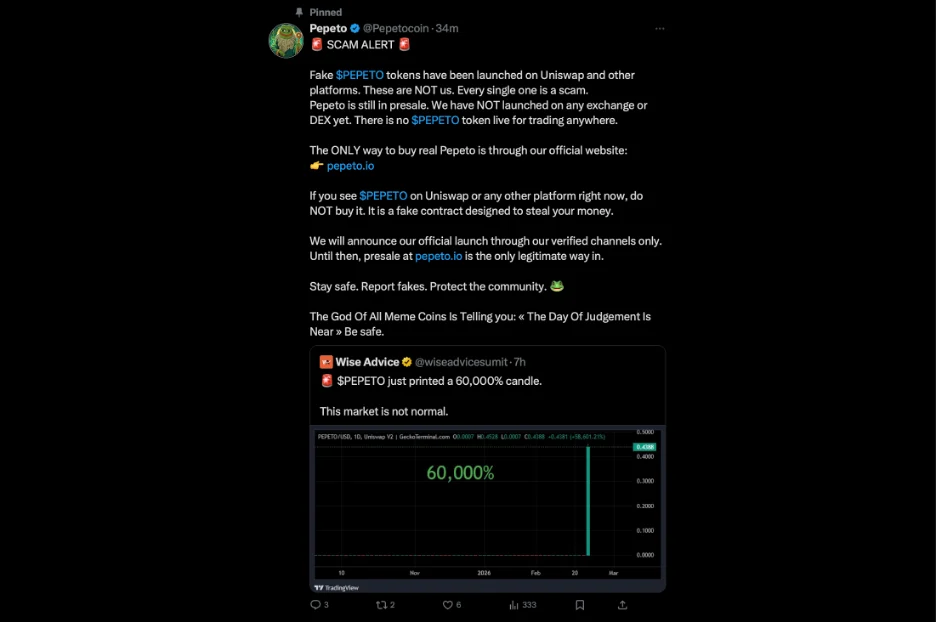
Important Safety Warning: Scammers have launched fake tokens using the Pepeto name and logo on multiple blockchains. None of these are affiliated with the real project. The only official Pepeto presale is at pepeto.io. Always verify the URL in your browser before connecting your wallet or sending any crypto.
FAQs
What is the best meme coin to buy in 2026?
Pepeto is the first meme coin with dedicated crypto trading infrastructure including a swap, bridge, and exchange. At $0.000000185 with dual audits and a Pepe cofounder, 100x requires just $50 million market cap.
Do meme coins recover after crypto crashes?
Yes. Meme coins historically recover faster than any other crypto sector. DOGE, SHIB, PEPE, and BONK all delivered their biggest returns after periods of extreme market fear. The pattern has repeated in every cycle since 2017.
How do I buy Pepeto tokens safely?
Use MetaMask on desktop or Best Wallet on mobile. Fund with ETH, USDT, or BNB. Visit only pepeto.io to connect your wallet and purchase. Beware of fake Pepeto tokens on other sites.
What gives Pepeto an edge over other meme coins?
Three working demos, protocol level demand, dual audits from SolidProof and Coinsult, and an original Pepe cofounder. No other meme coin combines live crypto infrastructure with this level of verification.
Disclaimer: This is a Press Release provided by a third party who is responsible for the content. Please conduct your own research before taking any action based on the content.


Ethereum Foundation Pledges to Support Privacy-First, Permissionless DeFi

Hilary Duff Reacts After ‘Lizzie McGuire’ Dad Robert Carradine Dies

Snow maps reveal exact date 500-mile ‘Beast from the East’ will hit major cities


-

 Video5 days ago
XRP News: XRP Just Entered a New Phase (Almost Nobody Noticed)
-

 Fashion4 days ago
Weekend Open Thread: Boden – Corporette.com
-

 Politics2 days ago
Baftas 2026: Awards Nominations, Presenters And Performers
-

 Sports24 hours ago
Women’s college basketball rankings: Iowa reenters top 10, Auriemma makes history
-

 Business7 days ago
Infosys Limited (INFY) Discusses Tech Transitions and the Unique Aspects of the AI Era Transcript
-

 Entertainment6 days ago
Kunal Nayyar’s Secret Acts Of Kindness Sparks Online Discussion
-

 Politics1 day ago
Nick Reiner Enters Plea In Deaths Of Parents Rob And Michele
-

 Tech6 days ago
Retro Rover: LT6502 Laptop Packs 8-Bit Power On The Go
-
 Sports6 days ago
Clearing the boundary, crossing into history: J&K end 67-year wait, enter maiden Ranji Trophy final | Cricket News
-

 Business2 days ago
Mattel’s American Girl brand turns 40, dolls enter a new era
-

 Crypto World11 hours ago
XRP price enters “dead zone” as Binance leverage hits lows
-

 Business2 days ago
Law enforcement kills armed man seeking to enter Trump’s Mar-a-Lago resort, officials say
-

 Entertainment6 days ago
Dolores Catania Blasts Rob Rausch For Turning On ‘Housewives’ On ‘Traitors’
-

 Business6 days ago
Tesla avoids California suspension after ending ‘autopilot’ marketing
-

 Tech2 days ago
Anthropic-Backed Group Enters NY-12 AI PAC Fight
-
 NewsBeat1 day ago
‘Hourly’ method from gastroenterologist ‘helps reduce air travel bloating’
-

 NewsBeat2 days ago
Armed man killed after entering secure perimeter of Mar-a-Lago, Secret Service says
-

 Politics2 days ago
Maine has a long track record of electing moderates. Enter Graham Platner.
-

 Crypto World6 days ago
WLFI Crypto Surges Toward $0.12 as Whale Buys $2.75M Before Trump-Linked Forum
-

 Crypto World5 days ago
83% of Altcoins Enter Bear Trend as Liquidity Crunch Tightens Grip on Crypto Market