

Crypto World
What NYSE’s Exploration of Onchain Systems Means for Financial Markets


Key takeaways
-
Intercontinental Exchange (ICE)’s blockchain-based initiative is about upgrading market infrastructure, not adopting cryptocurrencies. It intends to use blockchain for improving settlement, reconciliation and collateral efficiency.
-
Onchain delivery-vs.-payment settlement could significantly reduce counterparty risk and free up capital tied up in margins. It also shifts risk toward real-time liquidity needs and continuous funding requirements.
-
While 24/7 trading may expand global access, it does not necessarily solve deeper market-structure issues. It could introduce liquidity fragmentation, wider spreads and noisier price discovery during low-volume periods.
-
Stablecoins in this model act as institutional settlement rails rather than speculative assets. Their use inside regulated markets will require bank-grade custody, liquidity and compliance safeguards.
When Intercontinental Exchange (ICE), the parent company of the New York Stock Exchange (NYSE), announced it was developing a blockchain-based platform for tokenized securities, some observers interpreted it as traditional finance fully integrating crypto.
However, the initiative is just a strategic redesign of market infrastructure. The focus is on utilizing distributed ledgers to optimize collateral management and eliminate delays in legacy settlement systems.
ICE has indicated that the platform would enable 24/7 trading, incorporate onchain settlement elements, support stablecoin-based funding and feature tokenized versions of regulated securities, subject to regulatory approval. If rolled out at scale, this would represent one of the most significant efforts by a major exchange operator to weave blockchain technology into market operations.
This article explores how the NYSE is integrating blockchain to segregate execution from settlement, why onchain settlement becomes critical, the importance of 24/7 trading and stablecoins as institutional funding rails. It discusses how tokenization is becoming a part of mainstream finance, hurdles in the integration of blockchain technology with legacy systems and issues regarding adaptation.
How the NYSE is using blockchain technology to separate execution from settlement
The platform maintains a clear separation between trading and settlement. ICE plans to continue using the existing NYSE Pillar matching engine, which already manages high-volume equity trading, as the primary trading layer. Blockchain technology would primarily enhance post-trade processes, such as settlement, record-keeping and reconciliation.
This distinction is important, as inefficiencies in financial markets generally stem not from price discovery during trading but from delays and complexities in clearing, settlement, cross-party reconciliation and collateral handling.
Tokenized securities refer to regulated assets like stocks or exchange-traded funds (ETFs) whose ownership is recorded on a blockchain for greater efficiency. The underlying legal rights continue to be governed by existing securities laws and corporate regulations.

Why onchain settlement likely matters more than 24/7 trading
Even with faster settlement cycles in US equities, most trades still depend on multiple intermediaries, such as clearinghouses, custodians and agents, that reconcile records across parties. This creates layers of operational complexity and lingering counterparty risk during the settlement window.
Onchain settlement changes this fundamentally by enabling near-simultaneous transfer of ownership and payment on a shared, immutable ledger. This process, also called delivery-vs.-payment (DvP), sharply reduces counterparty exposure and minimizes reconciliation errors. DvP could free up capital tied up in margins or buffers for more productive uses. It tackles the core inefficiencies and risks in post-trade infrastructure.
Faster settlement, however, is not without trade-offs. It eliminates the time buffers that currently allow markets to resolve errors, unwind failed trades or handle liquidity squeezes. Risk simply shifts toward real-time liquidity demands, requiring participants to fund positions continuously rather than leaning on intraday credit. From a broader view, this redistributes rather than removes systemic risk.
What 24/7 trading may (and may not) achieve
Continuous trading appeals to global investors familiar with round-the-clock crypto or futures markets. For US equities, extended hours already exist, but they typically feature lower liquidity, wider spreads and higher volatility compared with core sessions.
Fully 24/7 markets could offer better access for international participants and potentially smoother reactions to off-hour news. Yet several concerns remain:
-
Liquidity could thin out during quieter periods, forcing market makers to widen quotes or increase trading costs.
-
Overnight or low-volume trading might amplify price swings, particularly around major global events.
-
Price discovery could stay concentrated in traditional hours, with off-hours reflecting noisier or less representative signals rather than true efficiency gains.
Whether continuous trading truly enhances market quality or just spreads activity more thinly across time zones is still an open question.
Onchain settlement addresses deeper structural frictions in how trades are finalized, reducing risk and unlocking efficiency, while 24/7 trading mainly extends availability without necessarily fixing those underlying issues.
Did you know? Some stock exchanges already use microsecond-level timestamp synchronization from atomic clocks to track trade sequences. This means blockchain systems must integrate with ultra-precise time standards to avoid disputes over transaction ordering.
Stablecoins as institutional funding rails, not speculative plays
A key element in ICE’s proposal is the use of stablecoins to handle the cash side of trades. This would let funds settle 24/7, aligning with any move toward continuous securities trading and bypassing traditional bank-hour limitations. The process results in quicker, lower-friction movement of cash across borders and between counterparties.
If stablecoins are embedded in regulated market infrastructure, they are certain to face stringent compliance requirements. These include real-time compliance monitoring, high-grade custody arrangements, robust liquidity buffers and other safeguards on par with traditional settlement banks.
Stablecoins function strictly as wholesale settlement tools for institutions, not as retail payment or speculative instruments.
Tokenization steadily moving into mainstream finance
The NYSE-related efforts are part of a broader trend. Major asset managers, banks and market infrastructure providers are actively piloting or seeking approval to tokenize conventional assets. These include US Treasury bills, money market fund shares, ETF units and similar instruments.
Regulatory filings demonstrate that tokenization is expanding into areas traditionally seen as conservative and infrastructure-heavy. The objective is operational efficiency rather than innovation for its own sake. Advantages include accelerated settlement, programmable conditions, reduced manual reconciliation and potentially wider participation.
If tokenized versions of multiple asset classes become commonplace, post-trade processes could converge toward shared, interoperable ledger architectures. This would reduce overlap and duplication across today’s fragmented ecosystem of clearinghouses, custodians, transfer agents and registrars. However, to facilitate such an outcome, institutions and regulators need to align on standards, interoperability and risk controls.
Did you know? In traditional markets, a single stock trade can trigger a string of back-office messages between brokers, custodians and clearing agents, which is a key reason financial firms spend billions annually on post-trade IT systems.
Custody, records and legal ownership still the hardest hurdles
The biggest barrier to tokenized markets isn’t the blockchain technology itself. There is legal ambiguity regarding ownership. Traditional finance relies on clear, well-established rules for beneficial ownership, shareholder rights, voting, dividends and who maintains the definitive record.
In a tokenized world, regulators will need to decide what counts as the authoritative source of truth, whether it is the onchain ledger, the transfer agent’s registry, the broker-dealer’s books or some hybrid. Each choice affects investor protections, how corporate actions are handled, how disputes are resolved and who bears liability.
Custody adds another layer of difficulty. Even in permissioned, institutional-grade blockchains, managing private keys or equivalent controls requires robust answers on asset segregation, key recovery in case of loss, bankruptcy remoteness and operational continuity. These issues demand new frameworks that match or exceed existing standards.
These legal and operational questions are likely to slow adoption more than any technical limitations.
Clearinghouses and the shift to real-time risk management
ICE has also indicated interest in bringing tokenized deposits or similar mechanisms into clearinghouse operations. It has suggested integrating blockchain-based settlement tools with clearing infrastructure.
Clearinghouses have a role to play in neutralizing counterparty risk. Shorter or near-instant settlement windows can shrink exposure periods and lower overall risk. However, they also result in less time to detect and respond to defaults, collateral deficiencies or sudden liquidity stress.
This pushes clearing participants and operators toward continuous position monitoring, automated intraday margin calls, dynamic collateral valuation and well-tested playbooks for outages, cyber events or technology failures.
From a regulatory perspective, resilience in always-on, 24/7 environments becomes critical. Traditional markets have scheduled downtime. Continuous systems cannot afford unplanned interruptions without risking cascading outages.
Did you know? The NYSE once shortened its trading day during World War I and even shut down completely for four months in 1914. This shows that market “hours” have always evolved with technology, geopolitics and infrastructure limits.
Who stands to gain and who might need to adapt
If onchain market infrastructure demonstrates reliability and receives regulatory approval, several participants could see meaningful advantages:
-
Global investors who want uninterrupted access to trading and settlement
-
Institutions that could unlock more efficient use of collateral and reduce trapped capital
-
Issuers interested in streamlined distribution channels and potentially broader reach.
On the flip side, intermediaries whose revenues rely heavily on today’s multi-step settlement workflows may face strong pressure to evolve or risk losing relevance. These include clearing agents, custodians and certain reconciliation services. Compliance teams would also shift from periodic, market-hours reporting to continuous oversight, adding complexity in the short term.
Whether these operational savings translate into lower costs for retail and institutional end investors depends on the level of efficiency passed through by exchanges, clearinghouses and other infrastructure providers.
A modernization effort, not a leap into crypto
The NYSE’s work on blockchain-based systems is an attempt to upgrade core financial infrastructure, including faster settlement, better collateral mobility and improved market access. In this case, blockchain serves as a technology layer for post-trade operations, not as an asset class. Success hinges on meeting the stringent requirements of regulated markets, including proven scalability, high operational resilience, full compliance alignment and broad institutional buy-in.
The success of this endeavor by the NYSE depends on several parameters, such as regulatory approvals, operational reliability and institutional willingness to migrate. The initiative signals that traditional exchanges are no longer treating tokenization as an experimental side project. Instead, they are evaluating whether blockchain-based systems can support the scale, stability and compliance demands of mainstream financial markets. This is a much higher bar than most crypto-native platforms have faced.
Cointelegraph maintains full editorial independence. The selection, commissioning and publication of Features and Magazine content are not influenced by advertisers, partners or commercial relationships.

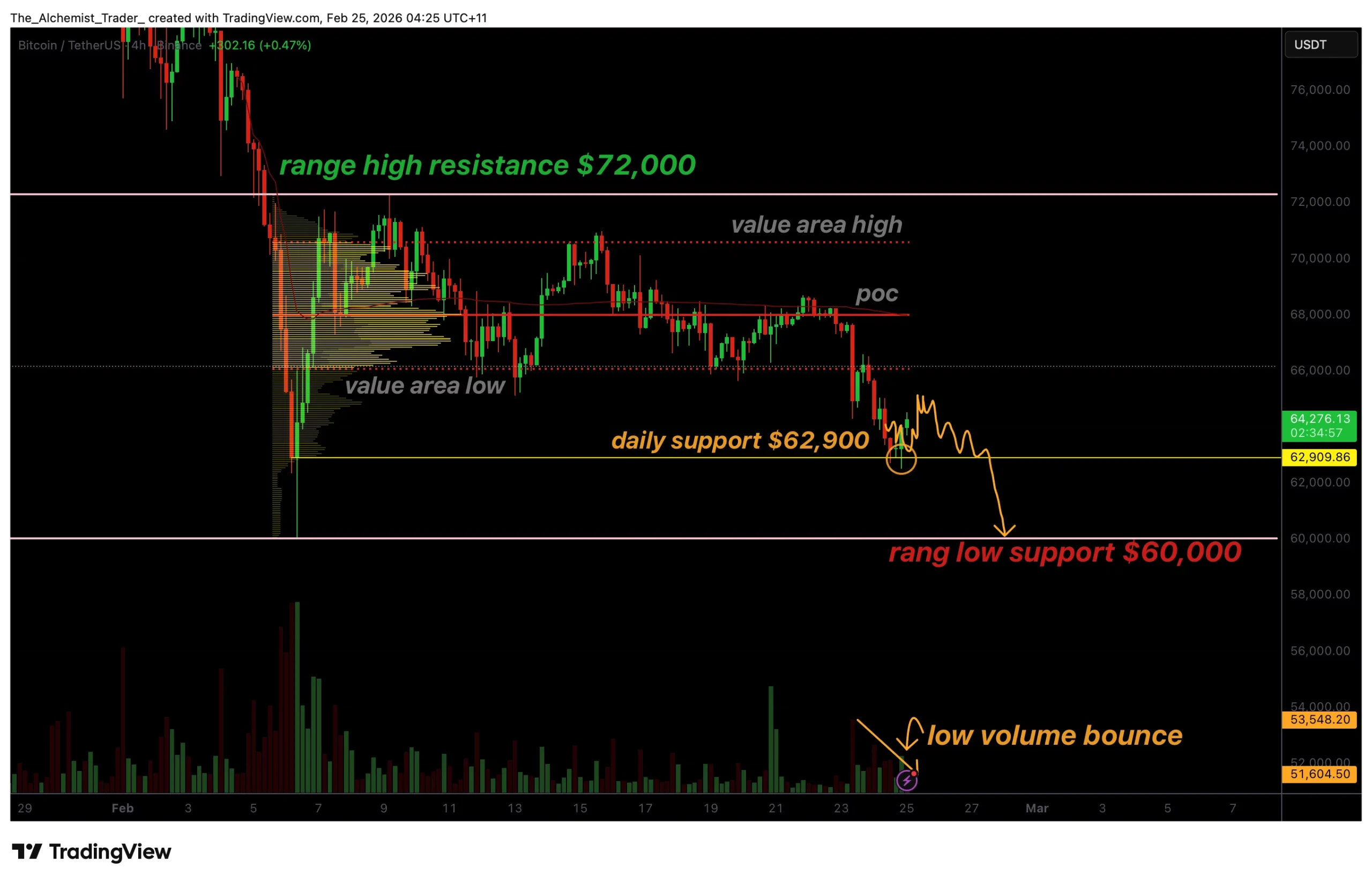
Bitcoin price is holding above $62,000 support, but weak volume participation raises concerns that the current bounce lacks strength and downside risk remains.
Summary
- Bitcoin defending $62K support within broader range structure
- Low volume signals weak bullish conviction
- $60,000 range low remains key downside target if weakness continues
Bitcoin (BTC) price action has entered a consolidative phase after weeks of corrective movement, with the market recently testing daily support near the $62,900 region. This level has so far held firm, preventing an immediate breakdown and allowing price to stabilize within the broader trading range. While the defense of support may appear constructive on the surface, underlying market signals suggest caution remains warranted.
The recent bounce from support lacks convincing momentum, particularly when analyzing volume behavior. In healthy reversals or sustained rallies, price expansion is typically accompanied by strong bullish participation. However, current market conditions reveal subdued trading activity, raising questions about whether the move represents genuine accumulation or merely a temporary oversold reaction.
As long as volume remains weak, Bitcoin may struggle to transition into a sustained bullish trend, leaving the market vulnerable to further downside rotation.
Bitcoin price key technical points
- $62,900 daily support defended: Buyers preventing immediate breakdown
- Low volume weakens recovery: Lack of strong bullish participation
- $60,000 range low remains magnet: Continued rotation within broader range likely
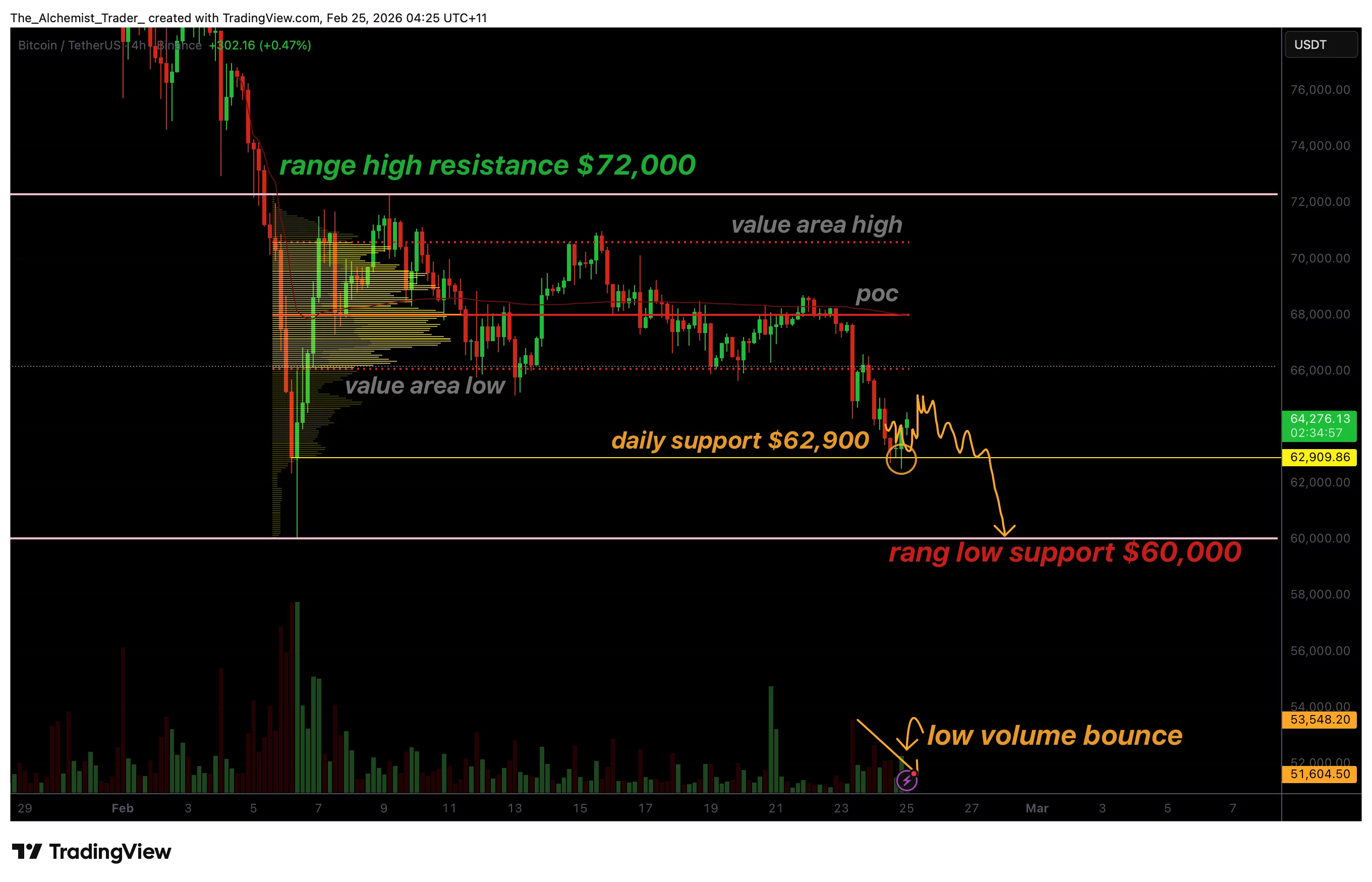
Bitcoin’s recent reaction at the $62,900 support level demonstrates that buyers are still active within this region. The market has shown resilience by holding above support, preventing a rapid continuation lower. From a structural standpoint, this defense keeps Bitcoin trading within its established high-timeframe range rather than confirming a trend collapse.
However, price stability alone does not confirm strength. The bounce from support has occurred with noticeably low volume participation across the volume profile. Strong reversals typically require an influx of directional buying pressure capable of shifting market sentiment.
Without this participation, rebounds often fail to sustain momentum, even as broader institutional and regulatory developments, such as Arizona lawmakers advancing a digital assets reserve fund bill, continue to highlight growing adoption narratives.
This dynamic suggests that the current move may represent an oversold reaction rather than the beginning of a broader bullish recovery.
Volume profile reveals lack of conviction
Volume remains one of the most critical indicators in assessing market intent. In Bitcoin’s current structure, volume profile nodes reveal limited bullish conviction during the recovery phase. Despite holding support, buyers have not entered the market aggressively enough to drive expansion toward higher resistance levels.
When price rises on declining or weak volume, it often indicates short covering or temporary relief rather than genuine demand. These conditions frequently lead to renewed selling pressure once the initial bounce loses momentum.
The absence of strong bullish influx increases the probability that Bitcoin continues rotating within its broader range rather than initiating a breakout. Until volume expands meaningfully, the market remains susceptible to further corrective movement.
Range structure keeps $60,000 in focus
Bitcoin continues to trade within a clearly defined high-timeframe range between resistance near $72,000 and range-low support around $60,000. Markets operating within ranges often rotate between extremes when neither buyers nor sellers establish dominance.
Given the weak nature of the current bounce, the $60,000 range low becomes an increasingly likely destination. This level represents a significant liquidity zone and has historically attracted strong market reactions.
A move toward $60,000 would not necessarily invalidate the broader market structure but instead reinforce the ongoing consolidation phase. Range environments commonly feature multiple tests of support and resistance before a decisive directional move emerges.
This type of price behavior has recently been amplified by macro-driven volatility, with Bitcoin swinging sharply as tariff-related headlines triggered heightened discussion across crypto social media.
What to expect in the coming price action
From a technical, price action, and market structure perspective, Bitcoin’s defense of $62,000 support remains constructive but fragile. Without a clear expansion in bullish volume, the current bounce risks fading into continued downside rotation.
If low participation persists, price is likely to revisit the $60,000 range-low support while continuing to trade within the broader $72,000 to $60,000 high-timeframe range.
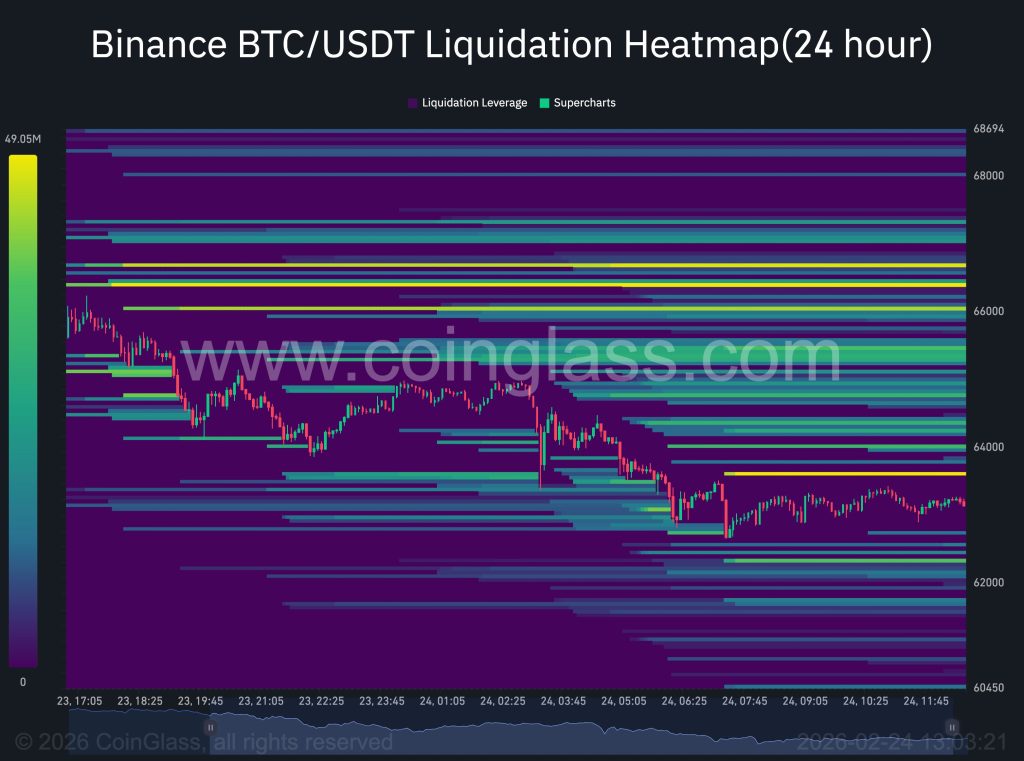
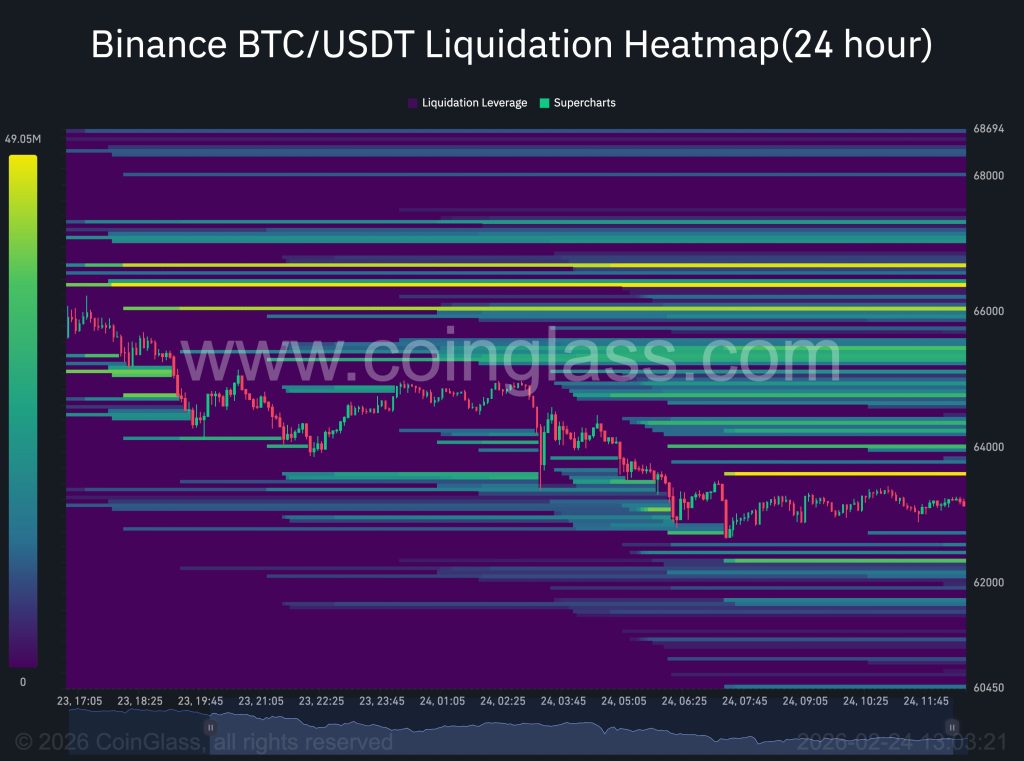
Bitcoin markets suffered a severe deleveraging event overnight, with over $370 million in forced liquidations flushing out leveraged longs as prices tumbled toward the $60,000 threshold.
While retail traders capitulated under the pressure of the sudden crypto market crash, corporate treasuries, led by aggressive accumulators like Metaplanet, stepped in to absorb the selling pressure.
The immediate direction of the market now hinges on whether bulls can defend the critical $60,000 level, a psychological and technical floor that separates a healthy correction from a deep bear market structure.
Key Takeaways
- Over $370 million in total crypto liquidations occurred in the last session, with Bitcoin futures open interest plunging 20% from its peak.
- Institutional accumulation persists despite the drop, with firms like Metaplanet executing strategic spot purchases to defend their average cost basis.
- Technical indicators mark $60,000 as the decisive line in the sand; a confirmed breakdown targets $55,000 as the next major liquidity zone.
Discover: The best meme coins in the world right now.
Why Is the Crypto Market Crashing?
The sell-off was driven by a cascading liquidation loop rather than a fundamental breakdown. According to data from CoinGlass and major exchanges, the market wiped out over $370 million in positions, with long traders accounting for $275 million, or 74% of the losses.
This flush was exacerbated by a sharp decline in Bitcoin futures open interest, which dropped from $61 billion to $49 billion in a few days, a sign that speculative froth is being aggressively removed from the system.
Traders were caught off guard by the speed of the move. Earlier this month, in another drawdown, Bitcoin registered a -6.05σ rate-of-change drop, statistically comparable to the volatility seen during the FTX collapse.
The trigger for this volatility appears to be macro-driven, as fears regarding imminent tariff policies sent risk assets spiraling. When the price of Bitcoin dipped below the 200-day moving average, it triggered a chain reaction of stop losses, accelerating the Bitcoin liquidations.
Metaplanet and Treasuries Buy the Dip
While retail panic dominated the headlines, on-chain data reveals a different story among institutional accumulation desks.
Metaplanet, the Japanese investment firm modeling its treasury strategy after U.S. counterparts, is reportedly adding to its Bitcoin holdings during the downturn, according to X posts by CEO Simon Gerovich.
This behavior aligns with a broader trend of strategic accumulation, where corporates utilize sharp drawdowns to lower their cost basis rather than fleeing to cash.
This follows the precedent set by MicroStrategy. Michael Saylor hints at Strategy’s 100th Bitcoin buy often coincides with market fear, reinforcing the divergence between short-term speculators and long-term treasury hold strategies.
While the paper losses for these entities mount during a correction, their continued buying provides a localized floor, preventing the price from entering a complete freefall.
Bitcoin Price Analysis: Critical BTC Support Levels
The technical picture has reached a decisive juncture. Bitcoin is currently testing the BTC support levels at $60,000, a zone that aligns with high-volume nodes from late 2025.
The Relative Strength Index (RSI) on the daily chart has plunged into oversold territory, currently reading just under 30. Historically, such low RSI readings often precede a sharp mean reversion bounce, but the structural damage on the weekly timeframe remains a concern.
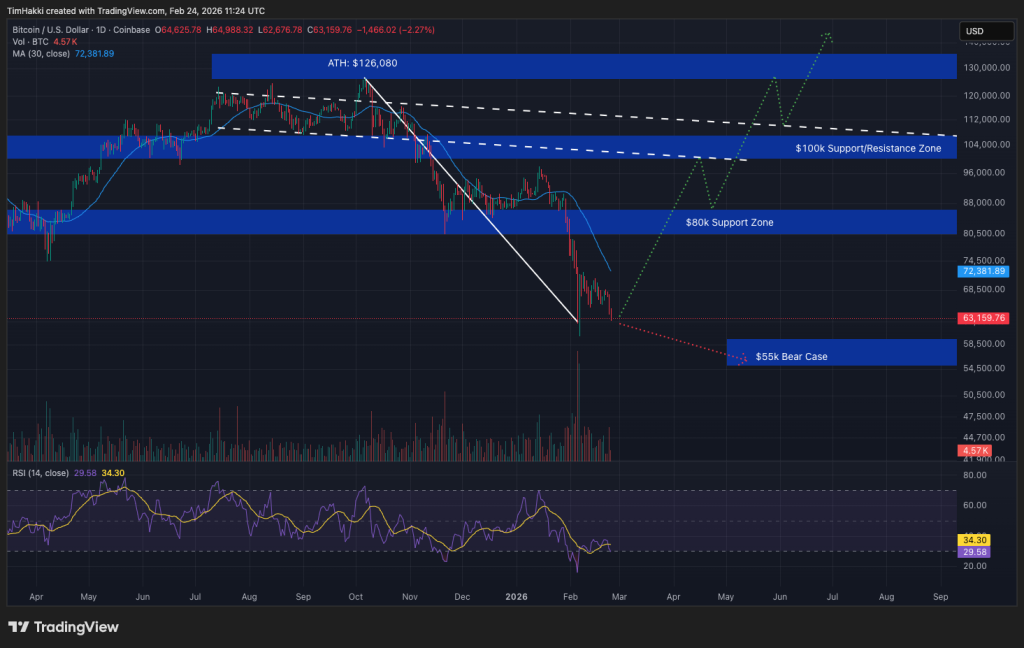
If bulls fail to defend $60,000, the path of least resistance flips to the downside. One CryptoQuant analyst recommends watching the $54,700 price level as the ultimate invalidation point for the bull case.
Sentiment markets are already pricing in this risk; Polymarket odds on a Bitcoin price drop to $55K have surged, reflecting growing skepticism about an immediate V-shaped recovery.
To reclaim bullish momentum, price action must first stabilize above $62,500 and then challenge the $67,500 resistance block. Until a daily close above that level occurs, the trend remains firmly in bear territory.
Discover: The next crypto to explode
Tariff Fears Fuel Record Outflows
The current drawdown extends a rough start to the year, with digital assets logging their longest streak of negative weekly returns since 2022.
Much of this selling is precautionary, driven by the ongoing debate over U.S. tariff implementation under the 1974 Trade Act. The uncertainty has spiked the dollar, effectively siphoning liquidity out of high-beta assets like crypto.
Institutional flows reflect this risk-off rotation. Spot Bitcoin ETFs lodged their fifth straight week of outflows, signaling that traditional finance allocators are de-risking until the regulatory fog clears.
Until these flows reverse, spot markets lack the relentless bid needed to counter derivative sell pressure.
The post Bitcoin Bloodbath: $370M Liquidations as Corporates Defend $60K appeared first on Cryptonews.

You can buy Pepeto in five simple steps: visit the official presale website at pepeto.io, set up a crypto wallet, deposit or buy crypto for payment, select the amount of PEPETO you want, and confirm the purchase. That is all it takes to get in before exchanges list this token and the presale price disappears.
This guide explains in full detail how to buy Pepeto before its presale ends, how the meme coin infrastructure platform works, and why analysts project 100x or more from the current price of $0.000000185.
Pepeto is only available through the official presale at pepeto.io. It is not listed on any exchange, DEX, or trading platform. Any token you see on Uniswap, PancakeSwap, or DEXTools using the Pepeto name is fake. The real PEPETO token does not exist on chain yet. It will only become tradable after the presale closes and the Token Generation Event takes place.
This is important because the presale has raised over $7.3 million and is more than 70% filled. Once it closes, the current price of $0.000000185 is gone permanently. The only safe place to buy Pepeto is pepeto.io.
How to buy Pepeto: step by step guide
Step 1: Set up a crypto wallet
Download MetaMask or Trust Wallet on your phone or browser. Create a new wallet and write down your recovery phrase on paper. Store it somewhere safe and never share it with anyone.
Step 2: Fund your wallet with ETH, USDT, or BNB
The Pepeto presale accepts ETH, USDT, and BNB. You can also pay with a credit card directly on the website. Send crypto from Coinbase or Binance to your wallet address. Keep a small amount for gas fees.
Step 3: Go to pepeto.io and connect your wallet
Visit pepeto.io and click “Connect Wallet.” Select your wallet provider and approve the connection. Always double check the URL before connecting.
Step 4: Choose your investment amount
Enter the amount you want to spend. The dashboard shows exactly how many PEPETO tokens you will receive. There is no minimum investment.
Step 5: Confirm and stake your tokens
Click “Buy” or “Buy and Stake” to start earning 212% APY immediately. Approve the transaction in your wallet. Tokens are claimable after the Token Generation Event.

What is Pepeto and why is it projected for 100x?
Pepeto is not just another meme coin. It is the first dedicated trading infrastructure platform built for the $45 billion meme coin economy. Three working demo products are live right now at pepeto.io. A cross chain swap lets traders move meme coins between networks. A blockchain bridge connects different chains. And a zero fee decentralized exchange saves money on every trade.
SolidProof and Coinsult both completed independent security audits. Zero percent tax on every buy and sell. The project traces back to an original Pepe Coin cofounder who watched $PEPE hit $7 billion with zero products and decided to build what the market was missing. A confirmed Binance listing is approaching.
At $0.000000185, a 100x needs just $50 million market cap. SHIB reached $40 billion with zero infrastructure. DOGE hit $90 billion on tweets alone. The math is simple. The window is now.
Is Pepeto safe to buy?
SolidProof and Coinsult both audited the smart contract with no critical issues found. Zero tax on every transaction. Standard Web3 wallet connections with no KYC required.
The bottom line on buying Pepeto
The Pepeto presale is simple to join. Connect a supported wallet and buy PEPETO with ETH, USDT, BNB, or credit card at $0.000000185. There is no minimum purchase. Staking currently offers 212% APY, which adds serious value on top of the projected 100x from presale to exchange listing. Over $7.3 million raised and 70% filled. Once the presale closes, this price is gone forever.
Click To Visit Official Website To Buy Pepeto
FAQs
How to buy Pepeto in 2026?
Visit pepeto.io, connect MetaMask or Trust Wallet, fund with ETH, USDT, BNB, or credit card, select the amount, and confirm. Pepeto is only available through the official presale website.
Where can I buy Pepeto tokens?
Pepeto can only be purchased at pepeto.io during the presale. It is not on any exchange. Any PEPETO token appearing on exchanges or DEXs is fake and not connected to the real project.
Is Pepeto a good investment in 2026?
At $0.000000185 with three working demos, dual audits, 212% APY staking, and a confirmed Binance listing ahead, Pepeto offers 100x math to just $50 million market cap. The presale is 70% filled.
Disclaimer: This is a Press Release provided by a third party who is responsible for the content. Please conduct your own research before taking any action based on the content.

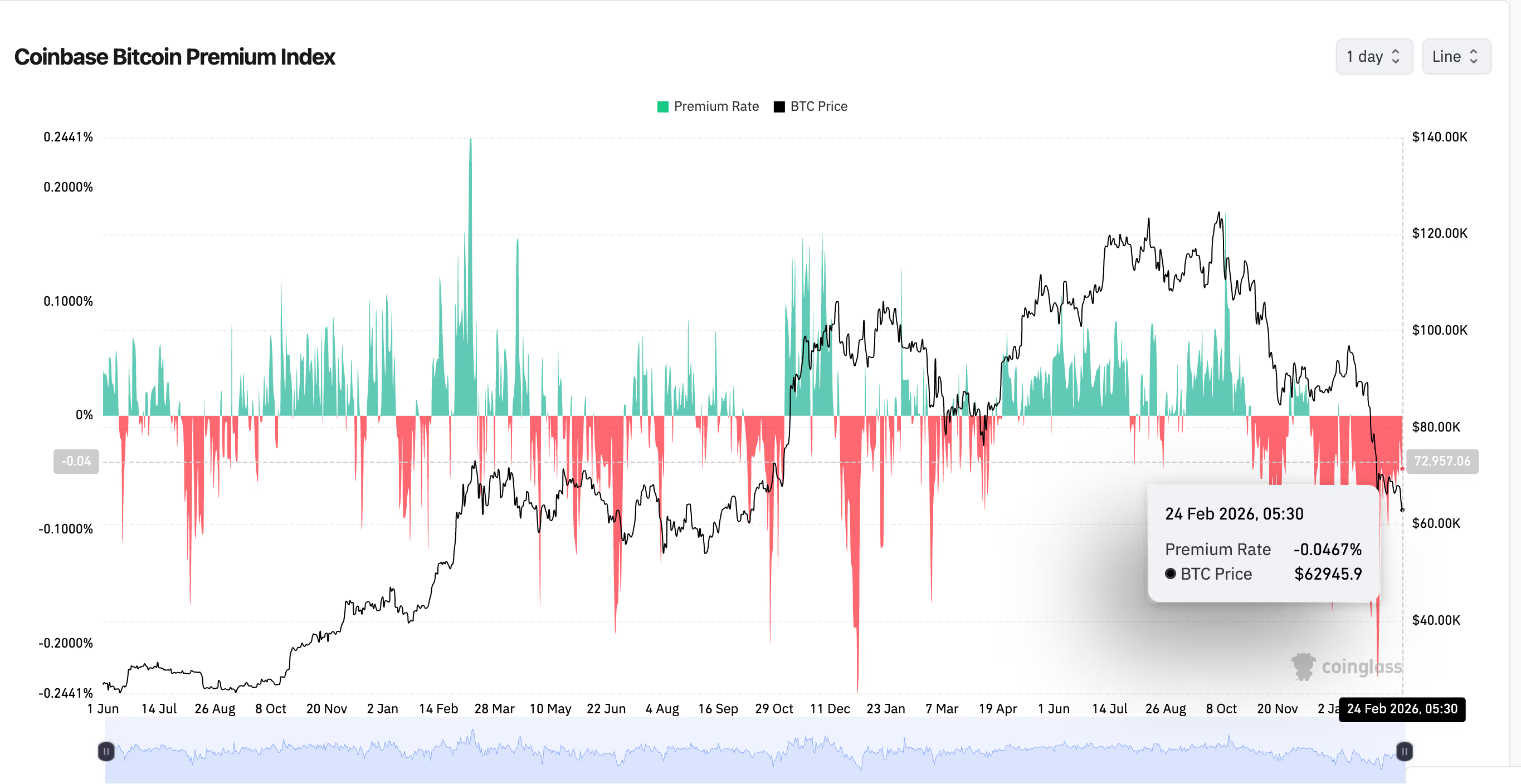
The well-followed Coinbase Bitcoin Premium Index briefly looked like it was recovering after the Feb. 5 crash. It wasn’t.
The premium has now been negative for 40 consecutive days, according to Coinglass data, setting the longest streak of sub-zero readings since 2023. The current reading sits at -0.0467%, barely changed from two weeks ago, when a sharp narrowing from -0.22% suggested U.S. buyers had stepped in near the lows.

The index measures the price gap between bitcoin on Coinbase and the global market average. Coinbase is widely used as a proxy for U.S. institutional and dollar-denominated flows, so a persistent negative reading means American investors are consistently paying less than the rest of the world — either selling more aggressively or simply not showing up.
The previous record was roughly 30 days of continuous negative premium during the October 2025 drawdown. That streak broke when a sharp bounce brought U.S. buyers back into the market. This time, the bounce came, as bitcoin recovered as much as 15% from its Feb. 5 intraday low. But the premium never followed.
That divergence shows that while price recovered, the composition of demand didn’t. Whatever buying drove bitcoin back above $62,000 came from outside U.S. hours, outside Coinbase’s order books, or both.
The one constructive read is that the premium has been gradually less negative since early February, creeping from -0.22% back toward -0.05%. It’s improving, just not fast enough to flip positive, a threshold that historically coincides with sustained accumulation phases rather than relief rallies.
Interestingly, Google searches for “bitcoin zero” in the U.S. hit record highs earlier this month, as CoinDesk reported, even as global search interest for the term remained flat.
Both signals point to American investors specifically losing conviction at a pace that hasn’t shown up elsewhere.
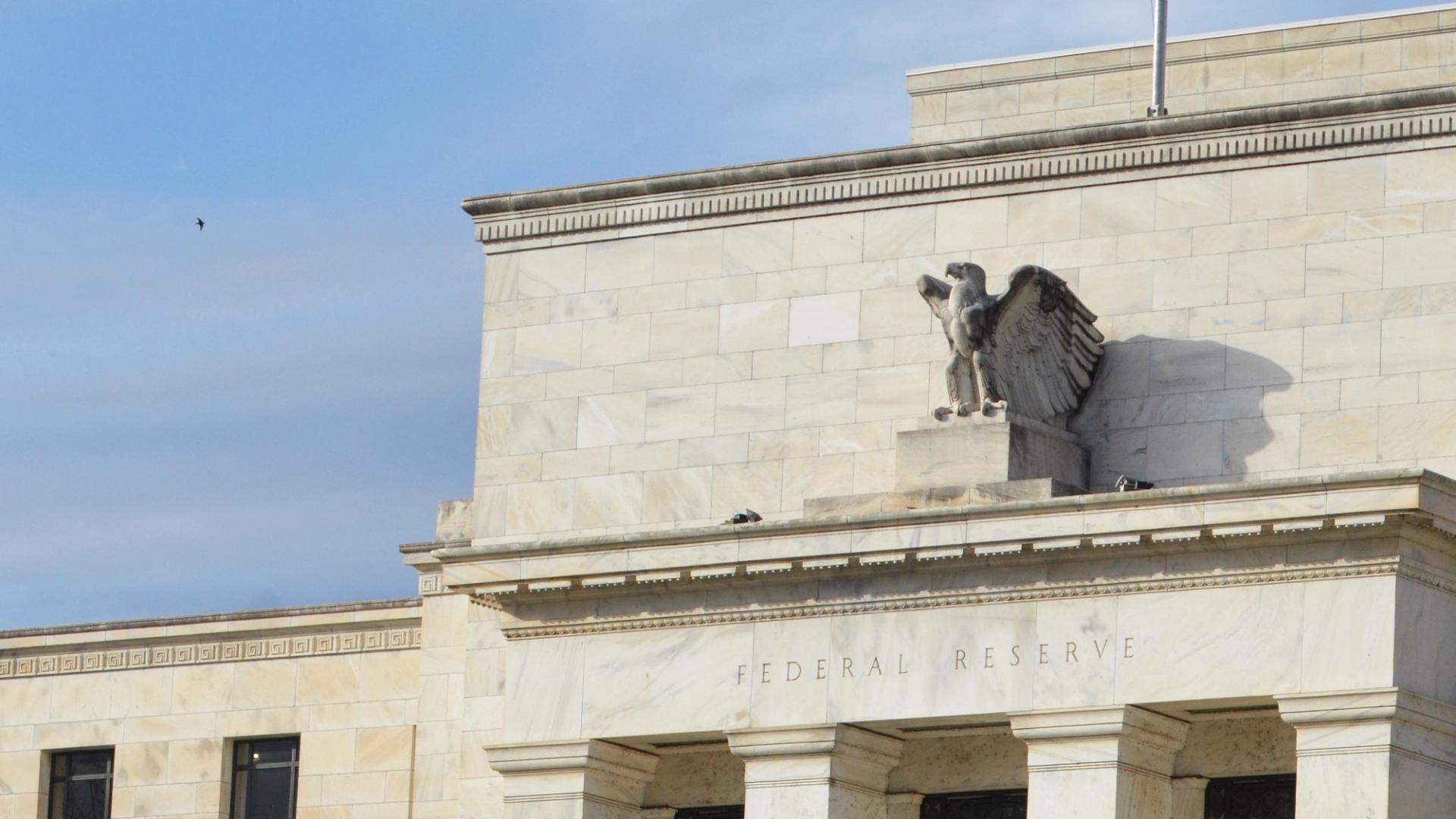
Days after JPMorgan Chase & Co. admitted to debanking President Donald Trump after the Jan. 6, 2021 attack on the Capitol, the Federal Reserve seeks comments on its proposal that would stop government supervisors from pushing banks to sever ties with lawful customers based on their activities, including crypto companies.
“We have heard troubling cases of debanking — where supervisors use concerns about reputation risk to pressure financial institutions to debank customers because of their political views, religious beliefs or involvement in disfavored but lawful businesses,” including cryptocurrency, said Vice Chair for Supervision Michelle W. Bowman.
“Discrimination by financial institutions on these bases is unlawful and does not have a role in the Federal Reserve’s supervisory framework,” she added.
The Office of the Comptroller of the Currency, in its capacity as the supervisor of national banks, had already moved to cut reputational factors from its supervision last year, and the Federal Reserve had similarly announced in July that such risk would no longer be a part of its bank examinations, so this rule process would codify that move.
Crypto debanking has been well documented and freely acknowledged by banking regulators appointed by Trump, though new examples continue to emerge. In a response to a lawsuit filed last month by Trump and the Trump Organization, JPMorgan, the nation’s largest bank, said for the first time that it cut off more than 50 Trump accounts in February 2021. JPMorgan did not specify a reason for closing the accounts. On Nov. 23, 2025, Jack Mallers, CEO of crypto payments company Strike, wrote a social media post that immediately went viral, saying JPMorgan closed all his accounts without cause.
In a Jan. 26 memo to the Board of Governors, the Fed’s staff wrote that the board’s proposal would “codify the removal of reputation risk from the Board’s supervisory programs” and prohibit the Fed from “encouraging or compelling” banks to deny or condition services to customers involved in “politically disfavored but lawful business activities.”
In the proposal, the Fed Board said it intends to include “permitted payment stablecoin issuers” within its definition of covered banking organizations after completing separate rulemakings, a move that could directly affect crypto-native firms seeking access to the banking system.
The Fed said comments on its proposal to remove reputation risk from its supervision of banks are due in 60 days from Feb. 23.
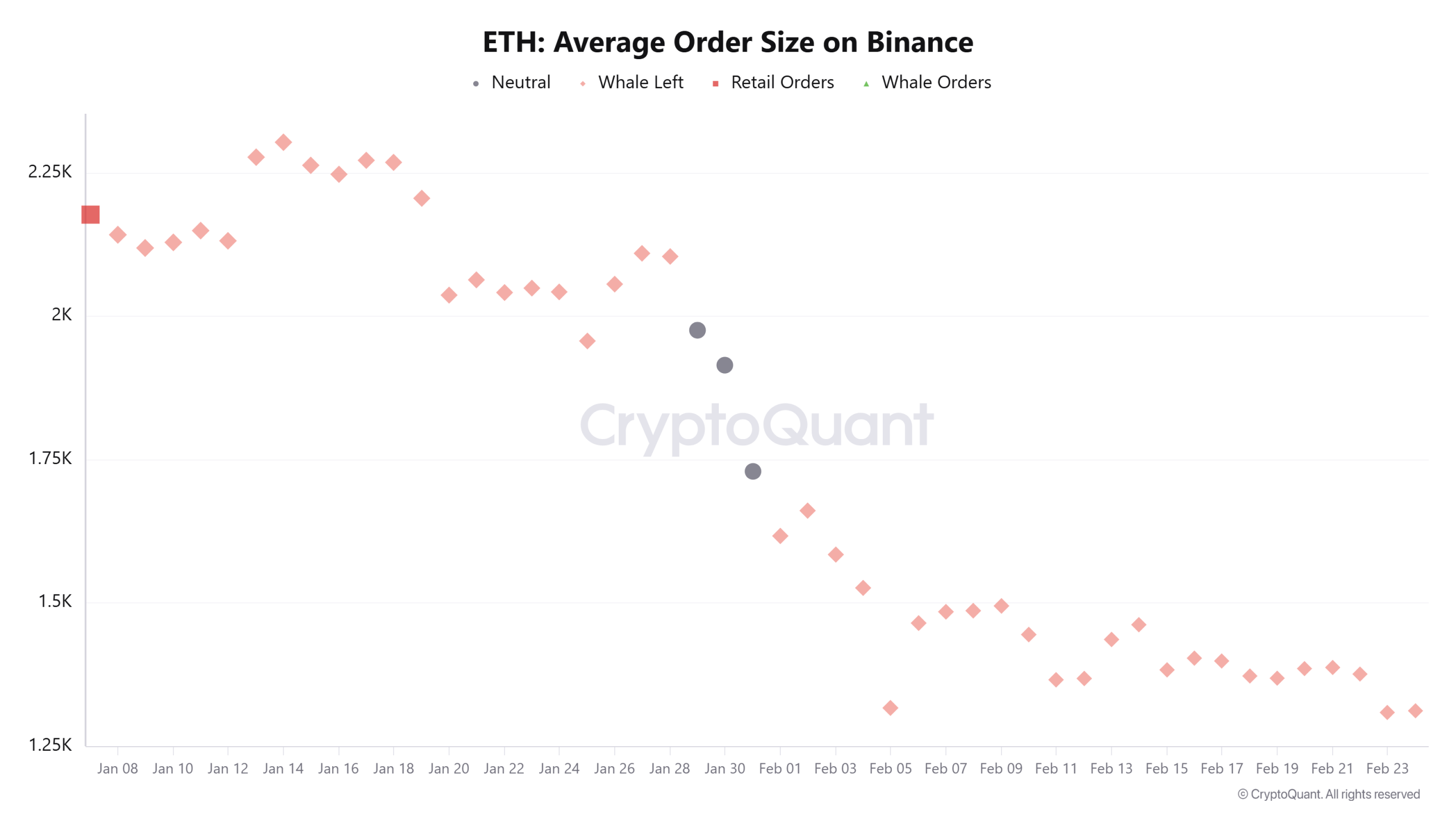
Ether (ETH) whale activity on a major exchange has slowed since the start of 2026, with roughly 2 million ETH traded in large-sized transactions over the past 45 days.
ETH is currently in the midst of its worst weekly losing streak since 2022, with exchange flow trends and futures market liquidation data impacting investor expectations for Ether’s short and long-term price direction in the broader market.
Ether whale order size hints at fading participation
CryptoQuant data shows that the average ETH whale sell orders on Binance have fallen to around 1,350 ETH in recent weeks, down from roughly 2,250 ETH in early January. Assuming 15 to 35 whale-sized executions per day, the cumulative gross sell-side turnover since Jan. 8 is estimated at around 1.8 to 2 million ETH over the past 45 days.

Using an average price of $2,400, this activity equates to roughly $4.3 billion to $4.8 billion in large-order executions. The figure reflects gross traded volume, not confirmed net outflows, as part of the flows may relate to hedging or liquidity provision within the derivatives market.
Crypto analyst Darkfost said the decline in the average order size points to a “gradual disengagement” from larger participants. According to the analyst, smaller traders continue to transact at stable volumes, while bigger players are reducing direct interaction with the order books.
This shift indicates a temporary thinning of market depth. With fewer large resting orders, ETH’s capacity to absorb sharp price imbalances narrows in the short term.
Parallel to exchange flows, ETH accumulation addresses added more than 2.5 million ETH in February as the price fell about 20%. Total holdings climbed to 26.7 million ETH from 22 million at the start of 2026, signaling steady demand beneath the surface.
Related: Ethereum price drops to $1.8K as data suggests ETH bears are not done yet
Will Ether break its longest bearish streak since 2022?
Ether is now in its sixth straight week of losses, marking the longest uninterrupted weekly decline since the 10-week drawdown between March 2022 and June 2022. That earlier stretch unfolded during a broader bear market and led to a cycle bottom before price stabilized.

While the current pullback is not as long, the streak highlights sustained selling pressure and weakening momentum on the higher timeframe.
Historical market cycle data suggests that if the decline continues, a broad weekly demand zone between $1,384 and $1,691 may come into focus, an area that previously acted as accumulation during the early stages of the rally in 2023.
Futures market liquidation data shows more than $2 billion in short positions clustered around $2,000. This creates a dense liquidity pocket that may act as the near-term magnet for Ether price.
On the downside, approximately $682 million in long positions remain at risk if Ether drops to $1,600, indicating thinner liquidity compared to the upside cluster.
Crypto trader RickUntZ said he still sees potential for a V-shaped rebound from current levels, citing signs of underlying demand in the current structure. For now, data suggests that the $2,000 liquidation band remains the next key resistance to break.

Related: Ethereum Foundation starts staking ETH as client diversity concerns persist
This article does not contain investment advice or recommendations. Every investment and trading move involves risk, and readers should conduct their own research when making a decision. While we strive to provide accurate and timely information, Cointelegraph does not guarantee the accuracy, completeness, or reliability of any information in this article. This article may contain forward-looking statements that are subject to risks and uncertainties. Cointelegraph will not be liable for any loss or damage arising from your reliance on this information.
Crypto World
Millions in crypto funded tools to exploit U.S. software, Treasury says in new sanctions
The U.S. Treasury Department has sanctioned a Russian company, Operation Zero, and the individuals behind it after accusing them of buying stolen cyber tools for millions in cryptocurrency and re-selling those technologies, which were created to be used by the U.S. government.
The tools bought and sold by newly sanctioned Sergey Sergeyevich Zelenyuk and his business, Operation Zero, were said to be originally stolen by an Australian national, Peter Williams, who once worked at the defense contractor that made the national-security focused software “for the exclusive use of the U.S. government and select allies.” Williams pleaded guilty last year to selling trade secrets.
“Treasury will continue to work alongside the rest of the Trump Administration to protect sensitive American intellectual property and safeguard our national security,” said Secretary of the Treasury Scott Bessent in a statement.
Zelenyuk and the others are said to be the first people to be sanctioned under the Protecting American Intellectual Property Act. The sanctions by the Office of Foreign Assets Control block U.S. people from any business dealings with those flagged or with others who do business with them.”Operation Zero has sought to recruit hackers to support its activities and develop business relationships with foreign intelligence agencies through use of social media,” the Treasury Department said in its statement. The accusations say the tools were offered for sale to those seeking to exploit vulnerabilities in computer software.
While the Treasury’s Office of Foreign Asset Control alleged that cryptocurrencies were used in the transactions, it did not list specific addresses for blacklisting.
Read More: Criminal use of crypto spikes after years of steady decline, TRM report says


A veteran bull said that the Bitcoin Core team is “fighting the last war.”
The blockchain’s quantum conundrum is intensifying, raising fresh concerns about whether Bitcoin can survive the long-term threat posed by quantum computing.
A veteran bull has warned that it poses Bitcoin’s first truly existential risk, but is being ignored.
“Fighting the Last War”
Charles Edwards, founder of Capriole Investments, said he is more concerned about Bitcoin’s future today than at any point across multiple market cycles, while citing the growing threat posed by quantum computing.
In a post on X, Edwards explained that he had previously remained confident through extreme price crashes, exchange shutdowns, hacks, and major frauds such as the collapse of FTX. He said those events never undermined his long-term outlook on Bitcoin.
However, the current risk is different in nature, according to Edwards, who warned that Bitcoin’s existing cryptographic defenses are not adequate to withstand advances in quantum technology. He compared the situation to outdated military strategies being deployed against modern warfare, and stated that Bitcoin “does not stand a chance” without adaptation.
The investor also added that the most troubling aspect is not only the severity of the quantum threat itself, but what he described as the dismissal and lack of urgency surrounding the issue.
CryptoQuant founder Ki Young Ju had also voiced concerns about the growing quantum computing threat facing Bitcoin. He said that protecting the network may require difficult decisions. One potential solution, according to Ju, could be freezing older Bitcoin addresses as part of a quantum-resistant upgrade.
You may also like:
He added that implementing such changes would be challenging, as the crypto community has often struggled to agree on protocol updates. Ju even went on to add that assets considered secure today may not remain safe if quantum technology continues to advance.
Industry Remains Divided
Not everyone in the crypto industry agrees on how urgent the threat to the world’s largest cryptocurrency really is. In December, Jameson Lopp, co-founder and chief security officer of Casa, said quantum computers do not pose a near-term risk to Bitcoin. He believes the technology remains far from being able to break Bitcoin’s cryptography. Lopp acknowledged that researchers should continue monitoring progress in the field, but said fears of an imminent threat are premature. He also noted that preparing Bitcoin for a post-quantum future would be a long process.
Similar views have been expressed by Grayscale, which said in a recent report that quantum computing is unlikely to have a meaningful impact on crypto markets in 2026. While acknowledging long-term risks, the firm downplayed short-term consequences.
More recently, Strategy co-founder Michael Saylor also minimized the concern. Speaking on Coin Stories with Natalie Brunell, Saylor said most cybersecurity experts believe any credible quantum threat remains more than a decade away.
Binance Free $600 (CryptoPotato Exclusive): Use this link to register a new account and receive $600 exclusive welcome offer on Binance (full details).
LIMITED OFFER for CryptoPotato readers at Bybit: Use this link to register and open a $500 FREE position on any coin!
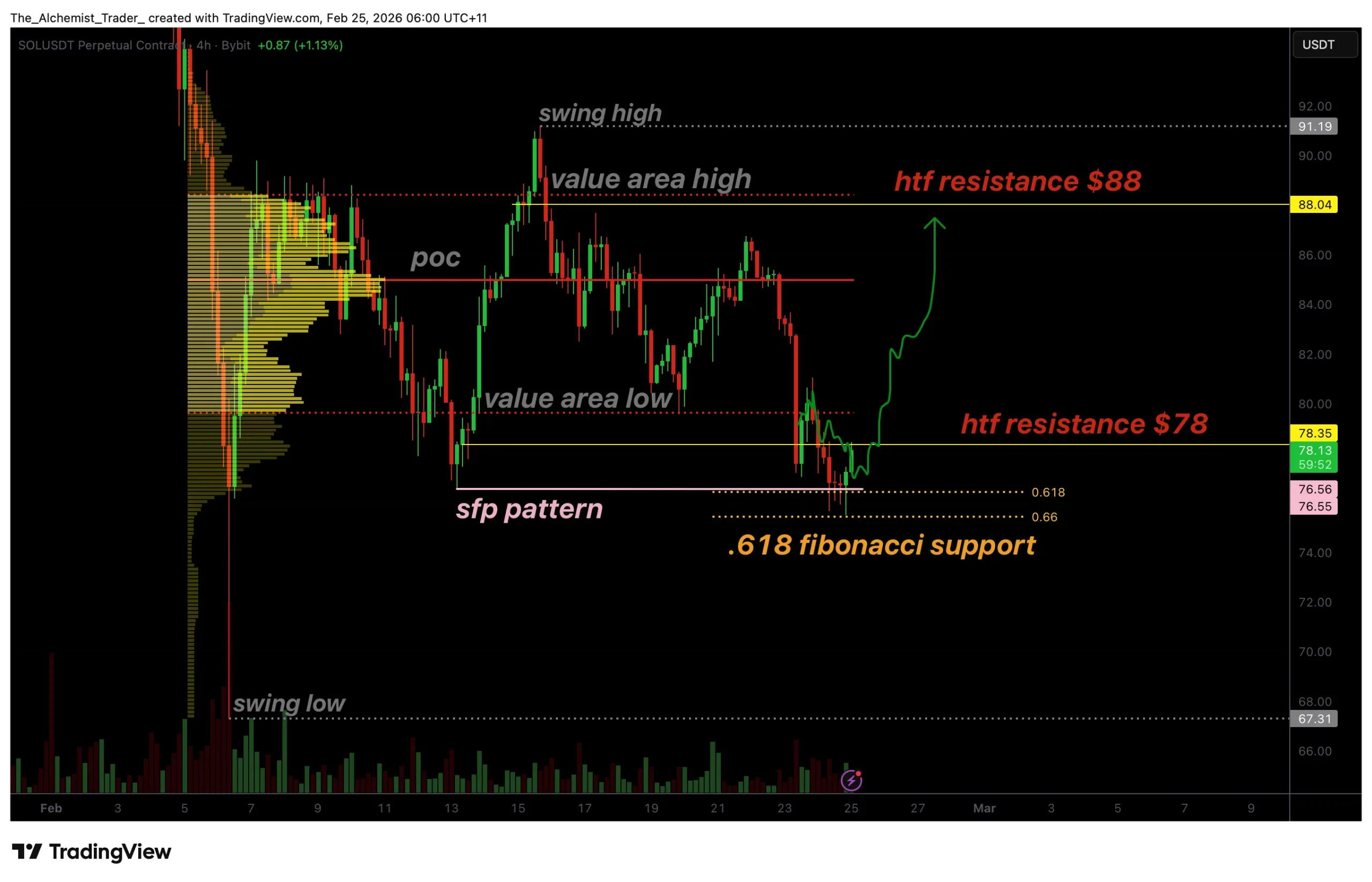
Solana price has formed a swing failure pattern at the 0.618 Fibonacci support, signaling potential demand and raising the probability of a short-term reversal.
Summary
- Swing failure pattern formed at key 0.618 Fibonacci support
- $78 resistance reclaim needed to confirm reversal structure
- Upside target toward $88 if bullish momentum strengthens
Solana (SOL) price action is displaying a technically significant development as a swing failure pattern (SFP) forms at a key Fibonacci support level. After an extended corrective move, Solana briefly broke below its previous swing low, only to quickly reclaim it, leaving multiple downside wicks on the chart. This type of price behavior often signals liquidity absorption and the presence of underlying demand.
The SFP has emerged at the 0.618 Fibonacci retracement level, a historically important support area that traders closely monitor during pullbacks. When liquidity is swept below prior lows and price immediately recovers, it frequently indicates that sellers are losing momentum and buyers are stepping in at discounted levels.
While confirmation is still required, the current setup raises the question of whether Solana is forming a local bottom within its broader trading structure.
Solana price key technical points
- Swing failure pattern confirmed: Previous low swept with strong rejection
- 0.618 Fibonacci support respected: Key retracement level attracting demand
- $78 resistance pivotal: Reclaim could trigger acceleration toward $88
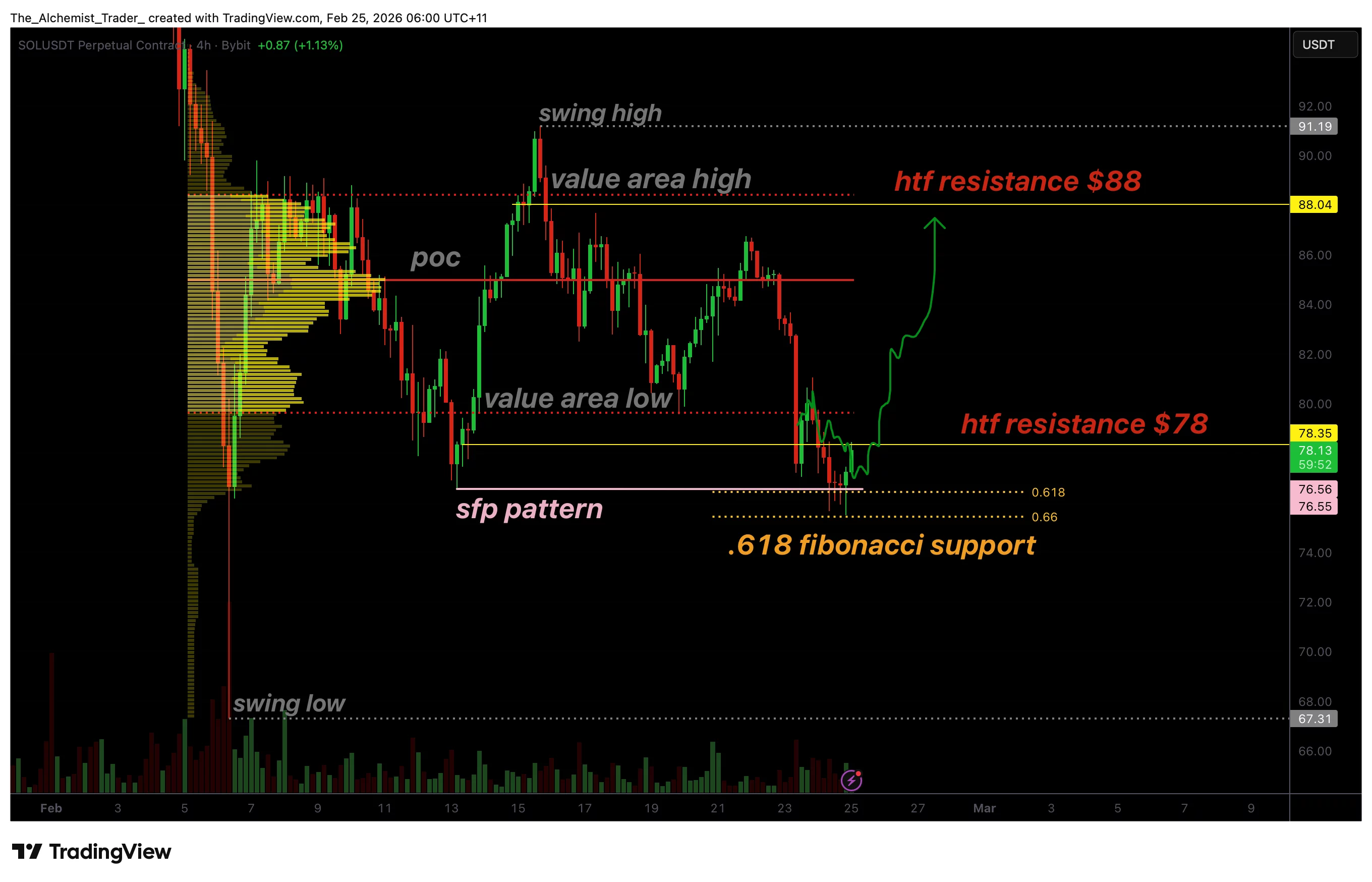
The defining feature of this setup is the swing failure pattern itself. An SFP occurs when price breaks below a prior swing low, triggers stop-loss liquidity, and then quickly reverses back above that level. This behavior traps aggressive sellers and often fuels short-term upward momentum.
In Solana’s case, multiple wicks below the previous low demonstrate that price attempted to trade lower but failed to find acceptance. Instead, buyers absorbed the selling pressure and pushed price back into prior structure.
These types of technical reactions are especially meaningful when they occur at major Fibonacci levels, even as broader ecosystem developments, including Step Finance shutting down its Solana-based platforms after a January hack that reportedly drained up to $40 million, continue to influence market sentiment.
The 0.618 retracement is widely regarded as one of the most important levels in technical analysis. Markets frequently react strongly here, as it represents a deep corrective zone within a broader trend. Solana’s ability to defend this level strengthens the argument that a bounce may already be underway.
Market structure shifts toward reversal potential
From a market structure perspective, early signs of reversal are beginning to form. The SFP suggests that downside momentum may be fading, but confirmation requires a shift in local resistance levels.
The key level to monitor now is $78. This region represents local resistance and an important decision point. For Solana to transition from corrective bounce to confirmed reversal, price must reclaim and hold above $78. Acceptance above this level would signal structural improvement and invalidate the immediate bearish bias.
Reclaiming $78 would also position Solana back above the value area low, an important benchmark in volume-based analysis. When price regains this level, it often reflects improving sentiment and increasing participation from buyers, particularly as ecosystem developments continue to evolve, including Zora expanding onto the Solana blockchain with its new “attention markets” product beyond its earlier NFT and Ethereum focus.
$88 emerges as next upside objective
If Solana successfully reclaims $78, the probability increases for an accelerated move toward the next high-timeframe resistance at $88. This level aligns with prior distribution zones and serves as a natural liquidity target following a confirmed SFP.
The move toward $88 would represent not only a relief rally but also a meaningful structural recovery within the broader market context. A break above this level would further reinforce the bullish thesis and potentially shift the medium-term outlook.
However, failure to reclaim $78 would weaken the setup. In that scenario, the SFP may represent only a temporary reaction rather than the start of sustained upside continuation.
What to expect in the coming price action
From a technical, price action, and market structure perspective, Solana is at a critical inflection point. The swing failure pattern at the 0.618 Fibonacci support suggests a potential local bottom may be forming. Confirmation now hinges on a decisive reclaim of the $78 resistance level. If achieved, Solana could accelerate toward $88 and reclaim higher value zones in the short term.
Until then, the market remains in a reaction phase, with traders closely watching resistance for validation of a broader reversal.
Crypto World
58% of Ethereum’s wealth is hiding in plain sight, and half of DeFi is built on thin air
Disclosure: This article does not represent investment advice. The content and materials featured on this page are for educational purposes only.
Ethereum’s top holders double in size when tokens and stablecoins are included in on-chain valuations.
Summary
- Aggregating ETH with tokens shows top holders control $426 billion, over 2x higher than ETH-only rankings reveal.
- Including ERC-20s shifts power view, with smart contracts holding nearly 40% of top Ethereum balances.
- New PPI metric flags self-minted DeFi exposure, warning of fragility if selling pressure triggers unwind risks.
Ethereum’s balance sheet looks nothing like what it looked like a couple of years ago.
A new on-chain analysis has found that 58% of capital held by Ethereum’s largest addresses exists outside of Ethereum (ETH) entirely — sitting in ERC-20 tokens and stablecoins that traditional rankings simply don’t capture.
When Ethereum addresses are ranked by ETH balance alone, the top 10,000 hold a combined $189 billion. Rank those same addresses by total assets — ETH plus ERC-20 tokens and stablecoins — and that figure climbs to $426 billion. The capital sitting at the top of Ethereum’s economy is more than twice as large as conventional rankings suggest.
The gap is not just a numbers story. It reveals an entirely different cast of major holders. Among the top 1,000 addresses, only 537 appear in both the ETH-only and the aggregated rankings, meaning nearly half of Ethereum’s largest holders are effectively invisible when the market looks at ETH balances alone.
The composition of those holdings tells its own story. ETH now represents just 42% of what the largest addresses hold. Stablecoins account for roughly 26%, with the remaining share spread across ERC-20 tokens. A form of dominance shift has already taken place through quiet balance-sheet accumulation across protocols and tokens while prices remained largely range-bound.
Smart contracts are a central part of this new picture. Through an ETH-only lens, they appeared as minor participants in Ethereum’s wealth distribution. In the aggregated ranking, they control nearly 40% of top-holder capital. This roughly three times their previous share. Risk, the report argues, has migrated from individual holders making decisions to automated mechanisms governed by code, collateral design and token economics.
That shift in who holds capital leads directly to a harder question: what is that capital actually made of?
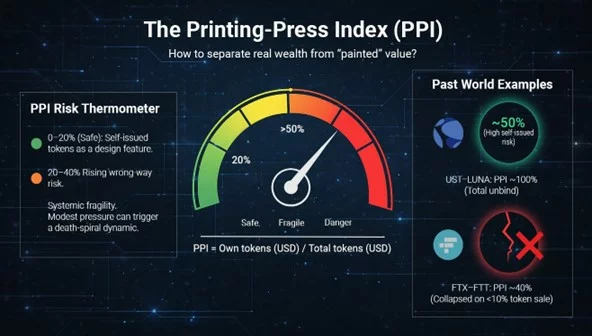
To answer it, the report introduces the Printing-Press Index, which is a measure of how much of a protocol’s token holdings are made up of its own self-issued tokens. Among DeFi protocols, that figure clusters around 50%, with names like Uniswap, Aave and Mantle among the examples cited.
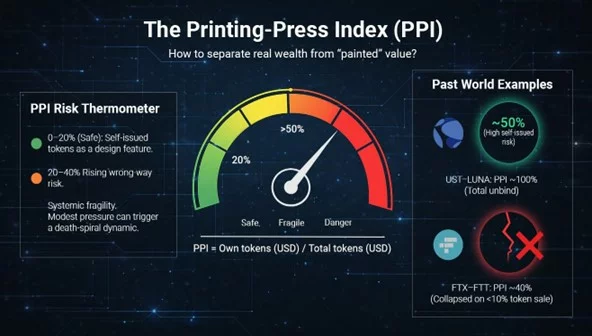
The report identifies roughly 20% as the point where self-issued tokens begin to introduce meaningful risk, and 40-50% as the threshold where a protocol enters fragile territory. At those levels, a balance sheet is no longer primarily backed by external capital — it is partially backed by confidence in itself.
Modest selling pressure can impair that confidence, compress liquidity, and trigger the kind of reflexive unwind seen in the LUNA-UST collapse, where a Printing-Press Index near 100% contributed to a full death spiral within days.
The implication for how Ethereum’s economy is analyzed is significant. Once tokens represent the majority of large-address holdings and smart contracts control nearly 40% of that capital, balance size alone becomes a poor indicator of resilience. The Printing-Press Index offers a practical way to look past headline figures and assess what is actually backing the wealth that aggregated rankings are now beginning to reveal.
Disclosure: This content is provided by a third party. Neither crypto.news nor the author of this article endorses any product mentioned on this page. Users should conduct their own research before taking any action related to the company.

Celebrating The 40th Anniversary Of The Greatest Batman Ever Made

Spring-like weather in the UK

Zaxbys adds dry rubs


-

 Video5 days ago
XRP News: XRP Just Entered a New Phase (Almost Nobody Noticed)
-

 Fashion4 days ago
Weekend Open Thread: Boden – Corporette.com
-

 Politics3 days ago
Baftas 2026: Awards Nominations, Presenters And Performers
-

 Business7 days ago
Infosys Limited (INFY) Discusses Tech Transitions and the Unique Aspects of the AI Era Transcript
-

 Sports1 day ago
Women’s college basketball rankings: Iowa reenters top 10, Auriemma makes history
-

 Entertainment6 days ago
Kunal Nayyar’s Secret Acts Of Kindness Sparks Online Discussion
-

 Politics1 day ago
Nick Reiner Enters Plea In Deaths Of Parents Rob And Michele
-

 Tech6 days ago
Retro Rover: LT6502 Laptop Packs 8-Bit Power On The Go
-
 Sports6 days ago
Clearing the boundary, crossing into history: J&K end 67-year wait, enter maiden Ranji Trophy final | Cricket News
-

 Business2 days ago
Mattel’s American Girl brand turns 40, dolls enter a new era
-

 Crypto World13 hours ago
XRP price enters “dead zone” as Binance leverage hits lows
-

 Business2 days ago
Law enforcement kills armed man seeking to enter Trump’s Mar-a-Lago resort, officials say
-

 Entertainment6 days ago
Dolores Catania Blasts Rob Rausch For Turning On ‘Housewives’ On ‘Traitors’
-

 Business7 days ago
Tesla avoids California suspension after ending ‘autopilot’ marketing
-

 Tech2 days ago
Anthropic-Backed Group Enters NY-12 AI PAC Fight
-
 NewsBeat1 day ago
‘Hourly’ method from gastroenterologist ‘helps reduce air travel bloating’
-

 NewsBeat2 days ago
Armed man killed after entering secure perimeter of Mar-a-Lago, Secret Service says
-

 Politics2 days ago
Maine has a long track record of electing moderates. Enter Graham Platner.
-

 Crypto World6 days ago
WLFI Crypto Surges Toward $0.12 as Whale Buys $2.75M Before Trump-Linked Forum
-

 Tech3 hours ago
Unsurprisingly, Apple's board gets what it wants in 2026 shareholder meeting