

Would Jane Austen have even understood the question of whether she was gay? Michel Foucault, French theorist and author of The History of Sexuality (1976), would answer: “Non”.
Foucault argues that, even though homosexual acts had been performed in the past, homosexuality as an identity did not develop until the later 19th century. Before then, you could do homosexuality, but you couldn’t be a homosexual. That’s because homosexuality as an identity didn’t exist yet.
Anne Lister, a contemporary of Austen’s who wrote coded diaries about her sexual liaisons with women and is now often hailed as the first modern lesbian, might disagree with Foucault. But it is unlikely that Austen thought of herself as gay.
In 1995 the London Review of Books (LRB) ran a review of Deidre Le Faye’s monumental edition of Austen’s letters. The piece, written by US literary critic Terry Castle was called Sister-Sister, but it was cheekily retitled “Was Jane Austen Gay?” on the cover. In her article, Castle suggested that Austen appears mainly dismissive of men in her correspondence, and was similarly dismissive of the various proposals she is said to have received.
Castle’s review, especially the LRB’s provocative retitling, caused a storm in a teacup of Austenian proportions. Readers of the LRB and Austen scholars fell into a fury of scandalised incomprehension, trading competing interpretations of Austen’s private life and public writing.
For Castle, Austen’s most significant relationship was with her sister, Cassandra. Her nuanced argument about the erotics of this relationship was brought to life recently in a collaboration between the LRB and City of London Sinfonia in London’s Covent Garden, the event’s name recalling the LRB coverline for Castle’s essay.
City of London Sinfonia, Author provided (no reuse)
Becoming Jane and friends
A one-off show which was part of the LRB and City of London Sinfonia’s Ideas in Concert series, Was Jane Austen Gay? brought to life Castle’s essay and the tumultuous response to it. Actresses Claudie Blakley, who played Charlotte Lucas in the 2005 Pride and Prejudice, and Lost in Austen’s Jemima Rooper read out Castle’s essay, as well as letters from, to, and about Austen. A concert mixing songs from Austen’s own music collection with modern-day Austen film soundtracks accompanied the staged reading.
The show began and ended with Castle’s bewildered response to the brouhaha that erupted over her argument on Austen’s inner life. “Surely,” bemoans Castle, “literary critics writing in the London Review are still allowed to speculate about such things”. As Blakley and Rooper demonstrated in the reading of Castle’s essay, Castle herself was not above a little childishness – malevolence, even.
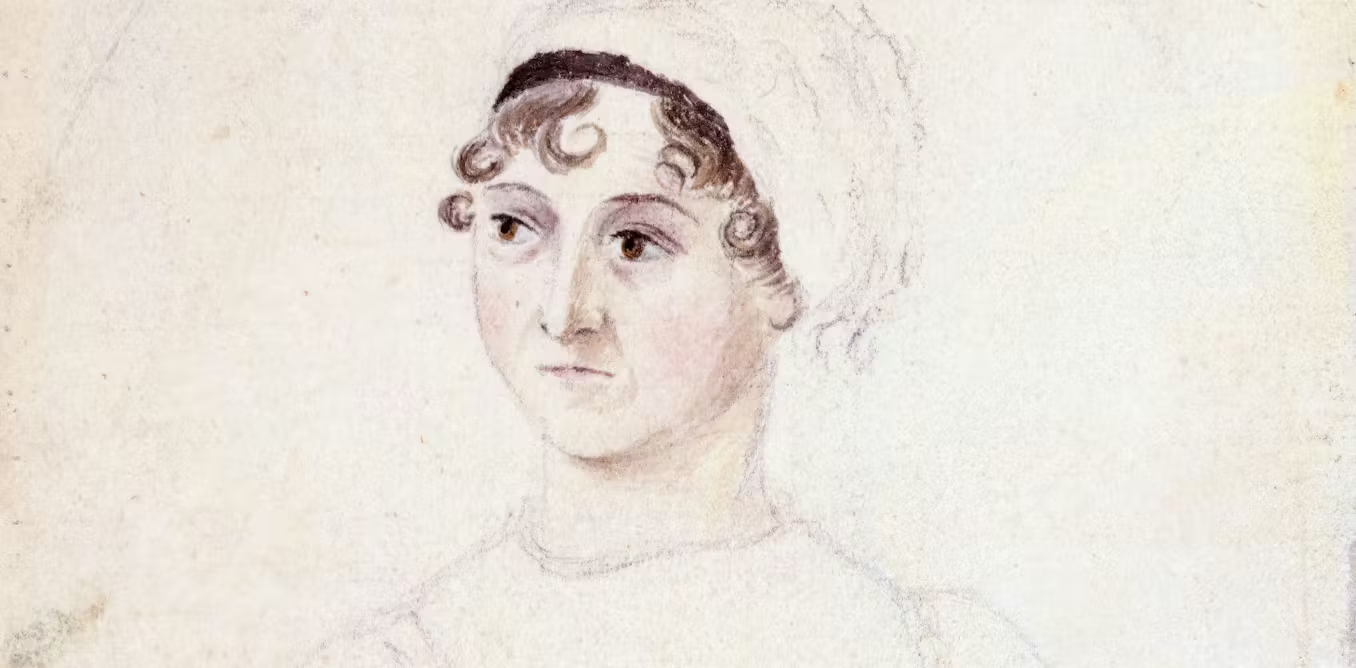
She describes – deliciously – Cassandra’s portrait of Jane as having eyes like “small astigmatic raisins”. So mean, and so Austen-like! And she also ventriloquises a taboo wish, which she detects running through writing on Jane and Cassandra: “Why did Jane have to be the one to die?”
Blakley and Rooper performed Castle’s essay in different voices, affecting an American twang for the critic’s rueful response to her British reception. They also alternated between breathless excitement for Jane, mournfulness for Cassandra, and pomposity for Austen’s family biographer James Edward Austen-Leigh.
There were voices, too, from Austen’s fiction, including Northanger Abbey’s Henry Tilney, an “unheterosexual” (to borrow critic D.A Miller’s phrase gentleman with a fondness for fine fabrics, and Emma, erotically enamoured with Harriet Smith.
The evening allowed for a deeper dive into Austen’s letters, as well as a taster of Anne Lister’s, and took great delight in dramatising the aftermath of Castle’s essay, often very funnily. This included a letter from the Independent’s arts correspondent castigating Terry Castle’s prurience, while mistaking her for a man. The LRB editors laconically responded: “We wonder what Ms McDonald would have written had she been alert to the fact that Terry Castle is a woman.”

Dale Wightman
Alexandra Wood, violinist and creative director of City of London Sinfonia, brought together a wonderful ensemble to provide a musical counterpoint to Blakley and Rooper’s dramatised reading of Castle’s essay. When Blakely and Roper discussed Jane’s flirtatious style in her letters to Cassandra, the music teased and flirted with the audience.
Another letter published in the wake of Castle’s essay, by the great Austen scholar Claudia Johnson – sadly overlooked in this event – begins: “Is she prudish? – is she queer?” Johnson playfully shifts focus from Austen’s sexuality to the oddness of one of her character’s here. Fanny Price is “queer” because she is immune to the dubious charms of Henry Crawford, who is asking these questions about her in Mansfield Park.
Reviewing attitudes to Austen’s sexuality that run the gamut from frigid to lesbian, Johnson defends Castle’s argument that sisterly bonds are among the most powerful in Austen’s writing. She expresses a preference for the naughty Austen glimpsed in her letters to Cassandra and available as a narrative voice – mischievous, stylish, “unheterosexual” – in her novels.
It is a voice that finds excitement and enjoyment by pressing at the confines of the marriage plot, which enforces a kind of normative heterosexuality on proceedings. It laughs at the misunderstandings and miscommunications that seem to bedevil all the actual marriages in Austen’s novels, and sides with characters like Henry Tilney, Emma Woodhouse and Fanny Price, who stand apart from these heterosexual demands, desiring otherwise.
Like Johnson, along with Castle and the organisers of “Was Jane Austen Gay?”, I find this naughty Austen more seductive than alternative visions of her as a heteronormative moraliser. Reading Austen’s novels queerly opens them up as works with surprising and subversive things to say about how to live and think and write. Even if Austen herself did not – and could not – think of herself as a homosexual, her writing invites queer interpretations, celebrating the mischievous, the stylish, and the “unheterosexual”.
Rather than asking “Was Jane Austen Gay?”, perhaps we should ask, “How can we read Austen today?” The original Castle essay and the LRB/CLS event named after it provide ways to do just that, thinking about Austen speculatively, wittily, and musically.
This article features references to books that have been included for editorial reasons, and may contain links to bookshop.org. If you click on one of the links and go on to buy something, The Conversation UK may earn a commission.

Looking for something good? Cut through the noise with a carefully curated selection of the latest releases, live events and exhibitions, straight to your inbox every fortnight, on Fridays. Sign up here.