

Crypto World
Bitcoin Bloodbath: $370M Liquidations as Corporates Defend $60K

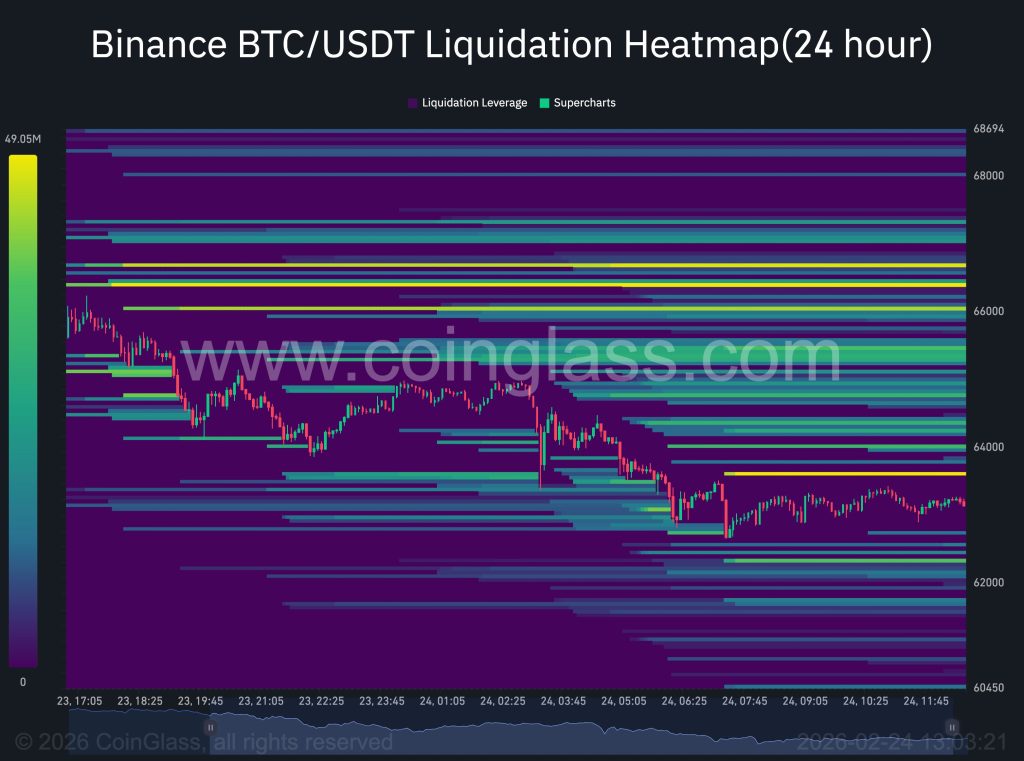
Bitcoin markets suffered a severe deleveraging event overnight, with over $370 million in forced liquidations flushing out leveraged longs as prices tumbled toward the $60,000 threshold.
While retail traders capitulated under the pressure of the sudden crypto market crash, corporate treasuries, led by aggressive accumulators like Metaplanet, stepped in to absorb the selling pressure.
The immediate direction of the market now hinges on whether bulls can defend the critical $60,000 level, a psychological and technical floor that separates a healthy correction from a deep bear market structure.
Key Takeaways
- Over $370 million in total crypto liquidations occurred in the last session, with Bitcoin futures open interest plunging 20% from its peak.
- Institutional accumulation persists despite the drop, with firms like Metaplanet executing strategic spot purchases to defend their average cost basis.
- Technical indicators mark $60,000 as the decisive line in the sand; a confirmed breakdown targets $55,000 as the next major liquidity zone.
Discover: The best meme coins in the world right now.
Why Is the Crypto Market Crashing?
The sell-off was driven by a cascading liquidation loop rather than a fundamental breakdown. According to data from CoinGlass and major exchanges, the market wiped out over $370 million in positions, with long traders accounting for $275 million, or 74% of the losses.
This flush was exacerbated by a sharp decline in Bitcoin futures open interest, which dropped from $61 billion to $49 billion in a few days, a sign that speculative froth is being aggressively removed from the system.
Traders were caught off guard by the speed of the move. Earlier this month, in another drawdown, Bitcoin registered a -6.05σ rate-of-change drop, statistically comparable to the volatility seen during the FTX collapse.
The trigger for this volatility appears to be macro-driven, as fears regarding imminent tariff policies sent risk assets spiraling. When the price of Bitcoin dipped below the 200-day moving average, it triggered a chain reaction of stop losses, accelerating the Bitcoin liquidations.
Metaplanet and Treasuries Buy the Dip
While retail panic dominated the headlines, on-chain data reveals a different story among institutional accumulation desks.
Metaplanet, the Japanese investment firm modeling its treasury strategy after U.S. counterparts, is reportedly adding to its Bitcoin holdings during the downturn, according to X posts by CEO Simon Gerovich.
This behavior aligns with a broader trend of strategic accumulation, where corporates utilize sharp drawdowns to lower their cost basis rather than fleeing to cash.
This follows the precedent set by MicroStrategy. Michael Saylor hints at Strategy’s 100th Bitcoin buy often coincides with market fear, reinforcing the divergence between short-term speculators and long-term treasury hold strategies.
While the paper losses for these entities mount during a correction, their continued buying provides a localized floor, preventing the price from entering a complete freefall.
Bitcoin Price Analysis: Critical BTC Support Levels
The technical picture has reached a decisive juncture. Bitcoin is currently testing the BTC support levels at $60,000, a zone that aligns with high-volume nodes from late 2025.
The Relative Strength Index (RSI) on the daily chart has plunged into oversold territory, currently reading just under 30. Historically, such low RSI readings often precede a sharp mean reversion bounce, but the structural damage on the weekly timeframe remains a concern.
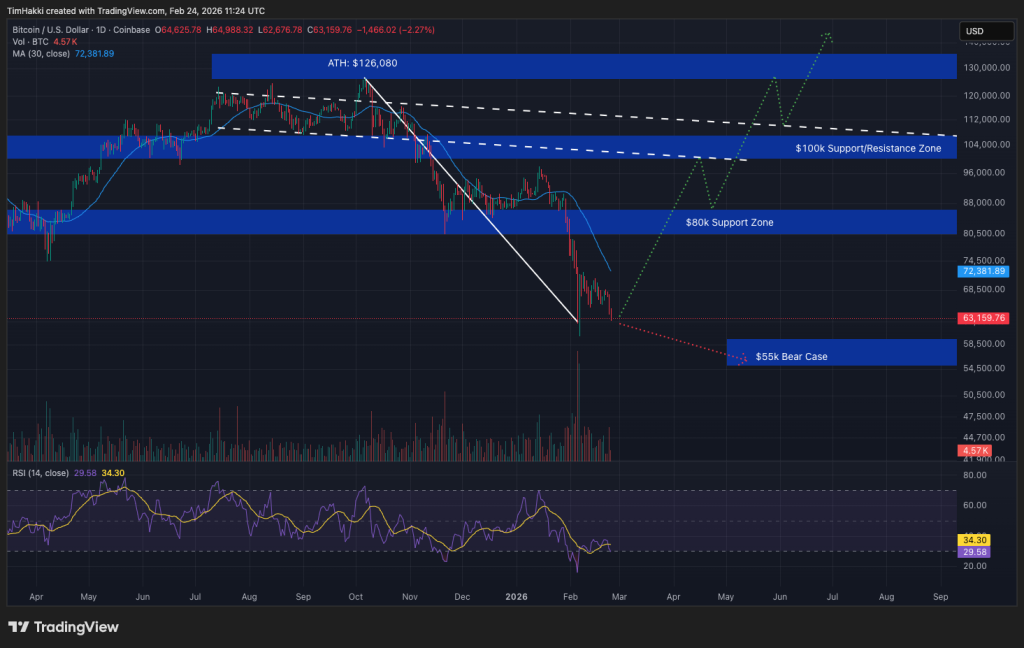
If bulls fail to defend $60,000, the path of least resistance flips to the downside. One CryptoQuant analyst recommends watching the $54,700 price level as the ultimate invalidation point for the bull case.
Sentiment markets are already pricing in this risk; Polymarket odds on a Bitcoin price drop to $55K have surged, reflecting growing skepticism about an immediate V-shaped recovery.
To reclaim bullish momentum, price action must first stabilize above $62,500 and then challenge the $67,500 resistance block. Until a daily close above that level occurs, the trend remains firmly in bear territory.
Discover: The next crypto to explode
Tariff Fears Fuel Record Outflows
The current drawdown extends a rough start to the year, with digital assets logging their longest streak of negative weekly returns since 2022.
Much of this selling is precautionary, driven by the ongoing debate over U.S. tariff implementation under the 1974 Trade Act. The uncertainty has spiked the dollar, effectively siphoning liquidity out of high-beta assets like crypto.
Institutional flows reflect this risk-off rotation. Spot Bitcoin ETFs lodged their fifth straight week of outflows, signaling that traditional finance allocators are de-risking until the regulatory fog clears.
Until these flows reverse, spot markets lack the relentless bid needed to counter derivative sell pressure.
The post Bitcoin Bloodbath: $370M Liquidations as Corporates Defend $60K appeared first on Cryptonews.

Crypto World
Bitcoin Down 49.53% From ATH: How Far Can BTC Fall Before This Bear Market Finds a Bottom?
TLDR:
- Bitcoin has fallen 49.53% from its October 6, 2025 ATH, wiping out roughly $1.2 trillion in total market cap.
- The BPDA% metric sits deep below its one-year average, signaling extreme stress, capitulation, and widespread panic selling.
- Bitcoin’s Realized Price near $54,600 marks a historically significant accumulation zone during past bear market cycles.
- The $49,000 to $42,000 range holds the highest probability of bear exhaustion and may signal the start of the next cycle.
Bitcoin’s 49.53% decline from its all-time high has wiped out roughly $1.2 trillion in market value. The drop has renewed serious debate about how far this bear market can extend.
On October 6, 2025, Bitcoin’s market cap sat at $2.4891 trillion. Today, it has fallen to $1.2918 trillion. With extreme fear gripping the market and macro pressures mounting, analysts are now mapping the levels where Bitcoin could finally find its floor.
On-Chain Data Points to Where Bitcoin’s Decline May Stall
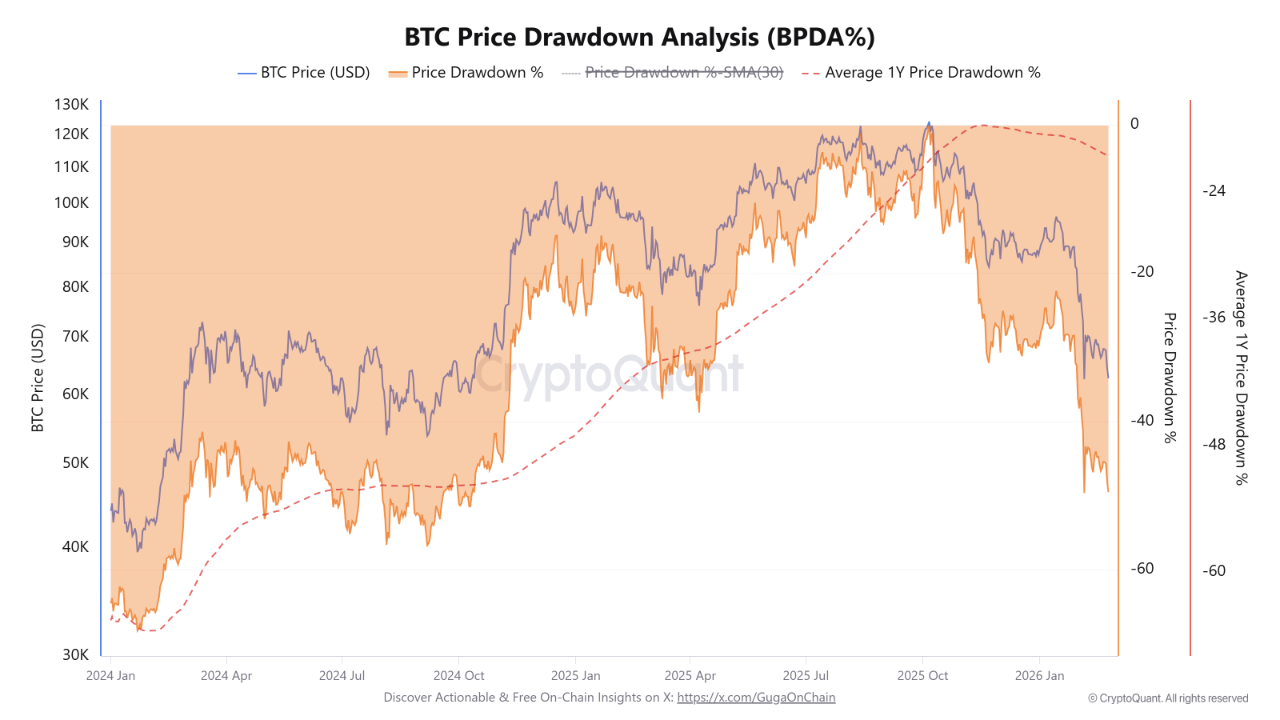
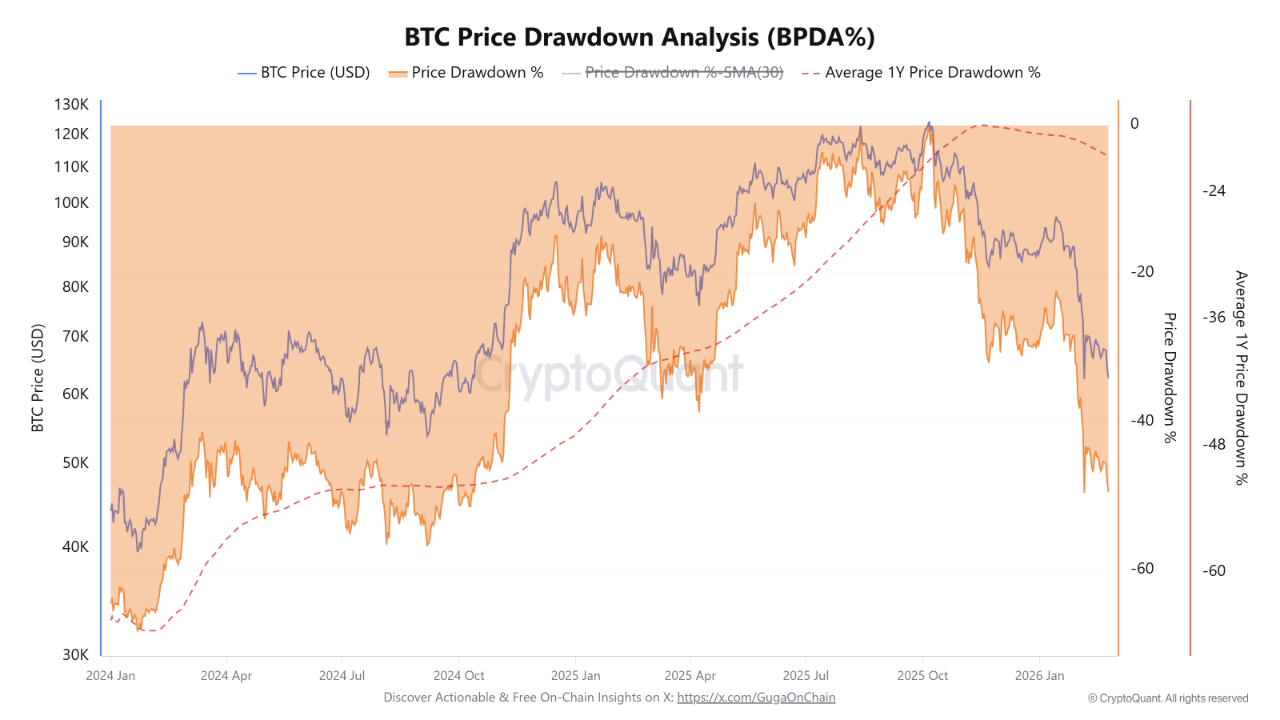
The BTC Price Drawdown Analysis (BPDA%) is one metric drawing close attention right now. When this reading falls far below its one-year average, it historically marks phases of stress, capitulation, and panic. That is exactly where it stands at this moment.
Crypto analyst GugaOnChain flagged this condition, noting that the current drawdown places Bitcoin in extreme stress territory.
Macro factors are adding pressure, particularly the 10% global tariffs announced by the Trump administration. These developments have kept fear elevated across broader risk markets.
Source: Cryptoquant
When BPDA% sits near its one-year average, the market is considered to be within a normal historical pattern. A reading well above that average typically signals recovery or relative stability. Neither condition applies today, which is why analysts continue watching lower levels carefully.
The data, therefore, suggests the correction may not be over. However, history also shows that readings this deep tend to precede meaningful accumulation phases. The question now is which price level triggers that shift.
Four Price Levels That Could Determine How Low Bitcoin Goes
GugaOnChain identified four support zones that may define Bitcoin’s downside from here. The $60,000 level is the nearest, though it is considered less likely to hold as a durable bottom given current momentum.
Below that, Bitcoin’s Realized Price near $54,600 becomes relevant. This metric reflects the average price at which all coins last moved on-chain. Historically, the Realized Price has acted as a magnet for accumulation activity during bear markets.
Further down, the $49,000 region carries the highest probability of bear exhaustion based on the analysis. This zone has previously drawn in long-term holders who view deep corrections as entry opportunities rather than reasons to exit.
The $42,000 level represents the most extreme scenario outlined in the data. While it would place a large portion of the market in unrealized loss, GugaOnChain describes it as an excellent area for initial long-term entries.
If on-chain metrics confirm seller exhaustion at any of these levels, the range between $49,000 and $42,000 could mark not just the bottom of this bear market, but the foundation for Bitcoin’s next major cycle.

The Dow Jones Index retreated sharply this week as geopolitical risks rose ahead of key earnings by companies like NVIDIA and Salesforce.
Summary
- The Dow Jones Index has formed an alarming rising wedge on the daily chart.
- Market risks, including on Iran and tariffs, have continued rising.
- NVIDIA and Salesforce will publish their financial results on Wednesday.
The blue-chip Dow Jones was trading at $48,805, down by over 3.3% from its all-time high. Other top indices like the S&P 500 and Nasdaq 100 also dropped by over 1%.
Salesforce and NVIDIA to publish earnings this week
The Dow Jones retreated as market participants positioned to major risks. One key risk is the rising possibility that the US will strike Iran as soon as this week.
The risk of an attack rose after President Donald Trump warned that he may launch a limited attack on Iran, a move that would lead to an escalation. Such an escalation would then lead to higher oil prices and market volatility.
Market participants are also worried about Trump’s tariffs. New tariffs based on Section went into effect on Tuesday as the administration worked on more long-lasting ones.
The Dow Jones Index also retreated as Jamie Dimon warned of a 2008-like Global Financial Crisis. In a statement, he said:
“Unfortunately, we did see this in ’05, ’06 and ’07, almost the same thing — the rising tide was lifting all boats, everyone was making a lot of money. I see a couple of people doing some dumb things. They’re just doing dumb things to create NII.”
Looking ahead, the next key catalyst for the Dow Jones Index is the upcoming Salesforce and NVIDIA earnings, which will come out on Wednesday this week.
NVIDIA, the biggest constituent, is expected to report strong results and forward guidance as demand for GPUs jumped. The average estimate among analysts is that its revenue rose to over $66 billion in the fourth quarter.
Salesforce stock will be in the spotlight as it has tumbled by over 50% from its all-time high. It has dropped as investors remain concerned about the potential disruption by new AI tools by companies like Anthropic and OpenAI.
Dow Jones Index technical analysis
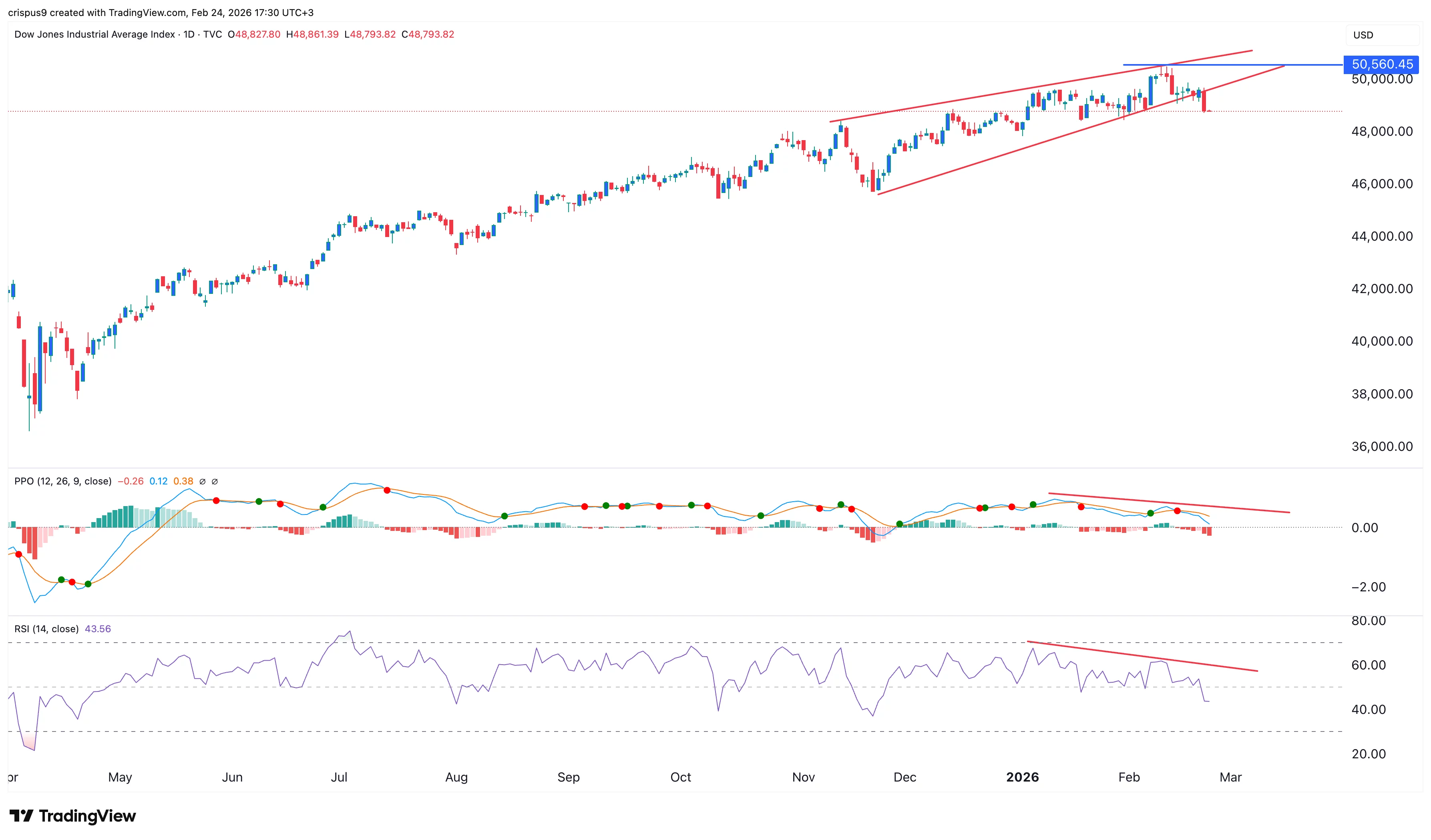
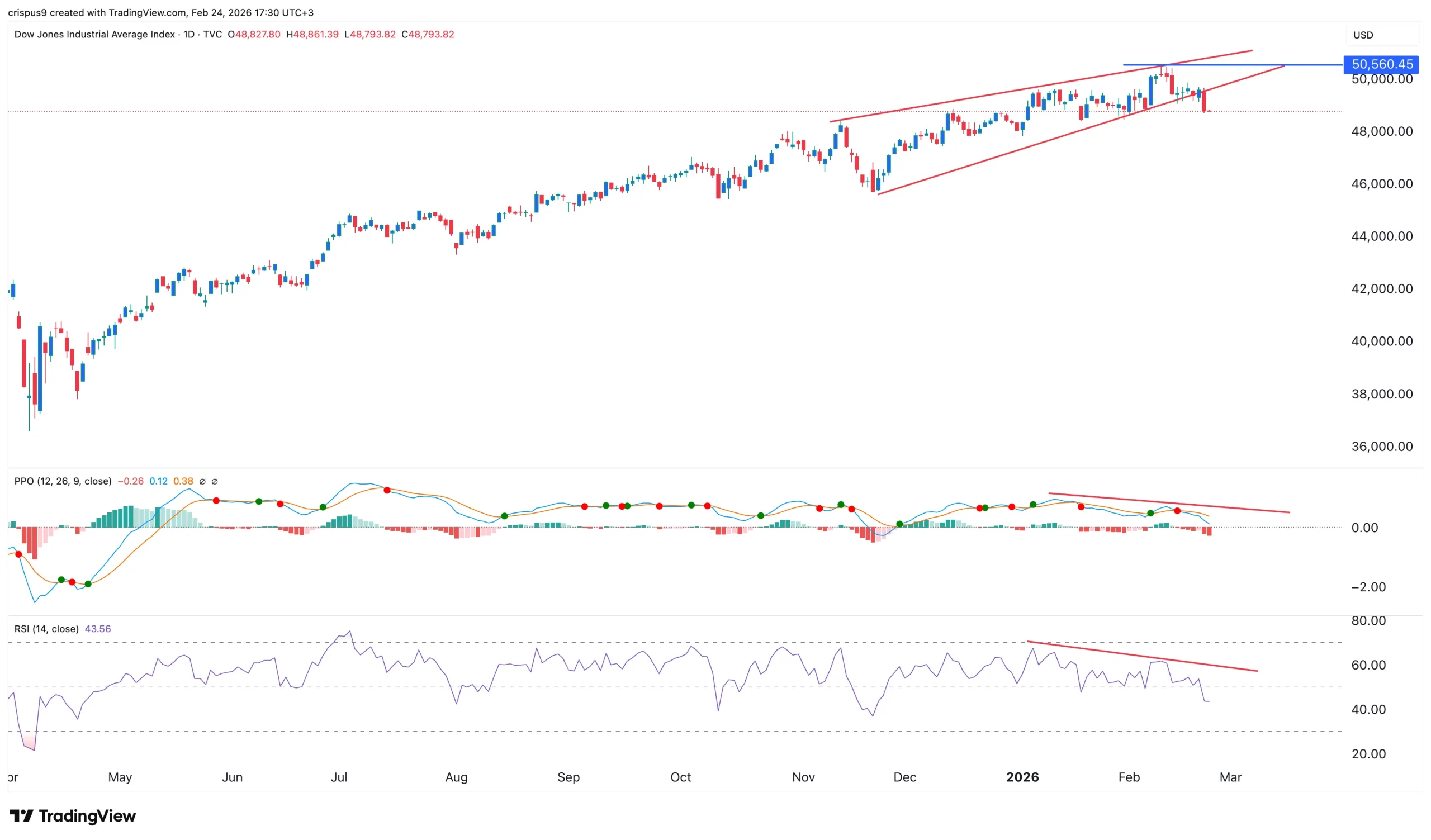
The daily chart shows that the Dow Jones Index reached a record high of $50,560 earlier this year. It has now pulled back to $48,805 as market risks escalate.
A closer look shows that the index has formed a rising wedge pattern, which is made up of two ascending and converging trendlines. It has already moved below the lower side, confirming the bearish outlook.
The index also formed a rising wedge pattern as the Relative Strength Index and the MACD indicators moved downwards as it rose.
Therefore, there is a risk that it may keep falling, potentially to the key target at $48,000.


Disclosure: This article does not represent investment advice. The content and materials featured on this page are for educational purposes only.
Cloud mining platforms like Hashbitcoin are reshaping crypto mining in 2026, offering hardware-free access to Bitcoin, Litecoin, and Dogecoin with automated daily payouts.
Summary
- Hashbitcoin leads the rankings with flexible contracts, AI-driven mining optimization, daily settlements, and a $15 trial bonus for new users.
- Competing platforms such as IQMining, BitFuFu, NiceHash, StormGain, BeMine, and Binance provide alternative models ranging from industrial-scale mining to hash power marketplaces.
- Cloud mining emerges as a low-barrier, energy-efficient way to earn passive crypto income without purchasing ASIC hardware or managing technical infrastructure.
Today, mining Bitcoin, Litecoin, and Dogecoin has become easier than ever. Thanks to cloud mining platforms like Hashbitcoin, traditional mining rigs are gradually being replaced. There’s no need to purchase expensive ASIC miners or high-performance GPUs, nor worry about costly electricity bills or technical complexities. By choosing a top-tier cloud mining platform, users can effortlessly enjoy stable and lucrative daily passive cryptocurrency income.
This article provides an in-depth review of the most popular cloud mining platforms in 2026, helping investors easily start their journey of mining Bitcoin, Litecoin, and Dogecoin. Let’s explore the endless opportunities that cloud mining has to offer.
1.Hashbitcoin: The best cloud mining platform of 2026 for earning cryptocurrency
As one of the world’s leading cloud mining platforms, Hashbitcoin has established itself as the go-to platform for Bitcoin, Litecoin, and Dogecoin mining. Founded in 2017, Hashbitcoin has been providing premium mining services and is registered with the UK’s Financial Conduct Authority (FCA). The platform operates over 100 verified ASIC mining farms globally, offering users a daily return on investment (ROI) ranging from 3% to 9%.
New users can start risk-free with a $15 trial bonus provided by Hashbitcoin. The platform offers a variety of flexible contracts catering to both short-term and long-term investment needs, making it a perfect fit for all types of investors.
Hashbitcoin cloud mining contracts: Flexible plans for maximum profitability
| Mining Plan | Amount | Contract Term | Daily Rewards | Principal + Total Return |
| Newbie Mining Plan | $200 | 1 day | $7 | $207 |
| Avalon Mining Machine A15 Pro | $1200 | 2 days | $43.2 | $1286.4 |
| BitDeer SealMiner A2 | $3600 | 3 days | $136.8 | $4010.4 |
| Avalon Nano 3S Miner | $8000 | 2 days | $344 | $8688 |
| Antminer S23 Hyd | $16800 | 3 days | $924 | $19572 |
| Whatsminer M63S (390T) | $33000 | 2 days | $2145 | $37290 |
| Antminer E9 Pro | $58000 | 1 day | $5104 | $63104 |
Want to learn more about exciting investment opportunities? Visit Hashbitcoin’s contract page for full details.
What makes Hashbitcoin stand out?
- Free trial bonus: New users receive a $15 trial bonus upon registration, allowing them to experience real mining earnings without any upfront deposit.
- AI-driven mining optimization: The platform’s mining algorithm automatically selects the most profitable cryptocurrency to mine.
- High-yield referral program: Earn up to 3% commission by inviting friends to join Hashbitcoin, making it easy to generate extra income.
- Multi-cryptocurrency support: With one Hashbitcoin account, users can mine multiple cryptocurrencies, including BTC, ETH, LTC, and DOGE, enabling diversified investments.
- Daily payouts with full transparency: All earnings are settled daily and paid in full, with no hidden fees.
- Eco-friendly mining: Hashbitcoin is committed to using renewable energy sources like solar and wind power, creating an efficient and environmentally friendly mining process while reducing carbon emissions.
How to start cloud mining with Hashbitcoin
1. Register an account: Sign up with an email in just a few seconds and instantly receive a $15 free trial bonus.
2. Choose a mining contract: Users can start with the free trial plan or select one of the flexible mining contracts based on their budget.
3. Activate mining: Once payment is confirmed, the mining contract will be activated immediately, and mining will begin automatically.
4. Earn daily profits: Users can enjoy daily passive income with earnings calculated and paid every 24 hours.
5. Withdraw or reinvest: At the end of the contract, users can withdraw their principal and profits or reinvest in a new mining plan.
2. IQMining: A pioneer in cloud mining with stable long-term returns
IQMining is one of the longest-running companies in the cloud mining industry, known for its stable long-term returns. Its “smart mining” technology optimizes mining profitability, and the platform offers diversified investment plans to cater to various investor needs. For those seeking consistent long-term returns, IQMining is a reliable choice.
3. BitFuFu: Industrial-scale mining backed by institutional power
BitFuFu is a cloud mining platform that partners with global mining hardware giant Bitmain to provide industrial-scale mining services. Users can purchase their own ASIC miners through the platform and enjoy high-performance mining. Although the initial deposit requirements are high, the platform’s stable mining capacity makes it an ideal choice for large-scale mining users.
4. NiceHash: A leading global hash power marketplace
NiceHash is a major player in the cloud mining industry, known for its unique hash power trading model. The platform allows users to buy and sell idle hash power, offering great flexibility. However, compared to one-click solutions like Hashbitcoin, NiceHash requires users to have some technical knowledge to get started quickly.
5. StormGain: An integrated cloud mining and trading platform
StormGain is a mobile app that seamlessly integrates cryptocurrency trading and cloud mining. It offers attractive low-cost mining contracts. However, its mining profitability is relatively low unless combined with trading activities. For investors looking to combine mining with trading, StormGain is a good option.
6. BeMine: Unlock mining potential with shared ASIC ownership
BeMine is a cloud mining platform that allows users to share ownership of physical ASIC miners. By purchasing partial ownership of a miner, users can participate in cryptocurrency mining and gradually increase their long-term profitability. Its innovative shared model allows individual investors to benefit from industrial-level mining returns.
7. Binance: Seamless crypto mining with the power of a global exchange
Binance Cloud Mining is one of the top cloud mining platforms, focusing primarily on Bitcoin mining. It integrates seamlessly with Binance accounts, allowing users to dive into Bitcoin mining without additional setup. For users seeking top-tier cloud mining services combined with trading and staking features, Binance Cloud Mining is an ideal choice.
Conclusion
The cloud mining platforms listed above are all legally operating and highly reputable on a global scale. In addition to complying with legal standards, they offer transparent contracts, user-friendly interfaces, and lucrative daily earnings of up to $5,104. Among these excellent platforms, Hashbitcoin stands out as the top choice for investors seeking flexible and high-yield investment solutions, thanks to its fixed ROI, instant withdrawals, and reliability.
To learn more about Hashbitcoin, visit the official website. Contact email: [email protected]
Disclosure: This content is provided by a third party. Neither crypto.news nor the author of this article endorses any product mentioned on this page. Users should conduct their own research before taking any action related to the company.
Crypto World
Terraform Labs Sues Jane Street for Alleged Insider Trading Prior to Terra-Luna Collapse: Report


The suit filed by Terraform Labs’ bankruptcy administrator seeks damages tied to alleged pre-collapse positioning.
Terraform Labs’ bankruptcy administrator has filed a lawsuit against Jane Street, alleging the company used insider information to profit from and accelerate the collapse of Terra-Luna.
The lawsuit claims that these trades came at the expense of investors and creditors who lost billions in the crash.
Jane Street Denies Accusations
A Wall Street Journal (WSJ) report reveals that Todd Snyder, the court-appointed plan administrator overseeing Terraform’s wind-down, is seeking damages from Jane Street, its co-founder Robert Granieri, and employees Bryce Pratt and Michael Huang.
In a complaint filed in a Manhattan federal court on Monday, Snyder alleges that the trading firm obtained material nonpublic information from insiders and used it to trade ahead of the market, speeding up the company’s downfall.
“Jane Street abused market relationships to rig the market in its favor during one of the most consequential events in crypto history,” wrote the administrator in a statement.
The company first signed on to trade directly with Terraform in late 2018, but its involvement in the project’s tokens did not intensify until February 2022.
The lawsuit claims that Pratt, a former intern at the crypto company who later joined the trading firm, reconnected with his previous colleagues and created a private group chat called “Bryce’s Secret” to collect insider information. He is also accused of coordinating email introductions between the company’s head of business development and the firm’s DeFi team. The complaint claims that these communications were then used to obtain confidential details and inform highly profitable trades.
Meanwhile, Jane Street has rejected the allegations, calling the lawsuit “a desperate attempt to extract money” and insisting that Terraform’s losses were the result of a multibillion-dollar fraud by its management. The firm added that it will defend itself “vigorously against these baseless, opportunistic claims.”
You may also like:
Insider Trades Linked to Terraform Collapse
The lawsuit highlights a May 7, 2022, incident in which the crypto platform moved 150 million TerraUSD out of the Curve3pool without notifying the market. Less than ten minutes later, a digital wallet reportedly connected to Jane Street withdrew 85 million TerraUSD from the same pool. However, Do Kwon, its founder, said the withdrawal was meant to move TerraUSD to a new liquidity pool for stablecoins.
Two days later, as the digital asset began losing its dollar peg, Pratt allegedly set up a group message with Kwon, Huang, and firm representatives to discuss potential bids on Luna as the company continued to reap more profits from trading the stablecoin.
Terraform collapsed later that month after TerraUSD lost its peg to the dollar, with the sister token Luna also plunging to near zero.
The crash erased roughly $40 billion in value and affected hundreds of thousands of investors worldwide, leading the company to file for bankruptcy in January 2024 and formally establish a wind-down trust later that year. Kwon is now serving a 15-year prison sentence following guilty pleas on two criminal counts in August.
Binance Free $600 (CryptoPotato Exclusive): Use this link to register a new account and receive $600 exclusive welcome offer on Binance (full details).
LIMITED OFFER for CryptoPotato readers at Bybit: Use this link to register and open a $500 FREE position on any coin!
Justin Sun-founded AINFT (formerly APENFT) describes itself as “The Biggest NFT Trading Platform on TRON” on its website.
Sun has recently been aggressively promoting AINFT, posting about it on X on February 20, twice on the 11th, on the 10th, on the 6th, twice on the 5th, and six times on the 3rd.
Despite these frequent endorsements and its advertising, this platform has averaged approximately $6.24 per day in trading volume.
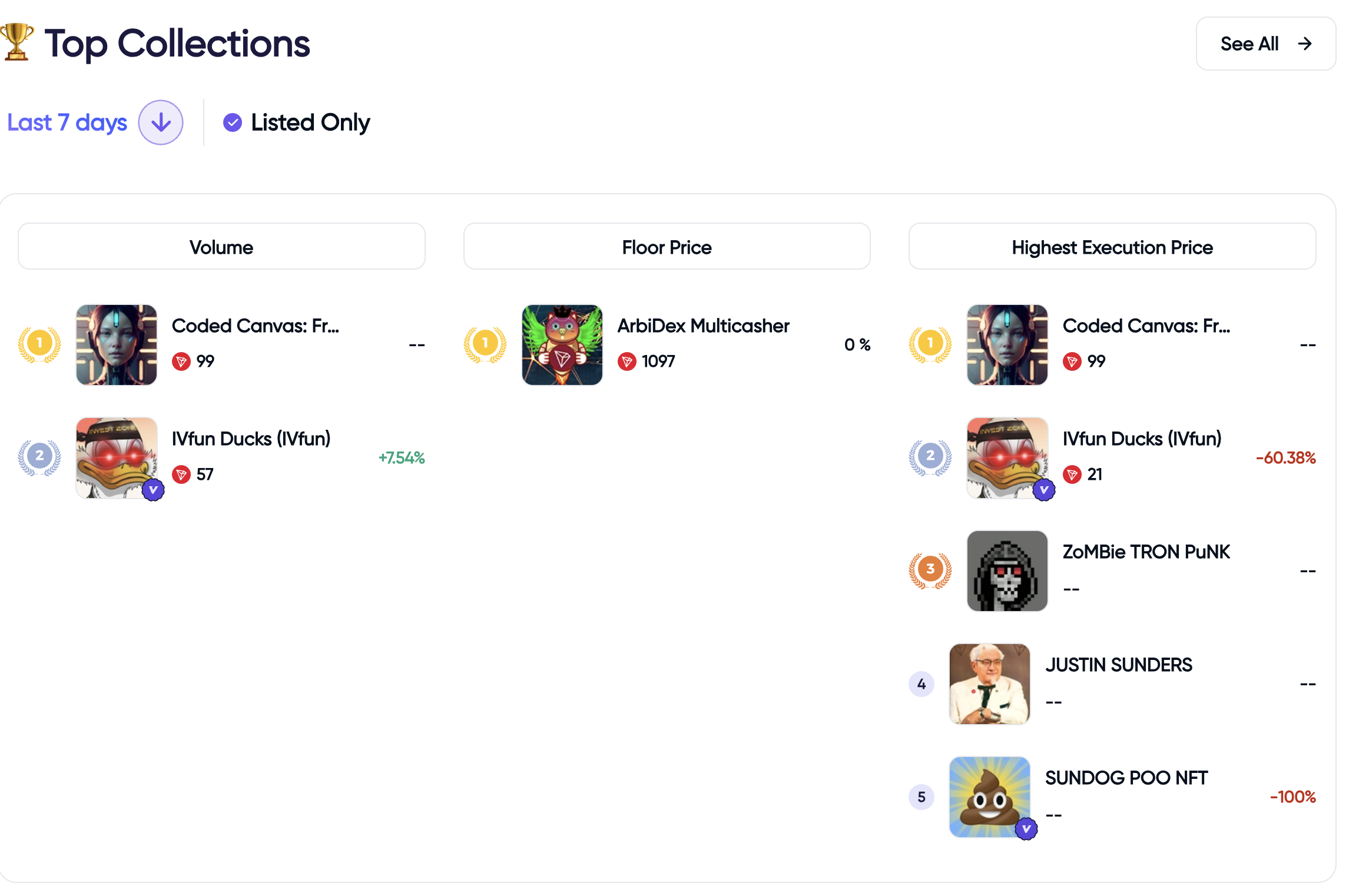
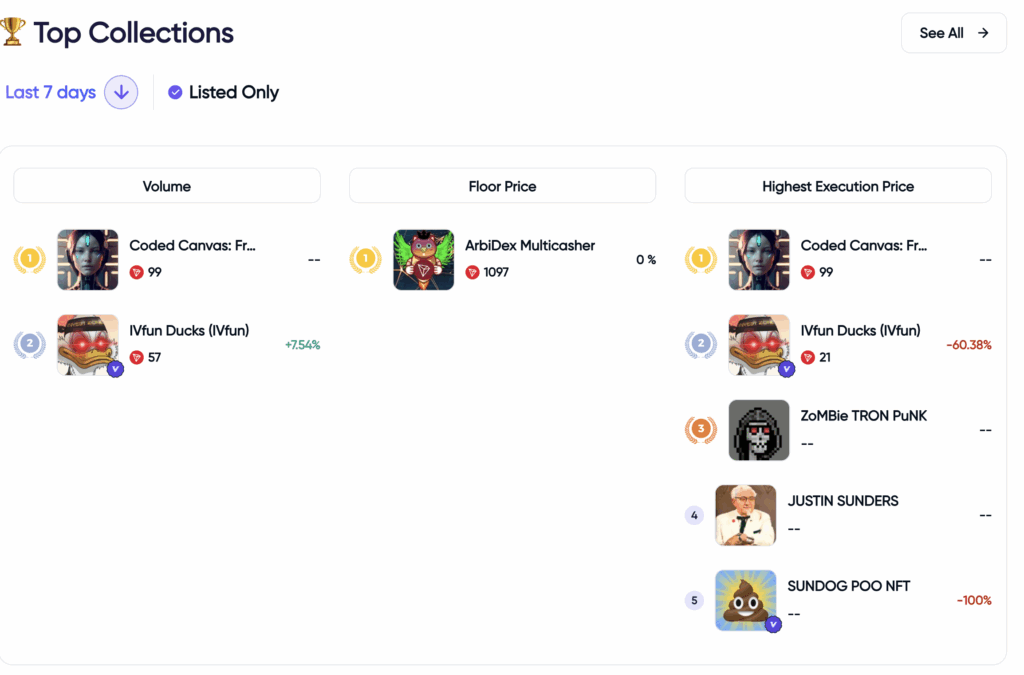
The AINFT marketplace lists a total of 156 TRX volume for its top project over the last seven days, split between only two collections.
At the current price of $0.28 for each individual TRX, that’s a total volume of $43.68 for this week.
If we divide that by the seven days, then we get a result of $6.24 per day in trading volume for the self-described “Biggest NFT Trading Platform on TRON.”
Read more: FTX estate says Justin Sun still owes it millions
AINFT has, in some sense, shifted away from NFTs, focusing on a variety of other artificial Intelligence (AI) features.
One of these features is what is advertised as the “BANK OF AI,” which is meant to make it convenient for AI agents to use TRON and BNB Chain.
Another feature, “AINFT Nova,” is described as “an AI agent launch platform where users can deploy AI agents and simultaneously issue their dedicated tokens.” This feature has yet to launch.
Read more: Justin Sun’s graveyard of abandoned crypto projects
Similarly, it’s yet to launch its “AINFT Agent Framework” for multi-agent systems, its “AINFT AgentTX,” which is “an AI-driven trading framework,” or its “AINFT Grid,” which claims to be “a platform dedicated to advancing decentralized AI model training and application.”
It has successfully embedded a chatbot interface that claims to provide access to a variety of models from OpenAI, Anthropic, and Google.
The value of the AINFT token has fallen by a quarter over the last year, according to data from CoinGecko.
AINFT is also connected to the legal dispute between David Geffen and Sun over the purchases of numerous pieces of art, with several of the transactions centering around what was then the APENFT Foundation.
Got a tip? Send us an email securely via Protos Leaks. For more informed news and investigations, follow us on X, Bluesky, and Google News, or subscribe to our YouTube channel.

Disclosure: This article does not represent investment advice. The content and materials featured on this page are for educational purposes only.
The partnership between BuySellVouchers and Finassets highlights how scalable crypto payment infrastructure can unlock cost-efficient international expansion.
Summary
- BuySellVouchers faced rising fees, limited network support, and operational bottlenecks that hindered global scaling under its previous payment provider.
- Switching to Finassets reduced processing costs by 50%, introduced fixed-fee predictability, optimized TRC-20 transactions, and enabled support for 70+ crypto networks.
- The upgraded payment architecture improved compliance alignment, automated mass payouts, enhanced transaction transparency, and created a stable foundation for sustainable international growth.

Bank payments on international marketplaces are losing efficiency, while crypto-based marketplace payments are becoming a fundamental payment infrastructure. Their success depends on the right payments partner and a scalable payment gateway for marketplace operations.
The BuySellVouchers case shows how the right payment solution supports expansion into new markets without increasing costs.
Marketplace payment processing must support business growth
BuySellVouchers.com is a global P2P marketplace for digital vouchers and gift cards, operating since 2015 with around $12 million in monthly turnover across Asia, Africa, Europe, and Russia.

Its business model is based on direct peer-to-peer trading, where marketplaces process payments between multiple parties, including cryptocurrency settlements.
As the company prepared for global expansion into new markets and planned to onboard sellers in different regions, it became clear that the existing payment gateway no longer met evolving business needs. Although crypto payments were already integrated, scaling exposed structural limits in the previous setup, turning the payment infrastructure into a bottleneck.
How to recognize when a payment provider no longer fits a business
Several warning signs indicated misalignment between the provider and the business model:
Sign
How it affects
Rising transaction fees as volumes increase
Makes financial planning difficult and reduces margin predictability as the business scales
Limited network support
Restricts flexibility across different payment methods and limits expansion into new markets
No dedicated technical support
Slows down resolution of transaction-related issues and increases operational risk
Lack of automation tools
Increases manual workload, operational pressure, and internal costs
At scale, these issues directly impact margins, predictability, and global expansion capability.
High volume payment processing requires strict technical and operational standards
For international growth, BuySellVouchers needed more than basic payment processing. It required marketplace payment solutions aligned with its business model.
The company defined clear criteria for a new payment gateway for marketplace operations:
Keeping costs stable as volume grows
The payment solution had to ensure that increasing transaction volume would not proportionally increase costs. This was critical to maintaining stable margins as the business expanded into different regions.
Clear pricing for financial planning
Transparent pricing without hidden monthly fees or setup fees, clear transaction statuses, and visibility across all marketplace payments were essential for financial forecasting and managing funds.
Regulatory coverage across regions
Processing had to comply with financial regulations, local regulations, and global regulations, ensuring compliance without limiting global expansion.
Easy onboarding and technical stability
- Scalable APIs capable of supporting growth
- Reliable high-volume payment processing
- Fast resolution of non-standard transaction scenarios typical for P2P marketplaces
Growth requires predictability, financially and operationally.
Finassets removed structural barriers for BuySellVouchers
After switching providers, BuySellVouchers partnered with Finassets.io low fee crypto payment gateway, which delivered a scalable marketplace payment platform designed for global payments and global payouts.

Low cost payment processing: financial effect of reducing processing costs by 50%
A fixed-fee model was implemented, allowing the company to forecast operational costs in advance and manage margins effectively.
Additionally, TRC-20 transaction optimization was introduced through the use of pre-purchased TRON Energy instead of burning TRX for every transaction.
As Vitalijs Feldmanis, CEO of Finassets, explains: “One of Finassets’ key advantages is that clients save significantly on transaction fees for the TRON network (TRC-20), because we cover network fees with purchased energy instead of burning TRX.”
Results:
- Processing fees reduced in half
- Predictable unit economics as turnover increased
- Direct positive impact on profitability
Broad network support
Support for more than 70 cryptocurrencies and networks, including ERC-20, BEP-20, Polygon, and others, allowed the platform to adapt to regional preferences and expand without structural payment limitations.
Compliance as a growth enabler
The processing structure aligned with BuySellVouchers’ offshore operating model and provided AML/KYC procedures adapted to the P2P risk profile, without excessive banking-style bureaucracy.
This enabled the company to:
- Standardize compliance processes
- Reduce internal operational workload
- Simplify interactions with a global user base
Compliance became a structured system rather than a scaling obstacle.
Operational stability as a competitive advantage
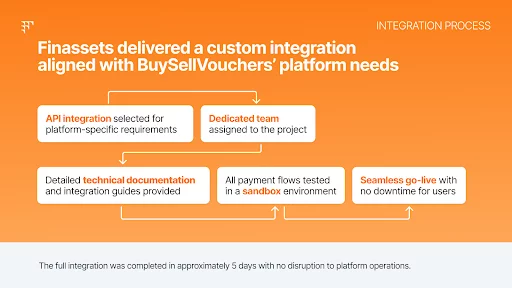
For a P2P marketplace, transaction speed and predictability directly influence user trust.
After implementing the Finassets infrastructure:
- Transaction statuses became fully transparent
- Delays and manual investigations were minimized
- High transaction volumes were processed reliably
Payments became predictable and manageable at scale.
Centralized visibility and financial control
The Finassets dashboard became a core operational tool for the BuySellVouchers team, particularly the Balance, Transactions, and B2B crypto Exchange tabs.
It enabled transparent balance tracking, full transaction visibility, real-time fiat equivalents, and simplified accounting exports. As a result, financial processes became more structured and operational workload was reduced.
Batch global payouts for high-volume operations
The mass payout feature accelerated recurring and large-volume transactions, a critical function for P2P and digital goods marketplaces.
This helped the business manage payouts more efficiently, save time internally, and maintain full control over payment operations.
Ongoing support and crypto expertise
Through the Finassets dashboard, the team gained:
- Full auditability
- Real-time fiat equivalents
- Simplified accounting
Sergej Balanel, CEO of BuySellVouchers.com, emphasized the importance of partner support: “We want to highlight the ongoing support from our partner, including their specialists being always available on Telegram. We got quick advice from the team, which helped us work smoothly together and speed up the integration process.”
With experienced technical specialists supporting operations, payments became a stable foundation for scalable growth.
Entering new markets without increasing payment costs
Traditionally, entering new markets leads to rising expenses due to fragmented payment methods, local options, bank transfers, and complex compliance requirements.
“As our volumes grew, processing costs and transaction predictability became critical. Finassets removed payments as a bottleneck, which directly improved realized turnover and simplified day-to-day operations. This is infrastructure we can confidently scale on.” — Sergei B., CEO, BuySellVouchers
Using a unified payment gateway for marketplace operations allowed the company to:
- Maintain a consistent fee structure across regions
- Eliminate chargebacks
- Avoid frozen funds
- Preserve predictable cash flow
Payments became a controllable, scalable infrastructure layer.
Scalability depends on payment architecture
The BuySellVouchers case shows that crypto payments alone do not guarantee lower costs or scalability.
What truly matters is the architecture of the payment gateway for marketplace operations and the strategic choice of a reliable processing partner.
A well-structured payment infrastructure allows businesses to enter new markets without increasing unit costs, improve margins as transaction volumes grow, and reduce operational and regulatory risks.
When payment operations become predictable and scalable, a marketplace gains a stable foundation for sustainable global growth.
Disclosure: This content is provided by a third party. Neither crypto.news nor the author of this article endorses any product mentioned on this page. Users should conduct their own research before taking any action related to the company.
Crypto World
PayPal (PYPL) jumps 7% as Stripe reportedly weighs acquisition. Here is what it means for crypto
Stripe, which processed $1.9 trillion in transactions last year and was recently valued at $159 billion, is considering an acquisition of all or parts of PayPal (PYPL), according to a Bloomberg report.
Deliberations are in early stages, the report continued.
If completed, the deal would bring together two major payment firms that have both moved into stablecoins.
PayPal launched its dollar-backed stablecoin in 2022 through issuer Paxos. The token has since grown to a market value of about $4 billion. It allows users to move dollars across crypto networks at any time of day, often at a lower cost than bank wires.
Stripe has also pushed deeper into crypto. In 2024, it acquired Bridge for $1.1 billion, a company that builds tools for businesses and crypto projects to issue their own U.S. dollar-backed tokens. Stripe is also working with venture firm Paradigm to develop Tempo, a payments-focused blockchain now in testing.
PayPal has struggled mightily in recent years, its stock tumbling about 80% from record highs hit in 2021. Shares were already higher this week on buyout chatter, and they rose another 7% late Tuesday in the wake of the Stripe report.
Read more: Stripe’s Bridge sees stablecoin volume quadruple as utility insulates from ‘crypto winter’


SAN FRANCISCO, CA – Crypto isn’t just building faster payments rails. It may be building the financial system for non-humans.
As AI agents grow more autonomous, developers are already giving them crypto wallets, allowing software to hold assets, pay for services, trade tokens and even hire other agents. The technical pieces are falling into place. The legal ones are not.
At a recent panel at NEARCON 2026, Electric Capital’s Avichal Garg framed the moment as historically significant.
“What happens if there’s not a human behind it at all?” Garg asked. “It’s some piece of code that owns a wallet, executing code to make more money… How does liability work in that case? I actually don’t know.”
Crypto makes this possible in a way traditional finance cannot. Blockchains allow programmable money, instant settlement and global access. Pair that with AI agents capable of making decisions, and you get something new: software that can both think and transact.
Garg compared the shift to the creation of the limited liability corporation in the 19th century — a legal breakthrough that unlocked pooled capital and industrial-scale growth.
“The cost of participating in the economy has come down so far,” he said. “You’re talking about anybody in the world, with relatively little money, being able to create value.”
But enforcement remains unresolved.
“You can’t punish an AI,” Garg noted. “You can turn them off, but they don’t care.”
If autonomous agents begin trading, lending, hiring and scaling businesses onchain, lawmakers may face a foundational question: Who is liable when software with its own wallet acts independently?
Read more: Kraken’s co-CEO could trust AI with 100% of his crypto — Dragonfly’s Haseeb Qureshi isn’t convinced
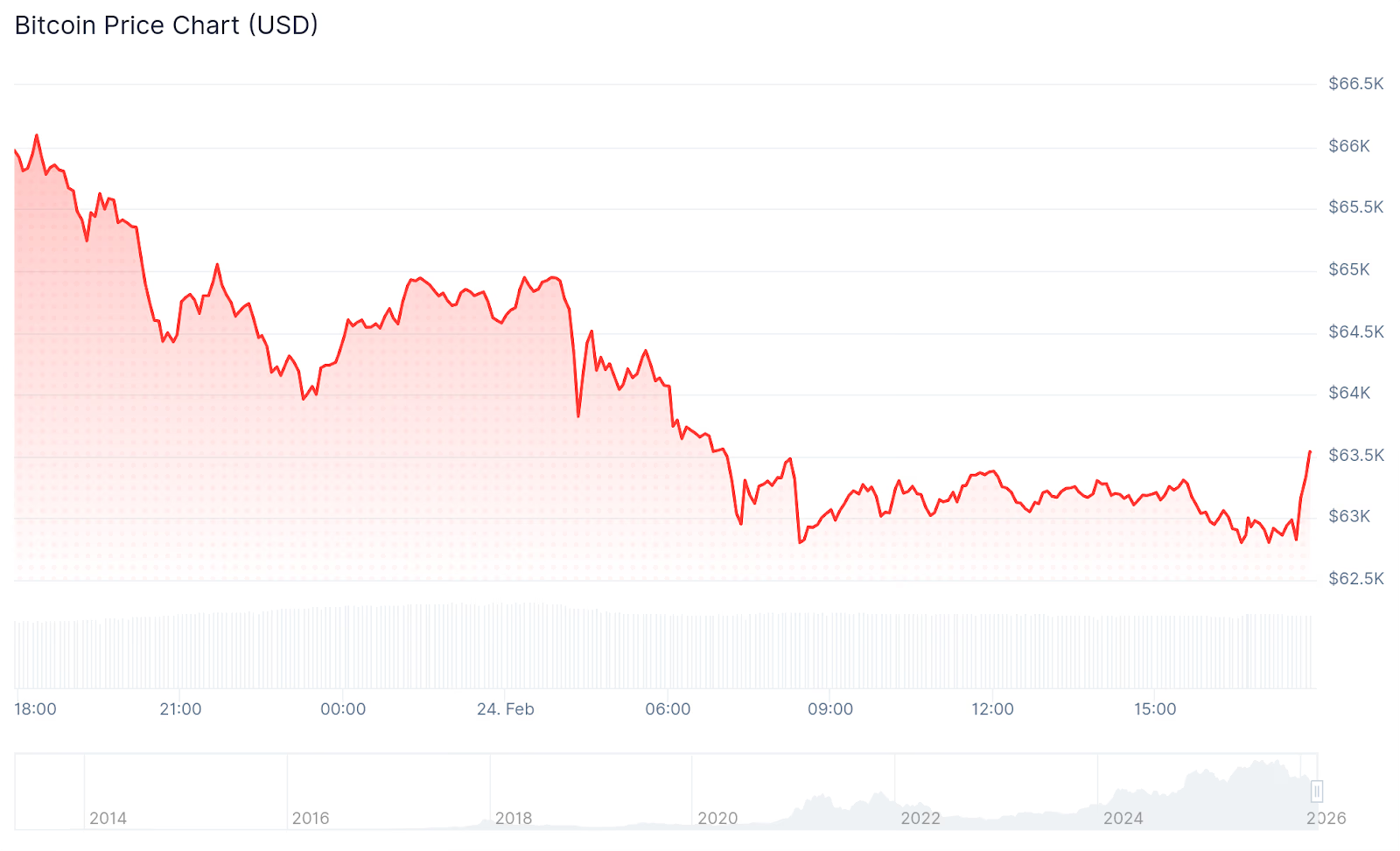
BTC failed to hold key support levels, dragging the wider crypto market lower.
Cryptocurrency markets are under pressure again, with traders reacting to broader AI-linked fears, lingering macro uncertainty and signs of waning institutional demand. Today, Feb. 24, total crypto market capitalization slipped 2.5%, currently hovering around $2.27 trillion.
Bitcoin (BTC) slid from about $66,000 on Monday morning, Feb. 23, to near $63,700 at press time, marking a 3% daily decline. BTC’s weekly losses are around 6%.
Ethereum (ETH) tracked BTC’s move, falling 3% to $1,840, and down 5.4% on the week.

Among the rest of the top-10 assets, most are seeing mild to moderate losses today. XRP is down 1.7% to $1.35, BNB lost 3.6% to about $585, and Solana (SOL) declined 3% to $77.
Figure Heloc (FIGR_HELOC) was the only top-10 large-cap in the green this morning, up 1.5%.
Oversold
Alex Thorn, head of firmwide research at Galaxy Digital, noted in an X post today that BTC is approaching all-time oversold territory, with weekly RSI readings lower than any moment outside the deepest bear markets, citing November-December 2018 and mid-2022 as rare comparable periods.

Wintermute analysts highlighted in another X post today that Bitcoin has repeatedly failed to break through the $70,000 mark in the past two weeks, while ETH dipped below the psychologically important $1,900 mark.
“Multiple times over the past decade, growth scares have triggered rotations that ultimately reversed as risk appetite returned and the market found its way back to momentum,” the analysts noted.
They added that thin liquidity with derivatives signals a lack of directional conviction. Some selective interest in altcoins from high-net-worth investors briefly emerged mid-week but quickly faded.
Big Movers and Liquidations
Looking at the top-100 assets by market cap, PIPPIN gained the most, up 6.6% to $0.77 on the day, while Monero (XMR) rose 3.4% to $325.
On the downside, Bitcoin Cash (BCH) led losses at 11% to $475.40, followed by NEXO, down 5.5% to $0.80.
According to CoinGlass data, around 137,000 traders were liquidated over the past 24 hours, with total losses of $412.9 million, where BTC accounted for $156.3 million and ETH for $131.7 million, while other altcoins accounted for $22.1 million.
ETFs and Macro Conditions
Spot Bitcoin ETFs saw $203.8 million in outflows on Monday, bringing cumulative assets to $80.7 billion. Ethereum ETFs recorded $49.4 million in outflows, with total net assets now at $10.4 billion, per SoSoValue data.
Macro conditions still feel shaky. Shares of IBM plunged about 13% on Monday, Feb. 23 — the stock’s steepest drop in more than 25 years. The selloff came after Anthropic said its Claude Code tool can automate COBOL modernization, the old-school language that still rakes in serious revenue for IBM.
Adding to the nervous mood, analysts at Citrini Research warned in a Feb. 22 note that rapid AI adoption could displace large numbers of white‑collar jobs, squeeze consumer spending, and put pressure on both financial and tech sectors.
In comments to investors on Monday, JPMorgan CEO Jamie Dimon drew comparisons between current credit and risk dynamics and those seen in the run‑up to the 2008 financial crisis, fueling more caution among investors.

Editor’s note: The GCC region is moving quickly from experimenting with Generative AI to embedding it across core business functions. Deloitte’s newly released survey of tax, finance and legal leaders shows a clear acceleration in GenAI adoption, driven by a demand for smarter research, decision support and quality assurance. As regional companies navigate data privacy, governance and implementation roadmaps, this editorial note highlights momentum and the remaining gaps that organizations must address to translate ambition into measurable outcomes.
Key points
- GenAI adoption is accelerating across tax, finance and legal functions in the GCC.
- Non-adoption fell from 52% in 2024 to 29% in 2025, with participation rising 47% year over year.
- Priorities have shifted toward research and analysis (41%) and quality improvement (38%).
- Only 18% are piloting GenAI, 9% are scaling, and 10% have enterprise-wide AI strategies and governance in place; 63% remain in pre-implementation.
- Automation remains a major opportunity, with 53% prioritizing automation; emphasis on research and data analysis (41%).
Why this matters
GenAI adoption in the GCC signals a shift from experimentation to strategic capability across tax, finance and legal functions. The findings underscore the importance of governance, robust operating models and workforce readiness to translate momentum into measurable business value and trusted, scalable deployment across enterprises. With rising confidence in AI’s long-term potential, organizations must balance speed with quality, risk controls and responsible governance to sustain momentum.
What to watch next
- Move from pilots to enterprise-wide AI strategies and governance frameworks.
- Strengthen governance, operating models and adoption roadmaps.
- Invest in data quality and capability development for deeper analytics.
- Monitor automation opportunities and balance between speed and quality.
Disclosure: The content below is a press release provided by the company/PR representative. It is published for informational purposes.
GCC Leaders Accelerate GenAI Adoption in Tax, Finance and Legal Functions
A new Deloitte survey reveals rapid uptake across the region, alongside growing gaps in governance, strategy and implementation.
Dubai, UAE – 24 February, 2026: A new regional survey by Deloitte’s Tax & Legal business shows that organizations across the GCC are rapidly adopting Generative AI (GenAI) in tax, finance, and legal functions – but many are still struggling to move from experimentation to enterprise-wide impact.
Based on insights from senior tax and finance leaders across Saudi Arabia, the UAE, Qatar, and Kuwait, the survey shows rapid acceleration in GenAI adoption across the GCC. Non-adoption fell sharply from 52% in 2024 to 29% in 2025, while survey participation rose 47% year over year. The survey results indicate that GenAI has become a mainstream strategic priority for regional leadership teams.
While early adoption focused on basic productivity tasks such as email drafting, priorities have moved toward research and analysis (41%) and accuracy and quality improvement (38%). This reflects a transition from efficiency-led experimentation to more strategic value creation. At the same time, 93% of respondents expect AI to have a significant impact on their organizations, highlighting strong regional confidence in the technology’s long-term potential.
Yet despite this momentum, execution remains a key challenge. While 18% of organizations are actively piloting GenAI use cases, only 9% have begun scaling solutions, and just 10% report having enterprise-wide AI strategies and governance frameworks in place. More than 63% remain in pre-implementation stages, underscoring the need for clearer operating models, stronger governance, and structured adoption roadmaps to translate ambition into measurable outcomes.
Automation continues to be a major opportunity area, with 53% of respondents prioritizing automation, particularly in data validation and data reconciliation. However, leaders are increasingly emphasizing quality over speed, with research and data analysis accounting for 41% of current GenAI applications, signalling demand for deeper analytical support rather than simple task automation.
Implementation approaches vary widely across the region. While some organizations are adopting subscription-based or hybrid models, 38% say they are still exploring how to operationalize GenAI, reinforcing the need for advisory support to bridge strategy and execution.
Reflecting on the regional landscape, Muhammad Bahemia, Middle East Tax Leader at Deloitte, said: “The pace of Generative AI adoption across the GCC reflects a region that is both ambitious and pragmatic. Leaders clearly recognize the technology’s potential, but many are now confronting the harder question of how to scale it responsibly. Through our work across tax, finance, and legal functions, Deloitte is helping organizations translate innovation into disciplined execution; strengthening governance, building capabilities, and embedding AI in ways that deliver measurable value and enduring trust.”
Further commenting on the findings, Mohamed Serokh, Partner, at Deloitte Middle East, said: “What we’re seeing across the GCC is a clear shift from curiosity to action. Leaders recognize GenAI’s potential to fundamentally reshape tax, finance, and legal functions, particularly in research, analysis, and quality improvement. However, our survey also shows that many organizations are still navigating how to move from pilots to scalable impact. Success will depend on strong governance, capability development, and a disciplined approach to implementation.”
The survey concludes that while experimentation is widespread, the next phase for GCC organizations must focus on structured execution. Prioritizing high-impact use cases in research and tax analysis, strengthening governance frameworks, and investing in workforce readiness to support responsible, scaled adoption.
Explore the survey insights on this link.
© 2026 Deloitte & Touche (M.E.). All rights reserved.
In this press release references to “Deloitte” are references to one or more of Deloitte Touche Tohmatsu Limited (“DTTL”) a UK private company limited by guarantee, and its network of member firms, each of which is a legally separate and independent entity. Please see deloitte.com/about for a detailed description of the legal structure of DTTL and its member firms. The information contained in this press release is correct at the time of going to press.
About Deloitte & Touche (M.E.) LLP
Deloitte & Touche (M.E.) LLP (“DME”) is the affiliate for the territories of the Middle East and Cyprus of Deloitte NSE LLP (“NSE”), a UK limited liability partnership and member firms of Deloitte Touche Tohmatsu Limited, a UK private company limited by guarantee (“DTTL”).
DME is a leading professional services organization established in the Middle East region with uninterrupted presence since 1926. DME’s presence in the Middle East region is established through its affiliated independent legal entities, which are licensed to operate and to provide services under the applicable laws and regulations of the relevant country. DME’s affiliates and related entities cannot oblige each other and/or DME, and when providing services, each affiliate and related entity engages directly and independently with its own clients and shall only be liable for its own acts or omissions and not those of any other affiliate.
DME provides services throughout 26 offices in 14 countries with more than 7,000 partners, directors and staff.
About Deloitte
Deloitte refers to one or more of Deloitte Touche Tohmatsu Limited (“DTTL”), its global network of member firms, and their related entities (collectively, the “Deloitte organization”). DTTL (also referred to as “Deloitte Global”) and each of its member firms and related entities are legally separate and independent entities, which cannot obligate or bind each other in respect of third parties. DTTL and each DTTL member firms and related entity is liable only for its own acts and omissions, and not those of each other. DTTL, NSE and DME do not provide services to clients. Please see www.deloitte.com/about to learn more.
Deloitte provides Audit & Assurance, Tax & Legal and Consulting and related services to nearly 90% of the Fortune Global 500® and thousands of private companies. Our professionals deliver measurable and lasting results that help reinforce public trust in capital markets, enable clients to transform and thrive, and lead the way toward a stronger economy, a more equitable society and a sustainable world. Building on its 175-plus year history, Deloitte spans more than 150 countries and territories. Learn how Deloitte’s approximately 457,000 people worldwide make an impact that matters at www.deloitte.com.
Noora Cheikh
Eminence, Media & Digital Marketing Leader
Deloitte & Touche (M.E.)
ncheikh@deloitte.com | www.deloitte.com

Former Tottenham coach was asked to stay but left ‘pointless’ situation | Football

February consumer confidence improves on labor market expectations

Bitcoin Down 49.53% From ATH: How Far Can BTC Fall Before This Bear Market Finds a Bottom?


-

 Video5 days ago
XRP News: XRP Just Entered a New Phase (Almost Nobody Noticed)
-

 Fashion4 days ago
Weekend Open Thread: Boden – Corporette.com
-

 Politics3 days ago
Baftas 2026: Awards Nominations, Presenters And Performers
-

 Business7 days ago
Infosys Limited (INFY) Discusses Tech Transitions and the Unique Aspects of the AI Era Transcript
-

 Sports1 day ago
Women’s college basketball rankings: Iowa reenters top 10, Auriemma makes history
-

 Entertainment6 days ago
Kunal Nayyar’s Secret Acts Of Kindness Sparks Online Discussion
-

 Politics1 day ago
Nick Reiner Enters Plea In Deaths Of Parents Rob And Michele
-

 Tech7 days ago
Retro Rover: LT6502 Laptop Packs 8-Bit Power On The Go
-
 Sports6 days ago
Clearing the boundary, crossing into history: J&K end 67-year wait, enter maiden Ranji Trophy final | Cricket News
-

 Business2 days ago
Mattel’s American Girl brand turns 40, dolls enter a new era
-

 Crypto World16 hours ago
XRP price enters “dead zone” as Binance leverage hits lows
-

 Business2 days ago
Law enforcement kills armed man seeking to enter Trump’s Mar-a-Lago resort, officials say
-

 Entertainment6 days ago
Dolores Catania Blasts Rob Rausch For Turning On ‘Housewives’ On ‘Traitors’
-

 Business7 days ago
Tesla avoids California suspension after ending ‘autopilot’ marketing
-

 Tech2 days ago
Anthropic-Backed Group Enters NY-12 AI PAC Fight
-
 NewsBeat2 days ago
‘Hourly’ method from gastroenterologist ‘helps reduce air travel bloating’
-

 NewsBeat2 days ago
Armed man killed after entering secure perimeter of Mar-a-Lago, Secret Service says
-

 Politics2 days ago
Maine has a long track record of electing moderates. Enter Graham Platner.
-

 Crypto World6 days ago
WLFI Crypto Surges Toward $0.12 as Whale Buys $2.75M Before Trump-Linked Forum
-

 Tech5 hours ago
Unsurprisingly, Apple's board gets what it wants in 2026 shareholder meeting