

Business
Reeves adviser sparks backlash after saying UK doesn’t ‘need any more restaurants’


A senior adviser to Rachel Reeves has drawn sharp criticism from the hospitality sector after saying Britain does not “need any more restaurants”.
Alex Depledge, appointed last year as the Government’s entrepreneurship adviser, argued that ministers should prioritise high-growth industries such as technology and advanced manufacturing rather than hospitality and retail.
Speaking to Insider Media, Depledge said: “We don’t need any more restaurants. I’m not anti-hospitality, but that’s not where my efforts are.” She added that the UK should focus on scaling sectors such as clean tech and creative industries to drive long-term economic growth.
Her remarks prompted an immediate backlash from publicans and restaurateurs already grappling with higher national insurance contributions and business rate reforms.
Sacha Lord, chairman of the Nighttime Industry Association and a former adviser to Manchester mayor Andy Burnham, said the comments deepened confusion about Labour’s stance towards hospitality. “Small and medium-sized businesses are the largest employers in the private sector,” he said, adding that the sector had been “blindsided” by recent tax changes.
TV chef Michel Roux Jr also criticised the remarks on social media, while pub campaigner Andy Lennox urged Depledge to reconsider what he described as “unwise words”.
Hospitality accounts for around 7 per cent of UK employment, with roughly 2.6 million people working in the sector, according to the Office for National Statistics. The number of restaurants fell 1.3 per cent in 2025 to 89,600, as operators faced rising costs and squeezed consumer spending.
Depledge, who founded property and software businesses including Resi UK and Good Lord, defended her focus on sectors capable of generating higher productivity and wages. She suggested that while small businesses remain vital, their overall contribution to the economy has remained broadly stable over decades.
The Chancellor has introduced targeted relief for pubs, including a temporary 15 per cent business rates discount, but restaurants and hotels have continued to press for broader support.
The episode underscores growing tension between Labour’s push to champion “future-facing” industries and the concerns of traditional sectors that remain major employers across the country.

Paul Jones
Harvard alumni and former New York Times journalist. Editor of Business Matters for over 15 years, the UKs largest business magazine. I am also head of Capital Business Media’s automotive division working for clients such as Red Bull Racing, Honda, Aston Martin and Infiniti.


Check out what’s clicking on FoxBusiness.com.
It’s that time of year again in college basketball, and BODYARMOR Sports Drink is getting back on the court for the most anticipated tournament of the year.
BODYARMOR announced its return to college basketball as the official sports drink of the NCAA after seven years, beginning with the 2026 March Madness tournament.
As such, the brand committed to better hydration is refreshing its “Choose Better” campaign with LSU senior guard Flau’Jae Johnson, who is hoping to make a run this March for her second career title, and a two-time NCAA men’s basketball champion – New York Knicks star guard Jalen Brunson.
CLICK HERE FOR MORE SPORTS COVERAGE ON FOXBUSINESS.COM

Jalen Brunson dribbles basketball in a partnership with BODYARMOR ahead of March Madness. (BODYARMOR / Fox News)
“For me, a couple of my career highlights happened during March Madness, so I think it’s a really unique spot for us,” Brunson told FOX Business about his partnership with the brand and its return to the court. “Most importantly, the best thing about BODYARMOR and my favorite part is our ‘Choose Better’ campaign. For us, it’s always about choosing better when it comes to hydration and everything that you do.”
The “Choose Better” campaign for BODYARMOR launched in April 2025, and this time, Brunson and Johnson are the ones urging all athletes, not just those on the March Madness stage, to make intentional changes to better themselves each and every day.
WARREN BUFFET EMPLOYEE WINS $1M MARCH MADNESS BRACKET CHALLENGE
For Brunson, playing in the intense atmosphere of the NBA means creating the best routine possible to get the most out of himself on gamedays. When asked where he starts, he focused on what he puts into his body.
“Most importantly, it starts with hydration,” Brunson explained. “I think no matter what, when you’re hydrated, your muscles [and] your body feel good. Obviously, you need nutrition as well. That’s how you replenish throughout the game, through hydration. So, that’s how I choose better.”
Throughout this March Madness tournament, BODYARMOR products, which include towels, sports bottles and coolers, will be spotted on the court for all hydration purposes for the NCAA teams participating. There will also be BODYARMOR branding throughout broadcasts, digital platforms and in-arena signage during games.

BODYARMOR is returning to college basketball as the official sports drink of the NCAA, starting with the 2026 March Madness tournament. (BODYARMOR / Fox News)
“The NCAA is home to the most exciting championships in college sports, starting with March Madness,” Tom Gargiulo, chief marketing officer at BODYARMOR, said in a statement. “As the Official Sports Drink of the NCAA, BODYARMOR is at the center of the biggest stage in college basketball.”
And while Brunson and Johnson take center stage with March Madness, the brand also teamed up with more than 20 NIL athletes from colleges and universities across the country to support digital and social media content.
Johnson and Brunson are a part of a strong group of superstar partners with BODYARMOR, which includes NFL stars Joe Burrow and CeeDee Lamb.
“My partnership with BODYARMOR has been amazing since day one. Very similar core values in how they operate and how I operate, so it’s been great,” Brunson said. “Obviously coming back with a sponsorship and partnership with NCAA March Madness – I think it’s going to be cool.

Flau’Jae Johnson drinks BODYARMOR, who she just partnered with ahead of the 2026 March Madness tournament. (BODYARMOR / Fox News)
GET FOX BUSINESS ON THE GO BY CLICKING HERE
Brunson called his time on the March Madness court with Villanova “one of the most intense times in my life,” so choosing better is certainly what these athletes want to do to hoist the championship trophy like he did years ago.
“Those times back in college and those championships, those were some of my favorite times,” he said.
Follow Fox News Digital’s sports coverage on X and subscribe to the Fox News Sports Huddle newsletter.
Florida Gubernatorial candidate and Former Florida House Speaker Paul Renner joins ‘Mornings with Maria’ to detail his property tax rollback plan, critique New York’s spending and pledge alignment with President Donald Trump.
A major reprieve from Florida’s property taxes may be coming much sooner than residents, lawmakers and real estate experts previously thought.
Last week, the state’s House advanced an amended HJR 203 bill that would effectively turn off the tax switch for homesteaded properties starting Jan. 1, 2027.
“Florida’s success has been built on smart fiscal policy, economic opportunity and a very clear identity. Major tax reform should strengthen those pillars, not complicate them,” OneWorld Properties President and CEO Peggy Olin told Fox News Digital.
“From where I sit,” she continued, “working with buyers across the country and around the world, confidence in the state’s long-term stability matters just as much as any short-term savings. If Florida can deliver meaningful relief while maintaining strong infrastructure and services, it will continue to lead. And based on what I’ve seen over the past 25 years, when Florida gets the balance right, growth follows.”
Backed by Gov. Ron DeSantis, the bill — originally proposed in October — works toward the state’s long-discussed “zero tax” goal. The language of HJR 203 explains how homesteaded properties would stop paying city and county property taxes entirely but could still pay roughly 35% to 50% of their total bill in school taxes. So even though property tax bills won’t go to zero, they could be cut in half or more.
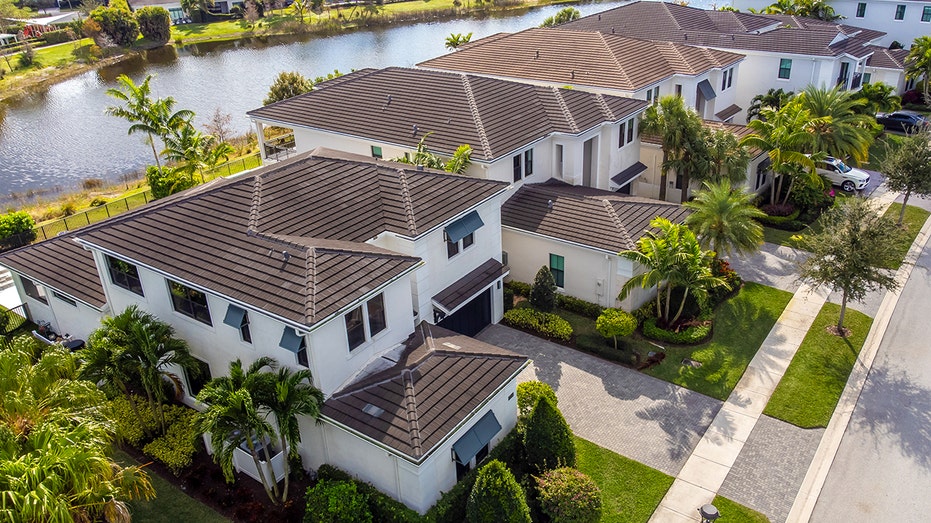
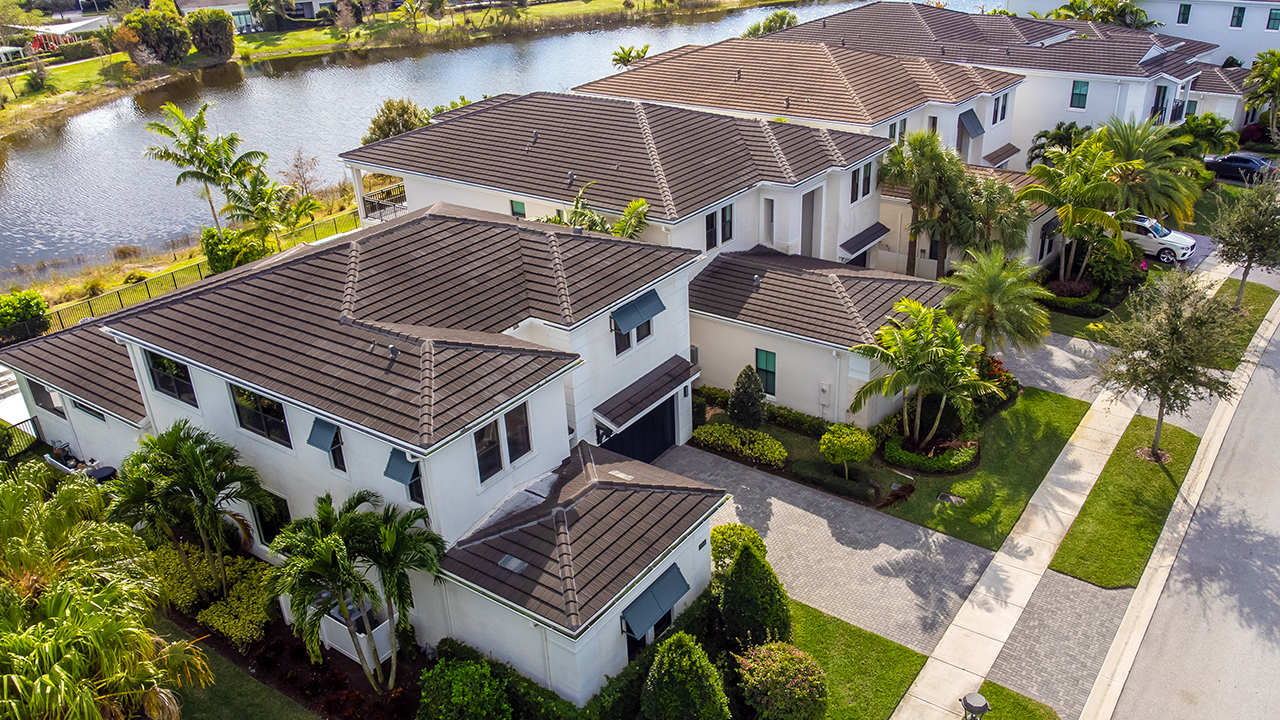
Homes from an aerial view in Palm Beach Gardens, Florida, on Sunday, Jan. 11, 2026. (Getty Images)
The newly passed amendment removed a 10-year phased-in plan and instead offers a fast-track timeline for homeowners to see maximum savings in their first tax bill of 2027 if 60% of voters approve it on the 2026 midterm ballot.
“I’m generally supportive of thoughtful tax relief, as it’s part of what has made Florida such a powerful growth story over the past decade,” Olin argued. “Homestead protections are core to the state’s identity, and giving full-time residents breathing room is always appealing.”
“Infrastructure, public safety and services don’t disappear just because a revenue line does. The intention is strong to protect homeowners, but the execution has to be disciplined,” she expanded. “Florida’s competitive edge isn’t just low taxes; it’s quality of life. We have to preserve both.”
Miami REALTORS Chief of Residential & Advocacy Danielle Blake and Douglas Elliman agent Jessica Julian speak to Fox News Digital about two recent legal changes within Florida’s condominium market.
State economists have warned that the plan could dig a $14.8 billion hole annually for local governments, and critics worry that if cities lose billions in tax revenue, police officers or fire stations could lose staff.
However, a provision in the bill offers a public safety guarantee that cities would be legally required to fund police departments at 2024-2025 funding levels even if they have no money coming in from homeowners.
“Cities are very creative when it comes to revenue. A gap of that size rarely goes unaddressed,” Olin reacted. “In reality, if funding disappears in one area, it often reappears somewhere else, whether through fees, assessments, utilities or broader consumption taxes. So the question becomes whether homeowners see true net relief or simply a restructuring of costs.”
Rep. Jimmy Patronis, R-Fla., discusses New York City Mayor Zohran Mamdani and Florida’s budget proposal, Palantir’s move to the state and GOP lawmakers calling for a crackdown on luxury exports to Cuba on ‘Varney & Co.’
Olin also responded to whether eliminating taxes will cause home prices to spike if buyers can afford larger mortgages, and whether there is a risk that this tax cut actually makes it harder for the next generation of Floridians to buy a home.
“Real estate markets are efficient. If buyers suddenly have more purchasing power, prices can adjust, especially in supply-constrained areas like South Florida. But in my experience, property values here are driven far more by migration trends, global capital and limited inventory than by a single tax adjustment,” she said.
“Buyers aren’t moving to Florida solely because of property taxes. They’re coming for lifestyle, economic opportunity and overall tax predictability. That said, affordability at the entry level is already delicate. If relief simply gets absorbed into higher prices, first-time buyers could feel pressure,” Olin pointed out, “which means the larger conversation isn’t just tax policy. It’s supply, smart development and creating attainable housing options.”
GET FOX BUSINESS ON THE GO BY CLICKING HERE
Florida Chamber of Commerce President and CEO Mark Wilson speaks to Fox News Digital about the latest statistics around the Sunshine State’s newest population and wealth migration boom.
When it comes to who might benefit most from HJR 203, Olin offered a bullish outlook for high-net-worth, luxury Florida homeowners and impactful change for median buyers.
“In pure dollar terms, higher-value homeowners see larger savings because property taxes scale with property value. However, the emotional impact may be greatest for retirees and middle-class families on stable or fixed incomes. For someone who purchased years ago and has seen their assessed value climb, relief can feel meaningful — even if it’s not the largest dollar amount in the market.”

Peter Mandelson was arrested at his Regent’s Park home amid concerns he posed a potential flight risk, according to his legal team.
The former cabinet minister and peer was detained on Monday afternoon on suspicion of misconduct in public office, following allegations that sensitive government documents were leaked while he was serving as business secretary under Gordon Brown.
Police questioned Mandelson for several hours before releasing him on bail in the early hours of Tuesday morning. As part of his bail conditions, he was required to surrender his passport.
His lawyers said officers had previously agreed to interview him on a voluntary basis next month but moved to arrest him following what they described as a “baseless suggestion” that he was planning to relocate abroad.
In a statement, a spokesperson for Mandelson said: “There is absolutely no truth whatsoever in any suggestion that he was intending to leave the country permanently. His overriding priority is to cooperate fully with the police investigation and to clear his name.”
Sources indicated that detectives from the Metropolitan Police Service acted after receiving new information over the weekend. Earlier this month, officers from the force’s Central Specialist Crime team executed search warrants at two properties linked to Mandelson and seized computers and documents for examination.
A source close to the investigation said the decision to arrest was taken for “clear operational reasons” after fresh intelligence came to light.
Mandelson has not been charged and denies any wrongdoing. The investigation remains ongoing.
Paul Jones
Harvard alumni and former New York Times journalist. Editor of Business Matters for over 15 years, the UKs largest business magazine. I am also head of Capital Business Media’s automotive division working for clients such as Red Bull Racing, Honda, Aston Martin and Infiniti.
US stocks rose Tuesday after getting a reminder that the artificial-intelligence boom may also have an upside.
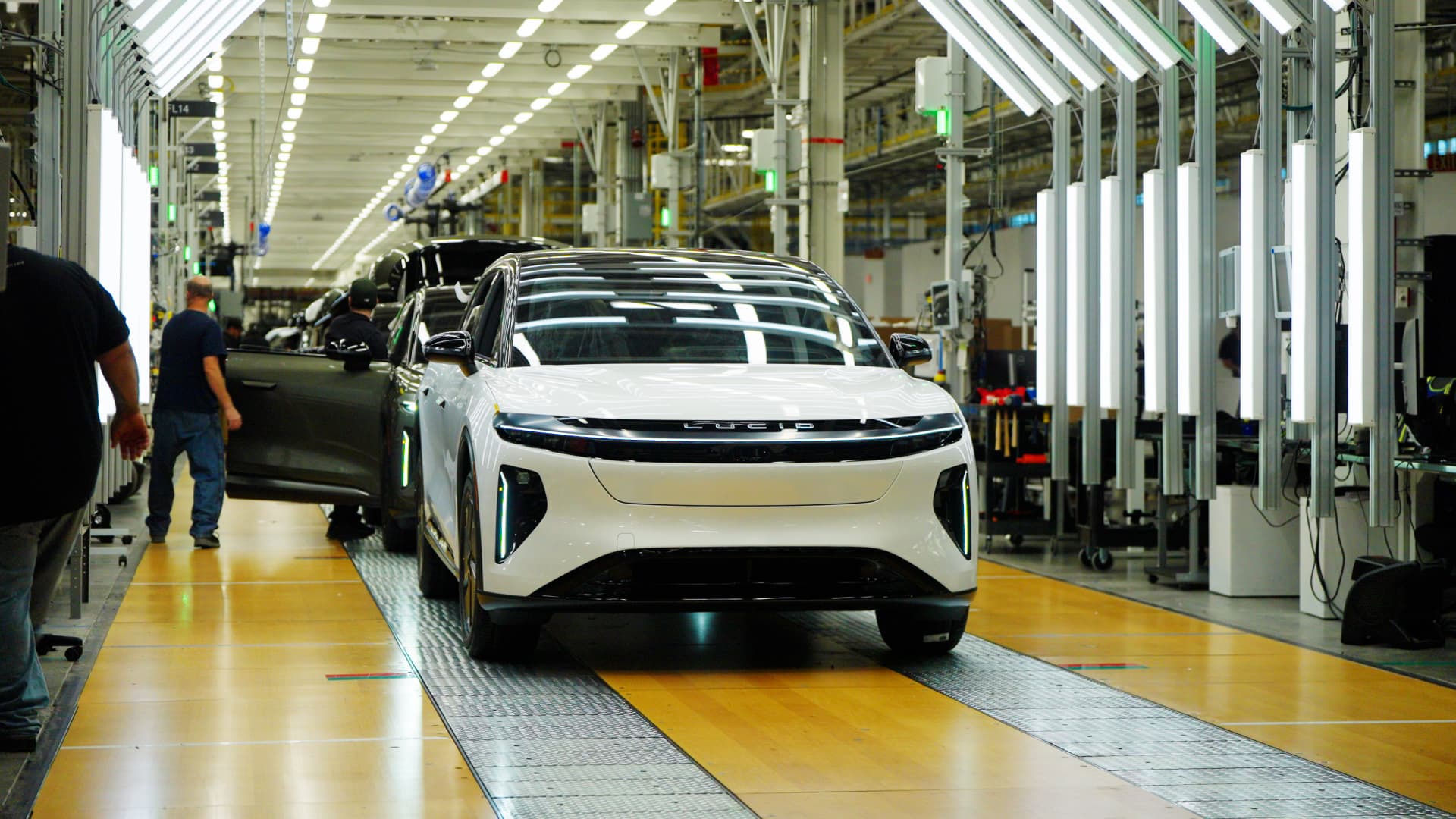
A Lucid Gravity coming off the line at the company’s factory in Casa Grande, Arizona.
Lucid Group reported mixed fourth-quarter results Tuesday as the electric vehicle maker continues to face challenging market conditions and internal struggles.
The company widely missed Wall Street’s quarterly earnings expectations, while beating average revenue estimates by roughly 12%. It also revised its 2025 production results due to internal validation issues, but guided for a notable increase in vehicle production this year.
Here’s how the company performed in the fourth quarter compared with average estimates compiled by LSEG:
- Loss per share: $3.62 vs. a loss of $2.62 cents expected
- Revenue: $523 million vs. $468 million expected
Lucid’s results come days after the company laid off 12% of its U.S. salaried workforce in an effort to streamline operations and “operate with greater efficiency and deliver on our commitments to gross margin improvement and long term growth,” according to a statement from the company.
Interim Lucid CEO Marc Winterhoff described the cuts Tuesday to CNBC as a needed realignment of the company’s workforce amid broader market and economic concerns as well as needed gains in efficiency.
“We are adjusting and going to a level where we think we want to be and need to be,” he said. “But it’s nothing that will continue in the future.”
For 2026, the company announced a vehicle production target of between 25,000 and 27,000 units. That would mark an increase of roughly 40% to 51% compared with the year-end figures the company released Tuesday.
Lucid said the revision for the year — from 18,378 units to 17,840 units — came as “538 vehicles had not completed certain internal procedures required under its final validation process to be classified as produced.”
The company said the vehicles are expected to be completed this year, with the change not affecting its previously reported financial results.
Winterhoff described the expected growth as “healthy,” but not “outrageous” given the current slowdown in overall vehicle sales, including EVs.
“Our initial plans were higher, but we wanted to really be conservative and make sure that we are hitting the numbers that we are projecting,” he told CNBC.

Lucid is expected to begin production of a new, less expensive midsize vehicle at the end of this year, but Winterhoff said it will not be material to its 2026 production plans. He said the automaker’s Gravity SUV is expected to account for the majority of its production and sales this year, followed by the Air sedan. The company also plans to launch its first Lucid robotaxis with previously announced partners.
Winterhoff said the company’s main priorities this year are achieving its production target, growing sales, continuing efficiency gains and preparing for production of the midsize vehicle and robotaxis.
“We really want to make sure that we [are] on our path to profitability, make sure that we’re not spending money that we don’t have to. That’s very, very important,” he told CNBC.
Lucid has yet to say when the company expects to be profitable. It is scheduled to host an investor day on March 12 in New York.
Lucid said it ended last year with approximately $4.6 billion in total liquidity, which Lucid CFO Taoufiq Boussaid said was “strong” and would provide flexibility “to execute near-term objectives while investing in future growth.”
Lucid reported a net loss of $2.7 billion in 2025, in line with a $2.71 billion loss a year earlier. That includes more than doubling its year-over-year losses during the fourth quarter to $814 million. It reported a loss of $12.09 per share for the year.
The company’s 2025 revenue was up 68% to $1.35 billion, including more than doubling year-over-year results during the fourth quarter.

Piper Sandler Chief Global Economist Nancy Lazar analyzes surging consumer confidence, the job market and more on ‘Making Money.’
Consumer confidence ticked higher in February as American households’ expectations for the labor market improved.
The Conference Board’s consumer confidence index rose 2.2 points to 91.2 in February from an upwardly revised 89 in January. The January data was initially reported as 84.5, the lowest level since May 2014.
Economists polled by LSEG estimated the February reading for the index would come in at 87.
FED’S FAVORED INFLATION GAUGE SHOWED CONSUMER PRICE GROWTH REMAINED ELEVATED IN DECEMBER
“Confidence ticked up in February after falling in January, as consumers’ pessimistic expectations for the future eased somewhat,” said Dana M. Peterson, chief economist at The Conference Board.
“Four of five components of the Index firmed. Nonetheless, the measure remained well below the four-year peak achieved in November 2024,” Peterson added.

The Conference Board found that consumer confidence rose in February from the prior month, though it remains well below a 2024 peak. (Gabby Jones/Getty Images)
The Conference Board’s present situation index declined overall, with views of current business conditions dipping to 0.7%.
Perceptions of employment conditions improved slightly, with the labor market differential, the share of consumers saying jobs are “plentiful” minus the share saying they’re “hard to get,” increasing by 0.6 percentage points to 7.4%.
All three components of the Conference Board’s expectations index increased slightly, with expectations for business and labor market conditions six months from now less negative than they were previously, while expectations for incomes were more positive.
US ECONOMY GREW SLOWER THAN EXPECTED IN FOURTH QUARTER
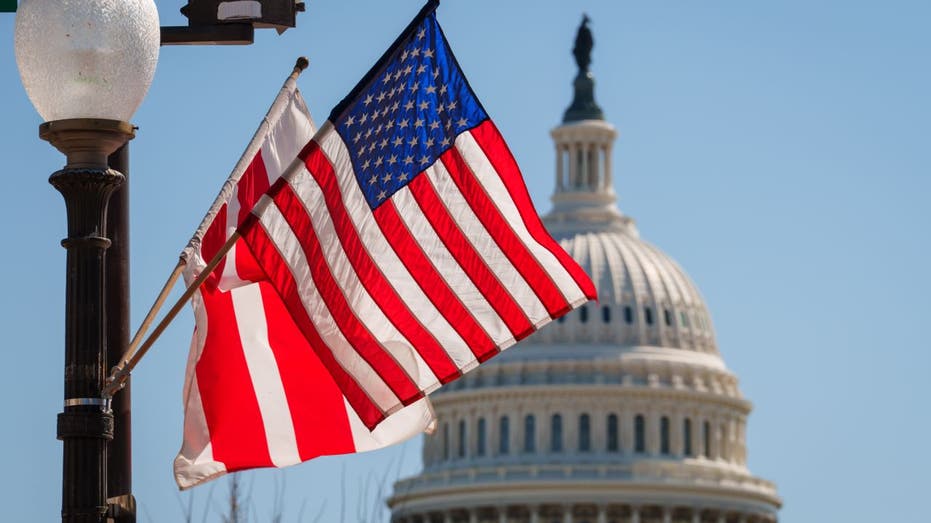
Consumer confidence rose among Republicans and Independents, while it continued to decline for Democrats. (J. David Ake/Getty Images)
Younger consumers were the most optimistic among age groups, with their confidence ticking upward on a six-month moving average basis in February among those under the age of 35. Confidence edged lower among those age 35 and older.
While consumer confidence rose among Generation Z respondents, in line with the findings among those under 35, it declined across older generations included in the report.
Consumer confidence based on political affiliation rose among Republican and Independent voters in February after a decline in January, while Democrats were less optimistic than a month ago.
US ECONOMY ADDED 130K JOBS IN JANUARY, DELAYED REPORT SHOWS
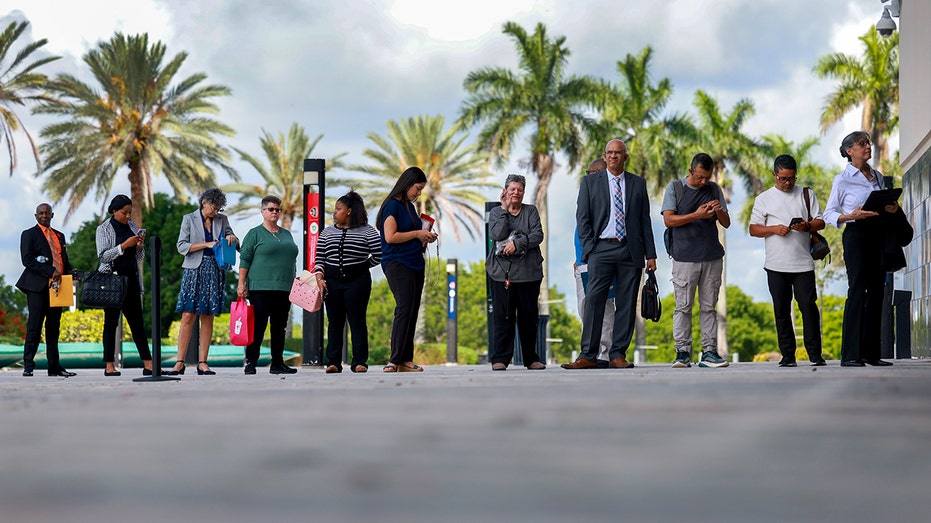
The report showed consumers were more confident about the labor market in February’s preliminary data. (Joe Raedle/Getty Images)
“Consumers’ write-in responses on factors affecting the economy continued to skew toward pessimism,” Peterson said. “Comments about prices, inflation and the cost of goods remained at the top of consumer’s minds.
“Mentions of trade and politics also increased in February. Labor market mentions eased a bit in February, while observations about immigration eased somewhat.”
Consumers’ views of their family’s current financial situation declined after surging unexpectedly in January in the final data, though expectations about their family’s future financial situation continued to be less optimistic.
GET FOX BUSINESS ON THE GO BY CLICKING HERE
Plans to purchase big-ticket items in the next six months rose in February, with the share of respondents who replied “yes” and “maybe” increasing and the share of those saying “no” declining. Used cars, furniture, TVs and smartphones were the most popular items within their categories for future purchases.

Packaging Stocks Are Today’s Leading Decliners. The Tariff Turmoil Doesn’t Help.
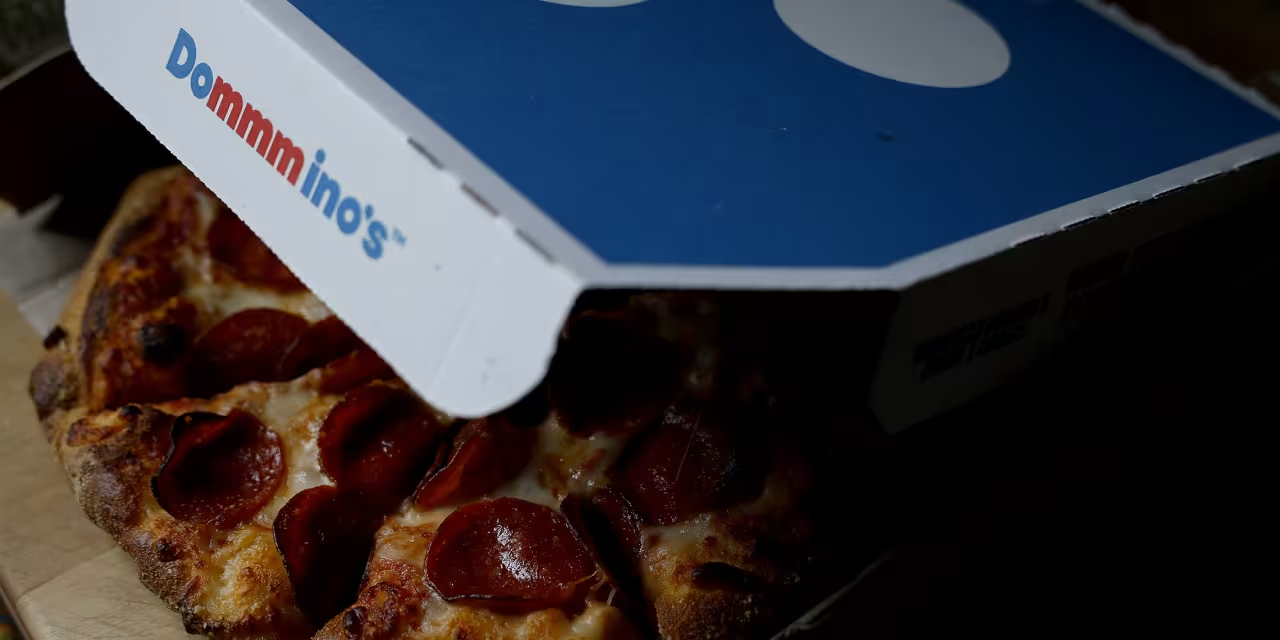
Domino’s Pizza Stock Rises After Earnings. The Chain Takes More Market Share.
Business
GameStop (GME) Stock Closes at $23.64 as Meme Momentum Fades and Focus Shifts to Capital Allocation

GameStop Corp. (NYSE: GME) shares closed at $23.64 on Monday, February 23, 2026, up 0.90% from the previous session’s $23.43 close, capping a volatile period where the once-dominant meme stock has traded in a narrow range amid fading retail frenzy and renewed scrutiny on the company’s cash position and strategic direction.

The stock has hovered between approximately $22.79 and $23.70 in recent sessions, reflecting limited directional momentum following the 2021 short squeeze that propelled it to an all-time high of $86.88 (split-adjusted) on January 27, 2021. Year-to-date in 2026, GME is up modestly around 14-15%, but it remains down about 5.4% over the past 12 months and trades well below its pandemic-era peaks. Trading volume on February 23 stood at around 5.6 million shares, below average for the volatile name.
GameStop’s market capitalization sits near $10.6 billion, supported largely by a cash hoard exceeding $9 billion amassed through equity offerings during meme surges. The company has no debt and generates modest free cash flow from its core retail operations, but investors increasingly view it as a capital allocation vehicle rather than a traditional turnaround story in the declining physical video game market.
CEO Ryan Cohen, who took control in 2021 and has pursued a Bitcoin treasury strategy and store closures, has faced criticism for limited transparency on deployment plans. Recent insider activity shows Cohen and other executives continuing to buy shares, signaling confidence, while some institutional holders have trimmed positions. Analysts note mixed signals: insider accumulation suggests belief in long-term value, but institutional selling raises questions about conviction.
A February 23 Seeking Alpha analysis described GME as “still in limbo,” arguing the stock’s valuation hinges more on management’s ability to deploy cash at attractive returns than on retail recovery. The piece rated it a Hold, citing risks if capital is not invested effectively in acquisitions or other high-return opportunities.
Speculation around mergers or major deals persists. Cohen has hinted at pursuing “very big” acquisitions of publicly traded companies, per CNBC reports from late January 2026, potentially transforming GameStop into a holding company. No concrete announcements have materialized, leaving investors to weigh the cash pile against ongoing store closures (hundreds expected in early 2026) and declining same-store sales in physical media.
The meme stock narrative has cooled significantly since 2021. Social media-driven short squeezes, once fueled by Reddit’s WallStreetBets, have given way to more traditional analysis. Recent research from the University of Kansas highlighted how online discussions amplified volatility in 2021, but today’s trading shows lower retail participation and more muted swings.
Analyst coverage remains sparse and bearish overall. Consensus price targets hover around $13-15, implying downside from current levels, though some models project higher fair values (up to $110+ in optimistic discounted cash flow scenarios) if management executes transformative moves. The stock’s forward P/E remains elevated given modest earnings, with focus shifting to free cash flow generation and potential Bitcoin exposure as hedges.
GameStop’s core business continues to face headwinds from digital downloads, streaming, and competition from Amazon and other retailers. The company has closed hundreds of stores globally and shifted toward collectibles, trading cards, and e-commerce, but physical sales remain under pressure.
As February 2026 progresses, attention turns to the next earnings report (expected late March or April) for updates on cash deployment, Bitcoin holdings (if any), and store rationalization. Until clearer strategic moves emerge, GME is likely to trade sideways, with occasional volatility from social media or insider activity.
For long-term holders, the $9 billion cash position provides a floor and optionality, but execution risk remains high. The stock’s meme legacy endures, but 2026 increasingly looks like a test of Cohen’s vision beyond retail revival.
Domino’s Pizza logged higher revenue in its latest quarter as same-store sales rose in the U.S., boosted by growth across both company-owned and franchise stores.
Shares were up 6.1% to $407.88 in premarket trading.
Copyright ©2026 Dow Jones & Company, Inc. All Rights Reserved. 87990cbe856818d5eddac44c7b1cdeb8

Israeli TV star hits back against Zionist trolls

After Rs 50 lakh reward from Bihar CM, 14-year-old Vaibhav Sooryavanshi flaunts new Rs 22 lakh car | Cricket News

LG’s massive 52-inch ultra-wide gaming monitor costs $2,000


-

 Video5 days ago
XRP News: XRP Just Entered a New Phase (Almost Nobody Noticed)
-

 Fashion4 days ago
Weekend Open Thread: Boden – Corporette.com
-

 Politics3 days ago
Baftas 2026: Awards Nominations, Presenters And Performers
-

 Sports1 day ago
Women’s college basketball rankings: Iowa reenters top 10, Auriemma makes history
-

 Entertainment6 days ago
Kunal Nayyar’s Secret Acts Of Kindness Sparks Online Discussion
-

 Politics1 day ago
Nick Reiner Enters Plea In Deaths Of Parents Rob And Michele
-

 Tech7 days ago
Retro Rover: LT6502 Laptop Packs 8-Bit Power On The Go
-
 Sports6 days ago
Clearing the boundary, crossing into history: J&K end 67-year wait, enter maiden Ranji Trophy final | Cricket News
-

 Business2 days ago
Mattel’s American Girl brand turns 40, dolls enter a new era
-

 Crypto World17 hours ago
XRP price enters “dead zone” as Binance leverage hits lows
-

 Business2 days ago
Law enforcement kills armed man seeking to enter Trump’s Mar-a-Lago resort, officials say
-

 Entertainment6 days ago
Dolores Catania Blasts Rob Rausch For Turning On ‘Housewives’ On ‘Traitors’
-

 Business7 days ago
Tesla avoids California suspension after ending ‘autopilot’ marketing
-

 Tech2 days ago
Anthropic-Backed Group Enters NY-12 AI PAC Fight
-
 NewsBeat2 days ago
‘Hourly’ method from gastroenterologist ‘helps reduce air travel bloating’
-

 NewsBeat2 days ago
Armed man killed after entering secure perimeter of Mar-a-Lago, Secret Service says
-

 Politics2 days ago
Maine has a long track record of electing moderates. Enter Graham Platner.
-

 Crypto World6 days ago
WLFI Crypto Surges Toward $0.12 as Whale Buys $2.75M Before Trump-Linked Forum
-

 Tech6 hours ago
Unsurprisingly, Apple's board gets what it wants in 2026 shareholder meeting
-
 NewsBeat2 hours ago
Police latest as search for missing woman enters day nine